White Rose Research Online URL for this paper: http://eprints.whiterose.ac.uk/132173/
Version: Accepted Version
Book Section:
Feldman, L. and Milin, P. orcid.org/0000-0001-9708-7031 (2018) Psycholinguistic studies of word morphology and their implications for models of the mental lexicon and lexical processing. In: Berthiaume, R., Daigle, D. and Desrochers, A., (eds.) Morphological Processing and Literacy Development: Current Issues and Research. Routledge , pp. 40-71. ISBN 9781138714311
This is an Accepted Manuscript of a book chapter published by Routledge in Morphological Processing and Literacy Development: Current Issues and Research on 26/03/2018, available online: http://www.routledge.com/9781351858212
[email protected] https://eprints.whiterose.ac.uk/
Reuse
Items deposited in White Rose Research Online are protected by copyright, with all rights reserved unless indicated otherwise. They may be downloaded and/or printed for private study, or other acts as permitted by national copyright laws. The publisher or other rights holders may allow further reproduction and re-use of the full text version. This is indicated by the licence information on the White Rose Research Online record for the item.
Takedown
If you consider content in White Rose Research Online to be in breach of UK law, please notify us by
RUNNING HEAD: Morphology and word processing
Psycholinguistic studies of word morphology and their implications for models of the mental lexicon and lexical processing
Laurie Beth Feldman
University at Albany, State University of New York
& Haskins Laboratories, New Haven, CT &
Petar Milin
The University of Sheffield, United Kingdom
Correspondence: Laurie Feldman SS 399
University at Albany, SUNY Albany, NY 12222
ABSTRACT
We sample from behavioral studies of visually presented inflected and derived words in the lexical decision task to describe how we understand morphologically complex word forms. We discuss how these results inform theories of the mental lexicon and lexical
processing and offer some implications for how these findings might inform teaching practices for beginning readers about morphology. We focus on experimental findings pertaining to morphological regularity, whole word and morpheme frequency (including family size, entropy measures, affix frequency and position), along with semantic
Psycholinguistic studies of word morphology and their implications for models of the mental lexicon and lexical processing
Research into how we understand and produce words composed of multiple morphemes touches on many of the current themes about how best to represent the knowledge that allows humans to store and use language. Many of the models of language processing diverge on the question of how to represent words composed of multiple morphemes and, more generally, whether knowledge about morphemes is explicitly represented. On the one hand, there are lexicon-based models that hypothesize the explicit representation of morphemes and of a word's morphological structure. These models differ considerably in their mechanisms for storing knowledge about morphemes and how they combine. On the other hand, there exist learning-based models that do not
assume the cognitive reality of morphemes, and claim that "morphological effects" emerge from conjoint effects of form and meaning. The latter emphasize not only the structures but also the underlying cognitive processes. Differences between approaches are highlighted below.
Among theorists who think that a word's morphological structure is explicitly represented, some describe morphological knowledge in terms of lexical representations that are decomposed into or built up from constituent morphemes by the application of linguistic rules (e.g., DIS + ALLOW + ABLE). Others describe morphological
knowledge in terms of a principle of lexical organization among whole word forms that share a morpheme. For the later models, a crucial question is when effects of morphemes are evident in processing, relative to form and semantic properties of the whole word. In essence, under what conditions does one grasp the ways in which the relation between GENEROSITY-GENEROUSNESS parallels that between CAPABILITY and
CAPABLENESS?
and meaning (Bybee, 1995). In connectionist models, for example, knowledge is distributed across patterns of activation based on similarity of form in conjunction with similarity of meaning, without making reference to morphemes and the rules by which they combine. Thus, the relation between GENEROSITY and GENEROUSNESS is captured at the level of whole words, not its morphemes.
In contemporary versions of these models, seldom are sublexical (e.g.,
morpheme) and lexical (e.g., whole word) processing mutually exclusive. More often,
accounts differ in terms of the relative independence or interdependence of lexical and sublexical processes. Similar issues of independence or interdependence arise in many domains several of which we describe below.
Morphological complexity and lexical storage
Lexicon-based models impose one additional and distinctive constraint that is absent in a learning-based framework: decomposition. The debate is whether or not all words composed of multiple morphemes (viz. morphologically complex words) are stored as decomposed units in the mental lexicon. Within this framework, words whose formation cannot be characterized by a rule (irregular) require whole word storage, whereas those whose formation is rule-governed (regulars) are candidates for storage in terms of their constituent morphemes. Lexicon-based models of morphology are
characterized as dual route models because there is a storage default as well as a rule-based option.
For example, theorists ask whether word pairs such as OVERRUN-OVERRAN, that undergo a change to their base morpheme, are represented differently from words with a compositional structure such as OVERWORK whose past tense form,
OVERWORKED, can be described by a rule that combines the ED affix with the base morpheme(s) OVER and WORK. Words whose base morpheme undergoes change, like in the RUN-RAN example above, are irregular. Irregular formations are non
especially those with complex morphology, what constitutes regular inflection tends to be more complex, however. It can entail not only changes to the stem but also choice of affix. For example in Serbian the plural of MOST (bridge) is MOSTOVI while the plural of GOST (guest) is GOSTI.
Assuming for the moment the perspective of communicative function, it is instructive to ask why irregularity exists and what communicative purpose it serves. One hypothesis is that an atypical form makes aspects of meaning more distinctive and, hence,
easier to grasp. In other words, a form that is distinctive from its morphological variants enjoys lower uncertainty. Across languages, irregular verbs are typically very frequent and distinguishing among similar forms, whether or not they share a base morpheme and whether or not that morpheme undergoes change, without focusing exclusively on the
presence of a particular, regular affix such as ED, may serve to enhance understanding (c.f., Ramscar, Dye, Blevins, & Baayen, 2015; Dye, Milin, Futrell, & Ramscar, 2017). Note that when regularity is extended to encompass similarity of meaning, we can ask whether morphologically complex words are semantically compositional such that the whole word meaning is systematically and compositionally related to that of the base morpheme. As will become evident below, an argument based on the communicative function of distinctiveness would apply for regularity with respect to form (orthographic transparency meaning stem spelling is preserved in a complex form) but not regularity with respect to meaning (semantic transparency meaning stem meaning (e.g., ALLOW) is preserved in a complex form (e.g., ALLOWABLE)). Compositionality, in principle, is demanding in that it presupposes some form of breaking down and isolating parts which are recombined (for an in-depth discussion consult Milin, Feldman, Ramscar, Hendrix, & Baayen, forthcoming). We shall return to this point below.
In order to detect evidence of constituent morphological structure in experimental reading tasks, the critical comparison centers on complex words and the extent to which they retain the form as well as the meaning of the base morpheme. For example, the
specify the meaning of this word. By some accounts of the early stage of word
recognition1, it is the appearance of morphological structure that is essential so it is also relevant to ask whether words like BUZZER that are semantically transparent with respect to the meaning of a base morpheme BUZZ differ from words like BUZZARD which appear to be composed of a base morpheme and an affix but really are not.
Those who emphasize similarity between relatives like ALLOWANCE and ALLOW rather than rules see analogies between the issue of semantic transparency
among derivations and the issue of differences between inflections and derivations. Accordingly, they ask whether, when semantic transparency is controlled, processing of complex word forms composed of a stem and an inflectional affix (e.g., S, ED, ING for English) differs from those composed of a stem and a derivational (e.g., TION, MENT,
ANCE, ITY for English) affix. By linguistic accounts that assume the representation of morphemes and rules to combine them, formation by the addition of an inflectional affix does not result in a new lexical entity, whereas formation by derivation and compounding does (Kurylowicz, 1964)2. Consider the way that (inflectional) ING combines with the meaning of the stem ALLOW compared to how (derivational) ANCE combines with the same stem. In this example, inflection tends not to change grammatical class, both forms are verbs and meaning changes are slight. By comparison, formation by derivation typically changes grammatical class (in this instance, from verb to noun) and introduces more dramatic semantic shifts relative to the base morpheme in isolation (Aronoff, 1976). Not surprisingly, experimental demonstrations of linguistically defined morpheme type Ð inflection vs. derivation, are often confounded with differences in semantic similarity to a base morpheme in isolation i.e., inflections tend to differ less than derivations with respect to the degree with which they distort the semantics of the base morpheme.
Typically, proponents of accounts where morphemes are not explicitly represented point out this confound and argue that neither similarity of form nor similarity of meaning in isolation can serve as an adequate comparison condition for
speaker's linguistic knowledge.
Below, we discuss these alternative perspectives with respect to the relation between inflection and derivation and between regular and irregular morphologically related forms as gleaned from performance in word processing tasks.
The Lexical Decision Task
The lexical decision task is an experimental reading-and-comprehending task. Its
variants are a primary source of data about how morphologically complex words are recognized. Interpretation of the data provides useful insights into how the requisite lexical knowledge is represented. In this task, participants judge whether letter strings called targets are real words (they make a "lexical decision") and latencies to reach a
decision along with judgment accuracy to a target are analyzed. Researchers have
developed ingenious manipulations to understand the underlying processes. For example, most typically targets are preceded by a single word that is called prime and the similarity between prime and target (rolled-ROLL (inflection); roller-ROLL (derivation); roles-ROLL (form control); typed-roles-ROLL (unrelated)) constitutes the primary experimental manipulation. Presentation conditions for the prime further define the context within which a participant makes lexical decision to the target. Other well-accepted variants of the lexical decision task differ with respect to the exposure duration of the prime and whether or not a pattern mask precedes it, for example.
In the forward masked lexical decision task, arguably the most common variant to study early morphological processing, a pattern mask such as #### appears for about 500 ms, then the prime appears in lower-case font for about 48 ms, and finally a target in upper case is visible for 500 ms or more (Forster, Davis, Schoknecht, & Carter 1987). Prime durations shorter than about 70 ms after a pattern mask meet the conditions for early processing. And as in other variants of the lexical decision task, latency and accuracy to judge the lexicality of the target are measured.
Many researchers prefer the forward masked version of the task to variants where the duration of the prime is longer and is at least partially visible, arguing that the
assumption is that processing is sensitive to informativeness of the prime even though the mask blocks conscious processing. However, it has been documented that even results in the forward masked lexical decision task are prone to episodic effects in the course of an experiment. For example, the difference between targets after related (rolled-ROLL) and unrelated (typed ROLL) primes (facilitation) gets larger as the proportion of related prime-target pairs increases even at prime durations of 48 ms with a mask (Feldman & Basnight-Brown, 2008; Bodner & Masson, 2003).
Lexical decision responses on single words is another common experimental method to study morphologically complex words. The typical way to control for differences between targets in these experiments has been to match target means for attributes such as frequency of use (ROLL (low frequency) vs. ROLE (high frequency)
and number of orthographically or phonologically similar words (Neighbors of ROLL are DOLL, ROLE. Neighbors of ROLE are ROLL, HOLE, MOLE, POLE, VOLE, ROBE, ROPE, ROSE among others) across the instances of targets and then to compare target decision latencies and accuracy judgments. Recently, researchers have begun to rely on this experimental task to explore individual differences in a reader's knowledge about those words (see, for example, Andrews & Lo, 2012; 2013; Milin et al., forthcoming).
In a primed lexical decision task, the primary experimental contrast is to the same target in the context of one or more types of related and an unrelated prime. When there are multiple types of related primes then, typically, each target appears with one type of related prime and an unrelated prime (e.g., Rastle, Davis, Marslen-Wilson, & Tyler, 2000). In the typical design, target is nested under type of related prime. An alternative design is to present the same target in different related prime contexts. For example, BUZZ would appear to different participants with related BUZZER or BUZZARD or with an unrelated prime (e.g., Feldman, 2000). One advantage of comparing decision latencies to the same target across the different related prime contexts is that the role of individual differences among targets can be better controlled so as to avoid potential
confounding of target properties with prime condition. In principle, this confounding issue can also be controlled by statistical means. Rigorous implementations are seldom, however3.
forward masked priming task to investigate how we understand morphologically complex word forms with the goal of informing theories of the mental lexicon and lexical
processing in general. We focus on behavioral studies of visually presented inflected and derived words in the lexical decision task to discuss experimental findings pertaining to regularity, whole word and morpheme frequency, morphological family size, entropy measures, affix frequency and position, semantic transparency and morpho-orthographic parsing.
Models of how we understand morphologically complex word forms are of interest to psycholinguists generally because views differ with respect to how best to capture knowledge about words and the extent to which sensitivity to the underlying structure hinges on a process that is specific to language.
Models of Morphological Processing
Theorists whose models represent morphology explicitly often describe
morphological knowledge in terms of rule-governed computation of complex linguistic forms over symbols, accompanied by a default option based on lexical storage of whole word forms. Others describe morphological knowledge in terms of a single mechanism and emphasize graded effects where activation dynamics based on the degree of similar form and similar meaning among morphological relatives, and among words more
generally (e.g., DRAW-DRAWN, FALL-FELL are more similar than BUY-BOUGHT or THINK-THOUGHT). At the beginning of this chapter we introduced a distinction
between lexicon-based and learning-based accounts. Roughly, the former relies on rules in order to handle the manner in which units combine to produce alternative forms. The later restrict the range of alternatives as to what gets learned in the service of
communication. Consequently, these opposing accounts differ not only with respect to the interpretation of regularity but also with respect to whether word frequency is most
with inferential machineries. Among them, dual mechanism accounts have enjoyed considerable popularity in the research community.
Dual Mechanism Accounts
The first class of models posits two independent mechanisms associated with different brain areas (Marslen-Wilson & Tyler, 1998; Pinker, 1999; Pinker & Ullman, 2002, 2003; Silva & Clahsen, 2008; Ullman, 2001; 2004) for the recognition (or
production) of words with regular as compared with irregular past tense forms. By one of the two mechanisms, regularly inflected forms are not stored in lexical memory; rather, their recognition must involve rules for decomposing a whole regularly inflected word (WORKED) into parts (and their production entails rules for combining parts (WORK
(base morpheme) + ED (affix) to form a whole word). However, because not all words (specifically, irregular verbs such as FELL) can be (de)composed by applying a rule, a second non-combinatorial (instance-based) mechanism based on associations among representations for uninflected (FALL) and inflected (FELL) forms must exist as well. Faster latencies for high as compared to low whole word frequency for irregularly but not regularly inflected forms in recognition (Alegre & Gordon, 1999: Prasada, Pinker, & Snyder, 1990) and production (Budd, Paulmann, Barry, & Clahsen 2013) tasks have been marshaled as evidence in support of a dual mechanism account.
Notably, proponents of the dual mechanism account claim that native and nonnative speakers differ with respect to processing of regular inflectional morphology (Clahsen & Felser, 2006; Clahsen, Felser, Neubauer, Sato, & Silva 2010; Kirkici & Clahsen 2013; Jacob, Fleischhauer, & Clahsen, 2013; Parodi, Schwartz, & Clahsen, 2004; Prasada & Pinker, 1993; Pinker & Ullman 2002; 2003; Ullman, 2006). Again, evidence typically comes from priming experiments, with results showing equivalent latencies for identity (ROLL-ROLL) and morphologically related (ROLLED-ROLL) prime Ð target pairs in native but not in nonnative speakers. With some exceptions, often
S) along with irregular formations and derivational formations (words ending with affixes such as ER, MENT). With increasing proficiency some claim that there is a shift from storage of lexical and semantic knowledge to more rule governed processing so that there is no consensus as to whether differences in inflectional processing between nonnative and native speakers continue to persist (see Bowden, Steinhauer, Sanz, & Ullman, 2013).
Words that appear frequently are faster to recognize and faster to produce. A classical dual mechanism interpretation of the whole word frequency effect in tasks such
as lexical decision emphasizes access or activation of forms that are stored in the lexicon. Therefore frequency effects should arise for or, by some account be more salient for, irregularly but not for regularly inflected forms in native speakers of a language. Because formation of the latter is described as rules operating on symbols, forms that are regularly
inflected need not be stored. Therefore, frequency effects for regularly inflected forms, when they do arise pose a challenge to the original dual mechanism model.
Single Mechanism Accounts
In contrast to the dual mechanism accounts, single mechanism models of morphological processing posit just one mechanism and that mechanism is sensitive to the probability of occurrence of linguistic units and patterns of units in everyday
language. Therefore, these mechanisms entail sensitivity to statistical structure as it arises in language. This position draws on those linguistic models that recognize that
morphemes capture the systematic mapping between form and meaning (Bybee, 1985; 1995; Bybee & McClelland, 2005) and that the meaning of a morpheme varies according to the morphological context in which it appears (Blevins 2003; 2006). The most familiar examples of this research framework are parallel-distributed connectionist models (PDP: Gonnerman, Seidenberg, & Andersen, 2007; Kielar, Joanisse, & Hare, 2008; Joanisse & Seidenberg, 1999; Plaut & Gonnerman, 2000; Rueckl & Raveh, 1999; Seidenberg & Gonnerman, 2000 etc.). The Connectionists' framework permits activation from the
In PDP accounts, generally, there are no stored representations or rules. Rather the system self organizes around distributed patterns of connectivity so that shared meaning as well as shared form contribute in a graded manner to the recognition and the production of all inflected verb forms. A systematic comparison of differences in
facilitation in a priming study reveals the plausibility for the underlying dynamics of a system to change depending on its initial conditions as prime duration increases (Rueckl, 2002). Accordingly, apparent benefits for regularly inflected verbs reflect greater
contributions of form than for regularly inflected verbs (e.g., Bird, Lambon Ralph, Seidenberg, McClelland, & Patterson. 2003; Bybee & McClelland, 2005; Patterson, Lambon Ralph, Hodges, & McClelland, 2001; Plaut, McClelland, Seidenberg, & Patterson, 1996). The finding (Basnight-Brown,Chen, Shu, Kostić, & Feldman, 2007)
that in native speakers irregularly inflected verb forms with high form overlap (DRAWN-DRAW) pattern like regular verb forms (GUIDED-GUIDE) and not like change stem irregulars (FELL-FALL) is consistent with single mechanism accounts based on convergent activations.
Information Theoretic Approach
Another approach to morphological organization and morphological processing is grounded in information theory. Here, the cost of retrieving information serves as a window on lexical organization. It is predicted by reaction time in the lexical decision task such that reaction time depends on how much information is retrieved. In the information theory tradition, amount of information is linked to probability. High information is characteristic of improbable events and low information by probable events. Processing speed depends on the amount of information: it gets faster per information unit (not absolute time) as the information load becomes higher. This has been shown for words presented both in isolation (decontextualized) and with various experimentally manipulated contexts (Kostić, 1991; Kostić, Marković, & Baucal, 2003;
Milin, FilipovićĐurđević, & Moscoso del Prado Mart’n, 2009; Moscoso del Prado Mart’n, Kostić, & Baayen, 2004; more on information-theoretic approach in lexical processing can also be found in Milin, Kuperman, Kostić, & Baayen, 2009).
frequency of that specific form normalized by the sum of the frequencies of all the inflected variants of that word (lemma frequency; however, it is also possible to
normalize with respect to the number of times that a word appears (tokens) in a corpus). The probability of a form is then estimated as the sum of the frequencies of its inflected variants, divided by N. These are decontextualized probabilities. In addition, the
probability distribution of the inflected variants of a particular word's inflected form may differ from the probability distribution of the inflectional class in general. The extent to
which the general and word specific probability distributions differ is quantified by relative entropy, often called Kullback-Leibler divergence.
In the information-theoretic framework, effects of regularity would be tied to properties of the words themselves including both their inflectional entropy Ð the relative
frequency of inflected forms including both irregular and irregular forms, as well as the different properties that pertain to their semantics such as imageability, number of senses in WordNet (Miller, 1995), contextual diversity with other words (Baayen & Moscoso del Prado Mart’n, 2005: see also McDonald & Shillcock, 2001 and Adelman, Brown, & Quesada, 2006). In the Information-theoretic framework, when inflections and
derivations or regulars and irregulars appear to incur different processing it is because their statistical properties differ, not because they are assigned different types of representations or different processing mechanisms from the outset.
Naive Discriminative Learning
Distinctive for both the Connectionist and Naive Discriminative Learning (NDL) single mechanism accounts is that a letter sequence's morphological status need not be specified. There is no decomposition of a letter string into constituent morphemes nor distinction between representations for derived, inflected or compound words. The NDL account of morphological processing constitutes a single mechanism system where morphemes are not explicitly represented and morphological effects emerge from the
RAN as well as RUN) link the semantic, phonological or orthographic forms of a word, although they are not true form representations nor semantic representations themselves. In the framework of discrimination, they are characterized as communicative contrasts that arise over varied contexts and facilitate distinguishing entities in the world.
In the NDL model, units (e.g., form cues, and lexeme outcomes) are symbolic. The NDL form-meaning mappings derive from a learning algorithm based on the Rescorla-Wagner equations (Rescorla & Wagner, 1972). Together, these determine the
activation weights of input n-gram (letter cues) to lexical meanings. Distinctive from the PDP approach above is that the NDL process of learning is not combinatorial but rather discriminative. It does not hypothesize distinctive units and separate cognitive ÔprintsÕ (i.e., representations) at many levels of granularity (from phones and morphemes, words
and phrases, to ÒmeaningsÓ) with a concomitant processing burden of continuous splitting into parts and recombining into more molar units. Simply stated, except for practical, implementational purposes, NDL does not invest in distinctive units (including
encapsulated ÒmeaningsÓ ) and how to combine them. Instead, as the process of learning enfolds, events (e.g., stimuli) get discriminated if they are useful cues for predicting and, ultimately, adjusting to the environment (c.f., Rescorla, 1988; Ramscar et al., 2010; Milin et al., forthcoming).
Specific to NDL is that letter n-grams (e.g., WOR) map to some lexemes (WORK,WORD), but not to others (TYPE, SING) and the re-occurrence of the same orthographic cues for different outcomes serves as the basis for learning the
discriminative weights of those cues (Milin et al., forthcoming). In effect, target
activation is offset by activation from its constituent Ð competing n-gram letter cues. The cues' discriminative weights for a particular outcome are calibrated by taking all
outcomes that share those letters (e.g., WORD, WORK, WORM, WORT, SWORD, REWORK). Furthermore, context (e.g, prime word cues and outcomes) also enter into the complex dynamics. Collectively they determine recognition latencies. With respect
to lexical access and word recognition, one implication is that the dynamics of word recognition change for word forms as they become similar to progressively more other words.
particularly well articulated is the competition to the target from words that are similar in form but not in meaning. The NDL model is equally well attuned to the graded form and semantic similarities among words in general. Further, the model does not focus on the similarity between the particular prime and word that are presented in an experimental trial. Instead, the weight distribution of an outcome reflects all input cues that have been attested (not only those that are presently active) and it serves as an indicator of how well a particular outcome lexeme is grounded in the learning network. Effects of
neighborhood similarity fall out naturally in this framework (see Milin et al., forthcoming).
Word and Morpheme Frequency Measures
Decision latencies and naming latencies are faster and more accurate for higher than for lower frequency words. The label for this robust finding is the word frequency effect. Arguably, the predominant interpretation of the frequency effect links it with the storage of lexical entries for individual words in long-term memory. The underlying logic is that more frequent words are recognized faster than less frequent words because
frequent exposure alters access to words in long-term memory (cf. Baayen, McQueen, & Dijkstra, 2003; New, Ferrand, Pallier, & Brysbaert, 2004; Baayen, Feldman, &
Schreuder, 2006, etc.).4 A common characterization linking frequency with lexical structure emphasizes search order through spatially arrayed lexical entries such that frequent words are encountered before less frequent words (Taft & Forster, 1975). Baayen refers to accounts such as this as adhering to the "counter-in-the head metaphor" and the assumption that lexical knowledge encompasses the storage of individual
exemplars (Baayen, Hendrix, & Ramscar 2013).
A significant alternative position has a more functional focus that emphasizes dynamics and the consequences for learning. Minimally, this possibility attributes
they are part (Ramscar, Yarlett, Dye, Denny, & Thorpe, 2010). Distinctive in NDL is that frequency effects of a unit can arise without assuming representations for those units. The implication for models of word recognition more generally is that the effect of a linguistic predictor like whole word frequency on a behavioral measure such as lexical decision latency is not a sufficient condition for postulating the existence of mental representations specific to that unit.
As might be anticipated given the difference in emphasis, the interpretation of
word frequency effects is one topic of contention for the one vs. two mechanism accounts of morphological processing. If irregular forms like RAN, but not regular inflected forms like WALKED are mandatorily stored, as proponents of rules plus stored exemplars accounts assert, then one would expect to detect greater differences between high and low
frequency words with irregularly than with regularly inflected forms. However, Baayen, Wurm & Aycock (2007) report a benefit of high relative to low frequency that does not differ for regular and irregular forms. This outcome challenges the claim that irregularly but not regularly inflected forms are represented differently and that only irregular forms are stored as lexical entries. More generally results such as these call into question any interpretation where frequency assumes a count and frequency effects are a marker for whole word storage. These findings are consistent with other evidence that frequency effects can arise in the absence of stored representations and can instead be interpreted as revealing about the dynamics of learning (Ramscar & Yarlett, 2007; Ramscar et al., 2010).
Depending on the account, hypotheses differ as to whether frequency effects should or should not be modulated by a prime manipulation. First, if facilitation arises in a priming experiment because activation spreads between word entries that are stored in the lexicon, and if low frequency regularly inflected forms are especially unlikely to be stored as wholes, then frequency effects on facilitation should be greater for irregularly than for regularly inflected morphologically related pairs forms. Second, interactions
Clahsen 1999). One methodological difference may also prove focal.
In lexical decision experiments with primes, some prefer to assess morphological facilitation against an identity rather than the more typical unrelated prime. The
underlying logic is that identical prime-target pairs elicit maximum facilitation and that facilitation following inflected primes can be meaningfully compared to identity pairs (Clahsen & Felser, 2006; Jacob, Fleischhauer, & Clahsen, 2013; Kirkici & Clahsen, 2013; Silva & Clahsen, 2008; Sonnenstuhl et al., 1999.) A finding that recurs in many
languages is that target decision latencies for WORK-WORK and WORKED-WORK type pairs differ in nonnative but do not in native speakers. However, when
morphological facilitation for derivationally related pairs like MADNESS-MAD is compared to identical prime-target pairs like MAD-MAD, they tend to differ in both
nonnative and native speakers. Proponents of a dual mechanism account interpret this pattern as evidence that inflection and derivation are represented differently and that the requisite grammar for inflection differs in nonnative and native speakers even when significant effects for the critical interaction of language background (native/nonnative), prime type (related/unrelated) and type of morphological relation (inflection/derivation) typically are not reported.
Morpheme frequency
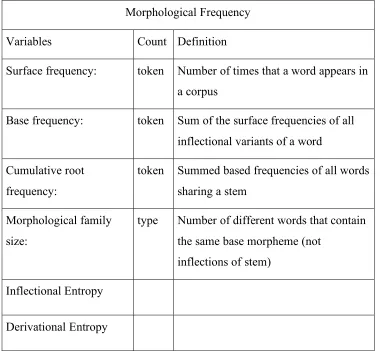
Many argue that not only whole word surface frequency Ð the number of times that a particular inflectional variant of a whole word appears in a corpus, but also a measure of morpheme frequency plays a role in word recognition. Units for morphemes differ with respect to whether the number of different word types or the number of tokens of words formed from a morpheme should be counted from. Additional factors are, also, whether morpheme counts encompass derived and compound or only inflected forms, and which form variants should be treated cumulatively. All of these possible measures tend to be highly correlated so it is almost impossible to identify one as universally
preferred.
Beauvillain, & Seguõ, 1989). The frequency of the lemma, that is, the summed frequency of all inflected variants of a word (e.g., WALKED, WALKING, WALKS) seems to more reliably influence decision latencies, however (Baayen, Dijkstra, & Schreuder, 1997; Taft, 1979). Both root frequency and lemma frequency are token-based counts: frequency is based on the number of occurrences of a particular form or collection of forms.
Type-based frequency counts often provide independent contributions to decision latencies in word recognition tasks (Schreuder & Baayen, 1997; Bertram, Baayen, &
Schreuder, 2000; de Jong, Schreuder, & Baayen, 2000 ). A word's morphological family is a type count of the number of different complex words that share the same stem. It is based on the number of words, without regard to their frequency. With other factors controlled, words with large families like WORK (N=64) tend to be recognized faster
than words with smaller families like SIT (N=1). For example, according to the CELEX lexical database (Baayen, Piepenbrock, & Gulikers, 1995), the morphological family of the word WORK encompasses the derived words WORKER, WORKMANSHIP, WORKUP, WORKABLE as well as the compound words WORKBOOK,
WORKFORCE, NETWORK, OVERWORK.
The morphological family size effect does not interact with morphological complexity of a given word. In other words, words with large families tend to be recognized faster than words with smaller families and the effect recurs for both morphologically simple (Baayen et al., 2006) and morphologically complex words (Bertram et al., 2000; Kuperman et al., 2010; Baayen et al., 2011). Thus, for a derived word such as WORKER, decision latencies depend on its surface frequency, the summed frequency of its inflectional variants (lemma frequency) and the number of words derived (and compounded) from WORKER (e.g., Baayen, Feldman, & Schreuder, 2006).
The influence of morphological family size is not specific to highly inflected languages. In fact, a facilitatory effect of family size on time to make a lexical decision has been documented in languages as diverse as Dutch, Hebrew, Italian, Finnish, and
although the semantic units that repeat have an orthographic but not always a
phonological form (Feldman & Siok, 1997) and for units that have an orthographic but not necessarily a semantic or a phonological form (Taft & Zhu, 1997).
It goes without saying that type-based morphological family size and token based measures of their cumulative frequency are strongly associated because the more family members a word has, the higher their summed frequency is likely to be. An early report indicated that when the effect of family size was controlled for, an effect of cumulative
frequency could not be detected (Schreuder & Baayen 1997). Nevertheless, a later report based on a more refined linear mixed effect model attested to a small inhibitory
contribution from token-based cumulative frequency (Baayen, Tweedie, & Schreuder, 2002). A more recent insight is that the distribution of frequencies for those various
related forms plays a role. This phenomenon is captured by the information-theoretic measure of uncertainty of those forms, its derivational entropy.
Derivational entropy can be understood as a token-based complement of the (derivational) family size. It captures the distribution of frequencies for the derived and compound words formed from a particular base morpheme or stem. Important to note is that these measures of morpheme frequency are not properties of the target in isolation but of the target relative to the other words with which it is associated because of shared form and meaning. The extent to which the probability distribution for a particular word differs from the more general probability distribution for a particular word type is captured by the relative entropy Of course, derivational patterns are less systematic than inflectional paradigms so it is difficult to stipulate what a comparison (i.e., general) distribution should look like (but see Milin, Kuperman, Kostić & Baayen, 2009). At a minimum the newer measures are no longer measures of "memory strength" for a particular word in the counter tradition (see Table 1).
Experimental Evidence for the Effects of Frequency and their Interpretation
frequency token counts are not fully independent. A word with a high surface frequency will tend to contribute more to its morpheme frequency than will one of lower frequency. A second limitation is that the experimental evidence consistent with the manipulation of target properties, such as surface and morpheme frequency, often depends not only on the frequency of the morpheme (stem) but also on other factors. Take for example the fact that regression based analyses show that, as a rule, effects of whole-word frequency modulate effects of stem frequency. More specifically stem frequency can have a
facilitatory effect for the low frequency words, but can exert an inhibitory effect for the higher frequency words (Baayen, Wurm, &Aycock 2007; see also Milin, Kuperman, Kostić, & Baayen, 2009 for formal analysis of these interplays). In addition, the direction of the difference due to target frequency on decision accuracy has been reported to
reverse depending on whether nonwords have real stems like MIRTH or created stems like MILPH such that high frequency helps in the context of MILPH but not MIRTH stems (Taft, 2004). Interactions such as these provide more evidence against a simple interpretation of surface and base morpheme frequency as respective independent markers of whole word and morphologically decomposed units in the lexicon. More generally, they demonstrate the interdependence of lexical and sublexical processes.
Any task that relies on lexical knowledge should show frequency effects. However, a regression based analysis of corpus data from the English Lexicon Project (Balota et al., 2007) showed that the lexical decision task is generally more sensitive to frequency measures than is the naming task (Baayen et al., 2006). A second similar study replicated greater effects of frequency in lexical decision than naming task and reported that visual presentations were more sensitive to frequency than were auditory
presentations (Baayen, Wurm, & Aycock 2007). Common across all four tasks (lexical decision/naming x visual/auditory), and therefore most characteristic of lexical processes, was a reliable pattern of faster latencies as surface frequency increased. Effects of base morpheme (stem) frequency were less reliable and more context dependent (e.g., task,
or in different experimental contexts demonstrate a serious problem with the temptation to interpret the absence of an effect (e.g., frequency for regularly inflected forms) in a single factorial experiment as evidence that a particular effect will never emerge. One way in which the context for a particular base morpheme can be defined is by the prefixes and suffixes (affixes) that accompany it.
Affix Morphemes
Some studies focus on the processing of the affixes in order to understand how morphologically complex words are processed. Affixes are morphemes that either precede the base morpheme (viz., prefixes) or follow it (viz., suffixes).5 For a long time, the motivating question was whether affixed words are decomposed into their constituent morphemes early in the course of recognition. By one account, affixes are stripped from morphologically complex words and the base morpheme serves as the unit to search the lexicon (Taft & Forster, 1975). What morphemes can combine with the base morpheme is specified at the lexical entry. As with inflections above, a dual mechanism account posits two options for the recognition of morphologically complex words. According to the Augmented Addressed Morphology (AAM) model (Caramazza, Laudanna, & Romani 1988), lexical access to morphologically complex words may proceed on the combination of base morpheme and affix(es), meaning the whole-word unit, as long as the combination is familiar. If that is not the case, or if the combination occurs only
rarely, then recognition proceeds on the basis of the base morpheme. Here, the criterion to determine morpheme or whole word processing is based on the familiarity of the sequence of morphemes and sometimes on the distributional properties of the affix (Laudanna, Burani, & Cermele, 1994).
Affix position
In English, morphologically complex words can be formed by adding either a prefix or a suffix or both kinds of affixes to the base morpheme, for example
UN+WORK+ABL(E)+ITY. English suffixes can be either inflectional or derivational in function, whereas prefixes in English can only be derivational.
between decision latencies to prefixed and suffixed forms as revealing about lexical units (i.e., whole word or morpheme), and about the order in which morpheme units are analyzed in the course of recognizing a word. For example performance in the lexical decision task to words like RELIGION that are pseudoprefixed because they have no internal morphological structure is slower or more prone to error than for truly prefixed words like REVIEW (Taft & Forster, 1975) whereas analogous differences between pseudosuffixed words like CORNER and truly suffixed words like FARMER are less
reliable and more difficult to detect. Here again, however, detection of these effects may depend on the composition of experimental item lists (Rubin, Becker & Freeman 1979). In many of the earlier studies, support for differential processing depending on affix position was based only on a significant contrast in prefixed words and the absence of an
effect in suffixed words, without reports of a significant interaction.
As an alternative to postulating different linguistic representations depending on affix type and/or position, Kuperman, Bertram and Baayen (2010) focused on base and affix morpheme combinations and introduced the notion of the relative informativeness to explain alleged effects of affix type. When a low-information derivational prefix precedes a high-information base, the combinatorial likelihood of the two elements (estimated by surface frequency) is important. When a high-information base precedes a low-information derivational suffix, then the combinatorial likelihood is less critical. The Baayen at al. (2007) study documented a reliable contribution of surface but not base morpheme frequency for regularly inflected and derived (both prefixed and suffixed) words.
Proponents of a dual mechanism account posit different types of relationships for inflectionally vs. derivationally similar words. Therefore, comparable contributions of surface and base morpheme frequency run counter to this account that predicts greater storage for derived than for inflected forms. Once again, if effects of surface frequency are a marker for storage then results fail to support the dual mechanism claim that
regularly inflected forms (at least those with a low surface frequency) cannot be stored as wholes.
in primed lexical decision tasks. When prefixed and suffixed primes for the same targets are compared, patterns of facilitation tend to differ more when presentation modality changes between prime and target; for example, when primes are auditory and targets are visual the differences in facilitation between PREPAY-PAYMENT and PAYABLE-PAYMENT is greater than when both are visual (Feldman & Larabee, 2001). Nevertheless, patterns of facilitation that vary with modality of presentation are less likely to reveal central lexical processes and more likely to reflect more peripheral
processes that are linked to differences between presentations that are auditory and arrayed in time and those that are visual and arrayed in space.
Inflections and derivations
In English it is possible to compare suffixes that are either inflectional or
derivational in function. As described above, potential confounds arise because there are more derivational than inflectional affixes. Furthermore, inflectional variations are more related to meaning specification that meaning shift (or change). In a long-term primed lexical decision task words intervene between prime and target, both are fully visible and subject make lexical judgments to each. Native speakers of English often fail to show effects of affix type in this task as long as differences in form and meaning similarity between base morphemes and complex words are controlled (Raveh & Rueckl 2000). For example, target decision latencies to FOLD did not differ when FOLDER (derivation) or FOLDED (inflection) appeared about ten items earlier in the experimental list.
Nonetheless, when primes and targets occur in immediate succession, magnitudes of facilitation for prime-target pairs related by inflection and derivation are more likely to differ.
Comparison between inflection and derivation are easier to execute in languages other than English where type of affix and position of affix are less confounded with word class. For example in Serbian, Feldman, Barac-Cikoja and Kostić (2002) have
PRIVOLE-VOLIM (meaning convince)). These studies typically fail to consider
differences between affixes like ZA and PRI including their length, how they change the stress and pronunciation of VOLE and the likelihood that they can combine with many or few other stems.
The role of distributional properties and relative informativeness is more often documented in single word than in priming contexts (but see Milin et al., forthcoming). When words appear in pairs the existence of a morpheme that is shared between prime
and target and the semantic similarity of those whole words can moderate those effects. However as a rule, inflectionally related primes and targets show greater facilitation than derivationally related pairs and, as the semantic similarity between derivationally related prime and target increases, so does the magnitude of facilitation between morphological
relatives.
Priming Outcomes as Support for the Explicit Representation Of Morphemes
An assumption common to many models of visual word recognition is that early in the process of recognizing a word, those words that are composed of multiple
morphemes (morphologically structured) undergo decomposition into their constituent morphemes. Further, it is often argued that the processing of morphologically related prime-target pairs is special because they share a base morpheme and that activation of the same base morpheme in prime and then in target is the basis of facilitation in primed word recognition tasks. To better understand morphological facilitation within this framework, morphological facilitation has been contrasted with the sum of orthographic and semantic similarity effects in the absence of a shared base morpheme under the assumption that the form and the semantic properties of a morpheme are processed independently (Feldman, 2000). The independence assumption also arises in debates about the role of semantic transparency in early morphological processing.
Contrasting types of facilitation
representation of morphology. Fewer still have repeated the same target with each type of related prime. In this framework, the critical comparison is facilitation to targets after morphological (VOWED-VOW), semantic (PLEDGE-VOW) and form similar (VOWEL-VOW) primes and whether summing semantic and form facilitation can predict morphological facilitation. Most informative are those studies that manipulate stimulus onset asynchrony (SOA) between prime and target as well as prime type.
In English, a similar pattern arises both when targets repeat across prime types as
above (Feldman, 2000) and when targets are nested within prime type, including
morphological (DEPARTURE-DEPART), semantic (CELLO-VIOLIN) and form similar (ELECTRODE-ELECT) primes and their unrelated controls (Rastle et al., 2000). As a rule, morphological effects tend to mimic semantic effects when SOAs are on the order
of 200 ms or more but resemble form effects at shorter SOAs.
Another characteristic pattern in priming studies that use the lexical decision task is that magnitudes of facilitation based on the differences between target recognition latencies after a related and an unrelated prime tend to fluctuate across stimulus onset asynchrony (SOAs). As SOAs get longer, facilitatory semantic effects tend to increase and form effects decrease or become inhibitory depending on the density of their
orthographic neighborhood. This pattern is interpreted to reflect the relative influence of semantically and form similar primes during the course of recognizing a target word. More processing time for the prime results from a longer prime duration and longer SOA and these condition permits greater contributions of semantics; less processing time for the prime permits effects of form to predominate (Feldman, 2000).
Any dual mechanism or other framework with an explicit representation of morphemes can highlight the inadequacy of a simple additive account, according to which a linear combination of semantic and orthographic facilitation fails to predict morphological facilitation, arguing for example that morphological facilitation (32 ms) is greater than what would be predicted from orthographic (10 ms) and semantic facilitation
mechanism framework. Collectively, the implication is that even when morphological effects differ from semantic or form effects, or their sum at a single SOA, that temporally restricted outcome cannot constitute compelling evidence for or against the explicit representation of morphological structure. In fact, there are numerous, complex,
nonlinear ways in which shared semantics and shared form can reinforce each other that would not be detectable by summing the effects of prime types (Feldman, 2000;
Feldman, Milin, Moscoso del Prado Mart’n, & OÕConnor, 2014; Pastizzo & Feldman,
2009). Whether nonlinear combinations of semantic and orthographic effects can or cannot predict a morphological effect have not been rigorously considered but 1) the systematic changes across SOAs seem crucial and 2) the dynamics are unlikely to function independently from distributional properties of each target.
Early Semantic Processing Of Morphemes
As noted above, an assumption common to many models of visual word recognition and priming where morphemes are explicitly represented is that
morphologically structured words undergo decomposition and that activation of the same morpheme in prime and target determines patterns of morphological facilitation. More contested is whether the decomposition process is based solely on the orthographic form of a morpheme (M+) without regard to how that unit maps onto the meaning of the word in which it appears (S+). We have referred to a sequential account of analysis of form and then meaning as a late semantic account and contrast it with the form with meaning view (Feldman 2009; 2014; Feldman, Kostić, Gvozdenović, OÕConnor, & Moscoso del Prado Mart’n, 2012). According to the sequential account, morphological decomposition is semantically blind in that it precedes semantic processing; it proceeds independently from the meaning of its morphemes or from the meaning of the word as a whole (Rastle, Davis, & New, 2004; Rastle & Davis, 2008). There are two predictions that follow from
the form-then-meaning account. First is that at short SOAs, facilitation for
ALLOWANCE-ALLOW (M+S+) and ALLOWABLE-ALLOW (M+S-) pairs fail to differ despite differences in semantic similarity between related forms (semantic
differ only with respect to semantics, decomposition and the facilitation that ensues should not differ. It is this null outcome that supports the claim that semantics plays no role in the early analysis of morphemes.
The second prediction is that facilitation at short SOAs for CORNER-CORN and CORNEA-CORN do differ because only the former is morphologically well structured and exhaustively decomposable into morphemes. The rational is that CORN and ER, but not EA, are morphemes in English and that decomposition is possible only when the
structure of a word is exhaustively decomposable into morphemes (following, for example, Davis & Rastle, 2010). In essence, the potential for exhaustive decomposition differentiates morphological from orthographic effects. Thus, facilitation for CORNER-CORN but not for CORNER-CORNEA-CORNER-CORN is the basis for the claim that facilitation is
morphologically informed and not based only on overlapping letters or orthographic form.
In fact, semantic effects have been detected in a variety of tasks, when primes are forward masked, and when orthographic processing is limited by a short presentation time. In a semantic categorization task, for example, latencies were slower for nonwords (e.g., TURPLE) that had an animal neighbor (e.g., TURTLE) than for nonwords (e.g., CISHOP) that did not (Forster & Hector, 2002). Similarly, property rejection latencies were slower for a word with a neighbor (viz., BEER) that had a particular property (e.g., Is a BEET foamy?) than when it was not (Pecher, De Rooij, & Zeelenberg, 2009).
Further, in the lexical decision task, forward masked nonword primes made by omitting a letter in an associate of the target (LGHT) activated related targets (DARK) more than unassociated nonword primes (Perea & Gomez, 2010). Collectively, these findings with morphologically simple words that are briefly presented and forward masked are
consistent with the activation of a word's semantics in parallel with orthographic processing.
Morphological priming variants of the lexical decision task are the method of
choice to study early semantic processing of morphemes. Typically, lower case
not it is masked, reliably greater facilitation for whiter-WHITE (semantically similar) than for corner-CORN (semantically dissimilar) type prime-target pairs is common not only in English (Feldman & Soltano, 1999; Rastle et al., 2000) but also in Hebrew (Bentin & Feldman, 1990), and Serbian (Feldman, Barac-Cikoja, & Kostić, 2002) as well. While semantic effects on morphological facilitation at longer SOAs are not
controversial, greater facilitation for semantically similar (transparent) than for dissimilar (opaque) pairs when primes are forward masked and appear at SOAs less than 60 ms are
less well documented in the literature. In fact, allegations circulate intimating that
methodological aberrations may be responsible for allegedly early semantic effects when they do arise (Amenta & Crepaldi, 2012; see also Marelli, Crepaldi & Amenta, 2015). Documentation of early semantic findings is crucial because the absence of an effect of
semantic transparency provides primary support for the claim that morphological decomposition is based on form orthographic) without meaning (morpho-semantic). Therefore below, we review two sources of evidence for early semantic analysis of morphemes.
Many published studies have failed to detect a difference between semantically similar (transparent) and dissimilar (opaque) pairs when primes are forward masked and appear at short (less than 60 ms) stimulus onset asynchronies (SOAs). The absence of an effect of semantic transparency in individual studies is the basis for the claim that
morpho-orthographic rather than morpho-semantic similarity underlies morphological facilitation (Rastle et al., 2000; Longtin et al., 2003; Devlin et al., 2004; Feldman et al., 2004; Rastle et al., 2004; Gold & Rastle, 2007; Lavric et al., 2007; Kazanina et al., 2008; Marslen-Wilson et al., 2008; Kazanina, 2011). A meta-analytic review of these priming effects, however, reveals early semantic effects insofar as morphological facilitation is significantly greater (6-15 ms) after semantically similar than dissimilar pairs (Davis & Rastle, 2010; Feldman, OÕConnor, & Moscoso del Prado Mart’n, 2009). To reiterate, these results attest to a very early form-with-meaning process.
Another related challenge to the form then meaning account derives from
in the "early range". Specifically, decision latencies after semantically similar pairs in English produced greater facilitation than did semantically dissimilar pairs (Feldman, Milin, Moscoso del Prado Mart’n and OÕConnor, 2014). Statistical modeling included heterogeneity of priming magnitudes due to target differences as well as main effects of prime type. Results established effects of prime type that increase with SOA. Further, differences were reliable at the 34 ms SOA alone (Feldman, Cho, Milin, Moscoso del Prado Mart’n, & Baayen 2013).
In those studies that do report an early effect of semantic transparency between morphologically related prime and target, the same target appeared with a semantically similar and with a dissimilar prime. Construction of prime-target pairs in this way obviates accounts that attribute effects of similarity to uncontrolled idiosyncratic
differences between targets in the similar and the dissimilar conditions (Marelli, Amenta,
& Crepaldi, 2015). The design and analysis, instead, emphasize the meaning of stem or base morpheme in its various morphologically complex forms. Semantically similar pairs produced greater facilitation than did semantically dissimilar pairs.
In summary by traditional models of word recognition, analysis of form precedes analysis of meaning. The first stage of analysis of morphologically complex words is to decompose those words into constituent morphemes. This stage is asserted to be
independent of semantics and has been described as morpho-orthographic and
semantically blind (Rastle et al., 2004). It is then followed by another stage where effects of semantic similarity arise. However, we have reviewed studies that support a
countervailing view whose essence is immediate semantic processing concurrent with
processing for morphological structure even when durations are shorter than 60 ms and primes are masked. Depending on one's account of facilitation in word recognition, activation may entail whole or morpheme units with decomposition of a morphologically complex word. By either account of facilitation, the outcome attests to semantic effects
that arise from the outset of processing.
primes are formed with derivational affix and that partially decomposable primes were constructed so as to contain a regular base morpheme and an additional string of letters that can never be a suffix in English. Importantly, neither type of prime-target pair is composed of semantically similar words.
In a recent series of three experiments, Milin et al., (forthcoming) failed to observe the crucial contrast between facilitation for partially and exhaustively
morphologically decomposable primes. Linear mixed effect analyses revealed that both
CORNER-CORN and CORNEA-CORN related prime types produced equivalent but small facilitation relative to the unrelated pairs. As above, properties of the target related to frequency and number of form neighbors played an important role in predicting target decision latencies with and without a related prime. Conversely it was not possible to
document an analogous role for properties of the prime such as frequency or number of neighbors even though limited evidence did surface in smaller, earlier studies (Giraudo and Grainger, 2000).
According to the morpho-orthographic account of early word recognition promulgated by Rastle et al. (2004) and Rastle and Davis (2008), exhaustively decomposable primes should enjoy a processing advantage relative to partially
decomposable prime. In the absence of this outcome, we conclude that the difference in facilitation between unrelated pairs and two types of morphologically decomposable primes (partial and exhaustive) is most likely the result of orthographic overlap between prime-target pairs and how target activation accrues relative to other word entries in the lexicon as a whole. This conclusion is compatible with models as diverse as Ratcliff and McKoon's compound-cue model of priming (Ratcliff and McKoon 1995) and Kinoshita and Norris' Bayesian reader for priming manipulation (Norris & Kinoshita, 2008).
Summary and conclusions
Debate continues about whether morphological knowledge is better characterized in terms of lexical representations that are decomposed into or built up from constituent morphemes by the application of linguistic rules or in terms of graded patterns of
making reference to morphemes. Within the explicit representation framework, experimental results are forcing a reappraisal of the purported independence of
processing for morpheme and whole word units. Similarly, recent experimental results are forcing an appreciation of the manner in which processing of form and meaning are interdependent and of how semantics as well as form play a crucial role even in early morphological processing. Morphological effects can be characterized as emerging from the systematic mappings between form and meaning as interdependent and overlapping
processes. This interpretation is compatible with recent developments in connectionist parallel-distributed models, in naive discrimination learning models as well as linguistic theory.
Implications for the classroom
The interdependence of lexical and sublexical processes described above has implications for the ways in which we teach children to read. In the developmental literature, it is well established that skilled readers tend to be more morphologically analytic than less skilled readers (Carlisle, 1988, 2000; Fowler & Liberman, 1995). Many argue that
morphological awareness is a significant predictor of reading comprehension over and above the contribution of phonology and non-verbal intelligence (Fowler, Feldman, Andjelkovic & Oney , 2003; Nagy, Berninger, & Abbott 2006). Thus across languages poor readers are likely to generate spellings that are phonologically plausible but fail to reference the morphological structure of their language (e.g., MARTION rather than MARTIAN). The unique contribution of morphology in predicting comprehension has been demonstrated not only in English with its simple morphological structure (e.g., inflectional affixes for verbs restricted to S, ED, ING) and its complex mapping between letter and sound (Fowler & Liberman, 1995) but also in Serbian and Turkish with their complex system for inflectional as well as derivational morphology and their relatively simple mapping between letter and sound. The special contribution of morphology
necessarily highlights the role of semantics over and above phonology (Fowler et al., 2003).
instruction on systematic semantic variation as particular morphemes combine to form different complex words. This analysis should not be focused on orthographic form
devoid of semantics and it should treat semantic effects as graded across families of words rather than all or none within a single word or pair of words. For example, Marelli and Baroni (2015) quantify 1) ease of arriving at the real meaning of a complex word by combining the meaning of its constituent morphemes and 2) the systematicity of the semantic change that a particular affix incurs and use both to characterize the semantic
similarity among words. They compare and contrast the compositional and the full word meaning of a morpheme combination. A treatment of the interdependence of lexical and sublexical processes with more explicit attention to graded form and meaning similarity by making available clusters (families) of morphologically related words and might
AUTHORS' NOTE
NOTES
1 This account and its variants tend to be more popular among psycholinguists (e.g.,
Longtin et al., 2003; Rastle, et al., 2004) than among linguists. 2 See also Anderson (1992) and Matthews (1991).
3 Analyses that control for multiple properties of the target are feasible with Linear Mixed
Effect Modeling (LME) and other, even more general (and more complex) techniques such as Generalized Additive Modeling (GAM) or Generalized Additive Mixed Effect Modeling (GAMM). Traditional ANOVA/ANCOVA types of analysis are less effective
in shielding us from the “language-as-a-fixed-effect fallacy" problem (Clark, 1973; see
also Raaijmakers, Schrinjnemakers, & Gremmen, 1999 and Baayen, Davidson, & Bates 2008).
4 Other references that discuss alternative views include McDonald & Shillcock, 2001
and Adelman, Brown, & Quesada, 2006;. Common to all these views is that frequency represents a proxy for a word collocational's (i.e., contextual) specificity, combining syntagmatic and paradigmatic factors.
5 Theory also differentiates infixes (inserted inside a word stem) and interfixes (or linking
References
Adelman, J.S., Brown, G.D.A., & Quesada, J.F. (2006). Contextual diversity, not word frequency, determines word-naming and lexical decision times. Psychological Science, 17, 814-823.
Adelman, J.S., & Brown, G.D.A. (2008). Modeling lexical decision: The form of frequency and diversity effects. Psychological Review, 115, 214-227.
Alegre, M., & Gordon, P. (1999). Frequency effects and the representational status of
regular inflections. Journal of Memory and Language 40, 41Ð61.
Amenta, S., & Crepaldi, D. (2012). Morphological processing as we know it: an
analytical review of morphological effects in visual word identification. Frontiers in
Psychology, 3. 232.
Anderson. S. R. (1992). A-morphous morphology. Cambridge: Cambridge University Press.
Andrews, S., & Lo, S. (2012). Not all skilled readers have cracked the code: Individual differences in masked form priming. Journal of Experimental Psychology: Learning, Memory and Cognition, 38, 152Ð163
Andrews, S., & Lo, S. (2013). Is morphological priming stronger for transparent than opaque words? It depends on individual differences in spelling and vocabulary. Journal of Memory and Language, 68, 279Ð296.
Aronoff, M. (1976). Word Formation in Generative Grammar. Massachusetts: MIT Press.
Aronoff, M. (1994). Morphology by itself: Stems and inflectional classes (No. 22). Cambridge: MIT Press.
Baayen, R.H., Davidson, D.J., & Bates, D.M. (2008). Mixed-effects modeling with crossed random effects for subjects and items. Journal of Memory and Language, 59 (4), 390-412.
evidence for a parallel dual-route model. Journal of Memory and Language. 37, 94Ð 117.
Baayen, R. H., Feldman, L. B., & Schreuder, R. (2006). Morphological influences on the recognition of monosyllabic monomorphemic words. Journal of Memory and Language, 55, 290Ð313.
Baayen, R. H., Hendrix, P., & Ramscar, M. (2013). Sidestepping the combinatorial explosion: Towards a processing model based on discriminative learning. Language
and Speech 56, 329-347.
Baayen, R. H., McQueen, J., Dijkstra, T., & Schreuder, R. (2003). Frequency effects in regular inflectional morphology: Revisiting Dutch plurals. In Baayen, R. H., and Schreuder, R. (Eds), Morphological structure in language processing, Berlin: De
Gruyter Mouton, 355-390.
Baayen, R. H., Milin, P., Filipovic Durdevic, D., Hendrix, P., & Marelli, M. (2011). An amorphous model for morphological processing in visual comprehension based on naive discriminative learning. Psychological Review, 118(3):438{481.
Baayen, R. H., & Moscoso del Prado Mart’n, F. (2005). Semantic density and past-tense formation in three Germanic languages. Language, 666-698.
Baayen, R. H., Piepenbrock, R., & Gulikers, L. (1995). The CELEX lexical database Philadelphia: University of Pennsylvania. Linguistic Data Consortium.
Baayen, R. H., Tweedie, F. J., & Schreuder, R. (2002). The subjects as a simple random effect fallacy: Subject variability and morphological family size effects in the mental lexicon. Brain and Language, 81, 55-65. doi: 10.1006/brln.2001.2506
Baayen R. H., Wurm, L. H., & Aycock, J. (2007). Lexical dynamics for low-frequency complex words: a regression study across task sand modalities. The Mental Lexicon 2, 419Ð463.
Balota, D. A., Yap, M. J., Cortese, M. J., Hutchison, K. A., Kessler, B., Loftis, B., Neely, J. H., Nelson, D. L., Simpson, G. B., & Treiman, R. (2007). The English Lexicon