Int. J. Electrochem. Sci., 6 (2011) 1586 - 1596
International Journal of
ELECTROCHEMICAL
SCIENCE
www.electrochemsci.org
Comparative Study of Different Methods for the Preparation of
Co
xO
y/C for the Electrosynthesis of Hydrogen Peroxide
M. H. M. T. Assumpção1,D. C. Rascio1, J. P. B. Ladeia, R. F. B. De Souza1, E. Teixeira Neto1, M. L. Calegaro2, R. T. S. Oliveira3, I. Gaubeur1, M. R. V. Lanza2, M. C. Santos1,*
1
LEMN – Laboratório de Eletroquímica e Materiais Nanoestruturados – CCNH – Centro de Ciências Naturais e Humanas, UFABC – Universidade Federal do ABC, CEP 09.210-170, Rua Santa Adélia 166, Bairro Bangu, Santo André, SP, Brasil.
2
IQSC – Instituto de Química de São Carlos, USP, Universidade de São Paulo, Caixa Postal 780, CEP 13.566-590, São Carlos, SP, Brasil
3
Faculdade de Ciências Exatas e Sociais Aplicadas, Campus II Universidade Federal dos Vales do Jequitinhonha e Mucuri - Rodovia MGT 367 – Km 583, n8 5000, Bairro Alto da Jacuba, 39100-000 Diamantina MG, Brazil
*
E-mail: [email protected]
Received: 27 January 2011 / Accepted: 23 April 2011 / Published: 1 May 2011
A comparative study of the sol-gel method (SGM) and polymeric precursor method (PPM) for the synthesis of CoxOy/C electrocatalysts has been performed. CoxOy/C electrocatalysts can
electrogenerate hydrogen peroxide (H2O2), which is desirable for the electrochemical treatment of
effluent containing organic pollutants in aqueous or non-aqueous medium. The results showed that SGM was superior for the synthesis of CoxOy/C catalysts for H2O2 electrogeneration. Analysis of
X-ray diffraction for CoxOy/Cprepared by PPM identified only one phase comprising Co3O4. Besides for
CoxOy/C prepared by SGM a mixture of oxides was observed: CoO and Co2O4. The average size of
crystallites in this material was 5 nm. A rotating ring-disc electrode was used for electrochemical analysis of the oxygen reduction reaction (ORR). The results showed that the SGM was better than PPM for H2O2 electrogeneration since it showed the highest ring-currents. Results also indicate that the
number of electrons transferred in the ORR for SGM and PPM were 2.4 and 3.5, while the percentage of H2O2 formed was 78 % and 23 %, respectively. The results were obtained in a 1 M NaOH and 1 M
H2SO4 electrolytes. CoxOy/C synthesized with SGM is a promising material for the production of
H2O2.
1. INTRODUCTION
The significance of pollutants is related to the quantity emitted into the environment and many technologies have been developed to remove pollutants in large concentrations from urban wastewaters [1]. However, most organic compounds are resistant to conventional chemical and biological treatments and these substances accumulate in the environment after discharge [2].
For this reason, alternative methods, such as adsorption and stripping, are being studied as a substitute for biological and classical physico-chemical processes [3]. Of these, advanced oxidation processes (AOPs) are the best option because only chemical and advanced oxidation technologies have the ability to mineralize organic pollutants. Furthermore, these methods are the only processes able to achieve satisfactory results [3-6].
Different routes for the production of hydroxyl radicals (OH), such as Fenton and Fenton-like reactions, are used in AOPs and cover a wide range of treatment processes under specific conditions [6,7]. Among then, the Fenton reaction is one of the cleanest and most efficient processes for the elimination of toxic compounds from wastewaters and soil [6].
Fenton’s reagent generates OH by reacting H
2O2 and iron (II) salts [9-11]. The global reaction
for the production of OH in acidic medium is:
H2O2 + Fe 2+ → Fe 3+ + OH + OH- (1)
The mechanism of the ferric ion catalyzed decomposition of H2O2 in acidic solution has been
widely described by Walling and Goosen [12].
Use of Fenton’s reagent as an oxidant is attractive because iron is a highly abundant and non-toxic element, and H2O2 breaks down to environmentally benign products [13].
In the last decade, there has been great interest in producing H2O2 in situ to increase the
efficiency of the subsequent oxidation reaction and lower the costs associated with transportation as well. H2O2 generated in situ is consumed prior to decomposition to H2O and O2 and leads to higher
yields and selectivity for the favored reaction [3].
H2O2 can be generated by the two-electron reduction of oxygen at an appropriate cathodic
potential. Electrogenerated H2O2 by the cathodic reduction of oxygen on an electrode occurs via the
following equations [14-16]:
In acid aqueous solutions: O2 + 2H+ + 2 e- → H2O2 (2)
In alkaline aqueous solutions: O2 + 2H2O + 2 e- → H2O2 + 2OH- (3)
Therefore, there is a continuous search for an improved electrochemical synthesis of H2O2 from
oxygen in aqueous media [17]. However, production of H2O2 via electroreduction of oxygen has two
Carbon is a well known cathode for the two electron reduction of oxygen to H2O2 in alkaline
solution [19, 20]. Graphite has been widely used in the reaction, but a gas diffusion electrode (GDE) is more common and is used to overcome the low solubility of oxygen, which causes mass transfer limitations at the cathode surface.
To enhance oxygen electroreduction to H2O2 at low pH (less than a pH of 12), previous
research has focused on electrode materials [21–23], the influence of the pH [24], and the use of surfactants [25]. Additionally, electroreduction mediated by 2-ethyl 9,10-anthraquinone [26, 27] and the use of electrodes modified with electrocatalytic materials [28–33] has been researched. Non-noble catalysts often catalyze a two-electron process of O2 reduction to produce H2O2 [34].
Considering the high activity of cobalt compounds for the production of H2O2 [35], the aim of
this work was to compare two methods for the preparation of an electrocatalyst material (CoxOy/C) for
H2O2 electrogeneration. The methods investigated include the PPM [36, 37] and the SGM [38, 39].
The performance of CoxOy/C materials for the reduction of oxygen to H2O2 in 1 M NaOH and 1 M
H2SO4 was evaluated.
2. EXPERIMENTAL
2.1. CoxOy/Cmaterials
CoxOy/C 20% (w/w) on black carbon was prepared using PPM as described by De Souza et al.
[36, 37]. The precursor solution was prepared by dissolving citric acid - CA (Sigma-Aldrich) into ethylene glycol - EG (Synth) in 50:400 ratio at 60oC. CoN2O6.6H2O (Sigma-Aldrich) was added to this
solution, maintaining a ratio of 1:50:400 (metal: CA: EG). The catalysts were prepared by placing a pre-determined volume of the resin in an appropriate amount of Vulcan XC-72R carbon (Cabot Corporation), followed by the addition of EG to cover the carbon powder. These mixtures were homogenized in an ultrasonic bath for 60 min and thermally treated at 400 ºC for 2 hours under N2
atmosphere.
In the SGM [38,39], the cobalt solution was prepared by adding the salt to 25 mL of a solution containing isopropyl alcohol (Synth) and acetic acid (Synth) 3:2 (v/v). The resultant sol–gel solutions were subjected to ultrasonic treatment (Sanders SW2000FI) for 20 min. After the homogenization step, carbon powder was impregnated with the organometallic compound and thermally treated at 400 ºC for 1 h. The final product was a CoOX/C composite powder.
2.2. CoxOy/Cmaterials characterization
2.2.1. Electrochemical characterization
electrode, reference electrodes and work electrode, respectively. 1 M NaOH and 1 M H2SO4 were
prepared from supra-pure grade reagents purchased from Merck and used as electrolytes.
The working electrodes were constructed as proposed by Paulus et al. [40] by dispersing 5 mg of the powder in 5 mL of water and mixing for 60 min in an ultrasonic bath. After that, 20 μL aliquots of the dispersion were pipetted onto the glassy carbon substrate of the disc. After the evaporation of the water in a nitrogen stream, 20 μL of a diluted Nafion® solution (5 wt%, Fluka) were pipetted onto the electrode surface to attach the catalyst particles onto the glassy carbon. The ratio of H2O/ Nafion®
in the solution was ca. 100/1.
For RRDE experiments an Au–Glassy carbon electrode from Pine Instruments was used as working electrode. This electrode consists of a central glassy carbon disk (area = 0.2475 cm2) and an Au ring (area = 0.1866 cm2). The collection efficiency of the RRDE was N = 0.37. This value was constant for all measurements.
An EDI101 rotator and CTV101 speed control unit were also used. The electrode rotation rate was varied from 100-3600 rpm and the experiments were controlled with General Purpose Electrochemical System (GPES) software.
The oxygen reduction reaction was studied in the two electrolytes. The electrolytes were saturated with oxygen for approximately 40 minutes, and the oxygen flow was maintained over the electrolyte during the entire analysis of the ORR. The measurements were obtained at a scan rate of 5 mV s-1. All measurements were carried out at room temperature.
An AAnalyst 200 flame atomic absorption spectrometer (PerkinElmer, Massachusetts, USA), equipped with deuterium background correction and cobalt hollow-cathode lamps as radiation sources, was used for cobalt determination in electrolyte solutions after 20% CoxOy/C catalysts were prepared
by PPM and SGM. The instrumental parameters were adjusted according to the manufacturer’s recommendations.
3. RESULTS AND DISCUSSION
3.1. X-Ray diffraction analysis of the CoxOy/C
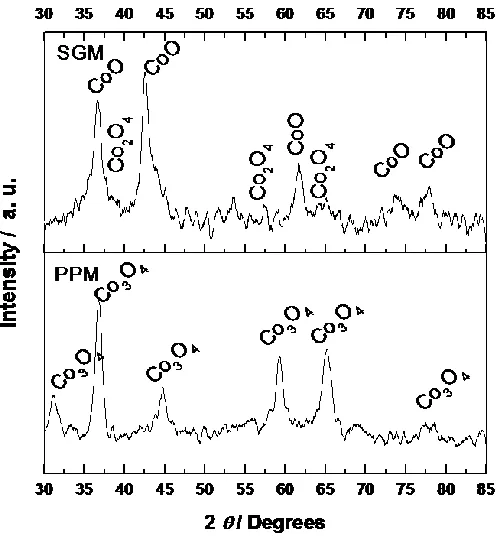
The materials were physically characterized using X-Ray Diffraction (XRD). Figure 1 shows the XRD patterns of the catalysts produced by PPM and SGM.
In the XRD patterns of the catalyst prepared by PPM, characteristic diffraction peaks were observed and attributed to Co3O4, according to JCPDS PDF # 76-1802. In the pattern derived from the
catalyst prepared by SGM, a mixture of oxides was observed. These oxides were determined to be CoO and Co2O4, according to JCPDS PDF # 72-1474 and JCPDS PDF # 80-1534, respectively.
The average size of the crystallites of cobalt oxide particles were estimated using the Debye-Scherrer equation [41] at crystalline planes ((311): 2 = 36.8 o) for material prepared by PPM and ((111): 2 = 61.7 o) SGM. The values obtained were 4 and 5 nm, respectively.
have not yet been observed. Even when using Co with triethylenetetramine chelate, the predominant phase is Co [46]. However, Douin et al. [47] study cobalt phases including Co4+ and using XANES, Lima and Ticianelli [48] concluded that a large fraction of Co atoms in PtCo/C electrocatalysts under alkaline conditions were present as Co3O4. In this study, it is important to point out that Co3O4
[image:5.596.171.419.202.472.2]predominates in the phase and exists almost exclusively when prepared by PPM while the CoO and Co2O4 is present in SGM.
Figure 1. XRD patterns of CoxOy prepared by the PPM and SGM.
Wu et al. [49] identified that compared to commercially provided CoO, which presents submicron sizes, nanoscale CoO is more potential as conductive agent considering the dispersancy in among the active material and that nanoscale CoO particles have previously been synthesized via a sol–gel process, what is in agreement with the results obtained in Figure 1. After that, Douin et al. [46] affirmed that the presence of tetravalent cobalt allows reaching a good conductivity. Considering that in SGM two phases were observed including Co2O4 and CoO, it could give more conductivity,
consequently leading to a higher activity in the ORR for H2O2 production.
3.2. ORR on CoxOy/C
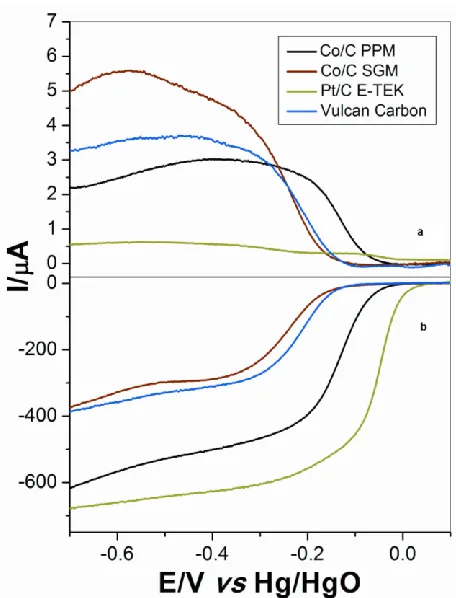
general shape for all materials investigated. The well defined limiting current plateau indicates that ORR is controlled by diffusion in this region [44]. The carbon’s disc current is two times lower than the Pt/C, as expected, since carbon features a 2-electron pathway in the ORR being the reference material for H2O2 production [24] while Pt/C is the reference material for the 4-electron pathway or
water production. Results showed that SGM disc current was much similar to carbon, indicating a 2-eletron transferred for the H2O2 production. In contrast the PPM showed a disc current much similar to
Pt/C featuring a 4-electron transferred or the H2O production. Ring currents are in agreement with disc
currents since the SGM showed the highest ring-current corresponding to the higher amount of H2O2
production.
Figure 2. Current-potential polarization curves in a stationary state for ORR with different CoxOy/C
electrocatalysts in oxygen-saturated 1 M NaOH: (a) ring current and (b) disc current. = 1600 rpm. Ring potential = 0.2 V.
To our knowledge, there are no literature references for Co/C prepared by PPM and SGM in alkaline medium or data associated with ORR polarization curves for Co/C. However, Lima et al. [48] showed that lower amounts of peroxide ions were formed for higher Pt/C ratios, which is in agreement with the results obtained from this study. Marcotte et al. [35] showed that CoAc on different carbon supports produces catalysts that are more active than the carbon supports alone for the production of H2O2. P. Hernández-Fernández et al. [44] showed that the onset potential of ORR and the performance
[image:6.596.184.412.249.548.2]
Because the ring current is proportional to the amount of H2O2 produced at the disc [35], the
results in the literature [35, 44, 48] are in agreement with the results obtained here, where Pt/C showed the lowest ring current and the highest disc current and Co/C prepared by SGM showed the lowest disc current and the highest ring current.
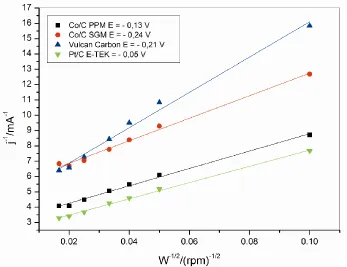
The data regarding oxygen reduction for all materials studied were analyzed using the Koutechy-Levich (K-L) equation (Equation 4) and the results are displayed in the Koutechy-Levich (K-L) plot shown in Figure 3.
1 = 1 + 1 = - 1 - 1 (4) i ik id nFAKC0 {0.62nFADO22/3 ν-1/6C0ω1/2}
where i is the measured current, ik and id are the kinetic and diffusion limited currents,
respectively, k is the rate constant for the ORR, F is Faraday’s constant (96484 C mol-1), A is the effective projected area covered with catalyst, ω is the rotation rate, Cº is the saturated concentration of oxygen in the bulk solution, Do2 is the diffusion coefficient of oxygen and υ is the kinematic viscosity
[image:7.596.126.473.367.634.2]of the solution.
Figure 3. The Koutechy-Levich plot for 1 M NaOH. Pt/C and Vulcan carbon plots were inserted for comparison.
electron reduction of oxygen to water. These plots are straight lines with distinct slopes and a nonzero y-intercept.
Oxygen can be directly reduced to water with the concomitant consumption of four electrons per O2 molecule. Alternatively, oxygen can be reduced indirectly, forming H2O2 as an intermediate and
only two electrons per O2 molecule are consumed [43]:
O2 + 3H2O + 4e- → H2O + 4OH- (5)
O2 + 2H2O + 2 e- → H2O2 + 2OH- (6)
From the analysis of the Koutecky-Levich diagram, ORR with the material prepared by SGM followed the 2-electron transfer pathway and showed a similar slope to Vulcan carbon. In fact, materials prepared by SGM showed superior results compared to black carbon, which is the reference material for a mechanism involving 2 electrons and the formation of H2O2 [24].
3.2.1 Number of electrons transferred and percentage of H2O2.
The reaction pathway of the ORR, i.e., the relative formation rates of H2O and H2O2, can be
determined quantitatively with a RRDE. Feng et al. [50] calculated the H2O2% by the following
equation:
H2O2% = 200 x Ir / N (7)
Id + Ir / N
where Ir is the ring current, Id is the disk current, and N is the collection efficiency, equal to
[image:8.596.195.400.586.678.2]0.37 for the present case. The procedure here used to calculate the number of electrons transferred during the ORR was the same adopted by Feng et al. [50].
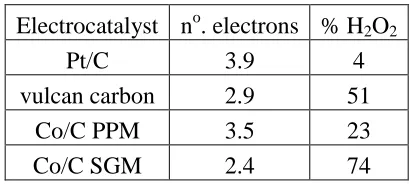
Table 1. Values of H2O2 percentage and number of electrons transferred.
Electrocatalyst no. electrons % H2O2
Pt/C 3.9 4
vulcan carbon 2.9 51
Co/C PPM 3.5 23
Co/C SGM 2.4 74
Table 1 shows the calculated percentage of H2O2 produced using each material. The results
were in agreement with the ring currents in Figure 3 because it is possible to confirm that SGM, which had the highest ring current, also had the highest percentage of H2O2 produced and Pt/C which had the
From the results in Table 1, CoxOy/C prepared using SGM transferred 2.4 and it is able to
generate considerable amounts of H2O2 in the bulk solution, more than the Vulcan carbon, while
CoxOy/C prepared using PPM transferred 3.5 electrons during ORR and it can be used as electrocalyst
for fuel cells.
The activity tests of the electrocatalysts were also performed in acidic medium (1 M H2SO4)
because the electrocatalysts could participate in the Fenton reaction, which is the reaction in Equation 1. However, after the utilization of 20% w/w CoxOy/Cprepared by PPM and SGM in oxygen reduction
under acidic conditions, cobalt concentrations of 1.13 + 0.10 mg L-1 and 0.750 + 0.015 mg L-1 were observed in the electrolyte solutions. Thus, the CoxOy/C prepared by both methods was soluble in
acidic media.
4. CONCLUSIONS
All methods were effective for obtaining cobalt oxides supported on carbon. The CoxOy/C
material prepared by SGM is a promising material for the H2O2 electrogeneration. This material forms
a mixture of oxides, CoO and Co2O4, which conferee more conductivity and more activity toward
2-electrons transferred in ORR in 1 M NaOH. The results indicate that SGM is a superior method to PPM for producing CoxOy/C with the ability to generate H2O2. However, the PPM CoxOy/C PPM
material can be tested as an electrocatalyst in fuel cells since it transferred 3.5 electrons for ORR without presence of Pt.
ACKNOWLEDGEMENTS
The authors wish to thank the Brazilian Funding Institutions, CNPq (577292/2008-0, and 473308/2010-0), CAPES and FAPESP (2005/59992-6, 2007/04759-0, 2008/58789-0, 2009/09145-6, 2010/04539-3), and UFABC for their financial support.
References
1. J.C. Forti, R.S. Rocha, M.R.V. Lanza, R. Bertazzoli, J. Electroanal. Chem. 601 (2007) 63.
2. E. Guinea, F. Centellas, E. Brillas, P. Canizares, C. Sáez, M.A. Rodrigo, Appl. Catal. B - Environ. 89 (2009) 645.
3. M.S. Yalfani, S. Contreras, F. Medina, J. Sueiras, Appl. Catal. B - Environ. 89 (2009) 519. 4. H. Cengiz Yatmaz, Yasin Uzman, Int. J. Electrochem. Sci., 4 (2009) 614.
5. R. Meiers, W.F. Hölderich, Catal. Lett. 59 (1999) 161.
6. S. Esplugas, J. Giménez, S. Contreras, E. Pascual, M. Rodríguez, Water Res. 36 (2002) 1034. 7. R. Andreozzi, V. Caprio, A. Insola, R. Marotta, Catal. Today 53 (1999) 51.
8. J.J. Pignatello, E. Oliveiros, A. Mackay, Crit. Rev. Env. Sci. Tec. 36 (2006) 1. 9. R. J. Bigda, Chem. Eng. Prog. 91 (1995) 62.
11. F.J. Benitez, J. Beltran-Heredia, J.L. Acero, F.J. Rubio, Ind Eng. Chem. Res. 38 (1999) 1341. 12. C. Walling, A. Goosen, J. Am. Chem. Soc. 95 (1973) 2987.
13. C.W. Jones, Applications of Hydrogen Peroxide and Derivatives, RSC, 1999, 207. 14. E. Brillas, R.M. Bastida, E. Uosa, J. Electrochem. Soc. 142 (1995) 1733.
15. D. Jing-Shan, C. Chin-Pin, J. Electrochem. Soc. 140 (1993) 1632.
16. W.H. Leng, W.C. Zhu, J. Ni, Z. Zhang, J.Q. Zhang, C.N. Cao, Appl. Catal. A - General 300 (2006) 24.
17. J.A. Mcintyre, Interface 4 (1995) 29.
18. J. González-García, C.E. Banks, B. Šljukić, R.G. Compton, Ultrason. Sonochem. 14 (2007) 405. 19. Z. Qiang, J. H. Chang, C. P. Huang, Water Res. 36 (2002) 85.
20. K.S. Yang, G. Mul, J.A. Moulijn, Electrochim. Acta 52 (2007) 6304. 21. S.M. Golabi, J.B. Raoof, J. Electroanal. Chem. 416 (1996) 75. 22. R.J. Taylor, A.A. Humffray, J. Elecroanal. Chem. 64 (1975) 63.
23. J. Xu, W. Huang, R.L. McCreery, J. Electroanal. Chem. 410 (1996) 235. 24. A.Alvarez-Gallegos, D. Pletcher, Electrochim. Acta 44 (1998) 853. 25. L. Gyenge, C.W. Oloman, J. Appl. Electrochem. 31 (2001) 233. 26. A.Huissoud, P. Tissot, J. Appl. Electrochem. 29 (1999) 11.
27. E.L. Gyenge, C.W. Oloman, J. Appl. Electrochem. 33 (2003) 633. 28. M.S. El-Deab, T. Ohsaka, J. Electroanal. Chem. 553 (2003) 107.
29. M. Van Brussel, G. Kokkinidis, A. Hubin, C. Buess-Herman, Electrochim. Acta 48 (2003) 3909. 30. B. Šljukić, C.E. Banks, R.G. Compton, Phys. Chem. Chem. Phys. 6 (2004) 4034.
31. A.Sarapuu, K. Vaik, D.J. Schiffrin, K. Tammevestki, J. Electroanal. Chem. 541 (2003) 23. 32. K. Vaik, A. Sarapuu, K. Tammeveski, F. Mirkhalaf, D.J. Schiffrin, J. Electroanal. Chem. 564
(2004) 159.
33. K. Tammeveski, K. Kontturi, R.J. Nichols, R.J. Potter, D.J. Schiffrin, J. Electroanal. Chem. 515 (2001) 101.
34. B. Wang, J. Power Sources 152 (2005) 1.
35. S. Marcotte, D. Villers, N. Guillet, L. Roué, J.P. Dodelet, Electrochim. Acta 50 (2004) 179. 36. R.F.B. De Souza, A.E.A. Flausino, D.C. Rascio, R.T.S. Oliveira, E.T. Neto, M.L. Calegaro, M.C.
Santos, Appl. Catal. B - Environ. 91 (2009) 516.
37. R.F.B. De Souza, L.S. Parreira, D.C. Rascio, J.C.M. Silva, E.T. Neto, M.L. Calegaro, E.V. Spinace, A.O. Neto, M.C. Santos, J. Power Sources 195 (2010) 1589.
38. M.C. Santos, L. Cogo, S.T. Tanimoto, M.L. Calegaro, L.O.S Bulhões, Applied Surface Science 253 (2006) 1817.
39. H.B. Suffredini, V. Tricoli, L.A. Avaca, N. Vatistas, Electrochem. Commun. 6 (2004) 1025. 40. U.A. Paulus, T.J. Schmidt, H.A. Gasteiger, R.J. Behm, J. Electroanal Chem. 495 (2001) 134. 41. H.P. Klung, L.E. Alexander, X-ray Diffraction Procedures for Polycrystalline and Amorphous
Materials, Wiley, New York, 1974.
42. K.H. Lee, K. Kwon, V. Roev, D.Y. Yoo, H. Chang, D. Seung, J. Power Sources 185 (2008) 871. 43. M.A. Garcia-Contreras, S.M. Fernandez-Valverde, J.R. Vargas-Garcıa, M.A. Cortés-Jácome, J.A.
Toledo-Antonio, C. Ángeles-Chavez, Int. J. Hydrogen Energ. 33 (2008) 6672.
44. P. Hernandez-Fernandez, S. Rojas, P. Ocon, J.L.G. de la Fuente, P. Terreros, M.A. Pena, J.L. Garcıa-Fierro, Appl. Catal. B: Environ. 77 (2007) 19.
45. N. Travitsky, T. Ripenbein, D. Golodnitsky, Y. Rosenberg, L. Burshtein, E. Peled, J. Power Sources 161 (2006) 782.
46. H.J. Zhang, X. Yuan, W. Wen, D.Y. Zhang, L. Sun, Q.Z. Jiang, Z.F. Ma, Electrochem. Commun. 11 (2009) 206.
47. G.M. Douin, L. Guerlou-Demourgues, M. Ménétrier, E. Bekaert, L. Goubault, P. Bernard, C. Delmas, J. Solid State Chem. 182 (2009) 1273.
49. J.B. Wu, J.P. Tua, X.L.Wang, W.K. Zhang,Int. J. Hydrogen Energ 32 (2007) 606. 50. Y Feng, T. He, N. Alonso-Vante, Electrochim Acta. 54 (2009) 5252