Int. J. Electrochem. Sci., 4 (2009) 855 - 862
International Journal of
ELECTROCHEMICAL
SCIENCE
www.electrochemsci.org
Separation of Ascorbic Acid, Dopamine and Uric Acid by
Acetone/Water Modified Carbon Paste Electrode: A Cyclic
Voltammetric Study
R. Raghavendra Naik1, B.E. Kumara Swamy1*, Umesh Chandra1, E. Niranjana1, B.S. Sherigara1 and H.Jayadevappa2
1
Department of P.G. Studies and Research in Industrial Chemistry, Kuvempu University, Jnana Sahyadri, Shankaraghatta, Karnataka, India
2
Department of Chemistry, Sahyadri Science College, Shimoga, Karnataka, India *
E-mail: [email protected]
Received: 8 May 2009 / Accepted: 14 May 2009 / Published: 6 June 2009
The carbon paste (CPE) was prepared by grinding the mixture of graphite powder and silicone oil ratio 70:30 respectively. The acetone/water modified carbon paste electrode was developed by immobilizing the different ratios of acetone/water. The best ratio was 20:80 acetone/water respectively. The peak currents in voltammogram of dopamine was increased at acetone/water modified carbon paste electrode when compared to bare CPE. The effect of substrate concentration, ratio of acetone/water and scan rate were studied. The electrode process was found to be diffusion controlled. The acetone/water modified carbon paste electrode showed selective enhancement of oxidation peak current for DA in the presence of ascorbic acid (AA) and uric acid (UA).
Keywords: Dopamine, Ascorbic acid, Uric acid, Cyclic voltammetry, Modified carbon paste electrode.
1. INTRODUCTION
Electrochemical biosensors are currently among the most popular of the various types of biosensors. The area of electrochemical biosensors continues to grow at a rapid pace based on the characteristics of fast, simple, low-cost detection capabilities inherent with biological binding. Research in this field remains focused on novel sensing strategies with specific attention to the enhancement of specificity, sensitivity, and response time.
to serious diseases such as Parkinson’s. Hence, much research work on the determination of DA has been carried out [1–7]. However, a major problem for electrochemical detection of DA in real biological matrices is the coexistence of ascorbic acid (AA) and uric acid (UA). Uric acid is an end product from purine derivatives in human metabolism. The assay of uric acid in body fluids (e.g. serum and urine) is a clinically valuable diagnostic indicator [8]. The presence of elevated uric acid levels is a sign of gout, hyperuricemia, or Lesch-Nyhan syndrome [9]. Similarly, elevated uric acid levels are related to other conditions including increased alcohol consumption, obesity, diabetes, high cholesterol, kidney disease, and heart diseases. Many epidemiological studies have suggested that serum uric acid is also a risk factor for cardiovascular disease [10]. In the extracellular fluid of the central nervous system, AA and UA are present in very high concentration, while the DA level is over 3 orders of magnitude smaller (< 100 nM) [11]. Moreover, DA, UA and AA are oxidized at nearly the same potential, which results in an overlapped voltammetric response. Many methods such as spectroscopy, chromatography and electrochemistry [12-15] were introduced to determine DA. Since DA is an oxidizable compound, it can be easily detectable by electrochemical methods based on anodic oxidation. Bioelectrochemists and electroanalytical chemists have been showing great interest in this area and various modified electrodes have been constructed for this purpose [16–26]. Because of the simple preparation and easy refreshing of the surface, carbon paste has been used extensively as a working electrode for a variety of electrochemical applications. It has also been shown that carbon tends to be more compatible with biological tissues than other commonly used electrode materials [27].
In this paper, we report the fabrication of carbon paste electrode and its surface modification with acetone. Acetone forms hydrogen bond with water. The acetone–water binding is stronger than in the liquid as in this case the water is also bound to other water molecules [28,29]. The modified electrode resolved the overlapped voltammetric responses of ascorbic acid, dopamine and uric acid in to three well defined cyclic voltammetric peaks.
2. EXPERIMENTAL PART
2.1. Reagents and Chemicals
Graphite powder, acetone was obtained from sigma. Ascorbic acid and dopamine were purchased from Aldrich and Uric acid from Fluka. DA was prepared by dissolving in 0.1M perchloric acid (HClO4) solution. The supporting electrolyte used was phosphate buffer [pH = 7.4]. All solutions were prepared with doubly distilled water. All chemicals were of analytical grade quality.
2.2. Apparatus and Procedure
paste electrode was prepared by grinding the 70% graphite powder and 30% silicon oil in an agate mortar by hand mixing for about 30 minute to get homogenous mixture. The paste was packed into the cavity of CPE and smoothened on weighing paper. Acetone modified carbon paste electrode [ACMCPE] was prepared by immobilizing the 15µL on the surface of CPE.
3. RESULTS AND DISCUSSION
3.1. Calibration of ACMCPE
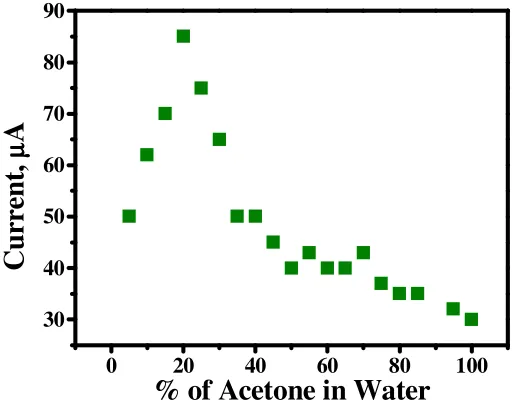
The percentage of acetone in distilled water was varied from 10 to 100% to calibrate the carbon paste electrode modification. The graph of current vs percentage of acetone was plotted (Fig. 1). The highest sensitivity occurred at 20%:80% of acetone:water, which can be seen from the graph. Acetone of 20% was immobilized on the surface of carbon paste electrode with time duration of 4 minute. The acetone at this percentage and time duration showed very good electrocatalytical activity towards the determination of DA in presence of AA and UA.
0 20 40 60 80 100
30 40 50 60 70 80 90
C
u
rr
en
t,
µµµµ
A
[image:3.612.168.424.334.536.2]% of Acetone in Water
Figure 1. Graph of current vs percentage of acetone in water.
3.2. Electrocatalytic response of DA at ACMCPE
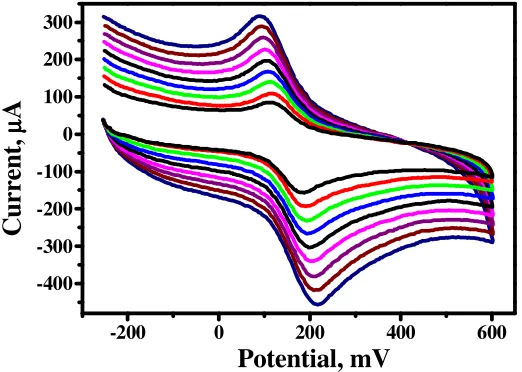
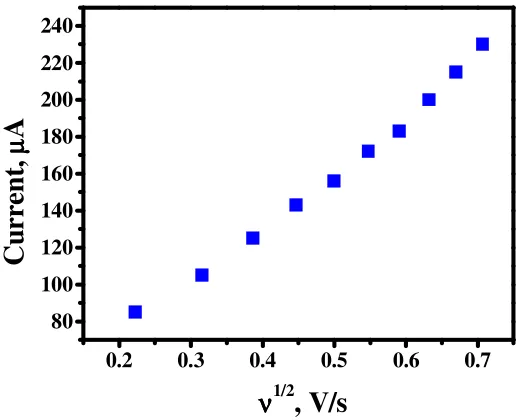
was located at 180mV and the corresponding cathodic peak potential was located at 115 (vs SCE). The peak-to-peak separation was calculated as 65mV and the value of Ipa/Ipc was about 1.15. So, the voltammogram obtained for ACMCPE was with good improvement in enhancement of oxidation and reduction peak currents. The voltammogram showed increase in the both Ipa and Ipc of the DA with increase in scan rate (Fig. 2b) at the modified electrode. The graph of current (Ipa) square root of scan rate (ν1/2) were plotted. The graph obtained was nearly straight line (Fig. 2c). In the range from 100mV s-1- 500mV s-1 the redox peak currents were proportional to the square root of scan rate (ν1/2) with correlation coefficient 0.999. This indicates that, the electrode transfer reaction was diffusion controlled.
Figure 2a. Cyclic voltammogram of 20µM DA at bare CPE (dashed line) and at ACMCPE (solid line) in 0.2M phosphate buffer solution of pH 7.4 at 100mV/s scan rate.
-200 0 200 400 600
-400 -300 -200 -100 0 100 200 300
C
u
rr
en
t,
µµµµ
A
Potential, mV
[image:4.612.146.464.223.422.2] [image:4.612.169.430.481.667.2]
0.2 0.3 0.4 0.5 0.6 0.7
80 100 120 140 160 180 200 220 240
C
u
rr
en
t,
µµµµ
A
ν
ν
ν
[image:5.612.170.430.66.276.2]ν
1/2, V/s
Figure 2c. Graph of current vs square root of scan rate.
3.3. Effect DA concentration
The concentration effect of DA was carried out by varying the concentration at ACMCPE. By increasing the concentration of DA, the Ipa and Ipc goes on increasing with shifting Epa towards positive and Epc with negligible shifting. 10µΜ to 100µΜ DA concentrations showed the Epa was shifted from 110mV to 125mV. The graph of Ipa vs concentration of DA was plotted, showed increase in electrochemical peak current, (Fig. 3). The graph obtained linearly increase in peak current with increase in the DA concentration and Ipa is proportional to concentration of DA.
0 20 40 60 80 100
60 80 100 120 140 160 180
C
u
rr
en
t,
µµµµ
A
[DA]/
µ
µ
µ
µ
M
[image:5.612.175.423.490.684.2]
3.4. Simultaneous determination of DA, AA and UA by cyclic voltammetry
DA, UA and AA are oxidized at nearly the same potential, which results in an overlapped voltammetric response with over potential at bare CPE. The concentration of AA and UA were existing much higher than that of DA. However, the ACMCPE has ability to separate the oxidation peak potential of AA, UA and DA.
Figure 4a. Cyclic voltammogram of 100µM AA and 50µM UA at ACMCPE in phosphate buffer solution of pH 7.4 at 100mV/s scan rate.
[image:6.612.163.448.174.383.2] [image:6.612.147.467.449.680.2]
At bare CPE voltammograms were recorded for 100µM AA and 50µM UA in the potential range -250 to 600mV Fig. 4a in 0.2M phosphate buffer solution of pH 7.4. The electrochemical anodic peak potential of AA and UA were found to be 65mV and 310mV at ACMCPE.
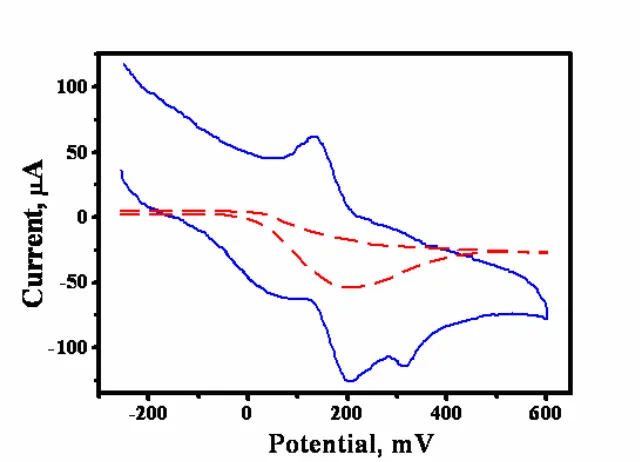
The Fig. 4b shows the voltammogram for solution containing mixture of 20µΜ DA, 100µΜ
AA and 50µM UA in 0.2M phosphate buffer system of pH 7.4. The bare CPE showed only one broad anodic peak without giving reduction peak (dashed line) for the sample mixture. The CPE was often suffer with fouling effect to resolve the problem of separation. The anodic peak potential was occurred at 205mV. The ACMCPE has able to separate the oxidation peaks of AA, UA and DA (solid line). The electrochemical response of AA shows oxidation peak potential at 70mV at ACMCPE. The electrochemical response for DA at ACMCPE, the oxidation peak potential was observed at 190mV and reduction peak potential was at 115mV and the anodic peak potential for UA was occurred at 315mV. The peak to peak separation of DA-AA was 120mV and DA-UA was 125mV at ACMCPE showed the selective determination of DA in the presence of AA and acts as sensor for the detection of DA in low concentration.
4. CONCLUSIONS
Acetone modified carbon paste electrode (20%:80%) has been shown to be effective for dopamine determination.The scan rate effect showed electrode process was diffusion controlled. The oxidation peak current was in proportion to the DA concentration in the range 10µM – 100µM. The ACMCPE showed good electrochemical ability to separate the electrochemical responses of DA, AA and UA in the mixed solution. Hence, the ACMCPE was acting as a good sensor for the determination of DA in presence of AA and UA. So, this ACMCPE can be further used for the determination of other neurotransmitter.
ACKNOWLEDGEMENT
One of the authors, R. Raghavendra Naik is thankful to University Grants Commission, New Delhi, INDIA for awarding Rajiv Gandhi National Fellowship.
References
1. A. Akiyama, T. Kato, K. Ishli and E. Yasydy, Anal. Chem., 57 (1985) 1518. 2. J. Ponchon, R. Cespuglio, J. M. Gonon and J. Pujol, Anal. Chem., 51(1979) 1483. 3. P. Heiduschka and J. Dittrich, Electroanalysis, 4 (1992) 223.
4. R. Raghavendra Naik, E. Niranjana, B. E. Kumara Swamy, B. S. Sherigara and H. Jayadevappa. Int. J. Electrochem. Sci., 3 (2008) 1574.
5. M. R. Deakin, P. M. Kovach, K. J. Stutts and R. M. Wightman, Anal. Chem., 58 (1986) 1474. 6. A. C. Michael and J. B. Justile, Jr., Anal. Chem., 59 (1987) 405.
7. J. Wang and A. Walcarius, J. Electroanal. Chem., 407 (1995) 183.
8. H. Yurahi, S. Tetsuhika and I. Hajime, Insect Biochem. Mol. Biol. 30 (2000) 173.
9. L.S. Raab, G.L. Decker, A. J. Jonas, M.A. Kaetzel, J.R. Dedman. J. Cell. Biochem., 47 (1991) 18. 10.M.I. Dussossoy, G. Pastor, X. Baulenc. J. Pharm. Sci.-US 85 (1996) 955.
11.A. Ciszewski and G. Milczarek, Anal. Chem., 71 (1999) 1055.
13.C.L. Guan, J. Ouyang, Q.L. Li, B.H. Liu et al Talanta, 50 (2000) 1197. 14.F.B. Salem, Talanta, 34 (1987) 810.
15.T.F. Kang, G.L. Shen, R.Q Yu Anal Chim Acta, 354 (1997) 343 16.C. R. Raj and T. Ohsaka, J. Electroanal. Chem., 496 (2001) 44. 17.J. W. Mo and B. Ogorevc, Anal. Chem., 73 (2001) 1196. 18.X. L. Wen, Y. H. Jia and Z. L. Liu, Talanta, 50 (1999) 1027.
19.H. Zhao, Y. Z. Zhang and Z. B. Yuan, Anal. Chim. Acta, 441 (2001) 117. 20.J. Chen and C. S. Cha, J. Electroanal. Chem., 463 (1999) 93.
21.M. D. Rubianes and G. A. Rivas, Anal. Chim. Acta, 440 (2001) 99.
22.Y. X. Sun, B. X. Ye, W. M. Zhang and X. Y. Zhou, Anal. Chim. Acta, 363 (1998) 75. 23.L. Z. Zheng, S. G. Wu, X. Q. Lin, L. Nie and L. Rui, Analyst, 126 (2001) 736. 24.H. Zhao, Y. Z. Zhang and Z. B. Yuan, Analyst, 126 (2001) 358.
25.L. Zhang and X. Q. Lin, Analyst, 126 (2001) 367.
26.M. Poon and R. L. McCreery, Anal. Chem., 58(1986) 2745.
27.R. M. Wightman, L. J. May and A. C. Michael, Anal. Chem., 60 (1988) 769A.
28.K. Countinho, N. Saavedra, S. Canuto, J.Molecular Structure (Theo Chem), 466 (1999) 69. 29.J.J Max, C. Chapados, J. chemical Physics, 120 (14) (2004) 6625