S
H
-R
I
U
s in g
A V
is u a l
I
n t e r f a c e
J
o c h e nH
e i n z m a n nMa s t e r o f Co mpu t e r Sc i e n c e (Un i v e r s i t y o f Ka r l s r u h e, Ge r m a n y)
A thesis submitted for the degree of Doctor of Philosophy of
The Australian National University
Robotics Systems Lab
Department of Systems Engineering
Research School of Information Sciences and Engineering
The Australian National University
THE AUSTRALIAN
NATIONAL UNIVERSITY
Robotic Systems Lab
These doctoral studies were conducted under the supervision of Prof. Alexander Zelinsky as advisor.
The work submitted in this thesis is the result of original research carried out by myself, except where duly acknowledged, while enrolled as a Ph.D. student in the Department of Systems Engineering, The Australian National University. It has not been submitted for any other degree or award in any other university or educational institution.
Acknowledgement s
Before I started this work more than 3^ years ago it was my biggest wish to do this PhD course. After I had the pleasure to visit my supervisor Alex Zelinsky and his PhD students Gordon Cheng and David Jung earlier in 95/96 for 6 months to do my Masters in Wollongong, and I was very excited about the idea to come back to Australia to do a PhD. Meanwhile Alex had changed to the ANU and I was given the opportunity to start my PhD shortly after. I would like to thank our school director Brian Anderson, the Head of Department John Moore and particularly Alex for their support in creating this opportunity for me.
One my way many people provided valuable advice and turned me in the right direction. I should thank most of all Alex of course, but there were many others who helped me along the way. Thanks to John Kieffer, John Moore, David Wettergreen and Oussama Khatib who all provided advice at various stages of this thesis. Thanks also to all the people who helped me with my daily technical problems, James Ashton, Ali Goektogan, Tim Edwards, Luke Fletcher, Peter Brown, Chanop Silpa-Anan, Harley Truong, Chris Gaskett and of course my buddies Gordon Cheng and David Jung who provided so much help particularly in the difficult start of this work. I hope that I was able to return some of the support to them and my fellow students. I’d like to thank the Department of Systems Engineering for providing not only a well equipped, comfortable and stimulating environment but also all the support a PhD student can wish for. Thanks to all my fellow students Rochelle O’Hagan, Chris Gaskett, Simon Thompson, Roland Göcke, Gareth Loy and particularly to Jenni Watkins and Marita Rendina for making the place something more than just an office.
The time at the ANU seems to have flown past, mostly because it was so enjoy-able also outside the lab. I’d like to thank my two fellow amigos Gordon Cheng and David Jung for being my friends and always making me feel welcome. Thanks also to Gordon’s wife Katrina and their kids Jamie, Maddie, Andrew and Nick for their hos-pitality and letting me share many wonderful memories with them. Thanks also to all the other people I had the pleasure to meet and who made the past years so enjoy-able, Yoshio Matsumoto, Andrew Brooks, Giovanni Bianco, Jacob Lidballe, Thomas Moor, Samer Abdallah, Frankie De Bruyne and everybody at Systems Engineering and particularly Alex for creating such a cooperative environment for everybody in the department.
The work presented in this thesis focuses on the research area of human-machine interaction, in particular the interaction between people and robots. If robots are to be introduced into the human world as assistants to aid a person in the completion of a manual task two key problems of todays robots must be solved: The human-robot interface must be intuitive to use and the safety of the user with respect to injuries inflicted by collisions with the robot must be guaranteed. Accordingly this research consists of two parts, the development of an intuitive visual human-machine interface and the formulation and implementation of a control strategy for robot manipulators which provides quantitative safety guarantees for the user.
The visual interface consists of a real-time visual eye gaze direction and facial gesture recognition system. These functionalities are based on a visual 3D head pose tracking system which requires only a monocular camera view and is completely passive. The system tracks natural facial features such as the eye brows and the mouth. Based on the image positions of the facial features the 3D head pose is determined. Robust feature tracking and 3D head pose estimation is achieved by employing probabilistic algorithms to integrate the correlation results of the vision hardware with the geometric constraints, to track the changes in the appearance of the facial features and to detect tracking failures.
The eye gaze tracking module uses the results of the 3D head pose estimation and derives the eye gaze direction from the 3D model of the head which includes the eye balls and the detection of the iris in the image. The gaze direction in combination with the 3D head pose allows the detection of the eye gaze point of the person. The facial gesture recognition detects characteristic motion patterns in the output of the face tracking system. It allows the robust detection of motion gestures such as nodding and shaking the head.
Safety guarantees for the user of a assistant robot are of paramount importance. The proposed control scheme for robot manipulators restricts the torque commands of a position control algorithm to values that comply to preset safety restrictions. These safety restrictions limit the potential impact force of the robot in the case of collision with a person. Such accidental collisions can occur with any part of the robot and therefore the impact force not only of the robot’s hand but of all surfaces is controlled by the scheme.
List of Publications
Journals
[1] J. Heinzmann and A. Zelinsky: A Safe-Control Paradigm For Human- Robot Interaction, Journal of Intelligent and Robotic Systems, volume 25, number 4, pp295-310, 1999
[2] A. Zelinsky and J. Heinzmann: A novel visual interface for human-robot communication, Journal on Advanced Robotics, volume 11, number 8, pp827-852, 1998
C onferences
[3] J. Heinzmann and A. Zelinsky: Visual Human-Robot Interaction, Proc. of the IEEE International Conference on Field and Service Robots FSR 2001, June 2001, to appear
[4] A. Zelinsky and J. Heinzmann: Human-Friendly Robot Design, Proc. of the International Symposium on Robotics Research ISRR’99, Octo-ber 1999, pp247-256
[5] Y. Matsumoto, J. Heinzmann and A. Zelinsky: The Essential Compo-nents of Human-Friendly Robot Systems, Proc. of IEEE International Conference on Field and Service Robots FSR’99, August 1999, pp43-51 [6] J. Heinzmann, Y. Matsumoto, J. Kieffer and A. Zelinsky: Smart
Inter-faces + Safe Mechanisms = Human Friendly Robots, IARP Workshop on Humanoid and Human-Friendly Robotics, October 1998, Tsukuba, Japan, pp 11-3
[7] J. Heinzmann and A. Zelinsky: 3-D Facial Pose and Gaze Point Esti-mation using a Robust Real-Time Tracking Paradigm, Proc. of IEEE International Conference on Automatic Face and Gesture Recognition FG’98, April 1998, ppl42-147
[8] D. Jung, J. Heinzmann and A. Zelinsky: Range and Pose Estimation for Visual Servoing of a Mobile Robot, Proc. of IEEE International Conference on Robotics and Automation ICRA’98, May 1998, ppl226- 1231
[9] J. Heinzmann and A. Zelinsky: A Visual Interface for Human-Robot Interaction, Proceedings of the International Conference on Field and Service Robotics, FSR’97, December 1997, pp572-579, represented as book chapter in: A. Zelinsky, editor, Field and Service Robotics, pp 540-547, Springer-Verlag, London, 1998
V ideo P ublications
[11] J. Heinzmann and A. Zelinsky: A Control Strategy for Human-Friendly Robots, Video Proc. of International Conference on Robotics and Au-tomation ICRA’99
Contents
1 Introduction 1
1.1 The interfaces of the f u tu r e ... 1
1.1.1 Natural interaction... 1
1.1.2 Interaction with m achines... 2
1.1.3 Communication channels... 3
1.1.4 Physical interaction ... 3
1.1.5 Traditional approaches... 4
1.1.6 Humanoid ro b o ts... 5
1.1.7 Safety issues... 5
1.2 Research objectives... 6
1.3 Contributions... 7
1.4 Application a re a s... 8
1.4.1 Head pose and 3D eye gaze tra c k in g ... 9
1.4.2 Gaze and gestures for robot control... 10
1.5 Organisation of this th e sis... 11
2 R elated Work 15 2.1 Road m a p ... 15
2.2 Visual human-computer interfaces ... 17
2.2.1 Face detection ... 20
2.2.2 Facial feature detection and track in g ... 25
2.2.3 3D head pose estim ation... 29
2.2.4 Eye gaze estimation ... 34
2.2.5 Facial g e stu re s... 38
2.2.6 Other face-related issues ... 39
2.2.7 Non-face related issues in human-centred visual interfaces . . 41
2.2.8 S um m ary... 44
2.3 Human-friendly ro b o ts... 44
2.3.1 Safety issues... 45
2.3.2 Physical interaction ... 49
2.4 Visual human-robot interfaces... 50
2.4.1 S um m ary... 51
2.5 S u m m ary ... 52
3 Face Tracking 55 3.1 System A rchitecture... 56
3.2 Layer 1: Template correlation h a rd w a re ... 57
3.3 Layer 2: Kalman filter n e tw o rk ... 59
3.3.1 The basic idea ... 60
3.3.2 The Kalman filter in a n u tsh ell... 60
3.3.3 Kalman filter n etw o rk ... 61
3.3.4 Improved Robustness... 64
3.3.5 Network of te m p la te ... 65
3.3.6 Area search windows... 69
3.3.7 Search window allocation ... 74
3.3.8 Strain integration... 75
3.4 Experimental re s u lts ... 78
3.5 S u m m ary ... 80
4 Head Pose E stim ation 85 4.1 Huttenlocher’s alignment algorithm ... 86
4.1.1 Analysis of the accuracy and sen sitiv ity ... 88
4.2 Systematic E rrors... 89
4.3 Tracking Error Sensitivity... 97
4.3.1 Sensitivity M odel... 101
4.3.2 Sensitivity and Spatial Orientation E rror... 105
4.3.3 Effect on the face tracking system ... 107
4.4 Multi-triangle pose estim ation... 110
4.5 Experimental evaluation... 115
4.5.1 Experimental setu p ... 115
4.5.2 F eatures... 116
4.5.3 Mannequin tracking re s u lts ... 118
4.5.4 Real-head tracking experim ents... 127
4.6 S u m m ary ... 130
5 Gaze Tracking and G esture R ecognition 133 5.1 Underlying eye model ... 133
5.1.1 General architecture... 134
5.1.2 Eye gaze direction calculation... 135
5.1.3 Merging results from two eyes... 138
5.1.4 S u m m ary ... 139
5.2 Experimental re s u lts ... 139
5.3 Gesture recognition... 144
5.3.2 Gesture definition and recognition ... 146
5.3.3 Gesture vocabulary... 148
5.4 S u m m ary ... 149
6 H um an-R obot C oexistence 155 6.1 The vision... 155
6.2 A safety philosophy for human-friendly ro b o ts... 156
6.2.1 Safety requirem ent... 156
6.2.2 The perception p roblem ... 157
6.2.3 Assignment of responsibility... 157
6.2.4 Defining human-friendly ro b o ts ... 159
6.2.5 A basic safe behaviour... 160
6.3 S u m m ary ... 162
7 Safe R obot Control 163 7.1 Safe robot control... 164
7.2 Impact P o te n tia l... 165
7.2.1 Impulsive impact force... 166
7.2.2 Poles of the impulsive impact fo rce ... 168
7.2.3 Collisions while considering friction... 171
7.2.4 Stationary p o in ts... 172
7.2.5 Poles of the generalised impact fo rc e ... 172
7.2.6 Kinematics of human-friendly ro b o ts ... 179
7.2.7 Definition of Impact Potential... 181
7.2.8 Controlling the impact force... 182
7.3 Implementing Impact Potential Control ... 183
7.3.1 Transformation to torque sp a c e ... 183
7.3.2 Torque verification... 184
7.3.3 Torque clipping... 184
7.3.4 Stationary r o b o t ... 187
7.3.5 Unsafe robot s t a t e ... 188
7.4 Simulation of a 2 DOF r o b o t ... 188
7.4.1 Impact control point selection... 189
7.4.2 Static sim ulation... 190
7.4.3 Dynamic sim ulation... 190
7.5 S u m m ary ... 195
8 Im pact Potential Control Im plem entation 199 8.1 Hardware p latform ... 200
8.1.1 The WAM r o b o t... 201
8.1.2 The WAM hand ... 202
8.1.4 Suitability for human-robot interaction... 205
8.2 Control point selection... 205
8.2.1 Poles of f e on the W A M ... 206
8.2.2 Geometry of the WAM r o b o t ... 208
8.2.3 Implementation... 215
8.3 Contact sensing without sensors... 216
8.3.1 M ethodology... 217
8.3.2 Implementation... 217
8.4 External position control... 218
8.4.1 Example: PID c o n tro l... 218
8.5 Software architecture... 220
8.5.1 Visual interface and application controller... 223
8.5.2 Safety core im plem entation... 223
8.5.3 Robot motion server interface... 223
8.5.4 IPC server... 224
8.5.5 Network communication... 225
8.6 Passive motion experim ents... 225
8.6.1 Zero-G mode interaction... 225
8.6.2 Safety envelope motion d a m p in g ... 227
8.7 Motion control experiment... 228
8.8 Impact Experim ent... 236
8.9 S u m m ary ... 242
9 System Integration 247 9.1 System fun ctio n s... 248
9.1.1 Basic concept... 248
9.1.2 Actions of the interactive pick-and-place system ... 249
9.2 Experimental se tu p ... 250
9.3 System s tru c tu re ... 252
9.4 Finite state machine im plem entation... 253
9.5 Experimental re s u lts ... 256
9.5.1 Place sequence... 261
9.5.2 Pick sequence... 265
9.5.3 Error correction sequence... 265
9.6 S u m m ary ... 267
10 C onclusions and Further Work 273 10.1 Conclusions... 273
10.2 Directions of future w ork... 274
10.2.1 Face and gaze tracking ... 275
10.2.3 Human-robot interaction... 276
10.3 Closing w ords... 277
A A sim ov’s Laws of R obotics 279 B Com m ercial V ision System s 281 C H uttenlocher’s A lignm ent algorithm 283 C.l The alignment algorithm in a n u ts h e ll... 283
C. 2 Closed form so lu tio n ... 284
D G ravity C om pensation 287 D. l Gravity compensation on a serial m anipulator... 287
D.2 Parameter identification... 290
D.3 4DOF configuration ... 291
D. 4 Least squares estim ation... 291
E V ideo Index 295 E. l Visual interface... 295
E.1.1 3D Head pose tracking... 295
E .l.2 Gesture recognition... 296
E.1.3 Eye gaze point estim ation... 296
E.2 Safe robot control... 297
E.2.1 Basic behaviour: Zero-G ...297
E.2.2 Safety core motion dam ping... 297
E.2.3 Collision experiments... 297
E. 2.4 Human intervention ... 298
E. 3 System integration: Interactive pick-and-place... 298
F Vectorspace Algebra 299 F. l Algebraic operations with n-dimensional subspaces... 299
F . 1.1 Intersection of affine su b sp aces... 300
F .l.2 Orthogonal projection into affine su b sp aces... 300
List of Figures
2.1 Categorisation of human-centred visual computer in terfaces... 16
2.2 Categorisation of safety measures in robotics ... 19
3.1 Structure of the tracking system ... 57
3.2 The computational cycle of the classical Kalman filter [Bozic79] . . 61
3.3 Part of the Kalman filter network ... 64
3.4 Change in appearance of the mouth area ... 66
3.5 Correlation kernel network ... 67
3.6 Example of the selection of templates ... 68
3.7 Local minima situation ... 69
3.8 Probability density functions for the distribution of area search win-dows ... 71
3.9 Distribution of area search windows ... 73
3.10 Heuristic allocation of correlation windows ... 75
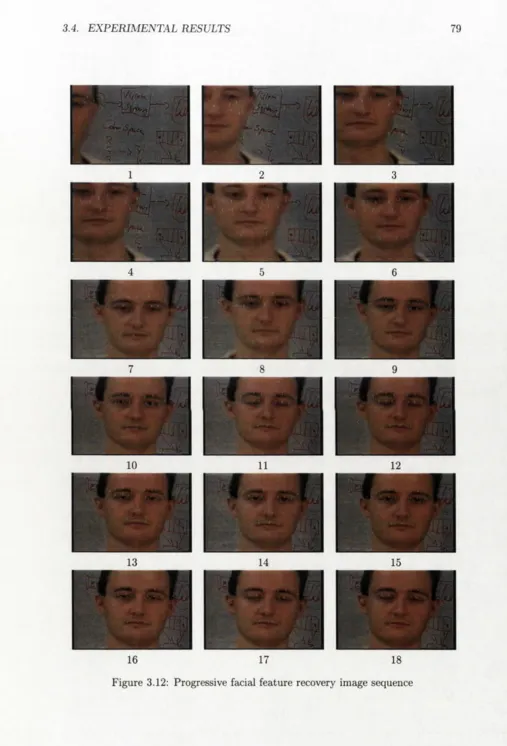
3.11 The modules of the strain integration on links between feature trackers 76 3.12 Progressive facial feature recovery image sequence ... 79
3.13 Feature tracking and recovery after partial and total occlusions . . . 81
4.1 Geometry and dimensions of the setup for the case study ... 89
4.2 Systematic angular error (a) for Huttenlocher’s original algorithm and (b) for s = max(si,S2)... 92
4.3 Systematic error for (a) s = si and (b) for s = s ? ... 93
4.4 Depth error for s = si b) for s = max(si,S2) (note the different scale). 94 4.5 Plot a) shows the systematic error of the original algorithm at a dis-tance of 2000mm over 9X and 6y. Plot b) shows the error of the extended algorithm... 96
4.6 Feature velocity ... 97
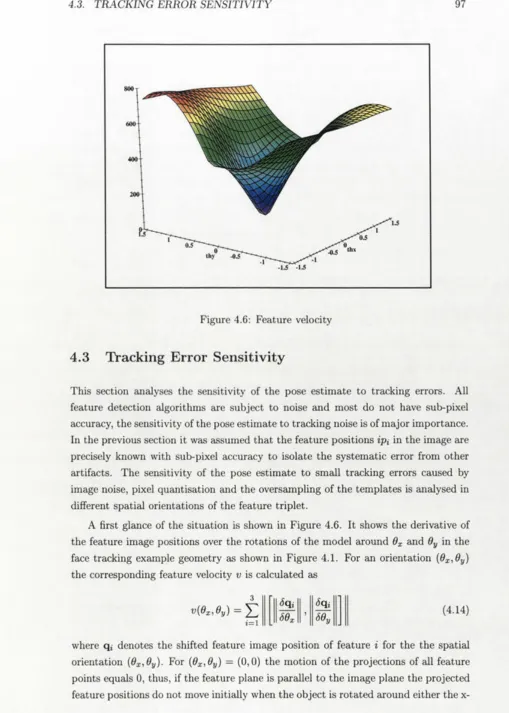
4.7 Rotational sensitivity sr ... 99
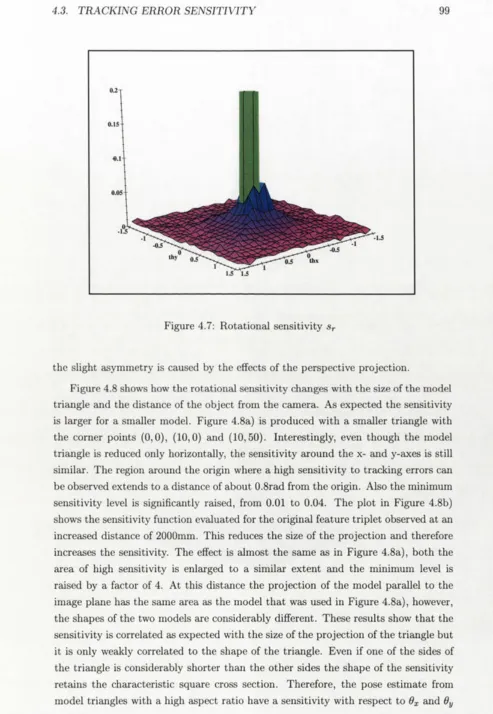
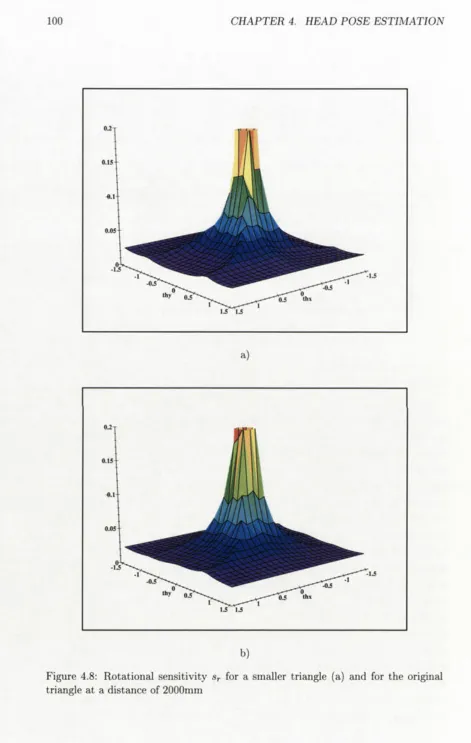
4.8 Rotational sensitivity sr for a smaller triangle (a) and for the original triangle at a distance of 2000m m ... 100
4.9 The sensitivity St of the depth estimate for the normal model triangle and a 45° rotated tria n g le ... 102
4.11 True sensitivity (a) and the error ratio (b) ... 106
4.12 Effective pose estimate errors (a) for (0x,6y) = (0.0,0.0) and (b) for (6x,0y) = (0 .0 ,0 .3 )... 108
4.13 Effective pose estimate errors (a) for (0x,0y) — (—0.8,0.6) and (b) for {0X, 0y) = (1-2, —1 .4 ) ... 109
4.14 Multiple solutions ... 110
4.15 Sensitivity of the rotation around the x-axis (a) and the z-axes(b) . . 113
4.16 Overall pose estimate error ... 114
4.17 Overall sensitivity ... 114
4.18 MARITA-system (a) and view from the vision system ( b ) ... 117
4.19 Bias (a) and standard deviation (b) of Rotx ... 119
4.20 Bias (a) and standard deviation (b) of R o ty ... 120
4.21 Bias (a) and standard deviation (b) of Rot2 ... 121
4.22 Bias a) and standard deviation (b) of the translation in x-direction . 123 4.23 Bias a) and standard deviation (b) of the translation in y-direction . 124 4.24 Bias a) and standard deviation (b) of the translation in z-direction . 125 4.25 Rotx, Roty and RoO over 6000 fram e s... 126
4.26 Tracking image sequence with pose triplets overlay (part 1) 128
4.27 Tracking image sequence with pose triplets overlay (part 2) 129
5.1 Schematic of the gaze vector calculation... 134
5.2 The underlying model of the eye gaze direction calculation... 135
5.3 Iris location correction... 136
5.4 Systematic error introduced by the approximation when merging the two gaze vectors... 138
5.5 Experimental setup for the measurements of the gaze estimators ac-curacy ... 140
5.6 Trace plot of the eye gaze vector intersected with the target plane . 141 5.7 Tracking sequence ... 142
5.8 Eye gaze trace plot for the pan and tilt of the gaze direction, measured in mm on the left side and in degrees on the right side... 143
5.9 Trapezoid functions which define the down action... 146
5.10 Typical activation p a tte rn ... 147
5.11 Architecture of the gesture recognition system ... 147
5.12 Tracking Information passed to the gesture recognition module . . . 150
5.13 Gesture recognition image sequence ... 151
5.14 Measurements during gesture recognition ... 152
6.1 Safety core and safety envelope... 162
7.1 Components of the safety envelope... 165
7.3 1 DOF manipulator configuration ... 174
7.4 Impact force distribution on the 1 DOF m anipulator... 174
7.5 2 DOF example manipulator ... 175
7.6 Impact force f e on a 2 DOF manipulator a r m ... 176
7.7 Poles at joint 2 ... 177
7.8 Impact force f e on a 2 DOF manipulator a r m ... 178
7.9 3DOF manipulator configuration... 179
7.10 Singularities in f e for a 3 DOF m anipulator... 180
7.11 Example of a base design for a human-friendly r o b o t... 181
7.12 Two link robot with two point masses at the end of the links . . . . 189
7.13 Test configurations of the 2 DOF robot ... 191
7.14 Safe region in the torque s p a c e ... 192
7.15 Simulation of a 2DOF robot with IPC core ... 193
7.16 Simulation of the robot initially in an unsafe state ... 194
7.17 Safe link design ... 196
8.1 The WAM robot (Figures courtesy of Barrett Technology) ... 201
8.2 3 fingered Hand of the WAM (courtesy of Barrett Technology) . . . 202
8.3 Potential poles on the first two li n k s ... 207
8.4 Potential poles on link 3 ... 207
8.5 Potential poles on link 4 ... 209
8.6 Experimental setup of the WAM robot ... 209
8.7 Configuration example of the WAM robot with a pole of f e on link 4 211 8.8 The pole in f e on link 4 ... 212
8.9 Test configuration of the WAM robot ... 213
8.10 Impact force f e on link 3 and 4 in a general configuration... 214
8.11 Control points on the WAM robot ... 215
8.12 Example configuration of the PID controller ... 221
8.13 Software architecture of the WAM control scheme... 222
8.14 Zero-G control structure ... 225
8.15 Image sequence of a Zero-G interaction experim ent... 226
8.16 Control structure for the motion damping experiment ... 227
8.17 Image sequence of the experiment in Zero-G m o d e ... 229
8.18 Image sequence of the experiment with safety envelope ... 230
8.19 Motion sequence 1 ... 231
8.20 Safe robot motion using PID control and a IN safety envelope . . . 232
8.21 Safe robot motion using PID control and a 3N safety envelope . . . 233
8.22 Safe robot motion using PID control and a 5N safety envelope . . . 234
8.23 Motion sequence 2 ... 237
8.24 Safe robot motion using PID control and a IN safety envelope . . . 238
8.26 Safe robot motion using PID control and a 5N safety envelope . . . 240
8.27 Setup of the impact experiment ... 241
8.28 Image sequence of the impact experiment ... 241
8.29 Plasticine impactors after the impact with different limits, a) IN, b) 2N and c) 3N... 243
9.1 Transfer configuration... 249
9.2 Experimental scene ... 251
9.3 Top view of the experimental setup ... 251
9.4 Information flow ... 253
9.5 Simplified representation of the FSM ... 254
9.6 sub-states of the idle state ... 255
9.7 Sub-states of the pick object state ... 257
9.8 Safe reconfiguration pose ... 258
9.9 Action sequence of the experiment ... 258
9.10 Interaction experiment (8:32 minutes) ... 260
9.11 Angles between current and target gaze angles ... 261
9.12 Put down object sequence (part 1 ) ... 262
9.13 Put down object sequence (part 2 ) ... 263
9.14 place object sequence ... 264
9.15 Pick object sequence (part 1 ) ... 266
9.16 Pick object sequence (part 2 ) ... 267
9.17 Pick object sequence... 268
9.18 Error correction sequence ... 269
9.19 Error correction sequence ... 270
D.l Kinematic configuration and dimensions of the robot, the position of the coordinate systems and the location of the centre of mass of the links... 288
D.2 Unknown estimation for the 4DOF configuration...293
G.l Substates of the idle (object grasped) state ... 304
G.2 Substates of the place s t a t e ... 305
G.3 Substate of the receive state ... 306
List of Tables
2.1 Overview of the algorithms and their applications... 18
3.1 Evaluation s ta te s ... 68
4.1 Parameter estimation analysis ... 122
5.1 Error analysis of the eye gaze tra c k in g ... 141
E.l Video in d e x ... 296
List of Algorithms
3.1 Correlation kernel selection: sele c t (S tate, S i z e ) ... 67
3.2 Strain integration: in teg rate (di ,^2) ... 77
4.1 Extended pose estimation : pose(q2, q ß ) ... 91
4.2 Multi-plane pose estimation : pose_n-plane(T) ... 115
7.1 Torque vector clipping function: c lip (re, C o n s tra in ts )... 185
8.1 Command Position G en eratio n ... 219
Chapter 1
Introduction
Since the beginning of electronic computers in the early 1950s, the interaction be-tween computers and their users has grown considerably. The first digital computers were programmed by punchcards. Users had to wait for hours to get the output of their program which would allow them to modify and debug their program. The invention of the von Neumann machine architecture combined with the progress in semi-conductor circuits improved the program execution process so programs could be immediately run by the user and their results could be examined immediately. Today, computer users have a set of applications accessible through graphical user interfaces that they can use to provide particular services such as word processing or spreadsheet calculations.
1.1 The interfaces of the future
Generally, ease of the interaction with computers has always been associated with a reduction of the abstraction required by the user to obtain desired information or results. In essence, people wish to describe tasks to the computer using an efficient interaction mode which is intuitive and requires the minimum of learning. These ideas have led to today’s graphical user interfaces (GUIs) in which the technical details are hidden from the user by symbols and procedures whose meanings are intuitively understandable, or at least easy to learn. The goal of human-machine interfaces are computer systems that allow the user to interact in completely intuitive ways.
1.1.1 Natural interaction
The most natural and intuitive form of interaction for people is the interaction with other people. It appears sensible to predict that future generations of computers and computerised machinery will allow the user to interact with the computer not only with keyboard and mouse but in similar ways as people interact with one and
another. Users could simply tell a computer what they want it to write, to display, to change in a document, which information to retrieve or what commands to send.
This vision of natural interaction with computers can be found in various flavours in many science fiction environments, for example in Arthur C. Clarke’s “2001: A
Space Odyssey” and in Gene Roddenberry’s “Star Trek”, both published in 1964. In
particular the robots of the future, as they are the most articulated and life-like of all computerised machines, are imagined by many people to be able to interact with a people in natural ways, for example in Isaac Asimov’s “I, Robot” and countless others. Although this is only fiction, it indicates that people believe that a natural, intuitive interaction is the optimal form of communication with machines.
1.1.2 Interaction w ith m achines
A development that started with the advent of cheap microcomputers is the evolution of devices and machines controlled by computers. This includes not only industrial manufacturing machinery, but also various kinds of household appliances such as dishwashers, washing machines, refrigerators and microwaves. Also motor vehicles have become increasingly computerised. Computer assisted car navigation is now a standard component in motor vehicles, and automobile manufacturers are developing advanced computer systems for visual lane tracking [Kosecka et al. 1998] [Lee et al. 1998], collision warning and visual systems to automatically read speed limit signs on the side of the road [Dickmanns 1999], to detect driver fatigue [Heinzmann and Zelinsky 1997]. Motor vehicles are consumer products with huge market volumes which allow the development of technology products using cutting edge research results.
Also, as computer systems become cheaper over time it will become economically viable to include more sophisticated computer systems in various consumer products such as interactive TV sets that also provide access to the Internet, multi-player games and other interactive datacast contents. As more consumer products become computerised with increasing levels of functionality, the technology will become more complicated to use. The question of how people should interact with such systems will arise. The first off-the-shelf solutions to network private homes and to control virtually any computerised appliance are pushing into the market. A speaker of SUN Microsystems which actively pursues this market has said “One of the challenges in the networked home is to keep things simple for the consumer”1. Products of this kind will be technically and economically feasible in the near future but the appropriate human-machine interface technology is yet to be developed.
1.1.3 C om m unication channels
The development of natural interaction systems for computers and computer con-trolled machinery depends on improvements in two key areas, the extension of the available communication channels and the inclusion of implicit information in the interaction. People use bilateral known contexts in their conversations to make the exchange of the new information more efficient. For example in a conversation about a particular car a person may use the term ’the radiator’ and the conversation partner will assume that this refers to the radiator of this particular car. However, today’s computers are nescient to anything other than the most basic context information.
Presently, the main communication channels between a user and a computer are the mouse and the keyboard. In some applications touch-screens are being used to replace the mouse. Speech recognition for word processing applications is now available2, but the market share of speech recognition systems is still small.
The dominant communication channel between the computer and the user is the computer screen. It presents all information for the user in form of text, images, graphs or video. Limited information is provided by sound in today’s computer systems. Force feedback systems in input devices have been used in telerobotics for a considerable time and recently have become available as haptic interaction devices for virtual worlds3.
To allow natural interaction computers must be able to replicate the same com-munication channels that people use between one and another. For many applications natural speech recognition is the major communication channel between the user and the computer. Besides speech, gestures are an important communication channel for humans. For human-machine interaction deictic gestures (pointing) are of the high-est interhigh-est. Deictic ghigh-estures refer to an entity in a given context. People use two different modes for pointing, arm/hand/finger and eye gaze. Arm/hand/finger point-ing is explicit and occurs quite deliberately while a person’s gaze fixates on an area or object of current interest. Depending on the scale of the environment one or the other mode can be preferable. Gaze fixation can be favourable in close-up/desktop situations, however, for larger scale environments, such as controlling a crane on a construction site, arm/hand/finger pointing is the preferred communication channel.
1.1.4 P h ysical interaction
Another mode of interaction which is particularly important for human-robot inter-action is physical interinter-action. The user of a robot should be able to guide or stop a robot manipulator by simply pulling or pushing the robot. This ability can be important in teaching a robot what to do, or what not to do. There are many other
2For example ViaVoice http://www.software.ibm.com/speech/index.html and Naturally Speaking h ttp : / / www. dragonsystems. com.
situations where people use physical interaction when completing a task, and people would expect a robot to be able to understand the same sorts of physical interaction patterns.
Among those devices that may become feasible in the mid-term future are robots that work together with humans. Such robots could assist a person to perform a particular task or complete subtasks autonomously [Khatib 1999].
1.1.5 T raditional approaches
Robotics research in the past 30 years has been polarised into two basic philosophies in terms of the autonomy of robots. Although both directions have been driven by the idea to extend the application areas of robots beyond repetitive tasks, their approaches to reach this goal have been quite different. While most academic re-searchers have focused on the development of fully autonomous robots that could perform variable tasks without human intervention, the industry oriented researchers devised telerobotic systems which require an operator to initiate each and every ac-tion of the robot from a remote control post.
Teleoperated robots are used for hazardous tasks in nuclear facilities [Perret 1998], servicing of live power line [Penin et al. 1998], fire fighting [Schraft et al. 1999], bomb disposal and in mines after accidents and in inaccessible places such as in pipe inspection applications4, deep sea5 and Mars exploration6.
Despite the initial high hopes, autonomous systems have never really left the research labs and have not made their way into real world applications. Deriving sensible actions from the available sensor information in low-structured environments has proved to be a much harder task than was anticipated a few decades ago. In the area of mobile robots limited success has been achieved. Today autonomous mobile robots are used for meal distribution on hospitals [Engelberger 1989], for floor cleaning tasks in airports and train stations, for in-house mail delivery in offices [Schweitzer et al. 1998] and luggage transportation in hotels [Graf and Weckesser 1998]. The autonomy of robot manipulators dispatched into real-world applications appears to be limited to making small adjustments in the location of welding seams in arc welding applications [Barborak et al. 1999] [Sicard and Levine 1989].
This situation has lead to the idea of teams consisting of a humans and robots working cooperatively on the same task. In this scenario, a person provides the sensory and the reasoning capabilities while the robot assistant provides precision, strength and endurance. Various names for this kind of human-robot cooperation systems have emerged including human-friendly robots, personal robots, assistant
robots and symbiotic robots.
4For example see http://www.roboprobe.com/
5For example see http://www.brooke-oce2m.com/ and http://www.m2Lkai.com/
1.1.6 H um anoid robots
Closely related to the idea of human-friendly robots is the development of humanoid robots. Although the idea of humanoid robots is not new, the interest in this topic sharply increased in 1997 after the motor vehicle manufacturer Honda presented the results of 10 years of confidential R&D, the humanoid robot P3. The P3 humanoid walks on uneven ground, climbs stairs, pushes a trolley and steps back when it is being pushed [Hirai et al. 1998]. The predominant motivation of giving a robot an anthropomorphic shape is that the human form is the most efficient shape for operation in environments designed for humans, and therefore the robot must have the ability to interact with people. Honda’s commitment to develop the P3 and its successors shows that Honda anticipates that humanoid and human-friendly robots could be technically feasible and that they have a strong market potential. What is desirable for household appliances is absolutely crucial for human-friendly robots: An interface that allows people to interact with this technology in a natural and intuitive way.
1.1.7 Safety issues
The transition from the control of physically passive computers and appliances to dynamic interaction with a robot brings up another issue. As mentioned previously, human-friendly robots will require the ability to physically interact with persons for a variety of tasks. The concept of humans and robots sharing the same workspace is orthogonal to the current workplace philosophy. Presently we protect humans from robots by isolating robots in work cells that automatically shut down if a person enters. The concept of humans and robots sharing workspaces requires a radical redefinition of the control strategies that are used to guide today’s robots.
The controllers of industrial robots are designed to provide high stiffness and high path tracking accuracy while moving at high speeds7. Even though such char-acteristics would also be desirable for a human-friendly robot, other charchar-acteristics are much more important. The highest priority in the control of any kind of human- friendly robot is to prevent any of the robot’s actions causing any harm to people. All executable tasks of a robot must be subject to this restriction. This logic was captured by Isaac Asimov in the first law of his famous 3 Laws of Robotics in 1960 (see Appendix A).
Stiffness and tracking accuracy at high speeds are characteristics that are con-tradictory to the goal of not harming a person under any circumstances. These traditional goals of robot control systems must be abandoned as the primary goals and a new philosophy for the control of such systems is required which is compatible with the safety requirements for human-friendly robots. The physical danger posed
by autonomous motion of the robot must be addressed in such a philosophy. So-lutions that expand on the idea of physically making it impossible for the robot to harm a person by building robots that are light weight, weak and flexible can render the robot useless for most tasks. Therefore, the second goal of such a philosophy must be to realise robotic systems that still have the ability to perform real tasks. The implementation of a control system for a human-friendly robot must achieve both goals otherwise the robot would be either dangerous or useless. Only then people will be comfortable to work with such systems, and manufacturers might be willing to produce them8.
Natural human-computer interfaces and a control philosophy that can guarantee the safety of humans are the technical prerequisites for the development of human- friendly robots. This thesis is directed at making a contribution in both these areas.
1.2 Research objectives
The goal of this thesis is to explore new ways of human-robot interaction which could be desirable and useful. The ultimate goal of human-machine interfaces is to allow a person to interact with machines in the most intuitive, natural and efficient way possible. This requires robots to use human communication channels to allow a person to use the robot with a minimum of training.
An inevitable side effect of this development is that machines become more an-thropomorphic. Even without a humanoid shape a machine could appear to be anthropomorphic simply by being able to communicate with a person in a human-like way. However, the aim of this work is not to create human-human-like machines. As a matter of fact I do not see any advantages in undertaking such an endeavour nor do I believe that society would like human-like machines to come into existence in the present or in the medium future. The ultimate goal are highly sophisticated machines which assist people, that are easy to use and which allow people to expand their own capabilities or to become more independent.
In this relatively new research area which has more unsolved problems than solved ones my work focuses on two aspects: Computer vision systems that allow machines to detect the eye gaze and facial gestures of the operator and robot manipulator control schemes for safe human-robot interaction. These two building blocks are integrated to create a robot manipulator system that allows a person to pick up or put down objects by simply looking at the object or the place where it should be put down. The actions of the robot are invoked by facial gestures such as nodding and shaking the head. The vision system must therefore be able to determine the eye
gaze direction in 3D and to recognise facial gestures of the user in real-time. When prompted the robot approaches the operator to receive or deliver an object. These hand-over actions facilitate the same mechanism used by humans and require the robot to “feel” the grip of the operator. Since there can not be any barriers between the robot and an operator for such interactions, the robot must be controlled in a way that makes safety guarantees possible.
To verify the applicability of the approach the system was implemented on the WAM9 robot. Although the overall system is operational and can be used by anybody to move objects in the robots environment, the aim has not been to develop a system with performance characteristics applicable to any particular real-world problem. The system rather is a proof of concept for human-robot interaction systems. In almost any imaginable real application the inclusion of natural language recognition is necessary to create a truly intuitive interaction system.
1.3 Contributions
The main contributions of this research work are in the area of real-time 3D head pose tracking with a monocular camera and in devising a control philosophy and algorithm for a robot manipulator that satisfies safety criteria for human-robot interaction. The contributions are summarised below:
• Hum an-m achine interfaces:
— A vision-based system to simultaneously measure 3D head pose and 3D eye gaze direction from a monocular camera view.
— A non-intrusive method to head and eye gaze tracking which does not re-quire head gear, markers, restricted head motion or infrared illumination. The system allows full natural head motion.
— A real-time 3D head pose estimation system based on feature locations and probabilistic inclusion of tracking reliability of the individual features. — An analysis of the practical accuracy and robustness of the well known
alignment algorithm proposed by [Huttenlocher and Ullman 1990]. — An extension of the alignment algorithm with the following improvements:
* Consistent results for noisy feature location measurements
* Reduced errors for the resulting pose estimate in noisy measurements * Improved robustness of the overall head pose
— Measures to improve the robustness and the efficiency of facial feature tracking and recovery from tracking failures.
— An experimental validation of all proposed vision algorithms.
• H um an-friendly robot control:
— A formulation of a novel safety concept that allows safe operation of a robot manipulator with a person in the robot’s work space.
— A control strategy for manipulators which limits the potential impact force of the manipulator with static obstacles.
— An implementation of the proposed impact force limitation scheme on a real robot manipulator.
— An experimental validation of the proposed control method.
• H um an-robot interaction:
— The integration of the described components into a working system. — A human-friendly robot system that allows human-robot interaction both
visually and through physical contact.
— A system that allows a non-expert to interact with a robot manipulator in a natural and intuitive way while the system guarantees safety constraints. — An experimental evaluation of the system and proof of feasibility of safe
human-robot interaction.
1.4 A pplication areas
The research results of this thesis have a variety of applications in many areas pre-viously mentioned, although the time horizons are quite different. Non-intrusive head and eye tracking systems are reaching a maturity level now that makes this technology applicable to real-world problems in an efficient and cost-effective way. Companies specialising in this technology are now appearing and are offering a vari-ety of systems. One of them, Seeing Machines, is selling a system closely related to the work presented in this thesis (see Appendix B). Considering that this research area attracted serious attention only in the mid 1990’s the time to market has been relatively short.
react to rather unstructured environments and to understand context information to allow for efficient deployment. The medium and long term prospects of this technology are subject of debates in industry and academia. The topic has attracted considerable attention in the recent years [Brooks et al. 1998], [Cheng and Kuniyoshi 2000]. Although there is no guarantee that this technology can reach maturity in the coming decades the effort to probe for possibilities to create such systems is definitely worthwhile.
1.4.1 H ead pose and 3D eye gaze tracking
There is an innumerable number of applications for visual human-machine inter-face systems ranging from desktop computer and interactive multimedia devices, to safety applications in the motor vehicle industry and human measurement systems for the animation and advertising industries. Other applications include more con-venient and richer interfaces for support systems for disabled persons and interfaces to intelligent home appliances. For most applications it is crucial that the person is able to interact naturally with the system, in particular that the head motion is not restricted artificially and no visual markers need to be worn by the user.
Safety applications
Operator inattention warning systems have potential applications in the transporta-tion sector, for example in heavy trucks, trains and aeroplanes. Also control post situations, such as power plants, chemical production plants, nuclear facilities and air traffic control rooms are potential application areas. Here, the detection of fatigue and inattention of the operator increases the safety level of the overall system since human error has shown to be a significant source of accidents. Such safety systems could monitor the gaze of the person to verify that the person notices warning sig-nals, detect operator inattention to the main process (for example the road in heavy trucks), detect fatigue indicators in the behaviour of an operator and recognise if the operator has actually fallen asleep.
Human performance measurement
Advertisement validation
Successful marketing is an important success factor for many mass market prod-ucts. However, little is known about how consumers actually look at advertisements. Gaze tracking systems could provide valuable information about where exactly con-sumers look while viewing an advertisement. This information could be used in the production stage of an advertisement to improve its effectiveness.
Interfaces for the disabled
Visual interfaces could allow people with disabilities, in particular paralysed people, to use computerised machines such as telephones, TV set, desktop computers or steer a wheel chair [Bergasa et al. 1999].
General desktop computer interface
With the advent of cheap web cams for desktop PCs, a gaze tracking system could be used as new input device. The obvious application for a gaze tracking system would be as a replacement or supplement to the mouse. Also this system could be used as an interface to virtual reality applications such as computer games and low bandwidth teleconferencing systems [Saulnier et al. 1995] [Sengupta et al. 2000] [Feng et al. 2000].
1.4.2 G aze and gestures for robot control
Human-robot interfaces are another area of application for visual interfaces. Al-though human-friendly robots are still far from being applicable to any real-world problem, the development of natural interfaces as well as safety precautions in their control are prerequisites to such systems. Human-friendly robots could be used in both home and office environments to aid the humans in performing simple daily tasks. Another application area that has attracted some attention is the construction industry. Various construction machines could be computerised allowing a skilled worker to coordinate the actions of a number of machines in tasks ranging from transport of material and control of cranes [Müller et al. 2000] and excavation ma-chines [Cohen et al. 1996] to cooperatively carry and deploy construction material [Khatib 1999] [Kim and Zhang 1998] [Luh and Hu 1999] [Hayashibara et al. 1999].
Helping hands for the disabled
with the system proposed in this thesis. The robot assistant could be used to move various objects in the environment. The robot could also be used to utilise the infrastructure designed mainly with able persons in mind such as lift buttons and traffic light buttons. Robotic arms could help elderly people to get in and out of their beds and bath tubs. Such simple capabilities would allow them to live in their homes by themselves longer and more independently.
H om e and office robots
Robots helping out in homes and offices are a long way away from commercialisation. Although autonomous vacuum cleaners, lawn mowers, floor cleaning machines, mail delivery robots are reaching maturity now, robots with manipulators are considerably more difficult to control, mainly due to the much more sophisticated tasks. However, if such systems are to be build in the future they will require both natural human- robot interfaces and safety measures which guarantee safe operation at all times.
H um anoid robots
Humanoid robots are probably the furthest away from commercial use. As mentioned previously, the main purpose of humanoid robots is to be used in environments designed for humans and thus they have to be able to work in the vicinity of humans. Human-friendly robots could be used as assistants in construction, production and office environments.
1.5 Organisation of this thesis
This first chapter sets the scene for motivating the research in the areas of face
and gaze tracking and safe control of robot manipulators and explains their relation
in the context of human-friendly robots. The remaining chapters of this thesis are organised in the following way.
C hapter 2: Previous work
Chapter 2 reviews the research areas of visual human-machine interfaces and safety measures in human-robot coexistence. This chapter also gives an account of the different ways in which human-robot interaction systems and visual human-robot interfaces can operate.
more than one functional block of visual interfaces. The discussion seeks to elucidate the interwoven pattern of algorithms and their applications.
The developments of human-friendly robots depends largely on two key aspects, the guarantee of safe operation and interfaces that allow the efficient use of such systems. Few systems have been developed that address these key aspects, but interest in the area recently has sharply increased and many research projects are on their way. Published results concerned with safety strategies and visual interfaces are reviewed.
Chapter 3: Face tracking
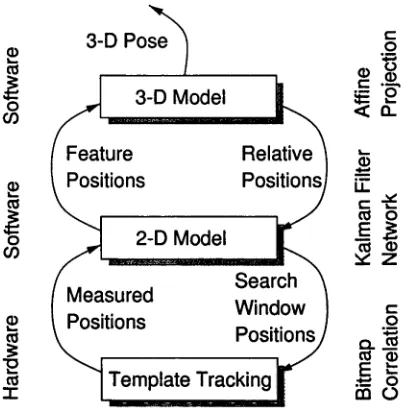
The feature based face tracking system developed in this research is described in this chapter. The system consists of three layers which extract the 3D head pose of a user from a monocular camera view. The lowest layer performs image correlations to find and track facial features such as the eyes, the mouth and the eye brows. The second layer merges the correlation results with geometric constraints provided by the 3D model of the face of the third layer. The third layer estimates the 3D pose of the head based on the robust image positions of the facial features.
Chapter 3 focuses on the first two layers which are concerned with robust feature tracking in monocular images. The actual feature tracking is performed in the first layer. However, this layer is not able to detect or recover from the loss of features, nor can it tolerate temporary occlusions of features or initialise when no feature posi-tions are known. These issues are addressed in the second layer by mechanisms such as Kalman filters to integrate the tracking results with the geometric constraints between the features, the exploitation of the strain exerted on these geometric con-straints, efficient tracking of changes in the appearance of the facial features and the balancing of resources spent between the position and the appearance tracking according to the tracking status.
Experiments demonstrate how the mechanisms achieve robust feature tracking, including feature position initialisation and feature appearance tracking.
Chapter 4: 3D head pose estim ation
Simulations and experiments using a robotic mannequin head verify the validity of the approach. The implementation of all three layers is experimentally validated on real image sequences with a person performing large and rapid head motions.
C hapter 5: Eye gaze and gesture recognition
Two additional modules based on the data derived by the face tracking system com-plete the visual human-machine interface: An eye gaze detection system and a facial gesture recognition system. The eye gaze estimation system provides a deictic com-munication channel that allows the user to reference objects and locations in the environment. The chapter also presents an experimental evaluation of the perfor-mance of the eye gaze tracking and gesture recognition modules.
The gesture recognition system consists of two layers, a preprocessing layer which detects characteristic constellations of the head pose parameters at each instance and a temporal matching layer that detects the temporal patterns in the output of the first layer.
The combination of the two modules forms a powerful visual interface for human- machine interaction. The interface uses the same communication channels that are also used in inter-human communication. Untrained users can control any device connected to the visual interface after only a few minutes.
C hapter 6: Hum an-robot coexistence
This chapter formulates a set of rules for the behaviour of human-friendly robots which define a framework which guarantees the safety of the human operator. It is particularly important to agree on a division of the responsibilities in the interac-tion between the human and the robot. Such a division is presented which allows for the development of behavioural rules for a human-friendly robot. The chapter presents a definition of the basic restrictions on the autonomous actions of a human- friendly robot. Also a control architecture is presented which incorporates the safety behaviour of the robot.
C hapter 7: Safe robot control
control constraints are verified in a simulation of a 2D0F robot manipulator. The simulation shows that impact force control can be successfully implemented.
Chapter 8: Im plem entation and experim ents
Chapter 8 presents implementation details and experimental results of the control scheme on a robot manipulator. The hardware platform is the WAM arm (Whole Arm Manipulator). This entirely cable driven 4DOF manipulator is well suited to human-robot interaction experiments because of its kinematic design, hardware safety features and light weight mechanical design. The safety scheme developed in the previous chapter is augmented with a position controller to allow the robot to move in a goal oriented manner. An outline of the software architecture used in the implementation is also presented. The implementation is tested at three different experimental levels, passive, externally generated motion, ego-motion and collision with a static obstacle. The experiments show that the impulsive impact force limitation controller has been successfully implemented.
Chapter 9: System integration
This chapter shows how the previously described components of human-friendly robots, the visual interface and the safe robot control scheme, can be used to create robotic systems that allow non-experts to interact with a robot safely and in a nat-ural and intuitive way. The system presented allows a person to control the robot with eye gaze and facial gestures only. The robot is able to retrieve objects from the environment or to put objects down in positions the user identifies by simply looking at them. The robot is also able to hand objects over to the user or the receive objects from the user.
The results of an interaction experiment are presented which demonstrate all functionalities of the system. It shows the details of the sensory data used to drive a finite state machine which represents the system state and generates all robot commands according to the gesture commands of the user.
Chapter 10.1: Conclusions
Chapter 2
Related Work
This chapter reviews previous work in the areas related to this research. It pro-vides a road map for visual human-computer interfaces and human-friendly robot control/human-robot interaction. The review categorises the different approaches and goals of the previous work. The review is followed by a discussion of the specific results that have been achieved in the visual human-computer interface area and the human-friendly robot control area respectively. This is followed by a review of the first attempts to build visual interfaces to allow a person to interact with a robot naturally and intuitively. The chapter ends with a summary.
2.1 R oad m ap
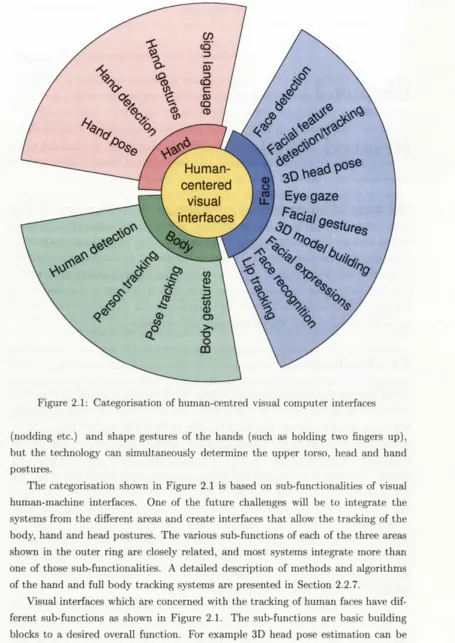
Visual human-computer interfaces have had three major development thrusts; sys-tems and methods concerned with face, hand and whole body tracking. The hand and body tracking systems are discussed only briefly since the work in this thesis is concerned with face tracking only. Figure 2.1 gives an overview over the various aspects and functions of hand and body tracking systems. While hand tracking is re-lated to face tracking in the sense that the detailed configuration of a body part over time is of interest, the work done on human body tracking is primarily concerned with the gross posture of the whole human body. No significant work has been done on integrating the three areas. One of the main reasons for this lack of integration of these obviously related areas is the problem of acquiring images of appropriate resolution. If the whole body of a person has to fit into an image, the image areas which contain the hands and the head of the person have insufficient resolution for most hand and head pose tracking systems.
Some work has been reported which track the head and the hands of a person in upper torso image sequences, but no hand or head poses are extracted [Wren and Pentland 1998], [Wu et al. 2000]. [Hongo et al. 2000] reported a system that uses multiple cameras, a wide angle scene camera and multiple cameras for the face and the hands respectively. The system recognises directional gestures of the face
Human-centered
visual
interfaces
[image:37.533.39.494.65.708.2]Eye gaze
Figure 2.1: Categorisation of human-centred visual computer interfaces
(nodding etc.) and shape gestures of the hands (such as holding two fingers up), but the technology can simultaneously determine the upper torso, head and hand postures.
The categorisation shown in Figure 2.1 is based on sub-functionalities of visual human-machine interfaces. One of the future challenges will be to integrate the systems from the different areas and create interfaces that allow the tracking of the body, hand and head postures. The various sub-functions of each of the three areas shown in the outer ring are closely related, and most systems integrate more than one of those sub-functionalities. A detailed description of methods and algorithms of the hand and full body tracking systems are presented in Section 2.2.7.
and Kambhamettu 2000] [Wu and Toyama 2000], view based face detection methods [Pappu and Beardsley 1998] or exploitation of symmetry [Jacquin and Eleftheriadis 1995]. Alternatively, sub-functions which depend on other sub-functions may implic-itly include them. View based systems [Pappu and Beardsley 1998] perform both, detection and pose estimation, in a single step and do not execute a separate face detection step. Most of the reported systems are no more than proof-of-concept systems and often the sub-functions that are required for initialisation are not im-plemented. Instead, a system may require the user to select the features in the first frame of a sequence so that the system can track the features motion in subsequent frames [Gee and Cipolla 1994]. Therefore, care is required when functionalities of different systems are compared.
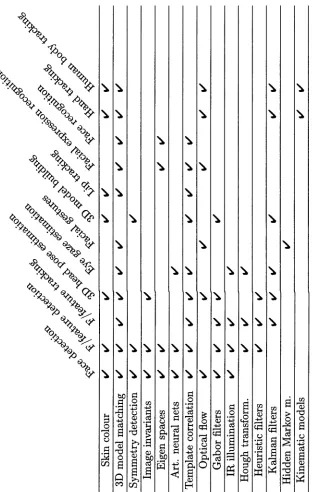
The proposed categorisation of visual interfaces using sub-functions is one possi-ble method. A categorisation could also be made with respect to the algorithms and methods used to achieve the functionality of the system. One algorithm can be used for a number of different sub-functions in different areas. For example the skin colour detection algorithm [Yang and Waibel 1996] is widely used for the detection of faces in head tracking systems, for the detection of hands in hand pose estimation systems and in the detection of the face and hands in body pose tracking systems. The re-sulting interweaving of algorithms and their applications is more complex than in the case of the categorisation along sub-functions. Accordingly, Section 2.2 is structured according to the sub-functions shown in Figure 2.1. Table 2.1 provides and overview of the relation between the functional blocks and the algorithms and methods used
to implement the functions.
2.2 Visual human-computer interfaces
Visual human-computer interfaces have attracted considerable attention in the aca-demic community in recent years. Some of the pioneering work in the face and head pose tracking area was done by [Azarbayejani et al. 1993] and by [Gee and Cipolla 1994]. The first non-intrusive eye gaze tracking system using neural net-works was reported by [Baluja and Pomerleau 1994a].
&
%
%
%
w
■'% % % * % \%
•<sv> 'v%
/y% Qa
A.
\c%
A %
% . '&» V
«.
% %
%
' \
^ ^
Q<x
■ \
\
\ *
\ ^ % Qe
\
V
\
\
*
Qa3> </ \ \ \ \ \ \ \ \ \ Sk in c ol ou r 3D m od el m at ch in g Sy m m et ry d et ec tio n Im ag e in va ria nt s Ei ge n sp ac es A rt . ne ur al n et s T em pl at e co rr el at io n O pt ic al f lo w G ab or f ilt er s IR il lu m in at io n H ou gh t ra ns fo rm . H eu ris tic f ilt er s K al m an f ilt er s H id de n M ar ko v m . K in em at ic m od el s [image:39.533.95.407.138.630.2]Safety
Measures
[image:40.533.20.522.21.763.2]Compliance
important characteristic which has not been matched by many later systems, which is impressive considering the much lower computing power available at the time.
The area of visual human-computer interaction now attracts much attention, not only in the academic community, but also in the computer vision industry1. The important subareas of visual human-computer interfaces are discussed in the following subsections.
2.2.1 Face detection
The detection of faces in still images and image sequences is one of the basic sub-functions of face-centred visual interfaces. It is required for almost all further pro-cessing stages. As in all visual feature detection methods, a tradeoff has to be made between missed occurrences and false detections of the feature. Different applications have significantly different requirements for the two error modes.
Appearance based
One straight forward method to detect faces is image correlation, that is, comparing small apriori known images of faces with the input images. Systems with a bank of fixed templates were reported in the early 1990’s [Brunelli and Poggio 1993], but their performance was unsatisfactory as they had low robustness with respect to different orientations and scaling of the faces in the image. However, this method is still used today as an initialisation stage for other face tracking systems such as face tracking systems [Matsumoto and Zelinsky 2000]. In such systems missed occurrences of faces are not critical since the detection is performed on a continuous video stream. Therefore misses in some frames do not degrade the overall system performance noticeably. This method has also been used in combination with the estimation of head pose [Pappu and Beardsley 1998]. The use of deformable templates is a variation of the fixed template method and has been applied to individual sub-features such as the eyes and the mouth (see Section 2.2.2).
Another variation of template matching is the use of eigenspaces [Sung and Poggio 1994]. The eigenspace approach assumes that all face patterns occupy a small parameterisable sub-space in the high-dimensional image space. In the training stage a representation of this sub-space, called the canonical face representation, is gener-ated from a small number of face patterns. Clusters of face patterns are represented by their principal components, or eigenvectors, as multi-dimensional Gaussians. In the detection stage the cluster model is used to calculate the distance vector of a given image to the model. [Sung and Poggio 1998] uses a Mahalanobis like distance function. The resulting distance vectors serve as input to a multi-layer perceptron. The perceptron is trained with the distance vectors from the face and non-face pat-terns. In the face detection stage the system performs an exhaustive search of the