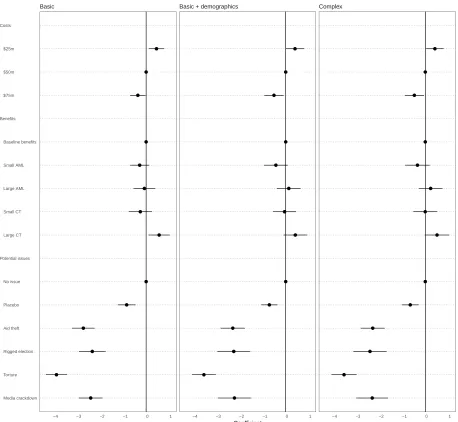
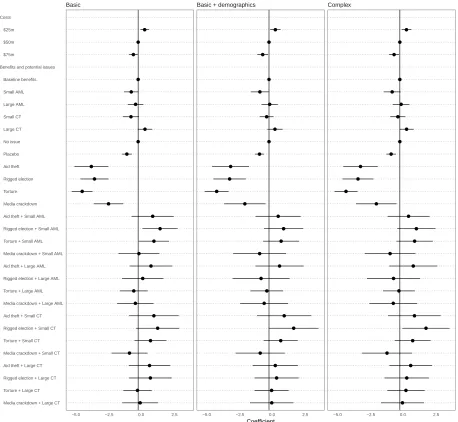
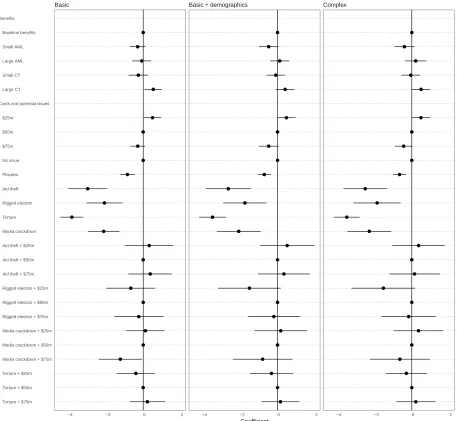
This is a repository copy of How Do People Evaluate Foreign Aid To ‘Nasty’ Regimes?. White Rose Research Online URL for this paper:
http://eprints.whiterose.ac.uk/126195/ Version: Accepted Version
Article:
Heinrich, T and Kobayashi, Y (2018) How Do People Evaluate Foreign Aid To ‘Nasty’ Regimes? British Journal of Political Science. ISSN 0007-1234
https://doi.org/10.1017/S0007123417000503
© 2018, Cambridge University Press. This article has been published in a revised form in British Journal of Political Science https:// doi.org/10.1017/S0007123417000503. This version is free to view and download for private research and study only. Not for re-distribution, re-sale or use in derivative works. Uploaded in accordance with the publisher's self-archiving policy.
[email protected] https://eprints.whiterose.ac.uk/ Reuse
Items deposited in White Rose Research Online are protected by copyright, with all rights reserved unless indicated otherwise. They may be downloaded and/or printed for private study, or other acts as permitted by national copyright laws. The publisher or other rights holders may allow further reproduction and re-use of the full text version. This is indicated by the licence information on the White Rose Research Online record for the item.
Takedown
If you consider content in White Rose Research Online to be in breach of UK law, please notify us by
How do people evaluate foreign aid to
“nasty” regimes?
∗
Tobias Heinrich
†Yoshiharu Kobayashi
‡Word count:≈10,100
Abstract
Recent theories of foreign aid assume that moral motives drive voters’ preferences over foreign aid. However, there is little knowledge how moral concerns interact with the widely accepted instrumental goals that aid serves. Moreover, what effects does such interplay have on preferences over policy actions? In this article, we assess these questions using a novel survey experiment in which respondents evaluate foreign aid policies toward nasty recipient regimes (e.g. those that torture or rig elections). The results indicate that the public does have a strong aversion for providing aid to nasty recipient regimes, but they are also appreciative of the instrumental benefits that aid acquires. Interestingly, contrary to a mainstay assertion in the literature, we find that moral aversion can be reversed to a great extent when the donor government engages more with the nasty country. These findings not only bring into question the micro-foundations of recent theories of foreign aid, but also produce a slew of implications for the aid literature.
∗We are grateful for comments from participants at the 2015 MPSA, 110th APSA Annual Meeting (2014),
2014 KUBEC workshop, 4th Annual General Conference Of The European Political Science Association (2014), and in particular from Daina Chiba, Simone Dietrich, Shu-shan Lee, Carla Martinez, Tom Scotto, Randy Stevenson, Christina Schneider, Mike Tierney, Dan Tirone, Teppei Yamamoto, Tim Peterson, and Cliff Morgan were also helpful. We also wish to thank Max Hilbig for help with executing the survey experiment and Thomas Leeper with dealing with Amazon’s MTurk.
†Department of Political Science, University of South Carolina, [email protected].
‡Department of Political Science and International Relations, Nazarbayev University,
1
Introduction
More and more research on foreign aid stresses the role of public opinion in donor
coun-tries as a key to explain complex decision-making regarding foreign aid (e.g. Van Belle,
Rioux & Potter 2004, Milner 2006, Eisensee & Str ¨omberg 2007, Hyde & Boulding 2008,
Nielsen 2013, Heinrich 2013, Milner & Tingley 2015). In particular, recent theories see
citi-zens in donor countries as driven by some moral impetus and explicitly assume that care
and concerns for others push people to support aid to poor countries and disapprove of
giving aid to unsavory1regimes.2Other work is less direct about these assumptions. When
scholars assume that the donor government wants aid to be effective for development and
welfare purposes, the implicit assumption seems to be that a non-trivial subset of people
embraces this moral dimension of aid.3
Theories’ predominant focus on the moral dimension of people’s preferences,
how-ever, runs counter to our existing knowledge on public opinion in foreign policy generally:
people do not single-mindedly evaluate foreign policy via some moral yardstick. Recent
experimental findings demonstrate that voters also care about material benefits and
conse-quences of foreign policies, ranging from immigration and trade policy to economic
sanc-tions and the use of military force.4,5 The possibility that material concerns coexist with
1 To improve legibility, we use “unsavory,” “unpalatable,” and “morally offensive” interchangeably when
they describe policies that the recipient pursues and of which citizens in the donor country might dis-approve. These are the nasty regimes from the paper’s title.
2 Our conception of morality here is in the tradition of liberal political philosophy and is about caring
and protecting others from harm. While recent studies have usefully expanded the scope of morality to include other principles (Haidt, Graham & Joseph 2009, Kertzer, Powers, Rathbun & Iyer 2014), we use the care/harm dimension as it comes closest to how foreign aid scholars are using the notion of morality.
3 Among many, see Dietrich (2013), Bush (2015), Reinsberg (2015), and Winters & Martinez (2015).
4 See examples concerning immigration policy (Scheve & Slaughter 2001a, Facchini & Mayda 2009),
trade policy (Scheve & Slaughter 2001b, Hays, Ehrlich & Peinhardt 2005), monetary policy (Bearce &
Tuxhorn 2017), economic sanctions (Heinrich, Kobayashi & Peterson 2016), diplomacy (Tanaka 2015), counterterrorism (Garcia & Geva 2016), and the use of the military (Tomz & Weeks 2013, Johns & Davies 2014).
5 In the aid literature, we also find suggestions for further non-moral dimensions of preferences. For
moral ones further complicates the task of theoretically identifying citizens’ preferences
over policy choices. Multidimensionality allows for trade-offs after all. If public
opin-ion truly holds the key to explaining donors’ policy choices, it is important to understand
citizens’ trade-offs involved in pursuing of these goals.
Drawing on these insights, we develop and study more complex micro-foundations
behind public opinion over aid policy. As a first step in this bigger enterprise, we focus on
how citizens see foreign aid policy toward nasty regimes, such as those that abuse human
rights, foster corruption, and rig elections. Aid policy toward such regimes presents an
excellent case for evaluating trade-offs. On one hand, public discussions demonstrate that
people perceive aiding such regimes to be morally unacceptable as it signifies complicity
in promoting harmful policies (Barratt 2007).6. On the other hand, substantial aid flows to
precisely such unsavory countries exist, presumably because they generate policy
conces-sions from the recipient in return for aid (Alesina & Weder 2002, Carey 2007, Nielsen 2013,
Esarey & DeMeritt 2016, AUTHOR 2016). By studying how citizens evaluate aid to these
nasty regimes, we seek to not only assess the depth and limits of people’s moral
senti-ments, but also how they interact with the pursuit of instrumental benefits and determine
the policy that people prefer their government to take.
We theorize about trade-offs between moral and material considerations and design
and implement a survey experiment to evaluate them empirically. We use side-by-side
comparisons of aid allocation scenarios in which we randomly vary multiple attributes,
including the obtained policy concessions from the recipient, potentially morally offensive
policies pursued by the recipient government, and how the donor government can deal
with these. The unsavory policies in our study include torture, theft of aid, crackdowns on
media outlets, and electoral fraud by the recipient country. These complex scenarios allow
in the donor government; all these findings rely on observational data. To our knowledge, an article by Allendoerfer (2015) and a companion paper of ours (AUTHOR 2016) constitute the only research that theorizes about moral and instrumental dimensions of preferences and rely on experimental manipula-tions.
6 Not surprisingly, such unsavory policies are also seen as common scourges for a variety of development
us to study the various trade-offs between instrumental and moral dimensions of foreign
aid policies that citizens may consider. Our survey was taken by 2,217 U.S.-based subjects
in the summer of 2014. Using this novel survey experiment, we show that people value the
morally guided as well as the political use of aid. Importantly, the moral concerns carry
far more weight, supporting one aspect of the conventional view.
We go a step further and study what these tradeoffs imply about the public’s
prefer-ences on policy toward nasty regimes. Donor governments can and do design different
features of aid policy in a way that may offset the (expected) negative reaction from their
citizens when a scandal or news coverage highlights the unpalatable policies. We
intro-duce three such remedial policies and study whether and how these policy strategies by
the donor government change citizens’ evaluation of aid. First, we examine the strategy
commonly assumed by prior research on human rights and foreign aid (see summarily
Nielsen 2013): by simply giving less aid, the donor can distance and disassociate itself
from the nasty policies of the recipient. However, our experiment shows no evidence that
this works. Second, the donor government can pair information about the specific policy
concessions from aid to lessen the concerns about aid going to an unpalatable regime; the
government would effectivelydivertattention from the unsavory polices. Our results show
that this works in some situations but is fairly ineffective overall.
Third and last, citizens may find giving aid to nasty recipients more acceptable when
their own government engages more with the recipients and specificallyaddressesthe
un-palatable issue. For example, when a recipient rigs elections, then citizens might have
fewer quarrels with the whole aid package when additional funds go toward election
monitoring. We find our strongest and most consistent results supportive of the
predic-tions with this last strategy. Across unsavory issues, donors fare betteraddressingthe issue
than ignoring it. The results are most pronounced when the recipient government is
government stands idly by;7however the drop is only 2.4 [1.7, 3.0] points when optimally
addressedby giving more aid.
At a more fundamental level, our findings provide a public opinion-based answer to
why and how democratic donors continue to provide a large sum of foreign aid to nasty
regimes. The conventional explanations to this puzzle rely on two stylized types of donors,
the samaritan and the bribe-payer. The former is altruistic and focuses its aid on unsavory
regimes to help those in dire situations. The latter type gives aid to nasty recipients because
they tend to be the optimal target to bribe for concessions (Bueno de Mesquita & Smith
2009).8 One problem with either type of donors is that their voters abhor giving aid to such
regimes as we will show. Our results suggest that, regardless of whether one conceives of
donor governments as selfless, selfish, or some mixture thereof (Heinrich 2013), donor
governments use these remedial policies routinely.
In the next sections, we develop our ideas about the interplay of public preferences over
aid, governments’ incentives, and potential policies in greater detail. Then, we introduce
the conceptual ideas in the survey design, and subsequently give the operationalizations
and the analysis. We conclude by discussing a slew of implications for wider issues in
the aid literature. These include the fragmentation of aid, the channel of delivery, and the
effectiveness of specialized aid, and we suggest that future work should explore donor
governments’ public relations efforts.
2
Moral public preferences over foreign aid
There is a long tradition in the aid literature to understand donors’ motives and
prefer-ences. Since early on, scholars have interpreted correlations between aid and covariates
to understand whether donor interests or the “needs” of recipients drive actual aid
alloca-7 Throughout, we provide 95% confidence intervals in hard brackets.
8 Bueno de Mesquita & Smith (2009) argue and show a purely selfish donor prefers buying policy
tions (e.g. McKinlay & Little 1977, Schraeder, Hook & Taylor 1998, Alesina & Dollar 2000,
Neumayer 2005). However, evidence that either motive is clearly more applicable has
long been elusive (Heinrich 2013). Recently, scholars have shifted their attention toward
the development of theoretical models that encompass multiple actors and motives, and
in particular engage the domestic political dynamics in the donor country. Two
assump-tions are widespread in the literature. First, donor governments prefer using foreign aid to
obtain any kind of policy concessions from recipients. Second, donor citizens view foreign
aid as a tool to help those under duress in poor countries. Scholars assume that such moral
motivations push voters to favor more aid to poor countries and prefer to eschew corrupt,
repressive regimes.
These conflicting preferences over the purposes of aid play a central role in recent
theo-rizing. In democracies, the government minimizes its parochial policy preferences by and
large and represents the preferences of its constituents if the anticipated electoral
conse-quences of ignoring the constituents are serious. One implication is that when citizens are
informed about foreign policy, policy becomes more congruent with the moral public
pref-erences. In this vein, scholars show why donors respond haphazardly when natural
disas-ters (Eisensee & Str ¨omberg 2007) and human rights violations harm people (Nielsen 2013).
They theorize that if either becomes prominent in the news, donors demand to give more
aid in the case of natural disasters and to withdraw it when human rights violations are
perpetrated. When voters are not informed, donors do not respond. Another example of
such citizen-government tension is Milner’s (2006) study of multilateral aid allocations.
She theorizes that donor governments delegate aid to international organizations (IOs)
as a means to deflect skepticism among their development-minded voters over potential
instrumental use of aid.
However, these new theories may stand on shaky ground. In particular, the prevalent
assumption that people are only morally-orientated is restrictive and actually at odds with
outcomes, effectiveness, and their personal benefits from policies.9More broadly, Jentleson
(1992) suggests that people are “pretty prudent” and not as single minded as assumed in
the aid literature reviewed above. More importantly, if we adopt a richer set of preferences
(e.g. material and moral concerns), it is no longer clear what policy options citizens favor.
For example, less aid to nasty regimes may soothe people’s moral concerns but is bound
to negatively affect the pursuit of instrumental goals. Similarly, while channeling more aid
through multilateral institutions may reassure citizens that aid is used for developmental
goals, this shift would also lead to less control over aid and thus fewer tangible benefits
from aid. In the next section, we will develop more policy options, some of which have
been prominently studied in the context of other foreign policies. We propose to take a
step back and develop from scratch the assumptions about individual preferences in the
context of foreign aid first. Then, we can examine the broader consideration of how donors
can manage the morality–benefits trade-offs.
3
People’s preferences and foreign aid
To examine complex preferences on foreign aid, we focus on how citizens evaluate aid
policy towards “nasty” regimes. In particular, we examine several policies pursued by
recipient governments, such as torture, theft of aid, crackdowns on media outlets, and
electoral fraud. We focus on nasty regimes and these policies because aiding such regimes
should have clear moral implications for donor citizens, as described below in more detail.
We begin by assuming that people’s attitudes toward a policy is a function of beliefs
about the attributes of the policy. Furthermore, we assume that people anticipate and
evaluate consequences on multiple dimensions and attach different saliency to each of
them. In particular, we assume two such dimensions: morality and tangible returns from
foreign aid to the recipient (i.e. policy concessions).
First, we expect moral considerations to be important for citizens to form policy
pref-erences. By morality, we mean caring for others and protecting them from harm. Aiding
nasty regimes that pursue policies like torture, theft of aid, and electoral fraud are likely
to have moral implications as these policies have clear, direct, and negative impacts on
the welfare of citizens within nasty regimes. In addition, donor citizens may consider
financial support to unsavory regimes as rendering them complicit in the wrongdoing
(Barratt 2007). These moral implications of aiding unpalatable regimes lead us to expect
that the donor public disapproves of aid to these countries. This has been central to
exist-ing work on foreign aid allocation.
Second, we also contend that citizens’ support for aid policy depends on evaluations of
the material consequences. While foreign aid is often viewed as a form of charity, it is well
known that donor governments often use aid to obtain economic and security benefits for
their citizens (e.g. Alesina & Dollar 2000, Bueno de Mesquita & Smith 2009). In many ways,
foreign aid is just like any other foreign policy in that it should bring (some) benefits to at
least a non-trivial number of citizens.10 Thus, we also assume citizens to prefer to give aid
to a regime that provides tangible benefits in return.
If our assumptions about how people view the moral and material dimensions are
cor-rect (which our survey experiments will confirm), then the best aid practice from the
vot-ers’ perspective would be to give aid to countries with democratic regimes (which tend
to be less nasty) which in turn provide lavish policy concessions. However, this is bound
to be wishful thinking as democratic recipient governments cannot provide policy
con-cessions cheaply (Bueno de Mesquita & Smith 2009). Thus, if policy concon-cessions are of
interest, donors will turn to autocrats which are the countries foremost engaged in nasty
policies (Hafner-Burton, Hyde & Jablonski 2014, Poe, Tate & Keith 1999, Treisman 2007).
As people’s desiderata cannot be catered to simultaneously, a donor government has to
de-sign a policy that remedies aspects of this dilemma. We develop and consider three such
possible options:distancing,diverting, andaddressing.
3.1 Distancing
The first strategy we consider is the one commonly assumed by previous work (e.g. Nielsen
2013, Hyde & Boulding 2008), which we calldistancing. When voters disapprove of aid to
a particular regime, the donor government is assumed to satisfy voters by withdrawing
aid to the recipient regime. As aid often signifies support and a stamp of approval for
the recipient (Barratt 2007), one simple tactic is to weaken ties with the nasty regime.
De-spite its intuitive appeal, this strategy may not be optimal from the citizens’ perspective
for the following reasons. On one hand, distancing address moral concerns as aid cuts
lead to less engagement and support to the nasty regime. On the other hand, the same
action would also bring material benefits to a halt. Aid giving serves political purposes
and withdrawal of aid would result in lost opportunities to maintain a mutually beneficial
relationship with an important state (Bueno de Mesquita & Smith 2009). Thus, we expect
thatdistancingshould have an ambiguous effect on citizens’ overall support for aid policy.
3.2 Diverting
Second, we posit that donor governments could attempt to divert the public’s attention
from the recipients’ nasty policies and thus not have to give up the policy concessions.11
Voters’ concerns about the recipients’ unpalatable policies can bedivertedby emphasizing
the policy concessions from the recipient. The logic behind this strategy is related to that of
framing. Numerous experiments by behavioral scientists demonstrate that subjects’
pol-icy preferences are strongly affected by how particular aspects of polpol-icy are presented and
emphasized (e.g. Tversky & Kahneman 1981, Chong & Druckman 2007a). Such framing
effects are particularly pronounced when the issue is complex and people have little
ex-pertise, a situation that cogently describes foreign aid policies from a citizen’s perspective.
Indeed, governments engage in deliberate framing of foreign aid, talking up its benefits
for the economy, security, or as a national duty on websites and across social media (Van
der Veen 2011). We argue thatdivertingcan be an effective measure to manage the public’s
moral concerns while not jeopardizing the receipt of material benefits. More concretely,
di-vertingwould affect citizens’ attitudes by increasing the saliency of material benefits while
reducing the saliency of moral concerns. Thus, we expect that greater policy concessions
would mitigate voters’ moral concerns.
3.3 Addressing
Third, we introduce another remedial strategy that directly tackles the moral valuation.
We take inspiration from the observation that foreign aid often comes as discrete projects
that are ostensibly designed toaddressspecific issues in the recipient country, ranging from
improving the handling of judicial matters to demographic forecasting, from
Tuberculo-sis control to reforming human rights practices and the administrative quality of elections
(Tierney, Nielson, Hawkins, Roberts, Findley, Powers, Parks, Wilson & Hicks 2011). Given
that some of these purposes are closely related to the discussed nasty issues, we argue
that citizens see funding for such specialized projects favorably as an attempt toaddress,
perhaps solve, the underlying offensive issue in the recipient country. For example, if a
recipient is rigging its elections, then the donor government may provide funds to notable
international and non-governmental organizations (IOs/ NGOs) that have a reputation
for monitoring electoral fraud. That is, aid is given in addition to the money that pays for
the policy concession.12 While this strategy costs more for the donor (which ought to be
disliked), citizens may view it more favorably. Theaddressing strategy not only mitigates
people’s moral concerns by funding to solve (eventually) the offensive issue, but also
al-lows people to continue obtaining material benefits from recipient countries. Thus, we
expect thataddressingwould lessen the public’s discontent from learning that aid goes to a
country that pursues nasty policies.
Our elaboration of preferences leads us to the following expectations. As a first step,
we investigate to which extent people’s support for foreign aid depends on concerns over
instrumental goals and moral concerns for the recipient. Second, we test whether the three
remedial strategies—distancing,diverting,addressing—can moderate the citizens’ moral
con-cerns.
4
Experimental design
In this section, we introduce a survey experiment designed to test our arguments about
moral and instrumental goals as well as donor government policy. We make use of a
side-by-side comparison of two hypothetical aid packages which Hainmueller, Hangartner &
Yamamoto (2015) suggest to fare well in capturing the real world phenomenon of
inter-est.13 Each aid package contains and randomizes information about costs and benefits as
well as other background information, including the pursuit of nasty policies and
reme-dial funds (for theaddressing policy). Below each pair, we ask the respondent to “express
[his/her] support for each aid package by checking the buttons.” The rating options range
from “Oppose” to “Support” along nine possible levels. Each respondent is shown four
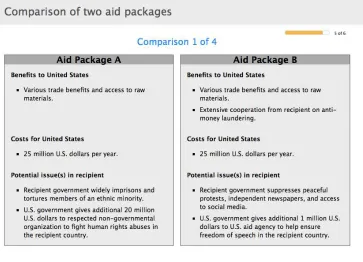
such screens in succession to evaluate. Figure 1 shows a representative screen.
4.1 Survey instrument
Each foreign aid package contains four manipulations reflecting the four variables required
to test our expectations: some baseline cost of the aid package, benefits that foreign aid
helps attain (i.e. the policy concessions), information about potentially unpalatable policies
pursued by the recipient regime, and possible actions that the government can take to
13 Such paired conjoint design have become popular in political science. See among many: Hainmueller
Figure 1:Representative example of screenshots of the survey experiment.
addressthese recipient’ policies. We explain each of these in turn.
Under “Benefits to United States,” we vary how much policy benefit foreign aid brings
about for the donor country. This manipulation helps us show how much voters like or
dislike the political use of foreign aid and lets us study whether such benefits can help
di-vertrespondents’ ire when the recipient pursues unsavory policies. All cases have a
base-line benefit specified as “various trade benefits and access to raw materials.” Randomly,
a specific policy concession is added, either “minor” or “extensive” cooperation from the
recipient on “counter-terrorism” (CT) or “anti money laundering” (AML). While this is not
an exhaustive list of benefits that foreign aid can buy, we chose these for two reasons. First,
develop-ment objectives, nicely capturing the idea of policy concessions in the form of public goods
to the donor populace. Second, cooperation on counter-terrorism ought to be particularly
salient to our respondents, which perhaps gives us a sense of how large the appreciation
of benefits can be. This results in five possible instrumental benefits.
Next, we randomize under “Costs for United States” the costs of the hypothetical aid
packages: 25, 50, and 75 million U.S. dollars.14 These costs are intended to capture the base
amount of foreign aid going to the recipient country, allowing us to investigate whether
distancingby the government mitigates the public’s moral concerns. As we argue above,
less extensive ties (i.e. less aid) with a regime that pursues unsavory policies should vex
respondents less.
To examine the extent to which public support for aid depends on moral concerns,
we consider four unpalatable policies by the recipient. First, corruption in general and
the theft of aid flows are a recurring issue in development debates. Theft of aid implies
that aid does not reach its ostensible targets, namely the impoverished, but instead goes
to politicians. The cases of politicians such as Indonesia’s Suharto, the Philippines’
Fer-dinand Marcos, and Zaire’s Mobutu Sese Seko who enriched themselves while most of
their countries lived in poverty are centerpieces of aid critiques.15 Second, good
gover-nance and political accountability have become important in discussions of development
(Winters 2010, Easterly 2010, Carothers & De Gramont 2013). Elections that are rigged or
undermined by the incumbent’s forces fail to square with the crux of elections. Citizens in
the donor country should see them as important norms to uphold (Brancati 2014). Third
and similarly, availability of news sources to learn about politics and to coordinate around
elections is crucial to functioning democracy processes. Therefore, interference with media
services by the recipient government should also be viewed as unpalatable. Last, human
14 These (roughly) correspond to 2014 U.S. net Official Development Assistance (ODA) disbursements to
Macedonia ($23m), Nicaragua ($26m), Dominican Republic ($27m), Marshall Islands ($47m), Kyrgyzs-tan ($49m), Chad ($50m), Turkey ($74m), Nepal ($75m), and India ($78m) in current U.S. dollars.
15 SeeThe Guardian, “Suharto, Marcos and Mobutu head corruption table with $50bn scams” (March 26,
rights abuses such as torture or political imprisonment on the basis of religion and
ethnic-ity are arguably the most obviously and overtly nasty policies that a recipient can pursue.
Ample literature, as discussed above, makes the link between aid and human rights. These
four potentially objectionable policies by recipients are common concerns in the study of
development, and we expect citizens in the donor country to disapprove of providing aid
to regimes pursuing such policies.
We translate these concepts about unpalatable policies into the survey experiment as
follows. Under “Potential issue(s) in recipient,” we randomly insert one of the following
six into the vignette. The first leaves blank the space in which an issue might be listed,
indicating no unpalatable policy is pursued. The second captures a placebo treatment
and states the athletes from the recipient scored an unexpected victory against U.S.
ath-letes in the last Olympic Games.16 The next four exhibit the potential recipient’s unsavory
policies: “Recipient politicians frequently steal money from development aid,”
“Recipi-ent governm“Recipi-ent systematically manipulates elections in its favor,” “Recipi“Recipi-ent governm“Recipi-ent
widely imprisons and tortures members of an ethnic minority,” and “Recipient
govern-ment suppresses peaceful protests, independent newspapers, and access to social media.”
Last, we study the idea that the donor government canaddressthe offending issue in the
recipient country. We focus on two salient features of this policy. First, we examine how the
amount of funding for such projects affects the public’s attitudes. Directing too little aid to
addressing problems may appear not effective from the eyes of the public, but providing
too much may appear wasteful as we also argued that costlier aid is less appreciated. Thus,
we examine how citizens’ attitudes respond to changes in the amount of this remedial
measure. Second, we also vary the channel of delivery of this extra aid. Drawing on
the recent literature that focuses on the variation in the aid delivery channels (e.g. Milner
2006, Dietrich 2013), we study the possibility that voters’ attitudes may change depending
16 Presumably, upsets in sporting competitions ought to not matter for the evaluation of an aid project.
on which actor directlyaddresses the underlying issue. We focus on the governmental aid
agency, NGOs, and IOs, covering the major channels used by actual donors.
If one of the unpalatable policies is drawn (aside from the placebo) for a vignette, we
randomly assign how the U.S. governmentaddressesthe issue. Either it ignores it, in which
case the bullet point for a remedy remains blank, or it proposes additional aid aimed at
addressing the issue. The language for the latter is: “U.S. government gives additional
Amountmillion U.S. dollars toAgencytoGoalin the recipient country,” where the
vari-ablesAmount∈{1, 5, 10, 15, 20, 25},Agency∈{U.S. agency, respected non-governmental
organization, respected international organization}, and Goal ∈ {help solve corruption
issues, ensure free and fair elections, fight human rights abuses, help ensure freedom of
speech}. Goalis automatically matched to the randomly drawn issue.
These packages capture many of the essentials of governments’ foreign aid policy choices:
costs, benefits, aspects about the target, and governments’ attempts to deal with potentially
unpalatable issues. All these fully randomized aspects are evaluated jointly, and we will
disentangle the causal interactive effects within the evaluations.17
4.2 Administration of survey
We recruited subjects via Amazon’s MechanicalTurk (MTurk) between August 5–19, 2014.
After accepting the task, participants were directed to a page on one of the authors’
web-site. 2,217 subjects participated in our survey experiment.18 As each subject sees four
17 Implicitly, our ensuing results are not only averaged across all attributes the aid package that one
evalu-ates, but also over the distribution of realizations of the other aid package on the other side of the screen. Some investigation shows that a left/right aid package entanglement exists and that it works consistent with our theory: the more expensive, the nastier the policy, and the worse the policy benefits are in the right-hand side package, the better the left-hand package gets rated. We see this as inherent in the side-by-side conjoint design. As Hainmueller, Hangartner & Yamamoto (2015) point out that side-side-by-side comparison fare better in capturing real world phenomena, we do not see this left/right entanglement as a problem. Future work could more explicitly study the implications and dynamics of competing
policy and framing proposals (e.g. Chong & Druckman 2007b). We thank a referee for making us think
about this issue.
18 It is well known that samples recruited via MTurk have demographics different from the target U.S.
side-by-side comparisons, we have 2, 217×4×2=17, 736 evaluations.19
4.3 Statistical analysis
In order to evaluate our various expectations, we rely on four linear regression models. We
define our outcome variableYas a measure of support for foreign aid (a nine-point scale in
which higher values indicate greater support levels). We include in our first specification
a series of indicator variables representing each level of the recipients’ potential issues,
benefits from aid giving, and baseline costs, which we denote byP,B, andC, respectively.20
Specifically, Equation 1 represents our first model (suppressing subscripts):
Y =α0+
∑
2≤j≤3α1jI(C=cj) +
∑
2≤k≤5
α2kI(B =bk) +
∑
2≤l≤6
α3lI(P =pl). (1)
where I(·)is the indicator function which takes the value 1 if the condition in the
paren-thesis is true and 0 otherwise.
To examine whether the distancingstrategy moderates the voters’ moral concerns, we
extend the first model by adding interactions between the cost dummies and the potential
by relying respondents from MTurk in that results are qualitatively very similar (Berinsky, Huber & Lenz 2012, Mullinix, Leeper, Druckman & Freese 2015).
19 Following suggestions by Berinsky, Margolis & Sances (2014), we included a screener as well as a
warn-ing that participants had to demonstrate that they were paywarn-ing attention to the instructions. (The screener was administered before treatments were assigned.) We dropped a small number of
obser-vations because either participants failed our screener excessively often (> 4) or barely spent any or
several minutes on each evaluation screen (less than ten or more than 200 seconds per screen). 124
re-spondents’ evaluations were omitted from the study, leading to a loss of 124×4×2=992 observations.
20 More precisely, we defineP,B, andCand their respective possible values as follows:
P={p1, ...,p6}={No Issue, Placebo, Aid Theft, Rigged Election, Torture, Media Crackdown}
B={b1, ...,b5}={Baseline Benefits, Small AML, Large AML, Small CT, Large CT}
C={c1,c2,c3}={$50m, $25m, $75m}.
issues. This leads us to our second model:
Y =β0+
∑
2≤j≤3β1jI(C =cj) +
∑
2≤k≤5
β2kI(B=bk) +
∑
2≤l≤6
β3lI(P = pl)
+
∑
2≤j≤3 3≤l≤6
β4jlI(C =cj∧P= pl). (2)
If distancing is effective, we should find that the effects of the unpalatable issues to be
smaller when the baseline cost is small than high. That is, in Equation 2, we expect that
the effect of unsavory policyl when the cost is $75m (β3l+β43l) is smaller than when it is
$50m or $25m (β3l andβ3l+β42l, respectively).
The third model is used to examine the effects ofdiverting. We modify the first model
by interacting all benefits with all issues but the placebo:
Y =δ0+
∑
2≤j≤3δ1jI(C =cj) +
∑
2≤k≤5
δ2kI(B=bk) +
∑
2≤l≤6
δ3lI(P= pl)
+
∑
2≤k≤5 3≤l≤6
δ4klI(B =bk∧P = pl). (3)
If the divertingstrategy mitigates the moral concerns, we expect that the effects of nasty
issues decrease with higher values of benefits. In Equation 3, we are specifically interested
inδ3l+δ4kl for issuelwhere 3≤l ≤6.
Last, we use the fourth model to study theaddressingstrategy by extending the baseline
in the following ways. First, we add the interactions between the issues and the linear
term of the additional aid, which is denoted by R, for each channel of delivery denoted
asD.21 These are in essence triple interactions, which allow for channels to have different
effects depending on the issue. Second, we add another set of interactions between the
21 More precisely,RandDare defined as follows:
R={0, 1, 5, 10, 15, 20, 25}
issues and no remedial aid (R = 0). It is important to include these as well because they
allow us to estimate the effect of ignoring the issues in the recipients separately.22 Thus,
mathematically, our fourth model is specified as:
Y =γ0+
∑
2≤j≤3γ1jI(C=cj) +
∑
2≤k≤5
γ2kI(B =bk) +
∑
2≤l≤6
γ3lI(P = pl)
+
∑
2≤l≤6
γ4lI(P = pl∧R=0) +
∑
3≤l≤6 1≤m≤3
γ5mlI(P= pl∧D =dm)×R (4)
In Equation 4,γ5ml×Rcaptures howRamount of additional aid through delivery channel
m conditions the effect of issue l while γ4l represents the effect of ignoring the issue by
giving no additional aid. Thus, to study whether addressing moderate the effects of the
issues, we compareγ5ml×Randγ4l for issuel.
When using the first three models to study the effects of issues and benefits as well as
thedistancing and divertingstrategies, we drop all observations in which some addressing
occurs (i.e. any with R > 0). We do this to keep the analysis simple so that we do not
have to account for any remedial aid (R); the results do not change when we include all
the observations. This leaves us with 4,975 evaluations for the first three models. When
we studyaddressingvia Equation 4, we use all the observations.
Respondents from MTurk do not represent a random sample of the U.S. population
(Berinsky, Huber & Lenz 2012, Huff & Tingley 2015). While the experimental manipulation
guarantees internally valid treatment effects, these estimates are only representative of the
population if treatment effect homogeneity holds. We believe that it is unlikely to hold,
but have no theoretical or empirical guidance for how big this heterogeneity ought to be.
Thus, we reweight our sample to match several demographic characteristics of a known
nationally representative survey.23 Our survey experiment includes numerous questions
22 For instance, the effect on the rating when R = 0 increases toR = 1 can be different from, say, when
R=6 changes toR=7. We view this as substantively important.
23 Hainmueller, Hangartner & Yamamoto (2015) and Wang, Rothschild, Goel & Gelman (2015) show how
experi-from the 2012 Cooperative Congressional Election Study (CCES) (Vavreck & Rivers 2008,
Ansolabehere 2012), and we use entropy balancing and create weights for our own data so
that several covariates’ moments match those of the CCES data (Hainmueller 2011). Our
preferred weights come from a complex set of variables to capture a variety of sources of
heterogeneous treatment effects: age, gender, whether one had four years of college and
beyond, a linear version of an ideological self-assessment, whether the respondent has a
full-time job, and whether life has got worse or much worse recently.24 Figure A.10 in the
appendix shows that entropy balancing removes the large imbalances in the raw data.25
Before proceeding, we want to address the generalizability of our U.S.-based results to
other major donor countries. While differences in level of public support for aid across
donor countries exist (see the respective Tables 1 in No¨el & Th´erien (2002) and Paxton &
Knack (2012)), the heterogeneity of individual-level effects need not necessarily be
note-worthy. In a rare effort examining this, Heinrich, Kobayashi & Bryant (2016) report that
individual (parochial) pocketbook effects on the support for aid are not unusual for the
United Kingdom compared to those of other European Union states. This is noteworthy as
the country is often portrayed as a stalwart for effective aid. While surely there will be
dif-ferences in magnitudes of effects across countries, it is not obvious why the fundamental
logic behind trade-offs between moral and instrumental goals behind aid should be absent
or reversed elsewhere. That said, we hope future studies will replicate (elements of our)
study in other countries to gain confidence in the generalizability of results.
Last, given that each respondent rates numerous packages, intra-subject correlations
are expected (Hainmueller, Hopkins & Yamamoto 2014). We account for these by
esti-ments.
24 These cover a set of rather standard demographic covariates as well as some that prior survey research
has shown to matter for attitudes on aid. See Heinrich, Kobayashi & Bryant (2016), Paxton & Knack (2012), and Chong & Gradstein (2008).
25 We replicate all analyses with two sparser sets as robustness checks. In our “basic” weighting
mating the variance-covariance matrix of the sampling distribution via a cluster-bootstrap
(Harden 2011), which we use for the parametric bootstrap to calculate uncertainty for the
estimates (King, Tomz & Wittenberg 2000).26
5
Results
We first examine the unconditional results for how moral and political concerns affect
pub-lic attitude for aid-giving, and how much costs matter.27 After showing these, we examine
the three proposed policies that might mitigate the public’s moral concerns.
5.1 Political and moral concerns
Of particular initial interest to us are the treatment effects of the benefits and the
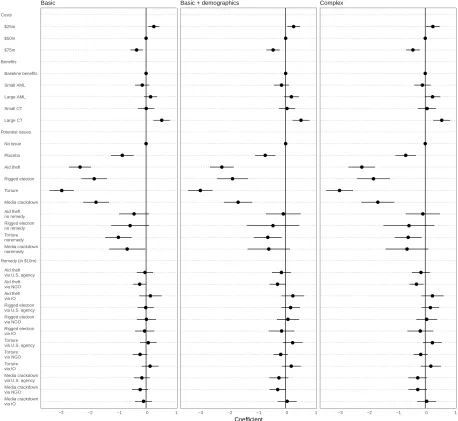
unpalat-able policies in the recipient country, presented in Figure 2. We use dots to represent
me-dian estimates and horizontal lines to indicate the 95% confidence intervals for the
treat-ment effects. The effects should all be interpreted in comparison to the reference levels:
the baseline benefits of “various trade benefits and access to raw materials” for the
bene-fits and no issues for the recipient’s unpalatable policies.
The results provide considerable support for the claim that voters evaluate foreign aid
on moral grounds. Consider the effects of the recipients’ issues, shown in the lower part of
Figure 2. First, it is noteworthy that the placebo is negative and statistically
indistinguish-able from zero. Merely presenting an issue unrelated to aid and development already
lowers respondents’ appreciation of the aid policy by −0.7 [−1.0,−0.3]. However, the
26 Our estimands correspond (relatively) closely to what Hainmueller, Hopkins & Yamamoto (2014) call
average component marginal effects (ACMEs) and average component interaction effects (ACIEs). The only difference is that we assume linearity for one of the terms in Equation 4, which nixes the non-parametric interpretation. However, as we are comparing our effects against a placebo condition and because everything has a rather straightforward substantive interpretation, we will not use the ACME and ACIE terminology to explain the results.
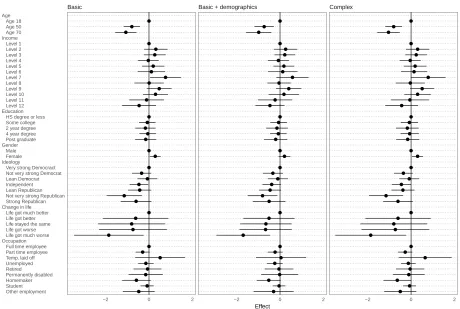
27 In the appendix, we also show a regression of the ratings on respondents’ demographics and
● ●
● ●
●
●
● ●
● ●
● ●
● ●
Media crackdown Torture Rigged election Aid theft Placebo No issue Potential issues Large CT Small CT Large AML Small AML Baseline benefits Benefits $75m $50m $25m Costs
−4 −3 −2 −1 0 1
Coefficient
[image:22.612.85.538.75.325.2]Costs, benefits, and potential issues
Figure 2: Effects of benefits, potential issues, and cost of aid. The x-axis presents the coefficient estimates
for each variable on the y-axis. The presented effects correspond to all estimates of α1j, α2k, and α3l in
Equation 1. The dot denotes the median estimate, the horizontal lines the 95% confidence intervals. All regression coefficients for the model are shown in Figure A.3 in the appendix.
placebo effect is much smaller than the effects of aid theft (-2.3 [-2.8, -1.7]), rigged elections
(-2.4 [-3.1, -1.6]), media crackdown (-2.3 [-3.0, -1.6], and torture (-3.5 [-4.0, -3.0]). Perhaps
unsurprisingly, torture elicits the greatest disapproval. Each of the issues exerts a strongly
negative effect on the evaluation of the foreign aid policy. It is thus the case that citizens
disapprove of providing aid to regimes with unpalatable policies, replicating the basic
re-sult by Allendoerfer (2015).
The survey respondents also appreciate greater benefits that come from giving aid.
Looking at the lower part of Figure 2, respondents appear to be indifferent or actually
slightly negative about small benefits (ie. minor cooperation from recipients) in
compar-ison to just obtaining the baseline benefits. Major cooperation on anti money laundering
are appreciated, but not strongly so. In contrast, cooperation on counter-terrorism fares
better. An extensive concession on fighting terrorism increases support by 0.5 [0.0, 1.0].
to a cost $50m, aid at $75m reduces support by 0.5 [0.1, 0.9]. If costs fall to $25m, support
increases by 0.4 [0.0, 0.8]. This corroborates (broadly) the pocketbook effects in aid which
Heinrich, Kobayashi & Bryant (2016) report.
The first batch of results suggests dual motives in voters’ evaluation of foreign aid
policy. Voters not only desire to see foreign aid used in a moral way but also appreciate
(some specific) benefits obtained by aid-giving. However, Figure 2 also shows that the
negative effects of the recipients’ unpalatable policies are much larger in magnitudes than
those of benefits of aid-giving, substantiating the often-made claim that voters see foreign
aid mainly through a moral lens.
Thus, when the donor government designs aid policy and aims to prevent alienation
of the public, it needs to consider what is taking place in the recipient country. That is, the
worst that can happen to the public support for a donor’s aid policy is the policy pursued
by the recipient country. Since the donor government also wants policy concessions mainly
from countries most likely to pursue such policies, donors should often be at an impasse.
5.2 Effectiveness of three remedial actions
Next, we test howdistancing,diverting, andaddressingcan moderate the negative effects of
recipients’ unpalatable policies on the rating. More specifically, we are interested how the
costs of aid packages, the benefits of aid-giving, and the funding of specific projects change
the effects of the unpalatable policies.
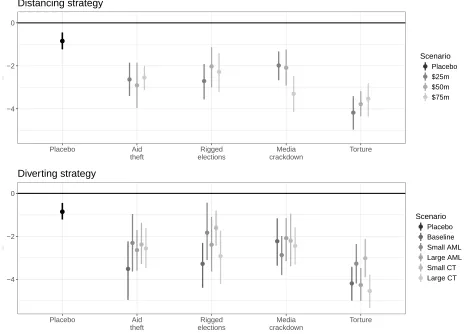
Figure 3 shows the effects of recipients’ morally offensive policies on subjects’ ratings
conditional on the costs of aid packages and benefits from aid-giving. First, consider the
top panel in Figure 3 for the results of the distancing strategy. The y-axis shows the
con-ditional effects whereas the x-axis list all the unpalatable policies as well as the placebo.
Each of the vertical lines (and their respective dots) give the effect of the issue listed on
the x-axis conditional on aid costing $25m, $50, and $75m, from left to right. Contrary to
● ● ● ● ●● ● ● ● ● ● ● ● ● ● ● ● ● ● ● ● ● ● ● ● ● ● ● ● ● ● ● ● ● ● ● −4 −2 0 −4 −2 0 Placebo Aid theft Rigged elections Media crackdown Torture Placebo Aid theft Rigged elections Media crackdown Torture Conditional eff ect Conditional eff ect Scenario ● ● ● ● Placebo $25m $50m $75m Scenario ● ● ● ● ● ● Placebo Baseline Small AML Large AML Small CT Large CT Distancing strategy Diverting strategy
Figure 3: Effects of unpalatable policies conditional ondistancinganddiverting.. The y-axis present the conditional effects of unpalatable policies of recipients whereas the x-axis represents all the recipient’s issues.
These correspond to the estimates ofβ3l+β42l,β3l, andβ3l+β43l(from left to right) in Equation 2; those of
δ3l+δ42l,δ3l+δ43l,δ3l+δ44l,δ3l+δ45l(from left to right) in Equation 3. The vertical lines and dots indicate
the 95% confidence intervals and the median estimate. Each separate vertical line shows a different remedial policy. The coefficients themselves are shown in Figures A.4 and A.5 in the appendix.
entanglement) aid does not consistently reduce public moral concerns over the unsavory
policies. For example, consider torture. The effect of torture is -3.2 [-4.1, -2.4] when the
cost of aid is $75m. If cutting the extent of aid was to successfullydistancethe donor from
the recipient’s policy, then the effect should become less negative when costs are $25m or
$50m. However, the disapproval actually increases in magnitude (to -3.8 [-4.6, -3.0] and
-3.4 [-4.2, -2.8], respectively). Across all policies, no consistent evidence emerges.28
The second strategy we examine is diverting, which is shown in the bottom panel in
28 Under one of the alternative sample reweighting schemes,distancingproduces a single statistically
Figure 3. We expect the effects of unpalatable policies to decrease as more benefits are
attained by giving aid. The results show some, but no consistent mitigating effects from
diversion. While most differences are indeed positive, some are actually making the
eval-uation worse, and only one policy benefit can significantly reduce citizens’ disapproval:
small anti money laundering benefits can undo some of the disapproval from the recipient
rigging elections. However, this is just one out of 16 cases.
●
●
●
●
●
●
● ●
●
−4 −2 0
Placebo Aid
theft
Rigged elections
Media crackdown
Torture
Conditional change
Scenario ●
●
● Placebo No remedial aid Best response
[image:25.612.76.535.224.409.2]Addressing strategy
Figure 4: Effects of unpalatable policies conditional when the government optimallyaddresses. The y-axis present the conditional effects of unpalatable policies of recipients whereas the x-y-axis represents all the recipient’s issues. The vertical lines and dots indicate the 95% confidence intervals and the median estimate. The coefficient estimates are shown in Figure A.2 in the appendix.
Finally, we investigate the addressing strategy. We first discuss how we show our
re-sults. Largely, channeling additional aid through one’s own agency, an NGO, or an IO and
choosing how much to fund are under the donor government’s discretion (Milner 2006,
McLean 2012, Dietrich 2013). That is, the donor government optimizes this and does not
randomize channel like we have done in the vignette. Therefore, it is not enlightening for
our purposes to consider all possible responses in great detail (ie. every level of remedial
aid via all three channels for each issue). Rather, we want to focus on the optimal
combi-nation of additional aid and channel. Using our statistical model (Equation 4) discussed
minimizes the respondent’s ire from the unsavory policy. We search over the space of
$0-25m extra aid that is given via one channel of delivery. As we do so for every draw of the
parametric bootstrap, we obtain the entire distribution of best responses for each potential
issue.29
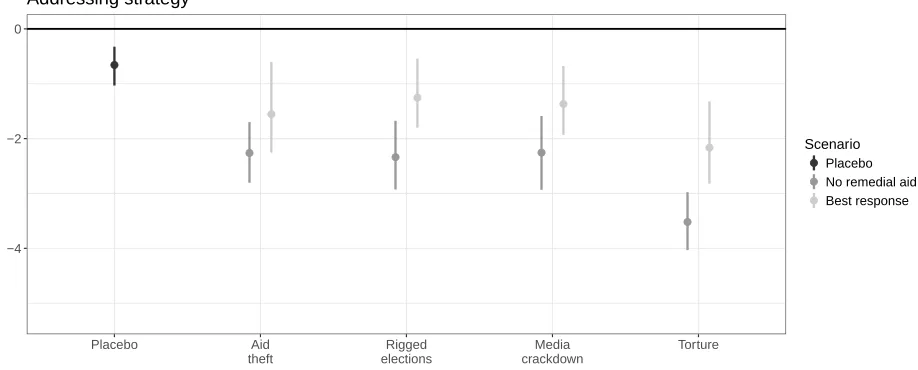
Figure 4 shows the effects of nasty policies on support conditional on the optimal
re-medial aid to address each issue. The darker lines and dots show the effects when the
government stands idly by and gives aid to a regime pursuing the unsavory policy listed
on the x-axis; the lighter variants show the effects when the optimal amount of aid and
channel of delivery is chosen.
Unlike the distancing and diversion strategies, the results here show consistently that
the effects of unpalatable policies significantly improve when the government applies the
best responses. For every issue aside from stolen aid is the 95% confidence interval of the
difference between the optimally tackled issue and the unremedied issue positive. The
improvements are also quite strong in magnitude. Take the rigged elections, for example.
When the rigged elections remainunaddressedby the donor, the support reduces by 3.7 [2.3,
6.6] times the effect-size of the placebo. When the donor optimally bundles the remedial
aid, then this effect falls to only 2.0 [0.9, 3.9] times the placebo size. The effects are also
pronounced for torture, which is the issue that elicits the most negative response. The
reduction in support is 5.7 [3.6, 10.8] times the placebo when the government stands idly
by, but shrinks to 3.5 [1.9, 6.5] times the placebo-effect if optimallyaddressed.
We wish to take these results a step further. So far, we have left the specific channel of
delivery in the background as we have focused on the best response that the government
can choose. Unlike in this survey experiment, reality should constrain donors (somewhat)
in their choice of the channel of delivery; the optimal IO or NGO might be reluctant to
29 Formally and working with Equation 4, we calculate the following for each issuel:
max
r∈{0,1,...,25}
m∈{1,2,3}
γ3l+γ4lI(r=0) +γ5mlI(D=dm)×r
accept governmental funds or is unwilling to engage in the particular recipient country.
Therefore, we also examine whether the donor can significantly lower the citizens’
malcon-tent through each of the three channels. In Figure A.9 in the appendix, we show for every
issue and for every channel of delivery the difference between the effect of the issue when
optimally choosing the remedial aid and the effect when the issue is leftunaddressed.30 For
the theft of aid, only the IO channel is effective at remedying the citizens’ ire. However, for
the other three issues, the optimal use of each channel leads to higher support than when
the donor does notaddress the issue at all.31 Except for the case of aid theft, each channel
allows for the donor to design additional aid that would make people more supportive
than if it remained oblivious to the issues.
6
Discussion and broader implications
Our findings lay out a more nuanced, complex understanding of voters’ preferences on
foreign aid than what the recent theories assume. Consistent with these aid allocation
the-ories, we found that voters care about moral consequences of aid policy. However and
contrary to commonly invoked assumptions, the moral dimension of public opinion does
not have a clear and unidirectional effect on preferences over policy. We found no evidence
that aid withdrawals mitigate voters’ moral ire on aiding nasty regimes as often assumed
by the recent theories. This is not surprising if we account for people’s additional concerns
about material benefits. Because aid cuts would jeopardize flows of benefits from the
re-cipients, voters do not wholeheartedly support weakening ties with the nasty recipients.
It stands to reason that withdrawal of aid is likely not the optimal response for the donor
30 Formally, we calculate the following for each issueland each channelm:
max
r∈{0,1,...,25}γ4lI(r=0) +γ5mlI(D=dm)×r−γ4l
whereγ3lis canceled in this expression.
31 Out of these nine estimates, the lower bound of three of the 95% confidence intervals just touch zero.
government and sudden drops in aid flows to these regimes seem unlikely. It follows that
parts of the recent theories are unlikely to hold.
Instead of weakening ties with nasty regimes, we found that voters prefer increased
engagement with them. Paradoxically, our findings suggest that voters’ morality-driven
support may push the government to give more aid to nasty regimes.32 This provides
possible reasons for why massive amounts of foreign aid continue going to countries like
Egypt and Pakistan and for why scholars have been unsuccessful in finding clear evidence
in favor of moral considerations in overall aid allocations (e.g. McCormick & Mitchell 1988,
Neumayer 2005).
Our findings about addressing also suggest where moral concerns may materialize in
the study of actual aid flows. We expect that more specialized, issue-specific aid (and not
necessarily general aid) should be given to regimes with objectionable policies to maintain
engagement. Some existing evidence is consistent with this expectation: Nielsen (2013,
Table 1) shows that funds specifically for human rights and democracy promotion
actu-ally increase as a recipient’s respect for human rights declines. While it is not clear from
his empirics how such increases in specialized aid is tied to other categories of aid, our
study shows the importance of thinking through the complex mechanisms through which
people’s preferences affect actual policies.
In this spirit, we engage our arguments and results further by discussing what they
suggest to the broader aid literature. Below, we discuss in more detail three ideas that we
see as ripe for exciting future research.
6.1 Aid heterogeneity and fragmentation
While we kept our experiment simple to have only one policy that make the recipient nasty,
we know that many of these unpalatable policies occur jointly (Besley & Persson 2011). In
turn, the donor government would have toaddress multiple issues simultaneously. This
32 We do not wish to suggest that this is always the case as in some cases donor governments may use aid
may lead to what is commonly known as “aid heterogeneity,” “project proliferation,” or
“aid fragmentation” (Mavrotas 2005, Roodman 2004, Easterly 2006)—many projects with
varying purposes delivered through different channels. Development scholars often
com-plain that such heterogeneity are a drain on aid because they spawn extra administrative
and reporting responsibilities for recipient governments. Development advocates have
moved to rank, name, and shame donors for high levels of fragmentation (Easterly &
Williamson 2011, Birdsall & Kharas 2013).
The existing literature on aid heterogeneity largely focuses on the effectiveness of
dif-ferent modalities and channels of aid as well as what gives rise to specific types and
de-livery channels (e.g. Dietrich 2011, Hamilton & Stankwitz 2012, Buntaine & Parks 2013).
Quite sensibly, almost all such research focuses on one or two aspects of aid heterogeneity
at a time (Milner 2006, Fariss 2010, Dietrich 2013, Milner & Tingley 2013, McLean 2015).
However, a downside with such an approach is that we are left with separate bodies of
knowledge that do not inform us about realizations (and lack thereof) of other dimensions.
For example, McLean (2015) explains delegation to IOs in the context of environmental aid.
While she provides insights into her research question, her study stays silent on why NGOs
would not be a better delivery channel, or why aid is allotted to environmental issues but
not toward health goals.
This exemplifies what Most & Starr (1989) call “islands of knowledge,” a fragmentation
of insights. Other bodies of international relations literature take to heart this greater scope
of study. For example, the study of foreign policy does so under the name “foreign policy
substitutability” (Palmer & Morgan 2006), and the study of international cooperation via
the “the rational design of institutions” framework (Koremenos, Lipson & Snidal 2001).
We believe that the study of foreign aid could also advance further by studying aid
hetero-geneity more generally under a common theoretical framework. Our evidence points to
donor citizens’ aid preferences and the donor government’saddressingstrategies as useful
6.2 Does addressing aid work?
Our findings also have implications for aid effectiveness, which remains an active area
of research. In particular, they speak to the puzzle of why recipient regimes would
al-low certain types of aid that appear to weaken the strength of the regime. Most
no-tably, recent evidence concurs that democracy aid, which funds projects for civil society
vibrancy, is effective at inducing democratization and accountability (Finkel, P´erez-Li ˜n´an
& Seligson 2007, Scott & Steele 2011). Then, why would a (nasty) dictator allow such
fund-ing? Arguments by Dietrich (2011), Bush (2015), and us point toward an answer to this
puzzle.
Our argument suggests that the donor government’s principal, the voters, entangles
aid for the policy concession and aid to address deficits in democracy. If people’s moral
motives were absent, recipient and donor governments would prefer to collude on pure
aid-for-policy deals (Bueno de Mesquita & Smith 2009) as they would save the donor
gov-ernment money (ie. specialized aid) and the recipient govgov-ernment would not have to deal
with regime-threatening “intrusions.” This collusion would ensure that the donor gets
pol-icy spoils (at some opportunity costs) and the recipient gets funds to bolster the regime
(Remmer 2004, Kono & Montinola 2009, Licht 2010).
However, the problem is that the donor public takes umbrage with a nasty recipient
regime. When the public can affect its government, the donor is forced toaddressthe
unsa-vory policies to prevent the aid-for-policy deal to unravel at home. Thus, people’s moral
motives force both governments into a new equilibrium and away from the pure
collu-sion constellation. In it, the donor gives aid to pay for policy concescollu-sions as well as aid
toaddressthe offensive issue, which the recipient accepts. However, in the case of
democ-racy aid, these additional funds may weaken the government’s hold on autocratic power
(Finkel, P´erez-Li ˜n´an & Seligson 2007, Scott & Steele 2011)33
33 One exception is the work by Wright (2008) who shows that some kinds of dictators are actually induced
by regular to democratize. In these cases, the remedialaddressingshould just accelerate or smoothen the
This logic may explain why recipient regimes are willing to accept remedial aid that
threatens their survival as prior research demonstrates. That raises a subsequent question:
why would such remedial,addressingaid be effective? After all, nothing in our own
theo-retical account requires it to actually achieve something; it might as well bekabukitheater.
Effectiveness might come about through a long chain of delegation from people to NGOs
and IOs who execute the projects. Bush (2015) and Dietrich (2011) argue that NGOs try to
be effective because their governmental funders monitor who in turn report to their
vot-ers that their tax money (ie. aid) was not squandered abroad. NGOs’ incentives are not
enough for effectiveness as the recipient government may still stonewall or sabotage the
projects. However, if the recipient government were to do so, NGOs would portray the
recipient as the prime detractor,34which would ultimately fray theaddressedaid-for-policy
collusion between the donor and the recipient governments. Thus, both NGOs and the
recipient government have incentives to make sure thataddressing aid works to maintain
the aid flows.
6.3 Messages about aid
Much debate about foreign aid and development occurs in public. For example in 1947,
U.S. President Truman was concerned with obtaining public support for what came to be
known as the Marshall Plan. He worried that the public would object to his administration
providing aid to a corrupt and non-democratic Greek government. Truman reflected in his
memoirs that “there was considerable discussion on the best method to apprise the
Ameri-can people of the issues involved,” settling eventually on “[explaining] aid to Greece not in
terms of supporting monarchy but rather as a part of a worldwide program for freedom”
(cited in Ambrose & Brinkley 2011, pg. 81). Today, books on development aid are
main-stream (Sachs 2006, Collier 2007, Moyo 2009), and celebrity activists such as Bob Geldof
and Bono engage the public widely. Implicit in their efforts to manipulate and convince
the public is the belief that public support is crucial to make progress on development and
that it is possible to shape public opinion on foreign policy. Recent research agrees with
the latter that public opinion on foreign policy is malleable via elite messaging (Aldrich,
Gelpi, Feaver, Reifler & Sharp 2006, Baum & Potter 2008).
Our results show that some aspects of a multifaceted foreign aid policy resonate with
people and that some of those are under the donor government control. However, the
public is often ill-informed about foreign policy in general and foreign aid in particular.
Then, even if actual aid policy reflects citizens’ concerns, they may not be aware and thus
their opinion does not respond to changes in aid policies. One important step missing
is that citizens learn about aid policy from the messages sent by elites and the media
(Zaller 1992, Baum & Potter 2008). Thus, in addition to choosing appropriate volumes,
types, targets and delivery channels of aid, we might expect the donor governments to
tailor messages in ways that increase public support and avoid criticisms.35 In particular,
our evidence leads us to expect donor governments would downplay unpalatable policies
chosen by the recipient (and turn to providing more aid toaddressthe issue).
Two observations provide preliminary support for the basics of the expectation. First,
all aid agencies spend non-trivial resources on public relations (Van der Veen 2011),
pro-duce streams of press releases, and are active on social media. Second, we have some
evidence that governments do care about the messages about their policies and seek to
manipulate unwanted information. For instance, Dreher, Marchesi & Vreeland (2008)
re-port that the International Monetary Funds (IMF) biases its growth and inflation forecasts
favorably for states which are friendly to the United States, and Qian & Yanagizawa (2009)
find that the U.S. State Department tends to downplay human rights violations for military
allies. In each case, presumably indirectly for the IMF and directly so for the State
Depart-ment, the U.S. government works to have issues (low growth, high inflation, bad human
rights) not stir people’s ire which might jeopardize what we would call policy concessions.