Edited by: Davide Bigoni, University of Trento, Italy
Reviewed by: Ivan Argatov, Technische Universität Berlin, Germany Alberto Salvadori, University of Brescia, Italy
*Correspondence: Enrico Dall’Ara [email protected]
Specialty section: This article was submitted to Mechanics of Materials, a section of the journal Frontiers in Materials Received: 25 July 2017 Accepted: 09 October 2017 Published: 08 November 2017 Citation: Dall’Ara E, Peña-Fernández M, Palanca M, Giorgi M, Cristofolini L and Tozzi G (2017) Precision of Digital Volume Correlation Approaches for Strain Analysis in Bone Imaged with Micro-Computed Tomography at Different Dimensional Levels. Front. Mater. 4:31. doi: 10.3389/fmats.2017.00031
Precision of Digital Volume
correlation approaches for
strain analysis in Bone imaged
with Micro-computed Tomography
at Different Dimensional levels
Enrico Dall’Ara1*, Marta Peña-Fernández2, Marco Palanca3, Mario Giorgi1,
Luca Cristofolini3 and Gianluca Tozzi2
1 Department of Oncology and Metabolism and INSIGNEO Institute for In Silico Medicine, University of Sheffield, Sheffield,
United Kingdom, 2 Zeiss Global Centre, School of Engineering, University of Portsmouth, Portsmouth, United Kingdom,
3 School of Engineering and Architecture, Alma Mater Studiorum – Università di Bologna, Bologna, Italy
Accurate measurement of local strain in heterogeneous and anisotropic bone tissue is fundamental to understand the pathophysiology of musculoskeletal diseases, to evaluate the effect of interventions from preclinical studies, and to optimize the design and delivery of biomaterials. Digital volume correlation (DVC) can be used to measure the three-dimensional displacement and strain fields from micro-computed tomography (μCT) images of loaded specimens. However, this approach is affected by the quality of the input images, by the morphology and density of the tissue under investigation, by the correlation scheme, and by the operational parameters used in the computation. Therefore, for each application, the precision of the method should be evaluated. In this paper, we present the results collected from datasets analyzed in previous studies as well as new data from a recent experimental campaign for characterizing the relationship between the precision of two different DVC approaches and the spatial resolution of the outputs. Different bone structures scanned with laboratory source μCT or synchrotron light μCT (SRμCT) were processed in zero-strain tests to evaluate the precision of the DVC methods as a function of the subvolume size that ranged from 8 to 2,500 µm. The results confirmed that for every microstructure the precision of DVC improves for larger subvolume size, following power laws. However, for the first time, large differences in the precision of both local and global DVC approaches have been highlighted when SRμCT or in vivo μCT images were used instead of conventional ex vivoμCT. These findings suggest that in situ mechanical testing protocols applied in SRμCT facilities should be optimized to allow DVC analyses of localized strain measurements. Moreover, for in vivo
μCT applications, DVC analyses should be performed only with relatively course spatial resolution for achieving a reasonable precision of the method. In conclusion, we have extensively shown that the precision of both tested DVC approaches is affected by different bone structures, different input image resolution, and different subvolume sizes. Before each specific application, DVC users should always apply a similar approach to find the best compromise between precision and spatial resolution of the measurements.
inTrODUcTiOn
This paper investigates comprehensively the precision of two digital volume correlation (DVC) approaches that can be used to measure the full three-dimensional (3D) displacement and strain fields of heterogeneous materials. While these approaches have huge potential for the assessment of complex material deforma-tion and the validadeforma-tion of predicdeforma-tions of computadeforma-tional models, the fact that there is no other way of measuring such properties makes the validation of their output difficult. In this article, we will focus on a natural biomaterial: bone tissue. Even though previously other studies have investigated the precision of DVC methods, in this paper for the first time we report data obtained from five datasets acquired from different bone structures, scanned with three different techniques, and analyzed with two different DVC approaches, providing the most comprehensive dataset available in the literature to date.
Bone is a complex heterogeneous, anisotropic and hierarchi-cal material for which the separation of shierarchi-cales does not hold (Viceconti, 2012). Therefore, its mechanical behavior (i.e., the load at which a certain bone fails or its toughness) depends on the intrinsic properties of the material that can be measured at the micro-scale (i.e., the heterogeneous distribution of extracel-lular matrix within the bone, its orientation, its mineralization, etc.), which depend on the properties of the material at the nano-scale (i.e., the molecular level, where collagen fibers and mineral grains are arranged). For example, to predict when and where a bone fracture will occur, the loading conditions on the
whole bone (Cristofolini et al., 2010b; Dall’Ara et al., 2013b) as
well as the density distribution and microarchitecture of the bone
tissue (Bouxsein, 2003) need to be accounted for. Similarly, to
evaluate the effect of mechanical stimuli (Birkhold et al., 2017),
aging (Razi et al., 2015), musculoskeletal pathologies (e.g.,
osteo-porosis imbalances the bone homeostasis toward reabsorption) (Badilatti et al., 2016), or interventions to treat them (Levchuk et al., 2014), the local mechanical properties on the different bone structural units (BSUs, i.e., trabeculae or osteons) need to be accurately quantified over the whole bone. Another example is the study of the effect of biomaterials such as injectable bone
cements (Danesi et al., 2016) or systems of screws and plates on
the bone mechanical properties and fracture healing (Widmer
Soyka et al., 2013), where the constructs need to bio-integrate with the tissue and provide mechanical integrity to the organ. This problem can be tackled by the reliable estimation of the 3D internal full-field distribution of local properties, such as displacements and strain for the considered construct in different loading conditions. However, such measurements are not trivial
because standard methods such as strain gauges (Cristofolini
et al., 2010a, 2013), or digital image correlation (Gustafson et al.,
2017) can only provide information on the external surface. Two
options are left. The local properties can be computed with spec-imen-specific computational models, such as the finite element
(FE) approach based on clinical (Dall’Ara et al., 2012, 2013a) or
preclinical high-resolution (Levchuk et al., 2014; Lu et al., 2017)
images. Nevertheless, it should be noted that the models have to
be rigorously validated (Anderson et al., 2007; Jones and Wilcox,
2008) for prediction of both apparent (Schileo et al., 2008;
Wolfram et al., 2010; Zysset et al., 2013; Schwiedrzik et al., 2016)
and local (Zauel et al., 2006; Chen et al., 2017; Costa et al., 2017;
Gustafson et al., 2017) properties before their application. The only method that currently allows for 3D measurements
within the bone structure is DVC combined with in situ
mechani-cal testing within a micro-computed tomography (μCT) imaging system. This method, which is based on the deformable registra-tion (i.e., allowing the possibility of the object to deform between the two scans) of high-resolution images of the undeformed and deformed structure, has been used to study the deformation
in biological tissues and biomaterials (Bay et al., 1999; Liu and
Morgan, 2007; Hussein et al., 2012; Madi et al., 2013; Gillard et al., 2014; Danesi et al., 2016) and to validate FE models based on
μCT (Zauel et al., 2006; Chen et al., 2017; Costa et al., 2017) or
clinical CT (Jackman et al., 2016; Palanca et al., 2017b) images.
For extensive review of the literature about the applications of DVC for studying bone deformation, please refer to two recent
reviews (Roberts et al., 2014; Grassi et al., 2016). Nevertheless,
the accuracy and precision of the DVC in measuring the displace-ments depend on the quality of the input images and such errors in displacements can be amplified for the strain field, once dif-ferentiated. DVC algorithms showed errors in the displacement measurements of a fraction of voxel (precision of 0.0004–0.115
voxels) (Zauel et al., 2006; Liu and Morgan, 2007; Dall’Ara et al.,
2014; Roberts et al., 2014). Nevertheless, a compromise must always be accepted between the precision of the DVC measure-ments and the measurement spatial resolution. In fact, the larger is the subvolume size (in local DVC) or the nodal spacing (NS, in global DVC), which represents the distance between two independent measurements of displacement, the lower are the
random errors associated with the measurement (Dall’Ara et al.,
2014; Palanca et al., 2015). There is no single optimal solution for all cases, but an adaptation of the method for different bone struc-tures and image resolutions is required. Moreover, considering that there is no other measurement technique that allows evaluat-ing the 3D bone deformations within heterogeneous structures, the precision of the method is typically estimated by registering repeated scans of the same undeformed specimen (“zero-strain” condition). Other approaches have been identified to test the precision of the method in measuring non-zero deformation
fields virtually imposed to the acquired images (Christen et al.,
2012). However, such methods do not account for the image noise
and tend to underestimate the uncertainties. Some recent studies have estimated the precision of the DVC algorithms on repeated scans of loaded structures or in relation to virtual homogeneous
deformations applied to repeated scans (Palanca et al., 2017a).
However, considering the novelty of these approaches, only the precision of one DVC algorithm has been assessed on one dataset, which is not enough to generalize the findings, yet.
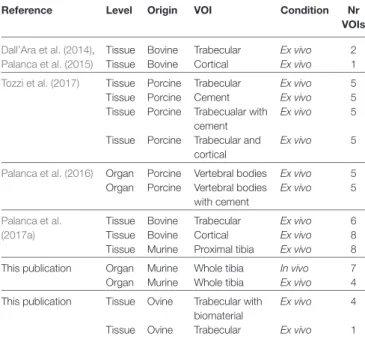
TaBle 1 | Summary of the information about the studies, the results of which are reported in this manuscript for different dimensional levels, origins of the bones, volume of interest (VOI), scanning condition, and the total number of volumes of interest (VOIs) where the measurements were performed (Nr VOIs).
reference level Origin VOi condition nr
VOis
Dall’Ara et al. (2014),
Palanca et al. (2015)
Tissue Bovine Trabecular Ex vivo 2 Tissue Bovine Cortical Ex vivo 1
Tozzi et al. (2017) Tissue Porcine Trabecular Ex vivo 5 Tissue Porcine Cement Ex vivo 5 Tissue Porcine Trabecualar with
cement
Ex vivo 5
Tissue Porcine Trabecular and cortical
Ex vivo 5
Palanca et al. (2016) Organ Porcine Vertebral bodies Ex vivo 5 Organ Porcine Vertebral bodies
with cement
Ex vivo 5
Palanca et al. (2017a)
Tissue Bovine Trabecular Ex vivo 6 Tissue Bovine Cortical Ex vivo 8 Tissue Murine Proximal tibia Ex vivo 8 This publication Organ Murine Whole tibia In vivo 7 Organ Murine Whole tibia Ex vivo 4 This publication Tissue Ovine Trabecular with
biomaterial
Ex vivo 4
Tissue Ovine Trabecular Ex vivo 1
of the magnitude of the errors and of their trend, for different applications. To comprehensively present the precision of two DVC approaches, the results obtained in previous studies on different bone structures and at different dimensional levels were integrated with new results obtained from high-resolution images of trabecular bone with and without biomaterials and
from in vivo and ex vivo analyses of the mouse tibia.
MaTerials anD MeThODs
In this article, data collected in several previous studies have been integrated to new datasets to provide a comprehensive understanding of the relationship between the precision of two DVC approaches and their spatial resolution for different microstructure, and for different quality of the input images. In particular, the previously examined datasets consist in results
from trabecular and cortical bone scanned with μCT (Dall’Ara
et al., 2014; Palanca et al., 2015) and with synchrotron light μCT
(SRμCT) (Palanca et al., 2017a), from vertebral bodies with and
without injected biomaterial scanned with μCT (Palanca et al.,
2016; Tozzi et al., 2017), and mice tibiae scanned with SRμCT (Palanca et al., 2017a). Moreover, two new datasets from SRμCT
scans of trabecular bone and biomaterials and from in vivo and
ex vivo μCT scans of the mouse tibia were included in this study.
More details for each study are reported in Table 1, Figure 1 and
below.
In these studies, the precision of the DVC method was evaluated in a particular condition of zero-strain, by registering repeated scans of the same object. The parameters of the scanning
procedures are reported in Table 2. For the different datasets a
global or a local (or both), DVC approaches were used to estimate the bone strain and the precision of the methods are reported in
this study in function of the chosen subvolume size. For a more detailed description of the methods and of the results for each study (effect of image processing, results on displacement, etc.), the reader should refer to the individual publications reported in Table 1.
In the following sub-chapters, the two DVC algorithms used in these studies will be presented, together with a brief description of the samples and scanning procedures.
DVc approaches and estimation
of the Precision
Both DVC approaches used in the studies presented in this article are based on a similar principle: two high-resolution 3D input images of the same object in undeformed and deformed configurations are imported and the algorithms compute a field of displacements, which minimizes the differences between the deformed images and the registered images (undeformed images after the application of the field of displacement). The field of displacement is then differentiated into a field of strain. The main features of the two methods are briefly reported hereafter.
BoneDVC (Previously Known As ShIRT-FE)
This global DVC (Dall’Ara et al., 2014) consists in computing
the displacement map by using the Sheffield Image Registration
Toolkit (ShIRT) (Barber and Hose, 2005; Barber et al., 2007;
Khodabakhshi et al., 2013). With BoneDVC, a grid with selectable nodal spacing (NS, or subvolume, or grid size) is superimposed to the images to be registered. The deformable registration equations are solved at the nodes of the grid to evaluate the displacement field. The procedure consists in finding the displacement functions
u(x, y, z), v(x, y, z), and w(x, y, z) that transforms the reference
image f (x, y, z) into the deformed image m(xʹ yʹ, zʹ). An additional
intensity displacement function c(x, y, z) is included to account
for potential changes in the gray levels. For small displacement, the following equation should be solved for each voxel:
f m− f +∂m f m f m
∂
+ ∂∂ +∂∂
+ ∂∂ +∂∂
−
≈ ∂
∂
1
2 u x x v y y w z z c
(
ff m+)
.
However, this problem is underdetermined and the algorithm solves the equations only in the nodes of the cubic grid superim-posed to the images. The displacements are interpolated with a tri-linear function between the nodes. Therefore, the problem is solving the following system of equations for the coefficients a of the displacement functions:
u a
v
=
=
=
∑
i xi i
i yi i
i zi i a
w a
∑
∑
ϕ
ϕ
ϕ
.
To provide a smooth solution, the algorithm includes a term based on the Laplacian operator L, and the coefficient λ that weights the relative importance of smoothing:
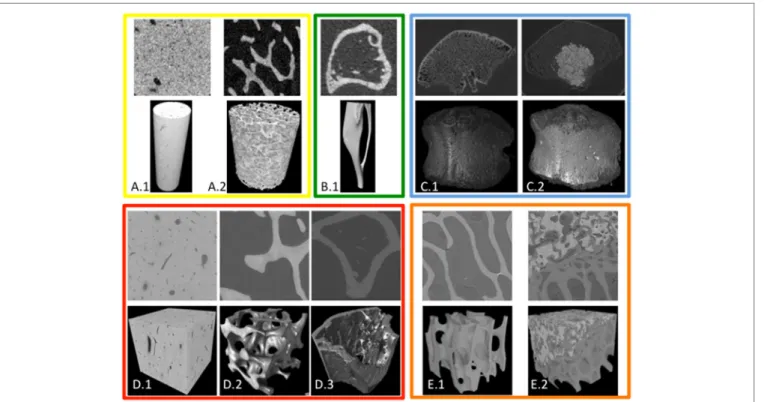
FigUre 1 | Overview of the different image types used for the deformable registrations with BoneDVC and/or DaVis-DC. For each dataset, a typical cross-section (top) and a 3D image reconstruction (bottom) are reported. Dataset include cortical (a.1) and trabecular (a.2) bone scanned with laboratory micro-computed tomography (μCT) at 10 µm voxel size (dimension of the 2D images: 1.79 mm × 1.79 mm); mouse tibiae (B.1) scanned with in vivoμCT at 10.4 µm voxel size (dimension of the 2D image: 4.11 mm × 4.11 mm); porcine vertebrae with (c.2) or without (c.1) biomaterial scanned with μCT at 39 µm voxel size (dimension of the 2D images: 27.61 mm × 19.5 mm); cortical bone (D.1), trabecular bone (D.2), and proximal mouse tibia (D.3) scanned with synchrotron light μCT (SRμCT) at 1.6 µm voxel size (dimension of the 2D images: 1.6 mm × 1.6 mm); ovine trabecular bone with (e.2) and without (e.1) biomaterial scanned with SRμCT at 2.6 µm voxel size (dimension of the 2D images: 2.60 mm × 2.60 mm).
g are the gray levels, respectively, in the reference and deformed
images. A third-order spline interpolation is used. This process provides a full 3D field of displacement vectors, which describes the mapping from reference to deformed state. The displacement field is then converted into strain field using the centered finite differences scheme.
The precision of the DVC methods for displacement meas-urements was quantified by reporting the standard deviation of
displacement along x, y, and z directions. As it was found that in
a first approximation the errors affecting strains were isotropic (Palanca et al., 2015), the precision of the DVC methods was quantified by reporting the standard deviation of the strain error (SDER), computed as the standard deviation of the mean of the components of strain computed for each measurement point
[referred as “precision” in Liu and Morgan (2007)]. In case more
specimens were analyzed for each bone type, median and stand-ard deviation of the SDER were computed for each sample. In case more specimens were analyzed for each bone type, median of the measurement was computed for each sample.
Datasets
μCT Scans of Bovine Trabecular and Cortical Bone
(Dall’Ara et al., 2014; Palanca et al., 2015)
A trabecular bone (8 mm in diameter, 12 mm in length) and a cortical bone (3 mm in diameter and 20 mm in length) cylinders
where T is a K × N matrix (K number of voxels in the image,
and N number of nodes in the grid). T is derived from integrals
of the image gradients multiplied by the basis functions of the displacements. For large displacements, the method can iterate to a correct solution. The grid is then converted into a mesh of 8-noded hexahedrons and the displacements are then imported into a FE software package (Ansys Mechanical APDL v.14.0, ANSYS, Inc., Canonsburg, PA, USA) to differentiate them into a strain field and to post-process the data efficiently.
DaVis-DC
This local approach is implemented in a commercial pack-age (DaVis LaVision, Germany) that uses a direct correlation (DC) function to match the subvolumes (hereby referred to as DaVis-DC). With DaVis-DC, the 3D images are divided into smaller subvolumes, which are then independently correlated as a discrete function of gray levels. A piece-wise linear shape function for the reference-deformed mapping and a normalized
cross-correlation function, rDaVis, based on gray level gaps are used:
r x y z g y z
f x y z g x y z
X x y z DaVis
VOI
= ∑∈ f( , , ) ( , , )x ( , , ) ( , , ( , , ) ′ ′ ′
′ ′ ′
2 ))
( , , ) ( , , )
2
X x y z X x y z∑∈VOI ∗ ∑∈VOI
where X (x, y, z) and X*(x, y, z) refer to coordinates (in voxels) of
Ta
B
le 2
| Summary of the scanning and DVC parameters used in the dif
fer
ent studies, the r
esults of which ar
e r
eported in this article.
r
efer
ence
imaging technique
s
canning machine
s
canning parameters image voxel size (
μ
m)
Filters
integration time (ms)
r
otation step (°)
s ubvolume BoneDV c (vox) s ubvolume DaVis-D c (vox)
Dall’Ara et al. (2014)
,
Palanca et al. (2015)
µCT Skyscan 1172 59 kV , 10 W 10.0 1.0 mm Al 1,180 0.710
5, 10, 15, 20, 25, 30, 35, 40,
45, 50
8, 10, 16, 20, 24, 28,
34, 40, 44, 52
70 kV
, 10 W
Tozzi et al. (2017)
µCT
Nikon XTH225
88 kV
, 110–115 µA
39.0 None 2,000 0.230 16, 48 16, 48
Palanca et al. (2016)
Micr
o-computed
tomography (μCT)
Nikon XTH225 88 kV , 110–115 µA 39.0 None 2,000 0.230
16, 32, 48, 64, 80, 96, 112
16, 32, 48, 64, 80, 96,
112, 128
Palanca et al. (2017a)
Synchr otr on light μ CT (SR μ CT)
Diamond Light Sour
ce I13-2 Polychr omatic “pink” beam (5–35 keV) 1.6 0.95 mm
C, 2 mm Al, 0.02 mm Ni
53
0.045
10, 15, 20, 25, 50, 75, 100, 150,
200, 250 NA This publication μ CT Scanco V ivaCT80 55 kV , 145 µA 10.4 0.5 mm Al 200 0.240
10, 20, 30, 40, 50, 60, 70, 80, 90, 100, 110, 120, 130, 140, 150
NA
This publication
SR
μ
CT
Diamond Light Sour
ce I13-2 Polychr omatic “pink” beam (5–35 keV) 2.6 0.95 mm
C, 2 mm Al, 0.06 mm steel
64
0.100
NA
16, 32, 48, 64, 80,
96, 112
were extracted from the femur of a bovine killed for alimentary purposes. In this case, ethics approval was not required as per institutional and national guidelines. Each specimen was scanned twice in saline solution with a μCT system (Skyscan 1172, Bruker, voltage: 59 kV for trabecular bone and 70 kV for cortical bone; power: 10 W; voxel size: 9.96 µm; exposure time: 1,180 ms; rotation step: 0.71; total rotation: 180°; images
aver-ages ×2; beam hardening filter: 1 mm Aluminum; height scan:
9.32 mm). After image reconstruction, a parallelepiped with square cross-section of 180 × 180 × 932 voxels was cropped in the central portion of each sample. In the trabecular specimen also a larger region 430 × 430 × 430 voxels was cropped for tests with larger subvolumes. Deformable registrations were run for different subvolume sizes with BoneDVC (5, 10, 15, 20, 25, 30, 35, 40, 45, 50 voxels) and with DaVis-DC (8, 10, 16, 20, 24, 28, 34, 40, 44, 52 voxels).
μCT Scans of Natural and Augmented Porcine Vertebral Bodies (Palanca et al., 2016;
Tozzi et al., 2017)
Ten thoracic vertebral bodies were extracted from spines of pigs killed for alimentary purposes. In this case, ethics approval was not required as per institutional and national guidelines. A sample of five vertebrae was addressed for augmentation (referred as “augmented”), with acrylic vertebroplasty cement (Mendec Spine, Tecres Spa, Italy). The other five vertebrae were left untreated (referred as “natural”). The samples were scanned twice in saline solution, inside the chamber of a loading device with a μCT system (XTH225, Nikon Metrology, voltage: 88 kV; power: 10 W; voxel size: 39 µm; exposure time: 2,000 ms; rotation step: 0.23°; total rotation: 360°). Deformable registrations were run for different subvolume sizes (16, 32, 48, 64, 80, 96, 112, 128 voxels) with BoneDVC and DaVis-DC on a parallelepiped of 300 × 300 × 432 voxels cropped inside each vertebral body with and without the augmentation (VOI-1). Moreover, the image of each augmented specimen was cropped in other four VOIs
of 152 × 152 × 432 voxels including fully cement-augmented
trabecular bone (VOI-2); interface between augmented and non-augmented trabecular bone (VOI-3); trabecular bone (VOI-4), and regions containing both trabecular and cortical bone, with surrounding saline solution (VOI-5). The smaller VOIs were analyzed with BoneDVC and DaVis-DC with subvolume sizes of 16 and 48 voxels.
μCT Scans of Mice Tibiae In Vivo and Ex Vivo (This Study)
Eleven mouse (C57BL/6J, female, 22 weeks old) tibiae were
scanned in vivo (seven) or ex vivo (four). The images from the
seven tibiae scanned in vivo were collected from a previous
study where mice were anesthetized during scanning (Lu et al.,
2015). All procedures were approved by the local Research
Ethics Committee of the University of Sheffield (Sheffield,
UK). The four ex vivo specimens were dissected from mice
of same strain, gender, and age, were isolated from the soft tissues, dehydrated and embedded in acrylic resin. Each tibia
was scanned twice by using an in vivo μCT system (vivaCT80,
scanning parameters: voltage of 55 keV, intensity of 145 µA, integration time of 200 ms, nominal isotropic image voxel size of 10.4 µm for a total scanning time of approximately 40 min per scan. Beam hardening artifacts were reduced by applying a third-order polynomial correction algorithm provided by the
manufacturer based on scans of 1,200 mgHA/cm3 wedge
phan-tom. Deformable registrations were run for different subvolume sizes with BoneDVC (10, 20, 30, 40, 50, 60, 70, 80, 90, 100, 110, 120, 130, 140, 150 voxels).
Synchrotron μCT Scans of Bovine Cortical and Trabecular Bone and of Proximal Mice Tibiae
(Palanca et al., 2017a)
Three tissue types were studied: cortical bones (three cylindri-cal specimens, 3 mm in diameter, 12 mm in length), trabecular bones cylinders (four cylindrical specimens, 8 mm in diameter, 12 mm in length) both obtained from the femur of a bovine killed for alimentary purposes; and four paired tibiae obtained from two 14-week-old female C57BL/6J mice (Harlan Laboratories, Bicester, UK). All procedures were approved by the local Research Ethics Committee of the University of Sheffield (Sheffield, UK). Each specimen was embedded in acrylic resin and was scanned twice at the Diamond-Manchester Imaging Beamline l13-2 of Diamond Light Source, UK. A filtered (950 µm C, 2 mm Al, 20 µm Ni) polychromatic “pink” beam (5–35 keV) of parallel geometry was used and the scanning parameters were: voxel size 1.6 µm; exposure time 53 ms; rotation step 0.045°; total rotation 180°. Two cubic volumes of interest (VOIs) with side length of 1,000 voxels were cropped from the middle of each cortical and trabecular specimen, and cubic VOIs were selected in the metaphysis of each murine tibia. The VOIs of the trabecular bone and of the mouse tibiae were masked, to evaluate the uncertain-ties only on bone tissues. Deformed registrations were run with BoneDVC with different subvolume sizes (10, 15, 20, 25, 50, 75, 100, 150, 200, 250, 300 voxels).
Synchrotron μCT Scans of Ovine Trabecular Bone with and without Biomaterials (This Study)
Four bone-biomaterial cylindrical specimens and two trabecu-lar bone cylindrical specimen (4 mm in diameter and 8 mm in length) were extracted from ovine femoral condyles, where biomaterials were implanted after surgically creation of bone
defects (Coathup et al., 2016). All procedures were carried
out following Ethics approval granted by the Royal Veterinary College and in compliance with the United Kingdom Home Office regulations (Animal Scientific Procedures Act [1986]). Samples were placed in a loading stage (CT5000, Deben Ltd., UK) and immersed in saline solution. Each specimen was scanned twice at the imaging beamline l13-2 of Diamond Light Source, UK. A filtered (950 µm C, 2 mm Al, 60 µm steel) polychromatic “pink” beam (5–35 keV, weighted mean photon energy: 28.6 keV) of parallel geometry was used. Scanning parameters were chosen as following: voxel size: 2.6 µm; exposure time: 64 ms; rotation step: 0.1°; total rotation: 180°. One cubic VOI (1,000 voxels side length) was cropped from the middle of each specimen. To evaluate the uncertainties only in the mineralized tissue,
masks were created by applying a non-local means filter (Buades
et al., 2011), followed by image segmentation based on Huang’s
method (Huang and Wang, 1995). The masks were used to create
the masked images (original gray levels corresponding to the bone voxels and zero values corresponding to the marrow), on which the deformable registrations (DaVis-DC) were run for different subvolume sizes (16, 32, 48, 64, 80, 96, 112 voxels).
resUlTs
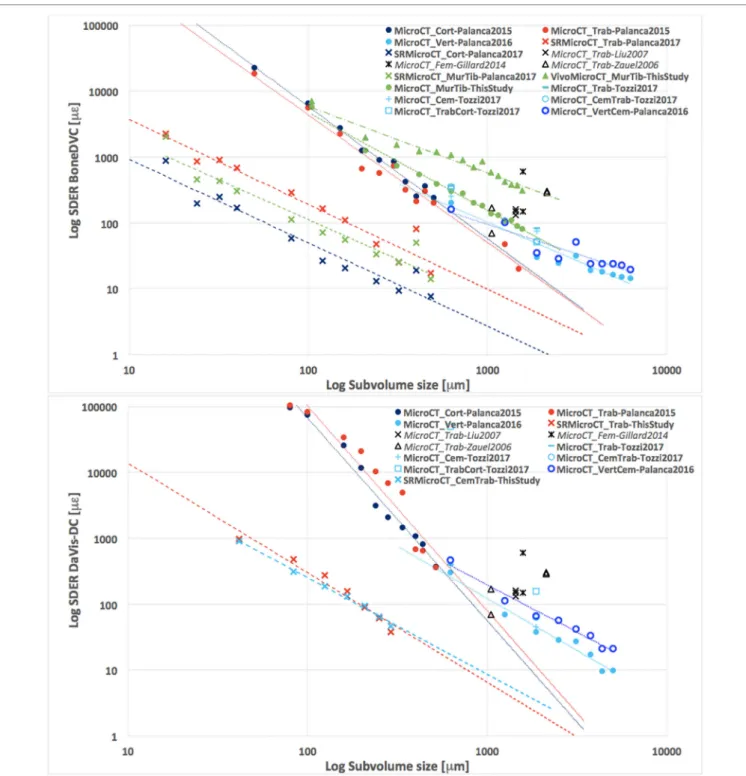
The precisions of the DVC methods as a function of the used
sub-volume size are summarized in Figure 2. As expected for all bone
types, the grid size and the SDER were highly correlated through
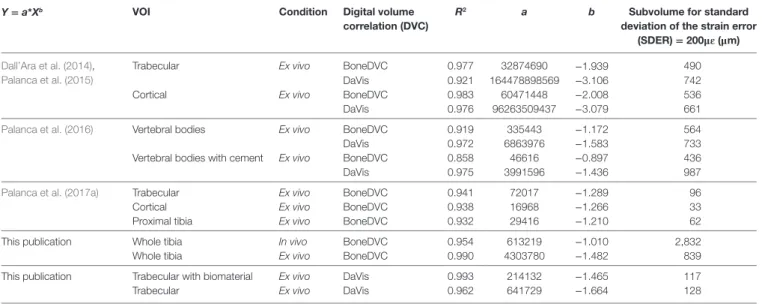
power laws, for both DVC approaches (0.858 < R2 < 0.993,
Table 3).
As expected, the images with higher quality, obtained with SRμCT, provided the best results, followed by those obtained
from ex vivoμCT and then those obtained from in vivoμCT.
Similar trends were found for the two DVC algorithms. These regressions can be used to choose the best compromise between the spatial resolution of the measured displacement and the
resulting precision in measuring strains (Table 3). In particular,
one may fix a level of acceptable strain, and consequently identify the corresponding spatial resolution. If a threshold of 200 με is accepted (one order of magnitude lower than typical strains in bone subjected to physiological loading conditions), the cor-responding spatial resolution can be found when images from SRμCT are used (at 1.6 µm for images used for BoneDVC and at 2.6 µm for images used for DaVis-DC) for cortical bone (33 µm for BoneDVC), for trabecular bone (96 µm for BoneDVC, 128 µm for DaVis-DC), as well as for trabecular bone with biomaterials (117 µm for DaVis-DC). Spatial resolutions that would allow the same errors on strains for measurements performed by using laboratory μCT images at the tissue level (voxel size between 10 and 39 µm) were in the range 490–564 µm for BoneDVC and 661–987 µm for DaVis-DC. The worst spatial resolution cor-responding to the same errors of 200 με was found for
measure-ments based on in vivo and ex vivo μCT images of the mouse tibiae
(2,832 and 839 µm, respectively, both obtained with BoneDVC). Only SRμCT-based DVC reached reasonable uncertainties for measurements performed the tissue level [for several BSUs, as trabeculae or osteons; spatial resolution for DVC displacement
and strain measurements of 300 µm (Pfeiffer, 1998); from 9 to
46 με, Table 4] or at the single BSU level (spatial resolution for
DVC displacement and strain measurements below 150 µm; from
21 to 156 με, Table 4).
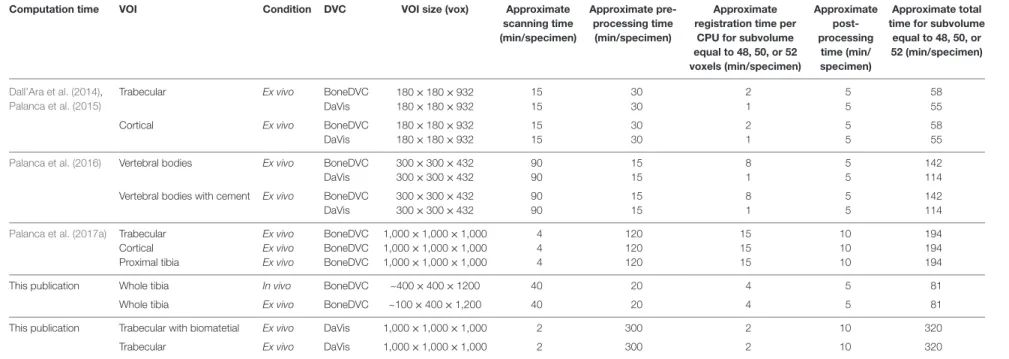
The computation time varied for the different voxel sizes, volumes of interest (VOIs), DVC approach, and post-processing
method used, as reported in Table 5.
DiscUssiOn
FigUre 2 | Relationship in logarithmic scale between the standard deviation of the error (SDER; median values in case more specimens were analyzed per group) and the subvolume size for both global (BoneDVC, top) and local (DaVis-DC, bottom) DVC approaches. Dataset include cortical (MicroCT_Cort-Palanca2015) and trabecular (MicroCT_Trab-Palanca2015) bone scanned with laboratory micro-computed tomography (μCT) at 10 µm voxel size; mouse tibiae scanned with in vivo
TaBle 3 | Coefficients of power law regressions (a, b) and the coefficient of determination (R2) between the standard deviation of the error (SDER) and the “subvolume”
size for the results obtained in the different studies reported in this manuscript.
Y = a*Xb VOi condition Digital volume
correlation (DVc)
R2 a b subvolume for standard
deviation of the strain error (SDER) = 200με (μm)
Dall’Ara et al. (2014),
Palanca et al. (2015)
Trabecular Ex vivo BoneDVC 0.977 32874690 −1.939 490 DaVis 0.921 164478898569 −3.106 742 Cortical Ex vivo BoneDVC 0.983 60471448 −2.008 536 DaVis 0.976 96263509437 −3.079 661
Palanca et al. (2016) Vertebral bodies Ex vivo BoneDVC 0.919 335443 −1.172 564 DaVis 0.972 6863976 −1.583 733 Vertebral bodies with cement Ex vivo BoneDVC 0.858 46616 −0.897 436 DaVis 0.975 3991596 −1.436 987
Palanca et al. (2017a) Trabecular Ex vivo BoneDVC 0.941 72017 −1.289 96
Cortical Ex vivo BoneDVC 0.938 16968 −1.266 33 Proximal tibia Ex vivo BoneDVC 0.932 29416 −1.210 62 This publication Whole tibia In vivo BoneDVC 0.954 613219 −1.010 2,832 Whole tibia Ex vivo BoneDVC 0.990 4303780 −1.482 839 This publication Trabecular with biomaterial Ex vivo DaVis 0.993 214132 −1.465 117 Trabecular Ex vivo DaVis 0.962 641729 −1.664 128
The last column represents the calculated value of the subvolume for a SDER equal to 200 με.
provides a comprehensive understanding about how the preci-sion of these methods (evaluated in a simple case of full-field zero-strain on repeated scans) is affected by the different tissue structures, by the input images, and by the algorithms.
The results from the different studies confirmed that the preci-sion in the measurements of displacement of the two tested DVC approaches are in the order of a fraction of voxel, with smaller
errors for the global DVC compared to the local one (Table 4). As
expected, for all the different studies that were compared in this article, strong correlations were found between the uncertainties of the DVC-computed strains (expressed as SDER), and the spatial distance between two independent measurements. This
result confirms those obtained from previous studies (Roberts
et al., 2014) and extend it for different bone and bone-biomaterial
structures. The equations describing such trends (Table 3)
pro-vide a way to choose the input parameters of the DVC according to the different applications. In particular, the elastic registrations based on higher resolution images (~1.6 μm voxel size, obtained
with SRμCT) allowed achieving uncertainties of 200 με for
measurement spatial resolution of 30–100 µm for all the types of microstructure considered (bovine cortical bone, bovine tra-becular bone, and mouse metaphysis), allowing strain measure-ments within BSUs. Conversely, μCT-based DVC measuremeasure-ments (~10 μm voxel size) showed the same strain errors (200 με) only for larger grid size, in the order of 400–600 µm, allowing for 3D measurements performed on subvolumes including more BSUs, but still enabling to detect strain gradients over the specimens. Such measurements can be used to classify regions at high or low localized strains as for example the beginning of failure in trabecular or cortical bone. It should be noted though that the strain values in this case refer to subvolumes containing both the mineralized tissue and the marrow. When DVC is applied
to μCT images acquired with lower resolution (~40 μm voxel
size), reliable information about the heterogeneous strain field
can be obtained only with larger subvolumes, up to 1,000 µm, which contain several BSUs. As expected, the worst case scenario
among those tested was related to the in vivo μCT images of the
mouse tibia (~10.4 μm voxel size), where the subvolume size
required to obtain the same strain errors (200 με) was as large as ~2,800 μm, which is even larger than the typical diameter of the bone (~1,000 μm). It should be noted that this case represents a very extreme case where the measurement resolution is affected by several artifacts (i.e., moving artifacts and lower contrast due to the lower energy), which may considerably affect the noise in the images and disturb the deformable registration. Therefore, with the current settings, it is hard to think of using such a
methodology in vivo, unless large deformations are applied and
larger errors can be accepted (e.g., hundreds of με). This would be feasible, for example, when strain measurements are used to clas-sify between bone strained below or above yield [7,000–10,000με (Bayraktar et al., 2004)].
The results summarized here were obtained from the best conditions studied on the different applications. For example, we noted that masking the bone tissue in non-homogeneous structures such as the trabecular bone and mouse tibia improved the precision of the DVC only if based on high-resolution SRμCT (Palanca et al., 2017a), but not on standard laboratory μCT images (Dall’Ara et al., 2014). Furthermore, for the local DVC approach, it is clear that a metric based on DC should be preferred to
analy-ses performed after Fourier Transformation (Palanca et al., 2015).
Then, the best settings were used, similar trends were found for both DVC algorithms, with the global DVC performing better in the experiments where both algorithms were tested on the same
specimens for the selected dimensional level (Tables 3 and 4), but
with slightly higher computational cost to run the registration (Table 5).
Ta
B
le 4
| Overview of the standar
d deviation of the err
or (SDER) for the strain measur
ements and standar
d deviation for the dif
fer
ent components of the displacement (StDev DispX, StDev DispY
, and StDev DispZ)
found in the dif
fer
ent studies for a subvolume size that could be used for measur
ements at the tissue level (~300
μ
m) and at the bone structural unit (BSU) level (~150
μ m). Pr ecision for B s U VO i c ondition
Digital volume corr
elation
(DV
c
)
s
ubvolume closest to 300
μ
m
(voxels)
Physical dimension closest to
300 μ m ( μ m) s
ubvolume closest to 150
μ
m
(voxels)
Physical dimension closest to
150 μ m ( μ m) s D er 300 μ m ( με ) s
tDev DispX
300 μ m ( μ m) s
tDcv DispY
300 μ m ( μ m) s
tDev DispZ
150 μ m ( μ m) s D er
150 µm (με
)
s
tDev DispX 150 µm (μ
m)
s
tDev DispY 150 µm (μ
m)
s
tDev DispZ 150 µm (μ
m)
Dall’Ara et al. (2014)
, Palanca et al. (2015) Trabecular Ex vivo BoneDVC 30 299 15 149 742 0.63 0.64 0.51 2,270 1.04 1.05 0.91 DaV is 28 279 16 159 6,865 4.33 5.22 3.86 33,957 17.66 17.33 13.06 Cortical Ex vivo BoneDVC 30 299 15 149 849 0.70 0.67 0.61 2,781 1.45 1.43 1.28 DaV is 28 279 16 159 2,063 2.92 2.30 3.65 25,747 14.42 11.84 19.24
Palanca et al. (2016)
Vertebral bodies Ex vivo BoneDVC 16 624 N.A. N.A. 202 N.A. N.A. N.A. N.A. N.A. N.A. N.A. DaV is 16 624 N.A. N.A. 302 N.A. N.A. N.A. N.A. N.A. N.A. N.A.
Vertebral bodies with cement
Ex vivo BoneDVC 16 624 N.A. N.A. 160 1.22 1.27 1.13 N.A. N.A. N.A. N.A. DaV is 16 624 N.A. N.A. 471 1.87 1.49 2.18 N.A. N.A. N.A. N.A.
Palanca et al. (2017a)
Trabecular Ex vivo BoneDVC 200 320 100 160 26 0.03 0.04 0.08 64 0.04 0.05 0.09 Cortical Ex vivo BoneDVC 200 320 100 160 9 0.03 0.02 0.05 21 0.03 0.03 0.05 Pr oximal tibia Ex vivo BoneDVC 200 320 100 160 41 0.08 0.07 0.04 55 0.08 0.07 0.05 This publication Whole tibia In vivo BoneDVC 30 312 20 208 1,547 4.49 7.29 3.48 2,003 4.67 7.48 4.03 Whole tibia Ex vivo BoneDVC 30 312 20 208 745 1.20 1.94 1.28 1,250 1.39 2.37 2.30 This publication
Trabecular with biomaterial
Ex vivo DaV is 112 291 64 166 46 0.08 0.23 0.14 131 0.12 0.35 0.15 Trabecular Ex vivo DaV is 112 291 64 166 38 0.21 0.24 0.18 156 0.29 0.37
0.27 of precision in the strain measurements [trabecular bone (et al., 1999; Liu and Morgan, 2007; Gillard et al., 2014) and Bay
trabecular bone-cement (Zhu et al., 2016) specimens], with the
exception of Zauel et al. (2006), where similar errors were found
but only after substantial smoothing of the displacement field, which may hide peaks of strain in applications under realistic loading conditions.
The DVC outputs can also be used to quantitatively validate the field of local properties identified by computational models
such as the FE method (Zauel et al., 2006). The typical scheme
is to acquire two images of the undeformed and deformed bone structure, to apply the DVC to measure the displacement and strain fields, to generate the FE models from the underformed configuration, to impose the DVC-measured displacement
field at the boundary of the FE model (Zauel et al., 2006), and
to compare the experimental and computational outputs in the middle portion of the specimen (far enough from the condi-tions imposed at the boundary). This approach has been used to evaluate the accuracy of the models in predicting the field
of displacements for trabecular bone specimens (Zauel et al.,
2006; Chen et al., 2017) and vertebral bodies (Jackman et al., 2016; Costa et al., 2017). The good precision of the DVC in
measuring the field of displacements (Table 4) allows in most
cases to test the ability of the models in predicting the local displacements. However, it should be noted that the limited precision of DVC in measuring the strain field with a spatial resolution of a few tens of μm [typical size of the finite elements
at the tissue level (van Rietbergen et al., 1995)], makes it
impos-sible to accurately validate the FE predictions of strain. We have shown that this could be potentially done if high-resolution
SRμCT images were used (Figure 2; Table 4) but unfortunately
for such application the challenge in performing repeated imag-ing of the specimens under loadimag-ing without inducimag-ing structural
damage to the irradiated tissue remains (Barth et al., 2011).
This method for evaluating and comparing the precision of the two DVC approaches has three main limitations: (1) the preci-sion is usually evaluated on different specimens, (2) the precipreci-sion is evaluated in case of very simple strain scenario (zero-strain), and (3) different parameters for the two DVC algorithms (opti-mization metric, interpolation of displacements, differentiation method) were used. To overcome to the first limitation, we suggest to publish in the public domain the images used to test the DVC precision in the different publications. We started this
process in previous studies (Palanca et al., 2016; Tozzi et al., 2017;
TaBle 5 | Estimated time required for the different applications split for the different parts of the procedure, from the scanning to the image pre-processing, digital volume correlation (DVC) running time, and post-processing of the results.
computation time VOi condition DVc VOi size (vox) approximate scanning time (min/specimen)
approximate pre-processing time (min/specimen)
approximate registration time per
cPU for subvolume equal to 48, 50, or 52 voxels (min/specimen)
approximate post-processing
time (min/ specimen)
approximate total time for subvolume
equal to 48, 50, or 52 (min/specimen)
Dall’Ara et al. (2014),
Palanca et al. (2015)
Trabecular Ex vivo BoneDVC 180 × 180 × 932 15 30 2 5 58
DaVis 180 × 180 × 932 15 30 1 5 55
Cortical Ex vivo BoneDVC 180 × 180 × 932 15 30 2 5 58
DaVis 180 × 180 × 932 15 30 1 5 55
Palanca et al. (2016) Vertebral bodies Ex vivo BoneDVC 300 × 300 × 432 90 15 8 5 142
DaVis 300 × 300 × 432 90 15 1 5 114
Vertebral bodies with cement Ex vivo BoneDVC 300 × 300 × 432 90 15 8 5 142
DaVis 300 × 300 × 432 90 15 1 5 114
Palanca et al. (2017a) Trabecular Ex vivo BoneDVC 1,000 × 1,000 × 1,000 4 120 15 10 194
Cortical Ex vivo BoneDVC 1,000 × 1,000 × 1,000 4 120 15 10 194
Proximal tibia Ex vivo BoneDVC 1,000 × 1,000 × 1,000 4 120 15 10 194
This publication Whole tibia In vivo BoneDVC ~400 × 400 × 1200 40 20 4 5 81
Whole tibia Ex vivo BoneDVC ~100 × 400 × 1,200 40 20 4 5 81
This publication Trabecular with biomatetial Ex vivo DaVis 1,000 × 1,000 × 1,000 2 300 2 10 320
Trabecular Ex vivo DaVis 1,000 × 1,000 × 1,000 2 300 2 10 320
The results are reported for a subvolume size equal close to 50 voxels (48, 50, or 52 voxels according to the different applications). As the registrations have been run with different workstations, we report the approximate registration time for each CPU and for the approximate total time assuming the registrations were run with a workstation with four CPUs.
10
DVC Pr
ecision for Bone Applications
|
www
.fr
ontiersin.org
November
2017
|
Volume
4
|
Article
not allow measuring the accuracy of the method due to the fact that the field of displacement under loading is not known (and cannot be measured with independent measurement systems).
In recent studies (Palanca et al., 2017a), we have suggested to
perform analyses on repeated scans where one of them is vir-tually deformed with a known strain field, for estimating both accuracy and precision of the DVC methods. Nevertheless, more parameters should be accounted for during the generation of the virtually loaded images (e.g., interpolation), the application of the load (tension, compression, torsion), the load level, and their effect on the different bone structures, increasing signifi-cantly the labor, the computation, and post-processing time of the analyses. We believe that this approach should be used at least in one loading scenario and loading level until a proper standardization and benchmarking is provided. Furthermore, so far only virtually imposed affine deformations have been tested: this does not enable testing the DVC algorithms under realistic heterogeneous strain fields. Therefore, future work needs to be done to simulate a realistic loading condition, for example, imposing realistic boundary conditions and displacement (and strain) distributions derived from FE models of the constructs. To overcome the third limitation (i.e., different algorithms used for the different DVC approaches), the comparison between the two DVC methods will be further investigated for a subgroup of data, to identify which parts of the algorithms could lead to the best precision. Finally, a further limitation of this study is that some of the dataset were not processed with either one or the other DVC approach.
In conclusion in this study, we report a comprehensive analysis of the precision of two DVC methodologies for different bone structures, the microarchitecture of which has been acquired with different X-rays imaging techniques. These data can be used by the research community intending to employ DVC measurements for the estimation of the best trade-off between DVC precision in strain measurements, and the spatial resolution of independent displacement and strain measurements. The users are welcome to test new DVC approaches on the datasets shared in this and previous papers for direct comparison of the results.
eThics sTaTeMenT
All work performed on tissues collected from animals killed for alimentary purpose does not need ethic approval as per
the institutional and national guidelines. All procedures performed on the mice were approved by the local Research Ethics Committee of the University of Sheffield (Sheffield, UK). The animal study from which the ovine bone specimens were extracted was performed according to the local ethical committee of the Royal National Orthopaedic Hospital.
aUThOr cOnTriBUTiOns
All authors contributed to the collection of the data, the interpre-tation of the results, and/or the writing of the paper.
acKnOWleDgMenTs
The project was partially funded by the FP7 European program (MAMBO: PIEF-GA-2012-327357), the Engineering and Physical Sciences Research Council (Frontier Grant Multisim, EP/K03877X/1), the National Royal Society (RG130831 and RG150012), and the UK National Centre for the Replacement, Refinement and Reduction of Animals in Research (NC3Rs, grant number: NC/K000780/1). MP acknowledges the “Marco Polo” travel grant awarded by University of Bologna. The authors would like to thank the Diamond Light Source for time at the Diamond-Manchester Imaging Beamline I13-2 (under propos-als: MT10315-Dall’Ara and MT14080-Tozzi), the SkeletAl (University of Sheffield), and the Zeiss Global Center (University of Portsmouth) for imaging and post-processing. We further acknowledge Prof. Hose and Prof. Barber for sharing the ShIRT scripts, Dr. Hollis (LaVision Ltd.) for assistance with DaVis soft-ware, Dr. Bodey for help with the acquisition of the Synchrotron images, and Dr. Danesi, Ms. Innocente, Mr. Morellato, and Dr. Boudiffa for help in the preparation and scanning of the samples. The whole or partial datasets used in this study can be found at the following figshare links: vertebral bodies scanned with μCT (https://doi.org/10.6084/m9.figshare.4062351.v1); verte-bral bodies with bone cement scanned with μCT (https://doi. org/10.6084/m9.figshare.4308926.v2); cortical bone, trabecular bone, and mouse proximal tibia scanner with SRμCT (https:// doi.org/10.15131/shef.data.4865300.v1); trabecular bone with and without biomaterial scanned with SRμCT (https://figshare. com/s/9e30505b66d77276cc9a); and mouse tibiae scanned
with in vivo and ex vivo μCT (https://doi.org/10.15131/shef.
data.5528104).
reFerences
Anderson, A. E., Ellis, B. J., and Weiss, J. A. (2007). Verification, validation and sensitivity studies in computational biomechanics. Comput. Methods Biomech. Biomed. Engin. 10, 171–184. doi:10.1080/10255840601160484
Badilatti, S. D., Christen, P., Parkinson, I., and Muller, R. (2016). Load-adaptive bone remodeling simulations reveal osteoporotic microstructural and mechanical changes in whole human vertebrae. J. Biomech. 49, 3770–3779. doi:10.1016/j. jbiomech.2016.10.002
Barber, D. C., and Hose, D. R. (2005). Automatic segmentation of medical images using image registration: diagnostic and simulation applications. J. Med. Eng. Technol. 29, 53–63. doi:10.1080/03091900412331289889
Barber, D. C., Oubel, E., Frangi, A. F., and Hose, D. R. (2007). Efficient computa-tional fluid dynamics mesh generation by image registration. Med. Image Anal. 11, 648–662. doi:10.1016/j.media.2007.06.011
Barth, H. D., Zimmermann, E. A., Schaible, E., Tang, S. Y., Alliston, T., and Ritchie, R. O. (2011). Characterization of the effects of x-ray irradiation on the hierarchical structure and mechanical properties of human cortical bone. Biomaterials 32, 8892–8904. doi:10.1016/j.biomaterials.2011.08.013 Bay, B. K., Smith, T. S., Fyhrie, D. P., and Saad, M. (1999). Digital volume
correla-tion: three-dimensional strain mapping using X-ray tomography. Exp. Mech. 39, 217–226. doi:10.1007/BF02323555
Bayraktar, H. H., Morgan, E. F., Niebur, G. L., Morris, G. E., Wong, E. K., and Keaveny, T. M. (2004). Comparison of the elastic and yield properties of human femoral trabecular and cortical bone tissue. J. Biomech. 37, 27–35. doi:10.1016/ S0021-9290(03)00257-4
Bouxsein, M. L. (2003). Bone quality: where do we go from here? Osteoporos. Int. 14(Suppl. 5), S118–S127. doi:10.1007/s00198-003-1489-x
Buades, A., Coll, B., and Morel, J. (2011). Non-local means denoising. Image Process. Line 1, 208–212. doi:10.5201/ipol.2011.bcm_nlm
Chen, Y., Dall Ara, E., Sales, E., Manda, K., Wallace, R., Pankaj, P., et al. (2017). Micro-CT based finite element models of cancellous bone predict accurately displacement once the boundary condition is well replicated: a validation study. J. Mech. Behav. Biomed. Mater. 65, 644–651. doi:10.1016/j.jmbbm.2016.09.014 Christen, D., Levchuk, A., Schori, S., Schneider, P., Boyd, S. K., and Muller, R.
(2012). Deformable image registration and 3D strain mapping for the quantita-tive assessment of cortical bone microdamage. J. Mech. Behav. Biomed. Mater. 8, 184–193. doi:10.1016/j.jmbbm.2011.12.009
Coathup, M. J., Edwards, T. C., Samizadeh, S., Lo, W. J., and Blunn, G. W. (2016). The effect of an alginate carrier on bone formation in a hydroxyapatite scaffold. J. Biomed. Mater. Res. Part B Appl. Biomater. 104, 1328–1335. doi:10.1002/ jbm.b.33395
Costa, M. C., Tozzi, G., Cristofolini, L., Danesi, V., Viceconti, M., and Dall’Ara, E. (2017). Micro finite element models of the vertebral body: validation of local displacement predictions. PLoS ONE 12:e0180151. doi:10.1371/journal. pone.0180151
Cristofolini, L., Brandolini, N., Danesi, V., Juszczyk, M. M., Erani, P., and Viceconti, M. (2013). Strain distribution in the lumbar vertebrae under different loading configurations. Spine J. 13, 1281–1292. doi:10.1016/j.spinee.2013.06.014 Cristofolini, L., Conti, G., Juszczyk, M., Cremonini, S., Van Sint Jan, S., and
Viceconti, M. (2010a). Structural behaviour and strain distribution of the long bones of the human lower limbs. J. Biomech. 43, 826–835. doi:10.1016/j. jbiomech.2009.11.022
Cristofolini, L., Schileo, E., Juszczyk, M., Taddei, F., Martelli, S., and Viceconti, M. (2010b). Mechanical testing of bones: the positive synergy of finite-element models and in vitro experiments. Philos. Trans. Series A Math. Phys. Eng. Sci. 368, 2725–2763. doi:10.1098/rsta.2010.0046
Dall’Ara, E., Barber, D., and Viceconti, M. (2014). About the inevitable com-promise between spatial resolution and accuracy of strain measurement for bone tissue: a 3D zero-strain study. J. Biomech. 47, 2956–2963. doi:10.1016/j. jbiomech.2014.07.019
Dall’Ara, E., Luisier, B., Schmidt, R., Kainberger, F., Zysset, P., and Pahr, D. (2013a). A nonlinear QCT-based finite element model validation study for the human femur tested in two configurations in vitro. Bone 52, 27–38. doi:10.1016/j. bone.2012.09.006
Dall’Ara, E., Luisier, B., Schmidt, R., Pretterklieber, M., Kainberger, F., Zysset, P., et al. (2013b). DXA predictions of human femoral mechanical properties depend on the load configuration. Med. Eng. Phys. 35, 1564–1572; discussion 1564. doi:10.1016/j.medengphy.2013.04.008
Dall’Ara, E., Pahr, D., Varga, P., Kainberger, F., and Zysset, P. (2012). QCT-based finite element models predict human vertebral strength in vitro significantly better than simulated DEXA. Osteoporos. Int. 23, 563–572. doi:10.1007/ s00198-011-1568-3
Danesi, V., Tozzi, G., and Cristofolini, L. (2016). Application of digital volume correlation to study the efficacy of prophylactic vertebral augmentation. Clin. Biomech. (Bristol, Avon) 39, 14–24. doi:10.1016/j.clinbiomech.2016.07.010 Gillard, F., Boardman, R., Mavrogordato, M., Hollis, D., Sinclair, I., Pierron, F.,
et al. (2014). The application of digital volume correlation (DVC) to study the microstructural behaviour of trabecular bone during compression. J. Mech. Behav. Biomed. Mater. 29, 480–499. doi:10.1016/j.jmbbm.2013.09.014 Grassi, L., Vaananen, S. P., Ristinmaa, M., Jurvelin, J. S., and Isaksson, H. (2016).
How accurately can subject-specific finite element models predict strains and strength of human femora? Investigation using full-field measurements. J. Biomech. 49, 802–806. doi:10.1016/j.jbiomech.2016.02.032
Gustafson, H. M., Cripton, P. A., Ferguson, S. J., and Helgason, B. (2017). Comparison of specimen-specific vertebral body finite element models with experimental digital image correlation measurements. J. Mech. Behav. Biomed. Mater. 65, 801–807. doi:10.1016/j.jmbbm.2016.10.002
Huang, L., and Wang, M. (1995). Image thresholding by minimizing the mea-sures of fuzziness. Pattern Recognit. 28, 41–51. doi:10.1016/0031-3203(94) E0043-K
Hussein, A. I., Barbone, P. E., and Morgan, E. F. (2012). Digital volume correlation for study of the mechanics of whole bones. Procedia IUTAM 4, 116–125. doi:10.1016/j.piutam.2012.05.013
Jackman, T. M., DelMonaco, A. M., and Morgan, E. F. (2016). Accuracy of finite element analyses of CT scans in predictions of vertebral failure patterns under axial compression and anterior flexion. J. Biomech. 49, 267–275. doi:10.1016/j. jbiomech.2015.12.004
Jones, A. C., and Wilcox, R. K. (2008). Finite element analysis of the spine: towards a framework of verification, validation and sensitivity analysis. Med. Eng. Phys. 30, 1287–1304. doi:10.1016/j.medengphy.2008.09.006
Khodabakhshi, G., Walker, D., Scutt, A., Way, L., Cowie, R. M., and Hose, D. R. (2013). Measuring three-dimensional strain distribution in tendon. J. Microsc. 249, 195–205. doi:10.1111/jmi.12009
Levchuk, A., Zwahlen, A., Weigt, C., Lambers, F. M., Badilatti, S. D., Schulte, F. A., et al. (2014). The Clinical Biomechanics Award 2012 – presented by the European Society of Biomechanics: large scale simulations of trabecular bone adaptation to loading and treatment. Clin. Biomech. (Bristol, Avon) 29, 355–362. doi:10.1016/j.clinbiomech.2013.12.019
Liu, L., and Morgan, E. F. (2007). Accuracy and precision of digital volume correlation in quantifying displacements and strains in trabecular bone. J. Biomech. 40, 3516–3520. doi:10.1016/j.jbiomech.2007.04.019
Lu, Y., Boudiffa, M., Dall’Ara, E., Bellantuono, I., and Viceconti, M. (2015). Evaluation of in-vivo measurement errors associated with micro-computed tomography scans by means of the bone surface distance approach. Med. Eng. Phys. 37, 1091–1097. doi:10.1016/j.medengphy.2015.08.017
Lu, Y., Boudiffa, M., Dall’Ara, E., Liu, Y., Bellantuono, I., and Viceconti, M. (2017). Longitudinal effects of parathyroid hormone treatment on mor-phological, densitometric and mechanical properties of the mouse tibia. J. Mech. Behav. Biomed. Mater. 75, 244–251. doi:10.1016/j.jmbbm.2017. 07.034
Madi, K., Tozzi, G., Zhang, Q. H., Tong, J., Cossey, A., Au, A., et al. (2013). Computation of full-field displacements in a scaffold implant using digital volume correlation and finite element analysis. Med. Eng. Phys. 35, 1298–1312. doi:10.1016/j.medengphy.2013.02.001
Palanca, M., Bodey, A. J., Giorgi, M., Viceconti, M., Lacroix, D., Cristofolini, L., et al. (2017a). Local displacement and strain uncertainties in different bone types by digital volume correlation of synchrotron microtomograms. J. Biomech. 58, 27–36. doi:10.1016/j.jbiomech.2017.04.007
Palanca, M., Cristofolini, L., Pani, M., Kinene, E., Blunn, G., Madi, K., et al. (2017b). Feasibility study for a clinical application of digital volume correlation. Orthop. Proc. 99-B(Suppl. 2), 18.
Palanca, M., Cristofolini, L., Dall’Ara, E., Curto, M., Innocente, F., Danesi, V., et al. (2016). Digital volume correlation can be used to estimate local strains in nat-ural and augmented vertebrae: an organ-level study. J. Biomech. 49, 3882–3890. doi:10.1016/j.jbiomech.2016.10.018
Palanca, M., Tozzi, G., Cristofolini, L., Viceconti, M., and Dall’Ara, E. (2015). Three-dimensional local measurements of bone strain and displacement: comparison of three digital volume correlation approaches. J. Biomech. Eng. 137:071006-1–071006-14. doi:10.1115/1.4030174
Pfeiffer, S. (1998). Variability in osteon size in recent human populations. Am. J. Phys. Anthropol. 106, 219–227. doi:10.1002/(sici)1096-8644(199806)106:2<219:aid- ajpa8>3.0.co;2-k
Razi, H., Birkhold, A. I., Weinkamer, R., Duda, G. N., Willie, B. M., and Checa, S. (2015). Aging leads to a dysregulation in mechanically driven bone formation and resorption. J. Bone Miner. Res. 30, 1864–1873. doi:10.1002/ jbmr.2528
Roberts, B. C., Perilli, E., and Reynolds, K. J. (2014). Application of the digital volume correlation technique for the measurement of displacement and strain fields in bone: a literature review. J. Biomech. 47, 923–934. doi:10.1016/j. jbiomech.2014.01.001
Schileo, E., Dall’ara, E., Taddei, F., Malandrino, A., Schotkamp, T., Baleani, M., et al. (2008). An accurate estimation of bone density improves the accuracy of subject-specific finite element models. J. Biomech. 41, 2483–2491. doi:10.1016/j. jbiomech.2008.05.017
Schwiedrzik, J., Gross, T., Bina, M., Pretterklieber, M., Zysset, P., and Pahr, D. (2016). Experimental validation of a nonlinear muFE model based on cohe-sive-frictional plasticity for trabecular bone. Int. J. Numer. Method Biomed. Eng. 32, e02739. doi:10.1002/cnm.2739
microstructures. J. Mech. Behav. Biomed. Mater. 67, 117–126. doi:10.1016/j. jmbbm.2016.12.006
van Rietbergen, B., Weinans, H., Huiskes, R., and Odgaard, A. (1995). A new method to determine trabecular bone elastic properties and loading using micromechanical finite-element models. J. Biomech. 28, 69–81. doi:10.1016/ 0021-9290(95)80008-5
Viceconti, M. (2012). Multiscale Modeling of the Skeletal System. Cambridge: Cambridge University Press.
Widmer Soyka, R. P., Lopez, A., Persson, C., Cristofolini, L., and Ferguson, S. J. (2013). Numerical description and experimental validation of a rheology model for non-Newtonian fluid flow in cancellous bone. J. Mech. Behav. Biomed. Mater. 27, 43–53. doi:10.1016/j.jmbbm.2013.06.007
Wolfram, U., Wilke, H. J., and Zysset, P. K. (2010). Valid micro finite element mod-els of vertebral trabecular bone can be obtained using tissue properties mea-sured with nanoindentation under wet conditions. J. Biomech. 43, 1731–1737. doi:10.1016/j.jbiomech.2010.02.026
Zauel, R., Yeni, Y. N., Bay, B. K., Dong, X. N., and Fyhrie, D. P. (2006). Comparison of the linear finite element prediction of deformation and strain of human cancellous bone to 3D digital volume correlation measurements. J. Biomech. Eng. 128, 1–6. doi:10.1115/1.2146001
Zhu, M. L., Zhang, Q. H., Lupton, C., and Tong, J. (2016). Spatial resolution and measurement uncertainty of strains in bone and bone-cement interface using digital volume correlation. J. Mech. Behav. Biomed. Mater. 57, 269–279. doi:10.1016/j.jmbbm.2015.12.017
Zysset, P. K., Dall’ara, E., Varga, P., and Pahr, D. H. (2013). Finite element analysis for prediction of bone strength. Bonekey Rep. 2, 386. doi:10.1038/bonekey. 2013.120
Conflict of Interest Statement: The authors declare that the research was con-ducted in the absence of any commercial or financial relationships that could be construed as a potential conflict of interest.