Brussels, 08.09.1999
COM( 1999) 178 final
Three yearly report on the
·implementation of Directive .
67/548/EEC on the classification,
packaging and labelling of
dangerous substances, as
amended by
Directiv~
92/32/EEC
Contents·
1 Introduction . 4
1.1 Why this report? 4
1.2 Short introduction to the Directive 4
1.3 Way ofworking 5
1.4 Structure of the report 6
.
.2 The administrative system and procedures 7
2.1 Administrative systems and :procedures on
EUIEEA
level7
2.2 Administrative system and procedures on national level 10
2.2.1 Austria ' 10
2.2.2 Belgium 10
2.2.3 Denmark 11
2.2.4 Finland 11
2.2.5 Fr.ance 12
2.2.6 Germany 12
2.2.7 Greece 13
2.2.8 Ireland 13
2.2.9 Italy 14
2.2.10 Luxembourg 14
2.2.11 Netherlands 14
2.2.12 Portugal 15
2.2.13 Spain 15
2.2.14 Sweden 16
2.2.15 United Kingdom 16
2.2.16 Norway 17
3 The implementation: legal aspects 18
3.1 · Introduction 18
3.2 Austria 18
3.3 Belgium 18
3.4 Denmark 19
3.5 Finland 20
3.6 Fr.ance 20
3.7 Germany 21
3.8 Greece 22
3.9 Ireland 23
3.10 Italy 24
3.11 Luxembourg 25
3'.12 Netherlands 25
3.13 Portugal 26
3.14 Spain 27
3.15 Sweden 28
3.16 United Kingdom 28
3.17 Norway 29
4 The implementation: notifications and risk assessments 34
4.1 Introduction 34
4.2 Notifications 34
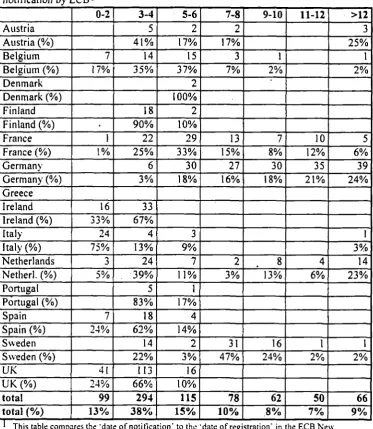
4.2.1 Notifications per Member State 34
4.2.2 Notifications EU/non EU manufacturers 38
4.2.3 Notifications per use category and desired effect category 39
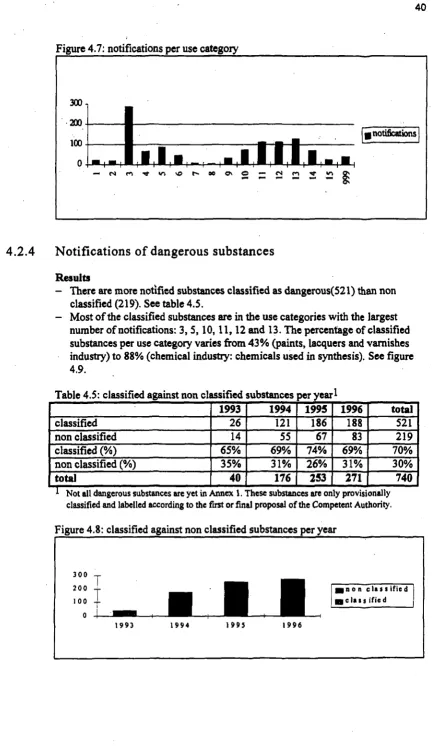
4.2.4 Notifications of dangerous substances 40
4.2.5 Notifications covered by sole representatives 41
4.2.6 Polymer notifications 42
4.2.7 Circulation of notifications 43
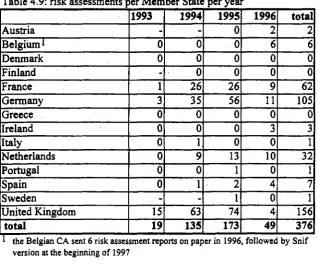
4.3 Risk assessments 44
5
The implementation: other aspects5.1 Research and development exemptions 5.2 · The procedures in practice
5.2.1 The notification procedure
5.2.2 Classification of dangerous substances 5.3 Other issues
6 Issues arising out of the implementation
7 The enforcement of the Directive
8 Summary and conclusions
Appendices:
1. List of Competent Authorities 2. Questionnaire
3. Description of use categories and desired effect .categories
46 46
so
so
52 5355
61
1 Introduction
1.1
Why this report?
Directive 671548/EEC as amended by Directive 92/32/EEC (hereinafter "the Directive") lays down the respective duties of the Commission and the Member States with regard to the implementation of the procedures for the notification of new substances in the European Union. (A short introduction to the Directive is
given in the next paragraph.) ,
Article 32 of the Directive req~ires the EU Member States and the Commission to prepare a report on the implementation of the Directive every three years, starting from three years after its implementation. Since the Directive became effective as from the beginning ofNovember 1993, the
first
report on this implementation is now due.This report gives an impression of the implementation of the Directive in the Member States with regard to. legal aspects (how is the Directive implemented in national legislation) as well as other aspects: the number of notifications and risk assessments, the number of process orientated research and development (PORD) exemptions, the notification procedure in practice, data sharing, etcetera.
Furthermore, the report gives an overview of general thoughts or comments of the Member States on the operation of the Directive. In addition, Member States were asked to give their view with regard to a number of issues that have all been identified as issues of concern.
The three yearly report can, by giving an overview of the implementation of the Directive in the various Member States, help the European Commission and the Member States to identify problems encountered with the implementation of the Directive, to identify priorities for future actions and to implement associated legislation in the future.
1.2
Short introduction to the Directive
Iri the 1970s, many EU Member States introduced notification procedures for new
substances prior to these substances being. placed on the market. The aim of these procedures was to undertake an a priori wessment of a new substance before it was marketed, thereby allowing the necessary measures to be taken to protect man and the environment from exposure to unacceptable risks.procedures would be applied across the Member States and wherein the information collected would be exchanged between all national authorities.
The EU-wide scheme for the notification of new substances was introduced as part of the sixth Amendment to Directive 67/548/EEC on the classification, packaging and labelling of dangerous substan~s. The 6th ~endment was adopted by the Council of Ministers of the European Union in September 1979.
In the light of more than 10 years' experience implementing the 6th Amendment to the Directive, a 7th Amendment to Directive 67/548/EEC (Directive 92/32/EEC) was adopted by the Council of Ministers on 30 April 1992. The 7th Amendment became effective as from the beginning of November 1993 in all Member States._ The notification procedures described in the next paragraph correspond to those laid down under the 7th Amendment.
1.3
Way
of working
This report is based upon two main sources of information: data gathered from the European Commission (ECB: European Chemicals Bureau in Ispra, Italy) and data gathered from the Member States.
In close co-operation with the Commission's Directorate General (00) XI (Unit E.2: Chemical Substances and Biotechnology), it was determined which data from ECB were required. ECB was asked to provide Arcadis Heidemij Advies
Consulting Engineers (the Netherlands) with statistical information on notifications and risk assessments over the period November 1993 -December 1996,.per
Member State per year, distinguishing between: - notifications of EU ~d non EU manufacturers;
- notifications per use category and des~red effect categ9ry; - notifications of dangerous substances;
- notifications covered by sole representatives; ·polymer notifications;
-- risk assessments per conclusion.
The questionnaire asked for: .
- a description of the administrative system in each Member State;
- the way Directive 67/548/EEC as amended by Directive 92132/EEC, and the related Directives 93/67/EEC (laying down the principles of risk assessment) and 93/105/EEC laying down the information requirements on polymers) are . . implemented in national legislation;
- co-operation and information exchange in practice; - issues arising out of the implementation of the Directive. The questionnaire is enclosed to this
report
as appendix 2.The questionnaire was filled in by every country that received it, except Luxembourg. In bilater&l contacts with Luxembourg it became clear that the Competent Authority did not feel the need to fill in the questionnaire, since there is relatively littl~ experience with the Directive in this country.
Data gathering (from ECB as well as from the Member States) took place in the beginning of 1997 (January and February). March and April were used to analyse the data gathered and to prepare the report. The months May and June were used to consult with the European Commission (ECB and DG XI) and the Competent · Authorities (during the 53rd meeting of the Competent Authorities-for New Substances, June 1997, in The Hague). The fmal version of the ~e yearly report was drafted in August and September. ·
1.4
Structure of the report
Chapter 2 starts with a description of the administrative system and the procedures related to· the Directive, on EUIEEA level as well as on nationalleyeJ. The
description ofthe procedures on EUIEEA level is a summary of the article The
notification of new substances in the Ewopean Union,
(P.M. Murphy, P. Rigat, DG XI, European Commission, 1994).In chapter 3, the implementation of the Directive in national legislation is shortly described per Member State.
Chapter 4 describes the data on notifications and risk assessments under the Directive, provided by the European Commission (ECB).
Chapter 5 deals with other aspects of the implementation of the Directive, mainly referring to research and development exemptions and to the notification
procedures in practice.
Chapter 6 gives an overview of ·'issues of concern' arising out of the implementation.
In chapter 7, the.results of the NONS project (a European enforcement project on the Notification ofNew Substances) are summarised, thus giving an impression of the way the Directive is enforced in the European Union.
r
2 The administrative
syst~m
and procedures_
2.1
Administrative systems and procedures on EU/EEA level
Substances liable for notification A substance is subject to notification if:
- it is placed on the EU market (either on its own or in a preparation); - it is not on the European Inventory of Exi~g Commercial chemical
Substances (EINECS)
- it is not covered by one of the exemptions granted under the Directive.
Exemptions. .
The following substances are exempted from the harmonised EU notification procedures:
- additives and substances for exclusive use in animal feedingstuffs; - substances used exclusively as additives or as flavourings in foodstuffs; - active ingredients used exclusively in medicinal products for human or
veterinary use (not including chemical intennediates);
- substances for exclusive U:se in plant protection products and which are subject to the evaluation procedures foreseen under Article 6 of Directive 91/414/EEC; - cosmetic ingredients when only marketed incorporated in cosmetic products.
In addition to those substances which are exempted from the notification
procedure, the Directive also recognises further categories which are considered as being notified and hence not subject to the harmonised EU notification procedures: -·polymers (with the exception of those which contain in combined form 2% or
more of any substance which is not on EINECS); · ·
- substances placed on the EU market in quantities of less than 10 kg per year; - substances for scientific research and development; . .,
- substances for process-orientated research and development.
Submittine a notification
For substances liable for notification, manufactured within the EU, it is the manufacturer who must submit the notification and is regarded legally as the
notifier. ·
For substances produced by a given manufacturer outside the EU, the situation is slightly more complicated. An individual importer bringing new substances directly into the EU can submit a notification dossier in the Member State were the import takes place. However, if each separate importer were to submit a
notification, this could result in the submission of numerous repeated notifications for the same substance. The Directive therefore allows the manufacturer to
Before notification:· preparatory steps
Once it has been determined that a substance must be notified and the company legally responsible for submitting the notification as been identified, the next step
is to compile a notification dossier.
-Before embarking upon the generation of a notification dossier, potential notifiers should identify precisely the substance which .is to be notified. Furthermore, to avoid duplicate animal testilig a potential notifier must, before carrying out animal testing, contact the Competent Authority in the Member State were he intends to notify to enquire whether the substance has been notified previously. ·Where the substance has been notified previously, the prospective and the previous notifier are obliged to take all reasonable steps to avoid animal testing and reach- an · agreement on the sharing of data. In some Member States the provision even goes further, with the two parties being obliged to share the data.
The notification dossier
The essential contents of a notification dossier for a new substance includes: - A technical dossier, describing the intrinsic properties of the substance, the
extent of which varies with the quantity of the substance to be placed on the market. With regard on the information to be provided on intrinsic properties, there aie three possible testing packages to be carried out, depending upon the amounts which will be marketed annually across the EU: more than one tonne per year, less than 1 tonne but .greater than 100 kg, less than 100 kg but more' than 10 kg. The testing packages corresponding to these marketing levels are laid down in Annexes VII A, B and C to the Directive, respectively. In
summary, the larger the amount placed on the market, the more testing is required.
A proposal for the classification and labelling of the substance. In addition to the notification procedure for new substances, the Directive is also concerned with the classification, packaging and labelling of dangerous substances. Criteria for the classification of substances are laid down in Annex VI to the Directive. When notifiers submit a notification dossier, they are requested to submit a proposal for the classification and labelling of the substance.
- A proposal for a safety data sheet for substances classified as dangerous. The Directive requires that all substances which are classified as dangerous should at the time of first delivery to a customer be accompanied by a safety data sheet, containing the information necessary to protect man and the environment. - A statement from the extra-EU producer in the case where the sole
representative procedure is being employed.
The notification dossier may also include, at the request/discretion of the notifier: - A provisional risk assessment, carried out by the notifier. .
- A request to be exempted for one year from the data sharing requirements imposed by the Directive.
Role of the national Competent Authorities
Once the notifier has put together all the elements in the notification dossier, the notification must be submitted to the national Competent Authority in the Member State were the notifier is located.
The national Competent Authority receiving the notification dossier has the following duties/powers with regard to the notification:
supply sampl~s of the substances for verification testing and.to take appropriate
measures relating to safe use of the substance. '
- To .inform the notifier within a fixed period after receipt of the dossier (60 days 'for substances to be marketed iri quantities of greater than one tonne per year
and 30 days for quantities of less
than
one tomie per year) to whether the dossier conform~ with the Directive and if not, what changes are to be made. - To carry out arisk cusessment
on the notified substance. The Directiverecognises four potential administrative actions following the risk assessment carried out by a Competent Authority. from conclusion (i) {=the substance is of · no immediate concern) to conclusion (iv) (• immediate recommendations for
risk reduction are necessary).
Role of the European Commission (European CbeJQlcals Bureau)
The national Competent Authority receiving the notification dossier·sends the following information to the Commission (European Chemicals Bureau): - A summary of the notification dossier in electronic form (SNIF: Summary
Notification Interchange Format). usually within a period of four to six weeks after their acceptance by a Competent Authority. including:
- A proposal for the formal classification and labelling of the dangerous substance as it should eventually be introduced into Annex I of the Directive (immediately with the notifiCation dossier the first proposal and after six months the.fmal proposal, taking into account any comments of the other Competent Authorities).
- A risk assessment report, carried out by the Authorities, containing
recommendations for further tests or risk reduction measures (usually submitted several weeks later than the notification dossier).
Upon receiving the information transmitted from the Competent Authority fli'St receiving the notification dossier, the ECB checks the contents of the dossier and stores the information in the new substances database. Copies of the summary notification dossier are sent out on a weekly basis to the Competent Authorities in the other Member States, together with any comments from the ECB.
In case of receiving a notification for a dangerous substance, the formal proposal of the Competent Authority for the entry to be included in Annex I to the Directive is communicated by the ECB to the other Member States which have six months to · send comments to the originating Authority.
Upon receipt of the risk assessment the ECB circulates it to the other Member States all of which can· (as for the notification dossier) comment and request changes and modifications.
Follow-up. to notification
As a general rule, the notifier is obliged to inform the Authority to whom the notification dossier was submitted of any changes to the information included in the notification and of any new data of which he may become aware and which are relevant to the risk assessment ofthe·substance.
Whereas the testing requirements for up to one tonne per year are clearly set out in the Directive (Annexes VII A, B and C), at I 0 tonnes per year, the Authorities review the dossier and a request for further testing is entirely discretionary. At I 00 tonnes per year the notifier is obliged to carry out a supplementary testing package (according to the schedule set out in Ieveii of Annex VIII to the Directive). Similarly, when marketed quantities reach 1000 tonnes per year, notifiers are again
2.2
2.2.1
2.2.2
required to
carry
out a supplementary testing package (according to Annexvm,
Ievell).Administrative system and
p-rocedur~son national level
Austria
Competent Authority
The Competent Authority is Department 112 within-the Federal Ministry for the Environment, Youth and Family ("Bundesministerium
fUr
Umwelt, Jugend und Familie, AbteilungU2").
Other involved authorities
Other authorities.involved in "running the system" are the Chemical Substances Department ("Chemilcalienabteilunj') of the Federal Environment Agency ("Umweltbwidesamf') and the "Bundeslranzleramt, Abteilung VU2".
Enforcement authorities
The supervision and enforcement o!"nationallegislation concerning the Directive is in hands of the nine (decentralised) states. Within these.federal states, enforcement is carried out by the Chemical Inspectorate ("Chemicalienimpektionen"). These inspectors may check manufacturing process and operating facilities and may take samples in required amounts of substal1ces, preparations and fmished products.
Belgium
. Competent Authority
According to a Royal Decree of24 May 1982 (published on 2 July 1982), the Minister or Secretary for Public Health and Environment
( "Minister/Staatssecretaris van Vollc.Jgezondheid en Leefmilieu") is the Competent Authority for the implementation of the Directive. The Minister/Secretary is advised by the Commission for Dangerous Products ("Commissie Gevaarlijlce Produkten"). This is an interdepartmental commission in which the Ministry of Public Health and Environment, the Ministry of Economic Affairs, the Ministry of Labour and the Ministry of Agriculture are represented. ·
Other involved authorities
The Commission for Dangerous Products, who carries out risk asses$ments for full notifications, can ask for the advice of the Council of Health ("Hoge Gezondheids
.Raatf'), consisting of academic experts.
2.2.3
2.2.4
· Enforcement authorities ·
According to a Ministerial Decree of 14 September 1993, inspectors of the Ministry of Public Health and Environment, the Ministry of Economic Affairs, the Ministry ofLabolir and the Ministry of Agriculture are responsible for the control and enforcement of the relevant legislation of the Directive.
Denmark
Competent Authority
The Ministry of Environment and Energy is responsible for implementation of the legislation of the Directive. The responsible policy departDJ.ent is the Chemicals Division ("Kemi/calielcontoref'). All administrative activities relating to notification of new substances are carried out by the Notification Group within this Chemicals Division.
Other involved authorities
The Chemicals Division may obtain expert advice from various institutions under other ministries, such as evaluation of toxicological and eco-toxicological data, in order fo~: the Chemicals Division to have the best possible grounds to form opinions and decisions on. Any advisory committees do not exits in this area.
Enforcement authorities
The Chemicals Inspectorate ("Kemilcalieinspelctionen") is in charge of control and enforcement of all Danish chemical legislation - substance and product wise - also the national regUlation on new substances deriving from the Directive.
Finland
Competent Authority
The Competent Authority for new substances is the National Product Control Agency for Welfare and Health ("Sosiaali-ja terveydenhuo/lon
tuotevalvontakeskus, STn"'), which is an agency under the Ministry of Social Affairs and Health.
Other involved authorities
Other involved authorities and institutes are:
- the Ministry of Social Affairs and Health (Occupational Safety and Health Department): their task is the assessment of occupational safety measures; - the Finnish Environment Institute: their task is the assessment of environmental
risks;
- the Safety Technology Authority: their task is the assessment of fire and explosion hazards.
Enforcement authorities
2.2.5
2.2.6
France
Competent Authority
· Two authorities are appointed as Competent Authority in the French legislation : - the Chemical Substances and Preparations Office ("BSPC - Bureau des
Substances et Preparations Chimiques") at the Ministry of Environment, which deals mainly with environmental issues of the notification dossiers;
- The Chemical Control Department ("Service Controle des Produits") at the National Institute for Research and Safety ("Institut National de Recherche et de Securite; INRS'), which deals mainly with human health (workers).
Other involved authorities
The Ministry ofEnvironment is advised by &national committee of experts (Commission of Chemical EcotOxicity Evaluation, 41 members from university, . industry, laboratories and state departments) which meets every month.
For consumer risk assessments, the Competent Authorities require the advice of the Ministry of Health.
Enforcement authorities
The following inspectorate& are the most involved in the enforcement of the Directive (control actions):
- "DGCCRF' (Ministry of Financial Affairs): controlling free-trade, fraud and consumer products;
- "DRIRE''
(Research, Industry, Environment): implementing environmental policym
industrial plants and facilities;- "DGD": general custom department ("Direction Generale des Douanes");
- . Labour inspectors: (Ministry of Labour) o~upational affairs.
Germany
Competent Authority
The responsibility for the implementation of the Directive and it"s Amendments rests with the Ministry of Environment, Nature Protection and Nuclear Safety
("Minuteriumfiir Umwelt, Naiurschutz und Reaktorsicherheif"). The notification procedlire is administrated _by the Chemical Notification Unit within the Federal Institute.for Occupational Safety and Health ("Bundesanstaltfiir .A.rbeitsschutz und .A.rbeitsmedizin, .A.nme/destelle Chemikaliengesetz").
Other involved authorities
Other involved authorities are experts from:
- health ("Bewertungsstelle Bundesinstitut fiir Gesundheitlichen Verbraucherschutz und Veterinlirmedizin, BgVJ"');
- environment ("Bewertungstelle Umweltbundesamt, UB.A.");
- occupational safety and health ("Bewertungsstelle Bundesansta/t for
.A.rbeitsschutz und .A.rbeitsmedizin, B.A.uA., .A.bt. Gefdhrliche Stoife").
These authorities receive the notification dossier for assessment
2.2.7
2.2.8
Enforcement authorities
The 16 Federal States ("Btindes/tinder';) cany out dle monitoring of the relevant legislation of Directive 67/548/EEC and its Amendments in their own
responsibility. They have installed a system of control unites in their area. These control units are not only responsible for new· chemicals, but also for occupational health and safety in general.
Greece
Competent Authority
The Division of Environment, Section of Dangerous Substances and Preparations/Articles, in the General Chemical State Laboratory (GCSL),
depending administratively from the Hellenic Ministry of Finance, is appointed for the implementation of Directive 67/548/EEC and its 7th Amendment. The
Compete~t Authority is carrying out all the activities needed to run the system.
Other involved authorities
There is no other authority or institute. ~volved. The Competent Authority has the possibility to invite scientists with recognised expertise in toxicity and ecotoxicity areas for consultations. Their judgement is used where needed.
Enforcement authorities
The GCSL with some 70 dependant regional branches and local offices, spread along the country, is in charge of the controls and inspections needed to ensure the implementation of the regulation for new and existing dangerous chemical
substances and preparations. The nominated inspectors of the GCSL are conducting inspections at places of production, storage and· in general circulation/distribution of chemical products, in order to check:
- con.fonnity to the provisions concerning notification requirements of new substances;
- confonnity to the requirements for labelling, packaging and safety data sheets Qf dangerous substances;
- confonnity to any other provisions of the legislation.
Ireland
Competent Authority
The Irish Competent Authority is the National Authority for Occupational Safety and Health ("Health and Safety Authority: HSA"). At the working level, the
Directive is the responsibility of the "Hazardous Substances Assessment Unif'.
Other involved authorities
There are no other authorities involved, although the HSA does have a "Substances Advisory Committee" which is consulted on new legislation and scientific or policy
Enforcement authorities ·
The HSA is in overall charge. The enforcement activities are carried out by inspectors of the "Hazardous Substances Assessment Unit''. The inspectors have a wide range of enforeement powers available.
· 2.2.9 . Italy
Competent Authority .
The Competent Authority is the Prevention Department ("Dipartimentc;> della Prevenzione'') within the Ministry of Health ("Ministero della Sanitll'). This ministry works in consultation with other ministries involved in this field (ministries oflndustry, Environment, and Labour).
Other involved authorities
Another involved Italian authority is the Notification Unit within the Health Institute ("Istituto Superiore di Sanitll').
Enforcement authorities
The e¢'orcement of relevant legislation concerning
the
Directive is in hands of the Prevention Department within the Ministry of Health.2.2.10 Luxembourg
Due to lack of experience with notifications, Luxembourg did not respond to the questionnaire.
2.2.11 Netherlands
Competent Authority
According to the Dutch Chemical Substances Act the Ministry of Housing, Spatial Planning and the Environment ("Ministerte van Vollahuisvesting, Ruimtelijke Ordening en Milieubeheer ") together with the Ministry of Social Affairs and Employment are the authorities responsible for the implementation of the Dangerous Substances Directive 67/548/EEC. By Regulation of 19 September
1986, the Minister _authorised the Chemical Substances Bureau ("Bweau
Milieugevaarlijke Stoffen, BMS'') with the mandate to act on behalf of the Minister regarding articles dealing with the notification procedure. ·
According to the most recent modification of the regulation concerning the Chemical Substances Bureau, the bureau is part of the National Institute of Public Health and Environmental Hygiene ("Rijlrsinstituut voor Volksgezondheid en
Milieuhygiene, RIVM'). BMS has the responsibility to take decisions on the compliance of the notification dossiers and on the necessity for additional testing.
Other involved authorities
Enforcement authorities
The Environmental Inspectorate ("lnspectie Milieuhygilne") of the Ministry of · Housing, Spatial Planning and the Environment and the Labour Inspectorate
( "Arbeidsinspectie ") of the Ministry of Social Affairs and Employment are the responsible authorities to control and enforce the relevant legislation.ofDirective 67 /548/EEC and its Amendments.
2.2.12 Portugal
Competent Authority
The Competent Authority for the implementation of Directive 67/548/EEC is the Directorate General for Environment ("Direc~ilo-Geral do .A.mbiente") from the Ministry of the Environment through its Division oflndustrial Risks and Chemical Substances ("Divislio de Ri.scos Industriais e Compostos Quimicos").
Other involved authorities
The Competent Authority is advised by the National Institute for Health (from the Ministry of Health) and the University of Science and Technology of Lisbon.
Enforcement authorities
The authorities which are in charge for the enforcement of relevant legislation concerning the Directive are:
- the General Direction for the Environment, Inspection of the Environment ("Direc~lio-Geral do Ambiente, Jnspec~iJo do Ambiente") and Regional Bodies for the Environment (''Direc~~es Regionais do Ambiente e Recursos Naturais"),
both from the Ministry of the Environment;
- the General Inspectorate of Economical Activities ("lnspec~ilo-Geral das Actividades Econ6micas"), of the Ministry of Economy;
- the General Direction for Customs ("Direc~iJo-Geral das Alfllndegas"), of the Ministry of Finances; and regional bodies of Industry and Energy ("Delega~~es
Regionai.s da IndUstria e Energia''), under the responsibility of the Ministry of Economy.
2.2.13 Spain
Competent Authority
The responsible department for the supervision and enforcement of Directive 67 /548/EEC is the Ministry of Health and Consumer Affairs (MSC). It takes policy decisions at national level. The Chemical Notification Unit, allocated in the
Subdirectorate General for Environmental Health of the Ministry, carries out the administrative and technical activities relating to notification. Since January 1997, the Ministry of Environment is involved also in the technical activities concerning environmental issues in this area.
Other involved authorities
There are no other authorities involved.
-Enforcement authorities
The Autonomous Communities are responsible for the inspections and control of chemical substances aecording to the Spanish National Law (Art. 24.2 R.D. 363/95). The co-ordination on this matter is made by the MSC through the Cout:tcll for the National System of Health and the Commission of General Directors of Autonomous Communities and the General Director for Public Health of the Ministry.
2.2.14 Sweden
Competent Authority
The National ChemiCals Inspectorate ("Keml') is appointed as the Competent Authority in. Sweden. "Keml' is the governmental agency, under the Ministry of the Environment and National Resources, responsible for carrying out chemicals control. The inspectorate issues regulations based on the act and the ordinances . . The inspectorate has recently made a reorganisation. All work within the
inspectorate is divided into four Programme Areas. Work concerning notification of new substances is in Area C "Classification & Labelling; Notifications", which also .includes work concerning classification and labelling. Most of the work at the inspectorate is performed in projects or processes (continued work). Notification of new substances is such a. process.
Other involved authorities
Other involved authorities are the National Inspectorate of Explosives and Flames, the National Board of Occupational Safety and Health and the Swedish . Environmental Protection Agency. Scientific experts from scientific institutes are not regularly involved, but may be uSed on a case-by-case basis.
Enforcement authorities
The National Chemicals Inspectorate is in charge of the· enforcement.
2.2.15 United Kingdom
Competent Authority
The Competent Authority is the Health and Safety Executive (HSE) and the Department of the Environment acting jointly. This means that for the notification process two departments handle the dossier and communicates with the ~uropean Commission in a co-ordinated manner, although HSE provide the core
administration of the notification system. HSE deal with human health matters and the Department of Environment handle environmental issues.
Other involved authorities
Enforcement authorities
With the exception of some aspects of the Directive relating to supply to the general public, all enforcement is carried out by inspectors of the Health and . Safety Executive. F.or chemicals supplied to the general public from shops,
enforcement is carried out by Local Authority Inspectors.
2.2.16 Norway
Competent Authority
The Norwegian Pollution Control Authority (appOinted as CoQlpetent Authority), is responsible for the administrative system and for the co-ordination of work done by other autborities, institutes, and advisory committees. The responsible
Department is the Department of Chemicals and Hazardous Wute,- where the work is mainly done by the Division for Chemicals Hazardous to Health, and the
Division for Environmentally Hazardous Chemicals. ·
Other involved authorities
A number of other authorities are involved:
- The Product Register: responsible for storing the notifications, for copying , distribution and collection of confidential information, and for the development and maintenance of datasystems;
- The National Labour Inspectorate: responsible for the assessment of Material Safety Data Sheets and risk assessment concerning Occupational Health; - The Directorate ofFire and Explosion Prevention: responsible for the
assessment of the data and risk assessments concerning flammability; - The Norwegian PetroleUm. Directorate: responsible for the assessment
concerning use of ne\V substances offshore;
National Institute ofPublic Health: assess the toxicological data and do risk assessments concerning human health.
Enforcement authorities
3 The implementatiot:'l: legal aspects
3.1
Introduction
This chapter summarises how in each ·country the Directive is transposed into national legislation. The four main items are:
- how is Directive .67 /548/BEC
u
.am~4ed by Directive 92/32/E~C implemented ·into national legislation (including a description of the implementation ofDirective 93/67/EEC (laying down the principles of risk-assessments) and Directive 93/105/EEC (laying
down
the informetion requirementS onpolymers); .
how
are
updates ofAnnex
I ind Annex V implemented into national legislation;are
there any additional national regulations (such as notification requirements · for substances marketed in quantitjes less than 10 kg/year, legal charges for anotifications); .
what are the sanction possibilities.
3.2
Austria
How is the Directive traupoHd ia utioaallepslatioD?
The Directive came into force on 1 March 1997 by the Chemical Substances Act 1996 (CSA; "ChsmilrDlienguetz"). The most important elements of the Directive were in force since 1989
m
the previous CSA.How are Dpclatel of ADDU: I ud AIUin: V t1'8111p0Nd ba utioulJeaislatioD?
Updates.
of Annex I and V are transposed by means ofthe
Chemical Decree("Chemikaliemerordnung") and the
Notif'IC&tion Decree ("
Anmeldeverordnung).Additioaal natioaal reaulatiou
Additional national legislation to the CSA are the Chemical Decree
("Chemilraliemerordnung") and the Notification Decree ("Anmeldeverordnung'").
Suctiou
Penalties on those that do
not
comply with the relevant national legislationcan be
imposed from 5.000 to 200.000 ATS (350 to 15.000 ECU).
3.3
Belaium
How is the Directive traupoHd iato aatioDal.leeiJlatioa?
In Belgium, the Directive is not yet transposed into national legislation. The procedure to do
so
has been startedin
1993.Despite
this delay, theCommission
How are updates of Annex I and Annex V transposed into national legislation?
Updates of Annex I and V are transposed by adaptation of the Royal Decree of 11 January 1993 respectively the Royal Decree of24 May 1982.
Additional national regulations
As soon as the Directive is transposed into national legislation~ previous and prospective notifiers
will
be obliged to share data in Belgium. The Commission for Dangerous Products will act as a mediator.Belgium imposes fees for a notification. The legal charge is 160.000 BF (4.000 ECU)for full notifications and varies from 20.000 to 85.000 BF·(500 to 2.000 ECU) for reduced notifications.
Sanctions
Penalties on those that do not comply with the. relevant national legislation can be imposed to a maximum of 5 years in prison or a fine of maximum 100.000 BF (2.500 ECU). The amount has now been indexed.
3.4
Denmark
How is the Directive transposed into national·lepslation?
The Directive has been transposed in "Statutory Order from the Ministry of Environment and Energy, no. 1002 of 14 December 1995 on Notification ofNew Chemical Substances ... Both Directives 93/67/EEC and 93/105/EEC have also been transposed in this Order; The 7th Amendment was origiiially tranSposed in Statutory Order no. 831 which came into force on 31 October 1993. Order 1002 is the amended version of Order 831.
How are updates of Annex I and Annex V transposed into national
legislation? ·
Annex I of 67/548/EEC is implemented in its own statutory order: the "Statutory order on the List of Dangerous Substances", which is amended whenever a new adaptation on Annex I has been agreed to between the Member States.
Annex V of 67/548/EEC is imple~ented into national legislation whereby it is given that physico-chemical, toxicological and ecotoxicological studies shall be carried out in accordance with the requirements.
Additional national regulations .
Manufacturers and importers have to submit information to the Danish
Environment Protection Agency on the identity of the substance, the classification and labelling data and the estimated quantity of sold or imported new substances in quantities less than 10 kilogram per year. Denmark also requires that a new
Sanctions
The penalties for not complying with the statutory order 1002 is a fine from 5.000 to 500.000 DKK (700 to 67.000 ECU), detention or imprisonment for up to 2 years.
3.5
Finland
How is the Directive transposed bato nationalleslslation?
The Directive is transposed in the Finnish Acton Chemicals'(744/1989,
1412/1992), in the Chemicals Decree (675/1993) and in different decisions of the Ministry of Social Affairs and Health. ne Directive was incorporated in national legislation during 1992 and 1993.
The act, the decree and some ofthe decisions came into force on 1 August 1993. The provisions concerning the notification of new substances came into force on I January 1994 together with the EEA-agreenient(Agreement on European
Economic Area). ·
How are updates of Annex I and Annex V transposed into national
lecislation? .
Updates of Annex I are implemented in the Decisions ofthe Ministry of Social Affairs and Health. Latest update includes Commission Directive 94/69/EEC adapting to technical progress for the 21st time Council Directive 67/548/EEC. Test methods including all technical adaptations are implemented by making a reference to the Annex V of the Directive 67/548/EEC in the Decision of the Ministry of Social Affairs and Health concerning criteria for classification and ·-·- -··- . ·labelling-of~hemical_s -(article 2-~~J:estrnethods"-). · ··
Additional national regnlations
There are no additional regulations to the Directive, except legal ch8rges for a notification. The legal charge for a full notification varies from 10.700 to 21.500 FIM (1.800 to 3.700 ECU). The charge for a reduced notification varies from 1.100 to 3.400 FIM (200 to 600 ECU).
Sanctions
In the Act on Chemicals, penalties are described in article 52 (fines, depending on the case, or a maximum of two years in prison).
3.6
France
Bow is the Directive transposed into national legislation?
The implementation of the Directive is achieved in the French law by its
transposition into two re~lations : ·
Regulation for the worker protection ..
The Directive was implemented into a law ("Code du travair') Articles L 231-6, L
231-7 and two acts, the "decret"
n°
941181" of 1st March 1994 (published in the French Official Journal on 2 March 1994) and the "arrete" of 20th April1994Regulation for the environment protection
The Directive was implemented by the law n° 77-771. o(12 July 1977 on the control of chemicals, the decree modified n° 85-217 of 13 February 1985 on the control of chemicals and the order of 31 October 1985 on the dossiers for control of chemicals. Anew
draft
of the law, including the modifications linked to the 7th Amendment-of Directive 67/548/EEC is still under discuisioo. However, this delay does not prevent the implementation of the Directive provided for by regulation for the workers protection.How are ·updates of Annex I aad Amlex V trimspoHCI IDto national leplation?
Annex
I and Annex Vare
not published at this ·time in the French Official Journal. The regulation makesreference
to the appropriate adaptation to technical progress (ATP) and gives the n~ber and the date of the Official.Joumal of the European Communities where they.can be found as a whole.Additional national replatlons
There is no legal requirement in the French regulation for any new substance marketed in quantities less than 10 kg/year. For new substances for research and development purposes (10- 100 kWYear) a register bas to be prepared but no specific announcement to the Competent Authorities is required.
France (INRS) imposes fees for notifications. The legal charges vary from 33.000 to 44.000 FF (5.000 to 6.700 ECU) for full notifications and vary from 5.500 to
11.000 FF (800 to 1. 700 ECU) for reduced notitications. A ~bate is given when a risk assessment is required and provided by the notifier. There
are
also charges for changes to another level of notiftcation.- .:.:.o~~ .;_ ·:.. :._Sanctions
With regard to the R..gulationfor worker protection, those who do not comply with the regulation (notification and labelling of chemicals)
can
be fined 25.000 FF (3 .800 ECU) and more, depending on the number of exposed workers. · With regard to the R..gulation for the enviromnent protection, those who do not comply with the law n° 77-771 on chemicals control can be penalised with a fme of:- 30.000 FF (4.500 ECU) if they do not notify a new chemical;
- with a fme ofSOO.OOO FF (76.000 ECU) and/or 2 years imprisonment ifthey do not notify a new chemical which is classified as dangerous.
3.7
Germany
How is the Directive transpoaed into nadonallepslation? The 7th Amendment was transposed in the German Chemical Act
("Chemikaliengesetz, ChemG'') on 25 July 1994 and came into force on 1 August 1994. In Article 12 ofthe CSA the principles of risk assessment are laid down as required by Directive 93/67/EEC. The Chemical Substances Sampling Decree C'PriJ.fnachweisverordnung, ChemPrilfl'") was brought out on the basis of article 20 of the CSA. Article 6 contains the elements ofDirective 93/105/EEC
How are updates of Annex I and Annex V transposed into national
leplation? .
The Hazardous Substances Ordinance
("Gefahrstoffverordnung, GejStofiV'')
was brought out on th~ basis of article Ja of the Chemical Act. As far as Annex I of Directive 67/548/EEC (article 28 and 29) were updated on the technical progress, it is in force on the first day of the 9th month after it is published in the Gennan · Federal Gazette. ·Article 2 of the "ChemPriifY" lays down that in each case Annex V of Directive 67/548/EEC is to be applied in its most recently published version.
Additional national naulations
,Additional national regulations with reference to article 13{2) (substances
marketed <10 kg) and article 13(2)(5) (R&D exemptions) of the Directive.are not in .force.
Infonnation on vapour pressure and &Cute toxicity for Daphnia has to be provided for reduced notifications of substances marketed from 100 - 1000 kilogram per manufacturer per year (in accordance to Annex VIIB).
Further, infonnation has to be provided by a notifier for substances which are not ·marketed (intennediates) or which are only marketed outside the EU market
(article 16b "ChemG'').
Legal charges for a notification are submitted in accordance to the
Chemika/ien-Kostenverordnung.The
charge is 10.000 DM (5.200 ECU) for a full notification and 2.500 to 6.000 DM (1.300 to 3.100 ECU) for a reduced notification. In particular situations (e.g. when a higher input is needed fonn the Competent Authority) the fee can be doubled. The fee may be reduced by up to 1.000 DM (51 0 ECU) when documents were stored electronically or on a magn~tic data carrier.Sanctions
Sanctions possibilities are defined in article 26 and 27 of"ChemG'': fmes up to 100.000 DM (52.000 ECU), or imprisonment from 2 till 5 years or a financial penalty.
3.8
Greece
How is the Directive transposed into national legislation?
The Directive is incorporated in the Greek law by the Common Decision of Ministers 378794, published in the Greek Official Journal. By this procedure, provisions set by the corresponding Directive are brought as they stand into the Greek law, where administrative measures enabling the implementation are also
incorporated. · .
By the same way, responsibilities of theCA and obligations of the notifier for any additional infonnation needed, concerning risk assessment reports (Directive
~3/67/EEC) and all requirements for the notification of new polymers (Directive 93/1 05/EEC) are incorporated in the national legislation (Common Decision of Ministers 17/95 and 3 78/94 correspondingly) together with the necessary administrative measures for the enforcement.
How are updates of Annex I and Annex V transposed into national
legislation? ·
Adaptation to Technical Progress {ATP) Directives for Ann~x I and Annex V are incorporated within the provided deadlines by Common Decision of Ministers, and related by reference to the Decision 378/94. Such Decisions are always published in the Greek Official Journal.
In this publication, Annex I is not annexed to the decision and instead a reference is made to the corresponding EEC publication, on grounds that this Annei contains also the Greek version.
In the case of Annex V all newly adopted or modified testing methods are annexed to the decision and published. ·
Additional national regulations
There are no additional elements to what is specifically required by the Directive, but only the obligation to submit the notification dossier (except for the studies )in the Greek language. Articles 13 and 15 are transposed as they stand.
Sanctions
Economic penalties, varying from 100.000 to 5.000.000 Drachmas (330 to 16.500 ECU) can be imposed to those who place chemical substances on the market not in confonnity with the legislation with regard to the classification, packaging,
labelling and safety data sheets. Accordingly, penalties from 500.000 to
10.000.000 Drachmas (1.650 to 33.000 ECU) can be imposed to those who place a new chemical substance on the market without the prior submission of the
notification dossier required.
3.9
Ireland
How is the Directive transposed into national legislation? .
The Directive is implemented in one specific Statutory Instrument: the European Communities Regulations 1994, S.I. 77 of 1994. It was incorporated into national legislation on 7 April1994, and came into force on the same day. These
regulations implement all of the requirements of the Directive other than the duties which are placed on Member States in the Directive.
Directive 93/67/EEC is implemented by a statement in S.l. No 77 of 1994 (giving effect to the Directive), article 7(3) of the regulations (further infonnation, verification and confinning tests for substances) and article 10(1Xg) ofthe Regulations (submission of a preliminary risk assessment).
Directive 93/1 05/EEC is implemented by a statement in S.l. No 77 of 1994 (giving effect to the Directive) and by requirements of a number of articles, which indicate that infonnation requirements on polymers are those of annex VTID of the
Directive.
How are update$._ of Annex I and Annex V transposed into national legislation?
Additional national regulations
There are no additional requirements incorporated
in
national legislation with respect to the Directive, otherthan
legal charges for a notifieation. The charge is 4.000 IP (5.000 ECU)for full notifications and 350-500 IP (440 to 630 ECU) fora reduced notifications and a PORD applications. There is an extra charge of2.000 IP(2.500 ECU) if an adequate risk assessment has not been provided. There are . also charges for Annex
vm
level 1 and 2 test packages.Sanctions
An inspector can seize, remove or retain any substance which in his or her opinion does not comply with the requirements of the Regulations. In cases of
non-compliance, the person placing the substance on the market could, be prosecuted. The fme ofthe event of
a:
successful prosecution is 1000 IP (1.250 ECU), shortly to be increased to 1500 IP (1.900 ECU). If it is necessary for the Authority to dispose of a substance seized under the Regulations, the costs of such disposal shall be borne by the owner of the substance.3.10
Italy
How is the Directive transposed Into national legislation?
The Directive was implemented by a legislative decree of 3 February 1997 (n. 52). The decree was published in the Italian· Official Journal on 11 March 1997 and came into force 15 days later. The Directives 93/67/EEC and 93/105/EEC were also implemented by this decree.
How are updates of Aaaex I and Annex V transposed into national
legislation? ·
Both Annexes are implemented into national legislation by a .decree signed by the Ministry of Health on 28 April 1997. The decree came into force in July 1997.
Additional national reaulations
There are no particular provisions in the Italian legislation with regard to research and development exemptions. For substances marketed in quantities less than 10 kilogram per year infonnation is requested in accordance with the provisions listed in Annex VII, points 1 and 2. As far as data sharing is concerned, the Ministry of Health (in co-operation with the Ministry oflndustry), will issue a specific decree concerning the procedures to be followed.
Sanctions
Article 36, points 1 and 2, of the Italian legislative decree foresees penalties up to L 10.000.000 (5.100 ECU), depending on the seriousness of non-compliance with the provisions of labelling and packaging of dangerous substances; in very serious cases imprisonment is also foreseen (up to six months).
3.11
Luxembourg
Pue to lack of experience with notifications, Luxembourg did not respond to the
questionnaire. ·
3.12
Netherlands
How is the Directive ti'IUIIposed iDto natioaalleplatio~?
The Directive bas .been implemented on three levels, namely by amending the Dutch Chemical Substances Act (CSA), by amencting four .enforcement orders on the basis of CSA, and by amending and adding supplementary regulations. The main part of the 7th Amendment will be implemented in the Notification Order CSA and ~e Order of Packaging and r..belling ofDangerous Substailces and Preparations CSA. The 7th Amendment is
in
force in the Netherlands since 20 June 1994.Linked·to this subject is the implementation.ofDirective 91/155/EEC on safety . data sheets for dangerous prep~ons (mOdified by Directive 93/112/EEC) in the Order on Safety Data Sheets. The order also covers the safety data sheets for dangerous substances as indicated in the 7th Amendment. ·
How are updates of Aanex I aad Aanex V traDJpoted iato natioaal leplatioa?
Updates of Annex 1 are automatically implemented and come into force on the last date to implement following the dynamic reference in article 19 of the
supplementary regulations for packaging and labelling of dangerous substances and preparations.
Updates of Annex V are implemented by specific regulations CSA.
Addltional·aatioaal rep.latioas
There are four additional pieces of legislation in force in addition to what is
specifically is required by the Directive. These are: Premamffaeturing notification requirement
In addition to the Directive a new substance must be notified prior to its production, called the premanufacturing notification requirement. New in this aspect means: all substances produced in the Netherlands after l January 1987. Requireme'ht of supplementary test data to justify process orientated research and
development (PORD) '
The extent of infoimation to be provided in the technical dossier to the Competent Authority of the Netherlands depends on the quantity of the substance placed on the market for process-orientated research and development purposes in the EEA. . For three categories ( < 100 kg, < 1000 kg or> 1000 kilogram per year per
manufacturer) additional information has to be provided. Announcement for public Inspection
The receipt of a notification submitted in the Netherlands wiU be announced in the Dutch Official Journal. The summary of the dossier without confidential data is made available for public inspection.
Register and record-keeping
registration requirements apply to all substances and preparations into circulation, that means including existing and new substances and preparations.
Legal charges for a notification
At the moment, no legal charges are imposed in the Netherlands. A proposal for the implementation of legal charges has been submitted for official approval. The proposed legal charges are 12.200-21.400 DG (5.700 to 10.000 ECU)for a full notification and 5.360- 8.450 DG (2.500 to 3.950 ECU) for a reduced
notification!PORD application.
Sanetions
Penalties for breaches of specified articles of the Chemical Substances Act are based on the Act on Economical Offences to a maximum of 6 years in prison or 100.000 DG ( 46.750 ECU).
3.13
Portugal
How is the Direetive transposed into national legislation?
The Directive was implemented into national legislation by the Decree Law. nr. 85!95 ("Decreto-Lei ,0 82195'') of22 April and the Specific Regulations nr. 732-A/96 ("Portaria ,0 732-A/96'') of 11 December and nr. 431196 ("Portaria no 431196'') of2 September 1996. The Decrees came into forceS days after their publication.
Directives 93/67/EEC and 93/105/EEC were both transposed into national
legislation by the Decree Law nr. 82195 ("Decreto-Lei nO 82195") of 22 April 1995 and the Specific Regulation nr. 732-A/96 "Portaria ,0 732-.A.96'') of 11 December 1996.
How are updates of Annex I and Annex V transposed into national legislation?
Annex I was implemented into national legislation by implementation of Directive 93/10 1/EEC (20th adaptation to the technical progress of Council Directive 67/548/EEC) and Annex·v was transposed into national legislation by
implementation of Directive 93121/EEC (18th adaptation to the technical progress of Council DireCtive 67/548/EEC), through the Specific Regulation 732-A/96. Following TPA-Directives will be transposed by amending Specific Regulation 732-A/96 through new Specific Regulations.
Additional national regulations
For substances marketed in quantities less than 10 kilogram per year, the notifier has to provide the Portuguese Competent Authority with the information as mentioned under annex VIIC points 1 and 2.
With regard to issues like R&D exemptions and data sharing some additional information is requested. This infonnation is not formally requested by the legislation but by the Competent Authority.
Sanctions
Penalties on those that do not comply with the legislation range from a minimum of 50.000 PTE (250 ECU) to a maximum of 500.000 PTE (2.500 ECU). These penalties can reach an amount of 6.000.000 PTE (30.000 ECU) for ~rporations.
3.14
Spain
How is the Directive transpo•ed into nationalleplation?
The transposition of the Directive into the national legislation has been done through the Royal Decree "Real Decreta 363/95, de 10 de marzo, por el que se aprueba el Reglamento sobre notificacion de sustancias nuevas y c/osificacion, envasado y etiquetado de sustancias peligrosas". This Royal Decree was perfonned by the Directorate General of Public Health in
co-operation with other Ministries involved in the matter. The Royal Decree was published in our Official Journal ("Boletin Oficial del Estado") on 5 of June 1995 and came into force on 6 June 1995. For the classification and labelling of substances already marketed there was a period of eighteen months to adopt the new measures, which thus came into force on 6 of December 1996.
How are updates of Annex I and Annex V transposed into national legislation?
When an Adaptation to Technical Progress is published in the Official Journal of the European Communities an Order is elaborated at National level. This Order modifies the fonner Annex I of the Royal Decree 363/95. The procedure is to add in some cases the new changes to the pr~vious one or replace the entries depending on the modification. This rule is only published in Spanish and does not appear in other community languages. This Annex I includes: Symbols, indications of danger, standard phrases (Rand S}, EC number, CAS number, common and IUPAC name ofthe substance.
Annex V ofDirective 67/548/EEC was all included in Arinex V of the Royal Decree and the later modification will be implemented similarly as in the Annex I · through an Order.
Additional national reaulations
Spain imposes fees for notification~. The legal charges vary from 460.000 to 820.000 Ptas (2.850 to 5.100 ECU) for a full notification and 130.000 to 260.000 Ptas (800 to 1.600 ECU) for a reduced notification. There can be a reduction if an adequate risk assessment has been provided.
Sanctions
Infractions and sanctions in relation to health are established in a Law "Ley General de Sanidad, Ley 14/86 de 25 de abrif'). In Article 28 of the Royal Decree 363/95 are defined in a specific way the infractions and sanctions about dangerous substances.
The infractions related to irregularities identified during company inspections are sanctioned with the following penalties:
- Minor offence: up to 500.000 Ptas (3.1 00 ECU)
- Severe offence: from 500.000 Ptas up to 2.500.000 Ptas (15.500 ECU)
Sanctions are the competence of the corresponding Autonomous Communities.
3.15
Sweden
Row is the Directive transpoied into nationalleaialation?.
Directive 67/548/EEC as amended by Directive 92/32/EEC (parts concerning. ·notification of new chemicals), Directive 93/105/EEC and Directive 93/67/EEC are
implemented in the National Chemicals IDspectorate's regulations ("l(JFS 1994:5") on notification of new chemical substances, which was published on 10 June 1994 and entered into force on 1 January 1995. The parts concerning classification and labelling from the Directive is implemented in the National Chemicals
Inspectorate's regulations ("KlFS 1994: 12") on classification and labelling of chemical products.
Bow are updates of Annex I and Annex V transposed into natio.nal
leaislation? ·
Updates of Annex I and Annex V are impl~mented as Amendment in the National Chemicals Inspectorate·
s-
regulations ("KIFS 1994: 12") on classification and labelling of chemical products.Additional national regulations
For substances placed on the market in quantities of less than 10 kg per year the manufacturer or importers niust provide available infonnation required by annex VII-C (1) and (2).
Sanctions
Sanctions can contain fmes to a·maximum of 150.000 SK (17.600 ECU) or imprisonment. Supervisory authorities may issue injunctions under penalty of a fine to ensure compliance in individual cases.
3 .. 16
United Kingdom
Bow is the Directive implemented in nationalleeislation?
The Notification ofNew Substances Regulations 1993 (NONS) and the Chemicals (Hazard Infonnation and Packaging for Supply) Regulations 1994 (CHIP),
implement Directive 67/548/EEC as amended by Directive 92/32/EEC in Great Britain. Equivalent Regulations implement the Directive in Northern Ireland. Directives 93/67 and 93/105 were implemented as part ofNONS in the UK. The UK guidance on NONS includes a ''NONS Charter", which is a public commitment of the standards which the Competent Authority has set for itself in carrying out the duties placed on it by NONS. Directive 67/548/EEC as amended by Directive 92/32/EEC (including annexes) was incorporated into national legislation in December 1993 (NONS; in force on 31 January 1994) and January 1995 (CIDP; in force on 31 January 1995).
How are updates of Annex I and Annex V implemented in national legislation?
Additiqnal national J'elulations
There is nothing in the scope ofthe nationallegisJation.which goes beyond the Directive, apart from in the case of new substances placed on the market in quantities of less than 10 kg
per
year. Where on the basis of the information available, a substance might reasonably be expected to be dangerous for the environment and is intended to be used outside physical containment, the person responsible for placing the substance on the market bas to notify the Competent Authority of any information relating to paragraph 2.3 of Annex VllC of the Directive.Fees are imposed for notifications. The legal charge for a full notification (Annex VllA) is 6.440 BP (8.000 ECU). Cumulative charges for Annex Vlli notifications vary from 3.500-6.200 BP (4.300 to 7.600 ECU). The. charges for
.a
reduced notification vary from 1.000 ~ 1.260 BP (1.240 - 1.550 ECU). There are rebates if an adequate risk assessment is included: 2.000 BP (2.450 ECU) in case of a full notification and 500 BP (620 ECU) in case of• reduced notification. The charge for a PORD application is 2.000 BP (2.450 ECU).Sanctions
Penalties for breaches of the UK Regulations can be as high as two years
imprisonment or an unlimited fmc for breaches of enforcement notices (orders). Otherwise, the limit is a fine of20.000 BP (24.500 ECU).
3.17
Norw.ay
How is tlle Directive transposed into nationallesislation?
Directive 67/548/EEC as amended by D~tive 92132/EEC is implemented as a separate regulation "Forslcrift omforhlmdsmelding av nyejemi/calier'. The regulation includes Directive 93/67/EEC and Directive 93/105/EEC. Directive 67/548/EEC as amended by Directive 92/32/EEC was in~rporated in national legislation on I July 1996 and came into force the same day. Until now Dangerous Chemicals h'ave been covered by several Regulations collected in a book named "Health Fire and Explosion Hazard Labelling". Besides there is a booklet
''Norwegian Regulations concerning the List of Substances for the Health, Fire and Explosion Hazard Labelling Regulations". These regulations covers most of the EU regulations concerning Dangerous Substances and Preparations.
Bow are updates of Annex I and Annex V transposed into national leJislatlon?
There is a proposal for bringing new regulations more in line with the . EU regulations on chemicals, even if there are a few deviations according to EEA agreement concerning classification and labelling. This will not be reflected in notifications from Norway. The proposed regulations will cover all parts of Directives 671548/EEC and all Amendments up to date. The regulations will be updated according to new Amendments of the Directive.
Additional national replations
of the substance, data to be used c;>n clusification and labelling and yearly quantity · put on the mark~ or sold
in
Norway, and iii the EEA-area totally.At present there are no legal charges ~or a notification, but soen a proposal on
charges will be forwarded. · ·
SaDctiODI
The Norwegian legislation (Product Control Act) gives the possibility to impose several types of penalties to those that do not comply with the Act or regulations laid down pursuant to the Act. A substance; or a prOduct con~ing the substance, may be prohibited tO be put on the market. If decided, the manufacturer/impOrter must recall a product from the market. The Ministry of Environment may impose a coercive fine.
3.18
Conclusions
3 .18.1 The
implementa~ionof the Directive
The info~atioo. gathered from the Member States made clear tliat
Directive 67/548/EEC as amended by Directive 92/32/EEC on the notification of new substances has been implemented in all Member States, including the countries that recently joined the European Union (Austria, Sweden, Finland) and No~y. This conclusion is supported by the following facts: · ·
1. Directive 67/548/EEC as amended by Directive 92132/EEC has been transposed into the national legislation of all Member States (except in Belgium, were the implementation procedure has been started and the principles of the 7th Amendment have been &Pplied since.November 1993). This includes the · implementation of Directive 93/67/EBC (laying down the principles of risk
assessment) and Directive 93/1 05/EBC (laying down the info~ation
requirements on polymers) and the implementation of updates of Annex I (list of dangerous chemicals) and Annex V (methods for the determination of physico-chemical properties, toxicity and ecotoxicity). ·
2. The administrativ.e system and the procedures belonging to the Directive are 'operational' in all Member States. Each Member State has assigned a Competent Authority and there are controlling authorities in each Member State. Most of these authorities have experience with notification· and risk assessment procedures, have an active role in informing chemical trade and industry on the requirements of the Directive and in enforcing the Directive.
3 .18.2 Additional national regulations
Most of the Member States have elements in their national legislation in addition to what is specifically required by the Directive. The most important-are:
- legal charges for notifications (all Member States except Austria·and Sweden; charges are being prepared in Greece, Italy, the Netherlands and Norway); - the obligation to notify new substances marketed in quantities less than 10 kg
per year (Austria, Denmark, Italy, Portugal, Spain, Sweden, UK, Norway); - the obligation for previous and prospective notifiers to share data, in order to
avoid duplicating testing on vertebrate animals (Austria, Bdgium, Denmark, Gennany, Greece, Italy, Spain);
- additional requirements with regard to PORD exemptions such as additional testing and the obligation to register (France, Netherlands, Portugal);
Furthennore, some Member States have additional legislation .with regard to export requirements (Austria, Denmark, Germany), pre-manufacturing requirements (Netherlands) and the yearly monitoring ofthe market quantities of new, notified substances (Austria).
3 .18.3 Overview of charges and sanctions
This paragraph gives an overview ofthe various national regulations with regard to charges for notifications and sanctions, as indicated per Member State in the previous paragraphs.
ChaJ'IeS for a notification
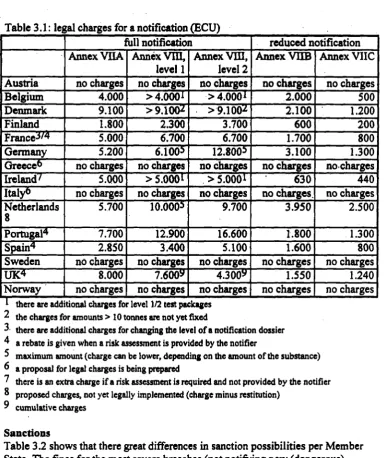
All Member S~tes except Austria, Greece, Italy, the Netherlands and Sweden impose ~barges for a notification (in Greece, Italy, the Netherlands and Norway charges are being prepared). Table 3.1 shows that there are substantial differences in the charges per Member State.
Some Member States give a reduction if an adequate risk assessment is supplied by the notifier (Denmark, France, Portugal, Spain, UK) . .Ireland charges extra if a risk assessment is required but not provided.