Problem-based Learning's Impact on the Understanding of Place Value
David A. Martin1*, Associate Professor Romina Jamieson-ProctorFaculty of Education, University of Southern Queensland
The conceptual development of place value is often described as the most significant of all number concepts which, when understood, enables students to develop a comprehensive sense of number (Reys, Lindquist, Lambdin, & Smith, 2009). Disappointingly, the development of place value is seen as an elusive concept for pre-service teachers. This paper reports on a study to determine the effect of a problem-based learning (PBL) approach versus a traditional teacher-centred instructional approach in a university course on pre-service teacher‟s content knowledge and conceptual understanding of place value.
Introduction
Globally, current educational reforms and initiatives prioritise literacy and numeracy outcomes for students. In 2008, the Australian Ministerial Council on Education stated, “Literacy and numeracy ... [are] the cornerstones of schooling for young Australians”(p. 5). Moreover, in support of a national set of educational goals, “The Australian mathematics curriculum focuses on developing increasingly sophisticated and refined mathematical understanding, fluency, logical reasoning, analytical thought processes and problem-solving skills.” (Australian Curriculum Assessment, 2010, p. 1). Accordingly, the responsibility for achieving these and other goals related to sustaining Australia‟s growth and prosperity in a competitive global economy is placed with teachers. Not surprisingly, teacher‟s professional knowledge bases (Shulman, 1987) have come under scrutiny in an attempt to understand the work of teachers and the global changes that have affected the way that teachers go about their work (Exley, 2005).
Miller (2003) states, “Effective teaching begins with effective teacher preparation (p. 3).” Haystead and Marzano (2009) also advise that university teacher preparation programs should focus their efforts on ensuring that graduates have strong content knowledge and are equipped to use research-based instructional strategies. Miller (2003) further suggests that by integrating researched-based teaching and learning strategies, teachers would be better equipped to bring conceptual understanding to the forefront of student learning. Miller‟s study of the American education system “reveals a 39 percentage-point difference in student achievement between students with „most effective‟ teachers and „least effective‟ teachers” (p. 2).
The Marzano Research Laboratory (Haystead M. W. & Marzano R. J., 2009) employed a meta-analysis to investigate instructional strategies over a five-year period which involved 300+ volunteer teachers, 38 schools in 14 school districts in the United States. Their principle findings revealed that, on average, when particular instructional strategies are used, there is a 16% learning gain between the students‟ pre-test and the post-test. Teaching strategies having such a statistically significant impact on student learning certainly warrants identification.
1
Three of the instructional strategies investigated that are of particular interest to this paper align with the principles of problem-based learning.
Problem-based learning (PBL)
The literature on PBL originated from the medical field in the mid-1950‟s. PBL has since been adopted by many other professions including schools of education (Savery & Duffy, 1996). Of particular interest to education is Major & Palmer‟s (2001, p. 1) definition:
PBL is an educational approach in which complex problems serve as the context and the stimulus for learning. In PBL classes, students work in teams to solve one or more complex and compelling “real world” problems. They develop skills in collecting, evaluating, and synthesizing resources as they first define and then propose a solution to a multi-faceted problem.
Levin (2001) also suggests that PBL is an instructional method which promotes critical thinking and problem-solving skills within the context of real-world problems which result in the acquisition of the intended content and conceptual knowledge. Furthermore, PBL instruction is considerably more student-centred than teacher directed.
Terms such as experiential, discovery, student-centred and inquiry learning (IL) have become synonymous with the PBL approach. Some have categorised these terms together as examples of the constructivist approach and placed PBL under the umbrella of minimally guided instruction (Kirschner, Sweller, & Clark, 2006). However, on the contrary, PBL requires skilled scaffolding of the students‟ learning by the teacher. To imply that PBL should be placed under the umbrella of minimally guided instruction does not accurately describe the instructional process. More accurately, PBL should be considered consistent with the principles of effective instruction arising from constructivism.
Hemelo-Silver, Duncan, and Chinn (2007) also disagree with the notion of classifying these pedagogical approaches under the category of minimally guided instruction and argue that these approaches, in particular, PBL and IL, are not minimally guided instructional approaches but rather offer extensive scaffolding and direction to support student learning (p. 99). For example, under the PBL model, the teacher facilitates the learning process by challenging the students‟ thinking through the asking of key, high order questions which probe deeply into what students know. This information together with additional investigations would be analysed and then synthesised by the students into new coherent forms of understanding required to solve the set problems. The idea being that their learning becomes connected rather than isolated and cumulative rather than fragmented (Levin, 2001).
engage in the learning process. Part of being actively engaged is the incorporation of discussion during and after collaborative group work. The sessions might then conclude with projects and/or presentations alongside reflective discussion as students demonstrate their understanding of the concept or problem.
Place Value (PV)
Central to the Number strand of the National Council of Teachers of Mathematics‟ standards is the development of number sense. Students with number sense naturally decompose numbers, solve problems using the relationships of the base-ten system, estimate a sensible result for a problem, and have a developed ability to make sense of numbers (National Council of Teachers of Mathematics, 2000). Unfortunately, content knowledge of PV systems is a common problem area experienced by university pre-service teachers and their conceptual understanding of PV is underdeveloped (Taplin, 1992).
Context of the Study
This paper focuses on pre-service teachers‟ conceptual understanding and Mathematical Content Knowledge (MCK) with respect to PV systems. This paper reports the results obtained from an analysis of two exam questions categorising students‟ MCK of the symmetry of the PV using the SOLO Taxonomy (Biggs & Moore, 1993).
The SOLO taxonomy is a classification system which is used to evaluate the quality of learning outcomes. As an evaluation instrument, it distinguishes between and describes different levels of increasing complexity in a student's understanding of a subject along a developmental continuum of five levels: prestructural, unistructural, multistructural, relational, and the extended abstract level.
The participants of this study were first year Bachelor of Education students enrolled in a mathematics education course at a regional Australian university (N=58). The course is based on the two major curriculum strands of numeration and patterns and algebra. The data collected were from two end-of-semester exam questions, from two consecutive 2009 (n=30) and 2010 (n=28) semesters, answered by students who were in attendance both weeks when place value was investigated. In both years, a two-hour whole group lecture was provided in traditional fashion in a lecture theatre followed by a two-hour tutorial session. The difference between the ways the students were taught is that during the tutorials, the 2010 group was taught using a PBL approach and the 2009 group was taught using a traditional instructor-led approach. Each method was designed to probe students‟ MCK related to their conceptual understanding of PV systems and their symmetry.
Instructional Process in 2009
Figure 1: Base-10 blocks
Consequently, the process of the conversion was demonstrated, by the instructor, to the students on the whiteboard in symbolic fashion reminiscent of how it was shown in the power point slides of the lecture (Figure 2).
Figure 2: Conversion demonstration
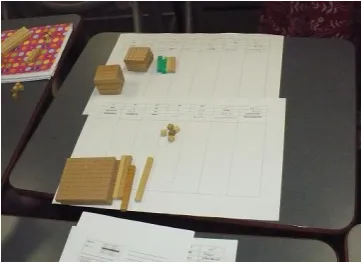
Students were next asked to add 24base 5 and 13base 5. Once again, most students could not apply the concept of the base-10 system and transfer that knowledge to add two numbers in another base system even with the assistance of concrete materials. In fact, the vast majority of students were not able to set the problem up correctly onto the PV mats. Not surprisingly, students struggled when asked to investigate the differences between the two PV systems. When asked to collaboratively build a pedagogical content knowledge understanding directed around the central question, “How would I help my students understand this” they were unable to respond. As a result, the instructional approach became teacher-centred where the instructor owned the knowledge and provided it to the students through a concrete and symbolic demonstration accompanied by an explanation.
In week two with the 2009 group, students were required to discover and describe the symmetry of different number systems, the role of the decimal point in those systems, the number of different digits needed for each system and the largest digit that could be used in each system.
[image:4.595.198.398.283.416.2]The next question required students to calculate the base-10 values of binary numbers from a base-2 PV chart (Figure 3). Following that exercise, they were then asked to fill in the missing components of a base-2 PV pattern, describe the pattern, and then extend the pattern on either end by 2 more places.
Figure 3: Base-2 PV chart
With minimal guidance by the instructor and having the value of the base-2 houses supplied above question 1.a. in Figure 3, students were, on the whole, successful in calculating the values of each house of the base-2 system. With further explanation and demonstration, students were able to complete the remaining questions of converting the base-2 numbers to values in base-10 (Figure 3).
Following the conversion of base-2 to base-10 questions, students were asked to convert 28base10 to a number in base-2. This conversion problem is similar to last week‟s problem, converting 245base10 to its equivalent number in base-5 and met with similar results. By observation it was apparent most students still possessed an inadequate content and conceptual understanding of PV to work out the solution. And once again, the process of the conversion was demonstrated, by the instructor to the students, on the whiteboard in symbolic fashion reminiscent of the lecture‟s power point slides (Figure 2).
The next question asked students to list as many base-10 PV concepts, or properties, as they could. This question was met primarily with answers from the majority of students that reflected a prestructural or unistructural (Biggs & Moore, 1993) understanding of the concept of PV. In other words, student responses were stated as acquired pieces of disconnected information with little understanding of the core concepts. Only simple and obvious connections were stated if at all. Yet even those were realized comparatively independent of each other and therefore the significance of the connections between their isolated pieces of information were not grasped (Biggs & Collis, 1989).
The final question was a yes or no query which asked, “Could you construct the places for base-3 or base-6 or any base e.g., base-X”? Students were not required to demonstrate this,
Instructional Process in 2010
For experimental validity purposes, the two hour lecture in 2010 was presented using an archived, recorded version of the 2009 lecture. Also, as in the 2009 cohort, the 2010 group were required to complete all the same tutorial tasks and questions and provided with the same concrete materials. However, this group was instructed using a student-centred, PBL approach. The goal was to guide the students to self-discovery and ownership of the intended learning outcomes through the use of specific PBL activities and key questioning techniques while avoiding providing them with any teacher-owned knowledge.
Utilizing the PBL approach, strategically designed tasks preceded several tutorial questions. This strategy required students to complete these specific tasks which tapped into their pre-existing knowledge while also collaborating with their peers. In anticipation of this cohort also possessing an inadequate content and conceptual understanding of PV, a content knowledge intervention task was introduced.
The students were guided through a process where they were to come to their own understanding as to why any number raised to the zero power is 1. The task was to first evaluate27. After the students collaborated, the two common responses received were 27= 2 x 2 x 2 x 2 x 2 x 2 x 2 and 27= 128. Both of these answers were posted on the whiteboard without any elaboration by the teacher.
The students were then asked to evaluate 23 x 24. Again after collaboration, the three agreed upon responses were (2 x 2 x 2) x (2 x 2 x 2 x 2), 8 x 16 and 128. These responses were also posted on the whiteboard without comment by the teacher.
The next task in this self-discovery activity asked students to evaluate (3 4)
2 . As anticipated, responses to this evaluation yielded answers such as (2 x 2 x 2) x (2 x 2 x 2 x 2), 8 x 16 = 128, and as hoped, 23x 24 = 27. These too were posted on the board for analysis and reflection.
The final question in this task required students to explain why, if 2(34)= 27, what the value of 2(30)was. After directing the students to use the previously posted problems and solutions to analyse this problem, the students collaborated and responded that if 2(34) = 23x 24 which is = 27, then 2(30) must = 23. This conclusion then led to the final question, “If 23 = 8, and 3
2 x 0
2 = 8, then what must 0
2 equal”? This activity produced what the researcher likes to call an “ah ha” moment or moment of enlightenment in which the students synthesized for themselves that any number raised to the zero power is one.
Guided through another series of self-directed learning activities, students were challenged to transfer their existing knowledge of the base-10 system to discover answers to base-5, base-2 and base-P type queries which were systematically and strategically provided by the instructor. This PBL activity first required students, in collaborative groups, to reinforce their understanding of the symmetry of the base-10 system by filling in the missing cells of a pre-designed template (Table 1).
1000 10 1/100
10 x 10 x 10 10 1/(10 x 10 x 10)
Thousands Hundreds Tens Thousandths
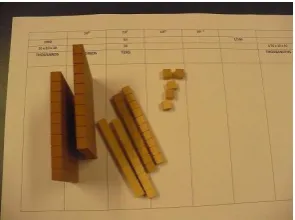
[image:7.595.207.388.255.387.2]To enable students to generalize their understanding of the base-10 system, a similar template was completed in collaborative groups on the base-5 system and reflected on through class discussion. Further to this activity was a short session on building the number 245 side-by-side in both base-5 and base-10 (Figure 4).
Figure 4: Building the number 245 side-by-side in Base-5 and Base-10
It was anticipated that by this point in the instructional sequence students would have a higher degree of success in completing the first tutorial question which was to convert 245base10 to a number in base-5. With their base-5 blocks, students collaborated to build 245 on their newly completed base-5 PV mats. With guided conversation students in the 2010 group were able to visualize and realize, through their own concrete representations, 245base10 as 1440base5. This activity was further followed by a guided symbolic demonstration reminiscent of how it was shown in the power point slides during the lecture (Figure 2) to allow for discussion and reflection.
Figure 5: Adding 24base5 and 13base5
[image:8.595.73.520.323.695.2]The next PBL activity was designed to scaffold students‟ understanding, by building upon the previous week‟s activities, and then reinforce and extend their understanding of the symmetry of the base-10, base-5, and base-2 system by filling in the missing cells of pre-designed templates (Table2, Table 3, and Table 4).
Table 2: Base-10 pattern system chart [week 2]
102 101 100 10-3
10 x 10 x 10 10 1/10 1/100
100 .1
Table 3: Base-5 pattern system chart [week 2]
52 51 50 5-3
5 x 5 x 5 5 1/5 1/(5x5)
25 .2
Table 4: Base-2 pattern system chart
22 21 20 2-3
2 x 2 x 2 2 1/2 1/(2x2)
4 .5
[image:8.595.75.523.336.429.2] [image:8.595.76.521.604.696.2]two-dimensional representation of base-10 and base-5 blocks (Figure 6) and, using a piece of graph paper, directed to generalize and then draw what the base-2 blocks would resemble.
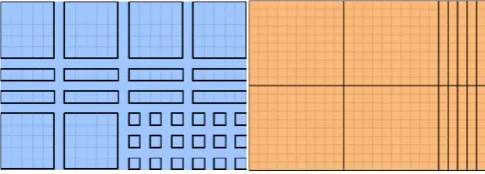
Figure 6: Two dimensional representation of multi-based arithmetic blocks
Completing this task, and the previous task in Table 4, enabled the majority of students to calculate the base-10 equivalency of the binary numbers (Figure 3). Furthermore, they were highly successful in completing the related tutorial tasks of filling in the missing components of the base-2 place value pattern, describing the pattern, and then extending the pattern on either end by 2 more places.
Students were next asked to convert 28base10 to a number in base-2. Collaboratively they set up the number 28 onto their base-10 PV mats and then built 28 on their base-2 mats. Consequently, students were able to visualize, realize and then demonstrate the conversion of 28base10 to 11100base2. The tutor followed the activity with a guided symbolic demonstration, on the whiteboard, of the conversion process to stimulate discussion and facilitate student reflection of their learning.
The next question asked students to list as many base-10 place value concepts, or properties, as they could. The 2010 tutorial group responded with answers which indicated unistructural, multistructural or relational (Biggs & Moore, 1993) understandings of the concept of PV. In other words, student responses were stated at a levelwheresimple, yetimportant connections were made as well as responses that indicated an attainment of what could be considered an adequate understanding of the topic (Biggs & Collis, 1989).
The final question asked, “Could you construct the places for base-3 or base-6 or any base e.g., base-X”? This question was this time preceded by another activity which required
[image:9.595.174.417.118.205.2]students, in collaborative groups, to reinforce and then extend their understanding of the symmetry of different base systems by filling in the missing cells of a pre-designed template for base-P (Table 5).
Table 5: Base-P pattern system chart
P2 P 1 P 0 P -3
P x P x P P
correct answers on the exam questions versus the 2009 group taught using the teacher-centred approach.
Method of Analysis
This study compared the data obtained from students‟ responses to two end-of-year semester exam questions, namely:
1. What is your understanding of the term “place value”?
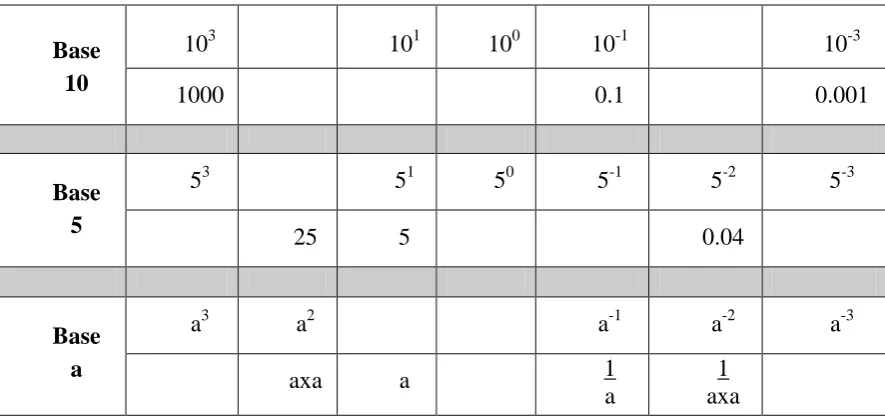
2. Demonstrate your understanding of the symmetry of any place value system by completing all 16 empty cells in Table 6 below.
Table6: Exam question investigating MCK of place value
Base 103 101 100 10-1 10-3
10
1000 0.1 0.001
Base 5
3
51 50 5-1 5-2 5-3
5 25 5 0.04
Base a
3
a2 a-1 a-2 a-3
a
axa a 1
a
1 axa
The responses to the exam questions were analysed using two different methods. The responses to Question 1 from both cohorts were coded using the SOLO Taxonomy to evaluate student responses. The responses from Question 2 were analyzed using an independent-samples t-test to compare the means between the two trial groups by year of the exam. The Statistical Package for the Social Sciences (SPSS) was used to analyse the data.
Results
The students‟ responses to exam Question 1: What is your understanding of the term “place
value?” were coded (prestructural=1; unistructural=2; multistructural=3; and relational=4) and compared by year using the Chi-square test to investigate the relationship between the two cohorts. Table 7 provides the percentage of students for each of the first four SOLO levels by year of exam as well as exemplar student responses for each of the four levels.
Table 7: Student response levels for Question 1
Level of Understanding
2009 Group
2010 Group
Indicative Student Responses
[image:10.595.78.521.268.477.2]Unistructural 19 (63%) 16 (57.1%)
The value of a number is determined by the place it is in.
Multistructural 2 (7%) 7 (25%) A numbers position determines its value. A numeral can have multiple values.
Relational 0 0
Symmetry runs through the ones house creating a mirror image on either side – tens/tenths. This forms a pattern where each house is ten times larger than the house to the right.
Totals 30 (100%) 28 (100%)
The Chi-square test indicated a non-significant difference between the two year groups‟ level of understanding. As can be seen in Table 7 however, more students from the 2010 cohort provided a multistructural response and less student responses were prestructural (meaning they provided a totally incorrect response). In teaching terms, one hopes that an intervention such as PBL will impact positively on student learning outcomes. The researchers believe, based on these results, as well as observations of the students working on the set tutorial tasks each year, that the change in pedagogy to a PBL approach shows promise, even though the result in this study was not statistically significant.
[image:11.595.70.529.68.281.2]Each of the 16 empty cells in Question 2 (Table 6) was given 1 mark for a correct answer and a 0 for an incorrect response. When the overall scores out of 16 were compared by year group, the results again indicated a non-significant difference between the year groups. Table 8 provides the mean and standard deviation for each cohort‟s overall score out of 16.
Table 8: Overall mean scores for each cohort
Year N Mean Std. Deviation
Sum of Scores
2009
2010
30
28
12.40
13.75
3.76
1.71
Finally, Table 9 provides the number and percent of students in each cohort who were able to complete the pattern by naming or calculating the value for each of the three place value systems (Table 6). Students had most difficulty with the fraction places and with naming the ones place. They also had less success when asked to generalise their understanding by naming the bases in a base a system.
Table 9: Student responses to exam Question 2
[image:11.595.62.493.522.607.2]102 Correct/ Incorrect 28 (93%) 2 (7%) 28 (100%) 0
100 Correct/
Incorrect
28 (93%) 2 (7%)
28 (100%) 0
10 Correct/
Incorrect
28 (93%) 2 (7%)
28 (100%) 0
1 Correct/
Incorrect
24 (80%) 6 (20%)
26 (93%) 2 (7%)
10-2 Correct/
Incorrect
28 (93%) 2 (7%)
28 (100%) 0
0.01 Correct/
Incorrect
26 (87%) 4 (13%)
27 (96%) 1 (4%)
125 Correct/
Incorrect
27 (90%) 3 (10%)
27 (96%) 1 (4%)
52 Correct/
Incorrect
28 (93%) 2 (7%)
28 (100%) 0
1 Correct/
Incorrect
24 (80%) 6 (20%)
24 (86%) 4 (14%)
0.2 Correct/
Incorrect
5 (17%) 25 (83%)
6 (21%) 22 (79%)
0.008 Correct/
Incorrect
3 (10%) 27 (90%)
5 (18%) 23 (72%)
a x a x a Correct/
Incorrect
25 (83%) 5 (17%)
28 (100%) 0
a1 Correct/
Incorrect
28 (93%) 2 (7%)
27 (96%) 1 (4%)
a0 Correct/
Incorrect
28 (93%) 2 (7%)
27 (96%) 1 (4%)
1 Correct/
Incorrect
20 (67%) 10 (33%)
21 (75%) 7 (25%)
1/(a x a x a) Correct/
Incorrect 22 (73%) 8 (27%) 27 (96%) 1 (4%) Conclusion
It has been long recognised that “...the real mathematical thinking going on in a classroom, in fact, depends heavily on the teacher‟s understanding of mathematics” (Ma, 1999). Unfortunately, many soon-to-be teachers, as this study further demonstrates, have limited understanding of mathematical concepts such as place value. In this study both cohorts‟ MCK was weakest when working with decimal fractions and when generalising their understanding of place value to any base. No students in either cohort, irrespective of teaching method, appear to possess a relational understanding of place value.
this understanding by naming the places in different bases. This lack of MCK with respect to place value needs to be addressed in order that their misconceptions are not transmitted to their students after they graduate. Hence, it may be suggested from this study and from other similar studies that if teacher knowledge of subject matter, student learning, and teaching methods are all important elements of teacher effectiveness (National Commission on Teaching and America‟s Future, 1996); and, effective teaching begins with effective teacher preparation, then university teacher preparation programs should focus their efforts on ensuring that pre-service education graduates have strong MCK and are equipped to use research-based instructional strategies such as the problem-based learning approach (Miller, 2003).
References
Australian Curriculum Assessment, Reporting Authority (ACARA). (2010). Australian curriculum draft consultation version 1.1.0. Retrieved September 2, 2010, from http://www.australiancurriculum.edu.au/Documents/K10/Mathematics%20curriculum.p df
Biggs, J. B., & Collis, K. (1989). Towards a model of school-based curriculum development and assessment using the SOLO taxonomy. Australian Journal of Education, 33(2), 151-163. Retrieved from
http://lib5.usq.edu.au/zportal/zengine?VDXaction=GetAttachment&illno=314981&obje ctno=26490&objectseq=1&is_popup_window=true
Biggs, J. B., & Moore, P. J. (1993). Process of learning (3rd ed.). London: Prentice Hall. Exley, B. E. (2005). Teacher thinking: A study of practical knowledge. London: Croom Helm. Haystead M. W. & Marzano R. J. (2009, August). Meta-analytic synthesis of studies
conducted at marzano research laboratory on instructional strategies Retrieved 13 April 2010, from
http://files.solution-tree.com/MRL/documents/Instructional_Strategies_Report_9_2_09.pdf
Hmelo-Silver, C., Duncan, R., & Chinn, C. (2007). Scaffolding and achievement in problem-based and inquiry learning: A response to Kirschner, Sweller, and Clark (2006).
Educational Psychologist, 42(2), 99 - 107. Retrieved from
http://www.informaworld.com/smpp/content~db=all~content=a787996949~frm=titlelin k
Kirschner, P. A., Sweller, J., & Clark, R. E. (2006). Why minimal guidance during instruction does not work: An analysis of the failure of constructivist, discovery, problem-based, experiential, and inquiry-based teaching. Educational Psychologist, 41, 75-86.
Retrieved from http://www.informaworld.com/smpp/title~db=all~content=g784754049 Levin, B. B. (2001). Energizing teacher education and professional development with
problem-based learning. Retrieved August 25, 2010, from http://www.ascd.org/publications/books/101002.aspx
Ma, L. (1999). Knowing and teaching elementary mathematics: Teachers' understanding of fundamental mathematics in China and the United States. Mahwah, NJ: Lawrence Erlbaum Associates
Major, C. H., & Palmer, B. (2001). Assessing the effectiveness of problem-based learning in higher education: Lessons from the literature. Academic Exchange Quarterly, 5(1), 1-5. Retrieved from http://www.rapidintellect.com/AEQweb/mop4spr01.htm
Miller, K. (2003). School, teacher, and leadership impacts on student achievement. Retrieved 15 August, 2010, from
http://www.mcrel.org/topics/TeacherPreparation/products/149/
September 1, 2010, from
http://www.mceecdya.edu.au/verve/_resources/National_Declaration_on_the_Education al_Goals_for_Young_Australians.pdf
National Commission on Teaching and America‟s Future. (1996). What matters most: Teaching for America‟s future. Retrieved December 15, 2009, from
http://www.nctaf.org/documents/WhatMattersMost.pdf
National Council of Teachers of Mathematics. (2000). Principles and standards for school mathematics. Retrieved September 2, 2010, from
http://standards.nctm.org/document/chapter3/numb.htm
Reys, R. E., Lindquist, M. M., Lambdin, D. V., & Smith, N. L. (2009). Helping children learn mathematics (9th ed.). Danvars: John Wiley & Sons.
Savery, J., & Duffy, T. (1996). Problem based learning: An instructional model and its constructivist framework. Constructivist learning environments: Case studies in instructional design, 135-148. Retrieved from
http://crlt.indiana.edu/publications/duffy_publ6.pdf
Shulman, L. S. (1987). Knowledge and teaching: Foundations of the new reform. Harvard Educational Review, 57(1), 1-22.
Taplin, M. (1992). Difficulties with basic mathematics amongst pre-service teachers. New Horizons in Education, 92, 3-19.
![Table 3: Base-5 pattern system chart [week 2]](https://thumb-us.123doks.com/thumbv2/123dok_us/183690.52840/8.595.73.520.323.695/table-base-pattern-chart-week.webp)