Theses
6-10-2019
An exploration of microaggression awareness in
real-time conversations and long-term tracking and
learning system
Feifei Guo [email protected]
Follow this and additional works at:https://scholarworks.rit.edu/theses
This Thesis is brought to you for free and open access by RIT Scholar Works. It has been accepted for inclusion in Theses by an authorized administrator of RIT Scholar Works. For more information, please [email protected].
Recommended Citation
An exploration of microaggression awareness in real-time conversations and long-term
tracking and learning system
by
Feifei Guo
A Thesis Submitted in Partial Fulfillment of the Requirements for the Degree of Master of Fine
Arts in Visual Communication Design Program
School of Design | College of Art and Design
Rochester Institute of Technology
Rochester, NY
Committee Approval
Adam Smith
Associate Professor/Graduate Director of Visual Communication Design Program
Chief Advisor
Miguel Cardona
Assistant Professor of New Media Design and Visual Communication Design Program
Abstract
Microaggression is a comment or action that subtly and often unconsciously or unintentionally
expresses a prejudiced attitude toward a member of a marginalized group. Microaggressions are
often subtle and ambiguous, it's often hard to know if you're committing one or if you're on the
receiving end. The recipients of microaggressions always feel a sense of powerlessness and
invisibility, while the aggressors are often unaware of the harm they’ve brought. The impact of
microaggressions always negatively affects both mental and physical health of recipients and
results in persistent health problems.
My goal of the thesis is to make the invisible visible. Leverage technology to help people notice
and rethink their microaggression behavior in real time, educate and inform people to interact
better with each other.
The first step to solve the problem is to raise awareness of unconscious behavior in real time
during the conversation. People should be able to recognize their own inappropriate actions or be
reminded by other people immediately so that they can realize what is considered unacceptable.
Learning to be empathetic is another factor in the process. People need to experience and feel
emotionally and mentally while confronting with each other so that the aggressor will be more
understanding about the recipient’s feeling and the impact of a certain microaggression.
It's also important to help people form a consistent habit and an inclusive mind to change their
inappropriate behavior in a long-term period. They will be able to view and track specific types
of microaggressions based on their activities and get a reminder of their performance in a daily
It is hoped that my exploration in microaggression can bring more awareness to people and help
them address microaggressions more easily and confidently.
Keywords: microaggression, communication, awareness, race, gender, differences
Introduction
78% of participants experience at least 1 microaggression over a two-week period. We all have
stereotypes, all the time, without knowing it. These biases come from our various background,
cultural environment, and personal experience. We consciously and unconsciously reveal these
attitudes and beliefs in different ways in everyday life. It might hurt a certain person or a group
through our implicit actions verbally or nonverbally. We call those slight or hidden indignities or
insults behavior: microaggression.
There are mainly three types of microaggressions: micro insult, micro assault, and
microinvalidation. For example, messages like "You're so smart for a Black girl" that demean a
person's heritage or identity are regarded as microinsult. A White woman or man goes out of
their way or checks their wallet when a Black or Latino homeless man approaches or passes by.
That is microassault which usually considered consciously. Also, we often heard messages like
"I meant that you must be smart because you're Asian ", "You speak really good English",
"Where are you really from?", etc. in our daily life. These are called microinvalidation which
Although these microaggressions are subtle and ambiguous, they still can make an unexpected
harmful impact on people’s mental and physical health. The recipient of the microaggression
always feel vaguely insulted and do not know whether to respond or not. If he/she takes actions,
it might lead to an argument or further aggression. But if the victim chooses not to react to it,
he/she will regret and feel sadness and the aggressors will never notice their inappropriate
behavior and the harm they’ve brought. And for an aggressor, he/she sometimes might aware of
the actions or need someone else to point it out. It’s important to educate people to be aware of
the language they use, always be open-minded and value diversity in the world.
Review of literature
Microaggressions are subtle and ambiguous insults or indignity, expressed consciously or
unconsciously towards a targeted person or group due to bias and discrimination of certain
gender, race or sex (Sue 2010). These microaggressions can be delivered verbally, nonverbally
or environmentally, which convey hidden messages. An empirical study reveals that there are
tremendous and psychological harm and impact on the recipients and eventually results in
depressive symptoms, low self-esteem and negative effects (D. W. Sue 2018). It’s important for
individuals to notice and identify the microaggressions in the early stage and educate them to
enhance sensitivity and awareness during the process.
Some microaggressions are related to social norms. McTernan believes, sometimes, the case of
microaggressions comes from wrong social practices, which are common patterns of behavior in
society and they are not authorized or obligated, but more because of personal habit and mind
workplaces. Tao experimented different microaggression ambiguity and emotional reaction for
ethnic minority and white individuals in the school environment (Karen W. Tao 2017). She
tested four conditions of interaction from no microaggression to an overt microaggression and
turned out only the overt microaggression has a significant difference in perceptions and
emotions compared to others. And in the workplace, there are snubs and slights from superiors,
men or other potential microaggressors. However, these situations intensify more negative work
outcome and isolation (Basford 2014).
How to create a safe and inclusive environment in both school and work communities? The
biggest challenge is to encourage people to be more open and honest when they engage in a
conversation. We should have a more educational training program to let people overcome their
fears and be brave to face and talk about their identities and feelings and educators should have a
clear understanding of how behaviors can influence the learning environment (Sue 2007). There
are already studies and projects about microaggression to raise more awareness to people in daily
life and showcase what people with different race, culture and backgrounds are experiencing
nowadays, which can bring more empathy and a learning process for readers. The photo series
are a great example to give voice to the people endure microaggressions every day to express
their experience (Ruble 2013).
All we did and will keep doing is to bring better communication among people, help us identify
microaggressions more confidently and create a more inclusive culture. Next attempt we can do
is to have a better understanding of the relationship among the aggressor, receiver and bystander
Process
The thesis project is an exploratory of microaggression awareness in real-time conversations and
educational learning system for long-term tracking and habit formation. I started with some
online research about microaggression, bias, stereotypes, verbal abuse, etc. to have a thorough
understanding of the problem people are currently facing. And I conducted several interviews
with people from different countries, culture and background, had a deep analysis of the
problems they are experiencing. Then, based on the people I talked to, I decided to create
personas and go through their typical day which helps me to empathize their frustrations and
goals. According to the five main phases from the initial incident to the end of the experience, I
went through the emotional journey of the recipients to perceive their emotions (Sue 2010).
Some brainstorming exercises help me to come up with some creative solutions and the “How
might we” questions allow me to reframe the challenge into a more actionable opportunity. I
filtered out some potential solutions and determined the major narratives I would design for.
After that, I started with quick sketches, considered how to present visual design more
intentionally and continued to do some testing during the whole process, coming up with some
iterations to achieve clear content, pleasant visuals and intuitive interactions.
Before the interview, I confirmed my goal is to know more about their experience with
microaggression as an individual, dig deeper to understand the changes of their emotion and
feeling and see the differences how they confront and deal with a specific microaggression.
During the process, I asked some prepared questions and encouraged them to recall and narrate
some of the experience has left them a deep impression. To better get to know the scenario and
context and uncover the pain points they have encountered, I tried to ask further questions based
tell his/her real feelings and thoughts. The opening questions helped us to better know each other
and I would leverage the information to build more trust and confidence between us to discover
later in the interview. I realized for the question “Have you felt you could be a microaggressor in
a conversation or situation?”, over a half of the interviewees said they never feel they could be
an aggressor, however, many times just because they didn’t realize it until someone points it out
for them. Also, I found that because microaggressions are so subtle and ambiguous, it's often
hard to know if you're committing one or if you're on the receiving end. If the recipients speak up
to talk about their dissatisfaction, they are often regarded as oversensitive and take offense too
easily. It makes communication and dialogue among people more challenging and distant.
After I synthesized the interview results and had a deep dive into the similarity and differences
among the participants. I found out the scenario that microaggressions mostly occurred is in the
educational environment and workplaces, where there are majority and minority, seniors and
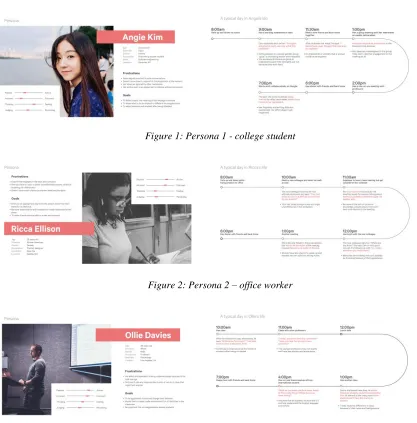
juniors, active and passive people, etc. I created three personas which represent the typical
recipient and aggressor in daily life, they are a student, a professor and an office work (see
Figure 1, 2, 3). For a college student, Angie, she gets up and drives to school at 8 a.m. When she
is having a morning mathematics class, she is asked by other classmates: “You guys are good at
math. It’s just a piece of cake for you.” Angie felt a little pressured because in actual she was not
good at math at all. However, she paused, then said: “I don’t know, I can have a try I guess.”
Other students in the group didn’t intervene in the conversation. From that narrative, I figured
out that the receiver felt a sense of powerlessness in the conversation but didn’t know that best
way to respond the aggressor in a polite way but can somehow express her uncomfortable
feeling. And the bystanders also didn’t know what to do or say to somehow interrupt the
inappropriate humor which subtly targeted a group of students. Also, he didn’t give all students
the same chance to present in class which he didn’t notice them at all. One of the students in the
class, felt unfair and angry. He chose to send an email to Professor Davies. After Professor
Davies got the feedback from his students, he noticed his problem and would love to create an
inclusive and positive environment for students. But how could we help Professor Davies to
change his behavior and keep track of his habit? These are the insights and thoughts that I
[image:10.612.86.503.273.696.2]learned from the analysis of the personas and their typical day.
Figure 1: Persona 1 - college student
Figure 2: Persona 2 – office worker
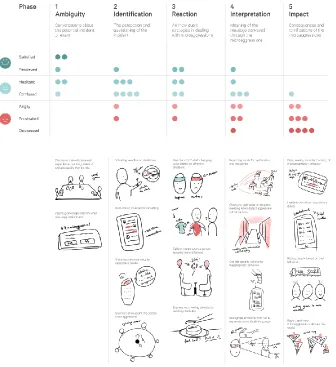
In order to better understand the feelings of the recipients in the microaggression, I analyzed
their emotional changes in the five phases and brainstormed different potential solutions. At this
point, I encouraged myself to have more blue-sky ideas without considering the implementation
(See Figure 4). The whole experience of microaggression starts from an ambiguous event. Then,
the recipient starts to question the event and becomes hesitant and confused. He/she thinks about
how to react to it, after that, he/she tries to interpret the meaning of the message and turns to a
little angry and frustrated. Finally, it ends up with a negative consequence and impact which will
stay on the victims for a long period. In the third phase, to help the people in the dialogue better
notice each other’s emotion changes and keep watching the language, I came up with using
visual indicators, wearables like a headband, T-shirt, watch, or environmental alert like light
Figure 4: Emotional journey & brainstormed solutions
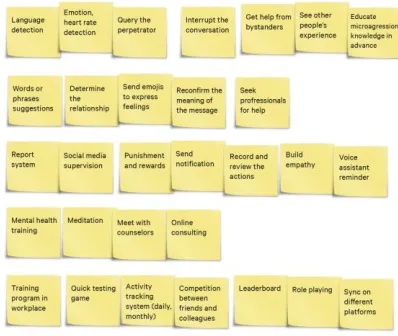
After the creative thinking stage, it was time to back to the major pain points and thought more
specifically to solve the problem. The “How might we” method (See Figure 5) helped me to
narrow down the issues and focus on two main problems and find out the actionable solutions for
them.
1. “How might we help people identify microaggression more obviously and effortlessly
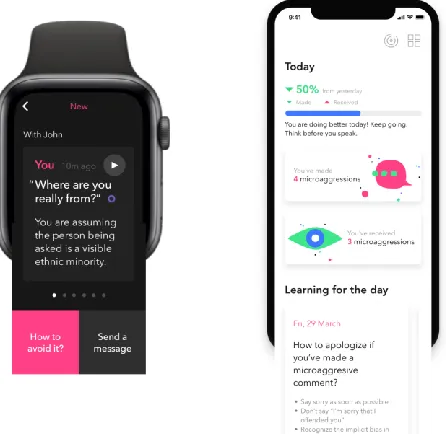
My solution based on the first problem is to utilize a wearable watch (See Figure 6) to
automatically detect and examine microaggressive language in real time, encourage less
ambiguity and timely clarification during the conversation. The watch will provide instant
visual and tactile feedback directly to users. For every action, there is a reaction to make sure
people have a better understanding of their behavior and modify it if necessary. There are
biometric sensors to monitor users’ multiple emotions so that can uncover their real feelings
and send out alerts for notification.
2. “How might we educate people to form a good habit and foster an inclusive and
supportive environment?”
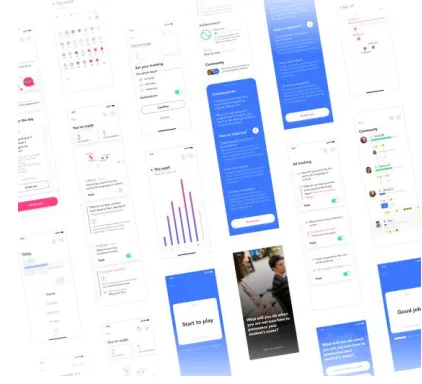
To experiment on solving the second problem, I designed a mobile application (See Figure 6)
to have a behavior tracking and educational system to help people to eliminate aggressive
actions and form a good habit in a long-term time period. Users can view daily activities and
track particular microaggressions based on preferences, interact with friends in the
[image:13.612.284.483.482.650.2]community and gain knowledge about a specific microaggression.
Figure 6: Final solution
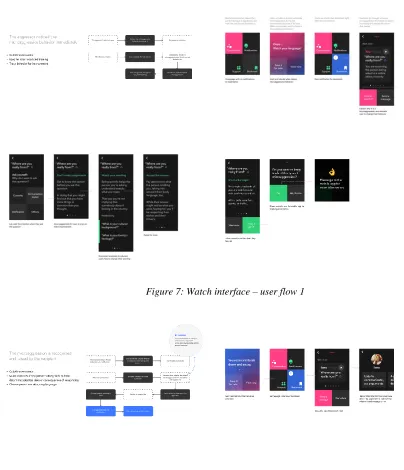
For the first solution, there are two main tracks that I designed for. Two people are in a
conversation, when someone said something aggressive, the watch will vibrate and send out a
notification. If the aggressor noticed his/her inappropriate behavior immediately (See Figure 7),
he/she can quickly save the event from the watch and be able to view right away or recall it later
after the conversation. He/she will learn about the reason why it is a microaggression, also some
tips to rephrase the language and maintain better communication. But if the aggressor didn’t
notice his/her behavior or chose to ignore the alert from the watch (See Figure 8), the recipients
did feel uncomfortable about specific words. The watch will detect the unusual condition from
heart rate, emotion, etc. of the person and send out alerts. The receiver can also save the event.
After the conversation, he/she can recall it and have a further conversation with the aggressor. In
order to help him/her to decide whether to respond to the microaggression or not, the recipient
responding. Also, if the recipient decides to send a message to the aggressor, there are preset
sentences to help them act in a positive way instead of evolving into an argument. The
aggressor’s watch will be locked when he/she got the message from another person until he/she
[image:15.612.81.485.191.661.2]respond to it and get it solved.
Figure 8: Watch interface - user flow 2
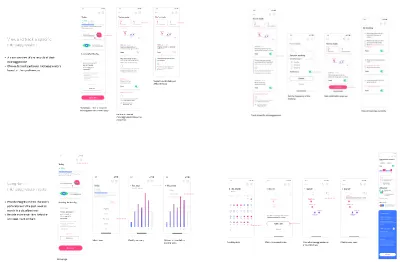
To bring more awareness and influence their behavior in daily life, the mobile application is the
way can provide both instant notifications and consistent performance statistics. People can
review daily microaggressions both received and made and track specific ones. The app provides
a way to simply and easily scan weekly and monthly data stats for users to have a clear view of
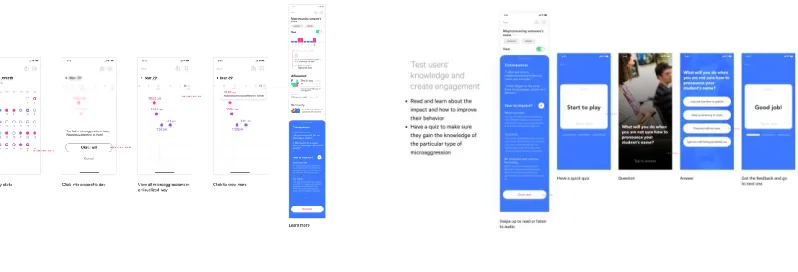
their performance. Also, when they learn more about a microaggression, they can take a quiz to
Figure 9: App interface
I used the same color palette for both designs of the watch and mobile application. However, the
difference is that I applied dark theme for watch and light version for the mobile (See Figure 11)
because dark background for watch helps people to focus on the content much easier and for
mobile, because there is more information need to present it, the light version can be more clear
and direct. And three main colors, red, blue and green (See Figure 10), indicate different level of
status which constantly appear in the app interface. To better understand whether people can
have the similar feeling for colors and the effective way to present information on the watch, I
did a user testing (See Figure 12) to find out their opinions and confusion.
[image:18.612.161.450.311.457.2]
Figure 11: Visual design
Figure 12: In the testing process
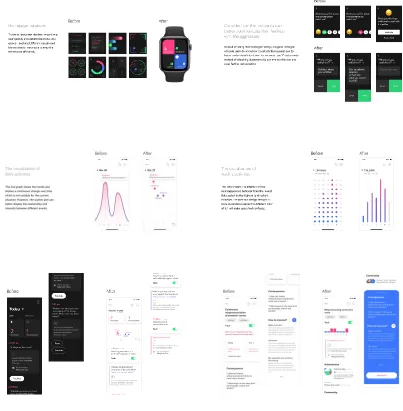
After the testing, I synthesized the results and feedback and came up with the modified design
(See Figure 13) aiming to provide better experience based on people’s needs. Basically, for the
third and fourth images of Figure 13, I aimed to provide explicit and precise data visualization
for daily and weekly information. The line graph shows the trends and implies a continuous
change over time which is not suitable for the data I want to present. However, the scatter plot
the graph represents the intensity of the microaggressive behavior from the lowest (blue color) to
[image:19.612.85.488.148.559.2]the highest (red color).
Figure 13: Iterations - Before and after
Summary
To sum up, I did the thesis project from doing research, looking for the real problems,
creating visuals and interactions, doing user testing and iterations, etc. I tried to tackle the
problem by utilizing technology in a creative and futuristic way. However, there is a group not
being involved in my design but can do a great difference to the situation, the bystanders.
70% of the bystanders choose not to intervene in the conversation. And 50% of them choose that
because they don’t know what to do or say. So how to educate bystanders to interrupt
microaggressions more confidently and appropriately? These are the thing I will keep on
thinking about.
Conclusion
Microaggressions are actions or comments communicate negative insults and slights that people
are easy to neglect in their daily life but truly play an essential role and affect people’s physical
and mental lives. I hope my thesis project can raise people’s attention to microaggression and
start to think more about their use of words and language. You will never know the effect that
your words or behavior will have on another person and how long they will stay. The importance
is to have better communication with people and be open-minded and diverse constantly.
Appendix
Interview questions
• Hello! Please introduce yourself a little bit, your name, occupation, hometown,
personality, etc., and what’s your understanding of microaggression and why are you
interested in joining the interview.
Interview questions
• Have you been treated disrespectfully or rudely in your point of view? Can you describe
it?
• Have you sensed you were left out of conversation or activities while in a group work?
Can you describe it?
• Have you been treated in an over-friendly or other uncomfortable way during a
conversation with others? Can you describe it?
• What would you do when you confront a microaggressor?
• Have you questioned yourself about the meaning behind a certain word or phrase in a
conversation? Can you describe it?
• Have you felt you could be a microaggressor sometime in a conver--sation or situation?
Can you describe it?
• Please describe a microaggressive experience you have encountered.
• What kind of words or actions could be aggressive to you?
Ending questions
• So today, you shared with me some of your experience of microaggressions. Now when
you look back, do you think the impact of these experiences has kept influence you in
Script example as a facilitator:
Interviewee:19 years old, African American, from Georgia, software engineering major
Have you been treated disrespectfully or rudely in your point of view? Can you describe the
situation?
“Yes, a friend of mine made a joke about me in front of many people that she has a black friend
and she is not able to see me until I smile.”
Have you sensed you were left out of conversation or activities while in a group work? Can you
describe it?
“Yes, I remember once I had a meeting with mostly males. During the break, they don’t talk to
me. It seems like they isolate for me when they get on the topic of sports, fantasy teams, etc. Also,
my friend told me one time she supposed to be the initial leader in a discussion, but somehow she
became a co-leader during the whole process because she is the only woman in the group.”
Have you been treated in an over-friendly or other uncomfortable way during a conversation
with others?
“Yes, a professor in my primary school said to me:’ If you were smarter, you will get the right
answer.’”
Have you felt you could be a microaggressor in a conver--sation or situation?
“Never”
Please describe an aggressive experience you have encountered.
“When I was 12 years old, I was running down the street, a truck driver yelled at me with the
What kind of words or actions could be aggressive to you?
“Racial slurs”
Bibliography
Sue, Derald Wing. Microaggressions in Everyday Life: Race, Gender, and Sexual Orientation.
Hoboken: John Wiley & Sons, Incorporated, 2010. Accessed May 7, 2019. ProQuest Ebook
Central.
Torino, Gina C. Microaggression Theory: Influence and Implications. Hoboken, NJ: Wiley,
2019.
Sue, Derald Wing, Christina M. Capodilupo, Gina C. Torino, Jennifer M. Bucceri, Aisha M. B.
Holder, Kevin L. Nadal, and Marta Esquilin. "Racial Microaggressions in Everyday Life:
Implications for Clinical Practice." American Psychologist 62, no. 4 (May, 2007): 271-286,
https://ezproxy.rit.edu/login?url=https://search-proquest-com.ezproxy.rit.edu/docview/614462086?accountid=108 (accessed May 7, 2019).
Sue, Derald Wing, Jennifer Bucceri, Annie I. Lin, Kevin L. Nadal, and Gina C. Torino. "Racial
Microaggressions and the Asian American Experience." Cultural Diversity and Ethnic Minority
Psychology 13, no. 1 (01, 2007): 72-81.
doi:http://dx.doi.org.ezproxy.rit.edu/10.1037/1099-9809.13.1.72.
https://ezproxy.rit.edu/login?url=https://search-proquest-com.ezproxy.rit.edu/docview/614450775?accountid=108.
Microaggressions. 2010. “Power, Privilege, and Everyday Life.” Accessed May 12, 2019.
Casey Ruble. 2013. “The Racial Microaggressions photo series.” Accessed May 12, 2019.
https://nortonism.tumblr.com/
Nadal, Kevin L., Katie E. Griffin, Yinglee Wong, Sahran Hamit, and Morgan Rasmus. 2014.
“The Impact of Racial Microaggressions on Mental Health: Counseling Implications for Clients
of Color.” Journal of Counseling & Development 92 (1): 57–66.
doi:10.1002/j.1556-6676.2014.00130.x.
Karen W. Tao, Jesse Owen, and Joanna M. Drinane. 2017. “Was that Racist? An Experimental
Study of Microaggression Ambiguity and Emotional Reactions for Racial–Ethnic Minority and
White Individuals.” Springer Science + Business Media (June). Accessed May 7, 2019.
https://link.springer.com/article/10.1007/s12552-017-9210-4
McTernan, Emily. "Microaggressions, Equality, and Social Practices." Journal of Political
Philosophy 26, no. 3 (2018): 261-281.
Rao, K. Sreenivasa, Shashidhar G. Koolagudi, and SpringerLink (Online service). Emotion
Recognition using Speech Features. 1. Aufl.;2013; ed. New York, NY: Springer New York,
2013;2012;.
Basford, Tessa E., Lynn R. Offermann, and Tara S. Behrend. “Do You See What I See?
Perceptions of Gender Microaggressions in the Workplace.” Psychology of Women Quarterly