1 DYNAMIC AND INTERACTIVE TEACHING WITH TECHNOLOGY
Peter J Phillips1 and Birgit I Loch2
This paper reports the results of an investigation into the efficacy of Tablet PC technology in teaching introductory level corporate finance to a large cohort of 400 students, of which three quarters were enrolled for distance study. Tablet technology consolidates elements of traditional white-board-based teaching and PowerPoint presentation in a manner that can generate a far more dynamic and interactive classroom experience without a dramatic departure from traditional instructional approaches. In addition, it provides a straightforward option to capture classroom action for instructors who wish to deliver elements of the classroom experience to distance students. The student experience, which was assessed by an analysis of solicited (survey) and unsolicited student comments as well as quantitative retention and performance data confirms the utility of the technology for both face-to-face and distance delivery. In fact,some striking improvements in motivation (higher retention rates) and performance (final examination performance) were deduced from the data.
Key Words: Finance, Tablet PC, PowerPoint, White Board, Interactive Classroom Experience, Screen-cast
JEL Codes: A2, A22
1Peter J. Phillips is Senior Lecturer in Finance at the University of Southern Queensland, Toowoomba, Queensland, Australia, 4350. Email: [email protected]. Telephone: 617 46 31 5490.
2
INTRODUCTION
This paper presents the results of an investigation into the efficacy of the Tablet PC computer in fostering engagement, performance and a positive student experience within an introductory (principles) corporate finance course. It contributes to the ongoing research into IT and educational outcomes. Ideas for using the Tablet computer are presented and evidence of its impact on engagement, performance and, importantly, student experience is assessed. The perspective is broadened by the inclusion of a distance education cohort in the analysis. The distance education cohort undertakes their studies without ‘face-to-face’ instruction and, instead, interacts with other students and the course instructor online via the university’s ‘Study Desk’ portal. The effectiveness of teaching technologies in assisting the delivery of online courses is of particular interest as more and more institutions move into the e-learning or blended learning space. The effectiveness of online delivery of higher education has implications for the institutions’ market shares and, more importantly, the value of the students’ experiences. The results presented in this paper show that the Tablet PC computer can be an effective teaching technology for both face-to-face and online delivery.
The University of Southern Queensland (USQ) operates its main campus from the regional Australian city of Toowoomba. The institution enrols 25,000 students in a multi-campus and multi-mode environment. Approximately 70 percent of these students study in the distance mode. The traditional approach to distance study—mailing printed study guides and other material to students—has largely been replaced by hybrid CD-web content delivery with a print option for students: The material that was once contained in printed study guides has been migrated onto CD and multi-modal formats, including audio and video recordings and is distributed via the online Moodle Learning Management System ‘Study Desk’. Since 2005, the institution has been trialling Tablet technology in a number of different disciplines but especially in mathematics (Loch 2005; Loch and McDonald 2007; Loch and Donovan 2006). In early 2009, there was a substantial expansion in the deployment of Tablet technology at the institution, funded through a strategic Learning and Teaching Fellowship program. The Tablet PC used in this study was part of the fellowship roll out.
3 Faculty of Business and, in particular, in the delivery of introductory corporate finance (or financial management) classes.
The paper is organised as follows. First, the relevant literature is surveyed. The literature review concentrates on research into teaching practices, the utilisation of technology in education and the fostering of student engagement, interaction and motivation through active learning. Second, the parameters for the trial, the Tablet technology and the teaching approach are outlined. This brief section provides contextual completeness for the remainder of the paper. Third, the formal analysis and evaluation of the Tablet PC trial in introductory corporate finance is presented. This part of the paper contains an analysis of data to reveal differences in engagement, motivation, performance and student experience in the Tablet PC trial semester vis-à-vis the previous offering of the course. Finally, conclusions are presented along with an overview of possible areas that require further investigation.
LITERATURE SURVEY: MOTIVATION AND ENGAGEMENT
The motivation and engagement of students of finance and economics is a challenge that confronts all instructors. It is important to meet this challenge because motivated and engaged classes of students are not only more likely to achieve the desired learning outcomes but may also be far more rewarding to teach. The motivation of students and their engagement in academic work appear to lie at the heart of both measureable performance and favourable teaching and learning experiences. Not surprisingly, student motivation and engagement has been accorded a substantial amount of attention in the literature. In this section, a brief survey of this literature is given. The literature survey is presented in two parts: (1) the general educational and educational psychology literature; and (2) the finance and economics education literature. The role of technology in enabling instructors to foster motivation and engagement is accorded additional emphasis.
Contemporary Educational Perspectives
4 the effects of these different variables is challenging because many of them are related to each other, especially beliefs about one’s current ability (ability beliefs) and expectations of future success at a particular task (Wigfield and Eccles 2000). Experimental psychology underlies the empirical work that is designed to investigate the validity of the theoretical models.
Within the educational psychology discipline, motivation and engagement has a deeper meaning than most economics or finance instructors would attach to these constructs. The attentiveness of students in class and their willingness to participate in or drive classroom activities may be how instructors gauge student motivation and engagement. An instructor with this point of view is likely to conclude that an interesting or fun or stimulating classroom environment is a critical element in determining student motivation and engagement. However, the educational psychology literature contains many contributions to the study of motivation and engagement that focus on factors that lie much deeper than this. This being said, many of the results still hold practical significance for the instructor and may help to inform teaching practice. The main factors can be categorised under a small number of headings: (1) competence-related goals; (2) socially directed achievement goals; (3) future consequence goals; and (4) student ability beliefs (Miller, Greene, Montalvo, Bhuvaneswari and Nichols 1996). Students only devote a portion of their energy and attention to a particular course. Increasing a particular course’s share of this energy and attention is something that most instructors would like to be able to achieve.
The competence-related goals—(1) performance goals, in which individuals seek to establish whether or not their ability is adequate; and (2) learning goals, in which individuals seek new skills and opportunities to enhance their mastery of a task (Dweck and Leggett 1988, p.259)—that individuals set for themselves influence their motivation and engagement in the learning task. Performance goals are associated with being judged. Learning goals are associated with developing new skills. Students with learning goals appear to be characterised by higher levels of engagement, motivation and achievement. This may be due to the differences in approaches that students with either performance goals or learning goals bring to their learning activities. Students with learning goals tend to apply more self-instruction and self-monitoring and tend to think more about how to do a task (trying different strategies and adapting their hypotheses) than students with performance goals who tend to view challenging tasks as holding a greater risk of failure. Consequently, students with performance goals tend to show impaired performance in the face of difficult tasks while students with learning goals maintain their optimism and even tend to enhance their problem-solving strategies (Ames and Archer (1988); Dweck and Leggett (1988); and Nolen (1988)).
5 social competence may play a critical role in determining these. Students who pursue a set of social responsibility goals—meeting the social requirements of the classroom, complying with classroom norms and meeting perceived expectations for behaviour—have been found to be higher-achieving (Wentzel 1989). The pursuit of multiple goals (social goals as well as cognitive or intellectual goals) may influence motivation, engagement and achievement because such behaviour not only reflects flexible, efficient and adaptive problem-solving skills but may also complement competence-related goals (Wentzel 1989, p.132). The interaction of competence-related and socially directed goals may be complemented further by future consequence goals. Students with longer term goals, including educational and employment goals, tend to have higher motivation, engagement and achievement. Longer term goals enhance the clarity of the future utility or value of the current educational task and may be associated with enhanced effort and learning strategy development (De Volder and Lens (1982); Miller et al. (1996); and Jang (2008)).
The multidimensional nature of motivation, engagement and achievement is further emphasised by the influence of student ability beliefs. The work on competence-related goals has shown that students who pursue performance goals might be more likely to attribute failure at a task to a deficiency in their ability (see Dweck and Leggett 1988). Their success at subsequent tasks deteriorates. Eccles et al. (1983), Bandura and Cervone (1983), Bandura (1986) and Miller et al. (1996), among many
others, have reported the results of investigations into the influence of student ability beliefs in determining motivation, engagement and performance. For example, Miller et al. (1996) found that ability beliefs accounted for significant amounts of variance in self-regulation, strategy use, effort and persistence and Bandura and Cervone (1983) found that self-evaluative and self-efficacy mechanisms are important factors that influence the effect of goals (against which performance is gauged) on performance motivation. Quite simply, individuals are not motivated to attempt to achieve performance goals which they believe they cannot attain.
Although these findings represent contributions to the fields of theoretical and empirical (or experimental) psychology, they have a useful and practical dimension that may be exploited by the instructor of finance or economics. These possible applications may be listed as follows:
6 • Socially directed goals may be especially important when tasks are not intrinsically
interesting or challenging. Under such circumstances, social-contextual conditions such as the rationale for the learning task, compliance with classroom norms and the expectations for behaviour are likely to be important for academic motivation and achievement (Wentzel (1989, p.132) and Jang (2008)).
• The importance of performance goals vis-à-vis learning is clear. The question is whether instructors can shape the goal formation of students and foster learning goals rather than performance goals. The available evidence is promising. Students tend to exhibit behaviour consistent with learning goals in classrooms where self-improvement is rewarded or emphasised rather than social comparison and there is a corresponding de-emphasis of negative consequences of errors (Ames and Archer 1988, p.261).
The formal educational psychology literature holds many results and insights that may be useful to instructors in all fields. In finance and economics, as in many other disciplines, instructors who actively seek to enhance student motivation, engagement and achievement have tried various strategies designed to achieve this objective. The finance and economics education literature is characterised by practical applications and the careful analysis of various classroom teaching approaches and strategies. In the following sub-section, some of the relevant contributions to the finance and economics education literature are surveyed. Special emphasis is placed upon the deployment of educational technologies with the objective of motivating and engaging students.
The Finance and Economics Education Literature
7 The static or passive nature of finance and economics instruction may be overcome with the assistance of various educational technologies. Of course, as the educational psychology literature shows, many factors will be salient for student motivation and engagement. Because of this, educational technology will never be able to solve all of the student motivation and engagement problems faced by instructors. However, even small improvements may have a substantial marginal impact when applied to what was a very static or passive classroom environment. In the past, instructors were not slow to adopt and integrate ‘general’ technologies such as email and the internet into the delivery of course material and the provision of teaching support (Goffe and Sosin 2005). Increased communication and increased opportunities for interaction that can accompany the application of web technologies in the classroom appears to have a positive impact on motivation and performance (see Leuthold 1998; Agarwal and Day 1998). Unfortunately, finance and economics instructors have not been as quick to adopt more ‘complex’ technologies and many of the potential advantages for more active interaction between student and instructor and student and course content remain untapped (Goffe and Sosin 2005; Siriopoulos and Pomonis 2007).
8
Conclusions from the Literature
The educational psychology literature highlights a number of important factors that determine student motivation, engagement and achievement. Whilst there is much that is intrinsic within the student that is important in determining motivation and engagement, the classroom environment and the teaching approach of the instructor are salient variables. The finance and economics education literature highlights the reliance on a static or passive ‘chalk and talk’ approach that is likely to be inconsistent with fostering high levels of student motivation and engagement. Technology may assist the instructor in enhancing the classroom environment. A number of studies report improved student performance stemming from improved interaction and communication associated with the deployment of technology in the finance and economics classrooms but at least one formal analysis reveals no positive impact at all. The challenge of motivating, engaging and enhancing student performance remains an open one for finance and economics instructors.
The complex interplay of variables ensures that the challenge of motivating and engaging students will never be easy to overcome. This complexity also makes the outcomes of different trials and experiments hard to measure, assess and compare. The positive impact of technology, for example, may be dampened if the instructor continues to emphasise and reward performance related goals rather than learning oriented goals. Tablet PC technology appears a likely candidate to bridge the gap between what finance and economics instructors are comfortable with (chalk and talk or orthodox lecture delivery supported by some teaching technology) and the prescriptions of a more interactive classroom and distance education environment.
THE TABLET PC AND CORPORATE FINANCE
9 trial encompass students in face-to-face mode, international partner delivery and distance mode across three different campuses and a range of Australian and international locations.
Using the Tablet PC in a lecture is straightforward. The set-up for each class involves connecting the Tablet PC (a Toshiba M750) to the projection equipment in the lecture theatre so that students can see what is happening on the screen. PowerPoint is used as the basic structure for the lecture but because a lot of writing can be added during the class, there is no need for a large number of dot-points or other pre-prepared content. Unlike a standard ‘dot-point’ presentation the slides can be mostly blank3. The average presentation contained between twenty and thirty slides. The average slide contained a title only. Other slides contained a title and a picture or a title and one line of text. Students were provided with printouts of the mostly-blank-slides (six slides per page) at the beginning of the lecture. Students then filled in the slides as the lecture progressed. The instructor was prepared with brief notes to prompt, guide and structure the delivery but many additional notes were ‘inked’ into the slides spontaneously during the lecture. Student input was either called for on certain points and then inked in by the instructor or when quantitative work was being undertaken students would work on a problem and call out answers to be inked into the slides. The flicking of paper as students thumbed through a pre-set slideshow was noticeably absent from the lecture theatre4.
The Tablet PC is particularly useful for content that requires visualisation and problems that require several or more steps. Because students must complete the lecture slides as the lecture evolves, they must work through the steps with the lecturer. This ensures that students have at least one attempt at following a problem step-by-step. As an example, students have special difficulty with the Capital Asset Pricing Model (CAPM) because of the visualisation of ‘tendency toward equilibrium’ that is required and with the weighted average cost of capital (WACC) because of the multiple steps involved in solving the problem. For the CAPM, the lecturer can use the Tablet PC to work from a description of return and risk through the geometry to the CAPM equation. For the WACC, the lecturer can work through each step of the problem. The Tablet PC naturally slows the pace the presentation and breaks it into manageable pieces. For diagrams, the Tablet PC allows each piece to be built during the lecture rather than presenting more or less complete diagrams to students in a PowerPoint slide. For equations and problem solving, likewise, the Tablet PC allows the student to see how each piece of the puzzle moves into place. As the students follow and contribute, the picture or process emerges. This happens while the lecturer maintains a connection with the students and their
3
An example of a previously used PowerPoint slide, the near blank slide used in lectures in 2009, and the slide with annotations after the lecture can be found in (Phillips and Loch 2011).
10 body-language because the Tablet PC allows the lecturer to avoid turning his or her back on the class to use a whiteboard.
Each week, the entire lecture was recorded using Camtasia Studio through the ‘add-in’ in PowerPoint. The recording or ‘screen-cast’ captured both the audio (everything that was said by the instructor plus some student input5) and all of the inking and its development. The screen-casts were uploaded the following day to the Moodle Study Desk. All students were able to: (1) stream the screen-cast (watch and listen while downloading the file); (2) download the audio only MP3 file; (3) download the iPod/iPhone video M4V file; and (4) download the inked PowerPoint slides. For students studying online without access to the face-to-face lectures, these recordings help to replicate a large part of the ‘classroom experience’. The enhanced interactivity of the lectures and the concept of building the lecture together with the lecturer are benefits that encourage students who are enrolled in face-to-face mode to attend lectures. The Tablet PC involves only minimal additional time investment from the lecturer. Indeed, a lot of time may be saved because the lecturer no longer needs to prepare a content-laden PowerPoint presentation. For a minimal investment, the experience within the classroom (and online) can be considerably enhanced.
These advantages are reflected in the improved engagement and performance of students. The assurance of learning is something that USQ has been taking very seriously since taking the first steps towards AACSB accreditation. In addition, in Australia the government regulator of the university sector places a great deal of emphasis on the assurance of student learning and the achievement of the learning objectives for courses. For the duration of the time period under consideration (pre-Tablet and post-Tablet) the introductory finance course has been characterised by an approach that aims to provide assurance of learning for students completing the course. The course has a set of learning objectives that each map into the assessment for the course. The criteria that are used to grade each piece of assessment in turn reflect the course learning objectives at a greater level of specificity. Each grade that the student achieves for each piece of assessment and for the course overall should accurately reflect the student’s learning and achievement. Assurance of learning is obtained because the student’s grade is based upon criteria that are in turn based upon the course learning objectives. The impact of the Tablet PC on student performance analysed in the following section takes place within an assurance of learning context.
11
DATA AND ANALYSIS
In 2009, the screen-casts replaced the standard PowerPoint dot-point slideshows that had been utilised in the corresponding semester in 2008. Until then, the slides were written with the distance student in mind, containing much more printed information than what would have been essential for in class teaching, keeping in mind that the whiteboard used to complement the teaching with static PowerPoint slides. In all important aspects, including the nature of the final examination, the 2009 and 2008 deliveries were very similar. In this section, a more formal analysis of the Tablet PC trial is undertaken on the basis of some critical quantitative data in both of these semesters. The experiences and opinions of students are assessed by an analysis of solicited (via a survey) and unsolicited feedback (which is also an indicator of student engagement).
Engagement Online
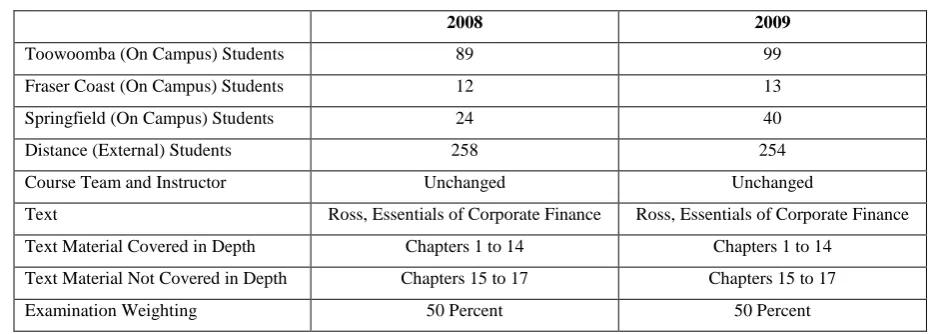
[image:11.595.65.534.555.722.2]The formal analysis of the efficacy of the Tablet PC in the delivery of introductory corporate finance is based upon: (1) final examination performance; (2) retention rates; and (3) access statistics for online resources. For each of these pieces of information, the Tablet PC trial semester (2009) and the corresponding non-Tablet PC semester (2008) are compared. Semester 1, 2009 and Semester 1, 2008 are similar and comparable in all important respects except for the utilisation of the Tablet PC and the availability of the recorded screen-casts. The salient features of each semester are presented in Table One. It should be noted especially that we are aware of no systematic or demographic differences in the student cohort across the two semesters. Because the course is a core course enrolling a large number of students each year, significant differences in student characteristics are not expected from year-to-year (though important differences may emerge in the long term).
Table One Introductory Corporate Finance: Semester 1, 2008 and 2009
2008 2009
Toowoomba (On Campus) Students 89 99
Fraser Coast (On Campus) Students 12 13
Springfield (On Campus) Students 24 40
Distance (External) Students 258 254
Course Team and Instructor Unchanged Unchanged
Text Ross, Essentials of Corporate Finance Ross, Essentials of Corporate Finance
Text Material Covered in Depth Chapters 1 to 14 Chapters 1 to 14
Text Material Not Covered in Depth Chapters 15 to 17 Chapters 15 to 17
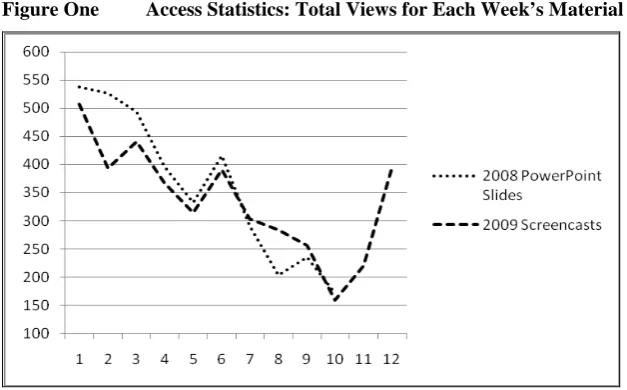
12 Measuring engagement is not straightforward. The course Study Desk operating from the Moodle learning management system provides the facility to generate statistical reports of students’ online activity. The statistical reports of interest to the present analysis are the access statistics that indicate student online access to the lecture material. For semester 1 2008, this lecture material consisted of PowerPoint slides based on typed dot-points and examples. For semester 1 2009, this lecture material consisted of the Tablet PC generated screen-casts (Video of PowerPoint slides with inking and audio) but not the actual PowerPoint slides. Of particular interest are: (1) the number of times each resource was accessed; and (2) the sustained access of each week’s lecture material as the semester proceeded. This is a rough but satisfactory measure of the students’ interaction with the material provided by the course instructor. The comparison of 2008 and 2009 permits conclusions to be reached regarding difference in mean access rates and standard deviation of access throughout each semester. In 2008, lectures five and six were combined within the same PowerPoint slideshow. In 2009, a final ‘summary’ screen-cast (twelve) was provided to students. This was not available in the previous year.
Figure One Access Statistics: Total Views for Each Week’s Material
The mean and standard deviation are informative. The mean number of times each screen-cast was viewed is 335.91. The mean for the standard lecture slides is 360.4. The standard deviation is much lower for the screen-casts—98.3 views for the 2009 screen-casts and 134.31 views for the 2008 standard lecture slides. When the results are ‘normalised’ for the differences in class sizes, the mean weekly total access statistics as a proportion of the total course enrolments are 94 percent for the 2008 standard lecture slides and 82.7 percent for the 2009 screen-casts. Once more, however, the standard deviation is much lower for the screen-casts—24.21 percent of course enrolments for the screen-casts and 35.07 percent of course enrolments for the standard lecture slides. Neither the total views nor the ‘normalised’ total views data series are characterised by statistically significant differences in variance.
13 A similar pattern is repeated when the unique access statistics—with all duplicate or multiple views by the same student removed—are considered. The access statistics for both the screen-casts and the standard lecture presentations are very similar. Across the entire semester, in both 2008 and 2009 approximately 90 percent of enrolments or some 350 students accessed at least one lecture or sceen-cast6. The mean number of times each screen-cast was uniquely viewed is 168.25. The mean for the standard lectures is 161. Once more, the standard deviation is much lower for the 2009 screen-casts— 38.06 views for the 2009 screen-casts and 53.34 views for the 2008 standard lectures. When the results are ‘normalised’ for the differences in class sizes, the mean weekly unique access statistics as a proportion of the total course enrolments are 42.03 percent for the 2008 standard lecture slides and 41.44 percent for the 2009 casts. The standard deviation is 9.37 percent for the 2009 screen-casts and 13.92 percent for the 2008 standard lectures. This difference in standard deviation (variance) is significant at the 0.10 confidence level.
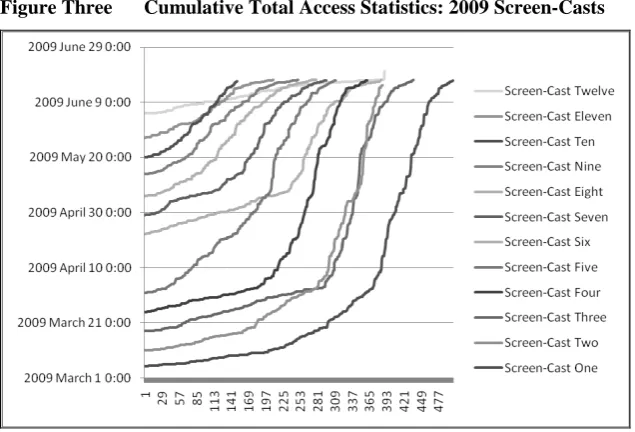
Cumulative total access statistics yield additional information. Presented in Figure Three and Figure Four, the cumulative total access statistics for each screen-cast and standard lecture indicate the growth over time of the total access statistics for each lecture resource. The growth rates of total access statistics for each lecture resource provide an indication of engagement if the growth rates are maintained throughout the semester. In order to shed some light on this, the percentage changes in ‘first week views’—the total number of times each resource was accessed in the first seven days after it became available—over the course of the 2008 and 2009 semesters was computed. The average percentage change in the number of first week views was + 4.872 percent for the 2009 screen-casts (or – 2.14 percent excluding the final screen-cast number 12) and – 3.13 percent for the 2008 standard
14 lectures7. The growth rates also indicate which lecture resources are more eagerly sought after by students. For the 2009 screen-casts, the sixth screen-cast covering the important topic of capital budgeting quickly reaches 200 views and, in fact, does so faster than the previous week’s lecture (the fifth screen-cast). For the 2008 lectures, the seventh lecture covering the topic of risk and return exhibits the same behaviour. It may be conjectured that this behaviour is characteristic of points in the semester where students fall back upon the lecture material as they struggle to keep pace with the study schedule. Whatever the case may be, the 2008 and 2009 semesters show very similar behaviour across most of the access statistics data that has been presented and analysed in this section.
Figure Three Cumulative Total Access Statistics: 2009 Screen-Casts
Figure Four Cumulative Total Access Statistics: 2008 Lectures
15 In this sub-section, an analysis of the online resource access statistics for standard and Tablet PC generated lecture material at a multi-mode institution has been undertaken. This unique analysis sheds much needed light on the engagement of students, particularly via an online learning management system, with material prepared deploying these two distinct approaches (in class and distance modes). For the most part, the data reveal no statistically significant differences in the access statistics for lecture material in 2008 and 2009. The access statistics for the 2009 screen-casts appear to exhibit more resilience. When ‘normalised’ by total class enrolments, the 2009 screen-cast unique views access statistics as a percentage of total class enrolments display a statistically significant lower variance than the corresponding statistics for the standard 2008 lectures. Despite considerable additional required download capacity, the 2009 screen-casts were accessed in much the same magnitude as the 2008 standard lectures. On these measures, no significant additional engagement with the lecture material accessible online was generated by the utilisation of the Tablet PC. However, because screen-casts (1) require time to view; and (2) contain audio and video, both the quantity and quality of student engagement may be significantly understated by access statistics alone. It is also not clear if students watched the full length of each recording.
Engagement Indicated By Course Abandonment
16 most difficult tasks for an instructor. Preventing students from ‘giving up’ on a course during the semester goes to the heart of interaction, communication, engagement and course design. Significant differences in ‘other fails’ across semesters are likely to indicate substantial improvements or, conversely, problems with these facets of a course. Table Two shows ‘other fails’ distributions for the two semesters.
Table Two Other Fails 2008 and 2009
2008
Total enrolments
Other Fails
(% of Students)
2009
Total enrolments
Other Fails
(% of Students)
Toowoomba (On
Campus) Students
89 15.85% 99 6.12%
Fraser Coast (On
Campus) Students
12 0.00% 13 0.00%
Springfield (On
Campus) Students
24 40.91% 40 20.00%
Distance (External)
Students
258 15.60% 254 12.70%
Total 383 16.67% 406 11.42%
While care needs to be taken when different cohorts are compared, the difference in ‘other fails’ across 2008 and 2009 is striking and cannot be contributed to cohort differences. The Toowoomba on-campus students to whom the Tablet PC lectures were delivered directly exhibited a substantial 61 percent decline in course abandonment rates (‘other fails’). Compared with 2008, many more students completed the assessment and examination in 2009 and many less gave up on the course and abandoned their studies. Students studying on the other campuses and in the external distance study mode also exhibited a marked reduction in the tendency to abandon their studies in 2009. Importantly, students studying in distance mode exhibited a 19 percent reduction in course abandonments during the 2009 Tablet PC semester when they had access to the Tablet PC generated screen-casts. Overall, there was a 31 percent reduction in course abandonments during the Tablet PC semester.
Final Examination Performance
17
Table Three Examination Performance 2008 and 2009
2008
Total enrolments
Examination
Performance
(Max. 100%)
2009
Total enrolments
Examination
Performance
(Max. 100%)
Toowoomba (On
Campus) Students
89 38.35% 99 66.94%
Fraser Coast (On
Campus) Students
12 57.71% 13 75.15%
Springfield (On
Campus) Students
24 30.72% 40 58.17%
Distance (External)
Students
258 35.58% 254 64.11%
Total 383 36.61% 406 64.56%
Note: The differences in mean examination performance for each of the cohorts in Table Three are statistically significant at the 0.05 level.
The improvements in examination performance are just as striking as the decline in course abandonments. There is significant evidence of improved student motivation to complete the course in 2009 rather than abandon their studies and of improved student performance on the final examination at the end of the 2009 semester. Student access to materials remained statistically unchanged during 2008 and 2009. The course team and material remained the same during 2008 and 2009. In the absence of experimental controls, it is not possible to be certain from where the improvements derived. However, the more favourable classroom environment facilitated by the Tablet technology almost certainly permeated through all of the cohorts in 2009. This is supported by the positive experiences reported by students during that semester, and by the course team.
Student Experiences: Feedback from Students
During the final lecture of semester one 2009, a short survey was distributed to students in the Toowoomba lecture theatre. A total of thirty-six (anonymously) completed surveys were collected by a student volunteer and sealed in an envelope to be opened after the release of final grades. This represented feedback from 36 percent of the total Toowoomba on-campus enrolments. The survey asked five simple questions designed to capture the students’ thoughts on the use of the Tablet technology in class (and the ‘fill in the blanks’ approach to using PowerPoint)8. During the semester the classes had seemed more dynamic, spontaneous and interactive to the instructor. The survey was distributed to collect evidence of students’ perceptions of the new technology. The results for each of the questions (excluding the general comments question) are summarised in Table Four. It should be noted that the survey was simply distributed to all students who attended the final lecture of the
18 semester, and therefore the responses may be biased. Despite all recordings being available online, these students decided to attend lectures, most likely because they preferred the live interaction with the lecturer, and appreciated the opportunity to ask questions in class. This was given as a predominant reason by students in a mathematics course where lecture screen-casts were also provided (Loch 2010).
Table Four Survey Results: On-Campus Students (Toowoomba)
Question Strongly Agree Agree Neutral Disagree Strongly Disagree
1 21 13 2 0 0
2 Most common suggestions: economics, statistics and accounting
Yes No
3 22 14
Strongly Agree Agree Neutral9 Disagree Strongly Disagree
4 15 11 9 0 0
The results of the survey indicate that students experiencing the utilisation of the Tablet PC technology in the lecture theatre found the experience to be favourable and advantageous to their study of the course material. The students’ comments, in addition to the scores for various questions presented in Table Four, are also predominantly positive. These have been collated and reproduced in the appendix. The Tablet PC trial was undertaken in introductory corporate finance. This course involves qualitative work, calculations from formula and geometry or graphs. When asked where else the Tablet PC technology could be useful, students listed the quantitative and geometrical courses, especially economics but also statistics and accounting. The survey results indicate a very high level of satisfaction with the Tablet technology. This conclusion is supported by the unsolicited comments provided by students across all of the modes of study.
Student Experiences: Unsolicited Email and Forum Posts
A surprising and very pleasing aspect of the 2009 Tablet PC trial semester was the large and unprecedented amount of unsolicited student feedback regarding the course and the screen-casts. In total 40 students provided unsolicited positive feedback via email or online forum posting. This represents approximately 10 percent of the total number of enrolled students. By way of comparison, only a handful of such pieces of feedback are usually received each semester. If the volume of unsolicited feedback may be considered to be a measure of engagement with the course, it may be concluded that the Tablet PC screen-casts connected positively with many more students than the
19 standard lecture presentations of previous years. Unsolicited feedback, particularly positive feedback, is usually a relatively rare event in first year corporate finance. Most students hold their comments for the formal course evaluations undertaken by the University administration. Whilst the number of students accessing the lecture material in 2009 was not significantly different from the access statistics of 2008, the impact that the screen-casts have had on the students’ experience and feelings about the course appear to have been substantial. This is reflected in the volume and nature of unsolicited feedback during 2009. Selected comments are reproduced in the appendix.
CONCLUSIONS
The ‘chalk and talk’ approach with which economics and finance instructors appear most comfortable does not rest easily with the prescriptions for a classroom environment designed to foster motivation and engagement. Of all the technological innovations that may be deployed as educational technologies, the Tablet PC is of interest because of the way in which it may help to bridge this gap between passive chalk and talk and a more interactive classroom environment with, it is hoped, a relatively low cost for instructors and institutions. The purpose of this paper is to present a combination of analysis and feedback for finance and economics instructors to consider and, in the process, contribute to the ongoing debate concerning the efficacy of educational technologies in promoting engagement and performance without becoming tangled in the complex web of variables that must be controlled for when undertaking an experimental analysis of the impact of particular facets of the learning and teaching upon student motivation, engagement and performance.
In a Tablet PC trial in introductory corporate finance at a multi-mode institution, the experiences of both the instructor and students were found to be overwhelmingly positive. The Tablet PC technology is easy to use and familiar enough to those accustomed to more traditional chalk and talk methods to deploy without difficulty. Rather than becoming an additional burdensome factor in the lecture theatre, the Tablet PC provides the freedom to be more spontaneous and to include the students in the process of ‘building’ the lecture. Student online access of the lecture material was not significantly different during the Tablet PC trial but the impact on their experience with the course, their motivation to continue studying rather than abandon study, their engagement and their final examination performance all point to something profound having occurred during the 2009 Tablet PC trial.
20 Tablet PC contributed positively to the delivery of a core concepts course by facilitating a more interactive, spontaneous and fresh delivery approach within the lecture theatre and, via the screen-casts, diffusing this positive mood throughout the entire cohort of students. A phenomenon that was observed in other USQ courses deploying a tablet PC for the first time in 2009 is that lecturers seem to take a fresh and enthusiastic approach, which is conveyed to students. This certainly was the case in the introductory corporate finance course described in this paper. Future research will involve a longitudinal study of the performance, engagement and experience of students in courses where Tablet PC technology is deployed.
Writing on the screen with a Tablet PC is not the full story. The utilisation of the Tablet PC removes the dot-point slideshow from the classroom. Because only the bare superstructure of the lecture is provided to students, there is the real feeling of building the lecture together. A standard chalk and talk approach with a whiteboard does not permit the same interactivity and contact with students is lost every time the instructor turns away from the students to write on the board. For an institution offering distance study mode, the Tablet PC screen-casts provide a very straightforward and effective way of capturing elements of the classroom experience for all students. The discussion and spontaneous ideas that almost always emerge during a lecture are not lost but captured for all students to experience or re-experience. A lecture theatre where a Tablet PC is in use is characterised by an interactive loop flowing through the instructor, the Tablet PC, the projection of the Tablet screen and the students. The Tablet PC becomes an integral component of the delivery and facilitates an experience that is much different from the ‘chalk and talk’ but familiar enough to be experienced without tremendous investments of time or radical departures from existing teaching philosophies.
REFERENCES
Agarwal, R. and Day, A. 1998. The Impact of the Internet on Economic Education. Journal of Economic Education Spring: 99-110.
Ames, C. and Archer, J. 1988. Achievement Goals in the Classroom: Students’ Learning Strategies and Motivation Processes. Journal of Educational Psychology. 80: 260-267.
Ball, S.B., Eckel, C. and Rojas, C. 2006. Technology Improves Learning in Large Principles of Economics Classes: Using Our WITS. American Economic Review 96: 442-446.
Bandura, A. 1986. Social Foundations of Thought and Action. Prentice Hall, Englewood Cliffs, NJ. Bandura, A. and Cervone, D. 1983. Self Evaluative and Self Efficacy Mechanisms Governing the
21 Becker, W.E. 1997. Teaching Economics to Undergraduates. Journal of Economic Literature, 35(3)
September: 1347-1373.
Becker, W.E. and Watts, M. 2001. Teaching Economics at the Start of the 21st Century: Still Chalk and Talk. American Economic Review: Papers and Proceedings of the 113th Annual Meeting of the American Economic Association 91(2): 446-451.
Chizmar, J.F. and Walbert, M.S. 1999. Web-Based Learning Environments Guided by Principles of Good Teaching Practice. Journal of Economic Education Summer: 248-259.
DeAngelo, L., Hurtado, S., Pryor, J.H., Kelly, K.R. and Santos, J.L. 2009. The American College Teacher: National Norms for the 2007-2008 HERI Faculty Survey. Higher Education Research Institute, UCLA, LA.
Detzler, M.L. 2000. Finance Courses on the Internet. Financial Practice and Education Spring/Summer 10 (1): 195-204.
Dweck, C.S. and Leggett, E.L. 1988. A Social-Cognitive Approach to Motivation and Personality. Psychological Review 95: 256-273.
De Volder, M.L. and Lens, W. 1982. Academic Achievement and Future Time Perspective as a Cognitive-Motivational Concept. Journal of Personality and Social Psychology 42: 566-571. Eccles, J.S., Adler, T.F., Futterman, R., Goff, S.B., Kaczala, C.M., Meece, J.L. and Midgley, C. 1983.
Expectancies, Values and Academic Behaviours. In Achievement and Achievement Motivation, J.T. Spence (editor), Freeman, San Francisco, 75-146.
Goffe, W.L. and Sosin, K. 2005. Teaching with Technology: May You Live in Interesting Times. Journal of Economic Education Summer: 278-291.
Jang, H. 2008. Supporting Students’ Motivation, Engagement, and Learning During an Uninteresting Activity. Journal of Educational Psychology 100: 798-811.
Letterman, D. 2008. Teaching Hybrid Principles of Finance to Undergraduate Business Students – Can it Work? Journal of College Teaching and Learning 5(7): 43-54.
Leuthold, J. 1998. Building a Homepage for Your Economics Class. Journal of Economic Education, Summer: 247-261.
Loch, B. 2005. Tablet Technology in First Year Calculus and Linear Algebra Teaching. Proceedings of Kingfisher DELTA'05, Fraser Island, 22-26 November: 231-237. Accessed 19 December 2009 from http://eprints.usq.edu.au/archive/000000185.
Loch, B., Donovan, D. 2006. Progressive Teaching of Mathematics with Tablet Technology. e-JIST, e-Journal of Instructional Science and Technology 9(2). Accessed 19 December 2009 from http://eprints.usq.edu.au/archive/00001716/.
Loch, B., McDonald, C. 2007. Synchronous chat and electronic ink for distance support in mathematics. Innovate 3 (3). Accessed 19 December 2009 from http://eprints.usq.edu.au/archive/00001717/.
Loch, B. 2010. HYPERLINK
22 Statistics', the Continuing Excellence in the Teaching and Learning of Maths, Stats and Operational Research Conference (CETL-MSOR 2009), Milton Keynes, United Kingdom, 07-08 September 2009.
Miller, R.B., Greene, B.A., Montalvo, G.P., Ravindran, B. and Nichols, J.D. 1996, “Engagement in Academic Work: The Role of Learning Goals, Future Consequences, Pleasing Others and Perceived Ability,” Contemporary Educational Psychology 21: pp.388-422.
Myers, S., Talley, D. 2007. Looking beyond the Whiz-bang Technology: Using Mobile Learning Technology Tools to Improve Economic Instruction. Presented to the AEA/CAI group, ASSA Annual Meetings, Chicago, January 7, 2007. Accessed 19 December 2009 from http://www.aeaweb.org/annual_mtg_papers/2007/0107_0800_0603.pdf
Nolen, S.B. 1988. Reasons for Studying: Motivational Orientations and Study Strategies. Cognition and Instruction 5: 269-287.
Pettijohn, J., Ragan, G. and Ragan K. 2003. E-FM: A Project for the Introductory Financial Management Course Designed to Involve Students With Online Financial Information and Analytical Tools. Journal of Economics and Finance Education 2 (1): 10-17.
Phillips, P. and Loch, B. 2011. Building lectures and building bridges with socio-economically disadvantaged students. Educational Technology and Society. forthcoming
Salemi, M.K. and Siegfried, J.J. 1999. The State of Economic Education. American Economic Review: Papers and Proceedings of the 111th Annual Meeting of the American Economic Association 89: 355-361.
Salemi, M.K. 2009. Clickenomics: Using a Classroom Response System to Increase Student Engagement in a Large-Enrollment Principles of Economics Course. Journal of Economic Education Fall: 385-404.
Savage, S.J. 2009. The Effect of Information Technology on Economic Education. Journal of Economic Education Fall: 337-353.
Siriopoulos, C. and Pomonis, G.A. 2007. Alternatives to Chalk and Talk: Active Vs Passive Learning – A Literature Review of the Debate (May 2006). Available at SSRN: http://ssrn.com/abstract=977283.
Sosin, K., Blecha, B.J., Agarwal, R., Bartlett, R.L. and Daniel, J.I. 2004. Efficiency in the Use of Technology in Economic Education: Some Preliminary Results. American Economic Review: Papers and Proceedings of the 116th Annual Meeting of the American Economic Association 94: 253-258.
Wentzel, K.R. 1989. Adolescent Classroom Goals, Standards for Performance, and Academic Achievement: An Interactionist Perspective. Journal of Educational Psychology 81: 131-142. Wigfield, A. and Eccles, J.S. 2000. Expectancy-Value Theory of Achievement Motivation.
23
APPENDIX
FIN1101 student survey – S1 2009 – June/July 2009
This is your chance to give feedback on this course and the technology used. Your comments are very important to me. Please give feedback by answering the following questions. This is not the official USQ course evaluation form ‐ please fill out that form as well, it is also important.
1. The use of writing on the screen (and ‘filling in the blanks’) during the lecture enhanced your understanding of the course material:
strongly disagree/disagree/neutral/agree/strongly agree.
2. Writing on the computer could be useful in other courses (please list course codes), and for the following reasons:
3. Did you access any of the live lecture screen-casts? Did you watch complete lectures? Please comment.
4. The screen-casts of live lectures with handwritten explanations on PowerPoint slides enhanced your understanding of the course material. Choose most appropriate answer:
strongly disagree/disagree/neutral/agree/strongly agree.
Please say so if you never accessed any.
5. Any further comments you would like to make?
More information about this study:
24 Unsolicited Student Comments (Selected from 40 Unsolicited Emails and Forum Posts)
1. When I could combine the spoken and the text methods of learning, I felt less like an external student and more part of the university learning experience. I studied two subjects last semester (being Finance and a Management subject) and the stark difference between the two made me question a few things. In my management subject I was given a text book, asked to read chapters and chapters of text and then complete text book questions. Then I had the experience of your Finance subject and was thoroughly engaged!
2. I thought I should email you and let you know how much I really enjoyed the course. At first I was struggling a bit at the beginning of the semester. I later realised that you provided the screencasts with audio. This is an excellent feature. Being an external student, I have found that they have helped very much. I then listened to all the class lectures and felt I had a much greater understanding of the course. You explained this course in a great way, using everyday language. For example, when I read WACC in the text book, I was like, what the..?? I did not understand it very well. Then I listened to your screencast with the powerpoint and I understood it the first time and felt pretty confident about it.
3. I have just purchased an ipod and have downloaded both audio lectures onto it. This is so helpful as I can listen to them while I drive to and from work or any place away from the computer. I turn 60 this year and welcome new technology especially if it makes life easier. So, even old dogs can be taught new tricks!
4. Congrats on lecture two production, it was excellent, sound was great... thank you for taking the time to record them for us. This technology is a very effective learning tool. What a shame more lectures can not offer the same delivery method. It is great for visual learners.
4. Congrats on your 'screen-cast' production. I am one of the many external students doing the subject, and I know I am really going to enjoy it now after hearing your lecture!!! Doing learning externally and 'online' is a challenge and a blessing, your lectures are going to make it just that little bit easier.
5. all I have to say is thank you for taking a leap of faith and trying this new technology! I wish more teachers would. even though i am an on-campus student I still find it extremely beneficial because there isn't as much pressure on me, being a first year student, to keep up with notetaking!!
6. Thanks for the recording, first one I have experienced in that format and thought it was great. Look forward to watching in future.
7. I really appreciate you taking the time to do the recorded lectures as I am much more of a visual learner than anything else and it is especially useful for learning subjects such as this where it is harder to stay focused!
8. I agree - the lecture presentations were extremely useful. They helped focus on the main concepts throughout the course and kept everything in perspective.
9. I am really enjoying the course to date. Particularly the delivery method of the lectures and your writing on the slides while explaining the concepts. While I am only just finishing my first year at uni, no other subjects have provided this interaction…..thanks for this.