Abstract: In Very-Large-Scale Integration (VLSI) application power and area are the vital factors for any digital circuits.This paper presented 16 bit Cyclic Redundancy Check (C RC) mapped in version v14.20-s013 1 of Cadence Encounter(R) RTL Compiler. The codes in numerous instances are visible to be advanced at block lengths of realistic hobby when they're used on low-noise BCCs.. By expeditiously mapping on cadence tool, Power is achieved small. The results of conversion are viewed mistreatment RTL synthesis cadence VIRTUOSO at 45nm technology. Supported digital signal process (DSP) architectures, the code for proposed low power is generated mistreatment 16 bit Cyclic Redundancy Check (CRC).
Index Terms: 16 bit Cyclic Redundancy Check (CRC), Low Power, Low Area, High Level Synthesis, DSP, LUTs VLSI.
I. INTRODUCTION
Cyclic Redundancy Code (CRC) are a general form of cyclic codes. Which are extensively used for error detection purpose[ 1], [2]. A CRC encoder appends p-parity bits to an input binary string in the sort of way that the resulting code words match to polynomial multiples of a generator polynomial g(x) of degree p. we will denote a CRC-code with p parity bits as a CRC p-code. The most advantageous minimal Power and Area available by way of a few CRC-sixteen codes is determined for all block lengths. For several normal low-noise BCCs the minimum undetected blunders opportunity potential with a few CRC-16 codes is given for all blocks.
The design of composite chips has supported a chain of transformations over the last 20 years. Within the last few years, layout for low power has initiated to change once more how designers’ technique complicated Silicon on chip (soc) designs. The increase in chip thickness drives the acceptance of synthesis presents the brilliant increase within the era of hundreds of thousands of gate designs, engineers uncovered that there has been a restrict to how an awful lot new Register Transfer Logic (RTL) will be aided for a new chip design. Depending on the application, CRC-codes are used at a Constant block length n, at variable block lengths, i.e., the generated Code words both all have a hard and fast wide variety of digits or their length can range from message to message. This regularly performs an essential position in
Revised Manuscript Received on June 5, 2019
B.Balaji, Associate Professor ECE, KLEF, Vijayawada, India
N. Ajay Nagendra, Assistant Professor ECE, KLEF, Vijayawada.
E. Radhamma, Associate Professor ECE, BRIL, Hyderabad
A. Krishna Murthy, Associate Professor, PETW, Hyderabad
M.Lakshmana Kumar, Assistant Professor ECE, KLEF, Vijayawada
receiver synchronization. R.Henkmat [2004] proposed a brand new model to calculate interference stages in wireless multi-hop advert-hoc networks. Robert C B.aumann [2005] provided radiation-prompted smooth errors in advanced semiconductor technologies. The as soon as- ephemeral radiation-precipitated tender errors has a key 14 danger to advanced business electronic components and systems. The smooth mistakes have the potential for inducing the best failure price of all other reliability mechanisms combined. to save you the accumulation, TMR is often matched with reconfiguration strategies which include complete reconfiguration, partial reconfiguration (PR), or scrubbing. Many of the previous studies used TMR with scrubbing or dynamic partial reconfiguration (DPR). DPR enables in losing the configuration time and is appropriate for a combinational circuits
II.LITERATUREREVIEW
Cyclic Redundancy checks (CRC) is
employed for detecting the corruption of
digital knowledge throughout the transmission, process or the storing of information. The CRC treats the info bits as a binary polynomial with a selected breadth, then it calculates the rest from the division of information bits with a generator polynomial. At the receiver facet, the information with the substantiation divided by a similar polynomial, if the result was achieved to be zero that confirms the information was received properly. it's far honestly unreasonable for any statistics reporting or verbal exchange intermediate to be one hundred% ideal of the time over its whole predicted beneficial life [1][2][3][4]. as greater bits are arranged right into a square centimetre of disk garage, as statistics sending speeds growth, the likelihood of blunders will increase sometimes geometrically. therefore, errors detection and correction is vital to strong information transmission, storage, and renewal. test digits appended to the cease of a long quantity can provide a few safety towards data enter mistakes. longer data streams have needed a more efficient and sensible errors detection gadget. Mathematically, a k-bit message may be considered because the coefficients of a polynomial B(x) = bk-1xk-1 + … + b1x1 + b0x0.. the most large bit leads the information circulation. Moreover, an (m+1) bit generator polynomial P(x) = xm + pm-1xm-1 + … + p1x1 + p0x0 of order m is selected. Calculations are completed in modulo-2 mathematics. The CRC is the remainder of the department of xm B(x) by P(x) and can be appended to the
message [4].
A. Cyclic redundancy
Design of Efficient 16 Bit Crc with Optimized
Power and Area in Vlsi Circuits
check
From the transmission side (antenna), the r bits are checked using linear codes, i.e. CRC codes, are generated at the outlined rule per the bits binary transmitted codes. The
check codes are then hooked up to the
transmission knowledge. At the receiving end (antenna), the check is done per the rule between data codes and also the CRC codes to create positive if there are some faults (errors) within the transmission method.
B.CRC polynomial:
It describes a way for locating cyclic redundancy check polynomials for systems for transmission over trifocal channels that inscribe info in multiple voltage levels. in orderthat the ensuing redundancy check offers smart error protection and is economical to implement. The codes that we tend to construct have a playing distance of three or four. We tend to discuss some way to cut back burst error in parallel transmissions and a few tricks for economical implementation of the register for these polynomials. we tend to illustrate our techniques by discussing a selected
example wherever the amount of levels
is nine, however they're applicable generally.
[image:2.595.319.522.81.182.2] [image:2.595.327.544.469.840.2])
1
.(
...
k
n
BCC
A data info polynomial G(x) is branched by a
selected generator polynomial operate P(x),
the result's broken and also therest is truncated to sixteen bits
and appended to the data as a BCS. The
division isn't accomplished with the quality arithmetic division. Instead, the modulo-2 division is employed, since this remainder springs from AN exclusive or (XOR) procedure.
16 bit-CRC will be expressed as
)
2
.(
)...
(
)
(
)
(
)
(
x
P
x
Q
x
R
x
G
Where
G(x)=Information polynomial P(x)=Generator polynomial Q(x)=Quotient
R(x)=Remainder
FIG.1:BLOCK CHECK CHARACTER
Fig.2: Cyclic Redundancy Checker
C.Bit-to-symbol block
The four least vital bits (namely LSBs) (b0, b1, b2, b3) of every set is depicted into one information sort and also the four most important bits (MSBs) (b4, b5, b6, b7) of every set is mapped into the subsequent information sort. Any cluster of the protocol information unit is processed
through the bit-to-symbol (BTS)
block incessantly, starting with the Preamble field (PF) and gap with the top set of the PSDU.
II.LOWPOWERANALYSIS
2.1DYNAMICPOWER:
The power consumed by a System on Chip is sum of dynamic power and static power.
Dynamic power is that the power dissipated/
consumed once the fabric is in active mode. Whenever the device is in active mode the ability dissipated within the device is termed as Static power, however the signal values are unchanged.
FIG 3: DYNAMIC POWER
FIG 5:LEAKAGE CURRENTS
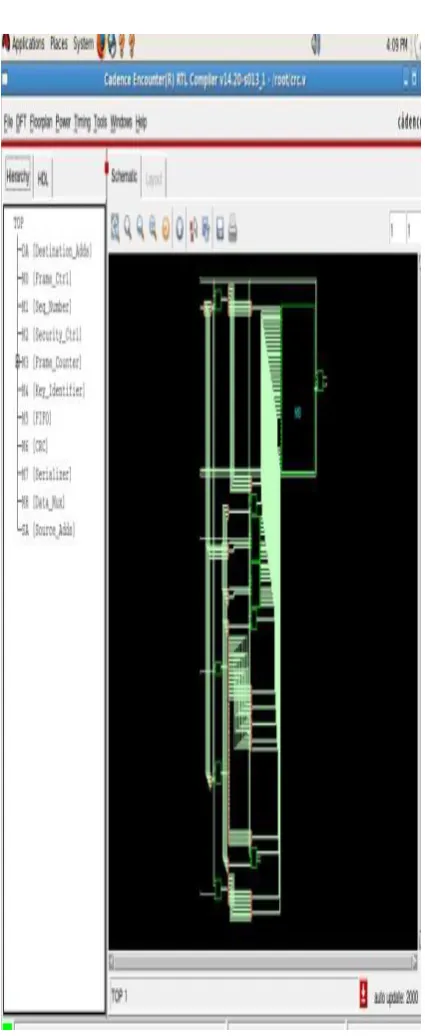
FIG6:16 BIT CRC SCHEMATIC DIAGRAM OF 45NM TECHNOLOGY
)
(
)
(
)
6
...(
)
5
.(
)...
(
[image:3.595.63.257.49.165.2] [image:3.595.310.551.129.521.2] [image:3.595.63.276.203.722.2])
4
...(
...
2
D G s dd CLK dd L Total
Leaksge Dynamic
Total
D G s dd Leakage
SC circuit Short
dd Static STATIC
I
I
I
V
f
V
C
P
P
P
P
I
I
I
V
P
V
I
P
IV. SYNTHESIS AND SIMULATION RESULTS
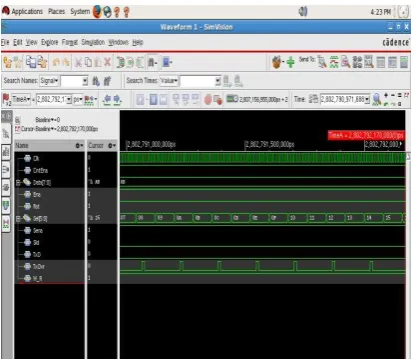
Figure 8: 16 bit CRC of Simulation Result of 45nm technology.
[image:4.595.58.265.50.230.2][image:4.595.321.533.253.407.2]
FIG 9: net power usages
FIG 10: instance power usage
FIG 11 gives the area of 16 bit CRC in 45nm technology.
[image:4.595.65.267.296.456.2]FIG 12 gives the area of 16 bit CRC in 45nm technology.
Table 1 16 bit CRC power dissipation using cadence tool 45nm
Model Structures Leakage Dynami c
Total
Power in nW
Power in nW
Power(nW)
TOP 963 161.258 47155.45 47316.708
SA 197 41.02 1087.3 1128.32
DA 197 42.65 11108.12 11150.77
M3 125 21.012 5089.56 5110.572
inc_add _
61 6.859 1285.25 1292.10
9 320_36_
2
M8 234 20.485 1923.117 1943.60
2
M5 62 13.213 4815.24 4828.45
3
M6 29 8.504 3604.23 3612.73
4
M7 39 8.128 3115.946 3124.07
4
M0 32 7.417 1301.483 1308.9
M1 16 3.654 921.727 925.381
M2 16 3.743 931.727 935.47
[image:4.595.302.547.463.840.2] [image:4.595.65.266.507.680.2]In this research paper, we simulated mapping style into cadence tool using 16 bit Cyclic Redundancy Checker (CRC). Table II represents 16 bit CRC of area at 45nm technology, table 2 represents 16 bit CRC of power dissipation at 45nm technology and table 3 represents 16 bit CRC of delay at 45nm technology and power of circuit at 0.7V. With the aid of DSP architectures, the code is generated which resulted in low power and area efficient
REFERENCES
1.Cisco, "The Zettabyte Era: Trends and Analysis," 2016.
2.H. H. Mathukiya , and M. P. Naresh. “A Novel Approach for Parallel CRC generation for high speed application.” Communication Systems and Network Technologies
3.C. Cheng and K. Parhi, “High-speed parallel CRC implementation based on unfolding, pipelining, and retiming,” IEEE Trans. Circuits Syst. II, Expr. Briefs, vol. 53, no. 10, pp. 1017–1021, Oct. 2006.
4.W. Peterson and D. Brown, “Cyclic codes for error detection,” Proc. IRE, vol. 49, no. 1, pp. 228–235, 1961.
5.A. Mohammed Mian and Divyabharathi. R,” Design and Simulation of
ZIGBEE Transmitter Using Verilog”, International Journal of Emerging Trends in Electrical and Electronics (IJETEE), Vol. 1, Issue. 3, March-2013.
6.Y. Sun and M. S. Kim, “A pipelined crc calculation using lookup tables,” in Proceedings of IEEE Consumer Communications and Networking Conference (CCNC), Jan. 2010.
7.W. Lu and S. Wong, “A Fast CRC Update Implementation”, IEEE Workshop on High Performance Switching and Routing ,pp. 113- 120, Oct. 2003.
AUTHORSPROFILE
Dr B. Balaji, Associate Professor in ECE Department, KLEF (Deemed to be University), Vaddeswaram, his research interests are VLSI and Communication
Ajay nagendra N, Assitant Professor in ECE Department, KLEF (Deemed to be University), Vaddeswaram, his research interests are VLSI and Communication
Dr. Erigela Radhamma, Associate Professor in ECE Department, Brilliant Institute of Engineering & Technology, her research interests are VLSI and Communication
Dr A Krishna Murthy, Associate Professor in ECE Department, Princeton College of Engineering for Women, his research interests are VLSI and Communication