International Journal of Innovative Technology and Exploring Engineering (IJITEE) ISSN: 2278-3075, Volume-8 Issue-7, May, 2019
Abstract: one of the possible problems that could appear in execution projects like highway construction, mass construction, industrial and residential building construction is low strength of underneath soil. Many methods have been used to stabilize such soil but are in high demand. In this research paper lime used as modifier and binder, and fly ash, which is a by-product producing in millions of tons every year and responsible for environmental contamination is used as clay soil stabilizers. initially, several laboratory experimental tests were conducted on clay soil with various percentages of lime (0%, 2%, 4%, 6%, 8%, and 10%) by weight. the results indicate that the addition of 7% of lime gives optimum results and increase the strength of soil up to twice. in the second round of investigation, many specimens were prepared with addition of 7% lime and various percentages of fly ash (4%, 8%, 12%, 16%, and 20%) by weight on the wet side (+2% of OMC), dry side (-2% OF OMC) and optimum water content. soil specimen were tested after (7, 14, and 28) days of curing. the results indicate that, as fly ash content increasing, the unconfined compressive strength (UCS) of soil increases till an optimum point (180 Kpa) which shows around (4) times increment. time of curing has considerable impacts on soil strength. the 28 days curing brought 44.5% improvement in the UCS of clay soil. addition of fly ash and lime make the soil more durable, after 12 wetting-drying cycles, the soil still indicates 98kpa compression strength which is 48% more than untreated soil strength.
Key words: Clay soil, Lime, Fly ash, Unconfined Compressive Strength
I. INTRODUCTION
Soil which swells with receiving moisture and shrink with releasing moisture is recognized as expansive clay soil. Expansive soil absorbs water and gets soft inflate and the potential to release water get reduced in rainy seasons. In drier seasons soil release water due to evaporation and cracks become exist. It is known in the geotechnical engineering field that swelling of expansive soil originated by moisture alteration result big troubles leading to severe damage to buildings and foundations. Nalbantog˘ lu, Z. (2004) [1]. Expansive clay soil is also named as black cotton soil due to its dominant black color and abundantly growing of cotton plant in such soil. Usually, this soil finds in dry and semi-dry regions in the world such as India, Australia, China, Canada, South Africa, Israel, and the United States. About 0.8*106 km2 area of India has covered by this soil and expanded over the states of Gujarat, Maharashtra, Rajasthan, Madhya
Revised Manuscript Received on MAY 07, 2019.
Mirhamza Noorzai, Civil Engineering Department, Chandigarh University, Punjab, India
Amanpreet Tangri, Civil Engineering Department, Chandigarh University, Punjab, India,
Pradesh, Southern part of Utter Pradesh, and some parts of Andhra Pradesh and Chennai Kumar A et al.,( 2007)[2].Various innovative soil stabilization techniques have been used for a specific foundations but are in high demand all over the world such as drilled piers, moisture barriers, belled pierss, and friction piers have been used to reduce the problems caused by expansive soils. Apart from these techniques, the addition of various additives including cement, lime, fly ash, and calcium chloride have a substantial result to stabilize the soil Kumar B.R.P. & Sharma R.S., (2004)[3]To grow up the economic level of a country industrial development is a must and it increases the demand for energy. Construction of thermal power plants fulfill the energy demands for industries. Raw material uses for heating in the thermal power plants are usually coal, natural fuel, and natural gas. These power plants produce wastes in large amount every year around the world which are responsible for pollution. To manage the contamination arising out of these wastes efforts should be taken to use these waste as raw materials in various profitable purposes.Millions of tons of various industrial wastes are being produced in the manufacturing industries & thermal power plants every year in India as well as all over the world. Most of these wastes left unutilized and causing environment hazardous by contaminating the soil, water, and air Zha F et al( 2008)[4]. Some of these wastes utilized in soil stabilization, road construction, and in other construction fields. Some of these wastes like fly ash & blast furnace slag have pozzolanic properties and have utilized in the construction industry along with cement or lime as activators. Fly ash is non-plastic fine silt material, extracting from flue gases of a furnace fired with coal. It has constituted from various compositions according to the coal type burned in power plant. It has been predicted to overstep 100 million tons of fly ash generation worldwide every year by the year 2000 Kumar B.R.P. & Sharma R.S., 2004[3]. Usually, fly ash has smaller Specific Gravity than conventional soil. It is a non-plastic silt-size material which consists of aluminum oxide, iron oxide, unoxidized carbon, and often hollow spheres of silicon Athanasopoulou A (2014), [5].
The combination of fly ash extensively depends on the coal type and nature burned and the power plant operational characteristics. Fly ash is a pozzolanic material which its engineering properties can improve with the addition of cement and lime Kumar A et al 2007[3].
Strength Evaluation of Clay Soil Using Fly Ash
and Lime
As Sabry (1977) [10] found that addition of lime could beneficially modify various significant engineering characteristics of soft soils. As addition of lime considerably reduce plasticity of soil, reduces shrinkage cracking and cause to reduce shrinkage limits of soil. All these modification ends with increments in the unconfined compressive strength and California Bearing Ratio (CBR) of soil.
II. MATERIALS
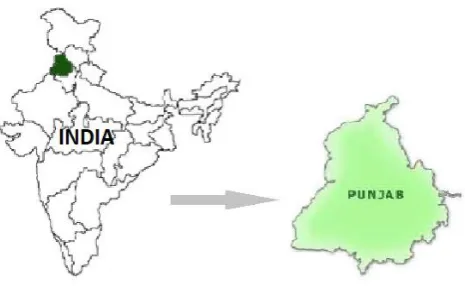
The clay soil used for the study, was collected from Mohali, Punjab, India (fig. 1). The soil excavated from 0.5 to 1 m depth from a sedimentary area. The collected soil placed in plastic bags and then carried to the laboratory for testing. Several laboratory tests were performed to determine the fundamental properties of untreated soil such as index properties of soil (liquid limit, plastic limit, and plasticity index), compaction properties of soil (MDD and OMC), and Specific Gravity of soil. Table (1)
Table 1. Physical and engineering properties of untreated clay soil and flash and
property Fly
ash
soil
Liquid Limit (%) 32 32
Plastic Limit (%) 15 15
Plasticity Index (%) 17 17
Specific Gravity 2.11 2.65
MDD (g/cm3) 1.193 1.87
OMC (%) 28.69 12
Unified soil classification system Class F
CL
gravel 0 0
sand 65.24 8.571
silt 31.6 76.029
clay 3.16 15.4
The grain size analysis of the soil shows that soil composes of (8.571%) sand, (76.029%) silt, and (15.4%) clay. The soil classified as (CL) based on the Unified Soil Classification system fig (2).
Fly ash used for experimental work is class F type which is collected from (Ropar Thermal Power Plant), the basic properties of fly ash tabulated in table (1) and lime used in the experimental program is collected from (Kharar, Punjab).
III. EXPERIMENTAL PROGRAM
The overall experimental program is carried out in two stages. In the first stage, lime added clay soil in various percentages (0%, 2%, 4%, 6%, 8%, and 10%) by weight. The compaction properties of soil (maximum dry density and optimum moisture content) determined using the Standard Proctor Test as per code (IS 2720-PART VII-1980.Numerous specimens (at least three specimens for each mixture) were
prepared using a split mold (7.6 m long, 3.8 m diameter) as per code (IS-2720-PART-10-1991). Samples were tested through the UCS testing machine. In the second stage, various percentages of fly ash (4%, 8%, 12%, 16%, and 20%) and the optimum amount of lime obtained already from first stage investigation added to clay soil.
Specimens were prepared as per code
(IS-2720-PART-10-1991) using a split mold (7.6 m long, 3.8 m diameter) and compacted at wet side (+2% of OMC), dry side (-2% of OMC) and optimum water content already calculated for each soil-additive admixture separately according to (IS-2720-PART 7-1980) code. Specimens were stored at 25oC temperature and cured for (7, 14, and 28) days. Samples have tested through the unconfined compressive testing machine.
To investigate the durability of lime-fly ash treated soil, based on IS: 4332 (part IV) – 1968, at least three specimens were prepared and cured for
[image:2.595.302.552.58.208.2]28 days and tested after 12 wetting-drying cycles.
[image:2.595.313.546.358.501.2]International Journal of Innovative Technology and Exploring Engineering (IJITEE) ISSN: 2278-3075, Volume-8 Issue-7, May, 2019
IV. RESULTS AND DISCUSSION
The compaction characteristics of the soil have been studied using standard Proctor test based on (IS 2720-PART VII-1980). To determine the effects of lime and lime-fly ash on OMC and MDD of clay soil Standard Proctor test have been carried out on virgin soil and lime and lime-fly ash treated soil. In first stage lime mixed with virgin soil (0%, 2%, 4%, 6%, 8%, and 10%) by weight. The addition of lime to clay soil provides a plenty of calcium ions (Ca+) and magnesium ions (Mg+). These ions displace potassium ions (K+) and sodium ions (Na+) trough cation exchange process with replacement of (Ca+) and (Mg+) ions with (k+) and (Na+) ions.
As per the above chemical reactions and cation exchanging process plasticity index of clay soil reduces significantly. Reduction in plasticity is always accompanied with swelling reduction Sharma N K (2012) [11]. The results, attained from the standard proctor test are plotted in fig (3). Results show that with increasing lime content (0% - 4%) interval the optimum moisture content increase rapidly and from (4% -
[image:3.595.67.535.50.229.2]10%) lime content the optimum moisture content graph took increasing trend smoothly and with increasing lime content (0-10%) by weight maximum dry density of lime treated soil indicates reduction. similar result obtained by researches (Asgari M. R. et al 2013, Noorzad R & Motevalian S 2018) [12, 13].
The Unconfined Compressive Strength of untreated clay soil is calculated to be around 45 kpa fig (4) which indicates a soft soil. To investigate the effects of lime on UCS of clay soil tests were carried out on clay soil samples with various percentages of lime (0%, 2%, 4%, 6%, 8%, and 10%) by weight.
With referring to fig (4), addition of 7% of lime to the clay soil
gives optimum results which increase the bearing capacity of clay soil up to 75 kpa.
As per second stage of investigations lime-fly ash admixture
added to the soil
in(7%L-4%FA,
7%L-8%FA, 7%L-12%,
7%L-16%FA,
[image:3.595.306.535.344.484.2]Figure 3. Figure 3. Effects of lime on OMC and MDD of clay soil.
[image:3.595.61.534.509.677.2]Figure 4. . Effects of lime on OMC and MDD of clay soil
(5), show that with increasing fly ash (4 - 20%) by weight plus 7% lime content in the clay soil, the optimum moisture content graph getting increase till a maximum point then drop down and the maximum dry density graph getting decrease till the lowest point then getting up, fig(5). To study the effects of lime and fly ash on UCS, 7% of lime and various percentages of fly ash (4%, 8%, 12%, 16%, 20%) added to clay soil,
With increasing fly ash content, the unconfined compressive strength of soil increases till an optimum point and then decreases slightly and with increasing curing
time
unconfined
compressive [image:4.595.146.470.118.285.2]of soil increases.
[image:4.595.64.533.346.677.2]International Journal of Innovative Technology and Exploring Engineering (IJITEE) ISSN: 2278-3075, Volume-8 Issue-7, May, 2019
Addition of fly ash and lime make the soil more durable. Referring to the UCS test results, table (2), after 12 wetting-drying cycles soil has 98kpa strength which is 48% more than untreated soil strength.
V. CONCLUSION
Based on the experimental study carried out on lime and lime-fly ash treated clay soil, the following outcomes can be drawn:
1. As lime content increases (0% - 4%), the optimum water content of soil increase rapidly and then from (4% - 10%) lime content the optimum moisture content graph took increasing trend smoothly. With increasing lime content (0-10%) by weight, maximum dry density of lime treated soil indicates reduce.
2. According to the results of UCS test, 7% of lime is the optimum amount to add clay soil which increases the strength of clay soil up to twice compare to untreated soil. 3. As fly ash increases (4 - 20%) by weight plus 7% lime content in the clay soil, the optimum moisture content graph getting increase till a maximum point then drop down and the maximum dry density graph getting decrease till the lowest point then getting up.
4. As fly ash content is increasing, the UCS of soil increases till an optimum point (180 Kpa) which shows around (4) times increment.
5. Time of curing has considerable impacts on soil strength 28
days curing brought 44.5% improvement in clay soil strength.
6. Addition of fly ash and lime make the soil more durable. Referring to the unconfined compressive strength test results, table (1), after 12 wetting-drying cycles soil has 98kpa strength which is 48% more than untreated soil strength.
REFERENCES
1. Nalbantog˘ lu, Z. (2004),” Effectiveness of Class C fly ash as an expansive soil stabilizer”, Construction and Building Materials, Volume 18, Issue 6, July 2004, Pages 377-381
2. Kumar A et al (2007),” Influence of Fly Ash, Lime, and Polyester Fibers
on Compaction and Strength Properties of Expansive Soil”, Journal of Materials in Civil Engineering ©ASCE, Vol. 19, No. 3.
Table (2) Over all UCS test results.
Lime-Fly Ash 0 Days
Kpa
7 Days Kpa
14 Days Kpa
28 Days Kpa
After 12 Wetting-Drying Cycles Kpa
7%L+%4FA
Wet side 73 91 113 143 82
OMC 75 95 115 145 85
Dry side 77 98 119 149 88
7%L+%8FA
Wet side 89 123 144 171 91
OMC 93 125 148 174 99
Dry side 96 127 152 178 102
7%L+%12FA
Wet side 93 129 145 171 92
OMC 95 126 150 174 98
Dry side 98 121 154 178 103
7%L+%16FA
Wet side 80 117 138 162 91
OMC 83 120 140 168 94
Dry side 85 124 146 173 99
7%L+%20FA
Wet side 73 107 125 150 87
OMC 77 110 128 156 90
[image:5.595.149.448.51.221.2]Dry side 81 116 132 161 94
[image:5.595.62.532.315.539.2]expansive marls”, Applied Clay Science, Vol 158, PP 29-36.
10. Sabry MA (1977),” Mineralogical and engineering properties of
compacted soil lime mixture. PhD thesis, Oklahama State University, Oklahama
11. Sharma N K (2012),” Stabilization of a Clayey Soil with Fly Ash and
Lime: A Micro Level Investigation”, © Springer Science Business
Media B.V., Geotech Geol Eng., 30:1197–1205 DOI
10.1007/s10706-012-9532-3.
12. Asgari M. R. et al (2013), “Experimental study on stabilization of a low
plasticity clayey soil with cement/lime”, Arab J Geosci © Saudi Society for Geosciences, 8:1439–1452.
13. Noorzad R & Motevalian S (2018),” Improvement of Clayey Soil with
Lime and Industrial Sludge”, Geotechnical and Geological Engineering© Springer International Publishing AG, Volume 36, issue 5, pp 2957–2966
14. Mishra N.K (2012) “Strength characteristics of clayey sub-grade soil stabilized with fly ash and lime for road works” Indian geotech (july-september 2012) 42 (3):206-211