Ames Laboratory Publications
Ames Laboratory
2-22-1999
Effect of the elastic modulus of the matrix on
magnetostrictive strain in composites
Y. Chen
Iowa State University
John E. Snyder
Iowa State University
Carl R. Schwichtenberg
Iowa State University
Kevin W. Dennis
Iowa State University, [email protected]
D. K. Falzgraf
Iowa State University
See next page for additional authors
Follow this and additional works at:
http://lib.dr.iastate.edu/ameslab_pubs
Part of the
Electromagnetics and Photonics Commons
, and the
Engineering Physics Commons
The complete bibliographic information for this item can be found at
http://lib.dr.iastate.edu/
ameslab_pubs/167
. For information on how to cite this item, please visit
http://lib.dr.iastate.edu/
howtocite.html
.
Effect of the elastic modulus of the matrix on magnetostrictive strain in
composites
Abstract
The effect of the matrix material on the magnetostriction of composites containing highly magnetostrictive
particles has been studied. Experimental results showed that the elastic modulus of the matrix is an important
factor determining the bulk magnetostriction of the composite. For a series of composites with the same
volume fraction of magnetostrictive particles but different matrix materials, the bulk magnetostriction was
found to increase systematically with decreasing elastic modulus of the matrix. A modeltheory for the
magnetostriction of such composites has been developed, based on two limiting assumptions: uniform strain
or uniform stress inside the composite. The theory was then used to predict the magnetostriction of the entire
material from the volume fractions of the components, their elastic moduli and magnetostrictions. These
predictions were in agreement with the experimental results. It is concluded that to obtain a high
magnetostriction and adequate mechanical properties of a composite, the elastic moduli of the
magnetostrictive phase and the matrix should be as close as possible in value.
Keywords
Composite materials, Magnetostriction, Elastic moduli, Magnetic materials, Elasticity theory
Disciplines
Electromagnetics and Photonics | Engineering Physics
Comments
The following article appeared in
Applied Physics Letters
74 (1999): 1159 and may be found at
http://dx.doi.org/10.1063/1.123473
.
Rights
Copyright 1999 American Institute of Physics. This article may be downloaded for personal use only. Any
other use requires prior permission of the author and the American Institute of Physics.
Authors
Y. Chen, John E. Snyder, Carl R. Schwichtenberg, Kevin W. Dennis, D. K. Falzgraf, R. William McCallum, and
David C. Jiles
Effect of the elastic modulus of the matrix on magnetostrictive strain in composites
Y. Chen, J. E. Snyder, C. R. Schwichtenberg, K. W. Dennis, D. K. Falzgraf, R. W. McCallum, and D. C. Jiles
Citation: Applied Physics Letters 74, 1159 (1999); doi: 10.1063/1.123473
View online: http://dx.doi.org/10.1063/1.123473
View Table of Contents: http://scitation.aip.org/content/aip/journal/apl/74/8?ver=pdfcov
Published by the AIP Publishing
Articles you may be interested in
Large energy absorption in Ni–Mn–Ga/polymer composites
J. Appl. Phys. 97, 10M319 (2005); 10.1063/1.1857653
Effective Elastic Properties of an AlSiC Composite Using Twopoint Statistical Mechanics Approach
AIP Conf. Proc. 712, 355 (2004); 10.1063/1.1766550
Large Scale Finite Element Modelling of the Effective Elastic Properties of Particle Reinforced Composites
AIP Conf. Proc. 712, 332 (2004); 10.1063/1.1766546
Effective magnetostriction and magnetomechanical coupling of terfenol-D composites
Appl. Phys. Lett. 78, 3490 (2001); 10.1063/1.1377046
Elastic properties of magnetostrictive thin films using bending and torsion resonances of a bimorph
J. Appl. Phys. 88, 5827 (2000); 10.1063/1.1318388
Effect of the elastic modulus of the matrix on magnetostrictive strain
in composites
Y. Chen, J. E. Snyder, C. R. Schwichtenberg, K. W. Dennis, D. K. Falzgraf, R. W. McCallum, and D. C. Jiles
Ames Laboratory, Iowa State University, Ames, Iowa 50011
~Received 26 May 1998; accepted for publication 11 December 1998!
The effect of the matrix material on the magnetostriction of composites containing highly magnetostrictive particles has been studied. Experimental results showed that the elastic modulus of the matrix is an important factor determining the bulk magnetostriction of the composite. For a series of composites with the same volume fraction of magnetostrictive particles but different matrix materials, the bulk magnetostriction was found to increase systematically with decreasing elastic modulus of the matrix. A model theory for the magnetostriction of such composites has been developed, based on two limiting assumptions: uniform strain or uniform stress inside the composite. The theory was then used to predict the magnetostriction of the entire material from the volume fractions of the components, their elastic moduli and magnetostrictions. These predictions were in agreement with the experimental results. It is concluded that to obtain a high magnetostriction and adequate mechanical properties of a composite, the elastic moduli of the magnetostrictive phase and the matrix should be as close as possible in value. © 1999 American Institute of Physics.@S0003-6951~99!03106-X#
There has recently been interest in the development of magnetomechanical torque sensors1–3 because of the sensi-tivity of magnetic properties to torsional stress. Clark4 and Greenough5have discussed rare-earth-iron compounds, how-ever the high cost and brittleness of these materials restrict applications. Composites of highly magnetostrictive particles in a different matrix material, as investigated by Clark and Belson6and by Sandlund et al.,7have the potential for main-taining adequate magnetostriction while meeting mechanical performance specifications. Herbst et al. have also studied SmFe2/Fe and SmFe2/Al composites and described a model
to predict the magnetostriction.8,9Recently Nan has also pro-posed a mathematical model.10
In preliminary work magnetostrictive composites were fabricated consisting of highly magnetostrictive particles in a low magnetostriction, high permeability magnetic matrix with the objective of using the high permeability matrix to enhance the magnetic flux and hence the magnetostriction in the particles. The magnetostriction of these materials was measured at various field strengths and this produced unex-pected low values.
An experimental study on magnetostriction of compos-ites was undertaken using various matrix materials with dif-ferent elastic moduli. Results indicated that the elastic modu-lus of the matrix has a significant effect on magnetostriction. The differences in bulk magnetostriction were investigated and, as a result of this, a model theory was developed and verified. This model theory was then used to predict the bulk magnetostriction of such composites.
The composites were prepared by blending powders in an argon atmosphere. The particulate magnetostrictive mate-rial used in this study was Tb0.3Dy0.7Fe2 while the matrix
materials consisted of metal and glass, the metals being Fe, Cu, Al, or CeFe2. Blended powder was poured into a 6 mm
diameter die, pressed at 1–3 kN under an inert argon atmo-sphere and heated at 10 °C/min to 300–600 °C depending on the matrix material. The load was removed and the material
cooled to ambient temperature while still under argon atmo-sphere. Magnetostriction was measured using strain gauges. The magnetic field was applied parallel to the cylindrical axis of the specimens and the strain was measured along the same direction.
The magnetostriction model was based on the limiting assumptions of uniform stress or uniform strain in an inho-mogeneous material. Beginning with the elastic properties, the model predicts that the elastic modulus should lie be-tween two bounds based on these limiting assumptions.11 The equations for the elastic modulus in the two cases are given below. The magnetostriction of the entire material was calculated in both instances, assuming that the stress in the whole material is generated only by the magnetostriction in the particles, scaled in proportion to the volume fraction of the particulate phase.
Assuming uniform strain throughout a composite mate-rial, the total stress in the linear regime over which Hooke’s law applies, can be found from
eEc5eEtVt1eEmVm, ~1!
wheree5strain, V5volume fraction, and E5elastic modu-lus. The subscript c indicates the whole composite, m indi-cates the matrix, t indiindi-cates the particulate magnetostrictive phase. Equating the strain throughout, the elastic modulus of the composite is given by
Ec5EtVt1EmVm. ~2!
Assuming that the stress throughout the material is uni-form an alternative expression for the elastic modulus of a composite material is obtained. Again in the linear Hooke’s law regime, uniform stress implies the product Ee must be the same for each component, therefore
s5Etet5Emem, ~3!
wheres5stress. The strain throughout the entire material is given by
APPLIED PHYSICS LETTERS VOLUME 74, NUMBER 8 22 FEBRUARY 1999
1159
0003-6951/99/74(8)/1159/3/$15.00 © 1999 American Institute of Physics
ec5etVt1emVm. ~4!
Substituting Eq.~3!into ~4!gives
ec5
s Ec5s
Vt Et1s
Vm
Em ~5!
and the elastic modulus is
Ec5
1
Vt Et1
Vm Em
. ~6!
In the magnetostriction model it is assumed that the stress generated in the composite is caused entirely by the magne-tostrictive phase and that the overall stress in the composite when it is magnetically saturated is the product of the vol-ume fraction of magnetostrictive phase and the stress exerted by it. Under these conditions the following equation is ob-tained
Ecls5EtlstVt, ~7!
wherels is the saturation magnetostriction of the entire
ma-terial and lst is the saturation magnetostriction of the
mag-netostrictive phase alone. Substituting the expressions for the elastic modulus from Eqs.~2!and~6!gives limiting values of the saturation magnetostriction. For uniform strain a lower limit of magnetostriction is obtained, while for uniform stress an upper limit is obtained
lse5
EtlstVt
EtVt1EmVm
, ~8!
lss5EtlstVt
S
VtEt1 Vm
Em
D
. ~9!
The saturation magnetostriction of a composite material should fall between the values oflseandlss given by these equations.
Magnetostriction curves of two series of samples were measured in order to test these predictions. The first was a series of specimens with a fixed volume fraction of the same magnetostrictive phase in matrix materials with different elastic moduli. The second was a series of specimens with different volume fractions of the magnetostrictive phase in the same matrix material. This allowed the effects of the elastic modulus of the matrix and volume fraction of the magnetostrictive phase to be studied independently. The
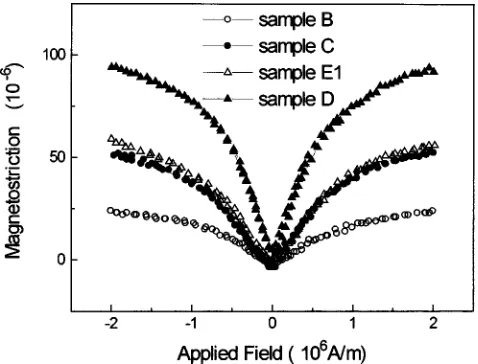
saturation magnetostriction and elastic moduli of both series of specimens are given in Table I. Magnetostriction curves of the first series of composite materials are shown in Fig. 1. These results show that the magnetostriction of the material increased with decreasing elastic modulus of the matrix. Re-sults on the second series are shown in Fig. 2. These indicate that the saturation magnetostriction of the material increased with increasing volume fraction of the magnetostrictive phase.
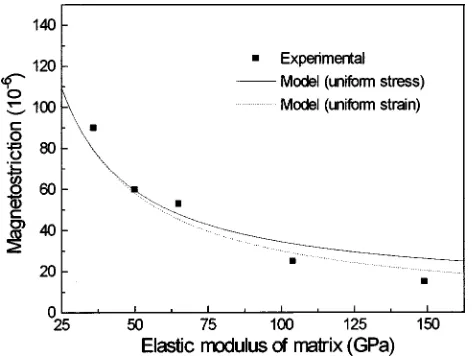
A comparison of experimental measurements with model calculations based on Eqs.~8!and~9!is given in Fig. 3. The model calculations show the predicted magnetostric-tions, as a function of the elastic modulus of the matrix, are in good agreement with measurements. For a two-component matrix (glass1metal), the value for elastic modulus of the matrix was calculated by averaging the limiting cases of the uniform strain value @Eq. ~2!#and the uniform stress value @Eq. ~6!#. The elastic modulus of the magnetostrictive phase was 30 GPa and that of the glass was 50 GPa as shown in Table I. Literature values were used for the elastic moduli of Fe, Cu, Al, and CeFe2. The measured saturation
magneto-striction decreased from 9031026 in a matrix with elastic modulus of 36 GPa to a value of 1531026in a matrix with
elastic modulus of 149 GPa. When the elastic moduli of the matrix and magnetostrictive phases were similar the
[image:5.612.124.486.77.221.2]pre-FIG. 1. Magnetostriction curves of several composites with equal volume fractions of magnetostrictive phase particles in different matrix materials. The elastic moduli of the different matrix materials are given in Table I. TABLE I. Measured and modeled saturation magnetostrictions of composites. Matrix materials were:
A(Fe1glass), B(Cu1glass), C(Al1glass), D(CeFe21glass), E(glass).
Sample
Vol. % components
Elastic modulus of matrix Em~GPa!
Measured saturation magnetostriction
le(1026)
Predicted magnetostriction
Uniform strain
lse(1026)
Uniform stress
lss(1026)
A 10/90 T1matrix A 149 15 20 26
B 10/90 T1matrix B 104 25 28 33
C 10/90 T1matrix C 65 55 46 48
D 10/90 T1matrix D 36 90 79 79
E1 10/90 T1matrix E 50 60 58 60
E2 30/70 T1matrix E 50 200 190 201
E3 60/40 T1matrix E 50 462 441 469
E4 80/20 T1matrix E 50 640 656 684
T Tb0.3Dy0.7Fe2 30 930
1160 Appl. Phys. Lett., Vol. 74, No. 8, 22 February 1999 Chenet al.
[image:5.612.319.558.564.746.2]dicted limits for the saturation magnetostriction, lse and
lss, were close in value, but the difference between these
predicted limits increased with increasing difference between the moduli of the matrix and magnetostrictive phases. These results suggest that the elastic modulus of the matrix material has a significant impact on the saturation magnetostriction of composites, with a lower matrix modulus leading to higher bulk magnetostriction.
Model calculations were performed to obtain the magne-tostriction as a function of the volume fraction of magneto-strictive phase using the same elastic modulus values of 30 GPa for the magnetostrictive phase and 50 GPa for the ma-trix. The results are compared with experimental measure-ments on a series of materials with the same values of matrix elastic moduli as shown in Fig. 4. In this figure, the solid line represents the modeled results based on the assumption of uniform stress and the dotted line represents the modeled results based on the assumption of uniform strain.
The model developed in the present work predicts that the magnetostriction of these composites should fall between an upper limit ~based on uniform stress! and a lower limit
~based on uniform strain!. The calculated magnetostrictions obtained on the basis of this model are in good agreement with the experimental results. In both experimental measure-ments and modeling the elastic modulus of the matrix seems to play a significant role in determining the bulk magneto-striction of a composite. Specifically the results show that the lower the elastic modulus of the matrix the higher the bulk magnetostriction of the composite. In practical terms the elastic modulus of the matrix cannot be too low without adversely affecting the mechanical performance of the mate-rial as a whole. In fact matching the elastic moduli of the matrix material and the magnetostrictive phase is probably the way to optimize this situation and obtain the necessary high bulk magnetostriction together with adequate mechani-cal properties for a magnetostrictive composite.
Ames Laboratory is operated by the U.S. Department of Energy by Iowa State University under Contract No. W-7405-ENG-82. This work was supported by the Office of Energy Research, Office of Computational and Technology Research, Advanced Energy Projects Division. The authors would like to thank the referee for calling attention to the work of C.-W. Nan, which was published after this letter was originally submitted.
1W. J. Fleming, Society of Automotive Engineers, 890 482 and 890 483,
1989~unpublished!.
2
J. F. Herbst and F. E. Pinkerton, J. Magn. Magn. Mater. 176, 183~1997!.
3I. J. Garshelis, IEEE Trans. Magn. 28, 2202~1992!.
4A. E. Clark, Ferromagnetic Materials, Vol. 1, edited by E. P. Wohlfarth ~North–Holland, Amsterdam, 1980!, pp. 531–589.
5
R. D. Greenough, Intermetallic Compounds: Vol. 2, Practice, edited by J. H. Westbrook and R. L. Fleischer~Wiley, New York, 1994!, pp. 389–405.
6A. E. Clark and H. S. Belson, US Patent No. 4,378,258~March 1983!. 7L. Sandlund, M. Fahlander, T. Cedell, A. E. Clark, J. B. Restorff, and M.
Wun-Fogle, J. Appl. Phys. 75, 5656~1994!.
8
F. E. Pinkerton, T. W. Capehart, J. F. Herbst, E. G. Brewer, and C. B. Murphy, Appl. Phys. Lett. 70, 2601~1997!.
9J. F. Herbst, T. W. Capehart, and F. E. Pinkerton, Appl. Phys. Lett. 70,
3041~1997!.
10
C. W. Nan, Appl. Phys. Lett. 72, 2897~1998!.
11
[image:6.612.318.557.51.237.2]W. D. Callister, in Materials Science and Engineering: An Introduction, 4th ed.~Wiley, New York, 1997!, p. 513.
[image:6.612.57.294.53.231.2]FIG. 3. Measured and modeled results of composites with fixed volume fraction of magnetostrictive phase and different matrix materials. Symbols are experimental measurement results at H523106A/m on materials with given values of matrix elastic modulus. The curves are model predictions for the uniform stress approximation and the uniform strain approximation. FIG. 2. Magnetostriction curves of several composites with different vol-ume fractions of magnetostrictive phase properties in the same matrix ma-terial.
FIG. 4. Measured and modeled results for magnetostriction of composites with a matrix phase of known elastic modulus and different volume frac-tions of magnetostrictive phase. Measurements were made at H52
3106A/m. Model calculations were made using Et530 GPa, and Em
550 GPa.
1161
Appl. Phys. Lett., Vol. 74, No. 8, 22 February 1999 Chenet al.
[image:6.612.58.294.549.727.2]