UNIVERSITI TEKNIKAL MALAYSIA MELAKA
SOLID FUEL FROM EMPTY FRUIT BUNCH FIBER AND RECYCLED MATERIAL
This report submitted in accordance with requirement of the Universiti Teknikal Malaysia Melaka (UTeM) for the Bachelor Degree of Manufacturing Engineering
(Engineering Materials) with Honors.
By
NIKMAH BINTI ABD MUIN
DECLARATION
I hereby, declared this report entitled “Solid Fuel from Empty Fruit Bunch and Recycled Material” is the results of my own research except as cited in references.
Signature : ……….
Author’s Name : NIKMAH BINTI ABD MUIN
APPROVAL
This report is submitted to the Faculty of Manufacturing Engineering of UTeM as a partial fulfillment of the requirements for the degree of Bachelor of Manufacturing Engineering (Engineering Materials) with Honors. The member of the supervisory committee is as follow:
………..……… (Principal Supervisor)
i
ABSTRACT
ii
ABSTRAK
iii
DEDICATION
For my beloved family especially my parents Abd Muin B. Ahmad and
iv
ACKNOWLEDGEMENT
I would like to convey my thanks to the all person who had contributed in ensuring a successful occurrence throughout the duration of my final year project. I also gratefully acknowledge to my PSM supervisor, Encik Yuhazri Bin Yaakob, for his encouragement, fully support, by providing me enormous guidance and idea for my research project. Without them all, this project may not valuable. Their knowledge and experience has fully inspired, motivated and drive me to complete my final year project successfully. Also, my special thanks to
v
TABLE OF CONTENTS
Abstract i
Abstrak ii
Dedication iii
Acknowledgement iv
Table of Contents v
List of Tables ix
List of Figures xi
List of Symbols xiv
List of Abbreviations xv
1 INTRODUCTION 1
1.1 Background of Study 1 1.2 Problem Statements 3 1.3 Objectives 4 1.4 Scope of Study 4 1.5 Thesis Frame 4
2 LITERATURE REVIEW 6
2.1 Biomass 6
2.1.1 Biomass Energy Potential 7 2.1.2 Availability of Biomass in Malaysia 8
2.2 Oil Palm 10
2.2.1 Oil Palm Biomass and Energy Content 11
vi
2.2.2 Empty Fruit Bunch 13
2.3 Solid Fuel via Briquetting Technology 14
2.3.1 Fuel Briquettes 15
2.3.1.1 Production of Fuel Briquettes From Waste Paper and Coconut Husk Admixtures 16 2.3.1.2 Summary of Journal 17 2.3.2 Briquetting Process 18
2.3.2.1 Production of Palm Based
Biomass Briquettes 18 2.3.2.2 Summary of Journal 20 2.4 Municipal Solid Waste 21 2.4.1 Solid Waste Generation in Malaysia 21 2.4.2 Fiber Energy Recovery: Use of
Wastepaper as Fuel 24 2.5 Binder System 24 2.6 Chemical Properties Analysis 25 2.7 Mechanical Properties Analysis 27 2.8 Summary of Literature View 30
3 METHODOLOGY 31
3.1 Introduction 31 3.2 Materials 33
vii
3.3.2.2 Addition of Binder 40 3.4 Laboratory Testing 41 3.4.1 Chemical Testing 42 3.4.1.1 Combustion Test 42 3.4.1.2 Ash Content 43 3.4.1.3 Moisture Content 43 3.4.1.4 Gas Emission 43 3.4.1.5 Combustion Analysis 44 3.4.2 Mechanical Testing 45 3.4.2.1 Compression Test 45 3.4.2.2 Water Resistance Test 46 3.4.2.3 Stability Test 47 3.4.2.4 Crack Test 47
4 RESULTS & DISCUSSIONS 48
4.1 Specimen 48
viii
4.2.1.4 Compression Test for S/N 4 77 4.2.1.5 Compression Test for S/N 5 78 4.2.1.6 Compression Test for S/N 6 79 4.2.1.7 Comparison on Overall Briquettes 80 4.2.2 Stability Test 84 4.2.3 Crack Test 87 4.2.4 Immerse Test 89
5 CONCLUSION & RECOMMENDATION 90
5.1 Conclusion 90 5.2 Recommendation 91
REFERENCES 92
APPENDICES
ix
LIST OF TABLES
NO.
TITLE
PAGES
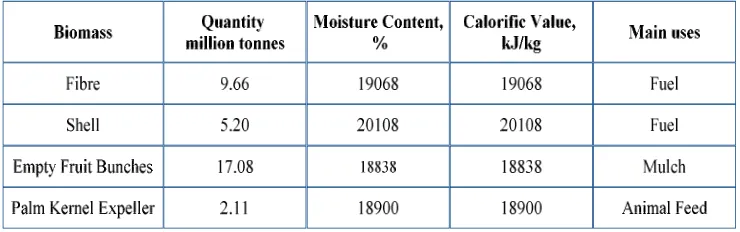
1.1 Palm Biomass generated in year 2005 2 2.1 Oil Palm planted areas and FFB production in 2005 9 2.2 Oil Palm Biomass Energy Potential 9 2.3 Heat value of Oil Palm Biomass (KCAL/Kg, dry) 12 2.4 Energy database for Palm Biomass 12 2.5 Different shapes of fuel briquettes 15 2.6 Solid waste composition locations in Peninsular Malaysia 22 2.7 MSW generated in Kuala Lumpur in 2002 23 2.8 Kuala Lumpur’s solid composition (1975 – 2000) 23
2.9 Properties of the raw materials and Palm based biomass briquettes 26
x
xi
LIST OF FIGURES
NO.
TITLE
PAGES
2.1 Types of Biomass in Malaysia 9 2.2 Cross section of an oil palm fruit. 10 2.3 Oil palm trees in Malaysia 11
2.4 Palm Biomass 11
2.5 (a) An empty fruit bunch (EFB) and (b) it fibrous form 14
2.6 Samples briquettes produced with 100 % wastepaper 16 2.7 Samples of wastepaper-coconut husk briquettes 17
2.8 Palm based biomass briquetting process 19
2.9 (a) EFB Powder, (b) EFB Fibre and (c) Sawdust. 20 2.10 (a) EFB Briquette (b) EFB Powder + Sawdust (50:50)
(c) EFB Powder + Sawdust (40:60) 20 2.11 Solid waste composition of selected locations in Peninsular
Malaysia 22
3.1 Methodology Process Flow Chart 32 3.2 EFB fibrous form 33 3.3 (a) Paper Shredder Machine and (b) Shredded Paper 34 3.4 Process flow of raw material Preparation 35
3.5 Drying Oven 36
3.6 EFB Powder. 36
xii
3.14 Gas particle analyzer 44 3.15 Burning Profile of Oil Palm Briquettes 44 3.16 Universal Testing Machine 45 3.17 Position of sample briquette on test machine 46 3.18 Set up for crack test 47
4.1 Solid briquette 49
xiii
xiv
LIST OF SYMBOL
° C - Celcius
e.m.c - electromagnetic compatibility g/min - gram per minute
GPa - giga pascal
kJ/kg - Kilo Joule per kilogram kN - Kilo Newton
kW - kilo watt MPa - mega pascal
µm - micro meter mm - millimeter N/m2 - Newton per meter % - Percentage lb - Pound
xv
LIST OF ABBREVIATION
BBQ - Barbeque CPO - Crude Palm Oil C - Carbon
CO2 - Carbon Dioxide
CV - Calorific Value EFB - Empty Fruit Bunch
EPSM - Environment Protection Society Malaysia FEFB - Fiber Empty Fruit Bunch
FFB - Fresh Fruit Bunch GCV - Gross Calorific value H - Hydrogen
HHV - High Heating Value KL - Kuala Lumpur LHV - Lower Heating Value N - Nitrogen
NOx - Nitrogen Monoxide
MPOB - Malaysian Palm Oil Board MSW - Municipal Solid Waste NCV - Net Calorific Value
PEFB - Pulverized Empty Fruit Bunch PORIM - International Palm Oil Congress RM - Ringgit Malaysia
SOx - Sulphur Monoxide
UN - United Nation UV - Ultra Violet
1
CHAPTER 1
INTRODUCTION
1.1 Background of study
2
Table 1.1: Palm Biomass generated in year 2005. (Nasrin, A.B., et al., 2008)
Producing energy from renewable biomass is only one of the various ways of responding to the challenges of the energy crisis. In 2004, Malaysia had about 3.87 million hectares of land under oil palm cultivation. Currently, more than 80 % of the oil palm produced is used for food applications like cooking oil, frying oil and many others. Oil palm is a perennial crop. It has an economic life span of about 25 years. Traditionally, oil palm is grown for its oil example like palm oil, palm kernel oil, and palm kernel cake as the community products. Besides palm oil and palm kernel, oil palm industry generates large quantity of biomass residue which is side products as stated before like fronds, trunks, EFB, palm oil mill effluent, palm fibre and shell that have not been fully commercially exploited. Through concerted research and development efforts by many research organizations including Malaysian Oil Palm Board (MPOB), this co – products from palm oil industry have been found to be good resources for many application. There are many competitive uses of these materials. One of them is to utilize them as a fuel for energy production. In fact, Malaysian government has identified biomass as fifth fuel resource to compliment the petroleum, gas, coal, and hydro as energy resources. Palm biomass has been identified as a single most important energy source. On the other hands, the main sources of biomass in Malaysia are domestic wastes, agricultural wastes, effluent sludge and wood chips.
3
burning biomass in conventional steam boilers, biomass gasification and anaerobic digestion (PORIM International Palm Oil Congress, 1996).
Converting palm biomass into a uniform and solid fuel through briquetting process appears to be an attractive solution in upgrading its properties and add value. (Nasrin, A.B., et al., 2008). Biomass briquette is the process of converting low bulk density biomass into high density and energy concentrated fuel briquettes. Biomass briquette plant is of various sizes which converts biomass into a solid fuel. Briquettes are ready substitute of coal or wood in industrial boiler and brick kiln for thermal application. Biomass briquettes are non conventional source of energy, renewable in nature, eco – friendly, non polluting and economical. Process of converting biomass into solid fuel is non polluting process. It involves drying, cutting, grinding, and pressing with or without the aid of a binder.
1.2 Problem statement
4 1.3 Objectives
There are several aims that need to be achieved in this project which is
(a) Determination of the best ratios of EFB and recycled papers for combustion.
(b) To develop a solid fuel from the mixing of an empty fruit bunch (EFB) and recycled papers at a different ratio/percentage.
1.4 Scopes of study
The scope of this project is mainly focusing on the mixing of the empty fruit bunch, EFB and the recycled papers. All these palm oil mills is to be obtained, mixed up and to be develop as a fuel briquette at a certain ratio or percentage with the EFB as the major element. This fuel briquette is to be carried out with the performance tests and comparison tests in terms of its calorific values, stability, and durability, proximate, ultimate, immerse and crack. Other aspects of the material will not be covered.
1.5 Thesis Frames
5