International Journal of Innovative Technology and Exploring Engineering (IJITEE) ISSN: 2278-3075,Volume-8 Issue-3C, January 2019
Abstract: Background/Objectives: This study was aimed to identify the effects of learning experience on core competencies of nursing students and other major students. Methods/Statistical analysis: The subjects of this research are 309 nursing college students located in C city in Korea. The data were analyzed using hierarchical multiple regression to estimate the learning experience factors to affect on core competencies and pearson’ correlation analysis was used to verify the relationships the variables. Findings: Core competencies of nursing students were associated with four learning experience factors. Academic challenge factor was most related to creativity convergence. Among the four factors of the learning experience, the academic challenge was the main factor affected on core competencies.
Improvements/Applications: It is necessary to develop curriculum and non-curriculum programs by positively reflecting the quantitative reasoning in reflective and integrative learning, reflective and integrative learning, learning strategies, and so on.
Keywords: Core competency, nursing students, learning experience, K-NSSE
I. INTRODUCTION
As a higher education institution, universities should be able to ensure that students have diverse experiences while they are studying, thereby promoting the educational outcomes. In recent years, I-E-O (inputs–environment– outcomes) models have emerged that show that student performance can vary according to the learning process and the human relationships that students[1]. In modern society, the ability to collect, store, process information from various environments and generate new knowledge is becoming important. Therefore, it is the social responsibility of the university that the efforts of universities and professors to promote student achievement are called university effects.It has become important to cultivate a complex ability element for future preparation through learner-centered learning activities.At university, the term "competency" or "core competency" has begun to be emphasized as a university student who is preparing for the future.
The concept of competence is an approach to measure and predict McClelland (1973) job performance or success in life. And it is considered as a conceptualization of the ability to be commonly used in various occupations and social rolesThe core competency reflects the talent that the university wants to foster, which is a sort of student achievement. Universities should promote core competencies of college students through curriculum and comparative activities. There are many studies to explore how to assess the competencies of nursing students and how to deliver special learning
experience to them [2-4 ]
In this study, it was attempted to understand whether the university is performing the role and function properly in promoting the core competency of nursing university students.
II. RESEARCHMETHODS 2.1. Research Design
This study was a descriptive research to identify the effects of learning experience on core competencies of nursing students and other major students.
2.2.Subjects
The subjects of this research are college students located in C city, Chungcheong-namdo province in Korea. Subjects were 345 nursing students by a convent sampling who listened the object, procedure, and method of the research and agreed to participate. This study used the G*power 3.1 program to calculate a minimum number of samples for a meaningful research with the conditions as follows: average size of slope for regression analysis is .15; significance levels (both sides) is .05; power is .95; the number of predictive variables is 9. It was found that, to satisfy the above requirements, the minimum number of respondents was 166. Thus, the number of respondents in this research is sufficient.
2.3.Research tools
2.3.1. BU-CCA(Baekseok University-Core Competency Assessment)
To identify students' core competencies, this study used a tool that was originally developed to investigate core competencies by Jihyun Kim et al.[5]. It is consisted of domains with 17 factors, 69 items in 6 domains. 6 domains are like as Interpersonal Relationship, Service other persons, Creative fusion ability, Practical performance ability, Glocal communication ability. Given that Christian knowledge or Christian spirit is not related with nursing education, and, that it is unique characteristics of some colleges, it was excluded from the analysis. This tool is made of 5-point Likert scale, and higher scores mean higher competences. Cronbach alpha of the tool is varied from 0.85~0.90 and it is reliable.
2.3.2. K-NSSE(Baekseok University-Core Competency Assessment)
K-NSSE was used to gather the dataabout learning experience of the subjects. K-NSSE is a Korean version of National Survey of Student Engagement(NSSE)of United States, and validity was proved by Bae et al.[6]. This tool is consisted of 4 domains and 10 factors, 47 items.
Effects of Learning Experience on Core
Competencies of Nursing Students
1
Learning challenge consists of 3 factors: learning strategy, reflective and comprehensive learning, and high-level learning. Classmates or peers and learning consists of 2 factors: active cooperative learning and various groups and discussions. Teaching and experience consists of 2 factors: professor-student mutual interaction and effective teaching. College environment are composed of 3 factors: relations with classmates, relations with professors and others in college, and supportive college environment. Among the three, while the former two factors were measured with the 7-point scale, the third one was done with 4-point scale. The higher the score is, the more abundant learning experience is. The reliability tested by Cronbach alpha was from 0.76~0.89.
2.4. Data collection and analysis
The data was created by a survey. Using the structured questionnaire, the online survey was conducted from October 27 to December 2, 2016. Using ‘the campus on online’ app, researcher explained the research purposes and survey contents to student respondents, and did survey to students who agreed to participate in the survey by sending online agreements to the survey. Researcher notified them of the fact that their responses to questions would be confidential, and that while filling out the answers, they could stop answering the questions any time, and there would be no harm to them for doing that. It took about 15 minutes for respondents to finish filling out the blanks. Among the 380 copies of the questionnaire, 345 were used for final analysis except for 35 where respondents answered not very sincerely. Collected data were analyzed using PASW SPSS-WIN 21.0. The followings are the statistical methods used to analyze data.
1) General characteristics of respondents were analyzed using real number, percentage, mean, and standard deviation.
2) To analyze core competencies and learning experiences, mean and standard deviation were used.
3) Correlations between core competencies and learning experiences were analyzed using Pearson's correlation coefficients.
4) To identify factors which influence problem-solving competencies of respondents, hierarchical multiple regression including all the factors found to be significant was performed.
III. RESULTSANDDISCUSSION 3.1. General characteristics of the subjects
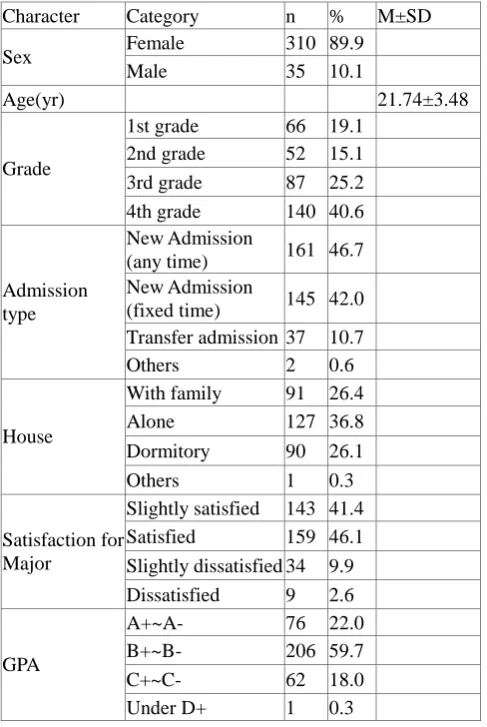
Among the respondents, female students took up 89.9%, and average age of all the respondents was 21.7 years old. In the school year distribution, seniors took up 40.6 %, the largest group. Among residential types, the largest proportion of them, 36.8% either lived in lodging houses or lived on their own near the campus. The rest either lived with their parents, or in dormitories. To enter the college, 46.7% used the non-fixed-time admission system. 87.5% of respondents answered that they were satisfied with their major. The average grades of 59.7% of them were B range [Table 1].
Table 1. General Characteristics of the Subjects (N=345)
Character Category n % M±SD
Sex Female 310 89.9
Male 35 10.1
Age(yr) 21.74±3.48
Grade
1st grade 66 19.1
2nd grade 52 15.1
3rd grade 87 25.2
4th grade 140 40.6
Admission type
New Admission
(any time) 161 46.7 New Admission
(fixed time) 145 42.0 Transfer admission 37 10.7
Others 2 0.6
House
With family 91 26.4
Alone 127 36.8
Dormitory 90 26.1
Others 1 0.3
Satisfaction for Major
Slightly satisfied 143 41.4
Satisfied 159 46.1
Slightly dissatisfied 34 9.9 Dissatisfied 9 2.6
GPA
A+~A- 76 22.0
B+~B- 206 59.7
C+~C- 62 18.0
Under D+ 1 0.3
3.2. Levels of Core competence and learning experience In the scores of core competencies of respondents, interpersonal relationshipand service other persons were 3.98±0.51, 3.95±0.53 respectively. On the other hand, the score of glocal communication ability was the lowest, 3.49±0.65. That of creative fusion abilitywas also relatively low, 3.55±0.49. In learning experiences, the score of 'academic challenge' was 2.61±0.51, a little over the average. That of 'learning with peers' was the lowest, 2.40±0.46. The score of 'campus environment' was 3.68±0.80 in 7-point scale [Table 2].
Table 2.Levelsof Core competency and Learning experience (N=345)
Variables Mean SD Min Max
Core competencies
Interpersonal relationship 3.96 0.52 2.80 5.00
Service other persons 3.95 0.53 2.73 5.00
Creative fusion ability 3.55 0.49 2.33 4.73
Practical performance
[image:2.595.306.550.74.438.2] [image:2.595.304.553.609.731.2]International Journal of Innovative Technology and Exploring Engineering (IJITEE) ISSN: 2278-3075,Volume-8 Issue-3C, January 2019
Glocal communication
ability 3.49 0.65 1.73 5.00
Learning experience
Academic challenge 2.61 0.51 1.00 4.00
Learning with peers 2.40 0.46 1.00 3.52
Experience with faculty 2.57 0.51 1.00 4.40
Campus environment 3.68 0.80 1.20 5.77
3.3. Relationships between core competencies and learning experiences
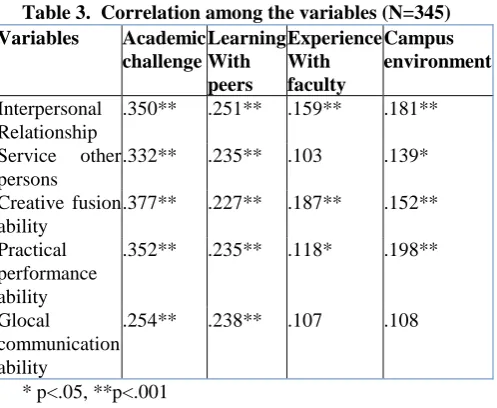
[image:3.595.47.293.49.164.2] [image:3.595.46.295.462.666.2]Personal relationlships had significant positive relations with all the variables in learning experience domain: academic challenge (r=.350, p<.001), Learning with peers (r=.251, p<.001), Experience with faculty (r=.159, p<.001), and Campus environment (r=.181, p<.001).Serve other persons had significant positive relations with the following variables: academic challenge(r=.332, p<.001), and Learning with peers(r=.235, p<.001).Creative fusion competence had significant positive relations with all the variables in learning experience domain: academic challenge (r=.377, p<.001), Learning with peers (r=.227, p<.001), Experience with faculty (r=.187, p<.001), Campus environment (r=.152, p<.001).Glocal communication ability had significant positive relations with the following variables: academic challenge (r=.254, p<.001), Learning with peers (r=.238, p<.001).It was found that academic challenge and Learning with peers were related with all the core competencies, and correlation coefficients of them with academic challenge were the highest. In contrast, serve other persons had small relations with campus environment, and thatGlocal communication ability had no relations with Experience with faculty and Campus environment[Table3]
Table 3. Correlation among the variables (N=345) Variables Academic
challenge
Learning With peers
Experience With faculty
Campus environment Interpersonal
Relationship
.350** .251** .159** .181**
Service other persons
.332** .235** .103 .139*
Creative fusion ability
.377** .227** .187** .152**
Practical performance ability
.352** .235** .118* .198**
Glocal
communication ability
.254** .238** .107 .108
* p<.05, **p<.001
3.4. Factors affecting core competencies
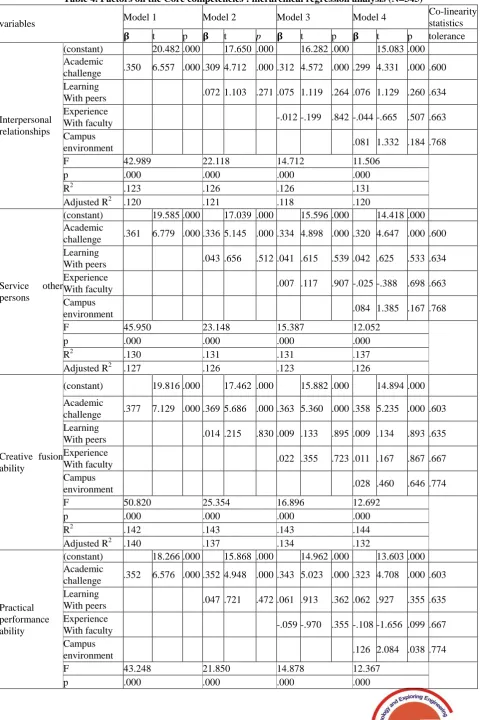
To identify factors affecting core competencies of nursing college students, this study used four variables under the learning experience domain as explanatory variables, and conducted hierarchical multiple regression [Table 4]. This study checked multicollinearity among explanatory variables, and there was no such a problem given that tolerance limits were 0.600-0.774, higher than 0.1, and variation inflation
relationship between residuals. So, a regression model is suitable for analysis. Hierarchical regression analysis was conducted by including each of the variables under the learning experiences domain ― academic challenge, learning with peers, experience with faculty, and campus environment ― in Model 1, Model 2, Model 3, and Model 4, and their explanatory power for four kinds of core competencies ― interpersonal relationships, service other persons, creative fusion ability, practical performance ability, andglocal communication ability.
In Model1 where only the variable academic challenge is put as a variable affecting interpersonal relationships, the explanatory power of the variable was 12.3% (R2=.123, p=.000). In Model 4 where all the four variables under the learning experience domain are included, the explanatory power of the variable was 13.1% (R2=.131, p=.000). But, in all models, only academic challenge had statistically significant effects ( =.350, p=.000, =.309, p=.000, =.312, p=.000, and =.299, p=.000).
In Model1 where only the variable academic challenge is put as a variable affecting competence to serve other persons, the explanatory power of the variable was 13.0% (R2=.130, p=.000). In Model 4 where all the four variables under the learning experience domain are included, the explanatory power of the variable was 13.7% (R2=.137, p=.000). But, in all models, only academic challenge had statistically significant effects ( =.361, p=.000, =.336, p=.000, =.334, p=.000, and =.320, p=.000).
In Model1 where only the variable academic challenge is put as a variable affecting creative fusion ability, the explanatory power of the variable was 14.2% (R2=.142, p=.000). In Model 4 where all the four variables under the learning experience domain are included, the explanatory power of the variable was 14.4% (R2=.144, p=.000). But, in all models, only academic challenge had statistically significant effects ( =.377, p=.000,=.369, p=.000, =.363, p=.000, =.358, p=.000),
In Model1 where only the variable academic challenge is put as a variable affecting practical performance ability, the explanatory power of the variable was 12.4% (R2=.124, p=.000). In Model 4 where all the four variables under the learning experience domain are included, the explanatory power of the variable was 14.0% (R2=.140, p=.000). But, in all models, only academic challenge had statistically significant effects ( =.352, p=.000, =.352, p=.000, =.343, p=.000, and =.323, p=.000).
Table 4. Factors on the Core competencies : hierarchical regression analysis (N=345)
variables Model 1 Model 2 Model 3 Model 4
Co-linearity statistics
t p t p t p t p tolerance
Interpersonal relationships
(constant) 20.482 .000 17.650 .000 16.282 .000 15.083 .000 Academic
challenge .350 6.557 .000 .309 4.712 .000 .312 4.572 .000 .299 4.331 .000 .600 Learning
With peers .072 1.103 .271 .075 1.119 .264 .076 1.129 .260 .634 Experience
With faculty -.012 -.199 .842 -.044 -.665 .507 .663
Campus
environment .081 1.332 .184 .768
F 42.989 22.118 14.712 11.506
p .000 .000 .000 .000
R2 .123 .126 .126 .131
Adjusted R2 .120 .121 .118 .120
Service other persons
(constant) 19.585 .000 17.039 .000 15.596 .000 14.418 .000 Academic
challenge .361 6.779 .000 .336 5.145 .000 .334 4.898 .000 .320 4.647 .000 .600 Learning
With peers .043 .656 .512 .041 .615 .539 .042 .625 .533 .634 Experience
With faculty .007 .117 .907 -.025 -.388 .698 .663
Campus
environment .084 1.385 .167 .768
F 45.950 23.148 15.387 12.052
p .000 .000 .000 .000
R2 .130 .131 .131 .137
Adjusted R2 .127 .126 .123 .126
Creative fusion ability
(constant) 19.816 .000 17.462 .000 15.882 .000 14.894 .000
Academic
challenge .377 7.129 .000 .369 5.686 .000 .363 5.360 .000 .358 5.235 .000 .603 Learning
With peers .014 .215 .830 .009 .133 .895 .009 .134 .893 .635 Experience
With faculty .022 .355 .723 .011 .167 .867 .667
Campus
environment .028 .460 .646 .774
F 50.820 25.354 16.896 12.692
p .000 .000 .000 .000
R2 .142 .143 .143 .144
Adjusted R2 .140 .137 .134 .132
Practical performance ability
(constant) 18.266 .000 15.868 .000 14.962 .000 13.603 .000 Academic
challenge .352 6.576 .000 .352 4.948 .000 .343 5.023 .000 .323 4.708 .000 .603 Learning
With peers .047 .721 .472 .061 .913 .362 .062 .927 .355 .635 Experience
With faculty -.059 -.970 .355 -.108 -1.656 .099 .667
Campus
environment .126 2.084 .038 .774
F 43.248 21.850 14.878 12.367
International Journal of Innovative Technology and Exploring Engineering (IJITEE) ISSN: 2278-3075,Volume-8 Issue-3C, January 2019
R2 .124 .125 .128 .140
Adjusted R2 .121 .120 .119 .129
Glocal
communication ability
(constant) 13.888 .000 11.434 .000 10.733 .000 10.027 .000 Academic
challenge .254 4.603 .000 .175 2.603 .010 .187 2.660 .008 .181 2.551 .011 .600
Learning
With peers .136 2.024 .044 .145 2.100 .037 .145 2.101 .036 .634 Experience
With faculty -.037 -.586 .559 -.050 -.734 .463 .663
Campus
environment .033 .524 .600 .768
F 21.191 12.750 8.596 6.501
p .000 .000 .000 .000
R2 .065 .077 .078 .079
Adjusted R2 .062 .071 .069 .067
According to study of Park and Jeonused K-CESA, the average score of interpersonal relationships of nursing students was 47.38 with 100 being full score[7]. And, the percentage of those classified as not sufficient in that competence was 43%. But, in this study interpersonal relationships was 3.96 with 5 full point higher than the Park and Jeon ‘s result. .
In their study, the average score of global competence of nursing students was 46.75, and those who were classified as lacking sufficient competence were 47%, and those who were classified as having certain amount of competence were also 47%, which means that glocal communication competence of most of nursing students was below the average. In this study, glocal communication ability was the lowest competency of nursing students, also. This means that nursing students don’t have sufficient chance to experience with overseas and they need to participate in programs to raise global and local experiences.
Competence to use resources, information, and technology was the lowest among K-CESA competences. those who were classified as lacking sufficient competence were 50%. It was reported that, among core competences, human relations competence and self-management competence have positive relationships with problem-solving competence. Dealing with stress also revealed positive relationships with human relations competence, self-management competence, and global competence. Human relations competence and self-management competence had positive relationships with dealing with stress and problem-solving competence.
Academic challenge was the only variable which significantly influenced interpersonal relationship com, competence to serve other persons, creative fusion competence, and practical performance competence. Its explanatory powers to such variables were 12.3~14.2%. Academic challenge and Learning with peers had small effects on glocal communication ability. This means that academic challenge and programs is the main and critical element to enhance the students’ core competencies in various learning processes. Therefore faculty focus on how to manipulate the context and organize students’ academic
8 competencies including communication skill, human relationships, management and knowledge integration in COPA model[10 ]. These competencies are very related with nursing field after school. So Strategies are need to be developed in CPE in the simulation or other methods.
IV.CONCLUSION
This study is to explore whether learning experiences of nursing students have effects on promoting core competences of them. Among core competences, the average score of human relations competence was 3.96; that of creative fusion competence was 3.95, both of which are above mean values. among variables related with learning experiences, the average score of academic challenge was 2.61; that of Learning with peers was 2.40; that of Experience with faculty was 2.57; that of campus environment was 3.68., all of ahich are above mean values. Among those variables, academic challenge and Learning with peers were related with all the core variables, with the former being stronger. Competence to serve other persons was weakly related with campus environment, and glocal communication competence was related with neither Experience with faculty nor Campus environment. Academic challenge was the only variable which significantly affects human relations competence, competence to serve other persons, creative fusion competence, and practical performance competence, with explanatory power ranging from 12.3% to 14.2%. Glocal communication competence was weakly related with Academic challenge and Learning with peers.
ACKNOWLEDGMENT This paper granted by Baekseok University.
REFERENCES
1. Astin A, Antonio A. Assessment for excellence the philosophy and practice of assessment and evaluation in higher education, New York:Rowman& Littlefield Publishers; 2012.
2. Wu C., Hsieh S., Hsu L. Self-evaluation of core competences and related factors among baccalaureate nursing students. J NURS, 2013 Feb:60(1), 48-59.
3. Cultivating nursing core competencies in college students. Nursing Education, J NURS, 2010 OCT:57(5), 18-23.
4. Hemalatha R, BS Shakuntala. Development and Testing of Competency Based Performance Assessment in the evaluation of core competencies of nursing students-a pilot study. International Journal of Nursing Education. 2014 Jul-Dec: 6(2)56-60.
5. Kim JH, Gum HJ, Lim MR, Yim SY, Shin SH, Kim BJ. Development of BU-CCA,(Baekseok Core Competency Assessment tool). Baekseok University Press; 2017.
6. Bae SH, Kang MS, Hong JI (2015). Validation of the National Survey of Student Engagement(NSSE) Model in the Korean Context, Asian Journal of Education, 2015 16(4), 77-104
7. Park IS, Jeon HN.The effect of core competency on stress coping and problem solving ability of nursing students. 2015. 4th K-CESA conference.
8. Bae SH Influential factors in th out of cass activities of Korean students. International journal for research on extended education2015 3(2), 99-122
9. Guo F, Shi J. The relation ship between classroom assessment and undergraduate learing within Chinese higher education . Studies in Higher Education, 2015. 1-22