International Journal of Innovative Technology and Exploring Engineering (IJITEE) ISSN: 2278-3075, Volume-8 Issue-9, July 2019
Mining of High Value Item Sets with Negative
Utility
Aatif Jamshed, Bhawna Mallick
Abstract: The patterns generated by frequent pattern mining aims to find the frequent items without considering the utilities of the different items. The traditional association rule mining treats all items to be of equal utility. This is not always the case for a real world application. Utility based data mining is a new area of research and is complementing the frequency based approach. The main objective of Utility Mining is to identify the item sets with highest utilities, by considering profit, quantity, cost or other user preferences as the Utility of the item. Recent approaches developed so far considers the utilities of items to be same over a particular period of time. In our approach we have proposed that the utility of items vary over a period of time. Our work also proposed that the utility of items may also assume negative values. Our work thus treats the data mining in more realistic manner
Index Terms: Mining, High value Item set, Utility mining, Negative value.
I. INTRODUCTION
Structuredknowledge canbe extractedfrom
largedatasetswiththehelpof datamining. Dataminingtasks likeClassificationandClustering also usefrequent pattern mining anditalsoforms thepremiseforassociation rulemining. Clustering also usefrequent pattern mining anditalsoforms thepremiseforassociation rulemining.Relationshipsoftheform X Y (amongstitem setsthatoccurtogetherina databasewhere
X andY aredisjointitem sets)
canbefoundusingassociationrulemining. Butfrequentpattern mining algorithmshasa drawback that itworksfor a limited set of applicationswheretheitemsaretreatedtobe of equalutilitytothebusiness.Itdidnot consider quantity and
weight that are significantforaddressingreal worlddecision problemsthatrequiremaximizingtheutilityin anorganization.Herecomestheroleof utility based data
mining that aims to find the item
setsthatareofhighutilitytothebusiness. It treats every
item to be of different
significanceandutilityof differentitemscan
expressasfunctionsofcost,profitetc.Fore.g. sellingamicrowavemayoccurlessfrequently
thansaleofbreadandbutterinasuperstore, buttheformergives amuchhigherprofitper unitsold.Thehigh utility item settmining problemistofindallitem setsthathaveutility larger
than a user specified value of
min_utility.Hencefrequencyofitemsisnot the sufficient indicator of item’s
interestingness.Othermeasureslike utility
shouldalsobetakenintoconsideration.
Revised Manuscript Received on July 10, 2019.
Aatif Jamshed, Information Technology, ABES Engineering College,Ghaziabad, India
Bhawna Mallick, Computer Science, Maverick Quality Advisory Services Pvt.Ltd Ghaziabad, India
Mostof thealgorithmsdevelopedsofarfor utility
miningeitherfolloweda prioritybased approach which relied on thetechniqueof candidate generate andtestmethod.These approaches sufferedfrom high time costsmoreoverthey
alwaysrun underthejeopardy of combinatorial
explosion.Moreoverthe algorithms d i d not take into
account into this kind of
activity.dynamicnatureofutilityandpossibilityofthe
negativevalueof utility.Asmoreconstraints on the utility
factors are applied the
computational complexityforthealgorithms
alsoincreasesthereforeinanutshellwecan say that not only simplification in the
calculationof utilityisthechallengebutalso candidate size restrictionis alsoanissue that mostofthealgorithms triedtoaddress.Before HUINIV[5]nootherworkwastaking intoconsideration that utility can also take
negativevalues, whentwophasealgorithm[3]
wasappliedtothescenarioof negativevalues wesawthatmany ofthehighutilityitem sets whichshouldhavebeen therein theresults weremissingbutsinceHUINIVwas theonly
workdonein theareaofnegativevalues therefore
therewasaninherentneedto improvise upon
the proposed algorithm. Henceforth
a challenge to improve
the existingHUINIVwas confrontingus.Later
sectionofour work describes in detailthat
howitmetthesechallenges.
II. RELATEDWORK
High utilityitem settminingisnothingbutan augmentation of frequent pattern mining. Perhaps it can be viewed
as a more generalized approach of the
later. Business/Fraudulent transaction, retail
communities, security,bio-informatics, are someof thereallifeapplicationswhereutility miningcan be
employed.SometimesRare item setsaretheresultof
utilitymining.These item settprovidesavery usefulinsightto decisionmakers.Forinstance,a supermarket’s customers purchasemicrowaveorrefrigerator rarely ascompared tobread,bakingpowder,
sauce.Butprofitforthesupermarketincase
oflatertransactionsisless thantheformer. Researches
thatdefinevariousinterestingness measuresof
discoveredpatternisproposedby LiqiangGeng and
H.J.Hamilton in[1]. Their work intended to come
up with some
parametersthatallowreducedtimeandspace
costsminingprocess.In thisworkutilityis definedasoneof theinterestingnessmeasures
databaseshavebeenproposedin [2]by
HONGYAOetal.Thispaperdelves into
thetheoreticalanalysisoftheresulting utility mining problem and it laid the foundationforvariousfuture utilitymining algorithms.This workintroduces autility bound
and support bound property and
thereafteritusheredamodel christened as MEU
(miningusingexpectedutility)that minedthehighutilityitem sets. Thenatwophasealgorithm[5]byYingLiuet alwasproposed
thatclaimedtoefficiently cut downthequantum
ofcandidatesandhencea completesetofhigh utilityitem setscomeout more adroitly. Theproposed two phase
algorithm solvestheissueofmaintaining
downwardclosureproperty.Besides several othermeasureslike
TransactionWeighted utilization
(TWU)wereintroducedwhich forms the premise and works like the benchmarkforseveralother algorithms. Then an algorithmHUINIVwasproposedby Chun-JungChuetal[6]whichmines thehigh utilityitem setsfrom databaseandalsotakes intoaccounttheitem withnegativeutility values.Theirworkwas authenticintheway thatitmatchesvery nearly tothereal life shopping basket analytics situation where someitemsmay alsoappearwith negative utilityvalues.
Temporal association mining or more precisely
calendarbasedminingbyKeshri
Vermaetal[4]wassuggestedwhichcanmine the itemsetwhich are frequentin a user definedtimeperiod T.Thesemethods address the problem to excavate items that are frequentforonlysometimeof thedatabase periodically.
III. METHODOLOGY
Thischapterwillbedelvingintominutiaof theapproach thatwecomply toreachtoour motiveofmininghigh utilityitem sett.Firstof all thisportion willexpoundvariousmeasures that
areomnipresent throughout the text. It will
definevarioustermsandexplainitthat howaretheycalculatedtakinganexample.
Table3.1
The above table denotes various ransactions of the retail store. Each transaction is explicitly given auniquetransactionidas T1, T2 etc. Business storeispresumed to have fiveitemslikeA,B,C,D, andE. Time
stamping oftransaction place is on the 7th
columnandon8thcolumntransactionutility asdefined later is
mentioned. The numbers representsthequantum
ofitemsthatwere boughtinthecorrespondingtransaction.
Table3.2
Table3.2describes theutilityvalues ofthe items ofthe retail storeduringthefour quartersoftheyear.
A. Definitions
Definition1.Theutilityofanitemipinthe transactionTdis
denotedas u(ip,Td)and definedas
p(ip)×q(ip,Td).Forexample,in Table3.1,u({A},T1,q1)=5×5=25.[5]
Definition2.Theutilityofanitem settXinTd is denotedas
u(X,Td) anddefinedas ∑(X,Td)
Forexample,u({AC},T3,q2)=u({A}, T3,q2) +u({C}, T3,q2)=25+80=105.[5]
Definition3.Theutilityofanitem settXinDis denotedas u(X)anddefinedas
∑(X,Td)For example,u({AD})=u({AD}, T1)+u({AD},T2) +u({AD},T3)
+u({AD},T4)+u({AD},T5))
+u({AD},T6))=33+44+33+72+50+34 =266. [5]
Definition4.Thetransactionutilityof a transactionTdis
denotedas TU(Td)and definedas u(Td). For
example,TU(T4)= u({ABCDE},T4)=48 –8+90+24+20= 174.[5]
Definition5.Thetransaction-weighted utilizationofanitem
settXis thesumofthe transactionutilities
ofallthetransactions containingX,whichis denotedas
TWU(X). Fore.g. TWU(AE)=TU(T1)+TU(T2)+
TU(T3)+TU(T4)+TU(T5)+TU(T6)=159
+324+151+174+1259+492=2546 [5]
Ifanyofthetransactionwouldnothave
containedAandC simultaneouslythenthe
transactionutilityofthattransactionwould nothavebeentakenintoaccount.
B. U-tree datastructure
For thesakeofsimplicitytounderstandthe
constructionofUtreeweconsideronemore
International Journal of Innovative Technology and Exploring Engineering (IJITEE) ISSN: 2278-3075, Volume-8 Issue-9, July 2019
[image:3.595.52.288.84.394.2]Table 3.3
Table 3.4
IhaveconstitutedtheU-Treedatastructure in
awaytocompactlyrepresentthetransaction datarequiredforhighutilitymining.It consistsofanitemheadertableandaU-tree.
C. Item Header Table
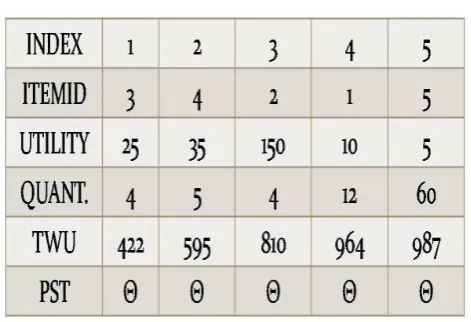
TheItemHeader tablecontainsindex,itemid,quantity,TWU, utility,PSTWhereTWUandPSTare
transactionweightedutilizationandpointerto subtree respectively.
D. Construction of Item Header Table
Initiallynoitems excepttherowheadingsare therein thetable.Thereafterthedatabaseof transactions is scanned once. As the transactionsareread fromthedatabase, theitem header table is updates using the
followingsteps. •Foranyitemwhichisabsentin theitem headertablebutpresentin transaction,anew column in the table is generated and the entries areinitialized,likeitem-id,utility/unit, its quantity,andtheTWU.Atthis stage mapped-idandthepointerremainnull.
•Foreveryitemwhoseentryisthereinthe itemheader
tableaswell asthetransaction, update in the corresponding column entries aredonei.e.totalquantityoftheitemisadded toexistingdetail alsoTUisaddedtoexisting entry.
•Itemsin theitemheadertablearestoredin increasing orderof
theirTWU and their mappedidisnothing but
theircorresponding ranks when placed in ascending order.
The itemwhichdoesnotcross theminimumutilit y
isnotincludedintheitemheadertable.
Theitemwiththe ITEMID6i.e.Fis eliminatedasitwas belowtheminimum utilityof120.Theoriginalitems thatwere3,
4,2and1,5arenowhaveanewmappedid
i.e.indexas 1,2, 3, 4, 5.
E. Construction of U-Tree
Since this work is on temporal mining
differenttree willbeconstructedfordifferent
timespecificationsbutsince the procedure of construction
will remainsame,thefollowing examplewilltalk
onlyaboutconstruction of treetakingonlytheutilityvaluesof
onlyone timeperiod.Now theveryfirstphaseofthe
[image:3.595.309.545.223.384.2]treeconstructionwhichisinitialization of tree comes into picture. The process of the
Table 3.5 item header table
initializationoftreeis asfollows
Thetreeisinitializedwithrootnodeofindex 1.ApathofN-1nodewithindexfrom2toN
iscreatedsuchthatanynodeiis thesuccessor iof(i-1).Apointertotherootofthesubtree isattachedtoevery itemi presentin theitem header table. i-item sett is attached to every node and its TWU is initialized as 0. Any node i will represent pattern like i,i-1,i-2,i-
3..1.Eachpatternalsohasapointerattached
withthearray oftotal quantity ofiteminthe
transaction.Thisistheprocedureof tree initialization.Thefull treeconstructionisthe nextstepin ourproposedmethodology.
The databaseisscannedonceagaintoupdate the
Utree.Scanningofeverytransactionisdone inincreasingorderofitem'sTWU.Ifapattern
isabsentincurrenttreethennodeiscreated and theappropriatepattern andcorresponding TWU are
recorded. Also array of total
quantityisupdated.Ifthepatternispresent theonlytheupdateofTWUandtotalquantity
isdoneinthepresentUtree. Oneimportant
thingtobekeptinmindwhileupdatingthe treeasthatin
theitemheadertabletheitems which were
absent,theircontribution to the
TWUisnotconsideredandexcluded.As the database is scanned once the tree is constructed.The tree correspondingto the aboveexampleis showninabovefigure. ITEM ITEM ID UTILITY
A 1 10
B 2 150
C 3 25
D 4 35
E 5 5
F. MiningAlgorithm
Descriptionofourproposedalgorithmtomine therequiredsetof highutilitypatternisgiven in this section. The algorithmis explained using the example dataset/database as
described earlier. Item header table’s
eachitemserveascommencement point tomine HUI.Thisis
donebyfirstinspectingtheTWU of
everyitemintheitemheadertableinits associatedsubtree.
Figure3.1
Algorithm starts with subtree that has item withindex ormappedid1asitsroot,then the correspondingitem’sactual utilityischecked whetheritliesabove orbelow the threshold. Thisresultinpattern1withtheactualutility of 100 which
certainly lies below the threshold. Hence this pattern 1s is not consideredamongthe HUI.Now the current node’s childsubtrees arecheckedfortheitems thatare leftintheitemheadertablestarting from rightmostitem anduptocurrentitem’s secondrightneighbor.Atthesametime an arraytostore theintermediateresultsofTWU while
traversingthe treeisinitialized.This array
istermedassum_TWU.Nowwestart from
therightmostitemintheitemheader
tablewhichis5.Alltheoccurrenceof 5is inspected under 1’s subtree and every
pattern’sTWUisaddedtothearray,thisis howtheTWUof thepattern15ischecked.
Thereare4occurrencesof5under1’ssubtree but each
occurrence apart from 125 is neglected
because those patterns are not presentin
thedatabaseitselfi.e.they havethe TWUof
0.TheTWUof125is110whichis less than minimum utility threshold. And henceitsrealutilitycalculationwillnot be
done.Also5 being therightmostitem,the
augmentationtopattern15isnotrequired.
occurrence of 4 under 1’s subtree is
considered and which results in pattern 14,
124,134, 1234. Butsince1234is absentinthe database itself it is not considered. The patterns14,134and124occurwith
the correspondingTWUof 35,195and80which
addsuptogiveaTWUvalueof310whichis >thresholdandthereforebeingthehigh TWU
itemwe’llcontinuetofindtheactual utility contribution of 14,124,134 which is 35, 45 and45respectivelywhich
addupto125and lessthanthethresholdvalueof 150.Nowthe longerpattern with 14astheprefixare exploredbut then thereisnopattern present hencethealgorithmagainiterates tominethe pattern of13.Thereisaonlypresenceof13 with TWU of195 and since the value lies abovetheutility
threshold thereforetheactual
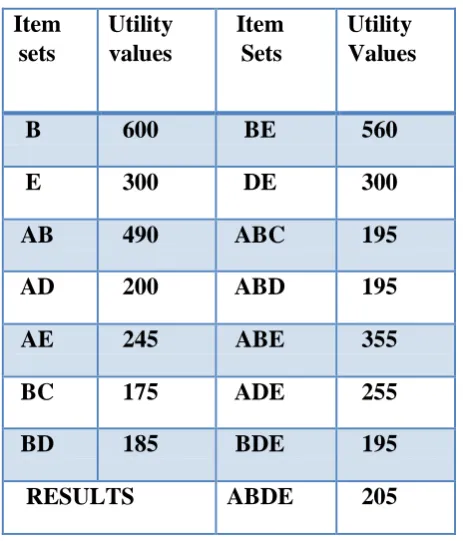
utilitycalculationofthispattern13isdone anditcomes upto175whichis alsothehigh utility item settsoitisamong theHUI.Again longerpatternslike 134and135are tobe
searched andmined with 13astheprefix and
weseethatthepattern 135isabsentand134 results in the HUI withutility of195. The original id of pattern 134 is item sett 123. Again 134isfurtherextendedto minefor patternslike
1345butnopatternlike thisis presentin
thedatabasethereforetheiteration stops
here,andsincethe3issecondright neighborof
1thereforepath12isnotmined andisleftforlater
computation.Moreover sincethereisapath 13in
thetreetherefore this’pattern TWUandquantity isattachedto thecorrespondingnodeintheleftmostbranch.
Thiscompletestheminingof HUIitemswith
subtreehavingrootnode1.Nowthesubtree of2
ischecked.Patternslike2and12 are derivedfrom
theroot.Itshouldbenoted that from
thisnodepattern12canbederived.And nowtheprogramwillcheckfortheoccurrence ofrightmostitemundernotonly2butalso12.
Thepatternslike25,125ans 24and124are checkedforhigh TWU.AndifTWU>thresholdthanactualutilitycalculationof the patternisdone. Fromthispoint24and25 comesouttobeof
HUIandtheymapto originalitem sett14 and
45respectively.The extensionof 25isnotpossiblebut24is extended tocheckfor245 and1245.And algorithmchecks for bothofthese item setsandfinds245tobeaHUIwithutilityof 255. Alsoitisnoted thatboth24and245existsin the tree therefore
their quantity value and TWUvalueisadded
tocorrespondingnode occurrenceattheleftmostbranchof thetree. Again thealgorithmsloopsforchecking the subtreewithroot3.In thiscasetherightmost item’s occurrences arecheckedunderthe occurrenceof root123and23 and3.The wholealgorithmsfollowthesameprocedure
asdesribedaboveandfindtheHUIof35and 235.Similarlysubtreewithroot4willgive 234and34asHUI.And5willgive5,45,
International Journal of Innovative Technology and Exploring Engineering (IJITEE) ISSN: 2278-3075, Volume-8 Issue-9, July 2019
[image:5.595.49.281.71.342.2]-1 Photo Table 3.6
Item
sets
Utility
values
Item
Sets
Utility
Values
B
600
BE
560
E
300
DE
300
AB
490
ABC
195
AD
200
ABD
195
AE
245
ABE
355
BC
175
ADE
255
BD
185
BDE
195
RESULTS
ABDE
205
IV. PERFORMANCE STUDY
In this section the performance of our
proposedalgorithmisempiricallystudied.The
Algorithmisdevelopedinjava and tested on
IntelPentiumcorei3processor,3GbRAM on transaction was50000.Wegenerateutility value randomly following a lognormal distributionasin[5].TheAlgorithmtookmore timeinexecution when utility threshold were higher as
comparedtothecasewhenutility thresholdarelower
anditoutperformedmany other previous
algorithms when utility thresholds
arefurtherlowered.
V. CONCLUSION.
In thispaper,anovel algorithm thatminesthe high utility item
setsfrom a transaction temporaldatabase is
proposed whichminesthecompletesetofhigh utilityitem setsovera userdefinedtimeperiod.Thealgorithm most closely relates tothereal world scenario wheretheitem utilitiesarenotconstantand keepon changing.Thisalgorithm addresses many problemslikemaintainingdownward
closureproperty andalsoaddressingthe problem
toconsidernegativevalues.This algorithm
usesatreebasedapproach anddoes notfollow candidate generationandtest methodwhichefficientlyminestherequired setofitems.
REFERENCES
1. Geng, L., & Hamilton, H. J. (2006). Interestingness measures for data mining: A survey. ACM Computing Surveys (CSUR), 38(3), 9. 2. Yao, H., Hamilton, H. J., & Butz, C. J. (2004, April). A foundational
approach to mining itemset utilities from databases. In Proceedings of the 2004 SIAM International Conference on Data Mining (pp. 482-486). Society for Industrial and Applied Mathematics.
3. Li, Y., Ning, P., Wang, X. S., & Jajodia, S. (2003). Discovering calendar-based temporal association rules. Data & Knowledge Engineering, 44(2),193-218.
4. Keshari Verma,O.P.Vyas,Efficient calendar based temporal Association Rule. ACMSIGMOD,ISSNNo.0163-5808,vol34,No3September2005. 5. Liu, Y., Liao, W. K., & Choudhary, A. (2005, May). A two-phase
algorithm for fast discovery of high utility itemsets. In Pacific-Asia
Conference on Knowledge Discovery and Data Mining(pp. 689-695).
Springer, Berlin, Heidelberg.
6. Chu, C. J., Tseng, V. S., & Liang, T. (2009). An efficient algorithm for mining high utility itemsets with negative item values in large databases. Applied Mathematics and Computation, 215(2), 767-778.Computation Volume 215, issue 2 , 15September2009
7. Pillai, J., Soni, S., Vyas, O. P., & Muyeba, M. (2010). A Conceptual Approach to Temporal Rare Item set Utility Mining. International Journal of Computer Applications, 1, 65-72.
AUTHORSPROFILE
Mr. Aatif Jamshed is pursuing Ph.d from Uttarakhand Technical University (A State Govt),Dehradun. He has completed his M.Tech in Computer science & Engineering from Jamia Hamdard University. He has experience in real life projects from leading IT company in India with proficiency in Java, J2EE. Mr.Jamshed has about 10 years of Teaching and Industrial experience across multiple institutes like Galgotias, Vidya, Beganto Inc. etc. He has published more than 20 Research papers in reputed International Refereed Journals/ Conferences. He has published 5 Books, 2 out of them are available on Amazon. He has contributed as Session Chair, organizing Committee, Member of Reviewer Committee and Technical Program Committee for multiple International Conferences (IEEE). He is the member of UACEE, IAENG, IACSIT, CSTA etc. His