International Journal of Innovative Technology and Exploring Engineering (IJITEE) ISSN: 2278-3075, Volume-8 Issue-11, September 2019
ABSTRACT:Content-based image retrieval is a technique which uses visual contents to search images from large scale image databases according to users' interests, has been an active and fast advancing research area since the 1990s. During the past decade, remarkable progress has been made in both theoretical research and system development. However, there remain many challenging research problems that continue to attract researchers from multiple disciplines. Some of the techniques used in CBIR are Query by example, Semantic retrieval, content comparison techniques etc. Most of the existing works were done on spatial domain which is not so efficient. To overcome the difficulties of the existing works, a new algorithm is planned. And the proposed approach is based on the frequency domain for the content based Image retrieval systems.A new image retrieval technique which will retrieve images from image databases based on their contents in frequency domain to get better results. And a relevance feedback method is used for improving the retrieval efficiency. Many techniques are there in this computer vision and image processing field. But using low level features as a basis and retrieve features with good efficiency is problem of the study. The proposed work relates Feature extraction using both frequency domain as well as spatial domain. For spatial domain SIFT and for frequency domain FDCT techniques are applied and results were compared to find better information retrieval.
Key wordss: fdct (Fast discrete curvelet Transform), sift (scale invariant function transform), svm (support vector machine )
I.INTRODUCTION
Content-based image retrieval (cbir) is the application of laptop imaginative and prescient to the photograph retrieval trouble, i.e. attempting to find digital pictures from huge databases. content material based image retrieval makes use of shade, texture and form features [1] .a machine which can filter out snap shots based totally on their content could offer better indexing and return extra correct effects. in content material based totally commonly image retrieval (cbir),[2] images place unit indexed by way of their visual content like color, texture and form. Those Low-level image alternatives region unit inadequate to explain most internet based generally picture search engines like google agree with strictly on facts and this produces heaps of garbage in the outcomes. Many structures had been developed but now not a unmarried gadget is perfect. green control of the rapidly expanding visual records is wanted. to search the most similar photographs to the question photograph, by way of fast discrete curvelet transforms [3] for better retrieval effects.
Revised Manuscript Received on September 08, 2019
K Sugamya, Chaitanya Bharathi Institute of Technology, Hyderabad, India.
Suresh Pabboju, Prof & Head ,Dept. of IT, Chaitanya Bharathi Institute of Technology, Hyderabad, India.
A Vinaya Babu, Prof. & Dean, Stanley College of Engineering and Technology, Hyderabad, India
Image retrieval system may be accomplished both in Frequency domain or spatial area [4]. Inside the frequency area, an photo at every factor represents a selected frequency contained in the spatial area photograph. via applying the changes, on an image it represents within the fourier or frequency domain, at the same time as the input image is the spatial area equivalent. in frequency area wavelet transforms affords a suitable frame work for analysis and characterization of pix at one-of-a-kind scales. wavelet transforms provide a multi-decision approach to texture analysis and category.[5] shengjiu wang (2001) “a sturdy cbir technique the usage of local color histograms” technical document. tr 01-13[6].
j. zhang, g. li, s. he, “texture-primarily based photograph retrieval via facet detection. Relevance comments [7] to modify the retrieval procedure in an effort to generate perceptually and semantically extra meaningful retrieval outcomes. Better retrieval charge may be possessed using relevance remarks [8]. To retrieve an picture with less computational complexity The use of low level functions in frequency domain is predominant motto of the work. Generalizing a cbir gadget is likewise tough as one characteristic will have exclusive significance in specific domain names. The quantity and type of characteristic decided on impacts the output. Complexity using low level features in Frequency Domain is main motto of the work. Generalizing a CBIR system is also difficult as one feature can have different significance in different domains. The number and type of feature selected affects the output.
II.CURVELETS
A decent frame has been introduced because the curvelet aid to lessen the information redundancy within the frequency domain.curvelets have both variable width and duration and represent more anisotropy. Wrapping based totally curvelet rework is simpler, Less redundant and faster in computation than ridgelet based curvelet transform. Wrapping based curvelet rework is a multi-scale rework with a pyramid shape which includes many orientations at each scale. sub-bands at high and coffee frequency stages have exclusive orientations and positions. at high scales, the curvelet waveform turns into so fine that it looks as if a needle shaped detail .with growth inside the decision degree the curvelet will become finer and smaller inside the spatial domainAnd indicates more sensitivity to curved edges that permits it to successfully capture the curves. curvelets have useful geometric options that set them inside the spacial domain, a curvelet has companion diploma envelope powerfully aligned on a given `ridge' whereas inside the
frequency domain; it is supported near a container high frequency components of an
CBIR using SIFT& FDCT with Relevance
Feedback Mechanism
photograph play a important position in finding distinction among pix. curvelets at first-rate scales correctly constitute edges by way of exploitation texture options computed from the curvelet
coefficients. If it will be inclined to combine the frequency responses of curvelets at definitely exceptional scales and orientations, we will be inclined to get an oblong frequency utility that covers the complete image within the spectral area. The frequency responses of curvelets at special scales and orientations are combined then a square frequency tiling that covers the entire photo inside the spectral domain can be received using wavelet redesign. to obtain better Stage of performance, curvelet redesign is normally enforced information and gabor redesign of the images to represent a photo within the transformed domain. curvelet rework can be a brand new multi scale rework used as an green device in photo denoising, image decomposition , texture classification , image deconvolution , astronomical imaging this is, each the curvelet and also the photograph rectangular degree remodeled and rectangular measure then expanded inside the fourier frequency domain.picture within the reworked domain. curvelet rework may be a new multi scale rework used as an efficient tool in image denoising, image decomposition , texture classification , image deconvolution , astronomical imaging that is, each the curvelet and also the image square measure remodeled and square measure then increased within the fourier frequency domain.
The product is then inverse fourier transformed to acquire the curvelet coefficients.
Curvelet rework = ifft [ FFT(Curvelet) × FFT(Image)] and the product from the multiplication is a wedge.
Trapezoidal wedge within the spectral domain isn't always appropriate for use, with the inverse fourier remodel that's the next step in amassing the curvelet coefficients using ifft.
III. WRAPPING BASED TOTALLY CURVELET TRANSFORM
The frequency response of a curvelet may be a quadrangle wedge that must be wrapped into rectangular guide to carry out the inverse fourier redecorate the wrapping of this quadrangle wedge is finished by using sporadically masking the spectrum in the wedge. Then assembling the oblong regular area within the beginning. via this periodic protecting, the oblong area collects the wedge’s corresponding fragmented components from surrounding parallelograms.
This wedge wrapping manner, for this method of curvelet remodel is referred to as the ‘wrapping based curvelet transform. Hence gain the Discrete curvelet coefficients with the aid of applying 2-d inverse fourier remodel to this wrapped wedge facts. The middle rectangle of length 2 j × 2 j/2 correctly collects all of the statistics in that parallelogram. by using making use of 2-d inverse fourier transform to this wrapped wedge statistics the discrete curvelet coefficients may be acquired. Discrete curvelet remodel is carried out to an picture to achieve its coefficients. Those coefficients are then used to shape the feel descriptor of that photograph.
IV.METHODOLOGY
First an picture is subjected to a filter ( δs ) which filters the pixels representing the tough edges gift within the photograph. Then, this filtered photo is split into ‘n’ small squares in an effort to make the processing clean. Once the photo is split into tiny squares, these squares are elongated up to a degree in which every and every square contains a directly line (if it incorporates anything in any respect).the elongation technique is executed in an effort to enlarge the curved edges of the photo barriers .In order that they end up immediately traces. This ensures that the brink irregularities are captured nicely and correctly without missing any giant detail.
Fig1. Block diagram
The filtered picture will be transformed into fourier domain using fast fourier rework. The curvelet coefficients in fourier domain and the photograph in frequency area elevated which ends up a wedge form. This wedge fashioned information does not suit into rectangle so wrapping can be executed.
Then curvelet coefficients can found with the aid of wrapping based totally curvelet transform. in addition the curvelet coefficients may be calculated for photo database additionally. after similarity degree the use of euclidean distance the retrieved pictures kept so as of maximum relevancies. to improve high retrieval price svm primarily based relevance feedback mechanism is carried out.
B sift set of rules
Scale-space height choice the usage of reference of gaussians (canine) approach. Key factor localization: removal of risky key points Orientation Mission: primarily based on key point nearby photograph patch .Key point descriptor: based upon the photograph gradients in key point neighborhood community.
C relevance remarks
International Journal of Innovative Technology and Exploring Engineering (IJITEE) ISSN: 2278-3075, Volume-8 Issue-11, September 2019
V. RESULTS
Retrieval of pictures has done primarily based on ten picture categories and the picture dataset is 1000images of coral statistics. range of retrieved photos primarily based on scale invariant characteristic rework with relevance remarks generation 1, 2, and3. and effects primarily based on speedy
discrete curvelet remodel the use of relevance comments new release 1 and2. FDCT with iteration stage 2 is getting higher retrieval percentage than sift with new release degree three. And the five strategies consequences have been tabulated in Table1as the no of retrieved snap shots and No. of applicable pictures for a given check case.
Table 1: No.of images retrieved from ten categories
Image Category
Total No.of retrieved images Total No.of relevant images (Matching Cases) Sift
Iter1 Sift Iter2
Sift
Iter3 FDCT FDCT
Iter1
FDCT Iter2
Sift Iter1
Sift Iter2
Sift
Iter3 FDCT FDCT
Iter1 FDCT Iter2
Beach 51 58 68 79 71 87 39 39 41 48 47 62
Building 55 61 64 77 68 75 37 36 42 56 54 63
Bus 57 54 59 80 74 78 33 40 47 51 49 57
Dinosaurs 54 57 67 72 75 83 38 34 38 50 51 71
Horse 50 56 66 66 83 76 35 35 46 47 56 67
Human 52 52 69 78 84 82 35 38 39 49 57 54
Mountain 59 53 62 68 72 77 32 36 42 41 46 72
Rose 58 60 57 63 76 84 39 33 35 48 53 66
Elephant 60 55 65 64 70 72 33 36 42 45 57 62
Fruits 56 59 56 70 69 80 32 41 45 52 53 65
In the given table 2 percentages of precision and Recall calculated for the table1 test case. And the average of each method is computed.
Table2: Precision and Recall percentages for 1000 images
Image Category
Precision % Recall %
Sift Iter1 Sift Iter2 Sift Iter3 FDCT FDCT Iter1
FDCT Iter2
Sift Iter1
Sift Iter2
Sift
Iter3 FDCT FDCT Iter1
FDCT Iter2
Beach 76.47 67.24 60.29 60.76 66.2 71.26 39 39 41 48 47 62
Building 67.27 59.02 65.63 72.73 79.41 84 37 36 42 56 54 63
Bus 57.89 74.07 79.66 63.75 66.22 73.08 33 40 47 51 49 57
Dinosaurs 70.37 59.65 56.72 69.44 68 85.54 38 34 38 50 51 71
Horse 70 62.5 69.7 71.21 67.47 88.16 35 35 46 47 56 67
Human 67.31 73.08 56.52 62.82 67.86 65.85 35 38 39 49 57 54
Mountain 54.24 67.92 67.74 60.29 63.89 93.51 32 36 42 41 46 72
Rose 67.24 55 61.4 76.19 69.74 78.57 39 33 35 48 53 66
Elephant 55 65.45 64.62 70.31 81.43 86.11 33 36 42 45 57 62
Fruits 57.14 69.49 80.36 74.29 76.81 81.25 32 41 45 52 53 65
Average 64.293 65.342 66.264 68.179 70.703 80.733 35.3 36.8 41.7 48.7 52.3 63.9
Fig.2 Precision Vs image category
[image:4.595.59.540.265.446.2]The plot of Fig.3 depicts the Recall values of each category for the five techniques for 1000image database.
Fig.3 Recall Vs image category
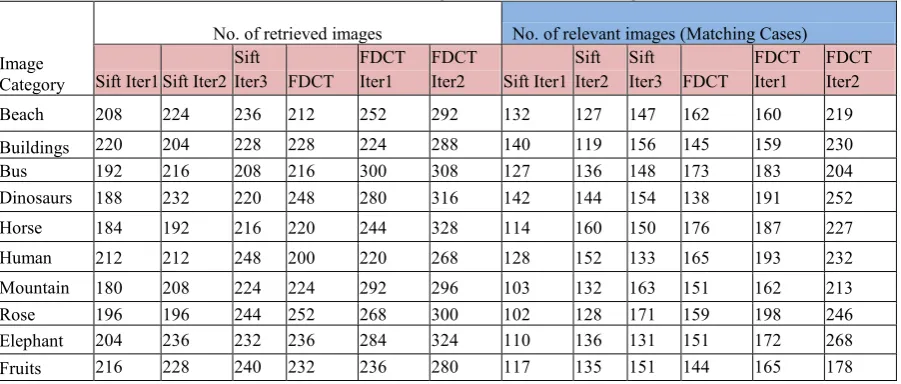
Retrieval of images has done for the most part based on ten picture categories and the picture dataset is 4000images. FDCT with iteration stage 2 is getting higher retrieval percentage than sift. And the five strategies consequences have been tabulated in Table3as the no of retrieved snap shots and No. of applicable pictures for a given check case.
Table 3: No .of images retrieved from ten categories
Image Category
No. of retrieved images No. of relevant images (Matching Cases)
Sift Iter1 Sift Iter2 Sift
Iter3 FDCT
FDCT Iter1
FDCT
Iter2 Sift Iter1 Sift Iter2
Sift
Iter3 FDCT
FDCT Iter1
FDCT Iter2
Beach 208 224 236 212 252 292 132 127 147 162 160 219
Buildings 220 204 228 228 224 288 140 119 156 145 159 230
Bus 192 216 208 216 300 308 127 136 148 173 183 204
Dinosaurs 188 232 220 248 280 316 142 144 154 138 191 252
Horse 184 192 216 220 244 328 114 160 150 176 187 227
Human 212 212 248 200 220 268 128 152 133 165 193 232
Mountain 180 208 224 224 292 296 103 132 163 151 162 213
Rose 196 196 244 252 268 300 102 128 171 159 198 246
Elephant 204 236 232 236 284 324 110 136 131 151 172 268
[image:4.595.74.525.520.712.2]International Journal of Innovative Technology and Exploring Engineering (IJITEE) ISSN: 2278-3075, Volume-8 Issue-11, September 2019
Table 4: Precision and Recall percentages for 4000 images
Image Category
Precision % Recall %
Sift Iter1 Sift
Iter2 Sift Iter3 FDCT
FDCT Iter1
FDCT
Iter2 Sift Iter1 Sift Iter2 Sift
Iter3 FDCT
FDCT Iter1
FDCT Iter2
Beach 63.46 56.7 62.29 76.42 63.49 75 33 31.75 36.75 40.5 40 54.75
Buildings 63.64 58.33 68.42 63.6 70.98 79.86 35 29.75 39 36.25 39.75 57.5
Bus 66.15 62.96 71.15 80.09 61 66.23 31.75 34 37 43.25 45.75 51
Dinosaurs 75.53 62.07 70 55.65 68.21 79.75 35.5 36 38.5 34.5 47.75 63
Horse 61.96 83.33 69.44 80 76.64 69.21 28.5 40 37.5 44 46.75 56.75
Human 60.38 71.7 53.63 82.5 87.73 86.57 32 38 33.25 41.25 48.25 58
Mountain 57.22 63.46 72.77 67.41 55.48 71.96 25.75 33 40.75 37.75 40.5 53.25
Rose 52.04 65.31 70.08 63.1 73.88 82 25.5 32 42.75 39.75 49.5 61.5
Elephant 53.92 57.63 56.47 63.98 60.56 82.72 27.5 34 32.75 37.75 43 67
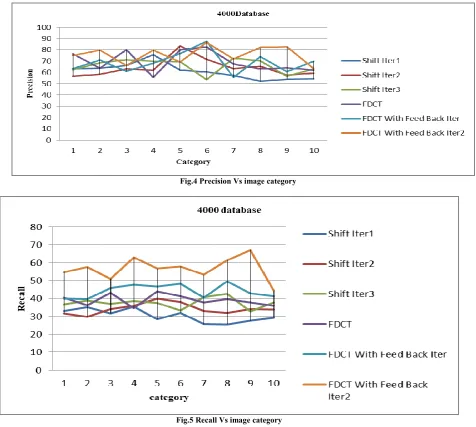
Fruits 54.17 59.21 62.92 62.07 69.92 63.57 29.25 33.75 37.75 36 41.25 44.5 Average 60.847 64.07 65.717 69.482 68.789 75.687 30.375 34.225 37.6 39.1 44.25 56.725 Range of retrieved photos based on scale invariant characteristic rework with relevance remarks And FDCT with iteration stage 2 is getting higher retrieval percentage than SIFT with relevance degree three. And the five strategies consequences have been tabulated as the no of retrieved snap shots and No. of applicable pictures for a given check case.
[image:5.595.68.545.313.740.2]Fig.4 Precision Vs image category
VI. CONCLUSIONSANDFUTURESCOPE Fast discrete curvelet remodel is used to extract texture and facet functions of the input picture to retrieve the relevant images from the database. The FDCT makes the feature extraction smooth and decreases computation complexity. However it is able to be made even higher by way of the usage of the relevance comments. In this work, a feedback based user interface would allow the user to mark the relevant output images and consequently evaluate the precision and recall rates. Image retrieval is still profusely under research and has a huge scope of improvement. In addition it is able to be proved to use to any sort of datasets and to see the progressed retrieval performance. It can be trained with a suitable Deep Neural Network, it can endeavor to achieve higher values of precision and recall rates, thereby potentially improved efficiency and better results.
REFERENCES
1. A. W. M. Smeulders, M. Worring, S. Santini, A. Gupta, and R. Jain,“Content-based image retrieval at the end of the early years,” IEEE Trans. Pattern Analysis and Machine Intelligence, vol. 22, no. 12, pp.1349–1380, 2000.
2. R. Datta, D. Joshi, J. Li, and J. Z. Wang “Image retrieval: Ideas, influences, and trends of the new age,” ACM Comput. Surv., vol. 40, no. 2, pp. 1–60, 2008.
3. Kazuhiro KobayashI,Qiu Chen,“Image Retrieval Using Features in Spatial and Frequency Domains Based on Block-Division” 978-1-4673-9795-7/15 $31.00 © 2015 IEEE DOI 10.1109/CSCI.2015.148.
4. Dr. Fuhui Long, Dr. Hongjiang Zhang and Prof. David Dagan Feng, “FUNDAMENTALS OF CONTENTBASED MAGE RETRIEVAL”. 5. Emmanuel Cand`es†, Laurent Demanet†, David Donoho and
LexingYing†, “Fast Discrete Curvelet Transforms Applied and Computational Mathematics”, Caltech, Pasadena, CA 91125 Department of Statistics, Stanford University, Stanford, CA 94305 July 2005.
6. shengjiu wang “a sturdy cbir technique the usage of local color histograms” Technical Report TR 01-13,department of computing science ,University of Alberta,Edmonton, Alberta, Canada 2001. 7. j. zhang, g. li, s. he, “texture-primarily based photograph retrieval via
facet detection” in sensors, 2017 Apr; 17(4): 911.
8. Khadidja BelattaR,Sihem Mostefai, “CBIR with RF: which Technique for which Image”, 978-1-4799-3392-1/13/$31.00 ©2013 IEEE.
AUTHORSPROFILE
Ms.K Sugamya, B.Tech (ECE), M.Tech (C.S.E) Research Scholar in Computer Science at JNTU, Hyderabad. She has total 18 years of teaching experience. She has published research papers in Scopus indexed journals, International journals and International Conferences. She also published papers along with students in Hand Digit Recognition in the areas of Deep learning and Neural Networks. She coordinated to develop Embedded Systems and Internet of Things lab. Her research interests are Image Processing, Internet of Things, Embedded Systems, VLSI Design and CNN. She is the Member, BoS, of I.T. department. She has proposed syllabus for DELD, VLSI Design and Embedded Systems for UG, Data Hiding for PG of Autonomous, CBCS and AICTE model based curriculum. She guided both M.Tech (CNIS) and B.E. main Projects in emerging areas. She has organized ROBOTICS WORKSHOP as a part of TECSTASY. She is Life Member of IETE.Her research area is Image Processing, Embedded Systems and Internet of Things.
Dr. Suresh Pabboju, born on August 15, 1965, graduated from CBIT, Osmania University and Post Graduated from JNT
Chaitanya Bharathi Institute of Technology, Hyderabad, in various capacities, since 1986. Presently, he is the Professor & Head of Information Technology the Department. He has played a key role in establishment and development of IT department in CBIT, Hyderabad since its inception. Under his dynamic and charismatic leadership, the department has been accredited twice by NBA-AICTE. His research interests include Image Processing & Computer Vision, Patter Recognition, Data Mining, Steganography and Digital Watermarking, Bid Data Analytics, etc. He has guided more than fifty ME/MTech Projects. Several scholars from JNTUH and Osmania University have been working under him for PhD degree. He has published more than 70 research publications in various national and international conferences and journals. He is a member of various Professional societies like ISTE, ISME, IEEE
,
IEEE CIS, CSI, etc. He was honored with Best Teacher Award for his extraordinary contribution in teaching field during the year 2017-18 by Bharath Talents Association.Dr. A.Vinaya Babu is a man of Dual fields ECE and CSE. He has done B.E (ECE) and ME (ECE) from University college of Engineering, Osmania University and M.Tech(CS) and Ph.D ( CS ) from JNT University. He has Put up 30 years of Academic experience coupled with 17 years of Administrative experience. After becoming professor of CSE in 2001 he also started Guiding the Scholars for their doctorial work and become recognized guide in different universities like JNTU H , JNTU K, JNTU A, O U, K U, Acharya Nagarjuna, Gitam etc.