International Journal of Innovative Technology and Exploring Engineering (IJITEE) ISSN: 2278-3075, Volume-8 Issue-9S3, July 2019
Abstract: This study, explores the intentions of institutions of Indian B-Schools academicians towards knowledge management and knowledge management processes. The use of knowledge management is recognized as an institutional capacity and tends towards growth. A review is conducted based on knowledge management treated as strategic and tactical plan. A pilot study is carried out and the findings are presented in the paper. The pilot study is based on the responses to the questionnaire prepared on the basis of literature. A closer link has to be brought in between the knowledge management and knowledge management processes as it helps our future managers and also provide them the skills they require throughout their life. It is felt that there should be a stronger requirement for change and responses from universities to address them and close the gap. There could be the knowledge management and its practices contributing to the performance of B-Schools and overall development of the institution.
Keywords : Knowledge, Knowledge Management, Knowledge Management processes and B-Schools.
I. INTRODUCTION
A vast literature has identified the gap between knowledge management and its processes in higher education and also brings about the awareness and its importance. Attempts have been made continuously to bridge this gap. The size and causes of the gap between knowledge management and its processes are based on emphasis amongst B-Schools. The gap is more prominent in B-Schools, there is a link between knowledge management and knowledge management processes. For knowledge management and knowledge management processes there is a wider agenda. The focus is on bridging the gap between knowledge management and knowledge management processes. It is confirmed that strengthening of knowledge management and knowledge management processes has lot of potential in delivering the skills required by the upcoming generation of administrators. Several questions require responses one is interested to know the factors raised by faculty that has impact on knowledge management. The cause for the gap along with remedies must be addressed by the universities. The intention of the academicians is for knowledge management or knowledge management processes to be explored which could trigger their preferences. [6]
Revised Manuscript Received on July 25, 2019.
Anil K S, Shubha Muralidhar, Research Scholar, BMSCE, Dept of MBA, Bangalore, Assistant Professor, BMS College of Engineering, Dept. Of MBA, Bangalore
II. LITERATUREREVIEW WHAT IS KNOWLEDGE?
Basically the meaning of knowledge and the most accepted one is it is true, justified and a belief [2]. It can be said to be a clear perception of the action and a factual knowledge. The knowledge interpretations derived through the researchers are illustrated with examples in the Table 1
Source: Reference [2]
The overview of the definitions of knowledge can be categorized and figured out as
1. There is clear distinction between data and information. 2. It could be in the minds or expressive.
3. It can be organizational as well as personal
Knowledge can be said on the basis of a function as a process to get the information, share it, interpret and share into facts that are intellectual and can be used by single or in groups. Based on the classifications, the knowledge can be classified into innovation, core and advanced. Core knowledge is the minimum time and knowledge level required for the game to be played. Knowledge level doesn’t give and ensure a viable term which is long. The knowledge is held by members of the industry and which in turn provides a little advantage over the non-members, the advanced knowledge is completely viable. The knowledge is of same level and quality though the knowledge content may vary from the competitors. Thus the organizations prefer to get head on with people in same positions hoping to know more than the competitor. Innovative knowledge allows the organization to take the lead of the industry and the competitors by showing that they significantly differentiate it from the competitors. This infers to say that the organization familiarity and an orientation link between the knowledge and strategy seem to be unique and different and may reflect advantage. The relation between knowledge and strategy is distinct and could show advantage. Thus the strategic knowledge which comprises of these three knowledge forms the construct origin of organisational advantage.
WHAT IS KNOWLEDGE MANAGEMENT?
This is defined from several aspects by the researchers and scholars where knowledge is managed systematically to search, create, share, organize, facilitate and evaluate the various aspects in using the technology and making decisions. Knowledge management can be considered as a process to evaluate, capture,
discover, apply, create, store and filter from the individuals to accomplish
Knowledge Management Processes for
B-Schools
the organization goals and objectives as told by Karadsheh et. al (2009). Drucker feels as long as there are persons working in an organization with knowledge will constitute knowledge
[image:2.595.65.542.112.695.2]management. The various definitions of Knowledge Management with typical examples are listed in Table 2.
International Journal of Innovative Technology and Exploring Engineering (IJITEE) ISSN: 2278-3075, Volume-8 Issue-9S3, July 2019
Source: Reference [2]
Life cycle activities grow and declines depending based on competence available in the organization. The various areas of knowledge could be classified as:
1. The components of knowledge in infancy stage which shows that there is capacity to alter execution of many tasks in the institution.
2. The important areas of knowledge classify the institution from other units and have maximum effect on the distinct position in the institution
3. The fundamental areas of knowledge carry out the activities of the organization and in every institution it is almost identical in nature
4. Areas not used in practice are rarely being used for business. Knowledge management is implemented in various stages until it matures.
[image:4.595.51.288.459.566.2]With the knowledge available in the institution one can obtain the promising knowledge. In stimulation of core knowledge, knowledge management can realize and identify the knowledge required during business operations. To distribute the basic knowledge and refresh the outdated knowledge, Knowledge Management can provide the easy access required and update the knowledge to be stored to maintain the Knowledge Management. The Knowledge life cycle is shown in Figure 1.
Figure 1: The Knowledge life cycle Source: Reference [2] [2]
Anil and Shubha Muralidhar [10] illustrates the need and benefits of knowledge management in B-Schools. Anil and Shubha Muralidhar [11] have also touched on
Entrepreneurship education in B-schools.
NATURE OF KNOWLEDGE MANAGEMENT AND ITS PROCESSES
As per resource-based view, the resources are personnel based; tangible and intangible happen to be the fundamental units of analyses that create the capabilities of the organizations by working together. Capabilities here refer to be able to integrate use and apply valuable inputs which add on to the knowledge management. The capability of knowledge management can be categorized along three dimensions, namely knowledge processes, knowledge skills and knowledge infrastructures. The knowledge generation processes include works where new knowledge is evolved.
The consolidation of knowledge is gained by transfer of knowledge. Improving the knowledge is done through the available knowledge. In addition to application the measurement of the process takes place that justify and measure the value of business knowledge.
Change in the institutional knowledge is the first sign of knowledge management. They are said to be dual in nature as one side there is the knowledge manipulation process which involves the acquiring of knowledge, convert into useful form, apply the knowledge and protect the knowledge. On the other side, it identifies that both culture and issues of organization play an important role in the deployment of knowledge management systems. The second dimension is knowledge skills, the knowledge management by nature are multi-faceted which involve dimensions human, organizational and technical. Chief Knowledge Officer should be a planner, evaluator and a human resource person. The person is able to facilitate the process of sharing the knowledge and the renewal of knowledge which facilitates the sharing of the information and is able to utilize the technologies available. With the ability to serve the creation of knowledge, sharing and document the knowledge are some of the required skills. The last being the infrastructure which has its technical side having more of information technology related activities like collaboration, discovering knowledge, mapping of knowledge and distributed learning. The structural side refers to the structure of the organization, its system of rewards and incentives. The cultural side has the vision and the organizations system values. [1]
OBJECTIVES
The primary objective of the study is to explore the intentions of academicians of Indian B-Schools. The next one being is to conduct a qualitative study on Indian B-Schools academicians, processes the data collected and draw conclusion from the study.
III. METHODOLOGY
This study is an exploratory one where questionnaire is framed based on various studies from the literature survey. The questions are designed by dividing into three parts as A, B and C where part A is the demographic information, part B is based on the Knowledge Management practices which are the independent variables and the competitive advantage which is the dependent variable. The practices considered here are five of them with questions framed under each practice and also under competitive advantage. Part C had questions which involved in listing or ticking more than one option. All the questions in
International Journal of Innovative Technology and Exploring Engineering (IJITEE) ISSN: 2278-3075, Volume-8 Issue-9S3, July 2019
value for each of them like 5 means strongly agree to 1 means strongly disagree. The questions are presented in a printed form as a hard copy so that they can fill and give back the same. The responses were collected from 42 respondents while the distribution was done to around 60 respondents. The questions were distributed to 5 colleges in South Bengaluru responses are collected in person from the respondents.
The dimensions of the quantitatively collected responses are reduced using Exploratory Factor Analysis (EFA). Promax oblique rotation was used to clearly classify a total of 42 variables into factors with least cross-loading variables among them.
IV. RESULTSANDINFERENCES
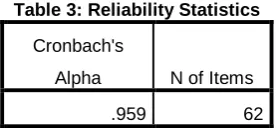
[image:5.595.304.553.168.241.2]The methodology is described in detail considering the reliability and validity parameters which is used for the full data. Reliability is determined using SPSS (25.0) using Cronbach’s alpha values. It was found to be greater than 0.9 meaning the scales are highly reliable. The results have been shown in Table 3. The closer the Cronbach’s value to 1.00, the more reliable the instrument is. Since the measured value is greater than 0.75, the items in the questionnaire are acceptable (Mertens, 2014). [27]
Table 3: Reliability Statistics
Cronbach's
Alpha N of Items
.959 62
[image:5.595.100.240.357.421.2]As a general purpose, the mean, standard deviation and variance of every item is determined and shown in Table 4
Table 4: Descriptive Statistics
N Mini
mum Maxi
mum Mean
Std.
Deviati
on Variance
Knowledge
Acquisition 43 2.82 5.00 3.8689 .55166 .304
Knowledge
Documentati
on
43 1.43 5.00 3.5150 .78565 .617
KS 43 1.89 4.00 3.0388 .53004 .281
KC 43 1.71 5.00 3.5581 .69415 .482
KAP 43 1.67 5.00 3.5465 .80944 .655
Valid N
(listwise) 43
The Kaiser-Meyer-Olkin (KMO) test was performed under exploratory factor analysis and the values so determined reflected the variance proportion because of the underlying factors. The KMO value having a number near to 1 show that factor analysis is useful. The number has to be at least 0.50 for the factor analysis usefulness, as a rule of thumb. Even though the sample size is 42 the KMO value,
0.519 is more than the expected cut-off value of 0.50 which means to say that factor analysis proves to be of use with value being thrice the number of variables i.e., 3 x 42 = 126. In performing the Bartlett’s test the p-value obtained is less than the minimum threshold significance of 0.05 thus we reject the null hypothesis as the correlation matrix being an identity matrix and the factor analysis is useful data as shown in Table 5.
Table 5: KMO and Bartlett's Test
Kaiser-Meyer-Olkin Measure of Sampling Adequacy. .519
Bartlett's Test of Sphericity Approx. Chi-Square 1455.725
df 741
Sig. .000
As per our study, the significance value i.e., 0.000 happens to be far less than required value. Thus the factor analysis is useful in the study.
As per the null hypothesis, assuming there is no difference seen among the items because of which the initial communalities as shown in Table 6 are all equal, i.e., 1.000. under principal component analysis after running exploratory factor analysis the values are not found to be the same. Thus the null hypothesis is rejected and inferred that proportion of variance and the other variables are not equal. The extraction communalities contribute to the estimates of variance of each variable that are accounted by the factors which also support our decision to reject null hypothesis. The values are large enough to be accounted for in our case.
Table 6: Communalities
Initial Extraction
Faculty active in associations and
external professional networks
1.000 .859
Information about requirements and
necessities of stakeholders 1.000 .613
Institution buys journals and reports 1.000 .742
New staff members hired 1.000 .808
Research done to explore new
knowledge and future possibilities 1.000 .774
Faculty attend seminars, courses and
training programs
1.000 .769
Institution have specific approach in
delivering and training 1.000 .781
Institution provide finanacial
assistance for higher education of
faculty
1.000 .814
Institution has an adequate
[image:5.595.306.544.451.833.2]Digital library is maintained in
institution 1.000 .850
Faculty are mandated to take up
online courses (MOOCs)
1.000 .718
Brainstorming sessions used for
problem solving 1.000 .826
Lessons learnt are taken by collecting
feedback 1.000 .798
Work guidelines and handbooks are
up-to-date 1.000 .859
Changes in handbooks and
procedures are informed
systematically
1.000 .881
Individual skills and specific
knowledge are documented in
knowledge repository
1.000 .761
Experts are urged to make explicit
methods in step-by-step description 1.000 .798
Skills acquired by faculty are
regularly updated in website
1.000 .789
Mentors help new members to fit into
organization culture 1.000 .709
In corridors and during lunch sharing
of knowledge happens in informal
ways
1.000 .725
Discussion of professional matters
happens during regular meetings 1.000 .828
Regular discussions about projects
undertaken and positive experiences
are documented
1.000 .795
Work methodologies discussed with
existing peer review create
opportunities for knowledge sharing
1.000 .832
Knowledge sharing culture evolved
over a period of time 1.000 .825
Faculty members share the new
knowledge with colleagues
1.000 .740
Knowledge sharing happens through
various events organized in
organizations
1.000 .713
Value addition of faculty and
organization by attending conferences
and seminars are assessed
1.000 .745
Doubts, failures and problems are
discussed openly
1.000 .860
Documented knowledge shared on
website viz. minutes of meeting 1.000 .804
Assigning new projects done based on
availability 1.000 .808
For testing new ideas and developing
new knowledge members are
rewarded
1.000 .795
Discussion of strategies and work
experiences through
research/innovation cell are
discussed
1.000 .763
Involvement of alumini with
organization brings culture of
creating new knowledge
1.000 .831
Through consultancies selling of
knowledge attracts explicit attention
1.000 .774
Improvisation of courses and
programs are done utilizing
experiences of students and
stakeholders
1.000 .609
In institution one makes use of of
existing faculty and alumni
knowledge in a creative manner
1.000 .829
Knowledge in repository is promoted
internally by faculty in institution 1.000 .885
Multi-disciplinary projects carried
out in th institution 1.000 .807
Stakeholders are approached before
developing new course or program 1.000 .791
International Journal of Innovative Technology and Exploring Engineering (IJITEE) ISSN: 2278-3075, Volume-8 Issue-9S3, July 2019
Table 7: Total Variance Explained
SI No
Initial Eigenvalues
Extraction Sums of Squared
Loadings Rotation Sums of Squared Loadings
Total
% of Variance
Cumulativ
e % Total
% of Variance
Cumulativ
e % Total
% of Variance
Cumulativ e %
1 13.832 35.467 35.467 13.832 35.467 35.467 7.811 20.028 20.028
2 3.419 8.766 44.234 3.419 8.766 44.234 5.68 14.565 34.593
3 2.366 6.067 50.301 2.366 6.067 50.301 4.489 11.509 46.102
4 2.149 5.511 55.812 2.149 5.511 55.812 3.368 8.636 54.738
5 1.749 4.484 60.296 1.749 4.484 60.296 2.168 5.558 60.296
6 1.684 4.317 64.613
7 1.528 3.918 68.53
8 1.371 3.515 72.046
9 1.144 2.933 74.978
10 1.089 2.791 77.769
11 0.947 2.427 80.197
12 0.9 2.309 82.506
13 0.83 2.128 84.634
14 0.77 1.975 86.609
15 0.615 1.576 88.185
16 0.572 1.467 89.653
17 0.538 1.379 91.031
18 0.519 1.332 92.363
19 0.478 1.226 93.589
20 0.386 0.991 94.58
21 0.377 0.966 95.546
22 0.291 0.745 96.291
23 0.243 0.623 96.914
24 0.226 0.579 97.493
25 0.192 0.491 97.984
26 0.155 0.397 98.381
27 0.132 0.337 98.718
28 0.118 0.302 99.02
29 0.091 0.232 99.253
30 0.078 0.2 99.453
31 0.053 0.135 99.588
32 0.045 0.116 99.704
33 0.039 0.099 99.803
34 0.029 0.075 99.878
35 0.018 0.046 99.923
36 0.011 0.028 99.951
37 0.01 0.025 99.977
38 0.006 0.014 99.991
39
0.003 0.009 100
Extraction Method: Principal Component Analysis.
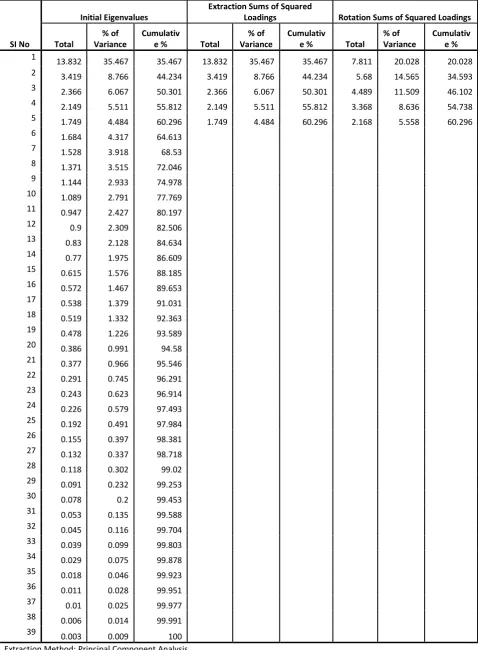
In concern with the number of factors turned out to be six after rotation as shown in Table 5. The value accounts for little more than 65% (cut off for acceptance) of the variability in the original values. This means to say that six latent
influences are connected with knowledge management and
knowledge management
explained i.e. 64.613 – 55.812 = 9 (approx.).
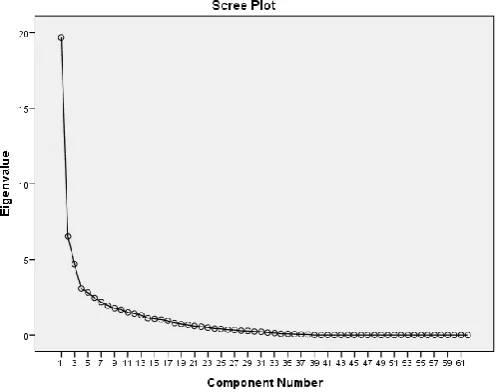
[image:8.595.42.291.108.304.2]The scree plot shown in Figure 2 confirms the factors selected. Thus there is a need for rotation being felt and was attained through promax rotation technique.
Figure 2: Scree Plot
V. CONCLUSION
Integration of knowledge management and its processes can build the student findings by also providing the tools required in understanding both. In doing so a stage is set for students so as to incorporate the management principles that are based on evidence into ones who are the decision making professionals. A closer link has to be brought in between the two as it helps our future managers and also provide them the skills they require throughout their life.
In the present scenario and the previous experiences put together the integration of knowledge management and its processes do not take place naturally. There are found to be several elements like work force, characteristics at individual and institutional level, cultures of profession and society which all act as barriers to have an easy exchange of knowledge management and its processes. It is felt that there should be a stronger requirement for change and responses from universities to address them and close the gap. To overcome or reduce the gap it is essential that one understands the factors to close the gap. To attain balance
between knowledge management and knowledge
management processes the concepts has to be seen individually.
Both complement each other is what the faculty also should know. Institutions can always take feedback and try to revise and implement in the policy which brings in a conducive atmosphere. It might be happening in some and may not in some other but measures have to be taken to reduce or close the gap. For this the faculty has to identify those factors that are affecting the choice of faculty. In doing so the institutions can build the policies, give the required support which brings in a harmony between knowledge management and its processes. It is essential that these two are given equal weightage amongst B-Schools. This is all possible if the future managers understand its value and act
in accordance realizing its need.
The contribution to the prevailing study is about applying knowledge management and its practices by academicians of Indian B-Schools. A good ground work can be taken up so as to continue on the quantitative studies and further study their relationships. A model can be proposed based on the determinants that are obtained based on the performance of the individuals and their contributions to the institutions as a whole. If a micro level study on these determinants are continued then the top management may focus on these areas. Thus there could be the knowledge management and its practices contributing to the performance of B-School and overall development of the institution.
Further findings from the study help the university in designing new interventions to enhance knowledge management and its practices. The model proposed which connects the determinants and the performance of B-School can be tested empirically. In doing so it gives clarity about the academician’s role which extensively contributes to the performance of the institution. Once this is realized, B-schools can come out with new strategies to promote knowledge management and its practices accordingly.
REFERENCES
[1] Zeid and Ekionea (2005), “Knowledge Management and Sustained Competitive Advantage: A Resource-Based Analysis”, Idea Group Publishing, pp. 622-625, Managing Modern Organizations With Information Technology, 2005, URL-http://www.idea-group.com [2] Mahdi et al. (2011),“The role of knowledge and knowledge management
in sustaining competitive advantage within organizations: A review”, African Journal of Business Management ,Vol. 5(23), pp. 9912-9931, http://www.academicjournals.org/AJBM DOI: 10.5897/AJBM11.1118 ISSN 1993-8233 ©2011 Academic Journals.
[3] Albert S (1998). Knowledge Management: Living Up To The Hype?. Midrange Syst., 11(13): 52.
[4] Singh SK (2008). Role of leadership in knowledge management: a study. J. Knowl. Manage. 12(4): 3-15.
[5] Alryalat H, AL-Hawari S (2008). A review of Theoretical Framework: How to Make Process about, for, from Knowledge work. 9th International Business Information Management Association Conference, pp. 37-50.
[6] Liu PL, Chen WC, Tsai CH (2005). An Empirical Study on Correlation between the Knowledge Management Method and New Product Development Strategy on Product Performance in Taiwan’s Industries. Technovation, 25: 637-644.
[7] Kim SK, Lim S, Mitchell RB (2008). A Method for Knowledge Modeling with unified modeling Language (UML): Building a Blueprint for Knowledge Management. In M. E. Jennex (Eds.) Current Issues in Knowledge Management. New York.
[8] Zuckerman A, Buell H (1998). Is the world ready for knowledge management?. Qual. Progr., 31(6): 81-84.
[9] Walczak S (2005). Organizational knowledge management structure. Learn. Organ. 12(4): 330-339.
[10] Alavi M, Leidner D (2001). Knowledge management and knowledge management systems: Conceptual foundations and research issues. Manage. Inform. Syst. Q., 25(1): 107-136.
[11] Kibet KS, Samuel CK, Magutu PO, Richard NB (2010). Knowledge Management as Source Of Sustainable Competitive Advantage Comparative Assessment of Egerton University Farms and Private Commercial Farms. Afr. J. Bus. Manage. (AJBUMA), 1: 70-83. [12] Grant RM (1996). Toward a knowledge-based view of the firm. Strateg.
Manage. J. 17: 109-122.
[13] Holsapple CW, Joshi KD (2004). A Formal Knowledge Management Ontology: Conduct,
International Journal of Innovative Technology and Exploring Engineering (IJITEE) ISSN: 2278-3075, Volume-8 Issue-9S3, July 2019
[14] Seeman P, DeLong D, Stucky S, Guthrie E (1999). Building Intangible Assets: A Strategic Framework for Investing in Intellectual Capital. Second International Conference on the Practical Applications Knowledge Manage. (PAKeM99).
[15] Yeh YMC (2005). The Implementation of Knowledge Management System in Taiwan’s Higher Education. J. Coll. Teach. Learn., 2(9): 35-42.
[16] Parikh M (2001). Knowledge Management Framework for High tech Research and Development. Engineering Manage. J. 13(3): 27-34. [17] Miltiadis L, Pouloudi A, Poulymenakou A (2002). Knowledge
management convergence expanding learning frontiers. J. Knowl. Manage. 6(1): 40-51.
[18] Albers JA, Brewer S (2003). Knowledge Management and the Innovation Process: The Eco Innovation Model. J. Knowl. Manage. Pract., 4: 1-10.
[19] Kim K, Lim S, Mitchell B (2004). Building A Knowledge Model: A Decision-Making Approach. J. Knowl. Manage. Pract., 5(4): 300-310. [20] Goh ALS (2005). Adoption of Customer Relationship Management
(CRM) Solutions as an Effective Knowledge Management (KM) Tool: A Systems Value Diagnostic. J. Knowl. Manage. Pract., 4(2): 153-158. [21] Chikati and Mpofu (2013), “Developing Sustainable Competitive Advantage Through Knowledge Management”, International Journal Of Scientific & Technology Research Volume 2, Issue 10, OCTOBER 2013 ISSN 2277-8616 pp. 77-81, IJSTR©2013 www.ijstr.org . [22] Halawi L, Aronson J and McCarthy R (2005) “Resource-Based View of
Knowledge Management for Competitive Advantage” The Electronic Journal of Knowledge Management Volume 3 Issue 2, pp 75-86, available online at www.ejkm.com, ISSN 1479-4411.
[23] Sharafuddin (2017), “The Role Of Knowledge Management In Achieving Sustainable Competitive Advantage In Business” , pp. 137-142, Journal of Education and Social Sciences, Vol. 6, Issue 2, (February) ISSN 2289-1552.
[24] Shaheen et al. (2013), “Behavioral Intentions of Academicians Towards Teaching and Research: A Study in the Indian B-School Context”, The IUP Journal of Soft Skills, Vol. VIII, No. 3, 2014, pp. 8-31.
[25] Anil and Shubha Muralidhar (2018), “Need and Benefits of Knowledge Management in B-Schools”, Shanlax International Journal of Management, pp.85-89, Vol.5, Special Issue 4 April 2018, ISSN 2321 – 4643.
[26] Anil and Shubha Muralidhar (2018), “Entrepreneurship Education in Business Schools”, International Journal of Exclusive Management Research, pp.1-6, Special Issue April 2018, IJEMR, www.ijemr.in , ISSN 2249 -2585.
[27] Mertens, D. M. (2014). Research and Evaluation in Education and Psychology: Integrating Diversity With Quantitative, Qualitative, and Mixed Methods: Integrating Diversity With Quantitative, Qualitative, and Mixed Methods. UK: Sage Publications.
[28] Anil and Shubha Muralidhar (2018a), “Need and Benefits of Knowledge Management in B-Schools”, Shanlax International Journal of Management, pp.85-89, Vol.5, Special Issue 4 April 2018, ISSN 2321 – 4643.
![Table 1: Various concepts of knowledge [2]](https://thumb-us.123doks.com/thumbv2/123dok_us/8189159.257289/2.595.65.542.112.695/table-various-concepts-of-knowledge.webp)
![Figure 1: The Knowledge life cycle Source: Reference [2] [2] Anil and Shubha Muralidhar [10] illustrates the need and benefits of knowledge management in B-Schools](https://thumb-us.123doks.com/thumbv2/123dok_us/8189159.257289/4.595.51.288.459.566/knowledge-reference-muralidhar-illustrates-benefits-knowledge-management-schools.webp)