COMMISSION OF
THE
EUROPEAN
COMMUNITIES
cou(75) 35
rinar
Bnrssels,
I
March1!J)
INITI,{L PROPOSALS FOR PRTORITY PROJECTS
IN
DATA-PROCESSI}IG(Cornnunioation
fron the
Connissionto
the
Council)TASLE OF CONTEI{TS
Chapter
I.
General summaryof
the
proposalsl.
Foreword.Page
2.
Initial
pronosalsin
the
field
of
applicat ionsPreparation
of
subseguent proposalsFinancial
i.mplicationsReport on d.evelooments
in
the
data-processin.g
sector
in
the
ConmunityFinanci.n6l and.
administration
of
projee-bsBreakdown
of
e4pend.ituresComments on finaneinn
Project
management and organisationSummary
table
showingcontract
period.sChapter LL
L.
2.
5
7
8
3.
4.
5.
9
10
I1 3.
Annex
A
3Annex
B
: [image:3.579.102.489.41.614.2]_g
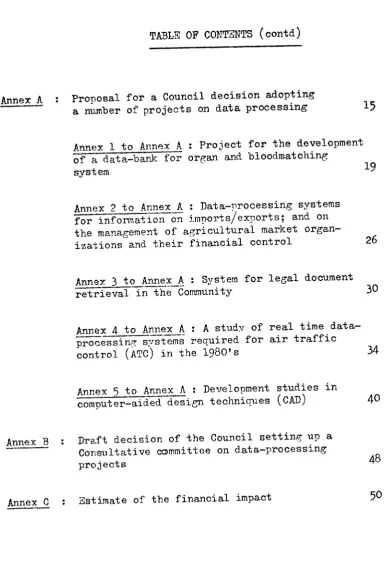
?TABLE OF COll'I-dNTS (contd')
Prop,osal
for
a
Councildecision
adoptinga
nu,mberof projects
on d'ata processingAnntlx
1
to
ArrnexA
:
Project
for
the
d"evelopment.f
E;.[#-bank
for
organ and blooclmatchingsysl;em
Annr;x
2
to
Annex A:
T)ata-nrocessing systemsffi:;1"*t;io"
on im-oorts/exportsl and onthe
managementof agricultural
marketorgan-iza'bions and
their iinancial control
25lnn,ex
3
to
44I9Tl!
:
S-vstemfor
lega1 document're#Gvat
irffie:dommunitY
3015
19
Annex
4
to
lmnex A:
A studvof real
time
data-air traffic
pil'cessit*.
si;istemsrequired
for
;;;i';i
(rtc')
in
the
rggo's
34Annex
5
to
ltnnex A:
Development stud'iesin
::-.;ffitGaEsign
technic;ries (cm)
Dra.ft decj.s:lon
of
the
Councilsetting
up
a Consrrltativ,e @mmittee on data-processingprc, j ect s
Est;imate
of
the
financial
imPact40
48
-l-CHAPITER
I :
GElrdRAt SUlitTARy olq TIilt pROposALsI.
ForewordThe
council
Resolutionof 1!
.Tury1!'f{
ona
communityporicy
for
data-processing has provid"ed.
the
groundworkfor
amindustrial
policy
in this vital
sector
of
the
ecohomlrrn that
Resolution,
the
councir
states
that it
intends
to
give
acommunit.y
orientation
to oolicies for
encoura4ing and promotingdata-processing, and welcomes
the
Commissionfsintention
to
submit,in I)l{, after
appropriate consurtations,
priority
proDosals concerning:a)
a
limited
nurnberof
projects
of
Europeaninterest in
the
field
of
d.ata-processins applications Ib)
collaboration
on stan<larcl^s andapplications
andin
public
procure-ment policSr;e)
the
promotionof
ind-ustrial
developmentprojects
in
areasof
common
interest
involving transnational
cooueration.In this
Comrmrnica,tion,the
Commissionoutlines
its
in
j.tial
frroposalr
eomorisrnr.'
five
oro.iects,
andindicates the co'rse
it
proposesto
l:ll:tt
in
drawinSup
further
proposals underthe three
heaaings mentionecj.aoove.
2. @-in
the_-l_iellof
aoptlcations2.1
field of
The Commission hasselected
asthe subject
of its first
orooosal the appl.icatiotts becausethere
appearsto
bea
uroa.d. r""g"-oi---conlmoninterests
at
Comnunit.rlevel.
The p:lomotionof
newapplications,
notabl;;
in
the public
serwices,
combinestire
two main aimsof
theResolution
: to satisfy
user
reguirementswhile
making economical useof
the
public-resources b;rjoint
ci.evelopment andto
create
a
strongE\rropean-based
industry.
2.2
rhe
criteria for
the
serection
of
the projects
were asfollows
:-
the.rr shouldsatisfy
aninternational
reqqirement commonto
usersin
several
l{ember States;t
2.3
Anotherfactor
that
influencerdthis
choice wasthe
need'for
the
userstobeorganized.atEuropean].evelandcapableofd.ovetailingtheir
respective
requirements'2.4
The comrnission has workedin
close
collaboration
with
an rrad hocrlworking
party
of
sen.ior d.ata-processingofficials in
ord'erto
ascertain
areasof oriority.
{he
proprcsals contained'in this
commrnication r'rere formulatedafter
setreral sta'gesof
workinvolving the
d'eterminationof
projects,consultationsandnegotiationsinthel'{emberStates.
2.5 rhe
commir;sionalso
consultedthe
committee onscientific
andTech-nological
Research (.cnnsr)to
obtain
its
opinion
onthe
technologicalresearchandclevelopmentaspectsoftheprojects.Itshould.benoted'
however,.bhattheclroiceofprojectsrrasmainlyguicledbyothercon.
sideratio:ns more
di:nectly
irr
keepingwith the
broad- guid'erinesof
policy
in this
sector
asset
d'or'tnin
the
Resolution'Phases
of
the
oroiects
2.6
Forthe
purposeof
defining
and. imprementinga
project,
four
d-istinct
phases have
to
be
comPleted' :l.theselectionphase,w)nichmaycallforarrexploratorystud.y'as
ment;ioned
in
srection
:5'1oi2.
abasic
stud.y(feasibility,
guantification
of
requirements, select:ionof
strategiest' specification
of
the systet
("));
3.development(:i'mplementationofallorsomepartsofthes;lstem);
4.utilisation(.btresystemisplaced.inactualservice).
project
no1
covers phase3r.
Projecte
\o
2-r3r 4
and")
comewithin
Phase
2
and, whenresults
errea'vailable'
shouldlead to
new proposalsforPhase',.ThereisnotrlrojectcoveringPha.se4ltheroleofa
Communitydata.processingpolicyistoactasacatalystand.notto
-3-2.J
Thefive
prooosedprojects
llhe
first
proiect
is
concerned.with the setting-up
of
a
data bankfor
the
matchingof
organs andblood.
llhe concept has been formulated. bya
gtoupof
communityhospitals,
whichare
already
engagedin
active
collaborationl
its
aimis to
use data-processing techniquesto
helpin
determiningthe compatibility
of
available
orsans (kid_neys, andsubsequently blood. erements,
skin,
cornea, bone mamow,etc.) for
patients
for
vrhoma
transprant
is wital.
Everyyear,
someloroco
or12rOOO persons
in
trfurope woulddie
fromimeversible
failure of
the kidneysr wereit
not
for
the
techniqueof
hemodialysis and./ortrans-plantation. 0f
these two techniques t::a-nsplarrtationis
the
one nherethere
is
abetter
chanceof
savinglife at
lor+ercost,
provi.dedthat
the
efforts to
securecornpatibility
between otisans and oatien-bs canbe made on
a
sufficiently
widesca1e.
The implementationof
the
orojeetwould. make
available
to
the
groupof
hospitals
concerned.the
d-ata-processinq
facilities
required.to
achievethis
aim.2.8
The seeon,lnroieet
is
a
study
onthe
automatic processingof
d.atarelating to
imports andexoorts, the
managernentof
the agricultural
market organisations andtheir financial control.
Alarge
voLumeof
information
whichis
need.edfor
the
administration
of
the
Customs Unionand
for
commonagricultural policy is
currentl;r
transmitted by post
ortelex.
Havingarrived
in
the
IrlemberStates,
these d.atafrequently
haveto
be
converted.to
the
required. forrnfor
input
to
the }ocal
computer.Moreover,
essential
information
onagricultural
imports
andexports
is
often not available
soon enough,or
not
in
the
proper forn, to
enablethe
Comnmnityto
take
promptdecisions
on i-mportantmatters
requiring
action.
Themajority
of
the
l/iemberStates are
graduatingto
automaticdata
processing,but the
rationalization of
systems and.a
cornmon-
4-2.!
llhetilird
project
concerns ,a need. which was underlined.by
the
CounciL(Minis-ters of Justice) in ihe
seseion
of
26th
November197+,
nanely
for
systemsfor retrierral of
legal
documents and accessto
Comrmrnity law. Orthat
occasion, l;he Council decid.edto
set
up
a workingparty
of
legal
erperts
to
outline a policy
which wouldbe
likely to
meetthe
needsof
the
Comnmnityinstjitutions
andthe
MemberStates.
Tiris
project is
intend.ed'to
provide
support andassist the
workof this
groupby a
systematicexamination
of
the
user
requirementsin
general,
the
problemsof
technical
compatibility
and :Lntercomrmrnication betweenthe
systems beingset
upor
under stud.y
in
the
lvlemberStates
and.the Institutions of the
Conmunity'2JO The
fourth project relates
to
a
highly technical
field
affecting
thesafety
of
passenge:cs andaeronautical
equipmentof
the
future, i.e. air
traffic control.
Data-proc,essing systensare
alread.yin
existencer
afidusers
in
several Mr:mberStates
andthird.
countries
are
associated'in
aninternational
bod-y, ETJROCONTROL. Evenat this
stage,
however, anangementsare
havingto
be mpd.efor
the
replacementof
these
systemsby
a real-time
processing system:in
the 1!B0ts;
furthermore,
this
problemis
aninter-national
one whichwill call for
substantial
investmentif
the
growingdemands
of the
nationa,lair traffic
control authorities
and- EIJR0CONTROLare
to
bemet.
Th,a proposed. stud.yis
aimed,at
detailed.
investigation of
the
solutions
that
are
possribleat
Comrmrni.tylevel
and howthelf cal
betranslated.
into
arllraneed da.ta-processing techniquesby
the
trhfopean computerind,ustry, thus
prouid.ingit with
a majorasset
as regards competitiveness which would ertendto
other
sectors
aswell.
211 r.ne
fifth ploject is of
a
d.ifferent
type:
computep-aid.ed. design techniques'if sufficiently
developed., mightwell
find. a
broad spectrrunof industrial
applications.
The:reare
twokey sectors
in particular -
the
d-esignof
electronic
logic circuits
andthe
managementof
integrated design
systemsin
the building sector
(cirril
engineering,
ship-build.ing,
etc.) -
wherethe
need.for
an assessmentof
the available
techniques andthe
ascertainmentof
worthwhile deve.l.opments is
felt
throuqhoutthe
communitv.
The tvtostudies
ar.e aimed a.t d.efinlng anri.evaluating
the
economic advantagesof
ad.evelopment progra.mme
in
these sectors.The
proposal
for
deeisio1 by
the
Council
relating to the
foregoing
3.r
Alongwith the
workthat
red
to its initiar
proposars (rrhich may befollowed by
further
proposarsfor
computerapplication
projects),
thecommission has been making 6ome
preliminar;r
investigations
in
the
areasind'icated
by
points
1) (t)
and(c) of
the
Resolutionwith a
view
to
d'rawing uofresh
proposarsin
the
first half of 1!lJ for
projects
to
start in
1976.3.2
As regarde normsar,{_:@g,
a
working partyby
the
Commissionwith the
taskapproach
to
the
problem.national
ex.oertsworki-ng
out
aof
of
has been
set
upgeneral
line
of
Another group
is
exarniningthe possibj-lities
of
collaboration
in
thearea
of
public
procurement poli.c.1,,3.3
In
regardto
,
the
Commission hasfound', as
a
result of
a series
of
d-iscussions an<iinvestiga.tions, that
there
is
a
vitally
important
areaof
commoninterest,
narnelythat
of
software
po{tabilit-y-" In
plain
terrns,
this is
the abilit.rr
to
rrrn
progranmes on
different
tynes
of
cornputersuithout
havingto
worr,v aboutthe
makeor
the
machine ranguagle used.within ilre
s-vstem.Tn
some cases,
the
softwareindustry
has alreariy madea
start
on thedevelopment
of
portability
whichalso affects
stand"ard.ization, butno
transnational action
has sofar
beentaken.
The Commission intends, d'uringthe
first
few monthsof r)lJ, to
draw up proposa,ls on theserines
'hich,
if
imr'lemented, might have an impor{ant impact on user cost s.-6-}.4Tfnoac.|ionofth:Lskind"isinitiatettatCommunitylevel,thecost
of
progrernme conve:csionin
the
Community d.uringthe
nert five
yearsattributable
to
in,:ompatibility
of
equipmentis
estimatedat
1'000 MUA-aheavrtrurdenwlnichwillhavetobebornebythellS€fsoActionon
the
scafe required vrould. b€r morethan
the
service
bureaux could' afford't and more thanthe
hardrlareindustry
intends
to
invest'
3'54|'softvlareportability''pro8:rajnmewouldhavetocoverthed.evelopment
of
rrportable
''
productsirrcluding
systemsoftware,
whichis
the
actua]'link
betneenthe application
prograrnmes(r"*itten for specific
user requirements) andthe
hardrvareitself'
3.6AnadequLaterangeofportableapplicationandsystemsoftwarewould
make i;he
users
lesrs depend,ent ontheir
hardrvare, anrlpermit
a moreactive
exchanqe of' prograrnrnes(resulting in
less duplication
of
norktvrhich 2i; present i-s
very
widesoread') anclgreater
freedomin
the
useof terminals.
Aproject
of this
kind- woul-dafford'
alropportunity
to
develop ad.d.itiona-l- no::ms ancl standard-s,thus providing
greater
markettransparencJl.
In this
way,the
progranme contemplated b;rthe
comrnissionwould acquire a w:icler
signi.ficance
than tha,r,of
the current
proposalsandmakeamored|rectimpactonthecomputerindustryandeconomic
activities
generailY'3.?
In
the
hard-vrare sectortto
be ProPosed LnL)lJ,
perioherals.*--the
Commi-ssionis
also
consideringprojects
-
t-3.8
rn
regardto
central
processors,the
two main E\ropean groups are each engaged.in
launchinga
newrine of products.
At the
moment,the
Commission d.oesnot
intend.to
put
forward. alry proposalsin this
fie1d. It
notes,
however,that
the evolution of
techni4res has made
effective
comrnercialcollaboration
morefeasible
than
in
the past; the
presentperiod,
when new productseries
are being launched(i.".,
before
the.r;take
finar
shapein
regard.to
softwarer
andbefore
new d.evelopmentsare
und.erw4v)r
is
a
time
whenthe
chancesof
cooperationare best.
3.9
Finallyr
the
Commissionis
now d.rawingup
a
proposal on 1easinqr which mightoffset
someof
the
handicaps frorn whichthe
smaller
comcanieszuffer,
and. whichare
mad.e more acuteby
inflation.
3J0
ro
back upthe
proposals whichit is
preparingto
put
fo::r,rard.in
theabove-mentioned.
sectors,
the
Commissionwill
haveto rely
onthe results
of
a
nunberof
exploratory
stud.ies whichare
to
be
carried. ou.tin l!lJ;
the
aimwill
beto
pinpoint, define
ancl evaluatefirrther
pro.jectsrelating to
applications
in
industrialdcvcloprnent
ofhardware andsoftware andto
the
establishrnentof
standard.s,leasing
forrnulas,
etc.,
whichwould.
be
:,:,
eoi_^ircn:"nterest
to
the
Conrnunit.r4.
Financial
implications
4.1
Thefinancing
of
+hefirrqprojects
wouLd.regtrire
anoverall
amountof
4.008 Mau( 1
)
spread. overthree
years.
Thecosts together
with
theannual breakd.own
are given
in
tabular
format
the
beginnirrgof
ChaoterII,
which Soes on
to
discussthe
method.sof
r.rork andthe
machinery whichwill
haveto
beset
up.(t)
The erpend-iture has been estimatecl onthe basis
of
price
-B-The amount
of
expenditurerequired
wlll
be
entered. eachyear
in
budget ofl
the
!,hropearr communities accord.ingto
estimates shown Annex C.4.2
The comrn:Lssionis
awarethat
projects
2, 3r 4,
and)
formonly
thefirst
nhaseof
possible
d.eveloomentprojects
in
respect
of
which thecouncil
ina.d reques'bed.forecasts
of their effect
onthe
bud'get overthe
nert five
yeags.(f)fut
the
verir purposeof
thesepreliminary
stud.ies whichare
er-oecte4to
eriend. overthree
lreaTstis to
deternrinein
d'etai1the
subsequent phases andtheir
budgetaryimplications.
Thereforet
whenthe results
of
the
stuCiesare avaiiable; the
Commissionwill
be
ableto
specify
theseirnplications
in
fresh
proposals'4.3
l.lith
regardto
the
erploratror;r stud-ies, whichare
needed'for
the
rea'sonsmentioned above,
they
woul-ittake
about oneyeal
to
complete and thearnount r"rhich nould have
to
be
appropriated"is
estimateclat 0i3
t"ta-u.(2)
4.4.A d-raft
supplementary bud-getvill-
be
subnnitted'in
due courseto
coverthe
ajrpropriati-onsfor
the
five
projects
andalso the exploratory
studiestfor
whlc:hthere
are neithe::
fundsnor
a bucgetentr;I.
J. Renort crn develonments
in
lL _Ltr_A.o'*un:i1rIn
accor.dance with,the
fin;el point in
the
Resolution,
the
Commissionwi1l,
during
1975,prelare a report
onthe
state of
data-nrocessinfr.In this report, it; will
rev-ievr developnentsin lP
and.the
trend-of
national
data-rrrocessin,gpolicies,
and.Sive
its
opi-nion on theadvisabiLlity
of
ernbodyingtite
communitypro;iects
in
a
multi-annualprogr€mrler as suggtested
in
the
Resolution'the
in
\r/
See Resolutionof llth
Jul-Y 1974, para.qraph 4ocosting oll
averaEe 2OTOOOu.a'.,
calcu)atednlus travel
ancl subsistenc€ €xD€rls€sr(Z)
ftrere are
lJ
studiest
,"""1.-9-CHAP]ER
II -
FINAIICING AND I,IAIIAGE.EITT OF PROJECTSI.
Sreal<down of expenditure (forecast)project
o"[i]1,"""t
1975
1976
19771. Data bank
for
matchingorgans and
blood
1.J60.500
9Z.5OO
1.237.500
3O.5CC
2. Data processing systems
in
import/export, agricultr:.raI
narket organizations
etc.
558.000
L63.OOO
423.jOO
B1.5CO3.
System5forretrieval
oflega1 inforrnation at
Cor:muni'by
l.er.ei
437.5OO
1I1.5OO
269.000
5?.OCO
.i.
Feguirenentsfor
dataproces-sing systems
in air traffic
control
923.000
t72.5oo
556.500
1B4.OOOJ.
Computer-aided desi.gni.
Electronicsstugr
313.000
llO.OOO
2O3.OOOii.
Design-orientedsystems
305.500
102.000
I9B.50O-10-2.
Comments on finaneing2.1.
Eachof
the projects
proposed.in
the
programme compriseseither
astu{y
p}raseor
a d.evelopne:rt phase. A11the projects
under consid'erati'onare
trensnational-in
operation
and.r/orrepresent
cases wherethe
users,on account
of
the
sirnilarity of their
requirements, have aninterest
in
joint
d.elveloprcent as a neansof
husbend.ingtheir
resources'
It is for
this
reasonthat j.t is
proposed.that
the
fund's bedrarn
from theCommwril;Y budget.
2.2,
Anil.lustraiion
mqyhelp
to clarify
the
role
which commr:nity andnatiorra.l
financing
coul-d.play.
fhe stu{y
onfutr:re
data-processingrequirements
for &ir traffic control is
aimed-at
investigating
theneeds aed.
the
feasibility of joint
future
developrnentprojects
throughou'"the
conununity. Asingle
tean mightbe
set
upto
study
a specific
problen undera single co:rtract, t,ut
would-also
meetthe
more general requirement t-o pronLote quali-f ied. teamsrat
the
Er:ropean i-nd.ustrylevel' If
thestudy resulted.
in
the
id.enLtification of
connon d'eveloprnentareas'
it
would. Likewise
be
approprj.atefor
thernto
be financed'jointly'
l'lhen thesejoint
d.evelopnentprojects
are
put into
operationby
usersin
the
l,lember Statesor
EUROCOIITROL,they
wi1l, of
course'
involvenationalorEUROCONTRoLe>lpend'itrrre,eswillalsobethecasewithany'
subseguent d.evelopraent work
to
a.d.aptthe
systemto
specific
national
requirerhents.
In
short,
connunity requirernents would' be covered byCommr::rity frrnd.s end
natiotral
requirementsby
national
funds.2.3.
Asa
generalru1e,
howeve:n,if
theto
industry
is
sttch asto
enableit
to
increaseits
efficienc;P,
it
hasproportion
of
the
financial risks'
d,e.relopment
activity
entrustedto
beco:::e morecompetitive
orll
-J.
Project
menagement and organization3.1.
Theusers,
the
Governments and.the
Commissionall
have apart
to
play
in
the
successful launchingof
the
applications progranme. The Corrunissionwill
be responsibl-efor
theexecution
of
the projects,
but,
since
the
pri-mary objectiveof
Cornmunity d.ata-processingpolicy is to
stimulate
Er:ropeanind.ustryrs
capability,
they
will in
the
norrnal cor:rse beactually
camied out
by
anindustrial
team.1.2.
For
the
me;na6ementof this
prograrnme,the
Commissionproposes
the setting-up
of
arrhorizontalrr
body, the 0onsultati-ve Committee on Data-ProcessingProjects,
vrith whichwill
be
associated.for
eachproject
a
project
leaderand
a
Technical Committeerepresenting
the
userseA
draft
Council Decisionsetting
up aConsultative
Committeeon Data-Processi-ng
Projects
will
be found.in
AnnexB
to
this
Communication.Consultative
Committee on Data-Processing Projects3.3'
This
Comnitteeis
composedof
onerepresentative
from eachof
the
l,{emberStates.
Eachrepresentative
may anangeto
beaccompanied
by specialists
in
the
fields
concerned. Arepresentative
of
the
Commissionwill
chair the
Committee.-12-3.4. In
respectto
th,:
role of'the
Committee,it will
assist
theCommission
in
th,e executionof
ections
in
data-processing adoptedby
the
Corrncil, :notablywith
regard.to orientation,
inplementation, d.evelopment antl:realisation
of
eachproject
against
objectives
set.
Technical Committee
3.5.
This
vrill
be
a
small worlr:ingparty
of
experts
seleeted.from
amongthe
users,
whichwill
meetregula.rly
and provid.ea
close liaison
with the project
leader
ontechnical
and. d.evelopment questions.Its
actual
fwrction
j.s
to
translate
user requirementsinto
technical
specif
ications,
and prov:Lde a cha.:nneIof
connr:nication betrteen theuser3 and.
the
project.
The worlcing method.sof
the
Technical Comrnitteewill
v'ary accordingto
tlr.eproject.
Pro.iect
ru.aur
(1)3,6.
Theproject
leadervi11
be
a person wi.thhigh-level
traini.ng
appropriate
to
the
nature
a:ld scopeof
the
project.
Theproject
leade3
will
be
assigned.'bothe
innplementationof
the
project
ona fuI1.-time basis.
(f)
Seetable
on page14:
Te:cnof project
learlerts
contract.
This
wi.l1be
longpr than 'bheduration
of
the actual
project
asthe project
leederswi.ll
haveto
preparethe
groundfor
the
wor'l<prior to
the
coruttencementof
the contrect(s)
ana tal<epart in
the
drafting of
the overall
find.ings
after
_13_
3.7. fn
the
main,the
project
leaderrs
d.uties naybe said
to
consist
in
:-
the
preparation
of
specifications
for
the
invitation
to
tend.erl-
the
day-to-d.ayeoordination,
supervision
andd.irection
of
work
in
close
collaboration
with
the contractor(s);
- liaison at
management 1eveIwith the
Commissi_on, theTechnical Conrnittee and
the contractor(s).
Contract ors
3.8.
Thesewill
beconsortia
of
European conpanies responsiblefor
the actual
executionof
the
work.-
14-O. 5q)
HC) .rr P 60
+) .p tr
. q ..i .-l
o oE I
{r oE O)
ooo
o ^() E
'n d0) o tr (Drl -i It (U(S(d 6
A .qo'd - g.rr +J
liU)H'rl o o€.q tr
.d otro 'A
P go!) O OEF tr
Epr 6
o Eoo
.d o r-l .c t!)
p o OP 5 > r'l
r.i qro-q Fl
O .+'O P qrO..lA
rDoS -q
h -|r.q +i
.-l '.lP (D tr
rJOO
6 rr tr.rt E
F o.rt 6 HO50 C 'ah]J 3
6 od U) {r li td
. pro O P>
5 tr.q tr
r OrlP Q)
6.C(spqrq)
o oo
o tr.rt h0
ooo9
- q{.q+) '-l
O oor-1 P Ln .o'A J q)
.d(D o
€ o3a) E
!kH
(do-o) .-t b0o) g
H d._t .p
doo o
O PrP U]
.d o65 u)
+)lrEO..{ Pr tA tA
fu €.-r (s
(Hoo
riH 0)
h 5.o (6 .q
A!O]J
d 30o) q
5 q.d O >)
tr4rd
C !J4+r d € 6 .dCd o \
-p d-d + tr
. o.oP $ (s
r otdO 5 \ 6 P.P (D o
6r-15
O (l)6 - (s 1
C)>rdo(s o 6q)0)
- .q-d{r oo o O .+ro.-lo O
\Or{r+Oc! r-1qr A (D O
.. '-t o E b0p{
H 3 o trti q
O Oo'-15 O
.rllr0?|pr'-l
.|J odH {) p 6 doo og d
rJ {d o EO -'l
5 O O.o '-l
=
o d.q +r.p o
rl+(DO6.-l dlj(dg(U
o o d.q !..1 o
O .-l O'tJ
qiln .P p tr qr
O O+'-l gO O
(D 9{o t{ g o Q
.rl O O 'rl
O O X.r; 0J ti tt
(s .d octr .q 0 cS
FA H- td E-{qr Fq
r N l.\
-1-oooooo
oooooo
u^rooooo
tc\ cU a\] N \O \O
c\ c\J oi c\l r
-O\ O\ O'\ O\
O\ o\
fq a\J c\l ta\
-rc
oooooo
oooooo
oIf\lJ\o|r\Lr\ Orr[r\lf\N\ oo,o\Ar^|r\ rC oo) EE'.1 'd
.P+) tl
ff
HH-j.c\j.\lN(sGc! c\J c! c\l Pr
Pr
\o \o
c\l @ oo co c\J c\l
C\l-rr--O C\l-rr--OC\l-rr--O .1
r{ qrlr d
_o5b0H
' (t).P O L H H
hn c.J A .-l
i,6i r-r ro tr tr
.; +o. ti(6 b0 b0
-q (D.-l I O > f'r 'd 'd
o ttr r re 0 O (D (D
+) (D boo .rl gi o C)
d 6+' E tr 6 d
E b0 o o+l or-1
- c - +(D po d € !r 'rl.|: (/) O ti g ! o) O
o uLg >i op'd ! qi (DoO Qd Etr '-l 'a
o Pr.rr O o O 6 6
fd o x+) h.-t L o | |
H O O d PP 'rl t4 fr
(6 tr\ O '-l 6 5 o {) C)
-o ci.r>.-t tr E cr'rl u ,
!1 q
" oqr = rr d d o d E o trqr P{ A.
.p .u C.bo Eqr d E E
d 6Efr Og &tr O O
A Q..l o C)'-l AP O O
.j ": rNrc\JL.\U\
.D
o
z,^
t, H +
E-r.J t/) t'l
Hrl(.aT F z H.6 x,z rltsH (5F(A
<rn z
EFqtr]
HEH >FH
<z<
l/1
trl tq
H H\J
E f'r < l.l Ool-1
fq H|l QrJ)Zl? .EOE OHI'llE Z ? Ea'C
I t'l < rJ)
lA Z^
Fl trl nl
piv
rDX
Ht']. t'1(n.
b- 6 &HZ AAH
tsu)
rc lH
\zz E()E
Or
6)z
fi- H
E4Hr EAov pq<<
-15-FROPOSAL TOR A COUNCIL DECISION ADOPITNG A NIN,DER OF
DRAET FROJECTS ON DATA PROCESSING
A}TNTX( A
Ti{E COIIUCIL OF TI{E EUROPE.A}I COI,IIIUMTIES,
Having regard.
to
the
treaty
establishing the
European Economic Comnr.nity,and
in particular Article 2ll
thereof,
Having regard.
to
the
proposal fromthe
Comrnission,Eaving regard.
to
the
Opinionof
the
Er:ropean ParliamentrWhereas
ihe
Council agreed.,in its
Resolutionof
15Jufy
1974 ona
Comrar.rnitypolicy
for
d.ata-processing,with
a viewto
giving
a Commr:nityorientation
to
policies for
encouraging and. promoting data-processing,to
adopt,
ona
proposalof
the
Commission, commonprojects
of
Eu1'spsaninterest in
the
fie]d.
of
applications
of
d.ata-processing.llhereas,
to this
end,
apriority
should be granted.to
projects
likely
to
help
to
meetthe
need.sof
users
and increasethe
capacity
of
the
European-based. data-processing ind.ustryto satisfy
these need-s onthe
European andworId markets;
Whereas,
in
the interests
of
public health,
an improved d.eterminationof
the cornpatibility
of
organs and.blood
groupsat
Cornmr:nitylevel is
required,and whereas a data-processing system
for
making such comparisons could helpto
save more humanlivesl
llhereas,
as regardsthe administration
of
the
CustomsIlnion
encithe
corlrrnonagricultr:ra1
policy, it is
essential
that
import/export
data,
data
on theagricultural
marketorganisations
andtheir
financial-
control
are rapid.ly-16-Hhereas
the
Cor:ncil
(t,{inisters
of
Justice) mentioned.in
particularr
atits
neeting
of
26 November 19?4,the
neecito
establish
a;ninter-Jnstitutional-Iega1
information
system,the
advantageof
rnaking Connr:nitylan fu1ly
accessible
to
the
l,iemberStates
andthe
needto
define
a
d.evelopnent planin
order
to
ensurethat
legal
d.ata-processing systens r:nderstudy
orconstruction
in
the
l,tember States and.in
the
-institutions
of
the
Communityare
compatible;
Whereas
the
nLostefficient
advarrced. data-processing systernsare essential
to
meetthe
n,eed.sof
Europeanalr
tra,f,fic
control
in
the
futr:re;
wherea^sthe
clevelopmentof
such. systemsat national
1eve1 would.require
consid-erablecapital
invesitmentsl whereas,to
this
end,,the opportr:nities
for
d.evelopingjoint
solutions
should be examined,teking
into
accor:ntthe very
consid.erabieind.ustrial
ir:Lterestin this
areiaof
technolorylWhereas improved cornputer-aid.ed. d.esign techniqr:es could- strengihen the
Ewopea.n el.egtronics irrd.ustry and could.
help
to
increaseprod.uctivity
in
the
construction
iniustriesl
Vlhereas
the
projectS re{'erred.to
aboveare
seento
be necessaryin
orderto
attain
cer:tain Commu:aityobjectives
within
the
frameworl<of
the
conmonmarketl
l.Ihereas
the
theaty
estirblishing the
European Economic Community has not provid.ed.the
necessary pol'tersof
action
to this
endt-t7-SsLlcie-f
A
total of five joint
data-processingprojects
shal1be
adopted a.sfrom
_ I
July 1975
,
with the following objectives
:1.
Data bankfor
matching crgans and b1ood.; (22 months)2.
Studyof
data-processing systemsfor
i.nforrnation on imports/exportsland. on
the
managementof agricultural
marketorganisations
endtheir financial controll
(18 nonths)3.
Studyoflequirements
for
1ega1 documentretrieval
systemsin
in
the
Community ('18 months)4.
Studyof
systems required.for
real-time
processingof air tref,fic
control- d.atain
the
ll8Ots;
(18 months)).
StuCyof
developmentsin
conputer-aideddesign;
(t2
months)The foregoing
projects
are
d.efined under trContentof the
Projecttt
in
the Annexes 1-5Article
2The necessary
appropriations
for
camying
out
theseproiects shall
be entered.in
the
bud.getof
the
Europeazr Corornunities.Article
3The Commission
shall
be responsiblefor
camying out
the
projeets.
It
shall
be
assisted.by
the
Consultative
Comrnittee on Data-Processing-
lB-The Comroission
shal]
present
areport
to
the
Council eachf,€ tlf o
Done
at
Brussels
...o....
FOR TI{E COiINCIL
-19-
ANNEX1
TO ANNE) A1.
PROJECT FOR THE DEVELOP}IENT OF A DATA-BANK FOR ORGAN AND BLOODI"IATCHTNGSYSTAi
Project
Su'nrnaryThe
project
coversthe
implementationof a
d.evelopment action withthe object
of
providing
the
following
Conmunity-wide systemsfacilities
:a)
A systemfor
the
exchangeof
information
throughout
the
Communityabout
potential
kidney
transplant recipients
b)
A systemfor
a
similar
exchangeof
information
aboutpotential
blood-
and,/or bloodcomponent donors(the
ttEuropdonorrtproject)
c)
Asysten
for
an exchangeof
infornation
aboutpotential
donorsof
othel
transplant
material
(e.g. skin,
cornea,
bone narrow).a)
Ttre durationof
theproject
is
estirnated.to
be 22 mon'bi:.s.r'
rNTRoDUcrroN.Problem
definition
r-1.
Srllgv-!:s!:P13!!3!]9!
It
has been estimatedthat
lO-4O personsper
million suffer
fromirreversible
kidney
failure
eachyear
in
Western Europe;therrfore
some 10.OOO
to
12.OOO people woulddie if
trearrnentby
haemodia-lysis
and./ortransplantation
werenot available.
In
manypatients
it is
advantageousto
useboth
haemodialysisand
transplantation. Intermittent
haemodialysis,
the
trincipal
method
of
treatment
usedat
present,
hasseveral
disadvantages :i)
it is
neither
curative'
norind.efinitely palliative
ii)
it is
expensive(approx.
$
2r.8oo
per
annum)iii)
since the
patient's life
andhealth are
dependent upona
twice weekly mechanical procedure severepsychological
complicationsare not
uncomnon.at{ll.,:i.'Y.
I
.T0 Al$D( A-20-I.2.
Transplantation
of a viable
kidney (from
a living or
cadaver
donor)offers
a,nalternative for
these
patients.
Themajor
problem
in
transplanting alLografts is the rejection of the
transplanted.
organ. In this rejection
two
of the
main
factors are : tbe
genetic
information
(transplantation
antigens)
and
the
imnunological
reac-tivity of the patient.
For these
reasons
it is essential
that
donor
ar:rdrecipient
are
well
matchedfor the histocompatibility
antigensr
(nl-A
antigens,
HumanLeucocyte
antigens
or
transplantlon
antigens).
Dueto the
polymorphismof the relevant genetic
systenthe
prob,ability of a
goodcombination
is smallr
and
in
1967Van Roodi proposed an
international
colLaborationto
oreate
a large central
filer of
organrecipient
d.ata andthus
to
irnprovethe likelihood of finding
well-
matcheddonor-recipient combinations. ff in
oneof the participating
centres
a
cad4verrdonor
becameavailable the centrally stored infornatiou
was
useil
to select the best
Itmatchedrrrecipient(s).
It is
esta-blished that the
chromosomalregion which
co,fesfor the
HL-A anti.genplays
a
dominantrole in
determining
the
prognosesof
akidney
allograft.
This is
confirmed
by the fact that
kidneys exchanged between HL-Aidentical
sibLings
havean
organ
survival
rate of
about
90 %(even
after four
years)
while
mismatchedsibling
transpl-arts survi,ve
for
50
%or
l-ess.Original-Iy
the
applicatic,n
of
HL-Amatching
whendonor
andreci-pient
wereunrelated
wasrather d-isappointing.
Tod.ayhoweveri
especially in
Europe,
there is
almost
unaninous agreementthat
HL-A matchin.gis able to
improvekidney
arlograft survival
significantly
even when d.onor andrecipient are
unrelated.
I.1.Lt is
orrthis basis that the
organ
exchangeorganizations
arefunctioning.
Tha.tthey
are effective is
shownby the analysis
of
the survival
rate,
of
kidneys transplanted under
their
auspices, and al.soby
the l'act
that;
the
average
survival time of
organstransplsnted
in
these
orEganizationsis
about
10-15
76better
than'
the
avel:agesurvj.val times reported
by the international
kidney
registry
(trworld
registrl'tt).
Generally
speaking
eachof the
under mentionedorganiz;ations
ltas on
its file
8OOor
morepatients.
-2t-
AI{NH( 1 qO A}lt:D( Aplace
all-
available
kidneys.
When,however,
the
recipient
has been immunizedby previous
bloodtransfusions
or
transplantation
the
numberof
kidneys which
are
likely to
be
HL-Acompatible
is
considerably
restricted,
so
that
these
files
then
becometoo
snalL anda
moreextensive
internationalisation
of
the
cooperative
effort is
necessAry. This
can be
best
doneby
the
institution
of
a
truly
international
Europeanfile
which
woul-d. eo:.rtaindetails
of all
those
patients
whohave, through previous
immuni"sai,ions, deveLopedstrong
HL-.Aantibodies.
In
somecountries
up
to
40
toof potential
recipients
already
have HL-A
antibcdies
and
the
overall
number maywel-l increase
astransplantation
becornes moregenerally
appLied.FoLLow'-up
analyses have
further
shownthat grafted
kidneys survive
better
whendonor
andrecipient are
matchedfor 3 or
+
antigens
(the
so
called ftFull
i{ousett match).Consideration might be given
therefore to
addall full
houserecipients in the
Communityto this List to
enable
these
to
obtain
a
kidney
with a survival rate that is better
than
those
with
an average rnatch.Existing
facilities
I.4.
THE F'OI,LOI{ ING KIDNEY-EXCHANGE-ORGANIZATTONS E}Ii" ..,'-TNG COi:PU1ERTACILITIES EXIST
I}i
Ti{E CO}I}IUNITY :EUROTRAI.ISPLANT
SKANDIATRANSPLANT
FRANCETRANSPLA}iT
The BRISTOL SYSTEM
These
Centres
serve users
in aLl
Cornrnunitycomputer
facilities at the four
centres
arethis greatly lirnits their efficiency in
theinternational
1eveI.
Leiden, Holland
(S"arted
Denmark
(
ttPar
is
(
ttu.K.
(
tt1n
in
in
in
58) 5e) 71)
countries.
Iioweveril:e
rnutually
inconpatibie
andexchange
of kidnels et
t-raANI'ftr 1 T0 Aln'IH( A
-22-r.f.IgIg-Pdo"ot
The
initiati,on of
an
internatronal
(European)
effort to
use
efficiently
tbe blooit
and bone marrowof
HL-A typed,individuals
for
blood'
coraponenttherapy (e.g;.
Leucocytes andplatelets)
and bonenarrow
transplanta-tions
uas
pt,oposedin 1g?1.
This
proposa)-nas
aot
acted
upon becauseof
the
diffi.culties in
makingit operational. It
required
a
very
large
data.llile
which
exceededthe
limits of
the
Europeantransplan-tation
org;anizations.
J.5.There was n11
conputer
systemavailable
to
handle
the
data
efficiently
(registration,
up-dat,ing,
analysis
etc.). In spite of
these
limita-tions,
the
:lndividual.
organizrations have appreciated'
the
iirportance
of
sucha
f:Lle
and herveconsj.derably
increased
the size
of their files
by
typing large
nurnberrsof irrdividuals.
Theactual
use
of this file
has however been extr.emely smarl- because
of
the
rel-ative
inaccessibili-ty of
the required
irrformation.
Becauseof
the
enormous polynrorphinof
the
HL-Asystem,
the
prob:rbility of
an
ident'icaI
donor-recipient
combination
is
extrenely sma-1I. A
file of at
l-east 5o'o0c
typedindividuals
j.s requi::ed
for'bhere
to
be
a
reasonable
chanceof
fin-ding an
identical
combinatio::,
particularly for
the
rarer
conbinations'
This
file
mustbe
re:rdily
acr:essible
to all
tissue
typing laboratories
of
the Comnunity.
T[is
necerssitates
a
computersysten
and
configu-ration
which
is
not
available
with
the existing
centres
in
theCommunitY.
eations
for
ementata
ccnnon stenan
Such
a
compurtersysten,
which meetsthe
reguirementsof
the
kic-neytra.nsplemt-and, Europd.onor
project,
wouldalso
be ueed'for
other
transpl-a^ntationapplicatiorrs
suchas
skin,
bone marrow-and cornea
transplantation
-23-
AT{N$ 1 TO AI.INFJ( AI1.
sul"tMARY Otr' REQUIREMENTS.II.I. In order to
neetthe
problemof
speed andrapid
matching' an urgent requirementexists to set-up a centralised
computerfile with
communi-cation links with the existing
computerfiles in the four
Mernber States(nentioned above).
The
outline
requirementsfor the service to
be providedare the
foilowsII.1.1.
Provisionfor
accessto
data on 5.OOOpotential
kidney transplantrecipients
II.1.2.
Provisionfor
accessto
data on 5O.0OOpotential
blood andbone-marrorJ donors, estimated
at
1Omil-lion
bytesII.i.3.
Provisionfor
expansionto
incfude inforrnationfor additional
trans-plantation applications
which might occupya further
40million
bytesII.1.4.
The guaranteedavailability of the
systemfor at least the
next5 years'
and PreferablY 1O YearsII.1.!.
Provisionfor the possibility of
enquiry terninalsto
betelex, teletypes, or teletyPe
compatible VDU's accessing the systemvia the public
switched networkII.1.5.
Provisionfor
10 users.II.1.7.
A nominally 24 hoursper day, 7
days per weekservice'
III.
USERS PROPOSALSIII.1.
The users have.proposedto
createa
European autonomous non-profitnakingfoundation
to
administerthe centralised
computerfacilities.
Theprogratl-me
of the
found.ation would encompass a wide spectru::'f
thereapy relatedpriority applications. Initially,
however,it
nould i::plement kidneyin-formation exchange and Europdonor
projects. Thereaft.:',
ona
continualbasis it
would undertakeother
urgent andrelated'applicatious
su-ch asplatelet
data-matchingregister for
use byregional
centresin the
Con-munity,transplant-related
researche.8.r analysis of post-5raft
fol-i-o:v up,data, liistocompatibility-analysis of
associations betveen iiL-A e.nddisease.
It is
proposedthat the
developmentof the centralised
syst'+:l befunded by
the
Community whereasthe responsibility for the
expJ-oitartion andutilisation of the
system would be taken bythe
foundation. Thetotsl-cost of
developmentfor
one-tinne funding bythe
Conrnunity:s
1.J5Orl C-\a'u'
whereas
the
estimated annualoperational
expenditureof
1)5rOO0a.u.
wDir;dbe met by
the
European Foundation(tr4otttn a
developnentof the
normal'nlrarai--
scheme already operated byexisting transplant centres).
There-v rraf 6 rrr6 r
A[ND( 1 [Q A}[I1'O( A
-24-III.2.The
econornicjustj.fication, for
tuno:.ngthis project is
a clear
oneiin
parti.cular the
total
investmentcost
canbe
offset in
a
little
over
two yearsby the
savings
in
cument
uational health
budgetoprovided.
by the
s1'sten.A discusrsion
of
the
proposed systenfor
funcllng bythe
Cbnrnunityfollo,;s
:rV.
CONTENT OF THE PRC,JECTfV.'1.The
tran,splant data
for aII
centres
will
beheld
in
oneuniform
fil-e.
Ilowever,
6pecial
interface
programsviII
bewritten
so
that
eachparti-cipant
can accessthe
system,for
both
retrievals
andupdates, v;ith
the
samedata
andformat as
he doesat
present"The main advantage's
of this
option are
that
the
response tirnewill
benuch improved.
since the loca1
files will
not
haveto
be accessed, andtmore
important.'
no personnelr,ril1
be neededl-ocally
at all
times
of
day,
to
support
tbe
central
system.t,r
" System requ irennentsThe system must be capable
of
perforning the following functions
:1.
Up-datingthe
mainfile
andrecipient/donor
file
2.
Selection
of
donor-reci'pient
combinationsfor
therapeutic
purposes].
Enabling acc€ssfor
research4.
For
Europdonora
reserviation
procedureis
required.to
insurethat
patients requiring rnultiple
therapywill
re.::"ve
this
at
appropriate
times).
Managementinformation
5.
Costs reimbursernent proceduref.
Teleprocessing8.
Duplication
of
infornat:Lon on separate discst.
Systern-housekeepingIV. JHardware conf
irrirat
ionIf
the a.Iternative
of
an autonomous systemis
preferred the
follo'n'ing hardwareconfiguration
is
::equired
:1.
A cen'tra1 processingunit with
128 Kbytea
of
core
memory. From these 128Kt 48Kwill
be neededfor
the
operating
systen.-25-
AI{ND( 1 TO A}NTff AJ.
Twodisc units,
capacityat least
48il
bytes €EChrTwo
disc units are required for duplication of the infornation
onparallel
d.iscsfor sufficient security
andreliability
4.
A tapeunit
5. A.line printer
5.
A card reader7.
A papertape reader,/punch8.
Teleprocessingcontrollers
andinterfaces for
bothteletype or
teletype-compatible VDUterminals
andtelex
terminals9.17
nodems (oneat
eachof the four local
up-dating centres). IV.4. Softr.'are reouirementTo real-ise
the
above rnentj.onedfunction it is
necessaryto
possess asimple data base system
with
teleprocessingfacility.
Only sma1l user programs needto
be developed.IV.5. Location
The
location of
the proposed computer systennwill
be deternined d.uri4gthe
systemspecification
development phase. The choiceof location
will-be governed by:- the
need(or not) to locate
the proposed systemswithin the locale
of anexisting transplant
organisation;-
generalfeasibility
andin particular the available
PTTservice (i.e.
vrhetheror not lines
may bereadily dialled in to or out
fromthe site);
-
operatingcosts (office, rental, salaries, staff
employment overheads,PTT charges,
etc).
IV.5.
In
viewof the latter of
thesecriteria it is
proposedto settle the
choiceof a location
aspart of the
businessplan
systems development phase. Thepossible
locations to
be consideredin detail
include Eurotransplant (Leiden)Francetransplant
(Paris)
and an independentlocation
(Brussels).ANNEfr 2 TO
NinItr
A-26-STUDY OF
DATA PROCBSSING SYSTEI.IS trfIR INFCR]:.AT]ON ON I].PORTS,/EXPORTS: A]ID ON TI]E
I'IAIIA0S.IMiT OF ACIRICULTURAI' ]!\RIET ORCA}IISATIO}{S AJID TIGIR FI}IA}IcTAL c0u1R0L
Proiect
SunnaryThe
project
covers a major in-d.ept)r stuQr whoseobjective
is to
d.etermirre longertern
d.etailed. requirementsfor
a
Cor.rmr:nity frameworlcwithin
which l,lember Statesand
the
Comrni-ssion rnay d.eve1op, encllink to
mutual a^dvantage, d,ata processingsystems concerning
imports, exports
and.related
aspectsof
rnanagingthe
agricul-tural
market endits financial
conl;rol.The
dr:ration
of
the stu{y
is
e>:pecl;edto
be
18 months.I.
INTI?ODUCTIONI.I.
Backgroundf.T.l.
Latge volumesof
dat;arelating to
inports
a.rrd.exports
anCcertair
agricultural
transac,tionsare
exchanged betweenthe
l,lernber Stategand
the
Cornnissiorr. Cqr.f,sinof
thesedata,
€g.
e6ricultural
prices,levy ratesr
importations
r:nder quotaetc.,
are
urgently
required.for
the appiication
of
the
Conmr:nityrsagricultural
and. cornnercialpolicies.
O'bher dater,eg.
the
Common CustoEsTariff
}lonenclatureand
foreign
traclesiatistics,
are
of
a
moreroutine nature.
Le*gequantities rrf
information
required"for
the
administration
of
theCustoms Unirrn and- cc,nrnon
agricultr.rral
policy
are
currently
e:rchanged. b;1 typed
letters or telex
nessages r'rhich, oncereceivei
i:r
the
l4emberStates,
in
the
najority of
cases,require
conversie:i:rto
yet
anotherforn for
data
input
into
the
local
coraputer.Urseful savitrgs could
be
achieved.by
the
Conmr:nityas
a wholeif
advanced me'bhods
of
data processing and d.ata transmissj-on coulCbe used.
in
i:he Commission andthe
j,lemberStates
in
a
coordinatedIIli9lllleIo