The role of stimulus-response bindings in priming:
multiple routes and multiple stages
Aidan James Horner
Clare College
Cambridge
Medical Research Council
Cognition and Brain Sciences Unit
Dissertation submitted for the degree of Doctor of Philosophy
This dissertation is the result of my own work and includes nothing which is the outcome of work done in collaboration except where specifically indicated in the text.
Experiments 1, 2, 4-8 in Chapters 1-3 were reported in the paper by Horner, A.J. & Henson, R.N. (2009). Bindings between stimuli and multiple response codes dominate long-lag repetition priming in speeded classification tasks. Journal of Experimental Psychology: Learning, Memory and Cognition, 35(3), 757-779.
First and foremost I would like to thank my supervisor, Rik Henson. His breadth and depth of knowledge and eye for experimental detail have been invaluable; as has his unfailing support and willingness to point out when I am being stupid.
Thanks are also due to the Medical Research Council for their financial support.
For their friendship, support and tolerance whilst sharing an office I want to thank Becky Lawson and Caroline Whiting. Their readiness to talk about all things psychological was of great help, as was their ability to make me realise there is more to life than carrying out yet another experiment. Thanks also to all those at the MRC-CBU who consider me a friend. The chance to talk about issues other than science over tea and coffee were welcome.
To my mother and father, thanks for instilling in me the importance of education, even if it took a while for the message to sink in. Thanks also to my father for proof-reading and expressing genuine enthusiasm and interest in my work.
Humans are remarkably adept at recognising, categorising and interacting with objects in their environment, an ability that is strongly modulated by prior experience. Behaviourally, such experience-dependent facilitation can manifest as an increase in response accuracy and/or a decrease in response time on a given task for repeated compared to experimentally novel stimuli. This behavioural priming effect is often accompanied by decreases in neural activity, as measured by functional magnetic resonance imaging (fMRI) and/or electroencephalography/magnetoencephalography (EEG/MEG), within distinct cortical regions – a phenomenon known as repetition suppression. Priming and repetition suppression (RS) are often thought to reflect the facilitation of psychological (component) processes engaged during initial and subsequent presentations of a stimulus. These phenomena however can also reflect the formation of direct, stimulus-response (S-R) bindings, retrieval of which can bypass many of the processes engaged during the initial presentation.
Chapter 1
Introduction ...1
1.1 Repetition priming ... 1
1.2 Theories of repetition priming ... 3
1.2.1 Modification accounts... 3
1.2.1.1 Abstractionist accounts ... 3
1.2.1.2 Perceptual representation systems... 4
1.2.2.3 Component process theories... 5
1.2.2 Episodic accounts ... 7
1.2.2.1 S-R theories... 8
1.2.3 Predictions of S-R versus CP theories ... 10
1.2.4 S-R learning across numerous paradigms ... 11
1.2.4.1 Task-switching paradigms... 11
1.2.4.2 Masked priming paradigms ... 12
1.2.4.3 Negative priming paradigms ... 13
1.2.5 Limitations of S-R theories of repetition priming... 14
1.3 S-R theories and repetition suppression ...15
1.4 Pitting CP versus S-R theories...17
1.4.1 Question 1: How dominant are S-R contributions within long-lag classification paradigms? ... 18
1.4.2 Question 2: At what level are stimuli and responses represented within S-R bindings? .... 20
1.4.3 Question 3: Does retrieval of S-R bindings result in facilitation when a response is repeated, and/or interference when a response is reversed?... 22
1.4.4 Question 4: Are repetition-related changes in neural activity, as measured by fMRI and EEG, related to S-R learning or component process contributions to behavioural priming? ... 23
1.4.5 Question 5: Is attention necessary for both the encoding and retrieval of S-R bindings?... 25
1.5 General methods ...26
1.6 Outline of thesis... 28
1.7 Chapter Summary ... 30
Chapter 2
S-R versus CP contributions to repetition priming ...32
2.1 Experiment 1 ...38
2.1.1 Method... 38
2.1.1.1 Participants... 38
2.1.1.2 Materials... 39
2.1.1.3 Procedure... 39
2.2 Experiment 2 ... 45
2.2.1 Method... 45
2.2.1.1 Participants... 46
2.2.1.2 Design ... 46
2.2.2 Results ... 46
2.2.3 Discussion... 47
2.3 Experiment 3 ... 48
2.3.1 Method... 48
2.3.1.1 Participants... 48
2.3.1.2 Design ... 49
2.3.2 Results ... 49
2.3.3 Discussion... 50
2.4 Inter-experimental analyses ...50
2.5 General Discussion... 52
2.5.1 Chapter Summary ... 55
Chapter 3
In search of CP contributions to repetition priming ...56
3.1 Experiment 4 ... 56
3.1.1 Method... 57
3.1.1.1 Participants... 57
3.1.1.2 Design ... 57
3.1.2 Results ... 57
3.1.3 Discussion... 60
3.2 Experiment 5 ... 62
3.2.1 Method... 62
3.2.1.1 Participants... 62
3.2.1.2 Materials... 62
3.2.2 Results ... 63
3.2.3 Discussion... 64
3.3 Experiment 6 ... 65
3.3.1 Method... 66
3.3.1.1 Participants... 66
3.3.1.2 Procedure... 66
3.3.2 Results ... 67
3.3.3 Discussion... 69
3.3.4 Inter-experimental analyses ... 70
3.4 General Discussion...72
3.4.1 Implications for S-R theories of priming ... 74
3.4.1.1 Extending Instance Theory? ... 74
3.4.1.2 Extending Event-File Theory? ... 77
S-R bindings at multiple levels of stimulus and response ...80
4.1 Experiment 7 ... 83
4.1.1 Method... 84
4.1.1.1 Participants... 85
4.1.1.2 Design ... 85
4.1.2 Results ... 85
4.1.3 Discussion... 87
4.2 Experiment 8 ... 88
4.2.1 Method... 92
4.2.1.1 Participants... 92
4.2.1.2 Design ... 92
4.2.1.3 Materials... 94
4.2.2 Results ... 94
4.2.3 Discussion... 97
4.2.4 Inter-experimental analyses of experiments 7 and 8... 98
4.3 Experiment 9 ... 99
4.3.1 Method... 103
4.3.1.1 Participants... 103
4.3.1.2 Materials... 103
4.3.1.3 Procedure... 103
4.3.2 Results ... 104
4.3.3 Discussion... 107
4.4 General Discussion... 108
4.4.1 Summary of chapters 2-4 ... 111
Chapter 5
S-R learning and repetition suppression: an fMRI study ...113
5.1 Experiment 10 ... 117
5.1.1 Method... 117
5.1.1.1 Participants... 117
5.1.1.2 Materials... 117
5.1.1.3 Procedure... 118
5.1.1.4 fMRI Acquisition ... 118
5.1.1.5 fMRI Analysis ... 119
5.1.2 Results ... 120
5.1.2.1 Behavioural results... 120
5.1.2.2 fMRI Results ... 123
5.1.2.2.1 Whole-brain analyses... 123
5.1.2.2.2 ROI analyses... 125
5.1.2.2.3 Further ROI analyses ... 128
5.2 General Discussion...130
5.2.1 Retrieval of S-R bindings ... 131
Chapter 6
S-R learning, repetition and event-related potentials: an EEG study
...139
6.1 Experiment 11 ... 142
6.1.1 Method... 142
6.1.1.1 Participants... 142
6.1.1.2 Procedure... 142
6.1.1.3 EEG acquisition ... 142
6.1.1.4 ERP analysis... 143
6.1.1.5 Space x Time SPM analysis ... 143
6.1.1.6 Time window analysis... 144
6.1.2 Results ... 145
6.1.2.1 Behavioural results... 145
6.1.2.2 Analysis across Experiments 9-11... 147
6.1.2.3 EEG results... 148
6.1.2.3.1 Space x Time SPMs... 149
6.1.2.3.1.1Stimulus-locked analyses………....149
6.1.2.3.1.2 Response-locked analyses………..150
6.1.2.3.2 Time-window analyses ... 151
6.1.2.3.2.1 Stimulus-locked analyses………...151
6.1.2.3.2.2 Response-locked analyses………..155
6.1.2.3.3 EOG analyses ... 157
6.1.2.3.4 Effect x Channel analyses... 157
6.2 General Discussion... 159
6.2.1 Stimulus-locked effects... 159
6.2.1.1 Facilitation of component processes?... 160
6.2.1.2 Explicit memory retrieval?... 162
6.2.2 Response-locked effect ... 163
6.2.3 Chapter Summary ... 164
Chapter 7
Is attention necessary for the both the encoding and retrieval of S-R
bindings? ...166
7.1 Experiment 12 ... 171
7.1.1 Method... 171
7.1.1.1 Participants... 171
7.1.1.2 Materials... 172
7.1.1.3 Procedure... 172
7.1.2 Results and Discussion ... 173
7.2.1.3 Procedure... 176
7.2.2 Results and Discussion ... 177
7.3 Experiment 14 ... 178
7.3.1 Method... 179
7.3.1.1 Participants... 179
7.3.1.2 Materials... 179
7.3.1.3 Procedure... 179
7.3.2 Results and Discussion ... 180
7.4 Experiment 15 ... 181
7.4.1 Method... 182
7.4.1.1 Participants... 182
7.4.1.2 Materials... 183
7.4.1.3 Procedure... 183
7.4.2 Results and Discussion ... 184
7.5 General Discussion... 184
7.5.1 Chapter Summary ... 187
Chapter 8
The Multiple-Route Multiple-Stage framework ...189
8.1 Summary of Results ... 189
8.1.1 Chapter 2... 189
8.1.2 Chapter 3... 191
8.1.3 Chapter 4... 193
8.1.4 Chapter 5... 195
8.1.5 Chapter 6... 197
8.1.6 Chapter 7... 198
8.2 Addressing the questions outlined in Chapter 1 ... 200
8.2.1 Question 1: How dominant are S-R learning contributions within long-lag classification paradigms?... 200
8.2.2 Question 2: At what level are both stimuli and responses represented within S-R bindings? ... 201
8.2.3 Question 3: Does the retrieval of S-R bindings result in facilitation when a response is repeated or interference when a response is reversed? ... 202
8.2.4 Question 4: Are repetition-related changes in neural activity, as measured by fMRI and EEG, related to S-R learning or component process contributions to behavioural priming. ... 202
8.2.5 Question 5: Is attention necessary for both the encoding and retrieval of S-R bindings?. 204 8.3 Multiple-Routes and Multiple-Stages: the MR-MS framework... 205
8.3.1 S-R retrieval route... 208
8.3.2 Component process route... 209
8.3.2.1 Pre-existing stimulus representations ... 210
8.3.2.2 Task-dependent response representations ... 211
8.3.3 Interaction between the multiple routes ... 212
8.3.4 Application of the MR-MS framework to the present data... 213
8.3.4.1 Same and Reverse conditions... 213
References ...221
Introduction
1.1 Repetition priming
Humans are remarkably adept at recognising, categorising and ultimately interacting with objects in their environment, seemingly oblivious to the computational complexities involved. Importantly, such abilities are modulated by experience – in general, we become more efficient with increased exposure to a particular stimulus. Experimentally, such increased efficiency can manifest as an increase in response accuracy and/or a decrease in response time (RT) on a given task for subsequent compared to initial presentation of a stimulus, a phenomenon known as repetition priming. Repetition priming is a robust phenomenon, and has been shown across a range of visual (e.g., Roediger & McDermott, 1993), auditory (e.g., Schacter & Church, 1992), haptic (e.g., Easton, Greene & Srinivas, 1997) and olfactory (e.g., Schab & Crowder, 1995) stimuli, as well as across short (i.e., msecs; e.g., Ratcliff, Hockley & McKoon, 1985) and long (i.e., months to years; e.g., Cave, 1997) time-lags between stimulus presentations.
make explicit reference to, or require explicit knowledge of, stimulus repetition) and
indirect memory tasks(i.e., those that do not refer or relate to stimulus repetition). In the realm of indirect memory tasks, a distinction can be made between
identification tasks (e.g., Jacoby, 1983a; Roediger, Srinivas & Weldon, 1989a) and classification tasks (e.g., Dennis & Schmidt, 2003; Schnyer et al., 2007; Schnyer, Dobbins, Nicholls, Schacter & Verfaellie, 2006). Whereas identification tasks simply require the participant to identify/recognise a particular stimulus, classification tasks require a further, often binary, classification. For example, following the presentation of a picture of a common object, participants might be required to name the object or classify it as being “man-made” or “natural”. Whereas the former naming task requires only identification of the stimulus (and subsequent naming), the latter man-made/natural task requires a further binary classification. The present thesis concentrates primarily on these latter indirect classification tasks, though I will return to identification tasks in the final chapter.
neural representations in certain brain regions (Henson, 2003). The alternative explanation of behavioural and neural priming effects explored in this thesis, however, questions such a use of priming.
1.2 Theories of repetition priming
1.2.1 Modification accounts
1.2.1.1 Abstractionist accounts
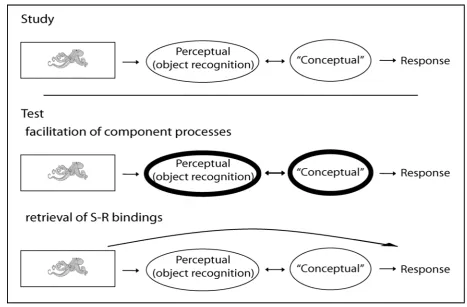
Figure 1.1. At Study, the presentation of a visual object entails the recruitment of specific processes involved in
the perceptual identification of the object as well as the extraction of particular (possibly semantic) task-relevant information prior to the generation of an appropriate response. Under the component process account, one or more of these process are facilitated at Test (i.e., when a stimulus is repeated) therefore resulting in priming. Alternatively, a previously encoded Stimulus-Response (S-R) binding is retrieved, resulting in the effective by-passing of previously engaged component processes.
1.2.1.2 Perceptual representation systems
suggesting that priming can reflect the construction (and subsequent activation) of 3D “structural” representations of objects (Schacter, Cooper & Delaney, 1990). Indeed, the mechanisms involved in the learning of new representations may be the same as the modifications thought to occur in standard abstractionist accounts, as illustrated for example by weight changes in connectionist models (Bowers, Damian & Havelka, 2002; Marsolek, Schnyer, Deason, Ritchey & Verfaellie, 2006; Stark & McClelland, 2000).
1.2.2.3 Component process theories
A different, though related, conception is that priming involves the facilitation of specific processes or procedures entailed by a task (Kolers & Roediger, 1984; Logan, 1990; Roediger, Weldon, & Challis1989b). Such processes might be thought of as task-specific computations and/or mappings between representations. Although this conception would seem to make similar predictions to abstractionist theories, the procedural conception does not focus on individual representations of stimuli. Thus it can explain practice effects in tasks like reading inverted or mirror-reversed text. With practice, participants are able to rapidly read such text despite a change in stimulus set (i.e., prose passage) between practice and test (Kolers & Perkins, 1975). In other words, such practice effects can generalise to new items. Procedural theory therefore offers greater explanatory flexibility in that it can accommodate highly task-specific novel processes. At the same time however, the procedural conception makes few a priori predictions regarding the specific types of processes that are engaged by tasks or that can demonstrate facilitation.
distinction between perceptual and conceptual processes (Blaxton, 1989; Roediger & McDermott, 1993). Such a distinction is primarily based on studies that show a dissociation between data-driven tasks thought to engage primarily perceptual processes, such as word identification, and conceptually-driven tasks thought to engage more conceptual processes, such as word generation when presented with an antonym (e.g., Jacoby, 1983b; though see Tenpenny & Shoben, 1992 for a critique of the data-driven/conceptually-driven distinction). More generally however, it is likely that there are multiple different computations that can be facilitated during any one task, the so-called component process (CP) view of priming (Tenpenny & Shoben, 1992; Witherspoon & Moscovitch, 1989) (see Figure 1.1). For example, priming in word-stem completion paradigms has been shown despite changes in modality between presentations (Richardson-Klavehn & Gardiner, 1996), suggesting a conceptual locus for such effects. However, word-stem completion priming is also reduced following graphemic versus phonological study tasks (Richardson-Klavehn & Gardiner, 1998), suggesting a perceptual component. Such results are therefore difficult to characterise with the broad perceptual vs. conceptual distinction, suggesting facilitation can occur at a lexical level too. Note though that not all component processes necessarily make a significant contribution to the final amount of priming, in that the critical ones that can be facilitated significantly by repetition are likely to be those that are not already maximally efficient (Henson, 2003).
(Franks, Bilbrey, Lien & McNamara, 2000), with the transfer of priming dependent on the similarity of semantic information retrieved by tasks at initial and subsequent presentation (Xiong, Franks & Logan, 2003).
Critically, both abstractionist and CP accounts are what have been termed “modification” accounts of priming. They both predict that the same mental representations and/or psychological processes are activated or engaged at initial and subsequent presentations of a particular stimulus, and that these representations/processes are in some way modified resulting in facilitation. In short, assuming that task demands remain constant, the “qualitative” representations/processes engaged in the generation of a response remain constant regardless of repetition. Given CP theory has become the modal theory of repetition priming, the present thesis uses this theory as the primary example of a modification account of repetition priming.
1.2.2 Episodic accounts
the broad domain of episodic accounts of priming, theories that focus on the binding of stimuli and responses are often referred to as “response learning” or “Stimulus-Response” (S-R) theories. The focus of the present thesis is on such S-R theories of priming.
1.2.2.1 S-R theories
One specific example of an S-R theory of priming is the "instance theory" proposed by Logan (1990), as an extension of his theory of expertise (Logan, 1988). This theory assumes that the response to the initial presentation of a stimulus is generated by an algorithmic processing route (i.e., the engagement of specific component processes), but that this response also becomes stored together with the stimulus in a separate "instance" (i.e., episode/S-R binding). When the stimulus is repeated, there is a race between the algorithmic route and retrieval of any previous instances. If the retrieval of a previous instance wins the race, the RT will be shorter, producing priming (see Figure 1.1). Importantly, stimulus repetition is not thought to result in the speeding up of the algorithmic route (e.g., facilitation of component processes); priming instead results from a qualitativeshift in processing, from the generation of a response via an algorithmic route to one of instance retrieval. By assuming that each stimulus-response repetition (i.e., trial) leads to the formation of a new instance, Logan's theory provides an elegant account of the change in both the mean and variance of RTs as a function of the number of repetitions.
facilitation. Note that the two routes to response generation are independent in Logan’s model, with the fastest route winning the race for response selection. In situations where the response should be reversed between presentations (e.g., following a task-switch), the successful retrieval of an inappropriate/incorrect response code should cause both an error and a speeding up of RTs. Alternatively, if the algorithmic route wins the race and is not itself error-prone, RTs should show no change. As such, RTs should never be slower than the time taken for the algorithmic route to produce a response. This lack of interference predicts that RTs for correct responses to repeated stimuli should never be slower than for novel stimuli when a response is changed between presentations (i.e., negative priming cannot occur).
The encoding of S-R bindings is also consistent with the Event File theory proposed by Hommel (1998). This theory can be seen as an extension of the object-file theory (Kahneman & Treisman, 1984; Kahneman, Treisman & Gibbs, 1992) originally proposed as a system that binds together visual information relating to a single object. These bindings were thought to include, though not exclusively, information relating to the stimulus shape, colour and location. The Event File theory extends this proposal to include bindings between stimuli and information relating to the task performed and response made, as well as additional contextual information. This theory has thus far focussed on interfering effects of prior encounters with a stimulus, whereby discrepancies between the present circumstances and retrieved Event Files tend to slow RTs compared to novel stimuli (Hommel, 2004). Given this focus on interference, it is presently unclear how the theory predicts positive priming (i.e., a speeding of RTs) as a result of response repetition (though see Waszak & Hommel, 2007).
not given a precise definition of what constitutes a “response” or a “stimulus”. For example, the question of whether responses in S-R bindings relate to specific motor-actions (e.g., left/right finger-press) or more abstract task-dependent decisions (e.g., “yes”/“no” in a binary classification task) is still disputed in the literature (e.g., Dobbins, Schnyer, Verfaellie & Schacter, 2004; Logan, 1990; Schnyer et al., 2007), as is the question of whether or not S-R effects are “hyper-specific” to repetition of exactly the same stimulus (e.g., identical pictures of an object) (Denkinger & Koutstaal, 2009; Schnyer et al., 2007). I address these issues directly in Chapter 4.
1.2.3 Predictions of S-R versus CP theories
bound to a specific (repeated) stimulus, facilitation will occur for both repeated and novel stimuli and therefore no priming will occur. Thus, repeating/reversing a response between repetitions should have no effect on priming.
In light of these predictions, S-R and CP accounts of priming are typically assessed by means of a response switch (versus response repetition), usually effected by a switch in task between initial and subsequent presentation of a stimulus. Using this manipulation, S-R learning has been shown to contribute to repetition priming of RTs and/or errors in long-lag classification tasks (e.g., Dennis & Schmidt, 2003; Schnyer et al., 2007), though its contribution is normally believed to supplement that from facilitation of component processes. Importantly, if priming does reflect such a qualitative shift in processing, and a “by-passing” of previously engaged processes, these S-R learning effects question the commonly held assumption that priming can be used as a tool with which to investigate the nature of stimulus representations, and question the nature of memory processes that are intact in amnesia.
1.2.4 S-R learning across numerous paradigms
1.2.4.1 Task-switching paradigms
repeated in a task that is incongruent with the task performed on its prior presentations. Such stimulus-specific task-switch costs are thought to result from the retrieval of information relating to the previous task and/or response, which interferes with the selection of a new response. Note however that such research has focussed primarily on the behavioural costs associated with switches in response between stimulus presentations, rather than the benefits (e.g., faster RTs) associated with response repetition as shown in long-lag repetition priming paradigms (though see Koch & Allport, 2006; Waszak et al., 2003).
1.2.4.2 Masked priming paradigms
S-R learning has also been used to explain aspects of short-lag subliminal priming (Abrams, Klinger & Greenwald, 2002; Damian, 2001; Kiesel, Kunde & Hoffmann, 2006; Kiesel, Kunde & Hoffmann, 2007; Klauer, Eder, Greenwald & Abrams, 2007; Kunde, Kiesel & Hoffmann, 2003). Subliminal priming paradigms typically assess priming for a “probe” stimulus that is immediately preceded by a “prime” stimulus. This prime stimulus is rendered subliminal by brief presentation accompanied by some form of masking. Facilitation is normally seen when the prime and probe are the same stimulus (Forster & Davis, 1984). Recently however there has been much debate as to whether “semantic” effects can be seen, where a stimulus is preceded by a semantically related masked prime (e.g., Hodgson, 1991).
response when they generate that response as a probe, and that this response can be triggered when that stimulus is presented briefly as a prime in a subsequent trial (causing priming), without that prime stimulus necessarily being processed semantically.
Although more recent studies have controlled for S-R contributions and still found evidence for subliminal semantic priming, there is little doubt that S-R learning plays a dominant role in such paradigms if not controlled (see Van den Bussche, Van den Noortgate & Reynvoet, 2009 for a meta-analysis). Such results are theoretically interesting in that they suggest that, whereas the encoding of S-R bindings requires conscious awareness of the stimulus (i.e., they are only formed when the stimulus is shown as a probe), such bindings are retrieved automatically with no need for conscious awareness (i.e., when previous probe stimuli are repeated as subliminal primes), as tested empirically by recent studies of masked categorical priming (e.g., Eckstein & Henson, submitted). Note however that further studies have shown that, while awareness for the prime may not be necessary to see masked priming effects, spatial (e.g., Lachter, Forster & Ruthruff, 2004) and temporal (e.g., Naccache, Blandin & Dehaene, 2002) attention are necessary. The issue of attention is revisited in the next section.
1.2.4.3 Negative priming paradigms
of task-irrelevant stimulus representations (Tipper, 1985). Such inhibition is thought to produce carry-over effects from initial to subsequent presentation, resulting in a slowing of RTs. Alternatively, unattended task-irrelevant stimuli might be tagged with a “do-not-respond” code that interferes with response generation on subsequent presentation (Neill, 1997). Again however, a third type of explanation for negative priming has appealed to S-R learning. According to such accounts, the response given to an attended stimulus becomes bound to the critical task-irrelevant unattended stimulus. In other words, a response becomes bound to any co-occurring stimulus, regardless of attention. When the unattended stimulus is repeated (and attended) negative priming can manifest if the response previously bound to the stimulus is incongruent to the newly generated response. Studies showing such effects therefore suggest that attention is not a necessary condition in the encoding of S-R bindings. I return to the issue of attention in Chapter 7.
1.2.5 Limitations of S-R theories of repetition priming
syllables at study and completing a word-stem at test, Schott et al., 2005). Although the present thesis focuses on the role of S-R binding in classification paradigms, I return to the differences between classification and identification paradigms in the final chapter.
1.3 S-R theories and repetition suppression
More recently S-R theories have been offered as a means to explain the reductions seen in neural activity following stimulus repetition, as measured by functional magnetic resonance imaging (fMRI) and magneto/electro-encephalography (M/EEG). In the case of fMRI, these repetition-related reductions in certain (but not all) cortical regions has been termed repetition suppression (RS; Grill-Spector, Henson & Martin, 2006). For example, when a visual object is repeated in the context of a given task, reductions in neural activity are often seen in lateral occipital and inferior temporal visual regions (i.e., the ventral visual stream) as well as distinct regions in prefrontal cortex (PFC). Given the co-occurrence of behavioural priming and these reductions in cortical activity, RS is often thought of as a neural analogue of behavioural priming. RS may therefore represent a fundamental form of long-term stimulus-specific neural plasticity, reflecting more efficient neural processing. In turn, such increased neural efficiency may contribute to analogous improvements in behavioural performance, such as priming (e.g., faster reaction times to make a categorisation; see Henson, 2003; Schacter & Buckner, 1998).
thought to result from the facilitation of visual identification processes. RS within inferior PFC however is often thought to result from the facilitation of task-specific semantic/conceptual and/or phonological processes (e.g., Poldrack et al., 1999; Wagner, Desmond, Demb, Glover & Gabrieli, 1997; Wagner, Koutstaal, Maril, Schacter & Buckner, 2000). Under this conception (as in the priming literature), RS can be used as a tool to investigate the nature and localisation of neural representations. For example, RS has been used to investigate the nature of object (e.g., Eger, Henson, Driver & Dolan, 2004; Kourtzi & Kanwisher, 2001; Vuilleumier, Henson, Driver & Dolan, 2002) and face (e.g., Eger, Schweinberger, Dolan & Henson, 2005; Eger, Schyns & Kleinschmidt, 2004; Winston, Henson, Fine-Goulden & Dolan, 2004) representations within the ventral visual processing stream.
response was repeated, RS was significantly curtailed (and no longer reliable) when a response was reversed between presentations. These results are striking in that they suggest that RS, even in supposed “visual” regions, simply reflects the retrieval of an S-R binding (though see Horner & Henson, 2008; Race, Shanker & Wagner, 2009 and Chapter 5 of the present thesis). Importantly, these results undermine the use of RS as a tool with which to investigate particular neural representations.
1.4 Pitting CP versus S-R theories
Although I have detailed a number of studies in favour of either CP or S-R accounts of repetition priming, it is plausible that priming results from the combination of both the facilitation of repeated component processes as well as the retrieval of S-R bindings. Indeed, a recent study suggested that contributions to priming from S-R learning – but not from component processes – are disrupted in amnesic patients (Schnyer et al., 2006). Specifically, amnesic patients did not demonstrate greater priming following response repetition than response reversal (that the controls did, and as S-R theories predict). Nonetheless, amnesics did show reliable priming for repeated objects that received either the same or a reversed response between repetitions. This significant priming was attributed to the facilitation of component perceptual and/or conceptual processes that are assumed to be intact in these amnesics (e.g., occurring in cortical regions unaffected by their brain damage, which was primarily to MTL regions). This finding therefore suggests a possible dissociation between S-R and CP contributions to behavioural priming.
independent contributions ultimately interact to effect a response. In the development of such a theory, several issues regarding S-R learning need to be addressed. I next introduce several questions that the present thesis will attempt to answer. In the final chapter the answers to these questions will be used in the development of a novel framework designed to incorporate S-R and CP contributions to behavioural and neural repetition effects. Specifically, this framework will aim to relate the repetition-related changes in neural activity, as measured by fMRI and EEG in Chapters 5 & 6 with the behavioural priming effects seen in Chapters 2, 3, 4 & 7.
1.4.1 Question 1: How dominant are S-R contributions within
long-lag classification paradigms?
As previously stated, S-R learning contributions to priming have been seen within long-lag classification paradigms (Dennis & Schmidt, 2003; Dobbins et al., 2004). Such S-R learning has been generally thought to supplement contributions from facilitation of component processes. For example, in the Dobbins et al. (2004) study, the authors saw greater priming when stimuli and responses were repeated between presentations compared to when responses were reversed. Significant positive priming was still present despite reversal in responses however. This significant positive priming following response reversal is not predicted by any current S-R theory and was therefore proposed to reflect the facilitation of component processes.
objects as to whether they were “bigger than a shoebox” in real life. Repetitions of stimuli in this block therefore required completion of the same task and as a result the same response. In a subsequent “Switch” phase, participants were asked the opposite question, viz. whether the object was “smaller than a shoebox”. As such, any stimulus that was initially presented in the Start phase required a reversal of response during the Switch phase (e.g., an item that is “bigger than a shoebox” will receive a “yes” response in the Start phase and a “no” response in the Switch phase).
One issue with the Start/Switch response manipulation is it remains unclear whether the retrieval of S-R bindings are increasing priming in the Start phase or decreasing priming in the Switch phase. In other words, is the retrieval of S-R bindings facilitating processing when a response is repeated or interfering with processing when a response is reversed? Although positive priming is seen in the Switch phase, it is possible that this could be the nett result of facilitation from repeated component processes and interference from S-R learning (presuming facilitation outweighs interference). As such, the Start/Switch paradigm does not offer a means to assess the baseline level of component process facilitation within an experiment.
phases of Dobbins et al. (2004), but within a more conventional “Study-Test” design that equates the lag between initial and repeated presentations across the conditions; a confound of the Dobbins et al. study (see Chapter 2 for more details). To address the baseline issue outlined above, I introduced a third Test condition in which I asked a question at Test (e.g., “is the object man-made?”) that was unrelated to that at Study. Here the stimuli were chosen so that responses made at Test were, on average, orthogonal to those made at Study (i.e., 50% of stimuli required the same response, 50% required a reversal of response). This condition was designed to act as a baseline measure against which possible facilitatory and/or interference effects in the Same/Reverse condition could be measured. I therefore used this design to assess the relative contribution of S-R learning compared to facilitation of component processes (Chapters 2-3).
1.4.2 Question 2: At what level are stimuli and responses
represented within S-R bindings?
format of the stimulus (Schnyer et al., 2007) or representations that are able to abstract across different object exemplars (e.g., two differing pictures of a lion; Denkinger & Koutstaal, 2009).
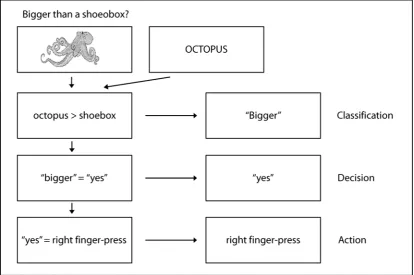
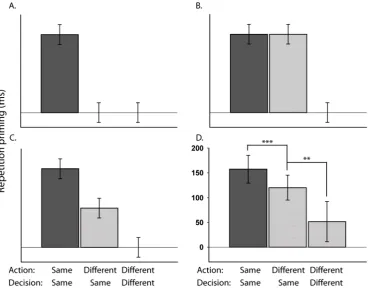
One possibility however is that S-R bindings can occur at multiple levels of stimulus and response abstraction. Here I can distinguish at least two levels of stimulus representation: a specific depiction of an object and an abstract representation of the identity of that object, and three possible levels of response representation: a particular motor Action (e.g., left/right finger-press), a particular binary Decision (e.g., yes/no) and a particular task-dependent Classification (e.g., bigger/smaller) (see Figure 1.2). Each of these levels of stimulus and response abstraction have been proposed in previous research (Abrams et al., 2002; Damian, 2001; Denkinger & Koutstaal, 2009; Dobbins et al., 2004; Koch & Allport, 2006; Logan, 1990; Schnyer et al., 2007), but normally when contrasting one with another, under the assumption that only one true level of stimulus or response representation needs to be identified.
component processes. In Chapter 4 I address the issue of the level of both stimulus and response representation within S-R bindings.
Figure 1.2. Two possible levels of stimulus representation (“specific” and “abstract”) and three
possible levels of response representation (Classification, Decision and Action). Either stimulus representations are specific to repetition of the same visual stimulus between presentations (e.g., a picture of an octopus), or they form at an abstract level and can be retrieved despite a change in visual format between presentations (e.g., a picture of an octopus and the word “octopus”). With regard to response representations, when a stimulus is presented in the context of the “bigger-than-shoebox” task the participant must first compare the size of the stimulus to that of a shoebox, resulting in a size-classification of “bigger”. Due to the particular direction of the question (i.e., “bigger-than”), a “bigger” Classification is mapped to a “yes” decision. This “yes” decision is then mapped to the appropriate motor-response, resulting in a right finger-press Action.
1.4.3 Question 3: Does retrieval of S-R bindings result in facilitation
when a response is repeated, and/or interference when a response is
reversed?
have been shown to result in a slowing of RTs, suggesting that retrieval of S-R bindings can interfere with current response selection (Koch & Allport, 2006; Waszak et al., 2003). To date, no long-lag classification experiment has demonstrated both facilitation and interference effects owing to the retrieval of S-R bindings. This issue is particularly important given the predictions of Instance Theory, where a slowing of RTs should not occur. Specifically, when a trial requires a change or reversal in response between presentations, Instance Theory predicts that priming should not occur if a correct response reversal is made (as the system reverts to algorithmic processing). Alternatively, response retrieval could win the race, resulting in faster RTs but an incorrect response. Thus, Instance Theory predicts a trade-off between RTs and accuracy. In situations where a reversal of response is required, priming should not be seen when a “correct” response is made. Using a variety of manipulations to effect repetitions/reversals in response I address the issue of facilitation/interference across Chapters 2-6.
1.4.4 Question 4: Are repetition-related changes in neural activity,
as measured by fMRI and EEG, related to S-R learning or
component process contributions to behavioural priming?
orthogonal to its previous response (Henson et al., 2003; Horner & Henson, 2008), and when changing both the stimulus and response, resulting in no obvious S-R binding, such as in identification paradigms that involve different tasks at study and test (e.g., word-stem completion Schacter, Alpert, Savage, Rauch & Albert, 1996; Schott et al., 2005). Thus S-R bindings would not appear sufficient to explain RS in all brain regions, particularly parts of the ventral visual processing stream.
In Chapter 5, I present an fMRI experiment designed to assess the relative roles of S-R and CP contributions in RS. The design of the experiment was based on the behavioural results presented in Chapters 2-4. Specifically, it controlled for S-R bindings at the three levels of response representation that I proposed above, and simultaneously examined changes in both response and stimulus representation. With this “optimised” experimental design, I was able to test for S-R and CP contributions to RS in a more rigorous manner than the design of the Dobbins et al. (2004) study allowed.
Chapter 5, I directly assessed whether the repetition-related changes seen in these previous studies were specific to the repetition of responses between presentations.
1.4.5 Question 5: Is attention necessary for both the encoding and
retrieval of S-R bindings?
1.5 General methods
In Chapters 2-7, I present the results of several long-lag classification priming experiments. All experiments used a Study-Test design. At Study, a number of stimuli were presented; at Test, the same stimuli were repeated (Repeated) along with experimentally novel stimuli (Novel). The lag between Study and Test presentations of a particular stimulus were in the order of minutes (e.g., approx. 5-10mins), but “long-lag” in the sense that there were many trials between initial and repeated presentations of the same stimulus (Henson et al., 2004), and as distinct from the “immediate” repetition across trials that is typical of negative priming studies, or the “within-trial” repetition in masked priming studies. I used speeded classification tasks (e.g., “is the object bigger than a shoebox?”) throughout, inline with previous behavioural and neuroimaging research in this area (e.g., Denkinger & Koutstaal, 2009; Dennis & Schmidt, 2003; Dobbins et al., 2004; Franks et al., 2000; Horner & Henson, 2008, submitted; Koutstaal et al., 2001; Schnyer et al., 2007; Schnyer et al., 2006; Wig, Buckner & Schacter, 2009)
Stimuli in all experiments were taken from a set of 400 colour images of common objects. These were generated from the sets used by Dobbins et al. (2004) and Koutstaal et al. (2001). To confirm their suitability for British participants, the objects were named and rated independently by six participants according to several different classifications (e.g., “is it bigger than a shoebox?” and “is it man-made?”). Object names and classifications were chosen by taking the modal response across raters. High naming agreement was present across raters (>80% of objects given the same name across all six subjects) with most names corresponding to the “basic category” level (Rosch, Mervis, Gray, Johnson & Boyes-Braem, 1976).
1.6 Outline of thesis
The present thesis therefore aims to assess modification versus episodic theories of repetition priming introduced above. In particular, it is concerned with the relative S-R and CP contributions to repetition priming and associated repetition-related neural changes (e.g., RS). In Chapter 2 I outline an experimental design that seeks to replicate and extend the results of Dobbins et al. (2004). Here I assessed priming across three conditions: (1) when the task (and response) was repeated across Study and Test (the Same condition), (2) when the task (and response) was reversed across Study and Test (the Reverse condition) and (3) when the task at Test was unrelated to that at Study (the Orthogonal condition). This design revealed several important signatures of S-R learning. Surprisingly, little evidence of residual priming was found that might be attributable to the facilitation of component processes (Question 1).
Given the lack of evidence for CP contributions to priming in Chapter 2, the experiments presented in Chapter 3 aimed to increase the chances of seeing such contributions. Here I used the same task manipulations outlined in Chapter 2, however I attempted to boost potential perceptual and/or conceptual facilitation using other tasks and stimuli. Mirroring the results of Chapter 2, these experiments failed to reveal any priming effects that could be unequivocally attributed to the facilitation of component processes (Question 1).
Action (e.g., right/left finger-press) to a Decision (e.g., “yes/no”) to a task-dependent Classification (e.g., “bigger/smaller”) (Question 2). I also present evidence that S-R bindings form at an abstract level of stimulus representation, with evidence consistent with S-R learning at two levels of stimulus representation (Question 2). Throughout Chapters 2-4, I saw evidence for both facilitation, resulting from response repetition, and interference, resulting from response reversal, suggesting that the retrieval of S-R bindings can both facilitate/interfere with component processes at Test (Question 3).
In Chapter 5, I outline an experimental design, based on the results of Chapters 2-4, that appropriately controls for S-R learning at all levels of response representation. This design allows proper separation of S-R from CP contributions to priming. Using this design in Chapter 5, I present an fMRI study that assessed S-R and CP contributions to RS. This study suggests that both S-R and CP contributions can be seen within separate cortical regions (Question 4). Specifically, I present evidence for a dissociation between occipital/temporal regions, where RS is robust to response repetitions/reversals, and inferior prefrontal regions, where RS is sensitive to response repetition/reversals. In Chapter 6, I present an EEG experiment using the same design that again showed both S-R and CP contributions to repetition-related changes in ERPs (Question 4). These effects are shown to be topographically distinct, suggesting that they are produced by differing neural generators (in line with the fMRI results) and, importantly, at different times prior to response onset. The latter result helps rule out alternative explanations of the fMRI results, for example that the fMRI RS reflects reduced attention to stimuli after a behavioural decision is made (given the poor temporal resolution of fMRI).
within long-lag classification paradigms. Contrary to previous studies (using immediate repetition designs) that suggest that S-R bindings can form between responses and unattended stimuli (Rothermund et al., 2005), I found no evidence for S-R learning when repeating previously unattended stimuli over multiple trials in the present Study-Test design. I also found no evidence for S-R learning when a previously attended stimulus was unattended (task-irrelevant) at Test. The results of Chapter 7 therefore suggest that attention is necessary for both the encoding and retrieval of S-R bindings (Question 5), at least within the present long-lag classification paradigms.
The results presented in Chapters 2-7 present a challenge for current S-R and CP accounts of priming and repetition-related changes in neural activity (e.g., RS). In particular, the existence of both S-R and CP contributions to priming (i.e., in classification and identification paradigms) suggests that a framework is needed that integrates these two contributions to priming. In Chapter 8 I focus on the limitations of previous theories of priming, identifying specific results from Chapters 2-7 that a future theory of priming would need to accommodate. In light of this appraisal I propose a novel framework that attempts to explain the present priming and RS effects. This framework incorporates multiple routes (i.e., component process and S-R retrieval routes) with multiple stages (e.g., perceptual vs. conceptual component processes) to response generation and is better able to explain the present data than any existing S-R or CP theory of priming.
1.7 Chapter Summary
Chapter 2
S-R versus CP contributions to repetition priming
As described in the preceding chapter, stimulus-response (S-R) and component process (CP) theories of priming make differing predictions under conditions that require either a repetition or a reversal in response between stimulus presentations (i.e., response-congruency). Whereas CP theories predict priming should occur regardless of response-congruency, as long as the same processes are engaged at Study and Test presentations, S-R theories predict priming should be greater following a response repetition than a reversal.
The present chapter outlines an experimental paradigm designed to assess possible CP and S-R contributions to repetition priming. The design was based on the Start/Switch manipulation first introduced by Dobbins et al. (2004). At Study, pictures of common objects were presented and participants were asked “is the object bigger than a shoebox?” in real life. At Test, the stimuli seen at Study were repeated along with experimentally novel stimuli. In line with Dobbins et al. (2004), participants performed the same task (“bigger than a shoebox” – the Same condition) or the reverse task (“smaller than a shoebox” – the Reverse condition) at Test. Critically, responses at the level of Action (right/left finger-press) and Decision (yes/no) will be repeated in the Same condition but reversed in the Reverse condition.
Actions or Decisions would cancel on average. This Orthogonal condition was therefore an attempt to control for possible facilitation and/or interference in the Same/Reverse condition respectively. The Orthogonal condition also presented an opportunity to assess S-R contributions within-block, by comparing priming for stimuli that received the same Action/Decision response between Study and Test (response-congruent) versus stimuli that received the opposite Action/Decision response (response-incongruent). The present experiments also utilised a manipulation introduced by Dobbins et al. (2004) where stimuli at Study were either presented once (Low-primed) or three times (High-primed). This manipulation was included to increase possible SR and CP contributions to priming by increasing the number of Study repetitions, thus increasing the amount of exposure participants had with particular stimuli. This experimental design is presented in Figure 2.1.
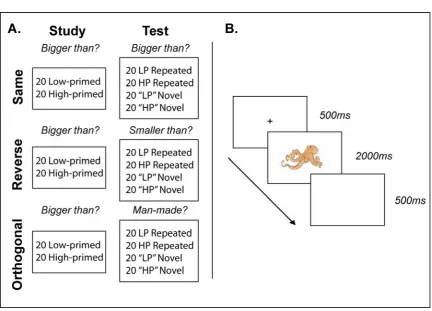
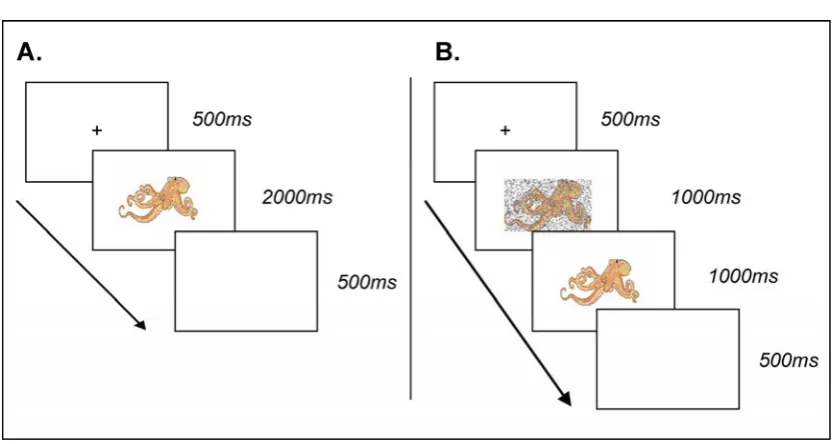
Figure 2.1. (A) Experimental design of Experiment 1. Stimuli were presented once (Low-primed) or
three times (High-primed) at Study. Participants were asked “is the object bigger than a shoebox?”. At Test the stimuli presented at Study were repeated (Repeated) intermixed with experimentally novel stimuli (Novel). Participants were either asked the same question (Same condition) the reverse question (Reverse condition) or an unrelated question (Orthogonal condition). (B) Trial sequence in both Study and Test blocks. A fixation cross was presented for 500ms followed by stimulus presentation for 2000ms. Each trial ended with a 500ms blank screen. Participants were free to respond at any point prior to the start of the next trial.
Low-primed stimuli (i.e., facilitation should generally increase with increased stimulus exposure).
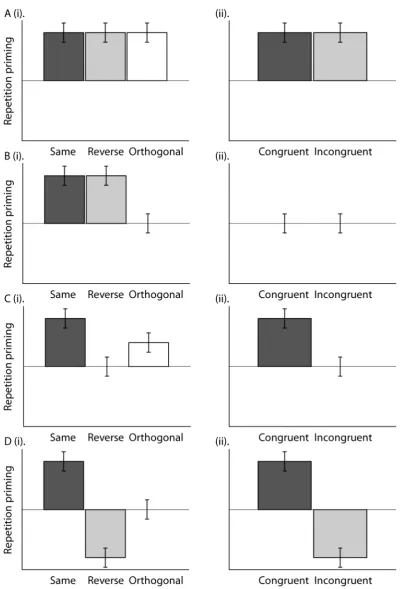
The predictions of an S-R theory depend on the nature of the response (R) representation. If responses are coded at the level of Actions (right/left finger-press) or Decisions (yes/no), positive priming should be seen in the Same condition. The Reverse condition should show significantly reduced priming compared to the Same condition. This is because the response given at Study is not repeated at Test in the Reverse condition (see below). In the Orthogonal condition, the mean amount of priming should be intermediate between that in the Same and Reverse conditions. This is because the same numbers of stimuli require a response repetition (“Congruent trials”) as require a response reversal (“Incongruent trials”). Furthermore, if Congruent and Incongruent trials in the Orthogonal condition are split, greater priming should be seen for Congruent than Incongruent trials.
Figure 2.2. Predictions made by various CP and S-R theories of priming in (i) the Same, Reverse and
If multiple Study presentations lead to the formation of more S-R episodic bindings, or a strengthening of an S-R association, High-primed stimuli should produce greater priming in the Same condition compared to Low-primed stimuli. In the Reverse condition, High-primed stimuli should show equivalent or even reduced priming, owing to greater interference, compared to Low-primed stimuli. As a result, the High-primed vs. Low-primed manipulation should interact with the Same vs. Reverse tasks. This pattern should also be present when comparing Congruent vs. Incongruent trials in the Orthogonal condition.
If, on the other hand, responses are only coded at the more abstract level of the Classification, then S-R theories would predict similar priming for the Same and Reverse conditions, but no priming in the Orthogonal condition for either Congruent or Incongruent trials. Note that this is the same prediction made for conceptual CP contributions to priming (Figure 2.2-B), and as such the present design is unable to distinguish between these two possible contributions to repetition priming (though see Chapter 4).
2.1 Experiment 1
Experiment 1 was designed to assess the relative contributions of S-R and CP accounts of long-lag repetition priming of visual objects, as outlined above. The experimental design of Experiment 1 is shown in Figure 2.2-A. At Study, participants performed the “bigger-than-shoebox” task. At Test, participants performed the “bigger-than-shoebox” task (the Same condition), the “smaller-than-shoebox” task (the Reverse condition) and the “man-made” task (the Orthogonal condition) in separate Study-Test blocks. Specifically, I was interested in comparing: (1) the Same vs. the Reverse condition and (2) Congruent vs. Incongruent trials in the Orthogonal condition. I was also interested in whether reliable priming would be seen in the Orthogonal condition, particularly for Incongruent trials, as this would be strong evidence for facilitation of component processes.
2.1.1 Method
2.1.1.1 Participants
Twelve participants (7 male) gave informed consent to participate in Experiment 1. The mean age across participants was 23.3 years (σ = 4.5). By self-report, all participants were right-handed.
2.1.1.2 Materials
Stimuli were 240 images taken from the main stimulus set. They were selected so that 25% were “bigger than a shoebox” and “man-made”, 25% were “bigger than a shoebox” and “natural”, 25% were “smaller than a shoebox” and “man-made”, and 25% were “smaller than a shoebox” and “natural”. Each picture was randomly assigned to one of 12 groups relating to the 12 experimental conditions (3x2x2; Task x Repetition x Prime-level), resulting in 20 stimuli per group. The assignment of groups to experimental condition was rotated across participants.
2.1.1.3 Procedure
Prior to the experiment, participants performed a practice session using the “bigger than a shoebox” task, where it was made clear that this comparison referred to the object's typical size in real life. They responded using a “yes” or “no” key with their right or left index finger respectively. Although participants were told the question may change during the course of the experiment, the other test tasks were only explained to the participants prior to each test block. They were told to respond as quickly as possible without sacrificing accuracy. No error feedback was provided either in the practice session or the main experiment.
repetitions, the stimulus presentation order within each Study block was randomised so that High-primed stimuli were approximately evenly distributed throughout. During each Test phase, the 40 stimuli from the Study phase (Repeated) were randomly intermixed with 40 novel stimuli. The order of the three test conditions (Task) was counterbalanced across participants.
An example trial sequence is shown in Figure 2.2-B. A central fixation cross was presented for 500ms, followed by a stimulus for 2000ms, followed by a blank screen for 500ms. Images subtended approximately 6o of visual angle. Participants were able to respond at any point up to the start of a new trial (i.e., the presentation of another fixation cross).
2.1.1.4 Behavioural analyses
Priming was defined as the difference in mean RTs between Novel and Repeated trials. To control for possible Novel RT differences across Task conditions, an additional proportional measure of priming was calculated by dividing the difference between Novel and Repeated trials by the mean RT for Novel trials (Schnyer et al., 2006). Analyses of proportional priming scores are reported in Appendix A.
To investigate whether responses made at Study had a significant effect on RTs at Test, Repeated trials in the Orthogonal condition were split further according to whether the participant had given the same (“Congruent”), or opposite (“Incongruent”), response at Study, regardless of accuracy. For High-primed stimuli, such trials were restricted to objects for which the same response was given across all three Study presentations. Note that this means that effects in this response congruency analysis of the Orthogonal condition (such as effects of High- versus Low-primed) can differ from those in the main analysis, because “incorrect” (as defined by modal response over participants) trials may be included in the former but not latter.
2.1.2 Results
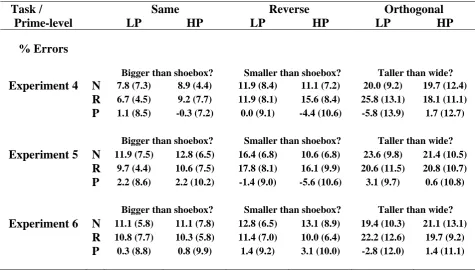
Table 2.1. Mean percentage errors and error priming (plus standard deviations) across Task (questions denote Tasks carried out at Test), Prime-level, and Repetition for Experiments 1-3. LP = Low-primed; HP = High-primed; N = Novel; R = Repeated; P = Priming (Novel-Repeated). Note that the division of Novel stimuli into High- and Low-primed is based on an arbitrary, equal split.
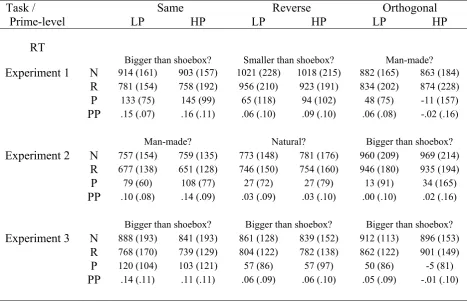
Table 2.2 displays mean RTs, together with subtractive (Novel-Repeated) and proportional ((Novel-Repeated)/Novel) measures of priming. A 3x2x2 (Task x Repetition x Prime-level) ANOVA on RTs revealed a significant Task x Repetition interaction, F(1.5, 17.0) = 7.15, p<.01 (plus main effects of Task, F(1.9, 21.0) = 14.39, p<.001, and Repetition, F(1, 11) = 21.82, p<.001). Given no reliable effects involving Prime-level (F’s<2.0, p’s>.16), subsequent tests collapsed across this factor. Pairwise tests of priming across tasks revealed significantly greater priming in the Same relative to Reverse, t(11) = 2.48, p<.05, and Same relative to Orthogonal, t(11) = 3.90, p<.01, conditions (Reverse vs. Orthogonal, t(11) = 1.57, p=.14). Furthermore, although priming was significantly greater than zero in the Same and Reverse conditions, t’s>2.92, p’s<.01, it was not reliable in the Orthogonal condition, t(11) = 0.60, p=.56. Thus, switches in task decreased priming in the Reverse condition and prevented reliable priming in the Orthogonal condition. This pattern of results is
Task / Same Reverse Orthogonal
Prime-level LP HP LP HP LP HP
% Errors
Bigger than shoebox? Smaller than shoebox? Man-made? Experiment 1 N 13.3 (3.9) 12.9 (7.5) 9.6 (4.5) 10.8 (5.6) 2.9 (3.3) 1.3 (2.3)
R 8.3 (4.9) 10.8 (7.9) 12.5 (6.9) 14.6 (7.8) 2.1 (2.6) 2.1 (4.5) P 5.0 (7.4) 2.1 (11.0) -2.9 (8.9) -3.8 (10.0) 0.8 (3.6) -0.8 (4.2) Man-made? Natural? Bigger than shoebox? Experiment 2 N 2.8 (3.9) 2.8 (2.6) 1.7 (4.9) 1.7 (2.4) 9.7 (6.1) 13.1 (7.1)
R 0.8 (2.6) 1.7 (3.0) 3.9 (4.0) 2.2 (3.9) 10.0 (6.4) 11.4 (5.1) P 1.9 (3.5) 1.1 (2.7) -2.2 (5.2) -0.6 (3.8) -0.3 (9.3) 1.7 (7.1)
Bigger than shoebox? Bigger than shoebox? Bigger than shoebox? Experiment 3 N 10.0 (5.6) 15.4 (9.4) 12.9 (5.4) 11.2 (9.3) 11.2 (4.3) 10.4 (5.4)
presented in Figure 2.3-A. Analogous ANOVAs on the proportional measure of priming showed the same pattern of results (Appendix A-1), suggesting that the difference in priming between the Same/Reverse and Orthogonal conditions was not a range effect owing to the shorter overall RTs in the Orthogonal (“man-made”) task.
Table 2.2. Mean reaction times (RT), RT priming and proportional priming (plus standard deviations) across Task (questions denote Tasks carried out at Test), Prime-level, and Repetition for Experiments 1-3. LP = Low-primed; HP = High-primed; N = Novel; R = Repeated; P = Priming (Novel-Repeated); PP = Proportional Priming ((Novel-Repeated)/Novel). Note that the division of Novel stimuli into High- and Low-primed is based on an arbitrary, equal split.
The Orthogonal trials were split according to Response-congruency between Study and Test (i.e., objects given the same “yes” or “no” response at Study and Test, regardless of accuracy, versus those given differing responses). The resultant priming data were entered into a 2x2 (Response-congruency x Prime-level) ANOVA. Only the main effect of Response-congruency was reliable, F(1, 11) = 7.73, p<.05, demonstrating greater priming for Congruent (+50ms) than Incongruent (-6ms) trials.
Task / Same Reverse Orthogonal
Prime-level LP HP LP HP LP HP
RT
Bigger than shoebox? Smaller than shoebox? Man-made? Experiment 1 N 914 (161) 903 (157) 1021 (228) 1018 (215) 882 (165) 863 (184)
R 781 (154) 758 (192) 956 (210) 923 (191) 834 (202) 874 (228) P 133 (75) 145 (99) 65 (118) 94 (102) 48 (75) -11 (157) PP .15 (.07) .16 (.11) .06 (.10) .09 (.10) .06 (.08) -.02 (.16) Man-made? Natural? Bigger than shoebox? Experiment 2 N 757 (154) 759 (135) 773 (148) 781 (176) 960 (209) 969 (214)
R 677 (138) 651 (128) 746 (150) 754 (160) 946 (180) 935 (194) P 79 (60) 108 (77) 27 (72) 27 (79) 13 (91) 34 (165) PP .10 (.08) .14 (.09) .03 (.09) .03 (.10) .00 (.10) .02 (.16) Bigger than shoebox? Bigger than shoebox? Bigger than shoebox? Experiment 3 N 888 (193) 841 (193) 861 (128) 839 (152) 912 (113) 896 (153)
Despite this main effect, priming did not reach significance for either Congruent, t(11) = 1.48, p=.17, or Incongruent, t(11) = .25, p=.81, trials alone (see Figure 3.2-B).
Figure 2.3. Mean repetition priming (Novel-Repeated) across (A) the Same, Reverse and Orthogonal
conditions (collapsed across Prime-level) and (B) Congruent and Incongruent trials in the Orthogonal condition in Experiment 1. Error bars represent 95% two-tailed confidence intervals of priming effect. * p<.05.
2.1.3 Discussion
learning that was reproduced and reached significance in subsequent experiments (see inter-experimental analysis of Chapter 3).
2.2 Experiment 2
Experiment 1 used the “shoebox” task on the basis of previous work by Dobbins et al. (2004) and Schnyer et al. (2006). Such a task is likely to represent a rather “ad hoc” categorisation (Barsalou, 1983). In other words, it is likely to involve a considerable strategic/executive component, which may encourage, or leave greater scope for, S-R learning. Experiment 2 therefore switched to the “man-made” categorisation task as the main task. It was thought this categorisation was a more natural categorisation, in that it is more likely to be a distinction represented within semantic memory (Farah & McClelland, 1991). This is consistent with the faster RTs for this task than the shoebox task in Experiment 1. The man-made task is also one that has been used in many previous priming studies (Bruce et al., 2000; Franks et al., 2000; Vriezen, Moscovitch & Bellos, 1995; Zeelenberg & Pecher, 2003). Thus the design of Experiment 2 was a mirror-reflection of Experiment 1, in the sense that the man-made and shoebox tasks were swapped (i.e., the man-made task was used in all phases, except the Orthogonal Test phase, when the shoebox task was used). Again, it was of interest whether significant priming would be seen in the Orthogonal condition, particularly for Incongruent trials.
2.2.1 Method
2.2.1.1 Participants
18 participants (5 male) gave informed consent to participate in the experiment. The mean age across participants was 22.6 years (σ = 3.0). By self-report, 3 participants were classified as left-handed, 15 right-handed.
2.2.1.2 Design
Participants were always asked “is the object man-made?” at Study. At Test, in the Same condition, the man-made task was repeated; in the Reverse condition, the opposite question was presented (“is the object natural?”); in the Orthogonal condition, the “bigger than a shoebox?” question was asked.
2.2.2 Results
After excluding 0.6% of trials with outlying RTs, the percentage of errors are shown in Table 2.1. Consistent with expectations, RTs for Novel stimuli were faster in the Man-made task (i.e., Same and Reverse conditions) than the Shoebox task (i.e., Orthogonal task). Analyses of errors revealed no significant effects of Repetition (Appendix A-2). A further 1.9% of Repeated trials were excluded from RT analysis due to incorrect responses given at Study (see Methods).
p=.91). Furthermore, although priming was significantly greater than zero in the Same and Reverse conditions, t’s>2.0, p’s<.05, it was not reliable in the Orthogonal condition, t(17) = 0.94, p=.36 (see Figure 2.4-A). The proportional priming measure revealed a similar pattern of results (Appendix A-2).
A 2x2 (Response-congruency x Prime-level) ANOVA for the Orthogonal condition showed only a main effect of Response-congruency, F(1, 17) = 23.18, p<.001, with greater priming for Congruent (+73ms) than Incongruent (-18ms) trials. Indeed, priming was reliable for Congruent trials, t(17) = 3.42, p<.01, but not Incongruent trials, t(17) = .71, p=.49 (see Figure 2.4-B).
Figure 2.4. Mean repetition priming (Novel-Repeated) across (A) the Same, Reverse and Orthogonal
conditions (collapsed across Prime-level) and (B) Congruent and Incongruent trials in the Orthogonal condition in Experiment 2. Error bars represent 95% two-tailed confidence intervals. ** p<.01; * p<.05.
2.2.3 Discussion
an important role even with the relatively easier (and less “ad hoc”) decisions required by the man-made categorisation task (relative to the shoebox task).
2.3 Experiment 3
The results of Experiments 1 and 2 demonstrated clear S-R effects using both the “bigger-than-shoebox” and “man-made” classification tasks. Such S-R effects would therefore seem to be replicable across tasks that demonstrate clear differences in response accuracy and RTs (see later inter-experimental analysis). Experiment 3 further tested the robust nature of these effects by switching the tasks undertaken at Study and Test. In Experiments 1 and 2 the Study task was held constant, whilst the Test task was varied. As such, priming differences at Test may have resulted from overall differences in task difficulty (consistent with overall task differences in RTs and accuracy). To control for such differences at Test, Experiment 3 varied the Study task whilst maintaining a constant Test task. At Test, participants always undertook the “bigger-than-shoebox” task. At Study, either the Same (“bigger-than-shoebox”), Reverse (“smaller-than-shoebox”) or Orthogonal (“man-made”) tasks were performed.
2.3.1 Method
The experimental design of Experiment 3 was identical to Experiment 1, with the following exceptions.
2.3.1.1 Participants
2.3.1.2 Design
Participants were always asked “is the object bigger than a shoebox?” at Test. At Study, in the Same condition, the “bigger-than-shoebox” task was performed; in the Reverse condition, the opposite question was performed (“is the object smaller then a shoebox?”); in the Orthogonal condition, the “man-made” task was performed.
2.3.2 Results
After excluding 1.0% of trials with outlying RTs, the percentage of errors are shown in Table 2.1. Analyses of errors revealed no significant effects of Repetition (Appendix A-3). A further 3.2% of Repeated trials were excluded from RT analysis due to incorrect responses given at Study.
Table 2.2 displays the mean RTs and priming effects. A 3x2x2 ANOVA revealed a significant Task x Repetition interaction, F(1.9, 20.9) = 4.98, p<.05 (plus main effects of Task, F(2.0, 21.9) = 11.27, p<.001, and Repetition, F(1, 11) = 17.89, p<.001). Given no reliable effects involving Prime-level (F’s<2.26, p’s>.16), subsequent tests collapsed across this factor. These tests revealed significantly greater priming in the Same relative to the Reverse, t(11) = 2.58, p<.05, and Same relative to the Orthogonal, t(11) = 2.74, p<.05, condition (Reverse vs. Orthogonal, t(11) = 1.14, p=.28). Furthermore, although priming was significantly greater than zero in the Same and Reverse conditions, t’s>2.4, p’s<.05, it was not reliable in the Orthogonal condition, t(11) = 1.08, p=.31 (see Figure 2.5-A). The proportional priming measure revealed a similar pattern of results (Appendix A-3).