Rochester Institute of Technology
RIT Scholar Works
Theses
Thesis/Dissertation Collections
5-21-1977
Operation Bookwatch
Vivian Mallison
Follow this and additional works at:
http://scholarworks.rit.edu/theses
This Thesis is brought to you for free and open access by the Thesis/Dissertation Collections at RIT Scholar Works. It has been accepted for inclusion in Theses by an authorized administrator of RIT Scholar Works. For more information, please [email protected].
Recommended Citation
OPERATION BOOKWATCH
by
Vivian Mallison
Candidate for the Master of Fine Arts
in the College of Fine and Applied Arts
of Rochester Institute of Technology
May 21, 1977
TABLE
OF.
CONTENTSPage No.
ir *>
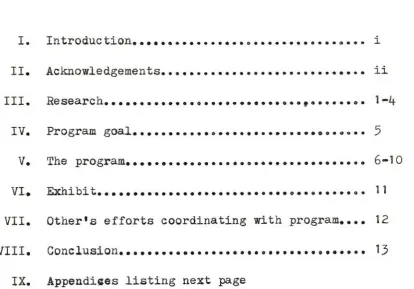
I. Introduction i
II, Acknowledgements ii
III. Research *... f 1-4
IV. Program goal 5
V. The program 6-10
VI. Exhibit W
VII. Others efforts coordinating with program,... 12
VIII. Conclusion 13
[image:3.568.76.491.149.438.2]APPENDICES LISTING
A. Letter from library to RIT Department of Communication Design
B. S.T.E.M information
C. Logo design evolution sketches
D. Bookmark sample
E. Tentcard sample
F. Doorhanger sample
G. Red poster sample
H. White poster sample
I. Black poster sample
J. Brochure cover design sketches
K. Brochure copy
L. Exhibit Specifications
M. Exhibit photographs
N. WITR radio spots
0. Questionnaire
P. Thesis proposal
LISTING
(CONT'D)
R. Project proposal
S. URI Theft campaign reprint
INTRODUCTION
The purpose of this thesis was to design a visual
communications program for the RIT library to combat the
growing problem of theft and vandalism.
A coordinated, hard-hitting campaign to bring this
problem to the students on campus, and other library
users, will include the following: The design of an
identification element and its implementation on
printed materials, exhibit and related materials.
It is believed that much of the damage suffered by
libraries, on campuses and in cities nationwide, occurs
through public ignorance and apathy. A multi-level,
coordinated campaign such as this, should help bring
the problem to the individual and encourage cooperation
ACKNOWLEDGEMENTS
Thesis Committee
Professor R.Roger Remington, Advisor
James Ver Hague
Lois Goodman, Head of Public Services Wallace Memorial Library
I would like to give special acknowledgement to
Gary MacMillan, Director of Libraries, Wallace Memorial
Library, for presenting this problem to the Communication
Design Department and for his cooperation in making this
thesis a practical and useful one.
My appreciation also to Mr, Al Meliutus of McCurdy & Co. Security Department for providing the S.T.E.M.
information.
RESEARCH
The increasing losses in the library at RIT prompted Dr. Bullard, Provost at the
Institute,
to confer with Gary MacMillan, Director of Libraries at Wallace MemorialLibrary. The result of this meeting was a letter to the RIT Department of Communication Design fqr possible
assistance, (Appendix A)
The S.T.E.M. (Shoplifters Take Everybody's Money) program used by the downtown merchants of Rochester was
an impetus in deciding to invest in this campaign program
against theft and vandalism in our library. S.T.E.M.
proved to be very successful with a 35% reduction in
shoplifting. Detailed information on S. T.E.M. is included
in Appendix B.
Professor R. Roger Remington, Chairman of the
Department of Communication Design,presented this project
to the graduate students as a potential educational
involvement.
Because I have long been appalled by the mutilation
of books in libraries, this project was one to which I
could easily relate. It evolved from a project into a
thesis and has ramifications which could involve subse
Accurate figures on the problem are difficult to
obtain because of the very nature of the crimes. Few muti
lated books or journals are reported to library personnel,
so the damage is likely to go undetected for a prolonged
period of time. Pinpointing the exact time the damage
occurred is not possible. Journals supply a more reliable
barometer since they are apt to be handled more frequently
and held for eventual binding.
Detection of the vandals 'in the act'
presents a
surveillance problem that few libraries, including ours,
are equipped to handle. The safeguards taken, such as
detectable metal plates glued into book covers, stamping
of page edges, journal covers and the extensive
checking-out procedure, have all failed to lessen the problem
appreciably.
The most popular targets for the vandals are the
glossy, expensive art books whose full color illustrations and painting reproductions prove irresistible. Photography
books, journals and scientific publications are also high
on the preferred list for the vandals. Unfortunately,
for the library ( and indirectly for us!), these very
books and journals are the most expensive to replace.
Estimates of the cost for replacement of such properties
materials. Other costs for in-print books range from $8 to
$25 in addition to the cost of the book. For journals, the cost ranges from $3 to $10 above the cost of the issue.
Damaged journals cannot be bound into permanent reference
volumes, so these loose issues must be put aside until
replacements can be obtained. If the issue is unavailable, the journals are glued by hand in the library and the
result is an incomplete volume.
Such acts of vandalism add to the volume of detailed handwork that is forced upon the library staff. Just to safeguard art books, for example, art plates that are
"tipped in" (that
is, glued only at the top two corners), used to be completely cemented down to prevent theft. The result was a buckled, discolored reproduction and a great deal of wasted time. The library can no longer afford to take this safeguard, it is simply too expensive.
Months can be spent trying to get a replacement book,
money and effort that could be spent on a new volume for
everyone's use. The frustration of the library staff can be only imagined when, after all this work, the volume is
again defaced, or stolen completely within days or weeks of acquisition. It has been estimated in our RIT library
The library has been forced to adopt control methods
which penalize everyone, innocent and guilty alike. Many
popular rip-off books and journals are dropped from the
purchasing lists of the library, so we no longer have them
to use for enjoyment and reference. The books already in
the collection, that are considered vulnerable, are placed
on limited access shelves, so a special effort must be
made to locate them and they cannot be checked out. As
more of these books join the limited access area, fewer
are available to be freely used. The problem of theft
and vandalism strikes all of us.
The annual loss to our library is $^0,000. The
portion of this that is now used for replacement of
damaged materials could be used to purchase new ones,
if vandalism and theft were controlled.
The problem is not a local one. Nationwide, the
losses to libraries exceed 90 million dollars.
Enlisting the help of the individual seems to be the
THE PROGRAM GOAL
The goal of the program is the reduction of theft
and vandalism in our library at RIT. To reach this goal,
it was determined that our audience should be able to:
1. be increasingly aware of the seriousness of the
problem.
2, gain increased respect for other's rights in the
library.
3. expect faculty support in protecting library
properties.
k, personally aid libraries by not indulging in
these offenses,
5. realize intact references are an advantage to all,
6, aid in keeping all areas of the library open for
all to use.
7. as parents, educate our children early to the
value of the library and its properties.
These objectives were translated into the concept
ual and visual elements which became the completed
THE PROGRAM
To communicate with library users and reach the
program goal, it was determined that a high impact,
graphic communication program was needed.
First, an"
identifying symbol or logo was essential
to unify all the various parts or elements visually.
Through consistent use of this identity symbol, familiar
ity with it would be established and a realization of
the problems of theft and vandalism.
The logo evolved from the combination of the Inter
national prohibition symbol, which should be easily
recognized by now, and a graphic symbol of a book. The
book has a diagonal tear following the angle of the
diagonal slash on the prohibition symbol. Sketches of
this evolution are in Appendix C.
The title of the program, OPERATION BOOKWATCH.
appears in a typeface named Times Roman. The classic
design of this type style seemed an appropriate choice
for a library. The italic form of the type gives a for
ward movement to the title and a positive impression to
the campaign.
The next consideration was the choice of printed
the program should reach. Printed pieces are often discard
ed without even being read or looked at. The challenge was
to not only get the recipient to look at the piece, but
to keep it and perhaps read it more than once. Fellow
students were polled and it was decided that if an item
had a useful purpose beyond its printed message, it would
more likely be retained and used. Further
f it was decided,
if the piece could also be attractive in color, eyecatch
ing and carry strong graphic and typographic images, its
life expectancy was even greater. Using this information,
a long list of possibilities was made and from this list
were chosen the most appropriate ones for this particular
program.
Because of its nature, a bookmark was the first choice
as the largest volume handout. Made from Champion stock,
white Kromecote and printed in Pantone #185 red, the book
mark is 2" X 8" in
sizet 20,000 in quantity.
The second piece is a doorhanger. The stock chosen
for this piece was Hammermill DuraGlo red, silkscreened in
white on the red side, and in black on the reverse. The
size is 5" X 6" with a 2" diecut for the doorknob hole.
The quantity printed was 5,000.
A tentcard was chosen as the third handout. The
8
in white on the red side, it was scored to fold in the
center. The quantity printed was 8000, The folded size is
5" X 3H.
The useful character of these three pieces should
encourage their being kept, used and read. The eyecatching
colors used and attractive stock add to their appeal. The distribution of the pieces is being handled in
different ways. The bookmarks are being placed in the
books,at the desk in the library, when they are checked out. The doorhangers are being handed out in the dormitor
ies by the RAs as well as by the Student Association in their freshman packets. The tentcards are place-d in
the library and may be picked up there.
Actual samples of these three pieces are included
A series of three posters are color coordinated with
the other printed pieces. The stock was the same Hammermill
DuraGlo, Colors chosen were red, black and white. All
three were silkscreened as follows: the red stock in white
and black ink, the white stock in black and red ink and
the black stock in white and red ink. The red ink was
Pantone #185. The poster size is 12"X15" and the
quantity
printed was 300 of each color.
It is planned to use these in the library and perhaps
around campus. Other distribution may be considered at a
later date.
Actual sample posters were cut, folded and placed in
pockets in Appendices G, H, and I,
The final printed piece of these two program phases
is a brochure. This carries more detailed information
than the other pieces and gives an in-depth picture of
the problems of theft and vandalism with suggestions for
its possible control. The stock chosen for this was
Consolidated Dorado dull blade-coated enamel, basis 60,
Offset printed in black and Pantone #185 red. The size is
U"X8>im folded twice to
3 3A" X 8". The quantity print
ed was 5000.
Distribution of the brochure will be done through
)0
or groups.
Developmental sketches for the cover design of the
brochure can be found in Appendix J and text copy in
11
An exhibit will show examples of vandalized library
properties, A well-traveled area, such as the library
entry is suggested for the placement of the exhibit. This
will serve to impress those entering, or leaving, that
the library indeed needs protection.
The exhibit system is a modular one consisting of
chrome tubing forming the frames into which plexiglas
panels can be fitted. The panels will be color-matched
to those of the printed material of the program. It will
carry graphic reproductions of the logo and logotype for
further identification with the theft and vandalism
program.
The exhibit system is manufactured by Abstracta
Structures of New York, Specifications for this exhibit
can be found in Appendix L.
The modular character of the exhibit will allow it
to be modified and changed to provide new and interesting
visuals. This would encourage sustained interest in the
program.
Fabrication and installation of the exhibit are
planned to extend the campaign during the summer and fall
of the next academic year.
For photographs of the exhibit scale model, see
12
The multi-media aspect of the campaign is being
furthered by efforts additional to this thesis. The library
is coordinating radio spots to be introduced on WITR
from April 18 through April 24. See Appendix N for spot
copy.
Coverage by the campus magazine, Reporter, is planned
in addition to the article covering the Be^ier Gallery
Graduate Thesis show.
A survey questionnaire has been distributed in
conjunction with Dr, Isaac's psychology course, Attitude
Formation and Persuasion Techniques, The questionnaire
was done by Sarah Reynolds, Head of Acquisitions, Wallace
Memorial Library, as a class project. The returned
questionnaires are providing some surprising and disturb
ing data. This may prove useful in future treatment of the
theft and vandalism problems. See Appendix 0 for copy of
13
CONCLUSION
The campaign to reduce theft and vandalism in our
library at RIT is a beginning effort to control an
extremely challenging and complex problem. There is no
one simple solution.
The multi-level campaign, which is now being put
into use as a result of this thesis, will hopefully
form a sound foundation upon which to build for further
efforts toward solutions.
The other departments at RIT which are becoming
involved will contribute new input resulting in fresh
approaches and possible solutions. Bringing the problem
to the individuals'
attention and making them aware of
its scope is the beginning of the education in the
control of theft and vandalism,
I have acquired a new understanding of the problem
personally and through working with the interested and
cooperative library staff, have developed great sympathy
for their difficult job%
The survey results of this program will be evaluat
ed next year at a meeting with local librarians. If it
has proven successful, possible implementation at other
APPENDIX A
R
OCHESTER
IN
S
TITUT
E
O
F
TECHNOLOGY
ROCHESTER, NEW YORK
OFFICE MEMORANDUM
r
Roger Remington
o ____
-=~~~~~~---Communications
Date _ _
J_ul-'-y_2_S--'-,_1_9_7_6 _ _ _ _
__
Subject Theft and Vandalism in the library
In a recent discussion of library problems with Dr. Bullard he suggested I contact you to see
if
you have any ideas on how the library could approach the problem of explaining to its users
its increasing losses due to theft and vandalism
.
.
Itis estimated that we expend in excess of
$10,000 to replace stolen or mutilated journals annually and an equal amount for books. In
many cases the material is lost forever since replacements cannot be found. Nationwide libraries
lose an estimated 90 million dollars in material annually so the problem is not unique to RIT.
As you can see libraries seem to be considered "fair game". Studies have shown that the patrons
don't really realize the ramifications of their actions nor do they feel guilt. They seem to feel that
their taxes or tuition give them license to steal.
The Retail Merchants Department of the Rochester Chamber of Commerce reported to us that
as a result of their recent two month campaign on shoplifting local stores have experienced a
35% decrease in that crime.
Is there a possibility of a class project in this problem or some other assistance from your division.
We could possibly also gain some nationwide publicity through mention in the library press and
display of the posters, videotape or What have you at the state and national library conferences
.
I would welcome any suggestions you may have and look forward to hearing from you
.
Gary D. MacMillan
Gary D. MacMillan
Director of Libraries
Wallace Memorial Library
APPENDIX B
S.T.I.M.
'Ne
S
hoplifters
T
ake
E
verybodys
M
oney
TO: Students, Teachers~ Parents~ Community and Business Leaders FROM: William A.,. Nowlin p Associate Chairman, SeT .E.M. D Inc.
RE: STEALING FRa.t STORES
Thirty-eight million dollars annually ($125,000 per day) are lost by retailers through the crime of shoplifting in a five-county area that includes Monroe County. Inevitably, part of this huge loss is passed on to the conilUlner in the form of increased prices for goods. Consumers do not wish to indiI~tly subsidize such criminal activity, nor do merchants want to bear this burdensome expense.. Even more important ~ however p is the concern
we
all have about the fact that t'he bulkof the shoplifting is done by our youth.
Local data received fr01ll retailers in New York indicates that two-thirds of all shoplifters caught are age 21 or under. While people of all ages and from all walks of life are caught shopliftingp the major problem obviously lies within
the student age group.
Why dQ they do it? For kicks, to impress their fellow students, as a prank, because they think the store won It mi ss i t? Yes~ all of these reasons, and pe-rhaps even because they were told by a "friend" that i t was easy, wi th Ii ttle c.hance of detection and punishment. What that so-called friend did not tell them was that
shoplifting is being detected and can result in a lifetime of trouble.
Shoplifting is a crime. It can mean a jail sentence, a heavy fine, a period of probation, or juvenile court. A criminal record can follow a person for many years and affect the chances for that very special job or desired profession. Even
though an offender later realizes how fooli sh i t was to shoplift~ the record of i t can last for yearsJ repeatedly requiring explanation and embarrassment.
"Going with the crowd" has been said to be at the root of the problem. We are confident that the "crowd" still represents a minority of our youth. The majority
of the youth today, as always, respects the property of others and does not commit crimes like shoplifting. This majority just needs to assert itself, letting i t be known that stealing will not be acceptable as a standard of conduct.
&ach person reading this letter can playa part in ridding our society of this type
of thefte Students can do. the most because. they pay attention to the views of fellow students. Teachers can bring the problem into focus through open discussion groups. Parents can keep up with how much money a youth has, how i t is spent, and insist on an explanation for m.erchandise worn or brought home which could not have been purchased with known available moneyo Community and husiness leaders can insure that the hazards and consequences of shoplifting are first explained in their areas, then take strong positive action when i t does occure And what can we all do? Set an example, practice what we preach, and carry the message -- SHOPLIFTING IS A ::RIME AND WILL
Nor
BE TAKEN LIGHTLY IN OOR HCf.1E D SCHOOL, COMMUNITY, OR BUSINESS.**
No authorization is required for reproduction**
Shoplifters Take Everybodys
Money
MEMO TO: \>'oRTH D. HOIDER
FROM: TOM
EDEL
RE: S. T .E.M., Inc. IN MIlJdAUKEE
Worth,
In response to your memo regarding the identification of S.T.E.M. in
Milwaukee as a program of the Hetropolitan HilvJaukee Association of Cormll<'~rce, a cal l "Jas TlE.de to this orgo.nizati on and conv8r'sations held with President Job~ Duncan and S.T.E.M. Director Suzanne Sheedy.
The S. T .E.M. camp aign tias added to the visible program of their
Associ~tion two (2) months ago. And, it is now identified as a Chamber
pr0;?rc1!". ~1ro. Dnnc::m, ':C",?1r~r, stated VL'.t for tLe first year i.t
1-jas NOT rromoted in th'O Charrib er program for tbe reasons '3mmv,rated in
our convers2tjons and b~sed on the reco~~endations of Spiro and
Associates,.Inc. Rather, it was treated as an independent organization
and retained its anonymity.
In further conversation, Hr. Duncan advised us to continue our S. T. E.tf:. c;;Jmraign i..l1c.eT'endently in retaining its anonymity for at le3.st tLr,; first year (as the;r did) or until the rrogram is esta'::llished in the community and its 81.:.CCeSS established.
In our d:'..':cuss::!on, I :0.1:0 clu<:;stioned t;:e al'tic2e POiIlt regarding the enrollment of other I/hsconsin Cha.mb-3!r's in S. T. E.M. by their Association.
This is done by Hay of a sub-franchising of the rights at a cost to
the chamber baSAd on their resident population of the city involved.
All materials, 2tC. are then purchased from the Association.
To assist our efforts on S.T.E.M., I asked that copiesof agreements,
l"'tters, etc. be for.;'1.rded to me £,.,:<1' rossible 1152 in our rrogram.
Sincerely,
TEM
Reports
rear
ofSuccess
1
The Association kicked off the second :
ar of its STEM (Shoplifters Take
erybody's Money) campaign and
sum-trized dramatic success in cutting :tropolitan-area shoplifting losses at a
d-November luncheon. 4
Metropolitan STEM Chairman K. Earl :rbytoldseveraldozenmedia executives
lending the event that STEM's impact
the Milwaukee area's $50 million an al shoplifting loss has "far exceeded :n themost optimistic
expectations."
He also disclosed plans for
"partic-irly high
visibility"
of the STEM
pro-im during the Christmas shopping ison,and announcedthatnew materials
:distributionto themedia,retailers and icol childrenhad been developed. Derby, a J. C. Penney Co. manager,
aorted the following developmentssince
'EMwaslaunchedoneyearago:
A decline in arrests, both adult and
;enile, for the first six months of 1974, spared with the first halfof 1973.
In the City of Milwaukee adult
shop-:ing arrests were down 33 c/c and juve-e arrests, 19Ce. Many other
munic-dities also reported declines.
A decline in shoplifted merchandise.
no major retailers Boston Store and mbels registered 20to 30re decreases shoplifting losses forthe firstsix months
1974, compared with the same period
1973. The J. C. PenneyCo., Sears and lerlarge stores also reported significant :lines.
19 other Wisconsin city chambers of nmerce have been enrolled in STEM
the Association.
Derby credited the
''outstanding"
par-ipationoflocalmedia and the coopera-n of retailers, school officials and the liciary as the most important elements the campaign's success.
MILWAUKEE COMMERCE Editor Suzanne L. Sheedy
Published semi-monthly except monthly in July, August, by the Metropolitan Milwaukee Association
of Commerce, 828 N. Broadway, Milwaukee, Wis consin 53202. Second-class postage paid at Mil waukee, Wisconsin. Subscription rate to members,
$1.00a year.
3<
xk
S.
DaQLTBG
V.e-nber V'isco"ji e:^'i*i Com.i n.
Ai;.i*-c'7n o B<.'
Association of 6u ;n eu Com-r^ C"-icoe'
of ConpeKS
Ui-3'c-i Ccj'c'1 ond inte'ia'iyncl
Some 50 Downtown business people were briefed on the timetable forconstruction of the Wisconsin Avenue bridge at a mid-November meeting called by the Downtown Association. Speaking to those attending are, from left, Edwin Laszewski, Milwaukee
City engineer; Herbert Goetsch, Commissioner of Public Works, and George Watts,
chairman of the Downtown Association Executive Committee.
Steel
Key
to
Bridge
Plan
Early delivery of steel could result in
completion of the Wisconsin Avenue bridge ahead ofschedule,MilwaukeeCity
Engineer Edwin LaszewskihastoldDown
townbusiness people.
Laszewski was among city and state
officials answering questions on construc
tion of the bridge at a meeting called by
the Downtown Association. Some 50 persons attended the session at City Hall. Laszewski said the bridge-construction
timetable relies heavily on the availability of steel on or beforethepromised delivery
date. He said early deliverymight result
in completion of the structure prior to theprojected date ofNov. 15. 1975.
In response to questions, he disclosed thatcontracting forcrews to workonthe
bridge around the clock had been considered.
Laszewskisaidtheideawasrejectedbe causeitwouldhaveadded $500,000to the
$2.7 million cost of construction with
no guarantee that completion would be speeded.
Herbert Goetsch, Commissioner of the
Milwaukee Department of Public Works, pointed out that the schedule lor budge
construction already had been shortened
from 16 to 10monthsto minimizedisrup tion of Downtown business patterns.
Goetsch said the bridge will be open during the day until Jan. 15, 1975. It
then will be closed until the following
Novemberand vehicular trafficwillbe re
routed to nearbystreets.
Also speaking at the meeting were DanielKastenholz,districtchief construc tion engineer for the Division of High ways, and Fourth Ward Alderman Kevin
O'Connor, who stressed that the City is making every effort to speed the con struction effort.
Updated
Milwaukee
Area
Maps
Produced
Attractive, four-color maps of metro
politan Milwaukee and southeasternWis
consin nowareavailablefromtheAssocia
tionofCommerce.
The maps were produced in response
torequestsfrom Associationmembers who have encountered difficulty in obtaining suitable maps of Milwaukee Couiuv and the aiea im:nediat,'h !>i\end it.-, btndeis.
discontinued recentlyby Exxon Corp. Mapscanbeusedforcustomer goodwill and promotions, as a door-opener for salesmen and fornewemployeesfromout sidetheMilwaukeearea.Theyalso areval
uable in helping solve delivery problems.
Ordess may be placed hv c>nfaru!._
Laurie Boe'iter r>t
:h'-Conn:ui.i.aiu i.-Ca:"t'_'!.iphv i>> a::
,le jxipuial Liiio :..
i.Ueu vriMi>n ;>' Divl
!<>r: at ?7:i-:;on,i. o-t ;,
PRESS RELEASE FOR IMMEDIA TE RELEASE
For Additional InfoI'!l1ation:
R. K. Griffin
Commercial Service Systems, Inc.
SHOPLIFTING - CRIME OF THE YOUNG
UP TO SEVENTY EIGHT PERCENT (78%) OF ALi. SHOPLIFTERS ARE
UNDER THIRTY YEARS OF AGE.
Shoplifting is an age old crime but it is not a crime of the
aged. On the contrary, there is strong evidence that THE RETAIL
RIP-OFF is truly a young person's crime.
Up to 78% of shoplifters apprehended have not reached their
thirtieth birthday; 55% are under eighteen and 9% are under twelve.
Those startling figures have just been released by
Commercial Service Systems, Inc. in its eleventh annual survey of
shoplifting.
*
*
The survey data was collected during 1973 and is based on 17, 876 actual apprehensions in Supermarkets, Drug Stores and Discount Stores. Six hundred and seventy-five Supermarkets from 16 companies contributed 14, 790 cases. Seventy-five Drug Stores from three companies contributedWHOM DO YOU TRUST
If you are a retail merchant,the DON'T TRUST ANYONE OVER
THIRTY slogan is a canard. If it is a matter of whom to trust NOT to
shoplift, the over the hill and even the over thirty group are where the
merchant should place his confidence.
The twelve to seventeen age group comprises approximately
12% of our total population. * This group contributed from two and one half
to over three times the number of apprehensions which might be anticipated
based on the demographics of age. (32. 4% in markets to 40. 2% in drug
stores)
The eighteen to twenty-nine age group makes up approximately
eighteen percent of our population. * However, this group contributed 22. 8%
of the drug store apprehensions and 28. 2% of those apprehended in super
markets.
The over thirty group makes up about half of our population but
contributed from 30% of the apprehensions in markets down to only 22% in
drug stores.
Investigation into the reporting practices of the companies
represented in this survey indicate that a substantial number of juvenile
apprehensions are not reported at all. The merchandise is recovered and
the young offender is treated informally, almost casually, as he is sent
on his way without really being detained or a written report made.
It is obvious that if all such apprehensions were reported,
the juvenile's role in shoplifting would be heavier even than reported here.
SHOPLIFTING BY THE AGED
Shoplifting by the aged perhaps should be examined in con
nection with a possible correlation between fixed income-inflation and
need.
The following table shows the apprehensions of individuals
over sixty years of age during the past five years. *
Apprehensions Over 60 Years ofAge
Market Drug Discount
1969
1970
1971
1972
1973 7.2% 4.6% 4.3%
Approximately 14% of the population is over sixty years of
age. The above figures suggest that this age group is shoplifting only
about one half (or less) the amount that might be expected based on the
size of the group within the general population.
The actual drop in reported apprehensions for 1973 would
refute to some extent claims that inflation is forcing the aged to shoplift
to get by.
7.8% _
6.8% 5.7%
7.1% 6.4%
8.0% 5.5%
7.2% 4.6%
WHEN THE POLICE ARE CALLED
The following table shows the percentage of cases which
were turned over to the police for official handling during the past five
years. *
Adult-Juvenile Ratio of Cases Turned Over to Police
Juvenile Adult
Market Drug Market Drug
22. 9% * 30.6%
_
20. 9% 24.7% 36.3% 43.5%
22.9% 18. 2% 37.1% 38.2%
23.6% 14. 9% 39. 4% 41.4% 24. 9% 18. 0% 42.6% 38.2% 1969
1970
1971
1972
1973
The markets have taken an increasingly strong stand in
their handling of adults as indicated by a twelve percent increase in the
number of bookings during the past five years. However, there is only
a two percent increase in the number of juveniles turned over to the police
during the same period.
The drug figures show a slight overall decrease in the
number of cases handled by the police during the period 1969-1973 but
there are still approximately twice as many adults being processed by
law enforcement.
The following table shows the adult juvenile ratio of total
apprehensions reported during the past five years. *
Adult-Juvenile Apprehension Ratio
Juvenile Adult
Market Drug Market Drug
42.0% _ 57.2% _
42. 8% 50.1% 56.2% 49.4%
41. 0% 49.9% 58.4% 49. 5%
39.4% 56.2% 60.0% 43.4%
41. 5% 55.1% 57. 8% 44.0% 1969
1970
1971
1972
1973
LENIENCY SHOWN TO JUVENILES
An obvious question is raised in view of the fact that juveniles
constitute half or more of the shoplifting problem. If juveniles are half the
problem, why are they treated so much less seriously (or severely) than
adults?
The merchant does not call the police as a matter of policy
because he wants the shoplifter punished, although he can be as angry as
any other victim of theft.
The police are called because the merchant hopes that the
procedure will have a deterrent effect on the shoplifter and that his loss
problem will be controlled. At the very least, he hopes that the shop
lifter will not steal from his store again. We believe this to be a true
evaluation of the merchant's motive when the police are called. Why
then does he ease up in his handling of juveniles?
In examining the policy of when to call the police in juvenile
cases based on the data from ten separate companies contributing five
hundred or more apprehensions, the range was from 43. 9% down to only
8% of the cases.
There may not be a definitive answer to this question.
Dif-ferent companies have different policies with or without clearly defined
reasons. One reason which may enter into the individual decision by the
person who makes the apprehension is how much time he has to spend in
detaining the juvenile, calling the police, waiting for the police to respond
and in preparing the necessary reports.
In many cases the manager, who is the busiest person in the
store, must get involved regardless of who makes the apprehension. There
is only so much time to devote to the problem. It is easy to understand
available time being spent in booking adults who "should know better. "
SMALLER AVERAGE THEFT FOR JUVENILES
The person apprehending a juvenile shoplifter may also have
his decision to release without calling the police influenced by the value of
the recovered merchandise. Juveniles steal less per theft than adults do
as shown in the following table covering the past five years. *
Average Value Merchandise Recovered per Apprehension
Market Drug
Adult Juvenile Adult Juvenile
1969 $4.03 $2.57
1970 $5.17 $1.98 $6.53 $4.00
1971 $5.70 $2.34 $5.35 $2.87
1972 $4.80 $2.36 $6.57 $3.05
1973 $5.75 $2.47 $7.90 $3.07
PARENTS CALLED INSTEAD OF POLICE
Very often the parents are called instead of the police. This
may occur when the parents are customers of the store or when the
juvenile is cooperative and contrite and the apprehending person is re
luctant to create an official record of the incident.
M
These are proper individual decisions properly made by the
apprehending person who must have substantial latitude in his handling of
shoplifting cases.
The long term effect of less strict handling of juveniles should
be assessed, however. The data presented here suggests that juveniles
should be treated as seriously as adults as a matter of policy in view of
the fact that the younger shoplifter's contribution to the problem is well
out of proportion to the size of his group.
A final reason that juveniles are treated lightly may be that
some companies do not fully realize the disparity in their policy in handling
the two groups. By presenting these figures we hope to assist the retailer
in an overall evaluation of shoplifting policy.
The retailer can review his policy regularly and use the counter
measures he thinks most effective for his operation. He cannot, of course,
PARENTS HOLD THE ANSWER
Shoplifting by the under eighteen age group can be stopped
only by interested parents. The attitude often expressed is objective and
suggests that shoplifting by the young is in the nature of a prank, that
only small amounts are involved and that it is something that is done by
other people's children.
It may be true that in the mind ofmany teenage shoplifters
they are not really thieves, that they are only being cute or clever or
perhaps they just go along with the crowd.
Certainly by no means do all teenagers shoplift and many
parents can be secure in that knowledge. But our statistics indicate that
the amount of shoplifting by the young reported each year should give
pause to any parent to consider this matter and to avoid complacency.
What might a parent do to ensure that his child is not in
volved or to prevent his child from becoming involved.
There are no easy answers. Many of the same suggestions
made for coping with other child-parent problems are pertinent, but let
us list a few.
SUGGESTIONS FOR PARENTAL INVOLVEMENT
1. Parent responsibility is of primary importance. It appears that when
parents know where their children are and what they are doing, all
2. Pay attention to what your children bring home. When things appear
that are not covered by an allowance or by earnings, go into the matter.
3. When a store manager or the police call and advise that they have your
child in custody for shoplifting, be calm and cooperate. You may wish
with all your heart that it is a "mistake", but that will not change the
facts. The people who call you face the problem daily and they are only
doing what must be done. Theyknow that even beautiful polite children,
who want for nothing, sometimes shoplift. Try to accept the situation
and approach the store personnel or the police with a positive attitude.
4. Enlist your PTA or your service club in an educational program. If
there is no communication between children and parents about a problem,
there is a chance that the child will conclude that his parents either do
not know or do not care about it.
5. Get involved in anyway you can. The price in emotional distress can
be high when your child is caught. Moreover, the cost of shoplifting
losses sustained by retail merchants is paid by the public at large.
CSS
COMMERCIAL SERVICE SYSTEMS, INC,
SHOPLIFTING SURVEY OF 1973 CASES
(Figures Released May, 1974)
PERIOD COVERED - 1973
C!
NUMBER OF CASES 17,876
Supermarket Drug Store Discount 14,790 2,019 1,067
STORES REPORTING 778
Supermarket Drug Store Discount 675 75 28
COMPANIES REPORTING 22
Supermarket Drug Store Discount 16 3 3
ARTICLES RECOVERED 52,411
Supermarket Drug Store Discount 44,726 4,645 3,040
ARTICLES RECOVERED PER CASE (Average)
Supermarket Drug Store Discount 3.0 2.3 3.1
VALUE RECOVERED $82,598.
Supermarket $63,859
Drug Store 10,565
COMMERCIAL SERVICE SYSTEMS, INC.
SHOPLIFTING SURVEY OF 1973 CASES Page 2
VALUE RECOVERED PER CASE (Average)
Supermarket $4. 32
Drug Store $5. 23
Discount $8.28
PERCENTAGE OF ADULTS PROSECUTED
Supermarket 42.6%
Drug Store 38. 2%
Discount 46.7%
PERCENTAGE OF JUVENILES TURNED OVER TO POLICE
Supermarket 25. 0%
Drug Store 18. 0%
Discount 26.0%
MOST APPREHENSIONS - BY MONTH
Supermarket 9. 8% October-November
Drugstore 13.1% December
Discount 12. 0% July
MOST APPREHENSIONS - BY DAY
Supermarket 16.1% Thursday
Drug Store 18. 6% Saturday
Discount 23.7%Saturday
MOST APPREHENSIONS - TIME OF DAY
Supermarket 38.2% 3:00 - 6:00
p.m.
Drug Store 31.2% 3:00 - 6:00
p.m.
Discount 39.7% 3:00 - 6:00
COMMERCIAL SERVICE SYSTEMS, INC.
SHOPLIFTING SURVEY OF 1973 CASES Page 3
MOST APPREHENSIONS - AGE GROUP
Supermarket 32. 4% 12-17 Years
Drug Store 40. 0% 12-17 Years Discount 44. 0% 12-17 Years
PERCENTAGE OF APPREHENSIONS UNDER 30 YEARS OF AGE
Supermarket 69. 5%
Drug Store 78.0%
Discount 71.0%
ADULT MALES APPREHENDED (% of Total Adult Apprehensions)
Supermarket 51.2%
Drugstore 51.4%
Discount 53. 3%
JUVENILE MALES APPREHENDED (% of Total Juvenile Apprehensions) (Under 18 Years of Age)
Supermarket 61.4%
Drug Store 56.3%
Discount 64.6%
ADULT FEMALES APPREHENDED (% of Total Adult Apprehensions)
Supermarket 48. 8%
Drug Store 48. 5%
Discount 46.7%
JUVENILE FEMALES APPREHENDED (% of Total Juvenile Apprehensions)
(Under 18 Years ofAge)
Supermarket 38. 6%
Drug Store 43. 6%
COMMERCIAL SERVICE SYSTEMS, INC.
SHOPLIFTING SURVEY OF 1973 CASES Page 4
PERCENTAGE OF CASES IN WHICH THE FOLLOWING KIND OF MERCHANDISE WAS RECOVERED FROM THE SHOPLIFTER:
Super Drug Discount Market Store Store
Vitamins
j
1.3% 1.4% 1.3%
Cigarettes 4.0% 2.2% .5%
Liquor 5.6% 3. 0% .9%
Clothing 6.4% 7.4% 10. 7%
Deli 9.6%
--.7%
Fresh Meat 12. 4%
--.7%
Other Food Items 20. 6% 7.1% 4.3%
Other Non-FoeDd Items 31. 4% 67.0% 79. 7%
RKG:y
News From
S!r.E
For Further Information Contact:
Al Meliutis Joseph Szuba
SoT ..B oM~ PRESS RELEASE
Shopl ifters Take Everybody's Money
FOR IMMEDIATE RELEASE
May 28~ 1976
William Burks, Chairman of S.ToE.M. (Shoplifters Take Everybody-·os Money}
and Vice-President of McCurdy and Company, Inc., announces S-.ToE .Mo 9S third anti-shoplifting campaign, to be conducted in the Rochester-/Monroe County Area, from June 5 to July 5, 1976. This summer campaign i~ a radio c.ampaign and is being directed at the teenager who is preparing for sU1lllller
vacation-. The campaign bears t-wo -':Iessages~ 9hopliftin9 is a serious crime and Shoplifting raises everybody's prie~s.
Several radio stations-ba~agreed 'to participate in this public service campaign by airing SeT .EoM-.-aDti-shoplifti~radio .armotmC~ents .and
by interviewing S.T.E.M. officials on local talk shows.
Burks Doted that the area retailers, the Rqc~~ ~~
and
.any other concerned groups made a ~ntial i~ ilrt t-ime- cmd moRel' inCOD-ducting a Fall 1975 anti-shepli~tift~ calltpaigt'l, de-si:qned t~ ~iscourage shopli.f.tiftg by y.eutT9 people aDd adults. Most st-ores report less shop-lifting arrests in 1975 than in 1~?4.
Stores have increased theirintoernal awa'rene-ss of methods and techniques to preven-t retail crimes--... Seeurity and -i-nventory ·~trol In'ograms have been strengthened. Law Enfo.rcement ·~ne:i;~s and the Courts . have placed additional emphasis on shopli~tin9p wh~ehisabenefit to the consumer and the- entire community-because of their eaphasis i t is a deterrent to shoplifting.
"Ther-e isn't a facet of ou·r C01IIIII1mi't!' that is immune fro. shoplifting", Burks point-ed out. "'TberefCR"e, <aear-e addre·ssi'll9 ourselves to all citizens of the Rocbester/Monroe County Areat&-htpress upon them "hat a cr4ainal record can 1IIean in teras of dblinisbi~ t'~ quali-ty of a per son's l.ife i-n
the future and also what shoplifting can mean to stabi lizing prices. n
F~dback froa a. wi-de- varie~ ·ofsources indicates that two S.T.8.M. goals are being 1Iet,': Alerting citize-ns that shoplifting is a crime which carries a serious penalty~ and that shoplifting is a practioe whieh hurt-s
every-me by putting pressure on merchants to raise prices."
News From
S!r.E
Shoplifters Take Everybodys Money
For Further Information Contact:
Thomas R. Edel
FOR IMMEDIATE RELEASE
November 19, 1974
MAJOR A.."lT! -SHOPLI FTING CA.'1PAIG"N BEGINS TOPAY IN GHEATER ROCHESTER/MONHOE COUNTY AREA
Under the banner S.T.E.~i., Inc. or "Shoplifters Take Everybody's Money",
gre?ter Roches-c:er /l..f::>n:roe County area I'~tailer s today officially introduced here a b.road-scale educC\tional campaign designed to curb shoplifting losses,
estimat~d 'to havE'! reClched $125,000 n day in the Greater Rochester/Monroe
County a7c:a.
The campaign
i3
a cooperative effort between Rochester and Monroe Count:;,r r~taile:rs, service and citizen organi zations, civic leaders, and all media inthe C\r~a.
1~D dramatize the cali"ipaign and under line the huge amounts being stclen,
$12:::,000 was pl<i.ced 011 di~pla.y 'today at a News Conference at the Central Trust
Coapar.y.
A
number ofS.T.E.
M
.
officers attended.During
the News Conference ,S.T.E.
M.
presidentJ.
Harry Power noted"our pr<lgraru is a broad-scale educational attack on shoplifting, underlining
that sho?lifti~q i 3
a
serious crime and onewhich
affects everyone- throughhigher pr ices. COi'wicticn for: shoplift ina can seriously affect a per sor.· S
career and can ma'<e i t difficult for that per son to attend college, to st~a~r
lc'.1~, obtain a loan 0': E>s~a1'JU 1::h cl-edit as well as jeopardizinq the indivi dual's
j ob status .. '~
-S.T.E.M.
page 2
The S.T.E.M. program stresses the message "No ifs, ands or buts,
shoplifting is stealing."
To combat the serious and growing problem of
shoplifting in the Greater Rochester/Monroe County area, the themes to be
used in the program include: you'll get caught, what happens when you do get
caught, resisting peer pressure, and shoplifting doesn't make sense. Many
of the ads as well as the major impact of the program have been designed to
reach teens, since statistics show that the incidence of shoplifting is
especially high among this group. Underlined in the S.T.E.M. ads are the
penalties for shoplifting, while shoplifters are clearly identified as
thieves.
The S.T.E.M. campaign will include newspaper, radio, TV, Anti-Shoplifting
speakers to schools, churches, and civic organisations, in-store signing
News From
S!r.E.
ShopliftersTake Everybody
'
s Money
For Further Information Contact:
Willia1ll Nowlin
Joseph SZuba
Jim O'Brien
FOR IMMEDIATE RELEASE
MAJOR ANTI -SHOPLI PTING CAMPAIGN
BEGINS TODAY IN GREATER ROCHESTER/MONROE CCX1NTY AREA
Today, S.T.E.M. (Shoplifte.rs
-
Take Everybody's Money) launches its second
annual Anti-Shoplifting campaign.
S.T.E.M. is an educational and public
awareness program designed to make the public aware that shoplifting is a
s~rious crime and that shoplifting raises everybody's prices. This year's
campaign is bigger than ever. Not only is the campaign supported by retailers,
but it is also supported by students, teachers, parents, law enforcement,
business
a~dcommunity leaders. A tremendous amount of support is being given
by Ipcal media sources -- newsprint, radio and television. In addition,
posters will be displayed in retail stores and on local buses.
A direct mail
appeal is being made to various segments of the community.
Thirty-eight million dollars annually are lost by retailers in this area due
to shoplifting
0This amounts to about $125,000 per day. Nationally., sto
'
re
:
s
lose approximately $4,000,000,000 and a la,s to stores of 2 - 4 percent of
the store's total retail sales. But money is not our only
concern.~Our
paramount concern is that 65 percent of the shoplifters are teenagers and
many lives are being ruined as a result of participation in shoplifting activity.
It is our feeling that part of the problem could be that teens and other
"amateur"
shoplifters do not have a clear understanding that shoplifting is
stealing. Some teenagers think it is "fun"
while others may do it on a "dare";
some teenagers may even feel that shoplifting is an attack on the "establishment"
And there is some evidence that shoplifting by young people may be a reflection
of a breakdown in the moral code of our nation. Other people have maintained
that parents are at fault, while there seems to be evidence that a few retailers
are lax in prosecuting the shoplifter. This, too, is changing.
This year's campaign is sure to reduce shoplifting in the Rochester/Monroe
County Community. The 1975 S.T.E.M. Campaign Committee is as follows:
Richard Eaton, President, Retail Merchants Council
William Burks, General Chairman, S.T.E.M. Committee
William Nowlin, Associate Chairman, S.T.E.M. Committee and
Chairman, Security Task Force, Retail Merchants Council
Joseph Szuba, Publicity and Promotion Chairman
rrn
.
n1>l
:~!
[~] ~
j I J il"hJ
IJHJ
':'
,<,' "'i._N allonal Retail Marcha nts Associ atlon
F ACT SHE E T
(Issued by Operations Division)
Subject:
CRIME STATISTICS
1.
RETAIL CRIME COSTS
IICrime costs incurred by the retai'l sector were estimated at
$5.8
billion for
1974,
or, slightly more than one-fourth of the
costs incurred by all businesses.
(This is disproportionate
relative to the contribution of retail trade to the GNP.
Which
was about
10
percent in
1970.)11
•
Based upon a reported average shortage of
2.01% of retail sales
by NRMA member general merchandise department and
speci~ltystores, the losses for such retailers (with $117 billion in
sales for 1974) are estimated to
,
be $2.3 billion; up from $2.0
biHion' in
1973.
-IIRetail stores are the major commercial targets for burglars and
robbers; according to the Law Enforcement Assistance Administration's
Crime in the Nation's Five Largest Cities.
In four of the cities,
the victimization rate for retail establishments was substantially
higher than other types of business.
While burglary or robbery
were reported by 49.7 percent of ali commercial establishments in
these cities, the rate was 71.4 percent for retail establishments,
in
1972 .• "
"About four million shoplifters are apprehended each year.
It is
estimated that orily one of every 35 shoplifters is caught.
This
would indicate that about 140 million instances of shoplifting
,',
occur every year.
In a study conducted by a major security firm,
500
shoppers were followed at random in a New York City department
store.
Forty-two, or one of every twelve, were observed stealing
some item during
.
their visit to the store."
"Retailers have found that a get-tough policy is effective in
re-ducing inventory shortages.
More than two-thirds of the menswear
stores prosecute all apprehended thi
'
eves.
One major Washington, D.C.
department store increased its security budget to over one million
dollars in
1972,
and expanded its security force to 150 people.
The store reported a significant reduction of shrinkage as a result
of these efforts.
A store in Columbus, Ohio, reported
,that
their
new, tougher'policy toward shoplifters had reduced losses from
outside theft, but that internal theft remained high-about $2,000
per day."
'
( mo re )
EXECUTIVE OFFICERS - - - -_ _ ~ _ _ _ _
Chnlrman 01 tho Boord JOHN M, BELl(
Proslclom
80lk Orothrrs CompRny
ChaJlotlo. North Carolina
First Vlco Cholrman of the BOllrd Second Vice ChAirmAn 01 Ihe BOllrd P'<')9Ident
STANLEY J, GOODMAN THOMAS M, MACIOCE JIIMf.S R. WILLIAMS Chairman ollila Elonrd nnd Presldont NHMII
CIII,,1 I'xocullve Olileor Ailiod $Ioro, Corporation Tllo May l)uJ)sltmenl Siores Compllny Now York. Now York
SI. Louis. Missouri
-2-2. GEOGRAPHIC DISTRIBUTION OF CRIME
"The Small Business Administration's 1969 report on crime against
Small Business states that shoplifting occurred in suburbs and rural
areas with about the same relative frequency as in central cities.
This was also true for the incidence of bad
checks."
Source for above facts:
THE COST OF CRIMES AGAINST BUSINESS
U.S. Department ,of Commerce
Bureau of Domestic Commerce
November, 1974
>VTHP 'ECONOMIC "IMPACT OF CRIMES AGAINST RETAIL STORES
"The imDact of losses from crime in relation to the size of the firm, as measured
by its ieceipts, indicates, that small business suffers an impact from crime which is 3.2 times that of firms with annual receipts of over $5 million. Unfortunately small firms are the least able to absorb these losses, nor can they afford the
overhead required for extensive protective measures."
Estimated Retail Losses Due to Ordinary Business Crime
1970, 1973 and 1974
Sales ($ billions) Losses ($ billions) '
1970 1973 1974 1970 1973 1974
Type of Business
General merchandise
and apparel 81 108 117 2.43
-3.24 3.51
1/ Estimated by Bureau of Domestic Commerce
Shoplifting
Inventory shortages occur when the value of the merchandise on the store's shelves
is less than the book value of the inventory. They result from many reasons but the
major causes are internal and external theft.
Shopliftinq is the most widespread crime affe'ctina retail stores today. In the
Period 1967-1972, reDorted incidences of shopliftinq rose 73 percent. Approximately
55,000 shoplifters are apprehended each year in New York City alone.
Employee Theft
Although shopliftinq is receivinq much attention from retailers, many authorities think
that emoloyee theft is the major cause of inventory shortaqes due to theft. Evidence to substantiate this assumption is fraqmentary. However, retailers in a major urban
area recently reported that 3,128 employees had been prosecuted for theft or had been
discharged after confessinq theft in 1974. The value of stolen merchandise was $857,000
and $623,000 in cash stolen. Dishonest employees were detected in all departments,
in-cludinq management, enaineerino, and personnel, but the majority of thefts, 80 percent.
on a dollar basis, occurred in sales, stock and the cashroom. Eighty-one of the
discharg
ed or prosecuted employees held positions in security.- >
-3-Buralary and Robbery
Potentially the most violent crimes against business are burqlary and robbery.
Robbery consists of thefts in the presence of the victim, usually throuqh the use or threat of force. Robbers are interested in,obtaining cash or merchandise with a
very hiqh value-to-weight ratio because the situation requires a quick exit from the scene.
Buralary, on the other hand, is the illeqal entry of premises with the intent to steal. This type of crime usually occurs after store hours and in unattended store
rooms where there is little likelihood of meetinq the victim. Burglars, by the nature o* the crime, can be more selective in the goods
thfjy take and usually take larger quantities.
According to the Law Enforcement Assistance Administration's Crime in the Nation's
Five Largest Cities, retail stores are the major commercial targets for bu;rqlars
and robbers. In all five cities, the victimization rate for retail establishments
was substantially higher than for ether types of businesses. While burqlary or
robbery were reported as having occurred by 49.7 percent of all commercial establishments in the five cities, the rate was over 70 percent for retail
establishments.-Vandalism
Vandalism can take many forms in addition to defaced buildings and smashed windows,
even some shoplifting may actually be vandalism. If the stolen merchandise is an item the thief cannot sell or does not want himself, he will discard it. As an
example, in grocery stores, foods miqht be removed from frozen food cabinets and allowed to spoil by thawing.
Except for the obvious attacks, such as broken windows, deliberate soiling or
mussing of merchandise, opening oackaqes and removing parts, and defacing pack ages are examples of vandalism that resembles normal shelf-wear or the result
of customer traffic. Because such vandalism is difficult to.identify in retail stores the actual loss to the retailer is hard to
determine."
Source for above facts: CRIME IN RETAILING
U.S. Department of Commerce August, 1975
**********
RETAIL THEFT AMONG FLORIDA STORES
-AJJZIJURVFJ REPORT
Retail Theft-cost'Floridians more each year than the four top major crimes comb ned The dollar loss to retail theft, shoplifting
and employee theft
????Sfi
696 334 estimated for fiscal year 1974, according to the FloridaRJtJn8Fede;ationf These figures were taken from a survey of
its,
membersand averaged against the Florida Department of Revenue Gross Sales and
Sales Tax Report for fiscal year 1974.
-4- y
.
Cost to Consumers
-According
to the U.S. Census Bureau there are 5,034,798persons over the age of 15 now
living
in Florida. Jim Gorman it iscosting each of these consumers $51.38
yearly in higher prices to subsidize
p!:rS0!?S^-0 stea1 from ""ethers. "There is 'no way that retailers can
absorb this tremendous loss each year,"
Gorman says, "although the popular
saying when one is caught is 'the store can afford it'."
Gorman says that this probably would be true if just one person were
stealing just one item from the store, but the facts are that thousands
of persons are stealing thousands of items and the loss has
to be consid
ered an operating expense and passed on to
consumers in the form of hiqher
prices. 3
In October 1974, the Florida Retail Federation made a fast survey of its members to determine retail theft losses for the year and reported in its
Anti-shoplifting Campaign for the Christmas season that retailers would
lose $252,000,000.
"This figure so astounded us,"
says Jim Gorman, "that we decided to do 'an
indepth study to see just how bad the problem was."
RETAIL THEFT BY STORE CLASSIFICATION
Gross Sales Loss % Dollar Loss
Department Stores
Total
$ 1,899,497,303 1.95 $ 37,040,197
18,056,170,901 $258,696,334+
PERCENTAGE OF STOCK SHRINKAGE BY STORE CLASSIFICATION AS TO:
Shop! i fti ng Employee Theft
Department Stores 60 ' 40 /
PERCENTAGE OVERALL 78 22
NOTE:
The percentages broken down as to whether caused by shoplifting or employee
theft is only a good and reasonable* guess . Stores know only their total
stock shrinkage and there is no real way to determine whether it was
caused from persons outside the store or by employees from within. Good
security personnel can come ^jery close based on their apprehension record.
t':atlonal Retail Merchants Association
F
ACT SHE E T
(Issued by Operations Divis1pn)
Subject:
Shoplifting
WASHINGTON, D.C., 1974 STUDY
The highlights of a shoplifting study conducted
among Washington,
D.C.
merchants by the Metropolitan Board of Trade,and
its
Retail
Bureau
were: Shoplifting has skyrocketed
here
in
thelast year.
Between
August 1973 and July 1974, merchants estimated
losses
totaling $345
million' from shoplifting.
This was up 46 per.:ent over the last year .
•
A significant factor revealed by the report, the Bureau said, was
that at least three quarters of the shoplifters can afford to buy
what they steal.
.
In fqct,· the study showed that 55 percent of the
thefts
are done by
middle-income people, another 20 percent from high-iricome levels.
For man y, the rep
0r t s howe d, s hop 1 i f tin g i s jus taw ay tog e t
IIk i c k s
IIor to dea'l with the "frustration of'life".
The study pinpointed primary offenders as teenagers (45 percent) and
housewives (25 percent).
Another 10 perc:nt were college stud2nts
and the remaining 20 percent fell into categories of laborers,
pro-fessional shoplifers, retired persons and school children.
The study'found that 49