i[D[?0[p©0DU
DGQW©8ÖGUD©CQÖ
B(3DQ[k
liôWîniio
(13g)CiXö](M)© (l(!i)R2pl(M)(n)© (â'0(Â)^ï;^S@Ûfl©§(§(ïml@(îoo
113§](ήχ§© lQfl(?®(ó)©a ( p i ? gOO 0(jiK!©g!ßfl(iin)©(n)ßö (lQQ[r®(»)©§© O(n)W§©Ö§(?0[iDg)§(o®(iöfö
N o 3 9 M a y 1 9 8 4 ISSN 0250-3891
Tte Qiìtemationai Capital Harket m t
The hopes entertained by the international capital market at the beginning of 1983 of a possible continu-ation of the decline in interest rates which had begun in 1982, accompanied perhaps by a slight weakening of the U.S. dollar, were quickly dissipated by develop-ments centred in the U.S.A. A stronger than expected economic recovery, a large and growing Federal
budget deficit and an above-target rate of increase in the money supply in that country aroused fears of a re-emergence of inflationary pressures. An already tight monetary policy was reinforced and from about April, onwards interest rates on dollar markets were mostly moving upwards, ending the year higher than when it began.
The powerful Influence which events on dollar markets exercise on other markets was accentuated last year by a sustained appreciation of the U.S. dollar itself in terms of all major currencies except the Yen. The dol-lar was strengthened by a swing in capital movements from a net out-flow from the U.S.A. in the first quarter of 1983 of nearly $ 20 bn to a heavy inflow in the latter part of the year. According to a preliminary esti-mate of the Federal Reserve, the net inflow for the year as a whole was about $ 40 bn which covered a cur-rent account deficit of aJDproximate-ly the same size. The capital inflow was largely inspired by expectations of further rises in interest rates and in the value of the dollar itself, as well as of increases in equity prices
In this issue
The International Capital Market in 1983
Outline of main
developments p.1
The secu rity markets p. 1 -6 The borrowers p. 6-7 Internationally syndicated bank loans p. 7-8 ECU exchange rates used for this review p. 2
as the economic recovery gathered momentum. The attraction of the dollar as a refuge currency also play-ed a role at times when political tensions in the Caribbean and the Middle East became more acute. A further contribution to the capital inflow came from developing coun-tries in that resource tf-ansfers from the U.S.A. to the Third World fell short of repaynients of earlier loans.
Under the circumstances attempts by monetary authorities in Europe to uncouple Interest rates in their re-spective markets from those in the U.S.A. or the dollar sector of the international market met with li-mited success. Long-term interest rates on some markets, for example those dealing in Deutsche Mark, Guilder or Belgian franc securities, ended the year higher than when it began while on others the decline achieved over the year as a whole was modest.
After their rapid expansion of 26 bn ECUs the previous year, internation-al and foreign issues of securities increased more moderately, by 7 bn in 1983 (see Table 1) as issuing activity was adversely affected from time to time by uncertainty over the direction in which interest rates might move. Most of the growth in 1983 was indeed in floating rate issues and a further part was ac-counted for by convertible issues or issues carrying warrants. Making
due allowance for possible distor-tions caused by converting all cur-rency amounts into ECU for the pur-poses of comparison (see inset on conversion rates), it would appear that there was not much change between thè two years in the amount of public issues of straight, fixed-interest, securities.
In contrast to security issues on the international market, commitments under internationally syndicated credit agreements fell sharply by the equivalent of nearly 28 bn ECUs. The cut-back in the lending of interna-tional banking syndicates to de-veloping countries and to Eastern European countries after the 1982 defaults on debt service was only partly offset by increased lending to borrowers in industrialised coun-tries or, for the purpose of balance of payments support, to the indus-trialised countries themselves. Be-cause of the fall in syndicated cre-dits in 1983, the bond markets al-most equalled them as international suppliers of capital.
The security markets
seen in Table 3, f r o m 6 9 % in 1982 t o 6 5 % in 1983, entirely because of a c o n t r a c t i o n equivalent t o 900 m ECUs raised by non-U.S. b o r r o w e r s o n the New Y o r k market.
The Deutsche Mark o v e r t o o k the Swiss franc as the s e c o n d c u r r e n c y used in international issues in ac-c o u n t i n g f o r 9.5% of the total. The Swiss franc and the Yen w i t h m o r e or less u n c h a n g e d p r o p o r t i o n s of 8.2% and 5.4% of the t o t a l , retained their appeal for b o r r o w e r s and in-vestors alike. A surge in eurosterling issues, however, raised the p r o p -o r t i -o n -of the t-otal market a c c -o u n t e d f o r by the U.K. c u r r e n c y f r o m 3.3% to 4 . 5 % . The rise in the p r o p o r t i o n of ECU issues f r o m 1.2% t o 2.9% was even more m a r k e d .
The f o l l o w i n g d e v e l o p m e n t s of n o t e o c c u r r e d in the different sectors of international and f o r e i g n , security m a r k e t s :
U.S. d o l l a r s
The terms of b o r r o w i n g o n the New Y o r k market remained more costly
for most of 1983 than in the dollar s e c t o r of the e u r o b o n d market. Even Canadian b o r r o w e r s w h o f o r m the largest category of nonU.S. b o r r o w -ers tended at times to f i n d their d o m e s t i c market m o r e advantage-ous. The only other non-U.S. issues o n f i x e d interest t e r m s were l a u n c h e d by international develop-ment banks, the W o r l d Bank, the Asian Development Bank a n d the Inter-American Development Bank, a n d by three sovereign b o r r o w e r s , Australia, Austria and Finland.
T h e y e a r 1983 opened w i t h a flurry of activity in fixed-interest rate interna-tional issues d e n o m i n a t e d in dollars as investors anticipated a c o n t i n u -a t i o n of the decline in o f f e r i n g yields. New issues of f i x e d interest securities then fell d u r i n g the next . t w o quarters as investors t u r n e d , hesitant in the face of c o n f l i c t i n g i n d i c a t i o n s of the d i r e c t i o n interest rates m i g h t take. More was raised t h r o u g h f l o a t i n g rate issues in the t h i r d quarter than by fixed-rate is-sues- a n d a l t h o u g h t h e a m o u n t of
Note
Unless otherwise stated, the statistics of bond issues in this article are of public issues on the.international market or of public issues by foreign borrowers o n national markets.
International issues are those which are sold through international banking syndicates, usually in rnore than one market including markets outside Europe; they include all issues to which special monetary clauses are attached (ECU, EUÄ, SDR and other multiple-currency issues). Foreign bond Issues are those which are sold on a single national market on behalf of non-resident borrowers by financial institutions of the country concerned. The distinction between international and foreign bond issues is no longer clear-cut.
Syndicated credits consist.of loans granted by international banking syndicates as publicly reported; they are recorded at the time of signature and not of drawdown.
The classification of developed or "Industrialised" and developing coun-tries is based on that of the World Bank, i.e., developing councoun-tries are mostly those which had an average income per head in 1981 of up to about USS 5 500. South Africa, however, has been classified as an industrialised country.
For the purpose of comparison, amounts in various currencies and · currency units have been converted in the summary tables into ECUs (consisting of specific amounts of the currencies of EEC Member Countries, excluding the Greek drachma). The rates applied in this article in. converting the ECU into J h e main currency units in' use on the international market are as follows:
US$ DM Sfrs Yen
1982 1983
1982 1983
1 ECU 1 ECU
1 ECU 1 ECU
0.993 0.911
Can. $
2.390 2.268
Fl.
1.979 1.889
Ffrs.
244.7 2160
0.557 0.596
1.225 • 1.121
2.633 2.535
6.403 6.732
fixed-rate issues in the final quarter of 1983 was m o r e o r less the same as that of f l o a t i n g rate issues, it was the latter that w e r e p r e d o m i n a n t In De-cember w h e n activity in fixed-rate issues came almost to a standstill. By this t i m e the d e m a n d f o r f l o a t i n g rate notes was so s t r o n g that inter-est rate spreads were b e i n g reduced by a w i d e n i n g range of borrowiers.
Further features of the d o l l a r s e c t o r of the international market in 1983 were a t r e b l i n g of the a m o u n t raised by convertible issues a n d a m o r e modest increase in issues w i t h war-rants a t t a c h e d . The first of these reflected the response of investors to the u p t u r n in e c o n o m i c activity in the U.S.A. a n d J a p a n , w h i l e the sec-o n d represented attempts by s sec-o m e b o r r o w e r s t o raise f u n d s at rather •less t h a n the prevailing cost by
offer-ing rights t o p u r c h a s e similar sec-urities after an interval d u r i n g w h i c h interest rates hopefully m i g h t fall.
D e u t s c h e M a r k
Issuing activity in this c u r r e n c y was also very heavy in.the first q u a r t e r of 1983 b u t d e c l i n e d thereafter. After the realignment of reference rates in the European Monetary System in M a r c h , t h e Deutsche Mark, w h i c h w a s . revalued against other par-t i c i p a par-t i n g c u r r e n c i e s , became par-the main sufferer in the European C o m m u n i t y f r o m capital o u t f l o w s t o -w a r d s the U.S.A. A s i m u l t a n e o u s in-crease in the rate of g r o w t h of the m o n e y s u p p l y led to a t i g h t e n i n g of monetary policy until the A u t u m n . A l t h o u g h a n a t t e m p t was made sub-sequently, t o revive issuing activity by i n c r e a s i n g , the size of the new issues calendar, the market had dif-f i c u l t y in a b s o r b i n g the new sec-urities. , ..
S w i s s f r a n c s
it possible to introduce some inter-est rate reductions.
Yen
Yields of foreign (Samurai) issues on the Japanese domestic market tended to rise until mid-year and then to decline as the Yen followed the U.S. dollar in its rise in terms of other currencies. This prompted a cut in the Discount rate which in the formally structured Japanese market led other interest rates downwards. They remained about two percen-tage points higher than those on the Swiss market but this nevertheless meant that borrowers prepared to accept the exchange risk could find them attractive. While the amount raised by "Samurai" issues creased, euro-yen issues on the in-ternational market declined partly on account of the strict regulation of this sector of the market by the Japanese authorities.
Pounds sterling
Issuing activity remained fairly low during the first half of the year both in the euro-sterling sector of the international market and in foreign (Bulldog) issues on the domestic market, largely In reflection of the uncertainty over the movement of interest rates and the exchange rate for the pound against the U.S. dollar. Euro-sterling issues revived in the third quarter, however, as institu-tional investors returned to the mar-ket and in the fourth quarter the flow of "Bulldog " as well as euro-sterling issues increased substantially. Ab-out 75% of the amount raised in the euro-sterling sector, however, was on floating rate terms.
Guilders
[image:3.580.197.560.19.828.2]At the beginning of 1983 the strength of the Netherlands market was such that the differential at which yields stood over those on the neighbouring German market had been greatly reduced. After the realignment of reference rates in the EMS in March in which the Guilder was revalued to a smaller extent than the Deutsche Mark, investors tended to neglect Guilder securities for a while. The consequent rise in yields re-established the customary differential over yields on Deutsche Mark securities and by the fourth quarter issuing activity had been fully resumed. To put matters in perspective, it should be em-phasized that private placements on the euro-guilder market which are
Table 1: Total international financing 1979-1983 through public issues of securities and syndicated bank credits
million ECUs
International securities
Foreign securities
Bond issues, total (of which floating rate notes)
Syndicated bank credits
1979
10 693
7 943
18 636 (2 836)
57 298
75 934
1980
13312
6 907
20 219 (3 124)
57 379
77 598
1981
20 981
13 700
34 681 (5776)
126 202·
160 883'
1982
43 902
16 847
60 749 (10 570)
98382
159131
1983
49 959
17 633
67 592 (13567)
70 620
138 212
* Including approximately U.S.$ 50 billion of stand-by credits for U.S. corporations' iake-over activities.
Table 2 : S e c o n d a r y b o n d m a r k e t y i e l d s of I n t e r n a t i o n a l a n d f o r e i g n i s s u e s
1982 average
1428
9 0
10.14
13.36
8.57
n.a.
1983 average
12.21
7.8
823
1251
7.78
6,10
1983 January
12.27
7.6
7.71
12.49
7.57
5.99
1983 December
12.46
8.1
8.31
11.93
7,58
6.11 Bonds denominated in
U.S. dollars
Deutsche Mark
Guilders
ECU
Yen
Swiss francs
Table 3: Total f i n a n c i n g t h r o u g h public issues of international a n d f o r e i g n s e c u r i t i e s a n d i n t e r n a t i o n a l l y s y n d i c a t e d c r e d i t s , c l a s s i f i e d a c c o r d i n g t o b o r r o w e r s
million ECUs
1982
I s t H . 2ndH, Total
%
International issues Foreign issues
Total issues
Syndicated credits
TOTAL
Borrowers
Developed countries Borrowers in EEC countries (incl. EEC organisations) Other developed countries Developing countries OPEC countries Other developing countries
Eastern European countries (incl Comecon organisations)
other international organisations
Unallocated
TOTAL
25 168 18 734 43 902 27 6 7 042 9 805 16 847 10 6
32 210 28 539 60 749 38.2
53 287 45 095 98 382 618
85 497 73 634 159131 100.0
54 440 17 242
37 198 27 378 4 940 22 438
51035 18716
32 319 18145 4 161 13 964
105 475 35 958
69 517 45 523 9 101 36 422
66.3 22,6
43,7 28.6 5,7 22.9
385
3 218
76
324 709 0.4
4 080 7 298 4.6
50 126 0.1
85 497 73 634 159131 100.0
1983
IstH, 2ndH. Total
%
26 594 23 365 49 959 36,19322 8311 17633 12,8
35 916 31 676 67 592 48.9
41 889 28 731 70 620 51,1
77 805 60 407 138 212 100.0
50 947 40 890 18779 17424
32 168 23 466 22 398 14 513 4 357 2 739 18 041 11 774
220 760
3 856 3 844
384 400
91 837 66.4 36 203 26,2
55 634 40,2 36 911 26.7 7 096 5 1 29 815 2 1 6
980
7 700
784 0.7
5.6
0.6
Table 4 : I n t e r n a t i o n a l a n d f o r e i g n s e c u r i t y c l a s s i f i e d a c c o r d i n g t o c u r r e n c y or c u r r e n c y u n i t , i n m i l l i o n ECUs
International issues Foreign securities Total
Currencies U.S. dollars Deutsche Mark Swiss francs Yen Pounds sterling Canadian dollars ,. Guilders
French francs ECUs
Other currencies/currency units
Total
I s t H .
21 134 2 014
—
290 270 1 023 ,72—
197 168 25 168 1982 2ndH. 15 082 1 939—
184 557 269 87—
525 91 18 734 Total 36 216 3 953 — • 474 827 1 292 .159. —
722 259 43 902I s t H ,
21 022 3 362
^
162 478 513 • 128^ ,
900 • 29 26594 1983 2nd H, 17 822 ,1 717 • — 162 1 568 669 103—
1 030 294 23 365 Total 38 844 5 079—
324 2 046 1 182 231—
1 930 323 49 959I s t H .
1 814 292 2 387 1 565 450
^
342 156 -36 7.042 1982 2ndH. 4 130 502 2 695 1 144 725—
391 78—
140 9.805 Total 5 944* 794 5 082 2 709 1 175 -733 234—
176 16 847I s t H .
2 883 ,661 2 708 1 829 373
-466 212—
190 9 322 1983 2ndH. 2 164 684 2 828 1 503 650—
430—
—
52 •8 311 Total 5 047· 1 345 5 536 3 332 1 023—
896 212—
242 17 633I s t H .
22 948 2 306 2 387 1 855 720 1 023 • 414 156 197 204 32 210 1982 2ndH. 19212 2 441 2 695 1 328 1 282 269 478 .78 525 231 28 539 Total 42160 4 747 5 082 3 183 2 002 ' 1 292 892 234 722 435 60 749
%
69.4 7.8 8.3 5.4 3.3 2.1 1.4 0.4 1.2 0.7 100.0I s t H .
23 905 4 023 2 708 1 991 851 513 594 212 900 219 1983 2ndH. 19 986 2 401 2 828 1665 2 218 669 533
—
1 030 34635 916 31676 Total 43 891 6 424 5 536 3 656 3 069 1 182 1 127 212 1 930 565 67 592
%
64.9 9.5 8.2 5.4 4.5 i:8 1.7 0.3 2.9 0.8 100.0Table 5: International and foreign security issues classified according to borrower, million ECUs
International issues Foreign securities Total
Borrowers
I. Developed countries Borrowers in EEC countries (incl. EEC organisations) Other developed countries
II. Developing countries OPEC countries
Other developing countries
III. Eastern European countries (incl. Comecon organisations)
IV. Other internat, organisations'"
Total • • '·
• I s t H .
21 965 5 706 16 259 1910 201 1709 1982 2ndH. 16 427 5 737 10 690 959 75 884 Total 38 392 11 443 26 949 2 869 276 2593 1st H. 25 055 10 604 14 451 277 8 269 1983 2ndH. 20 283 9 742 10 541 1 269 292 977 Total 45 338 20 346 24 992 1546, 300 1 246
I s t H .
5 330 1 386 3 944 167 167 1982 2ndH. 7 043 2 208 4 835 41. 41 Total 12 373 3 594 8 779· 208 41 167
I s t H .
6 496 1 680 4 816 232 32 200 1983 2ndH. 6118 1 634 4 484 162 46 116 Total 12614 3314 9 300 394 . .78 316
•1982 1983
IstH. 2ndH. Total IstH. 2nd H. Total
27 295 23 470 50 765 83.6 31 551 26 401 57 952 85.7 7 092 7945 15 037 24.8 12284 11376 23 660 35.0
20 203 15 525 35 728 58.8
2 077 1 000 3 077 5.0 201 116 317 0.5 1876 884 2 760 4.5
19 267 15 025 34 292 50.7
509 1 431 1 940 2.9 40 338 378 0.6 469 1093 1562 2.3
1293 1348 2 641 1 262 . 1 813 3 075. 1 545 2 721 4 266 2 594 2 031 4 625
; 25 168 18 734 43 902 26 594 23 365 49 959 7 042 9 805-16 847 9 322 ,'8 311 ,17 633
2838 4 069 6 907 11.4 3 856 3 844 7 700 11.4
32 210 28 539 60.749; 100.0 . , 35 916 31676 67 592 100.0
' Including private placements by Canadian borrowers.
[image:4.837.33.814.25.576.2]not included in Table 3 amounted to more than three times the public euro-guilder issues recorded in these statistics and would place the Guilder ahead of the Canadian dollar.
Canadian dollar
An impetus to new issue activity in the Canadian dollar sector was given in the early part of the year by a reduction in interest rates on the Canadian domestic market. The dif ferential between yields on Cana dian dollar securities issued on the international market and the usually lower yields on U.S. dollar securities
narrowed during the course of the year. While Canadian borrowers raised a smaller amount in their own currency on the international market in 1983 than in the previous year because of more attractive terms of issue available on their domestic market, a larger number of non-Canadian borrowers approached the Canadian dollar sector taking advantage of the relative improve ment in conditions. Among non-Canadian borrowers tapping this sector of the market for the first time, the European Investment Bank launched a Can$ 80.6 m issue in December 1983.
Other currencies
The amount of French francs bor rowed in the form of foreign issues remained small in 1983. Other small amounts were raised in Belgian and Luxembourg francs, Kuwaiti dinars, Australian and New Zealand dollars, Norwegian kroner and Austrian schillings. A first issue denominated in Danish kroner made its appear ance.
ECU (European Currency Unit) issues
The ECU sector continued to ex pand at a rapid pace reminiscent of
Average yields on new bond issues made in selected markets
% 18
17
16
15
14
13
12
11
10
9
8
7
1
-Γ
-Γ* '
F
_,
-^
LZ
_
I
-Γ—
l^
/
/
*
^'
Γ ~
Ί
->
ι
• I ·
ι
U
J
Λ
1 —
.
j s
-•' I
I
*
7
/
η ·
/
.«·
ν
y
-ι
-•*
_*'
A
-—
» *'
Ν
· · .
^-^
\,^
IT*
—
t · *
^
J
/
/
/
/
f
y
.--/
'
1
k
\
\
\
<
^ l
•,
•
--—
-/
i^
/
Z J i Z I
—
··<
i
\
^
L~
--.
•^
Ί
1—
t
—
^^
^ ^
c^
V
! ' ': ^
I
'
^
1— 1
Ρ
•
-^
' ,
V
· •
• * - <
—
•
^^^
^
-N
Ί
—,
V
•
i V
J
/
/
X
l·—
^
^
A
E-V^
\
\
\
\
>
k
#
y *
'
—
»-*.
1
^
\\
Π
•
>
•^
..«
—
[
1
V, * • ,
V-^
^
^
-»,
. • • J
>
»^
^•,
• —1
L M
r\
\
'*«
*
1
^
\
\
*'
y
t i
· · .
•
S,
λ .
Λ
^ ^
Ι « —
* * •
f —•
/
r• ΐ
-Λ -Λ -Λ
^
/
\
—
,Λ»·
/
···
>'·· y ^
y
Β » .
Γ ^
\
r i
1 - ^
k
«*.
• ^
ι ·
" ^
• » • J
••
—
.^
^__
ι
"
**
ι
—
—
%
18
17
Ιό
15
14
13
12
11
10
9
8
7
6
5
F M A M J J A S O N D J F M A M J J A S O N D J F M A M J J A S O N D
1981 1982 1983
International US $ bond market International DM txind market SWISS market m foreign issues Japanese market in toretgn issues
I
U.S. domestic market (medium-term issues by Aa rated public utilities)
bonds with maturities between 7 and 15 years issued by first class borrowers Source EIB
Source Salomon Brothers
the start up of the eurobond market in the early 1960s. The amount of new issues more than doubled to reach 1 930 m ECUs in 1983 or near-ly 3% of the market as a whole. This sector of the market has now come to be tapped by borrowers from outside as well as from within the European Community. At the begin-ning of the year yields on ECU sec-urities were about 1/4% higher than the weighted average of yields in its component currencies; as the mar-ket grew in importance this differen-tial disappeared.
The borrowers
As shown in Table 4, the offtake of developed countries from the inter-national market and foreign bond markets through public issues of securities increased in 1983 not only in amount but as a proportion of the total. The share of the market taken by developed countries as a whole rose from 83.6% in 1982 to 85.7% last year as a result of increased activity on the part of borrowers in the European Community who ac-counted for 35% of the total com-pared with 24.8% in 1982. A substan-tial part of the European Commun-ity's borrowing consisted of issues by the Governments of Member Countries and their public enter-prises; the proceeds of such issues served the dual purpose of helping to finance balance of payments de-ficits on current account and the public sector borrowing require-ment.
A significant number of the issues were launched on floating rate terms. In earlier years issuing activi-ty in floating rate notes gave the appearance of being almost an inter-bank market but the international banks, having cut down their syndi-cated loans to developing countries' in the aftermath of the 1982 debt service defaults, have themselves been seeking to broaden the scope for lending to prime borrowers on floating rate terms. From the angle of borrowing, the large amounts that could be raised in a single operation — up to $ 1.8 bn. in an EEC floating rate issue for onlending to France for balance of payments support — maturities stretching out to twenty years and a sharp reduction in inter-est rate spreads in the latter part of 1983 made floating rate issues a better proposition, at least for first class borrowers, than alternative forms of floating rate finance such as internationally syndicated bank credits.
A small decline in the amount (in ECU terms) of borrowing accounted for by developed countries other than members of the European Community was brought about by the decline in the approaches of U.S. and Canadian enterprises to interna- ' tional markets. For U.S. corpora-tions the revival of economic activity no doubt helped to increase interna-tional resources and the buoyancy of Wall Street provided an opportun-ity for reinforcing financial"ratios through the issue of fresh capital. For Canadian borrowers it was rather the better tone of the domes-tic market that offered a more
effec-Table 6 : International issues by sector
' = . . : .
I . ' . .. ,;Mining, exploitation of hydrocarbon deposits"
Manufacturing
Transport and communication
Public utilities (electricity, gas, water)
Financial institutions ' ·'
International organisations
National governments, provincial and local authorities
Miscellarieous
•
1980
6 7
13.6
4.3
8.3
40.2
10.8
12.5 0.4
100.0
Percentage o ' total
1981
/ 9
20.2
5.4
10.5
37.0
9.0
7.8
0.6
100.0
1362
7 ?
24 9
5 8 0 8
^6 8 7 fi
16?
0 7
100.0
1983
2 2
12.4
3.0
5.8
•' 40.4
·. 15,7
18.1
0,8
100.0
five alternative to external fund rais-ing than in recent years.
The performance of Japanese cor-porations was in, sharp contrast to that of their U.S. and Canadian counterparts. Japanese corpora-tions almost doubled their borrow-ing on external markets in 1983, taking advantage in particular of ac-cess to the Deutsche Mark and Swiss franc markets on relatively advantageous terms as well as of the appetite of investors for "Japanese equity linked bonds. Issues by Swe-den and Swedish public corpora-tions also rose substantially in 1983. The sectoral breakdown of interna-tional bond issues in Table 6 reflects a number of significant changes that occurred between 1982 and 1983. The main increase between the two years was in borrowing by financial institutions in their efforts to broaden their access to longer term funds for use in their lending. Banks without a dollar-deposit base had to seek a solution to the problem of compensating for the stretching out maturities of earlier dollar lending to developing countries. In the ab-sence of a replenishment of their resources through floating rate is-sues, either directly or through swapping fixed-interest for floating rate debt, the ability of such banks to participate as fully as previously in the dollar roll-over credits of interna-tional syndicates would have been curtailed.
A halving of the share of the market taken up by the manufacturing in-dustry, on the other hand, is partly the consequence of reduced bor-rowing by U.S. apd other corpora-tions which, as mentioned earlier, found that their cash flow problems were eased in the resurgence of economic activity and that they were also able to improve their gearing ratios by launching equity issues on receptive markets. The second of these considerations would apply also to the sharp contraction in issues by enterprises engaged in mining and the exploitation of hyd-rocarbon deposits, although as far as oil companies are concerned the. excess production of oil evident in. 1983 appears to have induced a slowing of output and hence prob-ably of investment activity in the petroleum industry.
exceptional 4 bn ECUs borrowing by the EEC on behalf of France, includ-ing the $ 1.8 bn. issue of floatinclud-ing rate notes mentioned earlier.
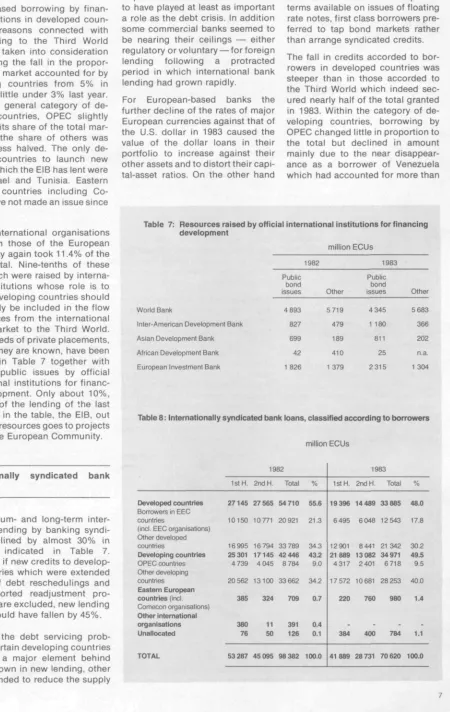
The increased borrowing by finan-cial institutions in developed coun-tries for reasons connected with their lending to the Third World should be taken into consideration in assessing the fall in the propor-tion of the market accounted for by developing countries from 5% in 1982 to a little under 3% last year. Within the general category of de-veloping countries, OPEC slightly increased its share of the total mar-ket while the share of others was more or less halved. The only de-veloping countries to launch new issues in which the EIB has lent were Egypt, Israel and Tunisia. Eastern European countries including Co-mecon have not made an issue since 1981.
In 1983 international organisations other than those of the European Community again took 11.4% of the market total. Nine-tenths of these funds which were raised by interna-tional institutions whose role is to lend to developing countries should accordingly be included in the flow of resources from the international capital market to the Third World. The proceeds of private placements, as far as they are known, have been included in Table 7 together with those of public issues by official international institutions for financ-ing development. Only about 10%, however, of the lending of the last institution in the table, the EIB, out of its own resources goes to projects outside the European Community.
and demand for credits. The swing in the OPEC current account ba-lance from a large surplus to a sig-nificant deficit — caused by the low-er price and demand of oil — seems to have played at least as important a role as the debt crisis. In addition some commercial banks seemed to be nearing their ceilings — either regulatory or voluntary — for foreign lending following a protracted period in which international bank lending had grown rapidly.
For European-based banks the further decline of the rates of major European currencies against that of the U.S. dollar in 1983 caused the value of the dollar loans in their portfolio to increase against their other assets and to distort their capi-tal-asset ratios. On the other hand
[image:7.580.92.542.104.816.2]the relatively slow pace of economic activity outside the U.S. held down credit demand from potential bor-rowers in many industrialised coun-tries and in view of the improved terms available on issues of floating rate notes, first class borrowers pre-ferred to tap bond markets rather than arrange syndicated credits. The fall in credits accorded to bor-rowers in developed countries was steeper than in those accorded to the Third World which indeed sec-ured nearly half of the total granted in 1983. Within the category of de-veloping countries, borrowing by OPEC changed little in proportion to the total but declined in amount mainly due to the near disappear-ance as a borrower of Venezuela which had accounted for more than
Table 7: Resources raised by official international institutions for financing development
World Bank
Inter-American Development Bank
Asian Development Bank
African Development Bank
European Investment Bank
1982
Public bond issues
4 893
827
699
42
1826
million ECUs
Other
5719
479
189
410
1379
1983
Public bond issues
4 345
1 180
811
25
2315
Other
5 683
366
202
n.a.
1 304
Table 8: Internationally syndicated bank loans, classified according to borrowers
million ECUs
Internationally loans
syndicated bank
New medium- and long-term inter-national lending by banking syndi-cates declined by almost 30% in 1983 as indicated in Table 7. Moreover, if new credits to develop-ing countries which were extended as part of debt reschedulings and IMF supported readjustment pro-grammes are excluded, new lending activity would have fallen by 45%. Although the debt servicing prob-lems of certain developing countries remained a major element behind the slowdown in new lending, other factors tended to reduce the supply
Developed countries Borrowers in EEC countries
(incl, EEC organisations) Other develooed countries
Developing countries OPEC countries Ottier developing countries Eastern European countries (incl. Comecon organisatkins) Other Intemational organisations Unallocated
TOTAL
IstH.
27145
10150
16995 25301 4 739
20 562
385
380 76
53 287
1982
2ndH.
27 565
10 771
16 794 17145 4 045
13100
324
11 50
45 095 Total
54 710
20 921
33 789 42 446 8 784
33 662
709
391 126
98 382
%
55.6
21 3
34.3 43.2 9.0
34.2
0.7
0.4 0.1
100.0
IstH.
19 396
6 495
12901 21889 4317
17 572
220
-38441889
1983
2nd H
14 489
6048
8 441 13 082 2 401
10 681
760
-40028731 Total
33 885
12543
21 342 34 971
6718
28 253
980
-78470620
%
48.0
17.8
302 49.5 9.5
40.0
1.4
-1.1half of new credits arranged in 1982. Algeria and Indonesia, however,
bor-rowed more.
Including Algeria, countries around the Mediterranean Basin, in which the EIB lends, obtained almost 50% more in syndicated credits in 1983. The increase was attributable not only to Algerian operations but also to those of Spain, Jordan and Tunisia. A decline in borrowing by Portugal and Morocco partly offset this increase. Reduced borro'^wing by the Ivory Coast, Papua New Guinea, Nigeria and Bermuda was respons-ible for a more than halving of lend-ing to the signatories of the Lomé Convention. .
A smaller amount of new credit was arranged for Latin-American bor-rowers in 1983. Only a small part consisted of the "voluntary and spontaneous" granting of credit as opposed to special financial pack-ages that included debt reschedul-ing. Among major Latin-American borrowers only Argentina and Chile arranged larger amounts of new cre-dit in 1983 than in the previous year. Lending to Eastern European coun-tries remained of minor importance as banks continued to hesitate over entering into new commitments and lending nnostly of a short-term trade related nature was generally to East Germany and Hungary.
Banks based in the U.S. continued to be the largest lenders followed by Japanese banks which benefited from the yen's relative stability against the U.S. dollar. In spite of the external deficit experience by most OPEC countries, Arab, banks also remained substantial suppliers of funds.
The U.S. dollar retained its domi-nance as a vehicle currency for in-ternational credits but lending de-veloped, if on a limited scale, in a number of other currencies includ-ing the pound sterlinclud-ing, Belgian and Luxembourg franc, Deutsche Mark, French franc, Swiss franc, Peseta, Canadian dollar, Saudi riyal. Yen, Hong Kong dollan Australian dollar, Singapore dollar. In line with its performance on the international bond market, the ECU has been accepted as a vehicle for syridicated credits.
The greater degree of caution adopted by international banks in 1982 in their syndicated lending continued to be evident in the terms attached to their credits in 1983
although a slight easing was dis-cernible towards the end of last year in credits negotiated with first class borrowers. Belgium, for example, obtained a 7-year credit in early 1983 in which a spread above the London inter-bank offered rate (LIBOR) of 0.375% applied to the first two years and one of 0.5% to the last five years. The same borrower obtained an eight year credit towards the end of 1983 in which the 0.375% spread applied to the first four years and the 0.5% spread to the remaining four. Not many internationally syndicated credits were granted to developing countries in the early part of 1983 but those which later succeeded in negotiating fresh credits obtained much the same terms as they had before. The spreads ranged from those on an eight year credit for Papua New Guinea of 0.625% above LIBOR for the first two years and 0.75% for the remaining six to 2.125% above LIBOR or 1.875% above the U.S. prime rate on the eight year credits which Brazil and Brazilian state enterprises managed to secure from the second quarter of the year onwards.
Borrowers, such as Sonatrach of Algeria were nearer the lower end of the range with spreads of 0.875% for the first nine years of a thirteen year credit and of 1 % for the remaining four. Gabon with spreads on its eight year borrowing split evenly between 1 % and 1.125% appeared in thé middle of the range. These few examples illustrate the conditions under which international banks continued to meet the financing re-quirements of a number of develop-ing countries in 1983.
In Eastern Europe which had also presented problems to lending syn-dicates the National Bank of Hun-gary obtained spreads of 1 % above LIBOR or 1.25% above the U.S. prime rate on a three year credit granted in the first quarter of the year; the same spreads were at-tached to a further credit negotiated in the third quarter of the year in which, however, the maturity was extended to six years. By the fourth quarter of 1983 the Czeehoslovens-ka Obchodni BanCzeehoslovens-ka had negotiated a four year credit carrying a 1.125% spread above LIBOR.
The international capital market s h o w e d in 1983 its resilience a n d
adaptability in dealing simultane-ously with an unsettling appreci-ation of the currency in which it mainly deaìs, the U.S. dollar, in terms of most other currencies, a substantial drainage of resources into the U.S.A. and some disquieting rises during 1983 in interest rates in a number of major currencies as well as the aftermath of the 1982 debt crisis of developing countries. The market has, however, grown to such a size that the reflux of funds in the form of interest maturities and capital redemptions gives it a certain momentum. In addition the inven-tiveness of borrowers and their agents has never failed to inspire them to seek ways of stimulating the appetites of investors who, it would seem, are unable or unwilling to remain on the sidelines indefinitely. The set-back to the syndicated cre-dit market, however, has been seri-ous and it has had to give ground to the advance of issues of floating rate notes. Signs were nevertheless ap-pearing in the latter part of 1983 of a prudent rebuilding of lending ac-tivity.
EIB-INFORMATION Is publjshed pe-riodically by thè European Invest-ment Bank in seven, different languages (Danish, Dutch, English, French, German, Greek and Italian). Material which appears in EIB-INFORMATION may be freely repro-duced; an acknowledgement would be appreciated and also a clipping of any article published.
100, bd Konrad Adenauer L-2950 Luxembourg ' t e i 4 3 7 9 - 1 - telex 3530 bnkeu lu
telecopier 43 7704 Department for Italy: Via Sardegna, 38 - 1-00187 Rome t e i 49 79 41 - telex 611130 bankeu i
telecopier 474 58 77 Representative Office in Brussels:
Rue de la Loi 227 B-1040 Brussels
tel. 230 98 90 - telex 21721 bankeu b telecopier: 23Ó 58 27
Liaison Office for the United Kingdom: 23, Queen Anne's Gate, Westminster
. London SWIH 9BU teL 222 2933 telex 919159 bankeu g
Telecopier 222 2936