This is a repository copy of Learning and performance outcomes of mental health staff
training in de-escalation techniques for the management of violence and aggression
.
White Rose Research Online URL for this paper:
http://eprints.whiterose.ac.uk/83735/
Version: Accepted Version
Article:
Price, O, Baker, JA, Bee, P et al. (1 more author) (2015) Learning and performance
outcomes of mental health staff training in de-escalation techniques for the management
of violence and aggression. British Journal of Psychiatry, 206 (6). pp. 447-455. ISSN
0007-1250
https://doi.org/10.1192/bjp.bp.114.144576
[email protected] https://eprints.whiterose.ac.uk/ Reuse
Items deposited in White Rose Research Online are protected by copyright, with all rights reserved unless indicated otherwise. They may be downloaded and/or printed for private study, or other acts as permitted by national copyright laws. The publisher or other rights holders may allow further reproduction and re-use of the full text version. This is indicated by the licence information on the White Rose Research Online record for the item.
Takedown
If you consider content in White Rose Research Online to be in breach of UK law, please notify us by
1 Title: Learning and performance outcomes of mental health staff training in de-escalation techniques
for the management of violence and aggression
Corresponding author: Owen Price
Address: Room 6.332, Jean McFarlane Building The University of Manchester
School of Nursing, Midwifery and Social Work University Place
Oxford Road Manchester M13 9PL
Tel: 0161 306 7877
E-mail: [email protected]
Co-authors: John Baker, Penny Bee & Karina Lovell
2 ABSTRACT
Background: De-escalation techniques are a recommended non-physical intervention for the
management of violence and aggression in mental health. Although taught as part of mandatory training for all NHS mental health staff, there remains a lack of clarity around training effectiveness.
Aim: To conduct a systematic review of the learning, performance and clinical safety outcomes of
de-escalation techniques training.
Method: The review process involved a systematic literature search of 20 electronic databases,
eligibility screening of results, data extraction, quality appraisal, and data synthesis.
Results: 38 relevant studies were identified. The strongest impact of training appears to be on de-escalation-related knowledge, confidence to manage aggression and de-escalation performance (although limited to artificial training scenarios). No strong conclusions could be drawn about the impact of training on assaults, injuries, containment and organisational outcomes owing to the low quality of evidence and conflicting results.
Conclusions: It is assumed that escalation techniques training will improve staff’s ability to
de-escalate violent and aggressive behaviour and improve safety in practice. There is currently limited evidence that this training has these effects.
Declaration of interest: Owen Price has received a Doctoral Research Fellowship from the National
Institute of Health Research to explore ways of improving mental health staff use of de-escalation techniques. This review represents one part of the fellowship project. The authors declare no other relevant interest.
<INSERT BOX 1 HERE>
BACKGROUND
Violence and aggression occur frequently in mental health settings (1) and are associated with significant individual costs to those assaulted, as well as substantial economic costs to the health service (2). Serious service user safety concerns have been reported about the use of physical restraint to manage violence and aggression in these settings, including death as a result of positional asphyxia (3) and symptoms of post-traumatic stress (4). Such serious consequences have resulted in the prioritisation of non-physical approaches, such as de-escalation techniques, in both US (5) and UK violence and aggression management policy (6). De-escalation techniques aim to stop the escalation of aggression to either violence or the use of physically restrictive practices via a range of
psychosocial techniques (7). These typically involve the use of non-provocative verbal and non-verbal clinician communication to negotiate a mutually agreeable solution to the aggressor’s concerns (8). Evidence of wide variation in skill levels among staff (9) may be a barrier to the effectiveness of these techniques, and suggests a potentially influential role for training in addressing skills deficits and their associated harms. Although training in de-escalation techniques is now a key component of
3
DE-ESCALATION TECHNIQUES TRAINING - MODE OF ACTION
To inform a robust evaluation of the evidence, it is important to first develop a conceptual
understanding of training function. Effective training has previously been conceptualised as a series of cognitive (knowledge, self-awareness, self-regulation), affective (enhanced motivation, self-efficacy) and skills-based improvements, combined with a transfer of learning to improved job performance (11). This review will use this framework to evaluate the effectiveness of de-escalation techniques training. The literature suggests that staff de-escalation techniques may be influenced either directly, through skills-teaching (12) or, indirectly, through modification of staff attitudes to service users, the nature of their mental health problems and their attributions as to the causes of aggression (13, 14). Both approaches are thought to improve interpersonal styles when faced with aggression, reducing the risk of assault (table 1). This review will incorporate the evaluation of both approaches, which can be delivered either individually or in combination.
<INSERT TABLE 1 HERE>
AIM
To evaluate the effectiveness of de-escalation techniques training through direct skills-teaching and/or staff attitude modification.
OBJECTIVES
• To identify potential moderatorsof the effectiveness of training. • To identify evidence of the acceptability of training interventions. REVIEW METHODS
SEARCH STRATEGY
Search terms were developed to answer the review objectives using the key concepts of mental health, staff attitudes, de-escalation techniques, training, and violence (full strategy available upon
request).The search strategy was subject to a preliminary validity check and then applied to:AMED, ASSIA, Social Services Abstracts, British Nursing Index (and archive), EMBASE, MEDLINE, PsycINFO, Cochrane Library (all sources), SSCI + SCIEXPANDED, CINAHL, metaRegister of Controlled Trials; all from database inception to August 2014. After eligibility screening and obtaining the final sample of included studies, each study’s reference list was screened to identify further studies that had not been identified (figure 1).
SELECTION CRITERIA
Inclusion criteria
Population
• Healthcare staff working with adult populations with mental health problems aged (18-65).
Intervention
• Training with a de-escalation techniques component.
• Training aiming to reduce violence and aggression AND/OR improve de-escalation skills
4
Design
• Quantitative studies evaluating training effectiveness and/or moderators of effectiveness
• Qualitative studies examining acceptability of training interventions.
Outcomes
• Cognitive, affective, skills-based, clinical and organisational outcomes of training (as per
table 1)
Exclusion criteria
Population
• Training of non-healthcare staff (police, security staff). • Non-working age service users.
• Learning disabilities services.
Intervention
• Training without de-escalation techniques or attitudinal component.
Design
• Non-primary research (reviews, opinion, discussion papers). • Grey literature
Outcomes
• Implementation studies providing no data on effectiveness, moderators or acceptability.
• Evaluations aiming to modify staff attitudes to aggression without investigating the
resultant impact on de-escalation performance or clinical outcomes.
ELIGIBILITY SCREENING
Duplicates were removed and screening conducted on titles and abstracts and full text according to the eligibility criteria. Selection of full text articles were independently verified by two researchers. DATA EXTRACTION
Extracted data were assigned to five categories of outcome: cognitive, affective, skills-based, and clinical and organisational outcomes (table 1). Moderators were extracted at staff level, service user level, organisational level, environmental level and training level (characteristics of training). Further data extracted included: acceptability of interventions, contextual information about the design and delivery of interventions, and design of the studies. Verification of extractions was completed independently by two researchers. The team met and potential errors/disagreements were resolved through team consensus (Data extraction tables are available on request).
QUALITY APPRAISAL
The methodological quality of included quantitative studies was appraised using the ‘Quality
5
demonstrates acceptable construct validity and inter-rater reliability (Kappa= between 0.61 and 0.74) (15). Quality assessment decisions were independently verified by two researchers who met and potential errors/disagreements were discussed and resolved through third party consensus. Quality of moderator analyses was assessed using four key criteria suitable for use with non-randomised studies. These were: the validity of tools used to detect moderators; the number of potential moderators tested (measuring fewer variables may enhance the reliability of predictor effects); hypothesis of predictor effects determined a priori (i.e. findings are confirmatory rather than exploratory); analysis involves direct testing of the relationship between the predictor and the independent variable (16). Quality of qualitative acceptability data was assessed using the COREQ, a checklist for appraisal of qualitative studies across three domains: (i) research team and reflexivity, (ii) study design and (iii) data analysis and reporting (17).
DATA SYNTHESIS
Qualitative and quantitative data were analysed separately. An initial scoping review of the available evidence revealed substantial heterogeneity of study designs and, with such small number of eligible studies returned for each outcome category, conducting a meaningful
meta-analysis was impossible. All quantitative data was tabulated according to key training outcomes
(cognitive, affective, skills-based, and clinical and organisational outcomes). Standardised Effect Sizes (Cohen’s d) were calculated for papers reporting data appropriately. Effect sizes were not calculated when no means and SDs were reported or when the product of a statistical test was omitted.
There was insufficient qualitative data to subject it to formal qualitative data analysis. The few open-ended comments about the training that were identified, were organised into themes and
agreed by the review team. Quantitative and qualitative data were then synthesised into narratives
for each of the relevant outcomes.
RESULTS
<INSERT FIGURE 1 HERE> SEARCH RESULTS
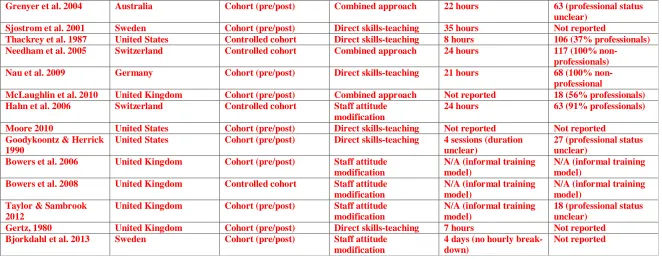
The search identified 38 relevant studies from 10174 hits (Figure 1). 26 studies were focused on direct skills-teaching, 6 studies aimed to influence either de-escalation performance or reduce violence and aggression through modification of staff attitudes, and 6 used a combination of both approaches
(Table 2). There were 23 uncontrolled cohort studies, 12 controlled cohort studies, and 3 case control studies (Table 2). No RCTs, the gold standard for intervention effectiveness, were identified. Studies were predominantly conducted in the United States (n=10) or the United Kingdom (n=14). Samples were biased toward unqualified staff (64% unqualified versus 36% qualified) and student nurse populations (39% of the total trained participants). 7 studies provided a rudimentary qualitative evaluation of training acceptability (18-24).
<INSERT TABLE 2 HERE>
Heterogeneity of intervention intensity and content
6
inadequate reporting in 3 studies and due to the informal nature of the training in a further 5 studies
(Table 2). Secondly, there was variation both in the de-escalation techniques taught and the amount
and content of adjunct training delivered. A full description of these differences is provided in tables 3 and 4).
<INSERT TABLE 3 HERE> <INSERT TABLE 4 HERE> QUALITY APPRAISAL
Overall the quality of the studies was moderate to weak. 1 study was rated as strong, 18 as moderate and 19 as weak (Table 5). Judgement of the representativeness of study samples was, in many cases, problematic. Often, studies failed to report how participants, wards or hospitals were recruited and only 11/37 studies reported response rates. Of those, seven had rates of uptake between 80-100%, although none provided data on non-respondents (Table 5). Although a number of the studies either reported potentially confounding differences between intervention and control groups at baseline or between service configuration or delivery models pre-and-post intervention (9, 18, 25-34), these were often not adjusted for in the analysis (18, 27, 29-34). Where wards or units were the units of allocation and/or analyses, insufficient information was provided about the baseline equivalence of these (35, 36). A number of uncontrolled studies failed to report on possible population/organisational differences between pre-and-post intervention periods (22-24, 37-40). The eight studies reporting participant withdrawals (Table 5) had a mean retention rate of 72.7% (SD19.66, range 32-91.1%). Included studies examining intervention effectiveness were limited by the absence of active controls in all but two studies (31, 41). Four studies where de-escalation performance was rated by
independent assessors reported good blinding procedures (9, 28, 29, 31). Studies frequently failed to evidence adequate validity and reliability of outcome measures (Table 5). Of nine studies providing evidence of potential moderators of effectiveness (9, 20, 28, 29, 31, 32, 42-44), only three (9, 20, 28) met at least three of the four key quality criteria for moderator analyses. Of the seven studies
providing a qualitative evaluation of the acceptability of training (18-24), none provided sufficient methodological detail to meet any of the COREQ quality standards.
<INSERT TABLE 5 HERE>
MAIN OUTCOMES
Direct skills-teaching as a predictor of improved de-escalation performance and related outcomes
Cognitive outcomes
Included studies generally supported the capacity of training to enhance de-escalation-related knowledge. Of five studies providing pre/post training data on this outcome, the four of comparable study quality (moderate) and training intensity (medium) (20, 31, 45, 46), were consistent in finding large (ES 0.91 (31), ES 1.13 (20), ES 1.39 (45)) and significant
de-escalation-related knowledge gains associated with training (20, 31, 45, 46). The final study, using
7
There was no evidence of differences in knowledge gains between professional groups pre-and-post training (20) but a regression analysis found staff occupation, rather than current level of clinical exposure to aggression predicted baseline level of de-escalation knowledge (20). This suggests that experience and prior training, rather than exposure to aggression predicts de-escalation knowledge (20). As might be expected, staff with no prior training improved the most (20).
Affective outcomes
Findings were consistent across study design, quality and training intensity in supporting
increased confidence to manage aggression associated with training. Nine of ten studies reported
significantly increased confidence post training (21, 28, 31-33, 45, 48-50). However, effect sizes were only calculable for four studies, with two negligible effects (ES<0.2) (32, 45), one medium-sized effect (ES0.76) (31) and one large (ES1.04) (50). Increases in confidence after training was reported elsewhere but the significance of this finding was not evaluated (22). Surprisingly, given the evidence of increased confidence, there was no evidence that the training impacted on subjective anxiety regulation in the management of aggression (19, 29, 32, 43), although one study reported a medium sized (ES0.54) non-significant reduction in feelings of anxiety post-training (29). There was some, albeit limited, evidence that training may, in the short term, sensitize participants to the risk of assault and increase anxiety (32).
Moderators of affective outcomes
Three studies revealed potential moderators of affective outcomes. As expected, more experienced staff had the highest levels of confidence to manage aggression (32). Staff working in areas of greatest acuity appear to benefit most in terms of confidence gains from training (31), and male participants may rate themselves as more able to regulate anxiety when faced with aggression than female participants (42).
Skills-based outcomes
The six studies investigating skill improvements, varied in both study quality and training intensity but generally supported the capacity of training to improve de-escalation performance.
Four studies reported significant objectively measured post-training improvements (9, 29, 31, 46) (effect sizes calculable for only two studies both demonstrating large effect sizes >0.8 (29, 31)); and there also was evidence of self-rated improvements (19). Negative findings included: reduction in self-rated de-escalation ability after training (43) and objectively measured improvements not reflected in participants’ subjective ratings (29).
Moderators of skills-based outcomes
8
Clinical outcomes
Assault rate
Irrespective of study design, quality or training intensity, findings for this outcome were mixed.
No clear evidence of the impact of this training on assault rate could therefore be derived. Of
five studies measuring risk of assault at ward level, three found a significantly reduced risk of assault (26, 27, 31) and two found no significant effect (34, 36). Three studies measured the risk of assault at the level of individual staff and only one (30) found a significant reduction (ES0.77), with two reporting no effect of training (26, 27).
Incidence of aggression
Eleven studies investigated the impact of training on aggressive incidents more broadly, which included verbal aggression and violence toward objects. Findings were often negative, irrespective of training intensity or study quality, with studies either reporting no effect on incident rate or severity (25, 34, 36, 41), or increases in aggression post-training (likely due to improved reporting post training) (39). There was even evidence that de-escalation trained wards increased staff risk exposure to being involved in an aggressive incident when compared to Control and Restraint trained wards (35), but there was a high risk of other programmatic or organisational variables being
responsible for this outcome. Again, there was evidence of a significant reduction in incident rates measured at ward level (26, 31) in two studies of moderate quality, one of these demonstrating a medium effect size (ES0.64) (31). Significant reductions in severity of incidents were also reported (26, 36), although the significance of this effect was marginal (P=0.52) in one of these (36). Three weak studies reported reductions in incident rate but failed to evaluate the significance of these effects (22-24).
Injuries
Results were again mixed, although the stronger two of four studies evaluating this outcome
demonstrated positive effects in reducing injuries (30, 41). There was evidence of a significant and
large (ES1.13) reduction in wards with high compliance with training compared with low compliance wards and the active control (CPR training) (41). This reduction was not found at individual staff level where the training was marginally outperformed by the active control in terms of reduced risk of injury (training ES0.3, CPR ES0.37); although a significant reduction at individual staff level was found in another study of similar design and quality (30). Two weak studies found no effect on injury rates (38, 39).
Containment
9 Moderators of clinical outcomes
No moderators of clinical outcomes were identified.
Organisational outcomes
A range of organisational benefits were reported among six studies that provided data on this
outcome. These included a highly significant, large (ES1.47) reduction in lost workdays (31) and two weak studies also supported this finding but failed to evaluate significance (18, 39). Further benefits, reported without evaluating significance, included: improved staff retention (18), reduced complaints (18), and reduced overall expenditure (18, 39). There were negative findings, including a non- significant increase in sick leave (34), and increased service user hospitalisation periods for de-escalation trained wards compared with control and restraint trained wards (35). However, variation in programmatic or organisational variations between study sites limits the interpretation of these data. No moderators of organisational outcomes were identified.
Attitudinal change as a predictor of improved de-escalation related outcomes
No study of moderate quality or above provided any evidence of attitudinal change impacting de-escalation performance or rates of violence and aggression (13, 49, 51, 52). Of three studies that used adequately validated scales, one measured attitudes toward service users in general (52) and two measured attitudes toward aggression (13, 49). Improvements in de-escalation performance were assumed via measured increases in confidence to manage service user aggression (49) via preference for aggression management method (an increase in preferences for non-physical methods indicating a positive result) (13), or via reductions in staff-patient conflict (52).
None of these studies influenced staff attitudes in the hypothesised direction (13, 49, 52). Noting this, there were anomalous findings: desirable outcomes (increased confidence to manage aggression (49)) and reduced staff-patient conflict (52) (although with a negligible effect size ES0.13) were achieved independently of attitudinal change. It should be noted that when this study was repeated using a more rigorous, controlled design, no effect on conflict was observed (51). Evidence to support attitudinal change to service user aggression as a mechanism for improving de-escalation related outcomes was only found in weak studies (19, 22, 40, 44, 50, 53).
Moderators of attitudinal change
10 Acceptability of training interventions
Seven studies provided some rudimentaryqualitative evaluation of training interventions but were weak in methodological quality. All studies, except one, in which a large number of participants perceived no impact of the training on their practice (21), reported positive views of the training. The reasons for the negative finding were not established (21). Improvements participants felt were important for the training included the following four themes:
Duration and frequency of training
The participants expressed the importance of increasing the frequency of training and regular refresher courses to maintain learning (18, 20, 22, 24).
Delivery methods
Participants felt that the training should be relevant to the clinical context in which they work (20) and that trainer supervision and feedback on actual clinical interactions would be useful (18, 20). They wanted a stronger emphasis on role plays and a broad spectrum of case studies (20, 24) and there was a preference for live demonstrations rather than videotaped scenarios (24). They also wanted a written manual on de-escalation to keep with them on the wards (18). The importance of delivering training to all levels of the MDT and training whole wards together to enable team approaches was emphasised (22, 23).
Intervention content
There was evidence of a perceived need for training content that considered aggression from a range of perspectives i.e. aggression motivated by both illness and non-illness factors (20).
Facilitator attributes
Participants wanted trainers to have practice credibility i.e. current ward experience so that training content could be directly linked to situations participants experience on the wards (20).
DISCUSSION
This review has synthesised the available evidence pertaining to de-escalation techniques training. There was insufficient evidence to consistently demonstrate cognitive, affective, skills-based improvements and transfer to enhanced job performance either through direct skills-teaching or attitude modification. De-escalation techniques are interventions predicated on a desire to enhance safety through reducing violence and the physical and psychological harms associated with it. It is thus, somewhat surprising, that only 18/38 included studies measured effectiveness via key safety outcomes such as rates of violence and aggression and/or the use of potentially harmful (3) containment strategies such as physical restraint. Furthermore, a large proportion of the included studies were rated as methodologically weak. Therefore, given the limited quality of the existing evidence, only tentative conclusions can be drawn about the effectiveness of this intervention.
Direct skills-teaching
11
useful in terms of predicting improvements in actual behaviour when faced with aggression. There may be no relationship between confidence to manage aggression and de-escalation performance (28), possibly because excessive self-confidence may be perceived as threatening to the aggressor and counterproductive to de-escalation efforts (28). It is possible that qualities such as self-awareness and the ability to connect interpersonally with service users may have a more pivotal role in effective de-escalation (28, 32). Measurement of these outcomes, rather than confidence, may be more appropriate in future intervention research.
This review found consistent evidence of objectively measured improvements in de-escalation performance post-training. However, these improvements were often measured on un-validated scales and limited to artificial training scenarios. As such, little can be concluded about the effective transfer of these skills to aggressive situations during routine practice. This review identified no evidence that age, occupation, level of experience or gender are reliable predictors of de-escalation performance,
either at baseline, endpoint or in terms of extent of improvement as a result of training. Within
the limited evidence available, there is therefore nothing to suggest that clinical managers should prioritise certain subgroups of staff over others for de-escalation training.
Few strong conclusions can be drawn about the impact of training on assaults, injuries, containment and organisational outcomes owing to a) the poor quality of evidence and b) conflicting results. The most consistent evidence of impact on clinical outcomes was on rates of violence, aggression and injuries at ward rather than individual level. Wards with high compliance with training appear to benefit more from training than those with low compliance (27, 31, 41). This may be explained through wards adopting whole team approaches that are more likely to reduce the risk of assault than individual advances in knowledge and skills (41). Clinical managers should not only ensure that sufficient numbers of their staff are trained but also that as many staff as possible are trained together at the same time, to foster such approaches and facilitate maximal gain.
Attitude modification
There was little evidence to suggest that de-escalation skills may be influenced through modification of staff attitudes. No study using validated measures detected positive attitudinal changes to service users or to aggression. Although one study reported significant reductions in conflict (52), the effect size was small and the effect was not found when the study was repeated under more rigorous
12 Review limitations
To limit heterogeneity of training interventions included, only studies of healthcare staff working with working age adult (18-65) populations were reviewed. It is probable that, to meet the specific needs of populations outside this group, substantial variation in training exists. This decision was therefore intended to enhance the precision of the review’s findings and
conclusions. However, it is accepted that this may have excluded potentially relevant data. It is also possible that the exclusion of grey literature may have excluded potentially relevant data.
The inclusion criteria for included interventions were relatively broad and, as such, these included additional components delivered in conjunction with de-escalation content (such as physical restraint training). This was a pragmatic decision based on the observation that this is a) often how the intervention is delivered in practice (56), and b) these interventions make up a substantial proportion of the evaluation research on this topic. Nevertheless, this may have complicated the isolation of the effect of the de-escalation components of the interventions. However, assessments of the effectiveness of de-escalation components could often be deduced from the nature of the outcome. For example, reductions in aggressive incidents and restraint usage would likely be a consequence of enhanced de-escalation techniques rather than learnt restraint techniques. Extractions and quality appraisal decisions were verified rather than independently conducted, which may have increased the risk of error/bias at these stages. Finally, due to the nature of existing evidence, the sample of studies was biased toward unqualified and student nurse populations. These factors may have reduced the generalisability of the review findings.
Recommendations
The development of evidence-based interventions followed by feasibility studies measuring both de-escalation performance and transfer to enhanced clinical and organisational outcomes is needed. This may require either new measures of de-escalation performance or further validation of existing measures. The limited acceptability data suggest that trainees are supportive of increased use of role play, case studies and prefer facilitators with relevant practice credibility. However, no empirical evidence of the relative effectiveness of methods of delivery or facilitator attributes was identified. Future work should include qualitative inquiry exploring issues of transfer of training to improved performance and the optimum delivery methods for this form of training. As a minimum, this should be conducted with staff who receive the training and training facilitators. Training staff in non-physical conflict resolution represents a substantial and costly proportion of NHS mandatory training. It is assumed that this training may improve staff’s ability to de-escalate violent and aggressive behaviour. There is currently limited evidence to suggest that this form of training has this desirable effect.
FUNDING
Owen Price has received a Doctoral Research Fellowship from the National Institute of Health Research to explore ways of improving mental health staff use of de-escalation techniques. This review represents one part of the fellowship project.
REFERENCES
13 2. NHS. Cost of violence against NHS staff: A report summarising the economic cost to the NHS of violence against staff 2007/8. NHS Security Management Service. 2010.
3. Paterson B, Bradley P, Stark C, Saddler D, Leadbetter D, Allen D. Deaths associated with restraint use in health and social care in the UK. The results of a preliminary survey. J Psychiatr Ment Health Nurs. 2003;10:3-15.
4. Bonner G, Lowe T, Rawcliffe D, Wellman N. Trauma for all: a pilot study of the subjective experience of physical restraint for mental health inpatients and staff in the UK. J Psychiatr Ment Health Nurs. 2002;9(4):465-73. Epub 2002/08/08.
5. Richmond J, Berlin J, Fishkind A, Holloman, Jr., Zeller S, Wilson M, et al. Verbal de-escalation of the agitated patient: Consensus statement of the American Association for emergency psychiatry project BETA De-escalation workgroup. Western Journal of Emergency Medicine. 2012;13(1):17-25. 6. NICE. Violence: The Short-Term Management of Disturbed/Violent Behaviour in In-Patient Psychiatric Settings and Emergency Departments. London: Royal College of Nursing.; 2005 Feb. 7. Bowers L, James K, Quirk A, Wright S, Williams H, Stewart D. Identification of the “Minimal Triangle” and Other Common Event-to-Event Transitions in Conflict and Containment Incidents. Issues Ment Health Nurs. 2013;34:514-23.
8. Price O, Baker J. Key components of de-escalation techniques: A thematic synthesis. Int J Ment Health Nurs. 2012;21(4):310-9.
9. Nau J, Halfens R, Needham I, Dassen T. Student nurses' de-escalation of patient aggression: a pretest-posttest intervention study. Int J Nurs Stud. 2010;47(6):699-708.
10. NHS. Promoting safer and therapeutic services: Implementing the national syllabus in mental health and learning disability services. NHS Security Management Service. 2005.
11. Kraiger K, Ford K, Salas E. Application of cognitive, skill-based, and affective theories of learning outcomes to new methods of training evaluation. J Appl Psychol Monograph.
1993;78(2):311-28.
12. Beech B, Leather P. Workplace violence in the healthcare sector: a review of staff training and integration of training evaluation models. Aggress Violent Beh. 2006;11:27-43.
13. Hahn S, Needham I, Abderhalden C. The effect of a training course on mental health nurses' attitudes on the reasons of patient aggression and its management. J Psychiatr Ment Health Nurs. 2006;13(2):197-204.
14. Endley L, Berry K. Increasing awareness of expressed emotion in schizophrenia: an evaluation of a staff training session. J Psychiatr Ment Health Nurs. 2011;18(3):277-80.
15. Thomas BH, Ciliska D, Dobbins M, Micucci S. A process for systematically reviewing the literature: Providing the research evidence for public health nursing interventions. Worldviews Evid Based Nurs. 2004;1(3):176-84.
16. Knopp J, Knowles S, Bee P, Lovell K, Bower P. A systematic review of predictors and
moderators of response to psychological therapies in OCD: do we have enough empirical evidence to target treatment? Clin Psychol Rev. 2013;33:1067-81.
17. Tong A, Sainsbury P, Craig J. Consolidated criteria for reporting qualitative research (COREQ): a 32-item checklist for interviews and focus groups. Int J Qual Health C. 2007;19(6):349-57.
18. Smoot S, Gonzales J. Cost-effective communication skills training for state hospital employees. Psychiatr Serv. 1995;46(8):819-22.
19. Beech B. Sign of the times or the shape of things to come? A 3-day unit of instruction on 'aggression and violence in health settings for all students during pre-registration nurse training'. Accident and Emergency Nursing. 2001;9(204-211).
20. Ilkiw-Lavalle O, Grenyer B, Graham L. Does prior training and staff occupation influence knowledge acquisition from an aggression management training program? Int J Ment Health Nurs. 2002;11(4):233-9.
14 22. McLaughlin S, Bonner G, Mboche C, Fairlie T. A pilot study to test an intervention for dealing with verbal aggression. Br J Nurs. 2010;19(8):489-94. Epub 2010/05/28.
23. Gertz B. Training for prevention of assaultive behavior in a psychiatric setting. Hosp Community Psych. 1980;31(9):628-30.
24. Goodykoontz L, Herrick CA. Evaluation of an inservice education program regarding aggressive behavior on a psychiatric unit. J Contin Educ Nurs. 1990;21(3):129-33.
25. Laker C, Gray R, Flach C. Case study evaluating the impact of de-escalation and physical intervention training. J Psychiatr Ment Health Nurs. 2010;17(3):222-8.
26. Needham I, Abderhalden C, Meer R, Dassen T, Haug H, Halfens R, et al. The effectiveness of two interventions in the management of patient violence in acute mental inpatient settings: Report on a pilot study. J Psychiatr Ment Health Nurs. 2004;11(5):595-601.
27. Whittington R, Wykes T. An evaluation of staff training in psychological techniques for the management of patient aggression. J Clin Nurs. 1996;5(4):257-61.
28. Nau J, Dassen T, Needham I, Halfens R. Sensitivity, specificity and predictive value of
Confidence in Managing Patient Aggression Scale on de-escalating behaviour. J Clin Nurs 2011;20(17-18):2584-6.
29. Wondrak RF, Dolan BM. Dealing with verbal abuse: evaluation of the efficacy of a workshop for student nurses. Nurse Educ Today. 1992;12(2):108-15. Epub 1992/04/01.
30. Infantino JA, Musingo S-y. Assaults and injuries among staff with and without training in aggression control techniques. Hosp Community Psych. 1985;36(12):1312-4.
31. Rice M, Helzel M, Varney G, Quinsey V. Crisis prevention and intervention training for psychiatric hospital staff. Am J Commun Psychol. 1985;13(3):289-304.
32. McIntosh D. Testing an intervention to increase self-efficacy of staff in managing clients perceived as violent. PhD, University of Cincinnati, Nursing : Doctoral Program in Nursing. 2003. 33. Thackrey M. Clinician confidence in coping with patient aggression: assessment and enhancement. Prof Psychol Res Pr. 1987;18(1):57-60.
34. Sjostrom N, Eder DN, Malm U, Beskow J. Violence and its prediction at a psychiatric hopsital. Eur Psychiat. 2001;16:459-65.
35. Lee S, Gray R, Gournay K. Comparing the outcomes of the application of C&R (general service) and SCIP in the management of disturbed behaviour in mental health care. J Ment Health. 2012;21(3):307-17.
36. Nijman HL, Merckelbach HL, Allertz WF, a Campo JM. Prevention of aggressive incidents on a closed psychiatric ward. Psychiatr Serv. 1997;48(5):694-8. Epub 1997/05/01.
37. Jonikas J, Cook J, Rosen C, Laris A, Kim J. A program to reduce use of physical restraint in psychiatric inpatient facilities. Psychiatr Serv. 2004;55(7):818-20.
38. Moore D. The least restrictive continuum. Institute for Nursing Newsletter. 2010;6(3):5-6. 39. Martin KH. Improving staff safety through an aggression management program. Arch Psychiatr Nurs. 1995;9(4):211-5.
40. Bjorkdahl A, Hansebo G, Palmstierna T. The influence of staff training on the violence prevention and management climate in psychiatric inpatient units. Journal of Psychiatric & Mental Health Nursing. 2013;20:396-404.
41. Carmel H, Hunter M. Compliance with training in managing assaultive behavior and injuries from inpatient violence. Hosp Community Psych. 1990;41(5):558-60.
42. Beech B. Aggression prevention training for student nurses: Differential responses to training and the interaction between theory and practice. Nurse Education in Practice. 2008;8(2):94-102.
43. Beech B, Leather P. Evaluating a management of aggression unit for student nurses. J Adv Nurs. 2003;44(6):603-12.
15 45. Calabro K, Mackey TA, Williams S. Evaluation of training designed to prevent and manage patient violence. Issues Ment Health Nurs. 2002;23(1):3-15.
46. Paterson B, Turnbull J, Aitken I. An evaluation of a training course in the short-term management of violence. Nurse Educ Today. 1992;12(368-375).
47. Cowin L, Davies R, Estall G, Berlin T, Fitzgerald M, Hoot S. De-escalating aggression and violence in the mental health setting. Int J Ment Health Nurs. 2003;12(1):64-73.
48. Robinson T, Hills D, Kelly B. The evaluation of an online orientation to rural mental health practice in Australia. J Psychiatr Ment Health Nurs. 2011;18(7):629-36.
49. Needham I, Abderhalden C, Zeller A, Dassen T, Haug H, Fischer JE, et al. The effect of a training course on nursing students' attitudes toward, perceptions of, and confidence in managing patient aggression. J Nurs Educ. 2005;44(9):415-20.
50. Grenyer BFS, Ilkiw-Lavalle O, Biro P, Middleby-Clements J, Comninos A, Coleman M. Safer at work: development and evaluation of an aggression and violence minimization program. Aust NZ J Psychiat. 2004;38(10):804-10.
51. Bowers L, Flood C, Brennan G, Allan T. A replication study of the City nurse intervention: reducing conflict and containment on three acute psychiatric wards. J Psychiatr Ment Health Nurs. 2008;15(9):737-42.
52. Bowers L, Brennan G, Flood C, Lipang M, Oladapo P. Preliminary outcomes of a trial to reduce conflict and containment on acute psychiatric wards: City Nurses. J Psychiatr Ment Health Nurs. 2006;13(2):165-72.
53. Taylor KN, Sambrook S. CBT for Culture Change: Formulating Teams to Improve Patient Care. Behav Cogn Psychoth. 2012;40(4):496-503.
54. Needham I, Abderhalden C, Halfens R. The effect of a training course in aggression management on mental health nurses; perceptions of aggression: a cluster randomised controlled trial. Int J Nurs Stud. 2005;42(6):649-55.
55. Corker E, Hamilton S, Henderson C, Weeks C, Pinfold V, Rose D, et al. Experiences of discrimination among people using mental health services in England 2008-2011. Brit J Psychiat 2013;202:s58-s63.
56. Bowers L, Nijman H, Allan T, Simpson A, Warren J, Turner L. Prevention and management of aggression training and violent incidents on U.K. Acute psychiatric wards. Psychiatr Serv.
16
BOXES, TABLES AND FIGURES
Box 1 Glossary
Moderators: baseline variables that may affect the
relationship between independent and dependent variables.
Grey literature: literature published outside of conventional academic channels i.e. outside of electronic databases and online journals.
17
Training approach Cognitive outcomes Affective outcomes Behaviour change Clinical outcome Organisational
outcomes
Direct skills teaching Knowledge of
behavioural skills and strategies for emotional regulation
Increased confidence/ self-efficacy
- Enhanced interpersonal style when managing aggressive behaviour
- Emotionally regulated when faced with aggressive behaviour
Reduced assaults
Reduced containment usage
Reduced expenditure
Modification of staff attitudes
Accurate understanding of the nature of service users’ problems and the causes of the aggression
- Reduced negative emotions (fear/ anger/ blame)
- Increased empathy
- Reduced behaviours likely to provoke escalations (avoidance/ hostility/criticism)
- Understands SU needs during escalation
- More compassionate responses to escalation
- Reduced escalations
- Reduced assaults
Reduced containment usage
Reduced expenditure
18
Study ref Study country Design Training approach Duration of training Trainees
Collins 1994 United Kingdom Cohort (pre/post) Staff attitude
modification
Not reported 26 (27 % professionals)
Whittington & Wykes 1996
United Kingdom Controlled cohort Direct skills-teaching 7 hours 155 (
77% professionals)
Nijman et al. 1997 Netherlands Controlled cohort Direct skills-teaching Two sessions (duration
unclear)
Not reported
Smoot & Gonzales 1995 United States Controlled cohort Direct skills-teaching 32 hours 65 (professional status
unclear)
Jonikas et al. 2004 United States Cohort (pre/post) Direct skills-teaching 7 hours Not reported
Nau et al. 2010 Germany Controlled cohort Direct skills-teaching 24 hours 76 (100%
non-profesionals)
Nau et al. 2011 Germany Controlled cohort Direct skills-teaching 24 hours 65 (100%
non-professionals)
Cowin et al. 2003 Australia Cohort (pre/post) Direct skills-teaching Not reported 49 (100% professionals)
Wondrak & Dolan 1992 United Kingdom Controlled cohort Direct skills-teaching 1.5 hours 29 (100%
non-professionals)
Beech & Leather 2003 United Kingdom Cohort (pre/post) Combined approach 21 hours 243 (100%
non-professionals)
Beech 2008 United Kingdom Cohort (pre/post) Combined approach 21 hours 243 (100%
non-professionals)
Beech 2001 United Kingdom Cohort (pre/post) Combined approach 21 hours 58 (100%
non-professionals)
Lee et al. 2012 United Kingdom Case control Direct skills-teaching 28 hours Not reported
Infantino & Musingo 1985
United States Case control Direct skills-teaching 7 hours 96 (100%
non-professionals)
Carmel & Hunter 1990 United States Case control Direct skills-teaching 6-8 hours Not reported
Needham et al. 2004 Switzerland Cohort (pre/post) Direct skills-teaching 35 hours Not reported
Rice et al. 1985 Canada Controlled cohort Direct skills-teaching 35 hours 135 (professional status
unclear)
Martin 1995 United States Cohort (pre/post) Direct skills-teaching 21 hours Not reported
Ilkiw-Lavelle et al. 2002 Australia Cohort (pre/post) Direct skills-teaching 14 hours 103 (53% professionals)
Paterson et al. 1992 United Kingdom Cohort (pre/post) Direct skills-teaching 70 hours 25 (100% professionals)
Laker et al. 2010 United Kingdom Cohort (pre/post) Direct skills-teaching Not reported Not reported
Calabro et al. 2002 United States Cohort (pre/post) Direct skills-teaching 10 hours 118 (50% professionals)
McIntosh 2003 United States Controlled cohort Direct skills-teaching 8 hours 82 (52% professionals)
Robinson et al. 2011 Australia Cohort (pre/post) Direct skills-teaching Online course over 24
weeks
19
Grenyer et al. 2004 Australia Cohort (pre/post) Combined approach 22 hours 63 (professional status
unclear)
Sjostrom et al. 2001 Sweden Cohort (pre/post) Direct skills-teaching 35 hours Not reported
Thackrey et al. 1987 United States Controlled cohort Direct skills-teaching 8 hours 106 (37% professionals)
Needham et al. 2005 Switzerland Controlled cohort Combined approach 24 hours 117 (100%
non-professionals)
Nau et al. 2009 Germany Cohort (pre/post) Direct skills-teaching 21 hours 68 (100%
non-professional
McLaughlin et al. 2010 United Kingdom Cohort (pre/post) Combined approach Not reported 18 (56% professionals)
Hahn et al. 2006 Switzerland Controlled cohort Staff attitude
modification
24 hours 63 (91% professionals)
Moore 2010 United States Cohort (pre/post) Direct skills-teaching Not reported Not reported
Goodykoontz & Herrick 1990
United States Cohort (pre/post) Direct skills-teaching 4 sessions (duration
unclear)
27 (professional status unclear)
Bowers et al. 2006 United Kingdom Cohort (pre/post) Staff attitude
modification
N/A (informal training model)
N/A (informal training model)
Bowers et al. 2008 United Kingdom Controlled cohort Staff attitude
modification
N/A (informal training model)
N/A (informal training model)
Taylor & Sambrook 2012
United Kingdom Cohort (pre/post) Staff attitude
modification
N/A (informal training model)
18 (professional status unclear)
Gertz, 1980 United Kingdom Cohort (pre/post) Direct skills-teaching 7 hours Not reported
Bjorkdahl et al. 2013 Sweden Cohort (pre/post) Staff attitude
modification
4 days (no hourly break-down)
[image:20.792.63.725.94.353.2]Not reported
20
Citation Selection bias Study design Confounders Blinding Data collection
methods
Withdrawals and dropouts
Global ratings
Carmel & Hunter 1990 Strong Moderate Strong Moderate Strong Strong Strong
Smoot & Gonzales 1995 Moderate Moderate Strong Weak Strong Strong Moderate
Nau et al. 2010 Moderate Moderate Strong Moderate Strong Moderate Moderate
Nau et al. 2011 Moderate Moderate Strong Moderate Strong Weak Moderate
Lee et al. 2012 Moderate Moderate Weak Moderate Strong Strong Moderate
Infantino & Musingo 1985 Moderate Moderate Weak Moderate Strong Strong Moderate
Needham et al. 2004 Moderate Moderate Moderate Weak Strong Strong Moderate
Rice et al. 1985 Weak Moderate Moderate Moderate Moderate Strong Moderate
Ilkiw-Lavelle et al. 2002 Strong Moderate Moderate Weak Moderate Strong Moderate
Paterson et al. 1992 Weak Moderate Moderate Moderate Moderate Strong Moderate
Calabro et al. 2002 Moderate Moderate Moderate Weak Strong Moderate Moderate
Thackrey 1987 Strong Moderate Moderate Weak Strong Strong Moderate
Needham et al. 2005 Moderate Moderate Moderate Weak Strong Strong Moderate
Nau et al. 2009 Weak Moderate Moderate Moderate Strong Moderate Moderate
Hahn et al. 2006 Moderate Moderate Moderate Weak Strong Strong Moderate
Bowers et al. 2006 Moderate Moderate Moderate Moderate Strong Strong Moderate
Bowers et al. 2008 Moderate Moderate Strong Weak Strong Strong Moderate
Laker et al. 2010 Moderate Moderate Moderate Strong Strong Weak Moderate
Whittington & Wykes 1996 Weak Moderate Weak Weak Strong Strong Weak
Nijman et al. 1997 Weak Moderate Weak Weak Strong Strong Weak
Jonikas et al. 2004 Weak Moderate Weak Weak Strong Strong Weak
Cowin et al. 2003 Moderate Moderate Moderate Weak Weak Strong Weak
Wondrak & Dolan 1992 Weak Moderate Moderate Strong Weak Strong Weak
Beech & Leather 2003 Moderate Moderate Moderate Weak Weak Moderate Weak
Beech 2008 Moderate Moderate Moderate Weak Weak Moderate Weak
Beech 2001 Moderate Moderate Moderate Weak Weak Moderate Weak
Martin 1995 Weak Moderate Weak Weak Weak Strong Weak
Grenyer et al. 2003 Weak Moderate Moderate Weak Strong Strong Weak
Sjostrom et al. 2001 Weak Moderate Weak Weak Strong Strong Weak
McLaughlin et al. 2010 Moderate Moderate Moderate Weak Weak Weak Weak
Moore 2010 Weak Moderate Weak Weak Weak Strong Weak
Goodykoontz & Herrick 1990 Weak Moderate Weak Weak Weak Strong Weak
Taylor & Sambrook 2012 Moderate Moderate Weak Weak Strong Weak Weak
Gertz 1980 Weak Moderate Weak Weak Strong Strong Weak
21
McIntosh 2003 Weak Moderate Moderate Weak Strong Strong Weak
Collins 1994 Moderate Moderate Weak Weak Moderate Moderate Weak
[image:22.792.64.734.91.131.2]Bjorkdahl et al. 2013 Weak Moderate Weak Moderate Strong Weak Weak
22 Problem
identification and when to intervene
Ensure safety pre-intervention
Non provocative verbal and non-verbal behaviour
Specific interpersonal strategies 1
Challenging aggressive behaviour and setting limits
Cognitive-affective components 2
Collins 1994 x
Whittington & Wykes 1996 x x
Nijman et al. 1997 x x x
Smoot & Gonzales 1995 x x x x
Jonikas et al. 2004 x x x x
Nau et al. 2010 x x x x x
Nau et al. 2011 x x x x x
Cowin et al. 2003 x x x
Wondrak& Dolan 1992 x x x x
Beech & Leather 2003 x x x
Beech 2008 x x x
Beech 2001 x x x
Lee et al. 2012 x
Infantino & Musingo 1985 x
Carmel & Hunter 1990 Needham et al. 2004
Rice et al 1985 x x x x
Martin 1995 x x x x
Ilkiw-Lavelle et al. 2002 x x
Paterson et al. 1992 x x
Laker et al. 2010
Calabro et al. 2002 x x x x
McIntosh 2003 x x x x
Robinson et al. 2011 x
Grenyer et al. 2003 x x x x
Sjostrom et al. 2001 x
Thackrey 1987
Needham et al. 2005 x
Nau et al. 2009 x x x
McLaughlin 2010 x x
Hahn et al. 2006 x x
Moore 2010 x
23
Gertz 1980 x x
Taylor & Sambrook 2012 x
Bowers et al. 2006 x
Bowers et al. 2008 x
Bjorkdahl et al. 2013 x x x
x = training component present
1
Specific interpersonal strategies included: problem clarification, positive reinforcement, offering alternatives, shared problem solving, and confirming messages.
2
[image:24.792.66.726.94.151.2]Cognitive-affective components included: attitudes, empathy, emotional regulation, self – awareness, and confidence.
24
Citation Preventive
interventions Crisis manage ment planning Self-defence/ breakaway techniques Physical restraint Systematic recording of aggressive incidents Post assault manageme nt Discussion of local policies and procedures Legal, ethical and safety issues Team working/ team dynamics Collins 1994
Whittington & Wykes 1996 x x
Nijman et al. 1997 x x x x
Smoot & Gonzales
Jonikas et al. 2004 x x x
Nau et al. 2010 x x
Nau et al. 2010b x x
Cowin et al. 2003
Beech & Leather 2003 x x
Beech & Leather 2008 x x
Beech 2001 x x
Lee et al. 2012 x
Infantino & Musingo 1985 x x x
Carmel & Hunter 1990 x x
Needham et al. 2004 x x x x
Rice et al. 1985 x x x
Ilkiw-Lavelle et al. 2002 x x x
Paterson et al. 1992 x x x
Laker et al. 2010 x
Calabro et al. 2002 x x x x x
Martin 1995 x x x x
McIntosh 2003 x
Robinson et al. 2011
Grenyer et al. 2004 x x
Sjostrom et al. 2001 x x x
Thackrey 1987 x x x
Needham et al. 2005 x x x
Nau et al. 2009 x x
McLaughlin et al. 2010 x x
Hahn et al. 2006 x x
Moore 2010 x
25
Gertz 1980 x x x x
Bowers et al. 2006 x x
Bowers et al. 2008 x x
Taylor & Sambrook 2012 Wondrak & Dolan
Bjorkdahl et al.2013 x x x x x x x
[image:26.792.70.724.93.163.2]x = training component present
26 FIGURES
Figure 1 Search results
Total hits = 12885
Duplicates excluded = 2711
Title screening =
10174
Excluded (of no relevance) = 8927
Abstract screening =
1247
Excluded (of no relevance) = 1180
Full text screen = 67
Excluded (29):
- 5 looked at attitudes but not impact on de-escalation outcomes
- 12 non working age service user population
- 7 trained non healthcare staff (police)
- 4 foreign language studies - 1 study provided no evidence of effectiveness/ no moderators
38 studies reference lists searched (no studies identified)
38 studies included in the final analysis:
27 Author details
Owen Price, BSc, MSc, RMN (contact details provided above). In addition to the University of Manchester (address below), Owen is also affiliated with the National Institute of Health Research, based at:
NIHR Trainees Coordinating Centre Room 132
Richmond House 79 Whitehall London SW1A 2NS
E-mail: [email protected]
Tel: 0113 346 6260 John Baker, PhD
E-mail: [email protected]
Tel: 0161 306 7837 Penny Bee, PhD
E-mail: [email protected]
Tel: 0161 306 7652 Karina Lovell, PhD
E-mail: [email protected]
Tel: 0161 306 7862
All authors affiliated with the University of Manchester and based at: The Jean McFarlane Building
The University of Manchester
School of Nursing, Midwifery and Social Work University Place