This is a repository copy of An Aligned Subtree Kernel for Weighted Graphs.
White Rose Research Online URL for this paper:
http://eprints.whiterose.ac.uk/88204/
Version: Published Version
Proceedings Paper:
Bai, Lu, Rossi, Luca and Hancock, Edwin R orcid.org/0000-0003-4496-2028 (2015) An
Aligned Subtree Kernel for Weighted Graphs. In: International Conference on Machine
Learning (ICML) 2015. , pp. 30-39.
[email protected] https://eprints.whiterose.ac.uk/ Reuse
Items deposited in White Rose Research Online are protected by copyright, with all rights reserved unless indicated otherwise. They may be downloaded and/or printed for private study, or other acts as permitted by national copyright laws. The publisher or other rights holders may allow further reproduction and re-use of the full text version. This is indicated by the licence information on the White Rose Research Online record for the item.
Takedown
If you consider content in White Rose Research Online to be in breach of UK law, please notify us by
Lu Bai [email protected]
School of Information, Central University of Finance and Economics, Beijing, China
Luca Rossi [email protected]
School of Computer Science, University of Birmingham, Birmingham, UK
Zhihong Zhang [email protected]
Software School, Xiamen University, Xiamen, Fujian, China
Edwin R. Hancock [email protected]
Department of Computer Science, University of York, York, UK
Abstract
In this paper, we develop a new entropic match-ing kernel for weighted graphs by alignmatch-ing depth-based representations. We demonstrate that this kernel can be seen as an aligned subtree ker-nelthat incorporates explicit subtree correspon-dences, and thus addresses the drawback of ne-glecting the relative locations between substruc-tures that arises in the R-convolution kernels. Ex-periments on standard datasets demonstrate that our kernel can easily outperform state-of-the-art graph kernels in terms of classification accuracy.
1. Introduction
Graph kernels are powerful tools for structural analysis in machine learning. The main advantage of using graph ker-nels is that they provide an implicit embedding of graphs in a high dimensional space where structural information is better preserved. Most of the existing graph kernels are instances of the R-convolution kernels proposed by Haus-sler (HausHaus-sler, 1999). This is a generic way of defining graph kernels by decomposing the input graphs into small-er and simplsmall-er substructures and comparing the original graphs in terms of these substructures. The R-convolution kernels can be categorised into the following classes, name-ly graph kernels based on comparing all pairs of a) walk-s (Jebara et al., 2004), b) pathwalk-s (Borgwardt & Kriegel, 2005), c) cycles (Aziz et al., 2013), and d) subgraph or sub-tree structures (Shervashidze et al., 2009; Kriege & Mutzel,
Proceedings of the32nd International Conference on Machine
Learning, Lille, France, 2015. JMLR: W&CP volume 37. Copy-right 2015 by the author(s).
2012; Bai et al., 2014a;c). One drawback arising in the R-convolution kernels is that they neglect the relative loca-tions of substructures. This is because the R-convolution k-ernels cannot establish reliable structural correspondences between substructures. Moreover, most R-convolution k-ernels cannot accommodate weighted graphs, i.e., a graph where each edge is associated with a weight. This is be-cause the distances between pairs of adjacent vertices de-pend on the edge weight, and it is difficult to identify the isomorphism for weighted (sub)graphs unless the weighted information is discarded. These drawbacks limit the preci-sion of graph kernel measures.
To overcome the shortcomings of existing R-convolution kernels, we propose a novel aligned subtree kernel for weighted graphs by aligning depth-based (DB) represen-tations. In the literature (Crutchfield & Shalizi, 1999; Es-colano et al., 2012), DB representations of un-weighted and un-directed graphs are powerful tools for characteris-ing graphs in terms of complexity measures. One approach to computing the DB representation of a graph is based on measuring the entropies on a family ofK-layer expan-sion subgraphs centred on the vertex having a maximum topological distance K to the remaining vertices (Bai & Hancock, 2014). Unfortunately, computing the DB repre-sentations for edge-weighted graphs tends to be an elusive task. This is because the distances between different pairs of adjacent vertices depend on the edges weight, making it harder to determine theK-layer expansion subgraphs. To overcome this problem, for each vertex of a weighted graph
GW, we compute its DB representation, i.e., itsentropic
representation. More precisely, we compute the entrop-ic representation on the vertentrop-ices of the quantum-directed graphGD that is obtained from GW through the
CTQW can reflect rich characteristics (e.g., the topologi-cal and the weighted information) of weighted graphs (see details in Section 2.1). Thus, we show that the entrop-ic representation of the vertentrop-ices of GD reflects both the
topological and weighted information ofGW. Moreover,
we define a new TI method to strengthen the vertex labels inGW through GD. We show that each strengthened
la-bel of GW corresponds to a non-backtracking subtree in GD. Based on the obtained entropic representations for
two weighted graphs, we develop a new entropic match-ing and identify the correspondence between vertices hav-ing the same strengthened labels. Finally, we compute the matching-based kernel for weighted graphs by counting the number of matched vertex pairs. We theoretically show the relationship between our kernel and the classical all sub-graph kernel. We demonstrate that the new kernel can be seen as analigned subtree kernelthat incorporates explic-it subtree correspondences. As a result, our kernel not only accommodates both un-weighted and weighted graphs, but also addresses the drawback of neglecting the relative lo-cations between substructures arising in the R-convolution kernels. Experiments on standard graph datasets demon-strate that our kernel can easily outperform state-of-the-art graph kernels in terms of classification accuracy.
2. Preliminary Concepts
2.1. A Quantum-directed Graph through The CTQW
The CTQW represents the quantum counterpart of the continuous-time random walk (CTRW) (Emms et al., 2009). The advantages of using the CTQW are three-fold. First, unlike the classical CTRW, the CTQW is re-versible, non-ergodic and does not possess a limiting distri-bution. As a result, the CTQW reduces the tottering prob-lem arising in the CTRW (Kempe, 2003). Second, the C-TQW uses qubits rather than bits as the basic representa-tional unit (Nielsen & Chuang, 2000). Thus, the CTQW can capture rich topological information in a graph struc-ture (Aubry et al., 2011; Rossi et al., 2013b; Suau et al., 2013). Third, the CTQW is not dominated by the low fre-quencies of the Laplacian spectrum, and thus is able to dis-criminate better among different graph structures.
LetGW(V, E)be a weighted graph with vertex setV, edge
set E, and a weight function ω : V ×V → R+. If
ω(u, v) > 0 (ω(u, v) = ω(v, u)), we refer to (u, v) as an edge of GW, and we say that u ∈ V andv ∈ V are
adjacent. Using the Dirac notation, the basis state corre-sponding to the CTQW being at a vertex u ∈ V is de-fined as |ui. A general state of the CTQW at time t is
|ψti=Pu∈V αu(t)|ui, where the amplitudesαu(t)∈C.
The probability of the CTQW visiting a vertex u ∈ V
at timet is given by Pr(Xt = u) = αu(t)α∗u(t), where α∗u(t)is the complex conjugate ofαu(t). LetAbe the
ad-jacency matrix ofGW, which satisfiesA(u, v) =w(u, v).
The degree matrixDis a diagonal matrix whose elements are given byD(u, u) = du = Pv∈V A(u, v), wheredu
is the degree ofu. We compute the Laplacian matrix as
L = D−A. The spectral decomposition L = Φ⊤ΛΦ
of the Laplacian matrix L is given by the diagonal ma-trixΛ = diag(λ1, λ2, ..., λ|V|)with the ordered
eigenval-ues as elements(λ1 < λ2 < ... < λ|V|)and the matrix Φ = (φ1|φ2|...|φ|V|) with the corresponding ordered
or-thonormal eigenvectors as columns.
Given an initial state|ψ0i, the Schr¨odinger equation gives
us the state of the walk at timet, i.e.,
|ψti= Φ⊤e−iΛtΦ|ψ0i. (1)
In this work, to compute the initial state of the CTQW for the weighted graphGW(V, E), we first transformGW into
an un-weighted graphGby ignoring the edge weighted in-formation, i.e., for each pair of adjacent verticesv∈V and
u∈V we haveω(u, v) =ω(u, v) = 1. We use the rooting of the vertex degree distribution ofGas the initial state. In quantum mechanics, a pure state can be described as a single ket vector. A quantum system, however, can al-so be in a mixed state, i.e., a statistical ensemble of pure quantum states |ψti, each with probability pt. The
den-sity matrix (or denden-sity operator) of such a system is de-fined asρ=P
tpt|ψti hψt|. Let|ψtidenote the state
cor-responding to a CTQW that has evolved from |ψ0i until
a timet. Using Eq.(1), we can define the time-averaged density matrix (i.e., mixed density matrix) ρT
G for G as ρT
G =
1
T
RT
0 Φ⊤e−iΛtΦ|ψ0i hψ0|Φ⊤eiΛtΦ dt.Letφra and φcbdenote the(ra)-th and(cb)-th elements of the matrix
of eigenvectorsΦof the Laplacian matrixL. When we let
T → ∞, Rossi et al. (Rossi et al., 2013b) have shown that the(r, c)-th element ofρ∞G can be computed as
ρ∞G(r, c) =X
λ∈Λ˜
X
a∈Bλ X
b∈Bλ
φraφcbψ¯aψ¯b, (2)
whereΛ˜ is the set of distinct eigenvalues of the Laplacian matrixL, andBλ is a basis of the eigenspace associated
withλ. The mixed density matrixρ∞
G is a|V| × |V|matrix.
For a weighted graphGW, the time-averaged probability of
the CTQW to visit a vertexv∈V at timeT → ∞is
pQ(v) =ρ∞G(v, v). (3)
Interestingly, despite the non-stationary behaviour of the CTQW, we have that asT → ∞the time-averaged prob-ability converges. Moreover, Eq.(1) indicates that the evo-lution of the CTQW relies on the spectral decomposition of the graph Laplacian, which encapsulates the weight in-formation residing on the edges. As a result, the proba-bilitypQ(v)not only reflects rich interior topology
of GW. Note that, the CTQW also accommodates
un-weighted graphs. For an un-un-weighted graph, we just need to guarantee that each entry of the adjacency matrix is 1
if the corresponding pairwise vertices are adjacent, and0
otherwise. See details in the literature (Bai et al., 2014d).
Quantum-directed graph: LetGW(V, E)be a weighted
graph. Its quantum-directed graphGD(VD,
− →
ED)is
estab-lished by replacing each edge by a directed edge through a CTQW (forT = ∞) and ignoring the weighted infor-mation residing on the edge. More specifically, we simu-late a CTQW onGW and we associate with each vertex v∈V the time-averaged probabilitypQ(v). The
quantum-directed graphGD(VD,
− →
ED)is defined as
(
VD =V,
− →
ED={
−−−→
(u, v)|(u, v)∈E, pQ(u)≥pQ(v)}.
(4)
The structure ofGDis represented by a|VD| × |VD|
adja-cency matrixADas follows AD(ud, vd) =
1 if(u, v)∈EandpQ(u)≥pQ(v),
0 otherwise. .
(5) whereud∈VD,vd ∈VD,ud=uandvd=v.
From Eq.(4) and Eq.(5), we observe that the directed-quantum graph GD has the same vertex set of its
origi-nal weighted graphGW. Moreover, the directed edges of GD are established by comparing the probabilities of the
CTQW visiting each pair of adjacent vertices inGW.
S-ince the probability of the CTQW visiting each vertex on
GW depends on the edge weights information ofGW, the
quantum-directed graphGDcan not only preserve the main
topological information of the weighted graphGW, but
al-so reflect the edge weighted information of GW through
the transformed directed edges fromGW.
2.2. A Tree-Index Method for Weighted Graphs
In this subsection, we introduce a new non-backtracking TI method for strengthening the vertex label of a weight-ed graph GW(V, E) through its quantum-directed graph GD(VD,
− →
ED)(V =VD). In other words, we compute the
strengthened label for a vertexvD∈VD, and use this as the
strengthened label for a vertexv ∈ V which corresponds tovD (i.e.,v =vD). Each strengthened label ofGW will
corresponds to a subtree onGD. We commence by
com-puting them-sphere neighbourhood for each vertex ofGD.
For each iterationm, the strengthened label forvDis
com-puted by taking the union of the original label of vD and
the original labels of them-sphere neighbourhood vertices ofvD. Moreover, We use a Hash function to compress the
strengthened label list into a new short label, and use this as the new label of the corresponding vertexvofGW. The
pseudocode of the TI algorithm is shown in Algorithm 1, where them-sphere neighbourhood of a vertexvD ∈ VD
is denoted asN(vD) ={uD∈VD|S(vD, uD) =m}and S(vD, uD)is the shortest path length betweenvDanduD.
Algorithm 1Vertex labels strengthening procedure 1: Initialisation.
• Input a weighted graphGW(V, E), transformGW into the quantum-directed graphGD(VD,−→ED).
• Setm=0. For each vertexvD∈VD(vD=v∈V), assign
the original label as the initial labelLm(vD).
2: Update the label for each vertex.
• Setm=m+1. ForvD, assign it a new label list as
Lm(vD) =∪uD∈N(vD){L0(uD),L0(vD)}, (6)
whereLm−1(vD)is at the end ofL0(vD), andL0(uD)is
arranged in ascending order.
3: Compress strengthened label lists into new short labels.
• Using the Hash functionH : L → Σ, compressLm(vD) into a new short label forvDasLm(vD) =H(Lm(vD)).
• The strengthened label forv∈V atmiteration is
Lm(v) =Lm(vD). (7)
4: Repeat steps 2 to 4 untilmachieves a pre-specified value.
Note that, in step 4 we use the same function H for all the graphs. This guarantees that all the identical labels of different graphs are mapped into the same number. More-over, for the weighted graph GW(V, E)and its
quantum-directed graphGD(VD,
− →
ED), each strengthened label of a
vertexv ∈ V corresponds to a subtree of heightmrooted at the corresponding vertexvD∈VD(v=vD) ofGD, and
the subtree consists of them-sphere neighbourhood ofvD
and the shortest paths fromvDto the neighbourhood. For a
pair of verticesu∈V andv∈V, if the strengthened labels
Lm(u)andLm(v)are equivalent, the corresponding
sub-trees rooted atuD∈VD(u=uD) andvD∈VD(v=vD)
are seen as approximately isomorphic. The new TI method is an inexact TI method. In fact, for a vertex onGD, there
may be more than one shortest path from the root to each vertex in its m-sphere neighbourhood. Moreover, the la-bels of the vertices in the shortest paths are also discard-ed. However, compared to the existing TI methods in (Bai et al., 2014d; Shervashidze et al., 2011) which cannot avoid or limit the notorious tottering problem, our TI method can completely avoid the tottering problem. This is because the shortest paths from the root to itsm-sphere neighbourhood are non-backtracking structures. Note finally that, for iter-ationm, if|N(vd) ={ud∈VD|S(vd, ud) =m}|= 0, we
the corresponding subtree of heightmrooted atvddoes not
exist. In other words, the strengthened label ofv =vdfor
the original weighted graphGW also does not exist.
3. Entropic Matching for Weighted Graphs
3.1. The Entropic Representation for Weighted Graphs
In this subsection, we compute the DB representation, namely the h-layer entropic representation, around a ver-tex of a weighted graphGW(V, E). The advantage of using
this representation to characterise graphs is that it not on-ly reflects dominant depth complexity information around each vertex of a graph but it also represents the graph or the corresponding vertex in a high dimensional space (Crutch-field & Shalizi, 1999; Bai & Hancock, 2014). Unfortunate-ly, as we have stated, directly computing this representa-tion tends to be elusive, since it is difficult to determine the required expansion subgraphs based on the pairwise dis-tances between vertices of a weighted graph. To address this problem, we transform GW into a quantum-directed
graphGD(VD, ED)through the CTQW. We compute the h-layer entropic representation ofGW onGD.
We commence by computing the h-layer un-directed D-B representation on the un-directed graph GU(VU, EU),
which is established by replacing the directed edges ofGD
with bidirectional edges. In other words,GU can also be
seen as a transformed graph ofGW where edge weighted
information is ignored. Theh-layer DB representation has been previously introduced by Bai et al. (Bai et al., 2014b), by generalising the DB complexity trace or representation around the centroid vertex (Bai & Hancock, 2014).
The h-layer un-directed DB representation: For
GU(VU, EU)and a vertexvU ∈VU, let a vertex setNvKUbe
defined asNK
vU ={uU ∈VU |SG(vU, uU)≤K}, where
SG is the shortest path matrix ofGU andSG(vU, uU)is
the shortest path length betweenvU anduU. ForGU, the K-layer expansion subgraphGK
vU(V
K vU;E
K
vU)aroundvUis
VK
vU ={uU ∈N
K vU}; EK
vU ={uU, wU ∈N
K
vU, (uU, wU)∈EU}.
(8) ForGU, theh-layer un-directed DB representation around vU ∈VU is
DBhGU(vU) = [HS(Gv1U),· · · , HS(G
K
vU),· · ·, HS(G
h vU)]
⊤,
(9) where(K≤h).HS(GvKU)is the Shannon entropy ofG
K vU
associated with the steady state of the random walk (Bai & Hancock, 2013) defined as
HS(GvKU) =− X
uU∈VvUK
P(uU) logP(uU). (10)
Here,P(uU) =DGK
vU(uU, uU) P
wU∈VvUK DGvUK (wU, wU)
is the probability of the random walk visitinguU ∈ VvKU,
andDGK
vU is the diagonal degree matrix ofG
K
vU.
Note that the h-layer un-directed DB representation
DBhGU(vu)can reflect the entropy-based information
con-tent flow rooted at each vertex on the original weighted graphGW in terms of the topological information. To
cap-ture the weighted information, we also compute the DB representations on the quantum-directed graphGD.
Theh-layer directed DB representation:ForGW(V, E)
and its quantum-directed graph GD(VD,
− →
ED). We first
establish theK-layer directed expansion subgraph ofGD
throughGU(VU, EU)and theK-layer expansion subgraph
GK vU(V
K vU;E
K
vU)on GU. TheK-layer directed expansion
subgraphGK vD(V
K vD;
− →
EK
vD)aroundvD∈VDis (
VK
vD ={uU|uU ∈ V
K vU}; −
→ EK
vD ={
−−−−−−→
(uU, wU)∈
− →
ED|(uU, wU)∈ EvKU}.
(11)
wherevD∈VD,vU ∈VU, andvD=vU. In other words,
GK
vU can be seen as a transformed graph ofG
K vU(V
K vU;E
K vU)
ofGU associated with the directed edges inGD. ForGD,
theh-layer directed DB representation aroundvD∈VDis
−−→
DBhGD(vD) = [HM(Gv1D), ..., HM(G
K
vD), ..., HM(G
h vD)]
⊤
(12) whereHM(GvKD)is the mixed entropy ofG
K
vD defined as
HM(GKvD) =HV(GvD) +HE(GvD). (13)
Here,HV(GvD)is the approximated directed von Neumann
entropy ofGvD (Ye et al., 2013) defined as
HV = 1−
1
|−→EK vD|
−
X −−−−−−→
(uD,wD)∈ − → EK vD 1 do(uD)di(wD)
2|−→EK vD|
2 ,
(14) wheredo(uD)is the out-degree ofuD∈ VvKD anddi(wD)
is the in-degree ofwD ∈ VvKD. AndHE(GvD)is the
Shan-non entropic signature ofGvddefined as
HE(GvKD) =−
X
uD∈VK
vD∧uD∈V;
PQ(uD) logPQ(uD),
(15) wherePQ(uD)is the probability of the CTQW visitingvD
in the original weighted graphGW(V, E). Note that, the
Shannon entropic signatureHE(GvKD)is not a strict
Shan-non entropy measure, since it is not computed by using all the CTQW probabilities of the vertices inGW(V, E).
The h-layer directed DB representation −−→DBh
GD(vD) not
the directed-quantum graphGD, but also encapsulates the
probability information of the CTQW visiting the vertices on the original weighted graph GW. As we have stated,
both the probabilities of the CTQW visiting the vertices in
GW and the directed information residing on the edges in GD can reflect the weighted information on the edges in GW. Theh-layer directed DB representationDBhGD(vD)
thus captures the weighted information onGW.
The h-layer entropic representation: For the weight-ed graph GW(V, E) and its quantum-directed graph GD(VD, ED), we compute theh-layer entropic
represen-tationEh
GW(v)around each vertexv∈V by summing the
h-layer un-directed DB representation on the un-directed graph GU(VU, EU)transformed from GD(VD,
− →
ED) and
the h-layer directed DB representation onGD(VD,
− →
ED).
ForGW(V, E)andv∈V,EGhW(v)is defined as
EGhW(v) =DBhGU(vU) +
−−→
DBhGD(vD), (16)
wherev=vU (vU ∈VU) andv=vD(vD∈VD). 2
Discussion: Eq.(16) indicates that for the weighted graph
GW(V, E)theh-layer entropic representation around each
vertex not only reflects the original topological information ofGW through the un-directed DB representation, but
al-so captures the weighted information of GW through the
directed DB representation. As a result, the h-layer en-tropic representation provides a convenient way of mea-suring the information content flow (i.e., the DB informa-tion (Escolano et al., 2012)) around a vertex for a weighted graph, and can be seen as a vectorial entropic signature for the vertex. Furthermore, note that, forGW(V, E)and
it-s quantum-directed graphGD(VD, ED), the strengthened
label of a vertexv ∈V at themiteration of the TI method (defined inAlgorithm1) corresponds to a subtree of height
m rooted atvD ∈ VD (v = vD). Eq.(11) indicates that
theK-layer directed expansion subgraphGK vD(V
K vD;
− →
EK vD)
rooted atvD fromGDencapsulates the subtree structure,
if K ≥ m. As a result, the h-layer entropic representa-tions also offer us an elegant way of identifying the corre-spondence information between a pair of subtrees in GD
by aligning the theh-layer entropic representation ofGW,
i.e., aligning the subtrees rooted at vertices.
3.2. The Entropic Weighted Graph Matching
We propose a new entropic graph matching method for a pair of weighted attributed graphs by aligning their entrop-ic representations. Our matching method is similar to that previously introduced by Scott et al. in (Scott & Longuet-Higgins, 1991) for point set matching, that computes an affinity matrix in terms of the distances between points (i.e., for a pair of graphs, we commence by computing the vec-torial signature for each vertex as the point coordinate of the vertex, and compute the distance measures between the
point coordinates of pairwise vertices to establish the affin-ity matrix). For a pair of weighted graphsGW;p(Vp, Ep)
andGW;q(Vq, Eq), we use theh-layer entropic
represen-tationsEGhW
;p(vi)andE
h
GW;q(uj)as the point coordinates
for the verticesvi ∈ Vp anduj ∈ Vq, respectively. For GW;p andGW;q, we compute the Euclidean distance
be-tweenEh
GW;p(vp)andE
h
GW;q(uq)as the elementR(i, j)of
their affinity matrixR, andR(i, j)is
R(i, j) =kEGhW;p(vi)−EGhW;q(uj)k2. (17)
whereRis a|Vp| × |Vq|matrix.R(i, j)represents the
dis-tance between the vertexviinGpand the vertexuj inGq.
Furthermore, for the affinity matrixR, the rows index the vertices ofGp, and the columns index the vertices ofGq.
IfR(i, j)is the smallest element simultaneously in rowi
and in columnj, and the strengthened vertex labelsLm(vi)
andLm(vj) are the same, we say that there is a
one-to-one correspondence betweenvianduj, i.e.,vi anduj are
matched. We record the correspondence using the corre-spondence matrixC(m)∈ {0,1}|Vp|×|Vq|that satisfies
C(m)(i, j) =
1 ifR(i, j) is the smallest element, both in rowiand in column j,
Lm(vi) andLm(uj) exist,
andLm(vi) =Lm(uj);
0 otherwise.
(18) where the parametermindicates that the affinity matrix is computed in terms of the strengthened vertex labels from them-th iteration ofAlgorithm 1. Eq.(18) indicates that if
C(m)(i, j) = 1, the verticesv
iandvjare matched.
Note that the vertex of a graph may have more than one matched vertex from the other graph. We propose to as-sign a vertex to at most one matched vertex. One way to achieve this is to update the matrixC(m;h)using the
Hun-garian algorithm (Munkres, 1957), following the strategy proposed in (Bai et al., 2014b). Unfortunately, the Hungar-ian algorithm usually requires very expensive computation-s. An alternative strategy is to randomly select a subset of the matched vertices. In other words, given the correspon-dence matrixC(m), we select a random entry with value1,
and we set every other element of that row and column of
C(m)to0. Based on our evaluations, this strategy does not
influence the effectiveness of the resulting kernel in Section 4, while keeping the computational complexity low.
4. A Graph Kernel from Entropic Matching
4.1. The Entropic Matching Weighted Graph Kernel
Let Gp(Vp, Ep) and Gq(Vq, Eq) be a pair of weighted
The entropic matching kernelk(EMM)is
k(EMM)(Gp, Gq) = M
X
m=0
|Vp| X
i=1
|Vq| X
j=1
C(m)(i, j), (19)
whereM is the greatest value of the parameterm(i.e.,m
varies from0toM). Eq.(19) indicates thatk(EMM)(Gp, Gq)
counts the number of matched vertex pairs betweenGpand Gqover theM correspondence matricesC(m). Intuitively,
the entropic matching kernelk(EMM)is positive definite. This is becausekEM(M)counts pairs of matched vertices over the
M correspondence matricesC(m).
2
4.2. Relation to the Existing Classical Kernel
The entropic matching kernel can be re-defined in another manner that elucidates its effectiveness, compared to the classical all subgraph (AS) kernel on sample graphs, i.e., the graphs are un-weighted and un-directed. To commence, we review the definition of the AS kernel. LetGa(Va, Ea)
andGb(Vb, Eb)be a pair of un-weighted and un-directed
graphs. The AS kernel is defined as
kAS(Ga, Gb) =
X
Sa⊑Ga X
Sb⊑Gb
kI(Sa, Sb), (20)
where
kI(Sa, Sb) =
1 ifSa≃Sb,
0 otherwise. (21)
As a result, the AS kernel is computed by counting the number of isomorphic subgraph pairs betweenGaandGb.
We re-define the entropic matching kernel for weighted graphs in a manner which is similar to that of the AS kernel between sample graphs. Let a pair of weighted graphs be
Gp(Vp, Ep) andGq(Vq, Eq), and their quantum-directed
graphs be GD;p andGD;q. Since the entropic matching
kernel kEM(M) for weighted graphs is defined by counting the number of matched vertex pairs, that have the same strengthened vertex labels from the m iteration of Algo-rithm 1. Moreover, each strengthened label of a weight-ed graph corresponds to a subtree on its quantum-directweight-ed graph.kEM(M)(Gp, Gq)can thus be re-written as
kEM(M)(Gp, Gq) =
X
Sp⊑GD;p X
Sq⊑GD;q
kI(Sp, Sq), (22)
where
kI(Sp, Sq) =
1 ifLm(vp) corresponds toSp,
Lm(uq) corresponds toSq, vpanduqare matched, and
Lm(vp) andLm(uq) exist;
0 otherwise.
(23)
where vp ∈ Vp and vq ∈ Vq. Eq.(22) and Eq.(23)
in-dicate that the entropic kernel k(EMM) can be seen as a k-ernel that counts the number of isomorphic subtree pairs on quantum-directed graphs. Each pair of isomorphic sub-trees are corresponded by a pair of matched or aligned ver-tices that have the same strengthened labels on the origi-nal weighted graphs. In other words, we establish the reli-able locational correspondence between the pair of isomor-phic subtrees. As a result, the entropic matching kernel is essentially analigned subtree kernelthat counts aligned isomorphic subtree pairs on the quantum-directed graphs transformed from the corresponding weighted graphs.
Discussion: Eq.(20) and Eq.(23) indicate that both the k-ernelskAS andk(EMM) need to identify pairs of isomorphic
subgraphs or subtrees. For kAS and k
(M)
EM, each pair of
isomorphic subgraphs or subtrees will add an unit value to the kernel function. However, Eq.(20) and Eq.(23) also highlight the following difference betweenkAS andkEM(M).
a) For k(EMM), only the subtrees that correspond to a pair of aligned vertices are evaluated with respect to being i-somorphic. ForkAS, any pair of subgraphs are evaluated
for identifying the isomorphism. As a result, the compu-tational efficiency ofk(EMM)is faster. b)ForkEM(M), all pairs of isomorphic subtrees are identified by a corresponding pair of matched vertices. Thus, we ensure locational corre-spondences between the isomorphic subtrees in the global graphs. By contrast, a pair of subgraphs having no location correspondence may also be seen as isomorphic bykAS.
4.3. Discussion and Related Work
The DB matching kernel developed in (Bai et al., 2014b) is also related to the DB representation in (Bai & Hancock, 2014). Moreover, similarly to our entropic matching ker-nel, the DB matching kernel can also better preserve graph structures by kernelizing theh-layer DB representation on sample graphs (i.e, un-weighted and un-directed graphs). However, similar to the DB representation in (Bai & Han-cock, 2014), the DB kernel also cannot be performed on weighted graphs, because of the similar reason. Moreover, according to the definition in Section 3.1, the requiredh -layer DB representations for the DB kernel is just the h -layer DB representations for our entropic matching ker-nel by ignoring the weighted information residing on the edges. By contrast, the requiredh-layer entropic represen-tations for the entropic matching kernel are computed not only from theh-layer DB representations using the Shan-non entropy associated with the steady state random walk, but also from theh-layer directed DB representations us-ing the approximated directed von Neumann entropy thor-ough the quantum-directed graph and the Shannon entropic signature from the probabilities of the CTQW visiting ver-tices. Since the CTQW can be performed on both weighted and un-weighted graphs, and capture rich topological in-formation in a graph structure. Theh-layer entropic repre-sentation for a vertex reflects richer characteristics than the
h-layer DB representation. As a result, the entropic match-ing kernel can capture more information for graphs than the DB matching kernel, even on un-weighted graphs. Moreover, Bai (Bai, 2014) has demonstrated the relation-ship between the DB matching kernel and the AS kernel. The DB matching kernel can also identify the locational correspondence between isomorphic substructures (i.e., the
h-layer expansion subgraphs), and count the number of i-somorphic substructure pairs. Thus, similar to our entropic matching kernel, the DB matching kernel also reflects the locational correspondence between each pair of identified isomorphic substructures. Unfortunately, the identified i-somorphic substructure pair number of the DB matching kernel is less than that of our entropic matching kernel. For a pair of sample graphs each havingxvertices, the D-B matching kernel can only identifyxpairs of isomorphic substructures at most. By contrast, the entropic matching kernel can identifyM xpairs of isomorphic substructures (i.e., subtrees) at most. Furthermore, the DB matching k-ernel ignores the vertex labels. By contrast, the entropic matching kernel accommodates the strengthened vertex la-bels from the TI method defined inAlgorithm 1. These again demonstrate that our entropic matching kernel cap-tures more information than the DB matching kernel. Another kernel related to ours is the subgraph matching k-ernel (Kriege & Mutzel, 2012). Although this kk-ernel can handle both node and edge attributes, in order to achieve a polynomial computational time, the authors decide to count
the number of matchings between subgraphs only up to a fixed size. In contrast, the computation of our kernel re-mains polynomial even when we let the h-layer expansion subgraph grow to the size of the whole graph. As a con-sequence, we are able to capture richer structural informa-tion. In general, note that any graph kernel what can deal with continuous node attributes (Neumann et al., 2012; Fer-agen et al., 2013) can be adapted to work on edge weighted graphs by replacing the original graph with its correspond-ing line graph, effectively movcorrespond-ing the weights from the edges to the nodes. However, in the case of dense graphs withnnodes the line graph would haveO(n2)nodes, thus
making the computation of the kernel measure harder. Finally, the idea of using CTQW to measure the similarity between graphs has also been used by Rossi et al. (Rossi et al., 2013a; 2015). Given a pair of graphs, the authors simulate two quantum walks on the union of the graphs and to exploit quantum walk interference effects to measure the similarity between the graphs. However, the union graph is established by roughly connecting all vertex pairs of the graphs and thus lacks vertex correspondence information.
4.4. Computational Analysis
For a pair of graphs each of which hasN vertices, com-puting the entropic matching kernel (i.e., the aligned sub-tree kernel) requires time complexity O(N3 +hM N2). This is because computing the CTQW for each graph re-lies on the Laplacian spectrum decomposition, and thus requires time complexity O(N3). Transforming a graph into the quantum-directed graph requires time complexity
O(N2). Performing the TI method and establishing the ex-pansion subgraph on the directed-quantum graph both re-ly on the shortest path computation, and thus require time complexity O(N3). For an (un)directed expansion
sub-graph, computing the directed von Neumann entropy, the Shannon entropy associated with the steady state of the ran-dom walk, and the Shannon entropic signature through the probabilities of the CTQW visiting vertices requires time complexityO(N2),O(N2)andO(N), respectively. Thus,
computing theh-layer entropic representations around the
V vertices for a graph requires time complexityO(hV3). Computing theM affinity matrices requires time complex-ity O(hM N2). Identifying the vertex correspondences through theM affinity matrices requires time complexity
M N2. As a result, computing the entropic matching kernel requires time complexityO(N3+hM N2). This indicates that our kernel can be computed in polynomial time.
5. Experimental Results
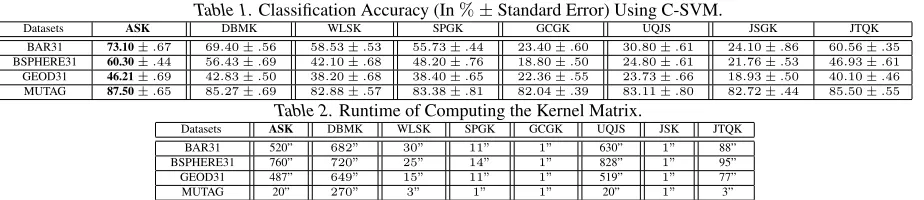
Table 1.Classification Accuracy (In%±Standard Error) Using C-SVM.
Datasets ASK DBMK WLSK SPGK GCGK UQJS JSGK JTQK BAR31 73.10±.67 69.40±.56 58.53±.53 55.73±.44 23.40±.60 30.80±.61 24.10±.86 60.56±.35 BSPHERE31 60.30±.44 56.43±.69 42.10±.68 48.20±.76 18.80±.50 24.80±.61 21.76±.53 46.93±.61 GEOD31 46.21±.69 42.83±.50 38.20±.68 38.40±.65 22.36±.55 23.73±.66 18.93±.50 40.10±.46 MUTAG 87.50±.65 85.27±.69 82.88±.57 83.38±.81 82.04±.39 83.11±.80 82.72±.44 85.50±.55
Table 2.Runtime of Computing the Kernel Matrix.
Datasets ASK DBMK WLSK SPGK GCGK UQJS JSK JTQK BAR31 520” 682” 30” 11” 1” 630” 1” 88” BSPHERE31 760” 720” 25” 14” 1” 828” 1” 95” GEOD31 487” 649” 15” 11” 1” 519” 1” 77” MUTAG 20” 270” 3” 1” 1” 20” 1” 3”
This is an usual benchmark in 3D shape recognition. From the SHREC 3D Shape database, we establish three graph datasets named BAR31, BSPHERE31 and GEOD31 through three different mapping functions. These func-tions are a) ERG barycentre: distance from the centre of mass/barycentre, b) ERG bsphere: distance from the centre of the sphere that circumscribes the object, and c) ERG integral geodesic: the average of the geodesic distances to the all other points. The number of maximum, mini-mum and average vertices for the three datasets are a) 220, 41 and 95.42 (for BAR31), b) 227, 43 and 99.83 (for B-SPHERE31), and c) 380, 29 and 57.42 (for GEOD31), re-spectively. For each graph of the datasets, we compute the Euclidean distances between theh-layer DB represen-tations for each pair of adjacent vertices as the edge weight.
MUTAG:The dataset consists of weighted graphs repre-senting 188 chemical compounds. The maximum, mini-mum and average number of vertices are 28, 10 and 17.93.
Experimental Setup:We evaluate the performance of our entropic matching kernel, i.e., the aligned subtree kernel (ASK), on graph classification problems. We also compare our kernel with several alternative state-of-the-art graph kernels. These graph kernels include 1) the DB match-ing kernel (DBMK) (Bai, 2014; Bai et al., 2014b), 2) the Weisfeiler-Lehman subtree kernel (WLSK) (Shervashidze et al., 2011), 3) the shortest path graph kernel (SPGK) (Borgwardt & Kriegel, 2005), 4) the graphlet count ker-nel (Shervashidze et al., 2009) with graphlets of size 4
(GCGK) (Shervashidze et al., 2009), 5) the un-aligned quantum Jensen-Shannon kernel (UQJS) (Bai et al., 2015), 6) the Jensen-Shannon graph kernel (JSGK) (Bai & Han-cock, 2013), and 7) the Jensen-Tsallis q-difference kernel (JTQK) (Bai et al., 2014d) associated with q = 2. For our ASK kernel kEM(M), we set hto10 andM to50. In fact, we observe that the classification accuracy tends to be stable whenh ≥8. Moreover, the height of the high-est subtrees identified by the TI method in the dataset is about 50. For the WLSK kernel and the JTQK kernel, we set the highest dimension (i.e., the highest height of subtrees) of the Weisfeiler-Lehman isomorphism (for the WLSK kernel) and the tree-index method (for the JTQK kernel) to 10. For the DBMK kernel, we set the highest layer of the required DB representation to10. For each k-ernel, we perform10-fold cross-validation where the
clas-sification accuracy is computed using a C-Support Vector Machine (C-SVM). In particular, we make use of the LIB-SVM library(Chang & Lin, 2011). For each datasets, we compute the optimal C-SVMs parameters. We report the average classification accuracy (±standard error) and the runtime for each kernel in Table 1 and Table 2, respective-ly. The runtime is measured under Matlab R2011a running on a2.5GHz Intel2-Core processor (i.e., i5-3210m).
Experimental Results:In terms of the classification accu-racy, we observe that our ASK kernel can easily outperfor-m all the alternative graph kernels on all the datasets. The reasons for the effectiveness are threefold. First, compared to the WLSK, SPGK, GCGK and JTQK kernels, which al-so require decomposing graphs into substructures, our ker-nel considers the relative locations between substructures. This information is neglected by WLSK, SPGK, GCGK and JTQK kernels. Second, compared to the JSGK and QJSK kernels, both of which rely on the similarity measure between global graphs in terms of the classical or quantum JSD, our kernel can identify the correspondence informa-tion between both the vertices and the substructures, and thus reflect richer topological characteristics. By contrast, the JSGK and QJSK kernels only reflect global graph sim-ilarity information. Third, compared to the DBMK kernel, our kernel can identify more pairs of aligned isomorphic substructures (i.e., subtrees). Finally, only our kernel can capture the edge weighted information. In terms of the runtime, our kernel is not the fastest kernel, but it can still finish the kernel matrix computation in a polynomial time.
6. Conclusions
We have developed a new aligned subtree kernel for weighted graphs. Our kernel not only accommodates both weighted and un-weighted graphs, but also addresses the drawback of neglecting the relative locations between sub-structures arising in the R-convolution kernels. Experi-ments demonstrate the effectiveness of our new kernel.
Acknowledgments
References
Aubry, Mathieu, Schlickewei, Ulrich, and Cremers, Daniel. The wave kernel signature: A quantum mechanical ap-proach to shape analysis. Inproceedings of ICCV Work-shops, pp. 1626–1633, 2011.
Aziz, Furqan, Wilson, Richard C, and Hancock, Edwin R. Backtrackless walks on a graph. IEEE Transactions on Neural Networks and Learning Systems, 24(6):977–989, 2013.
Bai, Lu. Information Theoretic Graph Kernels. University of York, UK, 2014.
Bai, Lu and Hancock, Edwin R. Graph kernels from the jensen-shannon divergence. Journal of mathematical imaging and vision, 47(1-2):60–69, 2013.
Bai, Lu and Hancock, Edwin R. Depth-based complexity traces of graphs.Pattern Recognition, 47(3):1172–1186, 2014.
Bai, Lu, Bunke, Horst, and Hancock, Edwin R. An attribut-ed graph kernel from the jensen-shannon divergence. In
Proceddings of ICPR, pp. 88–93, 2014a.
Bai, Lu, Ren, Peng, Bai, Xiao, and Hancock, Edwin R. A graph kernel from the depth-based representation. In
Proceedings of S+SSPR, pp. 1–11, 2014b.
Bai, Lu, Ren, Peng, and Hancock, Edwin R. A hypergraph kernel from isomorphism tests. InProceddings of ICPR, pp. 3880–3885, 2014c.
Bai, Lu, Rossi, Luca, Bunke, Horst, and Hancock, Ed-win R. Attributed graph kernels using the jensen-tsallis q-differences. InProceedings of ECML-PKDD, pp. 99– 114, 2014d.
Bai, Lu, Rossi, Luca, Torsello, Andrea, and Hancock, Ed-win R. A quantum jensen–shannon graph kernel for u-nattributed graphs.Pattern Recognition, 48(2):344–355, 2015.
Biasotti, Silvia, Marini, Simone, Mortara, Michela, Patan`e, Giuseppe, Spagnuolo, Michela, and Falcidieno, Bianca. 3d shape matching through topological structures. In
Proceedings of DGCI, pp. 194–203, 2003.
Borgwardt, Karsten M and Kriegel, H-P. Shortest-path k-ernels on graphs. InProceedings of ICDM, pp. 8–pp, 2005.
Chang, Chih-Chung and Lin, Chih-Jen. Libsvm: a library for support vector machines. ACM Transactions on In-telligent Systems and Technology, 2(3):27, 2011.
Crutchfield, James P and Shalizi, Cosma Rohilla. Thermo-dynamic depth of causal states: Objective complexity via minimal representations. Physical review E, 59(1):275, 1999.
Emms, David, Wilson, Richard C, and Hancock, Edwin R. Graph matching using the interference of continuous-time quantum walks. Pattern Recognition, 42(5):985– 1002, 2009.
Escolano, Francisco, Hancock, Edwin R, and Lozano, Miguel A. Heat diffusion: Thermodynamic depth com-plexity of networks. Physical Review E, 85(3):036206, 2012.
Feragen, Aasa, Kasenburg, Niklas, Petersen, Jens, de Brui-jne, Marleen, and Borgwardt, Karsten. Scalable kernels for graphs with continuous attributes. InProceedings of NIPS, pp. 216–224, 2013.
Haussler, David. Convolution kernels on discrete struc-tures. Technical report, Technical report, Departmen-t of CompuDepartmen-ter Science, UniversiDepartmen-ty of California aDepartmen-t SanDepartmen-ta Cruz, 1999.
Jebara, Tony, Kondor, Risi, and Howard, Andrew. Prob-ability product kernels. Journal of Machine Learning Research, 5:819–844, 2004.
Kempe, Julia. Quantum random walks: an introductory overview.Contemporary Physics, 44(4):307–327, 2003. Kriege, Nils and Mutzel, Petra. Subgraph matching kernels
for attributed graphs. InProceedings of ICML, 2012. Munkres, James. Algorithms for the assignment and
trans-portation problems.Journal of the Society for Industrial & Applied Mathematics, 5(1):32–38, 1957.
Neumann, Marion, Patricia, Novi, Garnett, Roman, and Kersting, Kristian. Efficient graph kernels by random-ization. InProceedings of ECML-PKDD, pp. 378–393. 2012.
Nielsen, Michael A and Chuang, Isaac L. Quantum com-puting and quantum information. Cambridge University Press, Cambridge, 2000.
Rossi, Luca, Torsello, Andrea, and Hancock, Edwin R. Attributed graph similarity from the quantum jensen-shannon divergence. In Hancock, Edwin R. and Pelillo, Marcello (eds.),SIMBAD, volume 7953 ofLecture Notes in Computer Science, pp. 204–218. Springer, 2013a. Rossi, Luca, Torsello, Andrea, Hancock, Edwin R, and
Rossi, Luca, Torsello, Andrea, and Hancock, Edwin R. Measuring graph similarity through continuous-time quantum walks and the quantum jensen-shannon diver-gence.Physical Review E, 91(2):022815, 2015.
Scott, Guy L. and Longuet-Higgins, H. Christopher. An al-gorithm for associating the features of two images. The Royal Society of London B: Biological Sciences, 244 (1309):21–26, 1991.
Shervashidze, Nino, Vishwanathan, S. V. N., Petri, Tobias, Mehlhorn, Kurt, and Borgwardt, Karsten M. Efficient graphlet kernels for large graph comparison. Journal of Machine Learning Research, 5:488–495, 2009.
Shervashidze, Nino, Schweitzer, Pascal, Van Leeuwen, Erik Jan, Mehlhorn, Kurt, and Borgwardt, Karsten M. Weisfeiler-lehman graph kernels. Journal of Machine Learning Research, 12:2539–2561, 2011.
Suau, Pablo, Hancock, Edwin R., and Escolano, Francisco. Graph characteristics from the schr¨odinger operator. In
Proceedings of GbRPR, pp. 172–181. 2013.