This is a repository copy of Intergenerational Analysis of the Donating Behaviour of Parents and their Offspring.
White Rose Research Online URL for this paper: http://eprints.whiterose.ac.uk/82780/
Version: Accepted Version Article:
Brown, S., Srivastava, P. and Taylor, K.B. (2015) Intergenerational Analysis of the Donating Behaviour of Parents and their Offspring. Southern Economic Journal, 82 (1). pp. 122-151. ISSN 0038-4038
https://doi.org/10.4284/0038-4038-2012.166
This is the peer reviewed version of the following article: Brown, S., Srivastava, P. and Taylor, K. (2015), Intergenerational analysis of the donating behavior of parents and their offspring. Southern Economic Journal, 82: 122–151., which has been published in final form at http://dx.doi.org/10.4284/0038-4038-2012.166. This article may be used for non-commercial purposes in accordance with Wiley Terms and Conditions for Self-Archiving (http://olabout.wiley.com/WileyCDA/Section/id-828039.html)
[email protected] https://eprints.whiterose.ac.uk/
Reuse
Unless indicated otherwise, fulltext items are protected by copyright with all rights reserved. The copyright exception in section 29 of the Copyright, Designs and Patents Act 1988 allows the making of a single copy solely for the purpose of non-commercial research or private study within the limits of fair dealing. The publisher or other rights-holder may allow further reproduction and re-use of this version - refer to the White Rose Research Online record for this item. Where records identify the publisher as the copyright holder, users can verify any specific terms of use on the publisher’s website.
Takedown
If you consider content in White Rose Research Online to be in breach of UK law, please notify us by
Intergenerational Analysis of the
Donating Behaviour of Parents and their Offspring
Abstract: Using data drawn from the U.S. Panel Study of Income Dynamics, we explore the relationship
between the donating behaviour of parents and that of their children aged less than 18 which gives a direct insight into whether an intergenerational relationship in donating behaviour exists. Furthermore, we exploit information relating to whether or not parents encourage their children to donate to charity by talking to them about donating in order to unveil information related to the intergenerational transmission of philanthropic behaviour. Our findings suggest that an intergenerational correlation is only present in the absence of a control for whether the parent talks to the child about donating. The effect from the parent talking to their offspring is associated with an increased likelihood that the child donates by approximately 10 percentage points, a finding which is robust to a number of different estimation strategies.
Key Words: Charity; Donations; Endogenous Probit Model; Intergenerational Relationships; Tobit Model. JEL Classification: D19; H24; H41; H31
Acknowledgements: We are very grateful to the Institute for Social Research, University of Michigan for
supplying the Panel Study of Income Dynamics 2001 to 2011. We are also very grateful to Pamela Lenton, Steven McIntosh, as well as participants at the Generosity and Wellbeing Conference, A Centre for Competitive Advantage in the Global Economy (CAGE)/Centre for Market and Public Organisation Conference, April 2013, University of Warwick, and participants at the Economics for a Better World, OECD-Universities Joint Conference, OECD, Paris, July 2013, for excellent comments. We would also like to express our gratitude to two anonymous referees and the co-editor for excellent comments and advice. The usual disclaimer applies.
2 1. Introduction and Background
Philanthropic behaviour has attracted considerable attention in the economics literature, with
theoretical contributions focusing on explaining why some individuals and households give
away a portion of their income, whilst empirical contributions have focused on identifying
the determinants of donating behaviour. Such interest in this particular facet of individual and
household behaviour is not surprising given that recent figures from Giving U.S.A. 2012
estimate total charitable contributions in the U.S. in 2011 at $298.42 billion.1
Over the last four decades, one strand of the empirical literature on the economics of
charity has focused on analysis of the decision to donate at the individual or household level,
with particular attention paid to the impact of tax deductibility and the corresponding price
and income effects. The empirical analysis of charitable donations has benefited from both
methodological advances with respect to econometric techniques as well as the increased
availability and quality of individual and household level data. Andreoni (2006) provides a
comprehensive survey of the influences on charitable donations established in the existing
economics literature, with economic factors such as income as well as demographic
characteristics playing important roles in explaining patterns of donating behaviour observed
at the individual and household levels.2
One area, which has attracted less interest in the existing empirical literature in
economics, concerns the relationship between the donating behaviour of parents and their
offspring. Conversely, there is a growing related empirical literature in economics exploring
intergenerational relationships related to attitudes and behaviours such as trust, risk attitudes
and sociability. For example, Guiso et al. (2008) model the intergenerational transmission of
priors about the trustworthiness of others within an overlapping generations framework,
1 The figure relates to total charitable contributions from U.S. individuals, corporations and foundations and
includes both cash and in-kind donations. 73% of this figure ($217.79) stems from individual donations.
2
3
whilst Dohmen et al. (2012) explore the intergenerational transmission of trust and risk
attitudes using the German Socio-Economic Panel. Finally, using data drawn from the U.S.
National Longitudinal Survey of Youth 1979, Okumura and Usui (2010) explore the effect of
parents’ social skills on their children’s sociability. Thus, the intergenerational transmission
of a wide range of skills, economic outcomes and attitudes has been the subject of much
theoretical and empirical scrutiny in the economics literature.
In contrast, the intergenerational relationship between the donating behaviour of
parents and their offspring remains relatively unexplored from an empirical perspective in the
economics literature, which may reflect the shortage of data in this area. One interesting
exception is Wilhelm et al. (2008), who estimate the correlation between the generosity of
parents and that of their adult children using data drawn from the U.S. Panel Study of Income
Dynamics (PSID). The findings, which are based on a wide array of econometric techniques
and specification tests, indicate a strong positive correlation between the religious donations
of parents and their adult children, a correlation in the same order of magnitude as that for
intergenerational relationships with respect to income and wealth. For secular giving, a
positive correlation remains, albeit, smaller in magnitude.
Becker (1993) argues that children are heavily influenced by the attitudes and
behaviour of their parents, with childhood experiences during the formative early years
serving to shape individuals’ preferences. Hence, empirical investigation into whether an
intergenerational relationship exists between parental donations and that of their offspring
pre-adulthood would seem warranted. For example, parents, who wish to instil in their
offspring altruistic attitudes and encourage philanthropic behaviour, may display altruistic
behaviour themselves in order to serve as role models. Evidence from the social psychology
literature based on controlled laboratory experiments cited by Cox and Stark (1996) indicates
4
models. Such contributions highlight the important role of social learning, which has attracted
considerable attention in the social psychology literature, whereby children learn to behave in
a pro-social manner by imitating models behaving pro-socially (Lévy-Garboua et al., 2006).3
Similarly, findings from the child psychology literature suggest that role-modelling plays an
important role in developing this type of pro-social altruistic behaviour in young children
(see, for example, Grusec, 1991, for a review of the psychology literature on the socialisation
of altruism in young children).
In the context of analysing the extent to which parents aim to inculcate in their
children certain attitudes, Cox and Stark (1996, 2005) explore the ‘demonstration effect’
whereby parents teach their children the ‘desired’ future behaviour by setting an example
themselves. They focus on preference shaping in the context of facilitating intergenerational
exchange in the provision of care, where parents take care of their own parents in order to
elicit future care from their children. They present empirical evidence consistent with the
‘demonstration effect’. Schokkaert (2006) comments that their theoretical model provides
insight into the ‘formation of dutiful altruists.’4
Clearly, for such preference shaping to take
place, the children must be young enough to respond to such modelling. Similarly, Ribar and
Wilhelm (2006) report results in accordance with a role model explanation for the
transmission of attitudes relating to intergenerational assistance. In the context of
volunteering, Bekkers (2007) reports evidence based on Dutch survey data supporting a
positive relationship between volunteering and parental volunteering. For example, parental
volunteering for quasi-religious associations is found to increase the probability of children’s
3 Recent evidence by de Oliveira et al. (2012) demonstrates that choices in a laboratory public goods game
predict giving in real donation experiments, as well as self-reported donations and volunteering outside of the laboratory, suggesting that evidence from such laboratory experiments provide valuable predictions for behaviour in different settings.
4
5
volunteering for secular associations, controlling for key characteristics such as religion,
education, wealth and personality.
We contribute to the empirical literature on altruistic behaviour by exploring the
relationship between the donating behaviour of parents and that of their children aged less
than 18 years, i.e. pre-adulthood. Our focus on younger individuals reflects the importance of
parental influence and guidance during this formative stage of the life cycle. Furthermore, we
exploit information relating to whether or not parents encourage their children to donate to
charity in order to ascertain how such ‘directives’ influence the intergenerational relationship
between parents and their offspring. In terms of non-disciplinary verbalisations, with
reference to the psychology literature, Lévy-Garboua et al. (2006), p.564, comment that
‘directives are generally effective and often last.’ Hence, our empirical analysis serves to
shed some light on the transmission of philanthropic behaviour in the context of exploring the
effects of such direct parental verbalisations in addition to establishing the existence of
intergenerational correlations in such behaviour.
Our findings suggest that whether a child donates to charity is influenced by positive
effects from whether the parent donates to charity. However, this intergenerational
correlation disappears once we control for whether the parent talks to their child about
donating to charity. This finding is robust to a number of alternative estimation strategies and
suggests that such parental verbalisations are what matter in shaping a child’s altruistic
behaviour.
2. Data and Methodology
We use data drawn from the U.S. Panel Study of Income Dynamics (PSID), which is a panel
of individuals on-going since 1968 with a nationally representative sample of over 18,000
individuals living in 5,000 families in the United States. The survey is conducted by the
6
1968 to 1996 and then biennially from 1997 through to 2011, the latest survey year. In 1997,
the PSID added an additional component, the Child Development Supplement (CDS), which
is a study of children (aged 0-12 in 1997) in a sub-sample of PSID families. Completed
interviews were obtained with 2,394 families (88% of target), providing information on 3,563
children. The CDS was undertaken again in 2002 and 2007 (when children were aged 10-19),
where for the latter 1,506 children were successfully re-interviewed (90% of target), and is a
nationally representative and longitudinal database of children. The CDS contains additional
information relating to parents in the PSID and their children, with the objective being to
provide information on early human capital formation. In cases where there were more than
two eligible children in the family, two were randomly selected to take part in the CDS.
With regards to the structure of the interviews in the PSID-CDS for those households
with a child, an interviewer visits the household and obtains written permission to interview
the child(ren) from the primary caregiver. Firstly, in the CDS, the child(ren) is (are)
interviewed in person using computer assisted personal interviewing (CAPI), including an
Audio Computer-Assisted Self-Interview (ACASI) component for sensitive topics asked of
adolescents, e.g. psychological control. Second, the adolescent’s primary caregiver (typically
the mother) is interviewed either in person or via a computer assisted telephone interview
(CATI) based on their preference. Finally, either the primary caregiver or their spouse is
interviewed in the PSID’s core main family interview.
We focus on data from the 2002 and 2007 CDS, matching the information in the CDS
with that available in the main head of family PSID questionnaires for 2001 and 2007,5 which
include a series of detailed questions relating to giving to charity. Our matched sample of
children and their parents comprises 2,366 child-adult pairs observed either once or twice in
the data yielding 3,105 observations, where the children are aged between 8 and 17 years.
5 We match the 2002 CDS to the 2001 PSID since there is no 2002 PSID given that the survey is biennial post
7
For those households with children, in the 2002 and 2007 CDS, the child was asked:
Did you give some of your money last year - if only a few pennies - to a church, synagogue,
or another charity that helps people who are not part of your family? The responses to this
question, which provide information on the donating behaviour of children, were used to
create a binary indicator, YC, which takes the value of one if the child makes such donations.
The primary caregiver was then asked: Do you ever talk to your child about giving some of
(his/her) money - if only a few pennies - to a church, synagogue, or another charity? The
responses to this question in the CDS potentially unveil information related to how charitable
behaviour is transmitted across generations. We use such responses to create a binary
indicator, T , which takes the value of one if the parent talks to the child about such
donations.
In the core PSID, households are asked about total donations to charity over the
respective calendar years, providing detailed information about the parent’s donating
behaviour.6 The responses to this set of questions are used to create a binary indicator of
whether the parent donates to charity, YP.7 The Center on Philanthropy Panel Study (COPPS),
which provides data on giving and volunteering by families, is the generosity module in the
core PSID.8
The matched child-parent data reveals that, on average, over the two years, 72% of
children report that they donate to charity compared to 60% of parents, whilst 70% of parents
6 The information on giving data has been shown to be nationally representative, see Wilhelm (2006). 7
The definition of a charitable organization in the PSID includes ‘religious or non-profit organizations that help
those in need or that serve and support the public interest’. It is clearly stated in the questionnaire that the
definition used does not include political contributions. The information about adult (parent) charitable donations available in the 2001 and 2007 PSID is related to activity in calendar years 2000 and 2006, implying that these variables describe role-modelling one year (or more) prior to the measurement of children’s donating in the CDS. Information on the primary caregiver talking to their child about donating comes from the CDS and
hence is concurrent with the measurement of children’s donating behaviour. Unfortunately, the survey questions
eliciting information about children’s donating behaviour differ from those eliciting information relating to
parental donating behaviour. Full details on the PSID and CDS documentation are available at: http://psidonline.isr.umich.edu/Guide/documents.aspx.
8
report that they talk to their child about donating to charity. In the matched sample, 45% of
the observations are characterised by the parent and the child both donating to charity, with
only 13% reporting that neither the parent nor the child donates to charity. Interestingly, 27%
of observations are characterised by the child reporting that they donate to charity, whilst the
parent indicates that they do not donate to charity compared to only 15% where the parent
reports that they donate to charity and the child reports that they do not donate to charity. The
data also reveals that in the case where the parent talks to the child about donating to charity,
77% of children report that they donate to charity.
We explore the intergenerational transmission of altruistic behaviour by considering
the influence of parental donating behaviour on the probability that their offspring donates to
charity. Defining YC* as the propensity to donate by the child, estimating the following
univariate probit model provides a direct test of the intergenerational effect where parental
donating YP is initially treated as an exogenous variable:
*
C C P
Y X ' Y (1)
For example, if the estimate of is positive this would suggest that the children of parents
who donate are more likely to donate. We then consider whether the likelihood that the child
donates to charity is influenced by their parent talking to them about donating, initially
treating this as an exogenous variable, which is captured by the 0 coefficient in equation 2:
0 0 0 0 0
*
C C P P
Y X Y T Y T (2)
In addition, the interaction term in equation (2) serves to shed light on how the association
between children’s and parental donation behaviour is influenced by a direct attempt by
parents to impart these attitudes to children by talking to them about donating. Hence, the
9
behaviour strengthens the intergenerational correlation in donating behaviour, which would
be supported empirically if 0 0.
It is unlikely that parental donating, YP, and talking to the child about donating, T,
are exogenous and, so to take this into account, we model the donating behaviour of children
via a system of three equations which captures the parent’s decision to donate to charity
(equation 3a below), whether the parent talks to the child about donating (equation 3b below),
and whether the child donates to charity (equation 3c below). The key advantage of
estimating a system of equations is that it allows us to account for the correlation via
unobservable individual or household characteristics that may affect the three decisions.
Thus, our system framework allows for the endogeneity of the parent’s donating behaviour
and whether they talk to their offspring about making charitable donations. We specify a
system of three latent equations as follows:
*
P P P1 P1;
Y X ' (3a)
*
T T1 T1;
T X ' (3b)
*
C C C1 1 P1 1 1 P C1
Y X' Y T YT ; (3c)
where YP* and YC* represent the propensity to donate by the parent and the child, respectively,
and T* is the propensity of the parent to talk to the child about donating. Assume that the
error terms in the three latent equations are independently and identically distributed and
jointly follow a multivariate normal distribution with mean 0 and covariance matrix . That
is, ( P1, T1, C1) ' ~MVN
0,
where the covariance matrix is given by:PT PC
PT TC
PC TC 1
1 ,
1
10
jk
being the correlation coefficient between j and k
j k, P, T, C; jk
and
P
T
Cvar var var 1 for identification purposes. Under this assumption, the set of
equations given by (3a, b and c) above results in an endogenous Multivariate Probit (MVP)
model with a recursive simultaneous structure. Identification is ensured through exclusion
restrictions and a highly non-linear specification. For instance, XP and XT contain separate
instruments that do not appear in XC , as detailed below. The MVP specification with
potentially non-zero off-diagonal elements in allows for correlations across the
disturbances of the three latent equations which embody unobserved characteristics. The
system of equations allows for the estimation of several joint and conditional probabilities,
such as, Prob
YP1,T 1,YC 1
, Prob
T0 |YP 1
and Prob
YC 1|YP 1,T0
.We also explore the effect of the amount of parental donations by estimating the
monetary amount donated by the family in equation (4a) simultaneously with, whether the
parent talks to the child about donating (equation 4b below), and the probability that the child
donates, equation (4c). The natural logarithm of the dollar amount donated in 2001 prices is
given by log D
P . The average donation by parents is $4,744 (4.5 in log levels) with 40%not making a charitable donation.9 This system framework allows for the endogeneity of both
the amount that the parent donates and whether they talk to their offspring about making
charitable donations. We specify a system of three equations, with one censored dependent
variable and two latent dependent variables, as follows:
p P P2 P2log D X' ; (4a)
*
T T2 T2;
T X' (4b)
*
C C C2 2log p 2 2 log P C2
Y X ' D T D T ; (4c)
11
In the psychology literature, results from laboratory experiments have indicated that the more
generous a role model is (in our application, the parent in terms of the level of their donation)
the larger is the effect that they have (Lévy-Garboua et al., 2006). Thus, we explore whether
the effect of parental donating behaviour on the probability that the child donates is
increasing in the amount that the parent gives to charity. Given that the dependent variable in
equation (4a) is now a censored variable, i.e. some parents do not donate to charity so there is
clustering at zero, and the dependent variables in equations (4b) and (4c) are probabilities, the
model is estimated simultaneously by a conditional (recursive) mixed process estimator in
STATA 12 using the CMP command, see Roodman (2009).10
We also estimate treatment effects of the endogenous variables in both systems, i.e. in
terms of equations (3a) to (3c), the impact of whether the parent donates on whether the child
donates to charity and the impact of whether the parent talks to the child about donating to
charity on whether the child donates to charity. Three widely used measures of treatment
effects are ones that average over all individuals (ATE), ones that average over only the
treated (ATET) and ones that average over only the untreated (ATEUT). For instance,
focusing upon equations (3a) to (3c), the three measures of the treatment effects of YP on
C
Prob Y 1 , where the likelihood of the child donating is also conditioned upon the parent
talking to them about making charitable donations, can be obtained as follows:
1 0
C C; C, C C1 1 1 1 C C1 1
ATE = E Y Y X T X ' T T X ' T (5)
1 0
C C P P C
2 P P1 C C1 1 1 1 PC 2 P P1 C C1 1 PC
P P1 P P1
| 1, , ,
, ; , ;
ATET = E Y Y Y T =
T T T
X XX X X X
X X
(6)
12
1 0
C C P P C
2 P P1 C C1 1 1 1 2 P P1 C C1 1
P P1 P P1
[ | 0, , , ]
( ( ), ( ; ( ( ), ( ;
( ( )) ( ( ))
PC PC
ATEUT E Y Y Y T
T T) T)
X X
X X X X
X X
(7)
where 1 C
Y and 0 C
Y denote the respective values of YC when YP takes values 1 and 0, and
and 2 denote the univariate normal cumulative density function and the bivariate normal
cumulative density function, respectively. Similarly, three measures of the treatment effects
of T on Prob
YC1
, where the likelihood of the child donating is also conditioned uponwhether the parent makes a charitable donation can be obtained. Furthermore, a set of
corresponding ATEs can be calculated for the system shown in equations (4a) to (4c).
In both of the systems of equations, the computation of marginal effects in these
models is fairly complex given the endogenous structure of the model and the presence of
common variables across the three equations. We therefore estimate them via numerical
derivatives of the multivariate normal distribution functions with respect to the exogenous
variables. In addition, we can obtain marginal effects not only on marginal probabilities but
also on joint and conditional probabilities. Treatment effects are also calculated using
numerical gradients given they are highly non-linear functions of X and analytical solutions
are difficult to obtain. The corresponding standard errors are computed using the delta
method.11 Consider the trivariate binary model shown in equations (3a) to (3c). Take the
variable, X*, which appears in all three equations. If we were to compute the marginal effect
of X* on YC, this would comprise of a direct effect of X* on Prob
YC 1
and indirecteffects through Prob[T1] and Prob[YP 1] given that T and YP enter equation (3c), see
Greene (2012). Similarly, direct and indirect effects occur when estimating equations (4a) to
(4c).
13
We explore whether parent and child donating behaviour are correlated after
controlling for a range of characteristics (such as income, wealth, health and religion) that are
expected to influence such intergenerational relationships. As argued by Bekkers (2007),
omitting such controls may lead to spurious correlation between parental and children’s
behaviour, based on biased empirical results. In terms of the explanatory variables, common
covariates in both XP and XT , are controls for the following head of household
characteristics: age; gender; ethnicity; years of schooling; health status specifically whether
in good/very good health, or whether in excellent health (where poor or very poor health
forms the reference category); and religious denomination of the family, whether catholic,
protestant, or any other religious group (where no religion forms the reference category). We
also control for household labour income, household non-labour income, household wealth
and whether the home is owned, either outright or via a mortgage. Following the existing
literature, we control for the price of donating to charity, which is determined by taxation as
income donated to recognised charities in the U.S. is not subject to income tax. Hence,
disposable income falls by less than the full amount donated: the price of the donation
becomes the donation net of the saving in tax since each dollar donated to a recognised
charity leads to less than one dollar sacrificed for consumption purposes (Auten et al., 2002).
For households who itemise charitable donations in their tax return, the price of the donation
is defined as one minus the household’s marginal tax rate on the contribution made, whereas
for households who do not itemise charitable donations, the price of the donation is one:
donating one dollar means that there is one dollar less for consumption. Households who
14
TAXSIM programme,12 which calculates federal state tax liabilities for survey data based on
a range of factors such as earnings, marital status and children.13
As the components of the model are nonlinear, the system is uniquely identified due
to these nonlinearities, Greene (2012). However, it is preferable to identify the three
equations on the basis of explicit exclusion restrictions and, hence, this is the approach we
take (see, for example, Wooldridge, 2010). In XP, equations (3a) and (4a), we include the
following set of instruments. Firstly, the proportion of households donating by state for age
specific (18+) reference groups matched to parents by state and age. This is generated from
the main PSID sample rather than the matched parent-offspring sub-sample. We conjecture
that this will influence parental donations for those who are in the same social reference
space, see Andreoni and Scholz (1998), i.e. state-age group. However, the donating decision
of the child is likely to be independent of this since a different reference group is arguably
applicable, i.e. 8-17 years olds. Secondly, we also use a binary indicator for whether the
household has itemised for medical expenses in the previous year. The logic here is that tax
deduction is an incentive to make donations, see Vesterlund (2006). Hence, the itemisation
status for items other than charitable donations, e.g. medical expenses, may act as proxy for
awareness of tax advantages, which might, therefore, be an appropriate predictor for
donations. In XT , equations (3b) and (4b), we include a set of binary instruments
specifically: whether the parent discusses what their child studies in school on a daily basis;
and whether the parent talks to the child on a daily basis about current events like things
12
See http://www.nber.org/~taxsim/.
13 One remaining issue, however, is that the decision to itemise is arguably not fully exogenous, i.e. the decision
15
going on in the news. The idea here is that talking to children about their studies and/or
events in the media is likely to be associated with the parent talking to the child about making
donations to charity, but arguably have no direct influence on the probability that the child
donates per se. We also use a binary indicator for whether the child eats with the family on a
daily basis as an instrument as it seems likely that children who regularly eat with their
parents will have a higher propensity to discuss issues, e.g. donating, yet this is not likely to
directly influence the decision of the child to undertake a charitable donation.14
In XC , we include controls for a range of child characteristics and family level
covariates. The following child characteristics are used in the model: gender; ethnicity; age;
whether the child has one sibling, or two or more siblings in the household (no siblings as the
reference category); health status, specifically whether in good/very good health, or whether
in excellent health (where poor or very poor health forms the reference category); the number
of friends that the child has; the amount of the allowance/pocket money received by the child;
whether the child was involved in any volunteer service activities or service clubs in the past
12 months; and a proxy for ability from performance in a reading test, passage
comprehension test, and an applied problems test.15 Finally, we attempt to control for aspects
of the child’s behaviour by combining a number of variables through factor analysis into a
single measure.16In terms of household controls included in the child’s donating equation,
we incorporate the price of donating, household income, wealth, family housing tenure and
14 The validity of the instruments is discussed in the following section.
15 Each test is the age-standardized score in the Woodcock-Johnson Revised Achievement Tests, which are
widely used and have been validated extensively (see Woodcock and Johnson, 1990, for further details of the tests).
16 The underlying variables used in the factor analysis are whether the parent states that the child does each of
16
the religious denomination of the family, where these variables are defined as above.
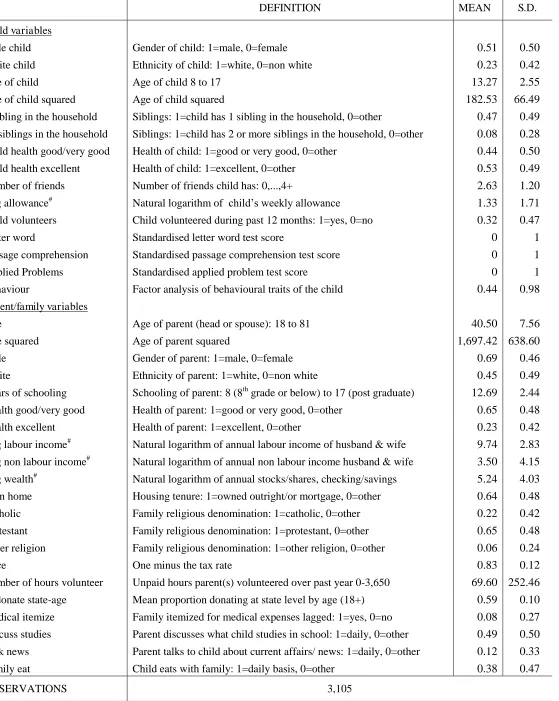
Summary statistics for all of the explanatory variables employed in our empirical analysis are
presented in Table 1 in the appendix.17 In equations (3a, 3b) and (4a, 4b), all covariates in
C
X are included in the regressors, i.e. XC {X XP, T}, in order to gain increased efficiency
in the estimates (Wooldridge 2010).
3. Results
Initially we focus on the results of estimating the univariate models of equations (1) and (2)
which consider the determinants of the probability that the child donates. As discussed above
this treats both whether the parent donates (amount of the donation) and whether the parent
talks to the child about charitable donations as exogenous variables. Hence, we then consider
the potential problem of endogeneity and whether this influences our findings by employing
the multivariate frameworks given by equations (3a-3c) and (4a-4c).
Univariate Analysis
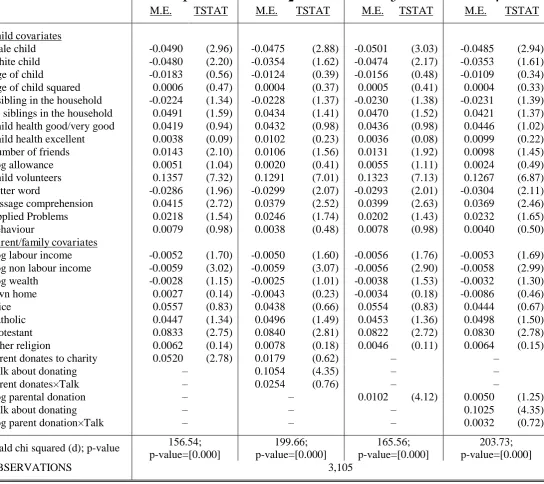
The results from estimating the univariate models of equations (1) and (2) are shown in Table
2 with marginal effects reported. There are four specifications shown. Columns 1 and 2 are
based on estimating equations (1) and (2) conditional upon whether the parent donates to
charity, whereas columns 3 and 4 repeat the analysis but are based on the amount that the
parent donates. The probability that the child donates is inversely related to, for example, the
child being male, which is consistent with the findings of Wilhelm et al. (2011), and the non
labour income of the household.18 Positive effects on the likelihood that the child donates are
found from whether the child volunteers; the passage comprehension test score; and whether
the family religious denomination is protestant relative to no religion. Turning to the effect of
parental donating behaviour, the results in both columns 1 and 3 reveal that the likelihood
17 It is important to acknowledge that some of the covariates may potentially be endogenous such as pocket
money or volunteering, which may lead to bias in the results. We find, however, that omitting such potentially endogenous variables from the model does not influence the results relating to our key parameters of interest.
18
17
that the child donates to charity is positively related to the parent donating and also to the
amount donated. To be specific, if the parent donates then the probability that the child
donates to charity increases by 5.2 percentage points. Or, if the parent increases the amount
donated by 1% the probability that the child donates to charity increases by 1 percentage
point. Hence, there is some evidence of an intergenerational effect in donating behaviour
when parental donating behaviour is treated as exogenous. However, this effect becomes
statistically insignificant once whether the parent talks to the child about donating is entered
into the model, see columns 2 and 4. In particular, whether the parent talks to the child about
donating is associated with around 10 percentage points higher probability that the child
donates.
There is some evidence in the existing literature to suggest differential effects of
parental role modelling upon children’s altruistic behaviour. For example, Stukas et al.
(1999) found that parental role modelling had a larger impact on the self-image of young
females and argued that this subsequently might imply a stronger effect on girls’ pro-social
behaviour. This is consistent with the reasoning put forward by Eisenberg et al. (2006) where
a higher level of moral reasoning is sometimes exhibited by girls. Consequently, girls might
be more responsive to parental role modelling whilst boys have to be encouraged verbally to
donate. Similarly, there may be differential effects of parental role modelling and
verbalisation by race. Often giving and volunteering are considered to be closely related
pro-social behaviour, see, for example, Wilhelm et al. (2011), and so it could be argued that the
influence of role modelling and conversations about giving may differ between parents who
volunteer compared to those who do not undertake voluntary work. A similar argument could
also be made for whether the parent reports a religious denomination or not. All these
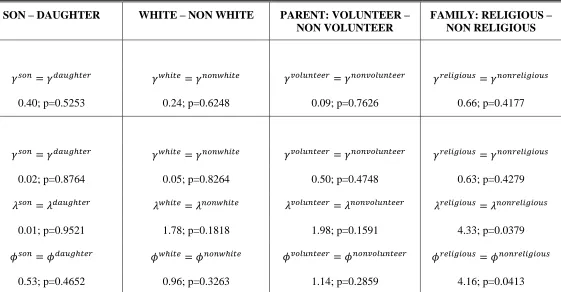
characteristics might influence the intergenerational transmission in different ways and so we
18
non-white; parent volunteers – non volunteer; and family religious – non religious. The
results of testing the equality of the inter-generational coefficient 0, the verbalisation
coefficient 0, and the interaction coefficient 0 are shown in Table 3. Interestingly, the only
group where statistical differences are found in the key coefficients is for those families
reporting a religious denomination relative to those who do not.
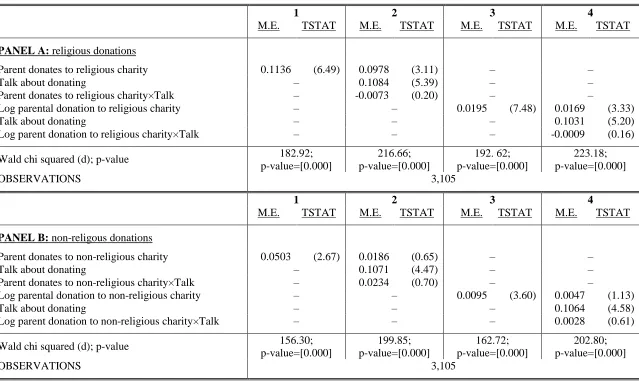
We have repeated the univariate empirical analysis of equations (1) and (2)
decomposing parental donations into those to religious and non-religious organisations, the
results are reported in Table 4 in Panels A and B respectively where four specifications are
shown as in Table 2. The analysis reveals that, when the binary parent donating indicator is
replaced with whether the parent donates to a religious cause, see Panel A, the
intergenerational marginal effect, 0, is always positive and statistically significant associated
with around a 10 percentage point increase in the probability that the child donates. Focusing
on the amount of religious donation made by the family, this is always statistically significant
with a one per cent increase in the level of the donation associated with around a 2 percentage
points higher probability that the child donates. The effect of the parent talking about
donating remains in terms of statistical significance and economic magnitude. There is no
evidence to support the premise that direct attempts by the parent to influence their
offspring’s behaviour strengthen the intergenerational correlation in donating behaviour, i.e.
the null hypothesis that 0= 0 is not rejected. Conversely replacing the parental donating
indicator with one for whether the parent donates to non-religious organisations is statistically
insignificant when talking to the child about donating is included in the specification, see
Table 4 Panel B. However, the effect of talking remains throughout.19 Thus the results
19 Unfortunately the CDS data does not have information on the type of donation made by the child, so we can
19
suggest that the transmission of religious giving is stronger potentially as a by-product of the
transmission of religion (although this is controlled for at the family level).
Univariate Analysis – Robustness
The analysis thus far has dealt with repeated observations on the same child, which can be a
maximum of two years, by clustering at this level of aggregation. What follows aims to
investigate whether the results are sensitive to: (i) employing a child fixed effects estimator;
(ii) clustering at both the child and sibling level, i.e. two-way clustering of the standard
errors; and (iii) adopting a sibling fixed effects estimator. In the robustness analysis we focus
upon overall charitable donations for brevity.20 In order to implement a fixed effects
estimator and adopt two-way clustering of the standard errors, we use the linear probability
model (LPM). Firstly, equations (1) and (2) are re-estimated using the LPM clustering at the
child level to see whether the results are similar to that of the univariate probit estimator. The
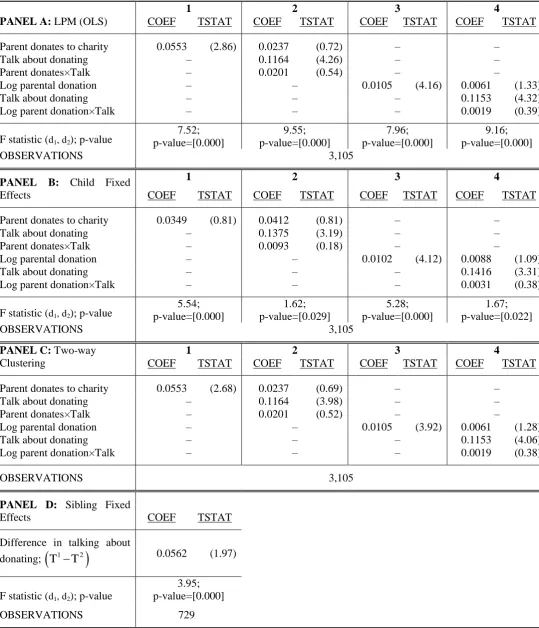
results are reported in Table 5 Panel A which has the same structure as Table 2. Columns 1
and 2 are based on estimating equations (1) and (2) conditional on whether the parent donates
to charity, whereas columns 3 and 4 repeat the analysis but are based on the amount that the
parent donates. Clearly, in terms of the magnitudes of the coefficients and statistical
significance of the primary variables of interest, the findings are very similar to that of the
probit specifications.21 In particular, a parent talking to their child about donating is
associated with around an 11 percentage points higher probability of the child donating. In
Panels B and C of Table 5, we re-estimate the same specifications allowing for child fixed
effects and two way clustering, respectively.
The advantage of the LPM fixed effects estimator is that for some children we have
two observations at different points in time and hence it is possible to account for
20 Results from splitting donations into religious and non-religious causes are available from the authors upon
request.
21
20
unobservable time invariant child effects which might influence their decision to donate.
Specifically, introducing child, C, and time, t, subscripts to the error terms in equations (1)
and (2), Ct CCt, the error can be decomposed into a fixed effect C and a white noise
component Ct where the former is the unobservable component. Table 5 Panel B
summarises the results of employing the fixed effects estimator and the analysis essentially
reveals that the results are robust to removing the child fixed effect.22
In the empirical analysis discussed thus far, the standard errors are clustered at the
cross sectional unit of observation, i.e. the child, with the exception of the LPM child fixed
effects estimator. However, it is possible that there are multiple children (siblings) in the
sample and so it may also be important to take into account clustering at this additional level
of aggregation. Indeed, for our sample of children, only 45% have no siblings in the sample.
To investigate this, we apply the Cameron et al. (2011) estimator, where standard errors in
the current application are clustered both at the child and family level. Failing to
accommodate the potential clustering within families could result in standard errors being
under-estimated. The results of the two way clustering analysis are shown in Table 5 Panel C
where only the t-statistics differ (the point estimates are the same). Again the results are
consistent with those discussed above. The predominant finding is that it is whether the
parent talks to their offspring about donating that matters with the effect remaining
statistically significant at the 1 per cent level.
The presence of siblings in the data enables us to employ an alternative strategy which
will help improve upon the identification of the influence of parents talking to their offspring
upon the child’s decision to donate. To do this, we employ a sibling fixed effects estimator
where variation that occurs at the sibling level is exploited. This is important in that different
22 We are grateful to an anonymous referee for highlighting the possibility that the difference in the estimated
21
children, for exogenous reasons, may have been exposed differently to their parent talking to
them about making charitable donations. Hence, this potential within family variation enables
us to isolate the effect of this verbal directive from influences that both siblings would have
been exposed to, i.e. family level covariates including whether the parent donates. The
approach we use can be summarised as follows:
1 2 1 2 1 2
C C C C
Y Y T T X X ' (8)
The superscripts ‘1’ and ‘2’ refer to the two siblings within the same household, and Cs X is a
vector of child specific covariates for sibling s, specifically: age; gender; test scores; log
allowance; child behaviour; and number of friends, where in equation (8) these covariates are
entered as a vector of sibling differences, 1 2 C C
X X . In this model all family covariates,
including whether the parent donates since this is defined at the household level (see Section
2), are differenced out of the analysis. Selecting families with two siblings and arranging the
data to employ the specification in equation (8) yields 729 observations at the family level,
i.e. 1,458 children, where only 36% of observations have no variation in both the sibling
difference of donating, 1 2 C C
Y Y , and the sibling difference in the parent talking to the child,
1 2
T T . The results are shown in the final row, Panel D, of Table 5 where we report the
estimated parameter only. Clearly, the influence of the parental directive is still apparent,
statistically significant, and this is after isolating the common effects upon siblings stemming
from family environment and other family fixed effects, both observable, e.g. parental
donating behaviour and parental education, and unobservable. Arguably this approach helps
22
siblings to their parents’ talking to their children about making charitable donations within
the same household.23
Multivariate Analysis
We now explore the potential problem of endogeneity in the key covariates of interest, i.e.
whether the parent donates to charity or the amount donated and whether they talk to their
child about donating. This analysis is based upon estimating the multivariate system of
equations, (3a-3c) and (4a-4c), and the results are presented in Tables 6 to 8. In each
alternative model, the joint test that the correlation in the three error terms is equal to zero is
rejected endorsing the modelling approach and implying endogeneity between the key
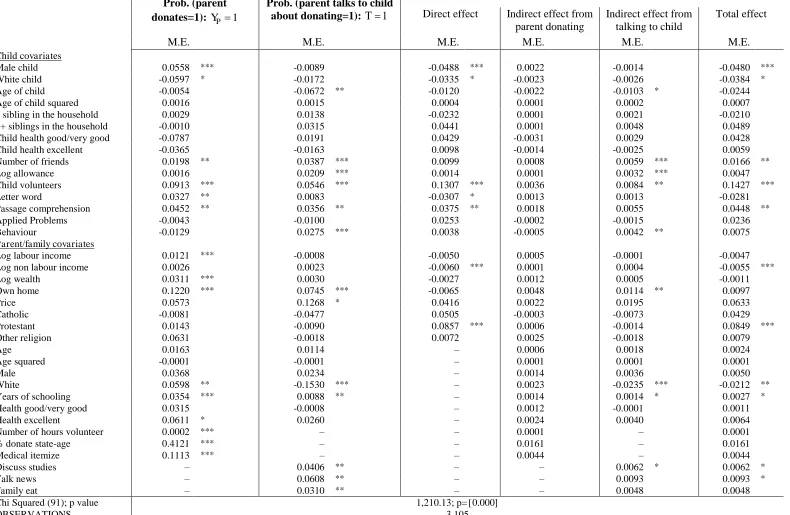
variables of interest.24 Table 6 presents the marginal effects from estimating the trivariate
probit model (equations 3a-3c) relating to the exogenous variables for: the probability of
whether the parent makes any donations; the probability that the parent talks to the child
about donations; and the associated marginal effects related to the probability that the child
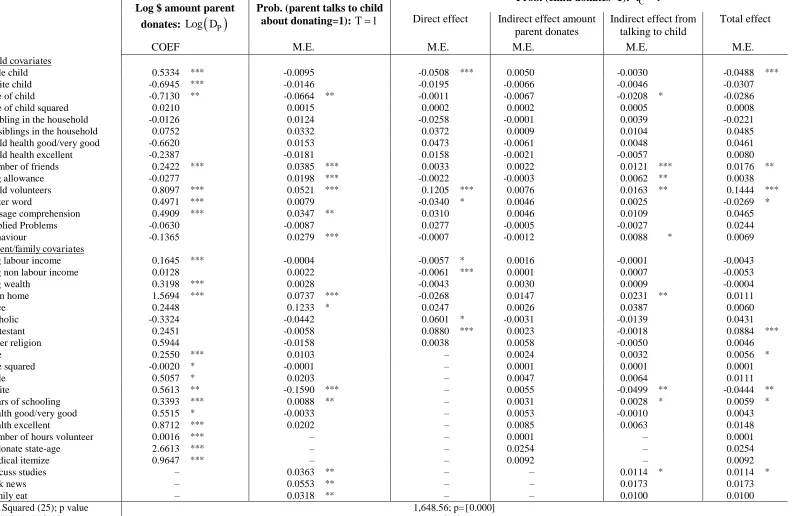
donates are presented (where direct, indirect and total effects are shown). Table 7 follows a
similar structure showing the coefficients (for the censored, i.e. tobit, part of the model) and
marginal effects from estimating the simultaneous model (equations 4a-4c) relating to the
endogenous variables for: the amount donated to charitable causes; the probability that the
parent talks to the child about donations; and the associated marginal effects related to the
probability that the child donates are presented (again direct, indirect and total effects are
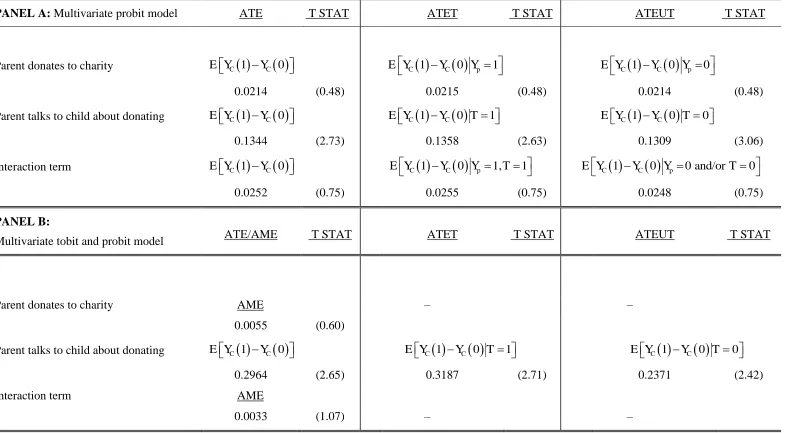
shown). Table 8 reports the associated treatment effects on the key variables of interest.
It is apparent from the first column in Table 6 that head of household characteristics
such as ethnicity and years of schooling all influence the probability that the parent donates to
23
An important caveat to note is that this identification strategy is only valid if the sibling variation in exposure to the parental talking about donating is exogenous, i.e. uncorrelated with unobserved sibling differences which may influence their decision to donate to charity.
24
23
charity. Statistically significant positive effects are also apparent from household labour
income, wealth and home ownership, signalling the importance of financial factors. The
positive marginal effect relating to volunteering ties in with the notion that donating money
and donating time to charitable causes are complementary activities, see, for example,
Wilhelm et al. (2011). In terms of the instruments used in the parental donating equation,
both the proportion of households donating in the state where the family resides, matched to
the parent’s age, and past medical itemization have a positive and statistically significant
influence on parental donating behaviour. Covariates are found to have a similar influence
when considering the amount donated, see Table 7, in addition the gender of the parent and
age are also statistically significant.
The outcome of whether the parent talks to their child about donating behaviour is
shown in the second column of Tables 6 and 7. Family and parental characteristics which are
significantly associated with this outcome are: years of schooling; ethnicity; and home
ownership. In terms of the instruments employed, all three, i.e. whether the parent discusses
school studies, and/or they talk about the news, and whether the family eats meals together,
are all individually and also jointly significant. For example, whether the family eat together
on a daily basis is associated with around a 3 percentage point higher probability that the
child donates to charity.
Statistically significant positive effects on the probability that the child donates to
charity, see Tables 6 and 7 final column, are apparent from the number of friends that the
child has, the child’s participation in volunteer service activities, and the number of years of
schooling of the parent. Inverse direct effects on the probability that the child donates are
apparent for male children, white children, and the level of household non labour income.
Both sets of instruments used in modelling whether the parent donates to charity (i.e. the
24
itemization) and whether the parent talks about donating to the child (i.e. whether on a daily
basis the parent discusses school studies, they talk about current affairs, and they eat together)
are jointly insignificant in the child donating equation.25 Hence, our findings would suggest
that the instruments perform well in a statistical sense and we would argue they are viable
intuitively (see Section 2 above).
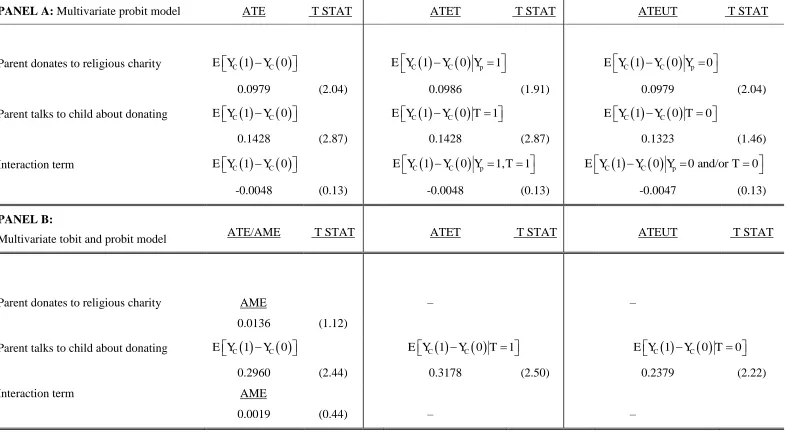
The ATEs, ATETs and ATEUTs are shown for the binary endogenous variables (i.e.
whether the parent donates to charity and whether they talk to the child about donating) in
Table 8 panel A. These are also reported in Table 8 panel B for the binary endogenous
variable, i.e. whether the parent talks to the child about donating, and average marginal
effects (AMEs) estimated over all individuals for the continuous endogenous variable (i.e. the
amount donated). It is apparent from Table 8 Panel A (Panel B) that the treatment effects
(AME) of whether the parent donates to charity on whether the child donates to charity
(amount donated to charity) are all positive, yet statistically insignificant. This is not
surprising given that there are no significant indirect effects stemming from the parental
donating equation on the child’s donating decision, as can be seen from the anti-penultimate
column of Tables 6 and 7. Conversely, it is clear from both of the models estimated that the
effects from the parent talking to their child about donating to charity are large, positive and
statistically significant, at around 13 percentage points in the multivariate probit model (see
Table 8 Panel A). This is due to the significant indirect effects of the parent talking to their
25 To further provide some insight into the validity of the instruments in the parent donates equation, namely the
proportion of households donating by state-age reference group and whether the family itemized for medical expenses in the previous year, we adopt an approach to exogeneity following Smith and Blundell (1986). To do this, equations (3a) and (3c) are estimated separately as univariate probit models. Initially, equation (3a) is estimated and then we test whether the residuals (linear prediction) from the first stage regression, i.e. the
parent’s donating equation, are statistically significant in equation (3c), i.e. the child’s donating equation. The residuals from the first stage are found to be statistically insignificant in the child donating equation (3c) and the instruments are jointly statistically significant in the parental donating equation at the 1% level, implying validity of their use in this application. We adopt the same approach to test the validity of the instruments in the
talking equation (3b), namely whether the parent discusses the child’s studies on a daily basis, whether they talk
25
offspring about making charitable donations on the decision of the child to donate (see
penultimate column of Tables 6 and 7). This would suggest that, whilst there is no direct
intergenerational effect from the overall donating behaviour of parents on their children’s
donating behaviour, talking about donating appears to be important.
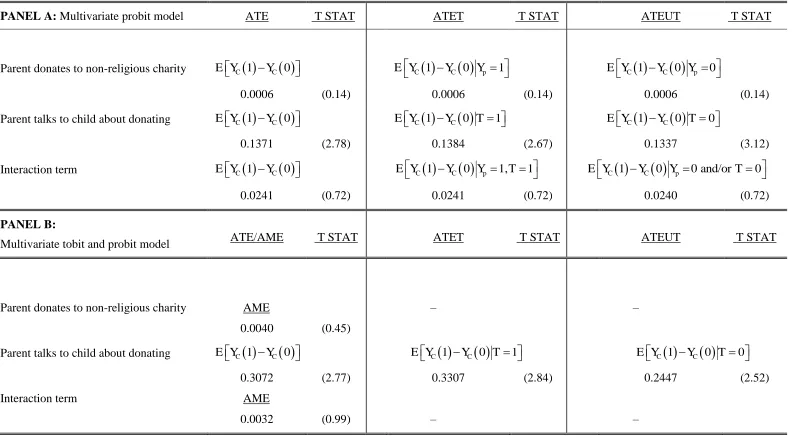
The exception to this is when we decompose parental donations into religious causes
and non-religious causes where the treatment effects are shown in Tables 9 and 10
respectively.26 There is evidence of an intergenerational effect between whether the parent
makes a donation to a religious charity and the probability that the child donates. Specifically,
the treatment effect is approximately 10 percentage points (Table 9 Panel A) which is similar
in magnitude to the univariate results reported in Table 4 Panel A. Generally, the role of
talking to the child is consistent with the previous findings for overall charitable donations
with the treatment effects of talking to the child dominating the religious intergenerational
coefficient in terms of magnitude. There is no evidence, however, that the intergenerational
coefficient is influenced by talking to children since the interaction term is always
statistically insignificant for all charitable donations and where donations are decomposed.
This implies that parents are able to influence this aspect of their offspring’s behaviour via
verbalisations, consistent with the psychology literature, e.g. Lévy-Garboua et al. (2006),
which may serve to nurture the generosity and altruistic behaviour of their children.27
4. Conclusion
In this paper we have contributed to the empirical literature on the analysis of charitable
donations by exploring the relationship between the donating behaviour of parents and their
offspring aged less than 18, i.e. pre-adulthood. Our findings suggest that whether the parent
26
Full marginal effects for the two decompositions are available from the authors upon request.
27 Since the question about which the child gives refers to ‘last year’ we cannot rule out the possibility that a
26
donates to charity and whether the parent talks to the child about donating both have positive
influences on the probability that the child donates to charity. However, the intergenerational
effect relating to the parent’s donating behaviour is driven to statistical insignificance once
we simultaneously control for whether the parent talks to their child about donating. The only
exception to this is when parental donations are decomposed into religious and non-religious
causes where for the former there is evidence of a direct intergenerational effect. This
suggests that parents through talking are able to influence this aspect of their offsprings’
behaviour and help to nurture the generosity and altruistic behaviour of their children.28
Dohmen et al. (2012), p.23 state ‘there are at least three potential transmission
channels: genetics, child learning by imitation, and deliberate efforts by parents to shape the
preferences and beliefs of their children.’29
As argued by Dohmen et al. (2012), shedding
light on the existence of such intergenerational relationships is important regardless of the
prevailing transmission mechanism due to its implications for important issues such as social
mobility or the persistence of cultural differences or economic outcomes such as income,
wealth and educational attainment. The results herein are consistent with parents shaping
their child’s preferences through talking about donating.
Schokkaert (2006) discusses the important role that social learning plays via
reinforcement or imitation in the formation of preferences. Moreover, evidence suggests a
hysteresis effect in that someone who has donated in the past is more likely to donate in the
future. Thus, it may be the case that individuals who donate during childhood are more likely
28
It is important to acknowledge that, throughout the paper, it is assumed that intergenerational transmission occurs from parents to children. However, Harris (1998), who summarises the research in developmental psychology, argues that causality in parent-child relationships is bidirectional, parents influence their children
and children also influence their parents: ‘the relationship between a parent and a child, like any other
relationship between two individuals, is a two-way street,’ p.26. Furthermore, Harris (1998) argues that if parents do have effects on children, it must be a different effect for different children ‘since children raised by
the same parents do not turn out alike,’ p. 353. Hence, as argued by an anonymous reviewer, some children may be sensitive to parental ‘preaching’ about the importance of generosity, while others are not or less so. The
former type of children may attract more conversations about giving.
29
27
to donate as adults. We provide some preliminary evidence for this by tracking 1,487 children
(observed in either 2001 or 2007) into adulthood in the latest wave of the PSID in 2011. For
this sub sample, the average age when observed as a child (adult) is 14 (23). The correlation
between whether individuals donated as children and whether they donated to charity in early
adulthood is 0.1103 (p-value 0.000), which is consistent with a hysteresis effect.
Philanthropic behaviour has already attracted considerable attention in the economics
literature yet to date little is known about the intergenerational relationship between the
donating behaviour of parents and their offspring. Our empirical findings have served to shed
some light on how parents influence the donating behaviour of their children and hopefully
will serve to stimulate further interest in this research area.
References
Andreoni, J. and Scholz, J. (1998) An econometric analysis of charitable giving with
interdependent preferences. Economic Inquiry, 36, 410-28.
Andreoni, J. (2006) Philanthropy. In The handbook of the economics of giving, altruism and
reciprocity, edited by S. C. Kolm and J. M. Ythier, Elsevier.
Auten, G. E., Sieg, H. and Clotfelter, C. T. (2002) Charitable giving, income, and taxes: an
analysis of panel data. American Economic Review, 92, 371-82.
Becker, G. S. (1993) Nobel Lecture: The Economic Way of Looking at Behavior. Journal of
Political Economy, 101, 385-409.
Bekkers, R. (2007) Intergenerational transmission of volunteering. Acta Sociololgica, 50,
99-114.
Bekkers, R. and Wiepking, P. (2011) Who gives? A literature review of predictors of
charitable giving. Part One: Religion, education, age and socialisation. Voluntary
Sector Review, 2(3), 337-365.
Bekkers, R. and Wiepking, P. (2012) Who gives? A literature review of predictors of
charitable giving. Part Two: Gender, family composition and income. Voluntary
Sector Review, 3(2), 217-245.
Bisin, A. and Verdier, T. (2001) The economics of cultural transmission and the dynamics of
28
Blanden, J., Gregg, P. and Macmillan, L. (2007) Accounting for intergenerational income
persistence: noncognitive skills, ability and education. Economic Journal, 117,
C43-C60.
Cameron, A., Gelbach, J. and Miller, D. (2011) Robust inference with multiway clustering.
Journal of Business and Economic Statistics, 29, 238-249.
Charles, K. and Hurst, E. (2003) The correlation of wealth across generations. Journal of
Political Economy, 111, 1155-1182.
Cox, D. and Stark, O. (1996) Intergenerational transfers and the demonstration effect. Boston
College Working Paper in Economics Number 244.
Cox, D. and Stark, O. (2005) On the demand for grandchildren: tied transfers and the
demonstration effect. Journal of Public Economics, 89, 1665-1697.
Cunha, F. and Heckman, J. (2007) The technology of skill formation. American Economic
Review, 97, 31-47.
Dohmen, T., A. Falk, D. Huffman and Sunde, U. (2012) The intergenerational transmission
of risk and trust attitudes. Review of Economic Studies, 79, 645-77.
Eisenberg, N., Fabes, R., and Spinrad, T. (2006) Prosocial development. In The Handbook of
child psychology, edited by Eisenberg, N., Damon, W., and R. Lerner, Wiley and
Sons.
Greene, W. (2012) Econometric analysis. International Edition, 7th Edition, Prentice Hall.
Grusec, J. E. (1991) The socialization of altruism. In Prosocial behavior, edited by Clark, M.
S., Sage Publications.
Guiso, L., P. Sapienza and Zingales, L. (2008) Social capital as good culture. Journal of the
European Economic Association, 6, 295-320.
Harris, J. R. (1998) The Nurture Assumption. The Free Press, New York.
Lévy-Garboua, L., Meidinger, C. and Rapoport, B. (2006) The formation of social
preferences: some lessons from psychology and biology. In The handbook of the
economics of giving, altruism and reciprocity, edited by S. C. Kolm and J. M. Ythier,
Elsevier.
Okumura, T. and Usui, E. (2010) Do parents’ social skills influence their children’s
29
de Oliveira, A. C. M., C. Eckel and Croson, R. T. A. (2012). The stability of social
preferences in a low-income neighbourhood. Southern Economic Journal, 79(1),
15-45.
Ribar, D. C. and Wilhelm, M. O. (2006) Exchange, role modelling and the intergenerational
transmission of elder support attitudes: Evidence from three generations of
Mexican-Americans. Journal of Socio-Economics, 35, 514-531.
Roodman, D. (2009) Estimating fully observed recursive mixed-process models with CMP,
Working Papers 168, Center for Global Development.
Schokkaert, E. (2006) Empirical analysis of transfer motives. In The handbook of the
economics of giving, altruism and reciprocity, edited by S. C. Kolm and J. M. Ythier,
Elsevier.
Solon, G. (1999) Intergenerational mobility in the labor market. In The handbook of labor
economics, volume 3, edited by O. Ashenfelter and D. Card, Elsevier.
Smith, R., and Blundell, R. (1986) An exogeneity test for a simultaneous equation tobit
model with an application to labor supply. Econometrica, 54, 679–686.
Stukas, A., Switzer, G., Dew, M., Goycoolea, J., and Simmons, R. (1999) Parental helping
models, gender and service learning. Journal of Prevention and Intervention in the
Community, 18, 5-18.
Vesterlund, L. (2006) Why do people give? In The nonprofit sector, edited by R. Steinberg
and W. Powell, 2nd edition, Yale University Press.
Wilhelm, M. O. (2006) The 2001 Center on Philanthropy Panel Study User’s Guide.
https://resources.oncourse.iu.edu/access/content/user/mowilhel/Web_page/data.htm
Wilhelm, M. O., E. Brown, P. M. Rooney and Steinberg, R. (2008) The intergenerational
transmission of generosity. Journal of Public Economics, 92, 2146-56.
Wilhelm, M. O., D. B. Estell and Purdue, N. H. (2011). Role-modeling and conversation
about giving in the socialization of adolescent charitable giving and volunteering.
Working Paper, Indiana University-Purdue University Indianapolis.
Woodcock, R. W. and Johnson, M. B. (1990) Woodcock-Johnson Psycho-educational Battery
Revised. Allen, TX: DLM Teaching Resources.