• No results found

Resource Request Mapping Techniques for OFDMA Networks

N/A
N/A
Protected

Academic year: 2019

Share "Resource Request Mapping Techniques for OFDMA Networks"

Copied!
24
0
0

Loading.... (view fulltext now)

Full text

(1)

This is a repository copy of

Resource Request Mapping Techniques for OFDMA Networks

.

White Rose Research Online URL for this paper:

http://eprints.whiterose.ac.uk/116428/

Version: Accepted Version

Book Section:

Basholli, A. and Lagkas, T. orcid.org/0000-0002-0749-9794 (2014) Resource Request

Mapping Techniques for OFDMA Networks. In: Modeling and Optimization in Science and

Technologies. Modeling and Optimization in Science and Technologies, 3 (3). Springer

International Publishing , pp. 145-163. ISBN 978-3-319-06703-2

https://doi.org/10.1007/978-3-319-06704-9-7

The final publication is available at Springer via

http://dx.doi.org/10.1007/978-3-319-06704-9_7

[email protected] https://eprints.whiterose.ac.uk/

Reuse

Unless indicated otherwise, fulltext items are protected by copyright with all rights reserved. The copyright exception in section 29 of the Copyright, Designs and Patents Act 1988 allows the making of a single copy solely for the purpose of non-commercial research or private study within the limits of fair dealing. The publisher or other rights-holder may allow further reproduction and re-use of this version - refer to the White Rose Research Online record for this item. Where records identify the publisher as the copyright holder, users can verify any specific terms of use on the publisher’s website.

Takedown

If you consider content in White Rose Research Online to be in breach of UK law, please notify us by

(2)

The final publication is available at Springer via http://dx.doi.org/10.1007/978-3-319-06704-9_7

Chapter

Resource Request Mapping

Techniques for OFDMA net

works

Adelina Basholli1, and Thomas Lagkas1,

1 Computer Science Department, The University of Sheffield International Faculty, CITY

College, Thessaloniki, Greece

{ abasholli, tlagkas }@city.academic.gr

Abstract Wireless broadband networks are designed to provide high quality ser-vices to multiple mobile users simultaneously. The IEEE 802.16e Mobile WiMAX standard uses Orthogonally Frequency Division Multiple Access (OFDMA) schema for frame structure. OFDMA defines rectangular resource allocation of time slots and frequency carriers, separating in this way the channel into multiple subcarriers. This structure is used for arranging the incoming user requests. Aimed to increase the bandwidth utilization, while arranging the incoming user requests into an effec-tive way, we have considered and evaluated Bin-Packing algorithms. Subsequently in the following sections are presented analysis and design of various Bin packing algorithms developed in our simulator. Moreover, a combined algorithm is pro-posed, named Guillotine First Fit Algorithm and a new version of the Shelf First Fit Algorithm. Simulation’s results concerning performance of implemented algorithms in different input values are gathered, analyzed and compared. The results are en-couraging and provide indications regarding usage of the proposed algorithms in practice.

1 Introduction to Wireless Communication and Bin Packing

Algorithms

(3)

enabled greater usage of mobile communication facilities [1]. Another indication of mobile technologies expansion includes the improvements of mobile communica-tion services from generacommunica-tion to generacommunica-tion [2-4]. Developed services comprise of: data transfer, international communication - roaming, multimedia services and voice over IP services, e-commerce, global positioning system services, and many other related services [5-8]. These facts lead to perceptions that mobile communi-cation technologies are integral part of human’s everyday life. Considering new ser-vices provided by different generations of mobile communication technologies [9], it is worth to mention that changes are required in both radio access part of the networks and in the core part, too [10]. Concerning the radio access part, various multiplexing techniques have been developed, such as: Time Division Multiple Ac-cess (TDMA), Frequency Division Multiple AcAc-cess (FDMA), Code Division Mul-tiple Access (CDMA), Wide Code Division MulMul-tiple Access (WCDMA), or Or-thogonally Frequency Division Multiple Access (OFDMA).

Regardless of the generation of mobile communication technologies, the prior aim is the user satisfaction with the quality of offered services and the ability to be al-ways ready to support different user requirements. For these reasons, large capacity of bandwidth is required. This implies higher data rates, support of more services and fulfillment of more user requirements in an efficient way. In order to accom-plish these needs, various multiplexing techniques may help. One of them is OFDMA that is used in fourth generation (4G) technologies [11]. OFDMA is known as a technique used in 4th generation standard- WiMAX [12], and it defines a rec-tangular resource space (time by frequency) in which multiplexed user requests are arranged. This technique is widely used in new wireless networks of IEEE standard, digital television, audio broadcasting and 4G mobile communications [13].

Bin packing algorithms present a method which may be used to increase utiliza-tion of bandwidth and to organize incoming OFDMA multiplexed user requests in an efficient way. Two dimensions are needed, corresponding to time and frequency. These dimensions are used in algorithms as input values for width and height of one rectangle which needs to be arranged into a specific shelf/bin. Different bin-packing algorithms exist with different scaling factors, which imply the usage of different properties for arrangement. We can mention: Shelf algorithms, Guillotine-able gorithms, Skyline algorithms, Maximal Rectangle algorithms, etc. Besides the al-gorithm to use, the objective is to arrange user requirements in a most possible ef-ficient way, in order to provide high bandwidth utilization.

(4)

The structure of the chapter is as follows: Section 2 presents related research and proposed solution for bandwidth utilization; Section 3 discusses concatenation of user request dimensions in OFDMA and Bin packing algorithms, while section 4 presents a thorough view of the developed simulator. Next, the implemented algo-rithms are analyzed, especially Guillotine First Fit and Shelf First Fit. Section 6 presents the simulation results and critically discusses usage of each algorithm in industry. Finally, the last section provides the overall conclusions.

2 Related Research and Proposed Solutions for Bandwidth

Utilization

A frequent problem that telecommunication industry confronts is the usage of a method which will increase bandwidth utilization while organizing incoming frames in an efficient way. Towards this problem, different schemas have been sug-gested. All these schemas propose usage of a specific algorithm, in some cases pro-posed an algorithm and in others developed one. However, compared to them, our application comprise of five developed and implemented algorithms each with a different working scenario, simulated with the aim to address the bandwidth opti-mization problem.

In [14] a simple heuristic algorithm is proposed for the two-dimensional rectan-gular mapping. This schema may be used for downlink bursts in IEEE 802.16e Mo-bile WiMAX, ensuring strict QoS requirements. The algorithm is called eOCSA (enhanced-One Column Striping with non-increasing Area first mapping) and it pre-sents an approach for handling the rectangle mapping problem. It first maps the resources for each subscriber into a downlink burst in a rectangular type. There is also a prior version (OCSA) which maps the resource allocation blocks from bottom to top and right to left [15]. The eOCSA aim is to maximize the throughput through sorting the resource requests in a descending order (largest first). Then, they are mapped from bottom to top and right to left to allow the space for the variable. Aimed to minimize the waste of utilized bandwidth, a group of researches in [16] proposed a method that dynamically adjusts the downlink-to-uplink ratio. Dynamic Ratio Determination (DRD) monitors the mapping operation of both downlink and uplink sub-frames, and while considering load balance it receives feedback from both processes and proceeds to the appropriate selection of the forthcoming down-link-to-uplink ratio.

(5)

allo-cation schema for each iteration. Gathered simulation results showed that the per-formance of WLFF is comparable to the recursive searching methods, while the complexity is much lower.

Similarly, aimed to maximize the available radio resources in WiMAX, the Greedy Scheduling Algorithm (GSA) is proposed [18]. This algorithm is capable of transforming 2D WiMAX OFDMA link packing problem into 1D searching problem.

3 Affiliation of User Request Dimensions in OFDMA and Bin

Packing Algorithms

Bin Packing algorithms present methods which are used while observing packing problems. In these cases, a resource (one or more dimensional) is given and an amount of items which need to be packed there is defined. Two-dimensional Bin packing problems deal with allocation of a set of n rectangles, each having width and height dimensions, into a predefined number of bins without overlapping [19-22]. Hence, the idea is to use the minimum number of bins with the same capacity, in order to accommodate the incoming user requests [23].

(6)

Fig.1. OFDMA multiplexing schema [27]

Orthogonally Frequency Division Multiple Access presents a multiplexing tech-nique which enables simultaneous transmission and reception of multiple user re-quests even within a single channel on the so-called subchannels [28, 29]. In order for multiple user requests not to interfere or overlap, the time and frequency dimen-sions are used (Fig.1.). These dimendimen-sions are used in algorithms as input values for width and height of one rectangle which needs to be placed into a specific shelf/bin. Bin packing algorithms may consider different scaling factors which imply the us-age of different properties for arrangement. In [30] the following most common algorithms are described:

 Shelf algorithms

Present a case were a shelf is defined to be a subrectangle of the bin with width Wb and height Hs, and then as packing proceeds the rectangles are placed into shelves, bottom-up, and from left to right. In this category, different versions with the same base logic are included. Some of those algorithms are: Shelf Next Fit NF), Shelf First Fit FF), Shelf Best Width Fit (SHELF-BWF), Shelf Best Height Fit (SHELF-BHF), Shelf Best Area Fit (SHELF-BAF), etc. However, these algorithms seem to waste a lot of space.

 Guillotine-able algorithms

(7)

Best Short Side Fit (GUILLOTINE-BSSF), Guillotine Worst Fit Rules, The Rec-tangle Merge Improvement (-RM), etc. These algorithms provide improvement compared to Shelf Algorithms, but the split line boundaries still cause problems with the practical performance.

 Skyline algorithms

These algorithms propose a similar solution with Shelf Algorithms. However, the specific approach completes packing a lot faster than the ones using the Max-imal Rectangles data structure.

 Maximal Rectangles algorithms

These algorithms store a list of free rectangles that represent the free area of the bin and they perform an operation that essentially corresponds to picking both split axes at the same time.

Regardless the used algorithm, the primary aim is to map user requirements, which from algorithms’ point of view are rectangles.

Before presenting more thorough analysis corresponding to the implementation of the chosen Bin Packing algorithms, a brief overview of the simulator features is presented in the next section.

4 Proposed Simulator of Network Request Mapping Techniques

The generic aim of our simulator is evaluation and optimization of resource sharing in OFDMA networks (like WiMAX or LTE). In this way we developed a program that has implemented different Bin Packing algorithms. The focus here is to arrange different requests that come from subscribers into a compact schema that will allow effective use of bandwidth. These requests are arranged in different time slots and frequency sub-carriers. Targeted groups for this application are internet or teleph-ony provider companies that operate in 4G platform.

The user request mapping simulator, is developed using Java programming lan-guage and practicing Software Engineering methodologies. This application imple-ments five Bin Packing algorithms. In order to simulate the considered algorithms, one should provide the input values to the application. The following are considered to be the input values:

 Dimensions of the bin

 Number of bins

(8)

Provision of user request dimensions is implemented using three different methods, as presented in Fig.2.

Fig.2. Distribution of values- GUI

Specifically, they are set according to:

– Fixed value distribution – Uniform distribution – Poisson distribution

Considering the first method, two dimensions should be provided. These are: the user request dimensions of width and height. Final results, for all methods, include the number of arranged user requests into predefined frame dimensions, the number of idle slots, and their combination of values saved in a spreadsheet. Fixed value distribution, shown in Fig.3 a), is used while simulating our application only for testing reasons. The reason consists of: facts that in telecommunication applications there are rare or no cases where user requests have same sizes.

In this application, the random number generator is used to set the user request dimensions and a maximum number is pre-defined. This value is used as a maxi-mum range value for generating user request dimensions. Hence, if the simulator user provides number 9, user request dimensions will have values ranging from 0 to 8. However, while simulating, we always add 1 in order to avoid user requests of null dimensions. The corresponding user interface while choosing Uniform Distri-bution is shown in Fig.3 b).

(9)

a). b). c).

Fig.3. Distribution value types- GUI: a). Fixed values; b). Uniform Distribution; and c). Poisson distribution

Regardless of the used input method for user request dimensions, in the end of the simulation, the gathered results will be presented as a total number of arranged user requests and total number of idle slots. In order to view the combination of idle slots, we have also created the output part in a spreadsheet. This is part of the appli-cation, too.

The next section presents the detailed analysis and design steps of the imple-mented algorithms, starting with Shelf Algorithms and continuing with Guillotine-able Algorithms.

5 Implemented Bin Packing Algorithms

(10)

– Rectangle, present the user request. Implying that the user request time and frequency dimensions are equivalent with rectangle’s width and height di-mensions.

– Shelf and bin, present the frames that are going to be used in order to arrange user requests. Similarly shelf’s dimensions correspond to frame dimensions.

These terms (rectangles, bin, or shelf) are used just for adoption with terms of Bin-packing algorithms.

Shelf algorithms, as the simplest methods of packing rectangles, are defined by two dimensions. Specifically, a shelf is considered a subrectangle of the bin with width (Wb) and height (Hs). The packing area is arranged with placement of rectan-gles into shelves from bottom-up, and from left to right. Hence, when packing a rectangle (w, h) onto the shelf (Wb, Hs) we have to choose whether to rotate it or not.

The orientation procedure, presented in Fig. 4, is applied to all Shelf Algorithms. This procedure considers the suitable orientation in which the rectangle will fit into the allocated area and arrange rectangles so as to save the predefined space. The orientation procedure consists of decision making, such as placing rectangles as fol-lows:

– Upright: R= (min (w, h), max (w, h)); or – Sideways: R= (max (w, h), min (w, h)).

However, first of all we should have shelf dimensions. As it is presented in Fig. 4, we have initialized the Width to zero (Wt=0). It corresponds to the total used Width, which at the beginning of arrangement is zero. After we have the rectangle with its dimensions, we need to determine whether this is the first rectangle on a new shelf:

– If so, then we store it sideways in order to minimize the height of the new shelf.

(11)

Fig.4. Orientation process in Shelf Algorithms

The Shelf Next Fit algorithm is one of the Shelf Algorithms that helps solve the packing problem. It first determines the proper orientation of the rectangle, and then it tries to fit it in the current open shelf. If the rectangle does not fit there, the algo-rithm opens a new shelf, if there is room for that; and if not it terminates execution. A closed shelf will not be opened again.

Shelf Best Width Fit Algorithm tries to minimize the remaining capacity or width of the shelf space. This algorithm is very similar to Shelf First Fit Algorithm which we will present in more detail in the next subsection.

5.1 Shelf First Fit Algorithm

(12)

areas starting from the lowest indexes. As shown in Fig. 5, this working methodol-ogy promotes a new version of Shelf First Fit algorithm. By all means of algorithm’s performance, the execution time compared to Shelf Next Fit algorithm is longer.

Fig.5. Shelf First Fit Algorithm’s operating logic

5.2 Guillotine First Fit Algorithm

Guillotine Algorithms present our second proposed pack of algorithms for better bandwidth utilization. These algorithms are based on the operation of guillotine split placement. The objective here is to place an incoming rectangle in the corner of a free-picked rectangle of the bin. Then the guillotine split procedure is applied and the L-shaped free space is composed of two disjoint free rectangles which can fur-ther sub-divided. In this way we need to maintain a list of the composed rectangles which can be used to arrange other incoming rectangles.

(13)

Fig.6. Split choices used in Guillotine Algorithms

Split procedure of Guillotine algorithms implies the possibility to choose between two possible directions. On behalf of this, we have combined two methods. The Shorter/Longer Axis Split Rule [30] is used to choose the direction of the split pro-cedure. This method includes two possible prerequisites, that for the horizontal split (w<h) and for the vertical one (w>h). Therefore, while observing rectangle’s di-mensions we choose which one of the split directions to apply. Finally, we will have an arranged rectangle, and another two free and disjoint rectangles with correspond-ing dimensions as presented in Fig.6.

(14)

Fig.7. Guillotine First Fit Algorithm’s operating logic

Detailed design milestones of proposed algorithms can be found in Appendix A. Workflow diagrams are presented based on these algorithms’ operating logic. It is worth to mention that the implementation procedure is completely based on those diagrams.

6 Analysis of Simulation results

In this section we present and discuss the results gathered via our simulation appli-cation. The corresponding results are summarized based on the distribution mode of user requests. Whereas simulation user should at the beginning choose the method of distribution of the values for the corresponding user requests.

(15)
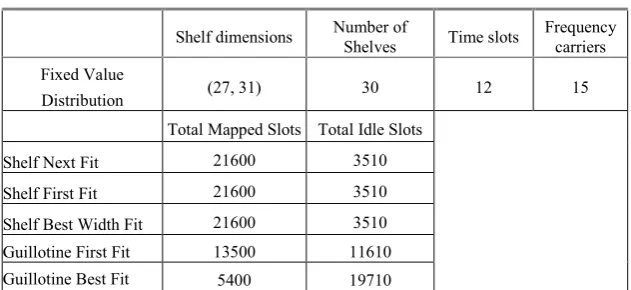
[image:15.595.135.451.154.299.2]

Table 1. Fixed Value Distribution

Shelf dimensions Number of

Shelves Time slots

Frequency carriers

Fixed Value

Distribution (27, 31) 30 12 15

Total Mapped Slots Total Idle Slots Shelf Next Fit 21600 3510

Shelf First Fit 21600 3510

Shelf Best Width Fit 21600 3510 Guillotine First Fit 13500 11610 Guillotine Best Fit 5400 19710

Table 1 presents the input dimensions of the shelf, the number of shelves, and the values of time slots and frequency carriers. These parameters are provided by the user at the beginning of the execution. In the subsequent columns the total number of mapped slots (arranged user requests) and the total number of idle slots (left ar-eas) are presented. Total values of the slots are calculated by summing the multi-plied user request dimensions.

The gathered results are promising for Shelf Algorithms. By observing the per-formance of the Guillotine Algorithms, we can notice high number of idle slots. This, due to low number of used frames (30 in this case scenario) for arrangement of user requests. While increasing the number of frames, the performance of Guil-lotine algorithms is enhanced, as presented in next scenarios. However, as men-tioned previously, Fixed Value Distribution is used in our application for testing reasons.

(16)

Fig.8. Uniform Distribution – Shelf First Fit Algorithm

Simulation results of Shelf First Fit Algorithm while using the Uniform Distribution are presented in Fig.8. As one can notice by doubling the number of used frames for user request arrangement, also the number of mapped and idle slots is doubled. From industrial application’s point of view this is seen as positive performance. Taking into consideration telecommunication applications where the number of user requests most of the time is unforeseen, so does the number of frames that the application should use.

Same results are gathered for Guillotine First Fit algorithm (Fig.9). However, we can summarize performance of proposed Bin packing algorithms as follows:

 The performance of Shelf First Fit algorithm is highlighted in most of the case scenarios

 Guillotine First Fit algorithm performs better for higher number of frames, im-plying the possibility to arrange more user requests

(17)

Fig.9.Uniform Distribution – Guillotine First Fit Algorithm

The third method of distribution of values implemented in our application implies Poisson distribution. This method generates user request dimensions based on man-ually entered mean values for the width and the height. For the simulations that are based on the Poisson distribution we used 200 frames, with user request dimensions having mean values of the width 24 and the height 27.

Fig.10. Gathered results while using Poisson Distribution

(18)

scenarios, the Shelf First Fit algorithm managed to arrange the highest number of user requests while generating the lowest number of idle slots. On the other hand, the Shelf Best Width Fit algorithm is very close to the best performance, too. It is reminded that the Shelf Best Width Fit uses the methodology of arranging the in-coming user request into the left position where the remaining capacity is the lowest. Therefore, as we can notice from the corresponding graphs, the number of idle slots is lower compared to the Shelf Next Fit algorithm.

Guillotine First Fit algorithm performance compared to Shelf First Fit algorithm is considered proximate in the context of mapped user requests. Even though the total number of mapped and idle slots differs, the memory usage and simulation time in the case of Shelf First Fit algorithm are higher. This implies a tradeoff be-tween delay, memory usage and efficiency.

7 Conclusions

Towards lowering the resource allocation problem in telecommunication areas, we propose different Bin-Packing algorithms which are designed for use in OFDMA networks.

The corresponding resource allocation techniques can be incorporated into small wireless broadband systems which use OFDMA as multiplexing scheme. Incoming parameters are provided as multiplexed values (time slots and frequency carriers) of user request, which should be arranged into the system’s resource space depend-ing on the available bandwidth. Hence, as a result at the end of execution the user requests are mapped to specific time-frequency slots, in a manner exploiting most of the free space left within the frame. The corresponding left areas are considered as idle slots, which vary depending on the specific case.

The implemented Bin-Packing algorithms exhibit different features and function-alities, which enable to compare and distinguish them for specific case scenarios where they can provide better bandwidth utilization.

(19)

References

1. Bannister, J., Mather, P., Coope, S.: Convergence Technologies for 3G Networks IP, UMTS, EGPRS and ATM. In: John Wiley & Sons Ltd The Atrium. Southern Gate Chichester. West Sussex (ed) Background to convergence 1rt end. PO19 8SQ, England, ISBN 0-470-86091-X (2004)

2. Romero, J.P., Sallent, O., Augusti, R., Diaz-Guerra, M.A.: Radio resource management strate-gies in UMTS. In: John Wiley & Sons Ltd. The Atrium Southern Gate Chichester. West Sussex (ed) The mobile communications sector 1rt edn. PO19 8SQ, England. ISBN-10: 0470022779 (2005)

3. Junaid, M.A., Farooq, A., Shah, A.: Evolution and Development towards 4th Generation (4G) Mobile Communication Systems. In: Journal of American Science. Volume 6. pp 63-68. ISSN: 1545-1003 (2010)

4. Tanaka, K.: The Mobile Communications Environment in the European Union: Systems, Reg-ulations, and Consequences in the Past, Present, and Future. In: IEEE 2001 Conference on the History of Telecommunications. St. John's Newfoundland Canada. Pp 25-27. July 2001

5. Marjanovic, D., Müller, C., Schönenberger, T.: New Opportunities for B2B and B2C Ser-vices Offered by New Mobile Communication Technologies. Presentation Lectures: De-partment of Informatics - Communication Systems Group. University of Zurich

6. Tellabs: 4G, the What, Why and When. The worldwide adoption and growth of wireless are the fastest technological achievements in history. In: White paper, Innovative solutions at your fingertips. 74.1948E Rev. C 2/12 (2012)

7. Borcoci, E.: WiMAX Technologies: Architectures, Protocols, Resource Management and Ap-plications. In: CTRQ Conference. Bucharest, Romania, June 29 - July 5, 2008

8. So-In, Ch., Jain, R., Tamimi, A.-K.: Scheduling in IEEE 802.16e Mobile WiMAX Net-works: Key Issues and a Survey. Vol27, No2, February 2009

9. Hwang, J.S., Consulta, R.R., Youn, H.J.: Opportunities & Threats for implementation of 4G cellular networks. Paper published in online library at http://www.scribd.com/doc/6852728/4G, PTC’07 Proceedings (2012)

10. Rumney, M.: IMT-Advanced: 4G Wireless Takes Shape in an Olympic Year. In: Agilent Meas-urement Journal. USA. 5989-9793EN (2008)

11. Omerovic, S.: WiMax Overview. Faculty of Electrical Engineering. Dissertation, University of Ljubljana, Slovenia

12. Toh, CK.: 4G LTE Technologies: System Concepts. In: Technology White Paper, VERSION 1.0, 16 Nov 2011

(20)

14. So-In, C., Jain, R., Al-Tamimi, A.: eOCSA: An Algorithm for Burst Mapping with Strict QoS requirements in IEEE 802.16e Mobile WiMAX Network. In: 2nd Inter. Conf. on Comp. and Automation Engineering (ICCAE 2010)

15. So-In, C., Jain, R., Al-Tamimi, A.: OCSA: An algorithm for Burst Mapping in IEEE 802.16e Mobile WiMAX Networks. In: 15th Asia-Pacific Conference on Comm. (APCC 2009)

16. Sarigiannidis, A., Nicopolitidis, P., Papadimitriou, G., Sarigiannidis, P., Louta, M.: Using Learning Automata for Adaptively Adjusting the Downlink-to-Uplink Ratio in IEEE 802.16e Wireless Networks. In: ISCC '11 Proceedings of the 2011 IEEE Symposium on Computers and Communications, Pages 353-358. ISBN: 978-1-4577-0680-6. doi 10.1109/ISCC.2011.5983863 (2011)

17. Wang T., Feng H., Hu B.: Two-Dimensional Resource Allocation for OFDMA System. In: IEEE Communications Society subject matter experts for publication in the ICC 2008 work-shop proceedings

18. Zubowa A., Murb D.C., Costab X.P., Favaroc P.: Greedy Scheduling Algorithm (GSA)- De-sign and Evaluation of an Efficient and Flexible WiMAX OFDMA Scheduling Solution. In: Elsevier Editorial System(tm) for Computer Networks, August 10, 2009

19. Lodi, A., Martello, S., Vigo, D.: Recent advances on two-dimensional Bin packing prob-lems. In: Elsiver. Volume 123. Issues 1–3. Pages 379–396. PII: S0166-218X(01)00347-X (2002)

20. Zhang, G.: A new version of on-line variable-sized Bin packing. In : Elseiver. Volume 72. Issue 3. Pages 193–197. AMS classification: 90B35, 9OC27 (1997)

21. Bin Packing. Presentation, The Icon Programming Language: The University of Arizona, http://www.cs.arizona.edu/icon/oddsends/bpack/bpack.htm

22. Dosa, G., Sgall, J.: First Fit packing: A tight analysis. In: Leibniz International Proceed-ings in Informatics Schloss Dagstuhl. pp. 1–15. Doi: 10.4230/LIPIcs.xxx.yyy.p (1998)

23. Baldi M.M., Crainic T.G., Perboli G., Tadei R.: Worst – Case Analysis for New Online Bin Packing Problems, CIRRELT, February 2013

24. Kühn, P.J.: Designing a Frequency Selective Scheduler for WiMAX using Genetic Algo-rithms. Dissertation, University of Stuttgart, Institute of Communication Networks and Com-puter Engineering (2008)

25. Davis, T.: Bin Packing, http://www.geometer.org/mathcircles (2006)

26. Lodi, A.: Algorithms for Two-Dimensional Bin Packing and Assignment Problems. Doc-torate thesis, Universita Degle Studi Di Bologna (1999)

27. History of OFDMA and how it Works (2005): http://www.webope-dia.com/DidYouKnow/Computer_Science/2005/OFDMA.asp

28. Shazzad, K.M.: Orthogonal frequency-division multiplexing,

http://www.mikrobiokosmos2009.org/7-orthogonal-frequency-division-multiple-access-ofdma.html

(21)

30. Jylänki, J.: A Thousand Ways to Pack the Bin – A Practical Approach to Two-Dimensional Rectangle Bin Packing. Dissertation. Available at http://clb.demon.fi/files/Rectan-gleBinPack.pdf, 2010 (2010)

(22)

Appendix A

(23)
(24)

Fig.13. Workflow diagram of Shelf First Fit Algorithm

Figure

Table 1. Fixed Value Distribution

References

Related documents

Actors within different social, political, cultural or religious fields receive, communicate, negotiate and develop the notion of aesthetics in close connection to their

Firstly, I will provide an analysis of the aesthetics within the virtual environment known as the Buddha Center 1 ; secondly, I will examine the aesthetics and religious practice

12 Instead, as I argue here through the lens of silent online meditation, what makes ethnography possible is in worlds such as Second Life is ‘virtual embodiment.’ When logged

The organisational structure of Church Online has developed in quite the opposite direction, toward more flexible reinterpretation of offline structures. LifeChurch.tv

file (ZA-Nr. 1795) contains all time series which have been established in this program since 1980 and some of these were already selected from ear- lier surveys extending the

We have shown that (1) because macroeconomic dynamics are nonlinear functions of the underlying model parameters, the expectation effect of regime switches in monetary policy

In this paper, we provide a detailed description of a world’s largest-class capacity generator-motor and a thyristor starter system implemented for the first time using digital

The findings of 1) reduced connectivity of the VWFA with the left inferior frontal gyrus and the inferior parietal lobule in children with dyslexia compared to controls and 2)