City, University of London Institutional Repository
Citation
:
Silvester, J., Anderson-Gough, F. M., Anderson, N. R. and Mohamed, A. R. (2002). Locus of control, attributions and impression management in the selection interview. Journal of Occupational and Organizational Psychology, 75, pp. 59-76. doi:10.1348/096317902167649
This is the unspecified version of the paper.
This version of the publication may differ from the final published
version.
Permanent repository link:
http://openaccess.city.ac.uk/445/Link to published version
:
http://dx.doi.org/10.1348/096317902167649Copyright and reuse:
City Research Online aims to make research
outputs of City, University of London available to a wider audience.
Copyright and Moral Rights remain with the author(s) and/or copyright
holders. URLs from City Research Online may be freely distributed and
linked to.
Draft of paper accepted as:n
Silvester, J., Anderson-Gough, F.M., Anderson, N.R. & Mohammed, A.R. (2002). Locus of control, attributions and impression management in the selection interview. Journal of Occupational and Organizational Psychology, 75, 59-76.
LOCUS OF CONTROL, ATTRIBUTIONS AND IMPRESSION MANAGEMENT IN THE SELECTION INTERVIEW.
Joanne SILVESTER Department of Psychology
City University, London Northampton Square London EC1V OHB, UK Tel: +44 (0)20 7477 8521 Fax: +44 (0)20 7477 8581 Email: j.silvester@city ac.uk
Fiona Mary ANDERSON-GOUGH Business School
University of Warwick
Neil R. ANDERSON Department of Pschology
Goldsmiths College
Afandi R. MOHAMED Department of Psychology
LOCUS OF CONTROL, ATTRIBUTIONS AND IMPRESSION MANAGEMENT IN THE SELECTION INTERVIEW.
ABSTRACT
Surprisingly little is know about the ways in which candidates create positive impressions during employment interviews. Three studies are presented which investigate how candidate and interviewer locus of control moderate preference for three categories of explanations proffered by candidates during graduate recruitment interviews. In study one 139 undergraduate students and 37 personnel managers rated internal-controllable, internal-uncontrollable and external-uncontrollable candidate attributions for hypothetical past events acording to the likelihood of each producing a positive impression during a selection interview. Students also completed Rotter‟s Locus of Control questionnaire and the Interview Behaviour Scales. Students and personnel managers rated internal-controllable attributions most likely to create a positive impression. However, students with an external LoC rated external-uncontrollable explanations and internal-controllable explanations as being equally likely to convey a positive impression. In study two 62 candidates applying for actual positions with a company completed the same attribution questionnaire prior to first-stage interviews. Interviewer ratings of candidate performance correlated positively with ratings of internal-controllable explanations (r=.36, p<.001). In study three 103 experienced interviewers completed the attribution questionnaire and the WLOC. All interviewers rated internal-controllable attributions most likely to convey a positive impression of a candidate. However, locus of control mediated preference for candidate attributions such that „External‟ interviewers rated external-uncontrollable attributions
INTRODUCTION
It is widely assumed that the selection interview is an important setting for impression management, (Baron, 1989; Ferris & Judge, 1991; Fletcher, 1989; Gilmore, Stevens, Harrell-Cook & Ferris, 1999; Rosenfeld, Giacalone & Riordan, 1995) and that candidates seek to influence selection decisions by answering interviewers‟ questions in a way which they believe will create a favourable impression (Anderson, Silvester, Cunningham-Snell & Haddleton, 1999; Baumeister & Tice, 1986; Leary & Kowalski, 1990; Schlenker, 1980; Stevens & Kristof, 1995). Yet we know little about the ways in which candidates seek to control these impressions, nor the relative effectiveness of different strategies (Arvey & Campion, 1982; Fletcher, 1989, 1990; Giacalone & Rosenfeld, 1989; Gilmore & Ferris, 1989a, 1989b). Indeed, as Gilmore et al. (1999) point out, whilst the employment interview is one of the most thoroughly researched topics in organisational psychology, systematic research has only recently begun to consider issues of social influence (pp. 321). This paper presents a series of three studies that explore preference for verbal impression management strategies on the part of candidates and interviewers in the
context of graduate recruitment interviews. The research had two main aims. First, to determine whether certain types of attribution for past life events and career decisions, produced by
candidates during selection interviews, are more likely to convey a positive impression of that candidate to an interviewer. Second, to investigate whether candidate and interviewer
personalities influence preference for different types of candidate attribution and, thus, interviewer ratings of candidates.
research concerned with discourse strategies during selection interviews in general (Harris, 1989; Gilmore et al., 1999: Silvester & Chapman, 1996), but it is unfortunate given that explanations have been shown to exert a powerful influence on interpersonal behaviour and decision-making (e.g., Sitkin & Bies, 1993).
One important means of verbal impression management is achieved is through causal attributions produced by individuals during discourse in order to maintain or enhance a positive public image (Snyder & Higgins, 1988; Higgins & Snyder, 1989; Higgins, Snyder & Berglas, 1990). These attributions are used to explain past behaviour and events to others and, in certain instances, to make excuses for actions that might otherwise create unfavourable impressions. Indeed, Bies and Sitkin (1992) found that attributions and excuse-making were „normal‟ components of everyday business among middle managers. Moreover, Higgins and Snyder (1989) argue that such „excuses‟ are both ubiquitous and adaptive. As causal attributions are particularly frequent in evaluative situations (Jones & Berglas, 1978), when the outcome is considered important, and when performance is public rather than private (Koditz & Arkin, 1982), it is perhaps not surprising that spoken attributions are produced frequently by candidates during selection interviews (Silvester, 1997). Yet virtually no research that has considered the role played by candidate explanations in the selection interview.
In a recent study, Ployhart, Ryan & Bennett (1999) found that the explanations proffered to applicants by organizations for their failure in a selection process was a critical determinant in enhancing favourable perceptions among applicants of the organization and its selection process. It is possible that the way in which candidates explain outcomes during selection interviews influence interviewer impressions and subsequent decision-making in a similar way. More specifically, certain types of causal attributions may be more effective than others at conveying a positive impression of a candidate. For example, there may be a common belief that candidates will do better in an interview if they accept responsibility for past failures rather than blame others or circumstances. Consequently, an internal-controllable attribution such as: “I didn’t get
the promotion because I spent too little time on personal development” may be viewed by an
application”. However, whilst attributions which blame negative outcomes on other people or circumstances may be less threatening to a candidate‟s self-esteem (Gioia, 1989; Higgins & Snyder, 1989; Snyder & Higgins, 1988), in the evaluative public context of the selection
interview they may also convey the impression that the individual is unable or unwilling to take responsibility for previous failings or mistakes (Silvester, 1997). In contrast, an
internal-controllable attribution such as “I didn’t get the promotion because I hadn’t prepared well
enough for the interview” conveys the impression that the candidate is taking responsibility for
his or her actions and may therefore be more effective at controlling their environment (Braaten, Cody & DeTienne, 1993; Rosenfeld, Giacalone & Riordan, 1995).
The first aim of this research was to explore the existence of shared beliefs regarding the relative effectiveness of different verbal impression management strategies. More specifically, it compared individuals‟ beliefs about the extent to which three types of explanations for past negative outcomes (e.g., having done poorly on an exam) would convey a positive impression of a candidate. The three types of explanations were represented by a) internal-controllable
attributions (e.g., failure to revise sufficiently), b) internal-uncontrollable attributions (e.g., being ill during the exam), and c) external-uncontrollable attributions (e g., inadequate supervision). On the basis of previous research (Silvester, 1997) it was predicted that, in general, both
potential applicants to an organisation and interviewers within organizations would rate internal-controllable attributions most likely to convey a positive impression of a candidate during a selection interview:
Hypothesis 1: internal-controllable attributions for previous negative life events and
career decisions will be rated by individuals as being more likely to convey a positive
impression of a candidate during a selection interview than either
internal-controllable or external-uninternal-controllable attributions.
1990; Keenan, 1982). For example, Fletcher (1990) argues that Locus of Control [LoC]
influences a candidate‟s preferred impression management strategy during a selection interview. He suggests that as Internals are more likely to see themselves as „masters (sic) of their own destiny‟, they are more likely than Externals to adopt assertive and controlling behaviours during selection interviews. There is limited evidence to support this claim: Fletcher (1990) found that externals were more likely to take their time when answering questions during a selection
interview, and Keenan (1982) found that Internals were more confident of interview success. In a recent study by Cook, Vance and Spector (2000) involving simulated employment interviews with undergraduate students, candidates‟ LoC was found to correlate significantly with ratings of interview performance. In a second study involving a graduate recruitment programme,
candidates‟ LoC also correlated with number of offers of second interviews, but not number of job offers.
The authors of the above studies suggest that locus of control has a direct impact upon candidate behaviour in selection interviews through, for example, candidates adopting more challenging questioning styles and assertive behaviours. However, it is equally possible that locus of control impacts upon what is said during selection interviews and not simply how it is said. For example, there is evidence that locus of control influences the choice of explanation in evaluation contexts. In a laboratory study, Wang and Anderson (1994) found that Externals indicated that they would be more likely to use explanations for negative outcomes that involved externalising blame and minimising personal responsibility. In contrast, Internals were more likely to accept responsibility and less likely to blame others. Although this study was not conducted within a selection context, it is possible that locus of control influences candidates‟ choice of explanations during interviews. Consequently, a second aim of this research was to replicate these findings in a selection context. It was anticipated that, unlike internals, candidates with an external locus of control would rate external-uncontrollable explanations for past
negative events (e.g., my teacher did not cover all the material I needed) as being equally likely to convey a positive impression in a selection interview as internal-controllable explanations (e.g., I did not revise enough).
internal-controllable explanations for past negative events more likely to convey a positive
impression than candidates with an external locus of control.
Hypothesis 2b: candidates with an external locus of control will rate
external-uncontrollable explanations for past negative events more likely to convey a positive
impression than candidates with an internal locus of control.
STUDY ONE
METHOD
Participants
A total of 139 undergraduate psychology students from a UK university participated in the study as part of a practical class (40 male, 99 female; mean age = 21.83 years, range 17-61
years). This sample was representative of a group likely to be applying for graduate jobs in the near future and 104 (74.8%) already had experience of being interviewed for a job. In addition, 38 respondents (21 male, 17 female) completed a postal questionnaire addressed to personnel managers in a sample of organisations actively involved in graduate recruitment. Organisations were selected at random from the Institute of Personnel Management Year Book (response rate 45.7%) and all respondents worked within the personnel field where they were actively involved in selection interviewing. Organisational respondents‟ working titles varied from Personnel Director to more junior positions such as Personnel Officer, but for simplification the generic title „personnel manager‟ has been used to describe the group. Respondents to the postal questionnaire were asked to indicate how many years‟ experience they had in selection interviewing. The sample included 10.8% with less than one year‟s experience, 35.1%with between two and five years experience, 21 6% with between six and ten years experience, and 32.4% of respondents with more that ten years experience of selection interviewing.
All students completed the Locus of Control Scale (Rotter, 1966), an Interview
Attribution Questionnaire [IAQ] developed for this study, and the Interview Behaviour Scales (Fletcher & Spencer, 1984). Students were not informed of the aims of the study until they had completed the questionnaires. The Interview Attribution Questionnaire [IAQ] was developed from transcripts of graduate recruitment interviews collected as part of an earlier study. Eight common negative scenarios were extracted from interview transcripts, together with candidate explanations. Explanations were coded using definitions provided by the Leeds Attributional Coding System (LACS: Munton, Silvester, Stratton & Hanks, 1999) and internal-controllable, external-uncontrollable and internal-uncontrollable causes were identified. As relatively few scenarios and attributions were required, coding reliability was assessed by five students who independently coded each of the statements and attributions. As a consequence one statement was changed slightly and students were subsequently able to categorise attributions with 100% accuracy.
Following a similar procedure to that adopted by Ployhart, Ryan & Bennett (1999), the IAQ was designed such that respondents were asked to imagine themselves as a candidate in a selection interview who wished to make the best possible impression in order to secure a job offer. Each respondent was asked to consider a series of interviewer questions concerning hypothetical negative outcomes involving the candidate. After considering an interviewer question (e.g., You applied to do a training course with a company but weren’tsuccessful. Why
do you think that was?) they rated each of the three candidate explanations according to how
likely they would be to use it in a selection interview. Three forms of candidate attribution were presented in randomised order for each question: an internal-controllable attribution (e.g., I
didn’t read up enough about the company before I went), an internal-uncontrollable attribution
(e.g., I had a dreadful cold on the day of the interview), and an external-uncontrollable
considered that it conveyed a positive impression of the candidate (1 = „extremely ineffective‟ and 9 = „extremely effective‟).
In addition to the IAQ, students completed the Locus of Control scale (Rotter, 1966) and the Interview Behaviour Scales (Fletcher, 1990). The Interview Behaviour Scales include eleven aspects of candidate behaviour likely to occur in a selection interview (e.g., asking questions, enthusiasm, bluffing around a question, initiating conversation, disagreeing with the
interviewer). Students were asked to rate each behaviour (e.g., „How important do you think it would be to be completely honest in a selection interview?‟) according to how likely they would be to use it during a selection interview on a 1-9 likert scale (where 1 = „not at all‟ and 9 = „very much so‟). Personnel managers were not required to complete either the Locus of Control scale or the Interview Behaviour Scales.
RESULTS
The results provide support for hypothesis one. Overall, both students and personnel managers rated internal-controllable attributions most likely to convey a positive impression of a candidate. A significant difference was found between ratings for each of the three attribution types (F(2,276) = 59.47, p<.001). Students rated internal-controllable most favourably (mean = 5.17, S.D. = .95), external-uncontrollable [EU] attributions next most favourably (mean = 4.67, S.D.=1.17), and internal-uncontrollable [IU] attributions were considered to be least likely to convey a positive impression (mean = 4 08, S.D.=1.06). Personnel Managers also rated internal-controllable attributions most likely to convey a positive impression (mean = 5.11, S.D. = .83), but no distinction was made between internal-uncontrollable attributions (mean = 4.40, S.D.= .80) and external-uncontrollable attributions (mean = 4.39, S.D. = .79). No significant gender effects were found for locus of control or any of the attribution types.
scoring in the mid range were excluded from subsequent analyses of group differences. As we were also interested in comparing students‟ ratings with those of the interviewers who could be deemed to be experienced in judging candidate responses in real interviews, a decision was taken to conduct a one-way repeated measures ANOVA which considered the effects of group
(personnel managers /internal students /external students) and attribution type (IU, EU, IC) found a significant main effect of attribution type (F(2,204) = 44.10, p<.001) and a significant
interaction between group and attribution type (F (4,204) = 5.68, p< 001). Mean ratings for each group by attribution type are provided in graph one.
Insert graph 1 about here.
Analysis of simple main effects revealed significant effects for the internal-uncontrollable (IU) response type (p<.05) and external-uncontrollable (EU) response type (p<.01), but not for the internal-controllable (IC) category. Using the Newman Keuls comparison test to explore these findings further, it was found that External students rated external-uncontrollable responses as significantly more likely to convey a positive impression than Internal students (p<.05), providing support for hypothesis 2b. External students alsorated external-uncontrollable responses as significantly more likely to convey a positive impression than personnel managers (p<.05).No support was found for hypothesis 2a: both Internal and External students were equally likely to rate internal-controllable responses as conveying a positive impression in a selection interview. Finally, personnel managers rated internal-uncontrollable responses as significantly more likely to convey a positive impression of a candidate than Internal students (p<.05).
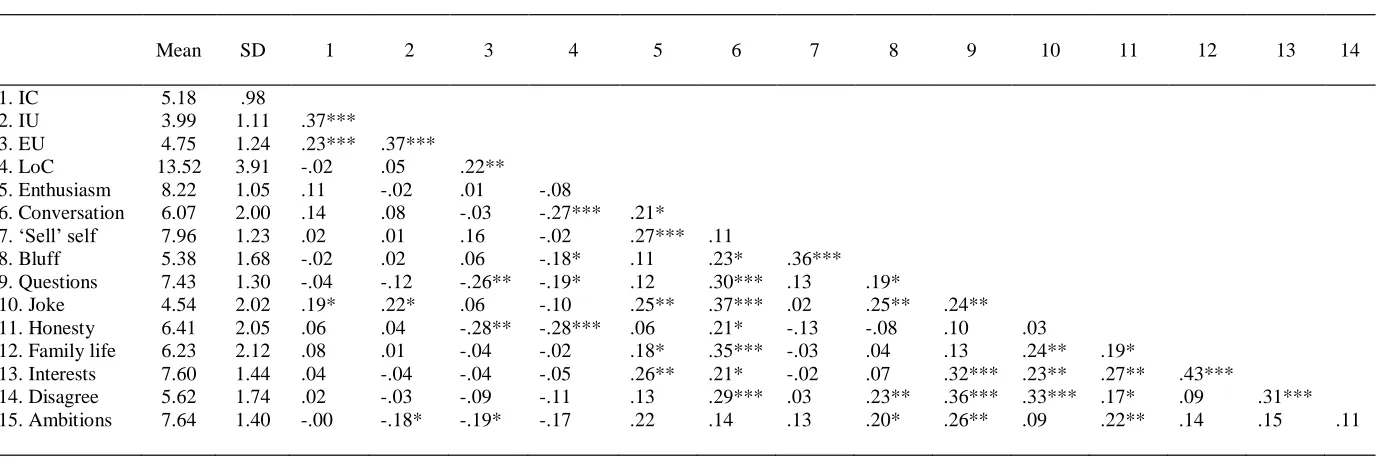
Insert table 1 about here.
honesty an important strategy in the selection interview (r= -.28, p<001). External-uncontrollable attributions, but not internal-uncontrollable or internal-controllable attributions, correlated
significantly with Locus of Control scores (r= .22, p<.01). External-uncontrollable attributions were also associated with being less likely to ask questions in an interview (r= -.26, p<.01) and less likely to discuss future ambitions with an interviewer (r= -19, p<.05). In addition, high scores on internal-controllable (r= .19, p<.05) and internal-uncontrollable (r= .22, p<.05)
attributions were associated with a greater willingness to joke with an interviewer. Finally, t-tests were conducted to determine whether gender differences existed on the Interview Behaviour Scales. No significant differences were found for all but two of the items. Male students were significantly more likely than female students to indicate that they would be dishonest (t =2.19, p<.05) and joke in a selection interview (t = 2.02, p<.05).
STUDY ONE: IMPLICATIONS
These results support hypothesis one. In general, candidates (both internals and externals) and interviewers appear to share a belief that internal-controllable attributions for negative events are more likely to convey a positive impression during a selection interview. Such findings are in line with previous research which has found that more successful candidates in graduate
attributions less likely to convey a positive impression, it is possible that Externals risk being assessed less favourably than Internals during selection interviews because of their choice of verbal impression management strategy.
Interestingly, the ratings provided by personnel managers also indicate that they may be more lenient than students think when evaluating internal-uncontrollable attributions (e g, illness or lack of the „right qualities‟). In general personnel managers rated internal-uncontrollable attributions significantly more favourably than students. Finally, these results support Fletcher‟s (1990) prediction that Internals would be more likely to describe themselves as using
„controlling‟ behaviour in a selection interview. Internals in this study described themselves as being more willing to initiate conversations, ask questions, or bluff their way around questions they were not sure of. In addition Externals described honesty as being less important in a selection interview and were less willing to discuss future ambitions with the interviewer.
STUDY TWO
Although study one provided information regarding the likely effectiveness of different verbal impression management strategies, and the likelihood of different groups of individuals using such strategies, it tells us little about whether such strategies would influence interview outcome in real-life selection settings. Consequently, study two, a field study, was designed to address this question. It was anticipated that candidates who, prior to an actual selection interview, rate internal-controllable attributions most likely to convey a positive impression during that interview would receive higher ratings from interviewers than candidates who rated external-uncontrollable attributions more favourably.
Hypothesis 3a: Candidates who rate internal-controllable attributions most likely to
convey a positive impression during an interview will be rated more positively by
interviewers following an actual recruitment interview.
to convey a positive impression during an interview will be rated less positively by
interviewers following an actual recruitment interview.
Hypothesis 3b: Candidates who rate internal-uncontrollable attributions most likely
to convey a positive impression during an interview will be rated less positively by
interviewers following an actual recruitment interview.
METHOD
Participants and Procedure
Candidates (N=62) and interviewers (N=17) involved in a UK graduate recruitment programme with a multinational oil corporation took part in the study. Candidates had been invited to a first-stage selection interview held at the company‟s London head office and had been informed that successful performance at that interview would result in progression to a second stage assessment centre. On arrival at the company‟s head office, and prior to their selection interview, candidates were asked to complete the Interview Attribution Questionnaire [IAQ] used in study one. All candidates were assured that their responses would be confidential and that no information from these questionnaires would be returned to the company. Following completion of the questionnaire, candidates received individual interviews from an interviewer who recorded his or her ratings of the candidate on a standardised Interviewer Report Form [IRF]. Interviewers were blind to the candidate‟s responses on the IAQ. All interviews were semi-structured and followed the same format. At the beginning the interviewer introduced him or herself and explained the structure of the interview. The interview then comprised a section concerning the candidate‟s interests and skills and a section designed to assess the applicant‟s ability to solve a job-related problem. Each interview lasted for approximately 30 minutes, including 20 minutes for questions from the interviewer and 10 minutes for questions from applicants.
These forms are a standard part of the company‟s recruitment procedure and require the interviewer to rate each candidate on three job-related criteria using a 1-9 Likert scale: (1) „Capacity to achieve‟ (likely ultimate level of advancement within the company); (2) „Achievement Motivation‟ (candidate‟s motivation to achieve at work); (3) „Relationships‟ (candidate‟s likelihood of building positive relationships in the workplace). Interviewers also provide an overall rating of the candidate‟s suitability for selection on a scale 1-9 Likert scale (where 1= totally unsuitable and 9 = extremely suitable). This final rating is used by the company to determine whether or not an applicant will be invited to a second stage assessment centre.
STUDY TWO: RESULTS AND IMPLICATIONS
Insert table two about here
Table two presents correlation co-efficients between the three types of explanation and the four interviewer ratings. The internal-controllable dimension correlates significantly with interviewer ratings of candidates for all three individual selection criteria as well as the overall judgment of the interviewer. There are no significant relationships between the
internal-uncontrollable and the external-internal-uncontrollable dimensions. The more an individual indicated that he or she considered an internal-controllable attribution to be appropriate when explaining a past negative outcome during a selection interview, the more favourably they were rated by the interviewer. Interestingly no contrary effect was found, such that high scores on external-uncontrollable attributions did not predict lower ratings by interviewers. However, it should be noted that the individual interviewer ratings correlated significantly with one another suggesting that they are not measuring independent criteria.
interview, this was not tested in the present research. A natural development for future research would therefore be to test this assumption by asking candidates to complete a LoC scale as well as the IAQ and then record the attributions they produce during a selection interview.
STUDY THREE
Study one demonstrated a relationship between candidates‟ locus of control and preferred impression management strategy in selection interviews. Individuals with an external locus of control rated external-uncontrollable attributions and internal-controllable candidate attributions as being equally likely to convey a positive impression to an interviewer. In contrast, individuals with an internal locus of control and personnel managers rated internal-controllable attributions significantly more likely to convey a positive impression than external-uncontrollable
attributions. However, only students completed the locus of control scale in study one.
Consequently, the possibility that interviewer personality might similarly influence preference for candidate attributions was not investigated. As Gilmore et al. (1999) point out, the
effectiveness of different impression management strategies may well involve an interaction between what the candidate considers appropriate in a selection context and what the interviewer considers to be appropriate. Study three was designed to test the possibility that interviewer personality might similarly influence preference for different types of attribution in a selection context. By doing so, the aim was to build on the findings of study one. Hypothesis four predicted that:
Hypothesis 4: interviewers with an external locus of control will rate
external-uncontrollable candidate attributions for negative outcomes more likely to convey a
positive impression of that candidate than interviewers with an internal locus of
control.
METHOD
A total of 103 managers from two companies participated in the study. All participants were either presently involved in selection interviewing or had acted as interviewers in previous selection contexts. Of these, 73 participants (N=46 females and N=27 males, response rate 47.6%) were recruited from Company A, a large UK publishing company with approximately 300 employees, and thirty participants (N=19 females and N=11 males, response rate 66.7%) from Company B, a multinational organisation responsible for providing employee assistance programmes. All participants received the questionnaires via their organisation‟s internal mail, together with a letter explaining the broad aim of the study and inviting them to take part. They were also assured of anonymity.
Materials
Respondents completed the Interview Attribution Questionnaire [IAQ] given to personnel managers in study one. They were asked to imagine themselves as an interviewer in a selection interview and rate each candidate attribution in terms of how effectively it conveyed a positive impression of the candidate. The IAQ scoring was modified slightly, from a 1-9 to a 1-7 Likert scale (where 1= „extremely effective‟ and 7= „extremely ineffective‟). In addition, respondents completed the Work Locus of Control Scale (WLOC: Spector, 1988). This scale comprises of 16 items related to generalised beliefs about the control of rewards at work that are rated on a 1-6 Likert scale (where 1= strongly disagree and 6= strongly agree). Eight items contain statements claiming that rewards are attributable to external causes such as the actions of others or luck and eight items attribute rewards to internal causes such as effort. A decision was taken to use the WLOC rather than Rotter‟s Locus of Control Scale, because the WLOC was designed
specifically for use in a work context and, as such, demonstrates higher face validity for individuals with work experience. Spector (1988) also reports correlations with measures of general locus of control that range from .49 to .56. High scores on the WLOC refer to an external Locus of Control and low scores to an internal Locus of Control.
The data were tested for group differences between Company A and Company B on age, gender, tenure, and interviewing experience. As no significant group differences were found the two samples were treated as a single group for subsequent statistical analyses. Scores on the WLOC were normally distributed (Mean = 43.1, SD = 11.1). „Internal‟ and „External‟ groups were created by selecting repondents who scored in the lower 30th (scores 1-36, N=32: Internal) and upper 70th percentiles (scores 48-96, N=32: External) of the WLOC. Individuals with mid-range scores were excluded from analyses. Mean scores for Internals and Externals for each of the three attribution types were as follows: Internals: internal-controllable, mean = 4.12, S.D. = .15; external-uncontrollable, mean = 3.04, S.D.=.13; internal-uncontrollable, mean = 3.23, S.D. = .15 and; Externals: internal-controllable, mean = 4.06, S.D. = .15; external-uncontrollable, mean = 3.60, S.D.=.13; internal-uncontrollable, mean = 3.66, S.D. = .15. These are shown in graph two. A 2 (Locus of Control) x 3 (attribution type) repeated measures ANOVA was conducted. A significant main effect for attribution type (F(1.79, 111.20) = 27.77, p<.001) was found, together with a significant interaction between locus of control and attribution type (F(1.79, 111.20) = 4.48, p =.04). Simple main effects of the between subjects variable (locus of control) were further examined by conducting three one-way ANOVAs for each of the three types of candidate attribution. No significant group differences were found for ratings of internal-controllable attributions. However, significant differences were found for both internal-uncontrollable (F(1,62) = 4.21, p<.05) and external-uncontrollable (F(1,62) = 8.76, p<.001) attributions, providing support for hypothesis four.
Insert graph 2 about here.
IMPLICATIONS
These findings suggest that interviewer locus of control influences preference for candidate impression management strategies in a similar way to candidate locus of control. However, whilst interviewers with an external locus of control clearly rate
being more effective at conveying a positive impression than external-uncontrollable attributions. These results appear to support findings from study one and previous research (Silvester, 1997). When asked to explain a previous negative outcome (e.g., failing an exam or being unsuccessful at achieving a particular goal) interviewers in general rate
internal-controllable attributions as being most likely to convey a positive impression of a candidate. It is possible, therefore, that candidates, who produce more internal-controllable than
external-uncontrollable attributions for previous negative events, will be rated more favourably by interviewers. However, these results also support claims made by Gilmore et al. (1999) that an understanding of the relative effectiveness of different impression management tactics needs to take account of both candidate and interviewer factors. Thus, one might anticipate that an interviewer with an external locus of control would be more favourably disposed towards a candidate who produces more external-uncontrollable attributions than an interviewer with an internal locus of control. Consequently, candidate and interviewer personality may both impact upon interview selection decisions.
GENERAL DISCUSSION
This series of studies had two main aims. First, to explore whether certain types of candidate attribution, produced during selection interviews, are more likely to convey a positive impression of a candidate. Second to determine whether candidate and interviewer personality mediate preference for, and therefore choice (candidate) or rating (interviewer) of different types of candidate attribution. The findings from these three studies can be summarised as follows:
1. in general, candidates and interviewers rate internal-controllable candidate attributions for previous negative events as being more likely to convey a positive impression of a candidate than either external-uncontrollable or internal-uncontrollable attributions (hypothesis 1);
an internal locus of control (hypothesis 2b);
3. candidates who described themselves as more likely to use internal-controllable attributions in a subsequent „real‟ graduate recruitment interview, received higher post-interview ratings from post-interviewers (hypothesis 3a);
4. whereas interviewers with an external locus of control rated internal-controllable attributions more likely to convey a positive impression than external-uncontrollable attributions, they rated the latter as significantly more likely to convey a positive impression than interviewers with an internal locus of control (hypothesis 4).
Thus there appears to be evidence for both the existence of shared assumptions regarding how best to explain previous negative events in selection interviews, and the prediction that personality influences preference for verbal impression management strategies. This is an important finding, because it suggests that candidates with a particular personality (external locus of control) may use less effective verbal impression management strategies. As a consequence, they risk being discriminated against in selection interviews. However, these studies do not address the equally important question of whether candidates who make more internal-controllable attributions during selection interviews demonstrate higher performance in the job. Therefore, we have no evidence as yet that attributions spoken by candidates during selection interviews are a valid source of information for interviewers making selection decisions.
improvement with practice, higher motivation and better subsequent task performance than individuals who attributed failure to internal and uncontrollable character defects. Finally, studies have documented a relationship between attributional style and sales performance (Corr & Gray, 1996; Seligman & Schulman, 1986).
A rationale for why causal attributions produced during selection interviews might predict subsequent motivation and work performance comes from work by Weiner (e.g., 1985, 1995). He argues that individuals who typically attribute failure to internal, stable, but
uncontrollable causes are less motivated to achieve success in similar future situations, because they do not believe that they have the ability to influence the outcome differently. In contrast, individuals who make internal, unstable but controllable attributions for failure are more likely improve their performance in future because they believe that they have the ability to perform differently and more successfully in future. Consequently, candidate attributions may predict subsequent work performance to the extent that they reflect the candidate‟s attributional style. However, the relationship between candidates‟ spoken attributions and subsequent work motivation is unlikely to be simple or direct. Spoken attributions occur in a public evaluative context and it is therefore reasonable to assume that candidates will seek to adapt how they present themselves in order to better meet the expectations of the interviewer and the interview context.
A useful distinction can be made here between two components of impression
management proposed by Leary and Kowalski‟s (1990). The first, described as an unconscious component, is dependent upon learned scripts and personality characteristics. The second is described as a conscious, controlled component that is dependent upon the individual‟s skill at recognising and adapting to situational demands. It is helpful to conceptualise spoken
attributions as a product of both conscious and unconscious components to impression
management. Attributional style is often referred to as a relatively stable cognitive personality trait that is comprised of causal schema laid down in LTM as a consequence of historical interactions with the environment (Bugental et al., 1998; Weick, 1979). Such causal schema are usually accessed via automatic, unconscious processing (Louis & Sutton, 1991). Thus
that an individual relies on automatic processing to access causal information. However, a candidate may also engage in a more controlled and conscious processing of causal information, in order to meet the demands of the interview situation and present him- or her-self in the best possible light. Such controlled processing will depend upon both the candidate‟s awareness of what is expected of them and their skill at adapting to those expectations.
If we conceptualise candidate impression management as being in part due to conscious controlled processing and presentation of controlled information, and in part due to the automatic accessing of causal schema laid down previously in LTM, it is possible to make a number of predictions. For example, the extent to which an individual relies upon automatic or controlled processing in a selection interview is likely to vary. In stressful interviews, or when an individual is new to the interview situation, automatic processing of causal information may be more
prevalent than controlled processing. Thus attributional style may be a more important influence upon impression management in these interviews. In contrast, individuals who are experienced an highly skilled at interviewing may experience less stress in the interview situation, be more aware of what is expected of them and therefore better able to engage in a controlled process of impression management. Importantly, however, according to Weiner‟s model, only attributional style (unconscious component) is likely to predict subsequent motivation and job performance. Although an individual‟s ability to engage in controlled impression management may well predict successful organizational socialization. There is clearly a need for further research to establish the relationship and predictive validity of candidate attributions, interview impression management and subsequent job performance.
Whilst this research has demonstrated preferences, on the part of candidates and interviewers, for different verbal impression strategies, there are inevitably limitations to the conclusions that can be drawn. In particular an important assumption underlying these studies is that candidate personality will influence interviewer impressions and subsequent
Moreover, it re-iterates the urgent need, not only for more investigation of communication and process in the selection interview (Eder & Harris, 1999, p.293), but also for researchers to integrate research concerned with candidate personality and selection outcomes (e.g., Cook, Vance & Spector, 2000) and research concerned with interview discourse (Jablin, Miller & Sias, 1999). It is highly unlikely that candidate attributions constitute the only means by which
candidates engage in impression management, nor that there is likely to be a simple relationship between types of attribution and success. However, as Eder & Harris (1999) point out, an emphasis among researchers on structured interviews, and an associated elimination of differences in interview process, has resulted in a decline in interest in the interview as a communication tool (p.294). An exploration of spoken attributions that rests on the strong theoretical and empirical bases of a large body of previous research affords one possible means of beginning to unpack the factors whereby candidates seek to influence interviewers and interviewers reach selection decisions.
REFERENCES
Anderson, C. A. (1983). Motivational and performance deficits in interpersonal settings: The effects of attributional style. Journal of Personality and Social Psychology, 45, 1136-1147.
Anderson, C.R., Hellriegel, D. & Slocum, J.W. (1977). Managerial response to environmentally induced stress. Academy of Management Journal, 20, 260-272.
Anderson, N.R. (1991). Decision making in the graduate selection interview: An experimental investigation. Human Relations, 44, 403-417.
Anderson, N.R. & Shackleton, V. (1990). Decision making in the graduate selection interview: A field study. Journal of Occupational Psychology, 63, 63-76.
Anderson, N.R., Silvester, J., Cunningham-Snell, N. & Haddleton, E. (1999). Relationships between candidate self-monitoring, perceived personality, and selection interview outcomes. Human Relations, 52, 1115-1131.
Andrasani, P.J. & Nestel, G. (1976). Internal-External control as contributor to and outcome of work experience. Journal of Applied Psychology, 61, 156-165.
Arvey, R.D. & Campion, J.E. (1982). The employment interview: A summary and review of recent research. PersonnelPsychology, 35, 28 1-322.
Baumeister, R.F. & Tice, D.M. (1986). Four selves, two motives, and a substitute process self-regulation model. In R.F. Baumeister (Ed.) Public Image and Private Self (pp. 63-74). New York: Springer-Verlag.
Baron, R.A. (1989). Impression management by applicants during employment interviews: The “too much of a good thing” effect. In R.W. Eder & G.R. Ferris (Eds.), The Employment
Interview: Theory, research and practice (pp. 204-215).Newbury Park, CA: Sage.
Bies, R.J. & Sitkin, S.B. (1992). Explanation as legitimisation: Excuse-making in organizations In M.J. Cody & S.J. Read (Eds.), Explaining one-self to others. Reason-giving in a social
context (pp.183-198). Hillsdale N.J.: Lawrence Erlbaum Associates.
Braaten, D.O., Cody, M.J., & DeTienne, K.B. (1993). Account episodes in organizations:
Remedial work and impression management. Management Communication Quarterly, 6,
219-250.
Bugental, D.B., Johnston, C., New, M. & Silvester, J. (1998). Measuring parental attributions: Conceptual and methodological issues. Journal of Family Psychology, 12, 459-480.
Cook, K.W., Vance, C.A. & Spector, P.E. (2000). The relation of candidate personality with selection-interview outcomes. Journal of Applied Social Psychology, 30, 867-885.
Corr, P.J. & Gray, J.A. (1996). Attributional style as a personality factor in insurance sales performance in the UK. Journal of Occupational and Organizational Psychology, 69, 83-87.
Ferris, G.R. & Judge, T.A. (1991). Personnel/human resources management: A political influence perspective. Journal of Management, 17, 447-488.
Fletcher, C. (1981). Candidates‟ beliefs and self-presentation strategies in selection interviews.
Personnel Review, 10, 14-17.
NJ: Lawrence Erlbaum Associates.
Fletcher, C. (1990). The relationships between candidate personality, self-presentation strategies and interviewer assessments in selection interviews: An empirical study. Human
Relations, 43, 739-749.
Fletcher, C. & Spencer, A. (1984). Sex of candidate and sex of interviewer as determinants of self-presentation orientation in interviews: An experimental study. International Review
of Applied Psychology, 33, 305-313.
Giacalone, R.A. & Rosenfeld, P. (1989). Impression Management in the Organization. Hillsdale NJ: Lawrence Erlbaum Associates.
Gilmore, D.C.& Ferris, G.R. (1989a). The politics of the employment interview. In R.W. Eder & G.R. Ferris (Eds.) The Employment Interview: Theory, research and practice (pp. 195-203). Newbury Park, Calif: Sage Publications.
Gilmore, D.C.& Ferris, G.R. (1989b). The effects of applicant impression management tactics on interviewer judgements. Journal of Management, 15, 557-564.
Gilmore, D.C., Stevens, C.K., Harrell-Cook, G. & Ferris, G.R. (1999). Impression management tactics. In R.W. Eder & M.M. Harris (Eds.) The Employment Interview Handbook (pp. 321-336). London: Sage.
Gioia, D.A. (1989). Self-serving bias as a self-sensemaking strategy: Explicit vs. tacit impression management. In R.A. Giacalone and P. Rosenfeld (Eds.) Impression Management in the
Organization. (pp 219-234). Hillsdale Lawrence Erlbaum Associates
Herriot, P. (1989). Selection as a social process. In M. Smith & I.T. Robertson (Eds.) Advances
in Selection and Assessment. Chichester: Wiley.
Higgins, R.L. & Snyder, C.R. (1989). The business of excuses. In R.A. Giacalone & P.
Rosenfeld (Eds.) Impression Management in the Organization. Hillsdale NJ: Lawrence Erlbaum Associates.
Higgins, R.L., Snyder, C.R. & Berglas, S. (1990). Self-handicapping: The paradox that isn ‘t.
Hillsdale NJ: Lawrence Erlbaum Associates.
Howard, J.L. & Ferris, G.R. (1996). The employment interview context: social and situational influences on interview decisions. Journal of Applied Social Psychology, 26, 112-136.
Jones, E.E. & Berglas, S. (1978). Control of attributions about the self through self-handicapping strategies: The appeal of alcohol and the role of underachievement. Personality and
Social Psychology Bulletin, 4, 200-206.
Kacmar, K.M. & Carlson, D.S. (1999). Effectiveness of impression management tactics across human resource situations. Journal of Applied Social Psychology, 29, 1293-1315.
Kacmar, K.M., Delery, J.E. & Ferris, G.R. (1992). Differential effectiveness of applicant impression management tactics on employment interview decisions. Journal of Applied
Social Psychology, 22, 1250-1272.
Keenan, A. (1982). Candidate personality and performance in the selection interview Personnel
Review, 11, 22-25.
Kipnis, D. & Schmidt, S.M. (1988). Upward-influence styles: relationship with performance evaluation, salary and stress. Administrative Science Quarterly, 33, 528-542.
self-handicapping strategy. Journal of Personality and Social Psychology, 43, 492-502.
Leary, M.R. & Kowalski, R.M. (1990). Impression management: a literature review and two-component model. Psychological Bulletin, 107, 34-47.
Louis, M.R. & Sutton, R.I. (1991). Switching cognitive gears: From habits of mind to active thinking. Human Relations, 44, 55-76.
Munton, A.G., Silvester, J., Strattton, P. & Hanks, H.G.I. (1999). Attributions in Action: Coding
Qualitative Data. Chichester: Wiley.
Peterson, C., Semmel, A., Von Baeyer, C., Abramson, L.Y., Metalsky, G.I. & Seligman, M.E.P. (1982). The attributional style questionnaire. Cognitive Therapy and Research, 6, 287-300.
Ployhart, R.E., Ryan, A.M., & Bennett, M. (1999). Explanations for selection decisions:
Applicants reactions to informational and sensitivity features of explanations. Journal of
Applied Psychology, 84, 87-106.
Rosenfeld, P., Giacalone, R.A. & Riordan, C.A. (1995). Impression Management in
Organizations: Theory, Measurement and Practice. London: Routledge.
Rotter, J.B. (1966). Generalized expectancies for internal versus external control reinforcement.
PsychologicalMonographs, 80 (1, whole no. 609), 1-28.
Schlenker, B.R. (1980). Impression management: The self-concept, social identity and
interpersonal relations. Monterey, CA: Brooks/Cole.
Silvester, J. (1997). Spoken attributions and candidate success in graduate recruitment interviews. Journal of Occupational and Organizational Psychology, 70, 61-73.
Silvester, J. & Chapman, A.J. (1996). Unfair discrimination in the selection interview: An attributional account. International Journal of Selection and Assessment, 4, 63-70.
Sitkin, S.B., & Bies, R.J. (1993). Social accounts in conflict situations: Using explanations to manage conflict. Human Relations, 46, 349-370.
Snyder, C.R. & Higgins, R.L. (1988). Excuses: Their effective role in the negotiation of reality.
Psychological Bulletin, 104, 23-35.
Spector, P. (1988). Development of the Work Locus of Control Scale. Journal of Occupational
Psychology, 61, 335-340.
Stevens, C.K. & Kristof, A.L. (1995). Making the right impression: A field study of applicant impression management during job interviews. Journal of Applied Psychology, 80, 587-606.
von Baeyer, C.L., Sherk, D.L., & Zanna, M.P. (1981). Impression management in the job interview. Personality and Social Psychology Bulletin, 7, 45-51
Wang, D. & Anderson, N.H. (1994). Excuse-making and blaming as a function of internal-external locus of control. European Journal of Social Psychology, 24, 295-302.
Weick, K.E. (1979). Cognitive processes in organizations. In B.M. Staw & L.L. Cummings (Eds.) Research in Organizational Behaviour, vol.1. Greenwich CT: JAI Press.
Weiner, B. (1985). An attributional theory of achievement motivation and emotion
Table 1
Means, Standard Deviations and Intercorrelations for all IAQ, LOC and Interview Behaviour Scales
Mean SD 1 2 3 4 5 6 7 8 9 10 11 12 13 14
1. IC 5.18 .98
2. IU 3.99 1.11 .37***
3. EU 4.75 1.24 .23*** .37***
4. LoC 13.52 3.91 -.02 .05 .22** 5. Enthusiasm 8.22 1.05 .11 -.02 .01 -.08
6. Conversation 6.07 2.00 .14 .08 -.03 -.27*** .21*
7. „Sell‟ self 7.96 1.23 .02 .01 .16 -.02 .27*** .11
8. Bluff 5.38 1.68 -.02 .02 .06 -.18* .11 .23* .36*** 9. Questions 7.43 1.30 -.04 -.12 -.26** -.19* .12 .30*** .13 .19*
10. Joke 4.54 2.02 .19* .22* .06 -.10 .25** .37*** .02 .25** .24** 11. Honesty 6.41 2.05 .06 .04 -.28** -.28*** .06 .21* -.13 -.08 .10 .03
12. Family life 6.23 2.12 .08 .01 -.04 -.02 .18* .35*** -.03 .04 .13 .24** .19*
13. Interests 7.60 1.44 .04 -.04 -.04 -.05 .26** .21* -.02 .07 .32*** .23** .27** .43***
14. Disagree 5.62 1.74 .02 -.03 -.09 -.11 .13 .29*** .03 .23** .36*** .33*** .17* .09 .31*** 15. Ambitions 7.64 1.40 -.00 -.18* -.19* -.17 .22 .14 .13 .20* .26** .09 .22** .14 .15 .11
Footnotes
Table 2
Means, Standard Deviations and Intercorrelations for attribution scales and Interviewer ratings of candidates
Mean SD 1 2 3 4 5 6
1. Internal-Controllable 4.01 .71
2. Internal-Uncontrollable 3.66 .62 .50***
3. External-Uncontrollable 3.59 .86 .50*** .56***
4. Relationship Building 5.94 1.41 .36*** .09 .05
5. Capacity for 5.79 1.54 .32** .15 .02 .89***
6. Achievement 5.96 1.58 .34*** .09 .01 .94*** .88***
7. Potential at recruitment 5.71 1.46 .36*** .16 .02 .80*** .88*** .83***
Footnotes