method and a computer tool for generating concept designs. Journal of
Engineering Design. ISSN 0954-4828 ,
http://dx.doi.org/10.1080/09544828.2012.721539
This version is available at https://strathprints.strath.ac.uk/42608/
Strathprints is designed to allow users to access the research output of the University of Strathclyde. Unless otherwise explicitly stated on the manuscript, Copyright © and Moral Rights for the papers on this site are retained by the individual authors and/or other copyright owners. Please check the manuscript for details of any other licences that may have been applied. You may not engage in further distribution of the material for any profitmaking activities or any commercial gain. You may freely distribute both the url (https://strathprints.strath.ac.uk/) and the content of this paper for research or private study, educational, or not-for-profit purposes without prior permission or charge.
Any correspondence concerning this service should be sent to the Strathprints administrator: [email protected]
The Strathprints institutional repository (https://strathprints.strath.ac.uk) is a digital archive of University of Strathclyde research outputs. It has been developed to disseminate open access research outputs, expose data about those outputs, and enable the
On: 18 January 2013, At : 04: 10 Publisher: Taylor & Francis
I nform a Lt d Regist ered in England and Wales Regist ered Num ber: 1072954 Regist ered office: Mort im er House, 37- 41 Mort im er St reet , London W1T 3JH, UK
Journal of Engineering Design
Publicat ion det ails, including inst ruct ions for aut hors and subscript ion informat ion:
ht t p:/ / www.t andfonline.com/ loi/ cj en20
Evaluation of a method and a computer
tool for generating concept designs
Roman Žavbi a , Nuša Fain a & Janez Riht aršiča
a Facult y of Mechanical Engineering, Universit y of Lj ublj ana,
Aškerčeva 6, Lj ublj ana, SI-1000, Slovenia Version of record first published: 18 Sep 2012.
To cite this article: Roman Žavbi , Nuša Fain & Janez Riht aršič (2012): Evaluat ion of a
met hod and a comput er t ool for generat ing concept designs, Journal of Engineering Design, DOI:10.1080/ 09544828.2012.721539
To link to this article: ht t p:/ / dx.doi.org/ 10.1080/ 09544828.2012.721539
PLEASE SCROLL DOWN FOR ARTI CLE
Full t erm s and condit ions of use: ht t p: / / www.t andfonline.com / page/ t erm s-and- condit ions
This art icle m ay be used for research, t eaching, and privat e st udy purposes. Any subst ant ial or syst em at ic reproduct ion, redist ribut ion, reselling, loan, sub- licensing, syst em at ic supply, or dist ribut ion in any form t o anyone is expressly forbidden.
The publisher does not give any warranty express or im plied or m ake any represent at ion t hat t he cont ent s will be com plet e or accurat e or up t o dat e. The accuracy of any
iFirst, 2012, 1–15
Evaluation of a method and a computer tool for generating
concept designs
Roman Žavbi*, Nuša Fain and Janez Rihtaršiˇc
Faculty of Mechanical Engineering, University of Ljubljana, Aškerˇceva 6, Ljubljana, SI-1000, Slovenia
(Received 6 July 2011; final version received 10 August 2012)
The authors have developed a method/computer tool to assist (student) engineering designers in generating concept designs. The method is based on the chaining of physical laws and complementary basic schemata (BS). The tool generates chains which serve as an aid in the development of concept designs. In this paper, the authors compare concept designs generated by a control group (which used functional structure and morphological matrix) with those from an experimental group that used computer-generated chains. The experimental group was found to have generated a greater number of different solutions than the control group; the generation of different solutions indicates a high level of variety and a better chance to find potentially innovative solutions. The established difference in the number of different solutions is statistically significant and the results indicate that the BS facilitate greater variety of concept designs.
Keywords: conceptual design; engineering design; alternative embodiments; experiment; physical laws; statistical significance
1. Introduction
The lack of testing of design methods is one of the five major areas of concern regarding the current situation in design research as expressed by Dorst (2008). Earlier, a similar observation was also expressed by Shahet al. (2000, 2003), who found that very little formal experimental evidence exists to indicate usefulness of idea generation methods for conceptual design and design methods/tools in general (Ruder and Sobek II 2007). The knowledge and ability to use specific methods and tools (especially for systematic synthesis in design) constitute the competency of engineering graduates (Eder and Hubka 2005). Therefore, formal experimentation in the use of design methods is a relevant research issue.
There is a positive correlation between the number of generated alternative product concepts and their quality (Parnes 1961, Cross and Cross 1996, Andreasen and Hein 2000), so it makes sense to further develop formal methods that will enable the generation of alternative concepts. Many different approaches have been used to tackle the problem of generating alternative product concepts based on variations of physical laws, material, geometry and geometrical position. Žavbi and Rihtaršiˇc (2010) discussed the most well-known and documented approaches, along with the
*Corresponding author. Email: [email protected]
ISSN 0954-4828 print/ISSN 1466-1837 online
© 2012 Taylor & Francis
http://dx.doi.org/10.1080/09544828.2012.721539
http://www.tandfonline.com
motivation to propose a new method and the method’s detailed description. Informal evidence indicating usefulness of the method and computer tool based on it exists, but formal experimental evaluation is still needed.
The objective of this paper is to briefly present a computer tool and to evaluate the effectiveness of the method/computer tool; an experiment was designed and performed and the data were
collected and analysed. The authors got the first idea for this experiment during the embodiment of a chain of physical laws and complementary basic schemata (BS) (i.e. the concept) for pressure as output quantity; three different design engineers produced three different embodiments for the same chain as reported by Rihtaršiˇcet al. (2009).
The experiment is the first one in a series of validations of the method and computer tool.
2. Chaining of physical laws
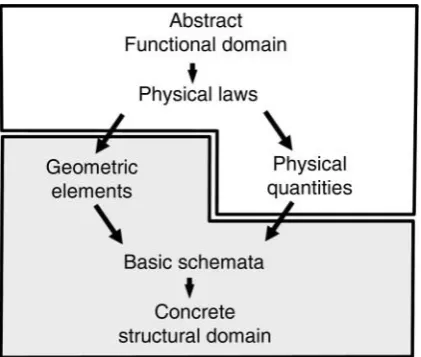
The kernel of the design process is the reasonable transformation from function to form (Roozen-burg and Eekels 1995). The tool to support the conceptual design phase presented in this paper is based on the chaining of physical laws and complementary BS (Figure 1).
Chaining of physical laws is one way of synthesising design concepts. The concept of using physical laws is based on the following observations (adapted from Žavbi and Rihtaršiˇc (2010)):
• All products (i.e. engineered, discrete and physical products) function according to physical
laws (the term ‘physical laws’ also covers laws in other sciences (i.e. biology and chemistry)).
• From the synthesis point of view, a chain of physical laws and complementary BS enables a
desired function of a product and from the analysis point of view; a chain of physical laws and complementary BS explains how a product functions (i.e. how stimulus and response are related).
• There is a complementarity(!) between a specific physical law and a specific basic scheme
(which actually enables the use of physical laws for the synthesis of product concepts).
The chaining algorithm is based on the idea of binding physical laws and their complementary BS via binding quantities. A binding quantity is a quantity common to a physical law and its successor in a chain.
Figure 1. Transformation from abstract functional domain to concrete structural domain.
[image:4.493.142.353.470.648.2]The result of chaining is a chain, which represents a design concept and describes the trans-formation of an input quantity to an output quantity (i.e. an abstract description of the mode of action). Chaining is regarded as the search for and synthesis of physical laws and complementary BS into structures which are capable of realising the required function. The chaining algorithm is described in detail in Žavbi and Duhovnik (2001) and the graphical representation of chaining in Žavbi and Rihtaršiˇc (2010). The method (and the computer tool based on the method) is further explained in Žavbi and Rihtaršiˇc (2010) and Rihtaršiˇcet al. (2012).
A basic scheme is an abstract structure which is complementary to a physical law. Such an abstract structure has certain geometry, geometric position and relevant environment (repre-sented by material and fundamental constants (Giancoli 1998)). It represents a structure capable of performing the transformation of quantities according to the physical law to which it is complementary.
The method basically comprises two activities, namely (i) chaining of physical laws and com-plementary BS and (ii) embodiment design based on the chains of BS. The first activity was formalised and is automated (i.e. automatic mode), the second one requires the human interven-tion (i.e. manual mode). Computainterven-tional tools can be more effectively exploited when combined with the designer’s creativity (as described in Bracewell (2002), Chakrabartiet al. (2002), Lossack (2002), Shaiet al. (2009) and Ziv-Av and Reich (2005)). Also, Kurtoglu’s experimental results showed that a test group involving the use of an automatically generated design aid demonstrated higher idea generation performance than a control group without such a design aid (Kurtoglu
et al. 2009). This subdivision of design activities (i.e. automatic and manual activities) is in line with Blessing (1994), who stated that the designer’s role is not only to provide input, but also constitutes an important reasoning component of the design process.
2.1. Implementation
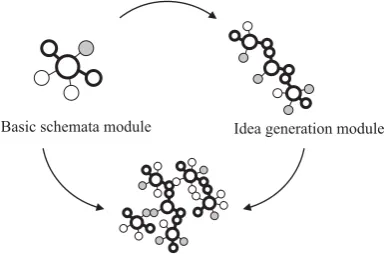
The computer tool based on the method proposed by Žavbi and Duhovnik (2001) consists of three modules: (i) module for the generation of BS (BS module), (ii) idea generation module (chaining wizard) and (iii) structural synthesis module (structural wizard) (Figure 2 (Rihtaršiˇcet al.2010)).
2.1.1. BS module
The BS module is used for the generation of the BS library. This library presents accumulated knowledge, which is available in a formalised structure that is suitable for computer applications.
Idea generation module Basic schemata module
Structural synthesis module
Figure 2. Three modules of the computer tool.
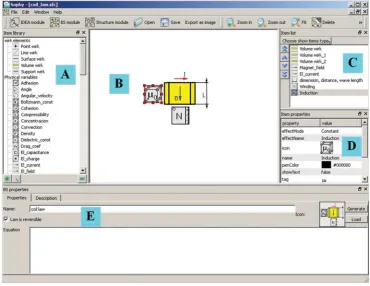
[image:5.493.150.345.514.641.2]Figure 3. BS module: A, item library; B, BS design space; C, item list; D, item properties; E, BS properties.
An important feature of the BS module is that it allows customisation and generation of new BS, which can be added to the existing set of BS. This enables the user to adapt the computer tool to different domains of physics and to his or her level of personal knowledge and comprehension of physical laws.
BS are generated using an assembly of geometric elements and physical quantities (Figure 3). Physical quantities are defined as causes (shown in red colour), effects (blue) and constants (black). If a specific physical quantity can be both a cause and an effect, it is represented by the green colour. The definition of a physical quantity influences the chaining process (the number of chains and sequence of physical laws within a particular chain).
The employed set of physical quantities and graphic elements is shown in the item library (Figure 3(A)). They are dragged from this library into the BS design space, where they are used to build a BS (Figure 3(B)). The imported quantities and elements appear in the item list (Figure 3(C)). The properties of an active item are displayed on the item properties menu (Figure 3(D)). The same physical quantities and graphic elements as are used for BS generation are also used for the structural synthesis of conceptual technical system (TS). The properties of the physical law represented by a BS, its description and the BS icon are generated and stored within the BS properties window (Figure 3(E)). The modes of connectivity between physical quantities and graphic elements were described in greater detail in Rihtaršiˇcet al. (2008).
2.1.2. Idea generation module
There is usually a range of potential solutions to every design problem. In the presented approach, the solution space is generated automatically by chaining physical laws. Thus, it also generates ideas that are physically feasible, but not yet known.
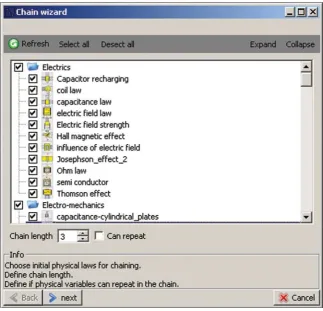
[image:6.493.61.432.72.358.2]Figure 4. Selection of physical laws which are used in the chaining process.
In most cases, a system of physical laws is needed for a complete functionality of a TS. By generating a chain of physical laws, one function at a time is being solved. Firstly, focus is on the fulfilment of the TS’s main function, which represents a functional and structural backbone of the intended TS. The procedure starts with a selection of the physical domains and physical laws to be used in the chaining process (Figure 4).
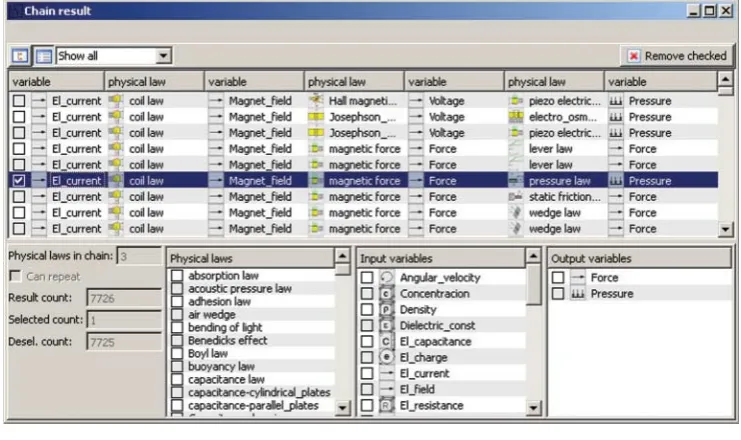
The user further controls the results of the chaining algorithm by selecting appropriate input and output variables (Figure 5). The chain represents a single input and a single output system. The result of the chaining process is a list of possible solutions that combine the specified input and output variables (Figure 6). Additionally, information is provided about the number of generated chains, used physical laws and obtained input and output variables. By selecting a chain from the chain result list, the structural synthesis module is automatically activated.
2.1.3. Structural synthesis module
The selected chain of physical laws presented in Figure 6 is then transferred to the structural design synthesis module, in which a chain of complementary BS is activated (Figure 7). Several chains of BS from various chaining procedures, and individual physical laws can be imported into the common structural design space to enable the embodiment of a chosen concept design.
Initially, BS within the chain (Figure 7) were connected via physical quantities (i.e. the binding quantities, namely causes and effects); BS of this type were part of the design task chosen for the experimental group (see Section 3.4), and they served as a computer generated aid to obtain further
[image:7.493.85.409.69.380.2]Figure 5. Selection of input/output variables.
Figure 6. Results of the chaining process.
Figure 7. Structural synthesis module; the depicted chain was part of the experimental group’s design task.
[image:8.493.60.430.69.249.2] [image:8.493.61.432.273.493.2] [image:8.493.64.430.512.652.2]paper-and-pencil embodiments (see Section 3.3). By activating an individual basic scheme from the chain of BS, it is possible to visualise the connections between the physical laws and geometric elements.Visualisation also reveals sharing of geometric elements and physical quantities between physical laws (Rihtaršiˇc and Žavbi 2011).
3. Experiment
The experiment was designed in an attempt to answer the following research questions regarding the effectiveness of the proposed method/computer tool:
• How large is the design space offered by the computer tool compared to the design space offered
by (student) design engineers?
• Do BS facilitate greater variety of embodiment design compared to the classical approach?
These research questions were based on informal observations on the use of this computer tool in an industrial setting. Like the current study, the one done by Kurtogluet al. (2009), for example, also explored how a computer tool facilitates design and influences the designer’s creativity.
The approach to conduct the experiment basically follows the ‘Direct Method’ (more specifi-cally, the ‘Intrinsic Merit Stage’) as proposed by Shahet al. (2000): formation of two groups (i.e. control and experimental group), selection of a design task, generation of results and the type of data collected.
3.1. Evaluation metrics
According to Shahet al. (2000, 2003), there are two fundamental measures to evaluate the use-fulness of a conceptual design method: (i) effectiveness of expanding the design space and (ii) thoroughness of exploring the design space. They proposed quantity, quality, novelty and variety as specific measures; to begin with, quantity and variety were adopted in our experiment. It is argued that a method/tool is worth using if it helps a design engineer with any of the above-mentioned measures (Shahet al. 2003).
Quantity is the total number of concept designs generated by a method. A concept design is a solution that has the potential to provide the main function as described in the design task. It is an important comparative item (Shahet al. 2000), because there is a positive correlation between the number of generated alternative product concepts and their quality (Parnes 1961, Cross and Cross 1996, Andreasen and Hein 2000).
Variety is a measure of explored design space and is also necessary to counterbalance the quantity measure. The generation of similar ideas indicates a low level of variety and consequently a lower probability of finding better ideas in the solution space (Shahet al. 2003).
3.2. Subjects
Students attending the Design Methodology course were asked to participate in the experiment; it was explained to them that such experimentation is needed to evaluate/further improve a computer
tool. The course is organised during the sixth semester of university studies (as part of the current 10 semester programme) within the Design Engineering and Engineering Mechanics module, as well as the Mechatronics module.
Of the 83 enrolled students, 60 accepted the invitation. They all had the same courses during the first two years, predominantly involving basic and engineering sciences (e.g. mathematics, physics, chemistry, statics, strength of materials, dynamics, fluid dynamics, thermodynamics and
Figure 8. Chains of one, two and three physical law(s) and their complementary BS.
materials science). The only course in which they had been exposed to some specific design tasks was Machine Elements.
3.3. Design task
The design task was kept simple in order to allow focus on the evaluation of quantity and variety; apart from the main function, no additional requirements were given.
The precise text of the control group’s design task (using function structure and morphological matrix to develop design concepts) was as follows:
• Develop concepts of a TS for emptying a tube (e.g. of toothpaste, shoe cream and paint).
The output physical quantity can be force or pressure, while the input physical quantity is arbitrary. The concepts should be presented with a sketch and text. Use function structure and morphological matrix.
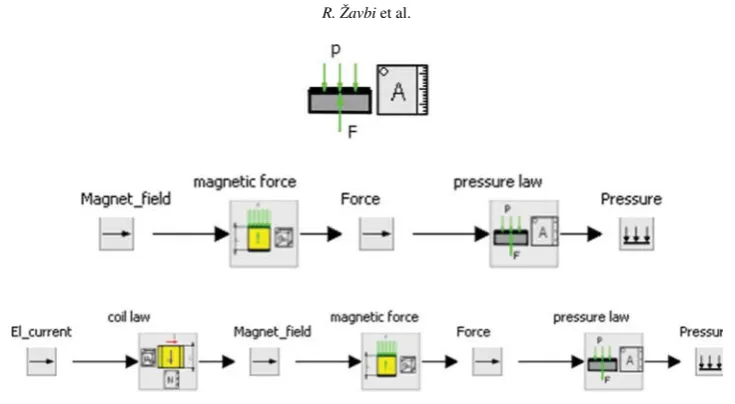
The precise text and the chains of physical laws and complementary BS (Figure 8) for the experimental group’s design task (transforming a chain of physical laws and complementary BS into various embodiments) were as follows (the equations describing the physical laws in the chains were also supplied within the text (in this paper, they are omitted for brevity)):
• Based on the chain of physical laws and BS (Figure 8 (Žavbiet al. 2011); the chains constitute the
output of the computational tool), embodiments of a TS for emptying a tube (e.g. of toothpaste, shoe cream and paint) have to be developed.
3.4. Procedure
The experiment was performed at the end of the semester. The students were divided into two groups: a control group (called the Classic group; 37 students) and an experimental group (called the COMP group; 23 students). Due to logistic problems, the COMP group was smaller than the Classic group, although a more balanced size was planned during the preparation phase.
In the experiment, two methods were compared: a classical one (i.e. comprising the use of function structures and morphological matrix to generate concept designs) and a hybrid one
[image:10.493.63.431.49.251.2](based on the manual embodiment of selected computer-generated chains of physical laws and complementary BS).
The classical method was used by the Classic group; function structures according to Pahl
et al. (2007) were taught within the regular Design Methodology course.
The hybrid method was performed by the COMP group. A short 90-min introductory course on chaining of physical laws and complementary BS and a demonstration of the computer tool (i.e. the generation of three concept designs, namely capacitor microphone, laser deflection probe and magnetostrictive pump, was demonstrated by one of the authors) was organised for the COMP group because this approach is not a part of the standard program.
Using the computer tool, the authors selected three chains of physical laws (one with one physical law, another with two physical laws and the third one with three physical laws per chain; magnetism as the governing physical principle was randomly selected by one of the authors) and complementary BS for the design task of the COMP group (Figure 8) prior to the central portion of the experiment (i.e. manual embodiment of the chains).
Due to the deterministic nature of the computer tool and given input data (the output variable, length of the chains and the selected governing physical principle in the chains), the results (i.e. the selected computer-generated chains of physical laws and complementary BS) were independent of the tool’s user.
The time allocated for the design task was 30 min, and the two groups were working on their tasks simultaneously. The decision to set the time limit to 30 min was based on the opinions of experienced product developers/R&D managers who were consulted in this regard. An additional
argument in favour of the selected time limit is Howardet al.’s (2011) finding that after the 30 min mark, the rate of idea generation during brainstorming decreases slowly and steadily, with a sharp decline in quality after 20 min.
The COMP group had an additional constraint in that, the allocated time was structured so that 10 min were assigned for each chain of the design task, that is, for chains with one, two and three physical laws and complementary BS in the chain, respectively.
3.5. Evaluation procedure
The concept designs generated by the Classic group and the computer tool (during the automatic mode, before the central part of the experiment) were classified by two experts as (i) ‘solutions’ or (ii) ‘non-solutions’. Obviously, a non-solution has no potential to provide the main function.
It was assumed that all the solutions (represented by chains of physical laws and complementary BS) generated by the computer tool were ‘solutions’.
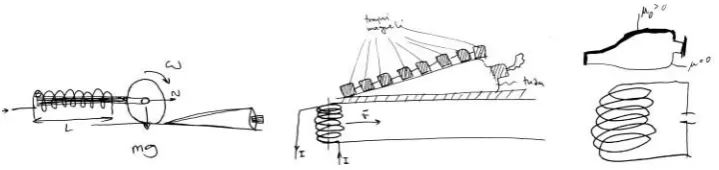
Variety was assessed according to differences in embodiment. Generation of different solutions indicates a high level of variety and a better chance to find potentially innovative solutions. All the concept designs (which were classified as solutions) were classified by two experts as (i) ‘different’ or (ii) ‘similar’. Differences in embodiment were sufficient for the concept design to be classified as different (e.g. second and third concept design in Figure 11). If two concept designs differed only in detail (e.g. the second and fourth concept design in Figure 10), then they were classified as similar. No additional classifiers (or rating scales) were used to further differentiate the design concepts of the ‘different’ class based on the use of different physical principles, for example.
The evaluation of variety was simplified compared to Shahet al.’s (2003) because we were interested in the influence of BS on the level of a variety of embodiments. BS in a chain are based on the physical laws. Therefore, the embodiments of the COMP group could not differ in terms of the physical principles used (see the experimental group’s design task). Consequently, the level of difference could not be calculated in the same way as Shah did it. The embodiments of the Classic group could be differentiated also by the physical principles used, but in order to compare variety of both groups, it was assessed in a simplified manner.
The classification of generated concept designs regarding quantity and variety was done by two experienced professional product developers (i.e. experts) who had a lot of experience with various phases of product development (Benkoet al.2004, Tavˇcar and Duhovnik 2005, Duhovnik
et al. 2006, 2010, Tavˇcar and Pogaˇcnik 2007, Benediˇciˇc 2009, Benediˇciˇcet al. 2010, Potoˇcniket al. 2010) and were also familiar with various concept generation techniques. The experts were blinded to the conditions of the experiment.
Only the concept designs regarded as different by both experts were classified as ‘different’, otherwise they were identified as ‘similar’. The same technique was used to differentiate ‘solutions’ from ‘non-solutions’: only concept designs regarded as solutions by both experts were classified as ‘solutions’.
The above approach regarding the inter-rater agreement is based on the approach for judging experimental results (i.e. inventions) used by Finke (1990).
4. Generated data and analysis of the results
The solutions for the design tasks of both groups were collected, classified and analysed.
4.1. Automatic mode
The following three characteristics (the second and the third are of qualitative character) of the concepts were found and they were mainly related to the number of generated concepts and to the knowledge of physical laws and effects:
(1) The computer tool generated more concepts (represented by chains of physical laws and complementary BS in the automatic mode) for a given design task than student designers of the Classic group.
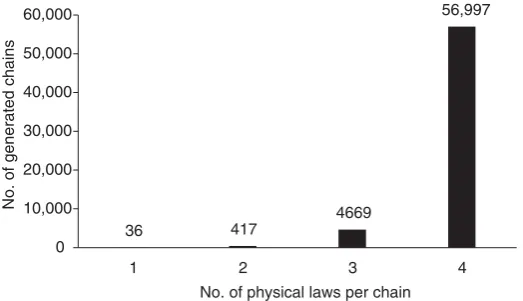
The students of the Classic group generated 108 concepts, while the computer tool generated over 60,000 concepts (Figure 9).
High number of generated concepts (i.e. quantity) is important, because there is a positive correlation between the number of generated alternative product concepts and their quality (Parnes 1961, Cross and Cross 1996, Andreasen and Hein 2000). This fact also has a disadvantage, that is,
36 417
4669
56,997
0 10,000 20,000 30,000 40,000 50,000 60,000
1 2 3 4
No. of generated chains
No. of physical laws per chain
Figure 9. Bar chart of all chains (with up to four physical laws per chain) generated for the design task by the computer tool (automatic mode).
[image:12.493.117.379.494.644.2]the problem of managing such a high number of generated solutions. In general, the management of generated solutions consists of (as proposed by Žavbi and Rihtaršiˇc 2010):
• Focusing the selection first on shorter chains, for example, chains with one to four physical laws
(and the complementary BS) per chain. Shorter chains have a smaller number of transformations and consequently higher efficiency (e.g. thermal, mechanical, electrical and combined). In this way, a design engineer is confronted with a much smaller number of alternatives.
• Eliminating those chains which contain physical laws from certain domains, e.g. electricity,
optics, hydraulics etc. if product requirements support the formulation of such elimination criteria;
• Clustering of chains, which is supported by the observation that longer chains are very similar
to each other and differ only in a few physical laws (and the complementary BS). Therefore, the analysis of longer chains is focused on these different laws; only one chain in a cluster of similar chains has to be analysed fully.
The first technique was chosen to provide chains for the design task of the COMP group, because our experiences have shown this to be most efficient.
(2) The computer tool generated concepts utilising physical laws which have not been utilised in the concepts generated by the student designers.
(3) The concepts generated by the tool were more complete than those generated by student designers regarding the explicit description of physical laws.
The concepts generated by the computer tool were described by physical laws that govern transformations of quantities (i.e. variables, constants and relations between them) and by com-plementary BS, while the concepts generated by student designers were focused on sketches and textual descriptions of their functioning.
4.2. Manual mode
What is even more important is the result of the manual mode. The experiment suggested that the division into the automatic mode (generation of chains of physical laws and complementary BS) and manual mode (embodiment of BS) seems appropriate, because the COMP group generated a greater variety of solutions than the Classic group.
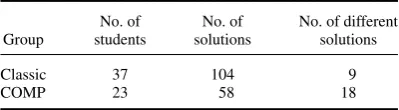
The students who embodied chains of BS generated a greater number of different solutions (i.e. embodiments) than those who used function structure and morphological matrix (Table 1). Examples of solutions are presented in Figures 10 and 11.
The numbers of solutions show, even at the first glance, that the students using chains of physical laws and complementary BS produced a greater variety of solutions (i.e. embodiments). In order to avoid this result being accidental, statistical tools were implemented for data analysis. The calculation of chi-square (χ2) was made in order to validate the statistical significance of
the results.
Chi-square test was selected based on the work of De Vaus (2001) and Petz (2007). We also relied on the work of Finke (Finke and Slayton 1988, Finke 1990, Finkeet al. 1992), who had
Table 1. Generated concepts for the design task.
No. of No. of No. of different Group students solutions solutions
Classic 37 104 9
COMP 23 58 18
[image:13.493.147.347.612.667.2]Figure 10. Examples of concepts for emptying a tube produced by students of the Classic group.
Figure 11. Examples of concepts for emptying a tube produced by students of the COMP group.
used chi-square tests to confirm statistical significance of the results of his experiments (e.g. experiments on pre-inventive object forms).
The critical value ofχ2at 1 degree of freedom and significance at 5% is 3.84. As the calculated
value ofχ2in the results (χ2 =6.6) is higher than this, it can be confirmed that the differences
in frequencies obtained for the two studied groups are statistically significant; 8.7% of the solu-tions generated by the Classic group were ‘different’, while the COMP group generated 31% ‘different’ solutions. This confirms the research hypothesis that the use of computer-generated BS offers more possibilities to generate ‘different’ solutions (i.e. alternative embodiments) than the classical approach.
5. Discussion
As regards the first research question, the obtained result was expected. The computer tool gen-erates a large number of solutions (without combinatorial explosion (Žavbi and Duhovnik 2001)) according to the algorithm (with its combinatorial character), using a library of common and less common physical laws and complementary BS, while the student designers (Classic group) generated a functional structure and a morphological chart manually. They also combined entries in the chart to synthesise concept designs manually. Consequently, the tool offered a much larger design space (i.e. quantity of solutions) and thus a better chance to find higher quality solutions; it is argued that there is a positive correlation between the number of generated alternative solutions and their quality (Parnes 1961, Cross and Cross 1996, Andreasen and Hein 2000). Additionally, Shahet al. (2003) argued that a method/tool is worth using if it helps a design engineer with any of the specific measures (i.e. quantity, quality, novelty and variety).
It is assumed that the main reason for the second characteristic (regarding the utilisation of various physical laws in the concepts generated by the tool and by the students) is the greater potential of the tool especially when its library of common and less common/unapplied physical laws (and complementary BS) and combinatorial power in experimental time frame are taken into
[image:14.493.66.424.55.159.2] [image:14.493.67.427.215.300.2]account. This is of great importance because many new inventions, innovations and new products are based on the utilisation of various laws and effects and their combinations. Knowledge of various physical laws is also important, because modern manufacturing technologies in the micro-scale enable the utilisation of small changes in the magnitude of quantities of various physical laws (e.g. in micro-electro-mechanical systems) that were ineffective in the macro-scale.
The third characteristic is presumably a consequence of the higher confidence of student design-ers (the Classic group) in sketching and providing complementary textual descriptions than that is the case with complementing sketches with complementary equations. The reason might be insufficient awareness of the role of physical laws in design, or taking the understanding of the governing physical laws for granted.
The major result was that statistical analysis showed the results regarding the greater variety of embodiments (i.e. the second research question) generated by the COMP group (compared to the Classic group) were found to be statistically significant. The results are explained by the fact that, although abstract, the chains of physical laws and complementary BS (generated by the computer tool) lessened the effort required from the student designers (of the COMP group), who consequently could focus only on the embodiments of abstract BS. The great variety of alternative solutions based on abstract chains is in line with Hubka’s statement that a higher abstraction offers more possibilities for variation (Hubka and Eder 2002). The great variety is also in accordance with Rusák’s (2003) statement that the variety of structural solutions (i.e. concept embodiments) is at least as large as the variety of (abstract) concepts. It is also interesting to mention Finke
et al.’s (1992) experiments on creativity: their results suggested that some types of constraints (e.g. use of specified basic building blocks to generate concept designs) enhance the probability of generating unique concepts. The results of our experiment also indicate that the BS provide such constraints and have a facilitating role in generating a greater variety of embodiments.
The student designers of the Classic group first have to synthesise function structure (in a more or less trial-and-error like manner), generate the morphological matrix while having limited knowledge of various physical laws and effects, combine partial solutions and finally gener-ate embodiments. This type of process provides no special focus on embodiment design and consequently does not stimulate a great variety of embodiments of particular concept designs.
Using the computer tool, the authors selected three chains of physical laws and BS (Figure 8) for the design task of the COMP group. A relevant question regarding the procedure for the COMP group would be the approach of the students of the COMP group without prior selection of the chains. It is speculated that the students would first try to focus on embodiments of the chains with one physical law per chain, then two and so forth. Such an approach would be in line with the suggested approach to the management of plethora of generated chains; more physical laws per chain mean more transformations and consequently a lower efficiency of such chains. But it could also happen that the student designers would get lost in the multitude of the generated chains and generate even fewer embodiments than those of the Classic group. This remains one of the topics of future research.
It is true that the exact mechanisms of how student designers from the COMP group actually use computer-generated chains of BS to generate the embodiments are not known. Gonçalves
et al. (2011), for example, reported that the question of how designers transform the available stimuli to produce innovative creative solutions has still been unanswered.
6. Conclusions
One of the most important findings is the supportive role of BS in embodiment design. The results indicate that the BS offer appropriate guidance for human designers (student designers at present) and enable focus on embodiment design. Consequently, the level of variety of the embodiments
is greater than in the case of the classical approach, and such greater variety also means better exploration of available design space. The database of physical laws and chaining of physical laws (and complementary BS) bridge the gap between insufficient knowledge of physical laws/effects
and possibilities offered by less known and as yet unapplied physical laws/effects (as well as
their combinations). A greater quantity of generated design concepts is produced, and this means greater expansion of the design space compared to the classical approach.
The design task was simple and there were no requirements (except for the main function) to be fulfilled by the generated concepts, thus allowing evaluation to be focused on variety rather than on the quality of fulfilment of additional requirements.
The experiment suggested that computational tools (i.e. computer generated chains) can be more effectively exploited when combined with the designer’s creativity (i.e. manually generated embodiments of the chains), which is in line with the results of other researchers (see Section 2).
References
Andreasen, M.M., and Hein, L., 2000 (reprint). Integrated product development. Lyngby: Institute for Product Development, Technical University of Denmark.
Benediˇciˇc, J., 2009.File mechanism having a double lever. International publication number WO 2009/078821 A1. Munich: European Patent Office.
Benediˇciˇc, J.,et al., 2010.Machine for placing hydro-insulation layers. Patent No. SI 22928 A. Ljubljana: Slovenian intellectual property office.
Benko, U.,et al., 2004. Fault diagnosis of a vacuum cleaner motor by means of sound analysis.Journal of Sound and Vibration, 276 (3–5), 781–806.
Blessing, L., 1994.A process-based approach to computer supported engineering design. Thesis (PhD). University of Twente.
Bracewell, R., 2002. Synthesis based on function – means trees: schemebuilder.In:A. Chakrabarti, ed.Engineering design synthesis. London: Springer, 199–212.
Chakrabarti, A.,et al., 2002. An approach to compositional synthesis of mechanical design concepts using computers.In:
A. Chakrabarti, ed.Engineering design synthesis. London: Springer, 179–197.
Cross, N. and Cross, A.C., 1996. Winning by design: the methods of Gordon Murray, racing car designer.Design Studies, 17 (1), 91–107.
De Vaus, D.A., 2001.Research Design in Social Research. Los Angeles, CA: Sage.
Dorst, K., 2008. Design research: a revolution-waiting-to-happen.Design Studies, 29 (1), 4–11.
Duhovnik, J., Benediˇciˇc, J., and Bernik, R., 2006. Side-delivery spreading of manure.Transactions of the ASAE,49 (6), 1663–1675.
Duhovnik, J., Benediˇciˇc, J., and Bernik, J., 2010.Multipurpose manure spreading device.EP 1306001 (B1), 15 September 2010. Munich: European Patent Office.
Eder, E. and Hubka, V., 2005. Curriculum, pedagogics and didactics for design education.Journal of Engineering Design, 16 (1), 45–61.
Finke, R.A., 1990.Creative imagery: discoveries and inventions in visualisation. New York: Psychology Press. Finke, R.A. and Slayton, K., 1988. Explorations of creative visual synthesis in mental imagery.Memory & Cognition, 16
(3), 252–257.
Finke, R.A., Ward, T.B., and Smith, S.M., 1992.Creative cognition. Cambridge, MA: The MIT Press.
Giancoli, D.C., 1988.Physics for scientists and engineers with modern physics. 2nd ed. Englewood Cliffs, NJ: Prentice-Hall International.
Gonçalves, M., Cardoso, C., and Badke-Schaub, P., 2011. Around you: How designers get inspired.In: T.J. Howard, K. Mougaard, T.C. McAloone, and C.T. Hansen, eds.Proceedings ICED2011, Vol. 7. Lyngby, Denmark: DTU, 404–413.
Howard, T.J., Culley, S., and Dekoninck, E.A., 2011. Reuse of ideas and concepts for creative stimuli in engineering design,Journal of Engineering Design, 22 (8), 565–581.
Hubka, V. and Eder, E., 2002. Theory of technical systems and engineering design synthesis.In:A. Chakrabarti, ed.
Engineering design synthesis. London: Springer, 49–66.
Kurtoglu, T., Campbell. M.I., and Linsey, J.S., 2009. An experimental study on the effects of a computational design tool on concept generation.Design Studies, 30 (6), 676–703.
Lossack, R.S., 2002. Design processes and context for the support of design synthesis.In:A. Chakrabarti, ed.Engineering design synthesis. London: Springer, 213–227.
Pahl, G.,et al., 2007.Pahl/Beitz Konstruktionslehre. 7th ed. Berlin: Springer.
Parnes, S.J., 1961. Effects of extended effort in creative problem solving.Journal of educational psychology, 52 (3), 117–122.
Petz, B., 2007.Statistics for nonmatematicians. Zagreb: Naklada Slap (in Croatian).
Potoˇcnik, S.,et al., 2010.Re-bar tier hand-tool. Patent No. SI 22929 A, Ljubljana: Slovenian intellectual property office.
Rihtaršiˇc, J. and Žavbi, R., 2011. Semi-automatic synthesis of conceptual technical systems.In: A. Chakrabarti, ed.3rd International Conference on Research into Design, 10–12 January 2011, Bangalore. Singapore: Research Publishing, 639–645.
Rihtaršiˇc, J., Žavbi, R., and Duhovnik, J., 2008. Physical nature of technical systems.In: D. Marjanovi´c, M. Štorga, N. Pavkovi´c, N. Bojˇceti´c, eds.10th International Design Conference, 19–22 May 2008, Cavtat, Zagreb: Faculty of Mechanical Engineering and Naval Architecture, 53–60.
Rihtaršiˇc, J., Žavbi, R., and Duhovnik, J., 2009. Properties of elementary structural elements for synthesis of conceptual technical systems.In: A. Chakrabarti, ed.2nd International Conference on Research into Design, 7–9 January 2009, Bangalore. Singapore: Research Publishing, 11–17.
Rihtaršiˇc, J., Žavbi, R., and Duhovnik, J., 2010. Sophy – Tool for structural synthesis of conceptual technical systems.In:
D. Marjanovi´c, M. Štorga, N. Pavkovi´c, N. Bojˇceti´c, eds.11th International Design Conference, 17–20 May Cavtat, Zagreb: Faculty of Mechanical Engineering and Naval Architecture, 1391–1398.
Rihtaršiˇc, J., Žavbi, R., and Duhovnik, J., 2012. Application of wirk elements for the synthesis of alternative conceptual solutions.Research in Engineering Design, 23 (3), 219–234.
Roozenburg, N.F.M. and Eekels, J., 1995.Product design: fundamentals and methods. Bath: John Wiley & Sons Ltd. Ruder, J.A. and Sobek II, D.K., 2007. Experiment on a system-level design tool.Journal of Engineering Design, 18 (4),
327–342.
Rusák, Z., 2003. Vague discrete interval modeling for product conceptualization in collaborative virtual design environment. Thesis (PhD). Delft University of Technology.
Shah, J.J., Kulkarni, S.V., and Vargas-Hernandez, N., 2000. Evaluation of idea generation methods for conceptual design: effectiveness metrics and design of experiments.Journal of Mechanical Design, 122 (4), 377–384.
Shah, J.J., Vargas-Hernandez, N., and Smith, S.M., 2003. Metrics for measuring ideation effectiveness.Design Studies, 24 (2), 111–134.
Shai, O., Reich, Y., and Rubin, D., 2009. Creative conceptual design: extending the scope by infused design.Computer Aided Design, 41 (3), 117–135.
Tavˇcar, J. and Duhovnik, J., 2005. Engineering change management in individual and mass production.Robotics and Computer-Integrated Manufacturing, 21 (3), 205–215.
Tavˇcar, J. and Pogaˇcnik, B., 2007.Turbine wheel or blower with reduced noise.Patent No. SI 22100 A. Ljubljana: Slovenian intellectual property office.
Žavbi, R. and Duhovnik, J., 2001. Conceptual design chains with basic schematics based on an algorithm of conceptual design.Journal of Engineering Design, 12 (2), 131–145.
Žavbi, R. and Rihtaršiˇc, J., 2010. Synthesis of elementary product concepts based on knowledge twisting,Research in Engineering Design, 21 (2), 69–85.
Žavbi, R., Fain, N., and Rihtaršiˇc, J., 2011. Do basic schemata facilitate embodiment design?In:T.J. Howard, K. Mougaard, T.C. McAloone, C.T. Hansen, eds.International conference on engineering design, 15–18August 2011, Copenhagen: Technical University of Denmark, 120–129.
Ziv-Av, A. and Reich,Y., 2005. SOS-subjective objective system for generating optimal product concepts.Design Studies, 26 (5), 509–533.