* To whom all correspondence should be addressed. 00265992303140; e-mail: [email protected] or
Received 13 December 2012; accepted in revised form 4 July 2013.
Classification and quality of groundwater
supplies in the Lower Shire Valley, Malawi –
Part 2: Classification of borehole water
supplies in Chikhwawa, Malawi
AM Grimason*
1,2,4, TK Beattie
3, TD Morse
1,2, 3,4, SJ Masangwi
2, GC Jabu
1,2, SC Taulo
1,2and KK Lungu
1,21Department of Environmental Health, University of Malawi – The Polytechnic, P/B 303 Chichiri, Blantyre, Malawi
2Centre for Water, Sanitation, Health and Appropriate Technology Development (WASHTED), University of Malawi –
The Polytechnic, P/B 303 Chichiri, Blantyre, Malawi
3Environmental Health, Department of Civil Engineering, University of Strathclyde, Glasgow, UK, G1 0NG
4Africa Academy for Environmental Health, PO Box 15574, Sinoville 0129, South Africa
Abstract
This paper compares data gathered from a study of the chemical and bacteriological quality of drinking-water from 28 rural borehole supplies in Chikhwawa, Malawi, with a tiered classification scheme (Class 0 being ideal through to Class III being unsuitable for drinking without prior treatment) developed by investigators from the Institute for Water Quality Studies, Department of Water Affairs and Forestry, South Africa. In general, the majority of borehole water supplies were classified as Class 0 or Class I supplies based upon the chemical analysis and bacteriological examination. However the classification of a borehole water supply was variable and depended upon the parameter, date of sampling and whether or not it was based on the mean or individual concentration. A number of boreholes were classified as II or III as they contained elevated levels of fluoride and nitrate suggesting that consumption over short or prolonged periods of time may lead to adverse or serious health effects, such as skeletal fluorosis in adults and methaemoglobinaemia in infants. Research is required to develop practicable, affordable and sustainable methods to enable villagers to treat Class II/III water supplies and improve the quality of their drinking-water to a class suitable for human consumption.
Keywords: Classification, water, borehole, Malawi, South Africa
INTRODUCTION
Over the last decade an increasing number of studies have been undertaken on the bacteriological and chemical quality of bore-hole water supplies in Africa. The data accrued by investigators is more often than not compared with the health-based guide-line values recommended by the World Health Organization (WHO, 2008). When studies are undertaken in conjunction with European and American investigators, the data presented is often compared with EU and USEPA drinking-water stand-ards. However, it should be noted that these standards are based upon the quality of drinking-water supplied to the consumer’s tap after the source water has undergone some degree of con-ventional treatment. Where national standards exist, inves-tigators have attempted to compare their findings with those standards, but these are invariably those recommended by the WHO. Little attempt has been made to publish drinking-water standards specific to borehole water supplies in Africa.
To address this issue Kempster et al. (1997) undertook a review of South African drinking-water standards and WHO recommendations, and produced a scheme to facilitate the classification of borehole water supplies in rural areas based on single parameters. The rationale behind such a scheme was awareness that ‘the boundary between the no-effect level [of
constituents] and the threshold for the initial appearance of undesirable effects is not a sharp one’ (Kempster et al., 1997 p. 163). In areas of the world under pressure from water resource scarcity, realistically, water quality, both source and treated, can fluctuate on a temporary basis. The scheme was designed with the thought of giving ‘a clearer picture of expected effects on the domestic user’. The scheme is based on a select number of aesthetic and health-based parameters that are commonly of concern in drinking-water. On this basis, Kempster et al. produced 4 classes of water quality in terms of suitability for use, ranging from the ideal (Class 0) through to that which is deemed unsuitable for use without further treatment (Class III).
Recently, we undertook a study of the chemical quality of borehole water supplies in Chikhwawa, Malawi (Grimason et al., 2013), and compared our findings with the maximum permissible standards laid down by the Malawi Bureau of Standards for borehole water supplies (MBS, 2005), and the WHO recommended health-based guideline values for drink-ing-water (WHO, 2008). In this paper we present a summary of the chemical and bacteriological data accrued from that study and compare our findings with the classification scheme proposed by Kempster et al. (1997). We believe that this is the first time that the proposed scheme has been utilised for the classification of borehole supplies outside South Africa.
METHODOLOGY
bank) located in 25 remote, rural villages in the Chikhwawa District (n=3 per borehole), distributed along the east (n=15) and west (n=10) banks of the Shire River. Samples were col-lected every 2 months during the wet season (December, February and April) (Grimason et al., 2013). Samples for chemi-cal analysis and bacteriologichemi-cal examination were processed in accordance with standard methods for the examination of water and wastewater (APHA, 1998). Bacteriological samples were collected in 500 mℓ sterile vessels after flaming the inside of the tap of the borehole pump and running off the water to waste for 30 s before obtaining a water sample. Vessels were sealed, labelled, stored in a portable ice chest (coolbox) at 4°C and transported to the Environmental Health Laboratory at the University of Malawi within 6 h. Samples were processed for faecal bacteria using a standard membrane filtration technique and subsequently with confirmatory media in accordance with APHA (1998).
CLASSIFICATION SYSTEM
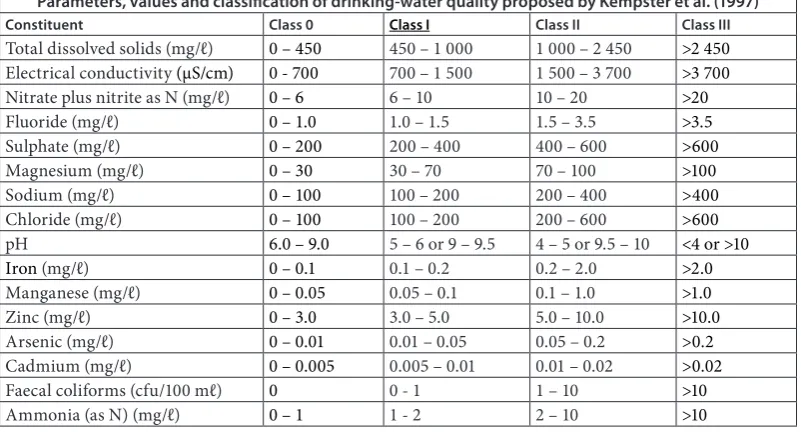
The classification scheme proposed by Kempster et al. (1997 p. 163) was used to classify rural borehole water supplies exam-ined in this study (Table 1):
• Class 0
‘This is ideal water quality, suitable for lifetime use, with no adverse health effects on the user. This class is essentially the same as the target water quality range in the 2nd edition
of the South African Water Quality Guidelines for Domestic Use (DWAF, 1996).’
• Class I
‘Water in this class is safe for lifetime use, but falls short of the ideal water quality in that there may be instances of adverse health effects, but these are usually mild, and overt health effects are almost sub-clinical and difficult to demonstrate. Water in Class I does not cause health effects under normal circumstances. Aesthetic effects may, however, be apparent.’
• Class II
‘Water in this class is defined as that where adverse health effects are unusual for limited short-term use. Adverse health effects may become more common particularly with
prolonged use over many years, or with lifetime use. This class represents water suitable for short-term or emergency use only, but not necessarily suitable for continuous use over a lifetime.’
• Class III
‘This water has constituents in a concentration range where serious health effects might be anticipated, particularly in infants or elderly people with short-term use, and even more so with longer term use. The water in this class is not suitable for use as drinking water without adequate treat-ment to shift the water into a lower and safer class.’
RESULTS AND DISCUSSION
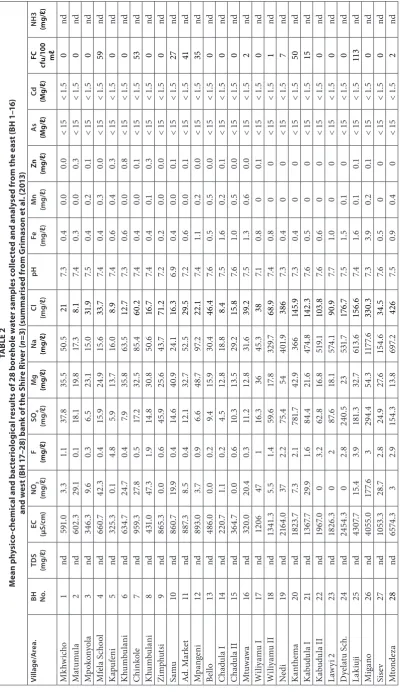
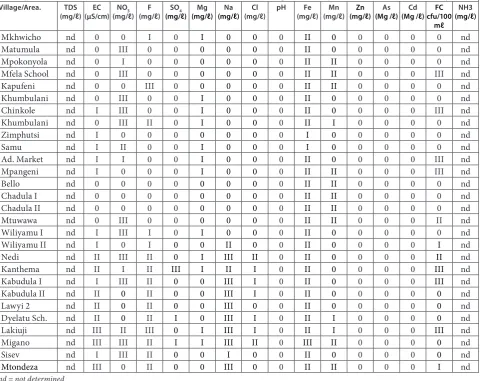
A summary of the data gathered by Grimason et al. (2013) on a range of chemical constituents and bacteriological analysis of 28 borehole water supplies in Chikhwawa, Malawi, is pre-sented in Table 2. Based upon this data, each borehole water supply was classified according to the criteria proposed by Kempster et al. (1997) (Table 3). Tables 4 to 7 present a sum-mary of the water classes determined for each borehole water supply based on the results of 3 samples. The physico- chemical and bacteriological data gathered highlight the variable nature of classifying borehole water supplies, demonstrating the need for a tailored classification scheme proposed by these investigators. For example, for the borehole supply at Matumula on the east bank the class for the iron parameter was Class 0 on 2 sampling occasions and Class II on a separate sampling occasion (Table 4). Despite this varia-tion in quality, based on the mean concentravaria-tion of the three samples taken, the borehole supply would be classified as Class II (Table 3).
Electrical conductivity and pH
[image:2.595.94.495.523.739.2]Based on the electrical conductivity (EC) data, 11 borehole water supplies of 16 tested on the east bank fell within Class 0, and 5 boreholes fell within Class I. On the west bank 4 bore-holes were classified as Class 1, 5 borebore-holes as Class II and 3 boreholes as Class III, respectively. All pH values were within Class 0 (pH 6–9).
TABLE 1
Parameters, values and classification of drinking-water quality proposed by Kempster et al. (1997)
Constituent Class 0 Class I Class II Class III
Total dissolved solids (mg/ℓ) 0 – 450 450 – 1 000 1 000 – 2 450 >2 450
Electrical conductivity (µS/cm) 0 - 700 700 – 1 500 1 500 – 3 700 >3 700
Nitrate plus nitrite as N (mg/ℓ) 0 – 6 6 – 10 10 – 20 >20
Fluoride (mg/ℓ) 0 – 1.0 1.0 – 1.5 1.5 – 3.5 >3.5
Sulphate (mg/ℓ) 0 – 200 200 – 400 400 – 600 >600
Magnesium (mg/ℓ) 0 – 30 30 – 70 70 – 100 >100
Sodium (mg/ℓ) 0 – 100 100 – 200 200 – 400 >400
Chloride (mg/ℓ) 0 – 100 100 – 200 200 – 600 >600
pH 6.0 – 9.0 5 – 6 or 9 – 9.5 4 – 5 or 9.5 – 10 <4 or >10 Iron (mg/ℓ) 0 – 0.1 0.1 – 0.2 0.2 – 2.0 >2.0
Manganese (mg/ℓ) 0 – 0.05 0.05 – 0.1 0.1 – 1.0 >1.0
Zinc (mg/ℓ) 0 – 3.0 3.0 – 5.0 5.0 – 10.0 >10.0
Arsenic (mg/ℓ) 0 – 0.01 0.01 – 0.05 0.05 – 0.2 >0.2
Cadmium (mg/ℓ) 0 – 0.005 0.005 – 0.01 0.01 – 0.02 >0.02
Faecal coliforms (cfu/100 mℓ) 0 0 - 1 1 – 10 >10
TA BL E 2 M ea n p hy si co -c he m ic al a nd b ac te ri ol og ic al r es ul ts o f 2 8 b or eh ol e w at er s am pl es c ol le ct ed a nd a na ly se d f ro m t he e as t ( BH 1 –1 6) an d we st ( BH 1 7– 28 ) b an k o f t he S hi re R iv er ( n =3 ) ( su m m ar is ed f ro m G ri m as on e t a l. ( 20 13 ) V ill ag e/ A re a.
BH No. TDS (mg/ℓ
) EC (µ S/c m ) NO 3 (m g/ℓ ) F (m g/ℓ ) SO 4 (m g/ℓ ) Mg (m g/ℓ ) Na (m g/ℓ ) Cl (m g/ℓ ) pH Fe (m g/ℓ ) Mn (m g/ℓ ) Zn (m g/ℓ ) As (Μ g/ℓ ) Cd (Μ g/ℓ ) FC cf u/ 10 0 m ℓ N H3 (m g/ℓ ) M khw ic ho 1 nd 591 .0 3. 3 1.1 37. 8 35 .5 50. 5 21 7.3 0. 4 0. 0 0. 0 < 15 < 1. 5 0 nd M at umu la 2 nd 602 .3 29. 1 0.1 18 .1 19. 8 17. 3 8.1 7.4 0. 3 0. 0 0. 3 < 15 < 1. 5 0 nd M pok on yo la 3 nd 34 6. 3 9. 6 0. 3 6. 5 23 .1 15 .0 31 .9 7.5 0. 4 0. 2 0.1 < 15 < 1. 5 0 nd M fe la S ch oo l 4 nd 66 0.7 42 .3 0. 4 15 .9 24 .9 15 .6 33 .7 7.4 0. 4 0. 3 0. 0 < 15 < 1. 5 59 nd K ap ufe ni 5 nd 32 5. 3 0.1 4.8 5. 9 13 .7 16 .0 8.9 7.4 0. 6 0. 4 0. 3 < 15 < 1. 5 0 nd K hu m bu la ni 6 nd 63 4.7 24 .7 0. 4 7.9 35 .8 63. 5 12 .7 7.3 0. 6 0. 0 0. 8 < 15 < 1. 5 0 nd C hi nk ole 7 nd 95 9. 3 27. 8 0. 5 17. 2 32 .5 85. 4 60. 2 7.4 0. 4 0. 0 0.1 < 15 < 1. 5 53 nd K hu m bu la ni 8 nd 431 .0 47. 3 1. 9 14 .8 30. 8 50 .6 16 .7 7.4 0. 4 0.1 0. 3 < 15 < 1. 5 0 nd Zi m phu ts i 9 nd 86 5. 3 0. 0 0. 6 45. 9 25. 6 43. 7 71. 2 7.2 0. 2 0. 0 0. 0 < 15 < 1. 5 0 nd Sa mu 10 nd 86 0.7 19. 9 0. 4 14 .6 40 .9 24 .1 16 .3 6.9 0. 4 0. 0 0.1 < 15 < 1. 5 27 nd Ad . M ar ke t 11 nd 88 7.3 8. 5 0. 4 12 .1 32 .7 52 .5 29. 5 7.2 0. 6 0. 0 0.1 < 15 < 1. 5 41 nd M pa ng en i 12 nd 89 3. 0 3. 7 0.9 6.6 48 .7 97. 2 22 .1 7.4 1.1 0. 2 0. 0 < 15 < 1. 5 35 nd Be llo 13 nd 48 6. 0 0. 0 0. 2 9. 4 15 .9 30 .4 46 .4 7.6 0. 5 0. 5 0. 0 < 15 < 1. 5 0 nd C ha du la I 14 nd 22 0.7 1.1 0. 2 4. 5 12 .8 18 .8 8. 4 7.5 1. 6 0. 2 0.1 < 15 < 1. 5 0 nd C ha du la II 15 nd 36 4.7 0. 0 0. 6 10 .3 13 .5 29. 2 15 .8 7.6 1. 0 0. 5 0. 0 < 15 < 1. 5 0 nd M tu wa wa 16 nd 32 0. 0 20 .4 0. 3 11 .2 12 .8 31 .6 39. 2 7.5 1. 3 0. 6 0. 0 < 15 < 1. 5 2 nd W ili yam u I 17 nd 12 06 47 1 16 .3 36 45. 3 38 7.1 0. 8 0 0.1 < 15 < 1. 5 0 nd W ili yam u I I 18 nd 13 41 .3 5. 5 1. 4 59. 6 17. 8 32 9.7 68 .9 7.4 0. 8 0 0 < 15 < 1. 5 1 nd Ne di 19 nd 21 64 .0 37 2.2 75 .4 54 401 .9 38 6 7.3 0. 4 0 0 < 15 < 1. 5 7 nd K ant he m a 20 nd 18 23 .7 7.3 2.1 781 .7 42 .9 36 6 14 5. 9 7.3 0. 4 0 0 < 15 < 1. 5 50 nd K ab ud ul a I 21 nd 13 67. 7 29. 9 1. 6 84 .4 21 .6 474 .8 14 2. 3 7.6 0. 5 0 0 < 15 < 1. 5 15 nd K ab ud ul a I I 22 nd 19 67. 0 0 3. 2 62 .8 16 .8 51 9.1 10 3. 8 7.6 0. 6 0 0 < 15 < 1. 5 0 nd Law yi 2 23 nd 18 26 .3 0 2 87. 6 18 .1 574 .1 90 .9 7.7 1. 0 0 0 < 15 < 1. 5 0 nd D ye lat u S ch . 24 nd 245 4. 3 0 2.8 24 0. 5 23 53 1. 7 17 6. 7 7.5 1. 5 0.1 0 < 15 < 1. 5 0 nd La kiu ji 25 nd 43 07. 7 15 .4 3. 9 181 .3 32 .7 61 3. 6 15 6. 6 7.4 1. 6 0.1 0.1 < 15 < 1. 5 11 3 nd M ig ano 26 nd 40 55 .0 177 .6 3 29 4. 4 54 .3 11 77 .6 33 0. 3 7.3 3. 9 0. 2 0.1 < 15 < 1. 5 0 nd Si se v 27 nd 10 53 .3 28 .7 2.8 24 .9 27. 6 154 .6 34 .5 7.6 0. 5 0 0 < 15 < 1. 5 0 nd Mt on de za 28 nd 65 74 .3 3 2.9 154 .3 13 .8 69 7.2 426 7.5 0.9 0. 4 0 < 15 < 1. 5 2 nd
nd = n
[image:3.595.91.492.50.743.2]TABLE 3
Classification of borehole water quality in Chikhwawa based upon mean physical and biological results of borehole water samples collected from the east and west bank of the Shire River according to the Kempster et al. (1997) classification system Village/Area. TDS
(mg/ℓ) (µS/cm)EC (mg/ℓ)NO3 (mg/ℓ)F (mg/ℓ)SO4 (mg/ℓ)Mg (mg/ℓ)Na (mg/ℓ)Cl pH (mg/ℓ)Fe (mg/ℓ)Mn (mg/ℓ)Zn (ΜgAs/ℓ)(ΜgCd/ℓ)cfu/100 FC mℓ
NH3 (mg/ℓ)
Mkhwicho nd 0 0 I 0 I 0 0 0 II 0 0 0 0 0 nd
Matumula nd 0 III 0 0 0 0 0 0 II 0 0 0 0 0 nd
Mpokonyola nd 0 I 0 0 0 0 0 0 II II 0 0 0 0 nd
Mfela School nd 0 III 0 0 0 0 0 0 II II 0 0 0 III nd
Kapufeni nd 0 0 III 0 0 0 0 0 II II 0 0 0 0 nd
Khumbulani nd 0 III 0 0 I 0 0 0 II 0 0 0 0 0 nd
Chinkole nd I III 0 0 I 0 0 0 II 0 0 0 0 III nd
Khumbulani nd 0 III II 0 I 0 0 0 II I 0 0 0 0 nd
Zimphutsi nd I 0 0 0 0 0 0 0 I 0 0 0 0 0 nd
Samu nd I II 0 0 I 0 0 0 I 0 0 0 0 0 nd
Ad. Market nd I I 0 0 I 0 0 0 II 0 0 0 0 III nd
Mpangeni nd I 0 0 0 I 0 0 0 II II 0 0 0 III nd
Bello nd 0 0 0 0 0 0 0 0 II II 0 0 0 0 nd
Chadula I nd 0 0 0 0 0 0 0 0 II II 0 0 0 0 nd
Chadula II nd 0 0 0 0 0 0 0 0 II II 0 0 0 0 nd
Mtuwawa nd 0 III 0 0 0 0 0 0 II II 0 0 0 II nd
Wiliyamu I nd I III I 0 I 0 0 0 II 0 0 0 0 0 nd
Wiliyamu II nd I 0 I 0 0 II 0 0 II 0 0 0 0 I nd
Nedi nd II III II 0 I III II 0 II 0 0 0 0 II nd
Kanthema nd II I II III I II I 0 II 0 0 0 0 III nd
Kabudula I nd I III II 0 0 III I 0 II 0 0 0 0 III nd
Kabudula II nd II 0 II 0 0 III I 0 II 0 0 0 0 0 nd
Lawyi 2 nd II 0 II 0 0 III 0 0 II 0 0 0 0 0 nd
Dyelatu Sch. nd II 0 II I 0 III I 0 II I 0 0 0 0 nd
Lakiuji nd III II III 0 I III I 0 II I 0 0 0 III nd
Migano nd III III II I I III II 0 III II 0 0 0 0 nd
Sisev nd I III II 0 0 I 0 0 II 0 0 0 0 0 nd
Mtondeza nd III 0 II 0 0 III 0 0 II II 0 0 0 I nd nd = not determined
Sulphate, nitrate, faecal coliform and fluoride parameters
With the exception of the borehole supply at Kanthema (Class III) on the west bank, every other supply fell within Class 0 (n=25; 89%) or I (n=2; 7%) for the sulphate parameter. Elevated levels of sulphate in water (400–600 mg/ℓ) may be associated with diarrhoea in sensitive, transient and non-adapted con-sumers, and can impart a bitter taste to the water (Kempster et al., 1997; WHO, 2008). Consumers of borehole water at Dyelatu School and Miagno on the west bank complained of a bitter taste associated with the water. Interestingly, these two supplies were the only ones to fall within Class I, with mean sulphate concentrations ranging from 219–252.3 mg/ℓ and 285.8–305.9 mg/ℓ, respectively. At levels > 600 mg/ℓ in water, such as the case with Kanthema (mean concentration 781.7 mg/ℓ), Kempster et al. (1997) state such water should not be used for drinking, especially by infants, due to the possibil-ity of life-threatening diarrhoea in this sensitive, non-adapted group of individuals. No health-based guideline value has been established by the WHO, as the existing data do not identify a level of sulphate in drinking water that is likely to cause adverse health effects in humans. However, because of the gastro-intes-tinal effects that can result from drinking water with elevated
sulphate levels, the WHO recommend that health authorities be notified of sources of drinking-water containing levels greater than 500 mg/ℓ (WHO, 2008). In Malawi, the Malawi Bureau of Standards (MBS) derived maximum permissible level for sulphate in borehole water supplies is 800 mg/ℓ, although the grounds upon which this standard is based is not known.
TAB LE 4 Cla ss ific at io n of M kh w ic ho , M at um ula , M po ko ny ola , M fe la S cho ol, K apu fe ni , K hu m vla ni a nd C hi nk ole b or eho le w at er s up pl ie s on t he e as t b an k o f t he S hi re R iv er a cc or di ng t o t he K em ps te r e t a l. ( 20 07 ) c la ss ifi ca ti on s ys te m M kh w ic ho M at um ul a M po kon yo la M fe la S cho ol Kap uf eni Kh umb ul an i Ch ink ol e Cl as s 0 I II III 0 I II III 0 I II III 0 I II III 0 I II III 0 I II III 0 I II III E.C . *** *** *** *** *** *** *** NO *** *** ** * *** *** *** *** F *** *** ** * *** *** *** ** * SO *** *** *** *** *** *** *** Mg ** * *** *** ** * *** *** *** Na *** *** *** *** *** ** * *** Cl *** *** *** *** *** *** *** pH *** *** *** *** *** *** *** Fe * ** ** * * ** * ** * ** * ** * ** Mn *** *** * ** *** *** *** *** Zn *** *** *** *** *** *** *** As *** *** *** *** *** *** *** Cd *** *** *** *** *** *** *** FC *** *** ** * * ** *** *** * ** * C la ss ifi ca tio n b as ed o n t he c on ce nt ra tio n o f t he p ar am et er d et ec te d i n e ac h o
f 3 s
am
pl
es
; n
d = n
ot d et er m in ed TAB LE 5 Cl as si fic at io n o f K hu m bu la ni , Z im ph ut si , S am u, A dm ar c M ar ke t, M pa ng en i, B el lo a nd C ha du
la I b
or eh ol e w at er s up pl ie s on t he e as t b an k o f t he S hi re R iv er a cc or di ng t o t he K em ps te r e t a l. ( 19 97 ) c la ss ifi ca ti on s ys te m Kh umb ul an i Zimp hut si Samu A dma rc M ar ke t M pan ge ni Be llo Ch ad ul a I Cl as s 0 I II III 0 I II III 0 I II III 0 I II III 0 I II III 0 I II III 0 I II III E.C . *** *** *** *** *** *** *** NO *** *** * ** *** *** *** *** F *** *** *** *** *** *** *** SO *** *** *** *** *** *** Mg ** * *** * ** *** *** *** Na *** *** *** *** *** *** Cl *** *** *** *** *** *** pH *** *** *** *** *** *** Fe *** * ** * ** *** * ** *** Mn * ** *** *** *** *** *** Zn *** *** *** *** *** *** As *** *** *** *** *** *** *** Cd *** *** *** *** *** *** *** FC *** *** ** * ** * * ** *** *** * C la ss ifi ca tio n b as ed o n t he c on ce nt ra tio n o f t he p ar am et er d et ec te d i n e ac h o
f 3 s
am
pl
es
; n
d = n
[image:5.595.67.539.17.748.2] [image:5.595.313.539.46.631.2]TAB LE 6 Cl as si fic at io n o f C ha du la I I a nd M tu w aw a b or eh ol e w at er s up pl ie s o n E as t S id
e & W
ili ya m u I , W ili ya m u I I, N ed i, K an th em a a nd K ab ud ul a I bo re ho le w at er s up pl ie s o n t he w es t b an k o f t he S hi re R iv er a cc or di ng t o t he K em ps te r e t a l. ( 19 97 ) c la ss ifi ca ti on s ys te m Ch ad ul a I I M tu wa wa W ili yamu I ( W S) W ili yamu II (W S) N ed i ( W S) Ka nt he m a ( W S) Ka bu du
la I (
W S) Cl as s 0 I II III 0 I II III 0 I II III 0 I II III 0 I II III 0 I II III 0 I II III E.C . *** *** *** *** *** *** *** NO *** ** * *** *** *** *** *** F *** *** * * * *** *** *** *** SO *** *** *** *** *** *** *** Mg *** *** *** *** *** *** *** Na *** *** *** *** ** * *** *** Cl *** *** *** ** * * ** *** * ** pH *** *** *** *** *** *** *** Fe * ** *** * ** *** * ** * ** *** Mn *** *** *** *** *** *** *** Zn *** *** *** *** *** *** *** As *** *** *** *** *** *** *** Cd *** *** *** *** *** *** *** FC *** * ** *** ** * ** * ** * *** * C la ss ifi ca tio n b as ed o n t he c on ce nt ra tio n o f t he p ar am et er d et ec te d i n e ac h o
f 3 s
am
pl
es
; n
d = n
ot d et er m in ed TAB LE 7 Cl as si fic at io n o f K ab ud ul a I I, L aw yi 2 , D ye la tu S ch oo l, L ak iu
ji, M
ig an o, S is ev a nd M to nd ez a b or eh ol e s up pl ie s o n t he w es t b an k of t he S hi re R iv er a cc or di ng t o t he K em ps te r e t a l. ( 19 97 ) c la ss ifi ca ti on s ys te m Ka bud ul a I I La w yi 2 D ye la tu S cho ol La ki uji M ig an o Sis ev M tond ez a Cl as s 0 I II III 0 I II III 0 I II III 0 I II III 0 I II III 0 I II III 0 I II III E.C . *** *** *** *** *** *** *** NO *** *** *** * ** *** * ** *** F *** *** *** * ** * ** *** *** SO *** *** *** ** * *** *** * ** Mg ** * *** ** * ** * *** *** *** Na *** *** *** * ** *** *** *** Cl *** *** *** ** * *** *** *** pH *** *** *** *** *** *** *** Fe *** * ** ** * *** *** * ** *** Mn *** *** *** * ** *** *** *** Zn *** *** *** *** *** *** *** As *** *** *** *** *** *** *** Cd *** *** *** *** *** *** *** FC * ** *** *** ** * *** *** ** * * C la ss ifi ca tio n b as ed o n t he c on ce nt ra tio n o f t he p ar am et er d et ec te d i n e ac h o
f 3 s
am
pl
es
; n
d = n
[image:6.595.65.370.49.748.2]permissible level for the faecal coliform parameter in borehole water is 50 cfu/100 mℓ (Grimason et al., 2013), whilst most national standards set a standard of 0 cfu/100 mℓ in drink-ing water in accordance with the World Health Organization guideline value (WHO, 2011). The basis for the MBS MPL for faecal coliforms is unclear and clarification could not be pro-vided by the MBS when consulted.
With the exception of samples collected from boreholes located at Khumbulani (> 40 mg/ℓ), Wiliyamu I (> 40 mg/ℓ) and Migano (> 170 mg/ℓ), all other borehole samples complied with the maximum permitted level of 45 mg/ℓ nitrate set by the Malawi Bureau of Standards and the WHO health-based guideline value (50 mg/ℓ). Although no faecal coliform bac-teria were detected in samples examined from these three borehole supplies, the reasons for the significantly high nitrate concentrations detected warrant further investigation by the health authorities. As a short-term measure, the WHO recom-mend that water should not be used for bottle-fed infants when nitrate levels are above 100 mg/ℓ; however, it may be used if medical authorities are increasingly vigilant when the nitrate concentration is between 50 and 100 mg/ℓ, provided that the water is known and is confirmed to be microbially safe (WHO, 2008).
Of equal concern is the number of borehole water supplies which were classed as II (n=10) and III (n= 10) with respect to the fluoride parameter, along with the known association of high fluoride levels with dental and skeletal fluorosis (Kempster et al., 1997; WHO, 2008). Fluoride in water is considered to be an essential element for the development and protection of teeth and bones. The current WHO health-based GV (1.5 mg/ℓ), which is 4 times lower than the Malawi maximum permitted level, is considered to be a threshold where the benefit of resistance to tooth decay is weighed against the risk of developing dental fluorosis. In this study evidence of den-tal fluorosis was clearly visible in consumers of Class II and III borehole water supplies, especially supplies located on the west bank of the Shire River. Consumption of borehole water containing levels greater than 3.5 mg/ℓ over a prolonged period of time may cause skeletal problems (Kempster et al., 1997). Therefore additional studies need to be undertaken to deter-mine the skeletal health effects in people consuming water from Class III supplies such as those located at Kapufeni, Kabudula II and Lakiuji.
Magnesium, sodium and chloride parameters
All borehole water supplies fell within either Class 0 (n=16; 57%) or I (n=12; 43%) for the magnesium parameter. At levels below 70 mg/ℓ (Class 0 and I supplies) no undesirable health or aesthetic effects are discernible; however problems associated with soap lathering may be noticeable with Class I supplies. Elevated levels of magnesium in water (> 70 mg/ℓ) can impart a bitter taste to water supplies (Kempster et al., 1997). The highest magnesium levels recorded in this study were detected in sam-ples from the borehole supply located at Migano (54.3 mg/ℓ), which consumers complained as having a bitter taste to it.
With respect to the sodium and chloride parameters, all samples on the east bank were classified as Class 0. In contrast, the majority of borehole supplies on the west bank were classi-fied as II (n=2) or III (n=8) with respect to the sodium param-eter, and two supplies were classified as II for the chloride parameter. Both Class II chloride supplies (Nedi and Migano) were associated with supplies classified as III for the sodium parameter. Health-based guidelines for magnesium, sodium
and chloride in drinking water have not been established by the WHO as they are deemed to be naturally occurring chemicals which are usually found at concentrations which are not toxic to health (WHO, 2008). However, it is acknowledged that con-centrations of chloride above 250 mg/ℓ can give rise to a detect-able ‘salty’ taste in water. In this study, 3 villages had borehole water supplies that contained chloride values greater than 250 mg/ℓ (Nedi, Migano & Mtondeza); interestingly water con-sumers from all three villages complained of there being a dis-tinct and mildly unpleasant salty taste to the water. The maxi-mum permitted levels for magnesium, sodium and chloride recommended by the Malawi Bureau of Standards for borehole supplies are 200 mg/ℓ, 500 mg/ℓ and 750 mg/ℓ, respectively.
Iron, manganese and zinc parameters
The majority of borehole water supplies on both sides of the river fell within Class II (n=25; 89%) for the iron parameter. Two supplies on the east bank were classified as Class I and one supply on the west bank as Class III (Migano). In general, no health effects are associated with the levels of iron in Class 0, I and II supplies (Kempster et al., 1997), except in sensi-tive individuals. However, Kempster et al. (1997) do state that negative health effects can occur in infants who consume water from Class III supplies. With regards to the manganese param-eter two-thirds of borehole supplies were classed as 0 (n=15; 54%) or I (n=3), well below the WHO health-based guideline value (0.4 mg/ℓ). Eight supplies on the east bank and 2 sup-plies on the west bank were classified as Class II; however, the concentrations detected were usually below the WHO guideline value, with slight exceedances detected at Bello, Chadula II and Mtuwawa (≤ 0.6 mg/ℓ).
All borehole supplies were classed as 0 with respect to the zinc parameter as they contained concentrations generally < 0.8 mg/ℓ, significantly lower than the upper limit for Class 0 supplies (3 mg/ℓ). At levels > 5 mg/ℓ zinc can impart a bitter taste to water and at levels > 10 mg/ℓ may be toxic (Kempster et al., 1997). However, the WHO reports that the concentrations of zinc found in groundwater are usually < 0.05 mg/ℓ (WHO, 2008), marginally lower than the levels detected in this study. Nevertheless, all borehole supplies complied with the Malawi Bureau of Standards maximum permitted levels for iron (3 mg/ℓ), manganese (1.5 mg/ℓ) and zinc (15 mg/ℓ), with the exception of the elevated iron levels detected at Migano (> 3.5 mg/ℓ). No WHO guideline values have been established for iron and zinc.
(MIWD, 2002). In light of the findings of this study we sug-gest that the MIWD consider revising their recommendation and require Government and non-Government providers of borehole water supplies to undertake an analysis of the param-eters identified by Kempster et al. (1997). This would enable the quality of the water to be classified and determine whether any additional treatment is required to ensure that the water is both wholesome and fit for human consumption. On too many occasions boreholes are sunk in Malawi without any consideration of the chemical and bacteriological quality of the supply. The recipient community, grateful for the provision of a borehole, may unknowingly consume water that is unfit for human consumption. Nevertheless, it is recognised that water derived from borehole sources in rural Malawi is undoubt-edly superior in quality to other protected (e.g. capped wells) and unprotected (shallow wells, rivers) drinking-water sources (Palamuleni, 2002; Pritchard et al., 2007; Mkandawire and Banda, 2010).
We recommend that the criteria for the classification scheme developed by Kempster et al. (1997) should be updated in light of recent amendments to the South African Water Quality Guidelines for Domestic Use (DWAF, 1996) and WHO recommendations (WHO 2008). It is recommended that any new classification scheme should be a default-based system whereby the overall class of a borehole defaults to the poorest class based on the health-related parameters. This would pro-vide an incentive for the propro-viders of boreholes to ensure that the water provided is wholesome, fit for human consumption and does not constitute a significant medical risk to the con-sumer. Research is required to develop practicable, affordable and sustainable methods to enable villagers to treat Class II/III water supplies and improve the quality of their drinking-water to a class suitable for human consumption.
ACKNOWLEDGEMENTS
Funding, in part, is acknowledged from UKAID.
REFERENCES
APHA (1998) Standard Methods for the Examination of Water and
Wastewater (20th edn.). American Public Health Association,
Washington DC.
DWAF (DEPARTMENT OF WATER AFFAIRS AND FORESTRY, SOUTH AFRICA) (1996) South African Water Quality Guidelines for Domestic Use (2nd edn.), Department of Water Affairs and
Forestry, Pretoria.
GRIMASON AM, MORSE TD, BEATTIE TK, MASANGWI SJ, JABU GC, TAULO SC and LUNGU KK (2013) Classification and quality of groundwater supplies in the Lower Shire Valley, Malawi. Part 1: Physico-chemical quality of borehole water supplies in Chikhwawa, Malawi. Water SA39 (4) 563-572.
KEMPSTER PL, VAN VLIET HR and KUHN A (1997) The need for guidelines to bridge the gap between ideal drinking-water qual-ity and that qualqual-ity which is practically available and acceptable.
Water SA 23 (2) 163–167.
MAKANDAWIRE T and BANDA E (2010) Assessment of drinking water quality of Mtopwa village in Bangwe township, Blantyre.
Desalination252 140–144.
MBS (MALAWI BUREAU OF STANDARDS) (2005) Malawi Bureau of Standards Borehole and Shallow Well Water Quality – Specification. MS 733:2005 1st Edition. Malawi Bureau of Standards,
Blantrye.
MIWD (MINISTRY OF IRRIGATION AND WATER DEVELOP-MENT, MALAWI) (2002) Development devolution of functions to assemblies: Guidelines and standards. Government of Malawi, Ministry of Irrigation and Water Development, Lilongwe. with a health-related contaminant. The appearance of unsightly
discoloured borehole water resulted in some women reverting back to unprotected sources (Grimason et al., 2013).
Arsenic, cadmium and ammonia parameters
Arsenic (MDL 15 µg/ℓ) and cadmium (MDL 1.5 µg/ℓ) were not detected in borehole samples above their minimum detection limits and therefore all borehole supplies fell into Class 0. An analysis of borehole water supplies for ammoniacal nitrogen was not undertaken as part of this study.
CONCLUSION
A review of the literature suggests that this is the first time that any investigators outside South Africa have utilised the guide-line criteria set out by Kempster et al. (1997) to classify rural borehole supplies in Africa. This may be due to the fact that most studies do not entail a comprehensive analysis of water samples for chemical constituents in order to facilitate such classifications. We found the criteria and range of classifications proposed by these investigators extremely useful to classify borehole water supplies as compared with the single guideline values recommended by the WHO for drinking-water (WHO, 2008; WHO, 2011) and maximum permitted levels imposed by the Malawi Bureau of Standards for borehole supplies (MBS, 2005). In addition, Kempster et al. (1997) also include a range of standards for parameters for which no WHO guideline values are currently proposed (e.g., iron, zinc, magnesium, electrical conductivity, total dissolved solids) which enabled the data accrued in this study to be compared and classified.
In general, borehole water supplies fell mainly within Class 0 and I for the vast majority of water parameters. Borehole sup-plies which were classified as II or II were primarily located on the west bank of the Shire River, mainly as a result of elevated levels of both health-related (e.g. nitrate, fluoride, faecal coli-forms) and non-health related parameters (e.g. iron, manganese and electrical conductivity).
The levels detected indicate that consumption over a short or prolonged period of time (depending upon the parameter) could have an adverse (Class II) or serious (Class III) health effect on the consumer, e.g., skeletal fluorosis in adults and methaemoglobinaemia in infants. Of particular concern is the borehole located at Migano as it currently provides Class II water to consumers with respect to the levels of fluoride, chlo-ride and manganese detected and Class III water with respect to the significantly higher nitrate, sodium, iron and electrical conductivity levels detected. Kempster et al. (1997) recom-mend that Class II borehole water supplies are only ‘suitable for short-term or emergency use only (and) not (for consumption) over a lifetime’ and Class III supplies should not be consumed by sensitive groups (e.g., infants, elderly), even over a short-period of time, without adequate treatment. However, in reality most villagers will be unaware of the quality of their borehole water supply and will probably consume such water from the cradle to the grave. For many people who reside in rural areas in Malawi a borehole water supply is deemed to be safe if it is clear, odourless and palatable.
PALAMULENI LG (2002) Effect of sanitation facilities, domestic solid waste disposal and hygiene practices on water quality in Malawi’s urban poor areas: a case of South Lunzu township in the city of Blantyre. Phys. Chem.Earth27 845–850.
PRITCHARD M, MKANDAWIRE T and O’NEILL JG (2007) Biological; chemical and physical drinking water quality from shallow wells in Malawi: a case study of Blantyre, Chiradzulu and Mulanje. Phys. Chem. Earth32 1167–1177.
TAULO S, WETLESEN A, ABRAHAMSEN R, MKAKOSYA R and KULULANGA G (2008) Microbiological quality of water and
associated management practices and risk at source, transport and storage points in a rural community of Lungwena, Malawi. Afr. J.
Microbiol. Res.22 131–137.
WHO (2008) Guidelines for Drinking-Water Quality. (Third edi-tion incorporating the first and second addenda). Volume 1, Recommendations. World Health Organization, Geneva. ISBN 9789241547611.
WHO (2011) Guidelines for Drinking-Water Quality (4th edn.). World