On graphs with representation number 3
Sergey Kitaev
∗October 13, 2014
Abstract
A graph G= (V, E) is word-representable if there exists a word w over the alphabet V such that letters x and y alternate in w if and only if (x, y) is an edge in E. A graph is word-representable if and only if it isk-word-representable for some k, that is, if there exists a word containingk copies of each letter that represents the graph. Also, being k-word-representable implies being(k+ 1)-word-representable. The minimum ksuch that a word-representable graph isk-word-representable, is called graph’s representation number. Graphs with representation number 1 are complete graphs, while graphs with repre-sentation number 2 are circle graphs. The only fact known before this paper on the class of graphs with representation number 3, denoted by R3, is that the Petersen graph and triangular prism belong to this class. In this paper, we show that any prism belongs toR3, and that two particular operations of extending graphs preserve the property of being in
R3. Further, we show thatR3 is not included in a class ofc-colorable graphs for a constant c. To this end, we extend three known results related to operations on graphs.
We also show that ladder graphs used in the study of prisms are2-word-representable, and thus each ladder graph is a circle graph. Finally, we discussk-word-representing com-parability graphs via consideration of crown graphs, where we state some problems for further research.
Keywords:word-representable graph, representation number, prism, ladder graph, circle graph, crown graph, comparability graph
1
Introduction
A graphG= (V, E)is word-representable if there exists a wordw over the alphabetV =V(G)
such that letters x and y alternate in w if and only if (x, y) is an edge in E = E(G). It follows from definitions that word-representable graphs are a hereditary class of graphs. A comprehensive introduction to the theory of word-representable graphs is given in [3].
A graph is word-representable if and only if it isk-word-representable for some k, that is, if there exists a word containingkcopies of each letter that represents the graph (see Theorem 3). By Proposition 4, being k-word-representable implies being (k + 1)-word-representable. The
∗Department of Computer and Information Sciences, University of Strathclyde, 26 Richmond Street,
minimum k such that a word-representable graph G is k-word-representable, is called graph’s
representation number. This number is denoted by R(G). Also, we let Rk denote the class of
graphs having representation number k.
R1 is easy to see to be the class of complete graphs (also known as cliques), whileR2 is the class of circle graphs (see Theorem 10). The only fact known before this paper on R3 was that the Petersen graph (to the right in Figure 1) and the triangular prism (to the left in Figure 6) belong to this class. Theorem 19 extends our knowledge onR3, in particular, showing thatall prisms belong to this class (also, see Theorem 18).
In Section 4 we revise connecting two word-representable graphs, sayG1 andG2, by an edge and gluing these graphs in a vertex, originally studied in [4]. One can use a graph orientation argument involving Theorem 7, or results in [4], to show that the resulting graph G, in both cases, is word-representable. However, these do not answer directly the following question: IfG1 isk1-word-representable, G2 isk2-word-representable, andG isk-word-representable (such ak must exist by Theorem 3) then what can be said about k? Theorem 22 answers the question.
Further, in Section 5 we revise replacing a vertex in a graph with a module, briefly considered in [1]. Theorem 23 in that section is an extended version of an observation made in [1]. In Section 6, providing two arguments based on Theorems 22 and 23, we show that R3 is not included in a class ofc-colorable graphs for a constant c.
In Section 7 we show that ladder graphs used in the study of prisms in [4] are 2 -word-representable, and thus each ladder graph is a circle graph. Finally, in Section 8 we discuss
k-word-representing comparability graphs via consideration of crown graphs, where we state some problems for further research.
2
Preliminaries
Suppose that w is a word and x and y are two distinct letters in w. We say that x and y
alternateinw if after deleting inw all letters but the copies ofxand ywe either obtain a word
xyxy· · · (of even or odd length) or a wordyxyx· · · (of even or odd length). If x and y do not
alternate inw, we say that these letters arenon-alternatinginw. For example, ifw= 31341232
then the letters1and3are alternating inwbecause removing all other letters we obtain31313, while 3and 4 are non-alternating because removing all other letters from wwe have 3343.
A simple graph G= (V, E)is word-representable if there exists a word wover the alphabet
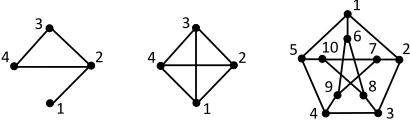
V such that letters x and y alternate in w if and only if (x, y) ∈ E for each x ̸= y. We say that w represents G, and w is called a word-representant for G. The graphs in Figure 1 are word-representable. Indeed, for example, 1213423 is a word-representant for M, 1234 is a word-representant for K4, and a word-representant for the Petersen graph is
1387296(10)7493541283(10)7685(10)194562.
In what follows, we will need the following two propositions that are easy to see from definitions.
Proposition 1. ([4]) Let w=w1xw2xw3 be a word representing a graph G, where w1, w2 and
w3 are possibly empty words, and w2 contains no x. Let X be the set of all letters that appear
1" 2"
3" 4"
5" 10" 6"7" 8" 9" 1"
2" 3" 4"
[image:3.612.203.408.76.140.2]1" 2" 3" 4"
Figure 1: Three word-representable graphs M (left), the complete graph K4 (middle), and the Petersen graph (right).
Proposition 2. If w represents G, then the reverse r(w), which is writing the letters in w in
the reverse order, also represents G.
2.1
k-word-representable graphs
A word is k-uniform if each letter in it appears exactlyk times. In particular, 1-uniform words are permutations. A graph isk-word-representable if there exists ak-uniform word representing it. We say that the wordk-represents the graph.
The following theorem is of special importance in the theory of word-representable graphs.
Theorem 3. ([4]) A graph G is word-representable if and only if it is k-word-representable for
some k.
In what follows, we will also use the following two propositions.
Proposition 4. ([4]) A k-word-representable graph G is also (k + 1)-word-representable. In
particular, each word-representable graph has infinitely many word-representants representing
it since for every ℓ > k, a k-word-representable graph is also ℓ-word-representable.
Proposition 5. ([4]) Let w=uv be a k-uniform word representing a graph G, where u and v
are two, possibly empty, words. Then the word w′ =vu also represents G.
2.2
Permutationally representable graphs
A graph G with the vertex set V = {1, . . . , n} is permutationally representable if it can be represented by a word of the form p1· · ·pk, where pi is a permutation of V for 1 ≤i≤ k. For
example, a complete graph Kn is permutationally representable for any n. Indeed, take any
permutation of {1, . . . , n} and repeat it as many times (maybe none) as desired. For another example, the path 1−2−3 is also permutationally representable, and one such representation is 213231, while some other such representations can be obtained from it by adjoining any number of permutations 213 and 231 to it. If G can be represented permutationally involving
k permutations, we say that G ispermutationally k-representable.
An orientation of graph’s edges is called transitive if having (directed) edges x → y and
y→z for some verticesx, y, z implies having the edge x→z. A graph is acomparability graph
if it accepts a transitive orientation.
Theorem 6. ([5]) A graph is permutationally representable if and only if it is a comparability
Comparability graphs correspond to partially ordered sets (posets), and the question whether such a graph can be permutationally k-represented is equivalent to the question whether the respective poset can be represented as an intersection of k linear orders. The minimum such
k for a poset is called the poset dimension. We call k-comparability graphs those graphs that correspond to posets having dimension k, that is, those graphs that are permutationally k -representable but not permutationally(k−1)-representable.
2.3
Semi-transitive orientations
A graph G = (V, E) is semi-transitive if it admits an acyclic orientation such that for any directed path v1 →v2 → · · · →vk with vi ∈V for all i, 1≤i≤k, either
• there is no edge v1 →vk, or
• the edge v1 →vk is present and there are edges vi →vj for all 1≤i < j ≤k. That is, in
this case, the (acyclic) subgraph induced by the verticesv1, . . . , vk is transitive (with the
unique sourcev1 and the unique sink vk).
We call such an orientation semi-transitive orientation. For example, the orientation of the graph in Figure 2 is transitive, and thus the underlying (non-directed) graph is semi-transitive.
2" 3"
1" 5" 6"
[image:4.612.261.352.371.446.2]4"
Figure 2: An example of a semi-transitive orientation.
Clearly, all transitive (that is, comparability) graphs are transitive, and thus semi-transitive orientations are a generalization of semi-transitive orientations.
1" 2" 3" 4" 5" 6"
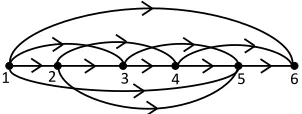
Figure 3: An example of a shortcut.
Semi-transitive orientations are defined in [2] in terms of shortcuts as follows. A semi-cycle
is the directed acyclic graph obtained by reversing the direction of one edge of a directed cycle. An acyclic digraph is a shortcut if it is induced by the vertices of a semi-cycle and contains a pair of non-adjacent vertices. Thus, a digraph on the vertex set {v1, . . . , vk} is a shortcut if
it contains a directed path v1 → v2 → · · · → vk, the edge v1 → vk, and it is missing an edge
vi → vj for some 1 ≤ i < j ≤ k; in particular, we must have k ≥ 4, so that any shortcut is
[image:4.612.229.380.528.585.2]2 → 6, and 3 → 6 are missing). An orientation of a graph is semi-transitive, if it is acyclic and contains no shortcuts. Clearly, this definition is just another way to introduce the notion of semi-transitive orientations presented above.
The following theorem is a useful characterization of word-representable graphs that allows answering questions on word-representability in terms of graph orientations.
Theorem 7. ([2]) A graph G is word-representable if and only if it is semi-transitive (that is,
it accepts a semi-transitive orientation).
A direct corollary to the last theorem is the following statement.
Theorem 8. ([2]) 3-colorable graphs are word-representable.
2.4
Graph’s representation number
The following statement is easy to see.
Theorem 9. A graph G is in R1 if and only if G=Kn, the complete graph on n vertices, for
some n.
We also have a characterization of graphs inR2. To state it we need the following definition:
A circle graph is an undirected graph whose vertices can be associated with chords of a circle
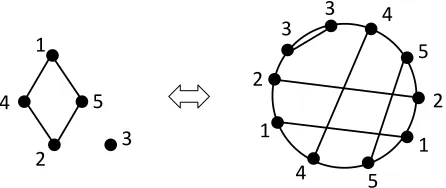
such that two vertices are adjacent if and only if the corresponding chords cross each other. See Figure 4 for an example of a circle graph, where chord i is denoted by labelling its endpoints byi.
4"
1" 2"
2" 3" 3"
5"
5" 1" 4"
1"
2" 4" 5"
[image:5.612.194.417.428.522.2]3"
Figure 4: A circle graph on five vertices.
Theorem 10. ([2]) For a graph G different from a complete graph, G is in R2 if and only if
G is a circle graph.
The following proposition is not difficult to see from definitions, where recall that R(G)
denotesG’s representation number.
Proposition 11. If R(G) = k and G′ is an induced subgraph of G then R(G′)≤k.
Proof. Indeed, using the hereditary nature of word-representable graphs, if representing G′
K"3,3# H"3,3# G"3#
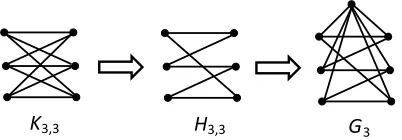
Figure 5: Graphs involved in defining the graph G3.
Theorem 12. ([2]) Each word-representable graph on n vertices is n-word-representable.
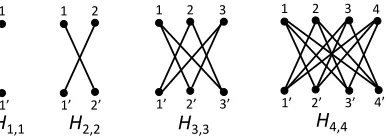
It turns out that there are graphs onnvertices with representation number of⌊n2⌋, matching the upper bound in Theorem 12 within a factor of 2. A crown graph Hk,k is a graph obtained
from the complete bipartite graph Kk,k by removing a perfect matching (see Figure 11 for
examples of crown graphs). Then Gk is the graph obtained from a crown graph Hk,k by adding
an all-adjacent vertex. See Figure 5 for graphs involved in defining G3, where note that all choices in defining H3,3 lead to isomorphic graphs.
Theorem 13. ([2]) The graphGk on 2k+ 1 vertices belongs to Rk.
2.5
Two operations to extend a graph
The following theorem gives a useful tool to construct 3-word-representable graphs, that is, graphs with representation number at most3.
Theorem 14. ([4]) Let G = (V, E) be a 3-word-representable graph and x, y ∈V. Denote by
H the graph obtained from G by adding to it a path of length at least 3 connecting x and y.
Then H is also 3-word-representable.
We also have the following proposition.
Proposition 15. Let G∈ Rk, where k≥2, and x∈V(G). Also, let G′ be the graph obtained
from G by adding an edge (x, y), where y̸∈V(G). Then G′ ∈ Rk.
Proof. Suppose thatGisk-represented by a wordw0xw1xw2· · ·xwk−1xwk, where for0≤i≤k,
wi is a word not containing x. Then it is not difficult to check that the word
w0yxyw1xw2yxw3yxw4· · ·yxwk−1yxwk
k-represents G′ (in particular, the vertex x is the only neighbor of y). Finally, if G′ could be
(k−1)-represented by some word, we would remove from that word the letter y to obtain a
(k−1)-representation ofG, which is impossible. So, G′ ∈ Rk.
3
Prisms and
R
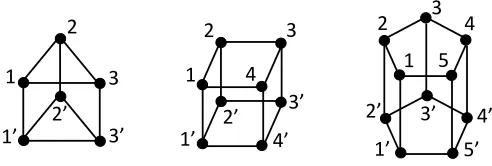
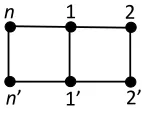
3A prism Prn is a graph consisting of two cycles 12· · ·n and 1′2′· · ·n′, wheren ≥3, connected
1" 2"
3" 1"
2" 3"
4" 1" 2" 3" 4"
5"
1’" 2’" 3’" 1’" 2’" 3’"
4’" 1’"
[image:7.612.182.428.75.158.2]2’" 3’" 4’" 5’"
Figure 6: Examples of prisms.
Theorem 16. ([4]) Every prism Prn is3-word-representable.
Theorem 17. ([4]) The triangular prism Pr3 is not 2-word-representable, and thus, by
Theo-rem 16, R(Pr3) = 3.
Our next theorem extends Theorem 17 by showing that any prism belongs to R3.
Theorem 18. Forn≥4, Prnis not2-word-representable, and thus, by Theorem 16,R(Prn) = 3.
Proof. Suppose that Prn can be 2-represented by a word w for n ≥ 4. It is not difficult to
see that there must exist a letter x in w such that no letter occurs twice between the two copies ofx. By Proposition 1 and definition of Prn, there are exactly three letters between the
copies ofx. By symmetry, without loss of generality we can assume that x= 1. Further, using Propositions 2 and 5, we only need to consider two cases (the second one is unnecessary in the case of n = 4 because of symmetry) where we took into account that the vertices 1′, 2 and n
form an independent set:
• w is of the form 11′2n1· · ·n· · ·2· · ·1′· · ·. Since (n, n′) ∈ E(Prn) and (1′, n′)∈ E(Prn),
we can refine the structure of w as follows
w= 11′2n1· · ·n′· · ·n· · ·2· · ·1′· · ·n′· · · .
However,2 and n′ alternate inw contradicting to the fact that (2, n′)̸∈E(Prn).
• w is of the form 121′n1· · ·n· · ·1′· · ·2· · ·. In this case, we will refine the structure of w
in two different ways and then will merge these refinements:
– Since (2,2′)∈E(Prn),(1′,2′)∈E(Prn)and (2′, n)̸∈E(Prn),wmust be of the form
w= 121′n1· · ·n· · ·2′· · ·1′· · ·2· · ·2′· · · .
– Since(n, n′)∈E(Prn),(1′, n′)∈E(Prn)and(2, n′)̸∈E(Prn),wmust be of the form
w= 121′n1· · ·n′· · ·n· · ·1′· · ·n′· · ·2· · ·
Merging the refinements, we see that w must be of the form
w= 121′n1· · ·n′· · ·n· · ·2′· · ·1′· · ·n′· · ·2· · ·2′· · · .
However, we see that the letters 2′ and n′ alternate in w contradicting to the fact that
Applying Proposition 15 as many times as necessary, we see that if G ∈ R3 then a graph obtained from Gby attaching simple paths of any lengths to vertices in G belongs to R3; call this way to extend graphs “operation 1”. Also, by Theorem 14, we can add simple paths of length at least 3connecting any pair of vertices in G∈ R3 and still obtain a graph inR3 (if a
2-word-representable graph would be obtained, we would have a contradiction with G∈ R3); call this way to extend graphs “operation 2”. The only graphs inR3 known to us for the moment are recorded in the following statement whose truth value follows from the considerations above.
Theorem 19. R3 contains the Petersen graph, prisms, and any other graph obtained from
these by applying operations 1 and 2 arbitrary number of times in any order.
4
Connecting two graphs by an edge and gluing two graphs
in a vertex
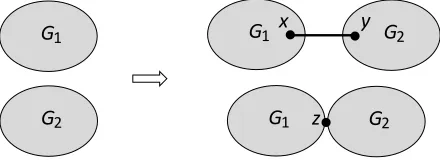
The operations of connecting two graphs, G1 and G2, by an edge and gluing these graphs in a vertex are presented schematically in Figure 7. It follows directly from Theorem 7 that if both
G1 and G2 are word-representable then the resulting graphs will be word-representable too, while if at least one of G1 or G2 is non-word-representable then the resulting graphs will be non-word-representable. Indeed, ifG1 andG2 are oriented semi-transitively, then orienting the edge (x, y)in either direction will not give a chance for the resulting graph to have a shortcut (defined in Subsection 2.3) thus resulting in a semi-transitively oriented graph; similarly, no shortcut is possible when semi-transitively oriented G1 and G2 are glued in a vertex z.
x"
1"
G"
2"
G"
1"
G" y" G"2"
z"
1"
[image:8.612.196.416.416.498.2]G" G"2"
Figure 7: Connecting graphs by an edge and gluing graphs in a vertex.
While the arguments above involving orientations answer the question on word-representability of connecting graphs by an edge or gluing graphs in a vertex, they do not allow to answer the following question: IfG1isk1-word-representable,G2isk2-word-representable, andGisk -word-representable (such ak must exist by Theorem 3) then what can be said about k? Theorem 22 below, that is based on Theorems 20 and 21, answers this question.
Theorem 20. ([4]) For k ≥ 2, let w1 and w2 be k-uniform words representing graphs G1 =
(V1, E1) andG2 = (V2, E2), respectively, where V1 and V2 are disjoint. Suppose thatx∈V1 and
y∈V2. Let H1 be the graph (V1∪V2, E1∪E2∪ {(x, y)}). Then H1 isk-word-representable.
Theorem 21. ([4]) For k ≥ 2, let w1 and w2 be k-uniform words representing graphs G1 =
(V1, E1) and G2 = (V2, E2), respectively, where V1 and V2 are disjoint. Suppose that x ∈ V1
and y ∈ V2. Let H2 be the graph obtained from G1 and G2 by identifying x and y into a new
Theorem 22. Suppose that for graphs G1 = (V1, E1) and G2 = (V2, E2), R(G1) = k1 and R(G2) = k2, x ∈ V1, y ∈ V2 and k = max(k1, k2). Also, let the graph G′ be obtained by
connecting G1 and G2 by the edge (x, y), and the graph G′′ be obtained from G1 and G2 by
identifying the vertices x and y into a single vertex z. The following holds.
1. If |V1| = |V2| = 1 then both G′ and G′′ are cliques and thus k1 = k2 = 1. In this case,
R(G′) =R(G′′) = 1.
2. If min(|V1|,|V2|) = 1 but max(|V1|,|V2|)>1 then R(G′′) =k and R(G′) = max(k,2).
3. If min(|V1|,|V2|)>1 then R(G′) = R(G′′) = max(k,2).
Proof. The first part of the statement is easy to see since both a single vertex (G′′) and the
one edge graph (G′) are 1-word-representable by Theorem 9.
For part 2, without loss of generality,|V1|= 1(that is,V1 ={x}) and thusG′′ =G2 leading toR(G′′) =k. On the other hand,G′ is not a clique and thusR(G′)≥2. Ifk2 = 1 thenG2 can be represented by the permutation yy1· · ·y|V2|−1 for y, yi ∈ V2 and thus G′ can be represented by xyxy1· · ·y|V2|−1yy1· · ·y|V2|−1 leading to R(G′) = 2. However, if k2 ≥ 2, so that k = k2, we can take anyk-word-representation of G2 and replace in it every other occurrence of the letter
y byxyx to obtain a k-word-representation of G′. Thus, R(G′) = k because if it would be less than k, we would have R(G2)< k by Proposition 11, a contradiction.
For part 3, neitherG′ norG′′is a clique and thus R(G′),R(G′′)≥2. By Proposition 4, both
G1 and G2 are k-word-representable. If k ≥ 2 then by Theorems 20 and 21 both G′ and G′′ are k-word-representable leading to R(G′) = R(G′′) =k since if R(G′) < k or R(G′′) < k we would obtain a contradiction either with R(G1) = k1 or with R(G2) = k2 by Proposition 11. Finally, if k = 1 then G1 and G2 must be cliques that can be represented by permutations
x1· · ·x|V1|−1x and yy1· · ·y|V2|−1, respectively, for x, xi ∈V1 and y, yi ∈V2. Then the words
x1· · ·x|V1|−1xx1· · ·x|V1|−1yxy1· · ·y|V2|−1yy1· · ·y|V2|−1
and
x1· · ·x|V1|−1zx1· · ·x|V1|−1y1· · ·y|V2|−1zy1· · ·y|V2|−1
2-word-represent the graphsG′ and G′′, respectively, and thusR(G′) =R(G′′) = 2.
5
Replacing a vertex in a graph with a module
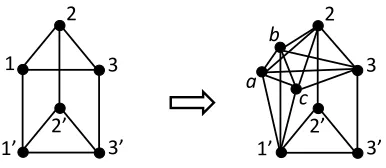
A subsetX of the set of verticesV of a graphG is amoduleif all members ofX have the same set of neighbours among vertices not in X (that is, among vertices in V \X). For example, Figure 8 shows replacing the vertex1in the triangular prism by the module K3 formed by the verticesa,b and c.
The following theorem is an extended version of an observation made in [1].
Theorem 23. Suppose thatG is a word-representable graph and x∈V(G). Let G′ be obtained
from G by replacing x with a module M, where M is any comparability graph (in particular,
any clique). Then G′ is also word-representable. Moreover, if R(G) =k1 and R(M) = k2 then
1" 2"
3"
1’" 2’" 3’"
2"
3"
1’" 2’" 3’" a"
b"
[image:10.612.210.403.73.157.2]c"
Figure 8: Replacing a vertex by a module.
Proof. By Theorem 6, M can be represented by a word p1· · ·pk2, where pi is a permutation
(of length equal to the number of vertices in M) for 1 ≤ i ≤ k2. If k2 < k, we can adjoin to the representation of M any number of copies of permutations in the set Π = {p1, . . . , pk2} to obtain a k-representation p = p1· · ·pk of M, where pi ∈ Π (indeed, no alternation properties
will be changed while adjoining such extra permutations).
Using Proposition 4, if necessary (in case when k1 < k), we can assume that G can be
k-represented by a word w = w0xw1xw2· · ·xwk for some words wi not containing x for all 0 ≤ i ≤ k. But then the word w′ = w0p1w1p2w2· · ·pkwk k-represents G′. Indeed, it is easy
to see that the pairs of letters in w′ from V(M) have the right alternation properties, as do the pairs of letters from V(G)\ {x} in w′. On the other hand, it is not difficult to see that if
y∈V(M)and z ∈V(G)\ {x} then (y, z)∈E(G′) if and only if (x, z)∈E(G).
If G′ would be (k −1)-word-representable, we would either obtain a contradiction with R(G) =k1 (after replacing eachpi inw′ with x) or with R(M) =k2 (after removing all letters inw′ that are not in M). Thus, R(G′) = k.
6
Graphs in
R
3and
c
-colorable graphs
Theorems 9 and 10 show that there exists no constantcsuch that all1- or2-word-representable graphs are c-colorable. Indeed, Kn is n-colorable, while circle graphs formed by Kn−1 and an isolated vertex (which are not1-word-representable) are (n−1)-colorable. On the other hand, known to us graphs requiring many copies of each letter to be represented, namely graphs
Gk from Theorem 13, are 3-colorable for any k ≥ 2 (because Gk is a bipartite graph with an
all-adjacent vertex). Thus, 3-word-representable graphs do not contain a class of c-colorable graphs for some constant c≥3 (this claim follows from the fact that Gk, being 3-colorable, is
not 3-word-representable for k≥4).
A natural question to ask here is: Is R3 properly included in a class of c-colorable graphs for a constant c? The following theorem shows that this is not the case.
Theorem 24. The classR3 is not included in a class ofc-colorable graphs for some constantc.
Proof. Suppose that any graph in class R3 is c-colorable for some constant c. We can assume
that c≥ 3 since G3 being 3-colorable belongs to R3 by Theorem 13. Consider the triangular prismP r3 to the left in Figure 8, which is also 3-colorable and, by Theorem 17, belongs toR3. Replace the vertex1inP r3 with a moduleKc+1, the complete graph onc+ 1vertices as shown for the case of c = 2 in Figure 8. Denote the obtained graph by P r′3. Since R(Kc+1) = 1, by Theorem 23, P r3′ ∈ R3. However, P r′3 is not c-colorable since it contains a clique of size c+ 1
We note that an alternative way to obtain a contradiction in the proof of Theorem 24 is to consider the triangular prism P r3 (which is in R3), the complete graph Kc+1 (which is in R1), and either to connect these graphs by an edge, or glue these graphs in a vertex. Then by Theorem 22, the obtained graph will be in R3, but it is (c+ 1)-colorable.
From considerations in this section it follows that, in particular, the classes R3 and 3 -colorable graphs (that are word-representable by Theorem 8) are not comparable in the sense that none of these classes is included in the other one. However, this section does not answer the following question.
Problem 1. Can each bipartite (that is, 2-colorable) graph be 3-word-represented? Namely,
does each bipartite graph belong to the union of the sets R1∪ R2∪ R3?
We suspect the answer to the question in Problem 1 to be negative. A good candidate for a counterexample should be the crown graph Hk,k for k ≥ 5; see Section 8 and, in particular,
Problem 3.
7
Ladder graphs
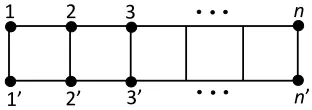
The ladder graphLn with 2n vertices and3n−2 edges is presented in Figure 9.
1" 2" 3" n"
[image:11.612.228.384.361.416.2]1’" 2’" 3’" n’"
Figure 9: The ladder graph Ln.
It follows from the proof of Theorem 16 in [4] that Ln is 3-word-representable. In the
following theorem, we will show thatLnis actually 2-word-representable for n≥2(it is clearly 1-word-representable for n= 1).
Theorem 25. Forn ≥2, R(Ln) = 2. Thus, by Theorem 10, any ladder graph is a circle graph.
Proof. We prove the statement by induction on n. L1 can be 2-represented by the word
w1 = 11′11′ that has the factor 1′1. Substituting the factor 1′1 in w1 by 2′1′22′12 and re-versing the entire word, we obtain the word w2 = 1′212′21′2′1 that contains the factor 2′2. It is straightforward to check that w2 representsL2 since one only needs to check the alternation properties of the just added letters 2and 2′.
More generally, given a 2-representationwi of Li containing the factor i′i, we substitute i′i
in wi by (i+ 1)′i′(i+ 1)(i+ 1)′i(i+ 1) and reverse the entire word to obtain the word wi+1 containing the factor(i+ 1)′(i+ 1). It is straightforward to check thatwi+1 representsLi+1 since the only thing that needs to be checked is the right alternation properties of the just added letters i+ 1 and (i+ 1)′. We are done.
In Table 1, we record2-representations of the ladder graphLn for n= 1, . . . ,5. The factors
n 2-representation of the ladder graph Ln
1 11′11′
2 1′212′21′2′1
3 12′1′323′32′3′121′
4 1′213′2′434′43′4′231′2′1
[image:12.612.187.425.71.161.2]5 12′1′324′3′545′54′5′342′3′121′
Table 1: 2-representation of the ladder graph Ln for n= 1, . . . ,5.
n" 1" 2"
n’" 1’" 2’"
Figure 10: The ladder graph on6 vertices.
Of course, an alternative proof of Theorem 25 would be in representing vertices in Ln by
properly overlapping chords on a circle. However, we find our proof of that theorem a bit easier to follow/record.
Remark 26. The thoughtful Reader would notice what seems to be an inconsistency: our
argument in the proof of Theorem 18 seems to show that the graph in Figure 10 is not 2
-word-representable, while by Theorem 25 we see that this graph is 2-word-representable by
n1′n′212′21′2′n1n′ (we renamed the labels in L3 respectively, and used the third line in
Ta-ble 1). The reason for possiTa-ble confusion is that we used symmetry in the proof of Theorem 18
to assume that there are exactly three letters between the 1s; such an assumption cannot be
made while dealing with the graph in Figure 10 because 1 is an “internal” vertex there, while
there are “external” vertices as well, namely 2,2′, n, n′.
8
Open problems
In Section 6, we have already stated an open problem, namely, Problem 1. In this section we offer two more problems for further research.
Recall the definition of the crown graphHk,k in Section 2.4 and see Figure 11 for a few small
such graphs. It is a well-known fact that the dimension of the poset corresponding toHk,kiskfor
k ≥2, and thus Hk,k is a k-comparability graph (it is permutationallyk-representable but not
permutationally (k−1)-representable). In [2], the following way to represent permutationally
Hk,k was suggested. Concatenate the permutation12· · ·(k−1)k′k(k−1)′· · ·2′1′ together with
all permutations obtained from this by simultaneous exchange of k and k′ with m and m′, respectively, for m= 1, . . . , k−1. See Table 2 for permutationally k-representation of Hk,k for
k = 1,2,3,4, where the case k= 1 is not obtained using the general construction.
[image:12.612.269.340.207.264.2]H"3,3# 1# 2# 3#
1’# 2’# 3’#
H"4,4# 1# 2# 3#
1’# 2’# 3’# 4’# 4#
H"2,2# 1# 2#
1’# 2’# 1#
1’#
[image:13.612.211.404.75.144.2]H"1,1#
Figure 11: The crown graphHk,k for k= 1,2,3,4.
k permutationally k-representation of the crown graphHk,k
1 11′1′1
2 12′21′21′12′
3 123′32′1′132′23′1′231′13′2′
4 1234′43′2′1′1243′34′2′1′1342′24′3′1′2341′14′3′2′
Table 2: Permutationally k-representation of the crown graph Hk,k for k= 1,2,3,4.
swapping a certain pair of consecutive letters in the word representing the path). 2-representing trees and cycles is discussed in detail in [3].
Consider the cycle graph C5 on five edges. C5 is inR2 (it is 2-word-representable, but not 1-word-representable), but it is not a comparability graph and thus, by Theorem 6, C5 is not permutationally representable. On the other hand, the crown graphs H1,1 and H2,2, being 2 -comparability graphs, belong to R2. Also, H3,3, being a 3-comparability graph, belongs to R2, sinceH3,3 is the cycle graphC6. Moreover,H4,4, being a 4-comparability graph, belongs toR3, which follows from the fact thatH4,4is the prismP r4(the3-dimensional cube) and Theorem 18 can be applied.
Crown graphs, being bipartite graphs, and thus comparability graphs, provide an interesting case study of relations betweenk-comparability graphs andk-word-representable graphs. While each k-comparability graph is necessarily k-word-representable, in some cases such a graph is also (k−1)-word-representable, and, in fact, it is in Rk−1 in the known to us situations. Thus, it seems like giving up permutational representability, we should be able to come up with a shorter representation of a given comparability graph. However, we do not know whether this is essentially always the case (except for some particular cases like the graphs H1,1 and H2,2). Thus we state the following open problem.
Problem 2. Characterizek-comparability graphs that belong toRk−ℓ for a fixedℓ. In particular,
characterize those k-comparability graphs that belong to Rk−1. Is the set of k-comparability
graphs that belong to Rk−ℓ (non-)empty for a fixed ℓ≥2?
A step towards solving Problem 2 could be first understanding crown graphs and solving the following problem.
Problem 3. Characterize thoseHk,kthat belong toRk−ℓ for a fixedℓ. In particular, characterize
thoseHk,k that belong to Rk−1. Is the set of crown graphsHk,k that belong to Rk−ℓ (non-)empty
for a fixed ℓ ≥2?
[image:13.612.142.470.178.253.2]A step towards solving Problem 3 can be the following observation: Take the concatenation of the permutations representing Hk,k discussed above and remove the leftmost k −1 letters 1,2, . . . , k−1and the rightmostk−1letters2′,3′, . . . , k′. The remaining word will still represent
Hk,k, which is not difficult to see. One would then need to remove from the word two more
letters, one copy ofk and one copy of1′, then possibly do some rearrangements of the remaining letters with a hope to obtain a word that would (k−1)-word-represent Hk,k. For example, for
k = 3, we begin with the word representing H3,3 in Table 2, and remove its first two, and its last two letters to obtain the following representation of H3,3:
3′32′1′132′23′1′231′1.
Now, remove the leftmost 3 and the leftmost 1′, make the last letter 1 to be the first letter 1 (that is, make the cyclic one-position shift to the right), and, finally, replace the six rightmost letters in the obtained word by the word obtained by listing these letters in the reverse order to obtain a 2-word-representation of H3,3 (this is the same representation as one would obtain for the cycleC6 if to follow the strategy described in [3]):13′2′132′1′321′3′2.
Unfortunately, similar steps do not work for 3-word-representing H4,4, and it is not so clear which copies of unwanted letters 4 and 1′ one should remove before conducting further rearrangements. In either case, even if one could demonstrate how to obtain a (k −1) -word-representation ofHk,k for somek≥5, it is not so clear what generic argument would show that
no(k−2)-word-representation exists, if this would be the case.
Acknowledgments
The author is grateful to the anonymous referees for a number of useful suggestions.
References
[1] M. Halldórsson, S. Kitaev, A. Pyatkin: Graphs capturing alternations in words, Lecture
Notes in Computer Science 6224 (2010) 436–437. Proc. 14th Conf. on Developments in
Language Theory, DLT 2010, London, Ontario, Canada, August 17–20, 2010.
[2] M. Halldórsson, S. Kitaev, A. Pyatkin: Alternation graphs, Lecture Notes in Computer
Science 6986 (2011) 191–202. Proceedings of the 37th International Workshop on
Graph-Theoretic Concepts in Computer Science, WG 2011, Teplá Monastery, Czech Republic,
June 21–24, 2011.
[3] S. Kitaev, V. Lozin: Words and graphs, Springer-Verlag, to appear.
[4] S. Kitaev, A. Pyatkin: On representable graphs, Journal of Automata, Languages and
Combinatorics 13 (2008) 1, 45–54.
[5] S. Kitaev, S. Seif: Word problem of the Perkins semigroup via directed acyclic graphs,