City, University of London Institutional Repository
Citation
:
Verhoeven, J., Marien, P., Engelborghs, S., D'Haenen, H. & De Deyn, P. P.
(2005). A foreign speech accent in a case of conversion disorder. Behavioural Neurology,
16(4), pp. 225-232.
This is the published version of the paper.
This version of the publication may differ from the final published
version.
Permanent repository link:
http://openaccess.city.ac.uk/18220/
Link to published version
:
Copyright and reuse:
City Research Online aims to make research
outputs of City, University of London available to a wider audience.
Copyright and Moral Rights remain with the author(s) and/or copyright
holders. URLs from City Research Online may be freely distributed and
linked to.
IOS Press
A foreign speech accent in a case of
conversion disorder
Jo Verhoeven
a,∗, Peter Mari¨en
b,c, Sebastiaan Engelborghs
c,d, Hugo D’Haenen
eand Peter De Deyn
c,d aDepartment of Linguistics, University of Antwerp, Antwerp, BelgiumbDepartment of Languages, Vrije Universiteit Brussel, Brussels, Belgium cDepartment of Neurology, ZNA-Middelheim Hospital, Antwerp, Belgium
dLaboratory of Neurochemistry and Behaviour, Born-Bunge Foundation, University of Antwerp, Antwerp, Belgium eDepartment of Psychiatry, Academic Hospital, Vrije Universiteit Brussel, Brussels, Belgium
Abstract. Objective: The aim of this paper is to report the psychiatric, neuroradiological and linguistic characteristics in a native
speaker of Dutch who developed speech symptoms which strongly resemble Foreign Accent Syndrome.
Background: Foreign Accent Syndrome is a rare speech production disorder in which the speech of a patient is perceived as
foreign by speakers of the same speech community. This syndrome is generally related to focal brain damage. Only in few reported cases the Foreign Accent Syndrome is assumed to be of psychogenic and/or psychotic origin.
Method: In addition to clinical and neuroradiological examinations, an extensive test battery of standardized neuropsychological
and neurolinguistic investigations was carried out. Two samples of the patient’s spontaneous speech were analysed and compared to a 500,000-words reference corpus of 160 normal native speakers of Dutch.
Results: The patient had a prominent French accent in her pronunciation of Dutch. This accent had persisted over the past eight
years and has become progressively stronger. The foreign qualities of her speech did not only relate to pronunciation, but also to the lexicon, syntax and pragmatics. Structural as well as functional neuroimaging did not reveal evidence that could account for the behavioural symptoms. By contrast psychological investigations indicated conversion disorder.
Conclusions: To the best of our knowledge this is the first reported case of a foreign accent like syndrome in conversion disorder.
Keywords: Foreign accent syndrome, conversion disorder, neurolinguistics
1. Introduction
Foreign Accent Syndrome is a rare speech produc-tion disorder in which a patient’s pronunciaproduc-tion is re-garded as foreign by speakers of the same speech com-munity. In most of the reported cases Foreign Ac-cent Syndrome originates from focal brain damage in the precentral gyrus of the language-dominant
hemi-sphere either as a result of trauma or stroke. The
first case was reported by Pick [6] in 1919 who de-scribed a native speaker of Czech developing a
Pol-∗Corresponding author: Jo Verhoeven, MSc, PhD, University
of Antwerp, Department of Linguistics, Universiteitsplein, B-2610 Wilrijk, Belgium. Tel.: +32 3 820 27 77; Fax: +32 3 820 27 62; E-mail: [email protected].
ish accent after a left hemisphere stroke. The impres-sion of a foreign accent was mainly caused by wrong word stress placement and the softer pronunciation of Czech fricatives. The relatively few cases of foreign accent that have been described since then included pa-tients who developed a German [9,16], Swedish [26], Welsh [34], French [25,31,38,49], Chinese [19], En-glish [3,15,21,46], Slavic [28,33], Hungarian [33], Northern Irish [17], Korean [52], Dutch [12], Scot-tish [23], Nordic [41] and Spanish [18] accent. In a number of cases, the foreign accent was not unambigu-ously related to one single language but could be re-garded as generic in nature [22,24,32,40,47,50]. It is interesting to note that in most cases, the native lan-guage of the patients was American English.
Only in a few cases the patient’s foreign accent could not be directly linked to brain damage. Critchley [34]
226 J. Verhoeven et al. / A foreign speech accent in a case of conversion disorder
described a 49-year-old patient suffering from post-traumatic neurosis after a car crash. Her speech was described as “curiously slow, syllabic and hesitant (...) with an excessive range of modulation, which was not wholly appropriate to the content of what she was
say-ing”. Her accent was identified by most people as
Welsh. Reeves and Norton [46] reported the case of a 65-year-old man with a long history of schizophre-nia being admitted with psychotic symptoms such as paranoid delusions, bizarre behaviour and auditory hal-lucinations. During these exacerbations he took on a British English accent that disappeared after adminis-tering risperidone. Gurd et al. [25] reported the case of an English-speaking 47-year-old female patient who developed a French accent after a sudden onset of aphasia and headache. The French accent was mainly caused by the abnormal syllable-timed speech rhythm and the effortful pronunciation of /h/. In addition, the patient’s pitch level was exceptionally high, which con-tributed to the general foreign quality of her speech. The neurological picture was unclear, but there was doubt as to the organical cause of the speech symptoms. Van Borsel et al. [28] describe the case of a 32-year-old Dutch speaking woman who developed a foreign ac-cent that was assessed by many of the participants in a listening panel as Eastern European. The predominant articulation errors were the devoicing of voiced con-sonants, cluster reduction of r-clusters, initial deletion of /h/ and final consonant deletion involving /r/. An analysis of the patient’s speech prosody revealed errors in the placement of word and sentence stress and a ten-dency towards scanning speech. Van Borsel et al. [28] indicate that these speech symptoms are likely to be of psychogenic origin in view of the absence of a brain lesion, the history of psychiatric problems, the sudden onset and the bizareness of the speech patterns, the ab-sence of struggle behaviour and the reversibility of the symptoms.
From the previous section, it can be concluded that Foreign Accent Syndrome in some case may be linked to psychiatric problems. Although a variety of psy-chogenic speech and language characteristics have been reported [1], foreign accent qualities have to the best of our knowledge never been described in conversion dis-order. This paper describes the psychiatric, neuroradi-ological, neuropsychological and neurolinguistic find-ings in a Dutch patient who developed a French foreign accent a few hours after almost having been involved in a traffic incident as a cyclist. At the time of admission to our hospital, the foreign accent had persisted for 8 years.
2. Case description
In 2003, a 51-year-old right-handed woman was re-ferred to our hospital because a Foreign Accent Syn-drome of psychotraumatic origin was suspected. At the time of admission to the hospital the patient had been suffering from disrupted speech and progressive
gait disturbances since 1995. She was
wheelchair-bound. Medical antecedents were not contributory and no history of developmental or psychiatric disorder was found. She was a qualified teacher of Dutch who had been teaching Dutch as a foreign language in a French company for several years.
Neurobehavioural symptoms started in 1995 just af-ter the patient had almost been involved in an accident with a car while riding her bicycle. After getting home she started behaving strangely and was confused. She developed a tremor in both hands and spoke in a stutter-like manner with what was perceived as a French ac-cent by the members of her family. Two months after the incident the patient was assessed neurologically for the first time: a computerized tomography (CT) scan of the brain and an EEG were normal. Neurolinguistic investigations formally excluded aphasia, dysarthria or apraxia of speech. Despite intensive speech therapy, physiotherapeutic treatment and psychotherapy there had been no improvement of neurobehavioural symp-toms.
3. Psychodiagnostic assessment
In 1995, the patient’s personality was assessed by means of the Minnesota Multiphasic Personality Inven-tory (MMPI) [48] and the results matched the profile of a conversion disorder. The MMPI profile showed a Conversion V pattern. The complete configuration indicated preoccupation with health, denial of anxiety and unsteadiness. In addition, the patient showed a strong motive to please others, to seek social contacts but an insensitivity to the psychological needs of others. In 2003, the MMPI and the dissociation Question-naire (DIS-Q) [27] were administered. The patient ob-tained a total score of 1.4 which is near the mean score of 1.5 in a normal population.
4. Neurological characteristics
inconsistent, wide-based and unsteady gait whereas co-ordination, muscle tone and tendon reflexes were nor-mal. Structural brain imaging by means of Computer-ized Tomography and Magnetic Resonance Imaging of the brain did not disclose any abnormalities. A stan-dard EEG, routine laboratory studies, a lumbar punc-ture with analysis of cerebrospinal fluid and serum vi-tamin B12 and red cell folate levels did not reveal any-thing abnormal.
5. Neuropsychological and neurolinguistic characteristics
During hospitalisation standardized neuropsycho-logical and neurolinguistic tests were carried out. The neuropsychological test battery consisted of the Mini Mental State Examination [36], the Wechsler Adult Intelligence Scale [10], the Wechsler Memory Scale-Revised [11], parts of the Alzheimer’s Disease Assess-ment Scale [51], subtests of the Hierarchic DeAssess-mentia Scale [37], the Stroop Colour-Word test [8,35], the Trail Making Test [2,7], the Rey-Osterrieth Figure [42] and the Judgment of Line Orientation test [4]. Handedness was formally assessed by means of the Edinburgh In-ventory [45]. The neurolinguistic test battery consisted of the Aachener Aphasie Test [43], a selection of sub-tests of a Dutch version of the Boston Diagnostic Apha-sia Examination [20], the Boston Naming Test [13,44] and a semantic and phonological verbal fluency task (1 minute generation of animal names, means of transport, vegetables, clothes and words starting with phoneme F, A and S) (unpublished norms). On all of these tests, the patient obtained above average results.
6. Language characteristics
6.1. Language samples
Two samples of the patient’s language were investi-gated. The first sample was a spontaneous conversation between a neuropsychologist and the patient recorded in 1995, that is three months after the acute onset of symptoms. The second speech sample was a sponta-neous conversation with two authors of this paper in 2003. In both interviews, the patient described what happened to her during and after the incident and spoke about various issues related to her personal and profes-sional life. In terms of the topics discussed, the two speech samples can be regarded equivalent. Both
sam-ples consisted of the first 1,000 words of the conversa-tion and covered approximately 15 minutes of speech.
In the analysis, some of the patient’s speech charac-teristics were compared to a 500,000 word reference corpus of spontaneous speech from 160 native Dutch speakers from Belgium and The Netherlands. This cor-pus was available at the University of Antwerp: it had been collected for purposes unrelated to this research. The speakers in the corpus were all teachers of Dutch and their professional background was thus compara-ble to that of the patient. A more detailed description of the corpus is found in [30].
All the analyses were carried out by the first author of this paper who is an experienced phonetician/linguist. At a later stage, the same data were analyzed indepen-dently of this investigation in the context of an MA-dissertation project [14]. A comparison between both analyses did not reveal significant discrepancies.
6.2. General impressions
The patient’s speech can generally be characterized as very hesitant, mostly effortful with stretches of flu-ent and clear speech. Throughout, there is a strong impression of a French accent that is mainly caused by pronunciation errors, wordfinding problems, the oc-casional use of French words and syntactic structures that are very consistent with mistakes made by French learners/speakers of Dutch.
6.3. Lexicon
At the lexical level, both speech samples are charac-terized by occasional language mixing and code
switch-ing. The patient sometimes uses French words (in
228 J. Verhoeven et al. / A foreign speech accent in a case of conversion disorder
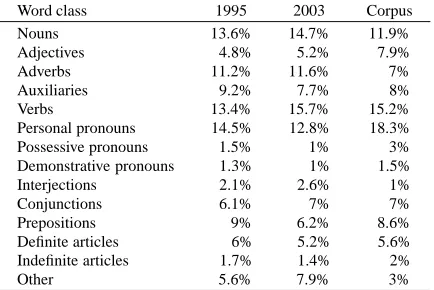
Table 1
Distribution of the different word classes in the 1995 and 2003 speech samples and the reference corpus
Word class 1995 2003 Corpus
Nouns 13.6% 14.7% 11.9%
Adjectives 4.8% 5.2% 7.9%
Adverbs 11.2% 11.6% 7%
Auxiliaries 9.2% 7.7% 8%
Verbs 13.4% 15.7% 15.2%
Personal pronouns 14.5% 12.8% 18.3% Possessive pronouns 1.5% 1% 3% Demonstrative pronouns 1.3% 1% 1.5%
Interjections 2.1% 2.6% 1%
Conjunctions 6.1% 7% 7%
Prepositions 9% 6.2% 8.6%
Definite articles 6% 5.2% 5.6% Indefinite articles 1.7% 1.4% 2%
Other 5.6% 7.9% 3%
χ2=9.40, d.f.=26,p >0.950.
speakers of Standard Dutch in the reference corpus, i.e. 3.87%.
An analysis of the frequencies of the various word categories in the patient’s speech revealed no significant differences between the 1995 and 2003 speech samples and they follow the normal distribution patterns for Dutch that were established in the reference corpus. The proportions for the different word categories are summarized in Table 1.
In addition to the distribution of the different word classes, the type/token ratio of content words (TTRC) was calculated for both the patient’s speech samples. The type/token ratio is defined as the proportion of unique content words over the total number of content words. Content words were nouns, adjectives, verbs and adverbs. This ratio can be regarded as an indication of the diversity in the patient’s content word vocabulary in spontaneous speech. For the 1995 speech sample the TTRC was 0.79 while that for the 2003 speech sample amounted to 0.86. The TTRC for her peer group in the Dutch reference corpus was 0.80. From this it can be concluded that the patient’s content word vocabulary is entirely in agreement with what can be expected from her peers.
Finally, word complexity was investigated and ex-pressed as the average number of syllables per word. In 1995, this value amounted to 1.3599 syll/word (range= 5), while in 2003 it was numerically slightly higher with 1.4247 syll/word (range=5). A t-test indicates that this difference is not significant (F(1,1998)=0.8489,
p =0.3570). These values compare extremely well
with that of the reference corpus, which was established at 1.41 syllables per word (range=9).
6.4. Syntax
The syntactic problems in the patient’s speech are mainly related to word order. Without any exception, all the grammatical errors observed in the patient’s speech are prototypical of French learners of Dutch.1 These grammatical errors included mistakes against: sentence word order (1995: 34; 2003: 35), subject-verb correspondences (1995: 1; 2003: 2), the use of definite articles (1995: 6; 2003: 3), adjective-noun cor-respondence (1995: 2; 2003: 1). Each of these error types are exemplified in examples (1)-(4) respectively:
(1) ‘En in het begin ik heb gehad . . .’ instead of ‘En in het begin heb ik gehad. . .’ (And in the
beginning I had. . .).
(2) ‘Dan gaat ik naar de psychiater’ instead of ‘Dan ga ik naar de psychiater’ (Then I went to the
psychiatrist)
(3) ‘De lopen ging steeds minder’ instead of ‘Het lopen ging steeds minder’ (Walking became
more difficult)
(4) ‘Ik heb een Latijnse temperament’ instead of ‘Ik heb een Latijns temperament’ (I have a
Latin temperament).
6.5. Pragmatics
It may be interesting to mention that in both speech samples the patient uses one or two self-corrections in which she dwells pragmatically on her status as a non-native speaker of Dutch. In example (5), she corrects a verb, in (6) the use of a personal pronoun. This is a phe-nomenon that we have regularly witnessed ourselves in real learners of Dutch when they show that they are consciously trying to stay in control of the correctness of their speech output.
(5) Heb mijn moeder gehaald. . . nee, OPgehaald
(Have my mother collected,. . . no, picked her up)
(6) Zo, dat is mij . . . DAT BEN IK (giggle,
em-phatic) (Right that is me. . .that is I)
These two examples of metalinguistic reflection show that the patient portrays herself as a competent, linguistically aware non-native speaker of Dutch.
1This claim is based on the first author’s extensive experience in
6.6. Pronunciation
The patient’s speech is characterized by a very prominent French accent. This impression of a French accent is mainly caused by the use of the French uvular-r: before developing the foreign accent, the patient used a vocalic-r that is very common in the Netherlands. In addition, we observed cumbersome articulation of the velar fricatives [x] and [γ], the excessively front artic-ulation of the open back vowel [α] and the too close articulation of the half-open unrounded front vowel [I]. In quite a number of cases, the patient makes pronunci-ation mistakes that are prototypical of French learners of Dutch, i.e. the extremely frequent wrong placement of word stress on the last syllable of words (1995: 40; 2003: 41), regular attempts to make wordfinal frica-tives and stops voiced by adding [∂] (1995: 21; 2003: 22) and the occasional strengthening of [x] and [γ] into [k] and [g] (1995: 2; 2003: 6).
Other aspects of the patient’s speech do not con-tribute to the French accent, but have to be qualified as generally inappropriate. In the first instance, the pa-tient’s speech is characterized by a very strong creaky voice that was not present in the 1995 speech sample. In addition, both speech samples have a very slow speech rate2: expressed as the number of syllables per sec-ond the patient’s speech rate in 1995 was 2.72 syll/sec. The patient’s rate in 2003 had gone down a little to 2.25 syll/sec. The normal speech rate for Dutch ranges between 3.98 and 4.23 syllables per second [30].
Furthermore, the patient displays regular stutter-like behaviour both word-initially and word-finally (1995: 10; 2003: 50). Aside from iterations (anything up to 15 repetitions), no blocks or prolongations were found. Finally, inappropriate pausing in the middle of speech segments was regularly observed, particularly in stops (1995: 2; 2003: 14).
2In the calculation of speech rate, a distinction is traditionally
made between speaking rate and articulation rate. The former is ex-pressed as the number of syllables per second and includes both silent and filled pauses (words as Erhm etc). The latter is also expressed as the number of syllables per second, but the measure excludes silent intervals. The measure of speech rate reported here refers to articula-tion rate. These measures were calculated by counting the number of syllables per utterance, while utterance duration was very accurately measured in a signal processing program PRAAT. This procedure was applied to each utterance and the values reported here are mean values averaged over all utterances.
6.7. Comparison to patient’s English and French
As part of the interviews conducted in 2003, some parts of the conversation with the patient were con-ducted in English and French. The patient’s English was also characterized by a strong French accent: this was caused by the use of uvular-r and wrong word stress-placement on the last syllables of words. The pa-tient’s speaking rate in English was 2.26 syll/sec, which is comparable to her speech tempo in Dutch. Quite re-markably there were hardly any iterations and inappro-priate pauses. In addition, no obvious syntactic prob-lems were found in her English. The patient’s French was actually the best language of all: her speaking rate is considerably faster than in the other languages (3.20 syll/sec) and there are no indications of a foreign accent nor any obvious syntactic problems.
7. Discussion and conclusion
The patient described in this paper is a native speaker of Dutch who developed a strong French accent after the traumatic experience of nearly having been involved in a traffic accident. Although the patient did not sus-tain physical injury in this accident, the psychologi-cal impact must have been severe. The French accent originates from a combination of lexical, grammatical and pronunciation characteristics. At the lexical level the patient shows occasional language mixing and code switching. In addition, she compensates word-finding problems by strategies that are typical for foreign lan-guage learners, i.e. direct translations from French, the adaptation of French words to the Dutch morphological system, the paraphrasing of words and the creation of neologisms. The Type/Token ratio suggests that the pa-tient’s content word vocabulary is entirely in agreement with her professional background.
At the grammatical level, the patient regularly makes mistakes that are characteristic of French learners of Dutch, particularly with respect to word order, subject-verb agreement and the use of definite articles before nouns. It should be pointed out that these inconsistent grammatical mistakes are very unlike the agrammatic phenomena observed in aphasic patients.
230 J. Verhoeven et al. / A foreign speech accent in a case of conversion disorder
In terms of pronunciation, the patient incorporated a few typical French pronunciation features such as the uvular-r, the excessively front articulation of the vowel [a] and pronunciation of [I] as [i]. Besides, the patient regularly makes mistakes that are again typi-cal for French learners of Dutch such as wrong accent placement.
It is important to note that the speech symptoms do not seem to have an organic basis: all neurological in-vestigations failed to reveal any evidence of an organic brain dysfunction. The psychiatric assessment of the patient, however, supported the diagnosis of a conver-sion disorder. The diagnostic criteria for converconver-sion disorder include essentially:
– One or more symptoms or deficits affecting vol-untary motor or sensory function that suggest a neurological or other general medical condition. – Psychological factors are judged to be associated
with the symptom or deficit because the initiation or exacerbation of the symptom or deficit is pre-ceded by conflicts or other stressors.
– The symptom or deficit is not intentionally pro-duced or feigned.
The emergence of a French accent in the patient’s speech is reminiscent of what has been called Foreign Accent Syndrome. It should be pointed out, however, that there are important differences between the speech characteristics of Foreign Accent Syndrome in the lit-erature and the speech output of this patient. In the first instance, the impression of foreign accent in For-eign Accent Syndrome is without exception created by the patient’s pronunciation only. In this patient, how-ever, the foreign accent originates from both speech and language characteristics. In this sense, the patient’s speech output resembles that of a patient reported in Van Borsel et al. [28] who also report a number of lan-guage problems such as the dropping of articles, prepo-sitions and auxiliaries. In addition, there were occa-sional grammatical errors involving plural formation of nouns, incorrect verb conjugations and incorrect word order.
Secondly, there is the degree of familiarity with the foreign accent. Patients with Foreign Accent Syndrome mostly do not have any previous experience with the foreign language the accent of which has emerged in their speech. This patient, however, used to be a teacher of Dutch as a foreign language and has taught Dutch to French learners. As such she is very familiar with the typical pronunciation/language mistakes that are made by these learners.
Thirdly, real Foreign Accent Syndrome gradually improves (slightly or disappears completely) over the years, i.e. in most of the reported cases it becomes less distinctly foreign. In this patient, however, the figures on a variety of dimensions suggest that the foreign accent and the degree of abnormality get progressively stronger.
Fourthly, in most reported cases Foreign Accent Syn-drome results from a structural brain lesion involving the precentral area of the language dominant hemi-sphere. Structural damage to this region as well as in-dications for an organic expressive language disorder were formally ruled out.
This foreign accent, however, seems to be the conse-quence of a conversion disorder: it is a mode of speech that the patient has perfected over the years. Many as-pects of her foreign accent are more outspoken in the 2003 speech sample as compared to equivalent speech output 8 years earlier.
On the basis of the considerations presented above, we feel that the speech mode in this patient is clearly distinct from what is typically observed in Foreign Ac-cent Syndrome and should not be considered as another example of FAS. Rather, it exemplifies the existence of psychogenic foreign accent behaviour associated with conversion disorder. As such, these data do not con-tribute significantly to the discussion of whether or not Foreign Accent Syndrome is a truly organic disorder.
Acknowledgments
We would like to thank Dr. J. Gurd from the Neu-ropsychology Research Unit, University Department of Clinical Neurology, Oxford, who was so kind to bring this patient to our attention. We very much appreciate the help of Guy De Pauw from the Centre of Dutch Language and Speech, Antwerp, who computed the Type/Token ratios and word complexity measures in the Dutch reference corpus. We also acknowledge the editorial assistance of Koen Meeussen.
References
[1] A. Aaronson, Clinical Voice Disorders, New York: Thieme, 1990.
[2] A. Alekoumbides, R.A. Charter, T.G. Adkins and G.F. Seacat, The diagnosis of brain damage by the WAIS, WMS, and Reitan Battery utilizing standardized scores corrected for age and education, International Journal of Clinical Neuropsychology
[3] A. Ardila, M. Rosselli and O. Ardila, Foreign accent: an aphasic epiphenomenon? Aphasiology 2 (1988), 493–499. [4] A.L. Benton, K. deS Hamsher, N.R. Varney and O. Spreen,
Contributions to Neuropsychological Assessment: A Clinical Manual, New York: Oxford University Press, 1983. [5] American Psychiatric Association, Diagnostic and Statistical
Manual of Mental Disorders, Fourth Edition, Text Revision (DSM-IV-TR), Washington DC: American Psychiatric Asso-ciation, 2000.
[6] A. Pick, ¨Uber ¨Anderungen des Sprachecharakters als Begleit-erscheinung aphasischer St¨orungen, Zeitschrift f¨ur die gesamte Neurologie und Psychiatrie 45 (1919), 230–241.
[7] Army Individual Test Battery, Manual of Directions and Scor-ing, Washington (DC): War Department, Adjutant General, 1944.
[8] C.J. Golden, Stroop color and word test: a manual for clinical and experimental uses, Chicago (IL): Stoelting, 1978. [9] C.W. Whitty, Cortical dysarthria and dysprosody of speech,
Journal of Neurology, Neurosurgery and Psychiatry 27 (1964), 507–510.
[10] D. Wechsler, WAIS-R Manual, New York: Psychological Cor-poration, 1981.
[11] D. Wechsler, Wechsler Memory Scale-Revised manual, San Antonio (TX): Psychological Corporation, 1991.
[12] E.J. Roth, K. Fink, L.R. Cherney and K.D. Hall, Revision to a previously learned foreign accent after stroke, Archives of Physical and Medical Rehabilitation 78 (1997), 550–552. [13] E. Kaplan, H. Goodglass and S. Weintraub, The Boston
Nam-ing Test, Philadelphia: Lea & Febiger, 1983.
[14] E. Puttemans, Foreign Language Syndrome, Vrije Universiteit Brussel: Unpublished MA dissertation, 2005.
[15] G. Denes, J. Trumper, M. Maddalon and L. Romito, Foreign Accent Syndrome: an Italian Case Study, Proceedings of the XXth Congress of Phonetic Sciences, 1988, 662–664. [16] G.H. Monrad-Krohn, Dysprosody or altered “melody of
lan-guage”, Brain 70 (1947), 405–415.
[17] G.M. Seliger, G.M. Abrams and A. Horton, Irish brogue after stroke, Stroke: a Journal of Cerebral Circulation 23 (1992), 1655–1656.
[18] H.A. Whitaker, Foreign accent syndrome, in: Neuropsychol-ogy and Cognition, (Vol. 1), series D, no. 9. R.N. Malatesha and L.C. Hartlage, eds, NATO Advanced Study Institute Se-ries, The Hague: North Atlantic Treaty Organization, 1982, pp. 168–207.
[19] H.B. Schiff, M.P. Alexander, M.A. Naeser and A.M. Gal-aburda, Aphemia: clinical-anatomic correlations, Archives of Neurology 40 (1983), 720–727.
[20] H. Goodglass and E. Kaplan, The Assessment of Aphasia and Related Disorders, Philadelphia: Lea & Febiger, 1983. [21] I. Moen, A case of the ‘foreign-accent-syndrome’, Clinical
Linguistics & Phonetics 4 (1990), 295–302.
[22] J.C.L. Ingram, P.F. McCormack and M. Kennedy, Phonetic analysis of a case of foreign accent syndrome, Journal of Phonetics 20 (1992), 457–474.
[23] J. Dankovicova, J.M. Gurd, J.C. Marshall, J.S. Coleman, M.K.C. MacMahon, J. Stuart-Smith and A. Slater, Aspects of non-native pronunciation in a case of altered accent follow-ing stroke (foreign accent syndrome), Clinical Lfollow-inguistics and Phonetics 15 (2001), 195–218.
[24] J.M. Gurd, N.J. Bessell, R.A.W. Bladon and J.M. Bamford, A case of foreign accent syndrome, with follow-up clinical, neu-ropsychological and phonetic descriptions, Neuropsychologia
26 (1988), 237–251.
[25] J.M. Gurd, J.S. Coleman, A. Costello and J.C. Marshall, Or-ganic of functional? A new case of foreign accent syndrome, Cortex 37 (2001), 715–718.
[26] J.M. Nielson and M. McKeown, Dysprosody: report of two cases, Bulletin of the Los Angeles Neurological Societies 26 (1961), 157–159.
[27] J.R. Graham, MMPI-2, Assessing personality and psy-chopathology, (2nd ed.), New York: Oxford University Press, 1993.
[28] J. Van Borsel, L. Janssens and P. Santens, Foreign accent syndrome: A case report and some reflections, Journal of Communication Disorders 38 (2005), 421–429.
[29] J. Vanderlinden, W. Vandereycken, R. van Dyck and H. Ver-tommen, Dissociative experiences and traume in eating dis-orders, International Journal of Eating Disorders 13 (1993), 187–193.
[30] J. Verhoeven, G. De Pauw and H. Kloots, Speech rate in a pluricentric language situation: a comparison between Dutch in Belgium and the Netherlands, Language and Speech 47 (2004), 297–308.
[31] J. Verhoeven and P. Mari¨en, Prosodic characteristics of a case of Foreign Accent Syndrome, Antwerp Papers in Linguistics
100 (2002), 131–148.
[32] K.M. Kurowski, S.E. Blumstein and M. Alexander, The for-eign accent syndrome: a reconsideration, Brain and Language
54 (1996), 1–25.
[33] M. Berthier, A. Ruiz, M. Massone, S.E. Starkstein and R.C. Leiguarda, Foreign accent syndrome: behavioural and anatomical findings in recovered and non-recovered patients, Aphasiology 5 (1991), 129–147.
[34] M. Critchley, Regional “accent”, Demotic Speech, and Apha-sia, in Livre Jubilaire Docteur Ludo Van Bogaert, Bruxelles: Les Editions Acta Medica Belgica, 1964, 182–191. [35] M.D. Lezak, Neuropsychological assessment, New York:
Ox-ford University Press, 1983.
[36] M. Folstein, S. Folstein and P. McHugh, Mini-Mental State: a practical method for grading the cognitive state of patients for the clinician, Journal of Psychiatric Research 12 (1975), 189–198.
[37] M.G. Cole and D. Dastoor, A new hierarchic approach to the measurement of dementia, Psychosomatics 28 (1987), 298– 305.
[38] M. Moonis, J. Swearer, S. Bloomstein, K. Kurowski, R. Li-cho, P. Kramer, A. Mitchell and D.L. Osgood, Foreign accent syndrome following a closed-head injury: perfusion deficit on Single Photon Emission Tomography with normal Magnetic Resonance Imaging, Neuropsychiatry, Neuropsychology and Behavioral Neurology 9 (1996), 272–279.
[39] M. Trimble, Somatoform disorders, Cambridge: University Press, 2004.
[40] N. Miller and H. O’Sullivan, What makes foreign accent syn-drome foreign? ICPLA, International Clinical Phonetics and Linguistics Association, 6th Annual Conference, Nijmegen, 13–15 October, poster presentation, 1997.
[41] N.R. Graff-Radford, W.E. Cooper, P.L. Colsher and A.R. Damaso, An unlearned foreign “accent” in a patient with apha-sia, Brain and Language 28 (1986), 86–94.
[42] P.A. Osterrieth, Le test de copie d’une figure complexe, Archives of Psychology 30 (1944), 205–353.
[43] P. Graetz, R. De Bleser and K. Willmes, De Akense Afasie Test, Lisse: Swets & Zeitlinger, 1992.
na-232 J. Verhoeven et al. / A foreign speech accent in a case of conversion disorder
tive Dutch-speaking Belgian elderly, Brain and Language 65 (1998), 447–467.
[45] R.C. Oldfield, The assessment and analysis of handedness: the Edinburgh inventory, Neuropsychologia 9 (1971), 97–113. [46] R.R. Reeves and J.W. Norton, Foreign accent-like syndrome during psychotic exacerbations, Neuropsychiatry, Neuropsy-chology and Behavioral Neurology 14 (2001), 135-138. [47] S.E. Blumstein, M.P. Alexander, J.H. Ryalls, W. Katz and B.
Dworedzky, On the nature of the foreign accent syndrome: a case study, Brain and Language 31 (1987), 215–244. [48] S.R. Hathaway and J.C. McKinley, The Minnesota
Multipha-sic Personality Schedule (revised), Minneapolis, MN: Univer-sity of Minnesota Press, 1943.
[49] T. Coughlan, S. Lawson and D. O’Neill, French without tears?
foreign accent syndrome, Journal of the Royal Society of Medicine 97 (2004), 242–243.
[50] T.J. Carbary, J.P. Patterson and P.J. Snyder, Foreign accent syn-drome following a catastrophic second injury: MRI correlates, linguistic and voice pattern analyses, Brain and Cognition 43 (2000), 78–85.
[51] W.G. Rosen, R.C. Mohs and K.L. Davis, A new rating scale for Alzheimer’s disease, American Journal of Psychiatry 141 (1984), 1356–1364.