Mackay, C. and Hayward, D. and Mulholland, A.J. and McKee, S. and
Pethrick, R.A. (2007) An inverse problem of reconstructing the electrical
and geometrical parameters characterising airframe structures and
connector interfaces. Inverse Problems in Science and Engineering, 15
(3). pp. 177-190. ,
This version is available at
https://strathprints.strath.ac.uk/18655/
Strathprints is designed to allow users to access the research output of the University of Strathclyde. Unless otherwise explicitly stated on the manuscript, Copyright © and Moral Rights for the papers on this site are retained by the individual authors and/or other copyright owners. Please check the manuscript for details of any other licences that may have been applied. You may not engage in further distribution of the material for any profitmaking activities or any commercial gain. You may freely distribute both the url (https://strathprints.strath.ac.uk/) and the content of this paper for research or private study, educational, or not-for-profit purposes without prior permission or charge.
Any correspondence concerning this service should be sent to the Strathprints administrator: [email protected]
An Inverse Problem of Reconstructing the Electrical
and Geometrical Parameters Characterizing Airframe
Structures and Connector Interfaces
C Mackay†, D Hayward‡, S McKee†,
A J Mulholland† and R A Pethrick‡
Abstract
This paper is concerned with the detection of environmental ageing in adhesively bonded structures used in the aircraft industry. Using a transmission line approach a forward model for the reflection coeffi-cients is constructed and is shown to have an analytic solution in the case of constant permeability and permittivity. The inverse problem is analysed to determine necessary conditions for a unique recovery. The main thrust of this paper then involves modelling the connector and then experimental rigs are built for the case of the air-filled line to enable the connector parameters to be identified and the inverse solver to be tested. Some results are also displayed for the dielectric-filled line.
† Department of Mathematics, University of Strathclyde, 26 Richmond Street,
Glasgow G1 1XH
‡ Department of Pure and Applied Chemistry, University of Strathclyde
1
Introduction
The imaging of the conductivity and permittivity of a heterogeneous material by electromagnetic field measurements is an inverse problem that is often called “impedance tomography.” It has applications in many areas such as nondestructive testing (NDT), radar and oil-pocket location. An NDT problem associated with the aircraft industry is that of testing adhesively bonded joints in airframe structures [1]. The bonds can become weakened by bird strikes, lightning, or thermal stress, eventually leading to water ingress, oxydation and bond failure. Recovery of the spatially dependent dielectric properties can provide an indication of water ingress and consequently some insight into the strength of the bond.
electromagnetic wave down the structure and receives a reflected response, effectively treating the structure like a waveguide. The reflection coefficient measured is given as a ratio of the reflected wave to that of the wave emitted by the VNA and is obtained through a range of frequencies.
This paper is concerned with the development of a multilayered model of a dielectric-filled transmission line and the recovery of the electrical and spatial parameters characterising that line. A forward model for the determination of the reflection coefficients has been developed in [5]. In this paper we revisit this model and focus on the simpler test case of an air-filled line. This leads to a clearer understanding of the different roles played by the connector and line parameters in the cost function. We also derive a necessary condition for the uniqueness of the inverse problem detailed in [5]. Finally, we derive an exact solution to the Riccatti difference equation which arose in the analysis in [5].
2
The forward problem:
Determination of
the reflection coefficient in a multilayered
medium
Following Norgren and He [6] we shall employ transmission line theory to model the adhesively bonded structures. However, in contrast to their work, we shall be interested in spatially varying bonds and consequently shall con-sider a multilayered approach [5]. In addition the differential equation relat-ing the reflection coefficient to the physical parameters of the structure will be solved analytically. This has the advantage that not only can the uniqueness of the recovered solution be analysed, but also that an analytic expression for the Jacobian can be obtained leading to substantial improvements in the computational efficiency of the optimisation algorithm.
Since there are two aluminium plates bounding a dielectric slab we shall, as we have stated, exploit transmission line theory. However, although the aluminium plates bounding the dielectric slab are highly conducting they are nevertheless not infinitely conducting. This will result in fringe field effects that will contribute to the attenuation of any electromagnetic wave propagating between the two aluminium conductors; as we shall see later this will have a small effect on the inverse problem. To facilitate our discussion on the uniqueness problem we must necessarily repeat some of the key equations from [5].
derived in matrix form [6]
d dz
V I
= 0 −j
ω
g µ
−jωgǫ 0
!
V I
(1)
whereǫ is the permittivity, µis the permeability, ω is the angular frequency,
W is the plate width, d is the plate separation (for the present assumed constant), g = W/d, and V(z) and I(z) are the voltage between, and the current through the plates (see Figure 1(b)).
(a) Air Filled Transmission Line: Plan View.
(b) Air Filled Transmission Line: Profile View.
(c) Connector and Transmission Line.
[image:4.612.197.399.220.264.2](d) Inner Conductor and Connector.
Figure 1: The Air Filled Transmission Line. Plate separation d = 2.7± 0.05mm, width W = 23.04±0.02mm, length L = 198±2mm (inner = 196 mm, outer = 200 mm), ǫ=ǫ0,ρ= 0.56µΩm and Z0 = 50Ω.
polarisation and the skin effect is also taken into account [5]. In a multi-layered approach in order to obtain the reflection coefficient r0 := r(z)
z
=0,
in addition to the line parameters xi = (ǫis, ǫi∞, di, ρi, ℓi) for each layer, the
boundary condition at z =Lis also required. The parameter ℓi is the length
of ith layer such that Pm
i=0ℓi = L. The governing differential equation in
this multilayered context is [5]
dri
dz = 2airi+bi(1 +r
2
i) (2)
subject torm+1 = (ZL−Z0)(ZL+Z0) whereai =jω/2(ǫiW Z0/di+diµi/(W Z0)),
bi =jω/2(ǫiW Z0/di−diµi/(W Z0)),ǫi =ǫ0(ǫi∞+ (ǫis−ǫi∞)/((1 + (jωτ)α)β))
and µi =µ0+ (1−j)/di
p
2µ0ρi/ω. Now equation (2) is a Riccati differential
equation and as such admits the recurrence relation
ri =
ri+1+Ai
Bi −Airi+1
(3)
where Ai = (Pi(1−Ei))(Ei−Pi2),Bi = (1−Pi2Ei)(Ei−Pi2),Pi =−ai/bi+
p
(ai/bi)2−1 = −(ai +jω√ǫiµi)/bi, Ei = e−jθi and θi = 2ω√ǫiµiℓi. Thus
given a boundary condition at z =L (i.e. rm+1) and the parameters xi, the
recurrence relation (3) may be used to obtain the solution for r0.
Reversing the indexing in (3), so that m increases from 0 to M, gives a Ricatti difference equation
rm+1rm−
Bm
Am
rm+1+
1
Am
rm+ 1 = 0. (4)
For the homogeneous case, that is constant permeability and permittivity, it may be solved exactly to obtain (see Appendix 1)
rm=
(Em−P2)r
0+P(1−Em)
P(Em−1)r
0+ 1−P2Em
. (5)
Comparing this with (3) it can be seen that the reflection coefficient at layer
m consists of raising the parameter E to the power m. Thus this analytic solution correctly predicts that the reflection coefficient of m layers is the same as a layer of length mℓ. However for the inhomogeneous case it would appear that no such analytic solution exists in general.
3
Necessary conditions for a unique recovery
parameters xi = (ǫis, ǫi∞, di, ρi, ℓj) is thatAi and Bi must be known uniquely.
Since the width of the structure was experimentally determined, the param-eter W is considered to be known. Further since the measuring equipment has a characteristic impedance of 50Ω for any selected frequencyω, the char-acteristic impedance Z0 and the frequency are also considered to be known.
Assuming then that Ai and Bi are known uniquely, then
Bi−1
Ai
=Pi+
1
Pi
=−2ai
bi
. (6)
Therefore knowledge of Ai and Bi yields the ratio ai/bi. Solving for ai and bi gives
ai =jω√ǫiµi
Pi+ 1/Pi
1/Pi−Pi
and bi =
2jω√ǫiµi
Pi−1/Pi
. (7)
Thus to resolveai andbi the value of√ǫiµi must be known. Note however
that since Ei =e−2jω
√ǫ
iµiℓi then
√ǫ
iµi = j
2ωℓi
ln
Pi+AiPi2
Ai+Pi
. (8)
Thusℓi must be uniquely known to give√ǫiµi uniquely. From the expressions
for ai and bi we also have
ǫi
W
di
= ai +bi
jωZ0
(9)
and
µi
di
W =Z0
ai−bi
jω
. (10)
Thus we see that the ratio of the permittivity and the plate separation (ǫi/di)
and that of the product of permeability and plate separation (µidi) may be
calculated. Hence
Z0(ai−bi)
jω =µ0
di
W +
(1−j)
W
r 2µ0ρi
ω . (11)
Resolving this into real and imaginary parts gives
Re
Z0(ai−bi)
jω
=µ0
di
W +
1
W
r 2µ0ρi
ω (12)
and
Im
Z0(ai−bi)
jω
=− 1
W
r 2µ0ρi
Addition of these two equations resolves di (providedW and µ0 are known).
Furthermore (13) gives
ρi =
W2Z2
0
2µ0ω
Im{j(ai−bi)}2. (14)
The permittivity ǫi is then determined from (9):
ǫi =
(ai +bi)
jωZ0
di
W . (15)
In Section 2 we have
ǫi =ǫ0ǫri =ǫ0
ǫ∞
i +
ǫs
i −ǫ∞i
(1 + (jωτ)α)β
(16)
where ǫ∞
i and ǫsi are the infinite and static permittivities respectively.
Multiplying the numerator and the denominator by the complex conju-gate of 1 + (jωτ)α and taking the principal root of j we get
ǫr
i =ǫ∞i + (ǫ s i −ǫ∞i )
δ1
δ2
β
(17)
where δ1 = 1 + (ωτ)αe−j
π
2α and δ2 = 1 + 2(ωτ)αcos π
2α
+ (ωτ)2α. In polar
form this may be written as
δ1 =|δ1|e−jφ (18)
where|δ1|2 = (ωτ)α+cos2 π2α
+sin2 π
2α
and argδ1 = arctan
(ωτ)α
sinπ
2α
1+(ωτ)α
cosπ2α
.
Splitting δ1β into real and imaginary parts results in
ǫri =ǫ∞i + (ǫ
s i −ǫ∞i )
e1+je2
δ2β
(19)
where e1 =|δ1|βcosβφ ande2 =−|δ1|βsinβφ. Finally taking real and
imag-inary parts of (19) yields Re{ǫr
i}=ǫ∞i (1−e1/δ β
2) +ǫsi(e1/δ β
2) and Im{ǫri}=
(ǫs
i − ǫi∞)e2/δ2β, which then gives ǫ∞i = Re{ǫri} − e1/e2Im{ǫri}and ǫsi =
Re{ǫr
i} −(e1 −δβ2/e2)Im{ǫri} where α, β and τ are assumed to be known.
Therefore given the parameters Ai, Bi, W, τ, α, β, ℓi and ω, the line
param-eters ǫ∞
i , ǫsi, ρi and di can be uniquely reconstructed. Note the
implica-tion of these results: we cannot simultaneously reconstruct the parameters
[L, W, d, ρ] (in the simpler case of the air-filled line). This is because ρ, W
4
Modelling the connector
Before resolving the spatial variation of the permittivity, resistivity and plate separation a model of the experimental connector is required [5]. An air-filled transmission line was constructed from tool plate aluminium 6mm thick with a flatness of 50µm in 1m and a roughness of 0.6µm (see Figure 1). The two plates were held in place by type N female connectors and the separation along the length was 2.7± 0.05mm. The inner plate was 196 mm long and the outer 200 mm. The difference in length of the inner and outer conductor is clearly seen in Figure 1(c). The width of both plates was 23.04± 0.02mm. The resistivity of the aluminium was measured as 0.56±0.03µΩm. Reflection coefficients were obtained using an Agilent 8753Es network analyser calibrated with a set of type N standards. Measurements were made at 801 linearly spaced points between 7.5 MHz and 6 GHz.
The vector network analyser (VNA) was connected to the air-filled line by a coaxial cable which terminated in a type N male connector. The air-filled plates were constructed with two type N female connectors that controlled the plate separation and avoided the need to use insulating spacers to fix the plate separation. There was no attempt to match the impedance between the VNA and the line since the permittivity could vary greatly from one test piece to another and was required over a large frequency range.
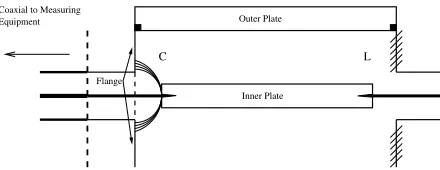
The connector was modelled as a length of lossless 50Ω line to account for the distance between the VNA calibration plane and the point of con-tact with the line. Also included in the model was an excess capacitance and inductance at the point of contact: the capacitance characterises the additional electric field between the inner plate and the connector flange (Figure 2) while the inductance represents the additional current path from the outer coaxial conductor to the outer plate.
Coaxial to Measuring
Equipment Outer Plate
Inner Plate
L C
[image:8.612.186.406.490.575.2]Flange
Figure 2: Coaxial-Connector-Plate Construction.
Initial measurements suggested that the electric length of the connector was about 15mm. The excess capacitanceCc was estimated to be about 1pF
and the excess inductanceLc to be about 0.1nH. The contact resistance was
estimate is based on the manufacturer’s specification [11], the inductance estimate is from a simple calculation of the inductance of the additional path taken by current from the outer of the type N connector and the capacitance estimate is again a simple calculation based on the geometry of the connector. Similarly, the conductance between the inner and outer conductors of the connector was typically about 10−12Sand was also neglected. The impedance
of the line at the connector-structure interface was calculated from
ZL=
1 +r0
1−r0
Z0. (20)
This impedance was then used to calculate the total impedance of the line and the connector-structure interface.
ZT =jωLc+
1
1
ZL +jωCc
. (21)
The original model was now modified to include the connector term and the recovery parameters were augmented by Cc and Lc. The connector was
modelled in two stages: a connection between the connector and the structure (connector-structure interface) and a connection between the connector and the coaxial cable (coaxial-connector interface). The reflection coefficient from the line just before the connector-structure interface isr1 while the reflection
coefficient just after the connector-structure interface will be denoted by r0,
that is r(0+) = r
1 and r(0−) = r0. However any wave travelling from the
measuring equipment must travel some effective distance ∆z, say, beyond the coaxial-connector interface (calibration plane) to actually reach this interface. This length (∆z) was treated as the length of an ideal coaxial line of 50Ω characteristic impedance and as such produces a phase shift between the measured reflection coefficient rcal and the modelled reflection coefficient r0.
Hence the reflection coefficient was given by
r0 =rcale2jk∆z=r(−∆z)e2jk∆z
where k is the wave number. Thus the reflection coefficient as observed by the measuring equipment has been shifted in phase by 2k∆z.
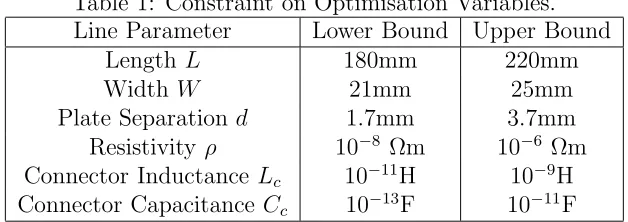
Table 1: Constraint on Optimisation Variables. Line Parameter Lower Bound Upper Bound
LengthL 180mm 220mm
Width W 21mm 25mm
Plate Separation d 1.7mm 3.7mm Resistivity ρ 10−8 Ωm 10−6 Ωm
Connector Inductance Lc 10−11H 10−9H
Connector Capacitance Cc 10−13F 10−11F
these results compared favourably with the experimental results (for more details see [10]).
A nonlinear least squares method was now employed to solve for the unknown parameters s = [(Cc, Lc, L, d, ρ], (see Section 5). The objective
function to be minimised, with respect to s, was
X
k
(|r(s;ωk)−rd(ωk)|2 (22)
for supplied reflection datard(ωk) from the boundary conditions. Constraints
on the parameters were specified by the experimental error bounds (see Ta-ble 1).
Larger bounds were set for the length and resistivity to account for the unknown effects of the two differing conductor lengths and of the conductivity of the conductor surface layer. The constraints were also used as an interval in which to generate 20 uniformly distributed random initial conditions for each parameter. This set of initial conditions was augmented by a set which was predicted from physical measurement. This spread of initial conditions provided some insight into the form of the objective function. In particular we were interested in whether certain subsets would converge to a unique minimum, or if they converged to a local minimum and if so were they closely clustered, well separated or periodic in some sense (for further details see [10]).
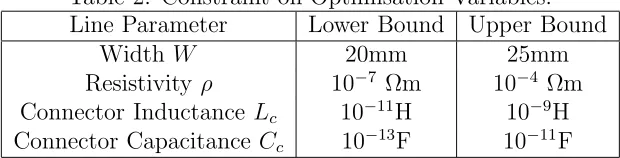
Table 2: Constraint on Optimisation Variables. Line Parameter Lower Bound Upper Bound
Width W 20mm 25mm
Resistivity ρ 10−7 Ωm 10−4 Ωm
Connector Inductance Lc 10−11H 10−9H
Connector Capacitance Cc 10−13F 10−11F
Thus the inverse solver was run with experimental data to recover the two connector parameters Lc and Cc and the two line parameters ρ and W.
In this case the solver always converges to a unique solution, although it was necessary at times to iterate outwith the bounds imposed by Table 2.
There was however a consistent overestimation of the width which was due to fringe fields. Indeed a finite element analysis of the full Maxwell’s equa-tions verified this and consequently an effective width must be used in the forward model to compensate for the additional energy in the non-uniform field. Considerably greater detail may be found in MacKay’s thesis [10].
5
Parameter recovery from the resin-filled line
In section 4 we demonstrated that the connector-structure could be modelled as a combination of an inductance and a capacitance term. In the air-filled line the outer and inner conducting plates had been drilled and the signal directly applied so as to minimise any resistance between the connector and the plates. Clearly drilling of the aircraft aluminium would not be a practical proposition; furthermore it is important that the experimental set up be as close to the real situation as possible. With this in mind we have developed a more sophisticated model of the connector-structure which takes account of clamping rather than drilling the connector to the resin-filled line [5].
Eight structures (denoted by X1, . . . , X8) were manufactured. Of the
eight structures X1 to X4 had a step geometry (Figure 3(a)) and X5 toX8
had a tapered form (Figure 3(b)).
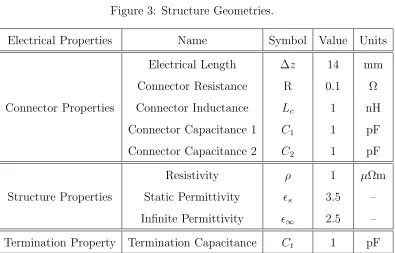
Estimates of the electrical properties are given in Table 3. This infor-mation was employed to generate simulated reflection coefficients to test the ability of the multilayered model to recover the parameters.
(a) Step Geometry. (b) Double Taper Geometry.
Figure 3: Structure Geometries.
Electrical Properties Name Symbol Value Units
Electrical Length ∆z 14 mm
Connector Resistance R 0.1 Ω
Connector Properties Connector Inductance Lc 1 nH
Connector Capacitance 1 C1 1 pF
Connector Capacitance 2 C2 1 pF
Resistivity ρ 1 µΩm
Structure Properties Static Permittivity ǫs 3.5 –
Infinite Permittivity ǫ∞ 2.5 –
Termination Property Termination Capacitance Ct 1 pF
Table 3: Electrical Property Estimations for Connector, Structure and Ter-mination.
was in general satisfactory with the stepped geometries being more amenable to this recovery than those from the tapered structures. The recovery of the resistivity was less encouraging with the recovered value varying markedly with the number of layers used. The main problem with the resistivity re-covery is that the resistivity term only contributes to the cost function over a relatively limited frequency range and so the cost function is dominated by the contribution from the connector terms. One solution may be to initially assume the line is uniform, solve for the connector parameters first, without generating a complete solution for all the line parameters, and then solve for the line including the resistivity.
[image:12.612.105.500.166.419.2](see Figure 4). However, it can be seen that the reconstructions consistently underestimate the plate separation, which may suggest that the adjustment of another parameter may remedy this.
0 20 40 60 80 100
0 0.1 0.2 0.3 0.4 0.5 0.6 0.7 0.8 0.9 1 P la te S ep ar at io n (m m )
Plate Length (mm)
Estimated Profile Reconstructed Profile
Structure X4
(a) Structure X4: 10 Layers.
0 20 40 60 80 100
0.3 0.4 0.5 0.6 0.7 0.8 0.9 1 1.1 P la te S ep ar at io n (m m )
Plate Length (mm)
Estimated Profile Reconstructed Profile
Structure X7
[image:13.612.110.520.140.324.2](b) Structure X7: 10 Layers.
Figure 4: 10 Layer Reconstructions.
0 20 40 60 80 100
0 0.1 0.2 0.3 0.4 0.5 0.6 0.7 0.8 0.9 1 P la te S ep ar at io n (m m )
Plate Length (mm)
Estimated Profile Reconstructed Profile
Structure X4
(a) Structure X4: 15 Layers.
0 20 40 60 80 100
0.2 0.3 0.4 0.5 0.6 0.7 0.8 0.9 1 1.1 P la te S ep ar at io n (m m )
Plate Length (mm)
Estimated Profile Reconstructed Profile
Structure X7
(b) Structure X7: 15 Layers.
Figure 5: 15 Layer Reconstructions.
[image:13.612.107.522.393.577.2]1.5 2 2.5 3 3.5
10 layers 15 layers 20 layers
X1 X2 X3 X4 X5 X6 X7 X8
ǫ∞
(a) Infinite Permittivity Reconstruction.
3 3.2 3.4 3.6 3.8 4 4.2 4.4 4.6 4.8 5
10 layers 15 layers 20 layers
X1 X2 X3 X4 X5 X6 X7 X8
ǫs
(b) Static Permittivity Reconstruction.
0.05 0.1 0.15 0.2 0.25
Resistivity (
µ
Ω
m
)
10 layers 15 layers 20 layers
X1 X2 X3 X4 X5 X6 X7 X8
[image:14.612.114.523.80.451.2](c) Resistivity Reconstruction.
Figure 6: Reconstructed Structural Electrical Properties of X1 to X8: 10, 15 and 20 Layers.
6
Conclusions
This paper has been concerned with the integrity of bonded aircraft struc-tures. By assuming transmission line theory on a multilayered structure a forward model for the reflection coefficients was developed. In any practical situation measurement of these reflection coefficients requires a measuring device and a connection to the aircraft structure. This connector therefore needs to be modelled and its associated electrical parameters identified. In this paper we have concentrated on an air-filled line to test the feasibility of the inverse solver in reconstructing the parameters associated with the line and the connector. Having demonstrated the efficacy of the inverse solver we turned our attention to the dielectric-filled line and the multilayered model. The connector was remodelled to take account of the fact that in a real situa-tion it would be clamped to an aircraft structure and the full inverse problem was solved both for simulated data and experimental data.
The results demonstrate the effectiveness of this approach in recover-ing the spatial parameters associated with an adhesively bonded structure. Reconstructions of the plate separation were shown to be consistently under-estimated in comparison with the experimental measurements. More serious was the resistivity which was substantially overestimated; the static per-mittivity reconstruction was also felt to be a little on the low side. From extensive simulations it appears that the resistivity term only contributes to the cost function over a relatively limited frequency range and so the cost function becomes dominated by the contribution from the connector terms. Our current work is focussing on initially assuming that the line is uniform, solving for the connector parameters first, without generating a complete solution for all the line parameters, and then solving for the line including the resistivity. The VNA performs a synchronous detection of its own sig-nal and we have found that the relatively low levels of noise which arise in a practical situation do not pose any difficulties for the method. There is a fur-ther level of uncertainty which arises through the calibration standard of the analyser but we have found that the results were very similar when various analysers with differing calibration standards were utilised. Thus this paper presents a feasible and practical method of nondestructive examination of in situ adhesively bonded aircraft structures.
The Riccati difference equation (3) reduces to
rm+1rm−
B A
rm+1+
1
Arm+ 1 = 0 (A.1)
when
Am =Am+1 =A=
P(1−E)
E−P2 , m = 0,1,2, . . . (A.2)
and
Bm=Bm+1 =B =
1−P2E
E−P2 , m= 0,1,2, . . . (A.3)
Performing the transformation rm = (B −zm+1/zm)/A results in the linear
second order difference equation
zm+1−(1 +B)zm+1+ (A2+B)zm = 0 (A.4)
which may be solved to give
zm =C1λm1 +C2λm2 (A.5)
where λ1 = (P2 −1)/(P2 −E)and λ2 = Eλ1. Transforming back to the
original variable gives
rm =
1
A
B −λ
m+1
1 +C3λm2+1
λm
1 +C3λm2
(A.6)
where C3 =C2/C1 and C1 6= 0. Now, if r0 is known we may solve (A.10)
(with m = 0) forC3 to obtain
C3 =
B−λ1−Ar0
Ar0−B+λ2
= P(P −r0)
r0P −1
(A.7)
after some manipulation using (A.1), (A.2), (A.3) and (A.8). Substituting (A.8) into (A.10) and writing the expression over a common denominator yields
rm =
B(1 +C3Em)−λ1(1 +C3Em+1)
1 +C3Em
(A.8)
= P(P −r0)E
m(1−E)−P3r
0(E−1) +P2(E−1)
P(E−1)(P r0(Em−1) + 1−P2Em)
(A.9)
using (A.1), (A.2) and (A.12). Further simplification results in
rm=
(Em
−P2)r
0+P(1−Em)
P(Em−1)r
0+ 1−P2Em
Acknowledgements
The authors would like to acknowledge funding both from the UK EPSRC (Grant GR/N02207) and the USAF (Contract number F61775-01-C00005).
References
[1] S. Affrossman, W. M. Banks, D. Hayward, and
R. A. Pethrick, Non-destructive examination of adhesively bonded
structures using dielectric techniques: review and some results, Proc
Instn Mech Engrs, 214 (2000), pp. 87–102.
[2] R. Pethrick, Comprehensive Composite Materials, vol. 5, Pergamon, Oxford and New York, 2000, ch. 15, pp. 360–390.
[3] S. B. Joshi, R. A. Pethrick, R. Gilmore, L. W. Yates, and D. Hayward, Environmental ageing of adhesively bonded joints. I.
di-electric studies, J. Adhes., 62 (1997), pp. 281–315.
[4] S. B. Joshi, R. A. Pethrick, T. F. Gray, W. M. Banks, R. Gilmore, L. W. Yates, and D. Hayward, Environmental
age-ing of adhesively bonded joints. II. mechanical studies, J. Adhes., 62
(1997), pp. 317–335.
[5] C. Mackay, D. Hayward, A.J. Mulholland, S. Mckee and R.A. Pethrick,Reconstruction of the spatial dependence of dielectric
and geometrical properties of adhesively bonded structures, J. Phys. D:
Appl. Phys., 38 (2005), pp. 1943–1949.
[6] M. Norgren and S. He, An optimization approach to the
frequency-domain inverse problem for a nonuniform, LCRG transmission line,
IEEE Trans. Microwave Theory Tech, 44 (1996), pp. 1503–1507.
[7] S. Ramo, J. R. Whinnery, and T. Duzer, Fields and Waves in
Communication Electronics, John Wiley, New York, 1994.
[8] S. Havriliak and S. Negami, A complex plane analysis of α
-dispersions in some polymer systems, J. Polymer Science: Part C,
(1966), pp. 99–117.
[9] D. Davidson and R. Cole,Dielectric relaxation in glycerol, propylene
[10] C. Mackay, An Inverse Methodology for the Reconstruction of Spatial
Dielectric Properties using Frequency Domain Reflection Coefficients.,
Ph.D. Thesis, University of Strathclyde, 2004.