City, University of London Institutional Repository
Citation:
Murphy, S., Moore, G., Tapper, K., Lynch, R., Clarke, R., Raisanen, L., Desousa,
C. and Moore, L. (2011). Free healthy breakfasts in primary schools: A cluster randomised
controlled trial of a policy intervention in Wales, UK. Public Health Nutrition, 14(2), pp.
219-226. doi: 10.1017/S1368980010001886
This is the unspecified version of the paper.
This version of the publication may differ from the final published
version.
Permanent repository link:
http://openaccess.city.ac.uk/1871/
Link to published version:
http://dx.doi.org/10.1017/S1368980010001886
Copyright and reuse: City Research Online aims to make research
outputs of City, University of London available to a wider audience.
Copyright and Moral Rights remain with the author(s) and/or copyright
holders. URLs from City Research Online may be freely distributed and
linked to.
City Research Online:
http://openaccess.city.ac.uk/
[email protected]
Free healthy breakfasts in primary schools: a cluster
randomised controlled trial of a policy intervention
in Wales, UK
Simon Murphy
1,*, GF Moore
1, K Tapper
2, R Lynch
1, R Clarke
1, L Raisanen
1,
C Desousa
3and L Moore
11Cardiff Institute of Society and School of Social Sciences, Cardiff University, 1–3 Museum Place, Cardiff, CF10
3BD, UK:2School of Psychology, Swansea University, Swansea, UK:3Institute of Social and Economic Research, University of Essex, Colchester, UK
Submitted 26 October 2009: Accepted 10 May 2010: First published online 6 July 2010
Abstract
Objective: The present study evaluated the impact of a national school pro-gramme of universal free healthy breakfast provision in Wales, UK.
Design: A cluster randomised controlled trial with repeated cross-sectional design and a 12-month follow-up. Primary outcomes were breakfast skipping, breakfast diet and episodic memory. Secondary outcomes were frequency of eating breakfast at home and at school, breakfast attitudes, rest-of-day diet and class behaviour.
Setting:Primary schools in nine local education authority areas.
Subjects:A total of 4350 students (aged 9–11 years) at baseline and 4472 at follow-up in 111 schools.
Results:Students in intervention schools reported significantly higher numbers of healthy food items consumed at breakfast and more positive attitudes towards breakfast eating at 12 months. Parents in intervention schools reported significantly higher rates of consumption of breakfast at school and correspondingly lower rates of breakfast consumption at home. No other significant differences were found.
Conclusions: The intervention did not reduce breakfast skipping; rather, pupils substituted breakfast at home for breakfast at school. However, there were improvements in children’s nutritional intake at breakfast time, if not the rest of the day, and more positive attitudes to breakfast, which may have implications for life-course dietary behaviours. There was no impact on episodic memory or classroom behaviour, which may require targeting breakfast skippers.
Keywords
Randomised controlled trial Free breakfasts Schoolchildren Intervention
The poor quality of children’s diets has received increased attention in recent years(1–3). Specific concern has focused on the many schoolchildren who do not eat breakfast everyday(4), given its association with a wealth of deleterious health outcomes(5–7), such as poorer overall nutritional adequacy(8–9), detrimental effects upon memory and con-centration(8–12) and obesity(13). Furthermore, studies con-ducted in the UK have highlighted social patterning in breakfast eating that may contribute to health inequalities, with children from more deprived backgrounds more likely to skip breakfast and to have less positive attitudes to breakfast than their wealthier counterparts(14–16).
Poor dietary behaviours in childhood have also received increased attention due to their potential impact in later life. Habitual behaviours developed in childhood may track into adulthood(19), as repeated exposure to healthier foods at an early age has been shown to increase the intrinsic rewards associated with their consumption as children develop(20–23). Efforts to facilitate change in such dietary behaviours have
been directed towards schoolchildren in particular due to the capacity of such approaches to reach large numbers of children simultaneously(17–18). Appropriate manipulation of the school environment may therefore offer an efficient means of improving the health of the population, addressing inequalities and improving educational achievement(24). Recognition of these potential benefits led to the introduction of breakfast initiatives in the USA(26), and by 2006, 9?7 million children were attending a school breakfast club each day(27). Previous evaluations of universal free breakfast pro-grammes in the USA have identified a range of dietary, cognitive and educational benefits, but have suffered from a number of methodological shortcomings, including a lack of randomisation and the provision of appropriate control groups(28–29). A recent randomised controlled trial (RCT) of a 3-year school breakfast programme, supported by the US Department of Agriculture, Food and Nutrition Ser-vice, employed a more rigorous methodology to assess a range of outcomes including diet and nutrition, school
behaviour, academic achievement and attendance(30). The study found significant improvements in students’ consumption of nutritious breakfasts in intervention schools(31), but no significant differences in break-fast skipping, school behaviour, academic achievement and attendance were observed(30).
In the UK, the introduction of breakfast programmes has occurred more recently, with the Department of Health introducing a pilot initiative in 1999. Despite a variation in the objectives of schemes(25), there is evi-dence to suggest that school breakfast programmes can help improve nutrition and in some cases may also be associated with improvements in school attendance, academic performance and behaviour(10,32–35). However, previous evaluations have been unable to address the confounding pre-intervention variables, incorporate appropriate control groups(36) or have suffered con-tamination between trial arms(35). Thus, although evi-dence suggests that there is good reason to believe that breakfast programmes can have beneficial dietary and educational outcomes, this has yet to be convincingly shown at a policy level in the UK.
The Welsh Assembly Government’s Primary School Free Breakfast Initiative (PSFBI) arose from a manifesto commitment to make free healthy breakfasts available to all state-maintained primary schools in Wales, UK. The core components of the PSFBI are highlighted in Box 1.
Here, we report findings from a cluster RCT of this policy intervention in which schools in the intervention group were asked to set up a breakfast scheme, following the guidance issued by the Welsh Assembly Government; schools in the control condition were asked to refrain from setting up a breakfast scheme during the 12-month eva-luation period. The Welsh Assembly Government provided support and assistance in facilitating the evaluation design within the policy roll-out. The design included a nested qualitative process evaluation to address issues concerning the context and implementation of the initiative. The present study received ethical approval from the Cardiff University Social Science Ethics Committee. The detailed design of the trial and results of the process evaluation are reported elsewhere(37–39).
Methods
Study design
The present study was a cluster randomised controlled trial, using a repeated cross-section design, with repeat samples of Year 5 and Year 6 students (9–11 years) sampled from the same 111 schools pre- and post-intervention.
Recruitment and data collection
All primary schools in nine local education authorities (LEA) were invited to participate in the trial in the aca-demic years beginning in autumn 2004 and 2005. Recruitment took place in two phases that matched the national implementation of the scheme. In the first year, 152 schools in ‘Communities First’ areas were invited. The Welsh Assembly Government classifies these areas as being prioritised for social and economic programmes. The definition of areas is based on the Welsh Index of Multiple Deprivation. In the second year, the remaining 456 schools in non-‘Communities First’ areas in these LEA were approached. Head teachers were asked to sign an agreement to participate in the data collection activities and to be randomised to either the control or intervention condition. Once all schools had been recruited within each phase, stratified block randomisation with conceal-ment of allocation was used with strata defined by LEA, school size, free school meal entitlement and Welsh lan-guage medium. Schools, students and data collection staff were not blind to treatment condition although data entry, cleaning and analysis were conducted blind to treatment condition.
The trial assessed the impact of the scheme in four key domains at 12-month follow-up: students’ breakfast eat-ing behaviour and attitudes, cognitive performance, classroom behaviour and their dietary habits throughout the day. As the scheme represented a complex interven-tion, a pre-specified analysis plan identified four primary outcomes: the proportion of students consuming two breakfasts over 2 d to assess breakfast skipping; number of ‘healthy’ food items (bread, cereal, milk and fruit) consumed at breakfast, number of ‘unhealthy’ food items (sweets and crisps) consumed at breakfast and episodic
Box 1 Core components of the Primary School Free Breakfast Initiative
> Schools and students have the opportunity to have a free ‘healthy breakfast’. > Breakfast provision takes place before the start of school each day.
> Students should be provided with one item from each of four food groups; milk-based drinks or products, cereal (not sugar coated),
fruit and breads.
> Schools are also encouraged to consider incorporating optional play and educational activities.
> Each participating school has a scheme coordinator and supervision of the sessions is provided by teaching staff, kitchen staff,
lunchtime supervisors, parent helpers or learning support assistants.
> Schools are advised to consult with parents at an early stage of development and encourage children to become involved in the
planning and running of the sessions.
> The scheme is promoted and supported by a local authority co-ordinator who administered the funding for the scheme. > The Welsh Assembly Government provides schools with £ 25 per child for each breakfast with separate funding for staff.
> The initiative aims to help encourage a healthy pattern of eating for life, improve concentration of students and to assist in the
raising of standards of learning and attainment.
memory. The most consistent effects of breakfast upon cognition, in experimental conditions, have previously been observed for episodic memory, which was therefore selected as the primary outcome as an indicator of cognitive performance(40,41). Secondary outcomes were identified as attitudes towards eating breakfast; rest-of-day healthy food items; rest-of-day unhealthy food items; scores on the hyperactivity scale of a teacher-reported strength and difficulties questionnaire; and parental reports of frequency of eating breakfast at home and at school.
In each school, at each time point (baseline and 12-month follow-up), one Year 5 (aged 9–10 years) and one Year 6 (aged 10–11 years) class were randomly selected. Using a dietary recall questionnaire validated for use within the present study(42), children were asked to list all foods and drinks consumed at chronologically ordered time points throughout the day. Details of breakfast on the day of reporting were collected first, followed by details of the previous day’s intake. This provided the primary measures of the number of healthy food items (fruit, bread, cereal and milk products) and number of unhealthy food items con-sumed at breakfast (sweets and crisps), and the number of days on which breakfast was consumed in the past 2 d (0, 1 or 2). It also provided the secondary outcomes of the number of healthy (fruit and vegetables) and unhealthy food items (sweets and crisps) consumed the previous day, excluding previous breakfast.
At each of the two time points, a validated attitudes questionnaire(43)and memory tests were also completed between 09.00 and 12.00 hours as supervised classroom exercises. The strengths and difficulties questionnaire (SDQ)(44)was completed by teachers to assess the class-room behaviour of a randomly selected subsample of five students in each year group (i.e. ten in each school at each time point). This measure assesses five dimensions of behaviour, with the hyperactivity/inattention dimen-sion hypothesised to be potentially influenced by break-fast due to its relationship to on-task behaviour(45). In each school at each time point, thirty-five children were randomly selected, stratified by year group across the full age range of each school, and their parents were sent a questionnaire about their child’s dietary behaviour, with particular focus on breakfast eating throughout the week. Non-respondents were followed up with a reminder and duplicate questionnaire.
Sample size requirements were calculated using effect sizes, assuming an intra-cluster correlation of 0?02, 80 % power and a two-tailed a of 0?05. With 111 schools in the trial, for student outcomes from the dietary recall questionnaire and memory tests, assuming an average of fifty responses per school, there would be power to detect an effect size of 0?11. For parent reports of breakfasting behaviour, assuming twenty responses per school, there would be power to detect an effect size of 0?15. For the teacher-reported SDQ, there would be power to detect an effect size of 0?2.
Participant flow
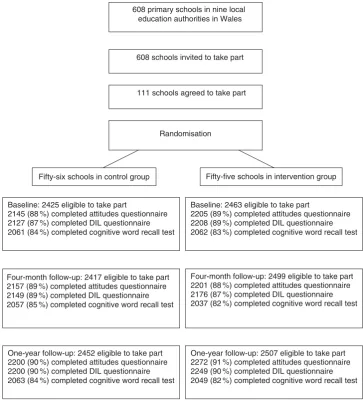
Of the 608 schools invited to participate, 154 expressed an interest and were visited by the research team, of which 111 agreed to be randomised and participate in data collection activities. Schools were asked to indicate a reason for non-participation. Of the 497 invited schools that did not participate, 259 did not provide a reason. Of the remaining 238 schools, they were most likely to cite anticipated staffing difficulties in setting up the intervention (29 %). None of the 111 randomised schools withdrew from the study, although five schools rando-mised to the control group set up a free breakfast scheme before the 12-month follow-up, and ten schools rando-mised to the intervention group did not set up the scheme within the follow-up period.
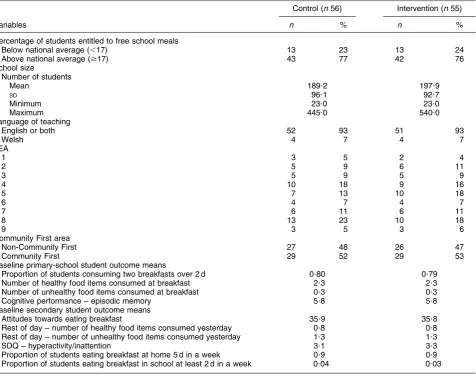
Figures 1 and 2 indicate the flow of schools through the study and the number of eligible and responding participants at each stage: Fig. 1 for the classroom-administered measures among students, and Fig. 2 for the teacher- and parent-completed measures. An examina-tion of the baseline characteristics in Table 1 indicates that there was a good balance between the two experimental groups in terms of both the school- and student-level variables.
Analysis
For each outcome variable, the primary analysis was a school-level weighted linear regression model in which each observation was a school-level mean (or proportion for categorical outcomes) with models weighted by inverse variance weights to adjust for variability and sample size in each school(46). All models included the baseline score of the respective outcome measure and the four stratification variables as covariates. These primary analyses were con-ducted on an intention-to-treat (ITT) basis, in which each school was coded according to the treatment condition to which it had been randomised (control556, interven-tion555). A second analysis was undertaken for each out-come, in which the treatment group was coded according to whether or not a free breakfast scheme was actually set up before outcome measurement. Regression coefficients and 95 % CI are presented.
Results
in control schools. Parents of students at intervention schools not only reported significantly higher rates of students’ consumption of breakfast at school (10?19, 95 % CI 0?12, 0?26), but also a correspondingly lower propor-tion of students reported by their parents to be eating breakfast at home (20?15, 95 % CI20?21,20?10).
There were no differences in either healthy or unhealthy items consumed during the rest of the day or hyperactivity/ inattention measures. In the secondary per protocol ana-lyses that coded schools according to whether or not the breakfast scheme had been implemented within the 12-month follow-up period, the magnitude and statistical significance of each of the significant effects were increased. Among students in intervention schools where the scheme had been implemented by a 12-month follow-up, 41 % (700 of 1693) stated that they attended the breakfast scheme at least once a week. Of these, 499 (30 %) reported attending the scheme 5 d/week, with the remaining 201 attending on
1–4 d/week. Frequency of attendance was positively asso-ciated with frequency of breakfast consumption, positive attitudes towards eating breakfast and consumption of healthy food items at breakfast (allP,0?01), and negatively associated with the consumption of unhealthy food items at breakfast (P,0?05).
Conclusion
Support for trials of the UK policy initiatives is a relatively recent phenomenon(47–48). The PSFBI study therefore represents a relatively rare example of a UK RCT evalua-tion of a naevalua-tional policy initiative that aimed to increase the opportunity of primary-school students receiving a free healthy breakfast at school. As such, it provides not only important information for national policy developments but also the opportunity for a cross-cultural comparison of 608 schools invited to take part
Randomisation
111 schools agreed to take part
Fifty-five schools in intervention group
Baseline: 2425 eligible to take part
2145 (88 %) completed attitudes questionnaire 2127 (87 %) completed DIL questionnaire 2061 (84 %) completed cognitive word recall test
608 primary schools in nine local education authorities in Wales
Fifty-six schools in control group
Baseline: 2463 eligible to take part
2205 (89 %) completed attitudes questionnaire 2208 (89 %) completed DIL questionnaire 2062 (83 %) completed cognitive word recall test
Four-month follow-up: 2417 eligible to take part 2157 (89 %) completed attitudes questionnaire 2149 (89 %) completed DIL questionnaire 2057 (85 %) completed cognitive word recall test
Four-month follow-up: 2499 eligible to take part 2201 (88 %) completed attitudes questionnaire 2176 (87 %) completed DIL questionnaire 2037 (82 %) completed cognitive word recall test
One-year follow-up: 2452 eligible to take part 2200 (90 %) completed attitudes questionnaire 2200 (90 %) completed DIL questionnaire 2063 (84 %) completed cognitive word recall test
One-year follow-up: 2507 eligible to take part 2272 (91 %) completed attitudes questionnaire 2249 (90 %) completed DIL questionnaire 2049 (82 %) completed cognitive word recall test
Fig. 1Flow of schools through study and response rates: classroom-administered student measures (DIL questionnaire, day in the
life questionnaire)
[image:5.595.111.475.56.459.2]universal free breakfast provision in the UK and USA, where a similar initiative has been evaluated using a comparable design(30).
The current trial design was in part determined by policy and practice constraints, rather than by conforming to evaluation frameworks(49) that recommend theory, modelling and exploratory trial phases before the con-duct of a definitive trial. Nevertheless, the present study addressed a number of methodological shortcomings identified in previous UK studies, including a lack of randomisation, the provision of appropriate control groups and contamination between trial arms(35). In the present study, the scheme started in five of the fifty-six control schools within the study period, while ten of the fifty-five intervention schools failed to set up the scheme. The primary ITT analysis of this pragmatic trial is not invalidated by this, and the per protocol analysis allows an assessment of the extent to which the primary analysis underestimates the potential impact of the scheme. The study also gained strength from the provision of a pre-liminary research and review phase that assessed the intervention content and implementation issues and deter-mined outcome measures(37)and a nested process evalua-tion(38) to determine what works, for whom and in what circumstances(50). It also included a relatively long-term outcome measure at 12 months compared with previous studies(35). Confidence in the robustness of these findings is also enhanced by the high response rates of students
achieved at each data collection point, although it should be noted that parental measures are based on a much lower response rate. In addition, the strengths lie in the diversity of schools involved in terms of free school meal entitlement, size and deprivation of local area and the retention of all schools for the duration of the trial. The main limitation of the study is its dependence upon self-reported outcomes of dietary behaviour, although these were validated among the target population(40).
The findings provide partial support for the PSFBI as a dietary intervention and closely replicate results from the study conducted in the USA(30–31). In both studies, breakfast skipping was at a similar level in intervention and control schools, and in each case the availability of universal free breakfast shifted the source of breakfast from home to the school in intervention schools. For educational and behavioural effects, results from the US study showed no differences in student behaviour, attendance or academic achievement. Similarly, the PSFBI was shown to be ineffective in influencing episodic memory or classroom behaviour, despite previous studies suggesting such effects(10,33–34) and process evaluation results for the present study(38)that highlighted consistent implementer reports of changes in learning and school behaviour. Given that the impact of differences in meal composition is less easily shown in generally well-nourished rather than malnourished children(51), such improvements may require the scheme to address breakfast skipping more Randomisation
Fifty-five schools in intervention group
Baseline:
SDQ – 560 eligible to take part
Parental questionnaire – 1960 eligible to take part
525 (94 %) completed SDQ
1141 (58 %) completed parental questionnaires Fifty-six schools in control group
Baseline:
SDQ – 550 eligible to take part
Parental questionnaire – 1925 eligible to take part
518 (94 %) completed SDQ
1108 (58 %) completed parental questionnaires
Four-month follow-up: SDQ – 560 eligible to take part
514 (92 %) completed SDQ
No data collection for parental measures
Four-month follow-up: SDQ – 550 eligible to take part
493 (90 %) completed SDQ
No data collection for parental measures
One-year follow-up:
SDQ – 560 eligible to take part (SDQ)
Parental questionnaire – 1960 eligible to take part
473 (85 %) completed SDQ
970 (49 %) completed parental questionnaires
One-year follow-up:
SDQ – 550 eligible to take part
Parental questionnaire – 1925 eligible to take part
485 (88 %) completed SDQ
852 (44 %) completed parental questionnaires
[image:6.595.116.487.55.352.2]effectively. Achieving higher levels of student uptake and greater reach among breakfast skippers will require increased engagement by the scheme with those families and students who are most in need.
[image:7.595.59.536.80.456.2]Although not impacting on the rest-of-day diet or unhealthy items consumed at breakfast, the PSFBI also improved the quality of children’s breakfasts by increas-ing the consumption of food items such as fruit, and Table 1Baseline characteristics (intention-to-treat) of intervention and control groups: school- and student-level variables (means of aggregated values for each school)
Control (n56) Intervention (n55)
Variables n % n %
Percentage of students entitled to free school meals
Below national average (,17) 13 23 13 24
Above national average ($17) 43 77 42 76
School size
Number of students
Mean 189?2 197?9
SD 96?1 92?7
Minimum 23?0 23?0
Maximum 445?0 540?0
Language of teaching
English or both 52 93 51 93
Welsh 4 7 4 7
LEA
1 3 5 2 4
2 5 9 6 11
3 5 9 5 9
4 10 18 9 16
5 7 13 10 18
6 4 7 4 7
7 6 11 6 11
8 13 23 10 18
9 3 5 3 6
Community First area
Non-Community First 27 48 26 47
Community First 29 52 29 53
Baseline primary-school student outcome means
Proportion of students consuming two breakfasts over 2 d 0?80 0?79 Number of healthy food items consumed at breakfast 2?3 2?3 Number of unhealthy food items consumed at breakfast 0?3 0?3
Cognitive performance – episodic memory 5?8 5?8
Baseline secondary student outcome means
Attitudes towards eating breakfast 35?9 35?8
Rest of day – number of healthy food items consumed yesterday 0?8 0?8 Rest of day – number of unhealthy food items consumed yesterday 1?3 1?3
SDQ – hyperactivity/inattention 3?1 3?3
Proportion of students eating breakfast at home 5 d in a week 0?9 0?9 Proportion of students eating breakfast in school at least 2 d in a week 0?04 0?03
LEA, local education authority; SDQ, strengths and difficulties questionnaire.
Table 2Intervention effects for student measures from school-level weighted regression analyses
Variables Effect estimate 95 % CI
Primary outcomes
Proportion of students consuming two breakfasts over 2 d 0?01 20?02, 0?03 Number of healthy food items consumed at breakfast 0?23** 0?09, 0?37 Number of unhealthy food items consumed at breakfast 0?01 20?04, 0?06 Cognitive performance – episodic memory (107 schools) 0?11 20?13, 0?36 Secondary outcomes
Average attitudes towards eating breakfast 0?74* 0?05, 1?43
Rest of day – number of healthy food items consumed yesterday 20?10 20?22, 0?01 Rest of day – number of unhealthy food items consumed yesterday 20?07 20?17, 0?03 SDQ – hyperactivity/inattention (ninety-three schools) 0?18 20?30, 0?65 Proportion of students eating breakfast at home 5 d in a week 20?15** 20?21,20?10 Proportion of students eating breakfast in school at least 2 d in a week 0?19** 0?12, 0?26
SDQ, strengths and difficulties questionnaire. *P,0?05, **P,0?01.
[image:7.595.52.538.495.629.2]while the type of bread could not be measured given the inability of children to reliably recall intake at this level of detail, only wholemeal bread was served within PSFBI, very likely improving the intakes of healthier forms of bread. It was also effective in promoting positive attitudes to breakfasts, which may represent important mediating targets for dietary interventions(15). In this respect, it again reflects findings from the USA, where students partici-pating in the intervention were more likely to consume a nutritionally substantive breakfast, although intake over the course of the day was essentially the same(31). Given the high levels of implementer support for the initia-tive(38), the PSFBI therefore has the potential to support a range of policy initiatives(52–53) that address healthy eat-ing. Indeed, given that many of the intrinsic rewards and habitual behaviours associated with food consumption develop at this age(19–23), it may represent an effective approach for addressing population dietary behaviour in the long term. Given the increasing recognition of the role of the obesogenic environment(3)on dietary behaviours, however, this is only likely to be effective within an ecological approach that works to support and maintain healthy dietary habits at multiple levels and throughout the early life course.
Acknowledgements
The present study was an independent evaluation funded by the Welsh Assembly Government. Janine Hale, Ruth Conway and Chris Roberts of the Welsh Assembly Gov-ernment provided support and assistance in facilitating the evaluation design within the policy roll-out. The authors declare that there are no competing interests. S.M., L.M. and K.T. led the design of the trial. S.M. managed the overall conduct of the study with the support of G.F.M. and R.L., L.M. oversaw the statistical analysis, which was conducted by C.D., R.L. and S.M. designed and undertook the process evaluation. All authors contributed to re-drafts of the present paper. S.M. acts as guarantor. The authors thank Rowan Brockman, Emily Harrop, Deborah Lancastle, Claire Pimm, Emily Warren, Iolo Madoc-Jones and Julian Buchanon for help with data collection, Zoe Macdonald, Hannah Lynch, Lorelei Simon, Fiona West and Andrew Rodgers for administrative assistance, Andy Smith for advice and sup-port on cognitive tests and Odette Parry for contributions to project management and data collection. The authors also thank members of our advisory group, and gratefully acknowledge the cooperation of all school staff, students and parents for participating in the present study.
References
1. Smithers G, Gregory J, Bates Cet al.(2000) The National Diet and Nutrition Survey: young people aged 4–18 years. Nutr Bull25, 105–111.
2. McCann D, Barrett A, Cooper Aet al.(2007) Food additives and hyperactive behaviour in 3-year-old and 8/9-year-old children in the community: a randomised, double-blinded, placebo-controlled trial.Lancet 370, 1560–1567.
3. Foresight (2007)Tackling Obesity: Future Choices. London: Government Office for Science.
4. Balding J (2001) Food choices and weight control. In Young People in 2000, pp. 1–12 [J Balding, editor]. Exeter: Schools Health Education Unit.
5. Berkey CS, Rockett HRH, Gillman MW et al. (2003) Longitudinal study of skipping breakfast and weight change in adolescents.Int J Obes27, 1258–1266.
6. Bruno-Ambrosius K, Swanholm G & Twetman S (2005) Eating habits, smoking and tooth brushing in relation to dental caries: a 3-year study in Swedish female teenagers. Int J Paediatr Dent15, 190–196.
7. Fujiwara T (2003) Skipping breakfast is associated with dysmenorrhea in young women in Japan. Int J Food Sci Nutr54, 505–509.
8. Nicklas TA, Bao W, Webber LS et al. (1993) Breakfast consumption affects adequacy of total daily intake in children.J Am Diet Assoc93, 886–889.
9. Sjoberg A, Hallberg L, Hoglund D et al. (2003) Meal pattern, food choice, nutrient intake and lifestyle factors in The Goteborg Adolescence Study. Eur J Clin Nutr 57, 1569–1578.
10. Pollitt E (1995) Does breakfast make a difference in school ? J Am Diet Assoc95, 1134–1139.
11. Pollitt E, Gersovitz M & Gargiulo M (1978) Educational benefits of the United States school feeding program: a critical review of the literature. Am J Public Health68, 477–481.
12. Rampersaud GC, Pereira MA, Girard BL et al. (2005) Review – breakfast habits, nutritional status, body weight, and academic performance in children and adolescents. J Am Diet Assoc105, 743–760.
13. Elgar FJ, Roberts C, Moore L et al. (2005) Sedentary behaviour, physical activity and weight problems in adolescents in Wales.Public Health119, 518–524. 14. Keski-Rahkonen A, Kaprio J, Rissanen A et al. (2003)
Breakfast skipping and health-compromising behaviors in adolescents and adults.Eur J Clin Nutr57, 842–853. 15. Moore GF, Tapper K, Murphy Set al.(2007) Associations
between deprivation, attitudes towards eating breakfast and breakfast eating behaviours in 9–11 year olds.Public Health Nutr10, 582–589.
16. O’Dea JA & Caputi P (2001) Association between socio-economic status, weight, age and gender, and the body image and weight control practices of 6 to 19-year-old children and adolescents.Health Educ Res16, 521–532. 17. James J, Thomas P, Cavan D et al. (2004) Preventing
childhood obesity by reducing consumption of carbonated drinks: cluster randomised controlled trial.BMJ328, 1237. 18. Moore L, Tapper K, Dennehy Aet al.(2005) Development and testing of a computerised 24-h recall questionnaire measuring fruit and snack consumption among 9–11 year olds.Eur J Clin Nutr59, 809–816.
19. Mikkila V, Rasanen L, Raitakari OT et al. (2004) Long-itudinal changes in diet from childhood into adulthood with respect to risk of cardiovascular diseases: The Cardiovascular Risk in Young Finns Study.Eur J Clin Nutr
58, 1038–1045.
20. Birch LL & Marlin DW (1982) I don’t like it; I never tried it: effects of exposure on 2-year-old children’s food preferences.Appetite3, 353–360.
21. Birch LL, McPhee L, Shoba BCet al.(1987) What kind of exposure reduces children’s food neophobia? Looking vs tasting.Appetite9, 171–178.
23. Wardle J, Herrera ML, Cooke L et al. (2003) Modifying children’s food preferences: the effects of exposure and reward on acceptance of an unfamiliar vegetable. Eur J Clin Nutr57, 341–348.
24. Bellisle F (2004) Effects of diet on behaviour and cognition in children.Br J Nutr92, S227–S223.
25. Shemilt I, O’Brien M, Thoburn Jet al.(2003) School breakfast clubs, children and family support.Child Soc17, 111–112. 26. Friedman BJ & Hurd-Crixell SL (1999) Nutrient intake of
children eating school breakfast.J Am Diet Assoc99, 219–221. 27. US Department of Agriculture (2007)The School Breakfast Programme. Alexandria, VA: US Department of Agriculture. 28. Fox MK, Hamilton W & Lin BH (2004)Food Assistance and Nutrition Research Reportno. FANRR19-3. Washington, DC: USDA, Economic Research Service.
29. Murphy J (2007) Breakfast and learning: an updated review.Curr Nutr Food Sci3, 3–36.
30. Bernstein LS, McLaughlin JE, Crepinsek MK et al. (2004) Evaluation of the School Breakfast Program Pilot Project: Final Report. Nutrition Assistance Program Report Series Report no. CN-04-SBP. Alexandria, VA: The Office of Analysis, Nutrition, and Evaluation.
31. Crensek M, Singh A, Bernstein Let al.(2006) Dietary effects of universal free school breakfasts: findings from the evaluation of the school breakfast program pilot project. J Am Diet Assoc106, 1796–1803.
32. Belderson P, Brandon M, Camina Met al. (2001)A National Evaluation of School Breakfast Clubs. Final Report. Norwich: University of East Anglia.
33. Bro RT, Shank L, Williams R et al.(1994) The effects of an in-class breakfast program on attendance and on-task behaviour of high school students.Child Fam Behav Ther
16, 1–8.
34. Murphy JM, Pagano ME, Nachmani J et al. (1998) The relationship of school breakfast to psychosocial and academic functioning.Arch Pediatr Adolesc Med152, 899–907. 35. Shemilt I, Harvey I, Shepstone L et al. (2004) A national
evaluation of school breakfast clubs: evidence from a cluster randomized controlled trial and an observational analysis.Child Care Health Dev30, 413–427.
36. Ani C & Grantham-McGregor S (1999) The effects of breakfast on children’s educational performance, atten-dance and classroom behaviour. In Fit for School: How Breakfast Clubs Meet Health Education and Childcare Needs, pp. 11–17 [N Donovan and C Street, editors]. London: New Policy Institute.
37. Roberts J & Murphy S (2005)A Study of the Preliminary Phase of the Welsh Assembly Government ‘Primary School Free Breakfast Initiative’. Cardiff: Welsh Assembly Government.
38. Lynch R & Murphy S (2007) A Process Evaluation of the Welsh Assembly Government’s Primary School Free Breakfast Initiative. Cardiff: Welsh Assembly Government. 39. Moore L, Moore GF, Tapper Ket al.(2007) Free breakfasts in schools: design and conduct of a cluster randomised controlled trial of the primary school free breakfast initiative in Wales (ISRCTN18336527).BMC Public Health
7, 258–270.
40. Smith AP, Kendrick AM & Maben AL (1993) Effects of breakfast and caffeine on performance and mood in the late morning and after lunch. Neuropsychobiology 26, 198–204.
41. Benton D & Sargent J (1992) Breakfast, blood-glucose and memory.Biol Psychol33, 207–210.
42. Moore GF, Tapper K, Murphy Set al.(2007) Validation of a self-completion measure of breakfast foods, snacks and fruits and vegetables consumed by 9–11 year old school-children.Eur J Clin Nutr61, 420–430.
43. Tapper K, Murphy S, Lynch Ret al.(2007) Development of a scale to measure 9–11 year olds’ attitudes towards breakfast.Eur J Clin Nutr62, 511–518.
44. Goodman RPD (2001) Psychometric properties of the strengths and difficulties questionnaire.J Am Acad Child Adolesc Psychiatry40, 1337–1345.
45. Benton D & Jarvis M (2007) The role of breakfast and a mid-morning snack on the ability of children to concen-trate at school.Physiol Behav90, 382–385.
46. Donner A & Klar N (2000)Design and Analysis of Cluster Randomised Controlled Trials in Health Research. London: Arnold.
47. Jowell R (2003)Trying it Out: The Role of ‘Pilots’ in Policy-Making: Report of a Review of Government Pilots. London: Strategy Unit.
48. Creegan C & Hedges S (2007)Towards a Policy Evaluation Service: Developing Infrastructure to Support the Use of Experimental and Quasi-Experimental Methods. London: Ministry of Justice.
49. Campbell M, Fitzpatrick R, Haines Aet al.(2000) Frame-work for design and evaluation of complex interventions to improve health.BMJ321, 695–696.
50. Pawson R & Tilley N (1997)Realistic Evaluation. London: Sage Publications.
51. Grantham McGregor S (2005) Can the provision of break-fast benefit school performance? Food Nutr Bull 26, 144–158.
52. Department of Health (2005)Choosing a Better Diet: A Food and Health Action Plan. London: Department of Health. 53. Welsh Assembly Government (2006) Appetite for Life.
Cardiff: Welsh Assembly Government.