JOURNALOFVIROLOGY,Jan.1973,p.87-97
Copyright( 1973AmericanSocietyforMicrobiology
Vol.11, No. 1 PrintedinU.S.A.
Gene
Expression
During the Development
of
Bacillus subtilis Bacteriophage
029
II. Resolution of
Viral-Specific
Ribonucleic Acid Molecules
D. J. LOSKUTOFF AND J. J. PENE
DepartmentofMolecular, Cellular, and Developmental Biology, University of Colorado,
Boulder,
Colorado 80302Received forpublication8September1972
The ribonucleic acid (RNA) specified by bacteriophage 029was isolated
un-der conditions which minimized physical and enzymatic degradation, reduced
aggregation, and enriched for completed molecules. This RNA was
fraction-ated both by sedimentation through sucrose density gradients and electro-phoresisthrough polyacrylamide gelstomeasurethesize and relativeamountof
each component. Early RNA consisted of six components of molecularweight 0.75 x 10⁶, 0.44 x 10⁶, 0.37 x 10⁶, 0.25 x 10⁶, 0.09 x 10⁶, and 0.04 x 10⁶,
ac-counting for 35% of the coding capacity of
029
deoxyribonucleic acid (DNA).All of these components except the one at 0.44 x 10⁶ were detected when
in-fection occurred in the presence of chloramphenicol. Synthesis of the major
early component (0.75 x 10⁶) ceased shortly after theonsetof viral DNA
syn-thesis. The other species of early RNAwere synthesized throughout the latent
period. Three additional components, 1.75 x 10⁶, 0.93 x 10⁶, and 0.07 x 10⁶,
appear at late times. The two large RNAs may be polycistronic messenger
RNAs corresponding to the seven viral capsid proteins.
Characterization of individual species of
messengerribonucleic acid(mRNA) would
con-tribute significantly to understanding mech-anisms which affect gene expression during
phage development. The isolation and resolu-tion of intact mRNA molecules have been constrained both by technical problems
as-sociated with the purification of these
meta-bolically unstable macromolecules and by the complexity of most systemsjudged attractive for genetic analysis. Thus, previous attempts to characterize transcription during bacterio-phage development have relied primarily
upon analysis of RNA by deoxyribonucleic
acid(DNA)-RNA hybridization (4, 7), orupon
detection of specific proteins by using
stan-dard biochemical techniques (4, 10). The tech-nique of competition-hybridization is
inad-equate to detectsingle species ofmRNA since
this approach doesnot distinguish between
in-tact and fragmented molecules. Inaddition, it
lacks the sensitivity requiredtodetectchanges in single species of mRNA among complex
populations of molecules. Examination of geneexpression by direct measurement of
pro-teins is similarly limiting, since in most cases
only a few viral functions are known. Neither
appraoch yields information about the number
87
ofindividual mRNAsortheir size. In addition, information about the intramolecular organiza-tion of polycistronic mRNAs and the rates of initiation and termination of transcriptive units are difficulttoobtainwhenutilizingthese techniques. This paper summarizes the re-sults ofexperimentsemploying polyacrylamide gel electrophoresis to fractionate the mRNA molecules specified by phage k29. Their me-tabolism throughout the virallytic cycle is de-scribed.
429is aBacillus subtilisbacteriophage which contains a single molecule ofdouble-stranded DNA ofmolecular weight 11 x 101 (1,9). Over 50% ofthe viral geneticinformation is devoted to the synthesis of seven capsid polypeptides (D. J. Loskutoff, A. R. Ayers, and J. J. Pene, Bacteriol. Proc., p. 197, 1971; see also refer-ence 14). Ifhalf ofthe DNA can betranscribed into mRNA, the sum total of potential viral-specific RNA should be 5.5 x 10⁶.
In a previous communication the transcrip-tion ofphage k29 chromosomes was examined by competition-hybridization (13). Two classes of
029-specific
RNA were defined. "Early" genes were those activated before the onsetof viral DNA replication, whereas "late" genes were those expressed at later times in
on November 10, 2019 by guest
http://jvi.asm.org/
LOSKUTOFF AND
PItNE
the viral lytic cycle, temporally at approxi-mately the same time as the onset of DNA
synthesis. Forty percent of the genome was
activated early, an additional 60% after 10
min. Although late genes were expressed in
conjunction with viral DNA replication, the
replication of
029
chromosomeswas not neces-sary for their expression. Most of the earlygenome was found tobe active throughout the
viral latent period. No late transcripts and only 80% of the early ones could be detected
when infection occurred in the presence of
chloramphenicol.
Preliminary experiments described the iden-tification of four distinct andatleastthreeless
defined size classes of late viral RNA (D. J. Loskutoff, A. R. Ayers, and J. J. Pene, Bac-teriol. Proc., p. 197, 1971). This paper
de-scribes the results of further experiments to
characterize the RNA molecules specified by
p29. Nine components, accounting for over
85% of the coding capacity of029 DNA, have been identified. Their time of appearance in
the viral life cycle and the percentage ofthe
genome devoted to their synthesis is in good
agreement with the hybridization-competition datapreviouslyreported (13).
MATERIALS AND METHODS
Bacteria and bacteriophages, media, growth, and
purification of 029, isolation of viral DNA, and the
procedures for DNA-RNA hybridization were
de-scribedpreviously (13).
Labeling and purification ofRNA. RNA from uninfected and infected bacteria was labeled by a
4-min exposure to uridine-5-3H (New England Nu-clear Corp.; 25.6 Ci/mmole) as described inthe
fig-ures. The cells were treated simultaneously with
chloramphenicol (CAP; Calbiochem, Los Angeles, Calif., 250 gg/ml) to minimize normal intracellular
degradationofRNA(11).Thistreatmentwasfoundto
increasesignificantlythestability of RNA after
addi-tion ofrifamycin (a giftofCiba-GeigyCorp., Summit,
N.J.) or actinomycin D (a gift of Merck and Co.,
Rahway, N.J.). RNA to be analyzed by
polyacryla-mide gel electrophoresis was prepared by a modi-fication of thediethylpyrocarbonate(DEP) technique
(20, 22). Bacteria wereexposed tolysozyme (500,ug/ ml) for the final 30 sec ofthe labeling period, fol-lowed by the addition of sodium dodecyl sulfate
(SDS) to 1.5% and DEP (Eastman Organic Chemi-cals, Rochester, N.Y.) to 3%. The clear, viscous ly-satewas incubated for an additional 3 min at 37 C and 0.5 volume ofcold saturated NaCl was added. Thechilled solutionwascentrifugedat12,000 xgfor 10 min and the supernatant solution was filtered
through a Nalgene 0.45-gm membrane filter unit
(Nalge Co., Rochester, N.Y.) and precipitated for 4 hr at -20 C with two volumes of ethanol. After centrifugation, the pellet was resuspended in water
and dialyzed against 0.1X Loenings buffer (12) for 1 hrat 4 C. Loeningsbuffer contains 0.036mm
tris-(hydroxymethyl)aminomethane (Tris), 0.03 M
NaH2PO4, 0.001 M ethylenediaminetetraacetic acid (EDTA) and 0.2% sodium dodecyl sulfate, pH 7.7.
The final RNA preparation was free ofDNA (13) andhad a specific activity ofapproximately 100,000 countsper min per.tg. Allpreparations for gel analy-sis were stored at -70 C until used. 029RNA proc-essed and stored as described above was stable for weeks.
Sucrose gradients. Initial approximations ofthe size of 429 RNA were obtained by subjecting total infected RNAto analysis by centrifugation through 15 to 30% linear sucrose density gradients
contain-ing 0.05 M sodium acetate, 0.01 Mdisodium EDTA,
0.01 M Tris (pH 7.4), and0.2% sarkosyl (Ciba-Geigy Corp., Ardsley, N.Y.). Centrifugation was for 12 to
14 hr (or as indicated) at 4 C, in a Beckman SW41 rotor at41,000rev/min.Aftercentrifugation, the
con-tents of eachtube were pumped through aflowcell and monitored at 260 nm to locate bacterial ribo-somal and transfer RNAs; each tube was
fraction-ated into 50 fractions containing 12 drops. Under these conditions, the23S RNA moves approximately two-thirds of the waythrough the gradient.
The positions of 23, 16, and 4S RNA markers in
the gradient were used to calculate the
sedimenta-tion coefficient of 029 RNA. The amount of viral-specific RNA in each fraction was determined by
hydridization to 029 DNA (8, 13). Blank filters
in-itially were included in each hybridization reaction
to evaluate the extent of nonspecific binding (e.g., resulting from bacterial DNA in the preparation), but since the background was low and constant
throughout the gradient, this step wassubsequently
eliminated.
Polyacrylamide gel electrophoresis. RNA was
analyzed by electrophoresis through columns (0.5
cm by 10cm or 15cm) of 2.5%polyacrylamide
con-taining 0.07% N,N'-methylenebisacrylamide (East-man Kodak, Rochester, N.Y.). The gels were poly-merized for at least 12hr, and electrophoresis was
conducted for 4hrat5v/cm priortothe addition of the sample. Gel tubes were completely submerged
in electrophoresis buffer to minimizeheating. Elec-trophoresis was conducted at room temperature at 10 v/cm (constant voltage) resultingin a current of
8 to 10 ma per gel. After electrophoresis, the gels were removed from the glass tubes and scanned at 260 nm using the linear transport attachment of a
Gilford 2000 recording spectrophotometer. The gelswerethen frozen inanethanol-dry icebath and cut into 2-mm slices. The molecular weight of the
RNA in each slice was estimated by comparing its
relative position with that of 23, 16, 5, and 4S bac-terial RNAs. Under these conditions a linear
re-lationship exists between the distance traveled by
an RNA molecule and the logarithm ofits molecu-lar weight (2). Each slice was incubatedfor 6 hr in
2 ml of 2 x SSC at 65 C to elute the RNA. Viral-specific RNA was detected by DNA-RNA
hybrid-ization. Gel slices did not appear to interfere with thehybridization reaction.
RESULTS
Analysis of viral RNA by sedimentation
J. VIROL.
88
on November 10, 2019 by guest
http://jvi.asm.org/
029 MESSENGER RNAs
through sucrose gradients. The results of competition-hybridization experiments re-ported separately (13) indicated that gene ex-pression during
029
development occurred in a highly regulated manner and involved two distinct stages. Viral RNA was analyzed by sedimentation through 15 to 30% sucrose gra-dientsinan attempt tofurther define the tran-sition from early to late transcription. Figure 1 shows the size distribution of X29 RNA labeled at progressively late intervals in the infectious cycle. In part A, the RNA was labeledfrom 2 to 6min after infection and thus well before the onset of viral DNA replication at 10 min (9, 13). Three major components were resolved, migrating with sedimentation coefficients of 17, 12, and 9S. In addition a shoulder was present on the9S
component with a sedimentation coefficient of approxi-mately 6S. Viral-specific RNA could not be detected in the region ofthe gradient corres-pondingto asize greaterthan23S.Figure 1B shows the sedimentation profile ofRNA extracted5.5 to 9.5 minafter infection, a time spanning the onset ofviral DNA rep-lication. RNA greater than 23S begins to ap-pear. In addition, a 14S component becomes prominentwhile the relativeamount ofthe 17S component hasdecreased.
Figure 1C shows the profile of
029
RNA labeled from 21 to 25 min after infection, well after the onset of viral DNA replication. The first intracellular phages are detected at this time(unpublished observation).
Data from DNA-RNAcompetition-hybridization
experi-ments have shown that most ofthe sequences in early RNA were present in late RNA, but that late RNA contained unique species ab-sent from early RNA (13). Furthermore, it was previously concluded that late RNA con-tained molecules of large molecular weight since experiments measuring the stability of late RNA after addition of rifamycin showed that phage RNA synthesis continuedfor 2min after addition of the drug (13). It can be seenfromFig. 1C that themajority ofviral-specific RNA latein
429
developmentmigrated
inthe region of thegradient
corresponding
toma-terial
larger
than17S,
thelargest
component foundinearlyRNA. DistinctRNA components were recognizedat 30, 26, 20, and14S,
aswell as inthe 6to9S region. Thecomplexity
ofthe pattern and the lack ofresolution made it dif-ficult to determine if the 12Sand 17S compo-nents were stillsynthesized
at this late time. These experiments indicate that geneex-pression during phage
029
developmentoccursvia the synthesis ofat least
eight
components ranging in size from 6 to 30S. Materiallarger
than30Swasalso present at the bottom of the centrifuge tube at late times after infection. An estimate of the molecular weight ofRNA molecules was obtained by comparing sedi-mentation values of the viral RNAs withRNAs of known molecular weight (2). The size dis-tributionislarge,the smallest componentbeing less than 105 daltons, whereas the largest one isapproximately 2 x 10⁶ daltons.
Figure 2shows the result of a similar experi-ment analyzing the size distribution of
029
RNA extracted from bacteria which were in-fected in the presence of CAP. Under these conditions only 80% of the early RNA and no late RNA is detected (13). The pattern is very similar to the early pattems shown in Fig. 1 in that components were detected at 17, 12, 9, and 6S, and no material larger than 23Swasdetected.
Analysis of viral RNA by polyacryla-mide gel electrophoresis: chloramphenicol RNA. Figure 2indicated thatatleast foursize components were synthesized when infection occurred in the presence ofCAP. The limited resolution of sucrose gradients suggested the possibility that other components might be present but not detectable. CAP RNA was, therefore, subjected to analysis by electro-phoresis through polyacrylamide gels in an effort to define further its composition.
Figure 3 shows the size distribution ofRNA extracted 29 min after infection from bacteria pretreated with CAP. Five components, super-imposed on a heterogeneous background, were found. Although the characterisitcs of the
background
material varyslightlyfrom experi-ment to experiment, these five components were reproducible. Since small variations arise from cutting or counting procedures, RNA peaks which consisted of less than two pointsonthesegraphsorwhich didnot appear in all gels have beenignored.
The molecular weights arepresented
as a fraction of 106 daltons.The largest molecules
migrate
between the 23S and 16S ribosomal RNA and have amolecular weight of
approximately
0.75 x 10⁶. Littleor noviral RNAwasdetectedintheareaof the
gel
corresponding
to sizes greater than 23S.Viral-specific
material was also present at 0.37 x 10⁶, 0.25 x 10⁶, and0.09 x 10' dal-tons, withaveryprominent
componentmigrat-ing between the
bromophenol
blue marker dye and 5SRNA. ThisRNAhas an estimated molecularweight
of0.04 x 106. The fivecom-ponents haveanaccumulatedmolecular
weight
ofabout 1.5 x10⁶,
accounting
for 27% of thetranscriptional
potential
ofthe virus(assuming
thatonly
onestrand of029
DNA is transcribed 89VOL.11,1973
on November 10, 2019 by guest
http://jvi.asm.org/
lo1
5W n FIG.1. Fractionationof029RNAbycentrifugation through sucrose gradients. Infected bacteria were
175
ITS
w \ exposed to CAP (250ag/ml)
and3H-uridine
(40A
\Ci/ml) at the indicated times. The RNA was ex-^ 4 N %12s tracted and fractionated as described in Materials
4 and Methods.
Approximately
100 jigof
total RNAx 6 was layered on each 15 to 30% sucrose gradient.
_II98 Centrifugation was for 14 hr using the SW41 rotor
a 3 l at maximum
speed
at4C. Theultraviolet-absorbing
material was monitored (arrows indicate the posi-U s \ tionof bacterial 23, 16, and 4S RNA), and eachfrac-c:a t \ tion washybridized to 10jgof029DNA to localize X 2 X \ viral-specific RNA. A, 2 to 6
min
afterinfection; B,>_ > \5.5 to 9.5 min afterinfection; C, 21 to 25 min after
\ infection.
FRACTION NUMBER
90
on November 10, 2019 by guest
http://jvi.asm.org/
[image:4.495.58.248.44.669.2]029 MESSENGER RNAs
o
750l
600-450- 17s
300-150
0 S 10 15 20
25
30 35Fraction Number
FIG. 2. Fractionation ofCAP RNA by
centrifuga-tion through sucrose gradients. Logarithmically growing bacteria were treated with CAP (250 gg/
ml) at -5 minand infected with 029at 0min. The
infected bacteria were labeled with 3H-uridine (40
MCi/ml) from 25 to 29 minafter infection, and the RNA was extracted by the DEP technique. Frac-tionation anddetection of viral-specificmaterialwas
thesame asthat described in thelegendtoFig.1.
and that each size class represents a distinct species ofRNAand not adegradation product of a larger class). This number is, therefore, in good agreement with the estimation ob-tained from the DNA-RNA hybridization-competition data(13).
Analysis of early and late RNA. The number of viral RNA components and their
changes
during
thelytic cycle
were further characterizedby
examination of RNApre-pared
atvarious times after infection. Figure4 shows the distribution of RNA labeled from 2 to 6 min after infection. The majorityofthe radioactivity was found to be associated with the 0.75 x 10⁶ dalton component.Comparison
ofthisgel profile andthose inFig. 1and2 indi-cates that this is the 17S RNA component resolved by sucrose. Viral-specific RNA was also found at 0.25 x 10⁶ and 0.09 x 10⁶daltons. In addition, material hybridizing to
029
DNA200,
.0
0.09
0.75
0.25
100-00
10 20 30 40 50 60 70Fraction Number
FIG. 3. Fractionation of CAP RNA by
polyacryl-amide gel electrophoresis. Logarithmically growing bacteria were treated with CAP(250 ug/mI) 5 min
prior to infection with 029. The infected bacteria
were labeledwith 3H-uridine (40 uCi/ml) from 25 to 29 minafter infection, and the RNA was extracted by the DEP technique. Between 20 and 30 Mg of
total RNA was layeredon a15-cm, 2.5%acrylamide
gel. Electrophoresis was for2.5 hrat 10 v/cm (see Materials and Methods for details). The gel was
analyzedat 260 nm tolocalize the 23, 16, 5, and4S components(arrows) and cut into2-mm slices. The RNA from each slice washybridized to 5
Mg
of029DNA tolocalizeviral-specific material. The molecu-lar weights ofviral-specific RNAs arepresented as afraction of 106daltons.
was detected reproducibly in the region of thegel correspondingto 0.44 x 10⁶ and0.37 x 106 daltons. This RNA wasdifferentfrom CAP RNA in two respects, i.e., the component at 0.04 x 10⁶ daltons was missing and a new one at 0.44 x 10⁶ daltons was present. The RNA at 0.04 x 10⁶ daltons was present at slightly later times but still well before the
VOL. 11, 1973
91
on November 10, 2019 by guest
http://jvi.asm.org/
[image:5.495.53.378.50.382.2] [image:5.495.257.446.56.427.2]LOSKUTOFF AND
P:NE
0
2
I0 a.
L) 8 _
'
6-
4-0.25
0.09
00
10 20 30 40 50 60 70
80 Fraction NumberFIG.4. Fractionationof2-to 7-min RNAby poly-acrylamide gel electrophoresis. Infected bacteria
were exposed to CAP (250
gsg/ml)
and 3H-uridine (40 uCi/ml) from 2 to 6 min after infection. The RNA was extracted and fractionated by the pro-cedure outlined in Materials and Methods. The RNA from each fraction washybridized to 5tg
of 029DNAtolocalizeviral-specificmaterial.onset of viral DNA replication (unpublished
observation).
The accumulated molecular weight ofthe six early species is 1.94 x 10⁶orabout 35% ofthe potential RNA.
Theprofilewasverydifferent when the RNA
was labeled from5.5 to 9.5 minafter infection (Fig. 5). Synthesisofthe componentsat0.44 x 106, 0.37 x 10⁶ and 0.25 x 10' daltons was
stimulated relative to the 0.75 x 10⁶ dalton component and new components at 1.75 x 10⁶ and 0.07 x 10⁶ daltons were detected. This interval is thusatransitionperiodcharacterized by the synthesis of new RNA components.
0-0
x
2
0. 10 .I
IM
Fraction Number
FIG. 5. Fractionation of 5.5- to 9.5-min RNA by polyacrylamide gel electrophoresis. Infected bac-teria were exposed to CAP (250 Mg/ml) and 3H-uridine (40 MCi/ml) from 5.5 to 9.5 minafter infec-tion. The RNA was extracted and fractionated by the procedure outlined in Materials and Methods. T7he RNA from each fraction was hybridized to 5 Mgof029DNAtolocalize viral-specific material.
DNA synthesis could not be detected under these conditions (CAP was added at 5.5 min), consistent with the conclusion that the transi-tion from early to late RNA occurs independ-ently of 029 DNA replication (13).
Figure 6 shows an electropherogram of 029 RNAmoleculeslabeled from 25 to 29 min after infection. Distinct components were found at
1.75 x 10⁶ and 0.93 x 10⁶ daltons. Viral RNA
was also located between these two compo-nents with an approximate molecular weight of 1.4 x 10⁶ to 1.5 x 10⁶. The component at 0.07 x 10⁶daltons was clearly resolved at this time, whereas the major early component (0.75)
wasnotdetected.
Nine late RNA components were recognized
92 J. VIROL.
on November 10, 2019 by guest
http://jvi.asm.org/
[image:6.495.62.452.53.434.2] [image:6.495.63.260.56.442.2] [image:6.495.243.449.59.411.2]V129 MESSENGER RNAs
0. .0
I2
Fraction Number
FIG. 6. Fractionation of 25- to 29-min RNA by polyacrylamide gel electrophoresis. Infected
bac-teria were exposed to CAP (250 Ag/ml) and
3H-uridine (40 gCi/ml) from 25 to 29 min after
infec-tion. The RNA was extracted and fractionated by theprocedure described in Materials and Methods. The RNA from each fraction was hybridized to 5
Mgof029DNAtolocalizeviral-specific material.
in thesegels,twomigratingslower than the 23S
RNA (1.75 x 10⁶ and 1.4 x 10⁶ daltons), one
between the 23S and 16S (0.93 x 10⁶ daltons) and six moving slower than the 16S ribosomal
RNA component (0.44 x 10⁶, 0.37 x 10⁶,
0.25 x 10⁶, 0.09 x 10⁶, 0.07 x 10⁶, and 0.04 x
106 daltons). Again, much unresolved
mate-rial was found in the middle of the gel,
mak-ing it difficult to detect the component at
0.25 orto eliminate the possibilitythat others
exist in this molecular-weight region. At these
times, the rate of synthesis of all components
relative to the one at 1.75 x 10⁶ daltons was
decreased, resulting in the tendency of this
species to dominate the profile. Very little
labeled RNA was found in that portion of the
gel corresponding to 0.75 x 10⁶ daltons. In
addition, some material did not enter the
gels atthese late times.
Analysis of the RNA specified in the absence of viral DNA replication. Previous experiments indicated that the transition from early to late RNA occurred independently of viral DNA replication(13). It was therefore im-portant to confirm this result directly by gel analysis of the RNA components present. In addition, it was of interest to determine the effect ofthe restrictive temperature (45 C) on the RNA profile. Accordingly, bacteria were grown at 45 C and infected with wild-type 029or
TS35,
ak29
mutanttemperature-sensi-tive for DNA replication (9). The RNA was labeled with 3H-uridine from 25 to 28 min after infection and extracted as described in Materialsand Methods. The results are shown in Fig. 7.
It is clear that distinct components are re-solved inboth cases and that these are similar to thoseseen at late times at 37 C (see Fig. 6). The presence ofdistinct species at 45 C sup-ports the conclusion that
029
RNA is rela-tively stable (13). The RNAs extracted from wild-type-infected (Fig. 7A) and TS35-infected (Fig. 7B) bacteriaarevery similar. The absence of the 0.75 x 10⁶ dalton component is appar-ent in both cases, and both contain the large-molecular-weight material which is character-istic oflate RNA.Effects of CAP on late profile. Pulitzer (18) and Cascino (3) have shown that expres-sion oflate T4 genes depends both upon viral DNA replication and the products of genes 55 and 33. Continuous protein synthesis was required for the continued expression of late genes. It was interesting, therefore, to deter-mine whether late
029
RNA continues to be made in the absence of protein synthesis, or whethergene expression revertsback to a pat-tern which is characteristic of early develop-ment. These questions were answered directly by gel analysis.CAP was added to infected bacteria at 21 min after infection, a time when late RNA is being synthesized. Radioactive uridine was then added for 4-min intervals at 21 (Fig. 8A) or 35 (Fig. 8B) min after infection, and the RNA was extracted and analyzed. The results are shown in Fig. 8. It can be seen that the RNA components present in the control (Fig. 8A) are also present after 18 minofadditional exposure to CAP. 029 transcription is thus very different from that of T4 in that expres-sion oflate
029
genes continuesevenafter pro-longed periods in the absence of protein syn-thesis.VOL 11, 1973 93
on November 10, 2019 by guest
http://jvi.asm.org/
[image:7.495.51.242.56.374.2]LOSKUTOFF AND P1NE
11
0
6
00.
0.
u
0
-o
0
500-400
300i'
10.37
0.04
200
0.93
0.25
01
0
10
20
30
40
50
60
70
80
Fraction Number
FIG. 7. Fractionation ofthe RNA specified by TS35at thenonpermissive temperature. B. subtilis60084 wasgrownat45Cto2 x 108 cells permlandinfectedwithwild-type phageormutantTS35(multiplicity of
infection = 10-15). CAP (250ug/ml) and 3H-uridine (20
ACi/mI)
wereadded at25minafterinfection. The RNA wasextracted at28min andfractionated bytheproceduredescribed in Materials and Methods. The RNAfrom eachfraction washybridized to5pg of 029DNA to localize viral-specific material.A, 029wildtype;B, TS35.
DISCUSSION
In the discussion ofthe experimentsreported
in this communication we have assumed that in vivo transcription of
029
chromosomes is asymmetric andthat the maximum amount of RNA which can becopied
from029
DNAwould represent half of the molecular weight of the DNA. We therefore expect, as a maxi-mumvalue, toaccountfor 5.5 x 10⁶ daltons of RNA sequences. As shown by electrophoresis
on acrylamide gels,
early
029
RNA iscom-posedofsixcomponents: 0.75 x 106,0.44 x 106, 0.37 x 10⁶, 0.25 x 10⁶, 0.09 x 10⁶, and0.04 x
94 J. VIROL.
on November 10, 2019 by guest
http://jvi.asm.org/
[image:8.495.126.396.61.526.2]V129 MESSENGER RNAs
50 60 70 80
Froction
Number
FIG.8. Viral RNA synthesis afterprolonged exposure to CAP.Logarithmically growing bacteriawere
in-fectedwith029 at 0minandexposed toCAP(250Asg/ml)at21min. A, 3H-uridine (20 MCi/mI) added from
21 to 25 min; B, 3H-uridine addedfrom 35 to 39min. The RNA was extracted and analyzed by
electro-phoresis through 2.5%acrylamide gels. TheRNA from each fractionwas hybridizedto5 ggof 429DNA to localizeviral-specificmaterial.
106daltons.Allof theseviral-specific molecules
except the component at 0.44 were detected
when infection occurs in the presence of CAP and, therefore, probably represent
tran-scription ofviralchromosomesbythe host RNA
polymerase. Although the 029 RNA speciesat
0.04 x 10⁶ daltons was always detected as
one of the members of CAP RNA (Fig. 3), its appearance does not coincide with that of the other species of early RNA (see Fig. 4). The
following two possibilities arise from this ob-servation. (i) The RNA at 0.04 x 10⁶ daltons
could represent an example of delayed
tran-scription in the absence of protein synthesis.
7
6
5
4
3
2
t0
10
I-lo
._
I
0
7
6
95
VOL. 11, 1973
on November 10, 2019 by guest
http://jvi.asm.org/
[image:9.495.111.387.64.531.2]LOSKUTOFF AND P1NE
According to the interpretation, this RNA would be located distal to the promoter of one ofthe other early species and would originate by "run-through" ofthe host RNApolymerase. (ii) The RNA at 0.04 x 10⁶ daltons could be a breakdown product of one of the larger early species. Out data, at this point, cannot sup-port either of these possibilities. The major obstacle in obtaining additional information about the origin of this species is the fact thatverylittleearly RNAismadeimmediately after infection. The sum of the molecular weight of early RNA molecules is 1.94 x 10⁶ or 35% ofthe maximumamountofRNA which could be transcribed from 429 DNA. This value is in good agreement with the40% value obtained from competition-hybridization ex-periments (13).
A difference between CAP RNA and early RNA was the absence of the 0.44 component in the former case. We cannot conclude from this observation thataviral protein isrequired as a positive control elementfortheexpression ofthismessenger RNA since ithasbeen demon-strated that promotor distal sequences in the tryptophanoperon are notdetected inthe pres-ence of CAP (16, 17). Thus, the distinction
which has been made between "immediate early" from "delayed early" functions in bac-teriophage T4 (15) or SPOl (5, 6) may reflect an effect of CAP on promoter distal tran-scripts.
The mechanism by which a drug inhibiting protein synthesis can affect transcription is notunderstood, although it has been suggested that this antibiotic may affect the stability of the distal portion of the tryptophan operon (17). In vitro transcription of
029
DNA mole-cules by purified RNA polymerase extracted from uninfected B. subtilis gives a product which ishomologous by competition-hybridiza-tion analysis to CAP RNA isolated in vivo (unpublished observation).Continued transcription of late
029
RNA occurred even after prolonged exposure to CAP (Fig. 8). The large-molecular-weight components were stillsynthesized 18 min after addition of CAP, and synthesis of the 0.75 x 10⁶ early component did not resume. These observations suggest that CAP, when added before infection, may in fact restrict transcrip-tion to 30% of the genome by inhibiting the synthesis of an early viral protein. If restric-tion resulted from an uncoupling oftranscrip-10
15 20 2530
[image:10.495.113.396.370.611.2]Minutes After Infection
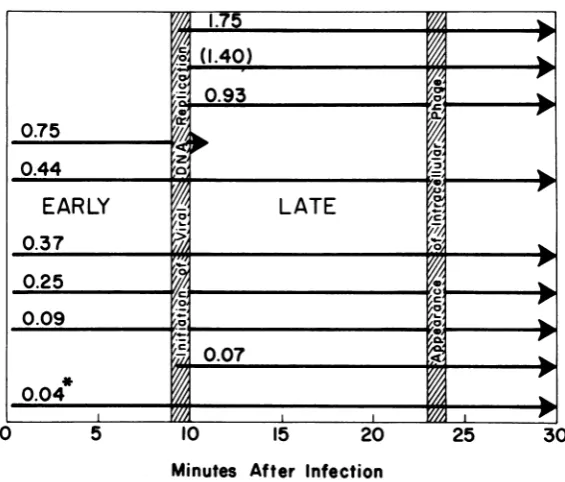
FIG. 9. Summary of029transcription.Eacharrowrepresentsasize classof029-specificmRNA. The
initia-tion andterminationpoints(heads andtails of the arrows)weredetermined both from the data in this
commu-nicationaswellasfromthehybridization-competitiondatapreviously reported(13). The numbers above each arrow arethe molecularweights of the components,expressedasafraction of 106 daltons. Thestarafter the
early speciesat 0.04 x 10⁶ daltonsrepresentsanuncertainty about itsexact timeofappearance(see
Discus-sion).
96 J. VIROL.
1.75
I.o
(1.40)
2
0.93
a075
0.44 i _ __
EARLY
LATE
0.37~~~~~~~~~~
0.25 _ _ _ _ *
0C CU'
0.09 0t
0.07
4o
0.04 ___________
_I P
0
5
on November 10, 2019 by guest
http://jvi.asm.org/
029MESSENGERRNAs
tion and translation (21) orfromthe decreased
stability of operator distal portions of viral transcripts (17), the profile should revertback
to the one characteristic ofthe RNA
synthe-sized in the presence of CAP. This does not
happen.
029
late RNA is composed ofat least three andpossibly four RNA molecules. These mole-cules were detected in bacteria infected withwild-type X29orwith029TS35,a
temperature-sensitive mutant blocked in DNA replication. It therefore appears that viral DNA
replica-tion is not a requirement for the expression
of late genes in 429. k29 late RNA contains
components of molecular weight 1.75 x 10⁶,
0.93 x 10⁶, and 0.07 x 10⁶. In addition, RNA
with molecular weight ofapproximately 1.4 x
106 was often detected. We are not certain at thistime that thecomponent at 1.4 x 10⁶
rep-resents a unique RNA species since it was
detected verylate in theinfectious cycle, after
the appearance of infective
029
particles.Further work is in progress to determine whether or notthis RNA represents a specific
cleavage product of the larger-molecular-weight RNA. With the omission of the RNA
at 1.4 x 10⁶ daltons, the sum of the class III RNA is 2.75 x 10⁶daltons or50% of the total
potential RNA. This value agrees with the valuedetermined bycompetition-hybridization analysis (13). It should be noted thatsynthesis
of the majorearly component, 0.75 x 10⁶ dal-tons, appears to cease at approximately the time in infection when late RNAbegins to be synthesized. The cessation of synthesis ofthis
molecule doesnotappeartorequire viral DNA replication since shut-off can be detected in
bacteria infected with
029
TS35atthe restric-tivetemperature.Figure 9 is a representation of the 029
tran-scriptionprogramas weunderstand it. We have
also detected late in infection k29 RNA with
a molecular weight of 2.5 x 10⁶ (see Fig. 7) both in bacteria infected with wild-type and
with TS35. The appearance of this large RNA
molecule after the production of intracellular
virus suggest that it may represent the failure
of RNA polymerase to terminate properly at
these late times.
ACKNOWLEDGMENTS
This workwassupported byPublic HealthServicegrant AI-08077 from the National InstituteofAllergyand Infectious
Diseases. One of us (D.J.L.) was supported by Public Health Service and National Science Foundation
trainee-shipsadministeredbytheUniversityofColorado.
LITERATURE CITED
1. Anderson, D. L., D. D. Hickman, and B. E. Reilly.
1966. Structure ofbacteriophage 029and the length of X29 deoxyribonucleic acid. J. Bacteriol. 91:2081-2089.
2. Bishop, D. H. L., J. R. Claybrook, and S. Spiegelman. 1967.Electrophoretic separation of viral nucleic acids onpolyacrylamide gels. J. Mol. Biol. 26:373-387. 3. Cascino, A., A. Riva, and E. P. Geiduschek. 1970. DNA
ligationand the coupling of T4 late transcription to replication. Cold Spring Harbor Symp. Quant. Biol. 35:213-220.
4. Calendar, R. 1970. The regulation of phage development. Annu. Rev. Microbiol. 24:241-296.
5.Gage, L. P., and E. P. Geiduschek. 1971. RNA synthe-sis during bacteriophage SPOl development: six classesofSPOlRNA. J. Mol. Biol. 57:279-300. 6. Gage, L. P., and E. P. Geiduschek. 1971. RNA
syn-thesis during bacteriophage SPOl development. II. Some modulations and prerequisites of the transcrip-tion program. Virology 44:200-210.
7. Geiduschek, E. P., and R. Haselkorn. 1969. Messenger RNA. Annu. Rev. Biochem. 38:647-676.
8. Gillespie, D., and S. Spiegelman. 1965. Aquantitative assay forDNA-RNA hybrids with DNA immobilized on amembrane. J. Mol. Biol. 12:829-842.
9. Hagen, E., V. Zeece, and D. L. Anderson, 1971. A geneticstudyoftemperature-sensitive mutantsofthe Bacillus subtilisbacteriophage 429. Virology 43:561-568.
10. Laemmli, U. 1970.Cleavage of structural proteins during the assembly of the head of bacteriophage T4. Na-ture(London)227:680-685.
11. Levinthal, C., A. Keynan, and A. Higa. 1962. Messen-gerRNA turnoverand protein synthesis in Bacillus subtilis inhibited by actinomycin D. Proc. Nat. Acad. Sci. U.S.A. 48:1631-1638.
12. Loening, U. E. 1967. The fractionation ofhigh molecular weight ribonucleic acid by polyacrylamide-gel elec-trophoresis.Biochem. J.102:251-257.
13. Loskutoff, D. J., J. J. Pine, and D. P. Andrews. 1972. Gene expression during the development ofBacillus subtilis bacteriophage 029. I. Analysis of viral-spe-cific transcription by deoxyribonucleic acid-ribo-nucleic acid competition-hybridization. J. Virol. 11:78-86.
14. Mendez, E., G. Ramirez, M. Salas, and E. Vinuela. 1971. Structural proteins of bacteriophage 029.
Virology 45:567-576.
15. Milanesi, G., E. N. Brody, 0. Grau, and E. P. Geiduschek. 1970. Transcriptionofthebacteriophage T4 genome in vitro: separation of "delayed early" from "immediate early" transcription. Proc. Nat. Acad. Sci. U.S.A. 66:181-188.
16. Morse, D. E. 1971.Polarityinducedbychloramphenicol and releasebySuA. J. Mol. Biol. 55:113-118. 17. Morse, D. E. 1970. "Delayed-early" mRNA for the
tryptophan operon. An effect of chloramphenicol? Cold Spring HarborSymp. Quant. Biol. 35:495-496. 18. Pulitzer, J. F. 1970. Function ofT4gene55. I. Charac-terization of temperature-sensitive mutations in the "maturation" gene55.J. Mol.Biol. 49:473-488. 19. Reilly, B. E., and J. Spizizen. 1964. Bacteriophage
deoxy-ribonucleate infection of competent Bacillus subtilis.J.Bacteriol.89:782-790.
20. Solymosy, F., I. Fedorcsak, A. Gulyas, G. L. Farkas, and L.Ehrenberg. 1968. A newmethodbased on the useofdiethylpyrocarbonateas anuclease inhibitorfor the extractionofundergradednucleic acidfromplant tissues. Eur. J. Biochem. 5:520-527.
21. Stent, G. S. 1964. The operon: on its third anniver-sary. Science 144:816-820.
22. Summers, W. C. 1970. Asimple methodfor extraction ofRNAfromE.coliutilizing diethylpyrocarbonate. Anal.Biochem.33:459-463.
97
VOL. 11, 1973