City, University of London Institutional Repository
Citation
:
Basara, B. (1993). A numerical study into the effects of turbulent flows around full-scale buildings. (Unpublished Doctoral thesis, City University London)This is the accepted version of the paper.
This version of the publication may differ from the final published
version.
Permanent repository link:
http://openaccess.city.ac.uk/8267/Link to published version
:
Copyright and reuse:
City Research Online aims to make research
outputs of City, University of London available to a wider audience.
Copyright and Moral Rights remain with the author(s) and/or copyright
holders. URLs from City Research Online may be freely distributed and
linked to.
City Research Online: http://openaccess.city.ac.uk/ [email protected]
A NUMERICAL STUDY INTO THE EFFECTS
OF TURBULENT FLOWS AROUND
FULL-SCALE BUILDINGS
Branislav Basara B.Sc. (Eng.)
Thesis submitted for the degree of Doctor of Philosophy
in the School of Engineering City University
Hydraulics Division
Department of Civil Engineering City University
Northampton Square
Abstract
This thesis describes the development and application of a numerical
pre-dictive procedure for turbilent flows around full-scale buildings.
Two different turbulence models were considered: a complete
Reynolds-stress model with two alternative proposals for the pressure-strain
cor-relations and a k-E model used in conjunction with both linear and
non-linear stress-strain relationships.
The governing differential equations were discretized using finite-volume
techniques and a co-located variable-storage arrangement. A multigrid
method was introduced and was found to reduce the computational time
by nearly a factor of ten. Both the Reynolds-stress transport model
and the non-linear k-€ model were implemented in a form suitable for
use with body-fitted coordinates on a co-located grid. When using the
Reynolds-stress models, a number of techniques were utilized to stabilize
the solution process and attain rapid convergence.
The atmospheric boundary layer at inlet to the computation domain,
traditionally specified from empirical correlations, was simulated here
using a full Reynolds-stress model in conjunction with a marching
inte-gration procedure. Due account was taken of the terrain roughness which
matched that for the full-scale tests. The outcome of those simulations
consisted of profiles of mean velocity and turbulence quantities that were
self sustaining and in close accord with the few full-scale measurements
available.
The turbulence models' performance was assessed first through detailed
comparisons with various benchmark flows including the backward-facing
step in both straight and divergent channel, the two-dimensional rib, the
circular cylinder and the three-dimensional cube. Detailed model
verifi-cation was then carried out by comparisons with full-scale measurements
on various structures including a single-span low-rise building, a
semi-cylindrical greenhouse and a multi-span glasshouse. It was found that
the Reynolds-stress models consistently produced more accurate
simula-tions than the
k-Emodels. Moreover, it was demonstrated that a recently
proposed model for the pressure-strain correlations yields very
satisfac-tory results without the use of wall-reflection terms.
Acknowledgements
I am very grateful to my Supervisor, Dr B.A.Younis, for his continuos
interest, guidance, encouragement and support during this study.
I wish to thank Prof I. Demirdzic, who made arrangements for my study
at City University and whose helpful advices I greatly appreciate.
I wish also to thank Prof M. Ivanovic, who introduced me to
computa-tional fluid dynamics.
Thanks to my colleagues Dr D. Cokijat, Mr Viado Przulj and Mr Jakirlic
Suad for their support, interest and helpful comments, which are greatly
appreciated.
I acknowledge the financial assistance provided by Agriculture and Food
Research Council - Engineering Institute, Silsoe (grant LRG 169).
Contents
PAGE
Abstract
1Acknowledgements
11Contents
111Nomenclature
vi
List of figures
ix
CHAPTER 1 INTRODUCTION
1
1.1 Background
1
1.2 The present approach and its justification
4
1.3 Previous related studies
6
1.4 Objectives
8
1.5 Contents of thesis
9
CHAPTER 2 MATHEMATICAL FORMULATION
12
2.1 Introduction
12
2.2 Mean-flow equations
13
2.2 The k-€ model
15
2.4 Reynolds-stress transport modelling
22
2.5 Closure
32
CHAPTER 3 SOLUTION PROCEDURE
33
3.1 Introduction
33
3.2 The discretization procedure
34
3.3 Interpolation practices
41
3.3.1 Central differencing schemes
41
3.3.2 Upwind differencing schemes
42
3.3.3 'Power-law' differencing schemes
43
3.3.4 Linear-upwind differencing schemes
44
3.3.5 Hybrid differencing schemes
45
3.4 Pressure-velocity coupling
46
3.5 Pressure-stress-velocity coupling
49
3.6.1 Inlet boundaries
54
3.6.2 Outlet boundaries
54
3.6.3 ymmetry boundaries
54
3.6.4 Fixed pressure boundaries
55
3.6.5 Wall boundaries
57
3.7 Solution algorithm and convergence criterion
59
3.8 A multigrid method
60
3.8.a Multigrid V cycle
61
3.8.b Coarse-grid equations
62
3.8.c Restriction and extrapolation
63
3.8.d Boundary conditions
65
3.8.1 Solution algorithm
65
3.8.2 Verification tests
68
3.9 Closure
69
CHAPTER 4 PRELIMINARY VERIFICATION OF
COMPUTATIONAL METHOD
73
4.1 Introduction
73
4.2 Backward-facing step
74
4.3 Two-dimensional square rib
77
4.4 Backward-facing step in divergent channel
78
4.5 Circular cylinder
81
4.6 Cube
83
4.7 Closure
86
CHAPTER 5 COMPUTATION OF FULL-SCALE FLOWS
114
5.1 Introduction
114
5.2 Simulation of the atmospheric boundary layer 115
5.2.1 Empirical correlations
117
5.2.2 Reynolds-stress transport modelling
119
5.2.3 Effects of inlet profiles
121
5.3 Results for building FB16
122
5.4 Results for building FB17
129
5.5 Results for building G07
131
5.6 Parametric studies
132
5.6.3
Effects of windbreaks135
5.7
Simulation of peak loads136
5.8 Closure
139
CHAPTER 6 CLOSURE 191
6.1
Introduction 1916.2
Fulfillment of objectives192
6.3
Recommendations for future work195
NOMENCLATURE
Symbol
Meaning
Ab
A
a13
C
D, CECf,
Cs
Cp
Cc
C 1 ,
Cc2C4u
Cl
C2
1-Il
r"
'-'1' '-'2
Dj
E
f
I?
, F1
G,J
k
L
p
p,
p
Pu
Coefficients in discretized equation
Area
Anisotropy tensor
Coefficients in nonlinear stress-strain relationship
Wall skin-friction coefficient
Coefficient in model for triple correlation
Coefficient of pressige
Coefficient in model for diffusion of e
Coefficient in model for sources of
Co efficient in formulation for eddy-viscosity
Coefficient in model for jj
Coefficient in model for
Coefficients in model for 'j,w
Rate of diffusion Uii term
Main rate of strain tensor
Oldroyd derivative
Logarithmic law constant
Wall-dumping function
Mass flux
Instantaneous and time-averaged value of body forces
Tensor in model for
term
Jacobian of coordinate transformation
Turbulence kinetic energy
Turbulence length scale
Time-averaged value of pressure
Fluctuating value of pressure and also pressure correction
Instantaneous value of pressure
Pe
R
q
q
Re
S i , S2 ,
S3Sjj
S4
t
Tm1 UT U1,u1 UIuiuj
V
Vb
vs
U \r, w
U,v,w
u2 ,v2 ,
w2uv,uw, vw
wii
x, y,
zxl , x2 ,
x3Yo
yl , y2 ,
y3y+
Pecklet number
Production of turbulent kinetic energy
Residual
Dynamic pressure
Diffusive flux
Reynolds number
Coefficients in formulation for design wind speed
Mean strain tensor
Source term of variable
Time
Stress tensor
Friction velocity
Time-averaged and fluctuating velocity
Instantaneous value of velocity
Reynolds-stress tensor
Triple velocity correlation
Volume
Basic wind speed
Design wind speed
Fluctuating velocity components in x, y and z directions
Time-averaged velocity components in x, y and z directions
Normal-stress components in x, y and z directions
Shear-stress components
Mean vorticity tensor
Cartesian coordinates
Coordinates of general system
Ground roughness
Cartesian coordinates
Non-dimensional distance from the wall
Greek Symbols
r 6 61j C 'C l-ilt p p Tk, O ni Tw
ii,1, LI,2 , LLw
Coordinate transformation factor
Diffusivity coefficient
Boundary-layer thickness
Kronecker delta
Dissipation of turbulent kinetic energy
Dissipation rate of UfiiJ
Von Karman constant
Molecular viscosity
Turbulent viscosity
Molecular kinematic viscosity
Turbulent kinematic viscosity
Density
Instantaneous density
Coefficients of turbulent diffusion of k and
Shear-stress tensor
Wall shear-stress
Symbol which denotes any variable
Instantaneous and fluctuated value of variable
Terms in modelled pressure-strain correlations
Abbreviations CFD DNS EKE LES LKE NKE RSM RSMO RS Ml
Computational fluid dynamics
Direct numerical simulation
Irrotational-strain modification of € equation
Large-eddy simulation
Linear k-€ model
Non-linear k-€ model
Reynolds-stress model
Pressure-strain correlations proposed by
Launder, Reece and Rodi (1975)
Pressure-strain correlations proposed by
Page
2
36
38
56
61
64
64
70
70
71
72
88
88
89
90
91
92
93
94
List of Figures
Number Title
1.1 Map of the U.K. showing "basic" wind speed in m\s (British Standards Institution,
1991).
3.1
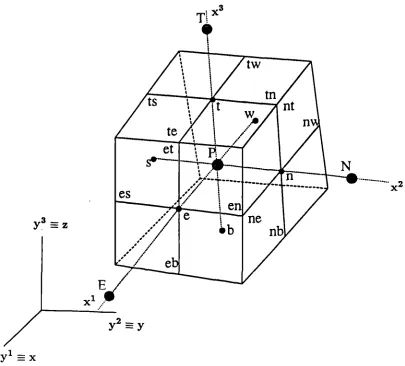
Three-dimensional control volume.3.2
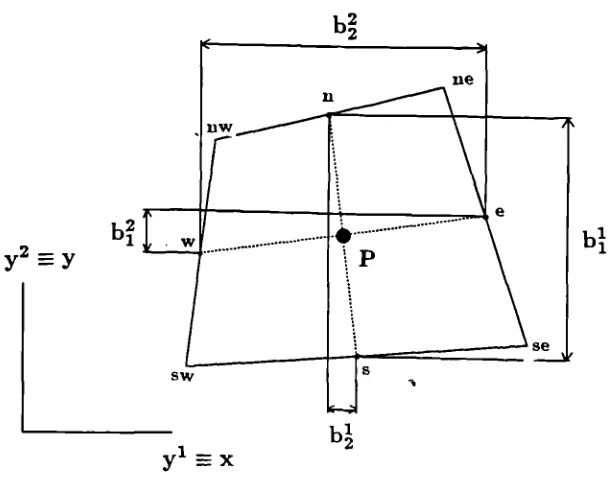
Area projections for two-dimensional control volume.3.3
Notation for fixed-pressure boundary.3.4
Multigrid V cycle.3.5
Restriction-extrapolation scheme.3.6
Flowchart of solution algorithm.317
Backward-facing step coordinates and geometry.3.8
Predicted and measured cross-stream profiles of mean velocity for different grid sizes.3.9
The nodal absolute relative error on different grids a)42x17,
b)82x62
and c)162x62.
3.10
Multigrid convergence rates for the laminar flow over backward-facing step.4.1
Backward-facing step coordinates and geometry.4.2
Backward-facing step. Predicted mean-velocity vectors by LKE.4.3
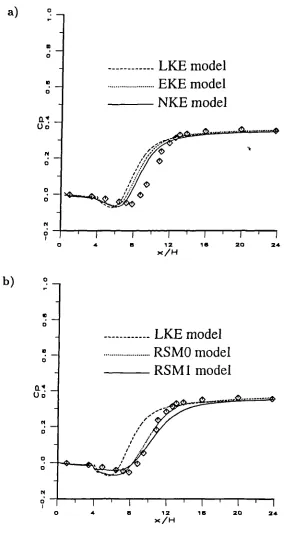
Backward-facing step. Predicted streamlines by LKE (a), EKE (b), NKE (c), RSMO (d) and RSM1 (e).4.4
Backward-facing step. Distribution of wall pressure coefficient predicted by LKE, EKE, NKE (a) and LKE,RSMO, RSM1 (b).
4.5
Backward-facing step. The mean-velocity profiles as obtained by LKE, EKE, NKE (a) and LKE, RSMO,RSM1 (b).
4.6
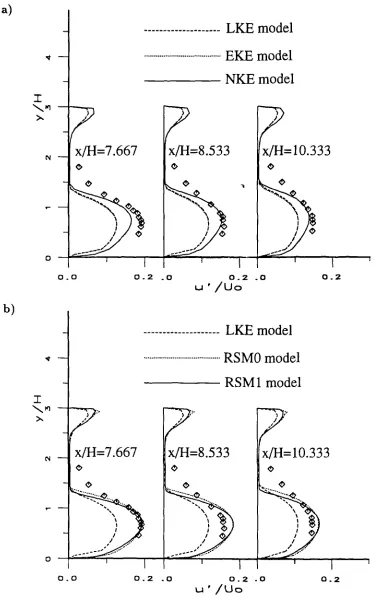
Backward-facing step. The turbulence intensity profiles as obtained by LKE, EKE, NKE (a) and LKE, RSMO,RSM1 (b).
4.7
Backward-facing step. The shear stress profiles as obtained by LKE, EKE, NKE (a) and LKE, RSMO, RSM1 (b).Number Title Page
4.9
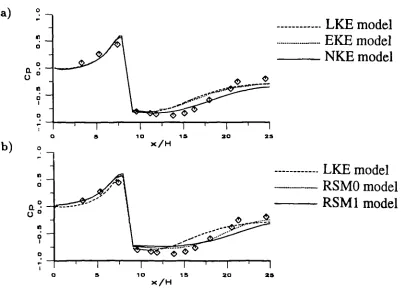
Two-dimension il rib. Distribution of wall pressure coefficient predicted by LKE, EKE, NKE (a) and LKE,RSMO, RSM1 (b).
94
4.10
Two-dimensional rib. The mean-velocity profiles as obtained by LKE, EKE, NKE (a) and LKE, RSMO,RSM1 (b).
95
4.11
Two-dimensional rib. The turbulence intensity profiles as obtained by LKE, EKE, NKE (a) and LKE, RSMO,RSM1 (b).
96
4.12 Backward-facing step (in divergent channel)
coordinates and geometry
97
4.13
Grid size185x82:
(a) 0 degree and (b)6
degree.97
4.14
Backward-facing step: (a) 0 degree and (b)6
degree.Predicted streamlines by RSMO and RSM1.
98
4.15
Backward-facing step: (a) 0 degree and (b)6
degree. Distribution of wall skin friction coefficientpredicted by RSMO and RSM1.
99
4.16
Backward-facing step: (a) 0 degree and (b)6
degree. Distribution of wall pressure coefficient predicted byRSMO and RSM1. 100
4.17
Backward-facing step: (a) 0 degree and (b)6
degree. The mean-velocity profiles as obtained by RSMOand RSM1. 101
4.18
Backward-facing step: (a) 0 degree and (b)6
degree. The shear-stress profiles (iiv) as obtained by RSMOand RSM1.
102
4.19
Backward-facing step: (a) 0 degree and (b) 6 degree. The normal stress profiles (u2 ) as obtained by RSMOand RSM1.
103
4.20
Backward-facing step: (a) 0 degree and (b)6
degree. The normal stress profiles (v2 ) as obtained by RSMOand RSM1.
104
4.21
The smoothness of grid lines.82
4.22
Circular cylinder. Grid size 109X67.105
4.23
Circular cylinder. Distribution of wall pressureNumber Title
Page
4.24
Inflow boundary conditions: velocity U (a),
turbulence kinetic energy k (b) and length scale 1
(c), non-dimensionalized by
UHand H, measured
in the wind tunnel.
107
4.25
Cube. Computational domain.
107
4.26
Cube. Vertical cross section: 44x28x21 (a), 55x33x28
(b) and 70x48x41 (c).
108
4.27
Cube. Velocity vectors as obtained by measurements a)
and predicted by LKE using the grids A (b) and C (c). 109
4.28
Cube. Velocity vectors predicted by LKE (a), NKE (b)
and EKE (c) (grid C and LUDS scheme).
110
4.29
Cube. Turbulence kinetic energy as obtained by
measurements (a), and predicted by LKE using the
grids A (b) and C (c).
111
4.30
Cube. Turbulence kinetic energy predicted by LKE (a),
NKE (b) and EKE (c) (grid C and LUDS scheme).
112
4.31
Cube. Comparison of surface pressure coefficients at
vertical and horizontal plane (yH/2).
113
5.1
Figure from Hoxey and Richards (1991) showing
measured velocity profiles for the roughness a)
Yo = 40mm and b) yo = 10 mm (N.B:
z above correspond to y in the present notation).
116
5.2
Predicted and measured wall static pressure
coefficients for boundary layer thickness 5=H,
3H, 5H, 7H (FB16).
142
5.3
Predicted and measured wall static pressure
coefficients for S= 55H and 'power-law'
distribution at inlet (FB16).
142
5.4
The physical a) and transformed b) coordinate
system.
120
5.5
The streamwise velocity, turbulence intensity and
dissipation rate profiles as obtained by the Harris
and Deaves correlations and by the Reynolds-stress
model.
5.6
Turbulence intensity profiles as obtained by the
Harris and Deaves correlations and by the
Number Title
Page
5.7
Measured and predicted velocity profile by the
Harris and Deaves correlations and by Reynolds-stress
model. Roughness (a) yo = 10mm and (b) Yo = 40mm.
144
5.8
Predicted wall static pressure coefficient for the
inlet profiles obtained by Harris and Deaves
correlations and by the Reynolds-stress model.
145
5.9
Dimensions of the building FB16 (From Richards, 1989).
146
5.10
Flow visualization on roof of FB16
(From Richards, 1989).
146
5.11
Smoke observations on the roof of the building (a)
and snow tracks in front of the building (b).
147
5.12
FB16. a: Grid 108x100, b: predicted stream lines,
C:velocity vectors (LKE).
148
5.13
FB16. a: Grid 142x110, b: predicted stream lines, c:
velocity vectors (LKE).
149
5.14
FB16. Distribution of wall pressure coefficient
obtained with the upwind and the power-law
differencing schemes.
150
5.15
FB16. Predicted streamlines for roughness lengths
yo = 0 (a) and for yo = 40mm (b).
151
5.16
FB16. LKE and NKE results for wall static-pressure
distribution.
152
5.17
FB16. Distribution of wall pressure coefficient
predicted by LKE and EKE.
152
5.18
FB16. EKE results for streamlines (a) and velocity
vectors (b).
153
5.19
FB16. Turbulence kinetic energy contours as obtained
by LKE (a) and EKE (b).
154
5.20
FB16. Predicted streamlines by RSMO (a) and RSM1 (b). 155
5.21
FB16. Distribution of wall pressure coefficient
predicted by LKE, RSMO (a), and RSM1 (b).
156
5.22
FB16. Predicted turbulence kinetic energy by
RSMOand RSM1.
157
5.23
FBI6. Computational domain (height = 300m) covered
Page
159
160
161
162
163
163
164
165
166
167
168
169
170
171
172
173
174
175
176
Number Title
5.24
"New" domain (height = 15m) covered with the grids
37x20 (a), 75x38 (b) and 142x74 (c).
5.25
Predicted streamlines for different grids (a), (b) and (c)
of Fig. 5.24.
5.26
FB16. Grid levels 37x29 (a), 72x56 (b) and 142x110 (c)
used for the multigrid method.
5.27
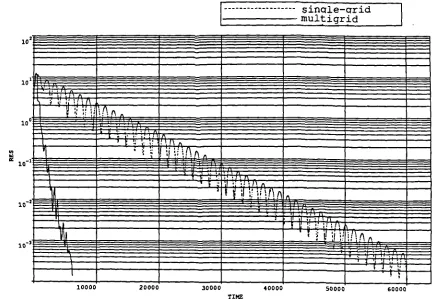
FB16. The convergence rate obtained with the
multigrid and the single-grid methods.
5.28
Dimensions of Greenhouse FB17 (From Richardson, 1991).
5.29
Grid 216x123 used for FB17.
5.30
FB17. Wall skin-friction coefficient predicted by LKE,
RSMO and RSM1.
5.31
FB17. Predicted streamlines by LKE (a), RSMO (b),
and RSM1 (c).
5.32
FB17. Distribution of wall pressure coefficient
predicted by LKE, RSMO and RSM1 (FB17).
5.33
FB17. Predicted pressure contours by LKE (a) and
RSM1 (b).
5.34
FB17. Predicted turbulence kinetic energy by LKE (a),
RSMO (b) and RSM1 (c).
5.35
Dimensions of multispan structure G07 (From Hoxey
and Moran, 1991)
5.36
G07. Predicted coefficient of wall pressure
distribution.
5.37
G07. Predicted streamlines by EKE (a) and RSM1 (b).
5.38
G07. Predicted turbulence kinetic energy by EKE (a)
and RSM1 (b).
5.39
G07. Grid levels 63x29 (a), 124x56 (b) and 256x110 (c)
used for the multigrid method.
5.40
G07. The convergence rate obtained with the multigrid
and single-grid methods.
5.41
Grid distribution for buildings of same width W but
different heights. H = 3m (a), 4.5m (b), 5.5m (c) and
7m (d).
Number Title
Page
5.43
Predicted average pressure coefficients for buildings
of different heights, on the windward (a), roof
(b) and leeward (c) sides.
177
5.44
Computation domains for the buildings with the same
height and different widths W = 5m (a), 6.7m (b),
8.6m (c) and 10 m (d).
178
5.45
Predicted streamlines for the different widths
W = 5m a), 6.7m b), 8.6m c) and lOm d).
179
5.46
Predicted pressure coefficients for the buildings
with different widths on the windward a), roof b)
and leeward c) side of buUding.
180
5.47
Dimensions of building FB19 (From Robertson, 1989).
Grids for sharp (b) and curved (c) eaves.
181
5.48
Predicted streamlines for sharp eaves a) and curved
eaves b).
182
5.49
Flow visualization around curved eaves. (From
Robertson, 1989).
182
5.50
Velocity vectors for sharp (a) and curved (b) eaves.
183
5.51
Predicted pressure coefficients over roof for sharp
and curved eaves.
183
5.52
Effects of windbreaks. (a) Notation. (b) streamlines
for H=2.18 and X=5m (b).
184
5.53
Predicted average pressure coefficients for the
windward a), roof b) and leeward (c) sides.
185
5.54
Typical records of wind mean velocity and surface
pressure (From Part 2 Code of Practice, 1991)
186
5.55
Unsteady results for the drag coefficient Cd.
186
5.56
Evolution of mean-flow streamlines with time.
187
5.57
Perturbation of velocity at inlet as a function of
time and amplitude.
188
5.58
Predicted pressure coefficient on building roof.
188
5.59
Field measurements of wind velocity at reference
height.
189
Chapter 1
INTRODUCTION
1.1 BACKGROUND
The structural design analysis for full-scale buildings requires knowledge of the pressures exerted on their sides by the turbulent wind flows around them. Those pressures are traditionally obtained from Codes of Practice which utilize the basic definition for the Coefficient of Pressure (Cr) thus:
Ap=Cq (1.1)
The value of C, which is taken to depend on the building shape and on the flow conditions that prevail at the chosen site, is given in tabulated form. q is the dynamic pressure defined as:
q=pV (1.2)
vs =
S1S2 S 3Vb (1.3)Three empirical correction factors are involved: S 1 which is introduced to take account of local topographic influences (e.g. hilly terrain), S2 which is needed to account for the combined effects of surface roughness, gust duration and the height of the structure and 53 which is related to the design life of the building. Vb is the true (or "basic") wind speed, defined in the UK Code as the 3-second gust speed at lOrn height in open level country likely to be exceeded on average once in 50 years. Its values are reported by the Meteorological Office which employs a wide-spread system of anemographs (continuously-recording wind-speed measuring instruments) to create maps of wind speeds (Fig. 1.1) which are then used for design purposes.
[image:18.595.205.385.318.568.2]S.-__ --S
Fig. 1.1 Map of the U.K. showing "basic" wind speed in rn/s (British Standards Institution, 1991).
deter-mined from measurements on either full-scale buildings on open sites or on scaled-down models in wind tunnels.
Data collected from full-scale buildings are probably the most appropri-ate for design purposes but they are very scarce and are in the main limited to very few building geometries. They are also influenced by the random behaviour of the weather which, together with the costs in-volved, make parametric investigations rather impractical. In contrast, the flow conditions can be precisely controlled in a wind-tunnel and data obtained here tend to be more reproducible. The difficulty here is in the simulation of the atmospheric boundary layer that develops upstream of the real building. Geometric similarity requires the equality in the real and the model building of at least one (but preferably both) of the fol-lowing scale ratios: L/yo and L/S where L is a characteristic buildings dimension, yo is the effective roughness height and S is the boundary-layer thickness. Boundary boundary-layer turbulence is produced by blocks placed upstream of the test section and those rarely succeed in reproducing the appropriate roughness characteristics of the real flow. Moreover, the sim-ulated boundary-layer thickness is rarely thick enough compared to the height of the model since wind-tunnels of sufficient length to produce this are not always available. Real winds are, of course, never steady and there are many practical difficulties which prevent the reproduction of the observed gustiness in a wind tunnel. Not surprisingly, therefore, difference between the modelled and the 'real' flow conditions remain and those decrease the significance of wind-tunnel experiments for the determination of dynamic wind loading.
1.2 THE PRESENT APPROACH AND ITS JUSTIFICATION
The first issue to be addressed in the simulation of flows around buildings
is the choice of the strategy for solving the Navier-Stokes equations of
motion. Direct Numerical Simulation methods (DNS) attempt to
simu-late directly all the dynamically important scales of turbulent flows and,
as such, they require a very large number of grid nodes to resolve all the
scales present. This requirement easily exceeds the capacity of modern
computers and this in turn limits the validity of this approach to some
very simple flows, at low Reynolds numbers. The approach is therefore
not appropriate to wind engineering pp1ications and is unlikely to
be-come so in the foreseeable future. In Large-Eddy Simulations (LES),
the three-dimensional time-dependent Navier-Stokes equations are again
solved numerically but now only motions of scales larger than the mesh
size are resolved. The effects of the small-scale dissipative motions are
modelled. This approach is now producing some very promising results,
but it remains far too expensive to be used as an everyday engineering
design tool.
At present, the only viable prospect for practical engineering
calcula-tions lies in the solution of the time-averaged Navier-Stokes equacalcula-tions
together with a turbulence model for approximating the resulting
un-known Reynolds stresses. Most turbulence models in current enginering
practice are of the eddy-viscosity type in which the turbulent stresses are
related to the local velocity gradients through a suitably-defined "eddy
viscosity". Depending on the number of additional equations solved,
zero- , one- and two-equation models may be used. The most popular
of the two-equation closure methods is the k-f model in which the eddy
viscosity is obtained from a relationship in terms of the turbulence
ki-netic energy (k) and
E,its dissipation rate. Often, this model has to be
modified to give satisfactory results for different applications and some
examples of these modifications will be tested in this study.
transport equation for each stress together with an additional one for a turbulence length-scale related quantity. Such models may not there-fore be suited to everyday use, particularly for complicated geometries, though their ability to produce very accurate results has been amply demonstrated in recent years (Speziale, 1991).
The turbulence models chosen for this study are the k-f model in both its standard and modified forms and a complete Reynolds-stress trans-port model. The purpose was to determine the minimum level of closure needed to reproduce the correct wind loads on the various building struc-tures investigated. Various modifications to the k-€ model were tested, including the use of a novel non-linear stress-strain relationship. For the Reynolds-stress model, alternative closure assumptions were investi-gated and a new model for the pressre-strain correlations, proposed by Speziale, Sarkar and Gatski (1991), was assessed in detail for the first time.
Another important issue to be addressed is related to the specification of the atmospheric boundary layer upstream of the buildings. The velocity profiles, together with those for the turbulence kinetic energy, the dissi-pation rate and (for RSM simulations) the Reynolds stresses, are needed as inlet boundary conditions for the wind-loading simulations. The choice of those inlet profiles may strongly influence the quality of the simula-tions. Various possibilities are examined, including the use of empirical relations and numerical simulations.
discretization schemes or by refining the grid, both options leading to an
increase in computational effort. In this study, consideration is given to
the multi-grid technique which reduces the computational effort involved
in obtaining numerically-accurate solutions on fine grids.
It is hoped that the combination of an appropriate turbulence model with
an efficient numerical method, together with modern graphics
postpro-cessors to present results, and the validation of the whole package against
experimental data will provide a practical tool to study building-related
flow problems.
1.3 PREVIOUS RELATED STUDIES
Several attempts at modelling the effects of turbulent wind flows around
buildings have been reported in the literature, both for two-dimensional
(2D) and three-dimensional (3D) geometries and for both simple and
complex shapes. Typically, two-dimensional simulations are performed
to test the turbulence models and the numerical methods in isolation of
complicating three-dimensional effects. Hanson, Summers, and Wilson
(1984) used a random vortex method to depict the flow evolution over a
2D hypothetical building. No turbulence model was used and there were
no comparisons with experiments. Mathews and Meyer (1987) applied
a
k-Emodel to calculate the flow over a semi-circular building. At
in-let to the solution domain, the velocity were obtained from a power law
with exponent of 0.15, while the turbulence intensity and length scale
were prescribed empirically. Their calculations are open to criticism on
many counts (see Richards and Younis, 1990). The inlet profiles used
were inappropriate in that they were not self sustaining: this means
that their calculations were dependent on the position of the inlet plane.
Moreover, the computational grid used was inadequate for the purpose:
being orthogonal, based on potential flow solution, leading to bad
resolu-tion of the area around the base of the building. Interestingly, a similar
grid-generation method was used by Mathews, Crosby, Visser and Meyer
(1988) for a multispan structure also leading to an inadequate grid and
poor overall agreement with measurements. Selvam (1992) used a
k-ETurbulent flows around cubes are frequently used as test cases for 3D model validation. Paterson and Apelt (1986) used a linear k-E model and underpredicted the extent of the separated zones on the sides and on the top of the cube. The pressures were also underpredicted in those areas. Similar results were obtained with the same model when used by Paterson and Apelt
(1990),
Murakami and Moshida(1989)
and Richards and Hoxey(1991).
Murakami and Moshida(1989)
made some serious grid independence checks but the problems remained. Somewhat better results were obtained by Baskaran and Stathopoulos(1989)
who modified the model for streamline curvature effects along the lines suggested by Leschziner and Rodi(1981).
Murakami, Mochida and Hayashi(1990)
re-ported some Large-Eddy Simulations for the cube which showed improved predictions of the pressure distribution and the turbulence kinetic energy. Comparisons were reported for the predicted and measured turbulence kinetic energy and its production rate and those were used to explain the reasons for defects observed with the k-€ model. Large-Eddy Simulations for the same flow were later reported by Murakami, Mochida, Hayashi and Sakamoto (1992) who compared the results with the algebraic-stress model. The latter gave poor results for the pressure distribution es-pecially for the top surface of the cube. The shape of the spectrum of fluctuating surface pressure predicted by LES agreed fairly well with that measured but at the expense of computing time, 50 times greater than for the k-E model (Murakami, private communication).1.4 OBJECTIVES
The objectives of the present study were:
1. To develop and validate a practical computational method for pre-dicting the patterns of turbulent flows around buildings and the associated pressure loading. The aim is to meet an identifiable requirement of the engineering community for a method which is reliable, cost-effective and of known capabilities and limitations.
performance of two very different turbulence models: a k-€ model, in both standard and modified forms, and a full Reynolds-stress-transport model of turbulence. The benchmark flows chosen for this comparison include the backward-facing step in both straight and divergent channels, the 2D rib, the circular cylinder and the 3D cube.
3. To simulate, using a full Reynolds-stress model, the properties of the atmospheric boundary layers that develop upstream of the full-scale structures and to use the results as input to the flow-solving method.
4. To verify the predictive procedure against the full-scale data from the Silsoe Research Institute (U.K.). A low-rise building, a semi-cylindrical greenhouse and a multi-span structure will be considered.
5. To conduct parametric studies aimed at quantifying the influences of geometrical parameters on the patterns of wind flow and pressure loading on selected full-scale structures.
6. To advance an appropriate method for the prediction of unsteady wind loading using conventional turbulence modelling techniques.
7. To implement and test a multigrid procedure suited to non orthogo-nal body-fitted coordinates with a co-located grid arrangement and to apply the method to the calculation of full-scale flows.
1.5 CONTENTS OF THESIS
assumptions needed to close them. Two very different models for the pressure-strain correlations are described.
Details of the finite-volume, methodology used here to solve the governing differential equations are presented in Chapter 3. Emphasis is placed on the techniques used for obtaining solutions with non-orthogonal, body-fitted coordinates. The SIMPLE algorithm for the pressure-velocity cou-plirig will be presented together with details of the interpolation practice used to avoid numerical oscillations. Details of the method employed to achieve the turbulent-stress/velocity coupling will also be given. The solution algorithm and the convergence criterion are described. Also pre-sented in this chapter are the details of the multigrid technique used to accelerate the solution of the governing equations on fine meshes. The method's results for a laminar flow overa backward-facing step will be presented in this chapter while the outcome of the application of this technique to the highly turbulent flows around full-scale buildings are presented in Chapter 5.
Chapter 4 is concerned with a preliminary assessment of the turbulence models against data from a number of established benchmark flows. Re-suits will be presented here for the k-e model with both linear and non-linear stress-strain relationships. Some modifications to the f-equation were considered and the outcome will be reported here. The Reynolds-stress model results will also be presented and the predictions obtained with two versions of pressure-strain correlations compared.
width of the building, the shape of the eaves (i.e. sharp or curved) and
the placement of windbreaks upstream of the building will be reported.
Optimization of the position of windbreak with no porosity against the
building is presented for two different heights of windbreak. Finally,
the procedure developed here for simulating the effects of unsteady wind
loading will be explained and some results presented for a full-scale
build-ing.
The main conclusions arrived at from this study will be summarized in
Chapter 6 and suggestions for future research will be made.
Chapter 2
MATHEMATICAL FORMULATION
2.1 INTRODUCTION
This chapter presents the basic equations governing fluid motion and considers the various alternative models used later in this thesis to close the time-averaged equations. The problems associated with modelling of turbulent separated flows are, of course, not confined to flows around buildings and there are, at present, many proposals aimed at improv-ing the performance of those models. Some of those proposals will be presented here and their performance verified later in Chapter 4 against some well documented experiments.
Section 2.2 lists the instantaneous and time-averaged equations of mo-tion. In Section 2.3, the manner in which the unknown turbulent stresses are related to the mean rates of strain is explained and options for both linear and non-linear relations discussed. This section will also provide the basis of the k— 6 model used in this study. The Reynolds-stress model
2.2 MEAN-FLOW EQUATIONS
It is generally accepted that the continuity equation together with the
Navier-Stokes equations provide a complete description of fluid flows
in-cluding turbulent ones.
The continuity equation describes the conservation of mass and may be
written as:
at
a
=::
(2.1)
The Navier-Stokes equations express the conservation of momentum and
may be written as:
+ a(UU1) =
Ii
+
+ - .-
(2.2)
at
a, aôq ,
ax1
In the above equations, the cartesian tensor notation is used wherein
repeated indices imply summation. Symbols with " " refer to the
in-stantaneous value of that particular variable.
In most engineering problems, the details of the instantaneous flow field
are not of particular use or interest and it is more useful to construct
models based on averaged quantities. The equations for averaged
quanti-ties can be obtained by first de-composing the instantaneous values into
mean and fluctuating parts, thus:
(2.3)
where denotes an averaged value and ' denotes the fluctuations about
the mean value.
In general, the time-averaged value, at a single point, is defined by
= 1imJdt
where r is the time interval for which the averaged value is to be defined. By substitution of the instantaneous values in the equations (2.1) and (2.2), and by using certain properties of averaged and fluctuating values (Hinze, 1959), we obtain the time-averaged equations which for an in-compressible fluid of constant property may be written as:
Continuity equation
axi (2.4)
Momentum equations
+ pU 0U1 - a / ou1 \ + F1 --
--
ii -
i - Pü1113)
The time-averaging of the Navier-Stokes equations has given rise to some unknown correlations (uiuJ), known as Reynolds stresses, which have to be determined somehow before equation (2.5) may be solved.
An exact transport equation for IIpij is obtained from the Navier-Stokes equations by multiplying the equations for the fluctuating components u1 and u by u and u respectively, then summing these equations and time-averaging the result. The resulting equations for constant-density flows with no body forces are given as:
+ U _u1 u j / ou au \
___ ___ - IUIUk-+UjUk-)
öX \ (9xk,
- : [uiuuk + (6jkU1 + SIkUJ) - auu]
(9Xk
+ (-+-" —
2u (
-p ax) \f9xkaXk) (2.6)
The first term appearing on the left-hand side of equation (2.6) repre-sents the rate of change of
içnj
with respect to time. This term vanishesin steady flows and will therefore be discarded from further
considera-tion. The second term on the left represents the rate at which
UjiIj istransported (convected) br the mean flow. The terms on the right-side
of equation (2.6) denote respectively the rates of: production of UpIJ by
mean shear, diffusion of
UjUjby various agencies, redistribution of the
turbulence kinetic energy amongst the fluctuating components, and,
fi-nally, dissipation by viscous processes.
Equation (2.6) does not by itself constitute a turbulence model since it,
too, contains some unknowns that will first need to be modelled. The
manner in which this is done here will be presented in Section
2.4;the
next section considers how upij is traditionally obtained from an algebraic
constitutive relationship.
2.3
THE k-e MODEL
The
k-Emodel of turbulence is based on Boussinesq's
(1877)proposal in
which the turbulent stresses are assumed to vary linearly with the local
mean rates of strain. The proposal is thus simply an extension, to
tur-bulent
flows,of Stoke's Law for laminar
flows,and may be written as:
I
au1 ou\
2=
lit+ -F-) -
p8jjk
(2.7)
Equation (2.7) defines the eddy-viscosity ,ut which, unlike its laminar
counterpart, depends on the flow rather than on the fluid. The
kine-matic eddy-viscosity is defined, for later use, as zi = fi t /p. The second
term in equation (2.7) was not present in Boussinesq's original proposal
but was added later to ensure that the sum of the normal
Reynolds-stresses yields the identity:
k(u2 +v2 +w2 )
(2.8)
The eddy-viscosity pt is assumed to be proportional to a velocity scale and a length scale characterizing the turbulence motion, which, in the context of the k-f model, are taken to be k and k/f, respectively. This then gives:
k2 lit =
pC-where E is the dissipation rate of turbulence kinetic energy.
Boussinesq's linear stress-strain relationship is known to give an adequate representation of the turbulence field in boundary-layer flows, where flow reversal is absent and the normal stresses do not appear in the governing equations. In other types of flow, however, the terms ôu 2 /ôx, t9v2/Oy etc. can form a significant contribution to the momentum balance and it is in those cases that Boussinesq's relation turns out to be a major source of error in the calculations. Separated flows fall in this category: the turbulence anisotropy at the point of flow separation is known to exert a significant influence on the subsequent development of the sepa-rated layer and hence the large inaccuracies observed in the prediction of those flows. Since anisotropy is badly represented by a linear relation-ship, it is logical to consider alternative stress-strain relationships for the prediction of separated flows. A number of alternative proposals have been reported in the literature, here the proposal of Speziale (1987) is adopted in which, by analogy between Newtonian turbulent flows and laminar, non-Newtonian, flows, the Reynolds stresses are written as:
2 k2
_uhTiJ =
--k8jj+2C---(2.9)
+ 4CD (DimDmj - DmnDmnt5jj)
13 0
1 0
+ 4CE C2c (] (2.10)
where the mean rate of strain tensor can be expressed as:
- 1 /au 1 au•
and the Oldroyd derivative of the mean rate of strain as:
=
+ Um
- -!Dmj -
(2.12)
The first line in equation (2.10) corresponds to Boussinesq, the remaining
two lines may be considered as corrections to it imparting a non-linear
dependence on the strain rate. Two new constants are now involved: CD
and CE. Both are assigned the value of 1.68, deduced by the model's
orig-inator from comparisons with normal-stress data from turbulent channel
flow. The model does not appear to be very sensitive to the choice of
values for the new coefficients: Speziale showed that even a 15% change
in their values results in only a small change in the computed results.
For the purpose of completeness, the models equations appropriate to
two-dimensional flows are given below in expanded form:
2
DU 1
- - __k+2vt_+_L[(CD_2CE)(-)
- 3
ox3
IOu av \
+ (C
D
- 2CE)
(J)2 + (
C
D
- CE)
+ (1
(aV21
( 0
2
u
92V\
–C
4
D
+
CE
' (-)I +
LCE U
-2
OV 1
- = --k + Zu
t
— + –L [(CD - 2CE)
3
'9y 3
(ouav'
+ (C
D
- 2CE) (af)2 + (
cD
- CE)
+ (cD
+
CE) (J\
21
/
32V
Oy) j+LCEVW–U)
(2.13)
(2.14)
/ OU OV)
fOUOV DUOV\
_LCE(--+--)
-liv
= 'It
+
Oy Oy
I /Zy 2y
\
/
92U 52u\1+ LCE
LU
-
+ Vk3
L=4C2
-I (2.16)
vt8k
–uk' =
--DXj (2.18)
where L is defined as:
It is clear from the above that the new stress-strain relationship is far more complicated than Boussinesq, not only because it involves more terms but, also, because it contains terms (quadratic in the velocity gra-dients) that can be difficult to implement in finite-difference schemes. Whether or not this added complexity is justified will be seen from the comparisons in subsequent chapters.
In addition to the stress-strain relationship, the complete turbulence model involves the solution of differential transport equations for the tur-bulence kinetic energy (k) and its rate of dissipation (€). The k-equation can be derived by contraction of the indices in equation (2.6), thus:
a b C d e
—
____ ak a 2
(2.17)
ax)
The pressure-strain term does not appear in the k-equation since the role of this term is to redistribute the turbulence energy among its compo-nents without affecting the overall level of turbulent kinetic energy in the flow.
- vtO€
=
Ox3
(2.22)
Term (e) is the dissipation rate of turbulence kinetic energy, hitherto
denoted as e.
The modelled equation for k therefore takes the form:
9k
0
utOk—+UJ—=—(--)+Pk—f
at
a a a, (2.19)A transport equation for
6can be obtained by differentiating the equation
for the fluctuating velocity u with respect to xi, multiplying the result
by 2v(au1\ax1) and then time averaging, thus:
a b Cl
86 0€ 8
+
U—=--(u€'+
a
C2
,.' Ox1 ax1 ax3
I
This Du Oui 8u\ au1 '
Ou a2u1
-
____
\
aCI8x ax
ax3 jOx3 Ox Ox3 Oxj
a 1
Ou
2 ( O2u
"a
Ox1 ax1 \OxjOxi)
(2.20)Reynolds
source
In the limit of high turbulencejnumbers only twojterms remain: term
(f) which expresses the generation rate of vorticity fluctuations through
the self-stretching action of turbulence and term (g) which expresses the
decay of the dissipation rate (Hanjalic, 1984). It is usual to model the
difference between terms (f) and (g) collectively as:
8u1 0u1 8u32 ( O2u
2= (2.21)
The final modelled equation for takes the form:
9E ô f11ôf\
+ U—
h-
+ C 1 Pk - C 2j . (2.23)Note that the form of the equations for the k and € remains unaltered irre-spective of whether the linear or the non-linear stress-strain relationship is used. The complete model then entails the solution of the momentum equations (2.5) and of equations (2.19) and (2.23) for k and 6 respectively.
The mean-flow and turbulence variables being linked via the eddy viscos-ity as defined in equation (2.7). The constants of this model are assigned the values in Table 2.1.
C,. k O C1 C 2 CE CD
0.09 1.0 1.3 1.44 1.9 1.68 1.68
Table 2.1 Constants for the k-f model
The k-f model is very widely used in practical calculations yet it is known not to be valid to a wide number of flows unless modified in some way. Usually, the f-equation is modified to affect the level of the energy dissi-pation rate and indirectly, the eddy viscosity.
Most modifications are applied to the source terms of 6 which are given
by:
2
S = C 1 - C 2 - (2.24)
Hanjalic and Launder (1980) argued that the irrotational strain rates are more influential in the production of 6 than the rotational (shear) strains.
part by a coefficient greater than that multiplying the
first. Details ofthis model adaptation and its justification can be found in the original
reference. Here, only the final form of the €-sources is relevant and this
(for two-dimensional flows) may be written as:
I OU Ov\
\Oy Ox)
Ox
3UV
2+ 4(C 1 - Ci)iit_-__] -
C 2 -
(2.25)
In thin shear layers (where t9U/Oy>> OV/Ox), this can be simplified to
the following:
auc
2_v2)__
S = —C 1 uv--- -
c:1(Ox k -
(2.26)
Hanjalic and Launder proposed that C 1 be kept at its original value of
1.44 and C assigned the value of 4.44. Later work by Johnston (1984),
in connection with boundary-layer flows in adverse pressure gradient,
suggested that a lower value for C 1 may be more appropriate; the value
of 2.5 was recommended and this will be adopted in the present work.
For later convenience, the following shorthand notation will be used to
identify the various model adaptations:
LKE denotes the standard, linear, k-f model;
NKE denotes the model when used with Speziale's non-linear
stress-strain relationship;
2.4 REYNOLDS-STRESS TRANSPORT MODELLING
Equation (2.6) for the transport of Ujiij may be written in the symbolic form:
_____ production diffusion pressure—strain dissipation
Uk = P3 + D + - (2.27)
ôXk
The production rate of Ujii is given as:
/ 9U
(2.28) P u = _ Iuiuk.__+ujukT—)
Clearly, this term requires no modelling as it is formed of quantities that are the dependent variables of equations to be solved.
The diffusion term D1j represents the rate of transport of upij by turbu-lent fluctuations, molecular diffusion and pressure fluctuations and this term is expressed in the form:
Djj = ---p- [uiuiuk -1/auuu + -(öku + öikui)] (2.29) ôxk
aXk
The viscous-diffusion term is small in all regions of the flow except very close to the walls. At any rate, it is exact and is retained without change. Almost nothing is known about the pressure-diffusion term and hence this term is dropped following the usual practice. In an extension to gradient-transport hypothesis, Daly and Harlow (1970) proposed that the diffusion of
u
1u5
is proportional to its spatial gradients to write:D c k___= s —ukul (2.30)
E
of the energy-containing eddies and C8 is a constant. Hanjalic and Laun-der (1972), from consiLaun-deration of the exact transport equation for UjUjUk,
proposed an alternative model which is written as:
UjUjUk = k I Iuuj ôUjUk _J3UkUj +UJUI +UkUI ôU1Uj1I (2.31) 6 ôxi ÔX1 ÔXI j
Note that Daly and Harlow's model is represented by the last term in above expression. There is no evidence that the adoption of the more complete expression leads to improved predictions in complex shear flows. Therefore, and following the example of Launder, Reece and Rodi (1975), Gibson and Launder (1978) and Gibson and Younis (1982), the simpler model of Daly and Harlow was used throughout this work.
The pressure-strain term 4' is given by:
- ! + (2.32)
- ôx Ox)
Chou (1945) derived an analytical solution to the Poisson equation for the fluctuating pressure correlations from which it was obvious that those correlations may be modelled as the sum of three separate contributions, thus:
jj = ij,1 + ij,2 + ij,w (2.33)
The first term represents interactions between turbulence quantities, the second term represents interactions between the turbulence field with the mean rate of strain and the third term accounts for the effects of a wall on the turbulent field in its vicinity.
In non-isotropic homogeneous flow with small or zero mean rate of strain, only the term is significant; its role being to redistribute the turbu-lence energy amongst its components and to diminish the shear stresses. Rotta (1951) proposed the following model:
where C 1 is a coefficient and a j is the normalized anisotropy tensor given
by:
ajj =
- Sjj
(2.35)
Launder, Reece and Rodi (1975) proposed that the second term ij,2 may
be modelled as:
+
+ (
- ijPi)
(2.36)
,2 =a(Pii-8iPk)
+8k(-\ aXJ
aXj)
where
/ ôUk
OUk
G1 = -
uj Uk--- + UjUkôxi)
(2.37)
and a, /3 and y are constants.
Launder et a!. (1975) also found that the first term in equation (2.36)
is the dominant one and suggested that it, alone, can also be used as a
complete model for ij,2, thus:
= -c2
(pj - 5ijPk)
(2.38)
Obviously, C 2 will need to assume a different value from that of a to
compensate for the absence of the additional terms in the simplified
ex-pression.
The complete model for the pressure-strain term has to account for
wall-proximity effects which act to reduce the level of the fluctuating velocity
component normal to the wall and increase the components parallel to
it. On the assumption that both jj,j and ij,2 are influenced by the
presence of the wall, ij,w (see equation, 2.33) may be modelled in two
parts as:
Shir's (1973) proposals for are widely accepted and may be written as:
ji = C'i (uk um nk nm öi - 5UkUiflkflj - UkUjflk flj' (2.40)
I
where L represents a typical length scale of the energy containing eddies, n is a unit vector normal to the wall and X is the normal distance to
the wall.
Gibson and Launder (1978) extended Shir's proposal to include a correc-tion for ij,2, thus:
ij,2 C'2 (1cm,2 flk flm 6U - ki,2kj - kj,2flkfli) f (! (2.41)
"xn)
Attention is now turned to consideration of the wall- damping function f: the ratio of a typical length scale of the energy-containing eddies to the normal distance from the wall. The turbulence length scale is usually taken to be proportional k/€ and therefore f can be expressed as:
3
k
f = a— (2.42)
X11f
Some authors prefer (-uv)/€ but the two definitions are broadly equiv-alent since the ratio —uv/k is constant in the near-wall region. The
3
proportionality coefficient a is taken as C/,c where K is the von Karman
constant.
With the assumption that the small-scale motions responsible for viscous dissipation are isotropic at high turbulence Reynolds number, the last term in equation (2.27), which represents the dissipation of ujuj, may be related to the dissipation of k, thus:
fjj = 2u! = ij€ (2.43)
2
- -o..€
3..,
(2.44)
au2 0u2
U— +V—
Ox
ay
a
0
k
–ai
a\1
ax{
e(
ax
Oy)J
- -.
—+uv--1I52 0v2
U—+v---ax
ay
a
0
k
--a
Ox[ c( Ox
-+iw-)I
OyjJ
This implies that energy is dissipated by molecular effects from the three
normal stresses in equal proportions. This, of course, would not be
valid in the viscous-dominated regions very close to the walls but
cer-tain boundary conditions may be adopted there to remove the need for
carrying out the computations in that region.
The full modelled Reynolds-stress transport equations adopted for this
study are:
au
1
u0 1
k
Ouu3\
I _
au
3
au1
Uk_ -
(
C8
–u
k
ul
J - I uluk — +
ujuk-aXk
aXk \
ax1
OXk
-
ci (uiu— Sk) - c2(P - SijPk)
+
c'
1i(ukumnlcnmöij - uku
InknJ -
ukuinkni)f
'
xn)+ c
(icm
,
2nkhh
1flii- 1ki,2 n
knj - 1kJ,2nkni) f (--'
'xli)
For two-dimensional flows, til e equations for the Reynolds stresses can
be written as:
+
-
a I
JO
kf
._ iuv—a
+v2 —
a\1
ii
\ ax
ay)J
+ Pll_C1(u2_k)_C2(PIl_Pk)
- 2Cf + 2C
(p
11 -
Pk) f
+ Cfy - C (p - Pk) f -
(2.45)
+
-
ay
a 0 k( a
—aT
+ P22_Cl(v2_k)_C2(P22–Pk)
+ cu2fx - C2 (p 11 -
Pk)
f- 2CV2f + 2C (p22 - P
k)
f - (2.46)aw
2 ow2 0k
f—Ow2 Ow2U—+v-- = - Cs– 1u2
—+UV--Ox Ox \ Ox Oy
Of
k
0w2
+ — I C8 —
UV
—+v
2--Ox
-
Cl(w2_k)+C2Pk
+ Cl1 1 uf
–c
-
Pk)
f+ C 1V2f - c' (p - . Pk) f (2.47)
Ouv Ouv a
k
f—auv OuvU —
+V
---= - C8-1u
2— +1IV--Ox
ay
Ox
f\Ox
Oy
a
kf
Ouv —Ouv+ - CS
–I
uv--+v2-€\
a
+ P12–C11uv–C2P12
- Cuvf + CP12f
- Cuvf + C'2 P 12 f - (2.48)
where f and f are the wall-damping functions, and P11, P 22 and P12 are the rates of production terms given by:
P 11 = _2u 2 -
2UV-Ox
ay
P 22 = _2v2
-
2UV-ov
ay
Oxp 12 = _
Y
—U- v 2 — (2.49)The equation for E used in conjunction with the Reynolds-stress model
is the same as before
(see
equation,2.27)
except that the diffusion term (term ci in equation2.20)
is modelled in a manner analogous to its coun-terpart in the stress equations, thus:jj7 ( k
- . = C—UJtii--- (2.50)
The final form of e-equation for the Reynolds-stress model is therefore:
ai k
(C—uJiii—) + C i
jPk -
C 2 - (2.51)+ Ui =
e ax1,
P
k
is now calculated by using the £tresses obtained from their own equa-tions.The complete model thus entails solving the set of momentum equations (2.5), together with equations
(2.44)
for the Reynolds stresses and equa-tion(2.51)
for €. A number of coefficients appear in the model and those are assigned the values shown in Table2.2
below.C i C2 C 1
C
C8 C Cd C2
1.8 0.6 0.5 0.18 0.22 0.18 1.44 1.90
Table
2.2
Coefficients used for the Reynolds-stress modelb••——L..
2k
3'
(2.53)
best practice for specifying the wall damping function in the corner
re-gion: sometimes a linear additive approach is used (wherein the walls are
assumed to act separately from each other) while in other applications
an integral, averaged, approach is preferred. The function is sometimes
taken to vary linearly with distance from the walls and, at other times,
quadratically. There are no rules or guidelines as to be the best practice
to employ for a particular geometry; that has to be determined by trial
and error and, even then, not without discontinuities appearing in the
predicted distributions of wall pressure and shear stresses. When the
fluid is bounded by curved surfaces requiring the use of body-fitted
co-ordinates that may be non-orthogonal, an added difficulty arises, namely
that the normal distances from the walls are not readily available but
must be evaluated from geometric considerations. Those can be costly,
in terms of time- and storage requirements, and may also become
en-tirely impractical when several such complex boundaries are
simultane-ously present.
Clearly, then, the ability to abandon the cumbersome wall-reflections
term without compromising the validity of the complete closure model
must be viewed as an important prerequisite to the wider acceptance and
use of the Reynolds-stress-transport models for practical engineering
cal-culations.
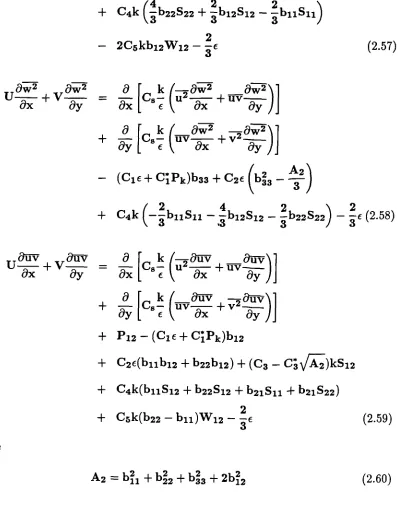
Recently, Speziale, Sarkar and Gatski (1991) proposed a new model for
the complete pressure-strain correlations which is written as:
ij = - (C
1 €+CP
k)b
jj+ C
2E(b
Ikb
Ij- bmnbmn8jj)
+ [C
3C(bmnbmn)]kS
jj+ C4k(bkSjk + bJkSIk - bmuSmn5jj)
+ C
5k(blkWjk + b
kW
1k )(2.52)
where b
jjis the anisotropy tensor, W
13is the mean vorticity tensor and
S 1
is the mean rate of strain tensor, quantities defined as:
1 IoU1 ou.
o
kf-0v2
0v2
-
C8-1u2--+Uv---Ox
e\ Ox
U— +V—
Ox
Oy
+
+
1 /ou1 +
(2.55) oxi)
The new model differs from that of Launder, Reece and Rodi in being
quadratic in the Reynolds-stresses and, as such, potentially more capable
of representing the complex interactions between the mean flow and the
turbulence fields. Indeed, the Launder et a!. model can be recovered
by simply setting the coefficient Cl, C2 and C to zero. The originators
also excluded some data sets for homogeneous free shear flows from its
calibrationwith the result that the new model obtains the correct
rela-tive stress levels in both free and wall-bounded flows , the latter without
contribution from a wall-reflections term. When this model was first
considered in the present work, no assessment of its performance had
been carried out anywhere and hence its suitability to complex,
sepa-rated, flows was yet to be determined. The present study thus forms the
first attempt at a detailed assessment of this model in practically-relevant
flows. The full set of model equations for two-dimensional flows are listed
below for completeness:
Ox
Oy
0
k(-0u2
0u2= -
C8-1 u2—
+tiV-Ox
€\ Ox
Oy
0
k(
Oi -oii+ - C5—(TiV—+v 2
-Oy €\
Ox
Oy
+ Pu - (
CuE +CPk)buu
A2 \
+
(b1 + b2 -
+ (C3 - C;\/i)kSll
+ C4 k (bii s ii + b 12 S 12 - b22S22)
+ 2C5 kb 12W12 -
(2.56)0 kf
0v
2 _OC
8IUV+v2 -
-ciy
E\ Ox OyP 22 -
(C i
f +CPk)b22
2
+ C2€ (
+ C4k (b22 s22 + b12 S 12 - b11S11)
- 2C5 kb12W12 -
(2.57)
Ow2 9w2
U—+v--Ox Oy
Ouv Ouv
Ox Oy
O
I k f—Ow2 O\1
= —IC8—Iu2—+uV----)I
Ox 6\ Ox
Oy)J
1 kf Ow
+
_IC8_(u__+2)]
OYL
f\Ox
A2\
- (C i
6+CPk )b33
+ (b3
-+ C4k
(_b 11 s 11–b12 S 12 - b22 S22) - (2.58)
O
k f—ouv
= - C8-1u2----+uv-..--_
Ox \ Ox Oy
O
kf
Ouv—Ouv
+ - Cs-IflV--+y2---.
Oy
E\ Ox Oy+ P12 - (C 1
E+CPk)b12
+ C2 €(b11 b12 + b22b12 ) + (C 3 - C/X)kS12
+ C4k(bii S i2 + b22 S 12 + b21 s 11 +
b21S22)+