C
2014. The American Astronomical Society. All rights reserved. Printed in the U.S.A.
GRAVITATIONAL WAVES FROM KNOWN PULSARS: RESULTS FROM THE INITIAL DETECTOR ERA
J. Aasi1, J. Abadie1, B. P. Abbott1, R. Abbott1, T. Abbott2, M. R. Abernathy1, T. Accadia3, F. Acernese4,5, C. Adams6, T. Adams7, R. X. Adhikari1, C. Affeldt8, M. Agathos9, N. Aggarwal10, O. D. Aguiar11, P. Ajith1, B. Allen8,12,13,
A. Allocca14,15, E. Amador Ceron12, D. Amariutei16, R. A. Anderson1, S. B. Anderson1, W. G. Anderson12, K. Arai1,
M. C. Araya1, C. Arceneaux17, J. Areeda18, S. Ast13, S. M. Aston6, P. Astone19, P. Aufmuth13, C. Aulbert8, L. Austin1,
B. E. Aylott20, S. Babak21, P. T. Baker22, G. Ballardin23, S. W. Ballmer24, J. C. Barayoga1, D. Barker25, S. H. Barnum10,
F. Barone4,5, B. Barr26, L. Barsotti10, M. Barsuglia27, M. A. Barton25, I. Bartos28, R. Bassiri26,29, A. Basti14,30,
J. Batch25, J. Bauchrowitz8, Th. S. Bauer9, M. Bebronne3, B. Behnke21, M. Bejger31, M. G. Beker9, A. S. Bell26,
C. Bell26, I. Belopolski28, G. Bergmann8, J. M. Berliner25, D. Bersanetti32,33, A. Bertolini9, D. Bessis34, J. Betzwieser6,
P. T. Beyersdorf35, T. Bhadbhade29, I. A. Bilenko36, G. Billingsley1, J. Birch6, M. Bitossi14, M. A. Bizouard37,
E. Black1, J. K. Blackburn1, L. Blackburn38, D. Blair39, M. Blom9, O. Bock8, T. P. Bodiya10, M. Boer40, C. Bogan8,
C. Bond20, F. Bondu41, L. Bonelli14,30, R. Bonnand42, R. Bork1, M. Born8, V. Boschi14, S. Bose43, L. Bosi44, J. Bowers2,
C. Bradaschia14, P. R. Brady12, V. B. Braginsky36, M. Branchesi45,46, C. A. Brannen43, J. E. Brau47, J. Breyer8,
T. Briant48, D. O. Bridges6, A. Brillet40, M. Brinkmann8, V. Brisson37, M. Britzger8, A. F. Brooks1, D. A. Brown24, D. D. Brown20, F. Br ¨uckner20, T. Bulik49, H. J. Bulten9,50, A. Buonanno51, D. Buskulic3, C. Buy27, R. L. Byer29,
L. Cadonati52, G. Cagnoli42, J. Calder ´on Bustillo53, E. Calloni4,54, J. B. Camp38, P. Campsie26, K. C. Cannon55, B. Canuel23, J. Cao56, C. D. Capano51, F. Carbognani23, L. Carbone20, S. Caride57, A. Castiglia58, S. Caudill12,
M. Cavagli `a17, F. Cavalier37, R. Cavalieri23, G. Cella14, C. Cepeda1, E. Cesarini59, R. Chakraborty1,
T. Chalermsongsak1, S. Chao60, P. Charlton61, E. Chassande-Mottin27, X. Chen39, Y. Chen62, A. Chincarini32,
A. Chiummo23, H. S. Cho63, J. Chow64, N. Christensen65, Q. Chu39, S. S. Y. Chua64, S. Chung39, G. Ciani16, F. Clara25,
D. E. Clark29, J. A. Clark52, F. Cleva40, E. Coccia66,67, P.-F. Cohadon48, A. Colla19,68, M. Colombini44,
M. Constancio Jr.11, A. Conte19,68, R. Conte69, D. Cook25, T. R. Corbitt2, M. Cordier35, N. Cornish22, A. Corsi70,
C. A. Costa11, M. W. Coughlin71, J.-P. Coulon40, S. Countryman28, P. Couvares24, D. M. Coward39, M. Cowart6,
D. C. Coyne1, K. Craig26, J. D. E. Creighton12, T. D. Creighton34, S. G. Crowder72, A. Cumming26, L. Cunningham26,
E. Cuoco23, K. Dahl8, T. Dal Canton8, M. Damjanic8, S. L. Danilishin39, S. D’Antonio59, K. Danzmann8,13, V. Dattilo23,
B. Daudert1, H. Daveloza34, M. Davier37, G. S. Davies26, E. J. Daw73, R. Day23, T. Dayanga43, R. De Rosa4,54,
G. Debreczeni74, J. Degallaix42, W. Del Pozzo9, E. Deleeuw16, S. Del´eglise48, T. Denker8, T. Dent8, H. Dereli40,
V. Dergachev1, R. DeRosa2, R. DeSalvo69, S. Dhurandhar75, L. Di Fiore4, A. Di Lieto14,30, I. Di Palma8, A. Di Virgilio14,
M. D´ıaz34, A. Dietz17, K. Dmitry36, F. Donovan10, K. L. Dooley8, S. Doravari6, M. Drago76,77, R. W. P. Drever78, J. C. Driggers1, Z. Du56, J.-C. Dumas39, S. Dwyer25, T. Eberle8, M. Edwards7, A. Effler2, P. Ehrens1, J. Eichholz16,
S. S. Eikenberry16, G. Endr ˝oczi74, R. Essick10, T. Etzel1, K. Evans26, M. Evans10, T. Evans6, M. Factourovich28, V. Fafone59,67, S. Fairhurst7, Q. Fang39, S. Farinon32, B. Farr79, W. Farr79, M. Favata80, D. Fazi79, H. Fehrmann8,
D. Feldbaum6,16, I. Ferrante14,30, F. Ferrini23, F. Fidecaro14,30, L. S. Finn81, I. Fiori23, R. Fisher24, R. Flaminio42,
E. Foley18, S. Foley10, E. Forsi6, N. Fotopoulos1, J.-D. Fournier40, S. Franco37, S. Frasca19,68, F. Frasconi14, M. Frede8,
M. Frei58, Z. Frei82, A. Freise20, R. Frey47, T. T. Fricke8, P. Fritschel10, V. V. Frolov6, M.-K. Fujimoto83, P. Fulda16,
M. Fyffe6, J. Gair71, L. Gammaitoni44,84, J. Garcia25, F. Garufi4,54, N. Gehrels38, G. Gemme32, E. Genin23, A. Gennai14,
L. Gergely82, S. Ghosh43, J. A. Giaime2,6, S. Giampanis12, K. D. Giardina6, A. Giazotto14, S. Gil-Casanova53, C. Gill26,
J. Gleason16, E. Goetz8, R. Goetz16, L. Gondan82, G. Gonz ´alez2, N. Gordon26, M. L. Gorodetsky36, S. Gossan62,
S. Goßler8, R. Gouaty3, C. Graef8, P. B. Graff38, M. Granata42, A. Grant26, S. Gras10, C. Gray25, R. J. S. Greenhalgh85,
A. M. Gretarsson86, C. Griffo18, P. Groot87, H. Grote8, K. Grover20, S. Grunewald21, G. M. Guidi45,46, C. Guido6,
K. E. Gushwa1, E. K. Gustafson1, R. Gustafson57, B. Hall43, E. Hall1, D. Hammer12, G. Hammond26, M. Hanke8,
J. Hanks25, C. Hanna88, J. Hanson6, J. Harms1, G. M. Harry89, I. W. Harry24, E. D. Harstad47, M. T. Hartman16,
K. Haughian26, K. Hayama83, J. Heefner1,142, A. Heidmann48, M. Heintze6,16, H. Heitmann40, P. Hello37, G. Hemming23,
M. Hendry26, I. S. Heng26, A. W. Heptonstall1, M. Heurs8, S. Hild26, D. Hoak52, K. A. Hodge1, K. Holt6, M. Holtrop90, T. Hong62, S. Hooper39, T. Horrom91, D. J. Hosken92, J. Hough26, E. J. Howell39, Y. Hu26, Z. Hua56, V. Huang60, E. A. Huerta24, B. Hughey86, S. Husa53, S. H. Huttner26, M. Huynh12, T. Huynh-Dinh6, J. Iafrate2, D. R. Ingram25,
R. Inta64, T. Isogai10, A. Ivanov1, B. R. Iyer93, K. Izumi25, M. Jacobson1, E. James1, H. Jang94, Y. J. Jang79, P. Jaranowski95, F. Jim´enez-Forteza53, W. W. Johnson2, D. Jones25, D. I. Jones96, R. Jones26, R. J. G. Jonker9, L. Ju39,
Haris K97, P. Kalmus1, V. Kalogera79, S. Kandhasamy72, G. Kang94, J. B. Kanner38, M. Kasprzack23,37, R. Kasturi98,
E. Katsavounidis10, W. Katzman6, H. Kaufer13, K. Kaufman62, K. Kawabe25, S. Kawamura83, F. Kawazoe8,
F. K´ef´elian40, D. Keitel8, D. B. Kelley24, W. Kells1, D. G. Keppel8, A. Khalaidovski8, F. Y. Khalili36,
E. A. Khazanov99, B. K. Kim94, C. Kim94,100, K. Kim101, N. Kim29, W. Kim92, Y.-M. Kim63, E. J. King92, P. J. King1,
D. L. Kinzel6, J. S. Kissel10, S. Klimenko16, J. Kline12, S. Koehlenbeck8, K. Kokeyama2, V. Kondrashov1, S. Koranda12,
W. Z. Korth1, I. Kowalska49, D. Kozak1, A. Kremin72, V. Kringel8, B. Krishnan8, A. Kr ´olak102,103, C. Kucharczyk29,
S. Kudla2, G. Kuehn8, A. Kumar104, P. Kumar24, R. Kumar26, R. Kurdyumov29, P. Kwee10, M. Landry25, B. Lantz29,
H. M. Lee100, J. Lee10, J. Lee18, M. Leonardi76,77, J. R. Leong8, N. Leroy37, N. Letendre3, B. Levine25, J. B. Lewis1,
V. Lhuillier25, T. G. F. Li9, A. C. Lin29, T. B. Littenberg79, V. Litvine1, F. Liu107, H. Liu7, Y. Liu56, Z. Liu16, D. Lloyd1,
N. A. Lockerbie108, V. Lockett18, D. Lodhia20, K. Loew86, J. Logue26, A. L. Lombardi52, M. Lorenzini59, V. Loriette109,
M. Lormand6, G. Losurdo45, J. Lough24, J. Luan62, M. J. Lubinski25, H. L ¨uck8,13, A. P. Lundgren8, J. Macarthur26,
E. Macdonald7, B. Machenschalk8, M. MacInnis10, D. M. Macleod7, F. Magana-Sandoval18, M. Mageswaran1,
K. Mailand1, E. Majorana19, I. Maksimovic109, V. Malvezzi59, N. Man40, G. M. Manca8, I. Mandel20, V. Mandic72,
V. Mangano19,68, M. Mantovani14, F. Marchesoni44,110, F. Marion3, S. M ´arka28, Z. M ´arka28, A. Markosyan29, E. Maros1,
J. Marque23, F. Martelli45,46, I. W. Martin26, R. M. Martin16, L. Martinelli40, D. Martynov1, J. N. Marx1, K. Mason10,
A. Masserot3, T. J. Massinger24, F. Matichard10, L. Matone28, R. A. Matzner111, N. Mavalvala10, G. May2,
N. Mazumder97, G. Mazzolo8, R. McCarthy25, D. E. McClelland64, S. C. McGuire112, G. McIntyre1, J. McIver52,
D. Meacher40, G. D. Meadors57, M. Mehmet8, J. Meidam9, T. Meier13, A. Melatos106, G. Mendell25, R. A. Mercer12, S. Meshkov1, C. Messenger26, M. S. Meyer6, H. Miao62, C. Michel42, E. E. Mikhailov91, L. Milano4,54, J. Miller64, Y. Minenkov59, C. M. F. Mingarelli20, S. Mitra75, V. P. Mitrofanov36, G. Mitselmakher16, R. Mittleman10, B. Moe12, M. Mohan23, S. R. P. Mohapatra24,58, F. Mokler8, D. Moraru25, G. Moreno25, N. Morgado42, T. Mori83, S. R. Morriss34, K. Mossavi8, B. Mours3, C. M. Mow-Lowry8, C. L. Mueller16, G. Mueller16, S. Mukherjee34, A. Mullavey2, J. Munch92,
D. Murphy28, P. G. Murray26, A. Mytidis16, M. F. Nagy74, D. Nanda Kumar16, I. Nardecchia19,68, T. Nash1,
L. Naticchioni19,68, R. Nayak113, V. Necula16, G. Nelemans9,87, I. Neri44,84, M. Neri32,33, G. Newton26, T. Nguyen64,
E. Nishida83, A. Nishizawa83, A. Nitz24, F. Nocera23, D. Nolting6, M. E. Normandin34, L. K. Nuttall7, E. Ochsner12,
J. O’Dell85, E. Oelker10, G. H. Ogin1, J. J. Oh114, S. H. Oh114, F. Ohme7, P. Oppermann8, B. O’Reilly6,
W. Ortega Larcher34, R. O’Shaughnessy12, C. Osthelder1, D. J. Ottaway92, R. S. Ottens16, J. Ou60, H. Overmier6,
B. J. Owen81, C. Padilla18, A. Pai97, C. Palomba19, Y. Pan51, C. Pankow12, F. Paoletti14,23, R. Paoletti14,15,
M. A. Papa12,21, H. Paris25, A. Pasqualetti23, R. Passaquieti14,30, D. Passuello14, M. Pedraza1, P. Peiris58, S. Penn98,
A. Perreca24, M. Phelps1, M. Pichot40, M. Pickenpack8, F. Piergiovanni45,46, V. Pierro69, L. Pinard42, B. Pindor106,
I. M. Pinto69, M. Pitkin26, J. Poeld8, R. Poggiani14,30, V. Poole43, C. Poux1, V. Predoi7, T. Prestegard72, L. R. Price1,
M. Prijatelj8, M. Principe69, S. Privitera1, R. Prix8, G. A. Prodi76,77, L. Prokhorov36, O. Puncken34, M. Punturo44,
P. Puppo19, V. Quetschke34, E. Quintero1, R. Quitzow-James47, F. J. Raab25, D. S. Rabeling9,50, I. R ´acz74, H. Radkins25,
P. Raffai28,82, S. Raja115, G. Rajalakshmi116, M. Rakhmanov34, C. Ramet6, P. Rapagnani19,68, V. Raymond1, V. Re59,67, C. M. Reed25, T. Reed117, T. Regimbau40, S. Reid118, D. H. Reitze1,16, F. Ricci19,68, R. Riesen6, K. Riles57, N. A. Robertson1,26, F. Robinet37, A. Rocchi59, S. Roddy6, C. Rodriguez79, M. Rodruck25, C. Roever8, L. Rolland3, J. G. Rollins1, J. D. Romano34, R. Romano4,5, G. Romanov91, J. H. Romie6, D. Rosi ´nska31,119, S. Rowan26, A. R ¨udiger8,
P. Ruggi23, K. Ryan25, F. Salemi8, L. Sammut106, V. Sandberg25, J. Sanders57, V. Sannibale1, I. Santiago-Prieto26,
E. Saracco42, B. Sassolas42, B. S. Sathyaprakash7, P. R. Saulson24, R. Savage25, R. Schilling8, R. Schnabel8,13,
R. M. S. Schofield47, E. Schreiber8, D. Schuette8, B. Schulz8, B. F. Schutz7,21, P. Schwinberg25, J. Scott26,
S. M. Scott64, F. Seifert1, D. Sellers6, A. S. Sengupta120, D. Sentenac23, A. Sergeev99, D. Shaddock64, S. Shah9,87,
M. S. Shahriar79, M. Shaltev8, B. Shapiro29, P. Shawhan51, D. H. Shoemaker10, T. L. Sidery20, K. Siellez40, X. Siemens12,
D. Sigg25, D. Simakov8, A. Singer1, L. Singer1, A. M. Sintes53, G. R. Skelton12, B. J. J. Slagmolen64, J. Slutsky8,
J. R. Smith18, M. R. Smith1, R. J. E. Smith20, N. D. Smith-Lefebvre1, K. Soden12, E. J. Son114, B. Sorazu26, T. Souradeep75,
L. Sperandio59,67, A. Staley28, E. Steinert25, J. Steinlechner8, S. Steinlechner8, S. Steplewski43, D. Stevens79,
A. Stochino64, R. Stone34, K. A. Strain26, N. Straniero42, S. Strigin36, A. S. Stroeer34, R. Sturani45,46, A. L. Stuver6,
T. Z. Summerscales121, S. Susmithan39, P. J. Sutton7, B. Swinkels23, G. Szeifert82, M. Tacca27, D. Talukder47, L. Tang34,
D. B. Tanner16, S. P. Tarabrin8, R. Taylor1, A. P. M. ter Braack9, M. P. Thirugnanasambandam1, M. Thomas6, P. Thomas25, K. A. Thorne6, K. S. Thorne62, E. Thrane1, V. Tiwari16, K. V. Tokmakov108, C. Tomlinson73, A. Toncelli14,30,
M. Tonelli14,30, O. Torre14,15, C. V. Torres34, C. I. Torrie1,26, F. Travasso44,84, G. Traylor6, M. Tse28, D. Ugolini122, C. S. Unnikrishnan116, H. Vahlbruch13, G. Vajente14,30, M. Vallisneri62, J. F. J. van den Brand9,50,
C. Van Den Broeck9, S. van der Putten9, M. V. van der Sluys9,87, J. van Heijningen9, A. A. van Veggel26, S. Vass1,
M. Vas ´uth74, R. Vaulin10, A. Vecchio20, G. Vedovato123, J. Veitch9, P. J. Veitch92, K. Venkateswara124, D. Verkindt3,
S. Verma39, F. Vetrano45,46, A. Vicer´e45,46, R. Vincent-Finley112, J.-Y. Vinet40, S. Vitale9,10, B. Vlcek12, T. Vo25,
H. Vocca44,84, C. Vorvick25, W. D. Vousden20, D. Vrinceanu34, S. P. Vyachanin36, A. Wade64, L. Wade12, M. Wade12,
S. J. Waldman10, M. Walker2, L. Wallace1, Y. Wan56, J. Wang60, M. Wang20, X. Wang56, A. Wanner8, R. L. Ward64,
M. Was8, B. Weaver25, L.-W. Wei40, M. Weinert8, A. J. Weinstein1, R. Weiss10, T. Welborn6, L. Wen39, P. Wessels8,
M. West24, T. Westphal8, K. Wette8, J. T. Whelan58, S. E. Whitcomb1,39, D. J. White73, B. F. Whiting16, S. Wibowo12,
K. Wiesner8, C. Wilkinson25, L. Williams16, R. Williams1, T. Williams125, J. L. Willis126, B. Willke8,13, M. Wimmer8,
L. Winkelmann8, W. Winkler8, C. C. Wipf10, H. Wittel8, G. Woan26, J. Worden25, J. Yablon79, I. Yakushin6,
H. Yamamoto1, C. C. Yancey51, H. Yang62, D. Yeaton-Massey1, S. Yoshida125, H. Yum79, M. Yvert3, A. Zadro ˙zny103,
M. Zanolin86, J.-P. Zendri123, F. Zhang10, L. Zhang1, C. Zhao39, H. Zhu81, X. J. Zhu39,
N. Zotov117,143, M. E. Zucker10, and J. Zweizig1
S. Buchner127,128, I. Cognard129,130, A. Corongiu131, N. D’Amico131,132, C. M. Espinoza133,134, P. C. C. Freire135,
E. V. Gotthelf28, L. Guillemot135, J. W. T. Hessels136,137, G. B. Hobbs138, M. Kramer133,135, A. G. Lyne133,
F. E. Marshall37, A. Possenti131, S. M. Ransom139, P. S. Ray140, J. Roy141, and B. W. Stappers133 1LIGO - California Institute of Technology, Pasadena, CA 91125, USA
2Louisiana State University, Baton Rouge, LA 70803, USA
3Laboratoire d’Annecy-le-Vieux de Physique des Particules (LAPP), Universit´e de Savoie, CNRS/IN2P3, F-74941 Annecy-le-Vieux, France 4INFN, Sezione di Napoli, Complesso Universitario di Monte S. Angelo, I-80126 Napoli, Italy
5Universit`a di Salerno, Fisciano, I-84084 Salerno, Italy 6LIGO - Livingston Observatory, Livingston, LA 70754, USA
7Cardiff University, Cardiff, CF24 3AA, UK
8Albert-Einstein-Institut, Max-Planck-Institut f¨ur Gravitationsphysik, D-30167 Hannover, Germany 9Nikhef, Science Park, 1098 XG Amsterdam, The Netherlands
10LIGO - Massachusetts Institute of Technology, Cambridge, MA 02139, USA 11Instituto Nacional de Pesquisas Espaciais, 12227-010 - S˜ao Jos´e dos Campos, SP, Brazil
12University of Wisconsin–Milwaukee, Milwaukee, WI 53201, USA 13Leibniz Universit¨at Hannover, D-30167 Hannover, Germany
14INFN, Sezione di Pisa, I-56127 Pisa, Italy 15Universit`a di Siena, I-53100 Siena, Italy 16University of Florida, Gainesville, FL 32611, USA 17The University of Mississippi, University, MS 38677, USA 18California State University Fullerton, Fullerton, CA 92831, USA
19INFN, Sezione di Roma, I-00185 Roma, Italy 20University of Birmingham, Birmingham, B15 2TT, UK
21Albert-Einstein-Institut, Max-Planck-Institut f¨ur Gravitationsphysik, D-14476 Golm, Germany 22Montana State University, Bozeman, MT 59717, USA
23European Gravitational Observatory (EGO), I-56021 Cascina, Pisa, Italy 24Syracuse University, Syracuse, NY 13244, USA
25LIGO - Hanford Observatory, Richland, WA 99352, USA 26SUPA, University of Glasgow, Glasgow, G12 8QQ, UK
27APC, AstroParticule et Cosmologie, Universit´e Paris Diderot, CNRS/IN2P3, CEA/Irfu, Observatoire de Paris, Sorbonne Paris Cit´e, 10, rue Alice Domon et L´eonie Duquet, F-75205 Paris Cedex 13, France
28Columbia University, New York, NY 10027, USA 29Stanford University, Stanford, CA 94305, USA
30Universit`a di Pisa, I-56127 Pisa, Italy 31CAMK-PAN, 00-716 Warsaw, Poland 32INFN, Sezione di Genova, I-16146 Genova, Italy 33Universit`a degli Studi di Genova, I-16146 Genova, Italy 34The University of Texas at Brownsville, Brownsville, TX 78520, USA
35San Jose State University, San Jose, CA 95192, USA 36Moscow State University, Moscow 119992, Russia 37LAL, Universit´e Paris-Sud, IN2P3/CNRS, F-91898 Orsay, France 38NASA/Goddard Space Flight Center, Greenbelt, MD 20771, USA 39University of Western Australia, Crawley, WA 6009, Australia
40Universit´e Nice-Sophia-Antipolis, CNRS, Observatoire de la Cˆote d’Azur, F-06304 Nice, France 41Institut de Physique de Rennes, CNRS, Universit´e de Rennes 1, F-35042 Rennes, France
42Laboratoire des Mat´eriaux Avanc´es (LMA), IN2P3/CNRS, Universit´e de Lyon, F-69622 Villeurbanne, Lyon, France 43Washington State University, Pullman, WA 99164, USA
44INFN, Sezione di Perugia, I-06123 Perugia, Italy 45INFN, Sezione di Firenze, I-50019 Sesto Fiorentino, Firenze, Italy 46Universit`a degli Studi di Urbino “Carlo Bo,” I-61029 Urbino, Italy
47University of Oregon, Eugene, OR 97403, USA
48Laboratoire Kastler Brossel, ENS, CNRS, UPMC, Universit´e Pierre et Marie Curie, F-75005 Paris, France 49Astronomical Observatory Warsaw University, 00-478 Warsaw, Poland
50VU University Amsterdam, 1081 HV Amsterdam, The Netherlands 51University of Maryland, College Park, MD 20742, USA 52University of Massachusetts - Amherst, Amherst, MA 01003, USA 53Universitat de les Illes Balears, E-07122 Palma de Mallorca, Spain
54Universit`a di Napoli “Federico II,” Complesso Universitario di Monte S. Angelo, I-80126 Napoli, Italy 55Canadian Institute for Theoretical Astrophysics, University of Toronto, Toronto, Ontario, M5S 3H8, Canada
56Tsinghua University, Beijing 100084, China 57University of Michigan, Ann Arbor, MI 48109, USA 58Rochester Institute of Technology, Rochester, NY 14623, USA
59INFN, Sezione di Roma Tor Vergata, I-00133 Roma, Italy 60National Tsing Hua University, Hsinchu 300, Taiwan 61Charles Sturt University, Wagga Wagga, NSW 2678, Australia
62Caltech-CaRT, Pasadena, CA 91125, USA 63Pusan National University, Busan 609-735, Korea 64Australian National University, Canberra, ACT 0200, Australia
65Carleton College, Northfield, MN 55057, USA 66INFN, Gran Sasso Science Institute, I-67100 L’Aquila, Italy
67Universit`a di Roma Tor Vergata, I-00133 Roma, Italy 68Universit`a di Roma “La Sapienza,” I-00185 Roma, Italy
69University of Sannio at Benevento, I-82100 Benevento, Italy and INFN (Sezione di Napoli), Italy 70The George Washington University, Washington, DC 20052, USA
73The University of Sheffield, Sheffield S10 2TN, UK
74Wigner RCP, RMKI, H-1121 Budapest, Konkoly Thege Mikl´os ´ut 29-33, Hungary 75Inter-University Centre for Astronomy and Astrophysics, Pune - 411007, India
76INFN, Gruppo Collegato di Trento, I-38050 Povo, Trento, Italy 77Universit`a di Trento, I-38050 Povo, Trento, Italy 78California Institute of Technology, Pasadena, CA 91125, USA
79Northwestern University, Evanston, IL 60208, USA 80Montclair State University, Montclair, NJ 07043, USA 81The Pennsylvania State University, University Park, PA 16802, USA 82MTA-Eotvos University, ‘Lendulet’A. R. G., Budapest 1117, Hungary
83National Astronomical Observatory of Japan, Tokyo 181-8588, Japan 84Universit`a di Perugia, I-06123 Perugia, Italy
85Rutherford Appleton Laboratory, HSIC, Chilton, Didcot, Oxon, OX11 0QX, UK 86Embry-Riddle Aeronautical University, Prescott, AZ 86301, USA
87Department of Astrophysics/IMAPP, Radboud University Nijmegen, P.O. Box 9010, 6500 GL Nijmegen, The Netherlands 88Perimeter Institute for Theoretical Physics, Ontario, N2L 2Y5, Canada
89American University, Washington, DC 20016, USA 90University of New Hampshire, Durham, NH 03824, USA 91College of William and Mary, Williamsburg, VA 23187, USA
92University of Adelaide, Adelaide, SA 5005, Australia 93Raman Research Institute, Bangalore, Karnataka 560080, India 94Korea Institute of Science and Technology Information, Daejeon 305-806, Korea
95Białystok University, 15-424 Białystok, Poland 96University of Southampton, Southampton, SO17 1BJ, UK 97IISER-TVM, CET Campus, Trivandrum Kerala 695016, India 98Hobart and William Smith Colleges, Geneva, NY 14456, USA 99Institute of Applied Physics, Nizhny Novgorod, 603950, Russia
100Seoul National University, Seoul 151-742, Korea 101Hanyang University, Seoul 133-791, Korea
102IM-PAN, 00-956 Warsaw, Poland 103NCBJ, 05-400 ´Swierk-Otwock, Poland
104Institute for Plasma Research, Bhat, Gandhinagar 382428, India 105Utah State University, Logan, UT 84322, USA 106The University of Melbourne, Parkville, VIC 3010, Australia
107University of Brussels, Brussels 1050 Belgium 108SUPA, University of Strathclyde, Glasgow, G1 1XQ, UK
109ESPCI, CNRS, F-75005 Paris, France
110Universit`a di Camerino, Dipartimento di Fisica, I-62032 Camerino, Italy 111The University of Texas at Austin, Austin, TX 78712, USA 112Southern University and A&M College, Baton Rouge, LA 70813, USA
113IISER-Kolkata, Mohanpur, West Bengal 741252, India 114National Institute for Mathematical Sciences, Daejeon 305-390, Korea
115RRCAT, Indore MP 452013, India
116Tata Institute for Fundamental Research, Mumbai 400005, India 117Louisiana Tech University, Ruston, LA 71272, USA 118SUPA, University of the West of Scotland, Paisley, PA1 2BE, UK
119Institute of Astronomy, 65-265 Zielona G´ora, Poland
120Indian Institute of Technology, Gandhinagar Ahmedabad Gujarat 382424, India 121Andrews University, Berrien Springs, MI 49104, USA
122Trinity University, San Antonio, TX 78212, USA 123INFN, Sezione di Padova, I-35131 Padova, Italy 124University of Washington, Seattle, WA 98195, USA 125Southeastern Louisiana University, Hammond, LA 70402, USA
126Abilene Christian University, Abilene, TX 79699, USA
127Hartebeesthoek Radio Astronomy Observatory, PO Box 443, Krugersdorp 1740, South Africa 128School of Physics, University of the Witwatersrand, Johannesburg, South Africa
129LPC2E/CNRS-Universit´e d’Orl´eans, F-45071 Orl´eans, France 130Nan¸cay/Paris Observatory, F-18330 Nan¸cay, France
131INAF - Osservatorio Astronomico di Cagliari, Poggio dei Pini, I-09012 Capoterra, Italy 132Dipartimento di Fisica Universit`a di Cagliari, Cittadella Universitaria, I-09042 Monserrato, Italy
133Jodrell Bank Centre for Astrophysics, School of Physics and Astronomy, University of Manchester, Manchester M13 9PL, UK 134Instituto de Astrof´ısica, Facultad de F´ısica, Pontificia Universidad Cat´olica de Chile, Casilla 306, Santiago 22, Chile
135Max-Planck-Institut f¨ur Radioastronomie, Auf dem H¨ugel 69, D-53121 Bonn, Germany 136ASTRON, the Netherlands Institute for Radio Astronomy, Postbus 2, 7990 AA, Dwingeloo, The Netherlands 137Astronomical Institute “Anton Pannekoek,” University of Amsterdam, Science Park 904, 1098 XH Amsterdam, The Netherlands
138Australia Telescope National Facility, CSIRO, P.O. Box 76, Epping NSW 1710, Australia 139National Radio Astronomy Observatory, Charlottesville, VA 22903, USA 140Space Science Division, Naval Research Laboratory, Washington, DC 20375-5352, USA
ABSTRACT
We present the results of searches for gravitational waves from a large selection of pulsars using data from the most recent science runs (S6, VSR2 and VSR4) of the initial generation of interferometric gravitational wave detectors LIGO (Laser Interferometric Gravitational-wave Observatory) and Virgo. We do not see evidence for gravitational wave emission from any of the targeted sources but produce upper limits on the emission amplitude. We highlight the results from seven young pulsars with large spin-down luminosities. We reach within a factor of five of the canonical spin-down limit for all seven of these, whilst for the Crab and Vela pulsars we further surpass their spin-down limits. We present new or updated limits for 172 other pulsars (including both young and millisecond pulsars). Now that the detectors are undergoing major upgrades, and, for completeness, we bring together all of the most up-to-date results from all pulsars searched for during the operations of the first-generation LIGO, Virgo and GEO600 detectors. This gives a total of 195 pulsars including the most recent results described in this paper.
Key words: gravitational waves – pulsars: general
Online-only material:color figures
1. INTRODUCTION
Pulsars are spinning, magnetized neutron stars with slowly decreasing rotation rates. In the model of a triaxial ellipsoid star, a deformation (possibly from shear strains in the solid part(s) of the star, or from magnetic stresses) can appear as a time-varying quadrupole moment as the star rotates. The observed loss of rotational energy, known as the spin-down luminosity (given byE˙ = IzzΩ| ˙Ω| = 4π2Izzfrot| ˙frot|, whereIzz is the moment of inertia around the principal axis (aligned with the rotation axis),frotis the rotation frequency, andf˙rotis the rotational
fre-quency derivative) provides a huge reservoir of energy. Along with magnetic dipole radiation some fraction of this reservoir is potentially dissipated through gravitational wave emission (see Shklovskii1969; Ostriker & Gunn1969; Ferrari & Ruffini1969; Melosh1969for four contemporaneous calculations of gravita-tional wave emission from soon after pulsars were discovered, or e.g., Owen2006for a review of more recent emission mech-anism calculations). Known pulsars usually have precisely de-termined frequency evolutions and sky-positions making them ideal targets for gravitational wave detectors. If a pulsar is moni-tored regularly through electromagnetic observations it can yield a coherent phase model, which allows gravitational wave data to be coherently integrated over months or years.
Since the initial science data runs of the Laser Interfer-ometric Gravitational-wave Observatory (LIGO), Virgo and GEO600, searches have been performed for continuous quasi-monochromatic gravitational wave emission from many known pulsars (Abbott et al.2004,2005,2007a,2008,2010; Abadie et al.2011). Most recently 116 known pulsars were targeted us-ing data from LIGO’s fifth science run (S5; Abbott et al.2010), and the Vela pulsar (J0835−4510) was targeted using data from Virgo’s second science run (VSR2). These searches reported no detections, but provided upper limits on the gravitational wave amplitude from the sources and surpassed the so-called spin-down limit (see Section1.1) for the Crab and Vela pulsars. We aim here to search for gravitational wave emission from a large selection of stars including some of those with the largest spin-down luminosities. Due to the sensitivity reduction caused at low frequency by seismic noise at the detectors, it is not worthwhile to search for pulsars with rotational frequencies,frot,
smaller than about 10 Hz, which corresponds to gravitational wave mass quadrupole emission at frequencies, fgw = 2frot,
smaller than 20 Hz. The exact value of this gravitational wave
142Deceased, 2012 April. 143Deceased, 2012 May.
low-frequency cut-off is rather arbitrary, our choice of taking 20 Hz is motivated by the presence of several noise lines and bumps in Virgo data at lower frequencies. In general, young pulsars, with large spin-down luminosities are searched for at lower frequencies where the Virgo detector has better sensitivity, whereas the search for millisecond pulsars (MSPs) is conducted at higher frequencies where the LIGO detectors are more sensitive. The selection of pulsars will be discussed more fully in Section2.
1.1. The Signal
The expected quadrupolar gravitational wave signal from a triaxial neutron star144 steadily spinning about one of its principal axes of inertia is at twice the rotation frequency, with a strain of
h(t)= 1
2F+(t, ψ)h0(1 + cos
2ι) cosφ(t)
+F×(t, ψ)h0cosιsinφ(t) (1)
in the detector, where
h0= 16π
2G
c4
Izzεfrot2
d (2)
is the dimensionless gravitational wave strain amplitude.h0 is
dependent onIzz, the fiducial equatorial ellipticity, defined as ε = (Ixx−Iyy)/Izz in terms of principal moments of inertia,
the rotational frequency, frot, and the distance to the source d. The signal amplitudes in the two polarizations (“+” and “×”) depend on the inclination of the star’s rotation axis to the line-of-sight,ι, while the detector antenna pattern responses for the two polarization states,F+(t, ψ) andF×(t, ψ), depend on the gravitational wave polarization angle, ψ, as well as the detector location, orientation and source sky position. The gravitational wave phase evolution, φ(t), depends on both the intrinsic rotational frequency and frequency derivatives of the pulsar and on Doppler and propagation effects. These extrinsic effects include relativistic modulations caused by the Earth’s orbital and rotational motion, the presence of massive bodies in the solar system close to the line-of-sight to the pulsar, the proper motion of the pulsar, and (in the case of a binary system) pulsar orbital motions. We will assume thatφ(t) is phase-locked to the electromagnetic pulse phase evolution, but with double
Table 1 Science Runs
Run Dates Duty Factor Data Length
(%) (days)
VSR2 2009 Jul 7 (20:55 UTC) – 2010 Jan 8 (22:00 UTC) 80.4 149
VSR4 2011 Jun 3 (10:27 UTC) – 2011 Sep 5 (13:26 UTC) 81.0 76
S6 Hanford (H1) 2009 Jul 7 (21:00 UTC) – 2010 Oct 21 (00:00 UTC) 50.6 238 S6 Livingston (L1) 2009 Jul 7 (21:00 UTC) – 2010 Oct 21 (00:00 UTC) 47.9 225
the value and with an initial phase offset,φ0. Given this phase
evolution, the four unknown search parameters are simplyh0,
cosι,φ0andψ. The gravitational wave amplitude is related to
the star’sl =m =2 mass quadrupole moment via (see, e.g., Owen2005)
Q22=
15
8πIzzε=h0
c4d
16π2Gf2 rot
15
8π, (3)
whereQ22is the slightly non-standard definition of quadrupole
moment used in Ushomirsky et al. (2000) and many subsequent papers. This value can be constrained independently of any assumptions about the star’s equation of state and moment of inertia.
If we allocate all the spin-down luminosity,E, to gravitational˙ wave luminosity,E˙gw, where
˙ Egw=
2048π6
5 G
c5f 6 rot(Izzε)2,
= 8π2 5
c3
Gf
2
roth20d2, (4)
then we have the canonical “spin-down limit” on gravitational wave strain145
hsd0 =
5 2
GIzzf˙rot
c3d2f rot
1/2
= 8.06×10⁻¹⁹I
1/2 38
dkpc
| ˙frot|
frot 1/2
, (5)
where I38 is the star’s moment of inertia in the units of
1038kg m2, anddkpcis the distance to the pulsar in kiloparsecs.
The spin-down limit on the signal amplitude corresponds (via Equation (2)) to an upper limit on the star’s fiducial ellipticity146
εsd=0.237
hsd0 10−24
frot−2I38−1dkpc. (6)
Johnson-McDaniel (2013) shows how to relate this to the phys-ical ellipticity of the star’s surface for a given equation of state. A gravitational wave strain upper limit that is below the spin-down limit is an important milestone, as such a measurement is probing uncharted regions of the parameter space. Likewise it directly constrains the fraction of spin-down power that could be due to the emission of gravitational waves, which gives insight into the overall spin-down energy budget.
145As noted in Johnson-McDaniel (2013), the versions of this equation given inline in the first paragraph of Abbott et al. (2008), as Equation (1) in Abbott et al. (2010) and as Equation (14) in Abadie et al. (2011) are incorrect and should haveI38substituted forI381/2.
146Again, as noted in Johnson-McDaniel (2013), the versions of this equation given inline in Section 3 of Abbott et al. (2008) and as Equation (7) in Abbott et al. (2010) are incorrect and should haveI38substituted forI38−1.
1.2. The Science Runs
In this paper we have used calibrated data from the Virgo second (Aasi et al.2012) and fourth science runs (VSR2 and VSR4) and the LIGO sixth science run (S6). Virgo’s third sci-ence run (VSR3) was relatively insensitive in comparison with VSR4 and has not been included in this analysis. This was par-tially because Virgo introduced monolithic mirror suspensions prior to VSR4 which improved sensitivity in the low-frequency range. During S6, the two LIGO 4 km detectors at Hanford, Washington (LHO/H1), and Livingston, Louisiana (LLO/L1), were running in an enhanced configuration (Adhikari et al.2006) over that from the previous S5 run (Abbott et al.2009). Table1
shows dates of the runs, the duty factors and science data lengths for each detector that we analyzed.
The Virgo and LIGO data used in these analyses have been calibrated through different reconstruction procedures, but both based ultimately on the measured response to actuation controls on the positions of the mirrors that define the interferometers. For Virgo VSR2, the calibration uncertainty was about 5.5% in amplitude and ∼50 mrad (3◦) in phase over most of the fre-quency range (Accadia et al.2011). For VSR4, the uncertainty amounted to about 7.5% in amplitude and to (40 + 50f) mrad in phase, wherefis the frequency in kilohertz, for frequencies up to 500 Hz (Mours & Rolland2011). For LIGO, the S6 calibration uncertainties over the relevant frequency range (50–1500 Hz) were up to∼19% in amplitude and∼170 mrad (10◦) in phase for L1, and up to∼16% in amplitude and∼120 mrad (7◦) for H1 (Bartos et al.2011). These phase errors are well within the range (i.e., less than 30◦as applied in Abbott et al.2007a) that would cause significant loss in signal power due to decoherence between the pulsar signal and the assumed phase evolution.
1.3. Methods
We used three semi-independent methods (very similar to those used in the Vela pulsar search in Abadie et al.2011) to search for signals described in Section 1.1. Here, we briefly outline their operation, but for full descriptions we refer the reader to the references below. Two of the search methods work with time domain data that has been heterodyned to remove the signal’s phase evolution and then heavily decimated. This leaves a complex data stream in which any signal would only be modulated by the detector’s beam pattern. In the first method, this data stream is used to give Bayesian parameter estimates of the unknown signal parameters147(Dupuis & Woan2005). The
second method computes the maximum likelihoodF-statistic rather than a Bayesian posterior (or in case where ψ and ι
are well constrained, the G-statistic) (Jaranowski & Kr´olak
2010). The third method (Astone et al. 2010) makes use of a Short Fourier Transform Database (SFDB) of each detector’s data. After the extraction of a small frequency band around the signal’s expected frequency, the Doppler effect, Einstein delay and spin-down are removed in the time domain and the data are down-sampled with a re-sampling technique. Two matched filters on the “+” and “×” signal Fourier components are then computed at the five frequencies at which the signal power is spread due to the signal amplitude and phase modulation; they are used to build a detection statistic and to estimate signal parameters in the case of detection. This 5-vector method has been extended over that used in Abadie et al. (2011) to allow for coherent analysis of data from multiple detectors (Astone et al.
2012). Each of these methods can incorporate prior information on the pulsar’s inclination and polarization angle. From here on, we will refer to the first method as theBayesianmethod,148
the second as the F/G-statistic method and the third as the 5n-vector method, where n refers to the number of datasets coherently combined.
All three methods apply some data cleaning. The procedure used to obtain the heterodyned data removes extreme outliers by running two passes of a scheme that identifies points with absolute values greater than five times the standard deviation of the dataset. TheF/G-statistic method performs further cleaning of this data through the Grubbs test (see Abadie et al.2011). In the 5n-vector method, after an initial time-domain cleaning before the construction of the SFDB, a further cleaning step is applied on the final down-sampled time series in which the largest outliers belonging to the non-Gaussian tail of the data amplitude distribution are removed.
We have incorporated some limits from the previous LIGO S5 results (Abbott et al.2010) as priors in the Bayesian analysis. However, the S6/VSR2,4 phase models were produced with up-dated pulsar ephemerides resulting in an unknown phase offset between them and the S5 results. We have, therefore, simply used the S5 marginalized posterior onh0and cosι,p(h0,cosι),
as our prior for the new results. In the case of glitching pul-sars (see Section 2), we used the same approach and (inco-herently) combined the separate coherent analyses produced between glitches. In the case of theF/G-statistic method, the results from different detectors or different inter-glitch periods are combined incoherently by adding the respective statistics. Also, for the 5n-vector method, results from different inter-glitch periods are incoherently combined by summing the cor-responding statistics. Our reasons for not coherently combining the data over glitches are twofold. The first is that we do not know how a glitch would effect the relative phase offset be-tween the electromagnetic pulses and the gravitational wave signal. The second reason is a practical consideration based on the timing solutions we have for our pulsars. For three of the four glitching pulsars (all except J0537−6910) in this analysis we have separate timing solutions for each inter-glitch period. These separate timing solutions, as provided by the pulsar tim-ing softwareTEMPO(2), do not give an epoch defined at a fixed pulse phase (i.e., the epoch is not given as the time of the peak of a particular pulse), so there is some unknown phase offset be-tween the separate solutions. However, if this phase offset were known (e.g., by going back to the original pulsar pulse time of arrival data) the gain in sensitivity would still be minimal: for
148For this analysis, the results were produced with version 6.16 of the LSC Algorithm Library Suite (LALSuite)
https://www.lsc-group.phys.uwm.edu/daswg/projects/lalsuite.html.
the Vela pulsar and J1813−1246 the data from VSR4 (which was after the glitches in these pulsars) was much more sensi-tive, so completely dominates the result; for J1952+3252 the post-glitch data contains the latter part of S6, which was more sensitive and would again dominate the results. For J0537−6910 the epoch for each inter-glitch timing solution is defined (see
Appendix), so the electromagnetic phase could be tracked over the glitches, but again our result is dominated by the longest and most sensitive inter-glitch period.
Even without a detection, all three methods can be used to produce upper limits on the gravitational wave amplitude from the pulsars. Here, we will quote 95% confidence upper limits on the amplitude. In the Bayesian method, an upper limit on the h0 posterior (after marginalization over the orientation
parameters) is found by calculating the upper bound, from zero, on the integral over this posterior that encloses 95% of the probability. In the F/G-statistic method, a frequentist upper limit is calculated through Monte-Carlo simulations, which find the value of h0 for which 95% of trials exceed
the maximum likelihood statistic.149 The 5n-vector method
computes an upper limit on theH0 posterior, given the actual
value of the detection statistic, and the marginalization over the other parameters is implicitly done in the Monte Carlo simulation used to compute the likelihood. The amplitude,H0, is
linked to the classicalh0, given by Equation (2), by the relation
H0=(h0/2)
√
1 + 6 cos2ι+ cos4ι(see Equation (A5) in Abadie
et al.2011).H0 is the strain amplitude of a linearly polarized
signal with polarization angle ψ = 0. In order to convert an upper limit onH0to an upper limit onh0, we use the previous
equation replacing the coefficient on the right hand side with its mean value over the distribution of cosι used in the upper limit procedure. This is justified by the fact that the posterior distribution of H0 is not dependent on ι. The three methods
have been tested with hardware and software simulated signal injections to check that they can recover the expected signal model (see, e.g., Abadie et al.2011). In the Bayesian analysis these upper limits are really 95% credibility, or degrees-of-belief, values, whereas for the frequentist analysis these are 95% confidence values. These are both asking different questions and in general should not be expected to produce identical results. A brief discussion of this is given in the first search for a pulsar in LIGO data in Abbott et al. (2004), whilst a more technical discussion of the differences between the upper limits can be found in R¨over et al. (2011).
2. PULSAR SELECTION
The sensitivity of the Virgo and LIGO detectors allows us to target pulsars with frot > 10 Hz. Currently the Australia Telescope National Facility (ATNF) pulsar catalog (Manchester et al. 2005) contains data for 368 pulsars (out of a total of 2264) consistent with this criterion.150 The majority of these (∼90%) are recycled MSPs that have been spun-up to high rotation frequencies by accretion from a binary companion which may still be present (see, e.g., Lorimer 2008, for an overview of MSPs and binary pulsars). MSPs spin down slowly (withf˙rotbetween approximately−10−14 and−10−17Hz s−1)
149TheF/G-statistic is most suitable for signal detection, whilst the upper limit derived from it here is mainly given for completeness. In the future a more sophisticated method, such as that of Feldman & Cousins (1998), may be used to produce frequentist confidence intervals for this analysis.
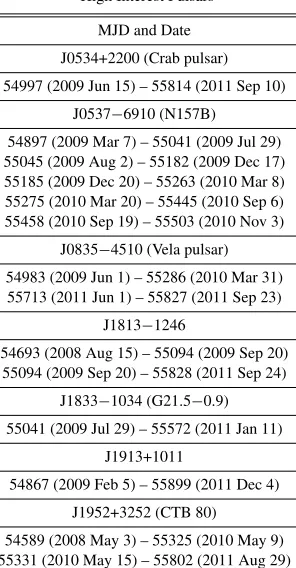
Table 2
Electromagnetic Observation Epochs for the High Interest Pulsars
MJD and Date J0534+2200 (Crab pulsar) 54997 (2009 Jun 15) – 55814 (2011 Sep 10)
J0537−6910 (N157B) 54897 (2009 Mar 7) – 55041 (2009 Jul 29) 55045 (2009 Aug 2) – 55182 (2009 Dec 17) 55185 (2009 Dec 20) – 55263 (2010 Mar 8) 55275 (2010 Mar 20) – 55445 (2010 Sep 6) 55458 (2010 Sep 19) – 55503 (2010 Nov 3)
J0835−4510 (Vela pulsar) 54983 (2009 Jun 1) – 55286 (2010 Mar 31) 55713 (2011 Jun 1) – 55827 (2011 Sep 23)
J1813−1246
54693 (2008 Aug 15) – 55094 (2009 Sep 20) 55094 (2009 Sep 20) – 55828 (2011 Sep 24)
J1833−1034 (G21.5−0.9) 55041 (2009 Jul 29) – 55572 (2011 Jan 11)
J1913+1011
54867 (2009 Feb 5) – 55899 (2011 Dec 4) J1952+3252 (CTB 80) 54589 (2008 May 3) – 55325 (2010 May 9) 55331 (2010 May 15) – 55802 (2011 Aug 29)
and have characteristic ages151greater than a few times 108yr,
implying a comparatively weak surface polar magnetic field (108G B
s 109 G, via the relation for an orthogonal
rotator with radius 10 km and Izz = I38 of Bs = 3.3×
1019(| ˙f
rot|/frot3)1/2G) compared to “normal” pulsars. About 10%
are young pulsars withf˙rotbetween approximately−10−10and
−10−12Hz s−1, characteristic ages of between∼1000 and a few
tens of thousands of years, and therefore with the large implied surface magnetic fields of “normal” pulsars,Bs ∼1012G. They
are situated towards the low-frequency end of our sensitivity range.
Young pulsars have large spin-downs and relatively low frequencies, so in general have the highest gravitational wave spin-down limits, see Equation (5). This makes them particularly important targets as the limits can be within reach of current detectors. Equations (3) and (6) show that to produce emission at around the spin-down limit the required mass quadrupole/ ellipticity would have to be large, at a level consistent with only the most exotic neutron star equations of state (see the discussion in Section4). Such strong emission is unlikely, but its detection would have profound implications. Young pulsars also often show rotational anomalies such as glitches and timing noise (see, e.g., Helfand et al.1980). The underlying causes of such phenomena are still quite uncertain, and gravitational wave data would be a powerful constraint. For the MSPs, the spin-down limits are generally several orders of magnitude below those for the young pulsars. They are located, however, in a more sensitive frequency range.
151Characteristic age is given byτ= −(1/(n−1))(f
rot/f˙rot), which, for a magnetic dipole braking index ofn=3, givesτ= −frot/(2f˙rot), and for purely gravitational wave (quadrupole) spin-down would ben=5, giving
τ= −frot/(4f˙rot) (a “gravitar,” Palomba2005; Knispel & Allen2008).
2.1. Electromagnetic Pulsar Observations
For this analysis, we have obtained ephemerides using radio, X-ray andγ-ray observations. The radio telescope observations have come from a variety of sources: the 12.5-m telescope and Lovell telescope at Jodrell Bank in the UK, the 26-m telescope at Hartebeesthoek in South Africa, the 15-m eXperimental Development Model (XDM) telescope in South Africa, the Giant Metrewave Radio Telescope (GMRT) in India, the Robert C. Byrd Green Bank Radio Telescope in the US, the Parkes radio telescope in Australia, the Nan¸cay Decimetric Radio Telescope in France and the Hobart radio telescope in Australia. High energy X-ray andγ-ray timings have been obtained from the
Rossi X-ray Timing Explorer(RXTE) and theFermiLarge Area Telescope (LAT).
In total, for this analysis, we collected timing solutions for 179 pulsars. This selection includes 73 pulsars that have not been previously studied. However, for five of the pulsars targeted in the S3/S4 analysis (Abbott et al.2007a) and another eleven of the pulsars targeted in the S5 analysis (Abbott et al.2010), new coherent timing solutions were not available, so these stars152
have not been included in this search.
2.1.1. High Interest Targets
As discussed in Abbott et al. (2008),153due to our ignorance
of the correct neutron star equation of state there is a large uncertainty in the moments of inertia for our targets, from 1 to 3×1038 kg m2. Therefore, the canonical spin-down limit
estimates could be increased by a factor of∼1.7. Also, there are uncertainties in some pulsar distance measurements of up to a factor of two which could further increase or decrease the spin-down limit. We therefore identified all sources that were within a factor of four of the canonical spin-down limit as worthy of special attention. Seven of the pulsars for which we have obtained timing solutions beat, or approach to within a factor of four, this limit. The electromagnetic observation epochs for each pulsar (which include each inter-glitch epoch for pulsars that glitched during the analysis) are given in Table2.
Further details of these observations are given below:
J0534+2200 (the Crab pulsar). We have used the Jodrell Bank Monthly Ephemeris (Lyne et al.1993) to track the phase of the Crab pulsar over the period of our runs. This ephemeris has timing solutions using the DE200 solar system ephemeris and the Barycentric Dynamical Time (TDB) time coordinate system. During S6/VSR2,4 the pulsar did not show signs of any timing glitches.
J0537−6910 (N157B). Long-term X-ray timing has been per-formed with theRXTE(Middleditch et al.2006). Recent data covering S6 shows four glitches over the span of our science runs and the ephemerides for each inter-glitch epoch are given in the Appendix. The timing solutions used the DE200 solar system ephemeris (see Marshall et al.
1998) and the TDB time coordinate system. Several more glitches have been observed since the end of our science runs, but we do not report on them here.
152The five additional pulsars targeted in S3/S4 were J1435−6100, J1629−6902, J1757−5322, J1911+0101A and J1911+0101B and the eleven additional pulsars targeted in S5 were J1701−3006B, J1701−3006C, J1748−2446P, J1748−2446ad, J1824−2452B, J1824−2452C, J1824−2452E, J1824−2452F, J1824−2452G, J1824−2452H, J1824−2452J.
J0835−4510 (the Vela pulsar). Radio observations over the period of VSR2 were taken with the Hobart radio telescope in Tasmania and the Hartebeesthoek 26-m radio telescope in South Africa (Abadie et al. 2011). Radio timing over the VSR4 run was performed with the XDM telescope and the 26-m telescope at Hartebeesthoek. The timing solutions have used the DE405 solar system ephemeris and the Barycentric Coordinate Time (TCB) time coordinate system. Vela was observed to glitch on 2010 July 31 (Buchner2010), between VSR2 and VSR4, but it has not glitched since then.
J1813−1246. This pulsar was discovered in a search of gamma-ray data from theFermiLAT (Abdo et al.2009), and using the unbinned maximum likelihood methods of Ray et al. (2011) timing measurements were made covering all our runs. It was observed to glitch once during this time on 2009 September 20. Pre-and-post glitch timing solutions have been produced using the DE405 solar system ephemeris and the TDB time coordinate system.
J1833−1034 (G21.5−0.9). The period from the start of S6/VSR2 until 2011 January is covered by observations made with the GMRT (Roy et al.2012). During this pe-riod, one glitch was observed, with a best fit epoch of 2009 November 6 (MJD 55142±2). To remove its effect, an ephemeris fit was performed on timing data excluding 80 days after the glitch. The timing solution uses the DE405 solar system ephemeris and the TDB time coordinate system.
J1913+1011. This pulsar was observed at Jodrell Bank and showed no timing anomalies over the science runs. The timing solution uses the DE405 solar system ephemeris and the TDB time coordinate system.
J1952+3252 (CTB 80). This pulsar was observed over the whole of our science runs at Nan¸cay and Jodrell Bank. It glitched on 2010 May 11 (MJD 55327), between the end of S6/VSR2 and the start of VSR4. Phase incoherent pre- and post-glitch timing solutions have been produced using the DE405 solar system ephemeris and the TCB time ephemeris. The solution include fits to the timing noise using thetempo2Fitwaves method described in Hobbs et al. (2006).
For several of these pulsars potential constraints on their orientations (the inclinationι and polarization angleψ154) are
available from observations of their pulsar wind nebulae (Ng & Romani 2004, 2008). These are listed in Table 3 where the uncertainties used are estimated from the systematic and statistical values given in Ng & Romani (2004,2008), and the mean angle value is used if multiple fits are given (e.g., fits to the inner and outer tori of the Crab pulsar wind nebula). We briefly discussed how these constraints are used in the analyses in Section1.3.
For J0534+2200 and J0537−6910, the Bayesian method also makes use of results from the LIGO S5 run (Abbott et al.2010) as a prior on theh0and cosιparameters. During S5, both of these
pulsars glitched, and the data for each inter-glitch period was analyzed independently. Results were also produced assuming that the data could be analyzed coherently over the glitches.
[image:9.612.318.571.86.159.2]154In Ng & Romani (2008) the inclination is denoted byζand the position angleΨis equivalent to our polarization angle. Our searches are insensitive to rotations of 90◦in the polarization angle, so our quoted values are rotated into the range−45◦< ψ <45◦.
Table 3
Implied Orientations of Pulsars from their Pulsar Wind Nebulae Observations (Ng & Romani2004,2008)
Pulsar ι ψ
J0534+2200 (Crab pulsar) 62.◦2±1.◦9 35◦.2±1.◦5 J0537−6910 92.◦8±0◦.9 41◦.0±2.◦2 J0835−4510 (Vela pulsar) 63.◦6±0◦.6 40◦.6±0.◦1
J1833−1034 85.◦4±0.◦3 45◦±1◦
J1952+3252a · · · −11◦.5±8.◦6
Note.aThe polarization angle is not taken from a fit to the pulsar wind nebula, but instead is the average of the angle calculated from proper motion measurements and Hαobservations of a bow shock (Ng & Romani2004).
To avoid the assumptions about coherence over the glitches, we have used the independent inter-glitch results that gave the lowesth0 as the prior for the current analysis (see Table 3 of
Abbott et al.2010).
3. RESULTS
None of the searches yielded evidence of a gravitational wave signal, and upper limits have been placed on signal strengths. These limits are subject to the uncertainties in the amplitude calibration, as discussed in Section1.2. For the joint results, which combine data from multiple detectors, the sensitivity is often dominated by the most sensitive instrument. Therefore, we expect the amplitude uncertainty due to calibration uncertainties to also be dominated by the most sensitive instrument. So, following the calibration error given in Section 1.2, below ∼50 Hz we have an amplitude uncertainty of∼6%, and above that we have uncertainty of∼20%. The phase uncertainties are small enough to have a negligible contribution to the possible amplitude uncertainty.
3.1. Data Selection
As discussed in Section 2.1, for a few pulsars the electro-magnetic observations did not always span the S6/VSR2,4 runs completely, and some pulsars glitched during the runs. As a re-sult, we deal with these instances separately. In most cases, we can use all the data coherently, but, in other cases, sections of data must be combined incoherently. The relative sensitivities of the detectors at the pulsar frequencies also dictate whether we have used Virgo-only, LIGO-only or Virgo and LIGO data (see Figure1). For J0537−6910, only the LIGO data has been used
because of its better sensitivity at the corresponding frequency, and results from each inter-glitch period have been combined in-coherently. For J0835−4510 (the Vela pulsar), a glitch occurred just prior to VSR4 and we had no phase-connected timing solu-tion between VSR2 (Abadie et al.2011) and VSR4 epochs. The VSR2 results and VSR4 data have therefore been incoherently combined. For J1813−1246, the results from the pre- and post-glitch periods using all data from S6 and VSR2,4 have been combined incoherently. For J1833−1034, only VSR2 data up to the time of the observed glitch has been used.
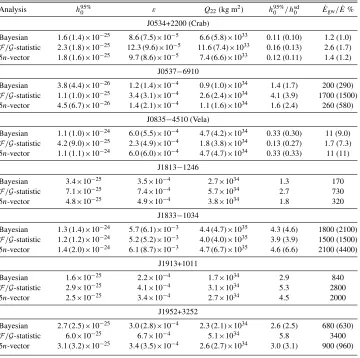
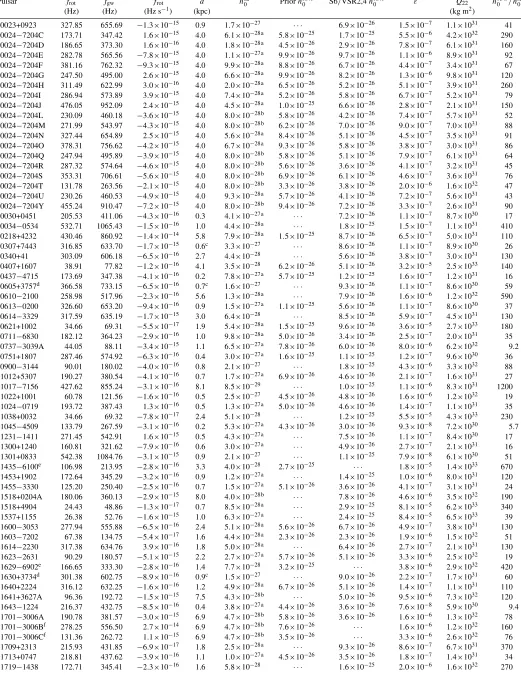
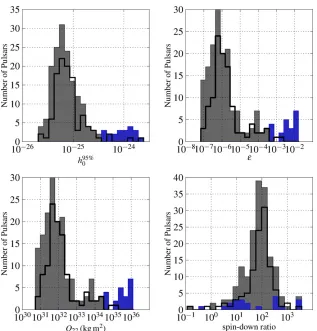
The parameters and results (from the three different analyses discussed in Section 1.3) for the seven pulsars highlighted in Section2.1are given in Tables4 and5, respectively. Table5
gives the 95% upper limit on the gravitational wave amplitude, h95%0 , the equivalent limits (via Equation (3)) on the stars fiducial ellipticity,ε, and mass quadrupole moment,Q22, the ratio of the
101 102 103 Gravitational-wave Frequency (Hz)
10−27
10−26
10−25
10−24
10−23
Strain
Sensitivity
S3/S4
VSR2/4
S5
S6
[image:10.612.150.464.56.291.2]AdV/aLIGO
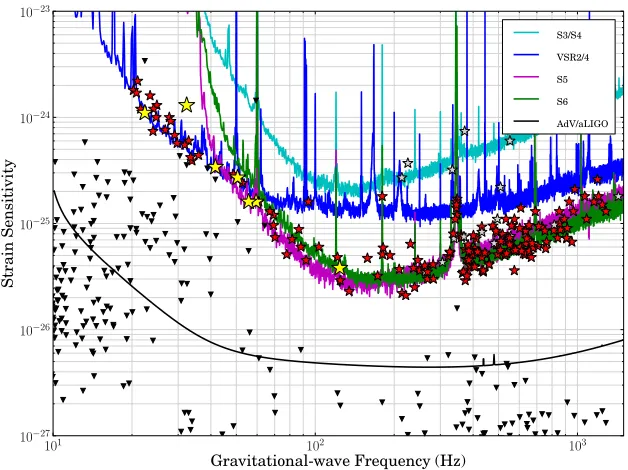
Figure 1.h95%
0 upper limits (given by) for 195 pulsars from the LIGO and Virgo S3/S4, S5, S6, VSR2, and VSR4 runs. The curves give estimated relative strain sensitivities of these runs and potential future science runs. The sensitivities are based on the harmonic mean of the observation time (T) weighted one-sided power spectral densitiesSnfrom all detectors operating during the given run, and are given by 10.8√Sn/T, where the scale factor of 10.8 is given in Dupuis & Woan (2005).
The AdV/aLIGO curve assumes a joint analysis of two equally sensitive advanced LIGO detectors and the advanced Virgo detector operating at their full design sensitivities with one year of coherent integration (the sensitivity curves are those given in Aasi et al.2013c). Thegive the spin-down limits for all (non-Globular Cluster) pulsars, based on values taken from the ATNF catalog and assuming the canonical moment of inertia. Theshow the observational upper limits from Tables5,6, and7, with the seven high interest pulsars represented by the larger, lighter colored stars. Results for pulsars using the previous S3/S4 and S5 data are given by the small lighter colored stars.
[image:10.612.70.546.406.508.2](A color version of this figure is available in the online journal.)
Table 4
The Properties of the Pulsars of High Interest
Pulsar α δ frot fgw f˙rot d E˙a hsda
(Hz) (Hz) (Hz s−1) (kpc) (W)
J0534+2200 (Crab) 05h34m31s.97 22◦0052.07 29.72 59.44 −3.7×10⁻¹⁰ 2.0b 4.6×1031 1.4×10⁻²⁴ J0537−6910 (N157B) 05h37m47s.36 −69◦1020.40 61.97 123.94 −2.0×10⁻¹⁰ 50.0c 4.9×1031 3.0×10⁻²⁶ J0835−4510 (Vela) 08h35m20s.61 −45◦1034.88 11.19 22.39 −1.6×10⁻¹¹ 0.29d 6.9×1029 3.3×10⁻²⁴ J1813−1246 18h13m23s.74 −12◦4600.86 20.80 41.60 −7.6×10⁻¹² 1.9e 6.2×1029 2.6×10⁻²⁵ J1833−1034 (G21.5−0.9) 18h33m33s.61 −10◦3416.61 16.16 32.33 −5.3×10⁻¹¹ 4.8f 3.4×1030 3.0×10⁻²⁵ J1913+1011 19h13m20s.34 10◦1123.11 27.85 55.70 −2.6×10⁻¹² 4.5g 2.8×1029 2.3×10⁻²⁵ J1952+3252 (CTB 80) 19h52m58s.11 32◦5241.24 25.30 50.59 −3.7×10⁻¹² 3.0g 3.7×1029 1.0×10⁻²⁵
Notes.
aThe spin-down luminosity,E˙, and spin-down gravitational wave amplitude limit,hsd, both assume a canonical moment of inertia ofI
zz=1038kg m2.
bSee Appendix of Kaplan et al. (2008). cPietrzy´nski et al. (2013).
dDodson et al. (2003).
eThis distance is the average of the two estimates from Wang (2011), which allow a distance between∼0.9–3.5 kpc. fTian & Leahy (2008).
gThe distance is taken from the ATNF pulsar catalog (Manchester et al.2005).
of the spin-down luminosity required to produce a gravitational wave at the amplitude limit (it can be seen from Equation (4) that this is just the square of the ratioh95%0 / hsd0). For those pulsars with constrained orientations (see Table3) the results with and without the constraints are also given in Table5. Despite the very tight constraints given in Table3it should be noted that these results would only show minor differences if the angle (ιandψ) errors were expanded to several times the given values. This is because the recovered posterior probability distributions on these parameters are slowly and smoothly varying over their parameter ranges. A brief discussion of the differences between the upper limits from the different methods is given in Section1.3.
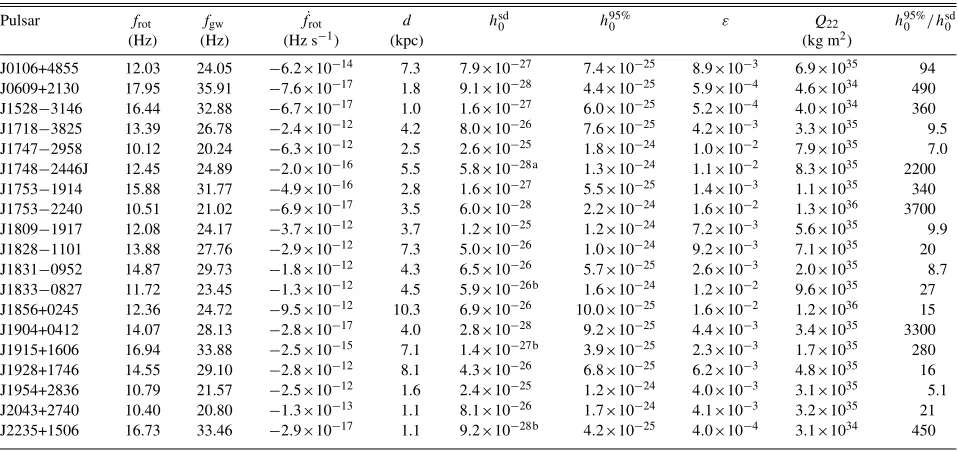
One of the new targets, J1824−2452I (which is an interesting pulsar that is seen to switch between being accretion and rotation powered; Papitto et al.2013), had a coherent timing solution that covered 2006, so S5 data from the LIGO detectors has been reanalyzed for this result. For all other pulsars, we have used only the VSR2 and VSR4 data iffgw <40 Hz, and have coherently combined VSR2, VSR4 and S6 data from H1 and L1 for pulsars withfgw >40 Hz. All the available science mode
data (i.e., when the detectors were operating in a stable state) has been used, with details given in Table1.