Bandwidth Ef
fi
cient Multi-Station Wireless Streaming Based on
Complete Complementary Sequences
Chadi Khirallah, Vladimir Stankovi´c, Lina Stankovi´c, Yang Yang, and Zixiang Xiong
Abstract—Data streaming from multiple base stations to a client is recognized as a robust technique for multimedia stream-ing. However the resulting transmission in parallel over wireless channels poses serious challenges, especially multiple access interference, multipath fading, noise effects and synchronization. Spread spectrum techniques seem the obvious choice to mitigate these effects, but at the cost of increased bandwidth requirements. This paper proposes a solution that exploits complete comple-mentary spectrum spreading and data compression techniques jointly to resolve the communication challenges whilst ensuring
efficient use of spectrum and acceptable bit error rate. Our
proposed spreading scheme reduces the required transmission bandwidth by exploiting correlation among information present at multiple base stations. Results obtained show 1.75 Mchip/sec
(or 25%) reduction in transmission rate, with only up to 6 dB
loss in frequency-selective channel compared to a straightforward solution based solely on complete complementary spectrum spreading.
Index Terms—Data streaming, spread spectrum technology, fading, multiuser detection.
I. INTRODUCTION
M
ULTI-SERVER communication, in the form ofmul-timedia downloading and streaming in parallel from multiple sites over wireline networks, has become very at-tractive, so much so that many efficient solutions have been developed [1], [2], [3], [4]. This is because multi-server streaming, compared to the traditional single-server streaming, has numerous advantages, namely: (i) reconstructed video is of better quality due to path diversity gain, (ii) resilience to server failure is improved, i.e., when a server fails (for example, due to too many incoming requests), remaining servers can maintain communications, (iii) security can be enhanced by a properly designed coding scheme (e.g., two servers can send two complementary parts of the source information, with the client requiring both parts in order to recover the source).
Research on multi-server streaming has mainly focused on thefixed packet network scenario, such as streaming over the Internet. However, with the imminent large-scale deployment of the mobile WiMAX standard, which supports the possibility
Manuscript received August 28, 2007; revised December 5, 2007; accepted March 27, 2008. The associate editor coordinating the review of this letter and approving it for publication was J. Zhang.
C. Khirallah, V. Stankovi´c, and L. Stankovi´c are with the Dept. of Electronic and Electrical Engineering, University of Strathclyde, Glasgow, UK (e-mail: {chadi.khirallah, vladimir.stankovic, lina.stankovic}@eee.strath.ac.uk).
Y. Yang and Z. Xiong are with the Dept. of Electrical and Computer Engineering, Texas A&M University, College Station, TX 77840, USA (e-mail {yangyang, zx}@ece.tamu.edu).
This work was supported in part by EPSRC Grant EP/E021964/2. This paper was presented in part at the Allerton-2007 Conference, Monticello, IL, Sept. 2007, and PCS-2007, Lisbon, Portugal, Nov. 2007.
Digital Object Identifier 10.1109/TWC.2009.070958
of employing two base stations (BSs) for multimedia transmis-sion to a client device [5], wireless streaming from multiple base stations is a realistic scenario. This multi-station setup is also applicable to wireless ad hoc networks, and in wireless peer-to-peer networks, where the same or similar video content is streamed from multiple network nodes to a mobile receiver. Thus, we consider the problem of multi-station streaming over wireless channels to mobile receivers/clients. Our wireless multi-station streaming solution will enjoy smooth handover because the client is always connected to at least one BS (during transition/handover to another), and traffic load can be dynamically adjusted depending on channel conditions, e.g., when one channel is in a deep fade, the others will be loaded more heavily, thus yielding large spatial diversity gain.
Multi-station wireless streaming of data requires that base stations are located in close proximity so that the target users are within range of more than one BS at any time. This implies that spread spectrum modulation is necessary to mitigate fading, multiple access interference, and channel noise effects that arise from this setup. The main issues that must be resolved here are multiple access (since a client simultaneously receives streams from at least two BSs) and synchronization (of the incoming streams from multiple BSs). Typically, data will be spread separately at each BS; at the receiver, the streams received from different BSs are separated using despreading. Spreading provides effective interference reduction and protection, but at the expense of increased band-width. Indeed, better protection implies designing spreading sequences with larger redundancy or bandwidth requirements. However, often in wireless networks, the system can only afford very limited spreading. Therefore, using conventional spreading techniques will double the total sending load if two BSs are used for streaming the same content from two sites simultaneously.
In this paper, we attempt to reduce the required bandwidth by exploiting the fact that the same source, or two highly correlated sources, are streamed over two wireless channels. ‘Distributed compression’ is performed by puncturing the spreading sequence components, prior to transmission, de-pending on channel conditions. The main idea is to puncture the output stream of a BS before transmission (i.e., to remove part of spread signal) leading to reduced transmission rate. We consider two cases: (i) when the source information at the streaming BSs is identical (streaming from multiple BSs), (ii) and when the BSs are provided with correlated information (which arises, e.g., in sensor networks or stereo video appli-cations). We also design a de-spread scheme at the decoder which combines the received streams by exploiting correlation among the sources at different BSs, and recovers the original
data. Specifically, we propose the use of complete comple-mentary (CC) sequences to perform spreading [6]. Our system design takes advantage of the ideal correlation properties of the CC sequences, namely, zero cross-correlation and zero out-of-phase auto-correlation [7], that allow a receiver to separate mixed signals from streaming BSs andfilter out delayed copies of received signals caused by multipath propagation.
CC sequences have already been employed in downlink and uplink wireless communication scenarios with flat- and frequency-selective fading, showing competitive performance and improved spectral efficiency compared to standard spread-ing sequences [8]. However, we focus on further bandwidth reduction in a multiple-station scenario by exploiting corre-lation information present among these BSs. The emphasis is in designing a source-independent CC coding scheme for robust delivery of highly correlated data from two or more asynchronous BSs to a mobile client. To achieve this further bandwidth reduction, straightforward application of CC se-quences is not possible because of loss of orthogonality caused by puncturing. We thus develop a new encoding scheme and a corresponding iterative decoding scheme based on CC sequences that provide both multiple access and robustness to interference and fading, while removing the redundancy in the transmitted data stream. Hence our system (i) inherits the advantages of CC sequences over traditional spreading sequences, (ii) achieves bandwidth reduction beyond what is possible by straightforward use of CC sequences. The designs are independent of the source data, and can be applied to any parallel transmission such as video, audio, or still
images. We show that our scheme achieves a 25% saving
in bandwidth with a small performance loss compared to a standard spreading system that does not perform puncturing.
The paper is organized as follows. In the next section we briefly review key properties of CC sequences. In Section III we describe our proposed design for multi-station streaming including multi-station transmission and iterative decoder de-sign. Our experimental results are presented in Section IV, followed by conclusions and future work in Section V.
II. COMPLETECOMPLEMENTARYSEQUENCES
CC sequences exhibit three fundamental differences com-pared to other well-known spreading sequences (such as Gold sequences, m-sequences, Walsh Hadamard sequences, etc.). Firstly, the mutual orthogonality of CC sequences is observed between ‘sets’ (of constituent sequences), rather than between constituent sequences. Secondly, the processing gain of the CC sequences equals to the aggregate length of all sequences in each set. Thirdly, CC sequences possess unique correlation properties with zero cross-correlation and zero out-of-phase auto-correlation for any relative shifts between two sequences. The performance of CC sequences surpasses that of any of the standard spreading sequences because of these ideal correlation properties [7], [9].
Systems based on CC sequences use the offset stacked (OS) spreading modulation technique [7] to spread data before transmitting different CC element sequences on orthogonal carrier frequencies. Due to the OS technique, systems are inherently capable of multirate transmission simply by shifting
different number of chips between consecutive spread symbols to speed up or slow down the data rate. No complex rate matching algorithms are needed. This makes CC sequences very attractive for real-time services, e.g., video streaming, with variable rate requirements to which data rate change should be made scalable and continuous.
According to [7], in order for N sets, each made up ofN
sequences, to be CC sequences of orderN, they must satisfy the following properties: (i) the sum of theN auto-correlation functions for each set is zero for any shift except the zero shift (this set is called ‘auto-complementary sequence of orderN’); (ii) the sum of theN cross-correlation functions between two sets ofN sequences is zero for any shift (each of these two
sets is called ‘cross-complementary sequence of order N’).
CC sequences can be generated as in [9].
Traditionally, each user in a cellular communication system is assigned a unique set of CC sequences. Since the total
number of available sets is N = √k = 2j , j = 1,2, ...,
with k being the length of each element sequence, then
the total number of users in one cell of the system is N.
For example, when k=4, the total number of available CC
sets is N=2; the first set, X, assigned to the first user,
consists of two element sequences w11 = [+,+,+,−] and
w12 = [+,−,+,+], while the second set, Y, assigned to
the second user, contains w21 = [+,+,−,+] and w22 =
[+,−,−,−] (here, “+" denotes +1 and “-" is -1). The
auto-correlation functions for CC sequence sets X and Y are
ΨXX = w11⊕w11+w12⊕w12 = [0,0,0,8,0,0,0]and ΨY Y =w21⊕w21+w22⊕w22 = [0,0,0,8,0,0,0], where ⊕ denotes the shift-and-add operation. The cross-correlation
functions between CC sets X and Y are the sum of all
cross-correlation functions between any pair of constituent
sequences in those sets ΨXY =w11⊕w21+w12⊕w22=
[0,0,0,0,0,0,0].
CC element sequences can be sent to the receiver either in parallel using different orthogonal carriers, such as in multi-carrier transmission, or serially where all constituent element sequences are sent using the same carrier. In this paper, the former approach is adopted with two carrier frequencies.
III. PROPOSEDSYSTEM
This section describes our system set-up for efficiently streaming data from multiple BSs over wireless links. Only
N = 2 BSs are used as example in this paper for ease of
presentation, but the methodology and results are more general
and can be extended to N >2 BSs. The maximum number
of streaming BSs is bounded to the maximum number of
available CC sets N or vice versa. We address the scenario
where the BSs stream identical or correlated source data to the client. It is assumed that the client is in the range of these BSs during the entire communication period, and the influence of all other clients is treated as noise.
A. Spreading at the base station
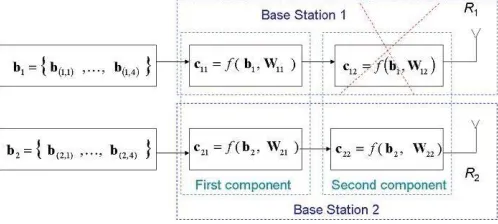
Fig. 1. An example of spreading two source blocksb1andb2, which consist
of four symbols each, using four CC sequences of lengthk=4. The second component of the spread signal transmitted from BS1,c12, is punctured. The
two BSs transmit at ratesR1 andR2, respectively.
time shifts induced either by a time-delay spread of a multi-path fading channel and/or asynchronous transmission from multiple BSs to a client. Source sequences are partitioned into source blocksb1andb2 of lengthk symbols (e.g., bits) present at BS1 and BS2, respectively. As mentioned in Section II, in conventional CC spreading, the transmitted spread signal
consists of N = √k components that are transmitted in
parallel over N orthogonal carrier frequencies. In this two-station example, we use a CC element sequence of length four, i.e.,k = 4and N = 2. Applying the spread-and-shift of the OS spreading technique, for each block of four data symbols, seven chips are transmitted at each of the two frequencies from each BS or 14 chips in total over both carriers. BS1 uses CC
sequencesw11 andw12, whilst BS2 uses sequencesw21 and
w22 for spreading. BS1 encodesb1withw11 into the spread
sequencec11, as shown in Fig. 1, and sends it on frequency
f1; at the same time, it uses w12 to spread the same source block intoc12, and sends it on frequencyf2. Similarly, BS2 encodesb2usingw21andw22intoc21andc22, respectively, and transmits them on frequencyf1 andf2, respectively.
Let Gbe the spreading factor defined as the ratio between the length (number of chips) of the output sequencecij,i, j= {1,2}, and the length of the source sequence k per carrier frequency. The transmission rate Ri is defined as the total
number of chips sent per source symbol from BSi (i= 1,2) on both carrier frequencies. For the conventional spreading
case [7], each user is assigned one set of N = 2 element
sequences to be used to spread all source symbols. This results
in transmission rate Ri = NG. For the above example we
havek= 4, G= 7/4 andRi = 14/4 = 3.5 for each of the
two carrier frequencies; the total rate from the two BSs to the client is thenR=R1+R2= 7 chips per source symbol.
However, the number of transmitted chips can be reduced by puncturing some of the transmitted chips (see Fig. 1), thus facilitating rate/bandwidth adaptability. The number of punctured chips and the best puncturing pattern depend on the quality of the transmission channel between the BSs and the client. An example of the rate reduction process is shown in Fig. 1, where BS1 sends only thefirst spread signal component c11 and BS2 sends both c21 and c22. This results in a total
transmission rate of R = R1+R2 = 3/2NG, which in
the case of k=4, N=2, and G=7/4 results in R=21/4=5.25
chips per source symbol. In order to evenly load both BSs, for the next source block, BS1 transmits both its component
sequences,c11 andc12, while BS2 sends only one, i.e., c21. In general, different rate allocations between the two BSs are possible, as long as the total transmission rateR is large enough to decode; this depends on the available channels between the BSs and the client and the correlation among the sources. The client can optimize rate allocation among the BSs by exploiting channel information obtained via feedback. The client can first sort the channels (from each BS) according to their highest estimated channel coefficient values, and then report this result to the BSs, which perform puncturing accordingly. Hence, the best puncturing pattern will depend on channel statistics collected at the client side. We do not focus in this paper on finding the optimal puncturing pattern based on channel statistics, but we use the intuitive fact that BSs with better channels should puncture more signals in order to maximize performance.
Although the idea of puncturing may seem straightforward, simply puncturing spread chips of one or more transmitted signal components will result in loss of mutual orthogonality between the sets of CC sequences. Note that orthogonality is established between sets of all sequences used in spreading [7]. Hence, we cannot use conventional despreading at the client. We propose a novel despreading decoder, which is iterative, that enables recovery of mutual orthogonality. Such a decoder, described below, needs to exploit correlation among the two source sequences and remove redundancy in the transmitted signals.
B. Client-side detection: Iterative decoder design
At the client side, estimation of the original streams is performed iteratively. The gist of our iterative decoder is best explained by means of an example.
Let ˆh1 and ˆh2 denote the estimated channel coefficients from BS1 and BS2 to the client, respectively. In this example,
we assume flat fading for simplicity, and perfect channel
knowledge at the client. When we implement the decoder for frequency-selective fading channel, we use an additional Suc-cessive Interference Canceller (SIC) to eliminate Intersymbol interference (ISI) resulting at each despread stage [9]. Suppose that the client reported channel coefficientsˆh1 andˆh2 to the BSs and that||ˆh1||2>||ˆh2||2. Since the channel from BS1 is better, BS1 decides to send only one spread sequence, sayc11, while BS2 sends bothc21andc22. Let the signals received at the decoder at frequencyf1andf2be:r1=h1c11+h2c21+z1 and r2= 0 +h2c22+z2, respectively, wherez1 and z2 are white Gaussian noise, each of unit power and independent of sent signals and each other.
The decoder in Fig. 2 starts by despreading received signals r={r1,r2}using conventional CC sequences correlators [9]. Thefirst signal component is transmitted from BS1 on carrier frequencyf1 and is contained only in the received signal r1.
Hence, the decoder obtains the estimate ofb1sequence from
r1at thefirst iteration asb1ˆ (1). Letlbe initialized to 1. Then, at the l-th iteration, the decoding algorithm is as follows:
• The estimated sequence b1ˆ (l) is spread using BS1’s
Fig. 2. Block diagram of the proposed iterative decoder.
Next, BS2’s source block sequence is estimated asb2ˆ (l)
by conventional despreading fromˆr1.
• b2ˆ (l)instead ofb1ˆ (l)(since the sources are assumed to be highly correlated) is further spread using the second CC sequence assigned to BS1,w12, to estimate the sec-ond signal componentc12(which was punctured at BS1); this way,ˆc12(l)is obtained, which is then multiplied by the channel coefficientˆh1. (Note that, in the case when the decoder knows the correlation between the source sequencesb1andb2, prior to spreading, it can passb2ˆ (l) through a “virtual" correlation channel to obtainb1ˆ (l); however, in this paper we assume no such knowledge at the decoder.)
• The symbols belonging to BS1 are extracted, asb1ˆ (l+
1), by despreading the constructed sequence d1 =
{ˆh1ˆc11,ˆh1ˆc12(l+ 1)}.
• Counterlis incremented, and the above steps are repeated until a satisfactory bit error rate (BER) performance for estimatedb1andb2 is reached.
The two source sequences at the two BSs can be identical, or they can be two correlated sequences, e.g., two different views of the same scene in stereo video coding. In the next section, we provide simulation results for both cases.
IV. SIMULATIONRESULTS
In all our simulations we assume uniform random binary sources at the two streaming BSs, whose correlation is mod-eled as a binary symmetric channel (BSC) with crossover probabilityp; p= 0 implies that both sources are identical. The source rate is set to 1 Msymbol/sec. We use CC element
sequences of length k=4 and two carrier frequencies, such
that G=7/4. All our results are averaged over 1,000,000
symbols transmitted per BS. BSs stream data asynchronously - simulated by an inter-BS shift of one chip - to a mobile client with relative client-BS speeds of 30 and 120 km/hr. The combined transmission rate at the client for the proposed
system, R = R1 + R2=5.25 Mchip/sec, is obtained by
alternatingly puncturing output signal components,cij, of the
two BSs, as described in Section II. Results for a conventional CC spreading system without puncturing (hence, the combined rate at the client is R=7 Mchip/sec, whereR1 = R2 = 3.5 Mchip/sec) are included as a benchmark.
Our channel model is set up with the following parameters: (i) a frequency-selective Rayleigh fading distribution; (ii) each
5 5.5 6 6.5 7 7.5 8 8.5 9 9.5 10 1.0E−4
1.0E−3 1.0E−2
SNR [dB]
BER
no puncturing p = 0 p = 1.0e−5 p = 1.0e−4 p = 1.0e−3 p = 1.0e−2
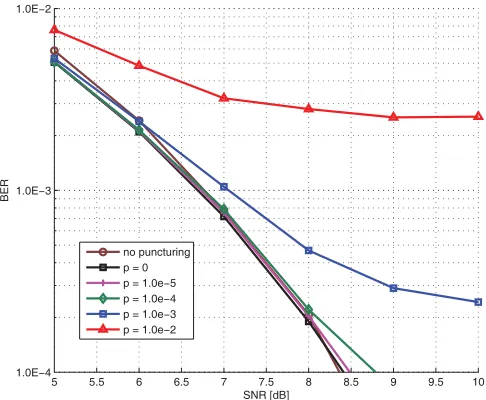
Fig. 3. BER vs SNR for the AWGN channel.
10 14 18 22 26 30
1.0E−4 1.0E−3 1.0E−2
SNR [dB]
Avg. BER
CPR = − 10 [dB], p = 1.0e−3
CPR = − 10 [dB], p = 1.0e−4
CPR = − 10 [dB], p = 0
CPR = − 10 [dB], no puncturing
CPR = − infinity [dB], p = 1.0e−3
CPR = − infinity [dB], p = 1.0e−4
CPR = − infinity [dB], p = 0
CPR = − infinity [dB], no puncturing
Fig. 4. BER vs SNR for relative client-BS speed of 30 km/hr.
sub-channel between a BS and a client has two paths with the second path delayed by one chip. Perfect channel estimation is assumed. The channel power ratio (CPR) is defined as the average power ratio between the second andfirst paths.
We show the results for: (i) conventional CC system (no
compression) with two identical sources (p=0), (ii)
com-pression of identical sources (p=0), and (iii) compression of correlated sources (p= 10−4 andp= 10−3).
Fig. 3 shows BER results for the Additive White Gaussian Noise (AWGN) case. The channels from the two BSs are simulated with the same signal-to-noise ratio (SNR). As observed, there is almost no performance loss when puncturing is used. Note that good results are obtained as long as the crossover probability p is less than or equal to 0.001. It is obvious that the puncturing rate used is too high forp= 0.01, since the curves hit the error floor at BER>10−3.
[image:4.585.315.558.43.243.2] [image:4.585.56.298.52.179.2] [image:4.585.314.560.276.456.2]10 14 18 22 26 30 1.0E−4
1.0E−3 1.0E−2
SNR [dB]
Avg BER
CPR = − 10 [dB], p = 1.0−4 CPR = − 10 [dB], p = 0 CPR = − 10 [dB], no puncturing CPR = − infinity [dB], p = 1.0e−4 CPR = − infinity [dB], p = 0 CPR = − infinity [dB], no puncturing
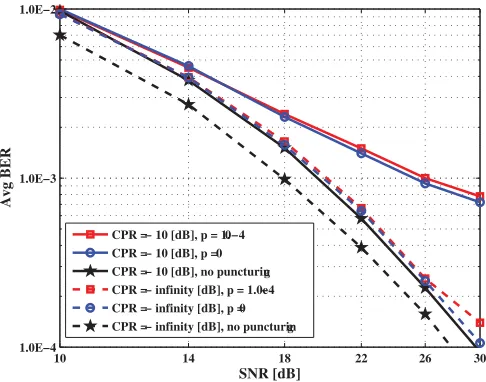
Fig. 5. BER vs SNR for relative client-BS speed of 120 km/hr.
and CPR=-∞ dB (flat-fading channel) with relative client-BS speeds of 30 and 120 km/hr are shown in Figs. 4 and 5, respectively. We observe in Fig. 4 that the proposed system
achieves almost error-free performance with BER≤ 10−3,
CPR = -10 dB and p ≤ 10−4 at SNR≈ 25 dB, with
degradation of almost 6 dB from theflat fading case. Similar results are obtained for the 120 km/hr speed case, as shown in Fig. 5. This demonstrates the robust system performance with variable client-BS speeds. The loss with respect to the conventional system without compression is larger for the frequency-selective case (CPR=-10 dB). This degradation is due to the error propagation problem associated with the single iteration feedback stage used in the SIC algorithm.
V. CONCLUSIONS ANDFUTUREWORK
In this paper, a solution for data streaming from multiple base stations is proposed that is robust to multiple access interference, fading and asynchronous parallel transmissions over frequency-selective wireless channels. The properties of Complete Complementary spreading sequences are exploited together with correlation information among sources. A new
low complexity iterative decoder is developed that combines the streams received from both wireless BSs to recover from the loss of mutual orthogonality caused by puncturing spread sequences at the BS. Our design achieves 1.75Mchip/sec (or 25%) rate reduction at the client side, over a conventional spreading system (without puncturing) with acceptable loss in BER performance.
In future work we intend to look further into the challenges of multimedia streaming over multiple BSs, including dis-tributed compression, optimal rate and power allocation among the BSs, and the effects of correlated fading channels, which all need to be resolved before practical deployment of the system. Short term investigations include the possibility of: (i) achieving a more flexible rate trade-off among BSs using longer CC sequences and variable puncturing rates (in this
paper a puncturing rate of 50%is used), (ii) improving BER
performance using more iterations at the decoder, channel coding, and a SIC more robust to error propagation.
REFERENCES
[1] J. G. Apostolopoulos, T. Wong, W. Tan, and S. Wee, “On multiple description streaming with content delivery networks," inProc. IEEE INFOCOM-2002,New York, NY, June 2002.
[2] J. P. Wagner and P. Frossard, “Adaptive and robust media streaming over multiple channels with burst losses," inProc. EUSIPCO-2007 15th European Signal Processing Conference,Poznan, Poland, Sept. 2007. [3] P. Chou, V. Padmanabhan, H. Wang, and K. Sripanidkulchai,
“Distribut-ing stream“Distribut-ing media content us“Distribut-ing cooperative network“Distribut-ing," inProc. ACM NOSSDAV,Miami Beach, FL, May 2002.
[4] T. Nguyen and A. Zakhor, “Multiple sender distributed video streaming,"
IEEE Trans. Multimedia,vol. 6, pp. 315-326, Apr. 2004.
[5] J. Wang, M. Venkatachalam, and Y. Fang, “System architecture and cross-layer optimization of video broadcast over WiMAX," IEEE J. Select. Areas Commun.,vol. 25, pp. 712-721, May 2007.
[6] N. Suehiro and M. Hatori, “N-shift cross-orthogonal sequences,"IEEE Trans. Inform. Theory,vol. IT-34, pp. 143-146, 1988.
[7] H. H. Chen, J. F. Yeh, and N. Suehiro, “A multicarrier CDMA archi-tecture based on orthogonal complementary codes for new generations of wideband wireless communications,"IEEE Commun. Mag.,vol. 39 no. 10, pp. 126-135, Oct. 2001.
[8] E. H. Dinan and B. Jabbari, “Spreading codes for direct sequence CDMA and wideband CDMA cellular networks,"IEEE Commun. Mag.,
pp. 48-54, Sept. 1999.
[image:5.585.53.296.43.234.2]