City, University of London Institutional Repository
Citation: Papadrakakis, Manolis (1978). Gradient and relaxation nonlinear techniques for the analysis of cable supported structures. (Unpublished Doctoral thesis, City, University of London)
This is the submitted version of the paper.
This version of the publication may differ from the final published version.
Permanent repository link: http://openaccess.city.ac.uk/21924/ Link to published version:
Copyright and reuse: City Research Online aims to make research outputs of City, University of London available to a wider audience. Copyright and Moral Rights remain with the author(s) and/or copyright holders. URLs from City Research Online may be freely distributed and linked to.
GRADIENT AND RELAXATION NONLINEAR TECHNIQUES FOR THE ANALYSIS OF CABLE SUPPORTED STRUCTURES
A Thesis submitted by Manolis Papadrakakis for the degree of Doctor of Philosophy
The City University,
is -nothing without those amongst whom one lived, from whom one lea:rnt, on whose knowledge one builds up. If only
I, in my way, oan some da.y be of use !"
LIST OF COMPUTER PROGRAMS
ABSTRACT
ACKNOWLEDGEMENTS
CHAPTER 1 : INTRODUCTION
.
1 .1. The Characteristics of Tension Structures
1 .2. State of the Art
1.3. Review of the Literature
CHAPTER 2 : ENERGY SEARCH APPROACH
2, 1. Energy Formulations
2 .2. Unconstrained Minimization
2. 3. Assumptions
2 ,4. The Total Potential Energy
2, 5, The Gradient Vector
2. 6, The Matrix of Second Partial Derivatives
2. 7, Scaling Effects of Iterative Methods
2.8. Termination Criteria
2, 9. Test Problems
CHAPTER 3 : GRADIENT METHODS
3. 1. Introduction
3.Z The Conjugate Gradient Algorithm
20 - 42
20
25 30
43 - 78
43
46 50
51
·53
55 59
66 69
79 - 102
79
3.3. The Single Variable Search 84
3.3.1. Methods for Bracketing the Solution 85
3.3.2. Methods for Approximating the Minimum 87
3.4. Buchholdt's Method 93.
3.5. Extensions of the CG Algorithm 95 3.5.1. Polak and Ribiere Algorithm 95
3.5.2. Sorenson's Version 96
3.6. The Memory Gradient ~ethod 97 3.7. The Inversion of a Matrix by the CG Method 101
CHAPTER 4 NUMERICAL. STUDIES ON CONJUGATE GRADIENT 103-129 METHODS
4.1. Fletcher and Reeves Method (CGFR) 103
4.2. Stanton's Method (CGST) 106
4.3. Other CG Algorithms 110
4.4. Comparative Study 113
4.5. Conclusions 125
CHAPTER 5 : RELAXATION METHODS 130-179
5.,. Dynamic Relaxation 130
5.1.1. Historical Development . 130
5. 1.2. Formulation of the Iterative Procedure 133 5.1.3. Asymptotic Convergence of Dynamic Relaxation 135 5. 1.4. Evaluation of the Optimum Iteration 139
Parameters
5.2. Methods with Three Term Recursion Formulae 145
5.3. Relation Between Dynamic Relaxation and Tchebycheff 149
methods
5.4. Relation Between Conjugate Gradient and Tchebycheff 151
methods
S.S. The Residual Polynomial 152
5.6. The Conjugate Gradient - Tchebycheff Method 154
5.7. Assessment of the Dynamic Relaxation Parameters 158
5.8. "A Priori" Evaluation of Dynamic Relaxation 162
Parameters
5.9. Automatic Adjustment of the Dynamic Relaxation 164
Parameters
5.10. The Use of Kinetic Damping
5.11. Successive Overelaxation
5.12. The Successive Overelaxation Parameter
5.13. Automatic adjustment of the SOR Parameter
5.14. Application of the Successive Overelaxation
Method to Cable Structures
CHAPTER 6 : THE SPECIAL EIGENVALUE PROBLEM
6.1. Introduction
6.2. The Power Method
6.2. l.Improving the Convergence of the Power
Method
6.3. The Method of Steepest Descent
6.4. The Method of Conjugate Gradients
168
171
175
176
178
180-212
180
182
184
187
6. 5. Optimization of the Conjugate Gradient
Algorithm
6.5.1. Fried's Method
6.5.2. Geradin's Method
6 .6. Convergence and Initial approximation
6.7. Gershgorin Theorem
6.8. Coordinate Relaxation
6.9. Numerical Studies
• 6 .1
o.
ConclusionsCHAPTER 7 : NUMERICAL STUDIES ON RELAXATION METHODS
7 .1.
7.2. 7.3. 7.4. 7.5. 7.6. 7.7.
Dynamic Relaxation Method
Automatic Adjustment of Dynamic Relaxation
Parameters
Kinetic Damping
The Conjugate Gradient-Tchebycheff Method
Successive Overelaxation Method
Comparative Study
Conclusions
CHAPTER 8 : STIFFNESS METHODS
I •
8.1. Linear Equation Systems
8.1.1. Introduction
8.1.2. Jenning's Compact Storage Scheme for the
Solution of Symmetric Linear Simultaneous
8.2. Nonlinear Equation Systems
8.2.1. Introduction
8.2.2. Newton Raphson Type Methods
8.2.3. Incremental Stiffness Procedure
8.2.4. The Perturbation Method
CHAPTER 9 : COMPARATIVE STUDY
9.1. 9.2. 9.3. 9.4. 9.5. 9.6.
Example l Suspension Cable
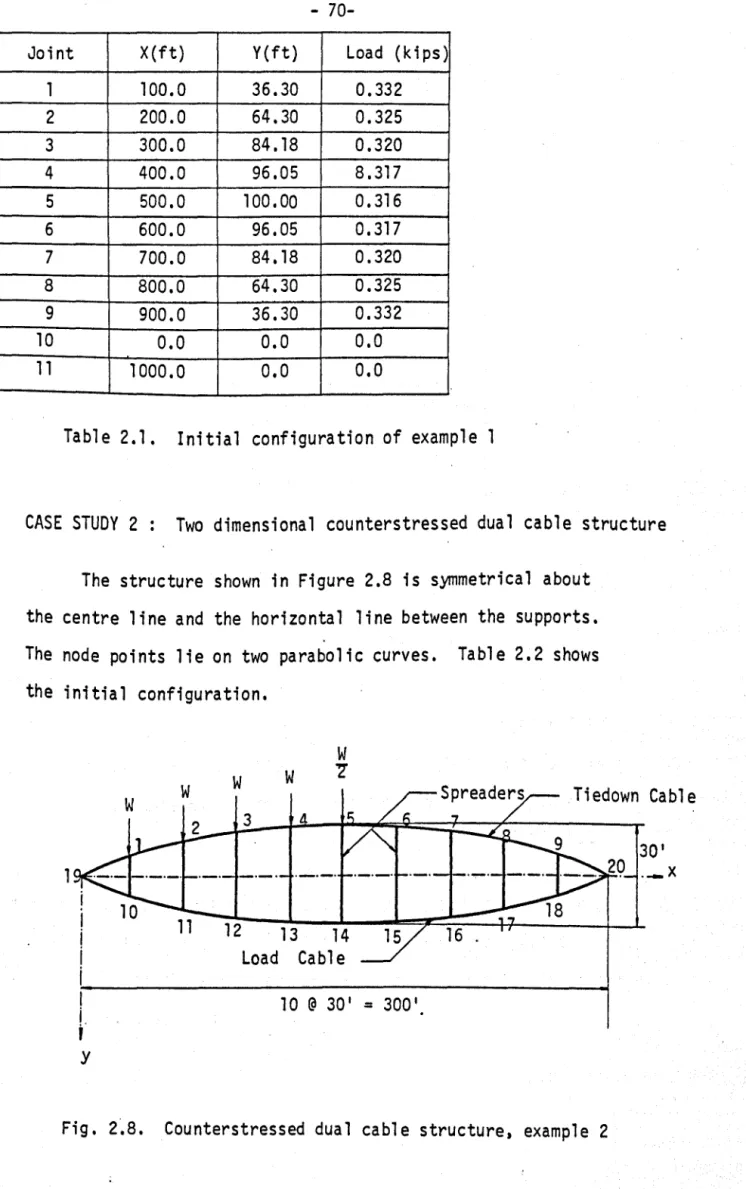
Example 2 Counterstressed Dual Cable
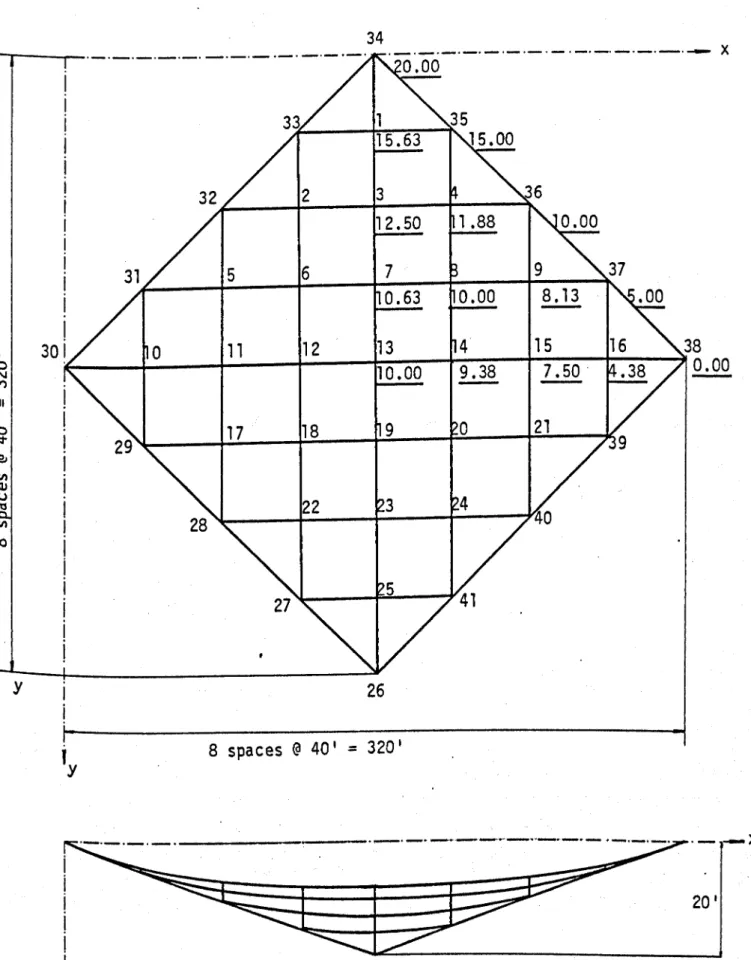
Example 3 Orthogonal Hyperbolic Paraboloid
Prestressed Net
Example 4 : Three Dimensional Counterstressed
Dual Cable Structure
Example 5 : Large Prestressed Net
Conclusions
•CHAPTER 10 : ULTIMATE LOAD ANALYSIS·
10.1. Introduction
10.2. Mathematical Formulation
10.3. Nonlinear Solution Techniques for Ultimate
Load Analysis
10.4, Numerical Studies
255 255 259 266 267 274-292 274 275 277 288 288 290 293-320 293 294 299 300
. 10.4.1. Example 3 Hyperbolic Paraboloid 300
10.4.2. Example 4 Three Dimensional Counterstressed 307
Dual Cable Structure
CHAPTER 11 GENERAL CONCLUSIONS AND SUGGESTIONS
FOR FURTHER WORK
11.l. Conclusions
.11.2. Suggestions for Further Work
REFERENCES
321-329
321
327
Computer Programs for Gradient.Methods
CGFRIN
CGFRIP
CGFRIL
CGFR
CGST
CGSR
CGMEM
CGBUC
CGSTPR
CGSDSR
..
.
The linear CG algorithm with the residuals and the stiffness matrix being modified after each iteration.
The linear CG algorithm with the product Kpi being obtained as the product Kx. and the
1
stiffness matrix being modified after each iteration.
A Newton Raphson iterative technique, with linear solutions obtained from the CG algorithm.
Davidon's linear search as modified by Fletcher and Reeves.
Stanton's technique for bracketing the solution in conjunction with the regular falsi-bisection algorithm.
A combined Stanton-Davidon linear search.
The memory gradient metho~.
Buchholdt's method.
Stanton's linear search with Polak and Ribiere's algorithm for
e.
Stanton's linear search with Sorenson's algorithm for
e.
The symbol "-St" after the abbreviated name of the method means
a scaled version of the method, while the symbol "-Rn" means
that a reinitialization process has been applied every after n
EIGP EIGSD EIGFRl
EIGFR2
EIGCG
EIGGER
EIGCR
The power method.
The steepest descent method.
The CG algorithm with Fried1s modification
(equation (6.36)).
The CG algorithm with Fried1s mtidification
(equation (6.35)).
The conjugate gradient algorithm.
The CG algorithm with Geradin's modifications.
The coordinate relaxation method.
The letter "811 after the abbreviated name of the method means
that the Bradbury and Fletcher orthogonalization process has
been applied.
Computer Programs for Relaxation Methods
DRGR
DRGRFS
DRGRYN
DRAUT
DRKR
The DR m~thod with an "a priori" evaluation of the relaxation parameters and Geradin1s algorithm
for the estimation of the extreme eigenvalues.
The DR method with Flanders and Shortley iteration parameters.
The DR method with Young1s iteration parameters.
The DR method with automatic adjustment of the iteration parameters.
The DR method with kinetic damping and a velocity criterion to avoid divergence.
All the above methods have been applied in their scaled versions.
The symbol "-UNSC" has been used after the abbreviated name when
SORNL
SORES
SORESC
SORESH
The SOR method with the stiffness matrix being updated at each iteration.
The SOR method with the stiffness matrix being held constant and reseting only the residuals.
The SOR method with Carre's algorithm for the automatic evaluation of parameterw .
. The SOR method with Hageman's technique for the automatic evaluation of parameterw.
Computer Programs for Stiffness Methods
NTRA
NTRAJE
The Newton Raphson iteration method with a semi-bandwidth Gaussian elimination technique.
The purpose of this work is to investigate the efficiency
of numerical nonlinear solution procedures when applied to the
static analysis of cable supported structures. Gradient and
relaxation methods are developed and compared with existing
nonlinear solutton techniques. In order to obtain a more
general picture of the performances of the above methods,
stiffness methods with Newton Raphson iterative schemes have
also been included in the comparative study.
Chapter 1 examines the behaviour and characteristics
of cable supported structures and investigates the analytical
requirements for static analysis. A state of the art of numerical
solution techniques used to analyse these structures is
presented. An extensive review of published work in relation
to the analysis of single unstiffened cables, dual cables and
cable networks is also presented.
Chapter 2 approaches the solution of the structural
problem through total energy formu'lations. Three basic energy
formulations are discussed with particular emphasis given to
the total potential energy formulation. The principles of the
unconstrained minimization method are considered
and different search techniques for approximating the minimum
are discussed. Expressions for the gradient vector of the total
potential energy are obtained and the tangent stiffness matrix
criterion used, for different methods of analysis, on the
final accuracy of the methods is also discussed.
In Chapter 3 there is an extensive theoretical treatment
of gradient methods for the nonlinear solution of structural
problems. Particular emphasis is given to the conjugate
gradient algorithm and the modifications proposed by various
investigators since it first appeared in 1952. A number of one
'.dimensional linear searches are studied which approximate
the minimum along the p direction and determine the scalar
parameter a for the next iteration. And extensions of the
conjugate gradient algorithm for the evaluation of the scalar
parameter
e,
as proposed by Sorenson and Polak and Ribiere are discussed, Finally, the memory gradient method which employsa two dimensional linear search for a simultaneously evaluation
of a and
e
is also presented.Chapter 4 examines the efficiency of the methods discussed
in Chapter 3 when applied to the nonlinear solution of a number
of test problems. The problems are selected to have varying
numbers of degrees of freedom and the respective stiffness
matrices to have differing condition numbers in order to
study the response of the methods for different structural
characteristics. The Fletcher and Reeves method with Davidon's
linear search with a cubic equation to approximate the minimum,
Stanton's algorithm for bracketing the solution and the regula
Buchholdt's method, Polak and Ribiere's algorithm, Sorenson's
version, the memory gradient method and a number of linearized
conjugate gradient algorithms are developed and their
convergence characteristics are compared. The effects of scaling
and reinitialization are also studied.
In Chapter 5 there is a theoretical investigation of
relaxation methods and in particular the dynamic relaxation and
the successive overelaxation methods. A rigorous examination
of the characteristic properties of dynamic relaxation is
carried out. The method is treated as a standard eigenvalue
problem for error vectors and expressions for the iteration
parameters are developed with respect to the minimum and maximum
eigenvalue of the current stiffness matrix. A theoretical
comparison of a number of pure iterative methods is performed
and relationships between the iteration or scalar parameters
of the conjugate gradient method, the dynamic relaxation method,
the jacobi semi-iterative method, and the Tchebycheff methods,
are established. This suggests that all these methods in fact
belong to the same family of methods called "three term
recursion formulae". A combined conjugate gradient and Tchebycheff
type method is also studied. A method for the automatic
evaluation of the dynamic relaxation parameters is developed
by the author which can guarantee convergence for almost any
arbitrary initial estimate of the minimum and maximum eigenvalues
of the current stiffness matrix. The concept of using kinetic
energy damping instead of viscous damping in the dynamic
processes for automatic evaluation of the optimum overelaxation
parameter w , proposed by Carre and Hageman, are also examined.
Chapter 6 is devoted to a theoretical and numerical
investigation of the problem of finding the minimum and maximum
eigenvalues of a symmetric matrix. The power method, the steepest
descent method, the conjugate gradient method, and the coordinate
relaxation method, are among the techniques examined and compared
in this Chapter. Several other modifications to the initial
conjugate gradient algorithm are also studied, including the
modification proposed by Fried for the evaluation of the scalar
parameters and the one proposed by Geradin. An orthogonalization
process is also applied to alleviate the dependency of the
convergence of the method on the initial approximation for the
final eigenvector.
I
In Chapter 7 numerical studies of the relaxation methods
discussed in Chapter 5 are performed. Alternative forms of the
dynamic relaxation methods with an "a priori" evaluation of the
iteration parameters (using one of the methods discussed in
Chapter 6), with automatic adjustment of the relaxation parameters
based on the method developed in Chapter 5, and with the
incor-poration of kinetic damping, are applied for different test
problems. Techniques to avoid the occurrence of instability of
the method, when the current maximum eigenvalue of the iteration
of the successive overelaxation method, with both constant
and adjustable relaxation parameters is examined and compared
with the efficiency of the dynamic relaxation method.
In Chapter 8 a review of methods operating through the
formulation of the overall stiffness matrix is carried out.
The efficiency of these methods is dependent on both the
method employed to perform the linear solution when this is
necessary and the nonlinear technique used to approximate the
nonlinear equilibrium position in each iteration. A compact
store elimination scheme, proposed by Jennings, is studied in
conjunction with the Gaussian elimination procedure. Three
different classes of nonlinear techniques are discussed together
with the area in which each one has proved to be more suitable.
Chapter 9 performs a general comparative study of the
convergence characteristics of the best methods from each
classification {gradient, relaxation and stiffness methods},
and examines the advantages and disadvantages involved in the
application of the methods to the nonlinear elastic analysis of
cable supported structures with members being allowed to slacken.
The computer time required to obtain a certain degree of accuracy,
the storage requirements and the cost involved are all examined
and compared in an effort to select the most suitable method
for each particular class of problem.
In Chapter 10 the ultimate load carrying capacity of cable
stiffness method with or without the compact store elimination scheme in conjunction with Newton Raphson iteration, and
I am deeply indepted to Dr. M. R. Barnes for his helpful
supervision and guidance throughout the preparation of this work.
I also would like to thank him for his patient reading of the
manuscript and for giving some useful suggestions. His help is
very much appreciated.
I would like to thank my colleagues Barry Topping and
David Wakefield for their assistance during my stay at The City
University.
I am also grateful to the staff of the Skinners Library
and the Computer Unit of the University for their help.
The typing of the thesis was done very effectively by
Miss M. Williams, for which I am very grateful.
Finally, I would like to thank my wife Anne-Marie for her
care of our daughter Isadora and myself.· This work would not have
CHAPTER 1
INTRO DUCT ION
The capacity to transmit forces and moments by tension loaded cables is found in animate and inanimate nature. The oldest cable nets were built millions of years ago by spiders. The history of the development of nets, produced by people, is lost in antiquity. Many Etruscan and Roman frescos and mosaics show scenes with hunting nets, fishing nets and ship nets. While in China at about 65 AD was recorded the use of vine ropes and metal chains in suspension structures.
Nevertheless the few records which are available on net structures, in contrast to structures subjected to compression and bending, indicate that major achievements were not attained unti 1 _recently.
structures have been built all over the world with resulting
advances in scale, methods of erection and prefabrication,
jointing and clamping details, and numerical design and analysis
procedures.
Although tensile structures built to date show a steady
increase in scale, they perform more or less conventional functions.
On the other hand, there are a number of projects, in different
stages of development, that would utilize a membrane envelope to
enclose a park, a resort, an office building, or even several city
blocks. It is in this area of very wide span structures that the
advantages of tension systems could become most significant. Since
both the technology and the need for such applications exist, their
realization is likely to be a matter of time (Varga (294]).
1.1. The Characteristics of Tension Structures
The primary characteristic of tension structures, is that the
main structural elements, transmitting the applied loads to bearing
structures, consist of high strength flexible cables with the
ability to sustain only tensile forces. The absence of bending
I
moments permits the full utilization of the cross section of the
cables, with permissible stresses not limited by instability effects.
Architects and Engineers have a strong interest in utilizing
suspension systems. This interest results from two factors. The
first factor is aesthetic; the inherent flexibility of the cables
permits further opportunities for architectural expression. The
supporting columns, and with the minimum steel consumption. In
addition they can be mounted on site very rapidly.
The analysis of cable suspended structures differs from that
of ordinary Civil Engineering structures, because they possess the
unique characteristic, that for a given loading condition, the
internal forces and the re~ulting geometry necessary to maintain
equilibrium are interdependent. The usual assumption of
infinitesimal deformations leads to erroneous results when
applied to these type of structures. Thus a valid analysis must
include finite deformations and their effect on internal forces,
i.e., the equations of equilibrium must be written corresponding
to the distorted configuration of the structure. This means that
the principal of superposition looses its validity and that the
governing equations become nonlinear.
Buchholdt [50], has introduced an expression for the degrees
of mechanical freedom for discrete pinjointed assemblies as
DMF = f - m + p ( 1. l)
where f is the number of degrees of freedom of the joints, m is
the number of members and P is the number of linearly independent
force vectors which can be superimposed without disturbing the
equilibrium configuration. The assembly is classified as a
structure when DMF = O, and as a structural mechanism when
DMF > 0. The advantage of equation (1.1) is that the existence
of mechanical freedom can be detected by considering the number
of ways in which an assembly can be prestressed, instead of
not possess an unstrained geometry and it is necessary to relate the deflections to a known equilibrium position of the structure. The geometry of the known equilibrium position replaces the
undeformed geometry· of a rigid structure.
Large displacements in cable systems arise mainly as a result of large rotations experienced by the elements of the structure and not as a result of high strains. Furthermore, the stress-strain curve for cables typically used in modern constructions exhibit linear characteristics only up to about 50% of their breaking strength, assuming the cables to be prestressed '[290]. Thus a rigorous investigation of the behaviour of cable structures must include both nonlinear stress-strain relationships and geometric nonlinearities; particularly when studying ultimate load carrying capacity. In addition to continuous stress-strain nonlinearities, discontinuous nonlinearities, such as cable slackening may occur.
Under these combined nonlinearities numerical search for an equilibrium position should strictly be treated as path dependent.
Another major characteristic of suspension structures, and in particular of cable networks, is that the stiffness matrix is inherently ill-conditioned. For a stiffness matrix of a linear structure, the elements of the ith column Kli' K2i, •••• Kni' a~e the nodal forces required to maintain an imposed displacement state·of Ui = l with all other displacements zero. For a nonlinear cable system the same physical explanation applies to the tangent stiffness matrix. For a shallow network structure, as in Figure 1.1, the horizontal node forces required to maintain this imposed
the horizontal node forces, KR.- 2,i , KR.-l,i , Kj.2,i , Kj-1,i , Kk 2 . ' Kk 1 . ' K 2 ,· ' - , , - , , m- , · K m- , , 1 . , K . 2 . ' K , - , , , - , . l ,· ' may be
considerably larger than the diagonal term Ki . . This difference
,,
becomes greater the more flat is the network. Thus, for this
type of structure, every third equation of the -stiffness matrix,
will usually have a main diagonal term which is smaller in magnitude
than the other tenns of the same row. This peculiarity is one of
the characteristics of poorly conditioned matrices (see Chapter 2,
Section 2.8).
Apart from static behaviour, the analysis of tension systems involves a special consideration of two major aspects. The first is the initial shape detennination which is directly coupled to the prestress distribution, and the second is the dynamic behaviour; the light-weight and flexibility of tension structures making them particularly sensitive to dynamic loads.
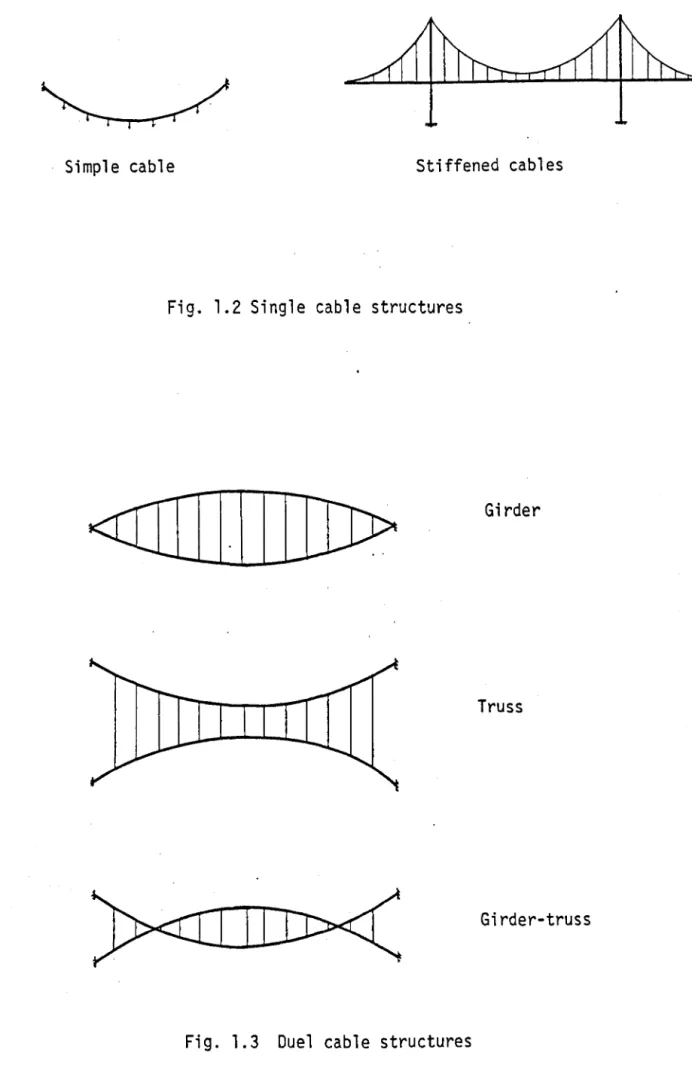
Some examples of t~nsion systems are shown in Figures 1 .2 through 1.5.
1.2. State of the Art
For the purpose of analysis cable structures may be treated either as continuous or as discrete systems. In the first half of the "sixties" most of the published work treated the system as continuous. For such analyses the cable net is assumed to be replaced by an equivalent flexible membrane which takes up the
shape of the middle surface of the net. The majority of the methods in this category are linearized methods which usually include some type of iteration correction for the nonlinear terms, although a direct treatment of the nonlinear equations has also been attempted.
In terms of practical structures, however, the 11
membrane" approach is somewhat limited. Only those cable nets with an
easily defined mathematical shape can be analysed and irregularities in boundary shapes and cable mesh are difficult to allow for.
Simple cable Stiffened cables
Fig. 1.2 Single cable structures
Girder
Truss
Girder-truss
Doubly threaded net Triply threaded net
Quadraply threaded net Hexagonal grid
Fig. 1.4 Cable net mesh patterns
Anti elastic
(negative curvature)
Sinclastic
(positive curvature)
For those cases where the net has a fine mesh and can be adequately represented by a membrane, considerable computational advantage can be gained, since the number of unknowns remains relatively small. Less time and storage is needed and the computations are resonably free from round-off errors.
The discrete idealization has the advantage of suiting better the true nature of the cable structure, which is inherently discrete. This idealization must be regarded as a more accurate method than the previous one, because it can be easily applied to structures with complex shape and widely different cable properties, can take
into account arbitrary types of support conditions, and permits an accurate treatment of the nonlinear effects.
The laws of mechanics when applied to the discretized structure lead to the formulation of algebraic field equations rather than differential equations. These equations can be categorized as either force or displacement. The force methods are usually difficult to automate for general purpose programs, although when practicable the formulation may lead to a system with fewer equations. The displace-ment method is generally more suited to computer application, and
particularly to nonlinear analyses where geometric nonlinearities
are predominant, as indeed is the case with cable supported structures. Some mixed formulations have also been used, particularly when the effects of flexible boundaries are included.
storage, is the stiffness fonnulation of the overall matrix with
nonlinear terms taken into account by various iterative schemes.
For minimising the computer storage requirements, sparse matrix
techniques, bandwidth optimization and frontal methods of solution
are widely reported. In addition to these, techr.iques for reducing
the size of the problem by static condensation or substructuring
are also available.
Other approaches to the solution of the resultant nonlinear
equations are the vector or explicit methods which do not require the
fonnation of an overall stiffness matrix and equilibrium and
compatibility conditions are treated separately. Most direct energy
minimization methods and the dynamic rela~ation method belong to
this category •. This type of approach offers several advantages.
The effort required to formulate the problem is reduced because
the energy formulation is simply the scalar sum of the energy
contribution of the individual elements. The need for the assembled
stiffness matrix of the structure is eliminated and a substantial
saving in computer storage is achieved. Also divergence problems
of finding solutions to nonlinear simultaneous equations may be more
easily avoided.
The inelastic response of the cables has also been considered
with different approximations to the nonlinear stress-strain curve;
the ultimate carrying capacity of a complete structure being
predicted using an incremental load procedure.
Finally, some simplified techniques have also been considered
1.3. Review of the literature
This review of the technical literature includes publications on the numerical static solution of single cable, dual cable and cable network structures. Stiffened cable structures as used in suspension bridge type of construction are not included in the review.
Pugsley [237] first considered the changes in cable geometry due to applied load by deriving the differential equations for inextensible cables. He also considered the use of flexibility or influence coefficients [238] for a single cable by dividing the cable into a number of equal segments. Jawerth [150, 151) was the first to carry out work of importance in dual cable structures by presenting a method of analysis that was valid for three different cable systems and the corresponding vertical loads. The resulting equations were solved by iteration. Bandel [10] in 1959, presented an analysis for orthogonal hyperbolic cable nets using a finite element or a finite difference approach and derived a set of linear algebraic equations for vertical displacements of the joints. In reference [11], Bandel presented a procedure for a single cable under three dimensional loading and temperature change by dividing the cable into several straight line segments and using an iteration procedure for the linearised equations.
Michales and Birnstiel [196] and Jennings [152] have used a force method to analyse the displaced position of a single cable subjected to change in vertical loading. The cable is treated as straight segments between load points. A method of successive
and a cable shear assumed as force unknowns, while in each iteration the resulting geometry is calculated and the initial assumptions corrected. An approximate force method was later used by Krishna and Sparks [170], to analyse counterstressed cable structures with vertical ties. Influence coefficients were derived for each tie location, taking into account approximately the nonlinear load deflection characteristics but applying superposition of the upper and lower systems.
Schleyer [267, 268] has published several studies on the analysis of cable structures treating them as continuous systems. The governing partial differential equation was derived with the assumptions that the horizontal displacements are small and that the cables in each direction lie in two orthogonal vertical planes. · Schleyer's method was essentially a linearised approach, and his
attempt to incorporate the nonlinear effects by means of iterative corrections were not entirely successful.
Zetlin (312, 313] proposed a design procedure for counterstressed cable structures that considered only uniformly distributed loading and vertical displacements. On the assumption that the cables have small sag to span ratios and the loads are normal to the chord of the cable, Morales [208] published a method of solution for cabJe tensions without the use of cable movements or displacements as pa~ameters. Continuous and the discontinuous theories are de~eloped by Stein [276] for calculating an orthogonal hyperbolic paraboloid
•
net bounded by completely rigid edges; polynomials being used to represent the load system. Eras and Elze [96] presented a finite element method for determining the vertical deflections of an
conditions to be subject to problems of non-convergence. Krishna [235] used an averaging displacement procedure for the nonlinear terms and improved the convergence of the method.
In 1963 Siev [271] proposed a method for determining the displacements of a general net, including the effect of horizontal displacements and changes in geometry. An iteration procedure was used to solve the linearised nodal equilibrium equations. The same procedure was used for two dimensional networks, neglecting
horizontal displacements [272]. Siev_also suggested incrementing the loads when the problem is highly nonlinear. Dean and Ugate [92] presented a close form solution for three dimensional nets having two, three, or four sets of cables. The method is based on the two dimensional analogue of the classical string polygon problem, with the assumptions of vertical loading only, and boundaries lying at a constant elevation. Buchanan and Akin [44] extended this closed form solution procedure, to cable nets with arbitrary boundaries using the reflection method. The reflection approach considers any
I
arbitrary shape structural net to be a loaded portion of a larger net with zero boundary elevations. The simultaneous equations are considerably reduced as they are equal to the number of internal boundary or loaded points.
Johnson and Bratton (162] applied the Newton Raphson approach for the analysis of three dimensional networks, and expressions for the elemental tangent stiffness matrix were also given. A classification and a comparison of different iterative methods, based on a stiffness formulation, by means of their convergence characteristics was carried out by Poskitt [234]. Correlations between theoretical and experimental results were made and a new method, valid only for certain type of cable structures was also presented.
Mollman
[199],
treating the system as discrete, derived general nonlinear equations for cable nets in tensor form and developed a theorem concerning the uniqueness of the solution. By introducing certain approximations, he further developed Schleyer's equation for a continuous system. Mollman and Mortensen [200]applied a modified Newton Raphsoniteration method for the solution of the governing nonlinear equations. The initial stiffness matrix was kept constant throughout the iterative procedure and inverted only once; tension changes, and hence the geometric stiffness
contributions being estimated in order to improve convergence. The nonlinear terms were treated as residual loads. Comparisons have been made with the results obtained from a continuous idealization of a special type of cable net. In another publication, Mollman [202] derived the nonlinear equilibrium equations for a plane prestressed cable structure composed of members of the following three kinds:
(a) simple tension members, {b) simple compression members and (c) flexible shallow cable members. The equations are again linearised by using second order terms from each cycle as a load vector in the next cycle of iteration. A Choleski triangular decomposition is
used for the stiffness matrix. A comprehensive treatment of the
analysis of cable structures has been given by the same author [205]
with many extensions to his previous work. A simple formula for
the ultimate carryigg capacity of certain cable nets is also
presented. Williams ~02] considered a cable net in the form of a
surface of revolution with radial and circumferential surface,
using Mollmom's nonlinear equation.
Thornton and Birnstiel [282] derived a set of nonline~r
simultaneous algebraic equations for a general cable network
using a discrete element ideali~ation. Two solution procedures
are considered. Firstly the 11method of continuity11
, in which the
nonlinear set of simultaneous algebraic equations is transformed
into a set of nonlinear differential equations that is numerically
integrated. Secondly the 11incremental load method11
, in which the
loads are applied·incrementally a~d the equations are solved at
each load level by means of an iterative technique. The second
method proved more effective in terms of computing time requirements.
Jensen [158] used a combination of load increments and iteration
for the governing nonlinear equilibrium equations.
An approach to the solution of the deformation of prestressed
cable structures which did not require the formation and storage
of an overall stiffness matrix was presented by Buchholdt. His
theory is based on the minimization of the total potential energy.
In his early papers [46, 47, 48, 49, 50], the descent direction
towards the minimum is the steepest descent direction. The
conjugate gradient direction was presented in [53, 54], and a
numerical comparison of five different descent directions was
presented in [56]. In all the above cases the step length
potention energy's fourth order polynomial with respect to the step length. In 1971 Buchholdt [55] was the first to propose a Taylor expansion scheme for the gradient vector and derived expressions for the 2nd, 3rd and 4th terms. A numerical solution was also presented, but although it was found more stable than the Newton Raphson solution, from the computational point of view the above process is less attractive. A modified Newton Raphson approach with step length control was also developed.
Bogner [29] removed the assumptions that the prestressed
forces are sufficient to preclude cable slackening under the
applica-,
.
tion of loads, and presented a general minimization method based on the Fletcher and Powell algorithm. He considered a conventional truss analysis, allowing the cables to go slack and the truss
members to buckle. The post-buckled configuration of the structure was traced.
The problem of combined geometric and material nonlinearities in cable structures was first considered by Greenberg [129] who developed an algebraic expression for a representative stress-strain curve to simulate cable behaviour. An averaging stiffness coefficient approach is used to accelerate convergence. Another stress-strain curve was proposed by Jonatowski and Birnstiel [160] who used an iterative procedure to evaluate the unstressed lengths of the cables.
Saafan (253] also considered the effects of nonlinear stress-strain properties in cable structures. He proposed a scheme similar to that used by Haug and Powell (135], which applied only a fraction of the residual loads in each Newton Raphson iteration.
In the work proposed by Avent [9], a field approach to nonlinear analysis of arbitrary net systems is used by formulating a
walk-through technique. Tottenham and Khan [287] have compared a
continuous approach, derived from first principles by Williams [302], and a discrete approach. The error involved in treating a physically discrete system as an equivalent continuous system was found to be small, particularly for nets with fine~meshes. Buchanan [45] presented a continuous approach for a single cable. The governing differential equations are solved by a perturbation technique as proposed by Van Dyke [293].
Dynamic relaxation has also been used for the solution of the nonlinear equations of tension structures. Day and Bunce [91] used an approximate upper bound for the time increment, while the optimum time coefficient was obtained from a trial run. Barnes [13] derived an approximate expression for evaluating close bounds to the critical time interval. The masses are then adjusted so as to give the same critical time in each node. Membrane cladding
Mollman [201] and Greenberg [130] have considered the loads applied along the cables,' but assumed the cable to take the shape of a shallow parabola, thus limiting the application only to cases when it is justifiable to assume the loads to be applied uniformly and laterally to the cables. Reference [114] examines the difference in the forces and displacements obtained assuming the loads are
applied to the joints rather thanto the cables.Buchholdt and
McMillan [57] used the conjugate gradient minimization procedure for the analysis of vertically and laterally loaded cables. The total potential energy was expressed in this case as an eighth order polynomial with respect to the step length. An exact analytical general solution to the static response of a single cable under arbitrary loading has been given by Irvine and Sinclair [147]. Explicit expressions for the tension within the cable and the displacements are derived as functions of a single independent variable, the Lagrangian coordinate, associated with the unstrained profile.
Braga and Care [35] presented a method of analysis taking into account the actual loads as applied along the cables. A method is described for the distribution of the loading to the nodes. The nodal loads then are updated at each iteration according to the actual deformation. Burtley and Harvey [64] also examined the effect of a uniformly distributed load along
the cables. Foster and Baufait [109] presented the effect of precast panels on the behaviour of cable networks.
exact equilibrium equations valid for arbitrary large strains and displacements and makes use of exact kinematic equations and a general nonlinear stress-strain relationship approximated by a polynomial. The method, however, made large demands on computer storage. Argyris [7] developed a modified derivation of the complete element stiffness matrix, particularly adopted for the nonlinear analysis of prestressed networks. Krishna
[173]
presented various iterative schemes and compared their efficiency with reference to their application to cable net problems.Kar and Okazaki [166] used a Newton Raphson type of solution for highly nonlinear cable net problems. The new iterative
technique presented, represents an effort to scale down the over-estimated displacements by the ratio of the largest applied load, at any cycle of iteration, to its corresponding equilibrium load, calculated on the basis of the linearised solution. The efficiency of the method is demonstrated by comparisons with other iterative methods. They also suggested that for highly nonlinear cases,
incrementing the loads may improve the rate of convergence.
Several investigators have considered the effect of flexible boundaries on cable structures. Mollman [206] presented a study on this problem using two methods: (a) the displacement method applied to the complete structure and (b) a mixed method in which the
Saitoh and Kurek
[254].
The basic equations are derived from the stationary conditions of the total energy of the function expressed in terms of the nodal displacements and the member forces. Asplaud[8] described a force method to analyse orthogonal nets.
Urelius and Fowler
[291]
examined the varying influence of de$ign parameters on the overall behaviour of a cable truss. They also compared the accuracy of approximate design equations. previously proposed by Zetlin. with that of a stiffners Newton Raphson typesolution procedure. Sand and Hagiescu
[255]
examined the influence of the characteristics of boundary structures on the forces anddisplacements in counterstressed cable structures. Noesgen
[215]
and Gero[126]
studied the behaviour of large cable network structures under various combinations of design parameters by modelling them to similar networks with fewer cables. Buchholdt[60]
also examined the same problem. Krishna and Natarajan [172] prese~ted a study of the influence of nonlinearity of vertical and lateral deformations hyperbolic paraboloid nets.A development of the approximate solution given by Schleyer
[268J
and Mo11
man[201]
has been described by Krishna and Agrawal'·
[174]. The method can be applied to a s~ngle cable. cable trusses and cable networks of restricted shape. Bhupinder and Bhusham
[24]
proposed a continuum method for anisotropic cable networks.Jonatowski
[161]
presented a numerical procedure forrelation-ships are derived as the cable unloads and reloads during the application of loading.
Aizaiwa et al [2,280] first applied the static perturbation technique for the solution of the nonlinear equations of cable structures. The derivation of the characteristic equations of the perturbation method with respect to the load increment parameter x
is outlined. The load is applied in one increment and no iteration correction procedure is performed. A comparison was also carried out with the Newton Raphson approach a~d it was suggested that the
perturbation method should be superior to the Newton Raphson approach from the standpoint of computational time. although these conclusions were not substantiated with numerical examples.
Finally Foster and Sandberg [292] discussed the pecularities of stiffness matrices arising during the nonlinear solution process of cable structures. They investigated cases where in addition to
large off-diagonal terms, the geometric stiffness approach can result in the generation of negative diagonal terms. In those cases the Choleski square root method for inverting the stiffness matrix cannot be used since it is restricted to symmetric positive definite matrices. The second Choleski algorithm, the Grout
reduction, which is mathematically similar to the Gauss elimination method, was recommended. They also found that for relatively small problems the Gauss elimination method is more practical and
In this thesis nonlinear methods of analysis have been
developed and compared for the static solution of cable supported
structures with varying degrees of freedom. A number of
conjugate gradient methods, with one and two dimensional linear
search and linearized algorithms without linear search, have
been used. Relaxation methods have also been developed and
compared. The dynamic relaxation method has been used in three
different forms : with the iteration parameters being evaluated
"a priori", with automatic adjustment of the iteration
parameters, and with the incorporation of kinetic energy·
damping instead of viscous damping. A number of methods,
for the estimation of the minimum and maximum eigenvalue of
the stiffness matrix have been also compared and the best
one has been employed for the 11a priori" evaluation of the
dynamic relaxation iteration parameters.
A.combined dynamic relaxation and conjugate gradient
algorithm has been developed and t·he efficiency of ·the successive
overelaxation method with and without automatic evaluation
of the relaxation parameter has been studied for problems with
stiffness matrices not possessing property "A". Stiffness
methods, in conjunction with the Newton Raphson iterative
algorithm, have also been included in a general comparative
study for small and large problems. The effects of nonlinear
stress-strain relationships and slackening of cable members have
been studied and the efficiencies of two different methods of
solution, namely the stiffness approach with Newton Raphson
iterations and the conjugate gradient algorithm with one
CHAPTER 2
ENERGY SEARCH APPROACH
2. l. Energy Formulations
The energy search approach to structural analysis is based
upon the application of mathematical programming methods to
appropriate energy functions. The structural analysis problem
can be envisaged as the search for a stationary point for the
energy function of the structure.
There are three commonly used energy formulations of the
structural analysis problem ; each one being associated with
a corresponding energy principle. The displacement method is
related to the principal of the total potential energy, the
force method is equivalent to the complementary energy approach,
and the mixed force-displacement formulation to the Reissner
energy principle.
(i) The principle of stationary potential energy states
that of all geometrically admissible sets of displacements
satisfying the boundary conditions, that which makes the total
potential energy,~, stationary satisfies the equilibrium
· conditions and is the actual displacement state x*. It follows
t~t
= 0 i = 1 ,2, •••
,n
(2.1)X = X*
where (2.2)
Furthermore, if
'IT(X*) < 'IT(X) (2.3)
for any virtual displacement from x*, then the associated
equilibrium position is stable. The potential energy formulation is a minimum principle.
(ii) The principle of complementary energy states
that of all force sets Pk that satisfy the equations of equilibrium and the boundary conditions, that which makes the complementary energy, 'IT* , stationary satisfies the compatability conditions. It follows that
d'IT*
I
~
p = P*= 0 k=l,2~ ... ,m (2.4)
where
(2.5)
V = the strain energy in terms of the member loads Pk.
Furthermore, if
'IT*(P*) > 'IT(P) (2.6)
for any virtual displacement from x*, then the associated
equilibrium position is stable. The complementary energy formulation
is a maximum principle.
the actual one makes the Reissner energy, J, stationary. It follows that
aJ
az.
l
z
=
z*
= 0 i = 1,2, .•• , t (2.7)
Reissner's energy function is formulated in terms of forces and displacements and is a stationary principle.
First to implement the energy search approach for the solution of structural problems was the Case Western University group. An exploratory study was carried out in References
(28. 189]. In References (1871188] studies for three dimensional
structures.that can be represented by straight truss and frame members are reported. Schmit et al [262] applied the energy approach to plate and shell type of structures, where energy search methods based on ·gradient minimization algorithms were shown to be computationally competitive with conventional stiffness approaches.
For geometrically nonlinear problems the formulation of the total energy is usually simpler if the displacement method is used, for materially nonlinear problems if the force method is used, and for combined nonlinearities if a mixed method is used. In other words, the Reissner's principle should be more
appropriate for problems with material and geometric nonlinearities. But. since it is neither a maximum nor a minimum, an additional step is required in order to apply the standard methods of
optimization: The calculation of the so-called residual function n
R(x) =
~
which has a minimum of zero at the solution x*.
In the case of the analysis of cable structures with
combined nonlinearity, it is felt that since only axial member
forces need to be considered, the additional complication of
applying the Reissner's energy principle can not be justified.
Thus the principle of the minimum potential energy will be
considered herein.
2.2. Unconstrained Minimization
An unconstrained function minimization technique is an
algorithm for choosing test points x, not obeying any constraint
requirements, which provides information about the function F(x)
and the location of its minimum. Minimization techniques are
divisible into two general classes according to the approach
taken in the selection of test points. In the first category,
the nonsequential search, a complete set of test points is chosen
prior to the initiation of testing. Each trial solution is
compared with the "best" obtained up to that time and there is
a strategy for determining what the next trial solution will be.
One approach is to choose the test points at random according
to an n-dimensional probability density function [39]. A second
approach is the so called factorial technique [31] where the
test points are chosen in a specific geometric pattern. Attempts
have been made to place the selection of a set of test points on
The second category, the sequential search, is appropriate for continuous and differentiable analytic functions. The
sequential techniques seek to move from a given point x; a
distance t along a direction ~i using the recursive relations
(2.9)
in such a way that the value of the function Fat the new point xi+l is reduced
Direct search methods are those which do not require the explicit evaluation of any partial derivatives of the functions and rely only on values of the objective function together with
information gained from earlier iterations. Gradient methods on the other hand are those which select the direction ~i using values of the partial derivatives of the objective function
.
with respect to the independent variables, as well as values of the objective function itself and ·information gained from earlier iterations.
Many of the direct search methods lack convergence proofs and are subjected to premature convergence. However in structural
problems, where derivatives of the objective function are easily evaluated, gradient methods have predominantly been used •
A third category of unconstrained minimization techniques are those which utilize the second derivative of the object function. Among these methods, the Newton Raphson procedure and the quasi-Newton techniques are most often used.
Given a function F(x), for which all the first partial derivatives ~F aX, • i = 1 •.•• ,n • exist at all points, a
1
necessary condition for a minimum to exist is aF
=
ax1
...
=
aF axi=
O (2.10)A sufficient condition for a point satisfying equations (2.10) to be a minimum is that all the second partial derivatives
2
a
Faxjaxk (j,k = 1 •••• ,n) exist at this point and that Di> 0 for i = l 121 • • • ,n, where
2 2 2
a F a F • • • a F
~
ax1 ax 1ax2 ax1axn
o.
= • • • • • • • • • • • (2.11)1
a2F • •
.
• • a2Faxnax 1
--,-
axni.e. the principal minors of the matrix of second partial derivatives must'all be positive [198],
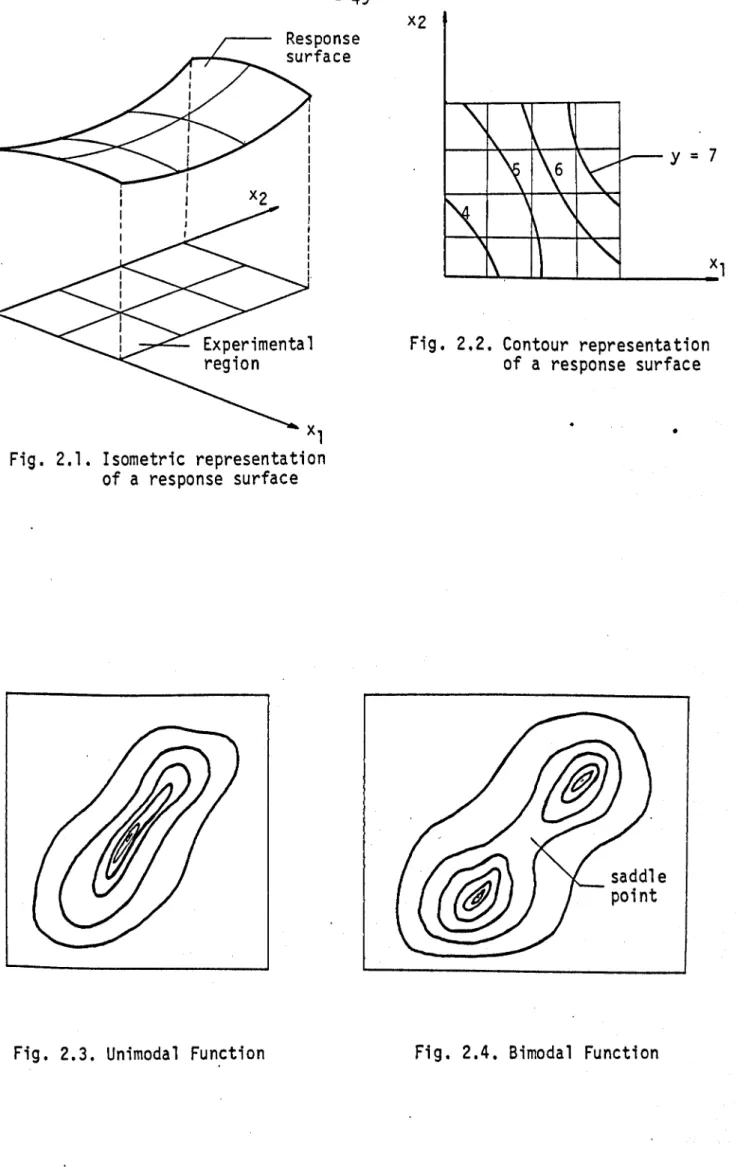
A convenient model for representing simple functions F(x) with only two independent variables, is to represent the function graphically using Cartesian co-ordinates in a three dimensional
x3
Response surface
x,
Fig. 2.1. Isometric representation of a response surface
Fig. 2.3. Unimodal Function
x2
Fig, 2,2. Contour representation of a response surface
•
visualised. Suppose y = y{x1,x2), then points yi form a
surface called the "response surface" (this name originated from the studies of Biologists and Statisticians for whom the criterion y is often the response of a living organism to environmental factors x1 and x2). The response surface of
Fig. 2.1 is termed two dimensional because only two co-ordinates are needed to specify a point on it. Figure 2.2 shows another way of depicting a response surface, by means of contour lines through points of equal values of the function y. Figure 2.3 shows a unimodal function where there is only one hump in the surface to be explored, while Fig. 2.4 shows a bimodal function with two optima and a saddle point.
2.3. Assumptions
For the nonlinear elastic analysis of cable structures the following assumptions have been made:
a, The cables are straight lines between nodes. b. Structural members are of uniform cross section.
c, The external forces are applied at the points of intersection of the cables and do not vary during the process of
deformation, either in magnitude or in direction.
d, The system consists of cables or cables and struts with no flexural or torsional rigidity.
e. The cables cannot resist compression.
-
51-g. The supports are fixed.
h. The stress-strain relationship is linear.
In Chapter 10, where ultimate load studies are carried out, assumption h is excluded.
2.4. The Total Potential Energy
The total potential energy of any body is given by
'II' = U + V (2 .12 )
where U is the strain energy or potential energy of the internal forces, and Vis the potential energy of the external forces acting on the body.
For an arbitrary unstiffened cable system
m
u
=I
u.
1 Jn (2 .13 )
where Ujn is the strain energy associated with segment jn and m is the total
N V =
I
l
number of cable segments, while NDF
L
,
Fin xin (2 .14 )with Fin is the external force at node n in direction i, x1n is the displacement of node n in direction i ,
The strain energy of a cable segment can be expressed in terms of the total stress and total strain as follows :
vol £ ujn = / / ad£
L
=
t /
a£dX0
with £= e0 + £a, where £0 is the strain before the application
of the incremental force,
P,
and £a is the additional strain after the application of the incremental force.Under the assumption {h), equation (2.15 ) becomes
=
l AE
!
L
/ £
2 dx
0
L
=
½
AE
/(£
0 + ea)2dx 0(2 .16 )
Under the assumption (f), equation (2.16 ) can be further
modified as follows
(2. 18 )
=
where e0 is the extension and L the initial length of member jn
before the application of the incremental force P, and ea is the
additional extension (from the initial state) after the
•
application of the load increment.
2.5. The Gradient Vector
The gradient vector of the total potential energy is of
great importance not only to the gradient methods but virtually
to any iterative nonlinear solution procedure. It represents
the out of balance forces arising from the difference between
the applied nodal load and the vector sum of the internal forces
in the members int~rsecting at the sa~e joint.
From equation (2.12) the partial derivative of the total
potential energy with respect to the displacement at the nth
node in the i direction is
(2.19)
Using the strain energy expression of equation (2.18 ), equation (2.19) can be written
k
o'IT
= ~~o aejn + AE aejn) - Fin
axin axin
T
ejn axink .. ae.
= L(Po +
P)
--1.!!. - Fin (2. 20) axink ae
= ~ p
.::.J.!!.
...
- ,·n
F. jn oXin
in which Pjn is the total force in cable segment j-n after
the application of the load increment, and ejn is the elongation of the cable segment from the initial or prestress configuration. Note, that for simplicity, the superscript a has been omitted from e in expression (2.20) and hereafter.
The elongation ejn can be expressed as
2
2
ejn = [Ljn + h(x) ] - Ljn
(2 .21 ) in which
NDF
h(x) =
~
[(2(Xin - Xij) + (x1n - xij)) (x1n - xij)](2.22)
where
x
1n and xin denote respectively the initial co-ordinate and the displacement of joint n •Differentiating equation (2.21) with respect toxin gives
l • ah(x) . 0(xin - xij)
From equation (2.22}
~~i~~
_
xij) = 2(Xin-xij} + 2(xin - xij) (2.24)Then substituting equation (2.24} into equation (2.23)
(2.25)
and finally substituting the above equation into equation (2.20 ).
the gradient vector becomes
(2. 27 )
2.6. The Matrix of the Second Partial Derivatives
Let the gradient vector of the total potential energy
at joint j, in the ith direction and at a position 6 in
displacement space be
-G:ij~A
with the corresponding gradient vector at position A+ dA
Expanding the last vector by Taylors theorem we obtain
(2. 28 )
+ • • •
Since the potential energy of the applied load system
is linear in x, the change in the gradient vector due to an
incremental change in the displacement space is given by
G;ij)
A+ dA (2. 29 )+ • • •
Assuming the changes in displacements to be so small that
their higher powers are negligible, equation (2.29) may be
written as
(~ij)
A+ dA -(;;ij)
AC2.
30 )Since the vector of the left hand side of equation (2.30)
represents the change in residual force components due to a
partial derivatives of the strain energy can be identified
as the stiffness matrix of the assembly.
Differentiating equation (2.20) with respect to the
displacement vector xr• we have
=
!(
a
0
ep jJ. nn
. ox~" .
a e . ~ a e j na2
e . )+ p
Jn
,n oxr jn axinaxr
( 2. 31 )
We now want to find expressions for the following terms in
equation (2.31)
and
The first derivative of the elongation ejn is given by
equation {2.25), which can be written in matrix form as follows
aejn
- {Xl + xl)
ax1j l
Ljn+ejn aejn
- (X2 + x2) ax 2j
aejn
- (X3 + X3)
- C
ax3j
= =
(2.32)
aejn + C
+ (X1 + x1) axln
aejn
+ (X2 + X2) ax2n
aejn