Submitted25 April 2017 Accepted 12 June 2017 Published14 August 2017
Corresponding author Ramona-Elena Irimia, [email protected]
Academic editor Todd Vision
Additional Information and Declarations can be found on page 6
DOI10.7717/peerj.3531
Copyright 2017 Irimia et al.
Distributed under
Creative Commons CC-BY 4.0
OPEN ACCESS
Extensive analysis of native and
non-native
Centaurea solstitialis
L.
populations across the world shows no
traces of polyploidization
Ramona-Elena Irimia1,2, Daniel Montesinos1, Özkan Eren3, Christopher J. Lortie4, Kristine French5, Lohengrin A. Cavieres6,7, Gastón J. Sotes6,7, José L. Hierro8, Andreia Jorge1and João Loureiro1
1Centre for Functional Ecology, Department of Life Sciences, University of Coimbra, Coimbra, Portugal 2National Institute of Research and Development for Biological Sciences, Stejarul Research Centre for
Biological Sciences, Piatra Neamt, Romania
3Adnan Menderes Üniversitesi, Fen-Edebiyat Fakültesi, Biyoloji Bölümü, Aydın, Turkey 4Department of Biology, York University, Toronto, Canada
5School of Biological Sciences, University of Wollongong, Wollongong, Australia
6Departamento de Botánica, Facultad de Ciencias Naturales y Oceanográficas, Universidad de Concepción,
Concepción, Chile
7Instituto de Ecología y Biodiversidad (IEB), Santiago, Chile
8Instituto de Ciencias de La Tierra y Ambientales de la Pampa, Consejo Nacional de Investigaciones
Científicas y Técnicas (INCITAP-CONICET) and Facultad de Ciencias Exactas y Naturales, Universidad Nacional de La Pampa, Santa Rosa, Argentina
ABSTRACT
Centaurea solstitialis L. (yellow starthistle, Asteraceae) is a Eurasian native plant introduced as an exotic into North and South America, and Australia, where it is regarded as a noxious invasive. Changes in ploidy level have been found to be responsible for numerous plant biological invasions, as they are involved in trait shifts critical to invasive success, like increased growth rate and biomass, longer life-span, or polycarpy.C.solstitialishad been reported to be diploid (2n=2x=16 chromosomes),
however, actual data are scarce and sometimes contradictory. We determined for the first time the absolute nuclear DNA content by flow cytometry and estimated ploidy level in 52 natural populations ofC.solstitialisacross its native and non-native
ranges, around the world. All the C. solstitialis populations screened were found to
be homogeneously diploid (average 2C value of 1.72 pg, SD = ±0.06 pg), with no
significant variation in DNA content between invasive and non-invasive genotypes. We did not find any meaningful difference among the extensive number of native and
non-native C. solstitialispopulations sampled around the globe, indicating that the
species invasive success is not due to changes in genome size or ploidy level.
SubjectsBiogeography, Evolutionary Studies, Plant Science
INTRODUCTION
Changes in ploidy level have been reported to be important for the invasive success of some plants species (Te Beest et al., 2011), by altering morphological, physiological and ecological parameters which can confer hybrid vigor, stress resistance, competitive advantages, or increased phenotypic plasticity, like in the case of the North American tetraploids of
Centaurea stoebe L. (Hahn, Buckley & Müller-Schärer, 2012). Additionally, there are a series of associated ‘‘genome size constrained traits’’, related mostly to reproduction and dispersal, which dictate the ecological niche a species can access (Te Beest et al.,
2011). In contrast, several studies support the hypothesis that a smaller genome can
contribute to some species invasive potential by boosting early plant growth and enhancing competitive ability (Bennett, Leitch & Hanson, 1998; Grotkopp et al., 2004; Beaulieu et al., 2007;Lavergne, Muenke & Molofsky, 2010; Suda et al., 2015). For instance, Phalaris arundinaceaL. (reed canary grass, Poaceae) in the USA underwent a quick and significant reduction in genome size compared to the native European genotype, which was correlated
with some advantageous phenotypic effects and enhanced aggressiveness (Lavergne, Muenke
& Molofsky, 2010). A list comparing the ploidy level of 128 worst invasive plant species
worldwide, was recently made available byTe Beest et al. (2011), indicating that a quarter
of them possess at least two different ploidy levels. An interesting example is C. stoebe
(spotted knapweed) which occurs both as a diploid and tetraploid, with only the latter
cytotype becoming invasive in the Western parts of the USA (Mráz et al., 2011). However,
for many invasive species, ploidy levels and genome size are unknown or have not been thoroughly investigated.
Centaurea L. is one of the most species rich genera in the Asteraceae (Bremer, 1994).
Numerous Centaureaspecies have been introduced into new non-native regions, where
many of them have become invasive. For instance, the US Federal Noxious Weeds list (USDA, NRCS, The PLANTS Database, 2017), includes no fewer than 13 taxa, but ploidy level for many of these is unknown or uncertain. In particular,C.solstitialisis a Eurasian native annual herb which was introduced into the Americas and Australia during the
last two centuries (Barker et al., 2017) and became an impactful invader in the former
case. In the invaded ranges,C.solstitialisforms dense stands that displace native plants species and reduce considerably livestock grazing capacity and forage value (Eagle et al.,
2007). It alters ecosystem functions by depleting soil water and nutrients through an
extensive root system (DiTomaso, 2000), and can cause a neurological disorder in horses
similar to human Parkinson (Chang et al., 2011). As an economically important plant,
the species has been the subject of intensive research, and significant differentiation
between native and non-native ranges have been reported for plant size (Eriksen et al.,
size and ploidy level could be potentially responsible for at least some of the observed trait-shifts.
Until now, only three genome size estimates were available in the literature for C.
solstitialis: two from the native range (Bulgaria: 1.74 pg/2C, one accession, inBancheva & Greilhuber, 2006; and Croatia: 1.95 pg/2C, five accessions, inCarev et al., 2017) and another from an invasive population in western USA: 1.66 pg/2C, thirty accessions (Miskella, 2014). Based on these few studies,C.solstitialishad been reported to be diploid (Dlugosch et al., 2013;Rice et al., 2015) with 2n=2x=16 chromosomes. However, records of 2n=2x=18
chromosomes were published more than 30 years ago from the native range of Bulgaria (Jasiewicz & Mizianty, 1975; Kuzmanov, Jurukova-Grancarova & Georgieva, 1990) and
recently from one accession from Sicily and the other one from Sardinia (Widmer et al.,
2007). Furthermore,Inceer, Hayirlioglu-Ayaz & Ozcan (2007)reported tetraploids in seeds (single accession) sampled in northern Turkey, but none of those observations, made in only a handful of individuals, have been confirmed since then. Consequently, it was still unclear whether ploidy could have played a role in at least some of theC. solstitialisinvaded ranges. To fill this knowledge gap for such an important species, we aimed to thoroughly
sample and assessC. solstitialisploidy level and genome size in a representative number
of populations from around the world, including native Turkey, the ancestral origin of the species; native Spain, the main source of American populations; and all the known non-native regions represented by Argentina, Chile, USA and Australia.
METHODS
Seed collection
A total of 477 accessions from 52 natural populations (Table S1) of C.solstitialiswere
investigated in this study, for genome size and ploidy level assessment. Within the native area, we sampled ten populations from Turkey, near the Caucasus region, where high genetic diversity has been detected, and is regarded as the site of origin of the species (Wagenitz, 1955;Gerlach, 1997a;Uygur et al., 2004;Dlugosch et al., 2013;Eriksen et al.,
2014), and ten populations from Spain, considered as the primary source of seeds to have
colonized Chile and Argentina (Hijano & Basigalup, 1995;Eriksen et al., 2012;Eriksen et al., 2014;Dlugosch et al., 2013;Barker et al., 2017) in the nineteenth century (Gerlach, 1997b). For the non-native regions, we included ten populations from Argentina and California, eight from Australia and four from Chile. Seeds were extracted from mature flower heads collected in the wild from ten individuals per population between 2009 and 2014. Ten seeds from each individual were germinated in plant growing trays, under common greenhouse conditions, in early spring 2016 at the Botanical Garden of the University of Coimbra, Portugal.
Flow cytometry
the chopping method ofGalbraith et al. (1983). Briefly, about 1 cm2of leaf tissue was
co-chopped with a razor blade together with the same amount of reference standard (Raphanus
sativusL. ‘Saxa’, 2C=1.11 pg,Doležel, Sgorbati & Lucretti, 1992) in 1 mL of woody plant
buffer (WPB): 0.2 M Tris×HCl, 4 mM MgCl2×6H2O, 2 mM EDTA Na2×2H2O, 86
mM NaCl, 10 mM sodium metabisulfite, 1% polyvinylpyrrolidone (PVP-10) (w/v) and 1% Triton X-100 (v/v), with pH of the buffer adjusted to 7.5 (Loureiro et al., 2007). The
resulting homogenate was filtered through a 50µm nylon filter into a sample tube to
remove large debris. Nuclei were stained with 50 mg/mL propidium iodide (PI; Fluka, Buchs, Switzerland), and 50 mg/ml of RNAse (Fluka, Buchs, Switzerland) was added to prevent the staining of double stranded RNA. Samples were kept at room temperature and analyzed immediately on a Partec CyFlow Space flow cytometer (Partec GmbH, Görlitz, Germany) equipped with a 532 nm green solid-state laser, operating at 30 mW.
Data collection and analysis
Results were acquired using Partec FloMax software (v2.4d) (Partec GmbH, Münster, Germany) in the form of six graphics: fluorescence pulse integral in linear scale (FL); forward light scatter (FS)vs. side light scatter (SS), both in logarithmic (log) scale; FLvs. time; FLvs. fluorescence pulse height; FLvs. FS in log scale and FLvs. SS in log scale. Mean fluorescence values and coefficient of variation (CV value) of the fluorescence
of both sample and standard were obtained for at least 1,300 nuclei in each G1 peak,
whenever possible. Samples with CV values above 5% were discarded, prepared and ran again. At least three individuals from every population were used to estimate genome size (Table S2), in different days, to account for the variation generated by the flow cytometer. The remaining individuals were analyzed in pool (three or four individuals) to determine ploidy level (Table S2), only. The absolute DNA content of a sample was calculated based
on the following formula: 2C nuclear DNA content of the sample =(sample G1peak
mean)/(standard G1peak mean)×2C DNA content of standard. Descriptive statistics were
calculated for genome size data (mean, standard deviation of the mean, standard error, coefficient of variation and minimum and maximum values) using Microsoft Excel 2016. Differences in average genome size values among regions were assessed by means of Linear
Mixed-Effect Models with the formulation ofLaird & Ware (1982), with a region as fixed
factor and population within region as a random nested factor, in R-3.2.0 (R Development
Core Team, 2010). Data was plotted in BoxPlotR (Spitzer et al., 2014).
RESULTS
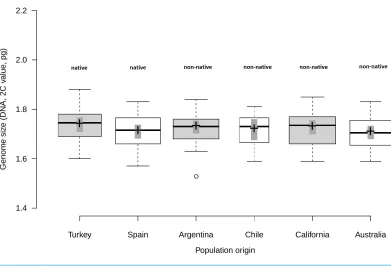
Analysis of fresh leaf tissue sampled from seedlings germinated from wild seeds of individuals from 52 populations from Turkey, Spain, Argentina, Chile, USA and Australia (Table S1), showed no significant differences in genome size (F5,44=0.58;p=0.716)
among regions (Fig. 1). All individuals (N=477) were found to be diploid, presumably
with 2n=16 chromosomes. Average genome size ranged from 1.70 pg/2C (SD=0.06 pg)
in Australia and Spain (SD=0.06 pg) to 1.71 pg/2C (SD=0.06 pg) in Chile, 1.72 pg/2C
(SD=0.06 pg) in Argentina and California (SD=0.07 pg) and 1.73 pg/2C (SD=0.07 pg)
Figure 1 Comparison of genome size among native and non-native genotypes ofCentaurea solstitialis.
Black center lines represent the medians, crosses indicate sample means, box limits indicate the 25th and 75th percentiles, whiskers extend 1.5 times the interquartile range from the 25th and 75th percentiles, bars show 95% confidence intervals of the means and outliers are represented by empty dots. Width of the boxes is proportional to the square root of sample size,n=26, 28, 29, 12, 30, 24 sample points.
Genome size variation among populations within regions (Table S1) was also not significantly different, as indicated by very small standard deviations for the intercept and the residual obtained for the random effects (SDintercept=0.024; SDresidual=0.063).
DISCUSSION
We found no traces of polyploidization events in theC.solstitialispopulations investigated and geographic differences in genome size were negligible.
A previous record of isolated tetraploids (one accession) in Northern Turkey (Inceer,
Hayirlioglu-Ayaz & Ozcan, 2007) is intriguing, since further genomic sampling in the area (e.g., less than 40 km from the initial site,Barker et al., 2017) did not validate the findings. Further investigation is also required to clarify the reported putative hybridization (Barker et al., 2017) withCentaurea nicaeensis L .(2n=20chromosomes,Guinochet & Foissac,
1962), since inter-specific hybridization does not seem to have played a significant role in the past invasion history ofC.solstitialis(Barker et al., 2017). Formerly, a single natural
hybrid ofCentaurea×moncktoniiCE Britton andC. solstitialiswas described from Oregon,
USA (Roché & Susanna, 2010) and found to be a sterile triploid (Miskella, 2014).
The genome size value we obtained for California (1.72 pg/2C, SD=0.07 pg) was similar
to the one previously reported for Southwestern Oregon (1.66 pg/2C, SD=0.07 pg), by
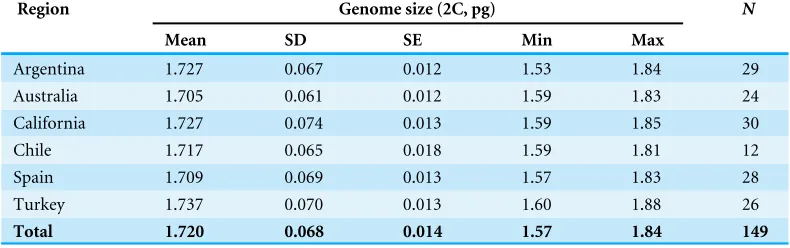
Table 1 Genome size estimations inCentaurea solstitialisacross the six sampled regions.
Region Genome size (2C, pg) N
Mean SD SE Min Max
Argentina 1.727 0.067 0.012 1.53 1.84 29
Australia 1.705 0.061 0.012 1.59 1.83 24
California 1.727 0.074 0.013 1.59 1.85 30
Chile 1.717 0.065 0.018 1.59 1.81 12
Spain 1.709 0.069 0.013 1.57 1.83 28
Turkey 1.737 0.070 0.013 1.60 1.88 26
Total 1.720 0.068 0.014 1.57 1.84 149
Notes.
Values are given as mean, standard deviation and standard error of the mean. The minimum and maximum values and the number of analyzed individuals (N) for genome size estimations are also provided.
In conclusion, our thorough sampling of the most representative native and non-native populations across the world’s distribution of C. solstitialis indicates that its invasive success is not due to changes in genome size or ploidy level. We cannot discard that some individuals in some unsampled populations could present some degree of polyploidy, but their role in invasive success, to date, would have been of minor importance.
ACKNOWLEDGEMENTS
We are grateful to Joan Vallès (Barcelona) and three other anonymous reviewers for their valuable comments on the previous version of this manuscript.
ADDITIONAL INFORMATION AND DECLARATIONS
Funding
This study was funded by the Portuguese Funda¸cão para a Ciência e a Tecnologia (FCT) of the Ministério da Ciência, Tecnologia e Ensino Superior, with national funds PTDC/BIA-PLA/0763/2014. The funders had no role in study design, data collection and analysis, decision to publish, or preparation of the manuscript.
Grant Disclosures
The following grant information was disclosed by the authors:
Portuguese Funda¸cão para a Ciência e a Tecnologia (FCT) of the Ministério da Ciência, Tecnologia e Ensino Superior: PTDC/BIA-PLA/0763/2014.
Competing Interests
Christopher J. Lortie is an Academic Editor for PeerJ. The authors declare there are no competing interests.
Author Contributions
• Ramona-Elena Irimia and João Loureiro conceived and designed the experiments,
• Daniel Montesinos conceived and designed the experiments, analyzed the data,
contributed reagents/materials/analysis tools, wrote the paper, prepared figures and/or tables, reviewed drafts of the paper, collected plant seeds.
• Özkan Eren, Christopher J. Lortie, Kristine French, Lohengrin A. Cavieres, Gastón J.
Sotes and José L. Hierro reviewed drafts of the paper, collected plant seeds.
• Andreia Jorge performed the experiments, reviewed drafts of the paper.
Data Availability
The following information was supplied regarding data availability:
The raw data is available as aSupplementary File.
Supplemental Information
Supplemental information for this article can be found online athttp://dx.doi.org/10.7717/
peerj.3531#supplemental-information.
REFERENCES
Bancheva S, Greilhuber J. 2006.Genome size in BulgarianCentaureas.l. (Asteraceae).
Plant Systematics and Evolution257:95–117 DOI 10.1007/s00606-005-0384-7. Barker BS, Andonian K, Swope SM, Luster DG, Dlugosch KM. 2017.Population
genomic analysis reveal a history of range expansion and trait evolution across the native and invaded range of yellow starthistle (Centaurea solstitialis).Molecular Ecology 26(4):1131–1147DOI 10.1111/mec.13998.
Beaulieu JM, Moles AT, Leitch IJ, Bennett MD, Dickie JB, Knight CA. 2007.
Cor-related evolution of genome size and seed mass.New Phytologist173:422–437
DOI 10.1111/j.1469-8137.2006.01919.x.
Bennett MD, Leitch IJ, Hanson L. 1998.DNA amounts in two samples of angiosperm
weeds.Annals of Botany82(Suppl A):121–134DOI 10.1006/anbo.1998.0785.
Bremer K. 1994.Asteraceae—cladistics and classification. Portland: Timber Press. Carev I, Ruščić M, Skočibušić M, Maravić A, Silijak-Yakovlev S, Politeo O. 2017.
Phy-tochemical and cytogenetic characterization ofCentaurea solstitialisL. (Asteraceae)
from Croatia.Chemistry and Biodiversity14(2):e1600213DOI 10.1002/cbdv.201600213.
Chang HT, Rumbeiha WK, Patterson JS, Puschner B, Knight AP. 2011.Toxic equine Parkinsonism: an immuno-histochemical study of 10 horses with nigropallidal
en-cephalomalacia.Veterinary Pathology49(2):398–402DOI 10.1177/0300985811406885.
DiTomaso JM. 2000.Invasive weeds in rangelands: species, impacts, and management.
Weed Science48(2):255–265
DOI 10.1614/0043-1745(2000)048[0255:IWIRSI]2.0.CO;2.
Dlugosch KM, Cang FA, Barker BS, Andonian K, Swope SM, Rieseberg LH. 2015.
Evolution of invasiveness through increased resource use in a vacant niche.Nature
Plants1: Article 15066DOI 10.1038/nplants.2015.66.
Dlugosch KM, Lai Z, Benin A, Hierro JL, Rieseberg LH. 2013.Allele identification for
transcriptome based population genomics in the invasive plantCentaurea solstitialis.
Doležel J, Sgorbati S, Lucretti S. 1992.Comparison of three DNA fluorochromes for
flow cytometric estimation of nuclear DNA content in plants.Physiologia Plantarum
85:625–631DOI 10.1111/j.1399-3054.1992.tb04764.x.
Eagle AJ, Eiswerth ME, Johnson WS, Schoenig SE, van Kooten CG. 2007.Costs and losses imposed on California ranchers by yellow starthistle.Rangeland Ecology & Management 60:369–377DOI 10.2111/1551-5028(2007)60[369:CALIOC]2.0.CO;2. Eriksen RL, Desronvil T, Hierro JL, Kesseli R. 2012.Morphological differentiation in a
common garden experiment among native and non-native specimens of the invasive weed yellow starthistle (Centaurea solstitialis).Biological Invasions7:1459–1467 DOI 10.1007/s10530-012-0172-6.
Eriksen RL, Hierro JL, Eren O, Andonian K, Török K, Becerra PI, Montesinos D, Khetsuriani L, Diaconu A, Kesseli R. 2014.Dispersal pathways and genetic
dif-ferentiation among worldwide populations of the invasiveCentaurea solstitialisL.
(Asteraceae).PLOS ONE9:e114786DOI 10.1371/journal.pone.0114786.
Galbraith DW, Harkins KR, Maddox JM, Ayres NM, Sharma DP, Firoozabady E. 1983.Rapid flow cytometric analysis of the cell cycle in intact plant tissues.Science
220:1049–1051DOI 10.1126/science.220.4601.1049.
García Y, Callaway RM, Diaconu A, Montesinos D. 2013.Invasive and non-invasive congeners show similar trait shifts between their same native and non-native ranges.
PLOS ONE8:e82281DOI 10.1371/journal.pone.0082281.
Gerlach JD. 1997a.How the west was lost: reconstructing the invasion dynamics of yellow starthistle and other plant invaders of western rangelands and natural areas.
California Exotic Pest Plant Council, Symposium Proceedings3:67–72.
Gerlach JD. 1997b.The introduction, dynamics of geographic range expansion and ecosystem effects of yellow starthistle (Centaurea solstitialis).Proceedings of Califor-nian Weed Science Society49:236–241.
Graebner RC, Callaway RM, Montesinos D. 2012.Invasive species grows faster,
competes better, and shows greater evolution toward increased size and growth than
exotic non-invasive congeners.Plant Ecology213:545–553
DOI 10.1007/s11258-012-0020-x.
Grotkopp E, Rejmánek M, Sanderson MJ, Rost TL. 2004.Evolution of genome size in Pines (Pinus) and its life-history correlates: supertree analyses.Evolution
58:1705–1729DOI 10.1111/j.0014-3820.2004.tb00456.x.
Guinochet M, Foissac J. 1962.Sur les Caryotypes de quelques espèces du genreCentaurea
L. et leur signification taxonomique.Bulletin de la Société Botanique de France
109:373–389DOI 10.1080/00378941.1962.10838114.
Hahn MA, Buckley YM, Müller-Schärer H. 2012.Increased population growth
rate in invasive polyploidCentaurea stoebein a common garden.Ecology Letters
15(9):947–954DOI 10.1111/j.1461-0248.2012.01813.x.
Hierro JL, Eren O, Khetsuriani L, Diaconu A, Török K, Andonian K, Kikodze D, Janoian L, Villarreal D, Estanga-Mollica ME, Callaway RM. 2009.Germination
Hijano EH, Basigalup DH. 1995.Hijano EH, Navarro A, eds.El cultivo de la alfalfa en la República Argentina. La Alfalfa en la Argentina, INTA: Buenos Aires, 13–18.
Inceer H, Hayirlioglu-Ayaz S, Ozcan M. 2007.Chromosome numbers of the twenty-two
Turkish plant species.Caryologia60:349–357DOI 10.1080/00087114.2007.10797958.
Jasiewicz A, Mizianty M. 1975.Chromosome numbers of some Bulgarian plants.
Fragmenta Floristica et Geobotanica21(3):277–288.
Kuzmanov BA, Jurukova-Grancarova PD, Georgieva SB. 1990.Chromosome numbers
of Bulgarian angiosperms.Fitologiya38:92.
Laird NNM, Ware JJH. 1982.Random-effects models for longitudinal data.Biometrics
38(4):963–974DOI 10.2307/2529876.
Lavergne S, Muenke NJ, Molofsky J. 2010.Genome size reduction can trigger
rapid phenotypic evolution in invasive plants.Annals of Botany105:109–116
DOI 10.1093/aob/mcp271.
Loureiro J, Rodriguez E, Doležel J, Santos C. 2007.Two new nuclear isolation buffers
for plant DNA flow cytometry: a test with 37 species.Annals of Botany4:875–488
DOI 10.1093/aob/mcm152.
Miskella J. 2014.Hybridization between yellow starthistle (Centaurea solstitialis) and
meadow knapweed (Centaurea×moncktonii). Master’s Thesis, Oregon State
University.
Montesinos D, Callaway RM. 2017.Inter-regional hybrids of native and invasive Cen-taurea solstitialisdisplay intermediate competitive ability.Ecography40(7):801–802 DOI 10.1111/ecog.02653.
Montesinos D, Santiago G, Callaway RM. 2012.Neo-allopatry and rapid reproductive
isolation.American Naturalist180:529–533DOI 10.1086/667585.
Mráz P, Garcia-Jacas N, Gex-Fabry E, Susanna A, Barres L, Müller-Schärer H. 2011.
Allopolyploid origin of highly invasiveCentaurea stoebes.l. (Asteraceae).Molecular
Phylogenetics and Evolution62:612–623DOI 10.1016/j.ympev.2011.11.006. R Development Core Team. 2010.R: a language and environment for statistical
computing. Vienna: R Foundation for Statistical Computing.Available athttps:
// www.r- project.org/ (accessed on 6 June 2017).
Rice A, Glick L, Abadi S, Einhorn M, Kopelman NM, Salman-Minkov A, Mayzel J, Chay O, Mayrose I. 2015.The Chromosome Counts Database (CCDB)–a
community resource of plant chromosome numbers.New Phytologist 206:19–26
DOI 10.1111/nph.13191.
Roché CT, Susanna A. 2010.New habitats, new menaces:Centaurea×kleinii(C. mon-cktonii×C.solstitialis), a new hybrid species between two alien weeds.Collectanea Botanica29:17–23DOI 10.3989/collectbot.2010.v29.002.
Spitzer M, Wildenhain J, Rappsilber J, Tyres M. 2014.BoxPlotR: a web tool for
generation of box plots.Nature Methods11:121–122 DOI 10.1038/nmeth.2811.
Suda J, Meyerson LA, Leitch IJ, Pyšek P. 2015.The hidden side of plant invasions: the
Te Beest M, Le Roux JJ, Richardson DM, Brysting AK, Suda J, Kubešová M, Pyšek P. 2011.The more the better? The role of polyploidy in facilitating plant invasions.
Annals of Botany109:19–45DOI 10.1093/aob/mcr277.
USDA, NRCS 2017.The PLANTS Database. Greensboro: National plant data team.
Available athttp:// plants.usda.gov(accessed on 10 January 2017).
Uygur S, Smith L, Nezihi Uygur F, Cristofaro M, Balciunas J. 2004.Population densities of yellow starthistle (Centaurea solstitialis) in Turkey.Weed Science52:746–753 DOI 10.1614/WS-03-150R1.
Wagenitz C. 1955.Pollenmorphologie and Systematik in der gattungCentaureaL. s.l.
Flora142:213–275.