Accepted
Article
This article has been accepted for publication and undergone full peer review but has not been through the copyediting, typesetting, pagination and proofreading process, which may lead to differences between this version and the Version of Record. Please cite this article as doi: 10.1111/bjd.15938
DR NATHAN JAMES DOWNS (Orcid ID : 0000-0002-3191-6404) Article type : Original Article
A comprehensive approach to evaluating and classifying
sun-protective clothing
*N.J. Downs1,2
, S.L. Harrison2,1
1. University of Southern Queensland, Faculty of Health, Engineering and Sciences Toowoomba, Queensland, Australia.
2. James Cook University, Skin Cancer Research Unit, College of Public Health, Medical and Veterinary Sciences, Townsville, Queensland, Australia.
3.
Short title: Classification of sun-protective clothing
Accepted
Article
Funding statement: This research was funded by a Research Infrastructure Block Grant from James Cook University. Drs Downs and Harrison both received travel support funding from The University of Southern Queensland. The study sponsors did not have a role in the study design; collection, analysis, interpretation of data; writing the report; or the decision to submit the report for publication.
Financial Disclosure: Dr Harrison has been an independent expert to and member of Standards Australia’s TX-021 Technical Committee responsible for revising AS/NZS
4399:1996 Sun-protective clothing - Evaluation and classification since February 2015. She was also part-time Director of an Australian private corporation, Sun Smart Industries Pty Ltd (designs some sun-protective swim-shirts) during the previous 3 years.
Dr Downs has no actual or potential competing financial interests to declare.
ABSTRACT
Background: National standards for clothing designed to protect the wearer from the
harmful effects of solar ultraviolet radiation (UVR) have been implemented in Australia/New Zealand, Europe, and the USA. Industry standards reflect the need to protect the skin by covering a considerable proportion of the potentially exposed body surface area (BSA) and by reducing UVR-transmission through fabric (the Ultraviolet Protection Factor; UPF).
Accepted
Article
Methods: A mannequin model was fixed to an optical bench and marked with horizontal lines at 1 cm intervals. An algorithm (the Garment Protector Factor; GPF) was developed based on the number of lines visible on the clothed versus unclothed mannequin and the UPF of the garment textile. This data was collected in 2015-16 and analysed in 2016.
Results: The GPF weights fabric UPF by BSA coverage above the minimum required by international sun-protective clothing standards for upper-body, lower-body and full-body garments. GPF increases with BSA coverage of the garment and fabric UPF. Three nominal categories are proposed for the GPF: 0 GPF < 3 for garments that 'meet' minimum
standards; 3 GPF < 6 for garments providing 'good' sun-protection; and GPF ≥ 6 indicating 'excellent' protection.
Conclusions: Adoption of the proposed rating scheme should encourage manufacturers to design sun-protective garments that exceed the minimum standard for BSA coverage, with positive implications for skin cancer prevention, consumer education and sun-protection awareness.
Keywords: Sun-protective clothing, UPF, standard, skin cancer
What’s already known about this topic?
Accepted
Article
What does this study add?
A new clothing classification system is introduced utilising an easy to calculate metric that incorporates both the fabric ultraviolet protection factor and protected body surface area. The new metric termed Garment Protection Factor (GPF) provides a mechanism for the fair assessment of apparel of different types and size categories aimed to encourage better sun-protective clothing design for the prevention of skin cancer.
INTRODUCTION
It is well established that ultraviolet radiation (UVR) is a human carcinogen1. Sunlight is the major environmental risk-factor for cutaneous melanoma, keratinoctye skin cancers, actinic keratoses, and pigmented moles1,2,3,4,5 as well as causing or exacerbating several eye diseases, some of which can result in blindness2,6.
Accepted
Article
In 1996, Australia pioneered a method for evaluating the UV-protective capabilities of clothing based on the transmission of UVR through fabric15. This research led to the development and implementation of the Australian and New Zealand Standard for the
evaluation and classification of sun-protective clothing, AS/NZS 4399:199616. It documented standardized Ultraviolet Protection Factor (UPF) measurement procedures and associated labeling specifications. As the first industry standard for sun-protective clothing to be
introduced, it was widely adopted17. However, the original Australian/New Zealand Standard did not consider garment design in relation to body surface area (BSA) coverage18,19. This requirement was incorporated into a subsequent revision of the standard (AS/NZS
4399:2017)18 and other international standards on sun protective clothing, such as those of the European Union20.
We propose a comprehensive index for quantifying the sun-protective capabilities of clothing that takes into account both the BSA coverage afforded by the design of the garment and the UPF of the fabric. This index could be incorporated universally in industry standards for sun-protective clothing and could form the basis of a new rating and labelling scheme (the Garment Protection Factor, GPF) that is more informative for consumers.
METHODS
Derivation of the Garment Protection Factor
Accepted
Article
and the UPF of the fabric of which it is comprised. The GPF determines if an item of clothing meets or exceeds minimum international standards for sun-protective clothing18,20 by the inclusion of two linear variables for the UPF and relative BSA covered as follows:
. (1)
In the equation, UPF is weighted relative to a minimum standard UPF of 15 (the lowest published international standard required for a sun protective garment)18 and expressed as a fraction. The relative BSA coverage of the garment is expressed relative to the minimum number of horizontal bands (surface contours drawn onto a body model or mannequin) that must be protected to achieve the minimum BSA coverage stipulated in the standard, for an (i) upper-body garment, (ii) a lower-body garment, or (iii) an all-in-one garment. The contours represent the maximum practical surface area able to be covered from the neck to the hip-line, and across the shoulders to the wrists for upper-body garments, from the hip-line to the ankle for lower-body garments, and from the neck-line, shoulder to wrist and the ankle for all-in one garments.
The number of body contours in Equation (1) varies depending on the aged standardized height for which the clothing is designed, however the equation evaluates the proportion of excess skin surface protected by clothing items beyond minimum limits required by sun-protective clothing standards. This makes the size of the mannequin model irrelevant for the purposes of calculating the relative proportion of the skin surface protected by a garment exceeding minimum standards. The maximum number of contours defined in the BSA
Accepted
Article
represents the number of surface contours protected/covered by a particular garment when the mannequin model is clothed, and is denoted as either PU or PL for upper- and lower-body garments respectively.
The number of body contours that must be covered by a garment to meet the minimum BSA standard is µ. In the GPF, µ may be described as µU or µL for the upper- and lower-body,
respectively. For an upper-body garment, µU involves counting all contours from the base of the neck to the hip-line, counted down the torso and across the shoulders to three-quarters of the way down the upper-arm, consistent with sun protective clothing standard EN 13758-2:2003+A120, and AS/NZS 4399:201718. Similarly, µL involves counting all contours from the hip-line to the mid-point of the crotch and the knee, based on the inner-thigh measurement and is consistent with AS/NZS 4399:201718.
Accepted
Article
standard), from 3 GPF < 6 (‘good’ protection), and GPF 6 (‘excellent’ protection). A
garment assessed using this simple linear application of UPF and BSA coverage that produces a negative result for either the weighted-UPF or BSA fraction coverage does not qualify for a GPF as both criteria must meet minimum BSA design and UPF to claim a sun-protective advantage.
Practical Testing of Clothing items
A flexible, standing, fabric-covered mannequin closely matching the median height of a 3-year-old child (as determined from the height for age percentile charts for 2-18 3-year-olds21) was used to model the BSA covered by (i) upper-body, (ii) lower-body and (iii) all-in-one UVR protective clothing. The 3 year-old mannequin was chosen as a model to demonstrate how upper, lower and all-in-one GPF is derived. The technique is applicable to mannequins of any size or gender.
Accepted
Article
Division of body surface and clothing limits
The implementation of GPF has been designed with current international minimum sun-protective clothing standards in mind. Upper body surface coverage eligibility criteria for GPF meets minimum international standards which currently specify the minimum
acceptable BSA incorporate the area from the neck-line, down to the hip-line and across the shoulders and down to the three-quarter upper-arm length sleeve boundary18,20 (corresponds anatomically with the area between the AC-joint and three-quarter upper-arm length shown as the uppermost and lowest green contour line on the right upper-arm of the mannequin in Figure 1). To facilitate the measurement of the BSA of upper-body garments, the
neck/shoulder and hip-line were chosen as shown in Figure 1 as the maximum garment limits, UU.
For a lower-body garment to qualify for a GPF we apply the minimum leg length surface coverage standard (AS/NZS 4399:2017)18, such that a lower body garment must fully cover the area from the hip-line (corresponds with the uppermost yellow line in Figure 1) to at least as far as the mid-point measured between the crotch and the knee (defined as a horizontal contour drawn through the uppermost point of the patella where it meets the femur)
corresponding with the lowest depicted yellow line shown on the right leg (Figure 1). For a lower body garment to qualify for a GPF, it will protect less BSA than required by the
European EN 13758-2:2003+A120 standard, which requires coverage to below the patella, but does ensure compatibility of the GPF with minimum international standards (AS/NZS
Accepted
Article
To account for potential differences between the anterior and posterior distribution of a garment placed upon a mannequin body model each counted anterior and posterior contour is weighted by 0.5. Thus, a garment placed on a mannequin model covering the whole of a posterior contour but not its corresponding anterior contour would be counted as 0.5 horizontal contours covered by clothing. For a contour (either anterior or posterior) to be counted as ‘visible’, the entire line segment must be discernable and not obscured either partially or fully by the garment. By counting the number (and proportion) of horizontal contours fully visible on a clothed mannequin and comparing this to the same mannequin unclothed, we have developed a reproducible method for determining the protected BSA of a garment. For instance, a long-sleeved shirt covers a greater number of total contour segments than an elbow-length shirt.
RESULTS
The GPF is designed to be consistent with the current Australian/New Zealand, European and US standards for the evaluation and classification of sun-protective clothing18,20,22,23.
Accepted
Article
and ‘excellent protection’ (GPF 6) for garments that just meet the minimum BSA requirement but have progressively higher UPF ratings. The categories we introduce also reward sun-protective garment designers by application of Equation 1, whereby the gradient of GPF verses UPF increases as the protected BSA increases. GPF versus UPF is shown in Figure 2 for garments that protect from 0% to 100% of the available excess skin surface.
The proposed GPF plotted in Figure 2 as a function of UPF shows the range of values able to be obtained for garments with UPF ratings of 15 or above. Here, garments will still either meet the standard for BSA contour coverage or exceed them up to the maximum number of contours visible on the mannequin within the specific upper-body, lower-body or all-in-one range limits. Thus, while a UPF 15 garment that protects the minimum surface area ‘meets’ the standard, it may achieve a ‘good protection’ rating if the UPF is increased toward (but not reaching) UPF 30 and the BSA covered exceeds the minimum limit by more than 0%. A garment with a UPF between 25 and 30 may similarly reach an ‘excellent protection’ standard provided the BSA cover improves (as shown by the dotted lines in Figure 2).
Accepted
Article
in the GPF, with garments that provide better protection receiving higher categorical ratings.
DISCUSSION
Accepted
Article
In our derivation of the GPF, we have set fixed coefficients to weight the influence of the textile UPF and the excess BSA covered above the minimum national standard we could identify. Equation 1 is purposefully designed such that a garment which meets the AS/NZS 4399:201718 minimum BSA requirement (0% excess surface protection) may receive either a ‘minimum’, ‘good’ or ‘excellent’ protection rating under the proposed GPF category limits of 0 GPF < 3; 3 GPF < 6; and GPF 6 respectively depending on the UPF of the garment textile (Figure 2). It should be noted a garment that just meets the BSA standard (0% excess surface protection) will receive a ‘good’ protection rating if the UPF of the textile used is 30. A garment meeting the minimum standard (0% excess surface protection) will also receive an ‘excellent’ protection category if the UPF of the textile used is 45 or more. Not only are our suggested protection categories compatible with the recommendation of the
Accepted
Article
The minimum UPF 15 standard applied here is compatible with the ASTM D 6603 standard for labelling (United States) and AS/NZS 4399:2017 which list UPF 15 as the minimum rating able to be claimed for items sold as sun-protective18,23. These standards are not as
prescriptive as others, such as the European Standard EN 13758-2:2003+A120 which restricts garments that can claim a sun-protective advantage to those items which achieve a
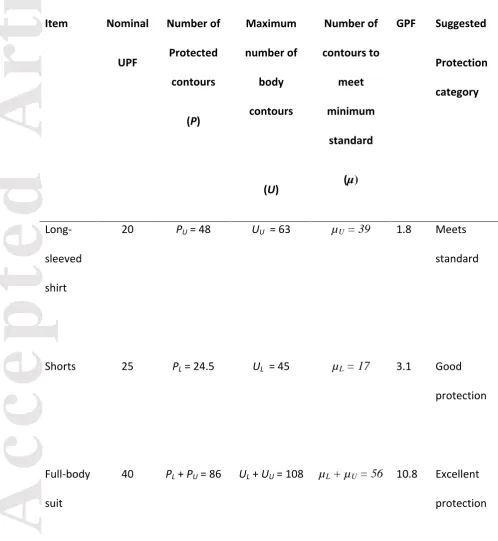
minimum UPF of 40, and cover a greater proportion of the lower-body. The minimum BSA specified in the European Standard covers the trunk from the neck line to the hip, across the shoulders and three-quarters of the way down the upper-arm for upper-body garments, and from the hip to below the knee (patella) for lower body garments. As a linear scale, the GPF can be used to compare the sun-protective capacity of any clothing items, provided the minimum BSA and UPF ratings are met. The extra protection provided by the minimum UPF and BSA requirements of the European EN 13758-2:2003+A120 standard would equate for example, to a GPF of 5.0 and 8.2 for our 3 year-old mannequin for respective upper- and lower-body garments (rows 1 and 2 of Table 1). This would change our suggested sun protection category for respective upper- and lower-body garments meeting the European standard to ‘good’ (3 GPF < 6) and ‘excellent’ (GPF 6) ratings compared to the minimum standard, beginning at GPF 0.
Accepted
Article
‘sun-protective’ will determine the suitability of the GPF ratings as currently proposed. The GPF presented in this work is the first quantifiable method to incorporate the two most important factors that influence the level of solar UVR protection provided by clothing. The proposed method also enables sun-protective garments to be compared objectively across different national standards.
The GPF is designed to be compatible with existing international standards for clothing labeled as sun-protective. The revised Australian/New Zealand AS/NZS 4399:201718
standard addresses the need to include provision for minimum BSA coverage. This standard, as currently proposed, is not as prescriptive as the European EN 13758-2:2003+A120 which requires minimum coverage of a greater surface area of the legs. Adoption of the European standard would therefore be an improvement on the currently proposed Australian/New Zealand standard, and perhaps a good starting place for an international minimum standard. However, regardless of the sun protective clothing standard adopted, there remains limited incentive for industry (clothing manufacturers) to strive for the design of garments sold as sun protective to improve BSA coverage that exceeds the minimum
Accepted
Article
of different designs and encourage greater competition by industry to develop clothing with improved sun protective qualities.
Acknowledgments: The authors wish to thank research assistants Alex Rawlings and Lachlan Von Pein for their assistance in marking the mannequin, and Prof Alfio Parisi for facilitating travel funding support and providing access to laboratory space. This research was funded by a Research Infrastructure Block Grant from James Cook University, and Drs Harrison and Downs both received travel support funding from The University of Southern Queensland. The study sponsors did not have a role in the study design; collection, analysis,
interpretation of data; writing the report; or the decision to submit the report for
publication. Both authors made a substantial contribution to the conception and design of the study, data collection, analysis and interpretation as well as writing sections of the manuscript and approving the final submitted version.
Financial Disclosure: Dr Downs has no actual or potential competing financial interests to declare. Dr Harrison has been an independent expert to and member of Standards
Accepted
Article
REFERENCES
1. International Agency for Research on Cancer, World Health Organization. IARC Monograph on the evaluation of carcinogenic risks to human: Solar and ultraviolet Radiation. Volume 55, Lyon: France, 1992.
2. Lucas R, McMichael A, Smith W, Armstrong BK. Solar Ultraviolet Radiation: Global burden of disease from solar ultraviolet radiation. Environmental Burden of Disease Series No. 13 (Prüss-Üstün A, Zeeb H, Mathers C, Repacholi M, eds). Geneva: World Health Organization, 2006.
3. Chang YM, Newton-Bishop JA, Bishop DT, Armstrong BK, Bataille V, Bergman W, et al. A pooled analysis of melanocytic nevus phenotype and the risk of cutaneous
melanoma at different latitudes. Int J Cancer. 2009; 124:420-428.
4. Harrison SL, MacLennan R, Speare R, Wronski I. Sun Exposure and melanocytic naevi in young Australian children. Lancet. 1994; 344:1529-1532.
5. Harrison SL, MacKie RM, MacLennan R. Development of melanocytic nevi in the first 3 years of life. J Natl Cancer Inst. 2000; 92:1436-1438.
6. Bourne, RA, Stevens GA, White RA, Smith JL, Flaxman SR, Price H, et al. Causes of vision loss worldwide 1990–2010: a systematic analysis. Lancet Global Health. 2013;
1:e339-49.
7. Armstrong BK, Kricker A. The epidemiology of UV induced skin cancer. J Photochem Photobiol B. 2001; 63:8-18.
8. Lomas A, Leonardi-Bee J, Bath-Hextall F. A systematic review of worldwide incidence of nonmelanoma skin cancer. Br J Dermatol. 2012; 166:1069-1080.
Accepted
Article
Australia attributable to exposure to solar ultraviolet radiation and prevented by regular sunscreen use. Aust N Z J Public Health. 2015; 39: 471–476.
10. Armstrong BK, Kricker A. How much melanoma is caused by sun exposure? Melanoma Res. 1993; 3:395-401.
11. Montague M, Borland R, Sinclair C. Slip! Slop! Slap! and SunSmart, 1980-2000: Skin cancer control and 20 years of population-based campaigning. Health Educ Behav. 2001; 28:290-305.
12. Glanz K, Geller AC, Shigaki D, Maddock JE, Isnec MR. A randomized trial of skin cancer prevention in aquatics settings: the Pool Cool program. Health Psychol. 2002; 21 :579-587.
13. Harrison SL, Buettner PG, MacLennan R. The North Queensland Sun-Safe Clothing Study: Design and Baseline Results of a Randomized Trial to Determine the Effectiveness of Sun-Protective Clothing in Preventing Melanocytic Nevi. Am J Epidemiol. 2005; 161:536-545.
14. Harrison SL, Buettner PG, MacLennan R, Woosnam J, Hutton L, Nowak M. Sun-safe clothing helps to prevent the development of pigmented moles - Results of a randomised control trial in young Australian children. Ann ACTM. 2010; 11:49-50. 15. Gies HP, Roy CR, Elliott G, Zongli W. Ultraviolet radiation protection factors for
clothing. Health Phys. 1994; 67:131-139.
16. Standards Australia. AS/NZS 4399:1996 Sun Protective Clothing – Evaluation and Classification. Available: http://www.standards.org.au/ Accessed 12 April 2015. 17. Harrison SL, Downs N. Development of a Reproducible Rating System for Sun
Accepted
Article
18. Standards Australia. AS/NZS 4399:2017 Sun Protective Clothing – Evaluation and Classification. Available: http://www.standards.org.au/ Accessed July 2017.
19. Gies P, Slevin T. Revision of the sun protective clothing Standard AS/NZS 4399. In: The 3rd International Conference on UV and Skin Cancer Prevention, 7-11 December 2015, Melbourne, Australia. Available:
http://uvandskincancer2015.org/session/uv-technical-elements-of-sun-protection/ Accessed 27 October 2016.
20. European Committee for Standardization. EN 13758-2:2003+A1 Textiles – Solar UV protective properties – Part 2: Classification and making of apparel. Brussels. Available:http://www.en-standard.eu/ Accessed 12 October 2016.
21. Centers for Disease Control and Prevention. Height for Age 2-18 Years. Available:http://www.dcd.gov/growthcharts Accessed 12 October 2016. 22. American Association of Textile Chemists and Colorists. AATCC TM183:2014
Transmittance or Blocking or Erythemally Weighted Ultraviolet Radiation Through Fabrics. Available:http://members.aatcc.org/store/tm183/579/ Accessed 12 October 2016.
23. ASTM. ASTM D6603-12, Standard Specification for Labeling of UV-Protective Textiles. West Conshohocken, PA: ASTM International. 2012. Available:
Accepted
[image:20.595.27.526.221.763.2]Article
TABLES
Table 1. Calculation ofGarment Protection Factor (GPF) and suggested protection category for clothing items rated for a 3-year-old child. Sample Ultraviolet Protection Factors (UPF) are nominal (not measured values) and are included here as examples to demonstrate the calculation of GPF.
Item Nominal
UPF
Number of
Protected
contours
(P)
Maximum
number of
body
contours
(U)
Number of contours to meet minimum standard (µ)
GPF Suggested
Protection
category
Long-sleeved shirt
20 PU = 48 UU = 63 µU = 39 1.8 Meets standard
Shorts 25 PL = 24.5 UL = 45 µL = 17 3.1 Good protection
Full-body suit