
Input-centric profiling and prediction for computational offloading of mobile applications
176
0
0
Full text
(2) Input-centric profiling and prediction for computational offloading of mobile applications PhD Thesis submitted by Adam James Rehn BIT (Hons). For the degree of Doctor of Philosophy College of Business, Law and Governance James Cook University Cairns, Queensland 4870 Australia December, 2016.
(3) ii.
(4) Acknowledgements This thesis represents the culmination of a doctoral journey that simply would not have been possible without the support of some truly wonderful people. First and foremost, I would like to thank my supervisors for their guidance and their patience. I thank my primary supervisor, Dr Jason Holdsworth, for his years of enthusiasm and encouragement. Throughout the course of my undergraduate and postgraduate education, Jason has acted as a sounding board for countless ideas, and served as a source of both wisdom and inspiration. I thank my secondary supervisor, Professor John Hamilton, for his insights into academia and the research process, his mentorship, and for his unwavering belief in me. I thank my associate supervisor, Dr Singwhat Tee, for his guidance on statistical methods and experimental design. I thank my other associate supervisor, Professor Ickjai Lee, for his insights into the field of data mining. I would particularly like to thank Jason, John, and Singwhat for the tremendous support they provided in helping me navigate through the final year of my doctorate. I would like to thank my family for their love and support throughout my entire educational journey, and in particular for their patience and understanding throughout the sometimes stressful doctoral experience. Special thanks go to Dr Leonie Cassidy for her valuable insights into the Design Science Research Methodology, to Aidan Possemiers, for providing his expertise on parallel programming using CUDA, and to Dr Bronson Phillipa, for providing insights into the configuration and performance monitoring of embedded systems devices. I would also like to thank my fellow PhD students and graduates at James Cook University for sharing their experiences as we each undertook our own doctoral journeys. Thanks to Andrew Joy, Matthew Joy, and Sarah Krivan, for their logistical assistance in running data collection on 20 iPad Air devices. I would also like to acknowledge the educational program of Apple, Inc., for providing access to the 20 iPad Air devices used for data collection in Chapter 3 and Chapter 7.. iii.
(5) iv. ACKNOWLEDGEMENTS.
(6) Statement of the Contribution of Others Research Funding Australian Postgraduate Award (APA) Research Scholarship stipend 3.5 years College of Business, Law and Governance Graduate Research Scheme award. Thesis Committee Dr Jason Holdsworth, Information Technology, James Cook University Professor John Hamilton, Management and Governance, James Cook University Professor Ickjai Lee, Information Technology, James Cook University Dr SingWhat Tee, Accounting and Finance, James Cook University. Statistical Support Professor John Hamilton Dr Singwhat Tee. Editorial Support Dr Jason Holdsworth Professor John Hamilton Professor Ickjai Lee. v.
(7) vi. STATEMENT OF THE CONTRIBUTION OF OTHERS.
(8) Abstract Relentless growth in mobile computing technologies continues to bring the vision of ubiquitous computing closer than ever before. As mobile hardware becomes more powerful and connected, user expectations of smartphones and tablets continue to push the boundaries of device capabilities. However, the inherent limitations of portability continue to impose constraints that are not present on traditional server platforms. The confluence of high-speed network connections and cloud compute services allows mobile applications to leverage cloud servers, in order to augment device capabilities and overcome the limitations of mobility. Computational offloading frameworks are a widely-researched tool for optimising the performance and resource use of mobile applications by exploiting the benefits of cloud computing. Offloading frameworks transparently facilitate the delegation of processing to remote servers, allowing mobile applications to utilise the power of cloud computing resources without imposing additional burden on developers. The improved performance and reduced energy use offered by computational offloading helps to mitigate the inherent limitations of mobile devices. Modern computational offloading frameworks facilitate dynamic offloading decisions that adapt to changing application and device conditions. Adaptive offloading is utilised to ensure that processing is always performed in the most efficient manner. To achieve this, offloading frameworks monitor the behaviour of the application and the state of the mobile device, and perform a cost-benefit analysis designed to produce optimal offloading decisions. The quality of these offloading decisions is dependant on the accuracy of the information used to produce them. Existing computational offloading frameworks fail to take into account the full influence of an application’s input data on its behaviour. Changes in arbitrary input characteristics can result in dramatic changes in application behaviour. However, the overwhelming majority of existing offloading frameworks consider only the size of input data when making offloading decisions. Many frameworks model changes in application behaviour only indirectly through monitoring performance changes over time. This approach assumes a temporal pattern in input characteristics that is not guaranteed to exist, and cannot cleanly differentiate between changes in application behaviour and performance differences caused by changes in device state. Hardware power saving features implemented in modern mobile devices allow a given device to shift between a number of different system states. Each of these states results in different performance characteristics for mobile applications running on the device. The interactions between hardware components, the mobile operating system, and user-facing applications, result in performance variations that introduce noise into vii.
(9) viii. ABSTRACT. measurements of application performance. This interference is known as OS noise. Both changes in device state, and the presence of OS noise in performance measurements, must be taken into account by computational offloading frameworks in order to provide accurate information for making offloading decisions. The overall aim of this thesis is to develop a system for profiling and predicting the performance of mobile applications, that takes into account the influence of arbitrary input characteristics, whilst mitigating the effects of OS noise. This profiling and prediction system should be efficient enough to perform the frequent processing required in order to adapt to changes in device state, and produce accurate predictions of application performance that can be used by a computational offloading framework to make quality offloading decisions. This thesis focusses on five research objectives in order to address the identified gap in the existing literature. The first three objectives are concerned with expanding the existing understanding of OS noise on traditional desktop and server platforms to encompass mobile device platforms, and examine the interaction between mobile device state changes and OS noise. The fourth objective is concerned with developing a new approach for mitigating the effects of OS noise on performance benchmark data, whilst accounting for the influence of changing device states. The fifth objective applies the outcomes of the preceding objectives to address the overall research aim, and is concerned with developing and input-centric profiling and prediction system for use by a computational offloading framework. Chapter 1 provides background detail on how computational offloading frameworks function, and presents a thorough literature review of current offloading frameworks. The gap in the existing literature is discussed, and the research question and objectives are described in detail. A brief overview of the Design Science Research Methodology (DSRM) used in this thesis is described, and the choice of methodology is discussed. Overviews of the data chapters of the thesis are provided, along with publication details and a statement of contributions for each chapter. Chapter 2 describes in detail the DSRM utilised by the research in this thesis. This chapter focusses on extending the existing evaluation methodology of the DSRM to address the unique technical challenges associated with evaluating research outputs that target mobile device platforms. Requirements are drawn from existing literature on both evaluation methodology and mobile data collection, then a model is proposed for automating the evaluation of Design Science artifacts targeting mobile device platforms. The proposed model automates feedback loops of the DSRM to facilitate rapid iteration, providing richer information to researchers. Chapter 3 addresses research objectives 1, 2, and 3, and addresses part of research objective 4. The first part of this chapter describes a study into the levels of OS noise present on Apple iPad Air devices, which addresses research objective 1. Examination of the collected data confirms that the characteristics of OS noise on mobile devices are consistent with those observed on traditional desktop and server platforms in the existing literature, thus addressing research objective 2. Further data analysis demonstrates that a relationship exists between OS noise levels and changes in device state, thus addressing research objective 3. The second half of the chapter proposes an adaptive noise mitigation technique for mitigating the effects of OS noise on.
(10) ix micro-benchmarking datasets. This addresses the key requirements of research objective 4. Chapter 4 builds on the work presented in Chapter 3. Research objective 4 requires that the adaptive noise mitigation technique be fully automated. However, the outlier removal phase of the noise mitigation technique described in Chapter 3 is only semi-automated. This chapter proposes a fully automated outlier removal technique. The proposed technique exploits the inherent clustering structure present in outliers introduced by OS noise to perform outlier removal. Hierarchical Agglomerative Clustering (HAC) is used to capture the nested clustering structure of the data, and a heuristic algorithm automatically extracts clusterings that isolate outliers from meaningful data. Chapter 5 extends the work presented in Chapter 4 by proposing a novel parallel algorithm for performing hierarchical clustering of single-dimensional data. The classical algorithm for HAC features computational costs that make it too expensive for use on resource-constrained mobile devices. The proposed algorithm utilises GPGPU technologies to enable massive parallelism on commodity consumer hardware, including modern mobile devices. By exploiting the unique properties of single-dimensional data, the proposed algorithm maximises the amount of processing that can be performed in parallel. This efficiency makes the proposed algorithm, and thus the automated outlier removal technique proposed in Chapter 4, suitable for use on resource-constrained mobile devices. This addresses the remaining requirements of research objective 4. Chapter 6 builds the foundation for addressing research objective 5. This chapter reviews existing software timing models from the literature on Worst-Case Execution Time (WCET), and adapts elements of two popular models for use on resource-constrained mobile devices. The proposed timing model simplifies these models to substantially reduce information requirements and computational complexity. Validation of the proposed timing model for individual code execution paths demonstrates that it is an extremely accurate approximation of the information represented by the models that it simplifies. The efficiency of the proposed timing model allows it to be invoked repeatedly to adapt to changes in device state. Chapter 7 completes the work that was started in Chapter 6 to address research objective 5. This chapter proposes a language- and platform-agnostic tooling pipeline that can be used to implement the proposed input-centric profiling and prediction system for any programming language and mobile device platform. The implementation of a prototype of the proposed model targeting the C++ programming language and the Apple iOS platform is then described. The second half of the chapter validates the predictive power of the input-centric profiling and prediction system for code with multiple execution paths. Validation results demonstrate that the produced predictions are extremely accurate across all of the code modules tested. The accuracy and efficiency of the proposed input-centric performance model make it well-suited for use in a computational offloading framework. Chapter 8 summarises the outcomes of the preceding chapters, and discusses the contributions of this thesis to the greater body of knowledge. Theoretical, empirical, and real-world contributions are discussed. The limitations of the thesis are then discussed and used to motivate directions for future research. The outcomes achieved by addressing the five research objectives represent a number of contributions to the greater body of knowledge. The OS noise study undertaken in Chapter 3 to address research objective 1 is.
(11) x. ABSTRACT. the first detailed exploration OS noise on mobile device platforms of which I am aware. The examination of the collected data that was undertaken to address research objective 2 demonstrates that the characteristics of OS noise on mobile devices are consistent with those characteristics observed on traditional desktop and server platforms in the existing literature. The data analysis performed to address research objective 3 demonstrates that a relationship exists between changes in OS noise levels and changes in device state. The work done in Chapters 3, 4, and 5 to address research objective 4 resulted in contributions that extend beyond mobile computing, to the field of data mining. The adaptive OS noise mitigation technique proposed in 3 is the first approach for mitigating the effects of OS noise on micro-benchmarking data to maximise accuracy by taking into account the actual noise profile of the device the benchmark is running on. The automated outlier removal technique proposed in Chapter 4 demonstrates that the structure of outliers introduced by OS noise can be exploited to provide an efficient, automated technique for removing such outliers from micro-benchmarking data. The novel GPU-accelerated clustering algorithm proposed in Chapter 5 demonstrates the enormous performance improvements that can be achieved through the maximisation of merge parallelism, by exploiting the unique properties of single-dimensional datasets. The input-centric profiling and prediction system presented in Chapters 6 and 7 to address research objective 5 represents the key contribution to the field of computational offloading. The application timing model developed in Chapter 6 simplifies popular software timing models from the existing literature to substantially reduce information requirements and computational complexity. This simplification demonstrates the feasibility of adapting timing models for use on resource-constrained mobile devices, even when the unmodified timing models are unsuitable for use in a mobile context. The language- and platform-agnostic tooling pipeline proposed in Chapter 7 allows the proposed inputcentric profiling and prediction system to be implemented for any programming language, and for any target mobile device platform. Evaluation of the input-centric profiling and prediction system in Chapters 6 and 7 demonstrates that the produced predictions are extremely accurate. The proposed system accounts for the influence of arbitrary input characteristics on application behaviour, whilst mitigating the effects of OS noise. The efficiency and accuracy of the proposed system make it well-suited for use in a computational offloading framework. The use of deep application-specific knowledge provides high-quality information for making optimal offloading decisions, thus maximising the performance and energy efficiency of mobile applications..
(12) Table of Contents Front Matter. i. Title Page . . . . . . . . . . . . . . . . . . . . . . . . . . . . . . . . . . . . . . . . . . . . . .. i. Acknowledgements . . . . . . . . . . . . . . . . . . . . . . . . . . . . . . . . . . . . . . . . .. iii. Statement of the Contribution of Others . . . . . . . . . . . . . . . . . . . . . . . . . . . . . .. v. Abstract . . . . . . . . . . . . . . . . . . . . . . . . . . . . . . . . . . . . . . . . . . . . . . .. vii. Table of Contents . . . . . . . . . . . . . . . . . . . . . . . . . . . . . . . . . . . . . . . . . .. xv. List of Tables . . . . . . . . . . . . . . . . . . . . . . . . . . . . . . . . . . . . . . . . . . . . xviii. 1. 2. List of Figures . . . . . . . . . . . . . . . . . . . . . . . . . . . . . . . . . . . . . . . . . . . .. xx. List of Abbreviations . . . . . . . . . . . . . . . . . . . . . . . . . . . . . . . . . . . . . . . .. xxi. Introduction. 1. 1.1. Background . . . . . . . . . . . . . . . . . . . . . . . . . . . . . . . . . . . . . . . . . .. 1. 1.1.1. Computational offloading . . . . . . . . . . . . . . . . . . . . . . . . . . . . . .. 2. 1.1.2. Use of input characteristics in offloading decisions . . . . . . . . . . . . . . . . .. 4. 1.1.3. Dynamic performance factors . . . . . . . . . . . . . . . . . . . . . . . . . . . .. 6. 1.1.3.1. Dynamic Voltage and Frequency Scaling . . . . . . . . . . . . . . . . .. 6. 1.1.3.2. Operating System Noise . . . . . . . . . . . . . . . . . . . . . . . . . .. 6. 1.2. Research Gaps, Questions, and Objectives . . . . . . . . . . . . . . . . . . . . . . . . . .. 7. 1.3. Research methodology overview . . . . . . . . . . . . . . . . . . . . . . . . . . . . . . .. 8. 1.4. Thesis Outline . . . . . . . . . . . . . . . . . . . . . . . . . . . . . . . . . . . . . . . . .. 9. Research methodology. 15. 2.1. Introduction . . . . . . . . . . . . . . . . . . . . . . . . . . . . . . . . . . . . . . . . . .. 15. 2.2. Background . . . . . . . . . . . . . . . . . . . . . . . . . . . . . . . . . . . . . . . . . .. 17. xi.
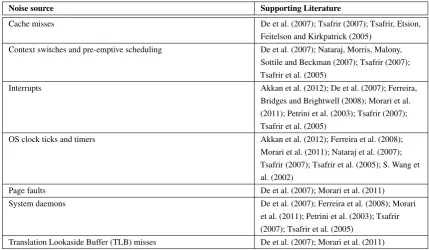
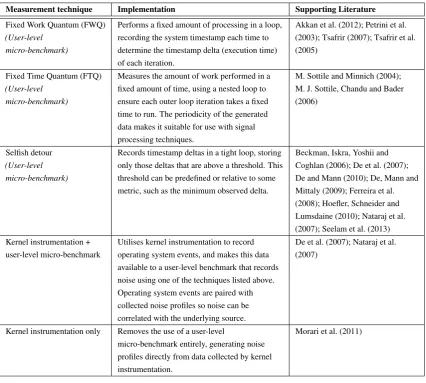
(13) xii. TABLE OF CONTENTS 2.2.1. Design science research methodology . . . . . . . . . . . . . . . . . . . . . . . .. 17. 2.2.1.1. Artifacts . . . . . . . . . . . . . . . . . . . . . . . . . . . . . . . . . .. 17. 2.2.1.2. DSRM Activities . . . . . . . . . . . . . . . . . . . . . . . . . . . . .. 18. 2.2.2. Design Science Research Artifact Evaluation . . . . . . . . . . . . . . . . . . . .. 19. 2.2.3. Mobile data collection frameworks . . . . . . . . . . . . . . . . . . . . . . . . . .. 21. 2.2.3.1. Data collection requirements . . . . . . . . . . . . . . . . . . . . . . .. 22. Model . . . . . . . . . . . . . . . . . . . . . . . . . . . . . . . . . . . . . . . . . . . . .. 24. 2.3.1. Objectives and Design Goals . . . . . . . . . . . . . . . . . . . . . . . . . . . . .. 24. 2.3.2. Model Architecture . . . . . . . . . . . . . . . . . . . . . . . . . . . . . . . . . .. 26. 2.3.2.1. Mobile Device Middleware . . . . . . . . . . . . . . . . . . . . . . . .. 27. 2.3.2.2. Server . . . . . . . . . . . . . . . . . . . . . . . . . . . . . . . . . . .. 28. 2.3.2.3. Artifact Assessment Deployment System . . . . . . . . . . . . . . . . .. 29. 2.4. Model validation . . . . . . . . . . . . . . . . . . . . . . . . . . . . . . . . . . . . . . .. 29. 2.5. Implications of research . . . . . . . . . . . . . . . . . . . . . . . . . . . . . . . . . . . .. 31. 2.5.1. Theoretical implications . . . . . . . . . . . . . . . . . . . . . . . . . . . . . . .. 31. 2.5.2. Practical and management implications . . . . . . . . . . . . . . . . . . . . . . .. 32. 2.6. Future Research . . . . . . . . . . . . . . . . . . . . . . . . . . . . . . . . . . . . . . . .. 33. 2.7. Conclusion . . . . . . . . . . . . . . . . . . . . . . . . . . . . . . . . . . . . . . . . . .. 34. 2.3. 3. Operating System (OS) noise study. 35. 3.1. Introduction . . . . . . . . . . . . . . . . . . . . . . . . . . . . . . . . . . . . . . . . . .. 36. 3.2. Background . . . . . . . . . . . . . . . . . . . . . . . . . . . . . . . . . . . . . . . . . .. 36. 3.2.1. Impact of OS noise within parallel computing . . . . . . . . . . . . . . . . . . . .. 37. 3.2.1.1. Sources of OS noise . . . . . . . . . . . . . . . . . . . . . . . . . . . .. 37. 3.2.1.2. Measuring OS noise . . . . . . . . . . . . . . . . . . . . . . . . . . . .. 39. Micro-benchmark accuracy . . . . . . . . . . . . . . . . . . . . . . . . . . . . .. 41. 3.3. Case study: Apple iOS device OS noise profiles . . . . . . . . . . . . . . . . . . . . . . .. 42. 3.4. Experimental methodology . . . . . . . . . . . . . . . . . . . . . . . . . . . . . . . . . .. 43. 3.5. Experimental results . . . . . . . . . . . . . . . . . . . . . . . . . . . . . . . . . . . . .. 44. 3.5.1. Outlier removal . . . . . . . . . . . . . . . . . . . . . . . . . . . . . . . . . . . .. 44. 3.5.2. Data analysis . . . . . . . . . . . . . . . . . . . . . . . . . . . . . . . . . . . . .. 46. 3.2.2.
(14) TABLE OF CONTENTS. 4. 3.6. Adaptive noise mitigation approach . . . . . . . . . . . . . . . . . . . . . . . . . . . . .. 47. 3.7. Discussion and future work . . . . . . . . . . . . . . . . . . . . . . . . . . . . . . . . . .. 49. 3.8. Conclusion . . . . . . . . . . . . . . . . . . . . . . . . . . . . . . . . . . . . . . . . . .. 50. Automated outlier removal. 51. 4.1. Introduction . . . . . . . . . . . . . . . . . . . . . . . . . . . . . . . . . . . . . . . . . .. 51. 4.2. Related work . . . . . . . . . . . . . . . . . . . . . . . . . . . . . . . . . . . . . . . . .. 53. 4.3. Data characteristics . . . . . . . . . . . . . . . . . . . . . . . . . . . . . . . . . . . . . .. 54. 4.4. Outlier removal algorithm . . . . . . . . . . . . . . . . . . . . . . . . . . . . . . . . . .. 57. 4.5. Simplified heuristic for mobile devices . . . . . . . . . . . . . . . . . . . . . . . . . . . .. 59. 4.5.1. Evaluation . . . . . . . . . . . . . . . . . . . . . . . . . . . . . . . . . . . . . .. 62. 4.5.1.1. Outlier removal effectiveness . . . . . . . . . . . . . . . . . . . . . . .. 62. 4.5.1.2. Algorithm efficiency . . . . . . . . . . . . . . . . . . . . . . . . . . . .. 62. Conclusion . . . . . . . . . . . . . . . . . . . . . . . . . . . . . . . . . . . . . . . . . .. 64. 4.6 5. xiii. GPU-accelerated hierarchical clustering. 67. 5.1. Introduction . . . . . . . . . . . . . . . . . . . . . . . . . . . . . . . . . . . . . . . . . .. 68. 5.2. Background . . . . . . . . . . . . . . . . . . . . . . . . . . . . . . . . . . . . . . . . . .. 69. 5.2.1. Hierarchical Agglomerative Clustering (HAC) . . . . . . . . . . . . . . . . . . .. 69. 5.2.2. General Purpose GPU (GPGPU) languages . . . . . . . . . . . . . . . . . . . . .. 70. 5.2.3. Parallel implementations of HAC . . . . . . . . . . . . . . . . . . . . . . . . . .. 72. Implementation . . . . . . . . . . . . . . . . . . . . . . . . . . . . . . . . . . . . . . . .. 73. 5.3.1. Benefits of single-dimensional data . . . . . . . . . . . . . . . . . . . . . . . . .. 73. 5.3.2. Algorithm . . . . . . . . . . . . . . . . . . . . . . . . . . . . . . . . . . . . . . .. 74. 5.3.3. Handling merge collisions . . . . . . . . . . . . . . . . . . . . . . . . . . . . . .. 75. 5.3.4. Pre-merging duplicate values . . . . . . . . . . . . . . . . . . . . . . . . . . . . .. 78. Evaluation . . . . . . . . . . . . . . . . . . . . . . . . . . . . . . . . . . . . . . . . . . .. 80. 5.4.1. Validation of correctness . . . . . . . . . . . . . . . . . . . . . . . . . . . . . . .. 82. 5.4.2. Performance benchmarking . . . . . . . . . . . . . . . . . . . . . . . . . . . . .. 82. 5.5. Implications and Future Work . . . . . . . . . . . . . . . . . . . . . . . . . . . . . . . .. 85. 5.6. Conclusion . . . . . . . . . . . . . . . . . . . . . . . . . . . . . . . . . . . . . . . . . .. 86. 5.3. 5.4.
(15) xiv 6. 7. TABLE OF CONTENTS Input-centric performance model. 89. 6.1. Introduction . . . . . . . . . . . . . . . . . . . . . . . . . . . . . . . . . . . . . . . . . .. 90. 6.2. Background . . . . . . . . . . . . . . . . . . . . . . . . . . . . . . . . . . . . . . . . . .. 91. 6.2.1. Application profiling . . . . . . . . . . . . . . . . . . . . . . . . . . . . . . . . .. 91. 6.2.2. Application characteristics . . . . . . . . . . . . . . . . . . . . . . . . . . . . . .. 93. 6.2.3. Timing models . . . . . . . . . . . . . . . . . . . . . . . . . . . . . . . . . . . .. 95. 6.3. Model . . . . . . . . . . . . . . . . . . . . . . . . . . . . . . . . . . . . . . . . . . . . .. 97. 6.4. Validation . . . . . . . . . . . . . . . . . . . . . . . . . . . . . . . . . . . . . . . . . . . 102 6.4.1. Synthetic datasets . . . . . . . . . . . . . . . . . . . . . . . . . . . . . . . . . . . 102. 6.4.2. Device datasets . . . . . . . . . . . . . . . . . . . . . . . . . . . . . . . . . . . . 103. 6.5. Implications and Future Work . . . . . . . . . . . . . . . . . . . . . . . . . . . . . . . . 104. 6.6. Conclusion . . . . . . . . . . . . . . . . . . . . . . . . . . . . . . . . . . . . . . . . . . 105. Input-centric profiling and prediction 7.1. Introduction . . . . . . . . . . . . . . . . . . . . . . . . . . . . . . . . . . . . . . . . . . 107. 7.2. Implementation . . . . . . . . . . . . . . . . . . . . . . . . . . . . . . . . . . . . . . . . 108 7.2.1. 8. 107. Pipeline section 1: collecting and transforming the execution tree . . . . . . . . . 109 7.2.1.1. Collecting the execution tree . . . . . . . . . . . . . . . . . . . . . . . 109. 7.2.1.2. Transforming the execution tree . . . . . . . . . . . . . . . . . . . . . .. 111. 7.2.2. Pipeline section 2: collecting and transforming the set of instructions . . . . . . . 112. 7.2.3. Runtime library . . . . . . . . . . . . . . . . . . . . . . . . . . . . . . . . . . . . 112. 7.3. Experimental methodology . . . . . . . . . . . . . . . . . . . . . . . . . . . . . . . . . . 113. 7.4. Results . . . . . . . . . . . . . . . . . . . . . . . . . . . . . . . . . . . . . . . . . . . . . 114. 7.5. Implications and Future Work . . . . . . . . . . . . . . . . . . . . . . . . . . . . . . . . 116. 7.6. Conclusion . . . . . . . . . . . . . . . . . . . . . . . . . . . . . . . . . . . . . . . . . . 117. Conclusion 8.1. 119. Thesis Outcomes . . . . . . . . . . . . . . . . . . . . . . . . . . . . . . . . . . . . . . . 119 8.1.1. Chapter 2 . . . . . . . . . . . . . . . . . . . . . . . . . . . . . . . . . . . . . . . 119. 8.1.2. Chapter 3 . . . . . . . . . . . . . . . . . . . . . . . . . . . . . . . . . . . . . . . 120. 8.1.3. Chapter 4 . . . . . . . . . . . . . . . . . . . . . . . . . . . . . . . . . . . . . . . 120.
(16) TABLE OF CONTENTS. xv. 8.1.4. Chapter 5 . . . . . . . . . . . . . . . . . . . . . . . . . . . . . . . . . . . . . . .. 121. 8.1.5. Chapter 6 . . . . . . . . . . . . . . . . . . . . . . . . . . . . . . . . . . . . . . .. 121. 8.1.6. Chapter 7 . . . . . . . . . . . . . . . . . . . . . . . . . . . . . . . . . . . . . . . 122. 8.2. Theoretical Contributions . . . . . . . . . . . . . . . . . . . . . . . . . . . . . . . . . . . 123. 8.3. Empirical Contributions . . . . . . . . . . . . . . . . . . . . . . . . . . . . . . . . . . . . 124. 8.4. Real-world Contributions . . . . . . . . . . . . . . . . . . . . . . . . . . . . . . . . . . . 125. 8.5. Limitations and Recommendations for Future Research . . . . . . . . . . . . . . . . . . . 127. References. 127.
(17) xvi. TABLE OF CONTENTS.
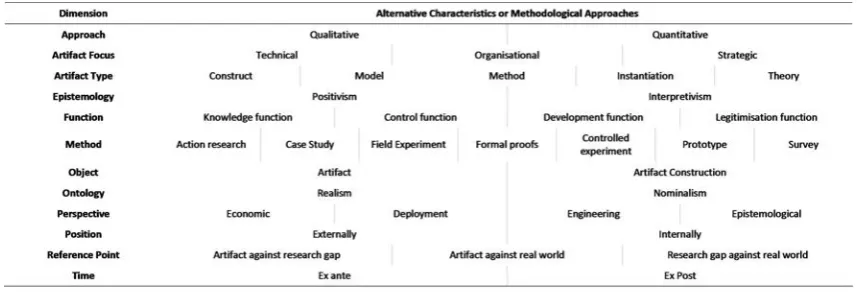
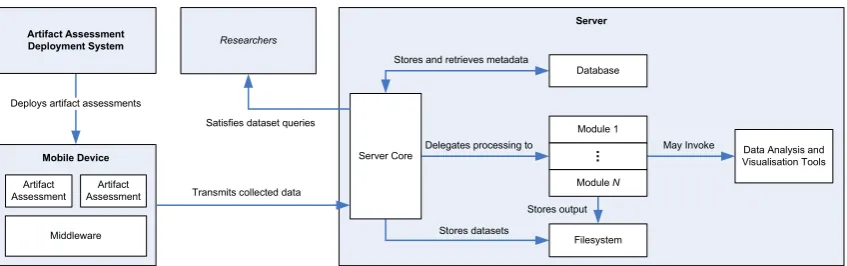
(18) List of Tables 1.1. Computational offloading frameworks, categorised by the characteristics of input data that they take into account when making offloading decisions. . . . . . . . . . . . . . . . . . .. 2.1. 4. DSR artifact evaluation dimensions, adapted from Cleven, Gubler and Hüner (2009). Note: vertical lines within dimensions are alternative characteristics or methodological approaches. 20. 2.2. Summary of mobile data collection features. . . . . . . . . . . . . . . . . . . . . . . . . .. 3.1. Commonly identified sources of OS noise from the existing literature. Sources can arise. 24. from the underlying hardware and operating system, as well as services running on behalf of the operating system. . . . . . . . . . . . . . . . . . . . . . . . . . . . . . . . . . . . . .. 37. 3.2. Common techniques for measuring OS noise from the existing literature. . . . . . . . . . .. 39. 3.3. Mean skewness and kurtosis of the collected data, before and after the removal of outliers.. 44. 3.4. Comparison of strategies for selecting the value of the scale factor F. . . . . . . . . . . . .. 48. 4.1. Normalised mean outlier detection error values for the two curves. . . . . . . . . . . . . .. 61. 4.2. Results for the four compactness metrics: TWGD, Depth, Radius, and the difference between the centroid and the medoid. . . . . . . . . . . . . . . . . . . . . . . . . . . . . . . . . .. 4.3. 63. Time complexity for the full and simplified outlier detection heuristics, excluding dendrogram construction. . . . . . . . . . . . . . . . . . . . . . . . . . . . . . . . . . . . . . . . . . .. 63. 5.1. A sample of existing approaches for implementing hierarchical clustering in parallel. . . .. 72. 5.2. Device characteristics for the three GPU models used for benchmarking, as reported by the CUDA cudaGetDeviceProperties() function. The value reported for the maximum number of threads is the number of Streaming Multiprocessor (SM) units the device has, multiplied by the maximum number of concurrent threads per SM. . . . . . . . . . . . . . . . . . . .. 85. 6.1. Comparison of existing timing models . . . . . . . . . . . . . . . . . . . . . . . . . . . .. 96. 6.2. Structure of a dataset. Values are examples. . . . . . . . . . . . . . . . . . . . . . . . . . 102 xvii.
(19) xviii. LIST OF TABLES. 6.3. Validation results for real hardware devices . . . . . . . . . . . . . . . . . . . . . . . . . 104. 7.1. Cross-validation results for the validation experiment, averaged across all 20 devices and all 5 runs of the experiment. . . . . . . . . . . . . . . . . . . . . . . . . . . . . . . . . . . . 115.
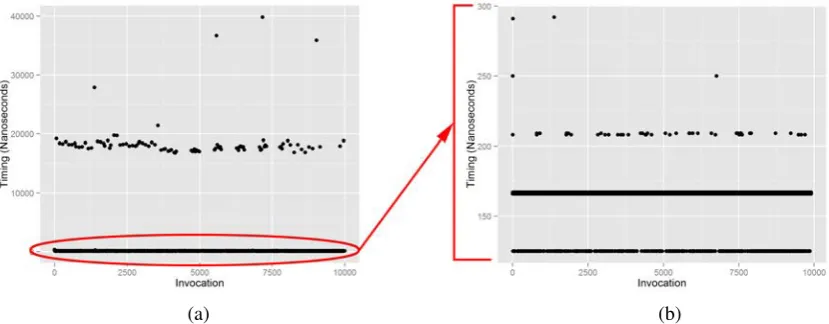
(20) List of Figures 1.1. Examples of offloading framework architectures, based on (a) RPC, from MAUI (Cuervo et al., 2010), and (b) VM Migration, from CloneCloud (Chun, Ihm, Maniatis, Naik & Patti, 2011). 3. 1.2. Computational offloading cost model, from Kovachev, Cao and Klamma (2011) . . . . . .. 3. 1.3. Design Science Research Methodology (DSRM) Process Model, adapted from Peffers, Tuunanen, Rothenberger and Chatterjee (2007). . . . . . . . . . . . . . . . . . . . . . . .. 2.1. 9. Interactions between the components of my proposed model for automated evaluation of design science research artifacts targeting mobile platforms. . . . . . . . . . . . . . . . .. 26. 2.2. Manual data collection using the Apple Xcode development tool. . . . . . . . . . . . . . .. 30. 2.3. DSRM process iteration loops (Peffers et al., 2007) automated by the automated evaluation workflow. . . . . . . . . . . . . . . . . . . . . . . . . . . . . . . . . . . . . . . . . . . .. 3.1. 32. High-level categorisation of OS noise measurement approaches and their outputs. The two main approaches are user-level micro-benchmarks and kernel instrumentation. The two approaches can be utilised individually or in combination. . . . . . . . . . . . . . . . . . .. 3.2. 41. Example scatter-plots of the collected micro-benchmarking data before (a) and after (b) outlier removal. Note the difference in scale: 0 - 40,000 for the raw data, 0 - 300 for the data after outlier removal. . . . . . . . . . . . . . . . . . . . . . . . . . . . . . . . . . . . . .. 4.1. 46. Example datasets for each of the mobile device hardware models. The top row depicts each dataset in full, whilst the bottom row depicts each dataset once outliers have been removed.. 55. 4.2. Example dataset highlighting both inliers and the two types of encountered outliers. . . . .. 56. 4.3. The unique intersections between the ideal ranges of the collected datasets. The y-value and colour saturation of each bar represents the normalised overlap count for that intersection. .. 60. 4.4. The two cut level ranking curves I evaluate for use with the simplified heuristic. . . . . . .. 61. 4.5. Log-log plot of the average runtime for the full heuristic and the simplified heuristic, excluding dendrogram construction. . . . . . . . . . . . . . . . . . . . . . . . . . . . . . . . . . xix. 64.
(21) xx. LIST OF FIGURES 5.1. Example of a scenario where merge collisions exist. Only the merges that are not marked as collisions will be merged in parallel by the naive collision detection algorithm, whereas all of the merges marked as “safe to merge” are able to be safely merged in parallel. . . . . .. 76. 5.2. Example run of the proposed collision detection algorithm, which maximises merge parallelism. 78. 5.3. An example of a scenario where the clustering decisions made by the parallel algorithm can differ from those made by the classical serial algorithm, depending on the properties of the points being clustered. . . . . . . . . . . . . . . . . . . . . . . . . . . . . . . . . . . . .. 5.4. Example results of the duplicate value pre-processing step. (a) is the sorted list of merges, and (b) is the resulting dendrogram. . . . . . . . . . . . . . . . . . . . . . . . . . . . . .. 5.5. 81. Benchmarking results for the CPU and GPU implementations of both complete linkage and single linkage, across the three dataset types. . . . . . . . . . . . . . . . . . . . . . . . . .. 5.6. 79. 84. Benchmarking results for the GPU implementations of both complete linkage and single linkage, across the three dataset types. . . . . . . . . . . . . . . . . . . . . . . . . . . . .. 84. 6.1. Application performance model, expanded from S. Wang, Kodase, Shin and Kiskis (2002). 92. 6.2. (a) Code that compares two integers for sorting purposes, and (b) the corresponding Control Flow Graph (CFG) . . . . . . . . . . . . . . . . . . . . . . . . . . . . . . . . . . . . . .. 6.3. 93. (a) Code that swaps two integers, and (b) the corresponding symbolic execution tree, from Anand et al. (2013) . . . . . . . . . . . . . . . . . . . . . . . . . . . . . . . . . . . . . .. 94. 6.4. Pipeline interference over three nodes and its timing model, from Engblom (2002). . . . .. 98. 6.5. Visualisation of the manner in which the k value for a given execution path is an approximation of the mean of the set W for that execution path. The k value for a path is a reflection of the unique mix of instructions in that path. . . . . . . . . . . . . . . . . . . . . . . . . . .. 7.1. 101. High-level overview of the tooling pipeline for collecting and transforming the data required by my input-centric application performance model. . . . . . . . . . . . . . . . . . . . . . 109. 7.2. Scatterplots depicting prediction error values on the vertical axis and k-coherence values on the horizontal axis, for each simplification strategy. Each point represents the average value for an individual execution path, averaged across the 20 devices and 5 runs of the experiment. Red lines represent the linear function of best fit for each set of values. . . . . . . . . . . . 116.
(22) List of Abbreviations Abbreviation. Definition. API. Application Programming Interface. AST. Abstract Syntax Tree. CFG. Control Flow Graph. CUDA DSR. Compute Unified Device Architecture Design Science Research. DSRM. Design Science Research Methodology. DVFS. Dynamic Voltage and Frequency Scaling. FTQ. Fixed Time Quantum. FWQ. Fixed Work Quantum. GPGPU. General-Purpose Graphics Processing Unit. GPIO. General-Purpose Input/Output. GPU. Graphics Processing Unit. HAC. Hierarchical Agglomerative Clustering. LOF. Local Outlier Factor. LSQ. Least-Squares. OS RPC SA SIMD. Operating System Remote Procedure Call Simulated Annealing Single Instruction Multiple Data. SM. Streaming Multiprocessor. TLB. Translation Lookaside Buffer. TWGD. Total Within-Group Distance. VM WCET. Virtual Machine Worst-Case Execution Time. xxi.
(23) xxii. LIST OF ABBREVIATIONS.
(24) Chapter 1. Introduction 1.1. Background. The domain of mobile and embedded computing continues to experience substantial growth and has established itself as a significant area of research and development (Gartner, Inc., 2016a, 2016b). Mobile computing is now a key component of our modern, information-driven society. Advances in System-on-aChip (SoC) hardware manufacturing and wireless networking technologies have resulted in a proliferation of powerful embedded devices with always-on network connectivity. Combined with software techniques for distributed processing, these enabling technologies are driving the realisation of the vision of ubiquitous computing, commonly referred to as the Internet of Things (IoT) (Gubbi, Buyya, Marusic & Palaniswami, 2013). At the forefront of this mobile revolution are smartphones and tablets. As the most prolific consumer mobile devices, the capabilities of smartphones and tablets stand to have the greatest impact on public perception of mobile computing. As smartphones and tablets become more powerful, users are demanding more from these devices. Graphically and computationally intensive applications such as games continue to be amongst the most popular mobile applications sold (Apple, Inc., 2016; Google, Inc., 2016). However, resources available to mobile devices are always inherently constrained by the requirements of portability. The most notable limitation is battery capacity (Ali, Simoens, Verbelen, Demeester & Dhoedt, 2016). By contrast, servers housed in data-centres and connected to mains power remain more powerful than mobile devices, as they are not constrained by a mobile form factor. The rise of cloud-based Compute-as-a-Service (CaaS) platforms enables mobile devices to leverage the powerful resources of remote servers (Fernando, Loke & Rahayu, 2013b). The use of remote servers to augment the capabilities of mobile devices has several names, including Mobile Cloud Computing (MCC) (Fernando et al., 2013b; Kovachev et al., 2011; Shiraz, Sookhak, Gani & Shah, 2015) and cyber-foraging (Balan, 2006; Lewis & Lago, 2015; Messinger & Lewis, 2013), but for the sake of simplicity, I will use the term computational offloading (Kumar, Liu, Lu & Bhargava, 2013; Yousafzai et al., 2016).. 1.
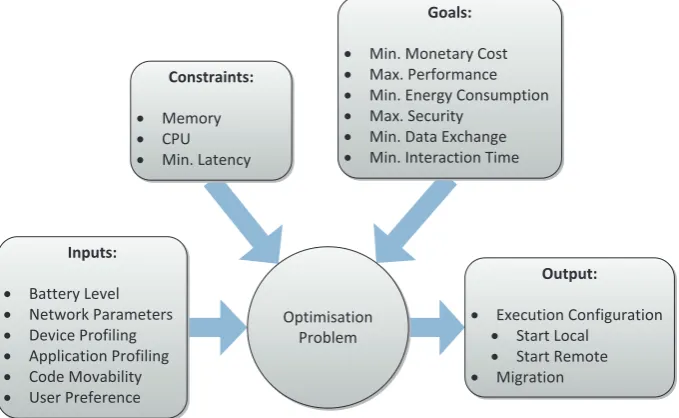
(25) 2. 1.1.1. CHAPTER 1. INTRODUCTION. Computational offloading. At its simplest, computational offloading utilises remote code execution to perform processing on a cloud server, and then retrieves the results (Balan, Satyanarayanan, Park & Okoshi, 2003). This allows mobile applications to perform processing that would otherwise be too costly to execute on the mobile device itself. However, applications that utilise unconditional computational offloading cannot function without an active network connection. In addition, there exist circumstances under which remote processing may be detrimental to application performance. Consider a scenario where a mobile device is connected to a remote server via an extremely slow or congested network connection, and performing execution remotely requires the transmission of a large amount of input and output data. In this case, local execution on the mobile device itself may result in better performance and reduced resource usage when compared to remote execution (Cuervo et al., 2010). Optimal use of computational offloading requires dynamic offloading decisions, informed by the circumstances under which processing takes place. This requirement is addressed by a type of software known as a computational offloading framework. Computational offloading frameworks are a type of middleware that aim to optimise application performance and resource use through the use of dynamic offloading decisions (Kumar et al., 2013). Offloading frameworks perform two key functions. The first is to make offloading decisions on behalf of the mobile application. The second is to abstract the implementation of migrating application execution between the mobile device and the remote server (Y. Zhang et al., 2012). The two most common migration mechanisms are Remote Procedure Calls (RPC) (Cidon, London, Katti, Kozyrakis & Rosenblum, 2011; Cuervo et al., 2010; Kemp, Palmer, Kielmann & Bal, 2010; Kosta, Aucinas, Hui, Mortier & Zhang, 2012; Ra et al., 2011; Verbelen, Simoens, Turck & Dhoedt, 2012) and Virtual Machine (VM) Migration (Chun et al., 2011; Flores & Srirama, 2013; Gordon, Jamshidi, Mahlke, Mao & Chen, 2012; Kakadia, Saripalli & Varma, 2013; Satyanarayanan, Bahl, Caceres & Davies, 2009). Regardless of the migration mechanism employed, the high-level architecture of a computational offloading framework remains largely the same. Figure 1.1 depicts two examples of offloading framework architectures, and how they distribute components between a mobile device and a remote server. Aside from the component responsible for performing application migration, the most common component of a computational offloading framework is the profiler. The profiler is responsible for monitoring the condition of the application, mobile device, network connection, and remote server. This information is then used to perform a cost-benefit analysis to determine whether execution of a given part of the application should be offloaded or not (Cuervo et al., 2010). This cost-benefit analysis is commonly formulated as an optimisation problem, which aims to satisfy a set of goals within a given set of constraints. Figure 1.2 depicts the components commonly utilised by the cost model used to make computational offloading decisions. The cost model may attempt to optimise one or more metrics, such as application performance or power use. The optimisation problem is often solved by feeding the data from the profiler component into a linear solver (Cuervo et al., 2010). The quality of the produced offloading decisions is dependant on the accuracy of the.
(26) 1.1. BACKGROUND. 3. (a). (b). Figure 1.1: Examples of offloading framework architectures, based on (a) RPC, from MAUI (Cuervo et al., 2010), and (b) VM Migration, from CloneCloud (Chun et al., 2011). Figure 1.2: Computational offloading cost model, from Kovachev et al. (2011) information generated by the profiler. A majority of existing research has focussed on improving the accuracy of the profiled components (Ali et al., 2016; W. Gao, Li, Lu, Wang & Liu, 2014; Gurun, Krintz & Wolski, 2008; Y. Kwon et al., 2013; Pathak, Hu, Zhang, Bahl & Wang, 2011). The two components to receive the most attention are device profiling and application profiling. Device profiling research has largely focussed on power models for battery consumption of both mobile device hardware components and network data transmission (Ali et al., 2016; Cuervo et al., 2010; Geng, Hu, Yang, Gao & Cao, 2015; B. Gil & Trezentos, 2011). Application profiling has focussed on execution behaviour and memory usage of mobile applications (Chun et al., 2011; W. Gao et al., 2014; C. Wang & Li, 2004; Y. Zhang et al., 2012). Application profiling presents the greater challenge of the two, since a computational offloading framework must be able to adapt to the behaviour patterns of a given mobile application, which are unique to the code in that application. A number of factors influence application performance. A detailed treatment of these factors can be found in Chapter 6. One factor that can have a significant impact on application behaviour is the application’s input.
(27) 4. CHAPTER 1. INTRODUCTION. data (W. Gao et al., 2014). The relationship between application input data characteristics and execution behaviour can be entirely arbitrary, and unique to each application (King, 1976). Input characteristics can include the size of the input data (Balan et al., 2003; Cuervo et al., 2010; Flinn, Park & Satyanarayanan, 2002; Ra et al., 2011), the values of individual input parameters (Flores et al., 2015; W. Gao et al., 2014; Shi et al., 2014), or arbitrary features of input data that are acted upon by the application’s code (W. Gao et al., 2014; C. Wang & Li, 2004). However, most existing computational frameworks fail to take into account the influence of arbitrary input data characteristics. In Section 1.1.2, I examine the treatment of input data characteristics by existing offloading frameworks, and the extent to which they are factored into making optimal offloading decisions.. 1.1.2. Use of input characteristics in offloading decisions. Table 1.1 summarises existing computational offloading frameworks, and categorises them based on the input characteristics that they take into account when making offloading decisions. Table 1.1 Computational offloading frameworks, categorised by the characteristics of input data that they take into account when making offloading decisions. Offloading frameworks. Input characteristics taken into account. Goyal and Carter (2004); Gurun et al. (2008); D. Huang, Zhang, Kang and Luo (2010); Huerta-Canepa and Lee (2010); Kemp et al. (2010); March et al. (2011); Ok, Seo and Park (2007); O’Sullivan and Grigoras (2013); Rachuri, Mascolo, Musolesi and Rentfrow (2011); Seshasayee, Nathuji and Schwan (2007); Su and Flinn (2005); Y. Zhang, t. Guan, Huang and Cheng (2009). None. Noble et al. (1997); Rigole, Berbers and Holvoet (2004). Programmer-defined. Y.-W. Kwon and Tilevich (2013); O’Hara, Nathuji, Raj, Schwan and Balch (2006); Ra et al. (2011); Rahimi, Venkatasubramanian, Mehrotra and Vasilakos (2012); L. Yang et al. (2013). Size of data passed between pipeline stages. Chu, Song, Wong, Kurakake and Katagiri (2004); Chun et al. (2011); Cuervo et al. (2010); Duga (2011); Ferrari, Giordano and Puccinelli (2016); Flores and Srirama (2013); B. Gao, He, Liu, Li and Jarvis (2012); Geng et al. (2015); Giurgiu, Riva, Juric, Krivulev and Alonso (2009); Gordon et al. (2012); Gu, Nahrstedt, Messer, Greenberg and Milojicic (2003, 2004); Han, Zhang, Cao, Wen and Zhang (2008); Hung, Shieh and Lee (2012); Hung, Shih, Shieh, Lee and Huang (2012); Hunt and Scott (1999); Imai (2012); Kakadia et al. (2013); Kovachev, Cao and Klamma (2012); Kovachev and Klamma (2012); Li, Wang and Xu (2001); Li and Xu (2002); Ma, Lam and Wang (2011); Ma and Wang (2012); Messer et al. (2002); Messinger and Lewis (2013); Mohapatra and Venkatasubramanian (2003); Nimmagadda, Kumar, Lu and Lee (2010); Ou, Wu, Yang and Zhou (2008); Ou, Yang and Liotta (2006); Ou, Yang and Zhang (2007); Satyanarayanan et al. (2009); Shiraz, Gani, Shamim, Khan and Ahmad (2015); Simanta, Ha, Lewis, Morris and Satyanarayanan (2013); Weinsberg, Dolev, Wyckoff and Anker (2007); Wolski, Gurun, Krintz and Nurmi (2008); K. Yang, Ou and Chen (2008); Yousafzai et al. (2016). Size of serialised program state. Ahnn and Potkonjak (2013); Ali et al. (2016); Angin and Bhargava (2013); Aucinas, Crowcroft and Hui (2012); Balan et al. (2003); Y.-S. Chang and Hung (2011); G. Chen et al. (2004); X. Chen, Jiao, Li and Fu (2016); Cidon et al. (2011); Dou, Kalogeraki, Gunopulos, Mielikainen and Tuulos (2010); Fernando, Loke and Rahayu (2013a); Flinn et al. (2002); Flores and Srirama (2014); Giurgiu, Riva and Alonso (2012); Hong, Kumar and Lu (2009); Imai and Varela (2011); Kosta et al. (2012); Kremer, Hicks and Rehg (2003); Kristensen (2010); Liu and Lu (2010); Marinelli (2009); Matthews, Chang, Feng, Srinivas and Gerla (2011); Paniagua, Flores and Srirama (2012); Rego et al. (2016); Rim, Kim, Kim and Han (2006); Rong and. Length of each input parameter. Pedram (2003); Saab, Saab, Kayssi, Chehab and Elhajj (2015); Shi, Lakafosis, Ammar and Zegura (2012); Srirama, Paniagua and Flores (2012); Verbelen, Hens, Stevens, De Turck and Dhoedt (2010); Verbelen et al. (2012); Verbelen, Stevens, Simoens, Turck and Dhoedt (2011); Xian, Lu and Li (2007); X. Zhang, Jeon, Gibbs and Kunjithapatham (2012); X. Zhang, Kunjithapatham, Jeong and Gibbs (2011); Y. Zhang et al. (2012) Shi et al. (2014, 2013). Key features model (automatically extracted fine-grained features, such as loop counter values). Flores et al. (2015). Input values included in request hashing for. W. Gao et al. (2014). Features captured by the order-k semi-Markov model. C. Wang and Li (2004). Arbitrary input characteristics. memoization. Some offloading frameworks do not directly take into account input data characteristics. These frameworks utilise approaches that indirectly respond to changes in input characteristics, typically by measuring changes in application performance over time (Goyal & Carter, 2004; Gurun et al., 2008; D. Huang et al., 2010; Kemp.
(28) 1.1. BACKGROUND. 5. et al., 2010; March et al., 2011; Rachuri et al., 2011). These models do not capture input characteristics themselves, instead capturing only the changes in application behaviour that manifest as a result of changing input data. Predictions generated from these purely history-based models are a function of the time series data they are based upon (Gurun et al., 2008). Accordingly, this approach works only if there exists a temporal pattern in input data characteristics, which is not guaranteed for all mobile applications. Several frameworks allow the programmer to specify the input characteristics to be taken into account, often by assigning a weighting to each characteristic (Noble et al., 1997; Rigole et al., 2004). This approach is relatively uncommon, as it is cumbersome and places a high level of burden on the application developer. A number of offloading frameworks model the behaviour of an application as a pipeline of computational stages, with data flowing between them. In such frameworks, the only input characteristic taken into account is the size of the input data and resulting output data flowing between pipeline stages (Y.-W. Kwon & Tilevich, 2013; O’Hara et al., 2006; Ra et al., 2011; Rahimi et al., 2012; L. Yang et al., 2013). This strategy is adapted from traditional distributed computing, where computation is taking place over a series of compute nodes (Ra et al., 2011). This offers increased flexibility, but is not strictly necessary when computation is only performed on one device at a time, which is the most common mode of operation amongst existing offloading frameworks. Many offloading frameworks utilise a far simpler version of the pipeline-based approach, where communication costs between intermediate stages of the pipeline are ignored because they are known to take place on the same device (Chu et al., 2004; Chun et al., 2011; Cuervo et al., 2010; Gordon et al., 2012; Gu et al., 2003; Satyanarayanan et al., 2009; Weinsberg et al., 2007). This simplified pipeline-based approach closely reflects the VM Migration offloading strategy, whereby the application is migrated back and forth between the mobile device and a server. The only input characteristic taken into account when making offloading decisions is the memory used by input values, as part of the overall size of the application state that must be migrated (Chun et al., 2011; Cuervo et al., 2010; Giurgiu et al., 2009; Han et al., 2008; Satyanarayanan et al., 2009). Just as one common approach reflects VM Migration, another common approach reflects the use of RPCs. In the RPC-oriented approach, the only characteristic of input data taken into account when making offloading decisions is the length of each input parameter to the offloaded function (Balan et al., 2003; Cidon et al., 2011; Flinn et al., 2002; Kosta et al., 2012; Verbelen et al., 2012). Like the previous approaches that include input data size, the size is used primarily in computing data transfer costs between the mobile device and the server, and less commonly for determining computational cost (Flinn et al., 2002; Imai & Varela, 2011). Several existing offloading frameworks utilise a model that I refer to as the key features model (Shi et al., 2014, 2013). The key features model automatically extracts a set of fine-grained features from an application that can be used to predict the behaviour of the larger application as a whole (L. Huang et al., 2010). Although this model can extract arbitrary features that are indirectly related to input characteristics, prediction is limited to larger parts of the application and the relationship between the input characteristics and the key features themselves cannot always be determined. The offloading framework proposed by Flores et al. (2015) caches the results of previous computations and.
(29) 6. CHAPTER 1. INTRODUCTION. reuses them when possible, a strategy known in computer science as memoisation. In order to prevent results from being reused incorrectly for differing input values, the input values themselves are included in the information that is hashed to produce a unique identifier for each cached request. The cached values can also be utilised by multiple mobile devices running the same application (Flores et al., 2015). However, this approach does not incorporate input characteristics into any sort of cost model, it merely utilises caching to provide performance improvements when the same input data is used more than once. The only existing offloading framework that takes arbitrary input data characteristics into account, that I am aware of, is that proposed by C. Wang and Li (2004). This framework utilises a software analysis technique known as symbolic execution to build a model that maps arbitrary input data characteristics to application behaviours. This represents the greatest extent to which a computational offloading framework can factor input data characteristics into its offloading decisions. However, there are a number of other factors that impact the performance and resource usage of an application at runtime that this framework does not take into account. These factors are discussed in the following section.. 1.1.3. Dynamic performance factors. In addition to the application code that is executing and the input data to that code, there are a number of other factors that can impact the performance and resource usage of a mobile application at runtime. The most important of these are Dynamic Voltage and Frequency Scaling (DVFS) and Operating System (OS) noise.. 1.1.3.1. Dynamic Voltage and Frequency Scaling. DVFS is a power management technique utilised by modern mobile processors. DVFS dynamically adjusts the voltage and frequency of the processor to optimise power consumption, based on the current processing workload (Mittal, 2014). Similar techniques are employed by other hardware components. The effect of these power management techniques is that a mobile device can transition between multiple steady-states while an application is running. The existence of multiple device steady-states is of particular importance to computational offloading frameworks because the profiling data recorded during one steady-state cannot be used to accurately predict the performance and resource use of the application during another steady-state. This precludes the use of precomputed training data, and necessitates frequent profiling to ensure prediction accuracy is maintained.. 1.1.3.2. Operating System Noise. OS noise refers to the variations in application performance that are caused by the underlying operating system and hardware (Morari, Gioiosa, Wisniewski, Cazorla & Valero, 2011). These variations are caused by a wide variety of factors, which are discussed in Chapter 3. The effects of OS noise manifest themselves in measurements of an application’s performance. Fine-grained performance measurements, known as.
(30) 1.2. RESEARCH GAPS, QUESTIONS, AND OBJECTIVES. 7. micro-benchmarks, demonstrate the effects of OS noise most clearly (Beckman, Iskra, Yoshii, Coghlan & Nataraj, 2008; M. Sottile & Minnich, 2004). Accordingly, any measurements of application performance that are recorded by the profiler of a computational offloading framework must be processed to prevent the presence of OS noise from interfering with the accuracy of the performance profile. Most existing studies of OS noise have been performed on traditional desktop and server architectures (De, Kothari & Mann, 2007; Morari et al., 2011; Petrini, Kerbyson & Pakin, 2003). To date I have not found any existing research that performs a thorough study of OS noise on mobile device platforms. Existing approaches to mitigating the effects of OS noise on micro-benchmarking data are currently based on the characteristics of OS noise on traditional platforms. Before an approach to mitigating the effects of OS noise on micro-benchmarking data for mobile devices can be explored, data needs to be collected on the characteristics of OS noise found on mobile platforms.. 1.2. Research Gaps, Questions, and Objectives. Despite the large number of existing computational offloading frameworks, the treatment of input data characteristics amongst the profiling and prediction components across the majority of these frameworks is still relatively simple. In addition, a thorough exploration of the issues surrounding fine-grained performance measurements on mobile platforms is largely lacking. Based on these limitations, I have identified the following gaps in the literature: 1. The profiling and prediction components of existing computational offloading frameworks do not comprehensively take into account the influence of arbitrary input data characteristics on application behaviour. 2. There has not been a thorough investigation into the levels of OS noise present on consumer mobile devices. In particular: (a) It is unknown if the levels and characteristics of OS noise on mobile platforms are consistent with observations of OS noise on traditional desktop devices and server architectures. (b) There has been no detailed investigation into the interactions between the changes in steady-state characteristic of mobile devices, and levels of OS noise. 3. Very few techniques for mitigating the effects of OS noise on micro-benchmarking data have been explored. Additionally, there has been no focus on optimising the efficiency of these techniques for use on resource-constrained mobile devices. From these gaps in the literature, I have developed my research question: • What is a feasible approach to building a profiling and prediction system for computational offloading that takes into account the influence of both arbitrary input characteristics and OS noise on application behaviour?.
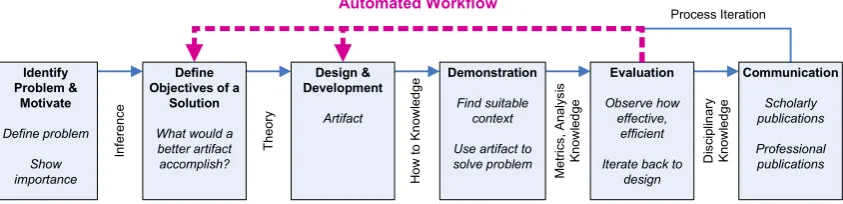
(31) 8. CHAPTER 1. INTRODUCTION. To answer this question, a series of smaller questions must first be addressed: 1. What levels of OS noise are present on consumer mobile devices? 2. Are the characteristics of OS noise present in micro-benchmarking data from consumer mobile devices consistent with those observed on other architectures? 3. Are OS noise levels influenced by changes in steady-state on mobile devices? 4. How can the effects of OS noise on micro-benchmarking results be mitigated in a manner that is both automated and efficient enough to be performed repeatedly on resource-constrained mobile devices? 5. What approach will allow a profiling and prediction system for computational offloading to be built that takes into account the influence of arbitrary input characteristics on application behaviour? 6. What approach will allow a profiling and prediction system that takes into account application input characteristics to be implemented in a manner efficient enough for use on resource-constrained mobile devices? In order to address these questions, I define the following objectives for this study: 1. To measure the levels of OS noise present on consumer mobile devices; 2. To identify the characteristics of noisy micro-benchmark data measured on consumer mobile devices; 3. To establish if a relationship exists between OS noise levels and mobile device state changes; 4. To develop an automated technique for mitigating the effects of OS noise on micro-benchmarking results that is efficient enough for repeated use on resource-constrained mobile devices; and 5. To develop a profiling and prediction component, usable by a computational offloading framework, that accounts for the influence of arbitrary input characteristics on application behaviour, and is efficient enough for use on resource-constrained mobile devices. The completion of each objective represents an answer to each of the associated research questions. Details on the solution to each objective are summarised in Section 1.4, described in the bridging statements at the start of Chapters 3 through 7, and summarised again in Chapter 8.. 1.3. Research methodology overview. The research methodology utilised by the research in this dissertation is design science. Design science is a relatively young research methodology, having originated from the Information Systems discipline in the early 1990s (Peffers et al., 2007). Design science is focussed on problem solving (Hevner, March, Park & Ram, 2004). Instead of formulating one or more hypotheses and evaluating them, design science research identifies a problem to be solved and then proposes and evaluates a solution to that problem..
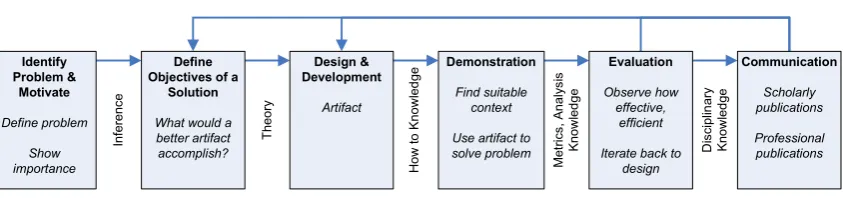
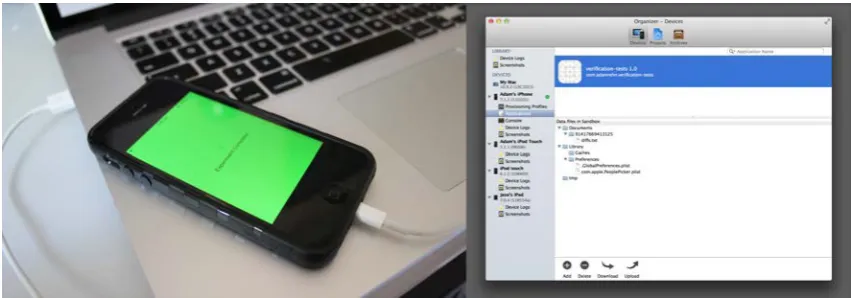
(32) 1.4. THESIS OUTLINE. 9. The research outputs of design science are referred to as artifacts. Artifacts contribute to the greater knowledge base and can take many forms, but are commonly prescriptive IT constructs (Gregor & Hevner, 2013). The Design Science Research Methodology (DSRM) is comprised of six activities for the development and refinement of artifacts. These activities are depicted in Figure 1.3. DSRM extends iterative models of software development and applies them to research. This iterative nature is reflected in a series of feedback loops that link the activities of the DSRM (Peffers et al., 2007).. Figure 1.3: Design Science Research Methodology (DSRM) Process Model, adapted from Peffers et al. (2007).. The iterative nature of design science makes it particularly well-suited to research in technologicallyfocussed disciplines such as engineering, computer science, and information systems. The feedback loops connecting the activities of the DSRM facilitate rapid refinement of artifacts, resulting in more mature research contributions. Such refinement is key to achieving the levels of efficiency required by several of the research objectives listed in Section 1.2, particularly objectives 4 and 5. Due to these benefits, design science was selected as the ideal research methodology for this dissertation. The overview of design science presented in this section includes only the details relevant to the rationale for selecting design science for use in this research. A more detailed discussion of design science and the activities of the DSRM is provided in Chapter 2.. 1.4. Thesis Outline. This dissertation was undertaken as a thesis by publication. The thesis is divided into eight chapters. The introductory and concluding chapters are unique to the thesis itself and do not have any associated publications. Chapters 2 through 7 contain content that has been either published, submitted for publication, or is planned for submission, in the form of four journal articles and three conference papers, all double-blind peer reviewed. Each chapter is prefaced by a brief abstract that discusses the research outcomes of the chapter, and lists the publications in which the chapter content has been disseminated. The chapters are organised as follows: • Chapter 2 describes in detail the Design Science Research Methodology (DSRM) utilised by the research in this thesis, with a focus on evaluation methodology. Design Science is a popular research methodology that continues to evolve and mature. The evaluation activity of the DSRM draws on.
(33) 10. CHAPTER 1. INTRODUCTION evaluation methodologies from existing research disciplines. The application of these methodologies is guided by frameworks that consider the general characteristics of the research outputs, known as artifacts, that are being evaluated. Evaluation of artifacts for mobile device platforms presents a number of unique challenges that are not addressed by these existing frameworks. In this chapter, I address this gap by gathering and consolidating requirements from the existing literature on both evaluation methodology and mobile data collection. Based on these requirements, I propose a model for automating the evaluation of Design Science research artifacts targeting mobile platforms. The proposed model automates the deployment and execution of experiments on mobile devices, as well as the collection, transmission, and processing of data generated by experiments. A prototype implementation of the proposed model is utilised in the data collection of the subsequent data chapters of the thesis, with the exception of Chapter 5, which does not collect data from mobile devices. • Chapter 3 addresses research objectives 1, 2, and 3, and addresses part of research objective 4. The two aims of this chapter are to examine the characteristics of OS noise on mobile devices, and to develop a technique to mitigate the effects of OS noise on micro-benchmarking results. To achieve this, I conduct a study of OS noise levels on Apple iPad Air devices. The study measures levels of OS noise present on devices whilst systematically varying the steady-state of each device. I examine the characteristics of the measured OS noise levels and compare them to the characteristics of OS noise on traditional desktop and server platforms reported by the existing literature. I then perform analysis to determine the relationship between OS noise levels and changes in system steady-state. After this, I propose an adaptive noise mitigation technique for use with micro-benchmarking data. The design of the noise mitigation technique is informed by the characteristics of the collected OS noise data. The initial version of the noise mitigation technique described in this chapter utilises a semi-automated outlier removal approach, which requires manual intervention to guide the adjustment of parameters. As a consequence, although the proposed noise mitigation technique addresses most of the requirements of research objective 4, the requirement for full automation is not yet satisfied at the conclusion of this chapter. • Chapter 4 builds on the work presented in Chapter 3. The aim of this chapter is to develop a fully automated outlier removal approach for use with the adaptive noise mitigation technique proposed in Chapter 3. To improve the generality of the outlier removal approach, I first collect OS noise data from a variety of Apple iOS device models to supplement the existing data, which was only collected from iPad Air devices. I then examine the collected data to identify the nature of the outliers present, as well as any inherent clustering structures. Due to the nested clustering structure observed in the collected data, I select hierarchical clustering as the basis for my proposed outlier removal technique. From this starting point, I develop a heuristic for automatically determining the point at which to cut the dendrogram produced by hierarchical clustering, and remove clusters that are identified as outliers. I then simplify this heuristic to develop an approximation that features reduced computational complexity and is suitable for use on resource-constrained mobile devices. Finally, I validate the efficiency and effectiveness of the full and simplified versions of the proposed heuristic. Validation.
(34) 1.4. THESIS OUTLINE. 11. demonstrates that the simplified heuristic produces results that are comparable to the full heuristic, at a significantly lower computational cost. This provides full automation of the noise mitigation technique proposed in Chapter 3, thus satisfying the associated requirements of research objective 4. Removal of outliers once hierarchical clustering has been completed is extremely efficient. However, the cost of performing hierarchical clustering itself is still too high for use on resource-constrained mobile devices. • Chapter 5 extends the work presented in Chapter 4 by proposing a novel parallel algorithm for performing hierarchical clustering of single-dimensional data. Existing parallel implementations of hierarchical clustering do not maximise the level of parallelism. In particular, cluster merges are often performed in serial during part or all of the clustering process. My proposed parallel clustering algorithm makes use of General-Purpose Graphics Processing Unit (GPGPU) technologies to achieve massive parallelism on commodity consumer hardware. In addition, the unique characteristics of single-dimensional data are exploited to maximise the number of cluster merges that can be performed in parallel. This allows the algorithm to maximise the gains that are achieved from parallelism and improve efficiency. I validate the efficiency and correctness of my proposed algorithm against the classical serial algorithm. Validation results demonstrate that the clustering results produced by my proposed algorithm are equivalent to the results produced by the classical algorithm. Performance benchmarking demonstrates that my parallel algorithm achieves a significant speed gain when compared to the classical serial implementation. On graphics hardware supporting a sufficient number of simultaneous threads, the computational cost of my proposed algorithm is low enough to make it suitable for use on resource-constrained mobile devices. This satisfies the efficiency requirements of research objective 4. • Chapter 6 builds the foundation for addressing research objective 5. This chapter aims to develop a model of application performance that takes into account the influence of arbitrary input characteristics, whilst remaining efficient enough for use on resource-constrained mobile devices. Existing software timing models are too computationally expensive for use on mobile devices and are not designed to adapt to changing device steady-states. After identifying timing models that are suitable for simplification, I select a timing model known as the count-and-weights model for use as the basis of my proposed model. I simplify the count-and-weights model to reduce information requirements and computational complexity, and also incorporate elements of a timing model known as the pipeline model to facilitate adaptation to changing device steady-states. I then validate the accuracy of the proposed timing model as an approximation of the count-and-weights model. Using both synthetic datasets and benchmarking data collected from a variety of embedded and mobile devices, I demonstrate that the proposed model is an extremely accurate approximation of the count-and-weights model for individual code execution paths. However, this chapter does not validate the predictive power of the proposed model for code with multiple execution paths. • Chapter 7 completes the work that was started in Chapter 6 to address research objective 5. In this chapter, I propose a language- and platform-agnostic tooling pipeline that can be used to implement a.
(35) 12. CHAPTER 1. INTRODUCTION profiling and prediction system based on my proposed input-centric application performance model. Using this tooling pipeline, I implement a prototype of my proposed model that targets the C++ programming language and the Apple iOS platform. I then design an experiment to validate the predictive power of my proposed model for code with multiple execution paths. The experiment performs leave-one-out cross validation to demonstrate the ability of the proposed model to generalise to independent datasets. I also propose a heuristic to quantify the suitability of a given piece of code to prediction with the proposed model. I run the experiment on a set of Apple iPad Air devices using a series of code modules representing varying levels of the suitability heuristic. Results demonstrate that predictions produced by the proposed model are extremely accurate, even as the value of the suitability heuristic becomes less desirable. The proposed input-centric application performance model, and associated profiling and prediction prototype, provides extremely accurate predictions whilst remaining efficient enough for use on resource-constrained mobile devices. This satisfies the requirements of research objective 5.. The following table provides a breakdown of the intellectual contributions made by myself and others to the research in each chapter:.
(36) 1.4. THESIS OUTLINE. 13. Chapter. Publications. Intellectual contributions. 2. Rehn, A., Holdsworth, J., & Hamilton, J. (2014). A. Hamilton provided guidance on the nuances of the. model for an automated evaluation framework for design. DSRM. Rehn conducted the literature review, developed. science artifacts targeting mobile platforms. Journal of. the model, implemented the software prototype of the. Management Systems, 24, 1–21.. model, evaluated the effectiveness of the model, and wrote the paper content. Holdsworth and Hamilton provided editorial support.. 3. Rehn, A., Hamilton, J., & Holdsworth, J. (2014).. Rehn performed the literature review, designed the. Towards an adaptive OS noise mitigation technique for. experiment, performed the data collection, performed the. microbenchmarking on mobile platforms. In Fourteenth. data analysis, developed the adaptive noise mitigation. international conference on electronic business and the. technique, developed the semi-automated outlier. first global conference on internet and information. removal approach, evaluated the noise mitigation. systems (p. 263-269).. technique, and wrote the paper content for both papers. Hamilton provided statistical support for the data. Rehn, A., Holdsworth, J., & Hamilton, J. (2014).. analysis. Holdsworth and Hamilton provided editorial. Adaptive OS noise mitigation for microbenchmarking on. support for both papers.. mobile platforms. Journal of Management Systems, 24, 1–17. 4. Rehn, A., Holdsworth, J., & Lee, I. (2015). Automated. Lee provided guidance on clustering evaluation metrics.. outlier removal for mobile microbenchmarking datasets.. Rehn performed the data collection, performed the data. In 10th international conference on intelligent systems. analysis, developed the automated outlier removal. and knowledge engineering (ISKE) (p. 578-585).. approach, conducted the analysis to develop the simplified heuristic for resource-constrained mobile devices, evaluated the two heuristics, and wrote the paper content. Rehn and Holdsworth wrote the algorithm pseudocode for the paper. Holdsworth and Lee provided editorial support.. 5. Rehn, A., Possemiers, A., & Holdsworth, J. Efficient. Possemiers provided guidance on the nuances of the. hierarchical clustering for single-dimensional data using. CUDA API. Rehn developed the parallel clustering. CUDA. Submitted to 2017 Pacific Asia Conference on. algorithm and the software implementation of the. Information Systems (PACIS).. algorithm, with additional support from Possemiers. Rehn performed the literature review, designed the validation experiment, validated the parallel clustering algorithm, and wrote the paper content. Holdsworth provided mathematical and editorial support..
(37) 14. 6. CHAPTER 1. INTRODUCTION. Rehn, A., Holdsworth, J., Hamilton, J., & Tee, S. An. Rehn developed the proposed timing model, with. input-centric performance model for mobile applications.. additional support from Holdsworth, Hamilton, and Tee.. Submitted to Journal of Systems and Software.. Rehn performed the literature review and identified the timing models suitable for simplification, designed the validation experiment, performed the benchmarking data collection and generated the synthetic datasets, validated the proposed timing model, and wrote the paper content. Holdsworth, Hamilton, and Tee provided editorial support.. 7. Rehn, A., Holdsworth, J., Hamilton, J., & Tee, S.. Rehn developed the tooling pipeline to implement the. Input-centric performance prediction for mobile. proposed profiling and prediction approach,. applications. To be submitted to Journal of Systems and. implemented the software prototype, designed the. Software.. validation experiment, performed the data collection, validated the profiling and prediction approach, and wrote the paper content. Hamilton and Tee provided statistical support. Holdsworth, Hamilton, and Tee provided editorial support..
Figure
+7

Outline
Design Science Research Artifact Evaluation
Mobile data collection frameworks
Impact of OS noise within parallel computing
Experimental results
Adaptive noise mitigation approach
Discussion and future work
Data characteristics
Algorithm efficiency
Handling merge collisions
Limitations and Recommendations for Future Research
Related documents
