Structure of Benthic Communities along the
Taiwan Latitudinal Gradient
Lauriane Ribas-Deulofeu1,2,3☯, Vianney Denis3,4☯*, Stéphane De Palmas1,2,3,
Chao-Yang Kuo5, Hernyi Justin Hsieh6, Chaolun Allen Chen2,3,4*
1Department of Life Science, National Taiwan Normal University, Taipei, 11677, Taiwan,2Biodiversity Program, Taiwan International Graduate Program, Academia Sinica and National Taiwan Normal University, Taipei, 11529, Taiwan,3Biodiversity Research Center, Academia Sinica, Nangang, Taipei, 11529, Taiwan,
4Institute of Oceanography, National Taiwan University, Taipei, 106, Taiwan,5ARC Centre of Excellence for Coral Reef Studies, James Cook University, Townsville, QLD, 4811, Australia,6Penghu Marine Biological Research Centre, Makong, Penghu County, 880, Taiwan
☯These authors contributed equally to this work.
*[email protected](VD);[email protected](CAC)
Abstract
The distribution and the structure of benthic assemblages vary with latitude. However, few studies have described benthic communities along large latitudinal gradients, and patterns of variation are not fully understood. Taiwan, lying between 21.90°N and 25.30°N, is located at the center of the Philippine-Japan arc and lies at the northern margin of coral reef devel-opment. A wide range of habitats is distributed along this latitudinal gradient, from extensive fringing coral reefs at the southern coast to non-reefal communities at the north. In this study, we examined the structure of benthic communities around Taiwan, by comparing its assemblages in four regions, analyzing the effects of the latitudinal gradient, and highlight-ing regional characteristics. A total of 25 sites, 125 transects, and 2,625 photographs were used to analyze the benthic communities. Scleractinian corals present an obvious gradient of increasing diversity from north to south, whereas macro-algae diversity is higher on the north-eastern coast. At the country scale, Taiwanese coral communities were dominated by turf algae (49%). At the regional scale, we observed an important heterogeneity that may be caused by local disturbances and habitat degradation that smooths out regional differences. In this context, our observations highlight the importance of managing local stressors responsible for reef degradation. Overall, this study provides an important baseline upon which future changes in benthic assemblages around Taiwan can be assessed.
Introduction
Coral reefs host an extraordinarily high biodiversity [1], providing shelter to hundreds of thou-sands of species and considerable services to human society [2,3]. Despite the existence of coral reefs over the last 500 million years, their ecological persistence into the future seems doubtful [4]. Global threats, such as rising seawater temperature and ocean acidification, have caused a worldwide decline of this ecosystem (review in [5,6,7]), which suffers repeated
a11111
OPEN ACCESS
Citation:Ribas-Deulofeu L, Denis V, De Palmas S, Kuo C-Y, Hsieh HJ, Chen CA (2016) Structure of Benthic Communities along the Taiwan Latitudinal Gradient. PLoS ONE 11(8): e0160601. doi:10.1371/ journal.pone.0160601
Editor:Carlo Nike Bianchi, Universita degli Studi di Genova, ITALY
Received:May 31, 2016
Accepted:July 21, 2016
Published:August 11, 2016
Copyright:© 2016 Ribas-Deulofeu et al. This is an open access article distributed under the terms of the Creative Commons Attribution License, which permits unrestricted use, distribution, and reproduction in any medium, provided the original author and source are credited.
Data Availability Statement:All relevant data are within the paper and its Supporting Information files.
episodes of coral bleaching [8], reduction of the calcification rates of reef organisms [5,9,10], and the emergence of diseases [11–13]. In addition, local human-induced and natural stressors (i.e., habitat destruction, invasive species, pollution, and overfishing) have eroded the resilience of reefs [14,15] and have precipitated the shift of this ecosystem from coral- to algae- (or alter-native taxa) dominated communities [14,16–19].
As the ability to limit the global temperature increase to less than 2°C by the end of the cen-tury already seems out of reach [20], coral reef organisms will have to demonstrate exceptional adaptation and acclimatization capacities in order to survive future environmental conditions [21]. Despite the short delay that might be provided by those capacities and allow some species to survive the changes, migration to more suitable habitats may be a more viable alternative for many reef organisms to escape stressful conditions. In this context, mesophotic habitats [22,
23] and high latitude locations [24–27] in some regions of the world could serve as refuges for diverse taxa. Therefore, connectivity along bathymetric and latitudinal gradients is critical for ensuring a significant source of propagules to these habitats [23].
Extending between 21.90°N and 25.30°N in latitude, Taiwan is located at the center of the Philippine-Japan arc and lies at the northern margin of coral reef development [28,29]. Warm waters from the Kuroshio Current (KC) flow from the southern point of Taiwan along its east coast toward the Ryukyu Archipelago. Sandy bottoms and steep slopes flank the island’s west and east coasts, respectively [30]. Extensive fringing coral reefs are present along the south coast and eastern islets [30,31]. In the west and north of Taiwan, the frequent occurrence of sea surface temperatures (SSTs)<18°C during winter is a strong limitation to reef accretion [32]. The Penghu Archipelago, located in the Taiwan Strait, and the north coast are therefore characterized by the presence of non-reefal coral communities [31,33]. A wide range of habi-tats distributed along this latitudinal gradient enables Taiwan to be considered among the ten most important marine hotspots of biodiversity in the world [34]. To date, 317 species of scler-actinian corals [35,36], 1,335 species of reef fishes [37], 150 algae species, 90 species of echino-derms, and 50 species of soft corals have been recorded in Taiwan [31]. Scleractinian corals present a gradient of increasing diversity from North to South [33], whereas macro-algae diver-sity is higher on the northeastern coast [31].
Reefs around Taiwan are at high risk, and the region is one of the five most threatened areas in Southeast Asia [38]. Since 1957, seawater temperatures around Taiwan have increased by 1.55°C, and this region is among the most rapidly warming areas of the world [39]. Extensive bleaching events occurred in 1998 and 2007 at Kenting [40,41] causing, at some sites, an important decrease in coral coverage. Recovery in some cases has been interrupted by tropical storms that regularly affect Taiwan reefs [42], as well as a variety of local stressors such as out-breaks of invasive species (Terpiosat Green Island [43],Condylactisin Kenting [18]), and human-induced disturbances usually related to the erratic development and use of the coastline (i.e., sedimentation, nutrient enrichment, mechanical damage, overfishing, and destructive fishing methods [40,42,44,45]). By 2085, SSTs around Taiwan are predicted to further increase by 2.0–2.5°C [46]. The extent to which these changes will affect benthic communities in the absence of a better management of human activities remains unclear. In particular, since there have been no studies integrating coral community information from all the different regions of Taiwan, it is difficult to assess the role that Taiwan might play in a poleward migra-tion scenario.
Therefore, this study aims to characterize the rocky bottom benthic communities around Taiwan. The structure of benthic communities in four regions around the island were com-pared by analyzing the effects of the latitudinal gradient and highlighting regional characteris-tics. The observed pattern in benthic assemblages was interpreted the light of the diversity gradient previously recorded for some taxa, and the information available on local disturbance
Mobilite Internationale des Etudiants, Conseil General, Ile de France (http://www.iledefrance.fr/ aides-regionales-appels-projets/aide-mobilite-etudiants-amie), to LRD.
factors. Finally, the role that Taiwanese benthic communities could potentially play in the con-text of poleward range expansion of tropical taxa is discussed.
Materials and Methods
Study location
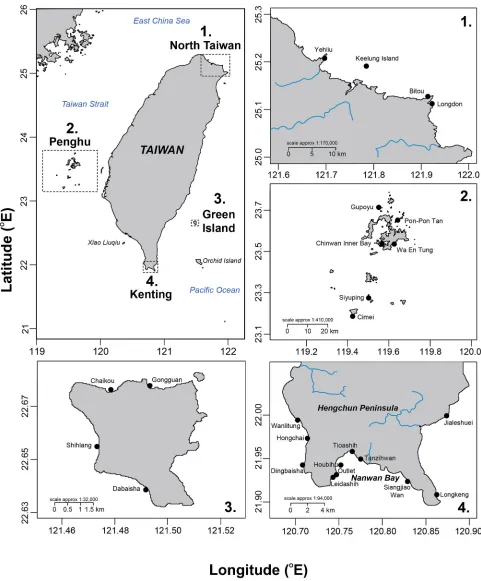
Within four major regions, 25 sites around Taiwan were selected for this study, including four in north Taiwan, six at Penghu, four at Green Island, and eleven at Kenting (Fig 1). The west coast of Taiwan was not surveyed due to its sandy bottom, which is unsuitable for corals [30]. Along the east coast, the underwater topography drops steeply to a maximum depth of 4,000 m, and there are no significant coral communities here [30].
Winter seawater temperatures prevent the formation of reefs in northern Taiwan (25.17°N, 121.74°E), thus benthic coverage is limited to more-or-less well-developed coral communities [29]. Penghu (23.52°N, 119.56°E) is a small archipelago to the west of Taiwan where winter SSTs also prevent the formation of proper coral reefs, but there is a clear distinction between the tropical coral communities in the south of the archipelago and the more temperate com-munities in the northern islands of Penghu [47]. Northern coral assemblages suffer from high sedimentation at some locations [48], and cold shock events that decimate entire coral popula-tions and their associated organisms [49]. Green Island (22.66°N, 121.49°E) is a small volcanic island located about 33 km off the east coast of Taiwan. With well-developed fringing reefs and clear waters, Green Island is usually considered one of the best scuba-diving destinations around Taiwan. Green Island is often impacted by typhoons, but the absence of major rivers usually restricts their impact to mechanical damage [50]. Kenting (21.90°N, 120.79°E) is located at the southern tip of Taiwan and is one of its most famous tourist spots. Its reefs attract more than five million visitors per year [40], who engage in numerous recreational activities such as scuba diving, snorkeling, surfing, and boating [44]. Kenting National Park (KNP), established in 1984 as Taiwan’s first national park, covers 33,269 hectares of terrestrial and marine environments. Some KNP sites have been particularly impacted by river run-off and mechanical damage along the path of repeated typhoons in recent decades [42]. A tide-induced upwelling [51] strongly influences physical, chemical, and biological processes in Nanwan Bay [52]. Human pressures [53], like overfishing [54] or degradation of water quality at some sites [44,55], have negative impacts on KNP’s benthic communities.
Sea Surface Temperatures
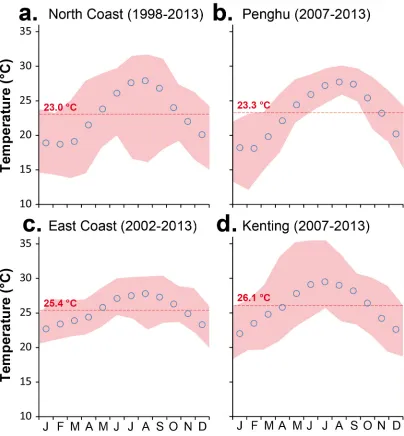
Monthly average SSTs typically range between 22.0°C and 29.5°C at Kenting, 22.7°C and 27.8°C on the southeast coast, 18.7°C and 27.9°C on the northern coast, and 18.1°C and 27.7°C in Penghu (Central Weather Bureau of Taiwan,http://www.cwb.gov.tw/;Fig 2). Mean differ-ences between maximum and minimum monthly temperatures (Δ°C) were 11.2 ± 2.5°C in northern Taiwan and 9.3 ± 1.8°C at Kenting, whereas theΔ°C at Green Island along the south-east coast and at Penghu did not exceed 5.8 ± 0.9°C and 7.2 ± 2.1°C, respectively. Monthly averages of less than 18°C are common in Penghu and northern Taiwan during the winter. The minimum temperature recorded in Penghu was 11.7°C in February 2008 [49]. In contrast, the maximum monthly average was recorded in June-July 2006 in Kenting, with SSTs reaching 35.5°C.
Benthic surveys
Fig 1. Study area.The four regions surveyed around Taiwan and locations of study sites.
at each site using a photo-transect method. Five 20 m long line transects were randomly posi-tioned at 5 m depth, with a minimum distance of 5 m separating each transect. Twenty-one photographs (0.5 x 0.5 m) per transect were taken at one-meter intervals, sampling a total sur-face of 26.25 m2at each site. Benthic community structure was then assessed by analyzing the photographs. Fifty random points were positioned on each picture using CPCe v4.0 software [56], and benthic organisms were identified to the most reasonable operational taxonomic unit (OTU) possible, considering the limitation of taxonomic identification via photography (S2 File). Thirteen major categories (hard coral [HC], soft coral [SF], macro-algae [MA], encrust-ing coralline algae [ECA], turf algae [TU], zoanthids [ZO], sponges [SP],Antipatharia[AT], sea anemones [AN], ascidians [AS], other living organisms [OL], bare substrate [BS], and
Fig 2. Sea Surface Temperature (SST) around Taiwan.Monthly average sea surface temperatures, annual means
(red dashed line), and monthly maxima and minima (red shaded area). (a)Northern Coast (1998–2013). (b). Penghu (2007–2013). (c) Eastern coast (2002–2013). (d) Kenting (2007–2013). Data: Central Weather Bureau, Taiwan (http:// www.cwb.gov.tw/).
unknown [UN];S5 File) were used to describe benthic coverage types. The term‘turf algae’ used herein denotes a low-growing (several mm to cm tall) layer of mixed, filamentous algae per Connellet al. [57]. In addition, a category“Turf + Sediment”was defined for describing sediment deposition and characterize roughly the sedimentation at each site.
Data analysis
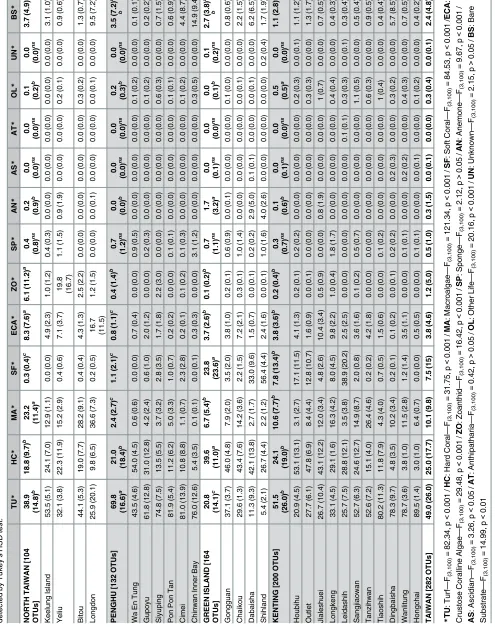
Unstable substrate categories such as sand, rubble, and gravel were removed from the dataset as they do not represent suitable substrates for sessile organisms and may represent a bias when characterizing benthic communities that inhabit hard substrates. The occurrence of dif-ferent OTUs along transects were summarized at country scale as well as regional, and local levels (S2 File). Data (S1 File) was converted into percentages and regional differences in major categories were tested using one-way nested analysis of variance (nested ANOVA,S3 File) from individual transects. Results of nested ANOVA are reported belowTable 1. Significantp -values (p<0.05) were interpreted using Tukey's HSD (honest significant difference) test (superscript letter inTable 1). OTU richness was calculated at the site level (α-diversity) and regional level (OTU richness).
Euclidean distances were then calculated between each combination of two sites, and multi-variate patterns in benthic assemblages were visualized using non-metric multidimensional scaling (nMDS). The regional centroids (referring to spatial medians) were overlaid on the graphics. OTUs contributing up to 70% of the differentiation between regions were identified using a similarity percentage (SIMPER) routine and added to plots. A homogeneity of disper-sion (PERMDISP) test was carried out to identify significant differences in within-group multi-variate dispersion among regions [58]. The data did not conform to an assumption of
homogeneity before and after transformation; therefore, testing for differences among regions using nested permutational multivariate analysis of variance (nested ADONIS) and analysis of similarities (ANOSIM) was performed on raw data using a conservativeαvalue of 0.01. Bon-ferroni corrected pairwise comparisons (adjusted by the number of comparisons made) were further used to interpret any significantp-values. Both tests were used together as ADONIS is usually considered more conservative and less sensitive to dispersion than ANOSIM, which however, can be useful for analyzing the magnitude of divergence among regions.P-values were systematically generated from 9,999 random permutations in each case. The effect of lati-tude was then assessed by analyzing regional differences. In addition, latilati-tude was used as a continuous predictor to test its effect on the benthic assemblage using the nested ADONIS test. However, this factor confounds the effect of seawater temperatures, which around Taiwan are not necessarily correlated with latitude due to the effect of the KC flowing along the east coast. Therefore, regional differences were considered the most pertinent factor in our analyses. All data were analyzed in R (v2.15.2) using the Vegan package [59].
Results
A total of 25 sites, 125 transects, and 2,625 pictures were analyzed in this study. Benthic assem-blages from all sites were categorized into 282 OTUs. Among these, 177 hard corals OTUs were distinguished, plus 29 of algae, and 19 of soft corals. Averageα-diversity values were 55.8 ± 11.0 in north Taiwan, 47.8 ± 15.5 at Penghu, 87.0 ± 14.8 at Green Island, and 73.4 ± 22.0 at Kenting. OTU richness for these four regions were 104, 132, 164, and 200, respectively, with corresponding hard coral OTU richness values of 64, 91, 115, and 140.
(69.8 ± 16.6%), followed by Kenting (51.5 ± 26.0%), north Taiwan (38.9 ± 14.8%), and Green Island (20.8 ± 14.1%). Hard corals contributed 25.0 ± 17.7% to the hard substrate coverage, with Green Island (39.6 ± 11.0%) presenting a significantly higher hard coral coverage (nested ANOVA, F3,100= 31.75,p<0.001;Table 1) than the other three regions: Kenting
(24.1 ± 19.0%), Penghu (21.0 ± 18.4%), and north Taiwan (18.8 ± 9.7%). Macro-algae
(10.1 ± 9.8%) were significantly more abundant along northern Taiwan (23.2 ± 11.4%) than at Kenting (10.6 ± 7.7%) and Green Island (6.7 ± 5.4%), and less abundant at Penghu
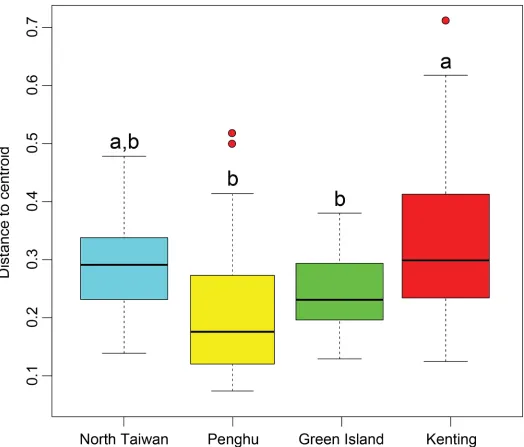
(2.4 ± 2.7%). Soft corals (7.5 ± 5.4%) were important components of the coverage at Green Island (23.8 ± 23.6%) and Kenting (7.8 ± 13.4%). The contributions of encrusting coralline algae, zoanthids, sea anemones, other benthic forms, and bare substrates showed significant differences among regions, but in each case represented less than 10% of coverage (Table 1). The benthic community structure within each region was clearly heterogeneous (Fig 3,S1 Fig). However, there were differences between regions (PERMDISP, F3,121= 7.00,p<0.001),
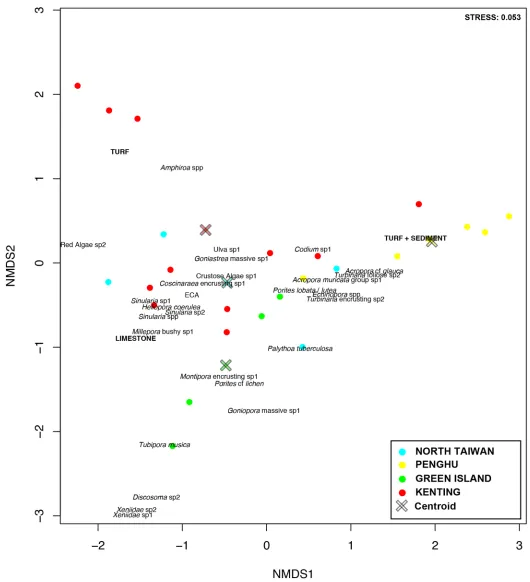
with Kenting presenting significantly higher dispersion than Green Island and Penghu. North Taiwan was in an intermediate situation (Fig 4). Multivariate patterns showed that regional groups could be easily distinguished, but with obvious overlap among regions (Fig 3). The cen-troid of Penghu’s sites was distinctly separate from those of the other three regions. Based on shared occurrences of some hard and soft coral taxa, encrusting coralline algae, and some macro-algae, the differentiation followed three trajectories: (1) an occurrence of turf algae mainly represented by some transects in Kenting, (2) an occurrence of turf algae partially cov-ered by sediment, especially at Penghu, and (3) an occurrence of Xeniidae corals, withTubipora
musicaand the corallimorpharianRhodactis indosinensisat Green Island. Two groups were
easily distinguished at Kenting, one being dominated by turf algae and the other by hard corals (Table 1;Fig 3;S1 Fig). However Leidashih on the western side of Nanwan bay (Kenting) was pulled from this group, due to the high contribution of soft corals in this location, which usu-ally characterizes transects from Green Island (Table 1). At Penghu, Wa En Tung was domi-nated by hard corals, strongly differing from all other sites in the region where sediment and turf algae typically represented>60% of substrate coverage (Table 1,S1 Fig). The benthic assemblages of north Taiwan tended to include each of these features in part (Fig 3,S1 Fig). The regional centroid was positioned almost at the orthocenter of the triangle composed by the centroids of the other three regions. Longdon differed from other northern sites by having less macro-algae and encrusting coralline algae but more hard corals. Keelung Island was charac-terized by a higher contribution of plate-like corals, when Yeliu by the one of the zoanthid,
Palythoa tuberculosa.
A significant difference in benthic assemblages was recorded with latitude (nested ADONIS, F1,100= 38.94,p<0.001), but this explained only 5% of observed variance. Regional difference
(F3,100= 100.73,p<0.001, nested ADONIS) was better supported, with 40% of the variation in
the benthic assemblage explained by this factor. Similarly, the ANOSIM test suggested a low but significant difference in the structure of benthic communities among regions (R = 0.34, p<0.001), clearly indicating some overlap between groups. ANOSIM pairwise comparisons revealed that Penghu differed strongly from Green Island (R = 0.75,p<0.001) and moderately from north Taiwan (R = 0.62,p<0.001) and Kenting (R = 0.48,p<0.001). Green Island dif-fered weakly from north Taiwan (R = 0.27,p<0.001) and Kenting (R = 0.16,p<0.05). In con-trast, benthic community structure was similar in the north and south (R = 0.05,p= 0.99).
Discussion
Fig 3. Multivariate pattern.nMDS ordination showing regional partitioning. Centroids (crosses) were overlaid on the multivariate pattern to represent the relationship between sites and regional dispersion, respectively. OTUs contributing up to 70% of the regional differentiations were added.
between regions and along the latitudinal gradient previously identified in the diversity of some taxa. We hypothesize that local patterns of disturbance could be responsible for the het-erogeneity observed at the regional scale, and may smooth out the differences between regions. We discuss below the potential role that this marine hotspot could play in the future, and high-light that the management of local factors responsible for reef degradation should remain a pri-ority in order for marine ecosystems to cope with climate change.
Structure of major benthic categories
[image:10.612.52.576.74.521.2]Like general worldwide trend of reef degradation [60,61], Taiwanese benthic communities were found to be largely dominated by turf algae (49.0 ± 26.0%). However, mean hard coral coverage
Fig 4. Boxplots summarizing, for each region, the distance of transects to regional centroids.Boxplots display median, first, and third quartiles
(hinges); 95% confidence interval of median (notches) and outliers.
was consistent with data previously reported from Taiwan and Japan (~24%, [62]), and slightly above the average coral coverage reported from the Indo-Pacific region in 1997–2004 (22.1%, [62]). Although comparison with those data should be interpreted with caution due to different protocols used and sites surveyed, it could indicate a stabilization to a low level of coral coverage in this area as this one was estimated to 50% in the past (i.e. 100–1000 yr BP) [62]. A similar trend was observed at the regional level, such as at Kenting, where Mok [63], suggested the stabi-lization (or even a slight increase) of coral coverage. Coral coverage was higher at Green Island and Kenting, consistent with the presence of well-developed fringing reefs [64] inhabited by a rich coral fauna (reviewed in [30]). Using coral coverage as an indicator of coral reef health [62], Green Island reefs could be relatively resilient to human disturbances, as characterized by an important influx of tourists during the summer (estimated at 400,000 visitors per year in 2002, [40]). In Kenting, anthropogenic disturbances were considered the major factors of degradation, producing heterogeneous ecological conditions in the reefs along the coastline [40,44,53]. Pen-ghu showed the highest coverage of turf algae, which is coherent with the pattern of degradation observed from 1994 to 2004, at four reefs around the main island of the archipelago [65]. With a subtropical climate prevailing in northern Taiwan, the coverage of macro-algae (23.2 ± 11.4%) and encrusting coralline algae (8.3 ± 7.6%) were the highest compared to other surveyed regions (Table 1). This was coherent with the pattern of diversity around Taiwan [63,66] and previous observations from high-latitude areas [67,68].
Diversity and multivariate patterns
An increasing diversity gradient was observed from North to South. Meanα-diversity and regional OTU richness values both suggested an obvious distinction in OTU richness between reefal (Kenting and Green Island) and non-reefal (Penghu and north Taiwan) benthic assem-blages. As shown in [33], hard coral followed the same general pattern observed in diversity, with species richness increasing as SST rises and latitude decreases. In contrast, macro-algae was more diverse at the northeastern coast [31], consistent with its subtropical environment.
This latitudinal gradient in diversity became less evident when the‘OTUs’contribution to the overall community was taken into consideration. Regional groups clearly overlapped in the multivariate pattern, with highly heterogeneous benthic assemblages characterizing the differ-ent regions. A common pool of species across regions included various species of hard and soft coral taxa, encrusting coralline algae, and macro-algae. We hypothesize that this feature could be representative of reefs in Taiwan. A prevalence of functionally distinct organisms (see dis-cussion in [69] and [70]) could also indicate resilient sites. Dispersion from this common facet followed three main trajectories: (1) a dominance of turf algae, particularly in Kenting, (2) a prevalence of turf covered by sediment, mostly characterizing Penghu, and (3) communities marked by the presence of soft corals (Xeniidaespp.), together withTubipora musicaand the corallimorpharianRhodactis indosinensisat Green Island. In these different locations, regional characteristics (turf in Kenting, turf + sediment in Penghu and soft coral in Green Island) have been previously highlighted at some sites such as at Wanlitung in Kenting [42], Chinwan Inner Bay in Penghu [45], and the western and southwestern coasts of Green Island [71]. For exam-ple, the coverage of the zoanthidPalythoa tuberculosa, together withTurbinariacorals and macro-algae such asUlvaorSargassum, were among the main contributors of the differentia-tion of the northern sites.Halimeda,Amphiroa,Codium, andNeomerisalgae were typical of reef communities from Kenting and Green Island. Overall, macro-algae seemed to be better ecological indicators than corals in differentiating regions along a latitudinal gradient.
latitudinal gradient observed in species richness within taxa, including corals [33] and algae [31], was not well reflected in community structure. This was best illustrated by the assem-blages in northern Taiwan and Kenting. They were the most similar despite being ~350 km apart and had contrasting seawater temperatures (annual average difference of 3.1°C). In addi-tion, there was a weak but significant difference between the two closest locations, Kenting and Green Island. While shifts in benthic communities have been classically reported along a latitu-dinal cline [72–74], observations similar to those reported here were recorded along the Aus-tralian western coast, from 28.5°S to 33.5°S. There, it has been suggested that the attenuation of the latitudinal temperature gradient (2°C over 1,000 km of north-south coastline) by the Leeu-win Current (LC) enhances the influence of local factors in the patterns observed [68]. There-fore, Smaleet al. [68] proposed that the selected locations, and possibly also the relatively coarse taxonomic resolution, could explain the lack of a latitudinal gradient in the benthic assemblages along the western coast of Australia. We hypothesize that the local anthropogenic and natural factors that are responsible for Taiwan’s regional heterogeneity, could have caused the situation observed in this study. Indeed, small scale variability triggered by local factors or disturbances may prevent us from distinguishing possible latitudinal patterns in benthic com-munity structure. Further investigation at a regional scale is necessary to understand such local variability.
Disturbance patterns
Taiwan is regularly affected by typhoons (averaging 4.5 typhoons per year [75]), and their fre-quency and intensity have tended to increase in recent decades [76]. According to historical paths, southern Taiwan has been the most susceptible part of the island to typhoons [77]. Aside from catastrophic damage to reefs by strong waves (see review in [78]), coral reef organ-isms suffer from terrestrial freshwater runoff following typhoons [78]. Reefs at Green Island seem to have recovered reasonably from past bleaching episodes, such as the 1998 event [79]. However, past severe mechanical disturbances generated by typhoons are suspected to have triggered a shift from hard- to soft coral-dominated communities on the west coast of Green Island [80], consistent with our observations at Shihland, and to a lesser extent at Dabaisha.
The effect of typhoons on benthic communities in Kenting seems not to be limited to mechanical damage, but to have a wide range of indirect impacts [78], such as increases in tur-bidity, sedimentation, and pollution, plus salinity decreases due to discharges from three major rivers [44]. On the west coast of the Hengchun Peninsula (Kenting), for example in Wanlitung, benthic communities suffer from recurrent and synergetic disturbances [42]. Typhoons, bleaching events, and locally-induced human stressors are responsible for the more than 50% decrease in coral coverage over the last 25 years and an increase by almost three fold in macro-algal coverage [42]. In Tiaoshih, those disturbances could also be responsible for the temporary shift from a coral- (Acropora) to the sea anemone- (Condylactis) dominated community that was observed in 2000–2003 [18]. The population of this anemone seems to have declined [81],
asCondylactiswas not observed during our survey despite the persistence of local
conditions at sites close to river mouths, which have lower percentages of coral coverage and higher one of macro-algae [44]. In Nanwan Bay, the coverage of macro-algae such asCodium is related to nutrient enrichment [30,84,85]. In our survey, the highest coverage of this macro-algae was observed in Sangjiaowan (6.7%) and Tanzihwan (5.5%), in the vicinity of the main river flowing into the bay (seeS2 File). Together with Tiaoshih, these sites presented the highest percentages of turf and macro-algae in the Bay. While on the west coast of Nanwan, sheltered from direct freshwater discharges, Leidashih, Outlet, and Houbihu are characterized by more stable water quality [44]. There, coral (HC and SF together) and algae (TU and MA together) coverages were respectively the highest and the lowest in Kenting. These sites could also have benefitted from coastal development being restricted due the presence of a nuclear power plant, operational since 1985. The occurrence of tidal upwelling [86], unevenly affecting Nan-wan [87], could strongly influence the response of reef organisms [88] and be responsible for the heterogeneity observed in the benthic assemblages [55]. Sites on the west coast of Kenting (Wanlitung, Hongchai, and Dingbaisha) do not seem to respond to the pattern of degradation associated with river discharge. The lowest coral coverage for Taiwan, as well as the prevalence of algae observed at these sites, could be due to alternative stressors such as those mentioned earlier for Wanlitung [42]. Overall, the effectiveness of the marine protected area, since its implementation in 1984 around the Hengchun peninsula, is relative, as illustrated by the con-trasting situations observed in the no entry and no-take areas of KNP such as Sangjiaowan or Houbihu and Tiaoshih (S1 Table) [42,55].
At Penghu, winter surges of cold water can cause mass mortality of reef organisms, as occurred during the 2008 cold shock event [49]. The high proportion of recently dead corals covered by turf algae at Cimei, Pon-Pon-Tan, and Siyuping (seeTable 1) suggest that a similar event could have occurred again in Penghu during the winter of 2011–2012, when SST fell below 18°C for 40 consecutive days (HJ Hsieh, unpublished data). The high density of coral juveniles (<5 cm, data not shown) at some locations, however, suggested a potential for fast recovery, which could be limited at some sites by human activities. For example, in Chinwan Inner Bay, coral coverage has suffered nutrient enrichment, sedimentation, overfishing [48], algae overgrowth [45], and an outbreak of the corallivorous snailDrupella[89]. In 2001, its coral coverage ranged between 63.9 and 93.0% [90], dramatically decreasing to 16.3% in 2008 [89] despite the establishment of a no-take area in the bay in 2005. In the present study, corals contributed only 5.4% of substrate coverage.
High-latitude sites seem to develop into monospecific community (see example in [91,92]). Aside from natural and human stressors, we suggest that dispersion among sites in northern Taiwan could be a response to environmental conditions in this area. In the absence of external disturbances to coral assemblages, theα-diversity ratio could be decreased by an increase in lat-itude and a decrease in SST. Alternatively, the heterogeneity in this region may also be related to its location within a transition area between tropical and temperate locations. This was made particularly obvious by the co-occurrence of tropical and temperate organisms (espe-cially for algae such asPadina,Sargassum, andUlvaspecies).
The role of Taiwanese benthic communities under climate change
conditions
our study, the lack of an obvious latitudinal cline in benthic assemblages could be a result of the tropicalization and homogenization of marine communities around the island, smoothing out regional differences, but this process could be accompanied by a loss of species less tolerant to high temperatures. Similar phenomena have been recorded in the North Sea for six fish spe-cies (Trisopterus luscusandesmarkii,Micromesistius poutassou,Echiichthys vipera,
Glyptoce-phalus cynogloscus, andArnoglossus lanterna) [96]. Today, environmental constraints limit
reef formation to the eastern and southern coasts of Taiwan, but in the mid-Holocene (6,000– 5,000 years ago), extensive reefs occurred at Keelung (north Taiwan) when seawater tempera-tures were less than 2°C higher than at present [97,98]. At Keelung Island, the contribution of pioneer and opportunistic frame-building species such asAcropora hyacinthus[92,99] suggest that a benthic community providing a basis for a reef could eventually develop.
Nevertheless, there is no evidence to date suggesting that any taxa, including corals, have disappeared or moved poleward to benefit from recent changes in environmental conditions in Taiwan. However, Taiwan constitutes an important area for the connectivity of marine organ-isms in the Kuroshio region, and the degradation of benthic communities could therefore rep-resent an important limitation to a possible poleward migration. If we establish high-latitude refuges for the survival of tropical taxa, propagule source conservation should remain a priority by reducing additional stressors in existing coral communities.
Overall, this is the first study suggesting that there is a generalized degradation of benthic assemblages around Taiwan. While recurrent natural disturbances probably explain part of the variation observed, anthropogenic disturbances are likely playing major roles at the local scale in explaining the heterogeneity observed within the region. Given the key geographic location of Taiwan in the Kuroshio region, this study highlights the importance of reinforcing marine conservation around the island and maintaining resilient coral assemblages to face climate change. This study provides the first integrative picture of the status of the benthic assemblages of the four main coral regions around Taiwan, and therefore constitutes an important baseline upon which future changes can be compared. Therefore, data and R script are provided as sup-plementary data for additional studies.
Ethics statement
Permits numbered 10200401200 from Kenting National Park, 1024150391 and 10300200398 from Keelung city government, and 1034150073 and 1034100291 from the Fishing Manage-ment Office of New Taipei city governManage-ment were required to perform field surveys in some restricted areas. All surveys procedures were non-destructive and were done with appropriate precautions to prevent damage to the ecosystem.
Supporting Information
S1 Fig. Taiwanese benthic assemblages—site location and protection status.Sites informa-tion (GPS coordinates in decimal degrees).
(TIF)
S1 File. Taiwanese benthic assemblages—script for data analysis. (TXT)
S2 File. Taiwanese benthic assemblages—dataset. (CSV)
S4 File. Taiwanese benthic assemblages—regional and site factors. (CSV)
S5 File. Taiwanese benthic assemblages—classification of OTUs into major categories. (CSV)
S1 Table. Taiwanese benthic assemblages—Multivariate pattern.nMDS ordination showing regional partitioning at transect level. Centroids (crosses) were overlaid on the multivariate pattern to represent the relationship between transects and regional dispersion, respectively. OTUs contributing up to 70% of the regional differentiations were added.
(DOCX)
Acknowledgments
Many thanks to Aichi Chung, Mathilde Loubeyres, Michael Honeth and the members of the Coral Reef Ecology and Evolutionary Genetics (CREEG) laboratory, Biodiversity Research Center, Academia Sinica (BRCAS). We are grateful to the staff of Penghu Marine Biodiversity Research Centre (PMBC) and Wei-Chieh for assisting in field work. This is CREEG, BRCAS contribution no.113.
Author Contributions
Conceptualization:VD CAC.
Data curation:LRD VD.
Formal analysis:LRD VD.
Funding acquisition:CAC.
Investigation:LRD VD SDP CYK HJH.
Methodology:VD CAC.
Project administration:VD CAC.
Resources:CAC HJH.
Software:LRD VD.
Supervision:VD CAC.
Validation:LRD VD.
Visualization:LRD VD.
Writing - original draft:LRD VD.
Writing - review & editing:LRD VD SDP.
References
1. Gibson RN, Atkinson RJA, Gordon JDM, Smith IP, Hughes DJ (2011) Impact of ocean warming and ocean acidification on marine invertebrate life history stages: vulnerabilities and potential for persis-tence in a changing ocean. Oceanogr and Mar Biol. 49: 1–42.
2. Moberg F, Folke C (1999) Ecological goods and services of coral reef ecosystems. Ecol Econ. 29: 215–233. doi:10.1016/S0921-8009(99)00009-9
4. Riegl B, Bruckner A, Coles SL, Renaud P, Dodge RE (2009) Coral Reefs: threats and conservation in an era of Ggobal change. Ann NY Acad Sci. 1162: 136–186. doi:10.1111/j.1749-6632.2009.04493.x
PMID:19432648
5. Hoegh-Guldberg O, Mumby PJ, Hooten AJ, Steneck RS, Greenfield P, Gomez E, et al. (2007) Coral reefs under rapid climate change and ocean acidification. Science. 318: 1737–1742. doi:10.1126/ science.1152509PMID:18079392
6. Hoegh-Guldberg O, Bruno JF (2010) The impact of climate change on the world’s marine ecosystems. Science. 328: 1523–1528. doi:10.1126/science.1189930PMID:20558709
7. Anthony KRN, Maynard JA, Diaz-Pulido G, Mumby PJ, Marshall PA, Cao L, et al. (2011) Ocean acidifi-cation and warming will lower coral reef resilience. Glob Change Biol. 17: 1798–1808. doi:10.1111/j. 1365-2486.2010.02364.x
8. Reaser JK, Pomerance R, Thomas PO (2000) Coral bleaching and global climate change: scientific findings and policy recommendations. Conserv Biol. 14: 1500–1511. doi:10.1046/j.1523-1739.2000. 99145.x
9. Jokiel PL, Rodgers KS, Kuffner IB, Andersson AJ, Cox EF, Mackenzie FT (2008) Ocean acidification and calcifying reef organisms: a mesocosm investigation. Coral Reefs. 27: 473–483. doi:10.1007/ s00338-008-0380-9
10. Gattuso JP, Allemand D, Frankignoulle M (1999) Interactions between the carbon and carbonate cycles at organism and community levels in coral reefs: a review on processes and control by the carbonate chemistry. Am Zool. 39: 160–183.
11. Harvell CD, Kim K, Burkholder JM, Colwell RR, Epstein PR, Grimes DJ, et al. (1999) Emerging marine diseases-climate links and anthropogenic factors. Science. 285: 1505–1510. doi:10.1126/science. 285.5433.1505PMID:10498537
12. Rosenberg E, Ben-Haim Y (2002) Microbial diseases of corals and global warming. Environ Microbiol. 4: 318–326. doi:10.1046/j.1462-2920.2002.00302.xPMID:12071977
13. Lafferty KD, Porter JW, Ford SE (2004) Are diseases increasing in the ocean? Annu Rev Ecol Evol Syst. 35: 31–54.
14. Hughes TP (1994) Catastrophes, phase shifts, and large-scale degradation of a Caribbean coral reef. Science. 1547–1547. doi:10.1126/science.265.5178.1547
15. Przeslawski R, Ahyong S, Byrne M, Wörheide G, Hutchings P (2008) Beyond corals and fish: the effects of climate change on noncoral benthic invertebrates of tropical reefs. Glob Change Biol. 14: 2773–2795. doi:10.1111/j.1365-2486.2008.01693.x
16. McClanahan TR, Muthiga NA (1998) An ecological shift in a remote coral atoll of Belize over 25 years. Environ Conserv. 25: 122–130. doi:10.1017/S0376892998000174
17. Nyström M, Folke C, Moberg F (2000) Coral reef disturbance and resilience in a human-dominated environment. Trends Ecol Evol. 15: 413–417. doi:10.1016/S0169-5347(00)01948-0PMID:10998519 18. Chen CA, Dai CF (2004) Local phase shift fromAcropora-dominant toCondylactis-dominant
commu-nity in the Tiao-Shi Reef, Kenting National Park, southern Taiwan. Coral Reefs. 23: 508–508. doi:10. 1007/s00338-004-0423-9
19. Work TM, Aeby GS, Maragos JE (2008) Phase shift from a coral to a corallimorph-dominated reef asso-ciated with a shipwreck on Palmyra Atoll. PLoS ONE. 3: e2989. doi:10.1371/journal.pone.0002989
PMID:18714355
20. Rogelj J, Hare W, Lowe J, van Vuuren DP, Riahi K, Matthews B, et al. (2011) Emission pathways con-sistent with a 2°C global temperature limit. Nature Clim Change. 1: 413–418. doi:10.1038/
nclimate1258
21. Pandolfi JM, Connolly SR, Marshall DJ, Cohen AL (2011) Projecting coral reef futures under global warming and ocean acidification. Science. 333: 418–422. doi:10.1126/science.1204794PMID:
21778392
22. Lesser MP, Slattery M, Leichter JJ (2009) Ecology of mesophotic coral reefs. J Exp Mar Biol Ecol. 375: 1–8. doi:10.1016/j.jembe.2009.05.009
23. van Oppen MJH, Bongaerts PIM, Underwood JN, Peplow LM, Cooper TF (2011) The role of deep reefs in shallow reef recovery: an assessment of vertical connectivity in a brooding coral from west and east Australia. Mol Ecol. 20: 1647–1660. doi:10.1111/j.1365-294X.2011.05050.xPMID:21410573 24. Yamano H, Sugihara K, Nomura K (2011) Rapid poleward range expansion of tropical reef corals in
response to rising sea surface temperatures. Geophys Res Lett. 38: L04601. doi:10.1029/ 2010GL046474
26. Makino A, Yamano H, Beger M, Klein CJ, Yara Y, Possingham HP (2014) Spatio-temporal marine con-servation planning to support high-latitude coral range expansion under climate change. Divers Distrib. 20: 859–871. doi:10.1111/ddi.12184
27. Vergés A, Steinberg PD, Hay ME, Poore AGB, Campbell AH, Ballesteros E, et al. (2014) The tropicali-zation of temperate marine ecosystems: climate-mediated changes in herbivory and community phase shifts. P Roy Soc Lond B Bio. 281: 20140846. doi:10.1098/rspb.2014.0846
28. Chen CA (1999) Analysis of scleractinian distribution in Taiwan indicating a pattern congruent with sea surface temperatures and currents: examples fromAcroporaand Faviidae corals. Zool Stud. 38: 119– 129.
29. Dai CF, Horng S (2009) Scleractinia fauna of Taiwan I. The complex group Taipei, Taiwan: National Taiwan University. 172p.
30. Dai CF (1997) Assessment of the present health of coral reefs in Taiwan. In: Grigg RW, Birkeland C (Eds) Status of coral reefs in the Pacific. Sea Grant Program, University of Hawaii, Hawaii. pp. 123– 131.
31. Dai CF, Soong K, Chen CA, Fan TY, Hsieh HJ, Jeng MS, et al. (2004) Status of coral reefs of Taiwan. GCRM Report of East China Sea Region. 3: 153–163.
32. Kleypas JA, McManus JW, Meñez LAB (1999) Environmental limits to coral reef development: Where do we draw the line? Am Zool. 39: 146–159. doi:10.1093/icb/39.1.146
33. Chen CA, Shashank K (2009) Taiwan as a connective stepping-stone in the Kuroshio traiangle and the conservation of coral ecosystems under the impacts of climate change. Kuroshio Science 3: 15–22.
34. Allen GR (2008) Conservation hotspots of biodiversity and endemism for Indo-Pacific coral reef fishes. Aquat Conserv: Mar Freshw Ecosyst. 18: 541–556. doi:10.1002/aqc.880
35. Huang DW, Licuanan WY (2014) Extraordinary diversity of reef corals in the South China Sea. Marine Biodiversity. doi:10.1007/s12526-014-0236-1
36. Denis V, De Palmas S, Benzoni F, Chen CA (2015) Extension of the known distribution and depth range of the scleractinian coralPsammocora stellata: first record from a Taiwanese mesophotic reef. Marine Biodiversity. doi:10.1007/s12526-014-0299-z
37. Shao KT, Ho HC, Lin YC, Lin PL, Lin HH (2008) Research and status of Taiwan fishes diversity and database. 2008 Taiwan species diversity I: research and status Taipei. pp. 249–258. In Chinese.
38. Burke L, Selig E, Spalding M (2002) Reefs at risk in Southern Asia. World Resources Institute, Wash-ington, DC. 72p.
39. Belkin IM (2009) Rapid warming of large marine ecosystems. Prog Oceanogr. 81: 207–213. doi:10. 1016/j.pocean.2009.04.011
40. Dai CF, Soong K, Chen CA, Hwang JS, Fan TY, Hsieh HY, et al. (2002) The status of coral reefs in Tai-wan and the conservation problems. Proceedings of the IUCN/WCPA EA4 Taipei Conference, Taipei, Taiwan. pp. 265–276.
41. Tew KS, Leu MY, Wang JT, Chang CM, Chen CC, Meng PJ (2014) A continuous, real-time water qual-ity monitoring system for the coral reef ecosystems of Nanwan Bay, Southern Taiwan. Mar Pollut Bull. 85: 641–647. doi:10.1016/j.marpolbul.2013.11.022PMID:24332988
42. Kuo CY, Yuen YS, Meng PJ, Ho PH, Wang JT, Liu PJ, et al.(2012) Recurrent disturbances and the deg-radation of hard coral communities in Taiwan. PLoS ONE. 7: e44364. doi:10.1371/journal.pone. 0044364PMID:22952967
43. Liao MH, Tang SL, Hsu CM, Wen KC, Wu H, Chen WM, et al. (2007) The“Black Disease”of reef-build-ing corals at Green Island, Taiwan-outbreak of a cyanobacteriosponge.Terpios hoshinota(Suberitidae; Hadromerida). Zool Stud. 46: 520.
44. Liu PJ, Meng PJ, Liu LL, Wang JT, Leu MY (2012) Impacts of human activities on coral reef ecosystems of southern Taiwan: A long-term study. Mar Pollut Bull. 64: 1129–1135. doi:10.1016/j.marpolbul.2012. 03.031PMID:22534409
45. Huang YCA, Huang SC, Meng PJ, Hsieh HJ, Chen CA (2012) Influence of strong monsoon winds on the water quality around a marine cage-culture zone in a shallow and semi-enclosed bay in Taiwan. Mar Pollut Bull. 64: 851–860. doi:10.1016/j.marpolbul.2012.01.012PMID:22306313
46. Liu CM, Lin SH, Schneider SH, Root TL, Lee KT, Lu HJ, et al. (2010) Climate change impact assess-ment in Taiwan. Global Change Research Center, National Taiwan University. 51p.
47. Hsieh HJ (2008) Studies on subtropical Scleratinian coral communities in Penghu Archipelago. PhD thesis, National Taiwan University, Taipei. 216p.
49. Hsieh HJ, Hsien YL, Jeng MS, Tsai WS, Su WC, Chen CA (2008)Tropical fishes killed by the cold. Coral reefs. 27: 599–599. doi:10.1007/s00338-008-0378-3
50. Teng WH, Hsu MH, Wu CH, Chen AS (2006) Impact of flood disasters on Taiwan in the last quarter cen-tury. Nat Hazards. 37: 191–207. doi:10.1007/s11069-005-4667-7
51. Lee HJ, Chao SY, Fan KL, Wang YH, Liang NK (1997) Tidally induced upwelling in a semi-enclosed basin: Nan Wan Bay. J Oceanogr. 53: 467–480.
52. Chen CC, Shiah FK, Lee HJ, Li KY, Meng PJ, Kao SJ, et al. (2005) Phytoplankton and bacterioplankton biomass, production and turnover in a semi-enclosed embayment with spring tide induced upwelling. Mar Ecol Prog Ser. 304: 91–100. doi:10.3354/meps304091
53. Chang YC, Hong FW, Lee MT (2008) A system dynamic based DSS for sustainable coral reef manage-ment in Kenting coastal zone, Taiwan. Ecol Model. 211: 153–168. doi:10.1016/j.ecolmodel.2007.09. 001
54. Liu PJ, Shao KT, Jan RQ, Fan TY, Wong SL, Hwang JS, et al. (2009) A trophic model of fringing coral reefs in Nanwan Bay, southern Taiwan suggests overfishing. Mar Environ Res. 68: 106–117. doi:10. 1016/j.marenvres.2009.04.009PMID:19464732
55. Meng PJ, Lee HJ, Wang JT, Chen CC, Lin HJ, Tew KS, et al. (2008) A long-term survey on anthropo-genic impacts to the water quality of coral reefs, southern Taiwan. Environ Pollut. 156: 67–75. doi:10. 1016/j.envpol.2007.12.039PMID:18262698
56. Kohler KE, Gill SM (2006) Coral Point Count with Excel extensions (CPCe): A visual basic program for the determination of coral and substrate coverage using random point count methodology. Comput Geosci. 32: 1259–1269. doi:10.1016/j.cageo.2005.11.009
57. Connell SD, Foster MS, Airoldi L (2014) What are algal turfs? Towards a better description of turfs. Mar Ecol Prog Ser. 495: 299–307. doi:10.3354/meps10513
58. Anderson M, Gorley RN, Clarke RK (2008) Permanova+ for Primer: Guide to software and statistical methods. PRIMER-E, Plymouth, UK.
59. Oksanen J, Blanchet FG, Kindt R, Legendre P, Minchin PR, O’Hara RB, et al. (2013) Vegan: commu-nity ecology package. R package version 2.0–6.
60. Birrell CL, McCook LJ, Willis BL (2005) Effects of algal turfs and sediment on coral settlement. Mar Pol-lut Bull. 51: 408–414. doi:10.1016/j.marpolbul.2004.10.022PMID:15757739
61. Mumby PJ, Hastings A, Edwards HJ (2007) Thresholds and the resilience of Caribbean coral reefs. Nature. 450: 98–101. doi:10.1038/nature06252PMID:17972885
62. Bruno JF, Selig ER (2007) Regional decline of coral cover in the Indo-Pacific: timing, extent, and subre-gional comparisons. PLoS ONE. 2: e711. doi:10.1371/journal.pone.0000711PMID:17684557 63. Mok HK (2008) Ecological environment in the area along the Kuroshio in Taiwan. Kuroshio Science
2:21–27.
64. Wu SH, Zhang WJ (2012) Current status, crisis and conservation of coral reef ecosystems in China. Proc Int Acad Ecol Environ Sci. 2: 1–11.
65. Hsieh HJ, Chen CA, Dai CF, Ou W, Tsai WS, Su WC (2007) From the drawing board to the field: an example for establishing an MPA in Penghu, Taiwan. Aquatic Conserv: Mar Freshw Ecosyst. 17: 619– 635. doi:10.1002/aqc.826
66. Chang JS, Tseng CC (2010) Effects of recent ecological events on the distribution and growth of macroalgae in marine waters around Taiwan. Bull Fish Res Agen. 32: 11–17.
67. Johannes RE, Wiebe WJ, Crossland CJ, Rimmer DW, Smith SV (1983) Latitudinal limits of coral reef growth. Mar Ecol Prog Ser. 11: 105–111.
68. Smale DA, Kendrick GA, Waddington KI, Van Niel KP, Meeuwig JJ, Harvey ES (2010) Benthic assem-blage composition on subtidal reefs along a latitudinal gradient in Western Australia. Estuarine Coast Shelf Sci. 86: 83–92. doi:10.1016/j.ecss.2009.10.016
69. Nyström M, Graham NAJ, Lokrantz J, Norström AV (2008) Capturing the cornerstones of coral reef resilience: linking theory to practice. Coral Reefs. 27: 795–809. doi:10.1007/s00338-008-0426-z 70. Gamfeldt L, Hillebrand H, Jonsson PR (2008) Multiple functions increase the importance of biodiversity
for overall ecosystem functioning. Ecology. 89: 1223–1231. doi:10.1890/06-2091.1PMID:18543617 71. Benayahu Y, Jeng MS, Perkol-Finkel S, Dai CF (2004) Soft corals (Octocorallia: Alcyonacea) from
southern Taiwan: II. Species Diversity and Distributional Patterns. Zool Stud. 43: 548–560.
72. Connolly SR, Roughgarden J (1998) A latitudinal gradient in northeast Pacific intertidal community structure: evidence for an oceanographically based synthesis of marine community theory. Am Nat. 151: 311–326. doi:10.1086/286121PMID:18811323
74. Dalton SJ, Roff G (2013) Spatial and temporal patterns of eastern Australia subtropical coral communi-ties. PloS ONE. 8: e75873. doi:10.1371/journal.pone.0075873PMID:24058705
75. Lee CS, Huang LR, Shen HS, Wang ST (2006) A climatology model for forecasting typhoon rainfall in Taiwan. Nat Hazards. 37: 87–105.
76. Tu JY, Chou C, Chu PS (2009) The abrupt shift of typhoon activity in the vicinity of Taiwan and its asso-ciation with Western North Pacific–East Asian climate change. J Clim. 22: 3617–3628. doi:10.1175/ 2009JCLI2411.1
77. Dai CF (1991) Reef environment and coral fauna of southern Taiwan. Atoll Res Bull, Smithsonian Inst. 354: 1–29.
78. Harmelin-Vivien ML (1994) The effects of storms and cyclones on coral reefs: a review. J Coastal Res. 12: 211–231.
79. Goldberg J, Wilkinson C (2004) Global threats to coral reefs: coral bleaching, global climate change, disease, predator plagues and invasive species. Status of Coral Reefs of the World. pp. 67–92.
80. Chang KH, Jan RQ, Dai CF, Zeng ZR, Jeng MS, et al. (1991) Resource investigations and conservative research project in Green Island. East Coast National Scenic Area Tourism Office (in Chinese). 110p.
81. Tkachenko KS, Wu BJ, Fang LS, Fan TY (2007) Dynamics of a coral reef community after mass mortal-ity of branchingAcroporacorals and an outbreak of anemones. Mar Biol. 151: 185–194. doi:10.1007/ s00227-006-0467-1
82. Dai CF, Kao KM, Chen YT, Chaun ST (1998) Changes of coral communities in the Nan-wan Bay, Kent-ing National Park from 1987 to 1997. Bull Natl Park (in Chinese). 8: 79–99.
83. Dai CF, Kao KM, Chen YT, Chaun ST (1999) Changes of coral communities in the eastern and western coast, Kenting National Park from 1987 to 1997. Bull Natl Park (in Chinese). 9: 111–129.
84. Chiang YM, Wang WL (1987) Distribution of seaweeds of Hengchun Peninsula, Taiwan. Chang KH (Ed). pp. 71–87.
85. Dai CF (1993) Patterns of coral distribution and benthic space partitioning on the fringing reefs of south-ern Taiwan. Marine Ecology. 14: 185–204.
86. Lee HJ, Chao SY, Fan KL (1999) Flood–ebb disparity of tidally induced recirculation eddies in a semi-enclosed basin: Nan Wan Bay. Cont Shelf Res. 19: 871–890. doi:10.1016/S0278-4343(99)00006-0 87. Chen CTA, Hsing LY, Liu CL, Wang SL (2004) Degree of nutrient consumption of upwelled water in the
Taiwan Strait based on dissolved organic phosphorus or nitrogen. Mar Chem. 87: 73–86.
88. Putnam HM, Edmunds PJ, Fan TY (2010) Effect of a fluctuating thermal regime on adult and larval reef corals. Invertebr Biol. 129: 199–209. doi:10.1111/j.1744-7410.2010.00199.x
89. Hsieh HJ, Chen KS, Lin YI, Huang YA, Baird AH, Tsai WS, et al. (2011) Establishment of a no-take area (NTA) could not guarantee the preservation of coral communities in Chinwan Inner Bay, Penghu, Taiwan. Zool Stud. 50: 443–453.
90. Hsieh H, Wei N, Lu Y, Jeng MS, Tsai WS, Chen C (2001) Unexpectedly high coral coverage in Chinwan Inner Bay, Pescadores: a proposed site for a Marine Protection Area. Coral Reefs. 20: 316–317. doi:
10.1007/s003380100169
91. Denis V, Chen CA, Song JI, Woo S (2013)Alveopora japonicabeds thriving under kelp. Coral Reefs. 32: 503. doi:10.1007/s00338-013-1019-z
92. Denis V, Mezaki T, Tanaka K, Kuo CY, De Palmas S, Keshavmurthy S, et al. (2013) Coverage, diver-sity, and functionality of a high-latitude coral community (Tatsukushi, Shikoku Island, Japan). PloS ONE. 8: e54330. doi:10.1371/journal.pone.0054330PMID:23342135
93. Hoegh-Guldberg O (2011) Coral reef ecosystems and anthropogenic climate change. Reg Environ Change. 11: 215–227. doi:10.1007/s10113-010-0189-2
94. Muir PR, Wallace CC, Done T, Aguirre JD (2015) Limited scope for latitudinal extension of reef corals. Science. 348: 1135–1138. doi:10.1126/science.1259911PMID:26045436
95. Haraguchi H, Sekida S (2008) Recent changes in the distribution ofSargassumspecies in Kochi, Japan. Kuroshio Science. 2: 41–46.
96. Perry AL, Low PJ, Ellis JR, Reynolds JD (2005) Climate change and distribution shifts in marine fishes. Science. 308: 1912–1915. doi:10.1126/science.1111322PMID:15890845
97. Lin CC (1969) Holocene geology of Taiwan. Acta Geol Taiwan. 13: 126.
98. Taira K (1975) Holocene crustal movements in Taiwan as indicated by radiocarbon dating of marine fossils and driftwood. Tectonophysics. 28: 1–5. doi:10.1016/0040-1951(75)90057-8