2019. In xxxx (Eds.). Mathematics Education Research: Impacting Practice (Proceedings
Technology and the Knowledge Quartet
Greg Oates
University of Tasmania
Rosemary Callingham
University of Tasmania
Seyum Getenet
University of Southern Queensland
Ian Hay
University of Tasmania
Kim Beswick
University of New South Wales
Damon Thomas
University of Tasmania
Rowland’s Knowledge Quartet (KQ) model can provide illuminating insights into teacher practice in mathematics classrooms. This paper explores a framework developed for pedagogical technology knowledge (TPACK) to consider teacher practice in integrated technology classrooms alongside the KQ model. Observations of a Year 11 class in an Australian school provides evidence that technology may impact practice in each of the four component areas, Foundation, Connections, Transformation and Contingency knowledge of the Knowledge Quartet model.
The Powerful Knowledge Project
Many studies in recent years have explored teachers’ knowledge for teaching mathematics (e.g., Ball, Thames, & Phelps, 2008; Rowland, Turner, Thwaites, & Huckstep, 2009). The Powerful Knowledge Project, from which this paper reports, aimed to consider changes in the ways that teachers drew on their subject and pedagogical content knowledge as the subject matter they taught became more specialised and advanced. The project was implemented in two curriculum areas—Mathematics and English—across two Australian states where the curriculum is similar, but the context of schooling differs, and in New Zealand, where there is a different curriculum and schooling structure. In volunteer teachers’ classrooms, single lessons were videotaped for later analysis and the videotape was supplemented by field notes taken by an experienced observer. Brief interviews were held with the teachers concerned before and after lessons. The lessons were not specially staged for the project but aimed to be a snapshot of regular lesson. Videotapes were viewed, transcribed and analysed by the research team using indicators described in the four quadrants of the Knowledge Quartet (Rowland et al., 2009).
This paper reports on observations from a Year 11 mathematics lesson in an Australian classroom where technology was highly integrated.
Theoretical Perspectives: The Knowledge Quartet and Technology
Since the seminal work on Pedagogical Content Knowledge (PCK) by Shulman (1987),
2011; Beswick, Callingham & Watson, 2012; Schmidt et al., 2008). These different knowledge components should be reflected meaningfully in classroom teaching for effective student learning outcomes. Such understandings underpinned the research by Rowland and his colleagues (e.g., Rowland, 2013; Rowland et al., 2009), which used a grounded theory approach to analyse the behaviours and practices of novice pre-service teachers of mathematics in primary and middle school classrooms from the United Kingdom. Within their framework known as the Knowledge Quartet (KQ), they identified four dimensions of knowledge and the processes for using that knowledge for teaching mathematics, as described in Table 1.
Table 1
Summary of the KQ framework (drawn from Rowland, 2013, p. 26)
The KQ framework has proved effective in the analysis of lessons recorded for the Powerful Knowledge Project to date (e.g., Getenet & Callingham, 2019 [submitted]). However, there is some uncertainly of its generalisability outside of the context in which it was developed (novice-primary teachersin the UK). How applicable is it at higher secondary levels and what value does it have in examining the practice of expert teachers? A review of the analysis of lessons (Rowland et al., 2009) indicates that the pre-service teachers were frequently operating within a traditional teacher-led instructional paradigm with teacher talk the main medium of instruction. How might the framework change, for example, in an inquiry-focused or a technology-rich classroom with experienced teachers? In addition, we have explored the value of additional frameworks to further inform our analysis. In one of these, Getenet and Callingham (2019, submitted) used the framework developed by Behr et al. (1997) to examine the teaching of fractions. They used the five interrelated constructs of the Behr et al. (1997) framework (part-whole, ratio, operator, quotient, and measure) to investigate a fraction lesson in a New Zealand Year 7 classroom. Their findings showed students often initiated unexpected uses of fractions as quotient and as operator, with implications for the teacher’s Foundation knowledge and Contingency. More recently, Oates, Callingham and Hay (2019, submitted) trialled the Pedagogical Technology
Categories Brief description
Foundation Teachers’ mathematical content knowledge which includes teachers’ beliefs about and understandings of mathematics itself and their ability to make meanings and create descriptions of relevant mathematical concepts, and of relationships between them
Transformation Teachers’ ability to transform their foundation mathematical knowledge into pedagogical actions, for example using powerful analogies, illustrations, explanations, and demonstrations
Connection The ability of teachers to make connections between different meanings and descriptions of mathematical concepts and make these explicit. It also examines the teacher’s skill in suggesting alternative ways of representing ideas and carrying out procedures
Knowledge (PTK) framework developed by Thomas and Hong (2013) to examine the use of integrated technology in a Year 9 probability lesson.
The integration of technology in teaching has received increasing attention as a factor for the development of students’ learning, and changing classroom dynamics (e.g., Getenet, 2017; Mishra & Koehler, 2006; Thomas & Hong, 2013). In this respect, researchers have considered the three intersecting domains of technical knowledge, content knowledge, and pedagogical knowledge for effective teaching (e.g., Chee et al, 2005; Forster, 2006; Mishra & Koehler, 2006). Various attempts have been made to conceptualise and analyse teachers’ teaching using integrated technology, for example, in the PTK of Thomas and Hong (2013), whichextended Shulman’s PCK-model (1987) to incorporate technology:
A teacher's PTK applied to mathematics includes the principles, conventions and techniques required to teach mathematics through the technology (Thomas & Hong, 2013, p. 69).
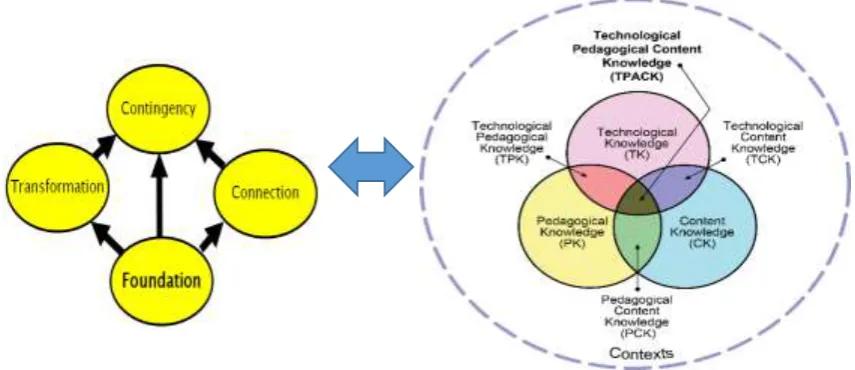
[image:3.595.103.531.431.616.2]In this paper, we adopt the conceptual framework Technological Pedagogical Content Knowledge (TPACK) proposed by Mishra and Koehler (2006) as depicted in the right-hand component in Figure 1. The model shows three intersecting components of teacher knowledge, which in effect adds a third component, Technological Knowledge (TK), to the conceptualisations of Pedagogical Knowledge (PK) and Content Knowledge (CK) described in previous studies (e.g., Ball et al., 2008; Shulman, 1987). To integrate technology in effectively into teaching practice (the intersection of all three components conceptualised as TPACK), the claim is that teachers need to be competent in all three domains (Mishra & Koehler, 2006). However, Mishra and Koehler’s (2006) definitions of knowledge types are based on a generic definition of content and hence of pedagogical knowledge and PCK. Only a few studies have related the TPACK framework to specialised subject contexts and mathematics in particular (Getenet, 2017; Guerrero 2010).
Figure 1. Complementing frameworks: The KQ (Rowland et al., 2009) and TPACK(Mishra & Koehler, 2006)
Figure 1 describes how the TPACK framework might be used to complement the KQ, as is explored in this paper. On the one hand, the KQ, which explicitly defines PCK specific to mathematics teaching, can be used to analyse teacher practice across the four components of the model; on the other hand, we can use TPACK as an additional framework to help explain the influence of technology on teachers’ Foundation, Transformation, Connection,
The Research Setting
The research for this paper took place in an independent (government, non-denominational) boys’ school in Australia. It offered education from Year 5 to Year12 with the school identified as being in a high socio-economic band (Index of Community Socio-educational Advantage (Australian Curriculum, Assessment and Reporting Authority, 2013) value 1215) and makes extensive use of digital learning practices. Teachers were asked not to prepare a special lesson but to go about their regular teaching. Researchers took notes from brief interviews with the teachers before and after the lesson, to determine where this lesson fitted in with their overall teaching plan and the nature of their students, so the researchers might better interpret the progression of the lesson and the teachers’ actions. Participating teachers were given a wireless lapel microphone linked to a single portable tripod-based video camera set up at the back of the room. One researcher operated the camera, while another observed and took notes. Recordings were transcribed identifying the teacher and generic student contributions.
The class on which this paper reports was a Year 11 class of 18 boys, seated in four long-row tables. The teacher (Neil, not his real name) was an experienced registered teacher of secondary school mathematics with a degree in mathematics and science and a postgraduate university qualification in Education. He had taught mathematics at the school for more than 10 years and the lesson occurred towards the end of the school year, so the teacher knew his students well. The observed lesson was a 60-minute part of a calculus unit that the teacher had been developing over several lessons. The main theme of the lesson was visually connecting the graphs of the gradient function with its initial function before differentiation and followed a previous lesson in which they had looked at differentiation from first principles. After a brief review of the learning, the students worked individually and with their immediate neighbours through the prepared activities and problems. Each student used a tablet-laptop computer (i.e., a laptop with the facility to write on the screen), connected to the internet and the school’s e-portal, which provided access to the lesson and enabled students to revise and review past content. The teacher used a tablet and a large-screen television monitor at the front of the room as his instructional focus point, connected through the e-portal to students’ computers. At different times he brought the class group together and used the screen to explain something to the whole group or to have the students review the problem under investigation and its “solution”. Although the teacher could monitor all laptops from the front, he constantly moved around the room talking to students in groups and individually.
Linking TPACK and the Knowledge Quartet: Evidence from the Lesson
Transcripts of the lesson were first analysed separately by three of the researchers to identify examples of practice within the four KQ components (Rowland et al., 2009) with close agreement in the resultant coding. We then looked for ways in which the seven categorisations of the TPACK framework (Mishra & Koehler, 2006) might distinguish between, or afford additional insights into, the examples identified within the KQ model. We also looked for examples from the lesson that might reflect elements of the TPACK model not previously identified in our KQ analysis. Figure 1 shows the relationship between the seven components of the TPACK Model as described earlier (PK, CK, TK, TPK, TCK, PCK, & TPACK), and we summarise some examples of these in Table 2.
With respect to the KQ framework, the lesson clearly demonstrated the teacher’s strong
drawing the lesson together. At the start of the lesson for example, Neil reviewed the previous lesson and positioned the new lesson, stating:
…yesterday, we were looking at differentiation by first principles and I kind of said, look, you could probably be very successful Year 11 and 12 calculus at the university if you didn’t really, if you got that right once and then you forgot about it, you could go on and be very good in terms of your calculus knowledge. What we’re doing today is pretty central, okay? So, you’re going to learn a whole bunch of things over the next couple of years, chain rule, product rule, quotient rule, integration, a whole lot of algebraic techniques, but this conceptual understanding and the graphical representation of what we mean by differentiation’s really important.
[image:5.595.87.524.310.750.2]This example illustrates Neil’s Foundation content knowledge (CK) in terms of the purpose and value in teaching differentiation from first principles; what Ball et al. (2008) would further categorise as Horizon Knowledge. It also identifies Neil’s knowledge of the importance of graphical representations for students to understand the concepts that they will meet in coming years and the need to make Connections between the various concepts (PK). Table 2
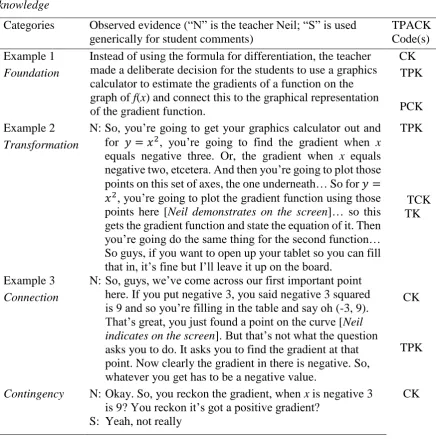
Technology influencing Foundation, Transformation, Connection, and Contingency knowledge
Categories Observed evidence (“N” is the teacher Neil; “S” is used generically for student comments)
TPACK Code(s) Example 1
Foundation
Instead of using the formula for differentiation, the teacher made a deliberate decision for the students to use a graphics calculator to estimate the gradients of a function on the graph of f(x) and connect this to the graphical representation of the gradient function.
CK TPK
PCK Example 2
Transformation
N: So, you’re going to get your graphics calculator out and for 𝑦 = 𝑥2, you’re going to find the gradient when x
equals negative three. Or, the gradient when x equals negative two, etcetera. And then you’re going to plot those points on this set of axes, the one underneath… So for 𝑦 =
𝑥2, you’re going to plot the gradient function using those
points here [Neil demonstrates on the screen]… so this gets the gradient function and state the equation of it. Then you’re going do the same thing for the second function… So guys, if you want to open up your tablet so you can fill that in, it’s fine but I’ll leave it up on the board.
TPK
TCK TK
Example 3
Connection
N: So, guys, we’ve come across our first important point here. If you put negative 3, you said negative 3 squared is 9 and so you’re filling in the table and say oh (-3, 9). That’s great, you just found a point on the curve [Neil indicates on the screen]. But that’s not what the question asks you to do. It asks you to find the gradient at that point. Now clearly the gradient in there is negative. So, whatever you get has to be a negative value.
CK
TPK
Contingency N: Okay. So, you reckon the gradient, when x is negative 3 is 9? You reckon it’s got a positive gradient?
S: Yeah, not really
Other components became evident as the lesson progressed. Connections were seen for example in the procedures and the sequencing of concepts in the lesson. Neil began with concrete examples of calculating gradients on the curve of a function 𝑓(𝑥) using estimates from drawing tangents on the curve (estimating ∆𝑦∆𝑥), and moved towards connecting this with the graph of the gradient function 𝑓′(𝑥). Soon after explaining the importance of what they would be doing, Neil demonstrated a powerful example of Transformation in describing the way he had set up the graphs, with the graphs of two functions 𝑓(𝑥) drawn at the top, and another set of axes aligned immediately below each function for sketching the points calculated for the gradient of 𝑓(𝑥). While one function was easily recognisable by the students as 𝑓(𝑥) = 𝑥2, the second function was more complex and there were no scales on the axes to help them determine its equation. Students had to make connections between the procedures and the concept of 𝑑𝑦𝑑𝑥 for 𝑓(𝑥) = 𝑥2 to help them with the second more complex example, using the aligned axes to help them and transform this knowledge to a new context.
Well, it just so happens that you went through a process to find the gradient function and it gave you the line 𝑑𝑦
𝑑𝑥= 2𝑥. Alright? So, even before you start this one, you should be able to work out what you're expecting in advance…this is deliberately a graph with no scale. That's the origin, but you've got no numbers to work with. I want you to sketch… again, the Y axes or the vertical axis is lined up. I want you to sketch a possible gradient function of that on the axes below. No numbers. You can't use your calculator. You've got to look at it and interpret, right, "What have I just learnt and how can I apply that to a function that has no scale when I don't have any numbers?"
Contingency is shown across the lesson as the teacher exchanges dialogue and stops and starts many times as the students come to an issue needing assistance. At one point in the lesson, Neil could see many students were confused about what turning points for a function itself told them about the gradient of that function, as distinct from the turning points of the gradient function: Neil asked one student to demonstrate on the screen how he used the turning points to help sketch the graph of the gradient function:
S: So, firstly just these two points, the turning points, you know that they're going to be… the intercept's on the next graph because the gradient here is zero and so, you can plot them easily. And the next thing is… the turning point and the turning point's going to be the highest gradient on the graph, which is here.
N: Hang on, so you mean the turning point of your gradient function?
S: [student is thinking and gesturing to the screen]
N: Sorry, I'm interrupting here, but you're telling me that… you're saying that this point has the highest gradient in this section?
This extract shows Neil dealing with Contingency and connecting this back to
Foundation knowledge using the definitions of turning points and gradients. This example also illustrates frequent observations from the lesson with respect to the sophisticated language used by the students in their conversations; further support for Neil’s attention to content knowledge (CK) and making connections (PCK). Neil revisited the concept of maximum and minimum turning points and their relationship to the gradient of the function later in the lesson to reinforce these connections. His choice of difficult examples was causing the students to struggle, requiring him to go back over terms and procedures. The suggestion here is that Neil’s strong Foundation knowledge and confidence in dealing with
Contingency allowed for more effective Transformation and scaffolded the students in their N: You need to use the trace function. You found the y
values. You’ve got to find the gradient.
struggle. This in turn helped students to make connections between the higher concepts. With respect to the use of technology, it is useful here to distinguish between “demonstration” technologies used by the teacher (e.g., OneNote to prepare the class materials provided to students and project on the screen) and tools for actually “doing” mathematics such as the graphics calculators used by the students and the teacher’s use of his tablet to show calculations and sketch directly onto graphs shown on the digital screen. Example 1 in Table 2 demonstrates how Neil used his awareness of the affordances of the graphics calculator (TPK) to design a lesson with an innovative approach to differentiation (CK) rather than what may be the more common approach using the formula (PCK). Example 2 shows how Neil used the technology to transform students’ knowledge, making connections between the gradients of a function calculated using technology (TK) and the gradient function itself, again lotted using technology (TPK). Examples 3 and 4 show how Neil responded to the Contingency by using the technology to distinguish between the gradient of a function, and the value of the function itself at a certain point (CK). In doing this, he demonstrated his technical knowledge (TK) in the value of the calculator’s trace function and his technological pedagogical knowledge (TPK) in how this may help students understand this potentially confusing but critical conceptual difference.
Summary
The evidence and discussion presented here reinforce the findings from Oates et al. (2019, submitted) that there is indeed value in using the KQframework (Rowland, 2013) to examine an experienced teacher’s practice at the upper secondary level, and thus supports extending the use of the KQ framework across curriculum levels (i.e., from primary to secondary). There are multiple examples that demonstrate how the teacher’s practice may be examined within all four components of the KQ model. The preliminary analysis by Oates et al. further suggested a greater exploration of the role of technology within the KQ framework when they observed that:
There is an implication that the contributing codes within each of the four components may need some modification or extension to accommodate the impact of technology on teacher practice and the mathematics classroom (Oates et al., 2019 submitted, p. 7).
The findings here add weight to this proposition, with clear examples of the impact of technology on the lesson within each of the four KQ components, and the additional insights into these provided by the TPACK framework. The teacher had a strong understanding of the purpose of the lesson and was working to build Foundation and Connection. He allowed the students to have control of the software but continually monitored their outputs to address any misconceptions (Contingency). Technology (OneNote) played a significant role by consolidating students’ work within one place while allowing for individual exploration. In this respect, Transformation is seen at the macro-control of the software and technology while the choice of activities and the time on task indicated the teacher had high levels of TPK (awareness of the technology’s affordances) and PCK in making Connections between procedures and concepts.
Casting a TPACK lens over the Transformation, Connection, and Contingency
foundation knowledge (PK) and the connection between concepts (CK). For the teacher, the technology was seen as a tool to advance the students’ mathematics knowledge (TCK) in a seamless, integrated manner. The teacher may therefore be regarded as working within the intersection of the three components of TK, PK, and CK, conceptualised as TPACK by Mishra and Koehler (2006, see Figure 1).
We thus conclude that using complementary models such as depicted in Figure 1 provides valuable insights into teachers’ classroom practice. The next steps might be to compare different lessons and examine to what extent such an approach allows us to identify the implications for effective teacher classroom practice.
Acknowledgments
This study was funded by the Australian Research Council Grant No. DP130103144. The contributions of Helen Chick, Suzanne Crowley, Tom Nicholson, and David Shorter to this study are gratefully acknowledged.
References
Australian Curriculum, Assessment & Reporting Authority. (2013). Guide to understanding 2013 Index of Community Socio-educational Advantage (ICSEA) values. ACARA. Available at: http://docs.acara.edu.au/resources/Guide_to_understanding_2013_ICSEA_values.pdf.
Ball, D. L., Thames, M. H., & Phelps, G. (2008). Content knowledge for teaching: What makes it so special?
Journal of Teacher Education, 59(5), 389–407.
Behr, M. J., Khoury, H. A., Harel, G., Post, T., & Lesh, R. (1997). Conceptual units analysis of preservice elementary school teachers’ strategies on a rational-number-as-operator task. Journal for Research in Mathematics Education, 28(1), 48-69.
Beswick, K., Callingham, R., & Watson, J. M. (2012). The nature and development of middle school mathematics teachers’ knowledge. Journal of Mathematics Teacher Education, 15(2), 131-157.
Blömeke, S., Suhl, U., & Kaiser, G. (2011). Teacher education effectiveness: Quality and equity of future primary teachers’ mathematics and mathematics pedagogical content knowledge. Journal of Teacher Education, 62(2), 154-171.
Getenet, S. T. (2017). Adapting technological pedagogical content knowledge framework to teach mathematics. Education and Information Technologies, 22(5), 2629-2644.
Getenet, S., & Callingham, R. (2019, submitted). Teaching interrelated concepts of fraction for understanding and teacher’s pedagogical content knowledge. Mathematics Education Research Journal.
Guerrero, S. (2010). Technological pedagogical content knowledge in the mathematics classroom. Journal of Digital Learning in Teacher Education, 26(4), 132–139.
Hill, H. C., Schilling, S. G., & Ball, D. L. (2004). Developing measures of teachers’ mathematics knowledge for teaching. The Elementary School Journal, 105(1), 11-30.
Mishra, P., & Koehler, M. J. (2006). Technological pedagogical content knowledge: A framework for teacher knowledge. Teachers College Record, 108(6), 1017–1054.
Oates, G., Callingham, R., & Hay, I. (2019, submitted). A consideration of technology with Rowland’s knowledge quartet framework. Research report submitted to the 43rd Conference of the International Group for the Psychology of Mathematics Education. Pretoria, South Africa: PME.
Rowland, T. (2013). The knowledge quartet: the genesis and application of a framework for analysing mathematics teaching and deepening teachers’ mathematics knowledge. Sisyphus-Journal of Education,
1(3), 15-43.
Rowland, T., Turner, F., Thwaites, A., & Huckstep,P. (2009). Developing primary mathematics teaching: Reflecting on practice with the Knowledge Quartet. London: Sage
Schmidt, W., Houang, R., Cogan, L., Blömeke, S., Tatto, M., Hsieh, F., & Paine, L. (2008). Opportunity to learn in the preparation of mathematics teachers: Its structure and how it varies across six countries. The International Journal on Mathematics Education, 40(5), 735-747. doi: 10.1007/s11858-008-0115-y. Shulman, L. S. (1987). Knowledge and teaching: Foundations of the new reform. Harvard Educational Review,
57(1), 1-22.
Thomas, M. O. J., & Hong, Y. Y. (2013). Teacher integration of technology into mathematics learning.