Template for Malta progress reports under Directive 2009/28/EC.
Article 22 of Directive 2009/28/EC requires Member States to submit a report to the
Commission on progress in the promotion and use of energy from renewable sources by 31
December 2011, and every two years thereafter. The sixth report, to be submitted by 31
December 2021, shall be the last report required.
Member State reports will be important for monitoring overall renewable energy policy
developments and Member State compliance with the measures set out in the Directive
2009/28/EC and the National Renewable Energy Action Plans of each Member State. The
data included in these reports will also serve to measure the impacts referred to in Article 23
of Directive 2009/28/EC. Consistency in Member State data and reporting would be useful.
The purpose of the template is to help ensure that Member State reports are complete, cover
all the requirements laid down in the Article 22 of Directive and are comparable with each
other, over time and with National Renewable Energy Action Plans submitted by Member
States in 2010. Much of the template draws on the template for the National Renewable
Energy Action Plans
1.
When filling in the template, Member States should comply with the definitions, calculation
rules and terminology laid down in Directive 2009/28/EC and those of Regulation (EC) No.
1099/2008 of the European Parliament and the Council
2.
Additional information can be provided either in the prescribed structure of the report or by
including annexes.
Passages in italics aim to guide Member States in the preparation of their reports. Member
States may delete these passages in the version of the report which they submit to the
Commission.
1
C(2009)5174 2
1. Sectoral and overall shares and actual consumption of energy from renewable sources
in the preceding 2 years (n-1; n-2 e.g. 2010 and 2009) (Article 22 (1) a of Directive
2009/28/EC)).
Please fill in the actual shares and actual consumption of renewable energy
for the preceding
2 years
in the suggested tables.
Table 1: The sectoral (electricity, heating and cooling, and transport) and overall shares of energy from renewable sources3
Table 1 2009 2010
RES- H&C 4(%) 9.10% 9.50%
RES-E 5(%) 0.02% 0.08%
RES-T 6(%) 0.83% 0.66%
Overall RES Share 7(%) 0.88% 0.90%
Of which from cooperation mechanism 8(%) 0.00% 0.00%
Surplus for cooperation mechanism9 (%) 0.00% 0.00%
Table 1a: Calculation table for the renewable energy contribution of each sector to final energy consumption (ktoe)10
Table 1a (ktoe) 2009 2010
(A) Gross final consumption of RES for heating and cooling 2.91 3.04 (B) Gross final consumption of electricity from RES 0.05 0.15 (C ) Gross final consumption of energy from RES in transport
(not including mutiplication factors for Art.21.2 and EV) 0.66 0.55
(D) Gross total RES consumption11 3.61 3.73
(E) Transfer of RES to other member States 0.00 0.00 (F) Transfer of RES from other Member States and 3rd
countries 0.00 0.00
(G) RES consumption adjusted for target (D)-(E)+(F) 3.61 3.73
3
Facilitates comparison with Table 3 and Table 4a of the NREAPs. 4
Share of renewable energy in heating and cooling: gross final consumption of energy from renewable sources for heating and cooling (as defined in Articles 5(1)b) and 5(4) of Directive 2009/28/EC divided by gross final consumption of energy for heating and cooling. The same methodology as in Table 3 of NREAPs applies.
5
Share of renewable energy in electricity: gross final consumption of electricity from renewable sources for electricity (as defined in Articles 5(1)a) and 5(3) of Directive 2009/28/ECdivided by total gross final consumption of electricity. The same methodology as in Table 3 of NREAPs applies.
6
Share of renewable energy in transport: final energy from renewable sources consumed in transport (cf. Article 5(1)c) and 5(5)of Directive 2009/28/EC divided by the consumption in transport of 1) petrol; 2) diesel; 3) biofuels used in road and rail transport and 4) electricity in land transport (as reflected in row 3 of Table 1). The same methodology as in Table 3 of NREAPs applies.
7
Share of renewable energy in gross final energy consumption. The same methodology as in Table 3 of NREAPs applies. 8
In percentage point of overall RES share. 9
In percentage point of overall RES share. 10
Facilitates comparison with Table 4a of the NREAPs 11
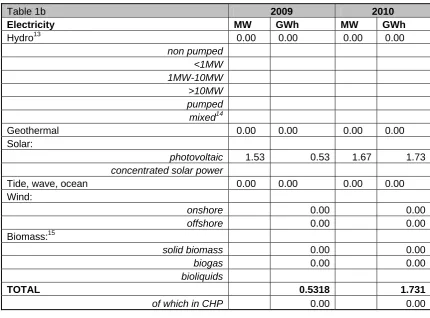
[image:2.595.104.495.358.493.2]Table 1.b: Total actual contribution (installed capacity, gross electricity generation) from each renewable energy technology in Malta to meet the binding 2020 targets and the indicative interim trajectory for the
[image:3.595.81.512.128.446.2]shares of energy from renewable resources in electricity12
Table 1b 2009 2010
Electricity MW GWh MW GWh
Hydro13 0.00 0.00 0.00 0.00
non pumped
<1MW
1MW-10MW
>10MW
pumped
mixed14
Geothermal 0.00 0.00 0.00 0.00
Solar:
photovoltaic 1.53 0.53 1.67 1.73
concentrated solar power
Tide, wave, ocean 0.00 0.00 0.00 0.00
Wind:
onshore 0.00 0.00
offshore 0.00 0.00
Biomass:15
solid biomass 0.00 0.00
biogas 0.00 0.00
bioliquids
TOTAL 0.5318 1.731
of which in CHP 0.00 0.00
Table 1c: Total actual contribution (final energy consumption16) from each renewable energy technology in Malta to meet the binding 2020 targets and the indicative interim trajectory for the shares of energy from renewable resources in heating and cooling (ktoe)17
Table 1c (ktoe) Heating & Cooling 2009 2010
Geothermal (excluding low temperature geothermal heat in
heat pump applications) 0.00 0.00
Solar 2.30 2.47
Biomass:18
solid biomass 0.50 0.33
biogas 0.00 0.15
bioliquids 0.10 0.08
Renewable energy from heat pumps:
of which aerothermal No data No data of which geothermal No data No data of which hydrothermal No data No data
12
Facilitates comparison with Table 10a of the NREAPs. 13
Normalised in accordance with Directive2009/28/EC and Eurostat methodology.
14
In accordance with new Eurostat methodology. 15
Take into account only those complying with applicable sustainability criteria, cf. Article 5(1) of Directive 2009/28/EC last subparagraph.
16
Direct use and district heat as defined in Article 5.4 of Directive 2009/28/EC. 17
Facilitates comparison with Table 11 of the NREAPs. 18
[image:3.595.79.494.495.665.2]TOTAL 2.91 3.04
Of which DH19 0.00 0.00
[image:4.595.99.493.172.364.2]Of which biomass in households20 No data No data
Table 1d: Total actual contribution from each renewable energy technology in Malta to meet the binding 2020 targets and the indicative interim trajectory for the shares of energy from renewable resources in the
transport sector (ktoe)21,22
Table 1d (ktoe) Transport 2009 2010
Bioethanol / bio-ETBE 0.00 0.00
Of which Biofuels23 Article 21.2 0.00 0.00
Of which imported24 0.00 0.00
Biodiesel 0.657 0.546
Of which Biofuels25 Article 21.2 0.657 0.546
Of which imported26 0.00 0.00
Hydrogen from renewables 0.00 0.00
Renewable electricity 0.00 0.00
Of which road transport 0.00 0.00
Of which non-road transport 0.00 0.00
Others (as biogas, vegetable oils, etc.) - please specify 0.00 0.00
Of which Biofuels27 Article 21.2 0.00 0.00
TOTAL 0.66 0.55
2. Measures taken in the preceding 2 years and/or planned at national level to promote
the growth of energy from renewable sources taking into account the indicative
trajectory for achieving the national RES targets as outlined in your National
Renewable Energy Action Plan. (Article 22(1)a) of Directive 2009/28/EC))
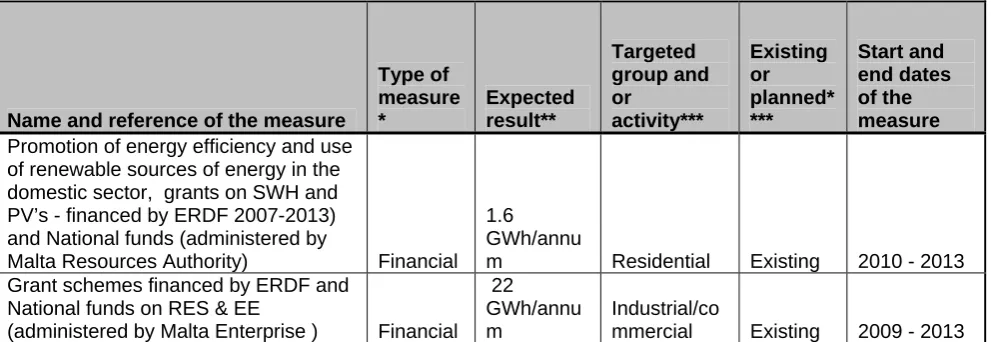
Table 2: Overview of all policies and measures
Name and reference of the measure
Type of measure *
Expected result**
Targeted group and or
activity***
Existing or planned* ***
Start and end dates of the measure
Promotion of energy efficiency and use of renewable sources of energy in the domestic sector, grants on SWH and PV’s - financed by ERDF 2007-2013) and National funds (administered by
Malta Resources Authority) Financial 1.6 GWh/annu
m Residential Existing 2010 - 2013 Grant schemes financed by ERDF and
National funds on RES & EE
(administered by Malta Enterprise ) Financial 22 GWh/annu m
Industrial/co
mmercial Existing 2009 - 2013
19
District heating and / or cooling from total renewable heating and cooling consumption (RES- DH). 20
From the total renewable heating and cooling consumption. 21
For biofuels take into account only those compliant with the sustainability criteria, cf. Article 5(1) last subparagraph. 22
Facilitates comparison with Table 12 of the NREAPs. 23
Biofuels that are included in Article 21(2) of Directive 2009/28/EC.
24
From the whole amount of bioethanol / bio-ETBE. 25
Biofuels that are included in Article 21(2) of Directive 2009/28/EC. 26
From the whole amount of biodiesel. 27
[image:4.595.52.548.466.637.2]Project calls from Planning and Priorities Coordination Division on energy related sectors including RES &
EE Financial Annual penetration of 340kWp of solar, and micro-wind, 2-3 schemes, 1 study Public, Non-profit
organisations Existing 2007-2013
Wind data measuring campaign to
determine wind resources potential. Soft
National Wind potential
Investors &
Public Existing 2009-2011 AA & EIA related to potential wind farm
sites Soft
109MW in wind energy
Investors &
Public Existing 2009-2012 EoI, Tender on Public roofs allocation
to PV developers Financial > 10MW
Investors &
Public Planned 2010-2013
Financial incentive mechanisms , e.g.
FiT, Regulatory
Self sustained market Residential and Non-residential electricity generators from Photovoltaic technology Existing for PV technolo gy 2010 Bio-fuel substitution obligation. Regulatory
4.9ktoe in 2020
suppliers,
end-users Existing 2011 Waste segregation for RRR (Reduce ,
Recycle, Reuse) Soft
behavioural
change end-users Existing Ongoing
EPBR implementation Regulatory
Low carbon buildings
architects,
end-users Existing Ongoing EE schemes - Free CFL's per
household Soft behaviour
change end-users Existing Done in 2009
CHP promotion Soft
behavioural change
investors &
end-user Planned 2012
Bio-fuels use in heating and generation Soft
behavioural change
generators,
end users Existing 2010
Guidelines for micro-wind turbine
installations Soft reducing
administrati ve barriers
investors,
architects Existing 2010 Promotion of micro-wind turbines at
Public sites Soft
behavioural
change public Existing Ongoing Promotion for the use of photo-voltaic
systems at public sites and buildings Soft
behavioural
Setting specifications for approved
technologies. Regulatory
Insuring quality and positive perception of RES
technologies end users Existing Ongoing Public awareness campaigns on EE
and RES Soft
behavioural change
end users,
students Existing Ongoing Installation of electricity smart metering Soft
behavioural
change end users 2009 -2012
Promotion of Electric Vehicles Soft
behavioural change and cleaner
commuting public Ongoing
Started in 2011 through a Life+ funded project DemoEV
Public transport reform and promotion Soft
behavioural change and cleaner
commuting public Existing
Implemented on massive public transport.
Promotion of more efficient vehicles
and use of bicycles Soft
behavioural change and cleaner
commuting public Existing Ongoing Promotion on careful use of water
resources Soft
behavioural
change public Existing
Ongoing
Promotion of wave and sea currents
generation studies Soft
National wave and sea currents potential
Investors &
Public Existing 2011 Training & certification of installers Soft
behavioural
change Installers Existing 2010-2012 * Indicate if the measure is (predominantly) regulatory, financial or soft (i.e. information campaign).
**Is the expected result behavioural change, installed capacity (MW; t/year), energy generated (ktoe)?
***Who are the targeted persons: investors, end users, public administration, planners, architects, installers, etc? or what is the targeted activity / sector: biofuel production, energetic use of animal manure, etc)?
**** Does this measure replace or complement measures contained in Table 5 of the NREAP?
2.a Please describe the progress made in evaluating and improving administrative
procedures to remove regulatory and non-regulatory barriers to the development of
renewable energy. (Article 22(1)e) of Directive 2009/28/EC)).
The concerns about barriers to the development of the major projects are being addressed already and are being treated on a case by case basis. The Government had identified the sites for windfarm development for which the Environment Impact Assessments or Appropriate Assessments are being undertaken. Malta has also applied through the NER300 for the development of a floating wind farm whereby a floating platform with total capacity of 54MW will be installed offshore if this project goes through and is selected. Innovative technologies being currently investigated, as wave and other sea energy technologies under experimentation are also being provided permission for study purposes.
It is expected that the uptake of other renewable energy technologies will take place in the form of a larger number but smaller installation capacities with priority being given to those technologies which are already widely available, mainly solar photovoltaic systems, solar water heating and micro-wind.
The Malta Environment and Planning Authority had issued a set of guidelines28 in 2007 on planning permitting of solar applications installed within the curtilage of a building. These guidelines have simplified the installation of such systems whereby subject to compliance with the guidelines, no planning permits will be required in most cases. Solar applications that fall outside the scope of these guidelines may require a planning permit from the local planning authority.
A set of planning permitting guidelines29 is also available for micro wind turbines with capacities up to 20kW.
The authorisation and licensing of new generation capacity is regulated by the Electricity Market Regulations (LN 166/11). The Electricity Market Regulations exempt generators with capacity not exceeding 16Amps per phase and producing electricity from renewable energy sources from the requirement to obtain an authorization and a license. Instead a fast track procedure was adopted whereby these generators require only the submission of a notification to the regulator prior to construction. Once the installation is ready, an application for connection to the grid and provision of the necessary metering has to be submitted to the Distribution System Operator (DSO).
Generation capacities falling outside the scope of the notification process are required to apply for and obtain an authorisation prior to construction of the generation capacity. The authorisation process requires that it is ascertained that the proposed installation does not impact negatively the stability of the network and also that an adequate connection to the grid is available otherwise the necessary steps have to be taken to upgrade the connection and the network where necessary. Therefore, the authorisation procedure involves consultation with the DSO to ensure that potential technical barriers that may exist for connection to the grid are addressed and mitigation measures taken in due time. At the authorization stage the applicant is also required to sign a Power Purchase Agreement with the DSO for the export of the electricity generated from the plant. Generation capacities that require an authorization prior to construct are also required to have a license to produce electricity for own use and/or sell to the DSO. The licence is issued by the regulator once informed in writing that the installation is ready for connection to the grid and then an application can be submitted to the DSO for connection to the grid and provision of the necessary metering.
Presently the regulator does not charge any fees for the processing of the Notifications, Authorisations and issue of licences with respect to generators producing electricity from renewable energy sources. An administrative charge applies when the application for connecting the generator to the grid is submitted to the DSO.
Measures being taken to facilitate the uptake of renewable energy resources include financial incentives in the form of grants on the initial capital investment made available for residential and non residential sectors through grant schemes launched by Government from time to time. Improvements in the administration procedures have also been applied in the applications for such grants in the recent
28
Development Control Policy and Design Guidance 2007 – MEPA
http://www.mepa.org.mt/LpDocumentDetails?syskey=%20655
29
residential PV grant scheme. The aim is to make these technologies more affordable to the general public and organizations. Effort is also being made such that technologies benefiting from the grant schemes meet certain quality requirements and standards as to ensure that the installed technologies are robust and perform according to specification. Installations as solar photovoltaic systems are being certified by warranted electrical engineers and this year courses have been implemented for the certification of installers of solar applications as to ensure the proper, safest and most effective methods of such installations. The certification of installers would also provide knowledge to the installers of the registration procedures for grid connected renewable energy technologies required by the Electricity Market Regulations (LN166/11) and would thus reduce the administrative reworking to process incomplete or incorrect registration of applications.
Other incentives to address financial barriers include the introduction of a feed in tariff for solar photovoltaic system in September 2010 through LN422/2008 Feed-in Tariffs Regulations such that photovoltaic installations including those benefiting from a grant could also benefit from the payment of a feed-in tariff on the electricity exported from such systems. The introduction of a feed-in tariff replaced the previous net-metering arrangement however owners of the photovoltaic installations could still use the system for auto production and export the surplus at the feed-in tariff. The introduction of the feed-in tariff increased the potential for exploitation of the roofs available especially for premises with no consumption and hence with no incentive for net metering. Whenever there is no defined tariff, a business case analysis must be undertaken per individual case and the proposed tariff needs to be approved by the regulator. Hence if a feed-in tariff is defined by law, as the case of widespread technologies as photovoltaic systems, this will reduce the regulatory and administrative barriers as well as the time for implementation.
Another potential barrier could be the uncertainty arising from the possibility that developments, in particular new building structures, erected in the neighborhood could affect adversely the potential of renewable energy sources in particular solar and wind. Government has recently approved a set of strategic objectives to guide the preparation of the Strategic Plan for Environment and Development. It is the intention of government that this Plan should develop policies that will require the integration of small scale renewable energy infrastructure into the design of buildings. Work on the formulation of this Plan is to commence in 2012 and it is expected to guide development until 2020.
2.b Please describe the measures in ensuring the transmission and distribution of
electricity produced from renewable energy sources and in improving the framework or
rules for bearing and sharing of costs related to grid connections and grid
reinforcements. (Article 22(1)f) of Directive 2009/28/EC)).
The distribution system operator is obliged to take into consideration among other factors, distributed generation that might replace the need to upgrade or displace electricity capacity when planning the development of the distribution network. The distribution operator submits grid investment plans to Parliament for approval of the budget on a yearly basis.
The relatively large scale renewable electricity generators have already been taken in account in the grid development investment plans. The electricity interconnection with Europe through a connection with the electricity grid in Sicily is expected to provide the necessary reliability and balancing facility in the electricity grid to enable the efficient and secure operation of the planned wind farm capacity.
Other decentralised relatively smaller renewable electricity sources which are expected to be quite higher in numbers, but distributed over the whole territory closer to the electricity load are not expected to present any particular issues for connection given that the grid covers most of the Maltese territory.
acquisition (SCADA) system covering the network above 11kV is also being implemented. These projects are expected to be completed by 2012. Currently there are no plans for storage systems.
With regards to the grid infrastructure approval for the connection of a renewable generation station, the Malta Environment and Planning Authority (MEPA) consults both the energy regulator the Malta Resources Authority and the grid operator Enemalta Corporation on all medium and large scale developments during the project development stage permit application. Once the application of the authorisation to construct the generating plant is submitted to the Malta Resources Authority with the specific technical details, this Authority in turn consults with the DSO, Enemalta Corporation, with regards to the detail of the connection requirements, and eventually issues the authorisation approval.
The Network code in Malta establishes the rules for interoperability of the network and requires that only generators above 1 MW are subject to dispatch. Therefore, smaller generators are being given automatic priority. The new Electricity Market Regulations requires that the DSO gives priority of access to renewable energy sources (RES) generators and priority of dispatch.
To date, the applications received by the DSO for connection of renewable energy generators to the grid, mainly included cases where an adequate connection to the grid was already available. As a norm in cases where the connection of a generator requires a new connection or an upgrade of an existing connection the developer will be required to finance in whole the connection. The same methodology and fees established in the Electricity Supply Regulations30 to connect a consumer to the grid would be applicable to determine the cost of the connection.
Discussions are underway to determine the methodology that would be applied for the sharing of costs when the integration of RES generators requires reinforcement of the grid.
Rules regarding the sharing of cost of infrastructure between initially and subsequently connected producers are being investigated and the provision will be included in the Electricity Supply Regulations.
The best options are being currently evaluated with regards to the dispatch of RES generation when capacity exceeds demand, which could occur when the large dispatchable renewable electricity generation capacity is connected. In this regard the interconnection with mainland Europe has to be utilized to provide the necessary balancing so as not to resort to curtailment of the excess RES capacity.
Currently the renewable electricity generated is being sold to Enemalta Corporation. So far the generators from renewable energy are owned by producers who are also consumers of electricity and as consumers they already pay a service charge for the use of the network and no further charges are applied for the use of the network to export electricity.
As regards the connection to the network if the connection is not adequate to accommodate the RES generator, the producer has to pay for the upgrade of the connection. The connection charges and the methodology for their determination together with the service charges are established by the Electricity Supply Regulations. Tariffs and service charges are approved by the Malta Resources Authority and are published on the Authorities website.
30
3. Please describe the support schemes and other measures currently in place that are
applied to promote energy from renewable sources and report on any developments in
the measures used with respect to those set out in your National Renewable Energy
Action Plan. (Article 22(1)b) of Directive 2009/28/EC)).
The Commission reminds Member States that all national support schemes must respect the
state aid rules as foreseen in Articles 107 and 108 of the Treaty on the Functioning of the EU.
The notification of the report in accordance with Article 22 of Directive 2009/28/EC does not
replace a state aid notification in accordance with Articles 107 and 108 of the Treaty on the
Functioning of the EU.
[image:10.595.71.469.320.768.2]It is suggested that
table 3
is used
to provide more detailed information on the support
schemes in place and the support levels applied to various renewable energy technologies.
Member States are encouraged to provide information on the methodology used to determine
the level and design of support schemes for renewable energy.
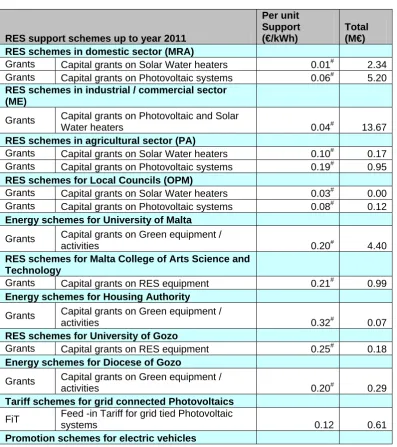
Table 3: Support schemes for renewable energy
RES support schemes up to year 2011
Per unit Support (€/kWh)
Total (M€)
RES schemes in domestic sector (MRA)
Grants Capital grants on Solar Water heaters 0.01# 2.34 Grants Capital grants on Photovoltaic systems 0.06# 5.20
RES schemes in industrial / commercial sector
(ME)
Grants Capital grants on Photovoltaic and Solar
Water heaters 0.04# 13.67
RES schemes in agricultural sector (PA)
Grants Capital grants on Solar Water heaters 0.10# 0.17 Grants Capital grants on Photovoltaic systems 0.19# 0.95
RES schemes for Local Councils (OPM)
Grants Capital grants on Solar Water heaters 0.03# 0.00 Grants Capital grants on Photovoltaic systems 0.08# 0.12
Energy schemes for University of Malta
Grants Capital grants on Green equipment /
activities 0.20# 4.40
RES schemes for Malta College of Arts Science and
Technology
Grants Capital grants on RES equipment 0.21# 0.99
Energy schemes for Housing Authority
Grants Capital grants on Green equipment /
activities 0.32# 0.07
RES schemes for University of Gozo
Grants Capital grants on RES equipment 0.25# 0.18
Energy schemes for Diocese of Gozo
Grants Capital grants on Green equipment /
activities 0.20# 0.29
Tariff schemes for grid connected Photovoltaics
FiT Feed -in Tariff for grid tied Photovoltaic
systems 0.12 0.61
Grants Capital grants on Electric Vehicles 0.40
Bio-fuel use in transport
Obligation Obligation of 1.5% bio-fuel mix, 0.75% in
case of bio-fuel from Article 21.2 N/A N/A Total annual estimated support in the electricity sector 26.41 Total annual estimated support in the heating sector 2.57 Total annual estimated support in the transport sector 0.40
Total estimated support 29.38
# Per unit cost = Public support funding / (Energy generated x lifetime of the technology)
3.1. Please provide the information on how supported electricity is allocated to final
customers for purposes of Article 3 (6) of Directive 2003/54/EC. (Article 22(1)b) of
Directive 2009/28/EC)).
The local energy supplier Enemalta Corporation provides information on the fuel mix and emissions through interactive requests from the website 31annual reports also available on its website32 and public annual reports. CO2 emissions are also available on the electricity bills
33
sent to its consumers.
The Enemalta Corporation website also indicates flue gas emissions period reports selected interactively per plant, a set of energy tips, promotion to alternative energy and clean energy initiatives with on-line reports. The website of its subsidiary for the billing activities, ARMS Ltd, provides information on billing and billing methods for grid connected renewable sources, namely photovoltaic systems.
4. Please provide information on how, where applicable, the support schemes have been
structured to take into account RES applications that give additional benefits, but may
also have higher costs, including biofuels made from wastes, residues, non-food cellulosic
material, and ligno-cellulosic material?) (Article 22 (1)c of Directive 2009/28/EC)).
The generation of electricity from renewable technologies, mainly those unconventional and deriving from innovative technologies, normally derive energy at a relatively higher cost than conventional and need to be financially assisted accordingly. The Maltese Government is aware of such a situation and has been providing capital grants for solar technologies as for solar water heating and solar photovoltaic systems. For the latter technology, the incentives have been further complimented by a feed-in tariff as to ensure that the installations of such systems are also a competitive investment and that such monies are invested in innovative and environmental friendly technologies. The Feed-in Tariff Regulation (LN422/10) is aimed at solar photovoltaic systems, however this is the first stepping
31
Enemalta Emissions interactive website : http://www.enemalta.com.mt/emissions/#
32
Energy supplier’s website link http://www.enemalta.com.mt/home.aspx and for annual reports defining the fuel mix at : http://www.enemalta.com.mt/index.aspx?cat=1&art=14
Billing Agency website link:
https://www.smartutilities.com.mt/wps/portal/Public%20Area/ARMS.PublicArea.Home/!ut/p/c5/hY3PCoJAHIS
fpQeI37jqakcz0a1wk01TL7KEiOCfDhH09ikdOpkzx28-hkqaOuhX2- hnOw66o5xKXhk8NbNTaCCMLwGEdXT95AomhT3xgld-6EWWcwYkywAW2ypBqkwIc8W-zX___ZljIR6-
fPFhhTNOcTT2Nal6oIJK57eUO-VDqEMa2IHLIB0qurrR9zc9-hyt2O4Tb7P5ACuwhYA!/dl3/d3/L3dDb0EvUU5RTGtBISEvWUZSdndBISEvNl9MOEdFU1VKNDE4RlI1ME lTS0RDR1VQMUFGMg!!/
33
Electricity Bill booklet explained at
https://www.smartutilities.com.mt/wps/wcm/connect/99177680460fae08b1d0f907673cd39a/4201+ARMS+NE W+BILLING+INFO+BOOKLET+FINAL+MALT.pdf?MOD=AJPERES
Or
stone to similar tariffs aimed at other grid connected renewable energy technologies, as micro-wind and co-generation especially if the latter is driven by a share of renewable energy sources. Similar to solar photovoltaic systems, capital grants are also available for micro-wind turbines.
As a further assistance in cleaner mobility the Government has also introduced incentives for the use of electric vehicles, specifically aimed to be re-charged from electricity deriving from renewable energy sources.
5. Please provide information on the functioning of the system of guarantees of origin
for electricity and heating and cooling from RES, and the measures taken to ensure
reliability and protection against fraud of the system. (Article 22(1)d of Directive
2009/28/EC)).
The regulation establishing ‘guarantees of origin’ came into force by means of the Guarantees of Origin of Electricity from High Efficiency Cogeneration and Electricity, Heating and/or Cooling from Renewable Energy Sources Regulations (LN92/10 as amended by LN126/11)34 and was amended to include references to ‘guarantees of origin’ from the Renewables Directive (Directive 2009/28/EC)35 of the European Parliament and of the Council of 23 April 2009 on the promotion of use of energy from renewable sources and amending and subsequently repealing Directives 2001/77/EC and 2003/30/EC.
The Regulations defines the conditions required for the issuing of a certificate and establishes the Malta Resources Authority as competent Authority to issue certificates and to keep and update an electronic register.
Within the national regulatory framework, Enemalta Corporation is under no obligation to generate from RES sources. Consequently no request has yet been received from the main electricity distributor on the Islands for the issue of a ‘guarantees of origin’ certificate. Other small RES electricity generators could have requested such ‘guarantees of origin’ certificate for it to be traded however up to this date, these electricity generators have opted for other measures such as the fixed feed-in tariff with a premium over the market price of conventional electricity and capital grants for the financing of the project. These measures were aimed to provide a financial payback to support RES and have taken precedence over the variable market of ‘guarantees of origin’ which currently does not have any local demands.
6. Please describe the developments in the preceding 2 years
in the availability and use
of biomass resources for energy purposes. (Article 22(1)g) of Directive 2009/28/EC)).
It is suggested that
tables 4 and 4a
are used
to provide more detailed information on the
biomass supply.
34
http://www.justiceservices.gov.mt/DownloadDocument.aspx?app=lom&itemid=10701
35
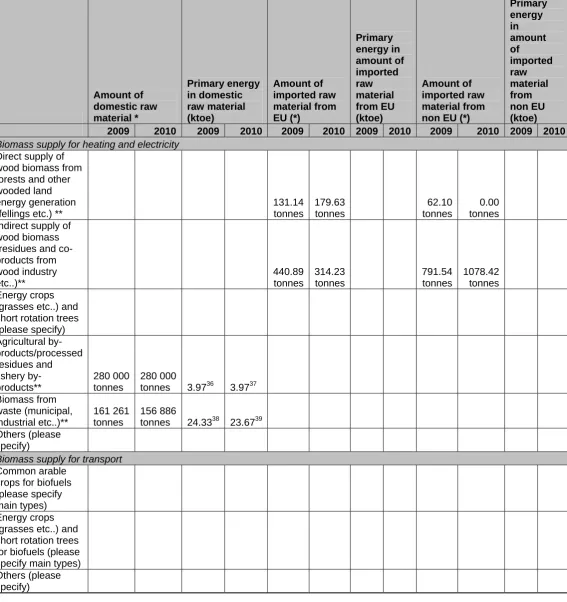
Table 4: Biomass supply for energy use Amount of domestic raw material * Primary energy in domestic raw material (ktoe) Amount of imported raw material from EU (*) Primary energy in amount of imported raw material from EU (ktoe) Amount of imported raw material from non EU (*)
Primary energy in amount of imported raw material from non EU (ktoe)
2009 2010 2009 2010 2009 2010 2009 2010 2009 2010 2009 2010
Biomass supply for heating and electricity
Direct supply of wood biomass from forests and other wooded land energy generation
(fellings etc.) **
131.14 tonnes 179.63 tonnes 62.10 tonnes 0.00 tonnes Indirect supply of
wood biomass (residues and co-products from wood industry etc..)** 440.89 tonnes 314.23 tonnes 791.54 tonnes 1078.42 tonnes Energy crops
(grasses etc..) and short rotation trees
(please specify) Agricultural by-products/processed residues and fishery by-products** 280 000 tonnes 280 000
tonnes 3.9736 3.9737 Biomass from waste (municipal, industrial etc..)** 161 261 tonnes 156 886
tonnes 24.3338 23.6739 Others (please
specify)
Biomass supply for transport
Common arable crops for biofuels (please specify
main types)
Energy crops (grasses etc..) and short rotation trees for biofuels (please
specify main types)
Others (please
specify)
36
Not utilised since no generation facilities available
* Amount of raw material if possible in m3for biomass from forestry and in tonnesfor biomass from agriculture and fishery and biomass from waste
** The definition of this biomass category should be understood in line with table 7 of part 4.6.1 of Commission Decision C (2009) 5174 final establishing a template for National Renewable Energy Action Plans under Directive 2009/28/EC
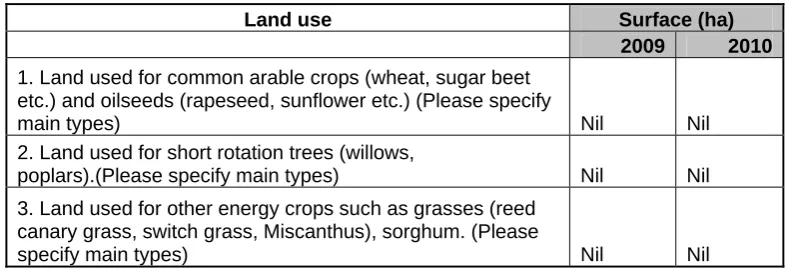
No substantial domestic land is being used for the production of crops, rotation trees and grasses mainly aimed as a produce of energy or fuel related purposes.
Table 4a. Current domestic agricultural land use for production of crops dedicated to energy production (ha)
Land use Surface (ha)
2009 2010
1. Land used for common arable crops (wheat, sugar beet etc.) and oilseeds (rapeseed, sunflower etc.) (Please specify
main types) Nil Nil
2. Land used for short rotation trees (willows,
poplars).(Please specify main types) Nil Nil 3. Land used for other energy crops such as grasses (reed
canary grass, switch grass, Miscanthus), sorghum. (Please
specify main types) Nil Nil
7. Please provide information on any changes in commodity prices and land use within
your Member State in the preceding 2 years
associated with increased use of biomass
and other forms of energy from renewable sources? Please provide where available
references to relevant documentation on these impacts in your country. (Article 22(1) h)
of Directive 2009/28/EC)).
When assessing commodity price impacts, it is suggested to consider at least the following
commodities: common food and feed crops, energy wood, pellets.
In the preceding 2 years (2009 and 2010), the use of biomass, in the form of biodiesel did not affect the commodity price because the product B100 was sold at a cheaper price than other fossil fuels. It also didn’t affect land use because no fuel crops are planted locally and biodiesel was retrieved from the cooking oil waste streams.
Grid connected renewable energy systems in the years being considered is mainly attributed to solar photovoltaic systems, where a net-metering mechanism i.e. an exchange of the units consumed with that generated was in force. These installations were based on premises where electricity consumption was being displaced by the electricity generated from the solar photovoltaic system. Thus there was a minimal influence on the price of the dispatched electricity to the end consumers as a direct exchange of the units occurred without any additional premium.
8. Please describe the development and share of biofuels made from wastes, residues,
non-food cellulosic material, and lingo cellulosic material. (Article 22(1) i) of Directive
2009/28/EC)).
[image:14.595.100.495.205.342.2]Article 21(2) biofuels40 2009 2010
Production - fuel type bio-diesel 0.76 0.63 Consumption - fuel type bio-diesel 0.76 0.63 Total production Art.21.2. biofuels (same as above) 0.76 0.63 Total consumption Art.21.2. biofuels (same as above) 0.76 0.63 % share of Art. 21.2 fuels from total RES-T 100.00% 100.00%
9. Please provide information on the estimated impacts of the production of biofuels and
bioliquids on biodiversity, water resources, water quality and soil quality within your
country
in the preceding 2 years
. Please provide information on how these impacts were
assessed, with references to relevant documentation on these impacts within your country.
(Article 22 (1) j) of Directive 2009/28/EC)).)
Local bio-fuel production derives mainly from used cooking oil waste streams. Thus there is minimal impact on biodiversity, water resources, water quality and soil quality. The local manufacturer of bio-fuels has to abide to Integrated Pollution Prevention and Control regulations. On the other hand, it is considered as having a positive impact on environment as it re-uses waste other wise required to be disposed of.
10. Please estimate the net greenhouse gas emission savings due to the use of energy
from renewable sources (Article 22 (1) k) of Directive 2009/28/EC)).
For the calculation of net greenhouse gas emission savings from the use of renewable energy,
the following methodology is suggested:
•
For biofuels: In accordance with Article 22(2) of Directive 2009/28/EC.
•
For electricity and heat it is suggested to use the EU wide fossil fuel comparators for
electricity and heat as set out in the report on sustainability requirements for the use
of solid and gaseous biomass sources in electricity, heating and cooling
41, if no later
estimates are available.
[image:15.595.75.509.568.693.2]If a Member State chooses not to use the suggested methodology for estimating the net
greenhouse gas emission savings, please describe what other methodology has been used to
estimate these savings.
Table 6: Estimated GHG emission savings from the use of renewable energy (t CO2eq)
Environmental aspects 2009 2010
Total estimated net GHG emission saving from using
renewable energy42 11714.87 12747.85
Estimated net GHG saving from the use of renewable
electricity 508.93 1550.69
Estimated net GHG saving from the use of renewable
energy in heating and cooling 9531.83 9805.89
Estimated net GHG saving from the use of renewable
energy in transport 1674.11 1391.27
40
Biofuels made from wastes, residues, non-food cellulosic material, and lignocellulosic material.
41
Report available on: http://ec.europa.eu/energy/renewables/transparency_platform/doc/2010_report/com_2010_0011_3_report.pdf . 42
11. Please report on (for the preceding 2 years) and estimate (for the following years up
to 2020) the excess/deficit production of energy from renewable sources compared to the
indicative trajectory which could be transferred to/imported from other Member States
and/or third countries, as well as estimated potential for joint projects until 2020.
(Article 22 (1) l, m) of Directive 2009/28/EC)).
Table 7: Actual and estimated excess and/or deficit (-) production of renewable energy compared to the indicative trajectory which could be transferred to/from other Member States and/or third countries in
Malta (ktoe)43,44
2009 2010 2011 2012 2013 2014 2015 2016 2017 2018 2019 2020
Actual/estimated excess or deficit
production 2.05 7.60 8.34 16.08 1.07
11.1. Please provide details of statistical transfers, joint projects and joint support
scheme decision rules.
Malta currently estimates that gross final consumption share by renewable energy sources targets in 2020 will be achieved through domestic means. Though the first interim target calculated on the average energy consumption and renewable energy generation during 2011 and 2012 indicates a slight margin of excess, the action plan still indicate a recovery once the planned major projects will become on line providing a maximum excess by 2018 declining towards 2020.
The indicated trend suggests that Malta, though initially tight to the first interim target due to delayed measures implementation will still recover by 2020 and does not have any substantial sustainable excess which can be marketed in the long term.
The rules for co-operative mechanisms have not yet been defined, and Malta would like to follow exemplary cases of other MS in these regards if the need arises in order to ensure that the legal procedures, for example concerning state aid issues, are addressed properly.
12. Please provide information on how the share for biodegradable waste in waste used
for producing energy has been estimated, and what steps have been taken to improve
and verify such estimates.
(Article 22 (1) n of Directive 2009/28/EC)).
The share of biodegradable waste in municipal waste is based on information on the composition of waste as published by the National Statistics Office (2002). The information is based on a field survey. The National Statistics Office has recently conducted a fresh survey; results have however not been published to date.
Please note that in the first progress report (2011 report) Member States are invited to
outline their intentions with regard to the questions addressed in Article 22(3 a-c). In
addition, Member States are also welcome to provide any other information considered
relevant to the specific situation of developing renewable energy of each Member State.
43
Please use actual figures to report on the excess production in the two years preceding submission of the report, and estimates for the following years up 2020. In each report Member State may correct the data of the previous reports.
In its first report, the Member State shall outline whether it intends to:
(a) establish a single administrative body responsible for processing authorisation,
certification and licensing applications for renewable energy installations and providing
assistance to applicants;
Aside from construction and development permitting required form the local planning authority, the Malta Environment and Planning Authority (MEPA) which may require environmental impact assessments (EIA) or appropriate assessments (AA); for energy generation related developments including those deriving from renewable energy sources the authorisation process for licensing the operator to generate and supply energy, the certification process to ensure competence in the staff commissioning renewable plants, and provision of assistance to applicants will reside in the energy regulator’s, the Malta Resources Authority, role.
As per Article 4 of the ACT XXV of 2000, the Malta Resources Authority shall have the following functions:
(a) to regulate, monitor and keep under review all practices, operations and activities relating to energy, water and mineral resources;
(b) to grant any licence, permit or other authorisation, for the carrying out of any operation or activity relating to energy, water and mineral resources;
(c) to regulate and secure interconnectivity for the production, transmission and distribution of the services or products regulated by or under this Act;
(d) to ensure fair competition in all such practices, operations and activities;
(e) to establish minimum quality and security standards for any of the said practices, operations and activities and to regulate such measures as may be necessary to ensure public and private safety;
(f) to secure and regulate the development and maintenance of efficient systems in order to satisfy, as economically as possible, all reasonable demands for the provision of the resources regulated by or under this Act;
(g) to carry out studies, research or investigation on any matter relating to the resources regulated by or under this Act;
(h) to provide information and issue guidelines to the public and to commercial and other entities on matters relating to the said resources;
(i) to regulate the price structure for any activity regulated by this Act and where appropriate to establish the mechanisms whereby the price to be charged for the acquisition, production, manufacture, sale, storage and distribution thereof is determined;
(j) to establish the minimum qualifications to be possessed by any person who is engaged or employed in any activity regulated by or under this Act;
(k) to establish measures for the protection of the environment and to promote the efficient use of resources in the practices, operations and activities regulated by or under this Act;
(l) to ensure that international obligations entered into by the Government relative to the matters regulated by or under this Act are complied with;
(m) to advise the Minister on the formulation of policy in relation to matters regulated by this Act, and in particular in relation to such international obligations;
(n) otherwise to advise the Minister on any matter connected with its functions under this Act; (o) to formulate and implement the policies and strategies with short-term and long-term objectives, in relation to the activities regulated by this Act;
(p) promote the interests of consumers and other users in Malta, particularly vulnerable consumers, especially in respect of the prices charged for, and the quality and variety of the services and, or products regulated by or under this Act;
(q) to determine disputes in relation to matters regulated by or under this Act;
(r) to perform such other functions as may from time to time be assigned to it by the Minister. (2) The Authority shall also:-
(i) promote, encourage and regulate the harnessing, generation and use of all forms of energy; and (ii) encourage the use of alternative sources of energy and for such purpose in accordance with such regulations as may be prescribed, to impose levies on energy produced by non renewable sources and grant subsidies in connection with the production of energy from renewable sources.
(
b) provide for automatic approval of planning and permit applications for renewable energy
installations where the authorising body has not responded within the set time limits; or
(
c) indicate geographical locations suitable for exploitation of energy from renewable
sources in land-use planning and for the establishment of district heating and cooling.
In relation to these questions, the competent authority for the approval of planning permission and environmental permitting is the Malta Environment and Planning Authority (MEPA). For particular cases, with no or minimal concern to the impact of such installations, the MEPA follows the Development Notification Order (DNO) (LN115/07).
The majority of solar panels and photovoltaic panels intended to be roof mounted or incorporated in building infrastructures fall under Class 1 “Alterations to existing buildings and development within the curtilage of buildings” of the above mentioned DNO, and are considered as permitted development without the need for any notification to MEPA, provided that the installation conforms to the guidelines issued by MEPA. Further guidelines have also been issued by MEPA with respect to installations of solar water heaters as well as micro-wind turbines.
As per article 5.3 (ii) of the DNO, for developments falling under such Order, where a notification is required under article 5(1), and without prejudice to any applicable provisions of this Order, the development shall only be treated as permitted if the developer has complied with the notification procedure established in sub-article (1) of this article and the Malta Environment and Planning Authority either:
(a) confirms that the development is permitted; or
(b) does not, within 30 days after the Authority has validated the notification, give to the developer a notice in writing that the development requires a development permission.
The procedures and time limits for any developments not falling under the DNO and thus requiring a development permission are defined in the Development Planning (Procedure for Applications and Determination) Regulations (LN514/10), in particular regulation 9. Only in some circumstances as defined in the sub-regulation 9 of the same regulation 9, permission is deemed being automatically approved in case that MEPA after taking a decision fails to issue the permission in accordance with the provisions of this regulation. The automatic approval is subject to conditions which are based on the development parameters and environmental constraints resultant from the local plan or any other plan, policy or regulation.