© EIB – 06/2010 – EN QH-AN-10-001-EN- C ISSN 1831-3086
JASPERS
Joint Assistance to Support
Projects in European Regions
Co
ver phot
o: Lithuania: E85 K
laipeda-Jak
ai Junc
Activity Report
4
➾ 1. Institutional issues and organisation 7
➾ 2. Organisational development 8
➾ 3. Operational activities 12
➾ 4. Detailed commentary by division 13
Financial information
23
➾ 1. Budget for 2009 24
➾ 2. JASPERS summary financial statement 24
Annexes
25
➾ 1. Human resources as at 31 December 2009 26
➾ 2. Assignments completed since 2006 27
➾ 3. Summary of assignments completed since 2006 28
➾ 4. Funding from EC and national budgets 28
➾ 5. List of JASPERS-supported projects approved by the European Commission to end-2009 29
➾ 6. Detailed list of assignments completed since 2006 31
➾ 7. Summary financial statement 2009 37
Overview
JASPERS completed 133 assignments in 2009, com-pared to 82 in 2008. As at 31 December 2009, there were 426 assignments receiving JASPERS assistance across all 12 of the JASPERS-beneficiary EU Mem-ber States and in all sectors of activity, compared with 280 as at 31 December 2008. Major projects accounted for some 86% of the 426 active assign-ments and small projects and horizontal assignassign-ments for some 7%.
At end-December 2009, 240 assignments had been completed since JASPERS began operations in late 2006.
During the year under review, JASPERS responded to the sharp global economic downturn by fur-ther expanding its activities on behalf of beneficiary Member States. With the recruitment of new staff after a substantial increase in the Commission’s finan-cial contribution, JASPERS intensified its efforts to help beneficiary Member States identify and prepare projects potentially eligible for assistance from the EU’s Structural Funds (Cohesion Fund and European Regional Development Fund).
Up to end-2009 DG REGIO received 144 applica-tions, of which 99 were supported by JASPERS. Of the 54 applications approved, 44 received JASPERS
assistance. Bialystok: European Arts Centre - Opera House and Concert Hall, Poland
JASPERS (Joint Assistance to Support Projects in European Regions) assists the 12 Central and Eastern EU
Member States in the preparation of major projects to be submitted for grant financing under the Struc
tural and Cohesion Funds.
The aim is to increase the quantity and quality of projects sent for approval to the services of the Euro
pean Commission. JASPERS assistance, which is provided free of charge, is geared towards accelerating
the absorption of the available funds.
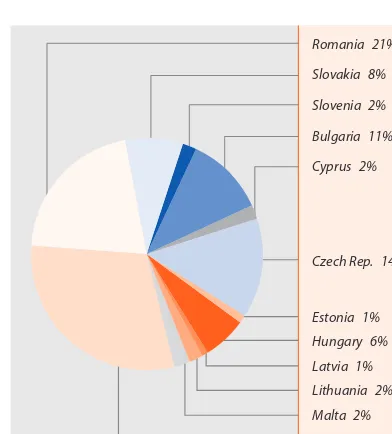
Assignments were completed in all sectors and countries, with the highest number in the Polish urban infrastructure and services sector (12). As of 31 December 2009, the JASPERS portfolio of active assignments was distributed among the beneficiary Member States broadly in line with their shares of EU funding, with Romania and Poland together account-ing for 51% of all assignments, Bulgaria, the Czech Republic, Hungary and Slovakia for 39% and the other six Member States for 10% (see Figure 1).
Experience with DG REGIO’s approvals since the begin-ning of JASPERS has shown the importance of exploit-ing synergies with DG REGIO and other DGs, before and after submission of applications to Brussels. To that end, ad hoc meetings and working relationships with all JASPERS partners were strengthened in 2009.
As part of the measures to stimulate recovery from recession in many Member States, in November 2008 DG REGIO announced that cohesion policy would be further supported and the Commission’s budgetary contribution to JASPERS would be increased by 25% over the period 2009-2013 compared to 2008. The Commission’s contribution to JASPERS made possible the recruitment of 15 new experts.
The EIB decided to increase its contribution to JAS-PERS in line with the increase promised by the Com-mission. The EIB’s contribution-in-kind to the ini-tiative will rise from its previous level of 16 years’ professional staff time to 20 years’ professional staff time annually, as from 2010.
This increase in overall resources was followed by an adjustment in the scope and emphasis of JASPERS activity. The Steering Committee (JASPERS’ govern-ing body, see section 1.1) agreed to give priority to projects that were likely to produce grant applica-tions relatively quickly and were closer to imple-mentation. JASPERS assistance was made potentially available to all major projects listed in the Opera-tional Programmes in order to ensure consistency of quality across all grant applications submitted to
Figure 1: JASPERS active assignments per country as of 31/12/2009
Bulgaria 11%
Czech Rep. 14% Slovenia 2% Romania 21%
Slovakia 8%
Lithuania 2% Malta 2% Cyprus 2%
Latvia 1% Hungary 6% Estonia 1%
Poland 30%
[image:8.624.314.510.418.635.2]the Commission. In addition, JASPERS was invited to provide assistance to projects which had not initially gone through JASPERS and had subsequently been rejected or delayed by the Commission during the appraisal process. In this context, JASPERS was asked to provide support in the form of remedial measures until such time as the projects in question reached a stage where they were capable of being accepted by the Commission (a transitional measure only).
In 2009 JASPERS supported project preparation in new ways, for example with project “repackag-ing” solutions1. In close cooperation with DG REGIO,
JASPERS supported the requests of some Mem-ber States to shift funds between sectors, providing impetus to project preparation in sectors where addi-tional funds may be allocated.
1. Institutional issues and organisation
1.1 Governance and reporting
JASPERS is supervised by a Steering Committee (SC) including two representatives from DG REGIO, two representatives from the EIB, two representatives from the EBRD and one representative with the status of observer from KfW. The SC is responsible for set-ting the strategic direction for JASPERS, deciding on major policy issues relating to JASPERS, and approv-ing its main activities and outputs (eg. the Country Action Plans and the Annual Report).
The European Commission chairs the JASPERS Steer-ing Committee and the EIB provides the Secretariat. Meetings of the Steering Committee comprising rep-resentatives of the four partners were held in Brus-sels on 9 March, 6 July and 23 November 2009. There were also regular staff-level meetings between JAS-PERS managers and DG REGIO throughout the year.
The JASPERS Annual Report for 2009 was approved by the SC.
1.2 First JASPERS stakeholders’ meeting
In order to hear stakeholders’ views, to profit from the experience of Managing Authorities and to learn how to improve the support and services offered within the cohesion policy, JASPERS organised its first stake-holders’ meeting in Krakow, Poland, on 28 and 29 May 2009. This meeting proved very useful in strengthen-ing cooperation.
Some sixty representatives from JASPERS beneficiary Member States compared their experiences of work-ing with JASPERS. The programme included presen-tations and case studies on the first three years of JASPERS service in different sectors.
Four working groups focused on energy efficiency, crossborder transport planning, cost overruns in municipal projects (mainly in the water sector) and possible JASPERS support in the implementation of projects. Four subsequent forum sessions on JASPERS services discussed issues of quality, timing, the role of JASPERS and the content of the completion notes. Pro-posals from stakeholders turned into concrete actions: early tripartite meetings between JASPERS, Manag-ing Authorities and the Commission; enhanced com-munication between Managing Authorities, Final Ben-eficiaries and JASPERS; early clarification on the role of JASPERS experts in serving the Final Beneficiaries and Managing Authorities; early acquaintance with national eligibility rules; and more knowledge transfer and training from JASPERS.
1.3 JASPERS status review meeting with DG REGIO
Following the first stakeholders’ meeting, JASPERS and DG REGIO organised a seminar on 11 Septem-ber 2009 to exchange views on JASPERS activities and developments and to get feedback from the coun-try and horizontal desks of DG REGIO. The manage-ment of JASPERS appreciated and acknowledged the recommendations of the participants and decided
1 Project repackaging – or dividing projects into phases – proved a
that meetings of this type would be held between JASPERS and DG REGIO every year. A similar meeting was held with DG Environment in conjunction with DG REGIO.
1.4 2009 Contribution Agreements
The 2009 Contribution Agreement between the European Commission and the EIB was signed on 29 June 2009 and subsequently amended on 18 December 2009 to reflect the Commission’s deci-sion to increase its contribution to the JASPERS budget (see section 1.5).
The 2009 Contribution Agreement between the EIB and the EBRD was signed on 29 December 2009. The 2009 Contribution Agreement between the EIB and KfW was signed on 22 February 2010.
1.5 2009/2010 budgets
The JASPERS budget for 2009 was agreed at the meet-ing of the Steermeet-ing Committee in Bratislava on 16 Octo-ber 2008. It was subsequently increased in mid-2009 by an additional EUR 5.03m as part of the EU’s Economic Recovery Package to expand the capacity of JASPERS
over the period 2009-2013. Following this revision, the Commission’s contribution in 2009 increased from EUR 18.96m to EUR 24m, equating to 75.1% of the esti-mated cost of JASPERS in 2009.
The provisional JASPERS budget for 2010 was pre-sented to the meeting of the Steering Committee in Brussels on 23 November 2009. The amount of the Commission contribution for 2010 will be EUR 26m, including 10 additional experts and 3 additional sup-port staff, to promote enhanced and refocused project preparation activities.
1.6 Offering assistance with project implementation
While recognising the potential project implemen-tation needs in certain sectors/countries, the JAS-PERS Steering Committee confirmed at its 23 Novem-ber meeting that the focus of JASPERS should remain on project preparation and assistance towards the approval of grant applications. Nevertheless, at the request of the relevant Managing Authorities, JASPERS may provide assistance to a limited number of specific projects during the early stages of their implementa-tion – such as assistance with the setting up of appro-priate Project Implementation Units (PIUs) and the reviewing of tender documents.
2. Organisational development
2.1 The structure of JASPERS
JASPERS has built up its capacity progressively since 2006. It initially operated with a provisional structure made up of a core team, which expanded quickly to comprise, at the end of 2009, 67 professional staff and 10 support staff located in the Luxembourg headquarters and in three regional offices in Warsaw, Vienna and Bucharest.
ture that reflects the need to ensure consistency in the advice delivered across beneficiary countries. The Heads of regional offices have a primary role as coun-try managers in contacting and liaising with the Man-aging Authorities of the beneficiary countries. They are also responsible for preparatory work relating to the annual Action Plans and are in charge of monitor-ing the plans, keepmonitor-ing track of progress on projects carried out by local staff and reporting, as appropri-ate, to the JASPERS management in Luxembourg. They are also responsible for the administration and management of the offices.
The Heads of regional offices report to the Opera-tions Manager who, in addition to ensuring a coordi-nated approach by the various offices and between the offices and Luxembourg, is in charge of overall relationship management with the national authori-ties and the Commission’s geographical desks. The Operations Manager is also responsible for the over-all execution of the various Action Plans and liaises, as required, with the Sector Managers and the Head of JASPERS.
Sector Managers prepare the Action Plans jointly with the Operations Manager and with the assistance of the Heads of regional offices. Sector Managers are responsible for the technical assistance and advice and for the effective contribution of JASPERS to the assignments within their sectors. They assign sector specialists and, where appropriate, external consult-ants. They supervise work undertaken and ensure the timely delivery and quality of the output expected in order to meet JASPERS commitments. They also ensure that the methodologies applied within the sector teams are harmonised and consistent with the rest of JASPERS and EU rules and policies.
In 2009, JASPERS work was organised in five sectors: roads; ports, airports and railways; water and waste-water; solid waste and energy; urban infrastructure and services.
2.2 JASPERS recruitment and staffing
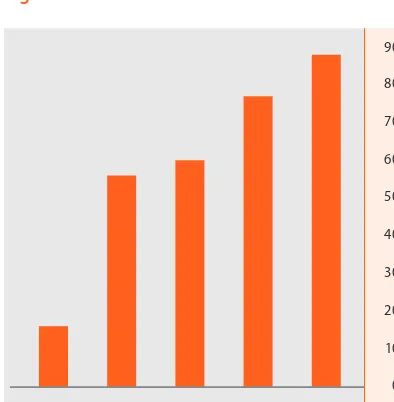
Following the 25% increase in the EU-funded budget contribution, in 2009 there was a rapid build-up in staff numbers: JASPERS had 67 professional staff and 10 support staff at the end of December 2009, as compared to 50 professional staff and 10 support staff at the end of 2008 (see Figure 2).
The Commission contributed funding for 46 experts and 10 support staff, the EIB provided 14.2 staff-years’ equivalent, the EBRD 3 staff-staff-years’ equivalent and KfW 2.25 staff-years’ equivalent.
Following the increase in resources available to JASPERS, a campaign to recruit experts in all sec-tors of activity was launched at the beginning of 2009, with the objective of establishing a pool of suitable candidates for recruitment in the course of the year. Between September and December 2009, 16 new experts and one support staff joined JAS-PERS. 70% of all JASPERS staff are based in the three local offices (see Annex 1).
90 80 70 60 50 40 30 20 10 0
Figure 2: Staff since 2006
[image:11.624.85.282.574.775.2]2.3 Management information system and website
An integrated management information system pro-vides continuously updated relevant information for monitoring assignments and guiding strategic and operational decisions. It provides information on the status of JASPERS assignments, on the status of the applications for grants and on the use of resources, etc. Templates of reports have been created for con-tract monitoring and project follow-up.
The website www.jasperseuropainfo.org is updated regularly with news and information on JASPERS activities. The project lists per country include the ongoing and completed JASPERS assign-ments. The data showing the development of JAS-PERS activities, especially the Facts and Figures page on the website, are regularly updated.
2.4 JASPERS performance indicators
Performance indicators are used to present the rela-tionship between programme inputs, outputs and results in a concise and systematic manner. JASPERS continued to develop its key performance indicators
in 2009, taking into account the “pillars” of efficiency, effectiveness, relevance, sustainability and impact commonly used in evaluation practice.
In the course of the year, after a pilot phase in 2008, feedback forms were sent to beneficiaries for all completed actions. As of 31 December, 2009 JAS-PERS had received 81 feedback forms from benefi-ciaries, out of 192 sent. JASPERS also included in its performance indicators feedback forms received from DG REGIO. From 2006 to 2009, the Commission approved 54 applications out of 144 submitted (of which 99 were JASPERS-supported). Of the 54 appli-cations approved, 44 had received JASPERS assist-ance. The average number of days elapsed from sub-mission of applications for support to approval by the Commission in 2009 was 341 without JASPERS support and 228 with JASPERS support.
2.5 Recourse to consultants
EUR 4.4m was committed to consultancy contracts in 2009. A total of 61 contracts were ongoing through-out the year, of which 38 were signed in 2009. The 61 contracts supported more than 75 assignments,
some of which had started in 2006 and were still ongoing as of 31 December 2009. Some of the assign-ments relating to these contracts included horizontal studies supporting several projects.
As in 2008, framework consultancy agreements were extensively used. About 74% of the consultancy budget committed was spent on 23 contracts signed under these agreements. 10 of them started in 2009. EUR 1.12m, representing 26% of the total consultancy budget, was spent on contracts procured outside the scope of the existing framework agreements.
Of the total budget committed to consultancy assign-ments in 2009, 46.6% was for transport, 47.6% con-cerned the environment and energy and 5.8% related to the development and maintenance of the JASPERS database and JASPERS website.
Periodic reports on the implementation status of consultancy contracts and the quality of their output were produced during 2009. Overall, JASPERS sec-tor managers and task managers were very satisfied with both the quality and timeliness of the work per-formed by the external consultants.
Figure 3: Distribution of budgetary commitments for consultancy assignments per sector in 2009
Environment & energy Transport Administration Total committed
in EUR m
3.5 3.0 2.5 2.0 1.0 0.5 1.5 0 5.0 4.5 4.0
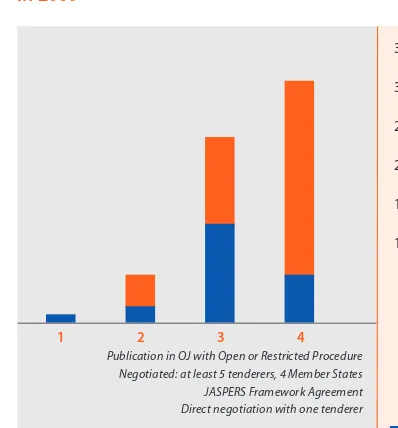
Figure 4: Overall distribution of procurement procedures relating to consultancy assignments in 2009
Started before 2008 and still ongoing at 01/01/2009 Publication in OJ with Open or Restricted Procedure Negotiated: at least 5 tenderers, 4 Member States JASPERS Framework Agreement Direct negotiation with one tenderer Started in 2009
35 30 25 20 15 10 5 0
1 2 3 4
[image:13.624.298.497.272.501.2] [image:13.624.296.495.561.775.2]3. Operational activities
3.1 2009 Action Plan process
JASPERS operates on the basis of Action Plans agreed annually for each country in cooperation with the beneficiary Member State concerned and the Euro-pean Commission.
All Action Plans were signed by the end of July 2009. Although negotiations about Action Plans for 2009 started in October 2008, signature in some countries took longer than expected. This was partly due to for-malities on the national authority’s side, such as com-plex approval procedures or changes in responsibili-ties. However, in most of the countries JASPERS had already identified and pre-agreed its work programme
for 2009 with the national authorities and DG REGIO between November 2008 and February 2009.
3.2 Project portfolio as of 31 December 2009
The JASPERS assignments portfolio at 31 Decem-ber 2009 is available in Annex 2.
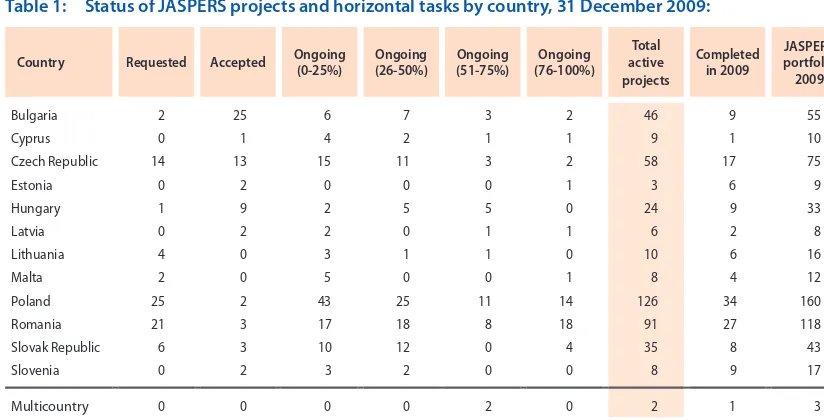
Table 1 summarises the degree of completion of the JASPERS portfolio at the end of 2009. A total of 133 assignments were completed in 2009. At the end of the year, 426 were ongoing and 44 were approaching completion. 110 assignments were up to 25% complete; these were mainly new assignments from 2009 Action Plans, with the remainder being between 25% and 75% complete. Some 62 assignments had been accepted but had not yet started, usually because of incomplete project scoping or delays in beginning assistance.
Country Requested Accepted Ongoing (025%) Ongoing (2650%) Ongoing (5175%) (76100%)Ongoing active Total projects
Completed in 2009
JASPERS portfolio
2009
Bulgaria 2 25 6 7 3 2 46 9 55
Cyprus 0 1 4 2 1 1 9 1 10
Czech Republic 14 13 15 11 3 2 58 17 75
Estonia 0 2 0 0 0 1 3 6 9
Hungary 1 9 2 5 5 0 24 9 33
Latvia 0 2 2 0 1 1 6 2 8
Lithuania 4 0 3 1 1 0 10 6 16
Malta 2 0 5 0 0 1 8 4 12
Poland 25 2 43 25 11 14 126 34 160
Romania 21 3 17 18 8 18 91 27 118
Slovak Republic 6 3 10 12 0 4 35 8 43
Slovenia 0 2 3 2 0 0 8 9 17
Multicountry 0 0 0 0 2 0 2 1 3
Total 75 62 110 83 35 44 426 133 559
[image:14.624.99.511.568.778.2]to the Managing Authority. Overall, the Managing Authorities from the countries covered by the Vienna regional office continued to make intensive use of the local JASPERS presence and advice on sector issues, such as strategic transport matters and selection cri-teria for major research and development schemes.
The JASPERS Southern Europe regional office in Bucha-rest covers Romania and Bulgaria. In 2009, the JASPERS portfolio in these two countries included 137 active assignments in all the sectors. The sector distribu-tion in Bulgaria was quite even. In Romania there was a higher concentration in transport, solid waste and energy and water, in line with the Operational Pro-grammes for Transport and the Environment, which are the largest ones. During most of 2009 the office also covered Cyprus2, where the portfolio included nine
assignments, with a high concentration in the environ-mental sector, mainly in solid waste. In addition, hor-izontal tasks and advice were provided upon request from the national authorities. The office increased in size by about 50%, with six new experts joining dur-ing the year and a new Head of office joindur-ing at the end of 2009. Romania is the European country that, to date, has the highest number of applications for major projects.
4. Activity by sector
4.1 Roads
Between 1 January and 31 December 2009, 24 assignments were completed in the roads sec-tor, compared with 7 in 2008 (see Table 3). The sharp increase was made possible by the prepar-atory work carried out in previous years, includ-ing horizontal actions to facilitate project devel-opment. DG REGIO approved 7 JASPERS- assisted applications out of a total of 20 submitted in 2009. Finally, some six assignments had been cancelled by
year-end, with a further five suspended. Cancelled assignments were withdrawn from the Action Plans for various reasons, including immaturity of the projects, a decision not to fund the project with EU assistance, prioritisation of JASPERS resources agreed with the Member State or deferral to a later year.
Some or all of the requested work had already been undertaken across a range of sectors and countries. Since any cancellation represents a loss of JASPERS resources, JASPERS tries hard to minimise the number of such cases by asking all partners to pay close atten-tion to the choice of proposals when establishing the annual Action Plan.
Suspension of a JASPERS assignment is not the same as cancellation; this usually takes place at the request of the beneficiary but the assignment remains within the portfolio of assignments, reflecting a continuing willingness on the part of JASPERS to provide assist-ance once a particular issue or delaying factor has been resolved.
3.3 Highlights from regional offices
The JASPERS Northern Europe regional office in War-saw covers Poland, Estonia, Latvia and Lithuania. Dur-ing 2009, the office recorded a significant increase in the number of both new assignments and comple-tions and covered over 170 assignments. Assignment completions achieved in 2009 included 34 projects in Poland, 6 in Estonia, 2 in Latvia and 6 in Lithuania. In the second half of 2009, seven new JASPERS experts joined the office. They were quickly integrated into the project work teams in the region. As a result, the prior-ity was to focus on project applications to be submit-ted in 2010 and on the timely filing of applications, to help accelerate the grant approval process.
The JASPERS Central Europe regional office in Vienna serves the Czech Republic, Slovakia, Hungary and Slovenia. In 2009, this office covered 126 assignments and completed 43 assignments. Activities in Hungary continued at a high level in terms of providing advice
2 JASPERS Headquarters in Luxembourg now acts as JASPERS
this point in time is quite limited. With regard to the roads portfolio in general, JASPERS is mostly involved in the preparation of the application (some 80% of cases), at a stage when the feasibility study and sometimes the design have already been prepared. The situation varies depending on the country. For example, in the Czech Republic JASPERS is almost always involved only when the draft final application is ready, whereas in Poland JASPERS starts providing assistance during the preparation of the feasibility study.
In Bulgaria, no project has been completed since the beginning of the programming period in the roads sector. Therefore clear priorities have been redefined, taking into consideration the actual and concrete possibilities and absorption capacity, and immediate and medium-term actions have been identified. Top priority was given to the Trakia motorway, and JAS-PERS is assisting with the preparation of the project application. In parallel, it is defining more general measures for ensuring progress for the other projects in the pipeline and preparing the terms of reference At the end of the year, around 100 assignments with
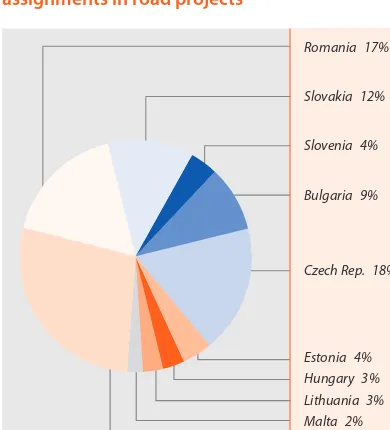
a total investment cost of some EUR 22bn were being supported by JASPERS in the road division. The dis-tribution of active projects per country was relatively stable, with Poland taking the highest share (28%), followed by the Czech Republic (18%), Romania (17%), Slovakia (12%) and Bulgaria (9%).
In 2009, reprioritisation or repackaging of some exist-ing projects took place in several countries with the aim of giving higher priority to, and focusing on, promising projects which can be implemented safely within the current financial perspective.
JASPERS continued its efforts to improve working relationships with beneficiaries, Managing Authori-ties and the Commission. In order to ensure effec-tive transfer of information on ongoing activities and developing projects and thus maximise its effective-ness, JASPERS tried to get involved as early as possi-ble in the project cycle. However, major road projects typically require a very long preparation period, and the possibility of being involved at an early stage at
for technical assistance to support finalisation of the studies and preparation of applications for several other projects.
In Slovakia, JASPERS is addressing major issues which can affect project choice and evaluation, and ulti-mately absorption capacity. These include sugges-tions and advice for the preparation of a national traf-fic model, the adoption of a tool for monitoring and forecasting commitments and disbursements, moni-toring absorption for the two priority arteries (motor-ways and national roads), a review of project risks and the implementation schedule, and discussion on envi-ronmental procedures for projects where the EIA was completed before the Natura 2000 areas were defined.
Specific issues are also dealt with in each country on a case-by-case basis, in full cooperation with local authorities and the Commission.
Figure 5: Detailed distribution of JASPERS assignments in road projects
Bulgaria 9%
Czech Rep. 18% Slovenia 4% Romania 17%
Slovakia 12%
Lithuania 3% Malta 2% Hungary 3% Estonia 4%
Poland 28%
4.2 Ports, airports and railways
In 2009 JASPERS worked on 125 assignments in the ports, airports and railways sector, for an estimated investment cost of approximately EUR 25bn.
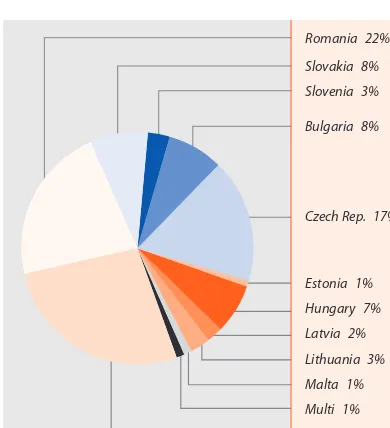
The largest number of projects was located in Poland (27) and Romania (23), followed by the Czech Republic (16), Slovakia (11), Bulgaria (9), Hungary (8), Lithuania (4) and Slovenia (4). JASPERS also sup-ported projects in Latvia (2), Malta (1) and Estonia (1).
Overall, some 23 assignments were completed, including ten major projects for which grant applica-tions were submitted to the European Commission. Three major rail projects were approved by the Com-mission during the year, one each in Latvia, Hungary and Slovakia. These represent the first approvals in the rail sector in those countries.
In Hungary, a JASPERS-supported project in the rail sector (Modernisation of Sopron-Szombathely-Szent-Gotthárd railway line) was approved, and another rail project was submitted during the period under review.
In Poland, while there was no major project applica-tion in the sector during 2009, progress was made on the pilot rail project supported by consultants com-missioned under the JASPERS Framework Agreement. The expectation had been that the application would be submitted before the end of the year but this schedule was not achieved and the revised timetable for submission is end-February 2010, which will facili-tate the submission of a number of other rail projects.
[image:17.624.86.281.522.737.2]In Bulgaria JASPERS agreed to provide intensive sup-port to two railway projects using framework consult-ants, who commenced work in November. The con-sultants will focus on finalising the application form and developing the cost-benefit analysis and funding gap methodology for the projects.
Figure 6: Detailed distribution of JASPERS assignments in port, airport and railway projects
Bulgaria 8%
Czech Rep. 17% Slovenia 3% Romania 22% Slovakia 8%
Lithuania 3% Malta 1% Multi 1% Latvia 2% Hungary 7% Estonia 1%
Poland 27%
4.3 Water and wastewater
The core tasks of this sector are support for water and wastewater, mostly for investments required to meet higher EU standards and achieve compliance with the acquis communautaire, and also flood risk management projects. The team is also responsible for coordinating a number of horizontal assignments on a multi-sector basis as well as assuming task management responsibilities for non-core projects (e.g. health) on a case-by-case basis.
In 2009, this sector actively supported some 110 assign-ments (99 projects and 11 horizontal tasks) included in the Action Plan 2009, for a total investment cost of more than EUR 7.5bn.
A significant number of the water projects were located in Poland (22), Romania (20) and Slova-kia (16), followed by the Czech Republic and Hungary (10 each), Bulgaria (9), Slovenia (6), Cyprus and Malta (2 each) and Estonia and Latvia (1 each). The 11 hor-izontal assignments concerned Romania (3), Bul-garia (2), Cyprus, Estonia, Latvia, Malta, Poland and Slovakia.
Overall, some 36 assignments were completed, including 19 major projects, three non-major projects, six upstream assignments on project screening and eight horizontal assignments. The Polish water sector recorded the highest number of completed assign-ments in 2009 (11), followed by Romania (7), the Czech Republic and Bulgaria (4 each).
In 2009, DG REGIO approved grants for 11 water projects supported by JASPERS – in Hungary (6), the Czech Republic and Romania (2 each) and Bul-garia (1). In 2008, eight major water projects had been approved.
The completed upstream assignments concern project screening operations in Poland (3), Bul-garia (2) and Slovenia. Based on the screening exer-cise, JASPERS and the Managing Authorities agreed either to introduce pre-screened projects into the JASPERS Action Plan or alternatively not to proceed further with specific project proposals.
4.4 Solid waste and energy
Waste management projects, brownfield rehabilitation projects, oil and gas projects and energy generation projects fall within the solid waste and energy sector.
The Action Plans agreed for 2009 with benefici-ary countries included 85 solid waste and energy projects, of which 54 were for solid waste and 31 for energy, for a total estimated investment cost of about EUR 6.3bn.
Waste management projects normally aim at achiev-ing compliance with the relevant EU standards regarding recovery of materials and energy, diver-sion of biodegradable waste from landfills and ade-quate final disposal of waste. Brownfield rehabilita-tion projects target a reducrehabilita-tion of environmental and health risks on highly contaminated land. Oil and gas
projects support improvements of systems operation as well as security of supply. Finally, the objective of energy generation projects is either compliance with the relevant standards governing emissions from large combustion plants or the generation of energy from renewable sources.
Most of the assignments were concentrated in Roma-nia, Bulgaria and Poland. Projects in Romania and Bul-garia, although not particularly complex from a tech-nical point of view, progressed somewhat slowly due to some necessary institutional arrangements associ-ated with the regional scope of the projects. Projects in Poland were generally more complex from the technical side and/or involved state aid issues and therefore required longer preparation. In the end, 22 assignments were completed during the year, and 8 major project applications in the sector prepared with the support of the Division were approved by the European Commission.
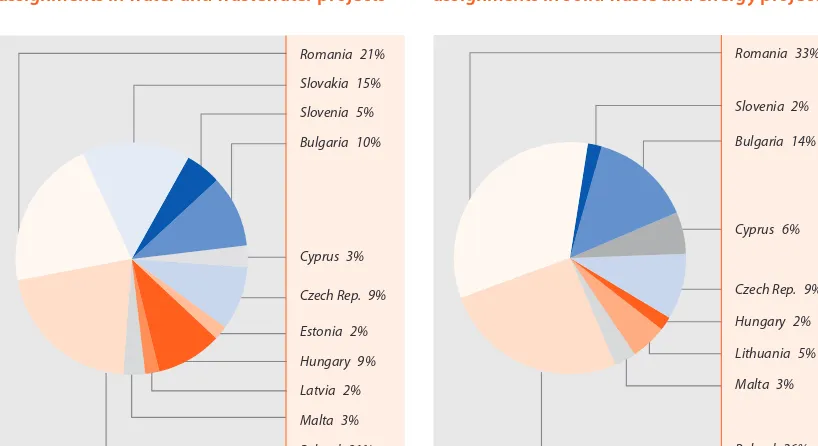
Figure 7: Detailed distribution of JASPERS assignments in water and wastewater projects
Bulgaria 10%
Czech Rep. 9% Slovenia 5% Romania 21% Slovakia 15%
Malta 3% Cyprus 3%
Latvia 2% Hungary 9% Estonia 2%
Poland 21%
Figure 8: Detailed distribution of JASPERS assignments in solid waste and energy projects
Bulgaria 14%
Czech Rep. 9% Slovenia 2% Romania 33%
Lithuania 5%
Malta 3% Cyprus 6%
Hungary 2%
[image:19.624.88.497.556.779.2]4.5 Urban infrastructure and services
During 2009 the Urban Infrastructure and Services sector covered 81 active assignments under the 2009 Action Plans, including 34 urban transport ments, 15 energy efficiency/district heating assign-ments, 9 R&D assignassign-ments, 12 culture assignassign-ments, 6 ICT assignments and 5 other assignments. These assignments supported projects with a total invest-ment cost of some EUR 6.6bn.
This reflected strong growth in the number of new requests for JASPERS support in the sector, more than doubling the number of assignments carried over from 2009. A large number of new operations were added, especially in the areas of urban transport (18 new assignments in Bulgaria and Poland) and the “knowl-edge economy” (for example 10 new R&D assignments in the Czech Republic, Poland and Lithuania), reflect-ing the increasreflect-ing importance of these areas in the development plans of the Member States.
During 2009, operations were concentrated in Poland (urban transport, energy efficiency, R&D, culture), Romania (energy efficiency, district heating), and Bul-garia (urban transport), with some 20 projects spread among the remaining countries.
As of 31 December 2009, 25 of the 81 assignments active during the year were completed, none was cancelled or suspended and 56 were carried over to 2010.
There was marked progress during 2009 in the sub-mission and approval of projects. During the year, 11 major project applications in the sector were submitted to DG REGIO following completion of the related JASPERS assignment. Four projects were approved by DG REGIO in the sector during 2009 (including the large and complex Sofia and Budapest Metro projects), for which JASPERS support had been largely provided during 2008 but with follow-up in 2009 during the DG REGIO review process. In addi-tion, three JASPERS-supported non-major projects were understood to have been approved during 2009 by the national authorities.
Highlights during the year included completion and submission of the first two major projects in Lithua-nia (in broadband and culture), completion and sub-mission of the first three district heating projects in Romania, completion and submission of the first knowledge economy projects in Poland, and com-pletion of the first two urban transport assignments in Poland. JASPERS also contributed important hori-zontal work on the Riga Mobility Plan (which will
underpin several major project applications in Riga), the development of the state aid and conceptual approaches for broadband and district heating in Romania and the preparation of CBA guidelines for district heating in Romania and R&D in the Czech Republic (the latter also including guidance on fea-sibility study preparation). JASPERS has also dem-onstrated its capacity to support DG REGIO and the Bulgarian authorities in adjusting to new priorities, in particular through rapid project identification in a new major urban transport project for Sofia.
With a view to establishing a more structured approach towards raising interest and increasing assignments in the knowledge economy, the idea of splitting the Urban Infrastructure and Services sector in two was discussed in 2009. The option suggested was to have one team focusing on urban infrastruc-ture and the other covering knowledge-economy projects. At the same time, it was proposed to incor-porate work related to district heating into the solid waste and energy sector.
Figure 9: Detailed distribution of JASPERS assignments in urban infrastructure and services projects
Bulgaria 10%
Czech Rep. 4% Slovenia 0% Romania 19%
Slovakia 0%
Lithuania 4%
Malta 1% Cyprus 2%
Latvia 4% Hungary 5% Estonia 2%
Poland 48%
4.6 Completions
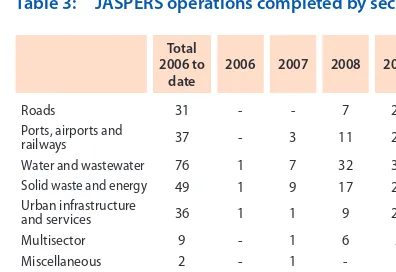
JASPERS completed 133 assignments in 2009 across its five sectors: roads (24); ports, airports and rail-ways (23); water and wastewater (36); solid waste and energy (22); and urban infrastructure and services (25). One project covered a horizontal issue (pre-screening and selection criteria for R&D projects in the Czech Republic); one other assignment was a workshop on CBA, financial analysis and risk analysis of trans-port projects in Lithuania; and one assignment cov-ered state aid issues in transport projects in Poland.
Total 2006 to
date 2006 2007 2008 2009
Bulgaria 15 - - 6 9
Cyprus 2 - - 1 1
Czech Republic 23 - 1 5 17
Estonia 11 - 2 3 6
Hungary 27 - 2 16 9
Latvia 8 - 3 3 2
Lithuania 8 - - 2 6
Malta 9 - 1 4 4
Multi 3 - 2 - 1
Poland 49 3 3 9 34
Romania 56 - 8 21 27
Slovakia 11 - - 3 8
Slovenia 18 - - 9 9
Total 240 3 22 82 133
Table 2: JASPERS operations completed by country
Total 2006 to
date 2006 2007 2008 2009
Roads 31 - - 7 24
Ports, airports and
railways 37 - 3 11 23 Water and wastewater 76 1 7 32 36 Solid waste and energy 49 1 9 17 22 Urban infrastructure
and services 36 1 1 9 25 Multisector 9 - 1 6 2 Miscellaneous 2 - 1 - 1
Total 240 3 22 82 133
[image:21.624.85.282.279.500.2] [image:21.624.297.495.425.602.2] [image:21.624.297.495.643.779.2]• 34 completions were in Poland (five in the roads
sector, one in the ports, airports and railways sec-tor, 11 in the water and wastewater secsec-tor, four in the solid waste and energy sector, 12 in the urban infrastructure and services sector, and one was a multi-sector operation);
• 27 completions were in Romania (five in the roads
sector, three in the ports, airports and railways sec-tor, seven in the water and wastewater secsec-tor, five in the solid waste and energy sector and seven in the urban infrastructure and services sector);
• 17 in the Czech Republic (four in the roads sector,
five in the ports, airports and railways sector, four in the water and wastewater sector, two in the solid waste and energy sector, one in the urban infrastructure and services sector, and one was a horizontal task);
• nine in Hungary (two in the roads sector, two in
the ports, airports and railways sector, three in the water and wastewater sector, one in the solid waste and energy sector and one in the urban infrastructure and services sector);
• nine in Slovenia (three in the roads sector, three in
the ports, airports and railways sector and three in the water and wastewater sector);
• nine in Bulgaria (four in the water and wastewater
sector, four in the solid waste and energy sector and one in the ports, airport and railways sector);
• eight in Slovakia (two in the roads sector, four in
the ports, airports and railways sector and two in the water and wastewater sector);
• six in Estonia (three in the roads sector, one in
the ports, airports and railways sector, one in the water and wastewater sector and one in the urban infrastructure and services sector);
• six in Lithuania (three in the solid waste and energy
sector, two in the urban infrastructure and services division, and one was a workshop on CBA);
• four in Malta (one in the ports, airports and rail -ways sector, one in the water and wastewater sec-tor and two in the solid waste and energy secsec-tor);
• two in Latvia (one in the ports, airports and rail -ways sector and one in the urban infrastructure and services sector);
• one in Cyprus, in the solid waste and energy
sector.
JASPERS has put in place a process for agreeing the completion of an assignment with beneficiaries and in several cases has provided further support follow-ing completion.
Description
Sofia Metro Line 2 was the first major project in Bulgaria approved by the European Commission for the 2007-2013 programming period. JASPERS has supported the preparation of the project from feasibility study through to final grant approval. The project illustrates the impor-tance of close cooperation between all parties involved – the Sofia Metro Company, the City of Sofia, the Min-istry of Transport, DG REGIO and JASPERS. Now at an advanced stage of construction, the project should be completed by the end of 2012.
Map: Sofia Metro Line 2 Project (solid blue line)
Tunnel construction – Aug 2009
Key project features
• Aims to promote clean public transport versus cars,
reduce congestion and connect metro to national rail hub
• Project cost EUR 379m (including rolling stock), of
which EUR 157m EU grant
• Key north-south link through city centre
• 1.2 million passengers per day to use the Sofia Metro
lines 1 and 2
• Main economic benefits include time savings,
reduced accident rates, rationalisation of public trans-port fleets, fuel savings and environmental benefits
JASPERS’ role
• Advise on phasing and scope of the project • Clarifying policy and other questions with
the European Commission
• Review of feasibility study, grant application,
CBA documents, environmental assessment
• Advice on timing the application process in
connection with construction procurement
• Assist beneficiary in answering questions from
DG REGIO
Key dates
2006-2008: Preliminary design 06-2007: JASPERS assistance started 09-2007: Strategy meeting DG REGIO, City,
Metro Company, Ministries 01-2008: JASPERS Completion Note 08-2008: Tender process concluded
10-2008: JASPERS Completion Note amended 10-2008: Submission of application to EC 05-2009: Answers to EC questions 06-2009: Tunnelling started 09-2009: EU approved the grant 10-2012: Construction to be completed
Sofia Metro – in operation
1. Budget for 2009
In line with Article 3 of the Contribution Agreement, as amended on 29 November 2009, the budget of JASPERS is based on eligible costs for financing by the Commission, as well as on contributions from the EIB, the EBRD and KfW in the form of professional staff time. The Contribution Agreement states that the estimated total budget for JASPERS in 2009 was EUR 31 956 000.
2. JASPERS summary financial statement
As stated above, the estimated budget for the year 2009 was set out in the Contribution Agreement. Eli-gible expenditure for reimbursement from the Com-mission’s contribution amounted to almost EUR 17m, out of a total expenditure of EUR 23.5m, including notional expenditure from contributions in kind from the JASPERS partners. By the end of 2009, 46 of the budgeted EU-funded 48 professional staff had been recruited. The recruitment of the new staff took place in the second part of the year. The summary financial statement for 2009 in Annex 7 shows the breakdown of revenues and eligible expenditure from 1 January to 31 December.
The financial chapter of the Annual Report was prepared in ac
cordance with the requirements of the Contribution Agreement
for 2009. It contains financial information for the implementation
period from 1 January 2009 to 31 December 2009.
Human resources as at 31 December 2009
Support staff
Staff EC EIB EBRD KfW Total
Professional staff 46 16 3 2 67
Support (including temporary external staff) 10 0 0 0 10
Total 56 16 3 2 77
of which to be allocated in
Warsaw 16 2 1 0 19
Vienna 13 1 0 2 16
Bucharest 16 1 1 0 18
Luxembourg 11 12 1 0 24
Total 56 16 3 2 77
Professional staff
Director man a
gers Sector mana
gers Other Head
of offices
Transport Environment developmentUrban EIA* specialist
Financial admi
nistrator Total Engi
neer Economist Engineer Economist Engineer Economist
Warsaw 0 0 0 1 4 1 4 2 0 3 2 0 17
Vienna 0 0 2 1 4 2 2 2 0 0 0 0 13
Bucharest 0 0 0 1 3 1 5 5 1 0 1 0 17
Luxembourg 1 6 1 0 1 0 2 2 1 2 1 3 20
Total 1 6 3 3 12 4 13 11 2 5 4 3 67
General sector IT database Total
Warsaw 2 0 2
Vienna 2 0 2
Bucharest 2 0 2
Luxembourg 3 1 4
Total 9 1 10
“Other” = Including professional staff input from EIB’s Projects Directorate and other directorates
Annex 1 – Human resources as at 31 December 2009
Annex 2 – Assignments completed since 2006
2009 SECTOR TYPE
Country TOTAL MIS MSE MUN RAL ROD SWE WAT MAJOR SMALL HORIZ.
Bulgaria 9 – – – 1 – 4 4 4 1 4
Cyprus 1 – – – – – 1 – – 1 –
Czech Republic 17 1 – 1 5 4 2 4 16 – 1
Estonia 6 – – 1 1 3 – 1 4 2 –
Hungary 9 – – 1 2 2 1 3 9 – –
Latvia 2 – – 1 1 – – – 1 1 –
Lithuania 6 – 1 2 – – 3 – 1 1 4
Malta 4 – – – 1 – 2 1 3 – 1
Multi 1 – – – 1 – – – – – 1
Poland 34 – 1 12 1 5 4 11 24 4 6
Romania 27 – – 7 3 5 5 7 18 – 9
Slovakia 8 – – – 4 2 – 2 7 1 –
Slovenia 9 – – – 3 3 1 3 6 3 –
Total 133 1 2 25 23 24 22 36 93 14 26
2007 SECTOR TYPE
Czech Republic 1 – – – – – 1 – 1 – –
Estonia 2 – – – 1 – – 1 2 – –
Hungary 2 – – 1 – – – 1 1 – 1
Latvia 3 – 1 – – – 2 – 2 – 1
Malta 1 – – – – – 1 – – 1 –
Multi 2 – – – – – – 2 – – 2
Poland 3 1 – – – – 2 – 2 – 1
Romania 8 – – – 2 – 3 3 5 – 3
Total 22 1 1 1 3 – 9 7 13 1 8
2008 SECTOR TYPE
Bulgaria 6 – – 1 1 – 1 3 4 2 –
Cyprus 1 – – – – – 1 – – 1 –
Czech Republic 5 – – – 3 – – 2 4 – 1
Estonia 3 – – – – 1 – 2 – – 3
Hungary 16 – – 4 1 1 3 7 16 – –
Latvia 3 – – – 1 2 – – 3 – –
Lithuania 2 – – – 1 – 1 – 1 – 1
Malta 4 – – – – 1 2 1 3 1 –
Poland 9 – 1 1 1 – 5 1 3 – 6
Romania 21 – 3 3 2 – 3 10 12 – 9
Slovakia 3 – – – 1 1 – 1 2 – 1
Slovenia 9 – 2 – – 1 1 5 3 4 2
Total 82 – 6 9 11 7 17 32 51 8 23
2006 SECTOR TYPE
Poland 3 – – 1 – – 1 1 3 – –
Total 3 – – 1 – – 1 1 3 – –
SECTOR TYPE
Country TOTAL MIS MSE MUN RAL ROD SWE WAT MAJOR SMALL HORIZ.
Bulgaria 15 – – 1 2 – 5 7 8 3 4
Cyprus 2 – – – – – 2 – – 2 –
Czech Republic 23 1 – 1 8 4 3 6 21 – 2
Estonia 11 – – 1 2 4 – 4 6 2 3
Hungary 27 – – 6 3 3 4 11 26 – 1
Latvia 8 – 1 1 2 2 2 – 6 1 1
Lithuania 8 – 1 2 1 – 4 – 2 1 5
Malta 9 – – – 1 1 5 2 6 2 1
Multi 3 – – – 1 – – 2 – – 3
Poland 49 1 2 14 2 5 12 13 32 4 13
Romania 56 – 3 10 7 5 11 20 35 – 21
Slovakia 11 – – – 5 3 – 3 9 1 1
Slovenia 18 – 2 – 3 4 1 8 9 7 2
Grand Total 240 2 9 36 37 31 49 76 160 23 57
Annex 4 – Funding from EC and national budgets, in EUR
Annex 3 – Summary of assignments completed since 2006
Szeged City tram system, Hungary
Country Community amount National public amount Total
Bulgaria 207 940 029 234 332 242 442 272 271 Czech Republic 168 192 832 136 953 189 305 146 021 Hungary 2 106 373 992 1 224 339 723 3 330 713 715
Latvia 65 560 962 47 813 203 113 374 165
Romania 1 321 297 736 1 050 737 449 2 372 035 185 Slovenia 119 197 192 141 183 546 260 380 738 Slovakia 309 829 544 267 588 175 577 417 719
Total 4 298 392 287 3 102 947 527 7 401 339 814
Country Title Total cost (EUR m) EU grant (EUR m) approvalYear of
2009
BULGARIA Sofia Metro Extension - Phase I 379 157 2009 Vratsa integrated water project 63 51 2009 CzECH REPUBLIC Rail optimisation Benesov-Strancice 211 111 2009 Water protection of the Dyje river Basin - Stage II 65 39 2009 Water quality improvement in Jihlava and Svratka Rivers above New Mills reservoir 29 18 2009 HUNGARy Budapest Metro Line 4, Section I 1418 729 2009 Bekescsaba water and wastewater 72 51 2009
Mid-Danube recultivation 31 26 2009
Nyireghaza water and wastewater 62 34 2009
Mecsek-Dráva solid waste 68 40 2009
Development of solid waste management system in the Györ Region 38 22 2009 Hanyi-Tiszasüly water and wastewater 103 85 2009 Nagykanizsa water and wastewater 55 45 2009
Mako water and wastewater 68 39 2009
Miskolc municipal transport 152 116 2009 Szeged city railway system 119 87 2009 M43 motorway between Szeged and Makó 343 201 2009 Sopron-Szent Gotthard rail 198 168 2009 Székesfehérvár water and wastewater 42 22 2009 Southern section of M0 Budapest ring road (between M1-M5) 490 386 2009 LATVIA Construction of second track Skriveri Krustpils (Riga-Krustpils section) 113 66 2009 ROMANIA Rehabilitation and extension of the water supply and sewerage systems in Brasov
county 189 145 2009
SLOVAKIA D1 Mway (Sverepec-Vrtizer) 380 224 2009 Modernisation of rail track ( zilina Krásno nad Kysucou) 198 86 2009 HUNGARy Debrecen municipal transport 71 55 2008 ROMANIA Rehabilitation and extension of the water supply and sewerage systems in
Teleorman county, Romania 122 99 2008
Rehabilitation and extension of the water supply and sewerage systems in
Giurgiu county, Romania 72 58 2008
Rehabilitation and extension of the water supply and sewerage systems in
Calarasi county 99 81 2008
Rehabilitation and extension of water supply and sewage systems in Tulcea
county, Romania 114 91 2008
Modernisation of water/wastewater infrastructure in the main towns of Medias,
Agnita, Dumbraveni, Copsa Mica area, Sibiu county 90 72 2008 Extension and rehabilitation of the water and wastewater systems in Gorj
county area 91 74 2008
Extension and rehabilitation of water and wastewater systems in Turda-Campia
Turzii region, in Cluj county 80 64 2008 Extension and rehabilitation of water and wastewater systems in Cluj/Salaj
counties area 197 146 2008
SLOVENIA Motorway Beltinci-Lendava 116 42 2008
Total 7 401 4 301
Country Title Total cost (EUR m) EU grant (EUR m) approvalYear of
Country Sector Type Title Completion date
2009
BULGARIA WAT HRzP Strengthening the capacity to perform cost-benefit analyses 09/01/09 WAT MAJP Screening and prioritisation of water transmission mains 17/12/09 WAT HRzP Masterplan - Task B consultant 29/10/09 WAT HRzP Assessment of the preparation process for environmental projects 01/12/09 SWE SMLP Regional waste management measure in Burgas region 18/12/09 SWE MAJP Waste management Kocherinovo 25/06/09 SWE MAJP Sofia solid waste management 15/12/09 SWE HRzP Workshop on Jaspers activities in the water and solid waste sectors 25/06/09 RAL MAJP Electrification and reconstruction of Svilengrad -Turkish border railway line
(Bulgaria, Region Haskovo) 17/12/09 CyPRUS SWE SMLP Installation of photovoltaic panels in public buildings & installation
of solar cooling systems 09/12/09 CzECH REPUBLIC RAL MAJP Electrification znojmo - Satov (border AU) 11/12/09 ROD MAJP Motorway D8 section Lovosice - Rehlovice 05/02/09 WAT MAJP Water protection of the Dyje river Basin - stage II 15/04/09 WAT MAJP Pardubice wastewater 26/11/09
WAT MAJP Cheb wastewater 17/07/09
SWE MAJP Power plant Opatovice - reduction of NOx emissions 16/07/09 SWE MAJP Clean-up and recultivation of Diamo site, Midlovary 09/07/09 ROD MAJP M-way D1 Kromeriz-Rikovice & E-way R55 Skalka-Hulin 04/08/09 ROD MAJP Expressway R6 Jenišov - Kamenný Dvur 24/07/09 ROD MAJP Expressway R35 Haradec Kralove - Opatovice 04/08/09 RAL MAJP Rail optimisation Stribro - Plana 24/07/09 WAT MAJP Water quality improvement in Jihlava and Svratka Rivers above New Mills reservoir 27/05/09 RAL MAJP Navigation improvements on Elbe 27/01/09 RAL MAJP Modernisation of rail corridor III Plzen - Cheb 02/06/09 MIS HRzP Horizontal action: Pre-screening and selection criteria of R&D Projects in Czech Republic 25/11/09 RAL MAJP Rail optimisation Plana - Cheb 25/06/09 MUN MAJP Prague Metro Line A - extension 18/12/09 ESTONIA MUN MAJP Tallinn Ulemiste Road Junct 02/09/09 RAL SMLP Tallinn-Tartu Railway line (Rail Baltica) 17/11/09 ROD MAJP E-20 Väo-Mardu section 04/06/09
ROD MAJP Pärnu bypass 04/06/09
ROD SMLP Jöhvi Junction project 16/09/09 WAT MAJP North Estonia regional hospital Tallinn 02/09/09 HUNGARy RAL MAJP Sopron-Szent Gotthard 04/02/09
WAT MAJP Szamos-Kraszna 22/10/09
WAT MAJP Nagykanizsa 05/03/09
WAT MAJP Erd 07/07/09
SWE MAJP Mecsek-Dráva recultivation 16/04/09
ROD MAJP Motorway M0 03/04/09
RAL MAJP GSM-R 10/07/09
MUN MAJP Interconnected tram transport in Buda (Budai fonódó) 13/05/09
ROD MAJP Motorway M43 25/03/09
LATVIA MUN SMLP Liepaja roads 02/09/09
RAL MAJP Riga railway 15/12/09
LITHUANIA SWE HRzP State aid implications of flue gas treatment of large combustion plants 22/09/09 MSE HRzP Workshop on CBA, financial analysis, risk analysis of transport projects 26/05/09 SWE MAJP Vilnius wastewater sludge treatment 17/06/09 SWE HRzP State aid implications of waste incineration projects 18/06/09 MUN HRzP Rural area Information Technology Broadband Network RAIN-2 15/12/09
MUN SMLP Kaunas arena 18/12/09
Country Sector Type Title Completion date
2009 (continued)
MALTA RAL MAJP Refurbishment and upgrading of breakwaters and other marine infrastructure 17/12/09 SWE MAJP Modifications to boilers at power stations 13/10/09 SWE MAJP Rehabilitation of landfills, phase 2 22/10/09 WAT HRzP Assistance in CBA and FS 29/06/09 MULTI RAL HRzP Preparation of TORs for the feasibility study on a new standard gauge railway line in
Lithuania, Latvia, Estonia 25/03/09 POLAND MSE HRzP State aid in transport projects 08/06/09 MUN MAJP Wroclaw: Dolnoslaskie Centre for materials and biomaterials 18/12/09 MUN MAJP Warsaw: launching rail link for Fryderyk Chopin airport (rolling stock) 17/12/09 MUN MAJP Warsaw: Centre for Preclinical and Technological Research 25/06/09 MUN MAJP Poznan: Centre for advanced technologies 09/10/09
MUN MAJP Polish ID card 15/06/09
MUN MAJP E-Health: electronic platform for medical events 02/09/09 MUN MAJP Bialystok: European Arts Centre - opera house and concert hall 22/07/09 MUN SMLP Koszalin: sports/exhibition hall 24/07/09 MUN MAJP Kraków and suburbs: Public transport - Stage 2 16/12/09 MUN MAJP Chorzow/zabrze: research centre for clean coal / chemical coal processing 14/09/09 WAT MAJP Improvement of water and sewege management in Strzelce Opolskie conurbation 03/12/09 MUN MAJP Construction of a crossroad at intersection of national road No 2 and Siekierkowska route 18/12/09 MUN SMLP Warsaw University revitalisation 03/07/09 WAT MAJP zory water and wastewater 12/08/09 WAT MAJP Water & wastewater system in Warsaw Phase IV 27/10/09 WAT MAJP Walcz water and wastewater 14/07/09 WAT MAJP Expansion and modernisation of the water supply and sewerage systems in
2008
BULGARIA MUN MAJP Sofia Metro Extension - phase I 30/01/08 RAL MAJP Electrification and reconstruction of railway line Svilengrad - Turkish border 19/12/08 SWE SMLP Closure and rehabilitation Ruse landfill 08/08/08 WAT SMLP Integrated water project-Sliven 28/04/08 WAT MAJP Integrated water project-Gabrovo 16/12/08 WAT MAJP Integrated water project-Vratza 16/12/08 CyPRUS SWE SMLP Closure of landfills 30/06/08 CzECH REPUBLIC RAL MAJP Rail optimisation Benesov-Strancice 24/04/08 RAL MAJP Regional rolling stock replacement 22/09/08 RAL MAJP Modernisation of rail corridor IV 25/06/08 WAT HRzP TA for preparation of CBA and financial analysis for environmental projects 16/12/08 WAT MAJP Cista Berounka water 16/12/08 ESTONIA ROD HRzP Technical assistance for CBA and financial analysis of road projects 22/09/08 WAT HRzP Technical assistance for CBA and financial analysis of environment Investment projects 18/11/08 WAT HRzP Programme of up to five water and wastewater management projects 07/02/08 HUNGARy MUN MAJP Miskolc municipal transport 11/08/08 MUN MAJP Szeged city railway system 14/10/08 MUN MAJP Budapest: METRO Line 4 08/10/08 MUN MAJP Debrecen municipal transport 09/10/08 RAL MAJP Budapest - Szekesfehervar 03/12/08
ROD MAJP Motorway M7 13/08/08
SWE MAJP Solid waste 24/10/08
SWE MAJP Mecsek-Dráva solid waste 13/10/08 SWE MAJP Mid-Danube recultivation 22/09/08
WAT MAJP Mako 02/10/08
WAT MAJP Székesfehérvár 17/12/08
WAT MAJP Nagykunság 08/10/08
Country Sector Type Title Completion date
2009 (continued)
Country Sector Type Title Completion date
2008 (continued)
HUNGARy WAT MAJP Hanyi-Tiszasüly 08/10/08
WAT MAJP South Buda 28/04/08
WAT MAJP Bekescsaba 03/09/08
WAT MAJP Nyireghaza 10/10/08
LATVIA RAL MAJP Construction of second track Skiveri - Krustpils (Riga - Krustpils section) 06/08/08 ROD MAJP E22 road section Ludza - Terehova 14/10/08 ROD MAJP E22 road section Riga (Tinuzi) - Koknese 14/10/08
LITHUANIA RAL MAJP Rail Baltica 03/12/08
SWE HRzP Prepare standard terms of reference for preparation of feasibility study for
construction of mechanical-biological treatment plant 13/06/08 MALTA ROD MAJP Upgrade TEN-T road network 17/12/08 SWE SMLP Extension of waste separation activities 05/09/08 SWE MAJP Rehabilitation of landfills 04/02/08 WAT MAJP Stormwater management 26/09/08 POLAND MSE HRzP Guidelines for transport projects 19/12/08 MUN HRzP Energy efficiency - model approach 13/06/08 RAL HRzP Guidelines for Revenue Generation (railway) 19/12/08
SWE HRzP Gas market study 29/09/08
SWE MAJP LNG terminal and underground storage 17/03/08 SWE MAJP Recultivation of sulphur mining areas 01/12/08 SWE HRzP State aid in environmental projects 16/12/08 SWE HRzP Waste flow control study 16/12/08 WAT MAJP Wloclawek dam Vistula river 21/11/08 ROMANIA MSE HRzP Preparing call for proposals (for energy efficiency, renewables, FGDs) 08/10/08 MSE HRzP Romania - energy sector state aid analysis 23/09/08 MSE HRzP Database with unitary costs for renewable energy and energy E projects and
industrial end users 08/07/08
Country Sector Type Title Completion date
2007
CzECH REPUBLIC SWE MAJP Blata region decontamination 30/04/07 ESTONIA RAL MAJP Koidula railway station 09/03/07
WAT MAJP East Viru water 06/08/07
HUNGARy MUN HRzP Energy efficiency and RES market study for SEFF facility 14/12/07 WAT MAJP Homokhatsag water management 01/04/07 LATVIA MSE HRzP Management of project cost increases in long-term projects 12/06/07 SWE MAJP Liepaja Karosta canal decontamination 24/09/07 SWE MAJP Incukalns and Olaine decontamination 24/09/07 MALTA SWE SMLP Restoration of fortifications 01/07/07 MULTI WAT HRzP CBA analysis for applications 05/12/07 WAT HRzP Revenue-generating projects - cofinancing rate calculations 01/09/07 POLAND MIS MAJP Broadband in East Poland - initial scoping 12/04/07 SWE HRzP State aid in energy 18/01/07 SWE MAJP GAS SySTEMS transmission 12/06/07 ROMANIA RAL MAJP State aid for multimodal terminals 13/07/07 RAL MAJP Strategy for the development of regional airport 05/09/07 SWE HRzP Environmental model of economic analysis 17/12/07 SWE HRzP Model of economic analysis for energy projects 12/12/07 SWE HRzP CBA energy training for MA and IB programming units 01/06/07 WAT MAJP Giurgiu county water ISPA 19/12/07 WAT MAJP Cluj and Salaj Counties Water ISPA 19/12/07 WAT MAJP Feasibility study on coastal protection and rehabilitation project at Mamaia Sud and
Eforie Nord (Black Sea) - Romania 06/07/07
2006
Actual amounts 31/12/2009
EUR
Accruals 31/12/2009
EUR
Total 31/12/2009
EUR
REVENUES
1. Cash revenues
Contribution from European Commission 17 064 360.00 0.00 17 064 360.00 Remuneration from JASPERS account 2 031.77 0.00 2 031.77
Total cash revenues 17 066 391.77 0.00 17 066 391.77
2. Contribution in kind
European Investment Bank - full-time staff 5 200 750.00 0.00 5 200 750.00 European Investment Bank - part-time staff 176 900.00 0.00 176 900.00 European Bank for Reconstruction & Development (EBRD) 540 000.00 0.00 540 000.00 Kreditanstalt für Wiederaufbau (KfW) 675 000.00 0.00 675 000.00
Total contribution in kind revenues 6 592 650.00 0.00 6 592 650.00
TOTAL REVENUES 23 659 041.77 0.00 23 659 041.77
EXPENDITURES
1. Expenditures from JASPERS account
Professional and support fixed-term staff - Commission contribution (11 996 600.00) 0.00 (11 996 600.00) External consultancy fees (2 375 010.35) (1 997 856.69) (4 372 867.04) Missions - travel & subsistence expenses
EIB (364 081.85) 0.00 (364 081.85)
EBRD 0.00 (46 130.00) (46 130.00)
KfW (22 276.29) (20 000.00) (42 276.29)
Other (94 520.17) (38 194.31) (132 714.48)
Total cash expenditures (14 852 488.66) (2 102 181.00) (16 954 669.66)
2. Notional expenditures from contribution in kind
European Investment Bank - full-time staff (5 200 750.00) 0.00 (5 200 750.00) European Investment Bank - part-time staff (176 900.00) 0.00 (176 900.00) European Bank for Reconstruction & Development (EBRD) (540 000.00) 0.00 (540 000.00) Kreditanstalt für Wiederaufbau (KfW) (675 000.00) 0.00 (675 000.00)
Total contribution in kind expenditures (6 592 650.00) 0.00 (6 592 650.00)
TOTAL EXPENDITURES (21 445 138.66) (2 102 181.00) (23 547 319.66)
BALANCE OF JASPERS ACCOUNT AS AT 31 DECEMBER 2009 2 213 903.11 (2 102 181.00) 111 722.11
Bulgaria
Ms Dobrinka Krasteva
Head of ISPA Coordination Department Ministry of Economy
2a, Saborna Street Floor 2, office 28 BG-1000, Sofia
3 (+359) 2 9264 290
5 (+359) 2 9264 200
Cyprus
Mr George Georghiou
Directorate for Structural Funds and Cohesion Fund
29, Vyronos Avenue Cy-1409 Nicosia
3 (+357) 22602900
5 (+357) 22666810
Czech Republic
Mr Ladislav Kylar
Head of CF Managing Authority Ministry for Regional Development Staroměstské nám. 6
Cz-110 15 Prague 1
3 (+420) 224 86 1306
5 (+420) 224 86 11 45
Estonia
Ms Karen Veidik Project Specialist
Foreign Financing Department Ministry of Finance
Suur-Ameerika 1, 15006 Tallinn
3 (+372) 611 3556
5 (+372) 696 6810
Hungary
Mr László Simon
Vice-President for Integration National Development Agency Wesselényi u. 20-22
H-1077 Budapest
3 (+36) 1 474 92 82
Latvia
Ms Diāna Rancāne
Director of Project Appraisal Department Cohesion Fund Managing Authority Ministry of Finance
Smilšu iela 1 LV -1919 Riga
3 (+371) 7095485
5 (+371) 7095540
Lithuania
Mr Raimonda Eidziune Deputy Head
Cohesion Promotion Operational Programme Management Division Operational Programme Management Department Ministry of Finance J.Tumo-Vaizgnato 8a/2 LT-01512 Vilnius
3 (+370) 5 239 01 37
Malta
Ms Marlene Bonnici Director General
Planning and Priorities Coordination Division Office of the Prime Minister
12, St. Paul’s Street VLT 1210, Valletta
3 (+356) 2200 1142
Poland
Mr Adam zdziebło Undersecretary of State
Ministry of Regional Development ul. Wspólna 2/4
00-926 Warsaw
3 (+48) 22 4613902
Romania
Mr Stefan Ciobanu
Director, Directorate for Analysis and Programming
Authority for Coordination of Structural Instruments Ministry of Economy and Finance 31, Vasile Lascar Street
Sector 2,
020492 Bucharest
3 +40 21 208 64 01
5 +40 21 316 90 60
Slovakia (for transport projects)
Mr Peter Havrila General Director,
Section of Project Management Ministry of Transport, Post and Telecommunications SR Námestie slobody 6 810 05, Bratislava
3 (+421-2) 5949 4645
5 (+421-2) 5244 2005
Slovakia (for environmental projects)
Ms Katarína Sasková
Director General of Environmental Programmes and Projects Section Ministry of Environment
Nám. L. Štúra 1 812 35 Bratislava
3 (+421-2) 5956 2351
Slovenia
Ms Irene Brcko-Kogoj Government Office for Local Self-Government and Regional Policy Kotnikova 28
SI-1000, Ljubljana
3 (+386) 1 400 55 93
JASPERS Regional Offices
JASPERS Office for Bulgaria and Romania:
Head of Office Ms Maria-Teresa Calvete Vasile Lascar Street, 3
RO-020492 Bucharest,
3 (+ 40-21) 208 64 01
5 (+ 40-21) 316 90 60
JASPERS Office for Poland and the Baltic States:
Head of Office Mr Michael Majewski Plac Piłsudskiego 1
PL-00-078 Warszawa, Poland
3 (+48 22) 310 05 10
5 (+48 22) 310 05 01
JASPERS Office for the Czech Republic, Hungary, Slovakia and Slovenia: Head of Office Mr Axel Hörhager Mattiellistrasse 2-4
A-1040 Wien, Austria
3 (+43-1) 505 36 76
5 (+43-1) 505 36 82
JASPERS Headquarters
JASPERS Team in Luxembourg Mr Agustín Auria
Head of JASPERS
European Investment Bank
98 -100, boulevard Konrad Adenauer L-2950 Luxembourg
3 (+352) 43 79-1
JASPERS Headquarters in Luxembourg acts as JASPERS regional office for Cyprus and Malta
JASPERS 2009 Annual Report is also available on JASPERS website : www.jaspers-europa-info.org
The EIB wishes to thank the following promoters and suppliers for the photographs illustrating this report: Photographs and illustrations were supplied by the EIB GraphicTeam.
Printed in Mayenne by Jouve on MagnoSatin paper using vegetable oil-based inks. Certified in accordance with Forest Stewardship Council (FSC) rules, the paper consists of 100% virgin fibre (of which at least 50% from well-managed forests).
© EIB – 06/2010 – EN QH-AN-10-001-EN- C ISSN 1831-3086
JASPERS
Joint Assistance to Support
Projects in European Regions
Co
ver phot
o: Lithuania: E85 K
laipeda-Jak
ai Junc