Approximate Maximum Margin Algorithms with
Rules Controlled by the Number of Mistakes
Petroula Tsampouka1 and John Shawe-Taylor1,2
1 School of Electronics and Computer Science
University of Southampton, UK
2 Department of Computer Science
University College London, UK
[email protected] [email protected]
Abstract. We present a family of Perceptron-like algorithms with mar-gin in which both the “effective” learning rate, defined as the ratio of the learning rate to the length of the weight vector, and the misclassification condition are independent of the length of the weight vector but, instead, are entirely controlled by rules involving (powers of) the number of mis-takes. We examine the convergence of such algorithms in a finite number of steps and show that under some rather mild assumptions there exists a limit of the parameters involved in which convergence leads to classi-fication with maximum margin. Very encouraging experimental results obtained using algorithms which belong to this family are also presented.
1
Introduction
Maximising the margin of the solution hyperplane, which plays an important role in the generalisation ability of a learning machine, is a central objective of Support Vector Machines (SVMs) [14, 1]. Their efficient implementation, how-ever, is somewhat hindered by the fact that they require solving a quadratic programming problem.
finite number of steps to an approximation of the optimal solution which keeps improving as the parameters of the algorithm follow a specific limiting process. An introductory discussion of Perceptron-like large margin classifiers leading to the construction of MICRA can be found in Sect. 2. MICRA is described in Sect. 3 together with an analysis regarding its convergence. Section 4 contains some experiments whereas Sect. 5 our conclusions.
2
Perceptron-Like Large Margin Classifiers
In what follows we make the assumption that we are given a training set which, even if not initially linearly separable can, by an appropriate feature mapping into a space of a higher dimension [14, 1], be classified into two categories by a linear classifier. This higher dimensional space in which the patterns are lin-early separable will be the considered space. By adding one additional dimension and placing all patterns in the same position at a distanceρin that dimension we construct an embedding of our data into the so-called augmented space [2]. The advantage of this embedding is that the linear hypothesis in the augmented space becomes homogeneous. Thus, only hyperplanes passing through the ori-gin in the augmented space need to be considered even for tasks requiring bias. Throughout our discussion a reflection with respect to the origin in the aug-mented space of the negatively labelled patterns is assumed in order to allow for a uniform treatment of both categories of patterns. Also, we use the notation R= max
k kykk, whereyk is thek
th augmented pattern. Obviously,R≥ρ. The relation characterising optimally correct classification of the training patternsyk by a weight vectoruof unit norm in the augmented space is
u·yk ≥γd≡ max
u′:u′ =1
min
i {u ′·y
i} ∀k . (1)
The quantity γd will be referred to as the maximum directional margin. It co-incides with the maximum margin in the augmented space with respect to hy-perplanes passing through the origin if no reflection is assumed. Betweenγdand the maximum geometric marginγ in the original space the inequality
1≤γγ d ≤
R
ρ (2)
holds. In the limit ρ→ ∞, R/ρ→1 and from (2)γd→γ[12].
We concentrate on algorithms that update the augmented weight vectoratby
adding a suitable positive amount in the direction of the misclassified (according to an appropriate condition) training pattern yk. The general form of such an
update rule is
at+1= (at+ηtftyk)Nt−+11 , (3)
where ηt is the learning rate which could depend explicitly on the numbert of
updates that took place so far and ft an implicit function of the current step
misclassified patternyk, which we require to be bounded by positive constants.
We also allow for the possibility of normalising the newly produced weight vector
at+1 to a desirable length through a factor Nt+1. For the Perceptronηt=η is
constant, ft = 1 and Nt+1 = 1. Each time the misclassification condition is satisfied by a training pattern, that is a mistake occurs, the algorithm proceeds to the update ofat. We adopt the convention of initialisingtfrom 1.
A sufficiently general form of the misclassification condition is
ut·yk ≤C(t) ,
where ut is the weight vector at normalised to unity and C(t) > 0 if we
re-quire that the algorithm achieves a positive margin. Ifa1=0we treat the first pattern in the sequence as misclassified. In the case that C(t) is bounded from above by a strictly decreasing function of t which tends to zero the minimum directional margin required by such a condition becomes lower than any fixed value provided t is large enough. Algorithms with such a condition have the advantage of achieving some fraction of the unknown existing margin provided they converge. Examples of such algorithms are the well-known standard Percep-tron algorithm with margin [2, 7] withC(t) =b/katkand the ALMA2algorithm [4] with C(t) =b/(katk
√
t). Here b is a positive constant. For the Perceptron the suppression ofC(t) with tincreasing is due to the growth of katk which is
bounded from below by a positive linear function oftwhereas for ALMA2C(t) is partly suppressed due to the growth of katk up to a fixed upper bound and
partly due to the growth of√t.
Another important quantity characterising algorithms with the perceptron-like update rule (3) is the “effective” learning rate [13]
ηefft≡
ηtR
katk
which controls the impact that an update has on the current weight vector. More specifically,ηefftdetermines the update of the directionut
ut+1=
ut+ηefftftyk/R
kut+ηefftftyk/Rk . (4)
In the most well-known casesηefftis bounded from above by a strictly decreasing
function of t which tends to zero. Examples are the standard Perceptron with margin in which ηt=η remains constant and ALMA2 in whichηtdecreases as
1/√t. In both cases the growth ofkatkwithtcontributes to the suppression of
ηefft. Moreover, both these algorithms have at-independent ratioηefft/C(t).
From the above discussion it becomes obvious that a Perceptron-like algo-rithm with the additive update (3) is uniquely determined by the functionsC(t), ηefftandft. In particular, it does not depend onkatkas long as the above
func-tions arekatk-independent. Our purpose here is to examine the sufficiently large
subclass of such algorithms with ft = 1 and C(t), ηefft inversely proportional
3
The Mistake-Controlled Rule Algorithm
MICRA
ǫ,ζWe consider algorithms with effective learning rate
ηefft=
η
tζ (5)
and misclassification condition
ut·yk≤ β
tǫ . (6)
Both (5) and (6) do not involvekatk. Here η,ζ,β andǫare positive constants.
The caseζ= 0, corresponding to a constant effective learning rate, is treated in [13]. We assume that the initial valueu1ofutis the unit vector in the direction
of the first training pattern. Then,
ut·u>0 . (7)
This is true given that, on account of (4),utis a linear combination with positive
coefficients of the training patternsyk all of which have positive inner products
with the optimal directionu because of (1). Additionally, we setft= 1. Since
ηefftof (5) and the misclassification condition of (6) do not depend onkatkand
given that the update (4) ofut withft= 1 depends onkatk only throughηefft
the algorithm iskatk-independent.
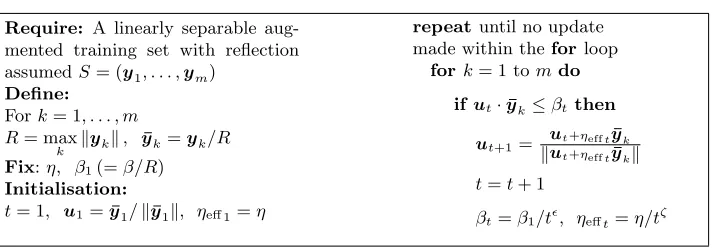
The above (family of) algorithm(s) parametrised in terms of the exponents ǫandζ will be called the Mistake-Controlled Rule Algorithm MICRAǫ,ζ and is
summarised in Fig. 1.
Theorem 1. The MICRAǫ,ζ algorithm of Fig. 1 converges in a finite number of steps provided0< ζ ≤1. Moreover, if η is given a dependence on β through
the relationη=η0
β R
−δ
the directional marginγ′
d that the algorithm achieves tends in the limit Rβ → ∞ to the maximum directional margin γd provided 0< ǫδ+ζ <1.
Require: A linearly separable aug-mented training set with reflection assumedS= (y1, . . . ,ym)
Define:
Fork= 1, . . . , m R= max
k kykk, y¯k=yk/R Fix:η, β1(=β/R)
Initialisation:
t= 1, u1 =y¯1/ky¯1k, ηeff 1=η
repeat until no update made within theforloop
for k= 1 tomdo ifut·y¯k≤βtthen
ut+1= ut +ηeffty¯k
kut+ηeffty¯kk
t=t+ 1
[image:4.595.139.496.519.643.2]βt=β1/tǫ, ηefft=η/t ζ
Proof. Taking the inner product of (4) with the optimal directionu, expanding
kut+ηeffyk/Rk−1 and using the inequality (1 +x)−
1
2 ≥1−x
2 we have
ut+1·u= (ut·u+ηefftyk·u/R)
1 + 2ηefftyk·ut/R+ηeff2 tkykk
2 /R2−
1 2
≥(ut·u+ηefftyk·u/R)
1−ηefftyk·ut/R−η2efftkykk
2
/2R2 . Thus, we obtain for D ≡ut+1·u−ut·u
R ηefft
D ≥yk·u−(ut·u)(yk·ut)−
ηefft
2R
kykk2ut·u+ 2(yk·u)(yk·ut)
−η 2 efft
2R2kykk
2
yk·u .
By employing (1), (6) and (7) we get a lower bound onD
D ≥ηefft
γd
R −
ηefft
2 −
η2 efft
2
−ηefft(1 +ηefft)
β Rt
−ǫ . (8)
From the misclassification condition it is obvious that convergence of the algo-rithm is impossible unlessβ/tǫ< γ
d i.e.
t > t0≡ β
γd 1ǫ
.
A repeated application of (8) (t−[t0]) times, where [t0] denotes the integer part oft0, yields
ut+1·u−u[t0]+1·u≥η γd
R
t
X
m=[t0]+1
m−ζ−η2
2
t
X
m=[t0]+1
m−2ζ−η3
2
t
X
m=[t0]+1 m−3ζ
−ηβ R
t
X
m=[t0]+1
m−(ζ+ǫ) −η2β
R
t
X
m=[t0]+1
m−(2ζ+ǫ) .
By employing the inequalities
t1−θ−(t
0+ 1)1−θ
1−θ =
Z t
t0+1
m−θdm
≤
t
X
m=[t0]+1 m−θ
and
t
X
m=[t0]+1 m−θ≤
Z t
t0
m−θdm+t−θ
0 =
t1−θ−t1−θ
0 1−θ +t
−θ
0
forθ >0 and taking into account (7) we finally obtain
1≥ηγd R
t1−ζ−t1−ζ
0 1−ζ
! −η
2 2
t1−2ζ−t1−2ζ
0 1−2ζ
! −η
3 2
t1−3ζ −t1−3ζ
0 1−3ζ
−ηβ R
t1−(ζ+ǫ)−t1−(ζ+ǫ) 0 1−(ζ+ǫ)
! −η2β
R
t1−(2ζ+ǫ)−t1−(2ζ+ǫ) 0 1−(2ζ+ǫ)
!
−ω . (9)
Here
ω≡γRdηt−ζ
0
2 +ηt−ζ
0
+1 2η
2t−2ζ
0
1 +ηt−ζ
0
>0 .
Let us define the new variableτ≥0 through the relation
t=t0(1 +τ) = β
γd 1ǫ
(1 +τ) . (10)
In terms ofτ (9) becomes
ηt1−ζ
0
−1γd R
−1
(1+ω)≥(1 +τ) 1−ζ
−1
1−ζ −
(1 +τ)1−(ζ+ǫ) −1 1−(ζ+ǫ)
− R 2γd
ηt−ζ
0
(1 +τ)1−2ζ
−1
1−2ζ −
R 2γd
η2t−2ζ
0
(1 +τ)1−3ζ
−1 1−3ζ
−ηt−ζ
0
(1 +τ)1−(2ζ+ǫ) −1
1−(2ζ+ǫ) . (11)
Letg(τ) be the r.h.s. of the above inequality. Since 0< ζ ≤1,g(τ) (withτ ≥0) is unbounded from above. Moreover, its derivativeg′(τ) satisfies the relation
(1 +τ)ζg′(τ) = 1−(1 +τ)−ǫ− R
2γd ηt−ζ
0 (1 +τ)−ζ− R 2γd
η2t−2ζ
0 (1 +τ)−2ζ
−ηt−ζ
0 (1 +τ)−(ζ+ǫ) . The r.h.s. of the above equation is a monotonically increasing function ofτwhich is negative atτ= 0 and tends to 1 asτ→ ∞. Thereforeg′(τ) has a single root at
τ =τmin which corresponds to a minimum ofg(τ) with g(τmin)<0. Moreover, the l.h.s. of (11) is positive. Thus, given thatg(0) = 0, there is a single valueτb ofτ where (11) holds as an equality which provides an upper bound onτ
τ≤τb (12)
satisfyingτb> τmin>0. Combining (10) and (12) we obtain the bound on the number of updates
t≤tb≡
β γd
1ǫ
(1 +τb) (13)
proving that the algorithm converges in a finite number of steps. From (13) and taking into account the misclassification condition (6) we obtain a lower bound β/tǫ
b on the margin γ′dachieved. Thus, the fraction f of γd that the algorithm achieves satisfies
f ≡γγd′ d ≥
fb≡β/γd tǫ
b
Let us assume that Rβ → ∞ in which case from η =η0
β R
−δ
and given that
0< ǫδ+ζ <1 we haveηt1−ζ
0 ∼
β R
1−ζǫ−ǫδ
→ ∞whereasηt−ζ
0 ∼
β R
−ζ+ǫǫδ
→0. Consequently the l.h.s. of (11) vanishes in the limit Rβ → ∞ whereas its r.h.s. (i.e.g(τ)) becomes a strictly increasing function forτ >0 (i.e.τmin→0) since (1 +τ)ζg′(τ) = 1−(1 +τ)−ǫ>0. Obviously, (11) holds as an equality only for
τ = 0. Therefore,
τb→τmin→0 as β
R → ∞ . (15)
Combining (14) with (15) and taking into account thatf ≤1 by definition we conclude that
f →1 as β
R→ ∞ .
Remark 1. In the case that ζ+ 2ǫ = 1 with 1
2 < ζ <1 it is possible to obtain explicitly an upper boundtbon the number of updates and a lower boundfbon the fraction f of the margin that the algorithm achieves. First we observe that since 1−2ζ, 1−3ζ and 1−(2ζ+ǫ) are negative it is allowed to set the terms (1 +τ)1−2ζ, (1 +τ)1−3ζ and (1 +τ)1−(2ζ+ǫ)to zero in the r.h.s. of (11). Then, the resulting less restrictive inequality withζ expressed in terms ofǫbecomes
A2 2 ≥
1 2(1 +τ)
2ǫ
−(1 +τ)ǫ+1
2 , (16)
where
A2 2 =ǫη
−1 β
R −2
γd
R(1 +ω) + ǫ 1−4ǫ
η 2
β
R
2−1ǫγd R
1ǫ−3
+ ǫ
1−3ǫ η2
4 β
R
4−2ǫγd R
2ǫ−5
+ ǫ
1−3ǫη β
R
2−1ǫγd R
1ǫ−2
.
Notice that ǫ < 14 if 12 < ζ <1. By solving the quadratic equation derived from (16) we obtain explicitly the bounds tb and fb. They are the ones of (13) and (14), respectively with
τb= (1 +|A|)
1
ǫ−1 .
In the present case 0< ǫδ+ζ <1 is equivalent to 2−1
ǫ < δ <2. Then, with
η =η0
β R
−δ
as βR → ∞ we getA →0 leading to τb→0. This demonstrates explicitly the statement of Theorem 1. It is worth emphasising, however, that |A| may be suppressed even for small Rβ if γd
R is small.
Example:Ifǫ=ζ=12 and moreoverδ= 0, i.e.ηdoes not depend onβ,ǫδ+ζ= 1
algorithm is a version of a well-known approximate maximal margin classifier, namely ALMA2 [4]. In this version the weight vector instead of being confined within a ball centered at the origin is normalised to a constant length which remains fixed during the asymptotic procedure. Thus, ALMA2 can be thought of as belonging to the MICRA family. Then, the analysis of [4] confirms our conclusion regarding asymptotic convergence to the optimal solution hyperplane in this special case. In the case, instead, that ǫ = ζ = 1
2 but δ = 1, i.e. η = η0
β R
−1
, ǫδ+ζ = 1 and the condition of Theorem 1 is violated. This case would correspond to a version of ALMA2 with the parameter b entering the misclassification condition set tob=β2and the weight vector normalised to the constant lengthβ which, however, does not remain fixed during the asymptotic procedure Rβ → ∞. Since the condition of Theorem 1 is violated we are unable to prove asymptotic convergence of such an algorithm to the maximal margin solution. The same conclusion is reached if the proof technique of [4] is employed which gives a lower bound
fb=
1 + 1 η0
+3 2η0
R2 β2
−1
on the fraction of the maximum directional margin achieved by the algorithm. As Rβ → ∞we get fb→ (1+η0η0) <1. We see that a “slight” modification of the asymptotic procedure is able to affect the ability of a Perceptron-like algorithm to attain the solution with maximum margin. We have reasons to believe that the inability in some cases of the Perceptron algorithm with margin, in contrast to ALMA2, to approach the maximal margin solution is due to such “slight” differences between the two algorithms regarding the asymptotic procedure.
4
Experiments
In this section we present the results of experiments performed in order to verify our theoretical analysis and evaluate the performance of MICRA in comparison with other two well-known algorithms, namely the Perceptron with margin and aggressive ROMMA1. The Perceptron is chosen as a fast and simple algorithm close in spirit to MICRA. The choice of agg-ROMMA, instead, is justified by the fact that it is claimed in [8] to be faster than SMO [9]. For MICRA we employ a β-independentη (δ= 0) and ǫ, ζ values for which, in most cases, the analysis of Remark 1 applies.
First we analyse the training data set of the sonar classification problem as originally selected for the aspect-angle dependent experiment. It consists of 104 instances each with 60 attributes obtainable from the UCI repository. Here the data are embedded in the augmented space at a distance ρ = 1 from the
1 The parameterδ ∈(0,1] in agg-ROMMA controls the accuracy to which the
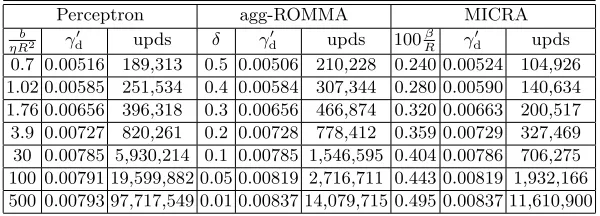
Table 1. Results for the sonar data set. The directional marginγ′
d achieved and the
number of updates (upds) are given for the Perceptron, agg-ROMMA and MICRA (ǫ= 0.05, ζ= 0.9). For MICRA we chooseη= 50.
Perceptron agg-ROMMA MICRA
b
ηR2 γd′ upds δ γd′ upds 100
β R γ
′
d upds
0.7 0.00516 189,313 0.5 0.00506 210,228 0.240 0.00524 104,926 1.02 0.00585 251,534 0.4 0.00584 307,344 0.280 0.00590 140,634 1.76 0.00656 396,318 0.3 0.00656 466,874 0.320 0.00663 200,517 3.9 0.00727 820,261 0.2 0.00728 778,412 0.359 0.00729 327,469 30 0.00785 5,930,214 0.1 0.00785 1,546,595 0.404 0.00786 706,275 100 0.00791 19,599,882 0.05 0.00819 2,716,711 0.443 0.00819 1,932,166 500 0.00793 97,717,549 0.01 0.00837 14,079,715 0.495 0.00837 11,610,900
Table 2.The number of updates (upds) required to achieveγ′
d≃0.00819 in the sonar
data set with MICRA and ALMA2. For MICRA variousǫ, ζvalues are considered and
theηemployed is given.
ǫ, ζ 0.005, 0.99 0.05, 0.9 0.1, 0.8 0.15, 0.7 0.2, 0.6 0.2, 0.5 0.5, 0.5
ALMA2
η 190 60 17 4.4 1.2 0.28 0.35
upds/106 1.53 1.86 2.32 2.89 3.57 3.74 7.54 53.4
origin in the additional dimension leading toR≃3.8121 andγd≃0.00841. The results of our comparative study of the Perceptron, agg-ROMMA and MICRA (ǫ= 0.05, ζ = 0.9) algorithms are presented in Table 1. We observe that MICRA is certainly the fastest. Moreover, the data suggest that the Perceptron algorithm is not able to approach the maximum margin arbitrarily close. We also present in Table 2 the number of updates required to achieve a margin γ′
d ≃ 0.00819 using MICRA with several ǫ, ζ values and ALMA2. For ALMA2 the accuracy parameter α was set to α = 0.1527 with the remaining parameters chosen to correspond to the ones of the Theorem in [4] if the data are normalised such that the longest pattern has unit length. From Table 2 it becomes clear that smallǫ’s combined with relatively largeζ’s lead to faster convergence.
We additionally analyse a linearly separable data set, which we call WBC−11, consisting of 672 patterns each with 9 attributes. It is constructed from the Wisconsin Breast Cancer (WBC) data set obtainable from the UCI repository by first omitting the 16 patterns with missing features and subsequently removing from the data set containing the remaining 683 patterns the 11 patterns having the positions 2, 4, 191, 217, 227, 245, 252, 286, 307, 420 and 475. The valueρ= 30 is chosen for the parameter ρ of the augmented space leading to R = √1716 and γd ≃ 0.0243. In Table 3 we present the results of a comparative study of the Perceptron, agg-ROMMA and MICRA (ǫ = 0.1, ζ = 0.8) algorithms. The superiority of the performance of MICRA on this data set is remarkable.
Table 3.Results for the WBC−11data set for the algorithms Perceptron, agg-ROMMA
and MICRA (ǫ= 0.1, ζ= 0.8). For MICRA the choiceη= 2.3 is made.
Perceptron agg-ROMMA MICRA
b
ηR2 γ′d upds δ γd′ upds 100
β R γ
′
d upds
0.4 0.01650 1,401,984 0.5 0.01642 1,630,857 0.119 0.01658 55,319 0.65 0.01880 2,058,524 0.4 0.01848 2,382,480 0.144 0.01883 106,867 0.97 0.02033 2,894,811 0.3 0.02030 3,541,471 0.162 0.02035 154,077 1.8 0.02197 4,980,423 0.2 0.02195 5,784,868 0.185 0.02198 267,146 4.1 0.02321 10,761,773 0.1 0.02318 13,931,792 0.207 0.02324 467,370 8.5 0.02374 21,798,933 0.05 0.02373 31,156,487 0.222 0.02376 755,816 45 0.02415 113,406,210 0.01 0.02415 174,388,827 0.270 0.02415 4,533,156
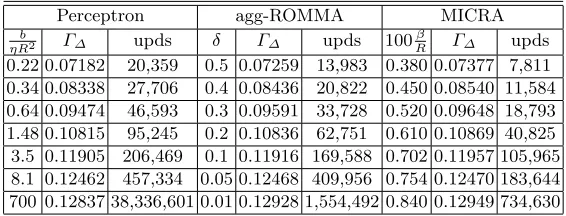
Table 4.Results for the (extended) WBC data set (with∆= 1). The marginΓ∆ and the number of updates (upds) are given for the Perceptron, agg-ROMMA and MICRA (ǫ= 0.05, ζ= 0.9). For MICRA we chooseη= 20.
Perceptron agg-ROMMA MICRA
b
ηR2 Γ∆ upds δ Γ∆ upds 100Rβ Γ∆ upds 0.22 0.07182 20,359 0.5 0.07259 13,983 0.380 0.07377 7,811 0.34 0.08338 27,706 0.4 0.08436 20,822 0.450 0.08540 11,584 0.64 0.09474 46,593 0.3 0.09591 33,728 0.520 0.09648 18,793 1.48 0.10815 95,245 0.2 0.10836 62,751 0.610 0.10869 40,825 3.5 0.11905 206,469 0.1 0.11916 169,588 0.702 0.11957 105,965 8.1 0.12462 457,334 0.05 0.12468 409,956 0.754 0.12470 183,644 700 0.12837 38,336,601 0.01 0.12928 1,554,492 0.840 0.12949 734,630
with missing attributes. Following [3] we make the data set linearly separable by extending the instance space by as many dimensions as the number of instances and placing each instance at a distance∆= 1 from the origin in the correspond-ing dimension. Then we attempt to obtain separatcorrespond-ing hyperplanes with as large a marginΓ∆ as possible in the extended space relying on the observation that
[image:10.595.166.449.323.431.2]5
Conclusions
We presented MICRA, a family of Perceptron-like large margin classifiers com-pletely independent of the length of the weight vector. Our theoretical approach proved sufficiently powerful in establishing asymptotic convergence to the opti-mal hyperplane for a whole class of such algorithms in which the misclassification condition and the effective learning rate are entirely controlled by rules involving arbitrary powers of the number of mistakes. Moreover, we provided experimen-tal evidence in support of our theoretical analysis regarding convergence of our algorithms to the maximal margin hyperplane. The preliminary experimental results also suggest that algorithms belonging to the MICRA family with slow relaxation of the misclassification condition and relatively fast suppression of the effective learning rate with the number of mistakes are very powerful tools in the hands of a skillful practitioner. Of course, this does not diminish at all the value and usefulness of established fast and easy to use algorithms like agg-ROMMA or SMO which only need the choice of a single parameter determining the accu-racy to which the optimal solution is approximated. It is remarkable, however, that simple extensions of the old Perceptron algorithm can be so competitive.
References
1. Cristianini, N., Shawe-Taylor, J.: An Introduction to Support Vector Machines (2000) Cambridge, UK: Cambridge University Press
2. Duda, R.O., Hart, P.E.: Pattern Classsification and Scene Analysis (1973) Wiley 3. Freund, Y., Shapire, R. E.: Large margin classification using the perceptron
algo-rithm. Machine Learning37(3) (1999) 277–296
4. Gentile, C.: A new approximate maximal margin classification algorithm. Journal of Machine Learning Research2(2001) 213–242
5. Keerthi, S.S., Shevade, S.K., Bhattacharyya, C., Murthy, K.R.K.: A fast iterative nearest point algorithm for support vector machine classifier design. Technical report, Indian Institute of Science, ISL-99-03 (1999)
6. Kowalczyk, A.: Maximal Margin Perceptron. Advances in Large Margin Classifiers (1999) MIT Press
7. Krauth, W., M´ezard, M.: Learning algorithms with optimal stability in neural net-works. Journal of PhysicsA 20(1987) L745–L752
8. Li, Y., Long, P.: The relaxed online maximum margin algorithm. Machine Learning 46(2002) 361-387
9. Platt, J.C.: Sequential minimal optimization: A fast algorithm for training support vector machines. Technical Report MSR-TR-98-14, Microsoft Research (1998) 10. Rosenblatt, F.: The perceptron: A probabilistic model for information storage and
organization in the brain. Psychological Review65(6) (1958) 386–408
11. Shawe-Taylor, J., Cristianini, N.: Further results on the margin distribution. In COLT’99 (1999) 278–285
12. Tsampouka, P., Shawe-Taylor, J.: Analysis of generic perceptron-like large margin classifiers. ECML 2005, LNAI 3720(2005) 750–758, Springer-Verlag
13. Tsampouka, P., Shawe-Taylor, J.: Constant Rate Approximate Maximum Margin Algorithms. ECML 2006, LNAI 4212(2006) 437–448, Springer-Verlag