VALUING COMMUNITY DEVELOPMENT
THROUGH THE SOCIAL INCLUSION
PROGRAMME (SICAP) 2015–2017
TOWARDS A FRAMEWORK FOR EVALUATION
A
DELE WHELAN, SEAMUS MCGUINNESS AND JUDITH DELANEY
NUMBER
77
F
e
bruary 2019
VALUING COMMUNITY DEVELOPMENT
THROUGH THE SOCIAL INCLUSION PROGRAMME
(SICAP) 2015–2017: TOWARDS A FRAMEWORK
FOR EVALUATION
Adele Whelan
Seamus McGuinness
Judith Delaney
February 2019
RESEARCH SERIES
NUMBER 77
Available to download from www.esri.ie
The Economic and Social Research Institute
Whitaker Square, Sir John Rogerson’s Quay, Dublin 2
ISBN 978-0-7070-0468-6
DOI: https://doi.org/10.26504/rs77
The mission of the Economic and Social Research Institute is to advance evidence-based policymaking that supports economic sustainability and social progress in Ireland. ESRI researchers apply the highest standards of academic excellence to challenges facing policymakers, focusing on 12 areas of critical importance to 21st Century Ireland.
The Institute was founded in 1960 by a group of senior civil servants led by Dr T.K. Whitaker, who identified the need for independent and in-depth research analysis to provide a robust evidence base for policymaking in Ireland.
Since then, the Institute has remained committed to independent research and its work is free of any expressed ideology or political position. The Institute publishes all research reaching the appropriate academic standard, irrespective of its findings or who funds the research.
The quality of its research output is guaranteed by a rigorous peer review process. ESRI researchers are experts in their fields and are committed to producing work that meets the highest academic standards and practices.
The work of the Institute is disseminated widely in books, journal articles and reports. ESRI publications are available to download, free of charge, from its website. Additionally, ESRI staff communicates research findings at regular conferences and seminars.
The ESRI is a company limited by guarantee, answerable to its members and governed by a Council, comprising 14 members who represent a cross-section of ESRI members from academia, civil services, state agencies, businesses and civil society. The Institute receives an annual grant-in-aid from the Department of Public Expenditure and Reform to support the scientific and public interest elements of the Institute’s activities; the grant accounted for an average of 30 per cent of the Institute’s income over the lifetime of the last Research Strategy. The remaining funding comes from research programmes supported by government departments and agencies, public bodies and competitive research programmes.
Adele Whelan is a Research Officer, Seamus McGuinness is a Research Professor, and Judith Delaney is a Post-Doctoral Research Fellow at the Economic and Social Research Institute. All members of the research team have adjunct research positions at Trinity College Dublin.
ACKNOWLEDGEMENTS
The work carried out in this report was funded by the Department of Rural and Community Development (DRCD) and managed in conjunction with Pobal as part of the Research Programme on Community Development and Social Inclusion. We would like to thank all the individuals within Pobal who provided assistance during the project, particularly Denis Leamy, Jerry Murphy, Martin Quigley, Richard Deane, Ela Hogan, Lucy Pyne, Maria Farry, Catherine Sheehan and Rebecca McCarthy. Valuable contributions were made by members of the Research Programme Steering Committee: Richard Deane, Paul Geraghty, Clodagh McDonald, Jerry Murphy, Philip O’Connell and Martin Quigley. We would like to thank all the individuals who participated in the SICAP Stakeholder Advisory Panel meetings: Sinead Carr, Bernie Doherty, Allan Farrell, Bryan Fields, Oonagh McCardle, Alan McGrath, John Orme, Ciaran Reid, Cormac Shaw, Kathleen Stack and John Stewart. We would like to thank all the facilitators who summarised the main points from each of the workshop discussions. Also thanks to Conor Ryan for his helpful written submissions. Finally, our thanks go to the Director of the Economic and Social Research Institute (ESRI), an external referee and two internal ESRI referees for their comments on earlier drafts of this report.
Executive Summary ... i
CHAPTER 1: Introduction ... 1
1.1 Research aims and approach ... 1
1.2 The SICAP programme ... 2
1.3 Outline of the report ... 5
CHAPTER 2: Measuring community development... 7
2.1 Introduction ... 7
2.2 Conceptual approaches to measuring community development ... 9
2.2.1 Logic Model ... 10
2.2.2 Four-pillar approach ... 10
2.2.3 ABCD framework ... 10
2.2.4 LEAP Handbook ... 11
2.2.5 Other approaches ... 11
2.3 Metrics suggested in the literature for the measurement of community development ... 12
2.4 Data currently collected by SICAP that could potentially be incorporated into a measurement approach ... 17
2.5 Input/Activity metrics at an area level collected by SICAP... 19
2.6 Can metrics currently captured under SICAP be improved? ... 20
2.6.1 Number versus intensity ... 21
2.6.2 Balance between qualitative and quantitative outcomes ... 21
2.6.3 Process and implementation monitoring ... 21
2.6.4 Cost considerations ... 22
2.7 Conclusion ... 22
CHAPTER 3: Qualitative research: feedback from consultative workshops ... 25
3.1 Introduction ... 25
3.1.1 Methodology ... 25
3.1.2 Structure of the workshops ... 26
3.2 Theme A: What is the most appropriate overarching approach to measuring community development, in the context of SICAP? ... 27
3.3 Theme B: Which indicators most effectively reflect changes in community development and the capacity of communities to effect change? ... 31
3.6 Conclusion ... 42
CHAPTER 4: Conclusions ... 43
4.1 Introduction ... 43
4.2 A conceptual framework for monitoring ... 43
4.3 Challenges with measuring causal relationships using aggregate outcomes ... 45
4.4 Measuring the impacts of LCGs ... 46
4.5 Limitations of the current data collection approach ... 47
4.6 Conclusion ... 48
REFERENCES ... 49
APPENDIX ... 53
A1 Analysis of 2016 IRIS LCG Data ... 53
A1.1 Introduction ... 53
A1.2 Number of local community groups (LCGs)... 53
A1.3 Type of LCGs ... 53
A1.4 LCG composition ... 54
A1.5 Stage of LCGs ... 55
A1.6 Number of individuals represented by LCGs ... 56
A1.7 Number of SICAP interventions by LCGs ... 57
A1.8 Distribution of LCGs by HP index ... 58
A1.9 Group assistance for LCGs ... 61
A1.10 Social enterprises ... 62
A2 Proposed indicators for measuring community development from consultation workshops . ... 62
A3 Summaries of the individual workshops by themes ... 65
Workshop 1 – LCG Members ... 65
Workshop 2 – LCG Members ... 70
Workshop 3 – LCG Members ... 73
Workshop 4 – LCG Members ... 78
Workshop 5 – Local Community Workers ... 81
Table 2.1 Programme action and Logic Model example ... 10
Table 2.2 Potential outcome and impact metrics at small-area level... 14
Table 2.3 Input/Activity metrics at an area level collected by SICAP, 2016 ... 20
Table 2.4 Output and outcome metrics for LCGs at an area level collected by SICAP, 2016 ... 20
Table 4.1 Logic model example for SICAP (Goal 1) ... 44
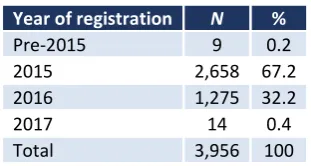
Table A1.1 Number of LCGs by year of registration... 53
Table A1.2 Type of LCG ... 53
Table A1.3 Stage of development at registration of LCGs ... 56
Table A1.4 Number of individuals by LCG type ... 56
Table A1.5 Number of individuals by LCG stage at registration ... 57
Table A1.6 Number of interventions by year of registration ... 57
Table A1.7 Number of interventions in 2016 by LCG type ... 58
Table A1.8 Mumber of interventions by LCG stage of development ... 58
Table A1.9 Distribution of LCG type and HP deprivation index ... 59
Table A1.10 Distribution of HP deprivation index and LCG stage ... 59
Table A1.11 Total number of individuals in an LCG by -HP Deprivation Index ... 60
Table A1.12 Number of interventions per group in 2016 by HP Deprivation Index ... 60
Table A1.13 Level of involvement with LCG assisted to participate in local, regional and national decision-making structures ... 61
Table A1.14 Level of involvement with LCGs supported into a public participation network ... 61
Table A1.15 Level of involvement with LCGs participating in annual planning and review processes for SICAP ... 62
Table A1.16 LCGs assisting and establishing social enterprises ... 62
LIST OF FIGURES
Figure 2.1 Circular overview of community development policy impact evaluation ... 7Figure 3.1 Community group progression matrix ... 36
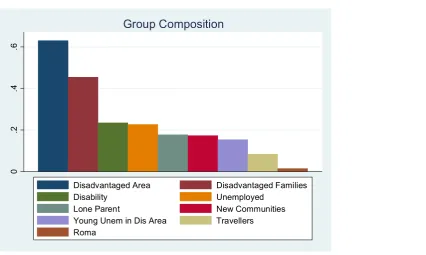
Figure A1.1 Distribution of target groups across LCGs ... 54
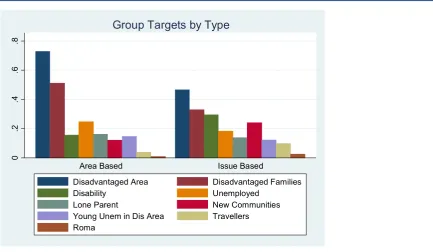
Figure A1.2 Distribution of target groups by type of LCG ... 55
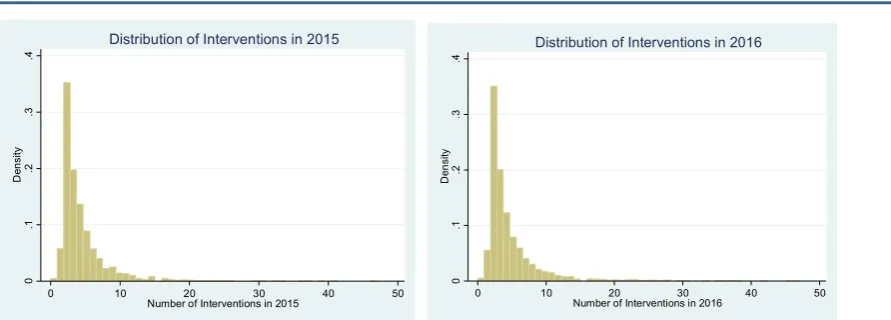
Figure A1.3 Distribution of Interventions in 2015 and 2016 ... 57
ABCD Achieving Better Community Development (framework)
CD community development
CDW community development work
CE Community Employment programme
CLLD community-led local development
COR community operational research
CSO Central Statistics Office
CW Community Worker
DHPLG Department of Housing, Planning and Local Government
DRCD Department of Rural and Community Development
DSP Department of Social Protection
ILDN Irish Local Development Network
IRIS Integrated Reporting and Information System
KPI key performance indicator
LCDC Local Community Development Committee
LCDP Local and Community Development Programme
LCG local community group
LCW local community worker
LDC local development company
LEAP Learning, Evaluation and Planning
ONS Office of National Statistics (UK)
OR operations research
PI programme implementer
PPN public participation network
EXECUTIVE SUMMARY
INTRODUCTION
The Social Inclusion and Community Activation Programme (SICAP) represents a major component of Ireland’s community development strategy, led by the Department of Rural and Community Development (DRCD). The vision of SICAP is to improve the opportunities and life chances of those who are marginalised in society, experiencing unemployment or living in poverty through community development approaches, targeted supports and interagency collaboration, where the values of equality and inclusion are promoted and human rights are respected. In 2016, total expenditure on SICAP amounted to approximately €36 million (Pobal, 2016a).
Using a mixed methodology, this report examines the extent to which community development programmes can or should be subject to evaluation, with a particular focus on SICAP. In doing so, the report draws on a rich body of information – including desk-based research; consultation workshops with members of local community groups (LCGs), local community workers (LCWs) and other key policy stakeholders; and an analysis of administrative data held by Pobal – on the characteristics of LCGs that received direct support under SICAP. The findings in this report relate to the delivery of the SICAP 2015–2017 programme which ended in December 2017.
The aim of the study is to inform policy by shedding light on a number of issues including the following.
Can community development be evaluated?
What are the current metrics and methodologies suggested in the literature for
evaluating community development interventions?
What possible metrics can be used to evaluate community development
interventions and how do these relate to the SICAP programme?
How can a framework be developed that could potentially be used by SICAP for
monitoring evaluation of its community development programme?
MAIN FINDINGS
There are emerging attempts within policy circles to measure community
community-level well-being using very broad aggregates that are not linked to any particular policy intervention.
No examples of formal evaluations to estimate the counterfactual impact of
community development policies exist in either the academic or policy literature. There are a number of possible reasons for this, including: (i) the fact that outcomes of community development supports are often multidimensional and, as such, hard to measure and quantify; (ii) there are typically many state national agencies simultaneously implementing policies that impact well-being of local communities, making it impossible to disentangle the impacts of any specific national intervention on local outcomes such as poverty rates or educational attainment; (iii) local community organisations implementing initiatives directly targeting community welfare receive funding from multiple sources, making it difficult to isolate the impact of any particular funding streams on community-level outcomes; and (iv) it is often impossible to identify workable control groups not exposed to policy interventions in order to measure a counterfactual outcome.
In the context of SICAP provision, formal measurement of the counterfactual is
particularly problematic. SICAP funding on average represents a minority proportion of the funding for the majority of programme implementers (PIs), with many organisations in operation to pursue the same goals, which makes separating out causal impacts impossible. Darmody and Smyth (2018) analyse the financial reports for PIs in 2015 to determine that approximately half of PIs received a fifth or less of their funding through SICAP and only one-tenth received at least half of their funding through SICAP. It is also the case that local community groups funded under SICAP have a broad range of objectives and goals and do not tend to target narrowly defined measures of community wellbeing.
Effective monitoring of community development initiatives is possible using
can focus on specific impacts of funding on particular target groups, such as lone parents, the disabled or those facing homelessness. Such qualitative approaches allow for a more systematic and in-depth analysis of the impact of SICAP on community-level outcomes. The research provided detailed examples as to how these monitoring tools could be operationalised within the context of SICAP.
Challenges associated with bottom-up approaches to the evaluation of SICAP
are the comparability of evaluations across PIs and the incentive for PIs to amplify or inflate the value of their programme spending (subjectivity bias). To ensure an appropriate assessment, intermittent independent monitoring, preferably by a third party, can be used with a combination of assessment approaches, i.e. qualitative and quantitative analysis of key metrics (informed by the Logic Model approach) to obtain a balanced and objective view of progress.
Other findings from the research show that there are limitations with the data
CHAPTER 1
Introduction
1.1
RESEARCH AIMS AND APPROACH
This report is part of a broader research programme designed to inform policy development regarding support for social inclusion programmes at community level. It adopts a mixed-methods approach, combining qualitative and quantitative analysis, to examine the extent to which community development programmes can or should be subject to evaluation, with a particular focus on the Social Inclusion and Community Activation Programme (SICAP). In doing so, the report draws on a rich body of information – including desk-based research; consultation workshops with members of local community groups (LCGs), local community workers (LCWs) and other key policy stakeholders; and an analysis of administrative (IRIS) data held by Pobal – on the characteristics of community
groups that received direct support under SICAP.1 The work carried out in this
report was funded by Department of Rural and Community Development (DRCD) and managed in conjunction with Pobal as part of the Research Programme on Community Development and Social Inclusion. The aim of the research programme is to create, improve and enhance knowledge on community development and social exclusion.
Previous research by the Economic and Social Research Institute has analysed the extent to which SICAP clients experience potential barriers to economic and social inclusion (McGuinness et al., 2018), an assessment of the goals and governance of SICAP (Darmody and Smyth, 2018) and an in-depth analysis of the training provided to programme beneficiaries (McGuinness et al., 2016). The approach utilised in this report sought to integrate insights from different data sources and relate these to the central aim of the research. The research is based on the SICAP 2015–2017 programme and most of the data used for analysis relate to 2016, which represented the most up-to-date information at the time of writing. A call for tenders, which contained an outline of the broad SICAP goals and governance of the new programme, was issued in August 2017. The new SICAP 2018–2022 programme has two goals which focus on community supports and individual supports respectively. As outlined by Darmody and Smyth (2018), the new framework introduces greater flexibility concerning target groups and the resource allocation across goals, thereby enhancing the capacity of SICAP to respond to local needs. Furthermore, LCDCs now have local-level input in setting targets and in selecting an additional target group over and above those specified in the programme guidelines. The new framework reduces the numbers of individuals
and local community groups specified under the key performance indicators, and
removes the headline indicators across a range of areas.2
The research questions to be addressed in the report include the following.
Can community development be evaluated?
What are the current metrics and methodologies suggested in the literature for
evaluating community development interventions?
What possible metrics can be used to evaluate community development
interventions and how do these relate to the SICAP programme?
How can a framework be developed that could potentially be used by SICAP to
monitor evaluation of its community development programme?
The remainder of this chapter highlights the main goals of SICAP in Ireland.
1.2 THE SICAP PROGRAMME
The aim of SICAP is to reduce poverty and promote social inclusion and equality through local, regional and national engagement and collaboration. The vision of SICAP is to improve the opportunities and life chances of those who are marginalised in society, experiencing unemployment or living in poverty through community development approaches, targeted supports and interagency collaboration, where the values of equality and inclusion are promoted and human rights are respected.
Pobal (2018) has defined community development as ‘a developmental activity comprised of both a task and a process. The task is social change to achieve equality, social justice and human rights, and the process is the application of principles of participation, empowerment and collective decision making in a structured and co-ordinated way.’
The programme is funded and overseen by the Department of Rural and Community Development with co-funding from the European Social Fund (ESF)
under the Youth Employment Initiative.3 In 2016, total expenditure on SICAP
amounted to approximately €36 million (Pobal, 2016b). Given the level of expenditure, there is scope to consider project evaluation. SICAP commenced on 1 April 2015 and in 2016, it had supported 3,056 LCGs and 47,511 individuals on a one-to-one basis. Following a tendering process covering 51 local areas or lots covering the whole area of Ireland, 45 programme implementers (PIs) were tasked
2 Other examples of changes implemented under SICAP 2018–2022 that were in planning at the time of the report preparation include changes to the community development matrix, addition of duration/intensity measurements of interventions with LCGs, and employing a survey of LCGs and LCG support plans.
with delivering the programme according to nationally specified requirements. The work of the PIs is overseen by Local Community Development Committees (LCDCs) at local level, with Pobal taking a national oversight role regarding programme and operational requirements on behalf of the Department of Rural and Community Development.
The three core goals of SICAP are as follows (Pobal, 2016a, p. 5).
1. Strengthening local communities: Support and resource disadvantaged communities and marginalised target groups to engage with relevant local and national stakeholders in identifying and addressing social exclusion and equality issues.
2. Promoting lifelong learning: Support individuals and marginalised target groups experiencing educational disadvantage so they can participate fully in, engage with and progress through lifelong learning opportunities via community development approaches.
3. Helping people become more job ready: Engage with marginalised target groups/individuals and residents of disadvantaged communities who are unemployed but who do not fall within mainstream employment service provision, or who are referred to SICAP, to move them closer to the labour market and improve work readiness, and support them in accessing employment and self-employment and creating social enterprise opportunities.
SICAP interventions are directed at both individuals and groups. Some of the programmes provided by SICAP are: Business programmes; Job-Seeking and Job Preparation; Personal Development; Care and Health; Parenting; IT; Kickstart Pre-employment; Enterprise; English; Driving; Construction and Trades; Food; Art, Craft and Design; Self-Employment; English for Speakers of Other Languages; Hospitality and Caring; Steps Pre-employment; Sports, Leisure and Tourism; Safe-Pass; Security; Start Your Own Business; Bookkeeping; First Aid; Manual Handling; Health and Safety; Community Capacity; Hair and Beauty; Business Planning; Cooking; and Languages. Individuals from a number of target groups, including individuals who are living in disadvantaged areas, are eligible to receive supports under the programme (Pobal, 2016a). Specific target groups are: children and families in disadvantaged areas; lone parents; NEETs (young people aged 15–24 years who are not in employment, education or training); new communities (including refugees/asylum seekers); people living in disadvantaged communities; people with disabilities; Roma; the unemployed (including those not on the Live Register); Travellers; low-income workers/households; and young unemployed people living in disadvantaged areas.
1. Equality: Promoting an equality framework, with a particular focus on gender equality and anti-discrimination practices.
2. Community development methodologies: Applying community development approaches to achieve the participation of disadvantaged and marginalised communities in the wider local development context.
3. Collaborative approaches: Developing collaborative approaches with local (through the LCDCs) and national stakeholders to improve how mainstream policies and programmes are delivered so that they have a more positive impact on the socially excluded.
LCGs primarily benefit from supports provided under Goal 1, although a number of LCGs are also supported under Goal 3 where activities involve the development of social enterprises. Goal 1 sets as an objective the need to support and promote the community engagement of disadvantaged communities and individuals across the life-cycle. Therefore, it is concerned with the principles of participation, empowerment, capacity-building, collective action and decision-making in a structured way. As a consequence of engaging with LCGs representing and/or comprising the programme target groups, more active participation by individuals from these target groups is expected across the other SICAP goals.
LCGs are groups operating out of community work principles and processes focusing on the needs of SICAP target groups and/or those living in disadvantaged areas. Examples of LCGs include sports groups, knitting groups and active retirement groups. LCGs are categorised as issue-based, area-based or both. Issue-based groups focus on a particular target group or need (e.g. lone parents’ group, those with disabilities) while area-based groups focus on the specific needs of a set area (e.g. residents’ association or community council). Data are collected by the Integrated Reporting and Information System (IRIS), an administrative data capture system used by SICAP to record information on an LCG once it registers with SICAP. A list of metrics currently collected by SICAP is given in Table 2.4. Provision of these data is a mandatory requirement of PIs receiving funding under the SICAP programme. In 2016, 3,076 LCGs were assisted under SICAP and most of these groups were both area- and issue-based (64 per cent). LCGS that are predominantly area-based or issue-based constituted 17 per cent and 19 per cent respectively of
the overall number of LCGs.4
The SICAP requirements (Pobal, 2016a, p. 21) state that supported LCGs should be all of the following:
focused on and inclusive of at least one of the target groups of the programme;
committed to the achievement of social inclusion and equality;
composed of the target group and, as appropriate, those working in solidarity with the target group;
engaged in collective analysis and action;
committed to the empowerment of the target group.
1.3 OUTLINE OF THE REPORT
CHAPTER 2
Measuring community development
2.1 INTRODUCTION
This chapter aims to summarise the international and national literature relating to the measurement and evaluation of community development programmes, examine proposed metrics that capture various aspects of community-level well-being, and summarise the data currently collected by Pobal under the SICAP programme.
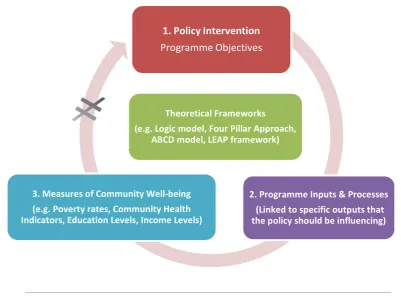
[image:22.595.89.491.428.724.2]In Figure 2.1, we have constructed a high-level summary of our overall findings. Within the academic and policy literature, there exist a number of theoretical frameworks (the Logic Model, Four Pillar Approach, ABCD model, LEAP framework, etc.) that provide suggestions on how progress in the community development sphere can be measured. Each of these theories generally involves a clear statement on programme objectives, which are linked explicitly to inputs, processes and outcome variables that the policy should be influencing.
FIGURE 2.1 CIRCULAR OVERVIEW OF COMMUNITY DEVELOPMENT POLICY IMPACT EVALUATION
1. Policy Intervention Programme Objectives
Theoretical Frameworks (e.g. Logic model, Four Pillar Approach,
ABCD model, LEAP framework)
2. Programme Inputs & Processes (Linked to specific outputs that the policy should be influencing) 3. Measures of Community Well-being
Across the literature, we found no evidence of any systematic attempts to practically measure a counterfactual estimate of community-level outcomes. Our research highlighted many reasons why this might be the case. The key issue relates to the ability of researchers to demonstrate a causal link between a policy intervention and changes in broad measures of community well-being, shown by the break in the circular overview (Figure 2.1) between points (1) and (3).
The confounding factors contributing to the difficulties of trying to estimate the causal impact of policies targeting community well-being are as follows.
Numerous national agencies simultaneously implement policies that will affect
such broad outcomes, making it difficult to isolate the impacts of one particular policy.
Local organisations targeting specific communities often receive funding from
multiple sources, making it impossible to measure the impact of a particular funding stream even in instances where the community-level outcome measures are narrowly defined and identifiable.
It may be more feasible to focus on narrower outcomes for the purpose of
evaluating the impact of funding to community-level organisations. However, local community organisations tend to be highly heterogeneous in nature, with differing objectives, making it extremely difficult to identify a set of specific community-level outcome measures relevant to the activities of all funded
groups.5
It is extremely difficult to identify control groups at a community level who have
not been subject to any policy interventions against which to measure the counterfactual impact of an intervention.
Therefore, the expectation of measuring any causal influence of SICAP on broad community level outcomes, such as poverty rates or levels of educational attainment, was not felt to be practical due to the existence of various streams of funding targeting such outcomes and the overall complexity of the system. Furthermore, there is limited value in collecting such broad community-level aggregates for the purpose of a counterfactual evaluation.
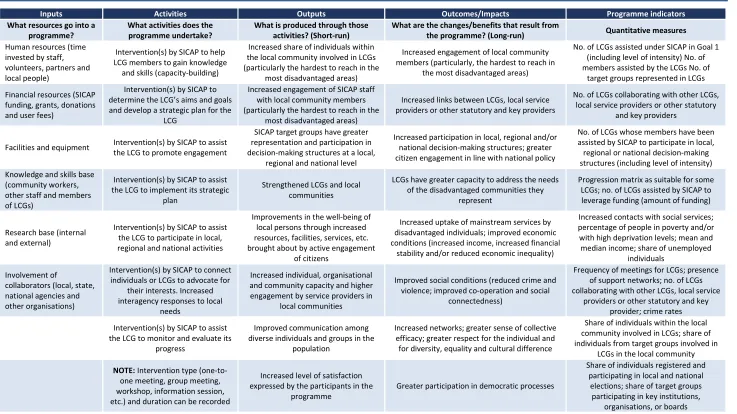
Nevertheless, community development, similarly to all government-funded activities, requires monitoring and measurement. Effective monitoring of community development initiatives within the SICAP model is possible with the collection of broad metrics relevant to all local community groups for use within a Logic Model framework. The Logic Model links all inputs, activities/interventions, outputs, outcomes/impacts and the associated indicators and a suggested
framework is proposed. Two further suggestions discussed at the workshops also seem to warrant further consideration: (i) a distance-travelled measurement tool
for LCGs and (ii) intermittent national-level thematic qualitative studies.
2.2 CONCEPTUAL APPROACHES TO MEASURING COMMUNITY
DEVELOPMENT
In the field of community development, it can be hard to know how deeply community development supports are impacting on participants and the wider community. Outcomes of community development supports are often hard to measure, because in essence they deal with social relationships and the complex functioning of groups and communities, which can be difficult to quantify (STARTTS, 2012, p. 49). Furthermore, sustainable change is linked to the wider impacts of a project on a community, and these can only be observed in the long term.
In order to measure the impact of community development supports, both qualitative and quantitative data are required. Quantitative or ‘numeric’ data quantify the measurable changes that have taken place as a result of the supports: for example, the pre- and post-programme assessment scales, which measure in numerical terms the change in participants’ behaviour, well-being, values or capacity from before the project to its completion. Other examples of quantitative data include statistics from surveys or other relevant sources such as government records or programme files that can provide data on changes that have occurred at both an individual and a community level. Qualitative or ‘non-numeric’ data can generate rich explanations capturing the complexities, nuances and organic nature of community development projects. Examples include transcripts of interviews and focus group discussions, observation journals or project notes, open-ended questions from feedback forms or surveys, etc. Traditionally, qualitative data have been regarded as less rigorous or ‘objective’ than quantitative data. However, these indicators can be complementary and the importance of qualitative analysis for a field like community development is now widely recognised (STARTTS, 2012).
Indicators for developments in communities can be measured in two ways: using objective outcome measures such as population change and using subjective measures such as the residents’ perceptions of change. Furthermore, a hybrid indicator such as an index can be used to quantify qualitative data. The aim of SICAP is to reduce poverty and promote social inclusion and equality through local, regional and national engagement and collaboration.
approach, the ABCD model and the LEAP framework, which we outline individually below.
2.2.1 Logic Model
A Logic Model is a tool that can be used by funders, managers and evaluators of programmes to evaluate the effectiveness of a community development programme, providing a simple framework under which metrics related to community development can be captured (Milstein and Chapel, 2011). This model has proved to be a successful tool for programme planning as well as implementation and performance management in numerous fields, including primary care (Frechtling, 2007).
While there are many ways in which Logic Models can be depicted, in the simplest form, four components of a programme are used: inputs (resources), activities, outputs and outcomes (Table 2.1). The Logic Model shows the logical relationships among the resources that are invested, the activities that take place, and the benefits or changes that result. The purpose of its construction is to attempt to assess the ‘if–then‘ (causal) relationships between the elements of the programme. In Chapter 4 we create a Logic Model that can potentially be used by SICAP.
TABLE 2.1 PROGRAMME ACTION AND LOGIC MODEL EXAMPLE
Inputs Activities Outputs Outcomes/Impacts
What resources go into a programme?
What activities does the programme undertake?
What is produced through those activities?
What are the changes or benefits that result from the programme?
Source: Milstein and Chapel, 2011.
2.2.2 Four-pillar approach
Pritchard and Kazimirski (2014) in association with New Philanthropy Capital (NPC) have published a ‘four pillar approach’ providing practical guidance on developing an impact measurement framework. The four pillars are: (i) mapping the theory of change; (ii) prioritising what is measured; (iii) choosing the level of evidence; and (iv) selecting the sources and tools. Moreover, they propose that the outcomes assessed should be ones that are directly influenced (rather than indirectly supported); are important or material to the mission; are not too costly to measure; and will produce credible data.
2.2.3 ABCD framework
(i) the aims of community engagement activity;
(ii) what activities will be undertaken;
(iii) how success will be measured.
The ABCD framework sets out ten dimensions of community development in a structure of ‘a healthy community’, ‘a strengthened community’, ‘quality of community life dimensions’ and ‘community empowerment dimensions’. This framework has been used as the basis for the Learning, Evaluation and Planning (LEAP) approach to identify three bases of evaluation (Barr and Dailly, 2007):
(i) expressed (from the viewpoint of the participants);
(ii) normative (relative to standards set down by authorised bodies and experts);
(iii) comparative (relative to conditions in other areas).
2.2.4 LEAP Handbook
Furthermore, the LEAP Handbook (Barr and Dailly, 2007) suggests a framework to identify outcome indicators, stressing that indicators need to be developed on a case-by-case basis to reflect the priorities of the stakeholders in an initiative, which relates to the following questions.
(i) How much has changed? (Quantity)
(ii) How beneficial has the change been? (Quality)
(iii) Who has benefited and who has not? (Equity)
(iv) What resources have been used? (Efficiency)
(v) How far have the planned outcomes been achieved? (Effectiveness)
The LEAP model advocates the development of meaningful indicators in collaboration with the stakeholders. This model suggests limiting the collection of data to answering the questions that are most relevant to understanding these issues (optimal ignorance), and not gathering data with more accuracy than is needed to understand the priority issues for evaluation (appropriate imprecision). They state that a useful indicator is measurable, precise or accurate, consistent and sensitive (changing proportionally in response to actual changes).
2.2.5 Other approaches
poverty in deprived communities. Emphasis is also placed on empowerment, increased levels of community spirit and mobilisation, and improved levels of community well-being generally. As stated above, in general there are limited quantitative elements in the evidence base and no systematic set of numerical indicators by which to measure impacts. Most discussions of impacts tend to focus on the dimensions of community activation and of personal benefits such as education, employment or access to benefits. There is little or no discussion of impacts in terms of political influence or structural change.
While it is not clear that any particular conceptual framework should guide the measurement of community development achieved under SICAP, each approach generally incorporates a clear statement on programme objectives, which are then linked explicitly to subsequent inputs and identified key outcome variables that the policy should be influencing. This is particularly important in the context of SICAP provision, where PIs (i.e. local development companies apart from the Dublin Inner City Co-op) draw funding from a range of sources, and SICAP funding mostly accounts for less than half of the total revenues (Darmody and Smyth, 2018).
2.3 METRICS SUGGESTED IN THE LITERATURE FOR THE MEASUREMENT
OF COMMUNITY DEVELOPMENT
McGuinness et al.’s (2016) review of the international academic literature revealed little or no evidence of systematic attempts or methodologies associated with the measurement of community-level outcomes of education and employment supports similar to those operated under SICAP. It is highly likely that the paucity of such research again stems from a lack of reliable and centralised data collection on community-based activities and outcomes.
Within the general academic and policy literature, emphasis is placed on empowerment, increased levels of community spirit and mobilisation, and improved levels of community well-being generally. There are limited quantitative elements to the evidence base and no systematic set of numerical indicators by which to measure impacts. Furthermore, the exclusive impact and long-term consequences of a programme, e.g. reduced poverty rates, can be very difficult to ascertain since several other similar or dissimilar projects can potentially lead to the same impact. It must be borne in mind that disadvantaged individuals, families and communities take part in numerous programmes and are recipients of multiple services, many of which have differing time frames. Therefore, community impact may only be able to capture the cumulative effect of these measures rather than a single programme.
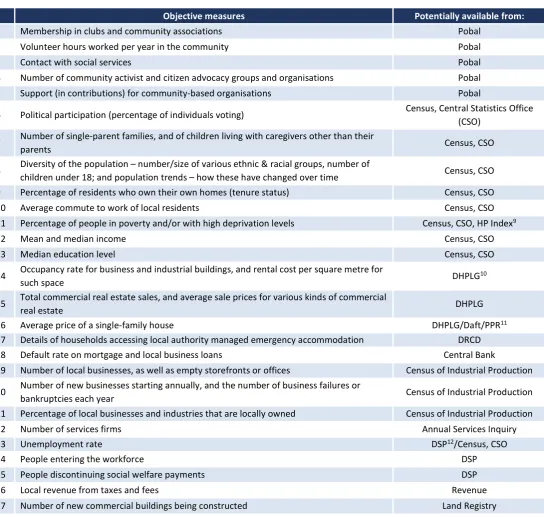
well-being.6 These are listed in Table 2.2 alongside potential sources to obtain these
metrics in an Irish context.7 While some of the sources may not currently be
publicly available at the small-area level, they do exist at a broader area level such as county or electoral district, and thus Table 2.2 in some cases illustrates metrics that can potentially be collected in the future and the associated source.
6 The Community Tool Box is a public service of the University of Kansas and developed by the KU Work Group for Community Health and Development and partners nationally and internationally (http://ctb.ku.edu/en).
TABLE 2.2 POTENTIAL OUTCOME AND IMPACT METRICS AT SMALL-AREA LEVEL8
Community-level impacts might be assessed by monitoring changes in the aggregate level of such metrics following the completion or introduction of a
8 Some of the metrics may not be available from the respective bodies and may have to be sourced locally.
9 The Haase Pratschke (HP) Deprivation Index for Small Areas provides a method of measuring the relative affluence or disadvantage of an area using data compiled from various censuses, and is a key determinant of the amount of funding allocated to particular geographical areas under SICAP. Based on earlier deprivation indices for Ireland, as well as analyses from other countries, three dimensions of affluence/disadvantage are identified: demographic profile, social class composition and labour market situation.
10 Department of Housing, Planning and Local Government. 11 Property Price Register.
12 Department of Social Protection.
Objective measures Potentially available from:
1 Membership in clubs and community associations Pobal 2 Volunteer hours worked per year in the community Pobal
3 Contact with social services Pobal
4 Number of community activist and citizen advocacy groups and organisations Pobal 5 Support (in contributions) for community-based organisations Pobal
6 Political participation (percentage of individuals voting) Census, Central Statistics Office (CSO)
7 Number of single-parent families, and of children living with caregivers other than their
parents Census, CSO
8 Diversity of the population – number/size of various ethnic & racial groups, number of
children under 18; and population trends – how these have changed over time Census, CSO 9 Percentage of residents who own their own homes (tenure status) Census, CSO 10 Average commute to work of local residents Census, CSO 11 Percentage of people in poverty and/or with high deprivation levels Census, CSO, HP Index9
12 Mean and median income Census, CSO
13 Median education level Census, CSO
14 Occupancy rate for business and industrial buildings, and rental cost per square metre for
such space DHPLG10
15 Total commercial real estate sales, and average sale prices for various kinds of commercial
real estate DHPLG
16 Average price of a single-family house DHPLG/Daft/PPR11
17 Details of households accessing local authority managed emergency accommodation DRCD 18 Default rate on mortgage and local business loans Central Bank
19 Number of local businesses, as well as empty storefronts or offices Census of Industrial Production
20 Number of new businesses starting annually, and the number of business failures or
bankruptcies each year Census of Industrial Production 21 Percentage of local businesses and industries that are locally owned Census of Industrial Production 22 Number of services firms Annual Services Inquiry 23 Unemployment rate DSP12/Census, CSO
24 People entering the workforce DSP
programme. Purdon et al. (2001) outline a number of underlying principles that should be reflected in any primary survey approach to measuring change in community development. They emphasise that asking the question ‘What has the impact of a programme been?’ means addressing the ‘counterfactual’, i.e. ‘What would the situation be if the programme hadn’t existed?’ Of course, quantification of this is extremely challenging.
Purdon et al. (2001) highlight the important decision of who are the ‘subjects’ of the evaluation. They suggest that the relevant actors can be considered in three main groups: (i) primary subjects (the individuals to whom the policy or programme is specifically targeted or who are directly affected by the policy or programme; for example, participants and non-participants); (ii) secondary subjects (the individuals who may have a key role in making the policy or programme work but are not integrally involved in the development or delivery of the policy or programme; for example, employers); (iii) actors involved in delivery (one of the key groups usually studied in evaluations is those involved in the delivery of new policies or programmes; for example, policy-makers or staff involved directly in delivery). Some methods of data collection are more costly than others in terms of time, people and money, depending on the scale of the project and the research questions to be addressed.
Other suggestions in this area come from the What Works Network, a UK government-led initiative to enable commissioners of public services to access independent, high-quality evidence syntheses across a broad range of social policy areas. It is made up of seven independent What Works Centres and two affiliate members. The centres aim to focus on understanding, improving and creating demand for the use of evidence in decision-making, focusing on key policy areas including:
local economic growth;
well-being;
crime reduction;
early intervention;
poverty;
public sector reform.
The What Works Centre for Wellbeing has 17 founding partners including Public Health England, the Economic and Social Research Council, government departments, the Office for National Statistics and the Local Government Association. It was launched in October 2014 with the aim of developing a strong and credible evidence base to support these organisations to concentrate efforts on interventions that will have the biggest impact. The centre has commissioned a research synthesis of what works, and secondary data analysis, initially in three areas: employment and learning, community well-being, and culture and sport. Its research also focuses on measuring, analysing data, definitions, and identifying areas for further research on well-being.
Well-being is a subjective individual-level indicator that could potentially be collected with changes monitored at the aggregate level following the completion or introduction of a programme. The UK Office of National Statistics (ONS) recommends that if there is space/time for only one question relating to well-being, a life satisfaction question be used:
Overall, how satisfied are you with your life nowadays?
If there is additional space/time, it recommends the Warwick Edinburgh Mental Wellbeing Scale, covering four personal well-being questions and four perspectives on an 11-point scale where 0 means ‘not at all’ and 10 means ‘completely’.
How satisfied are you with your life nowadays? (Evaluative perspective)
To what extent do you feel that the things you do in your life are worthwhile?
(Eudaimonic perspective)
How happy did you feel yesterday? (Positive experience perspective)
How anxious did you feel yesterday? (Negative experience perspective)
Online surveys and polls can be used to collect data on participants’ satisfaction and to inform programme development (Ollerton and Black, 2017). Online surveys with users or engaged participants can be a quick and easy way to collect data on people who have already been reached and/or engaged with in some way. These post-event surveys and interviews can be sent to registered users via email, or posted on a website or social media page. Survey Monkey can also be used to create surveys with links that can be posted on Twitter or embedded in other social media networks.
Happy City developed an online survey measurement tool, the Happiness Pulse, consisting of 20 questions in order to gather valuable data on the well-being of
people in Bristol from April to July 2016.13 The Happiness Pulse was designed to be
a well-being health-check that could be taken just once, several times over the course of a few months or as a before-and-after impact evaluation of projects and interventions. Because the Happiness Pulse includes national measures of well-being (ONS life satisfaction questions and Short Warwick–Edinburgh Mental Well-being Scale (SWEMWBS)), the composite measures can be compared to other national datasets. Gathering representative nationwide or city-wide data is very difficult without population contact details, so they experimented with a partnership strategy, working with umbrella organisations in key sectors across Bristol (health, voluntary, culture, business, environment) to promote the Happiness Pulse to their members and staff. Each organisation was given a unique URL and code allowing them to collect well-being data specifically within their organisation. After the trial, Happy City provided them with the Happiness Pulse data for their organisation, a mutual benefit of well-being data collection.
The What Works Centre for Wellbeing has partnered with Happy City, which has three pioneering measurement and policy tools, as follows.
Happiness Pulse14 is an interactive survey that aims to measure well-being
across three domains: mental/emotional well-being, behavioural well-being, and social well-being in urban communities.
Happy City Index15is an annual progress report on the conditions for well-being
at a city or local authority level, which aims to help decision-makers understand and assess the city determinants of well-being.
WellWorth Policy Tool16is an evaluation tool currently in an extended piloting
phase, which aims to assess the impact and cost benefits of well-being interventions across key policy areas.
2.4 DATA CURRENTLY COLLECTED BY SICAP THAT COULD POTENTIALLY
BE INCORPORATED INTO A MEASUREMENT APPROACH
We next provide an overview of the data that are currently collected by SICAP, examine the limitations and assess the extent to which various measures can be captured and improved under any evaluation/monitoring approach guided by an overall conceptual framework. Bamber et al. (2010) state that programme design is most likely to be robust and effective when it is underpinned by a clear theoretical framework, which makes explicit the expectations as to why providing a specific input should lead to a change in a specific outcome.
SICAP is underpinned by community development principles, so activities under all goals (1, 2 and 3) are designed to promote social inclusion and enhance community
outcomes. At present, detailed information is collected on the individuals who avail of education and employment supports (goals 2 and 3). However, their outcomes are measured at individual level only; for example, in terms of progression to education, training and employment. There is considerable potential to adopt the kinds of metrics discussed in the previous section in looking at the potential impact of availing of supports on individual well-being more broadly as well as the impact of individual participation on the community as a whole. In the remainder of this section, we concentrate on information collected in relation to Goal 1, which focuses on working with local community groups, while recognising that this represents a narrow way of assessing community development measures.
Important information is currently collected in terms of the number of key community development interventions that take place under SICAP in any given year. For instance, SICAP commenced on 1 April 2015 and in 2016, SICAP had supported 3,056 LCGs and 47,511 individuals on a one-to-one basis.
Support interventions are recorded when the PI engages with an LCG and provides support under one of the following support categories.
G1.1 To support and promote the community engagement of
disadvantaged target groups across the life-cycle.
G1.2 To support the development of LCGs which promote equality and
social inclusion in a local, regional or national context.
G1.3 To support disadvantaged communities and individuals to enhance
their participation in local, regional and national decision-making structures.
G1.4 To develop and facilitate strategic collaborative frameworks and networks as part of a dialogue for developing solutions to social exclusion.
(1 per cent), but their engagement levels are higher relative to their representation
in the overall population.17
Again, metrics are collected in terms of the number of interventions targeted at the various stages of community group development. Objective G1.2 seeks to support the development of LCGs that promote equality and social inclusion in a local, regional or national context. In 2016, 28 per cent of LCGs received support interventions related to group formation and development (G1.2).
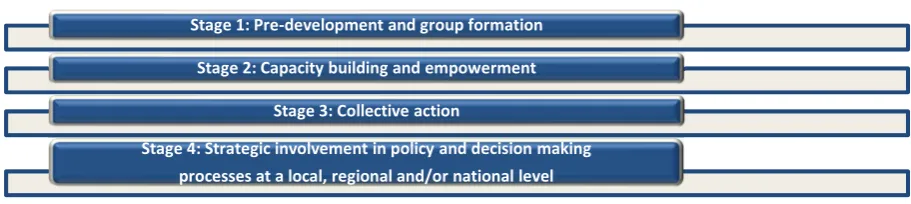
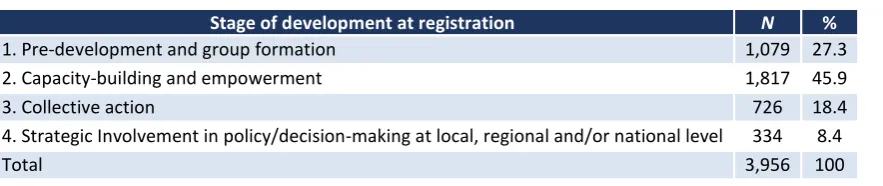
There is an emphasis on facilitating LCGs’ progression along the community development matrix, which comprises four stages:
Stage 1: Pre-development and group formation;
Stage 2: Capacity-building and empowerment;
Stage 3: Collective action;
Stage 4: Strategic involvement in policy and decision-making processes at a
local, regional and/or national level.
In 2016, 10 per cent of all LCGs recorded progression along the community
development matrix.18 The majority of movements (47 per cent of those that
moved) was from Stage 2 to Stage 3, with the next highest (32 per cent) moving from Stage 1 to Stage 2. The LCGs that progressed along the community development matrix on average received eight support interventions, compared to an average of four interventions for all LCGs supported under SICAP (Pobal, 2016a).
Support interventions totalling 1,854 related to participation in local, regional and national decision-making structures (G1.3). With regard to G1.4, 121 LCGs (4 per cent) were supported to put anti-discrimination and equality measures in place. Examples of activities supported under this goal include participation of LCGs in disability awareness days, Traveller cultural awareness training and workshops focusing on issues of inequality and discrimination.
2.5 INPUT/ACTIVITY METRICS AT AN AREA LEVEL COLLECTED BY SICAP
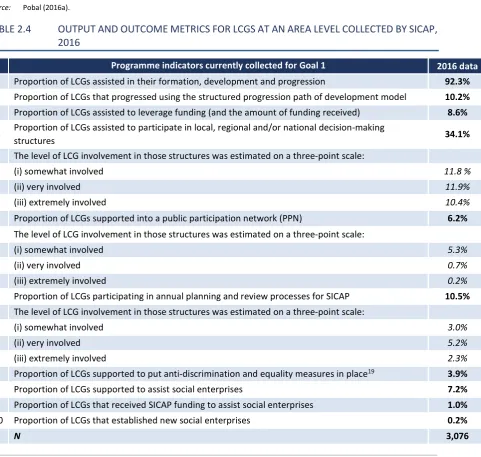
In addition to data on the number and nature of LCG interventions, a number of additional key metrics are captured annually in IRIS which can also potentially be incorporated in a community measurement approach (Tables 2.3 and 2.4).
17 Authors’ calculation using IRIS 2015–2017 data.
TABLE 2.3 INPUT/ACTIVITY METRICS AT AN AREA LEVEL COLLECTED BY SICAP, 2016
1 Number of LCGs assisted under SICAP (KPI) 3,076
2 Total number of disadvantaged individuals (15 years and upwards) engaged
under SICAP on a one-to-one basis (KPI) 47,511
[image:35.595.85.567.152.609.2]Source: Pobal (2016a).
TABLE 2.4 OUTPUT AND OUTCOME METRICS FOR LCGS AT AN AREA LEVEL COLLECTED BY SICAP, 2016
Programme indicators currently collected for Goal 1 2016 data
1 Proportion of LCGs assisted in their formation, development and progression 92.3% 2 Proportion of LCGs that progressed using the structured progression path of development model 10.2% 3 Proportion of LCGs assisted to leverage funding (and the amount of funding received) 8.6%
4 Proportion of LCGs assisted to participate in local, regional and/or national decision-making
structures 34.1%
The level of LCG involvement in those structures was estimated on a three-point scale:
(i) somewhat involved 11.8 %
(ii) very involved 11.9%
(iii) extremely involved 10.4%
5 Proportion of LCGs supported into a public participation network (PPN) 6.2% The level of LCG involvement in those structures was estimated on a three-point scale:
(i) somewhat involved 5.3%
(ii) very involved 0.7%
(iii) extremely involved 0.2%
6 Proportion of LCGs participating in annual planning and review processes for SICAP 10.5% The level of LCG involvement in those structures was estimated on a three-point scale:
(i) somewhat involved 3.0%
(ii) very involved 5.2%
(iii) extremely involved 2.3%
7 Proportion of LCGs supported to put anti-discrimination and equality measures in place19 3.9%
8 Proportion of LCGs supported to assist social enterprises 7.2% 9 Proportion of LCGs that received SICAP funding to assist social enterprises 1.0% 10 Proportion of LCGs that established new social enterprises 0.2%
N 3,076
Source: Pobal, 2016.
2.6 CAN METRICS CURRENTLY CAPTURED UNDER SICAP BE IMPROVED?
It is clear that a large amount of information is currently collected by SICAP relating to the inputs, activities and outputs of funding to community groups. An obvious question related to the objectives of the current study is how these can be improved to allow better monitoring and evaluation of community-level
interventions. We summarise some of the main observations at this stage of the study which formed the basis of the discussions at the consultation workshops with LCWs, members of LCGs and other stakeholders.
2.6.1 Number versus intensity
The current metrics monitor the number of individuals and activities, but improvements could be made in order to capture the varying levels and intensity of programme activities and interactions. Intensity measures can relate to the resources allocated to interventions in terms of either time or cost (or both).
For example, in 2016, 34 per cent of LCGs were assisted to participate in local, regional and/or national decision-making structures. The level of involvement is captured on a three-point scale: (i) somewhat involved, (ii) very involved and (iii) extremely involved. However, it may also be helpful to capture the associated duration of meetings, the total number of individuals involved and/or the expenditure attached to this specific element of the SICAP goal.
2.6.2 Balance between qualitative and quantitative outcomes
Pobal currently collects outcomes relating to three horizontal themes – (i) equality, (ii) community development methodologies and (iii) collaborative approaches – in a qualitative way. In addition, work with other agencies and leveraging service is a core part of the PI’s role but is not well captured using the current metrics. It may be possible to consider the application of basic standardised metrics to capture developments across these themes.
2.6.3 Process and implementation monitoring
A process evaluation or implementation assessment is a form of programme monitoring designed to determine whether the programme is delivered as intended to the targeted recipients (Rossi and Freeman, 1982). Purdon et al. (2001) make a distinction between measuring process and measuring impact, arguing that they are entirely different goals. This creates additional challenges for community development, where process dimensions are so important and yet so hard to evaluate. For example, Pobal could potentially collect information to examine:
processes such as finding out about a service;
whether all those eligible receive the programme; who does/does not
participate, and why;
finding out about a service delivery;
whether service delivery is consistent with the programme’s intention;
whether programme resources/programme delivery are consistent across all locations;
looking at the programme’s resources;
whether costs per unit are reasonable;
looking at participants’ experiences of the programme;
whether participants are satisfied with their interactions with staff delivering
the programme, with the procedures, and with the services they receive.
2.6.4 Cost considerations
Finally, as outlined by McGuinness et al. (2016), the cost of additional data collection and qualitative assessment elements has to be weighed against the overall cost of the programme’s delivery, which, in some cases, can be quite low. This suggests that it may not be sensible to collect all metrics for all interventions.
2.7 CONCLUSION
This chapter has examined the international and national literature relating to the conceptual approaches proposed for the measurement and evaluation of community development programmes. Furthermore, it has examined proposed metrics that capture various aspects of community development and well-being and reviewed the data currently collected by Pobal under the SICAP programme.
It can be extremely complex to understand exactly how deeply a community development approach is impacting on participants and the wider community. A number of conceptual approaches have been suggested to provide an overall framework to guide decisions around the particular metrics to be collected in any assessment of community development; examples include the Logic Model, four-pillar approach, ABCD model and LEAP framework. While it is not clear that any particular conceptual framework should guide the measurement of community development achieved under SICAP, each approach generally incorporates a clear statement on programme objectives, which are then linked explicitly to subsequent inputs and identified key outcome variables that the policy should be influencing.
CHAPTER 3
Qualitative research: feedback from consultative workshops
3.1 INTRODUCTION
In October 2017, the ESRI organised a series of six consultation workshops. Stakeholders engaged very positively, with 129 people attending the sessions in total. In line with the community development literature, Midgley et al. (2017) highlight the need for communities to have a substantial input into how community problems are addressed, describing community operational research (COR) as not just applying operational research methods to community development: it is the ‘meaningful engagement of communities which is most important‘. Operations research (OR) is a problem-focused discipline in which the selection of methods is guided by the features of the particular problem and decision processes at hand, with flexibility to customise the blend of quantitative and qualitative approaches.
In addition, Midgley et al. (2017) stress the importance of the term ‘enhanced OR‘, which suggests that it is crucial to supplement the traditional problem-solving ‘conventional OR‘ with engagement of communities and stakeholders. This is especially true given the research questions of our study. Furthermore, they stress that community members should be at the heart of the decision-making process and that it is not feasible to fully identify the problem of the community without
consulting and engaging the community members.20 This study uses an integrated
participatory approach alongside the desk-based research and the analysis of the IRIS data in order to explore the possibility of impact evaluation for community development projects such as SICAP.
3.1.1 Methodology
We organised a series of six consultation workshops involving members of local community groups (LCGs), local community workers (LCWs) and other key stakeholders, such as representatives from Community Work Ireland (CWI), the Irish Local Development Network (ILDN), the Irish National Organisation of the Unemployed (INOU), and Pavee Point, in order to capture their views across a
range of themes. Specifically, we held four separate workshops for members of LCGs and two workshops for LCWs and other key stakeholders during the month
of November 2017. In total 129 participants took part in these sessions.21 The
workshops were organised across six lots, with each lot area chosen to reflect diversity in terms of geography, client base and the focus of PI activities.
The aim of the workshops was to explore key indicators of community development and community well-being, and to examine the feasibility of indicators emerging from the desk-based research in an Irish context and the extent to which the concept of community development could or should be measured. Furthermore, it was an opportunity for members of LCGs, LCWs and other key stakeholders to suggest metrics, and/or approaches, that could potentially be adopted for monitoring and evaluation purposes within (or potentially outside) IRIS.
3.1.2 Structure of the workshops
The workshops started with a short presentation of the project, including the goals, methodology and the results from the desk-based research. After this presentation, semi-structured round-table discussions revolving around different aspects of the study took place and were moderated by facilitators (chosen from among the participants and each assigned to a particular theme for the duration of the event). All workshop participants had the opportunity to express their views across the four main themes identified and listed below. At the end of the round-table discussions the facilitators summarised the feedback from the participants in a presentation and the researchers/authors summarised the main findings of the workshop before concluding it.
Feedback was recorded by the use of flipcharts, which the facilitators took notes on and used when presenting feedback. In addition, the researchers took notes while the facilitator presented the feedback so as to gather any additional information that arose during the presentation. These notes and flipcharts were then analysed to capture the common themes that emerged from the discussions, which we discuss below. The themes for the workshops and related sub-sections of this chapter are organised into the following four main topics.
A. Approach: What is the most appropriate overarching approach to measuring community development, in the context of SICAP?
B. Indicators: Which measures most effectively reflect changes in community development and the capacity of communities to effect change?
C. Progression: In terms of the community group progression matrix, to what extent is progression the norm and is progression along this matrix a true reflection of capacity-building at a community level?
D. Improve: How can we improve the existing approach to data collection in order to more accurately reflect changes in community development in areas supported by SICAP?
In addition to the consultative aspect of this research project, Darmody and Smyth
(2018) simultaneously conducted another piece of research entitled The Goals and
Governance of the Social Inclusion and Community Activation Programme (SICAP) 2015–2017: A Mixed Method Study. Although their study covered a wider range of research questions than the focus of this report, we were able to incorporate some aspects that directly related to impact evaluation for community development programmes such as SICAP. Specifically, we draw on issues emerging from interviews conducted by Darmody and Smyth (2018) with PI CEOs and workers involved in Goal 1 (strengthening local communities) related to the themes from the workshops. In this context, stakeholders mainly discussed metrics for SICAP 2015–2017. The interviews were conducted in early 2017 in ten case-study areas selected to capture variation in demographic profile, size of budget, region and perceptions of SICAP derived from a survey of PIs.
3.2 THEME A: WHAT IS THE MOST APPROPRIATE OVERARCHING
APPROACH TO MEASURING COMMUNITY DEVELOPMENT, IN THE
CONTEXT OF SICAP?
As emphasised both by previous research and by the lack of robust evaluations attempting to estimate the counterfactual impact in the community development space, it is extremely difficult to capture the impacts of interventions and expenditure that occur at the community level. Motherway (2006) summarises this difficulty by stating that ‘there is no simple, universal, magical way to measure the outcomes and impacts of community development’. Nevertheless, the vast majority of members of LCGs and LCWs participating in the workshops stressed that community development, like other interventions, requires monitoring and measurement of the processes, outcomes and impacts achieved. There was certainly an overall acknowledgement of the complexity of this task, but participants communicated a strong willingness to realise methods that are appropriate both for the interests of marginalised communities and groups and for the needs of the state and other funders.