P
LACINGP
ROGRESS:
C
ONTEXTUALI
NEQUALITY ANDI
MMIGRANTI
NCORPORATION IN THEUS
J
AMIEG
OODWIN-W
HITEA
BSTRACTThis study contributes to research on immigrant economic incorporation by considering the relative wages of immigrants and their adult children to the US-born population. By comparing racially-disaggregated wage distributions for New York, Los Angeles, and the US overall, this study provides perspective on the complicated social and economic contexts within which intergenerational immigrant progress occurs. This research is of interest because consideration of the US-born children of immigrants invokes questions of social mobility and the persistence of inequality more broadly. Further, this paper contributes to a theoretical debate over place and immigrant progress by examining the 1.5 generation, for whom residence in concentrated immigrant cities has been theorized as detrimental to economic incorporation. Finally, this paper introduces substantial analysis of local wage structures. Results suggest that intergenerational prospects are geographically specific and contingent on the continuing contexts of racial wage inequality - for even the US-born of US parents.
Placing Progress: Contextual Inequality and Immigrant Incorporation in the US
June 2006
Jamie Goodwin-White Division of Social Statistics
Southampton Statistical Sciences Research Institute School of Social Sciences
University of Southampton
Highfield, Southampton SO17 1BJ United Kingdom
Abstract
This study contributes to research on immigrant economic incorporation by considering the relative wages of immigrants and their adult children to the US-born population. By comparing racially-disaggregated wage distributions for New York, Los Angeles, and the US overall, this study provides perspective on the complicated social and economic contexts within which intergenerational immigrant progress occurs. This research is of interest because consideration of the US-born children of immigrants invokes questions of social mobility and the persistence of inequality more broadly. Further, this paper contributes to a theoretical debate over place and immigrant progress by examining the 1.5 generation, for whom residence in concentrated
immigrant cities has been theorized as detrimental to economic incorporation. Finally, this paper introduces substantial analysis of local wage structures. Results suggest that
intergenerational prospects are geographically specific and contingent on the continuing contexts of racial wage inequality - for even the US-born of US parents.
Keywords: 1.5 generation, immigrant economic incorporation, spatial assimilation, labor market contexts, immigrant cities
Introduction
Research on immigrant economic progress has increasingly focused on prospects for the
second generation. In part, this is a result of the entry into adulthood of many of the children of
post-1965 immigrants, and the concomitant visibility of large numbers of 2nd generation/1.5
adult individuals1 in US census data and other sources. More than a cohort data effect, however,
this emphasis also results from the realization that immigrant incorporation is a
1 Although Current Population Survey data provide information on parental birthplace necessary to
identify the second generation, limited sample sizes prohibit metropolitan-level consideration of wage data of race-disaggregated foreign-stock groups. The identification of the 1.5 generation in the 1990 and 2000 5% PUMS data affords a suitable proxy, with a substantially larger sample. I differentiate the 1.5-generation population from the remainder of the foreign-born population by age at arrival: following Perlmann and Waldinger (1997) I define the 1.5 group as immigrants who entered the US before they were twelve years of age. It is plausible that this group has had many of the benefits of a US education and exposure to English by the time they enter the labor market as adults. The foreign-born as
generational process (Niedert and Farley 1985, Farley and Alba 2002, Perlmann 2005).
Theoretically, the US-born and educated children of immigrants should largely escape the
immigrant penalties their parents face in the US labor market. Yet those very disadvantages may
have consequences that persist into the 2nd generation. Among the many factors thought to
determine how the children of immigrants fare, significant attention is paid to where the children
of immigrants live and work. This emphasis derives in part from an empirical understanding of
the difficulties workers (and especially immigrant workers) face in highly unequal immigrant
cities like Los Angeles and New York. At the same time, predictions that second generation
economic progress will be constrained by their location in ethnically-concentrated immigrant
cities (or dependent on their relocation away from sites of first-generation settlement) owe much
to spatial assimilation theorists’ conflation of social and spatial mobility via internal migration. I
suggest that this results in a geographically uncontextualized analysis, in that 1) it theorises places
with regard to immigrant incorporation as little more than concentrations of immigrants and 2)
it ignores how urban labor market contexts might differ across generations and across racial
groups. This paper seeks to introduce relational understandings of how immigrants and the
children of immigrants fare relative to the US-born in the US overall and in the immigrant cities
of New York and Los Angeles. In so doing, it introduces consideration of the local labor
market structures of wage inequality to questions of immigrant intergenerational progress,
especially with regard to the racial/ethnic structure of wages in comparative city contexts.
Much of the focus on the importance of location for the second generation arises from
spatial assimilation theory’s suggestion that immigrant assimilation is reliant upon dispersal from
concentrated sites of immigrant settlement. This is especially true over time, and especially for
economic opportunity. Geographers and others have broadened this spatial focus away from
concentration and dispersion to questions of how and why immigrants' prospects for economic
incorporation are geographically contingent, both within and across US metropolitan areas (see,
for example, the contributors to Waldinger 2001). More detailed considerations have examined
how immigrants fit into occupational sectors of local economies, their resulting occupational
comparisons with natives, and how this process has changed over time (Ellis, Wright, and
Goodwin-White 2005). This work is consistent with what has been termed a "configurations of
inequality" approach, whereby researchers seek to understand how and why dimensions of
inequality among various groups vary across labor markets (McCall 2001). Comparisons of
immigrants with the US-born are particularly fruitful in this regard as they engage dimensions of
both race and class in questions of inequality. The relatively recent ability to consider the adult
children of immigrants provides an opportunity to examine these relationships not only with
regard to immigrants but also to their US-born and educated children, further invoking
questions of social mobility and the persistence of ethnicity as a component of overall inequality.
Thus far, there has been surprisingly little academic attention to how second generation
wages compare with the US-born (at least third generation) or with their immigrant parents’
generation, let alone geographic variation in wage gaps.2 Much of the focus has remained
instead on educational attainment and concluded that the second generation is by and large more
educated than their parents’ generation (Zhou 2001, Farley and Alba 2003). At the same time,
this literature raises concern that immigrants’ concentrated settlement in immigrant cities with
highly unequal labor market conditions may threaten their childrens’ progress in catching up
with the US-born of US parents (Gans 1992, Clark 2001, Zhou 2001). Whether proceeding
2 Although there is considerable emphasis on comparing ethnic wage gaps (with US-born whites) of the current
from a theoretically spatial assimilation perspective that equates individual progress with spatial
mobility, or the more macro-level concern with conditions in global cities, it is apparent that
geographic context needs more investigation with regard to its implications for immigrant
fortunes. In this paper, I suggest that the key to understanding how immigrants and their
children fare involves a more nuanced and relational understanding of the structures of local
labor markets. Educational gains among the children of immigrants may translate differently in
different labor markets, depending on the demographic “aging out” of natives, economic
restructuring, and discrimination, as well as the social configurations of inequality that reward
education and skills with different labor market positions depending on racial or ethnic status.
Although this is far from a thorough foray into considering the importance of multiply-scaled
immigrant geographies, it is certainly a critical step in theorising the relational contexts within
which we assess immigrant incoporation.
I employ a relative distributions approach to the examination of wages (from 1990 and
2000 U.S census data) for natives, immigrants, and their adult children in the immigrant cities of
Los Angeles and New York, as well as for the US overall. Relative distributions methods
provide for more detailed analysis of structures of inequality and employment than traditional
parametric approaches by examining the overall distribution of wages rather than comparing
mean wages of different groups (Handcock and Morris 1999). They thus provide a means for
comparing different groups' relative positions within the wage structure across and within cities,
and how these positions have changed over time. I also decompose relative wage changes for
educational covariates such that compositional differences between various immigrant, second
generation, and US-born race groups can be isolated from residual inequality between groups in
incorporation have been affected by these city contexts of wage inequality, as well as the
relational changes in labor market position realized by native, immigrant, and second generation
groups between 1990 and 2000.
These preliminary analyses indicate that, just as for their parents, cities of residence
matter in determining the economic prospects of the second generation. This is not just because
some cities have higher wages than others, but also because there are different opportunities and
penalties accruing to relative position in local labor markets – and perhaps especially in
immigrant metropolises. The relative position of the children of immigrants is also contingent
on socialcontext, however, such that intergenerational mobility between immigrants and their
children does not translate into the same mobility relative to the US-born in different city or
national contexts. This is in part due to the fact that immigrants enter urban labor markets that
are already highly racialized in ways that structure opportunities for the US-born (Bound and
Freeman 1992, Jencks 2001, Hirsch and MacPherson 2004) and immigrants alike. Relatedly, it is
also because of the differing penalties to immigration in differently-structured labor markets, and
different opportunities for and limits to intergenerational social mobility. Relative distributions
analysis of immigrants, their children, and the US-born by race provides perspective on the
relative positioning of groups in local labor markets and the US as a whole. Coupled with
analysis of economic changes over time and decomposition of educational differentials, this
approach allows consideration of the ways in which context is important in determining how the
children of immigrants will fare in the US, and begins to complicate the spatial and theoretical
contexts within which we assess immigrant incorporation.
Intergenerational Immigrant Incorporation
Research on the children of immigrants has largely been concerned with their
educational attainment, as a predictor of labor market outcomes. In part, this is because the 2nd
generation are still quite young as a cohort. Although sizeable numbers of the second generation
were only beginning to enter adulthood by 2000, however, the extended histories of immigration
to Los Angeles and New York are such that there are substantial numbers of the second
generation in these cities. While some of these are the children (both child and young adult) of
post-1965 immigrants, Mexico’s contiguous border and continuous flow of immigrants to the
US means that there are significant numbers of non-white second generation adults in Los
Angeles (Massey, Durand, and Malone 2002, Perlmann 2005).
Concerns with 2nd generation economic progress invariably invoke intergenerational
incorporation issues, and these are mostly economic in nature. A recent literature stresses that
significant intergenerational educational gains for all ethnic groups leave little doubt the second
generation will close the wage gap their immigrant parents had with the US-born. (This is
especially true for some 2nd generation Asian groups, whose parents already had higher levels of
education than the US-born). There is a very high rate of college attendance for the second
generation overall, although the Latino second generation does not yet have the very high levels
of college completion typical of some Asian groups (Zhou 2001, Farley and Alba 2003). 3 In
fact, the oft-cited reason for increasingly severe immigrant wage penalties (that immigrants’ skill
levels improved but those of the US-born increased much more rapidly and significantly) 4 is
3
Clark(2001) Grogger and Trejo (2002) and Trejo(2004) are among those who are concerned that the low levels of education and high levels of poverty of some (especially Mexican)immigrant parents will translate into educational disadvantages for their children.
4 This argument was initially articulated by Chiswick (1978), in his debate over immigrant wages and skill
likely to be challenged by the very high level of educational mobility between the current
immigrant and second generations – a level much higher than that for the US-born of US-born
parents, whose educational trajectories peaked rather earlier in times of newly high college
attendance (Card 2004).
While educational gains made by the children of immigrants are indeed impressive, many
researchers are concerned that the low socioeconomic background of some immigrants will
continue to seriously hamper their children’s economic progress (Clark 2001, Fry 2002, Trejo
2004, Kochar 2005). The spatial focus on immigrant cities and the continued residence of the
second generation in these locations informs these prognoses. And although there is certainly
an empirical dimension to these anxieties (large US metropolises are, after all, nightmares for
many parents competing for scarce educational resources), the somewhat decontextualized
reading of places as little more than immigrant concentrations is at play here. More theoretically,
the same assimilation theories applied to immigrant economic incorporation are also applied to
their US-born and educated offspring – in ways that neglect to consider spatial concentrations
processurally and intergenerationally. While segmented assimilation perspectives explicitly
address generational differences in orientation to the host society, spatial assimilation
perspectives are more difficult to theorize intergenerationally, in part because they describe a
particularly immigrant journey. However, both approaches have been threaded through
prognoses for the second generation, and they invoke specifically geographic understandings of
intergenerational immigrant progress. This is not to argue that parental position is not critical
for the children of immigrants – just that the unique geographies of immigrant employment and
Segmented assimilation theorists emphasize the increasingly harsh labor market
conditions that have characterized the last thirty years in which many of the second generation
have come of age, suggesting that the low-skilled but adequately compensated jobs that provided
upward mobility for immigrants prior to economic restructuring are no longer available.
Further, segmented assimilation scholars suggest, the children of immigrants are even less likely
than their parents would have been to have accepted substandard employment as a means of
social mobility, as they have the expectations of US citizens, rather than the immigrant
willingness to take on unrewarding work. Thus, they argue, the interaction of immigrant
generation and changing economic conditions is unlikely to yield second generation progress,
and may result in downward mobility for many in the second generation (Kao and Tienda 1996,
Perlmann and Waldinger 1997). Compounding this relatively dire forecast is segmented
assimilation’s important contribution that race and ethnicity continue as important determinants
of labor market outcomes even among the 3rd generation+ US-born, such that the erasure of
group distinctiveness suggested by classical linear assimilation stories is quite limited.
Complementary to this, scholars argue, the current second generation will not benefit, in terms
of economic and social position, from the closing off of large influxes of immigrants that
benefited earlier immigrant arrivals and their children by limiting competition for employment
and host society discrimination (Borjas 1999, Waldinger and Lee 2001).
Spatial assimilation theorists have pursued significantly different understandings of what
affects intergenerational immigrant progress, if with similar expectations. While spatial
assimilation ideas suggest that geographic dispersion is consonant with (if not either evidence of
or requisite for) economic and social assimilation, it seems far more of a stretch to apply this
most notably by Massey (1986) and Alba and Logan and their colleagues5 originally applied to
the intra-urban central city to suburb dispersion associated with the economic progress of new
immigrants, they are increasingly deployed at grander scales. 6 Ideas that immigrant cities
provide initial sites of concentrated ethnic resources for new immigrants, but that long-term
residence in immigrant cities hinders both economic and social mobility have dominated the
literature on immigrant incorporation, as well as public discourse. Yet the very negative
conditions that mark continued residence in an immigrant city (namely segregation in poorly
renumerated, low-status immigrant jobs) are unlikely by definition to be experienced by their
US-born children.7 Zhou, for example, presents evidence that California residence is often
advantageous for the second generation because of the concentration of colleges and
universities, and because of opportunities for the second generation to avoid the “only minimally
adequate employment” their immigrant parents experience (2001). The research presented in
this paper and related research on internal migration and destination choice (Ellis and
Goodwin-White in press, Goodwin-Goodwin-White 2006a) provides further evidence of this critique of the
extension of city-level spatial assimilation arguments to the second generation. Before
proceeding, however, it is necessary to note briefly the connections of spatial and segmented
assimilation perspectives to a broader concern with the geographic dimensions of immigrant and
second generation incorporation.
Geographic perspectives on immigrants and the second generation
5 See, for example: Alba and Nee (1997), Alba et al 1999, Logan et al (2002). 6 See Ellis and Goodwin-White (2006) for a review.
7 In fact, part of the reason for such jobs is that these immigrant cities are gateways for newcomers to the
It is perhaps not surprising, given the theoretical antecedents just discussed, that
immigration researchers have increasingly turned to ideas that geographic context matters a good
deal for how immigrants fare, at a variety of scales. Although context is often expressed in
comparative international perspective, considering how immigration policy, refugee law, and the
role of the state in social welfare provision have shaped different national experiences of
immigrant and second generation incorporation,8 and also in more classically spatial
assimilation-informed investigations of neighborhood residential choice (Alba et al 1999, Estrada and Mare
2004), the vast majority of such studies compare metro-level contexts of immigrant
incorporation.9 Clark, for example, notes that immigrants currently reside in cities with very
high and increasing levels of immigrant poverty, especially Phoenix and Houston. Further, while
in most cities immigrants’ wages fall between those of US-born blacks and US-born whites, this
is not the case in major immigrant cities of the southwestern US10, where immigrants make lower
wages than all US-born groups. Clark suggests, as do other scholars concerned with immigrant
progress in highly unequal cities, that such conditions will likely prove detrimental to second
generation economic incorporation, even with increasing levels of education (2001, see also
Waldinger 2001, Trejo et al 2002).
In line with Clark’s analysis of high-poverty immigrant cities, Ellis considers how labor
market conditions in immigrant cities improved for natives and declined for immigrants in the
1980s, although the pattern of change varied by city (2001). In single locations, Myers and
Cranford (1998) examine the changing economic contexts of occupational segmenting for
Latinas across cohort and generation in California, and Ellis, Wright and Goodwin-White
8
See, for example, Zolberg (1999), and Reitz (1998) on national contexts of immigrant incorporation, and vanTuebergen et al (2004) on the second generation specifically.
9 Most notably the contributors to Waldinger (2001).
(forthcoming) similarly consider the occupational distributions of immigrant and native workers
in Los Angeles following the economic changes of the 1990s. A recent attempt to link
geographic context to spatial assimilation critiques finds metro and state-level immigrant
concentrations have continuing importance for 1.5 generation internal migration and destination
choice, with little evidence of negative economic effects (Ellis and Goodwin-White in press,
Goodwin-White 2006). The more specifically geographical (rather than sociological) nature of
this research turns on investigation of where immigrants and natives have what kinds of jobs
and how those jobs are rewarded, rather than on cities as concentrations of immigrants. As
such, they attempt to consider prospects for immigrant incorporation under disparate and
changing wage and employment structures. Following on the heels of this research, the
remainder of this paper attempts more relational understandings of relative position by
comparative wage analyses in two immigrant cities and in the US overall, as well as the ways in
which these relationships have changed in the 1990s. This introduction of new methods for
analyzing inequality to understandings of why place matters for immigrant incorporation falls far
short of a comprehensive analysis of the social, cultural, and economic forces that yield different
outcomes for different groups in different places. As a foray into understanding contextual
inequality, however, it is a first step in analyzing and re-theorizing the different geographies of
immigrants and the second/1.5 generation, and what they bode for social mobility.
Research Questions
As a consequence of the discussion over the second generation, above, several specific
research questions are posed. How are immigrants and their adult children are faring
parents better in some places than in others? While we often presume that different places
present different opportunities for both US-born individuals and immigrants, we are less sure
how this is so, and how it is relationally, as well as absolutely, so. This is to say, that while 2nd
generation Hispanics may make higher wages in New York City than in Los Angeles, they may
fare worse relative to other groups in New York City. It is not only that costs of living differ
between cities, although they do and this fact is certainly important. It is moreover that relative
position marks a range of disadvantages that structure labor markets and the opportunities they
offer different individuals. Relative position may be as important as absolute position in terms
of understanding the intergenerational immigrant incorporation.11 This leads to the third and
fourth research questions posed in this paper. How is second generation economic mobility
related to the relative position of their parents and US-born co-ethnics in various US contexts?
Finally, to what extent does residual inequality persist between children of immigrants and
children of US natives after controlling for educational attainment differences between
populations?
In order to answer these questions, I present the results from three different relative
wage analyses, as described above. These analyses focus on the immigrant cities of Los Angeles
and New York as well as the entire US. As the two largest immigrant cities in the US, and ones
with diverse immigrant populations, these cities have the advantages of large samples of multiple
1.5 generation race groups. Further, they have been of considerable theoretical interest in
forecasting the economic futures of the children of immigrants. Geography matters first and
foremost, of course, because immigrants and natives live in very different labor markets, ones
11 In related research, I find that relative wages at origin and destination are a more significant
that tend to be highly unequal. Comparing these immigrant cities with the US at large also
allows a focused investigation of wage gaps as they vary geographically.
Data and Methods
Researchers focusing on immigrant economic progress spend considerable effort on
analysis of gaps in the mean wages of immigrants and natives. This is problematic in that
immigrant wage distributions are much more polarized than those of the US-born population.
To take an illustrative example, comparison of mean wages of US-born whites and immigrant
Asians would show that immigrant Asians have equaled native white wages, while 1.5 generation
Asians have surpassed them12. This is in large part due to the top skew on foreign-stock Asian
wages pulling up the mean. Analysis of overall wage distributions for both groups shows that
there is still extensive overrepresentation of immigrant Asians at the lowest end of the labor
market, relative to US-born whites. Further, much of the immigrant-native wage gap is thought
to be a product of the extraordinarily low wages recent immigrants earn. As this should not be a
characteristic of the second generation, more detailed analysis of wages at the lowest end of the
wage distribution allows a glimpse of whether significant racial wage differences persist into the
second generation. In fact, the relative distributions approach of this paper provides a useful
visualization tool for considerations of intergenerational immigrant economic incorporation
under unequal labor market structures, as will become evident in the following section.
Thus, from the 1990 and 2000 5% PUMS, I extract samples of 25-54 year-old men who
are not self-employed or in group quarters and have wage and hours data. I limited analysis to
men because of the very different employment situations of immigrant and native women
(Hagan 1998, Myers and Cranford 1998, Ellis 2001, Wright and Ellis 2000), and the
incomparability of men’s and women’s wages (Hondagneu-Sotelo 1994, Pessar 1999, Smith
2002). An intergenerational assimilation perspective is harder to apply to women, as immigrant
women generally make less than immigrant men, but US-born non-white women often fare
better in the labor market than their white counterparts. And finally, I chose to omit women
because of the already complicated visuals. Much immigrant labor, especially in immigrant cities,
is so highly gender-segregated that wage distributions are relatively incomparable as men and
women are not in competition for the same jobs (Hagan 1998, Myers and Cranford 1998). The
men selected for this analysis are in prime working years rather than nearing retirement, and not
self-employed as such employment is unregulated by (and perhaps not in competition with)
more generalized labor market structures.
For comparison purposes, foreign-born and 1.5 generation Hispanics and Asians are
compared with US-born (second generation or more) whites, blacks, Hispanics, and Asians.
These groupings capture the major nativity/race groupings in the US. All other groups are
omitted from comparison. Again, this is largely because of the complexity of such analysis, and
the increased difficulty of interpretation with multiple groups. For this reason, foreign-stock
whites were eliminated from the analysis as their wage profiles scarcely differ from native-born
whites. (The reality, of course, is that foreign-born whites are also not really theorized in the
current literature on immigrants’ economic incorporation.) Multiple race categories from the
2000 census are made compatible with 1990 single race responses by use of a crosswalk scheme
that compresses small numbers of multiple-race respondents into single race categories.13 Where
13 In this scheme, those respondents who claimed white/black or white/Asian were included as blacks
1990 and 2000 wages are directly compared, 2000 wages are adjusted by a Consumer Price Index
deflator of .792 (Bureau of Labor Statistics, 2000) for population-weighted samples of 1000
persons from each group in each of 1990 and 2000.14 The decompositions of wages by
educational composition reported in the next section are the result of a 4-category education
covariate measured by education completion of 1) less than high school, 2) a high school
diploma or GED, 3) some college, or 4) a bachelor’s degree. For these eight groups, the entire
wage distribution is compared, with US-born whites serving as the reference distribution. All
wages are logged and represented proportionally to US-born white wages.
The decision of a comparison group is obviously critical in such analysis. Although
researchers concerned with immigrant assimilation might choose US-born Latinos as the
assimilatory reference for immigrant and 1.5 generation Latinos, for example, this would be
challenging to analyze in that 1.5 generation Latinos or Asians often have higher wages than
their US-born counterparts. This has led, increasingly, to diagnoses of economic
“over-assimilation”, as if to imply that the children of immigrants are doing too well (Leslie, Lindley,
and Thomas 2001). 15 From a perspective taking account of the racial inequality that persists
among the US-born of US-born parents and grandparents, it makes sense to compare other
groups’ wage relative to those of US-born whites (generally speaking, the highest wages overall).
This choice also allows for an understanding of immigrant and second generation assimilation to
14 Metro-specific deflators are not necessary in a relative distributions approach where entire metro wage
distributions are compared.
15 This would obviously be the case were 1.5 generation Caribbean blacks to be compared with US-born
a national or local context in which race still matters a great deal for one’s economic position –
without a normative acceptance of this.
The choice to compare New York and Los Angeles with the US as a whole was made
for several reasons. First and foremost, Los Angeles and New York are by far the largest and
most diversely-constituted immigrant cities, and have long histories as such. The emphasis in
much of the immigrant incorporation literature, as well as the new second generation literature,
is on the highly unequal labor markets these cities provide for immigrants. This includes the
suggestion of some scholars that prospects for second generation economic mobility are
contingent upon mobility out of these highly unequal immigrant cities. (Although, as I suggest
throughout this paper, the disadvantages immigrants face in these places should not necessarily
be expected to translate to their US-educated children, who may not escape ethnic penalties, but
should escape those associated with immigrant/US-born differences.) This is because much of
the immigrant/US-born wage gap is attributable to the quite different residential and work
geographies of recent immigrants and the US-born (Card 2004, Goodwin-White 2006b). Finally,
these cities have captured the attention of immigration researchers to the extent that we have a
good deal of information on the social and economic mechanisms of immigrant inequality in
these cities. We know from Waldinger’s analysis, for example, that immigrants faced much less
discriminatory institutional environments in New York City than in Los Angeles throughout
most of the past century, largely as a result of unionization that benefited immigrants and natives
alike (1996). Although a tale of two immigrant cities is largely incomplete as a
spatially-contextualized analysis (as the contributors to a five-city analysis, see Waldinger 2001,
here – and hence for a detailed introduction of labor market inequality to condition questions of
intergenerational immigrant incorporation.
In presenting the results of this analysis, I first examine relative wages in 1990 and 2000
in the US, in order to get a picture of the structure of the overall US labor market with regard to
immigrant intergenerational progress and racialized wage gaps. I follow this with analysis of Los
Angeles and New York in order to compare specific immigrant city contexts of wages between
the cities and with reference to the US as a whole. Whatever significant wage differences exist
between New York and Los Angeles, especially with regard to immigrant/1.5
generation/US-born gaps, can also be expected to exist between other cities much more different than these
two immigrant cities are from each other. As such, this comparative analysis presents initial
evidence that further attention is needed to the ways in which city contexts of inequality affect
immigrant incorporation, across places far removed from immigrant cities.
Results
I. Intergenerational Immigrant Inequality in the United States, 2000
Figure 1 displays logged hourly wages for US-born blacks and foreign-born, 1.5
generation, and US-born Asians and Hispanics relative to wages of US-born whites.16 US-born
white wages are represented as the dashed line at 1 on the y-axis. All other groups’ wage profile
lines are proportional to this distribution, such that the intersection point of each group with this
dashed straight line marks the point in the distribution of US-born white wages where there are
equal proportions of the comparison group at that point in the wage distribution. (If any group
16 For clarification, these are raw logged hourly wages (not modeled). The lines represent a smoothed distribution
had a wage profile equivalent to US-born whites, their wage distribution would also be
represented by the dashed line at 1.) In other words, from Figure 1 (panel 1) we can tell that
there are proportionally as many 1.5 generation Hispanics making the same wages as US-born
whites at the 38th percentile of the US-born white distribution. This is the point, so to speak,
where the two wage distributions “balance out”, such that 1.5 Hispanics are overrepresented
below the 38th percentile of the white wage distribution, and underrepresented (relatively) above
this point. In real values, this is approximately $12.50/hr, represented by the real log values on
the top x-axis. Most notably (as indicated by the relative density measured on the y-axis) there
are about twice as many 1.5 generation Hispanics at the lowest end of the wage distribution as
there are US-born whites, and about two-thirds as many at the top end. Predictably, immigrant
Hispanics are much worse off relative to the US-born than are 1.5 generation Hispanics: there
are nearly twice as many of them at the bottom of the wage distribution as their children’s
generation, or about four times as many of them as US-born whites (and consequently, only
about half as many immigrant Hispanics as US-born whites are at the uppermost end of the
wage distribution).
As a point of reference, we can see that US-born blacks are also very disadvantaged
relative to US-born whites. Curiously, for the US as a whole, US-born blacks and 1.5 generation
Hispanics look quite similar in terms of relative wage position. US-born Hispanics also look
similar, although they are more extremely overrepresented among the lowest wage earners,
probably as a result of their lower educational levels when compared with 1.5 generation
Hispanics. Wage distributions for Asians look much more similar to those of US-born whites,
although all Asian groups show some skewing at the upper end of the wage distribution. This is
Comparing relative wage distributions of these eight major immigrant, 1.5 generation, and
US-born race groups clearly provides a picture of labor market structure, including racial and ethnic
segmenting across generations. This also allows relational analysis of economic assimilation, in
that questions of whether the 1.5 generation closes their parents’ generation’s gap with various
US-born groups can be assessed both in terms of decreasing distance from the reference wage
distribution and in terms of the comparative shapes of each group’s distribution.
More interestingly still, the interactions of generational status and race in this regard
complicate ideas of immigrant generational progress toward economic parity with US-born
whites, and perhaps provide evidence of patterns of economic incorporation more in line with
suggestions of segmented assimilation theorists. While intergenerational social mobility is
evident for 1.5 generation Hispanics (in terms of lower inequality with US-born whites
compared to immigrant Hispanics), this progress does not continue for US-born Hispanics.17
Although there is no doubt that 1.5 generation Hispanics are making significant progress in
closing the wage gap their parents’ generation had with US-born whites, there still exists marked
inequality between white and Hispanic wage distributions, whether immigrant or US-born. This
raises questions of how we conceptualize economic assimilation. Here, I suggest that economic
assimilation of the 1.5 generation can most usefully be assessed by comparing the diminishing
gap with US-born whites’ wages between the foreign-born and 1.5 generation. Although the gap
should diminish considerably, in line with ideas of intergenerational progress, the still-clear
differences between US-born race groups here emphasizes the racially-structured labor markets
immigrants and their children are expected to assimilate to.
17 This provides dramatic visual evidence of what researchers comparing annual mean wages have are
Examining the entire structure of Asians’ wages yields insights regarding economic
assimilation ideas as well: 1.5 generation and US-born Asian wage distributions look much more
like those of US-born whites. This is not only because of the downward skewing of
foreign-born Asians’ wages compared with US-foreign-born whites, but also because of their positive wage
skew. The shape of wages for foreign-born Asians is much more polarized than wages for
US-born whites, although there is predictably more overrepresentation at the bottom of the wage
distribution. This is easily explained by the bifurcating of immigrant skills encouraged by US
immigration policy that admits both unskilled family migrants and highly-skilled professionals.
The differently-shaped wage distribution, however, renders interpretations of economic
assimilation in terms of “catching up with US-born whites” problematic. The importance of
examining relative wages across the entire distribution of wages becomes apparent here, as
analysis of mean wages obscures the fact that much of the reason Asian immigrants’ wages look
similar to US-born whites is that large distributions of immigrants at the top end of the wage
distribution pull their mean much closer to the US-born white mean wage. In part, of course, as
will be seen in the following section, this is due to the very different geographies of immigrants
and the US-born – such that Asian immigrants’ wages are higher in large part because they are
more likely to reside in relatively high-wage cities.
A Tale of Two Cities: Immigrant Inequality in New York and Los Angeles
Figure 1 compares the overall 2000 wage distribution (panel 1) just seen with those of
Los Angeles (panel 2) and New York (panel 3). The first thing to note is that the scale of the
y-axis for these specific city comparisons increases, in line with the high levels of inequality
represented by the real log values reported on the x-axis. New York and Los Angeles show no
polarization of Asian wages.18 The top skewing of wages here is isolated from what these high
wages would “pull up” in an analysis of mean wages. This means that Asian immigrants’
earnings are not actually at parity with US-born whites at the mean, as some reports suggest, but
in fact that part of the “increased inequality” in immigrant cities is in fact due to extraordinary
“within-group” inequality in these cities versus the US as a whole. This doesn’t explain away
between-group inequality, obviously, as the overrepresentation of most foreign-stock groups
(5-7 times that of native whites at the lowest point!) among extremely low wage earners is quite
apparent.
Comparisons of these two immigrant cities and the US demonstrate the reasons for
considering local wage structure in intergenerational incorporation. There is less distance
between US-born race groups in Los Angeles than in New York or the US. While both
foreign-born and 1.5 generation Hispanics and Asians are more unequal (relative to native whites) in Los
Angeles than in the US as a whole, this disadvantage is relatively abated by the US-born
generation. In summary, then, Los Angeles is marked by higher than average inequality for
immigrants and their children, but much lower inequality for US-born Hispanics (and Blacks)
than the US as a whole.
There is, then, a significant wage penalty to immigrants in Los Angeles, one that extends
to 1.5 generation Hispanics. However, there are opportunities for US-born Hispanics to do
much better (relatively) in Los Angeles when compared with the rest of the US. From an
immigrant assimilation perspective, the fact that 1.5 generation Hispanics have wage
18
distributions more like U.S-born Hispanics is complicated by the fact that US-born Hispanics
are still strongly segmented from other US-born groups (Blacks excepted) in the overall US labor
market. In Los Angeles, in comparison, greater immigrant and 1.5 generation segmenting is
accompanied by diminished inequality for US-born non-white groups. Although considerable
segmenting continues for these groups, it is quite less than that in the US overall. Although Los
Angeles continues to look quite bleak for immigrants, there is some reason for optimism in that
there is less racial inequality for the US-born (some the descendants of immigrants) in this very
unequal immigrant city than in the US as a whole. Again, much of the extraordinary wage
penalty faced by immigrants in Los Angeles is due to the presence of large numbers of
newcomers in a bifurcated high-wage labor market.
In New York, however, all non-white groups, whether native- or foreign-born, show
higher levels of inequality with whites than in Los Angeles. All Asian groups are far worse off
in New York than in the US overall - especially immigrants. This is even true of US-born Asians
(at parity with US-born whites in Los Angeles). Hispanic immigrants are also much worse off in
New York than in Los Angeles or the rest of the US, with nearly seven times as many immigrant
Hispanics at the bottom of the wage distribution. And US-born Hispanics are almost as unequal
in New York as in the US at large, which is to say that they are significantly more segmented
from other born groups than in Los Angeles. In the US overall and in New York, then,
US-born Hispanics are almost as unequal as 1.5 Hispanics. In Los Angeles, inter-generational
assimilation between immigrant, 1.5, and US-born Hispanics occurs largely because US-born
Hispanics have almost closed the wage gap with US-born whites - unlike in New York or the US
II. Changes in Group Inequality, 1990-2000
These conditions have also changed markedly over the last decade, such that local
economic conditions change the contexts into which immigrant/1.5 generation groups live and
work. These shifts are analyzed by considering decadal shifts in wage positions (Figure 2) in
order to determine who gained and who lost during the 1990s. There is dramatically increasing
inequality for Hispanics in the US overall. However, this not so much the case for foreign-born
Hispanics, despite popular concern with immigrants’ contribution to increasing inequality. It is
especially true, though, of 1.5 generation and US-born Hispanics, who were much more likely to
be at the very lowest end of relative wage distributions in 2000 than 1990. Further, while
economic assimilation arguments might suggest that Hispanic 1.5ers are doing better in both
1990 and 2000 than their immigrant parents’ generation, the size of this advantage has declined
significantly over the decade. As a result, intergenerational mobility, especially with regard to
closing the gap between Hispanics and whites, has declined. In summary, changes in the US in
the 1990s were such that Hispanics fared relatively worse over the decade – although
foreign-born Hispanics escaped some of the downturn that 1.5 and US-foreign-born Hispanics experienced.
Changes in Two Immigrant Cities: 1990-2000
Figure 2 also juxtaposes decadal changes in city labor market structure. Los Angeles,
shows a considerable decrease in relational inequality for immigrant Hispanics, and a smaller but
still significant decrease for 1.5 generation Hispanics. In New York, however, the disadvantage
of immigrant Hispanics increases dramatically, while foreign-stock Asians begin to do relatively
better (although they are still more unequal than in Los Angeles by 2000). The very clear point
depending on the reference group, may in fact be remaining really unequal, given the racial
hierarchies that interact with immigration in the US. In these figures, as throughout this paper,
we see evidence of Los Angeles’ “immigration penalty” and New York’s “race penalty”.
The most notable finding here is that by 2000, all non-whites fare much worse relatively in New
York than in Los Angeles. 19 This is especially true for immigrant Hispanics and Asians. It is
possible that this has much to do with New York’s long-term economic decline, whereas the fact
that Los Angeles’ booming economy didn’t slow down until the 1990s, gave non-white groups
an opportunity to gain a foothold in the labor market (Wright and Ellis 2001). This means that
suggestions that New York provided a better context for immigrant economic incorporation
that Los Angeles (Waldinger 1996) may not hold up when relative wages are considered vis-à-vis
US-born whites across an entire distribution of wages, and when an intergenerational perspective
on economic progress is taken. While Waldinger (1996) suggested that the institutional history
of New York helped to provide better opportunities for immigrants (largely in terms of union
jobs), such mechanisms were increasingly present in Los Angeles in the 1990s. The living wage
movement in Los Angeles emerged from the immigrant-led Justice for Janitors campaign, and
continues to be driven by coalitions that include immigrant organizers (Valle and Torres 2000).
Immigrant workers are disproportionately affected by the living wage ordinance as employees of
agricultural and landscaping firms with City of Los Angeles contracts or service workers in
tourist zone hotels covered by the measure (LAANE 2005). During this same period unions
organized immigrant workers in unprecedented numbers (Meyerson 2004), and the minimum
wage was increased. This is not to say that Los Angeles becomes an idyllic place for immigrants
and their descendents in the 1990s, as these figures so clearly show, but rather that in that local
context matters, there were tremendous social and economic shifts in the 1990s. As summary,
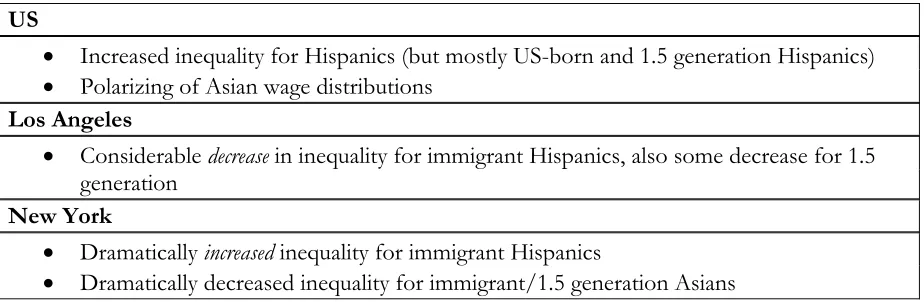
[image:27.612.86.548.192.343.2]Table 1 reviews 1990-2000 changes in New York and Los Angeles, as well as in the US overall.
Table 1 - Summary of 1990-2000 Wage Changes
US
• Increased inequality for Hispanics (but mostly US-born and 1.5 generation Hispanics)
• Polarizing of Asian wage distributions
Los Angeles
• Considerable decrease in inequality for immigrant Hispanics, also some decrease for 1.5
generation
New York
• Dramatically increased inequality for immigrant Hispanics
• Dramatically decreased inequality for immigrant/1.5 generation Asians
Understanding Decadal Changes: Gainers and Losers in Immigrant Cities in the 1990s
Relative distributions analysis can be extended to ask which groups were overrepresented
among those who gained or lost position in New York and Los Angeles in the 1990s. This is
important since part of the reason immigrants’ position improved relatively in Los Angeles is
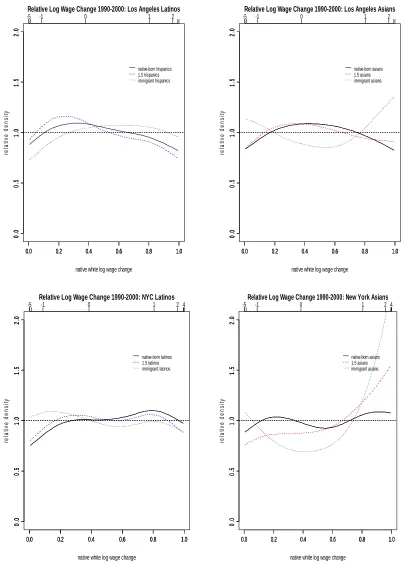
doubtless due to the downturn in wages in that labor market generally. In Figure 3, relative log
wage change is represented over the decade. In Los Angeles, immigrant Hispanics are
significantly more likely to have gained from economic shifts between 1990 and 2000 than
U.S.-born whites. This is both relative to U.S.-U.S.-born whites and also in terms of real wages, as
indicated by the log wage values on the top horizontal axis. 1.5 generation and U.S.-born
Hispanics, conversely, were overrepresented among losers in the 1990-2000 Los Angeles
economy. Again, this is probably due in large part to an increase in wage setting mechanisms
that disproportionately affected immigrants, even as the Los Angeles economy faltered and
Angeles are overrepresented among both strong wage gainers and strong wage losers, consistent
with the polarization of Asian wages in Los Angeles over this period. Curiously, though,
U.S.-born Asians display wages that were more likely to remain unchanged than those of U.S.-U.S.-born
whites. This could perhaps be because of compositional differences related to which groups left
Los Angeles in the 1990s, a possibility that points to the necessity of linking wage analysis to
internal migration during this period.
This is in stark contrast to how immigrants fared over the same period in New York.
U.S.-born Latinos are wage gainers, while immigrants are more likely to have experienced both
relative and absolute wage losses. New York and Los Angeles have differently-composed
Hispanic populations, to be sure,20 but this is further evidence that context matters not only in
terms of absolute wages but also in terms of who benefits or loses from changing economic
circumstances. Indeed, it seems likely that a strong surge of immigrant organizing and activism
around the living wage contributed to gains for immigrants at the lowest levels of the wage
distribution in Los Angeles, especially given that gains for these groups were absolute as well as
relative (when native-born groups had no such absolute gains). These gains may not translate as
well to the slightly-better paid (2nd-decile) Latino jobs. At any rate, the 1990s made clear that
Los Angeles’ institutional wage-setting mechanisms were beginning to be established very
differently from New York’s, in large part due to immigrant activism.
All Asians are strongly represented among New York’s gainers. The more selective
immigration policy of the 1990s, in which quotas for professionals were increased substantially,
may be part of the explanation here. It is important to remember, however, as demonstrated in
20 Although Puerto Ricans are excluded from these analysis, since the fact that they don’t really
panel 3 of Figure 1, that all Asians still experience greater inequality relative to U.S.-born whites
in New York. It is also important to remember that immigrant Hispanics were able to turn
economic downturn to their advantage in Los Angeles (relatively speaking), whereas Asians are
the only group faring better in 2000 than ten years previously in New York (panels 5 and 6 of
Figure 2). In fact, the vast majority of wage gains made during this decade in New York were
made by immigrant Asians.
III. Education-Adjusted Wage Distributions in Los Angeles and New York
The final question this paper seeks to determine is the extent to which wage inequality
remains after controlling for differences in educational composition between foreign-born, 1.5
generation, and US-born individuals. Again, this is an attempt to take discussions of immigrant
economic incorporation away from individual “skills packages” that garner labor market rewards
toward awareness of contextual inequality. It is obviously rudimentary, in that the only control
in this case is a 4-category measure of educational attainment.21 However, given the focus of
many researchers on the relationship between lower educational levels and wage inequality
between immigrants and natives, the following analysis provides an initial means of addressing
this correlation and assessing discrimination by controlling for the educational differences
thought to affect wages.
Figure 4 compares the wages of immigrant/1.5 Hispanics with those of US-born whites
in Los Angeles and New York in 2000.22 These are similar to earlier figures, although only two
21
The categories employed are: 1) less than high school, 2) high school diploma, 3) some college, and 4) bachelor’s degree.
22 The remainder of this paper focuses on 1.5 generation and immigrant Hispanics (by far the largest
groups are compared in these cases, and bars representing deciles of the wage distribution are
superimposed along with thesmoothed relative distributions function. In each case, the first of
the three plots presents unadjusted comparisons of wages. The second presents the same wage
comparison with the comparison group (immigrant or 1.5 generation Hispanics or Asians)
having the same educational profile as the US-born white reference group. The third plot then
reveals the residual inequality not explained by differences in educational composition. Entropy
statistics, as a measure of the differences in the two wage distributions, are provided in each
case. There are then two comparisons taking place for each city: 1) a comparison of
immigrant/1.5 generation wages with US-born white wages, and 2) immigrant inter-generational
comparisons relative to the US-born. In this way, it becomes possible to compare
immigrant/1.5 generation/racial/city differences in wages.
Panel 1 (Figure 4) compares the relative wages of immigrant Hispanics and US-born
whites. The unadjusted wage distribution in the first plot is thus identical to that in Figure 1. In
the second plot, immigrant Hispanics’ educational levels are adjusted such that they match those
of US-born whites. This counterfactual decomposition poses the question of what the relative
wages of these two groups would look like if Hispanic immigrants had the same educational
composition as US-born whites. The entropy decreases by about two-thirds from this
adjustment, from .61 to .39, such that approximately two-thirds of the difference in wage
distributions between the two groups is explained by differences in educational composition.
Residual inequality (that unexplained by education) is thus about one-third of total inequality.
More information is gleaned by comparing the shape changes of these plots. In this case, most
of the decline in inequality after adjusting for education is in the first wage decile. This is not
Here, perhaps, is evidence of what Piore (1979) termed “immigrant jobs”: the especially
low-skilled low-paid jobs at the lowest end of the labor market that are reserved especially for
immigrants and completely segregated from the rest of the workforce. This is the difference that
can be attributed to the difference in education/skills gaps between immigrants and the
US-born. If immigrants had educational profiles similar to natives, they would not be so
overrepresented in this decile. Perhaps, in fact, many of these jobs would not exist, especially in
Los Angeles (Card 2004, Ellis, Wright, and Goodwin-White forthcoming). The shape change
due to educational composition reduces immigrants’ overrepresentation in the lowest decile, and
predictably has the effect of increasing their representation in all other deciles – even the next
lowest one. The final plot then shows the difference in wage distributions remaining after
education is equalized. Immigrants are greatly overrepresented in the lowest two deciles of the
wage distribution, even after controlling for educational differences.
Surprisingly, given the fact that the 1.5 generation is largely US-educated, their
educational differences vis-à-vis the US-born continue to exert the same proportional influence
(about 1/3) on the differences between their wages and those of native-born whites (panel 2).
Inequality with US-born whites for the 1.5 generation is about half that of their parents’
generation in Los Angeles, but nearly two-thirds of the difference is attributable to educational
composition and one-third remains after adjusting for these differences. This suggests that
racialized wage structures go well beyond just the 1st generation of immigrants, as evidenced
further in the nearly identical wage positions of US-born blacks, Hispanics, and 1.5 generation
Hispanics we considered in Figure 1.
While about two thirds of foreign-born and 1.5 generation Latino inequality with
remains unexplained in New York, as shown in Panel 3. Despite similar initial entropy to Los
Angeles (.61), entropy only declines to .35 in New York, indicating that nearer to half of the
difference in overall wages remains unexplained by controlling for education. This effect is
exacerbated for 1.5 generation Hispanics in New York, as seen in the final panel, with half their
wage gap with US-born whites unexplained by educational differences. The fact that such high
residual inequality persists for those who arrived in the US as very young children, even when
controlling for educational differences, speaks to the extraordinary persistence of ethnic wage
segmenting in New York.
As with Hispanics in Los Angeles, inequality with US-born whites diminishes between
immigrants and the 1.5 generation (panel 4). Again, less of the wage gap is explained by
educational differences in New York than in Los Angeles, and nearly half remains after 1.5
Hispanics’ education is adjusted to match that of US-born whites. While this result falls short of
establishing greater discrimination in New York than in Los Angeles, it does indicate that there
are greater hypothetical returns to education (in terms of relative wage position and decreasing
gaps with US-born whites) for immigrants and their 1.5 generation children in Los Angeles.
This complements the earlier finding that race matters more for wage differentials in New York
for US-born non-whites, while disadvantage in Los Angeles is due in large part to immigrant-native
differences. 1.5 generation Hispanics are less unequal than their parents’ generation with regard
to US-born whites in both cities. There is more intergenerational social mobility in New York
than in Los Angeles, but this is largely due to the fact that their educational profile is nearer that
of US-born whites in New York. In summary, although immigrant Hispanics start out with
similar wage differentials in New York and Los Angeles, significantly more of this disadvantage
inequality persists in New York. While the 1.5 generation makes significant advances from their
parents’ generation in terms of parity with US-born whites in both cities, however, they do so to
a greater extent in New York, largely as their educational profile in that city more nearly matches
that of US-born whites.
Discussion and Conclusions
The relative distributions and comparative metropolitan area analyses of this paper
provide several insights. First, standard mean-based wage analysis comparing third generation
US-born whites with immigrant and second generation groups underestimates the persistence of
inequality (and often overestimates intergenerational immigrant economic incorporation) due to
the more polarized distributions of immigrant and second generation wages. This is especially
true of comparisons of US-born whites with Asian foreign-stock groups, such that immigrant
and second generation Asians are overrepresented with regard to US-born whites at both the
highest and the lowest ends of the wage distribution. This polarization has increased
dramatically in the last decade, such that mean wage comparisons that find this foreign-stock
group “catches up to” or surpasses native whites neglect their persistent concentration at the
bottom of the labor market. Further, the relative distribution of wages varies substantially
between US cities, such that relative position may be an important predictor in terms of
determining immigrant economic incorporation – as well as the internal migration choices that
are often seen as outcome (rather than context for) incorporation. In that labor market
may mark job segregation that has long-term consequences for inequality. The contexts of labor
market inequality vary geographically in ways that affect immigrant progress. 23
While 1.5 generation Hispanics, for example, fare better in terms of absolute wages in
New York than in Los Angeles, they are far more likely to be at the lowest end of the overall
wage distribution in New York than in Los Angeles. Further, while their wages are higher
relative to their immigrant parents in New York, and close gaps with US-born Hispanics, this is
in large part because US-born Hispanics fare so much more poorly relative to US-born whites in
New York City. Discussions of intergenerational mobility, then, must be situated in relational
contextual analyses in which race continues to play a major role in determining labor market
position even for the US-born. There is a definite “immigration penalty” (immigrants and their
children are more highly isolated from the rest of the labor force, but this isolation abates
significantly for US-born blacks and Hispanics) in Los Angeles. However, more significant
immigrant intergenerational mobility for Hispanics and Asians in New York is complicated by
an intensely persistent “race penalty”, in which all US-born groups remain more isolated from
US-born whites than in New York.
Comparison of different economic trends between cities and the US as a whole over the
period in question revealed a substantially different potential for the relative wages of
immigrants and their children. In Los Angeles, for example, where job growth stagnated during
the 1990s after booming in the 1980s (Ellis, Wright, and Goodwin-White forthcoming),
immigrant Hispanics managed to improve their (relative) position between 1990 and 2000. They
were also overrepresented relative to all other groups in terms of real wage growth (although still
earning the lowest wages), doubtless in part because of institutional changes in the wage
23 I find additional support for this argument, and link it to immigrant and 1.5 generation destination choice,
structure such as the increase in the minimum wage, immigrant unionization and the living wage
movement. In New York City, however, immigrant Asians fared relatively better in 2000 than in
1990 (despite being relatively worse off than immigrant Asians in Los Angeles), but immigrant
Hispanics fared worse over the decade, as did all non-white US-born groups.
It is likely that both changes in immigration policy and the internal migration of these
groups played a role. Relative wage distributions changed in part as higher-wage workers left
Los Angeles over the decade. Additionally, Los Angeles’ substantial job growth in the 1980s
may have provided immigrant Hispanics with entry points into the labor force that New York’s
already stagnating labor market did not (Wright and Ellis 2001). The fact that immigrants made
relative economic gains in the 1990s in Los Angeles, while US-born Hispanics made this
decade’s relative gains in New York may indicate the strengths of different wage-setting
institutional mechanisms in these two cities: largely immigrant in Los Angeles and largely union
in New York. At any rate, the different economic circumstances and racial and ethnic
configurations of inequality of US cities in the last twenty years are critical considerations in
understanding immigrant incorporation and second generation social and economic mobility.
Finally, decomposition of relative wage distributions for educational differences between
immigrant and 1.5 generation Hispanics and US-born whites yields information on the wage
returns to education and non-skill-based discrimination in different contexts. While immigration
researchers have argued that much of the mean difference between immigrant and US-born
wages are explained by differences in education (Borjas 1995, Grogger and Trejo 2002),
educational decomposition for overall distributions of immigrant, 1.5 generation, and US-born
wages falls far short of explaining wage differentials, with substantial residual differences
is persistent concentration of immigrants and their children at the lower end of the distribution.
Distributional analysis thus provides evidence of what these researchers call the “very different
labor market opportunities” available to immigrants and natives (Grogger and Trejo 2002).
More interestingly, the sizable residual wage differentials that persist after controlling for group
differences in educational composition vary geographically. While educational differences
explain almost two-thirds of the wage distribution difference between native whites and second
generation Hispanics in Los Angeles, they explain just over half of the difference between the
two groups in New York City.
As Waldinger reminds us, New York may no longer be “the promised city” for immigrants
and their children. In some ways, however, this has little to do with the labor market
disadvantage of first generation immigrants, or even their children, despite the continued
emphasis on the vastly polarized 3rd-world in the 1st-world immigrant cities discourse. New
York and Los Angeles’ lack of promise for immigrants may have as much to do with the racially
stratified local labor markets for those whose parents and even grandparents were born in the
US. Segmented assimilation theorists were right in suggesting that there are many Americas one
could assimilate into, but that none of them exactly hold equal promise for everyone. How the
children of immigrants fare may have much to do with where they locate, and the relational
inequalities that structure labor markets – such that (at least in New York) their greater gains
vis-à-vis their parents are curtailed by labor markets that are segregated racially - maintaining
distinctions from US-born white workers well beyond the second generation. Oddly enough,
questioning immigrant assimilation, and especially 1.5 generation assimilation, only lets us see
how very far we have yet to come. This is the reason that I suggest that studies of immigrant