Phare Ex post Evaluation. Phase 2, National Programmes: Bulgaria
Bulgaria
Programmes covered:
National and Cross Border
Co-operation Programmes
1999-2001 with a Brief
Review of Post-2001
Allocations.
November 2007
The views expressed are those of the MWH Consortium and do not necessarily reflect those of the European Commission.
This report has been prepared as a result of an independent evaluation by the MWH Consortium contracted under the Phare programme.
EUROPEAN COMMISSION
DG
E
NL A RGEM E NTE
VALUATIONU
N I TTABLE OF CONTENTS
GLOSSARY OF ACRONYMS
PREFACE
EXECUTIVE SUMMARY
MAIN REPORT ...1
1. INTRODUCTION ...1
1.1.Objectives ...1
1.2.Background and Context...1
1.3.Evaluation Questions ...2
2. PERFORMANCE OF PHARE ASSISTANCE...4
2.1.Limited overall achievement of Phare due to institutional and operational weaknesses ...4
2.2.Insufficient high-level commitment to a strategic approach for Phare assistance...4
2.3.Pervasive delays in contracting and implementation seriously hampered efficiency ...7
2.4.Phare institution building for acquis sectors constrained by systemic lack of administrative capacity. ...10
2.5.Reasonable immediate impact; intermediate and wider impacts weak in the absence of adequate public administration reform...12
2.6.Pre-conditions for sustainability are generally fragile and insufficiently assured...15
3. THEMATIC/ CROSSCUTTING FINDINGS ...18
3.1.Bulgaria’s pre-accession process was heavily dependent on Phare assistance ...18
3.2.Phare achievements were restrained by underperformance in horizontal PAJC...20
3.3.National preparations for Structural Funds came too late and with little enthusiasm for achievement ...22
4. CONCLUSIONS AND LESSONS LEARNED ...26
4.1.Conclusions...26
4.2.Lessons Learned ...27
4.3.Recommendations...30
ANNEXES...34
Annex 1. Terms of Reference...35
Annex 2. Phare National and CBC Programme Data for Bulgaria 1999-2004 ...40
Annex 3. Evaluation Planning Summary Sheet...45
Annex 4. Evaluation Indicators ...51
Annex 5. Sample projects – Financial data and results ...55
Annex 6. Additional Sectoral Information ...67
Annex 7. Legislative, procedural and institutional changes in the environmental sector...69
Annex 8. Processing delays with development and approval of project fiches...72
Annex 9. List of Documents...73
GLOSSARY OF ACRONYMS
acquis acquis communautaire
AP Accession Partnership
CAP Common Agriculture Policy
CARDS Community Assistance for Reconstruction, Development and Stabilisation
CBC Cross Border Co-operation
CC Candidate Country
CFCU Central Finance and Contracting Unit
CMR Comprehensive Monitoring Report
CPER Country Phare Evaluation Review
DG Directorate General
DIS Decentralised Implementation System
EDIS Extended Decentralised Implementation System ERDF European Regional Development Fund
ESC Economic and Social Cohesion
ESF European Social Fund
EU European Union
FM Financing Memorandum
IA Implementing Agency
IACS Integrated Administration Control System
IB Intermediate Body
IE Interim Evaluation
IPAEI Institute of Public Administration and European Integration ISPA Instrument for Structural Policies for Pre-accession
JHA Justice and Home Affairs
JMC Joint Monitoring Committee
JPD Joint Programming Document
M€ Million Euros
MAP Multi Annual Programming
Matra Dutch programme for social transformation (maatschappelijke transformatie) in
Central and Eastern Europe
MEUFD Management of European Union Funds Directorate
MoE Ministry of Economy
MoEW Ministry of Environment and Water
MoF Ministry of Finance
MLSP Ministry of Labour and Social Policy
MS Member State
NAC National Aid Co-ordinator
NARD National Agency for Regional Development
NDP National Development Programme
NGO Non-governmental Organisation
NIJ National Institute of Justice
NMS New Member State(s)
NPO Non-profit Organisation
PAA Pre-accession Adviser PAJC Public Administrative and Judicial Capacity
PCM Project Cycle Management
PIFC Public Internal Financial Control PIU Programme Implementation Units
PMC Phare Management Committee
RR Regular Report(s)
SAPARD Special Accession Programme for Agriculture and Rural Development
SF EU Structural Funds
SME Small and Medium Size Enterprise(s) SMSC Sectoral Monitoring Sub-Committee
SOP Sectoral Operating Programme
ToR Terms of Reference
USAID United States Agency for International Development
VAT Value-added tax
PREFACE
The purpose of this ex post evaluation is to assess the contribution of the 1999-2001 Phare
national and cross-border co-operation (CBC) programmes to supporting Bulgaria in meeting the Copenhagen criteria so as to facilitate its accession to the European Union. This is an in-depth evaluation which also includes an analysis of post-2001 allocations.
This report has been prepared between December 2005 and June 2006,1 and reflects the
situation where the Phare national Programmes in the 1999-2001 period have substantially ended. The evaluation is based on an analysis of documents provided at the start, during and on completion of the national Programmes, including previous interim evaluations, on the results of questionnaires, and on interviews with beneficiaries, contractors, and stakeholders. It examines the performance of the programmes in addressing the objectives stated in the formal programming documents, provides a general assessment of the programmes and draws conclusions and lessons learnt from them.
The evaluation of Bulgarian national and CBC programmes is one of a series of ten evaluations in the new member states. The evaluations of the eight new member states in 2004 will feed into a consolidated evaluation of Phare national and CBC programmes, which, together with the in-depth evaluations of Romania and Bulgaria, will form part of a consolidated ex post
evaluation of the Phare programme.
1 The initial draft was prepared by Colm Dunne and finalised by Ann Hyde, Lead Evaluator. It was reviewed at MWH
EXECUTIVE SUMMARY Scope and objectives
The purpose of this ex post evaluation is to assess the contribution of the 1999-2001 Phare
national and cross-border co-operation programmes to supporting Bulgaria in meeting the Copenhagen criteria in order to facilitate its accession to the European Union. A review of post-2001 programmes is also provided. The overall objective of this evaluation is to provide accountability with respect to the use of European Commission funds, and lessons learned for decision-making on improvements to pre-accession aid for remaining and future candidate countries.
Key Evaluation Findings
Limited overall achievement of Phare due to institutional and operational weaknesses.
Phare offered a valuable opportunity to accelerate progress towards accession, but this was not fully utilised. Although programme relevance and design were stronger in acquis-related
sectors and much of the assistance was concerned with legal approximation and the creation of new structures for those sectors, the strategic approach was weak on the Bulgarian side. Institutional capacity for problem analysis and objective setting was generally inadequate or absent and most Bulgarian administrations were under-resourced in terms of human resources, equipment, sectoral knowledge and experience, which made it difficult for them to cope with the Phare environment and contributed to poor project readiness and an overall impression of operational fatigue. Despite a substantial number of Phare interventions related to the modernisation of public administration, this lack of institutional capacity combined with widespread resistance to change has meant that Phare institution building interventions have at the same time overloaded the administration and consistently under-performed. The stalled reforms of the judiciary and of public administration further undermined both effective use of Phare assistance in all sectors and the sustainability of the results.
Performance varied significantly across different sectors. Overall, too many programmes and projects suffered from weaknesses in design and widespread inefficiencies in implementation which led to delayed impact or loss of funds (particularly in the CBC and transport sectors). Moreover, the systemic lack of institutional absorption capacity was a continuous threat to efficient implementation for all capacity building interventions. Nevertheless, in the internal market, agriculture, public finance - and particularly environment – sectors, Phare effectively supported the creation of technical and procedural systems to apply and enforce the newly transposed EU acquis.
Programme relevance and design were stronger in acquis-related sectors, but the strategic approach was weak on the Bulgarian side. Where acquis requirements were precisely
partner country in certain instances led to project failure. In many cases, the main actor deciding where Phare CBC investments should be made was the Commission, rather than the Bulgarian authorities which, while understandable, did nothing to encourage national ‘ownership’ and created a negative image and perception of Phare CBC assistance.
Reasonable immediate impact; intermediate and wider impacts weak in the absence of adequate public administration reform. The immediate impacts achieved from specific
interventions were generally good in relation to the enactment of legislation and the establishment of new institutions and operational proceduresin acquis areas such as agriculture
and environment (though these impacts required disproportionate administrative effort and were almost always achieved much later than originally planned). In the other sectors, such as the accession driven sectors of CBC and social affairs, immediate impact was sometimes weak or missing. Intermediate impacts from support in the earlier period have recently begun to emerge in some acquis-related sectors, and in some other areas such as the fight against money
laundering. However, lack of progress in public administration reform, with frequent changes in staff and late implementation, have substantially constrained the intermediate and wider impact of Phare assistance in Bulgaria. Impact measurement and monitoring systems are weak, which makes assessment problematic.
Pre-conditions for sustainability are generally fragile and it is therefore insufficiently assured. Programmes were mostly implemented in the context of a largely unreformed public
administration which suffered from insufficient administrative and absorption capacity, high turnover of personnel, low salary levels and the widespread under-resourcing of Phare-related tasks. In consequence, prospects for sustainability, especially of institution and capacity building, are poor. In the recent past, measures have been adopted by some ministries to increase the salary levels and to enhance the working conditions of public servants, and this should go some way to improving sustainability of know-how and to strengthening the capacity of public institutions.
Delays and late contracting seriously hampered operational efficiency. Implementation
delays were principally caused by inadequate staffing levels in the implementing agencies; the time taken to approve documentation, and overall lack of management responsibility in the contracting process. The Bulgarian public administration is weak, inexperienced and under-staffed. Practical improvements were made in management structures from 2002 onwards, and increasing programme ownership has improved the commitment to Phare. Twinning was generally successful, but there was insufficient use of grant schemes, especially to support preparation for Structural Funds at an early enough stage in the pre-accession period.
Conclusions
Conclusion 1: Institutional and operational weaknesses constrained overall achievements.
Programme design had clear and direct links to the closing of acquis chapters and to building
capacity to take on the obligations and opportunities of EU membership. An appropriate mix of Phare instruments was used. In the earlier period, much of the effort was concerned with legal approximation and the creation of new structures and, by 2004, outputs achieved reasonable immediate impact especially in the acquis-driven sectors.
However overall performance was limited due to many negative influences, including a non-existent or weak strategic approach, especially in the non-acquis areas; serious operational
management capability to pursue a modernising agenda. Some progress has been made since 2004, but it is not dynamic or widespread enough to compensate for the time lost or to complete preparations to take full advantage of the opportunities of EU membership from the date of accession.
Conclusion 2: More assistance should have been given, earlier, to embedding a strategic approach to national and sectoral policy making.
Individual Phare programmes have contributed to the creation or modernisation of acquis
-related structures and procedures in Bulgaria, and have catalysed progress through the provision of staff training, equipment and other capital items.
However, the lack of strategy has inevitably been disadvantageous, most importantly for issues arising under the political criteria, such as reform of public administration and judicial reform where there is neither acquis nor a standard template to build on, and those issues where the acquis absolutely requires, but does not define, a national strategic framework covering the
areas of responsibility of a number of ministries, such as economic and social cohesion.
Conclusion 3: Phare support was crucial to initiate public administrative and judicial reform but very little progress was made.
Phare support was a crucial factor to kick-start the process of public service reform. Although some progress was made in a number of key sectors and in some key institutions, the breadth and depth of change was not sufficient to have an influence across the public sector. There is no visible high-level commitment to the reform process, and what has been achieved has been a slow and intermittent process of change.
A number of permanent institutions were created, crucial to provide the framework for guiding public and judicial reform, but inadequate human resource management and investment in human capital has seriously constrained administrative and judicial capacity, and thus progress in all sectors. Bulgaria could make the necessary resources available but has not seen the value of making this deployment or indeed of the reform process.
Conclusion 4: Support to building the management structures for Structural Funds was not enough to alleviate serious institutional weakness.
The general neglect and lack of investment, particularly in municipalities and other potential local partners, coupled with failure to develop the structures necessary for the management and administration of Structural Funds, has meant that Bulgaria is unprepared to benefit appropriately from the socio-economic opportunities that these Funds offer to Member States.
Recommendations
Strategic recommendations
Recommendation 1: Future programming of assistance should be strategy-based.
Assistance should not be started until the relevant national or sectoral strategy is in place to provide a secure basis of information about needs and capacities to enable the Commission and the national authorities to set the priority, sequence, balance, content and pace of assistance. The only exception should be comprehensive EU assistance to such strategy development and project cycle management throughout the public administration concerned, centrally and regionally.
In planning for assistance, the balance of support to public administrative and judicial capacity and other aspects of the political criteria and to acquis chapters, and the balance of support
across the acquis chapters, should take account of the relative difficulty that recent candidates,
including Bulgaria, have found with the issues concerned.
Recommendation 2: The preparation of Multi-annual Indicative Planning Documents for the Instrument for Pre-Accession and of national strategies should take full account of lessons learned from Phare.
In order to maximise the value-added of Multi-annual Indicative Planning Documents as a needs’-based strategic document, a checklist should be prepared by the Commission Services, and used by those responsible for programming, of the lessons learned from Bulgaria (and other recent candidates). Priority points are the need to assess country resources and capacities and adapt the extent and pace of programming to absorption capacity, and to progress public administrative and judicial capacity reform in step with acquis institution building. Candidates
should also be assisted to develop their own multi-annual strategies, both for investments and for administrative structures and human and financial resources, and this should be an essential pre-condition before assistance is given to Structural Funds-type operations.
Recommendation 3: Public administration and judicial capacity assistance should be given from the start.
From the start of pre-accession assistance, and throughout the pre-accession period, a high priority should be afforded to assistance to improve public administrative and judicial capacity, throughout the pubic administration, centrally and regionally, to avoid the pervasive undermining of the sectoral impact of Phare assistance observed in Bulgaria.
Operational recommendations
Recommendation 4: There should be full involvement of stakeholders in an effectively scaled programming process. The prospects for successful assistance depend of those
Recommendation 5: There should be greater investment and stronger commitment to administrative and judicial reform for the remainder of Phare and Transition Facility assistance.
This evaluation has clearly demonstrated the pervasive and debilitating consequences of weak public administration. If the current overload on the national administration is not to persist for the remainder of the Phare and Transition Facility periods, urgent reconsideration is needed of what can be realistically achieved, and a specific and comprehensive public administrative and judicial capacity strategy and assistance action plan should be prepared by the Commission Services and the Bulgarian national authorities together, taking account of measures already in hand.
Recommendation 6: Concerted effort needs to be made to address and minimise the recurring delays that occur in the contracting and implementation processes.
The protracted timescales in the contracting process and other implementation delays have become endemic and, in many cases, have significantly reduced the achievement of objectives, impact and sustainability. Much more effort should be applied to project start-up and pre-contract preparatory activities as well as better management of slack time and stricter enforcement of document processing deadlines to reduce delays and to generate and maintain momentum in implementation. The National Aid Co-ordinator should encourage beneficiaries not to wait for final approval before starting preparation of necessary documents.
Recommendation 7: More and better training is needed on the subjects associated with effective strategic planning.
The Commission Services, in agreement with the Bulgarian authorities, should provide resources to develop comprehensive training in strategy development and implementation. For better sustainability of training effort, support should also be offered to develop the market place provision for human resource development training to build competences in key areas like policy analysis, monitoring and evaluation.
Recommendation 8: Good practice and lessons learned from Phare programming and implementation should be more widely applied.
The Bulgarian administration should ensure that the project cycle management approach, in particular the needs’-based problem analysis techniques for setting desirable and attainable objectives, is applied rigorously in every ministry to optimise the value added of national and EU resources. The prospects for sustainability should be realistically assessed at design stage and provisions included in assistance to maximise the probability of sustainability.
Much more attention should be paid to setting indicators that relate to achievement of objectives and impact that can be used as management tools. Regular, formal assessment of the extent to which agreed indicators are being achieved should be built into Joint Monitoring and Sectoral Monitoring Sub-Committee procedures.
Similarly, those with responsibilities for programming should ensure that cost-effectiveness indicators are defined before approving investments in infrastructure, and they need to be measured after the assistance is completed and the newly built infrastructure becomes operational. Otherwise the only measurement of success is the completion of the works per se,
Recommendation 9: Co-ordination between beneficiaries should be further improved; especially between those in the national administration and in the Commission Services responsible for assistance management.
This co-ordination has a major effect on the functioning of Phare assistance through its various phases. The particular elements that could be considered jointly by the Commission Services and National authorities are a better communications mechanism, including use of an intranet between the various parties, improved networking between the parties (with more emphasis on
ad hoc meeting and less on formal correspondence) to resolve routine difficulties more quickly
MAIN REPORT
1. INTRODUCTION
1.1. Objectives
1. The purpose of this ex post evaluation is to assess the contribution of the 1999-2001
(“earlier period”) Phare national and cross-border co-operation (CBC) programmes to support Bulgaria in meeting the Copenhagen criteria in order to facilitate its accession to the European Union. The evaluation also includes an analysis of post-2001 allocations (“later period”). The evaluation of the Bulgarian national programmes is one of a series of ten similar evaluations in the ten candidate countries (CC). The results of this evaluation will feed into a consolidated
ex post evaluation of the Phare programme. 1.2. Background and Context
2. The key objectives of the Phare Bulgarian national and CBC programmes during the period under review were to provide assistance in the following areas:
• Support public administration reforms, the judicial system, anti-corruption measures and protection of minorities;
• Support economic reform including financial intermediation,2 small and medium-sized
enterprises (SME), reduction of state aid, and simplification of licensing procedures.
• Enhance the administrative and judicial capacity to implement and enforce legislative measures and assume the obligations of EU membership.
• Improve the strategic planning and effective utilisation of EU funds and prepare for Structural Funds (including implementing the Extended Decentralised Implementation System, EDIS).
3. National and CBC programmes provided about M€ 331 during the evaluation period (1999-2001).3 Total post-2001 allocations until 2004 amounted to approximately M€ 560.4
The key sectors of assistance were economic and social cohesion, public administration, including adoption of the acquis and justice and home affairs (JHA)/civil society. CBC
projects represented 26% of the funding. A summary of the Phare programmes from 1999 to 2004 is set out in Annex 2.
4. Bulgarian national programmes have been subject to regular interim evaluations (IE). A Country Phare Evaluation Review5 (CPER) pointed to good progress in the harmonisation of
Bulgarian legislation with the acquis, although the effective implementation of harmonised
legislation appeared to be generally some way off. The CPER highlighted that institution building projects had limited success due to their lack of relevance to the commitment and absorption capacity of beneficiary institutions and that efficiency, effectiveness and sustainability of Phare assistance were negatively affected by continuing high rates of staff turnover in key Phare implementation structures. Phare interventions were expected to have a positive impact in the long term although it was not possible, when the CPER was prepared, to
2 The collection of savings and the loaning out of the proceeds to others.
3 See Annex 2 for details. The programmes to be evaluated include the so called Other Financing Memoranda, which were
implemented by national authorities and subject to previous interim evaluation, but excludes Community and nuclear safety programmes. Bulgaria benefited from Phare-funded multi-beneficiary programmes, such as TAIEX and SIGMA, which are also outside the scope of this evaluation.
4 This figure includes some special allocations, e.g. for the decommissioning of nuclear plants, which are excluded from the
scope of this evaluation.
assess the extent to which the achievement of wider objectives could be attributed to Phare or other factors.
5. The 2005 Comprehensive Monitoring Report (CMR) stated that Bulgaria had reached a considerable degree of alignment with the acquis in most areas,6 but demanded increased
efforts in many other areas to complete preparations for accession; such as air and maritime transportation; taxation; labour law, social dialogue, public health, anti-discrimination and social inclusion. The report expressed serious concerns about institutional capacity and the efficiency of public administration in general, and specific areas such as controls in the agriculture sector, including the Paying Agency and the integrated administration control system (IACS), and institutional structures and financial management and control in the area of regional policy. The report demanded urgent action in the justice and home affairs sector, including management of EU external borders, preparation for the application of the Schengen
acquis, police cooperation and the fight against organised crime and fraud.
6. The 2006 CMR noted further progress towards the preparations for membership, with a high degree of alignment with the acquis in most areas. However, the Commission identified
areas of continuing concern, where it would initiate appropriate measures to ensure the proper functioning of the EU, unless Bulgaria took immediate corrective action. The areas that require further work include the financial control, the justice system, fight against corruption, police cooperation, the fight against organised crime, money-laundering, IACS, and transmissible spongiform encephalopathy (TSE). The CMR referred to the acquis-based
safeguard measures laid down in the Accession Treaty that will, if necessary, be maintained after accession. These include:
• A mechanism for cooperation and verification of progress in the areas of judicial reform and the fight against corruption, money-laundering and organised crime, which will be set up by the Commission, after consultation with Member States;
• The necessary legal provisions to ensure the proper management of EU agricultural funds, already adopted by the Commission;
• In the area of food safety, certain animals and animal products may not be exported to the EU from Bulgaria because of the presence of animal diseases;
• In the area of aviation safety, particular measures will be needed for Bulgarian aircraft and carriers.
1.3. Evaluation Questions
7. This evaluation focuses mainly on the outputs produced by the national and CBC programmes for Bulgaria. It assesses the impact and sustainability of these outputs. The evaluation also assesses the effectiveness and efficiency of the contribution of the national and CBC programmes towards the actual performance of services in the beneficiary country, taking into account EU standards as benchmarks where relevant.
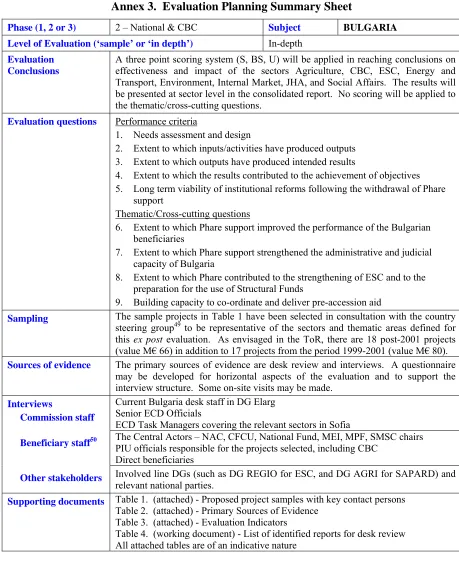
8. Evaluation questions were established in a Terms of Reference (ToR) for the evaluation, and these were divided into performance evaluation questions, and thematic/cross-cutting questions (see Annex 1). The methodology is also given in the ToR in Annex 1. This evaluation is in-depth, and includes not only a retrospective assessment (the ex post evaluation
of the 1999 – 2001 programmes) but also interim evaluation of post-2001 allocations.
9. Following a sampling approach, a number of example projects were selected by the Steering Group for this evaluation7 covering the following eight sectors: agriculture, cross
border co-operation, economic and social cohesion, energy and transport, environment, internal market, justice and home affairs and social affairs. As the scope of this evaluation was in-depth, the sample of projects included post-2001 allocations. The sampling approach enabled conclusions on impact and sustainability at sectoral level to be based on the most recent experiences of Phare assistance and the current position in the Bulgarian administration. An evaluation plan summary is given in Annex 3 and the reference evaluation indicators are given in Annex 4. Details of the sample projects referred to in the evaluation are set out in Annex 5, including a summary of their operational results.
7 The Steering Group consisted of representatives of the Evaluation Unit of DG ELARG, the country team in DG ELARG,
2. PERFORMANCE OF PHARE ASSISTANCE
10. This chapter examines the overall performance of Phare national and cross-border co-operation programmes in the 1999-2001 period, and reviews the continuation of Phare assistance in the post 2001 period. It assesses sectoral performance by reference to the performance evaluation questions set in the ToR (see Annex 1). These require a methodical consideration of needs’ assessment and design, inputs, outputs, levels of impact and sustainability.
2.1. Limited overall achievement of Phare due to institutional and operational weaknesses
11. Although Phare offered a valuable opportunity to accelerate progress towards accession, this was not fully utilised. Programme relevance and design were stronger in acquis-related
sectors and much of the assistance was concerned with legal approximation and the creation of new structures. However, the strategic approach was weak on the Bulgarian side. Institutional capacity for problem analysis and objective setting was generally inadequate and there was a shortage of internal resources to develop sectoral plans in many line ministries.
12. Performance varied significantly across different sectors. Overall, too many programmes and projects suffered from weaknesses in design and widespread inefficiencies in implementation which led to delayed impact or loss of funds (particularly in the CBC and transport sectors). Moreover, the systemic lack of institutional capacity was a constraint for all capacity building interventions. Nevertheless, in the internal market, agriculture, public finance - and particularly environment – sectors, Phare effectively supported the creation of technical and procedural systems to apply and enforce the newly transposed EU acquis.
13. The stalled reform of the judiciary and public administration undermined both the effective use of Phare assistance in all sectors and the sustainability of the results. There have also been capacity absorption issues with some aspects of the proposed reforms. Some progress was made since 2004, but not dynamic or far reaching enough to compensate for lost time or to close the gap in preparations to be ready to take full advantage of the opportunities of EU membership from the moment of accession.
2.2. Insufficient high-level commitment to a strategic approach for Phare assistance
14. This section examines the needs’ assessment and design of the Phare programmes in the 1999/2001 and post-2001 reference periods. It focuses on the extent to which the objectives/strategies of the national programmes identified the needs and the involvement of the stakeholders in the design (ownership). The key considerations were the adequacy of underlying strategies (clarity of objectives set and availability of needs’ assessment), and the degree of consultation with stakeholders.
15. The sectors supported by Phare fall into two groups, ‘acquis driven’ and ‘accession
driven’. The former have highly specific requirements with a direct link to the closing of the
acquis chapters. These included agriculture, environment, energy and transport, internal
market and economic development/finance. The second group of sectors supported the progress towards accession, that is, acquis chapters with less clearly defined requirements, or
Box 1: Sectoral strategies did exist for some sectors The environmental sector strategy was relevant for
the pre-accession years as a guide for meeting acquis requirements through the enactment of primary and secondary legislation. However, long-term relevance beyond the provisions of the acquis is limited. Although sustainable development is a key issue, it has not been reflected in the direction or design of Phare assistance.
In the justice sector, a strategic approach is pushing
the reform process. Earlier diagnostic reviews concluded that the sector was unreceptive to modernisation and was corrupt in many areas. A 2000 SIGMA report drew attention to profound weaknesses in the sector. USAID, in partnership with Matra, developed a reform strategy that, together with the preparation of a detailed action plan, provided the direction and pathway for Phare support.
16. Where sectoral strategies did exist they arrived very late in the pre-accession period
and did not attract sufficient commitment to offer the context and priorities for programming. The concept of creating long-term overarching ‘strategic’ documents to provide the context for Phare assistance has not yet been fully taken on board in Bulgaria. Strategic documents created internally have had very little, if any, effect on programming over the pre-accession period.
17. Some sectors developed strategies with Phare assistance in the earlier period (e.g. environment, justice and public finance sectors, see Box 1), but there was not enough high-level inter-ministerial commitment behind these strategies to support sound multi-annual programming. In addition, the recurrent restructuring and frequent personnel changes in the Bulgarian public administration made it difficult for strategies to remain relevant for any length of time. Bulgaria, like many of the CCs before it, looked to the acquis and other
external strategic documents to provide the context and direction for Phare programming.8
18. Highly-specified requirements of the acquis provided a good base for programming.
The annual programming priorities for Phare in Bulgaria emerged out of a process of negotiation between Commission representatives and from a gap analysis of the findings and recommendations contained in the Commission’s annual report on Bulgaria’s progress towards accession.9 In the acquis-driven sectors, programme design was tied to accession priorities
and the overall objectives were usually stated in terms of meeting the objectives of a relevant chapter of the acquis. There was a clearer sense of direction and a verifiable endpoint.
19. Much of the assistance in acquis driven sectors was concerned with legal approximation
and support to the creation of new structures, and for the enforcement of regulatory obligations. For example, the Accession Partnership (AP) priorities for the environment sector are related mainly to legal approximation and to developing the enforcement capacity and the assistance focused on these priorities. Similarly, in the internal market sector, Phare support has been directed towards the stated accession priorities and has focused on institution building and legal approximation.
20. It was less clear how to programme support in the accession-driven sectors. In the
accession-driven sectors, where there should have been complementarity between the Phare priorities and a strategically defined policy framework, based on in-country analysis and prioritisation of identified need, the direction was much less apparent.
21. Programme design in the accession-driven sectors in the earlier period was weakened by a combination of inexperience of the national counterparts and weak political commitment to
8 Consolidated Summary Report, “From Pre-Accession to Accession - Interim Evaluation of Phare Support Allocated in
1999-2002 and Implemented until November 2003”, March 2004.
Box 2: Weak strategic commitment to CBC
The Joint Programming Document (JPD) provides the framework for CBC assistance, which should be prepared by the lead ministry in close cooperation and partnership with local actors, for example municipalities and locally based organisations from both sides of the border. However commitment to planning process was limited and there was no real needs’ analysis at local level to support the JPD. The proposals submitted by municipalities had little or no foundation in local economic development plans developed on the basis of based proven need. In many cases, interviewees stated that the main actors deciding where Phare CBC investments should be made was the EC headquarters and ECD, rather than the Bulgarian authorities in the border regions.
the reform agenda being offered by Phare for these sectors (see Box 2). The expertise of final beneficiaries in the use of the technical
toolkit for studying needs, identifying problems and converting them into coherent sectoral responses was limited. The identification of real need was often vague. The analytical information and the systems to supply the necessary data to support programme design were limited within the state administration. The institutional structures and the expertise to support the development of a policy framework at national and regional levels were limited and the mechanisms to involve municipalities in economic development planning were largely missing.
22. In the later period, since 2002, programme design in the accession-driven sectors has begun to improve due to the availability of key strategic planning documents like Agenda 2000
for ESC, and the 2002 Roadmap,10 which contributed to a better focus and understating of
horizontal issues like public administration and judicial capacity (PAJC). Two key Bulgarian strategies (Strategy for the Modernisation of the Public Administration and Strategy for Reform of the Bulgarian Judiciary) were approved in 2002. Experience and prior lessons have been more constructively utilised and as the expected deadline for accession approached, there was more investment and attention in these areas of intervention.
23. Insufficient involvement of stakeholders in the programming process. Programming of
Phare assistance has been a centrally-driven process controlled by the National Aid Co-ordinator (NAC) in Bulgaria. Until recently, the process used to select and approve proposals for inclusion in the Phare programme was subject to some criticism both from applicant line ministries and some task managers in the ECD for its lack of transparency and for the exclusion of stakeholders in the decision-making process. After line ministries submitted proposals for inclusion in Phare programmes, final decisions were made internally within the NAC without open participation or consultation with line ministries. The ECD and line ministries were generally unclear about why certain proposals were accepted and others were rejected, which led to a feeling of detachment in many line ministries. Recently the NAC has tried to make the process more open and inclusive, and has begun informing line ministries which projects have been rejected and the reasons for rejection.11
24. Multi-annual programming provided limited improvement. Multi-annual programming
(MAP) was introduced in 2004, but it has not been possible to maximise the full potential of this approach because the multi-annual framework has retained a strong reference to the annual programming process, and in many areas there was a lack of adequate strategic documentation (see 21). Every year either a new phase of a project or the continuation of the earlier phase has
10 Communication from the Commission to the Council and the European Parliament, Roadmaps for Bulgaria and Romania,
November 2002.
11 In its comment on the draft version of this report, the NAC stated that the decision-making/project selection process has
Box 4: Delays in project fiche preparation Basic changes to a project fiche took up to two months to be approved by the ECD. More substantive changes took much longer (e.g. a change to the project evaluation list for ecotourism to avoid a conflict of interest took 6-9 months). There were no agreed timescales for acceptance that might have improved the efficiency of the approval process. There appeared to be little or no follow-up when a change request was submitted. The approval procedure involved many non-value added steps (that is several iterations or exchanges of documents to resolve issues). Even at this late stage, there is a case for revising co-ordination arrangements to speed up approval processes.
to be programmed and incorporated into the Financing Memorandum. Opinions about the MAP are mixed. Some consider that while the idea for MAP is good on paper it is difficult to put into practice. Others praised the concept as it helped to reinforce the need to think in terms of a longer term sectoral perspective (the absence of which had been a criticism of annual planning) and place a higher weight on the specific purposes (immediate impact) and broader results (intermediate impact) of assistance rather than just on outputs. The preparation of a multi-annual sectoral fiche was viewed
as a useful preparation for the planning for Structural Funds (SF).
25. Programme planning was often out of date when the proposal was being included in a Phare programme. For large infrastructure projects in the environmental, transport and CBC
sectors, the pre-programming preparation was weak and many of the projects were based on out-of-date proposals supported by over-simple feasibility studies in terms of location, budget and technical relevance. As a consequence the design of projects had to be realigned and amended after the Financing Memoranda (FM) were signed to guarantee sectoral relevance and viability (see for example, Box 3). However, awareness did grow over time and the situation began to improve in the later period.
2.3. Pervasive delays in contracting and implementation seriously hampered efficiency
26. In this section, the efficiency with which inputs/activities produced outputs is considered. The criteria used included rates of commitment and disbursement of funds, implementation scheduling, the visible quantification of output, the relative cost effectiveness of programmes, and the choice of implementation method (twinning, technical assistance, or grant schemes).
27. Project management capacity across Phare administration was weak. Efficiency relies
heavily on the capacity of the implementing bodies and the ECD, and co-ordination between all the actors. Overall project management capacity was generally poor in both the earlier and later periods. This was compounded by resource shortages, for example at the Central Finance and Contracting Unit (CFCU) up to 2004, and scarcity of reliable operating data, which continues up to the present. The result is a
predominantly reactive approach to situations, rather than a proactive one that anticipates the actions required for forthcoming interventions. There were major delays and significant time lags between programming and implementation. In most situations, very little was done to prepare for future projects.
28. Major causes of delays were the lengthy procedures for processing basic modifications to project fiches and the fact that preparation of programming documents only started after signature of the FM (see Box 4). An analysis
of the times to process project fiches in a small sample of projects (see Annex 8) showed delays ranging between 33 days and 154 days. There was also a very rigid adherence to regulations, which is commendable but in many ways this was at the expense of efficiency.
29. Late contracting was extensive, and there was no real management of the problem.
Late contracting was very common, and there is a local view that this was exacerbated by the timing of the signing of the FM. In pre-2004 programmes,12 the date of signing the FM
coincided with the contracting deadline for the previous year when staff resources at the CFCU and in the ECD were stretched to full capacity. The stress of completing one year led to a lull in the subsequent period and momentum did
not pick up again until the next contracting deadline approached. The effect of the delays in the completion of the 2004 programming has been to create a significant overlap in the contracting schedule for Phare 2004 and Phare 2005 projects. Serious efforts were made in early 2006 to complete the contracting in an orderly fashion and to avoid the contracting crush as the deadline approached.
30. The “last minute” approach to contracting meant that in most cases implementation periods were reduced (see Box 5),13 that the process was unnecessarily
hurried, and that there was no scope to re-tender, if no suitable application was received, or to re-allocate resources if the costs were lower than originally anticipated. Although all of the central actors share some
responsibility for the delays, the under resourcing of the CFCU until recently and the timelines for approval procedures in the ECD were dominant contributing factors. However, no single organisation is managing the timetable leading up to contacting and no single official takes absolute responsibility to ensure that the allocated Phare assistance is disbursed. The lack of supporting information confirms an overall lack of management responsibility for the contracting process.14
31. The multi-annual approach created additional pressure which compounded the already
severe contracting inefficiencies. The first phase of the multi-annul programme was mostly delayed, which caused a build up of pressure in the second year to finish Phase 1 but also to move into and to complete Phase 2. For example, in 2004, the adoption of the FM took eight months which meant that all the multi-annual implementation timetables were out of date from the outset. The knock-on effect of this was widespread requests for implementation extensions to complete the first and second phases. These delays affected the 2006 FM and resulted in reconsideration of the viability of the third multi-annual phase.
12 From Phare 2004 onwards, there were three FMs signed in each year. Early September 2004 (contracting November 2004),
the main part in February 2005 and a final component in May 2005.
13 In one project, the implementation period was reduced to 17 months of which over 50% was allocated to contracting. 14 Attempts were made during the evaluation to investigate the late contracting process in detail, but this was not possible
because the CFCU was unable to provide basic management information about the progress of contracting for the projects included in the evaluation sample.
Box 5: Delays in the contracting process
• According to the CFCU the main cause of delays is in the preparation and approval of tender dossiers. Much of the delay is in the time required for ECD approval for this process where in many cases independent experts are hired to review the documentation.
• The CFCU considers that 80% of projects approved by them are ready to go – but then even small, and possibly unnecessary changes required to the project fiche can take considerable length of time.
• Alterations appear at different times. There are cases where as soon as one change is approved the need for another one will emerge;
• Requests for changes can halt the process – work does not continue on the assumption that the change will be approved;
32. Inefficiencies and shortening of implementation time limited effects of Phare support.
While there have been some notable successes in some areas, inefficiencies and shortening of implementation time have limited the effects of the Phare support. Late contracting and inadequate responses to tenders resulted in loss of funds in some sectors.15 For many IT
projects, late contracting in a rapidly changing environment meant that specifications and requirements became out-dated. Results of
capacity building support (particularly staff development and the introduction of new internal procedures) were also reduced by shortened implementation times. Although significant effort and resources were directed towards delivering project outputs, there is a limit to how much new information can be absorbed in a short period of time (see Box 6).
33. Limited absorption capacity was a continuous threat to efficient
implementation. Most Bulgarian
administrations were under-resourced in terms of human resources, equipment,
sectoral knowledge and experience, which made it difficult for them to cope with the Phare environment that was generally complex and bound by bureaucratic procedures requiring inputs from many individuals. Staff were overworked with the lengthy contracting processes, and under significant pressure to deliver high-quality outputs. This gave an overall impression of operational fatigue. Although in recent times some steps have been taken to improve the conditions of service for public servants, the effects of these are not yet apparent, and absorption capacity is still an area of concern.
34. Practical improvements were made in the Phare management structures from 2002 onwards. The transfer of the National Aid Co-ordinator (NAC) to the Management of
European Union Funds Directorate (MEUFD) of the Ministry of Finance (MoF) was an important change and it had the desired effect of tightening up and improving the management of Phare. There were improvements in the management of co-financing and more recently the National Fund (NF) has been in a position to front load project start-up if EU funding was late and provide supplementary finance should an unanticipated expenditure or gap in the budget arise during implementation. This has helped to improve the efficiency of implementation in the later years and in some cases has circumvented project fiche amendments. It does however suggest an inadequacy in co-ordination of project and budget planning procedures.
35. Increasing programme ownership has improved commitment to Phare. The
consolidation of monitoring arrangements through Sectoral Monitoring Sub-Committees (SMSCs) and the Joint Monitoring Committee (JMC) was set in place from 2002 onwards. The key effect of this has been that that Phare is no longer thought of in terms of an external donor and the increased ownership of the programmes by the Bulgarian ministries has been an important change. Similarly the introduction in 2004 of monthly monitoring meetings organised by the NAC and the SMSC Secretariats, involving the ECD, implementing bodies,
15 For example, in the agriculture sector some € 348,000 worth of phytosanitary equipment could not be contracted and one of
the supply lots failed, resulting in a loss of resources.
Box 6. Limited output in capacity building
NF and all beneficiaries has been an important factor that has gone some way to improving implementation efficiency and to strengthen co-ordination between the relevant stakeholders. While these changes have provided a much-needed boost to the overall management of Phare activities, the extent of the backlog of development that had accumulated by 2004 has placed a considerable burden on the central co-ordinating institutions.
36. Choice of implementation instrument was mostly appropriate, but grant scheme projects have not always followed needs. Twinning was generally successfully used in
legislation harmonisation and institution building in the public institutions, and TA has tended to be used for interventions requiring specialist input. Between 1998 and 2003 there were 86 separate twinning projects.
37. However, the extent of the use of grant schemes in Bulgaria has been small and they have suffered from many failures leading to unspent funds, and a lack of transparency in the decision making process for the selection of projects (see Box 7). The final decision on projects to be funded was often taken at a political level, notwithstanding the efforts undertaken at the project design stage to prioritise investment projects according to identified needs.
38. The management and administration for CBC grant schemes, for example, was controlled from Sofia with little genuine input from the administrations in the border regions. There was little connection between the priorities set out in the Joint Programming Document (JPD) and the projects actually funded, and criteria other than needs were used for project selection, some positive, such as readiness of a project to start and equitable distribution, and some negative, such as vested interests.16 Lack of involvement of border region institutions has
created a negative image and perception of Phare CBC assistance.
39. In the civil society sector there were concerns over the susceptibility of grant schemes to corrupt practices in the award process. There are quite close connections between high-ranking public servants, politicians or the partners of politicians, and the NGO sector. Until relatively recently, the practice of multiple registrations of NGOs by the same person or group of people using the same address has been commonplace. In a recent civil society programme, the EC Delegation took steps to ensure that no multiple applications filtered through the evaluation process. Although this was a time-consuming and human-resource-intensive practice it was a positive step that should go some way to guarantee the integrity of this and, if repeated, the future civil society grant scheme programme.
2.4. Phare institution building for acquis sectors constrained by systemic lack of administrative capacity.
40. This section considers the Phare programme outputs in terms of the improvements in legislative/ administrative structures, systems and resources with specific reference to the ability of the Bulgarian administration to take on the obligations of the acquis.
16 The considerable deficiencies in infrastructure provision in all border regions meant that it was not difficult for project
sponsors to make a justification for their own projects.
Box 7: Example of grant scheme project
Box 8 : Examples of Phare outputs Sector Output
New Institutions
Agriculture Agriculture Statistic Directorate Public Finance Internal Control Directorate
Audit of EU Funds Directorate JHA National Institute of Justice
Modernised Institutions
Public Finance National Customs Agency
Public Finance Public Internal Financial Control Agency Internal market SME promotion agency was reshaped to take
account of comments in the Commission Regular Report.
Merger of the production and trade functions in the Ministry of Economy
Combining foreign trade functions in the Ministries of Economy and Energy.
Investment outputs (equipment and systems)
Public Finance New organisational structures in the Ministry of Finance, modernisation of systems, including state budgeting and financial reporting, and economic modelling Agriculture Inspection and control areas like TSE
control, phytosanitary control, biological testing and the registration of plant protection products.
CBC Vessel Management Information System project for the Black Sea
Public Administration
Various IT systems for human resource management. Unified software installed on a central server will be accessed for the management of appointments, promotions, etc. and has been tested in nine pilot administrations. A web-based information database for public administration.
41. Phare supported modernisation in some key sectors, but performance was constrained by limited capacity and resistance to change. There is evidence of the delivery of good
outputs from both institution building and investment interventions in some key sectors in the 1999/2001 period. However, despite a substantial number of projects, either directly or indirectly related to the modernisation of public administration, and significant effort from many individuals, the lack of institutional capacity across many of the line ministries combined with widespread resistance to change has meant that the performance of Phare institution building projects did not make as much of a contribution as was originally planned and expected.
42. The key outputs are summarised in Box 8 and more detail of sectoral performance is given in Annexes 5 and 6. In sectors such as agriculture, environment, public finance and JHA, Phare support for the transposition of EU standards into new legislation led to the creation of new institutions, the development of systems and procedures (both manual and electronic) and staff training and investment in equipment (e.g. new information management systems). In other sectors, such as public finance and internal market, existing institutions were modernised. Where this work continued in the post-2001 period, (for example in internal market and justice sectors), the effectiveness of performance improved. Phare support for the creation of new institutions and the harmonisation of others has gone some way to achieve a better allocation of roles and responsibilities across the centralised administrations in Bulgaria.
43. Mixed performance of support to internal market, agriculture, and environment sectors. Phare supported the creation of technical and procedural systems to apply and enforce
the newly transposed EU acquis. Important restructuring of institutions in the internal market
44. Phare generally underperformed in the social sector. In the earlier period, Phare
supported the Ministry of Labour and Social Policy to develop and implement job creation programmes at a time of economic crisis in Bulgaria, when there was virtually no economic activity. Although the job creation programmes initially appeared to deliver results, over time the crude ‘active labour market’ methodology became outdated and no longer appropriate for a pre-accession country with a growing construction economy. However, Phare social sector programmes did not respond to these changes and investment in large low- performing employment and training programmes
continued (see Box 9). In the later period, more successful social sector programmes provided physical investment to upgrade the vocational educational facilities across a number of key locations.
45. The performance of CBC assistance was weak on a number of levels. CBC
infrastructure projects were problematic and were often not adequately prepared to guarantee successful completion and achievement of the immediate objectives. The worst examples were two border crossing points with serious delays due to poor or indifferent performance from the contracting ministry and the contractor,17
and such weak cooperation between Bulgaria and the Romanian counterpart that the Commission Services suspended transfer
of payment of EU funds. Other projects eventually achieved the anticipated result, but much later than originally expected. Although the outputs from the Joint Small Project Fund usually had a positive impact on those individuals who participated, they were generally small-scale one-off interventions with no strong economic development focus.
46. Still far to go with restructuring the Bulgarian justice sector. Individual Phare capacity
building programmes for the JHA acquis often successfully delivered their outputs. Twinning
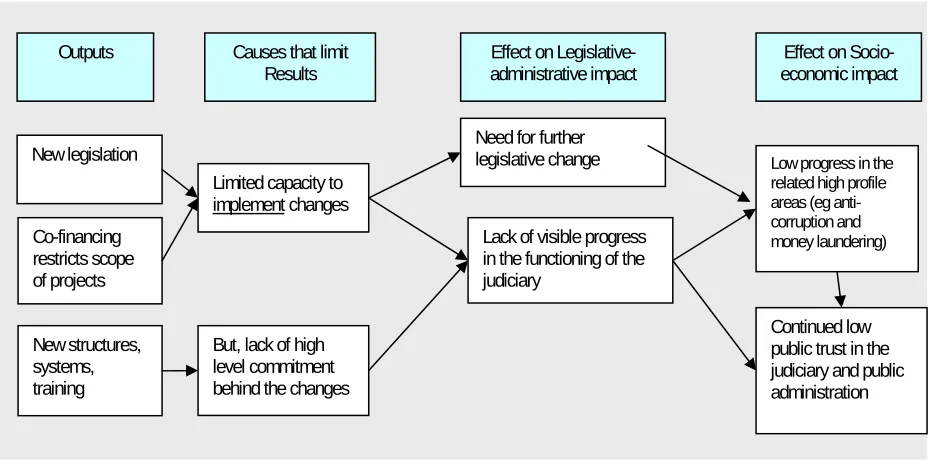
was used effectively to develop revised versions of the penal, civil, procedural and administrative codes, all of which were enacted, and the formation of the National Institute of Justice was a positive step. The IT reform process, when fully completed, should result in the modernisation of procedures and practices across all courts in Bulgaria. However, although these specific programme results are important, they did no more than address isolated topics and could not contribute significantly to the quality of justice because of their context was the unreformed governance of the justice sector as a whole. On the other hand, Phare support to the more specific requirement of the Home Affairs acquis was generally more effective.
2.5. Reasonable immediate impact; intermediate and wider impacts weak in the absence of adequate public administration reform
47. This section provides an updated view of the progress being made of Phare support in terms of impacts achieved.18 While some progress has been made in achieving immediate
17 Progress was also delayed by floods.
18 The results or immediate impacts are the short-term or initial effects of an intervention at the level of the direct
beneficiaries. The intermediate impacts are short-to-medium term effects on both direct and indirect beneficiaries and
Box 9: Outputs in the social sector
Phare supported ‘Beautiful Bulgaria’ - a large-scale employment and training project. This temporary employment scheme involved 11 municipalities and over the years created 8,500 jobs (one third for Roma) for renovation of public and private buildings that had historical or cultural value. Some 179 sub-contracts were concluded, 221 sites were refurbished and business start-up training courses were delivered to 526 unemployed persons.
The intermediate impact of Beautiful Bulgaria has not been fully realised, as the project failed to establish a strong link between participation in the project and real employment for most participants. Only 15% of jobs created became permanent, which is significantly lower than similar intermediate labour market projects in other countries - where 50% of project participants would be expected to find permanent work.
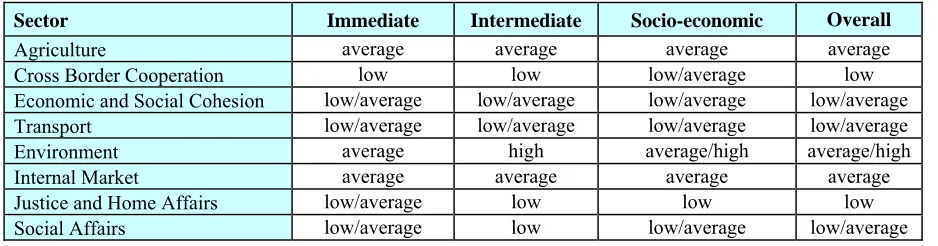
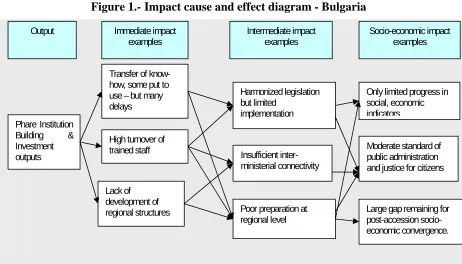
impact with direct beneficiaries, issues of political commitment of the beneficiaries, absorption capacity, co-financing and retention of key staff have restricted intermediate and wider impacts. Impacts of assistance to acquis sectors are rated in Table 1 below. Overall, only the
[image:24.595.66.535.195.318.2]environment sector showed a strong impact from Phare interventions. The Agriculture and Internal Market sectors performed reasonably well, with ESC, Transport and Social Affairs, somewhat weaker, but the level of performance of Phare assistance to CBC and to justice was low.
Table 1.- Mixed rating of sectors for different categories of impact
Sector Immediate Intermediate Socio-economic Overall
Agriculture average average average average
Cross Border Cooperation low low low/average low
Economic and Social Cohesion low/average low/average low/average low/average
Transport low/average low/average low/average low/average
Environment average high average/high average/high
Internal Market average average average average
Justice and Home Affairs low/average low low low
Social Affairs low/average low low/average low/average
48. Some evidence of immediate impact with direct beneficiaries. Phare assistance has
achieved some immediate impact but a lack of implementation capacity means that many achievements fell short of expectations. In the stronger sectors (agriculture, environment and internal market) immediate impacts achieved from specific interventions ranged between good and very good, but at the expense of disproportionate administrative effort and substantial delay. In other sectors, such as the accession driven CBC and the social sectors and also in areas closely related to the political criteria, immediate impact was sometimes weak or missing (for example, there is little impact from the support to create, develop and support a quality development programme for Roma inclusion (see Box 10).
49. In the acquis areas, Phare was
instrumental in achieving the enactment of primary and secondary legislation and establishing new institutions and operational networks.19 In the agriculture and
environment sectors the commitment for institutional reform and modernisation is growing and earlier Phare programmes have strengthened the legal, organisational and administrative pre-conditions for that process. This is demonstrated by the existence of some new systems, methodologies, and regulations, and the installation of new or upgraded equipment, software applications, statistical collection methods, the development of databases and national and international networking that can be attributed to earlier Phare
socio-economic impacts (global impacts) are the longer-term effects usually expressed in terms of broad socio-economic consequences in the sector, region or country as a whole.
19 For example, the Agriculture Statistic Directorate, the Public Internal Financial Control Agency and the National Institute
of Justice.
interventions.
50. Significant results from Phare support to the JHA sector are uncertain in an unreformed context. The aim is that, through a combination of different interventions, for
example recruitment of and training of new magistrates and the introduction of new systems and procedures, a growing cohort of new recruits with modern views towards corruption and transparency will be absorbed into the system every year and that these growing numbers of enlightened people will accelerate the judicial reform process. While procedural reform will modernise the operational environment, without political commitment behind the reform process it is unlikely, in itself, to change the outmoded behaviour of the current system. There is an additional risk when the instrument of change is newly trained recruits (young people with limited influence) and new systems that they will simply conform to fit into the existing environment rather than struggle to influence and drive forward change.
51. Intermediate impact is mainly limited to interventions from the earlier period.
Intermediate impacts and value added from the Phare interventions in the earlier period are beginning to emerge in some of the acquis-related sectors. However, as a consequence of
delays and widespread institutional weakness, hardly any intermediate impact has yet emerged from Phare applied in the later period, especially in the accession-related sectors, such as CBC and social affairs.
52. The strongest sector in terms of intermediate impact was environment, built on some good results with twinning. One example is the development of an innovative wetlands project. This is a relatively new concept, combining environmental management and community development, which is being piloted in Bulgaria. If successful, the concept has the potential to be a highly influential development model in the longer term that can be replicated in other countries. Also in the environmental sector, the recommendation and instruction from a twinning partner led Bulgaria to adopt a river basin management approach for four separate river areas in Bulgaria in line with the EU Water Framework Directive. This has proved to be a success and will continue to be an effective management approach for the river system in Bulgaria. The long-term environmental and economic implications stemming from improved river management in Bulgaria have the potential to increase impact significantly.
53. In some sectors, Phare assistance has resulted in increased professional contacts and peer networking. For example, contact is occurring on a regular basis on money laundering
issues, environmental development and on various aspects related to training of the judiciary. In particular, the potential for intermediate impacts is beginning to emerge in the fight against money laundering where Phare support is being given to establishing the Financial Intelligence Agency (on the basis of a national strategy and action plan), and to maintaining up-to-date legislation. However, although the number of reported potential prosecution cases has increased from 300 to 600, no case has yet been processed through the courts, so intermediate impact has yet to materialise. Although the general conditions for intermediate impacts remain generally weak, due to weak enforcement and sanction procedures in the public prosecutor’s office, Phare support is targeting the required improvements in co-ordination, feedback and communication mechanisms with the aim of making the system operationally effective. The availability of good practice information from member states, often introduced via TAIEX, has also been a useful ‘soft’ contribution to intermediate impact.
54. Wider impact has been negligible in nearly all sectors. With the exception of the