Synthesis and control of crosslinked poly(acrylic acid) based viscosity modifiers using dense phase carbon dioxide as a solvent
W.H. Alexander,a J. Wickson,b J. Duncan,c K. Carmichael,b D.J. Irvine,d S.M. Howdlea* a School of Chemistry, University of Nottingham, NG7 2RD, UK
b Croda Europe Ltd, Bridge Lane, Rawcliffe Bridge, Goole, DN14 8PN, UK c Lacerta Technology, 80 Hathern Rd, Shepshed, Loughborough, LE12 9GX, UK d Faculty of Engineering, University of Nottingham, NG7 2RD, UK
* Corresponding author [email protected]
Abstract:
We investigate the clean synthesis of a cross-linked poly(acrylic acid) viscosity modifier using supercritical CO2 to replace more hazardous volatile organic solvents that are typically used for this process. The polymers were analysed by aqueous swell ratio studies to demonstrate the effect of process conditions such as pressure and temperature on the cross-link density of the materials. The reactions were optimised to yield high swelling polymers of up to 134 g water /g polymer. Dynamic mechanical analysis (DMA) was also applied to investigate the mechanical properties of the synthesised cross-linked poly(acrylic acid) materials and these data were directly correlated with swell ratio. In addition, rheological studies demonstrate that the hydrated gels are comparable with commercially available equivalents.
Introduction:
Cross-linked poly(acrylic acid) (PAA), otherwise known as a carbomer, is a material commonly used as a superabsorbent polymer, or a thickener for cosmetic products. Conventionally, carbomers are produced via precipitation polymerisation using solvents such as benzene,[1, 2] DCM,[3] or more recently co-solvent combinations of ethyl acetate and hexanes.[4] Significant efforts have been focussed upon the use of less toxic solvents largely because of the regulatory requirements in personal care and cosmetics and also because complete removal of residues is highly energy intensive.
Experimental: Materials:
CO2 (99.99, SFC grade) was obtained from BOC gases, glacial acrylic acid (AA) (99.9%, MEHQ – 200 ppm) was obtained from VWR chemicals. Pentaerythritol triallyl ether (tech. 70% tri-functional), 1,1'-Azobis(cyclohexane-1-carbonitrile) (V-88) and 2,2′-Azobis(2-methylpropionitrile) (AIBN) were obtained from Sigma Aldrich. 2,2'-Azobis(4-methoxy-2,4-dimethyl valeronitrile) (V-70) was obtained from Wako chemicals. All chemicals were used as received.
Synthesis of PAA:
A solution of AA (15 mL, 208 mmol) and pentaerythritol triallyl ether (PETAE) (0.15 mL, 0.701 mmol) was prepared and flushed through a purge line. V-70 (0.112 g, 0.365 mmol) was placed into the reactor with a flow of CO2 (inlet pressure ~ 2 bar) through the access hole for 30 minutes to remove oxygen. The reactor was then sealed, the pressure was raised to 175 bar, and temperature was raised to 30 °C. The pre-prepared monomer solution (6 mL) was injected into the reactor via the addition line and an HPLC pump at 3 mL/min (1 mL excess allowed for volume of the line). The addition line was then closed and the reactor topped up to the required pressure with scCO2.
The conditions were maintained for 18 hours before turning off the heater and allowing the reactor to cool to below 25 °C, at which point the exit tap was opened slowly to vent the reactor. A low bulk density powder was collected and yields were measured gravimetrically to be between 40 and 99 %. Swell test:
Swell tests were performed in triplicate by measuring polymer sample (0.05 g) inside a closed drawstring tea bag (unknown mesh size), before being immersed in de-ionised water at room temperature. Gravimetric measurements were taken daily after hanging for 15 minutes to allow surface water to drip off. Measurements were carried out until an equilibrium had been reached.
DMA:
Dynamic mechanical analysis using a TT DMA (Mettler Toledo, formerly Triton Technology) was performed on polymer bars moulded at 150 °C, in a specially constructed mould (detailed in supporting info). The samples were run in tension mode with a pre-load force of 1.5 N, and a displacement amplitude of 0.02 nm. The storage modulus, E’ was determined at 1 Hz after a 30-minute isotherm at 150 °C.
Extraction:
stirred for 10 mins, then 10% H3PO4 (2 mL) was added. After stirring, 2ml of 10% H3PO4 was added to the solution, which was stirred then filtered through a 0.45 µm filter and analysed by HPLC.
Recovery was determined by adding a known amount of acrylic acid to the solution prior to precipitation. The precipitation was performed and the extract measure to ensure acrylic acid was not also removed from the solution.
Results and Discussion:
[image:4.595.78.470.364.626.2]ScCO2 is a highly tuneable solvent, and small changes in temperature and pressure can produce significant changes in fluid density[18] which could affect the cross-link density of the PAA. To follow these changes, we initially focussed upon the very simple measurement of water absorption and swell ratio; a technique that has been used very widely to give an indication of cross-link density.[19-21] We performed a series of PAA syntheses in CO2 with temperatures ranging from 30 °C (liquid CO2) to 88 °C (scCO2) at a pressure of 276 bar giving a range of CO2 densities (0.67 g mL-1 to 0.94 g mL-1).[22] A tri-functional cross-linker, PETAE was chosen as a well understood and commercially utilised crosslinker. PETAE was used at constant concentration (0.27 mol% wrt. AA). Additionally, in order to maintain consistent radical flux over the temperature range, three different initiators were used. V-70 at 30 °C (half-life ~ 10 hr-1), AIBN at 50 °C (68 hr-1) and 65 °C (10 hr-1), and V-88 at 71 °C (68 hr-1) and 88 °C (10 hr-1) (Figure 1).
Figure 1: Swell ratios for cross-linked PAA synthesised between 30 and 88 °C in CO2. The highest swell ratio was obtained at 30 °C, 276 bar. Error was calculated by ± standard deviation of triplicate
measurements.
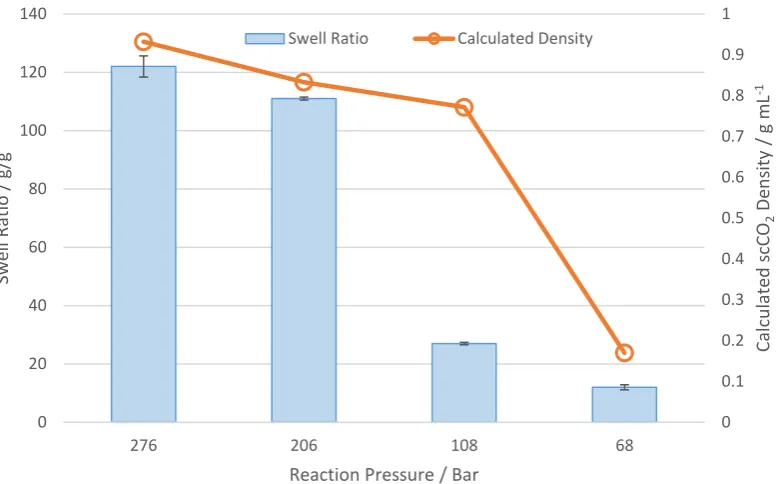
Initial experiments favoured lower temperatures (greater CO2 density) for producing higher swelling polymers, with the highest swell ratio (122 g/g) observed at 30 °C and the lowest (11 g/g) at 71 °C. These results indicated that the CO2 density dramatically affected the cross-link density of our materials. To explore this relationship further, the reaction temperature was fixed at 30 °C and the pressure was varied from 68 to 276 Bar, to give CO2 densities from 0.16 g mL-1 to 0.94 g mL-1 (NIST) (Figure 2).
10 hr-1half life
68 hr-1
15 g/g
10 hr-1 11 g/g
68 hr-1
14 g/g 10 hr-1
0 20 40 60 80 100 120 140
V-70 AIBN AIBN V-88 V-88
30 50 65 71 88
Sw
el
l Rat
io / g/g
Figure 2: Swell ratios of polymers produced at varying pressures of CO2 at 30 °C, demonstrating that higher pressures (~276 bar) were required for high swelling PAA with a fixed relatively high
concentration of PETAE (0.27 mol%) and V-70 (0.17 mol%).
The maximum swell ratios were observed at the highest CO2 pressures, and these dropped off quickly from >100 g/g to ~ 25 g/g at reaction pressures of around 100 Bar. As demonstrated in the plot, this decrease mirrors the rapid reduction in CO2 density. It is likely that higher CO2 density better solubilises the AA reaction mixture, leading to a more conventional organic solvent based polymerisation, which would fit with the literature reports.[14] These results confirm that CO2 density has an important role in controlling the cross-link density of the PAA (Figure 3), although temperature also has a role to play.
0 0.1 0.2 0.3 0.4 0.5 0.6 0.7 0.8 0.9 1
0 20 40 60 80 100 120 140
276 206 108 68
Calcula
ted
s
cC
O2
De
n
sity
/ g
m
L
-1
Sw
ell
Rat
io
/ g/g
Reaction Pressure / Bar
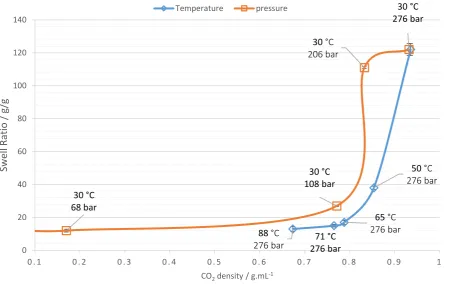
Figure 3: Demonstrating the effect of scCO2 density on swell ratio by varying temperature at constant pressure and pressure at constant temperature. Reactions were conducted in two separate studies,
temperature was varied at a constant pressure of 276 bar, and pressure was varied at a constant temperature of 30 °C.
At a fixed temperature (30 °C), the swell ratio increases rapidly on reaching a CO2 density of 0.83 g mL -1 (Figure 3 Trace 1). However, when fixing the pressure (276 bar) and changing temperature, the swell ratios remained low (38 g/g) only increasing at densities beyond 0.83 g mL-1, which occurred as the temperature was reduced to 30 °C. Thus, our data seem to indicate that the path to higher swell ratios and hence more viable commercial products with higher viscosity build could come through synthesis at lower temperatures and higher CO2 densities. This can be explained by the fact that solution viscosity is lower at higher CO2 density. Better interaction of scCO2 with the growing polymer chains leads to reduced entanglements and hence greater swelling of the polymer particles, increased chain mobility, and hence the formation of large networks with lower cross-link densities. It is clear that at densities less than 0.83 g mL-1 the materials swell much less with water. We hypothesise that this is a result of significant entanglements and more crosslinker incorporation since these materials are formed in more “bulk-like” conditions, i.e. when the CO2 interaction is much poorer and this might also induce higher cross-link densities. To test this hypothesis we have also assessed the material produced using DMA (Figure 5).
The commercially available PAA thickener Optasense G40 exhibits a swell ratio of 321 g/g. when assessed by our methods. So, although we have developed higher swell ratios in scCO2, there is significant difference between our results and the commercial sample. There are many reasons why the commercial sample will show improved absorption of water most of these will be commercially sensitive but likely include the possibility of pre-neutralisation steps to introduce salts,[23, 24] which will have a significant effect along with the possibility of higher molecular weights[25] and optimised homogeneity of cross-linking.[26] In addition there are specific improvements that can include the use 50 °C 276 bar 65 °C 276 bar 71 °C 276 bar 88 °C 276 bar 30 °C 276 bar 30 °C 206 bar 30 °C 108 bar 30 °C 68 bar 0 20 40 60 80 100 120 140
0 . 1 0 . 2 0 . 3 0 . 4 0 . 5 0 . 6 0 . 7 0 . 8 0 . 9 1
Swell
Ratio
/
g
/g
CO2density / g.mL-1
of co-polymers (e.g. methacrylic acid),[27-30] a range of different cross-linker types,[31] and of course fine control of cross-link density.[32] To further optimise our system we next investigated the combined effect of varying the initiator and cross-linker concentrations (Figure 4).
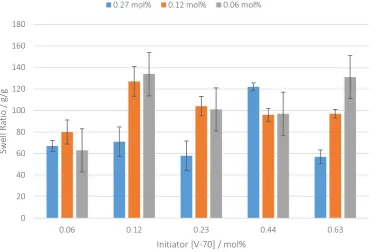
Figure 4: Optimal initiator concentrations (V-70) and cross-linker concentration at each level (PETAE) and the effect upon swell ratio. Syntheses were conducted at 30 °C and 276 bar, error was calculated
from experiments in triplicate.
The absorption of water and the swelling behaviour showed some reliance upon the cross-linker and initiator levels, giving an increase of a factor of two in the swell ratios to a maximum of 134 g/g. Still significantly less than the commercial sample G40 which under our swell tests produced a greater swell ratio (321 g/g). To try to understand if there was any effect of crosslink density, we next undertook mechanical testing of the samples using dynamic mechanical analysis (DMA). The samples were moulded into a film using a hot press at 150 °C (to allow moulding and polymer flow) with no further cross-linking (see supporting info). These films were then cut into bars, and mechanically tested by DMA. The trend in mechanical properties was then compared with the equivalent swell ratio results (Figure 5).
0 20 40 60 80 100 120 140 160 180
0.06 0.12 0.23 0.44 0.63
Swel
l Ra
ti
o
/ g
/g
Figure 5: Qualititative comparison between DMA and water swelling measurments, showing an inverse relationship between swell ratio and storage modulus G’. Swelling measurements were taken
gravimetrically and DMA measurements were collected after a 30 minutes isotherm at 150 °C (tension - 1 Hz).
These data exhibit an inverse linear relationship between the swell ratio and storage modulus. This was to be expected since one would predict that the flexibility of the material would decrease as the cross-link density increases. This of course will also limit the amount of water that can be absorbed, and hence the degree of swelling will be reduced.[23, 33] Unfortunately, in the DMA measurements some of the higher swelling samples were found to deform heavily at 150 °C; ie above the nominal Tg (~ 130 °C). For these samples, obtaining useful DMA data was difficult and these were omitted from the data set (Images in supporting information). However, our data demonstrate the versatility of DMA in allowing a much quicker test of cross-link density, requiring only around one hour per sample, rather than the two weeks needed for swelling samples to equilibrate.
Extraction of residual AA
A key advantage of the CO2 process was that no solvent was used in the production of the polymers, but it was likely that there was residual AA remaining in the samples. We have used scCO2 as our reaction solvent, but there is also a vast literature showing that it can be an extremely good extraction medium.[34-40] Thus, we set out to exploit this opportunity with a post reaction flushing process, in which a slow flow of dense phase CO2 was passed through PAA to remove any residual AA. This of course could be built into a single process immediately following reaction on the commercial scale. Here, the extraction was conducted in a specially designed CO2 flow rig.[17] The samples were weighed
R² = 0.9471
0.2 0.25 0.3 0.35 0.4 0.45 0.5 0.55
0 20 40 60 80 100 120 140
Sto
rgae
Mo
d
u
lu
s,
G'
/
Pa
into the cage, before closing and then pressurised to 276 bar. At this point the outlet tap was opened in conjunction with the inlet tap to provide a slow and continuous flow of CO2. The autoclave was heated to counteract the cooling effect of the adiabatic expansion from the CO2, holding the autoclave temperature at ~ 25 °C.
[image:9.595.139.454.305.514.2]After flushing, the samples were analysed using a protocol developed by Croda. The PAA was dispersed in water and NaCl was then added to negate viscosity once neutralised. Then NaOH was added to swell the particles and release any residual AA into the water. H3PO4 was then added to lower the pH, precipitating the PAA and leaving the collected residual AA in the water phase. This solution was then passed through a 0.45 µm syringe filter to separate any PAA particles. The method was calibrated by spiked addition (see supporting info). The AA solutions were then eluted in water:acetonitrile (90:10) at pH 4 using HPLC against AA standards (Error! Reference source not found.).
Table 1: Reduction of AA residuals with CO2 flushing measured by HPLC. Results of crude powder against purified and Optasense G40.
Results (ppm of acrylic acid)
Crude Purified Optasense G40
Repeat 1 13822 163 7.316
Repeat 2 13824 202 6.656
Repeat 3 13836 203 7.214
Repeat 4 13821 202 -
Repeat 5 13707 169.5 -
Average 13802 187.90 7.06
Std Dev 53.16 19.90 0.36
%RSD 0.39 10.59 5.03
The commercialsample G40 was found to have a much lower residual AA value (7 ppm) compared with our samples (180 ppm). However, we have achieved a demonstrably large reduction in AA content (1.38% to 0.02%), and there is the opportunity for significant further optimisation of the process. Moreover, we have achieved this without the use of VOCs for washing or rinsing and subsequent heating to remove residues from the powder; hence providing potential for a significantly lower energy cost. A recent report on the safety of AA copolymers found that many cosmetic products routinely use PAA or their derivatives with a AA contents between 10 and 1500 ppm,[41] indicating that we have been able to purify the material to a typical level. However, regulations are specific to the use so it is possible that our material would not satisfy products requiring more stringent quality. For example, it is increasingly common for customers to specify that for a product in a cosmetic formulation the residues would need to be below 100 ppm. To achieve this, improvements to scCO2 extraction efficiency could certainly by optimising extraction chamber design to maximise extraction capability of scCO2 on the larger scale
43] Additionally, the PAA samples from scCO2 contained around 1.38% AA before extraction, this amount could be lowered by injecting small amounts of initiator towards the end of the reaction, in order to drive the reaction to completion.
Viscometric Analysis
[image:10.595.163.433.294.466.2]Design of these materials has been targeted towards high viscosity gels to be used in a variety of different applications from cosmetic rheology modifiers to superabsorbent polymers for disposable nappies (diapers) and the agricultural industry.[44-46] Analysis of potential performance can be achieved through Brookfield viscometry and rheological analysis of the swollen gels. To achieve this, the PAA powders were dispersed in deionised water, and the pH raised to ~ 6.5 to produce a thickened gel; the synthesised polymers were compared against the commercial product, Optasense G40, used in cosmetic thickeners (Table 2).
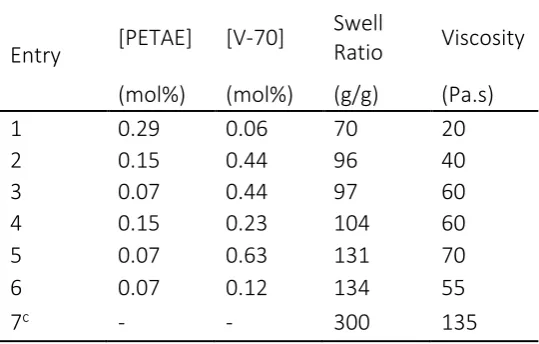
Table 2: Solution viscosities of PETAE samples at pH 6.5 with a range of swell ratios. All reactions were conducted in CO2 at 30 °C and 276 bar, with 10 v/v% acrylic acid.
Entry
[PETAE]
[V-70]
Swell
Ratio
Viscosity
(mol%)
(mol%)
(g/g)
(Pa.s)
1
0.29
0.06
70
20
2
0.15
0.44
96
40
3
0.07
0.44
97
60
4
0.15
0.23
104
60
5
0.07
0.63
131
70
6
0.07
0.12
134
55
7
c-
-
300
135
aSwell ratios were collected as an average of triplicate measurements, bviscosity was measured using a Brookfield viscometer, spindle 6 at 10 rpm. cG40 commercial sample used for comparison.
Comparisons between the highest swelling samples (Entry 5) and the commercial G40 (Entry 7, Table 2) demonstrate a difference of around a factor of two not only in swell ratio but also in Brookfield viscosity. Although this seems a significant difference, we were pleased to note that the samples synthesised in CO2 did in fact generate highly viscous gels that were suitable for rheology testing. Our data seemed at odds with a patent filed in 1987 by BASF, covering the synthesis of PAA in dense phase scCO2 at temperatures of 40 – 160 °C, quoting aqueous PAA gels as giving viscosities of around 1,800 – 11,600 mPa.s at pH 8.0 (Haake viscometer 5.5 rpm).[13] Whereas, our reactions conducted above 50 °C, yielded low swelling materials with minimal dispersion into aqueous solutions, and had no significant increase in viscosity when neutralised. This might have been caused by the higher loading level of AA used in this study (10 vol%, 6 ml in 60 ml) compared with those in the patent (5 vol%, 15 ml in 300 ml). Greater levels of AA may not have been solubilised at higher temperatures and would have produced more highly cross-linked material. Another patent by BASF in 1990 on the synthesis of PAA in CO2 did use a 10 vol% addition of AA, stating that it is advantageous to carry out the reaction in the supercritical state.[47] However, these experiments did not appear to add a cross-linker, and would not therefore have produced a viscosity thickener.
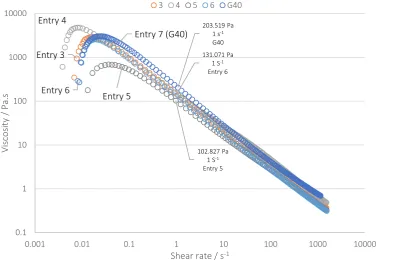
time constraints we were unable to fully characterise the pH behaviour of our materials to compare directly with the earlier patent. However, data provided (supporting info) from industry indicated that typical Carbomer viscosity peaks around pH 7, dropping and then plateauing until around pH 10-11. To further probe these materials, two principal tests were conducted, first to investigate flow behaviour through rotational measurements and second, to probe gel structure through oscillatory measurements. Initially, shear behaviour was investigated by increasing shear rate at a fixed amplitude and monitoring changes in the viscosity (Figure 6). For these experiments the first two samples (Table 2, Entries 1 and 2) were discounted as their viscosities were significantly lower than the others.
Figure 6: Comparison of viscosity behaviour against shear rate for working solution gel samples (Entry 3-6) against G40 (Entry 7).
All data show an initial increase in viscosity, most likely caused by insufficient force at low shear rates. All of the materials then present shear thinning behaviour typical of PAA thickened gels. Although the Brookfield viscometer data (Table 2) indicated that the viscosity of the commercial sample G40 (Table 2, entry 7) was almost twice that of the best sample prepared in scCO2 (Entry 5, Table 2). Interestingly, these traces demonstrate that the highest viscosity obtained by Brookfield viscometer (Entry 5, table 2; 70 Pa.s) actually provided the lowest viscosity over the full working shear range and shows a 2 times lower viscosity than G40 at a shear rate of 1 s-1. By contrast, others (Entries 3, 4 and 6) all provide higher viscosities at around 135 Pa.s at 1 s-1, much closer to G40 (200 Pa.s at 1 s-1)
To further understand the shear behaviour, we utilised a standard commercial test that focussed upon high shear of the PAA thickened gels and their recovery. Three stages of analysis were utilised, starting with a low shear of 10 s-1, followed by a high shear of 500 s-1, and then a measurement of the recovered viscosity at 10 s-1 (
Entry 3 Entry 4
Entry 5
102.827 Pa 1 S-1
Entry 5 Entry 6
131.071 Pa 1 S-1
Entry 6 Entry 7 (G40)
203.519 Pa 1 s-1
G40
0.1 1 10 100 1000 10000
0.001 0.01 0.1 1 10 100 1000 10000
Vi
sc
os
it
y
/ Pa.
s
Shear rate / s-1
Table 3: Comparison of the effect of high shear rate on the viscosity and recovery of sample gels
Sample
Entry
Viscosity10
aViscosity500
bViscosityrecov
cViscositylost
d/ Pa.s
/ Pa.s
/ Pa.s
/ Pa.s
3
18
0.7
13
5
4
27
0.7
21
6
5
16
0.8
13
3
6
15
0.7
13
2
G40
28
0.8
26
2
aViscosity measured at 10 s-1, bviscosity measured at 500 s-1, cviscosity recovered at 10 s-1 after 500 s-1, dviscosity reduction during the experiment.
As expected, all viscosities were significantly reduced at a shear rate of 500 s-1, corroborating with earlier data (Figure 6). Yet, in the recovery step all the gels were still active and thickened with generally a minimal loss in viscosity. These data clearly show that the flow behaviours of the PAA materials synthesised in CO2 are comparable with the commercial product.
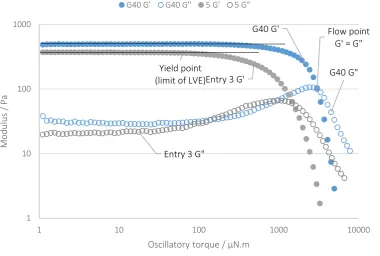
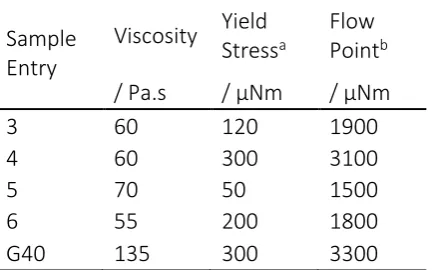
A final test explored the mechanical properties of the gels with increasing levels of stress, conducted via oscillatory rheometry and measuring storage (G’) and Loss (G’’) moduli (Table 4). Two properties were investigated. First the yield stress, measured at the onset of the decrease in storage modulus away from the linear viscoelastic region (LVE) indicating the point at which the gel shows an irreversible structural change. Secondly the flow point, measured at the intersection of storage and loss moduli (G’=G”) above which, flow becomes more liquid-like with increasing stress (Figure 7).
G40 G' Flow point
G' = G"
G40 G" Yield point
(limit of LVE)Entry 3 G'
Entry 3 G"
1 10 100 1000
1 10 100 1000 10000
Mo
du
lus
/ Pa
Figure 7: Amplitude scan rheological experiments showing LVE, yield stress and flow point for aqueous gels of G40 and Entry 3.
Table 4: Comparison of yield stress and flow point values for the five sample gels under test
Sample
Entry
Viscosity
Yield
Stress
aFlow
Point
b/ Pa.s
/ µNm
/ µNm
3
60
120
1900
4
60
300
3100
5
70
50
1500
6
55
200
1800
G40
135
300
3300
aApproximate yield stress values determined by deviation from the LVE, bdetermined by the intercept of G” and G’
The key focus in these data is that the gels maintain solid-like behaviour, displaying elastic deformation at higher stresses. G40 showed a yield stress at an oscillatory torque of 300 µNm, and a flow point of 3300 µNm; which was higher than any of the samples synthesised in CO2. Pleasingly, one of the scCO2 samples (Table 4 Entry 4) was found to be close to G40 with the same yield stress (300 µNm) and a slightly lower flow point (3100 µNm) despite generating less than half the viscosity (60 compared to 135 Pa.s). By contrast, Entry 5 which had the highest viscosity of the synthetic experiments (70 Pa.s) again demonstrated the lowest yield stress (50 µNm) and flow point (1500 µNm).
Although the scCO2 gels appeared to have only 50% of the viscosity of G40, they were found to exhibit yield stresses and flow points that approached those of the commercial sample. This is a significant observation considering that the commercial sample will undoubtedly have undergone extensive pre-neutralisation and optimisation; something that we have not yet introduced into the scCO2 synthesised samples.
Conclusions:
We have demonstrated the successful synthesis of cross-linked PAA powder using dense phase (liquid or supercritical) CO2. Importantly, the density of the CO2 solvent phase has been found to have a distinct effect on the cross-link density of the polymeric material. Two studies looking at variations in temperature and pressure have determined that high CO2 density led to higher swelling polymers using a simple swell test. Importantly, the highest swelling results were found at the lowest temperature (30 °C) and the highest pressure (276 bar); the highest CO2 density used in this study. Attempts to optimise the system through variation of cross-linker and initiator concentrations met with limited success indicating serendipitous selection of original reagent levels. Maximum swell ratios of 131 and 134 g/g were found at the lowest cross-linker concentration (0.06 mol%).
We have shown also that dynamic mechanical analysis of pressed films of the PAA material can provide a rapid approach to assessing cross link density and that these corroborate the swell test data through an inverse linear relationship between swell ratio and the storage modulus
Acknowledgments
Supporting information:
Figure 8: Engineering drawings for the mould for developing polymer bars for DMA studies. Optional gas inlets provide for avoidance of oxidation on heating
[image:16.595.102.496.407.672.2]Figure 10: Moulded polymer bar used for the measurements
Figure 11: There was clear deformation of polymer bars within the DMA, mostly resulting in vastly different dimensions but also in some cases the polymeric bar was found to be unstable and broke
[image:17.595.186.411.281.587.2]Figure 12: Repeated cycles up to 150 °C on the same sample resulted in a consistent Tg indicating no further crosslinking or cure.
Figure 13: Minimal Tg shift observed after repeated temperature increase (200 °C, 3 °C min-1) from dynamic mechanical analysis measurements (single-bending - 1 Hz), which suggested limited increase
in cross-linking.
Scan 1
Tg= 142 °C
Scan 2 Tg= 140 °C
Scan 3 Tg= 141 °C
0.0200 0.0400 0.0600 0.0800 0.1000 0.1200 0.1400 0.1600
120.0 125.0 130.0 135.0 140.0 145.0 150.0
Tan
δ
Temperature / °C
Scan 1
Tg= 142 °C
Scan 2 Tg= 143 °C
Scan 3 Tg= 146 °C
0.0000 0.0100 0.0200 0.0300 0.0400 0.0500 0.0600 0.0700
100.0 120.0 140.0 160.0 180.0 200.0
Ta
n
δ
[image:18.595.77.454.397.650.2]Figure 14: HPLC calibration showing linear relationship of counts per area against addition of acrylic acid.
Figure 15: AA spiked addition of Optasense G40 determining legitimacy of results. y = 7396x R² = 0.9999
0 50000 100000 150000 200000 250000 300000 350000 400000
0 10 20 30 40 50 60
Co
u
n
ts
p
e
r
ar
e
a
μg/ml Acrylic Acid
y = 1.2107x + 7.5506 R² = 0.9999
0.00 10.00 20.00 30.00 40.00 50.00 60.00 70.00 80.00
0 10 20 30 40 50 60
Co
u
n
ts
p
e
r
ar
e
a
[image:19.595.103.461.434.683.2]Figure 16: Viscosities against pH of two commercially available carbomers demonstrating that typically the viscosities peak at pH7 and then plateau and finally decrease at higher pH.
References:
[1] M.K. Mishra, S.N. Bhadani, Free-radical polymerisation of acrylic-acid in benzene, Journal of Macromolecular Science-Chemistry, A22 (1985) 235-242.
[2] E. Jabbari, S. Nozari, Synthesis of acrylic acid hydrogel by gamma-irradiation cross-linking of polyacrylic acid in aqueous solution, Iranian Polymer Journal, 8 (1999) 263-270.
[3] A. Bresciani, Crosslinked polyacrylic acids having low solvent residue, a process for the preparation thereof and the use thereof as thickening agents, 3V Inc. (Weehawkin, NJ), 5342911, 1994
[4] X.Y. Ma, Z.P. Du, W.X. Wang, P. Li, Q.X. Li, Y.H. Zhao, E.Z. Li, Properties of Powdered Associative Alkali-Swellable Acrylics Thickeners Synthesized by Precipitation Polymerization, J. Appl. Polym. Sci., 131 (2014) 8.
[5] A.I. Cooper, Polymer synthesis and processing using supercritical carbon dioxide, J. Mater. Chem., 10 (2000) 207-234.
[6] M. Poliakoff, M.W. George, S.M. Howdle, V.N. Bagratashvili, B.X. Han, H.K. Yan, Supercritical fluids: Clean solvents for green chemistry, Chin. J. Chem . 17 (1999) 212-222.
[7] J. Jennings, M. Beija, A.P. Richez, S.D. Cooper, P.E. Mignot, K.J. Thurecht, K.S. Jack, S.M. Howdle, One-Pot Synthesis of Block Copolymers in Supercritical Carbon Dioxide: A Simple Versatile Route to Nanostructured Microparticles, J. Am. Chem. Soc., 134 (2012) 4772-4781.
[8] W.J. Ye, J.M. DeSimone, Emulsion polymerization of N-ethylacrylamide in supercritical carbon dioxide, Macromolecules, 38 (2005) 2180-2190.
[9] P. Alessi, A. Cortesi, I. Kikic, F. Vecchione, Plasticization of polymers with supercritical carbon dioxide: Experimental determination of glass-transition temperatures, J. Appl. Polym. Sci., 88 (2003) 2189-2193.
[10] P.A. Charpentier, J.M. DeSimone, G.W. Roberts, Continuous polymerizations in supercritical carbon dioxide, Clean Solvents: Alternative Media for Chemical Reactions and Processing, 819 (2002) 113-135.
0 10000 20000 30000 40000 50000 60000
5 6 7 8 9 10 11 12
Vis
cos
ity
/ cent
ip
o
is
e
pH
[11] C. Boyère, C. Jérôme, A. Debuigne, Input of supercritical carbon dioxide to polymer synthesis: An overview, Eur. Polym. J., 61 (2014) 45-63.
[12] F. Picchioni, Supercritical carbon dioxide and polymers: an interplay of science and technology, Polym. Int., 63 (2014) 1394-1399.
[13] H. H, D. W, Preparation of finely divided pulverulent crosslinked copolymers BASF, 4748220, 1988 [14] T.J. Romack, E.E. Maury, J.M. Desimone, Precipitation polymerisation of acrylic-acid in supercritical carbon-dioxide, Macromolecules, 28 (1995) 912-915.
[15] T. Liu, J.M. DeSimone, G.W. Roberts, Cross-linking polymerization of acrylic acid in supercritical carbon dioxide, Polymer, 47 (2006) 4276-4281.
[16] T. Liu, P. Garner, J.M. DeSimone, G.W. Roberts, G.D. Bothun, Particle formation in precipitation polymerization: Continuous precipitation polymerization of acrylic acid in supercritical carbon dioxide, Macromolecules, 39 (2006) 6489-6494.
[17] A.R. Goddard, S. Perez-Nieto, T.M. Passos, B. Quilty, K. Carmichael, D.J. Irvine, S.M. Howdle, Controlled polymerisation and purification of branched poly(lactic acid) surfactants in supercritical carbon dioxide, Green Chemistry, 18 (2016) 4772-4786.
[18] J.L. Kendall, D.A. Canelas, J.L. Young, J.M. DeSimone, Polymerizations in supercritical carbon dioxide, Chem. Rev., 99 (1999) 543-563.
[19] G.M. Eichenbaum, P.F. Kiser, A.V. Dobrynin, S.A. Simon, D. Needham, Investigation of the swelling response and loading of ionic microgels with drugs and proteins: The dependence on cross-link density, Macromolecules, 32 (1999) 4867-4878.
[20] L.E. Nielsen, Cross-Linking–Effect on Physical Properties of Polymers, Journal of Macromolecular Science, Part C, 3 (1969) 69-103.
[21] T. Hatakeyema, A. Yamauchi, H. Hatakeyema, Studies on bound water in poly(vinyl alcohol). Hydrogel by DSC and FT-NMR, Eur. Polym. J., 20 (1984) 61-64.
[22] E.W. Lemmon, M.O. McLinden, D.G. Friend, Thermophysical Properties of Fluid Systems, in: P.J. Linstrom, W.G. Mallard (Eds.), National institute of standards and technology, NIST Chemistry Webbook, 2014.
[23] H. Omidian, S.A. Hashemi, P.G. Sammes, I. Meldrum, A model for the swelling of superabsorbent polymers, Polymer, 39 (1998) 6697-6704.
[24] F.J. Hua, M.P. Qian, Synthesis of self-crosslinking sodium polyacrylate hydrogel and water-absorbing mechanism, Journal of Materials Science, 36 (2001) 731-738.
[25] M. Kurata, Y. Tsunashima, Viscosity - Molecular Weight Relationships and Unperturbed Dimensions of Linear Chain Molecules, in: J. Brandup, E. Immergut, E. Grulke (Eds.) Polymer Handbook, Wiley-Interscience, 1998.
[26] B. Lindemann, U.P. Schroder, W. Oppermann, Influence of the cross-linker reactivity on the formation of inhomogeneities in hydrogels, Macromolecules, 30 (1997) 4073-4077.
[27] A.M. Atta, K.F. Arndt, Synthesis and characterization of polyelectrolyte hydrogels with controlled swelling behaviour, Polym. Int., 50 (2001) 1360-1369.
[28] B.S. Fernandes, J.C. Pinto, E.C.M. Cabral-Albuquerque, R.L. Fialho, Free-radical polymerization of urea, acrylic acid, and glycerol in aqueous solutions, Polym. Eng. Sci., 55 (2015) 1219-1229.
[29] C. Ma, L.Q. Cao, X.H. Wang, L.J. Zhang, M.S. Shi, J.D. Wang, Characterization and adsorption capacity of a novel high-performance polymeric sorbent synthesized in supercritical carbon dioxide, J. Supercrit. Fluids, 62 (2012) 232-239.
[30] D. Foungfung, S. Phattanarudee, N. Seetapan, S. Kiatkamjornwong, Acrylamide-itaconic acid superabsorbent polymers and superabsorbent polymer/mica nanocomposites, Polym. Adv. Technol., 22 (2011) 635-647.
[31] H. Es-Haghi, H. Bouhendi, G.B. Marandi, M.J. Zohurian-Mehr, K. Kabiri, An investigation into novel multifunctional cross-linkers effect on microgel prepared by precipitation polymerization, Reactive & Functional Polymers, 73 (2013) 524-530.
[33] F. Askari, S. Nafisi, H. Omidian, S.A. Hashemi, Synthesis and characterization of acrylic-based superabsorbents, 50 (1993) 1851-1855.
[34] M. McHugh, A., V. Krukonis, J., Supercritical Fluid Extraction: Principles and Practice, 2nd ed., Butterworth-Heinemann, Stoneham, 1993.
[35] A. Marsal, P.J. Celma, J. Cot, M. Cequier, Supercritical CO2 extraction as a clean degreasing process in the leather industry, J. Supercrit. Fluids, 16 (2000) 217-223.
[36] F.J. Eller, J.W. King, Supercritical carbon dioxide extraction of cedarwood oil: a study of extraction parameters and oil characteristics, Phytochem. Anal, 11 (2000) 226-231.
[37] W.E. Rudzinski, T.M. Aminabhavi, A review on extraction and identification of crude oil and related products using supercritical fluid technology, Energy & Fuels, 14 (2000) 464-475.
[38] P. Hubert, O.G. Vitzthum, Fluid extraction of hops, spices, and tobacco with supercritical gases, Angewandte Chemie-International Edition in English, 17 (1978) 710-715.
[39] W.-J. Kim, J.-D. Kim, J. Kim, S.-G. Oh, Y.-W. Lee, Selective caffeine removal from green tea using supercritical carbon dioxide extraction, J. Food Eng., 89 (2008) 303-309.
[40] M. Gameiro, P. Lisboa, A. Paiva, S. Barreiros, P. Simões, Supercritical carbon dioxide-based integrated continuous extraction of oil from chicken feather meal, and its conversion to biodiesel in a packed-bed enzymatic reactor, at pilot scale, Fuel, 153 (2015) 135-142.
[41] Final report on the safety assessment of carbomers-934, carbomers-910, carbomers-934P, carbomers-940, carbomers-941, and carbomers-962, Journal of the American College of Toxicology, 1 (1982) 109-141.
[42] G. Brunner, Supercritical process technology related to energy and future directions – An introduction, J. Supercrit. Fluids, 96 (2015) 11-20.
[43] A. Capuzzo, M. Maffei, A. Occhipinti, Supercritical Fluid Extraction of Plant Flavors and Fragrances, Molecules, 18 (2013) 7194.
[44] R. Kroepke, K. Luettig, V. Kallmayer, Cosmetic or dermatological preparation, useful for matting the oily skin and moistening the dry skin, comprises an oil-in-water emulsion comprising at least one stearic acid emulsifier and at least one polyacrylic acid thickener, Beiersdorf Ag, EP2364688-A2; DE102010011335-A1; EP2364688-A3, 2011
[45] M. Matsumoto, S. Kato, S. Fujino, N. Nabara, R. Otani, Y. Kawaguchi, N. Okugawa, K. Ichikawa, M. Eto, Manufacture of polyacrylic acid (salt)-based water-absorbent resin used for disposable diaper, involves carrying out polymerization to aqueous monomer solution including acrylic acid (salt), drying and subjecting classification process, Nippon Shokubai Co Ltd (Japc-C), WO2014021432-A1,
[46] Y. Nakashima, K. Wada, H. Ikeuchi, M. Ueda, Particulate water-absorbing agent comprises surface-crosslinked polyacrylic acid (salt)-type water-absorbent resin as main component, hydrophilic polymer and stabilizer, Nippon Shokubai Co Ltd (Japc-C), WO2014034667-A1,
[47] W. Sertage, P. Davis, H. Schenck, W. Denzinger, H. Hartmann, Acrylic acid polymerisation, BASF, 1274942 1990